Virtual
Organization
as Network
Virtual Organization
a temporary or permanent collection of
geographically dispersed individuals, groups,
organizational units, or entire organizations that
depend on electronic linking in order to complete
the production process. Virtual organizations do not
represent a firm’s attribute but can be considered as
a different organizational form and carries out the
objectives of cyber diplomacy.
1. Flat organization
2. Dynamic
3. Informal communication
4. Power flexibility
5. Multi-disciplinary (virtual) teams
6. Vague organizational boundaries
7. Goal orientation
8. Customer orientation
9. Home-work
10.Absence of apparent structure
11.Sharing of information
12.Staffed by knowledge workers.
Virtual Organization Characteristics
Types of Virtual Organizations
1. Telecommuters
2. Outsourcing employees/competencies
3. Completely virtual
Depending on the degree or spectrum of
virtuality, virtual organizations can be
classified into three broad types as follows:
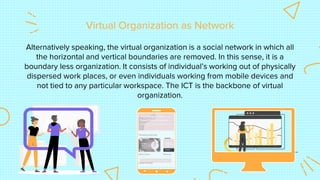
Virtual Organization as Network
Alternatively speaking, the virtual organization is a social network in which all
the horizontal and vertical boundaries are removed. In this sense, it is a
boundary less organization. It consists of individual’s working out of physically
dispersed work places, or even individuals working from mobile devices and
not tied to any particular workspace. The ICT is the backbone of virtual
organization.
Network
Organization /
Clusters
Network Organization
A collection of autonomous firms or units that
behave as a single larger entity, using social
mechanisms for coordination and control.
A blend of market and firm. They are halfway
between vertical integration and market
disaggregation.
Types of Network Organization
Internal Network
Large company that sees its units as
separate profit centers.
Stable Network
Consists of a central organization that
outsources much of its operations to
other companies.
Dynamic Network
Outsource even more heavily. Basically, an
integrator firm identifies and assembles assets
owned by other companies.
Market Networks
These organizations don't have a lead player
that coordinates the others. Instead, a
collection of organizations trading in the
market fall into a stable pattern of
relationships that gradually becomes
solidified
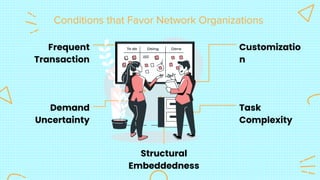
Conditions that Favor Network Organizations
Frequent
Transaction
Demand
Uncertainty
Task
Complexity
Customizatio
n
Structural
Embeddedness
Self-
Organizing
Systems
Self Organizing Systems
A class of systems that are able to change their internal structure
and their function in response to external circumstances. By self-
organization it is understood that elements of a system are able to
manipulate or organize other elements of the same system in a way
that stabilizes either structure or function of the whole against
external fluctuations
Advantages of Self-organzation in
Companies
•Authority is pushed down to individuals and teams, rather than being centralized,
which means they can respond more quickly and take more responsibility
•Information is shared widely and transparently so teams and individuals can make
faster, more informed decisions
•With distributed authority and leadership, employees take more ownership for
making local improvements and reducing waste, for example
•The quality of customer service increases dramatically when frontline employees
are given the autonomy to decide how they deal with the customer
•Managers are an expensive resource and removing the need for supervision or
management means organizations can be leaner
Don’t use force to
coerce another
person
Honour your
word and keep
your promises
Balance individual
needs with the needs
of the collective
Simple Guiding Principles for New Forms of
Organization

Topic 4 - ORGANIZING- virtual organizations.pptx

  • 1.
  • 2.
    Virtual Organization a temporaryor permanent collection of geographically dispersed individuals, groups, organizational units, or entire organizations that depend on electronic linking in order to complete the production process. Virtual organizations do not represent a firm’s attribute but can be considered as a different organizational form and carries out the objectives of cyber diplomacy.
  • 3.
    1. Flat organization 2.Dynamic 3. Informal communication 4. Power flexibility 5. Multi-disciplinary (virtual) teams 6. Vague organizational boundaries 7. Goal orientation 8. Customer orientation 9. Home-work 10.Absence of apparent structure 11.Sharing of information 12.Staffed by knowledge workers. Virtual Organization Characteristics
  • 4.
    Types of VirtualOrganizations 1. Telecommuters 2. Outsourcing employees/competencies 3. Completely virtual Depending on the degree or spectrum of virtuality, virtual organizations can be classified into three broad types as follows:
  • 5.
    Virtual Organization asNetwork Alternatively speaking, the virtual organization is a social network in which all the horizontal and vertical boundaries are removed. In this sense, it is a boundary less organization. It consists of individual’s working out of physically dispersed work places, or even individuals working from mobile devices and not tied to any particular workspace. The ICT is the backbone of virtual organization.
  • 6.
  • 7.
    Network Organization A collectionof autonomous firms or units that behave as a single larger entity, using social mechanisms for coordination and control. A blend of market and firm. They are halfway between vertical integration and market disaggregation.
  • 8.
    Types of NetworkOrganization Internal Network Large company that sees its units as separate profit centers. Stable Network Consists of a central organization that outsources much of its operations to other companies. Dynamic Network Outsource even more heavily. Basically, an integrator firm identifies and assembles assets owned by other companies. Market Networks These organizations don't have a lead player that coordinates the others. Instead, a collection of organizations trading in the market fall into a stable pattern of relationships that gradually becomes solidified
  • 9.
    Conditions that FavorNetwork Organizations Frequent Transaction Demand Uncertainty Task Complexity Customizatio n Structural Embeddedness
  • 10.
  • 11.
    Self Organizing Systems Aclass of systems that are able to change their internal structure and their function in response to external circumstances. By self- organization it is understood that elements of a system are able to manipulate or organize other elements of the same system in a way that stabilizes either structure or function of the whole against external fluctuations
  • 12.
    Advantages of Self-organzationin Companies •Authority is pushed down to individuals and teams, rather than being centralized, which means they can respond more quickly and take more responsibility •Information is shared widely and transparently so teams and individuals can make faster, more informed decisions •With distributed authority and leadership, employees take more ownership for making local improvements and reducing waste, for example •The quality of customer service increases dramatically when frontline employees are given the autonomy to decide how they deal with the customer •Managers are an expensive resource and removing the need for supervision or management means organizations can be leaner
  • 13.
    Don’t use forceto coerce another person Honour your word and keep your promises Balance individual needs with the needs of the collective Simple Guiding Principles for New Forms of Organization