Providing Safe Food
Objectives:
l Recognize the importance of food safety
l Understand how food becomes unsafe
l Identify TCS food
l Recognize the risk factors for foodborne illness
l Understand important prevention measures for
keeping food safe
1-2
Challenges to Food Safety
A foodborne illness is a disease transmitted to
people through food
An illness is considered an outbreak when:
l Two or more people have the same symptoms
after eating the same food
l An investigation is conducted by state and local
regulatory authorities
l The outbreak is confirmed by laboratory analysis
1-3
Challenges to Food Safety
Challenges include:
l Time and money
l Language and culture
l Literacy and education
l Pathogens
l Unapproved suppliers
l High-risk customers
l Staff turnover
1-4
Costs of Foodborne Illness
1-5
Costs of a foodborne illness to an operation:
Loss of customers and sales Loss of reputation
Negative media exposure Lowered staff morale
Costs of Foodborne Illness
1-6
Costs of a foodborne illness to an operation:
Lawsuits and legal fees Staff missing work
Increased insurance premiums Staff retraining
How Foodborne Illnesses Occur
Unsafe food is the result of contamination
l Biological
l Chemical
l Physical
1-7
Contaminants
Biological Contaminants
l Bacteria
l Viruses
l Parasites
l Fungi
1-8
Contaminants
Chemical Contaminants
l Cleaners
l Sanitizers
l Polishes
1-9
Contaminants
Physical Hazards
l Metal shavings
l Staples
l bandages
l Glass
l Dirt
l Natural objects (e.g., fish bones in a fillet)
1-10
How Food Becomes Unsafe
Five Risk Factors for Foodborne Illness
1. Purchasing food from unsafe sources
2. Failing to cook food correctly
3. Holding food at incorrect temperatures
4. Using contaminated equipment
5. Practicing poor personal hygiene
1-11
How Food Becomes Unsafe
1-12
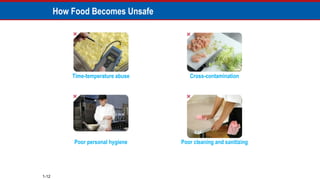
Time-temperature abuse Cross-contamination
Poor personal hygiene Poor cleaning and sanitizing
How Food Becomes Unsafe
Time-temperature abuse:
l When food has stayed too long at
temperatures good for pathogen growth
1-13
How Food Becomes Unsafe
Food has been time-temperature
abused when:
l It has not been held or stored at
correct temperatures
l It is not cooked or reheated enough
to kill pathogens
l It is not cooled correctly
1-14
Pg 1.5 SSF 6e
Pg 1.5 SSF 6e
Pg 1.5 SSF 6e
How Food Becomes Unsafe
Cross-contamination:
l When pathogens are transferred from one
surface or food to another
1-15
Pg 1.5 SSF 6e
How Food Becomes Unsafe
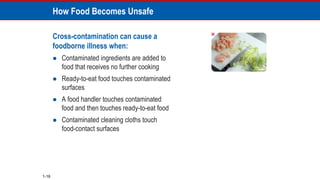
Cross-contamination can cause a
foodborne illness when:
l Contaminated ingredients are added to
food that receives no further cooking
l Ready-to-eat food touches contaminated
surfaces
l A food handler touches contaminated
food and then touches ready-to-eat food
l Contaminated cleaning cloths touch
food-contact surfaces
1-16
Pg 1.5 SSF 6e
How Food Becomes Unsafe
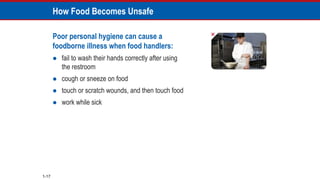
Poor personal hygiene can cause a
foodborne illness when food handlers:
l fail to wash their hands correctly after using
the restroom
l cough or sneeze on food
l touch or scratch wounds, and then touch food
l work while sick
1-17
Pg 1.5 SSF 6e
How Food Becomes Unsafe
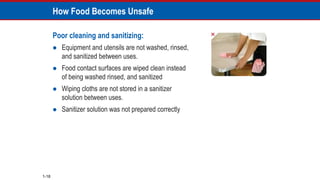
Poor cleaning and sanitizing:
l Equipment and utensils are not washed, rinsed,
and sanitized between uses.
l Food contact surfaces are wiped clean instead
of being washed rinsed, and sanitized
l Wiping cloths are not stored in a sanitizer
solution between uses.
l Sanitizer solution was not prepared correctly
1-18
Pg 1.5 SSF 6e
Food Most Likely to Become Unsafe
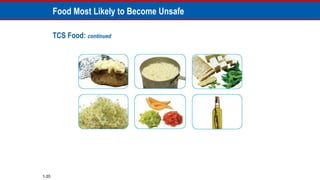
TCS Food:
1-19
Food Most Likely to Become Unsafe
TCS Food: continued
1-20
Ready-to-Eat Food
Ready-to-eat food is food that can be eaten without further
l Preparation
l Washing
l Cooking
Ready-to-eat food includes:
l Cooked food
l Washed fruit and vegetables
l Deli meat
l Bakery items
l Sugar, spices, and seasonings
1-21
Populations at High Risk for Foodborne Illnesses
These people have a higher risk of getting
a foodborne illness:
l Elderly people
l Preschool-age children
l People with compromised immune systems
1-22
Keeping Food Safe
1-23
Focus on these measures
l Controlling time and temperature
l Preventing cross-contamination
l Practicing personal hygiene
l Purchasing from approved, reputable suppliers
l Cleaning and sanitizing
Keeping Food Safe
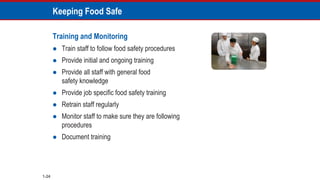
Training and Monitoring
l Train staff to follow food safety procedures
l Provide initial and ongoing training
l Provide all staff with general food
safety knowledge
l Provide job specific food safety training
l Retrain staff regularly
l Monitor staff to make sure they are following
procedures
l Document training
1-24
Keeping Food Safe
Government Agencies
l Kementerian Kesihatan Malaysia (KKM)
l State and Local Municipal and Regulatory Authorities
l Centers for Disease Control and Prevention (CDC)
1-25

TOPIC 1_PROVIDING SAFE FOOD.pdf

  • 2.
    Providing Safe Food Objectives: lRecognize the importance of food safety l Understand how food becomes unsafe l Identify TCS food l Recognize the risk factors for foodborne illness l Understand important prevention measures for keeping food safe 1-2
  • 3.
    Challenges to FoodSafety A foodborne illness is a disease transmitted to people through food An illness is considered an outbreak when: l Two or more people have the same symptoms after eating the same food l An investigation is conducted by state and local regulatory authorities l The outbreak is confirmed by laboratory analysis 1-3
  • 4.
    Challenges to FoodSafety Challenges include: l Time and money l Language and culture l Literacy and education l Pathogens l Unapproved suppliers l High-risk customers l Staff turnover 1-4
  • 5.
    Costs of FoodborneIllness 1-5 Costs of a foodborne illness to an operation: Loss of customers and sales Loss of reputation Negative media exposure Lowered staff morale
  • 6.
    Costs of FoodborneIllness 1-6 Costs of a foodborne illness to an operation: Lawsuits and legal fees Staff missing work Increased insurance premiums Staff retraining
  • 7.
    How Foodborne IllnessesOccur Unsafe food is the result of contamination l Biological l Chemical l Physical 1-7
  • 8.
  • 9.
  • 10.
    Contaminants Physical Hazards l Metalshavings l Staples l bandages l Glass l Dirt l Natural objects (e.g., fish bones in a fillet) 1-10
  • 11.
    How Food BecomesUnsafe Five Risk Factors for Foodborne Illness 1. Purchasing food from unsafe sources 2. Failing to cook food correctly 3. Holding food at incorrect temperatures 4. Using contaminated equipment 5. Practicing poor personal hygiene 1-11
  • 12.
    How Food BecomesUnsafe 1-12 Time-temperature abuse Cross-contamination Poor personal hygiene Poor cleaning and sanitizing
  • 13.
    How Food BecomesUnsafe Time-temperature abuse: l When food has stayed too long at temperatures good for pathogen growth 1-13
  • 14.
    How Food BecomesUnsafe Food has been time-temperature abused when: l It has not been held or stored at correct temperatures l It is not cooked or reheated enough to kill pathogens l It is not cooled correctly 1-14 Pg 1.5 SSF 6e Pg 1.5 SSF 6e Pg 1.5 SSF 6e
  • 15.
    How Food BecomesUnsafe Cross-contamination: l When pathogens are transferred from one surface or food to another 1-15 Pg 1.5 SSF 6e
  • 16.
    How Food BecomesUnsafe Cross-contamination can cause a foodborne illness when: l Contaminated ingredients are added to food that receives no further cooking l Ready-to-eat food touches contaminated surfaces l A food handler touches contaminated food and then touches ready-to-eat food l Contaminated cleaning cloths touch food-contact surfaces 1-16 Pg 1.5 SSF 6e
  • 17.
    How Food BecomesUnsafe Poor personal hygiene can cause a foodborne illness when food handlers: l fail to wash their hands correctly after using the restroom l cough or sneeze on food l touch or scratch wounds, and then touch food l work while sick 1-17 Pg 1.5 SSF 6e
  • 18.
    How Food BecomesUnsafe Poor cleaning and sanitizing: l Equipment and utensils are not washed, rinsed, and sanitized between uses. l Food contact surfaces are wiped clean instead of being washed rinsed, and sanitized l Wiping cloths are not stored in a sanitizer solution between uses. l Sanitizer solution was not prepared correctly 1-18 Pg 1.5 SSF 6e
  • 19.
    Food Most Likelyto Become Unsafe TCS Food: 1-19
  • 20.
    Food Most Likelyto Become Unsafe TCS Food: continued 1-20
  • 21.
    Ready-to-Eat Food Ready-to-eat foodis food that can be eaten without further l Preparation l Washing l Cooking Ready-to-eat food includes: l Cooked food l Washed fruit and vegetables l Deli meat l Bakery items l Sugar, spices, and seasonings 1-21
  • 22.
    Populations at HighRisk for Foodborne Illnesses These people have a higher risk of getting a foodborne illness: l Elderly people l Preschool-age children l People with compromised immune systems 1-22
  • 23.
    Keeping Food Safe 1-23 Focuson these measures l Controlling time and temperature l Preventing cross-contamination l Practicing personal hygiene l Purchasing from approved, reputable suppliers l Cleaning and sanitizing
  • 24.
    Keeping Food Safe Trainingand Monitoring l Train staff to follow food safety procedures l Provide initial and ongoing training l Provide all staff with general food safety knowledge l Provide job specific food safety training l Retrain staff regularly l Monitor staff to make sure they are following procedures l Document training 1-24
  • 25.
    Keeping Food Safe GovernmentAgencies l Kementerian Kesihatan Malaysia (KKM) l State and Local Municipal and Regulatory Authorities l Centers for Disease Control and Prevention (CDC) 1-25