1
2
FDST-2104
Course Name: Food Safety
Course Instructor: Hafiz M. Aaqib Saeed
Topic: Food safety History and overview
3
Road Map
• Introduction
• Historical aspects
• Definitions
• Scope of the Food safety
4
Introduction
• Food safety
– is used as a scientific discipline describing
handle, preparation, and storage of food in ways that
prevent food-borne illness.
• The occurrence of two or more cases of a similar
illnesses resulting from the ingestion of a
common food is known as a food-borne disease
outbreak.
• This includes a number of routines that should be
followed to avoid potential health hazards.
• In this way food safety often overlaps with food
defense to prevent harm to consumers.
5
History
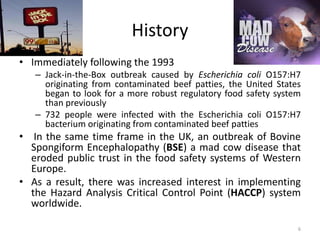
• Immediately following the 1993
– Jack-in-the-Box outbreak caused by Escherichia coli O157:H7
originating from contaminated beef patties, the United States
began to look for a more robust regulatory food safety system
than previously
– 732 people were infected with the Escherichia coli O157:H7
bacterium originating from contaminated beef patties
• In the same time frame in the UK, an outbreak of Bovine
Spongiform Encephalopathy (BSE) a mad cow disease that
eroded public trust in the food safety systems of Western
Europe.
• As a result, there was increased interest in implementing
the Hazard Analysis Critical Control Point (HACCP) system
worldwide.
6
Brought recent 5
Out breaks from different
countries
7
• The precursor to quality control was Total Quality
Management (TQM). The TQM system was first
introduced by W. Edward Deming and relied on
the concept of continuous improvement
• The HACCP concept was first developed in the
1960s by the U.S. National Aeronautics and Space
Administration (NASA), working with Pillsbury, to
ensure crumb- and pathogen-free food that had
extensive shelf-life properties for space travel
8
Contd…
• The implementation of this program allowed for the
reduction of risk related to foodborne pathogens in food,
although the original HACCP plan only consisted of three
principles as opposed to the seven we know today.
• As Pillsbury became engaged in improving the space
programs’ HACCP system, they also began to implement it
into their own food safety practices within the company.
• In the spring of 1971, HACCP was presented to the food
industry for the first time at the first National Conference
on Food Protection
• The following year, Pillsbury began teaching HACCP classes
to Food and Drug Administration (FDA) inspectors and
HACCP was implemented in low-acid canning regulation
9
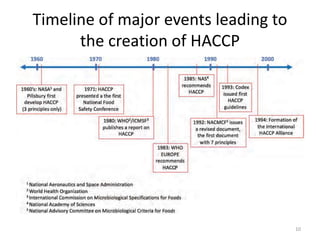
Timeline of major events leading to
the creation of HACCP
10
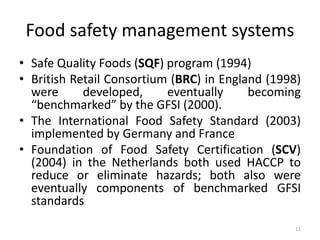
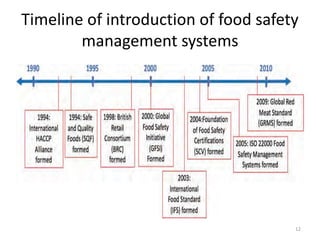
Food safety management systems
• Safe Quality Foods (SQF) program (1994)
• British Retail Consortium (BRC) in England (1998)
were developed, eventually becoming
“benchmarked” by the GFSI (2000).
• The International Food Safety Standard (2003)
implemented by Germany and France
• Foundation of Food Safety Certification (SCV)
(2004) in the Netherlands both used HACCP to
reduce or eliminate hazards; both also were
eventually components of benchmarked GFSI
standards
11
Timeline of introduction of food safety
management systems
12
Pakistan Food safety laws
• The Pure Food Ordinance 1960 consolidates
and amends the law in relation to the
preparation and the sale of foods. Its aim is to
ensure purity of food being supplied to people
in the market and, therefore, provides for
preventing adulteration.
• Pakistan Hotels and Restaurant Act, 1976
applies to all hotels and restaurants in
Pakistan and seeks to control and regulate the
standard of service(s) by hotels and
restaurants. 13
14
Foodborne illness (Food Poisoning)
• Foodborne illness is an infection or irritation of the
gastrointestinal (GI) tract caused by food or beverages that
contain harmful bacteria, parasites, viruses, or chemicals.
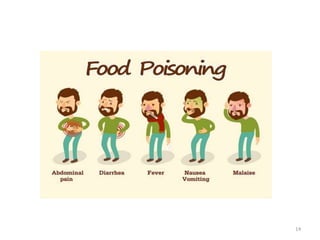
• Common foodborne illness symptoms include vomiting,
diarrhea, abdominal pain, fever, and chills.
• Most foodborne illnesses are acute, meaning they happen
suddenly and last a short time, and most people recover on
their own without treatment.
• Occasionally, foodborne illness may lead to more serious
complications.
• Each year, an estimated in the United States
– 48 million people experience a foodborne illness
– Foodborne illnesses cause 1,28,000 hospitalizations
– About 3,000 deaths in the United States annually
15
Diseases from pathogenic
microorganisms
These are of two types: infection and intoxication
• Foodborne infection is caused by the ingestion of
food containing live bacteria which grow and
establish themselves in the human intestinal
tract.
• Foodborne intoxication is caused by ingesting
food containing toxins formed by bacteria which
resulted from the bacterial growth in the food
item. The live microorganism does not have to be
consumed.
16
Scope of food safety
• The scope of food safety research should span the complete
production chain, from the agricultural inputs used to
produce the food or food ingredients (e.g., animal feed,
irrigation water) to the timeframe during which foodborne
illnesses are diagnosed and reported in surveillance systems.
• One way to organize this complex chain is the following:
• - agricultural inputs, for instance:
• Feed, agricultural water manure and soil amendments,
others (e.g., vaccines, pesticides)
• - pre-harvest environmental factors, such as
• Climate, soil, others (e.g., flooding events)
• - harvest-related factors, such as
• Workers, machinery, harvest technology
17
Contd…
• post-harvest / food manufacturing associated factors, such as
– storage and transportation conditions (e.g., times and temperatures)
• post-harvest treatments (e.g., washes with antimicrobial substances)
– food processing conditions
– opportunities for cross-contamination
– retail handling and storage
– consumer handling and storage
• surveillance systems (Monitoring of behavior, activities, or information
)
• diagnostic capabilities to identify, characterize and trace back illnesses
– foodborne outbreaks
– sporadic cases attributable to food
– foodborne source attribution
– economics of foodborne illness
18
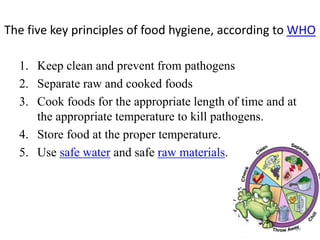
The five key principles of food hygiene, according to WHO
1. Keep clean and prevent from pathogens
2. Separate raw and cooked foods
3. Cook foods for the appropriate length of time and at
the appropriate temperature to kill pathogens.
4. Store food at the proper temperature.
5. Use safe water and safe raw materials.
19
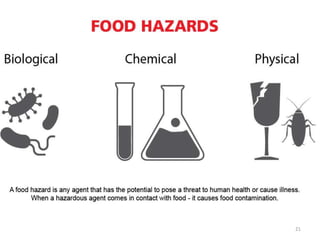
• Food contamination:
• Food contamination happens when food are corrupted
with another substance. It can happen In the process
of production, transportation, packaging, storage, sales
and cooking process.
– The contamination can be physical, chemical and biological
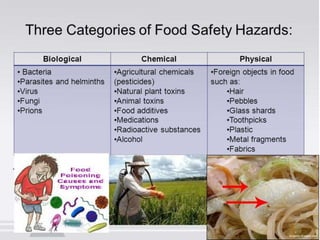
• Physical contamination and (Physical Hazards)
• Physical hazards are foreign objects that are found in
food products.
• Physical contaminants (or ‘foreign bodies’) are objects
such as hair, glass or metal, pests, jewelry, dirt and
fingernails.
– Physical Hazards Prevention
• Prevention of physical hazards focus primarily on
thorough inspection of food, and strict adherence to
food safety regulations,
20
0
21
Chemical contamination /Chemical Hazards
• Chemical contamination happens when food is contaminated
with a natural or artificial chemical substance.
• Common sources of chemical contamination can include:
– pesticides, herbicides, veterinary drugs, contamination from
environmental sources (water, air or soil pollution), cross-
contamination during food processing, migration from food packaging
materials, presence of natural toxins or use of unapproved food
additives and adulterants.
• Chemical Hazards Prevention
• By proper cleaning procedures and sanitation requirements are
the best methods of prevention.
• Training employees to follow strict guidelines is essential in
preventing a chemical hazard.
• Additionally, limiting the use of chemicals to those generally
recognized as safe (GRAS), and ensuring that chemicals are
stored in designated areas separated from food products.
22
• Biological contamination
• Biological contamination refers to food that has been
contaminated by substances produced by living creatures,
such as humans, rodents, pests or microorganisms.
• Includes bacterial contamination, viral contamination,
or parasite contamination that is transferred through saliva,
pest droppings, blood or fecal matter.
• Biological Hazard Prevention
• Implement robust processing and storage strategies.
• Kill steps used prior to packaging is necessary, such as
cooking thoroughly or pasteurization of milk and juices.
• Use of packaging technologies during processing like vacuum
sealing hinders bacterial growth. Proper temperature
management for storage can dramatically reduce microbe
growth.
• Finally, effective sanitation practices throughout the
distribution chain will reduce cross-contamination of food
products. 23
24
Conclusion
• Development of HACCP over the past 50yr has led to
documented improvement in food safety outcomes
• In terms of industry cooperation, GFSI has allowed multiple
food safety management systems to be benchmarked and
considered acceptable for use; all require HACCP.
• Developed countries all have the core components of
reducing foodborne illness, with additional considerations
that include traceability, sustainability, food fraud, or food
defense.
• On the other hand, developing countries still struggle with
uniform regulatory implementation of food safety
standards.
• To continue to decrease foodborne illness worldwide, focus
needs to be expended on increasing implementation of
these proven systems in developing countries.
25

1st%20Lecture%20change.pptx

  • 1.
  • 2.
  • 3.
    FDST-2104 Course Name: FoodSafety Course Instructor: Hafiz M. Aaqib Saeed Topic: Food safety History and overview 3
  • 4.
    Road Map • Introduction •Historical aspects • Definitions • Scope of the Food safety 4
  • 5.
    Introduction • Food safety –is used as a scientific discipline describing handle, preparation, and storage of food in ways that prevent food-borne illness. • The occurrence of two or more cases of a similar illnesses resulting from the ingestion of a common food is known as a food-borne disease outbreak. • This includes a number of routines that should be followed to avoid potential health hazards. • In this way food safety often overlaps with food defense to prevent harm to consumers. 5
  • 6.
    History • Immediately followingthe 1993 – Jack-in-the-Box outbreak caused by Escherichia coli O157:H7 originating from contaminated beef patties, the United States began to look for a more robust regulatory food safety system than previously – 732 people were infected with the Escherichia coli O157:H7 bacterium originating from contaminated beef patties • In the same time frame in the UK, an outbreak of Bovine Spongiform Encephalopathy (BSE) a mad cow disease that eroded public trust in the food safety systems of Western Europe. • As a result, there was increased interest in implementing the Hazard Analysis Critical Control Point (HACCP) system worldwide. 6
  • 7.
    Brought recent 5 Outbreaks from different countries 7
  • 8.
    • The precursorto quality control was Total Quality Management (TQM). The TQM system was first introduced by W. Edward Deming and relied on the concept of continuous improvement • The HACCP concept was first developed in the 1960s by the U.S. National Aeronautics and Space Administration (NASA), working with Pillsbury, to ensure crumb- and pathogen-free food that had extensive shelf-life properties for space travel 8
  • 9.
    Contd… • The implementationof this program allowed for the reduction of risk related to foodborne pathogens in food, although the original HACCP plan only consisted of three principles as opposed to the seven we know today. • As Pillsbury became engaged in improving the space programs’ HACCP system, they also began to implement it into their own food safety practices within the company. • In the spring of 1971, HACCP was presented to the food industry for the first time at the first National Conference on Food Protection • The following year, Pillsbury began teaching HACCP classes to Food and Drug Administration (FDA) inspectors and HACCP was implemented in low-acid canning regulation 9
  • 10.
    Timeline of majorevents leading to the creation of HACCP 10
  • 11.
    Food safety managementsystems • Safe Quality Foods (SQF) program (1994) • British Retail Consortium (BRC) in England (1998) were developed, eventually becoming “benchmarked” by the GFSI (2000). • The International Food Safety Standard (2003) implemented by Germany and France • Foundation of Food Safety Certification (SCV) (2004) in the Netherlands both used HACCP to reduce or eliminate hazards; both also were eventually components of benchmarked GFSI standards 11
  • 12.
    Timeline of introductionof food safety management systems 12
  • 13.
    Pakistan Food safetylaws • The Pure Food Ordinance 1960 consolidates and amends the law in relation to the preparation and the sale of foods. Its aim is to ensure purity of food being supplied to people in the market and, therefore, provides for preventing adulteration. • Pakistan Hotels and Restaurant Act, 1976 applies to all hotels and restaurants in Pakistan and seeks to control and regulate the standard of service(s) by hotels and restaurants. 13
  • 14.
  • 15.
    Foodborne illness (FoodPoisoning) • Foodborne illness is an infection or irritation of the gastrointestinal (GI) tract caused by food or beverages that contain harmful bacteria, parasites, viruses, or chemicals. • Common foodborne illness symptoms include vomiting, diarrhea, abdominal pain, fever, and chills. • Most foodborne illnesses are acute, meaning they happen suddenly and last a short time, and most people recover on their own without treatment. • Occasionally, foodborne illness may lead to more serious complications. • Each year, an estimated in the United States – 48 million people experience a foodborne illness – Foodborne illnesses cause 1,28,000 hospitalizations – About 3,000 deaths in the United States annually 15
  • 16.
    Diseases from pathogenic microorganisms Theseare of two types: infection and intoxication • Foodborne infection is caused by the ingestion of food containing live bacteria which grow and establish themselves in the human intestinal tract. • Foodborne intoxication is caused by ingesting food containing toxins formed by bacteria which resulted from the bacterial growth in the food item. The live microorganism does not have to be consumed. 16
  • 17.
    Scope of foodsafety • The scope of food safety research should span the complete production chain, from the agricultural inputs used to produce the food or food ingredients (e.g., animal feed, irrigation water) to the timeframe during which foodborne illnesses are diagnosed and reported in surveillance systems. • One way to organize this complex chain is the following: • - agricultural inputs, for instance: • Feed, agricultural water manure and soil amendments, others (e.g., vaccines, pesticides) • - pre-harvest environmental factors, such as • Climate, soil, others (e.g., flooding events) • - harvest-related factors, such as • Workers, machinery, harvest technology 17
  • 18.
    Contd… • post-harvest /food manufacturing associated factors, such as – storage and transportation conditions (e.g., times and temperatures) • post-harvest treatments (e.g., washes with antimicrobial substances) – food processing conditions – opportunities for cross-contamination – retail handling and storage – consumer handling and storage • surveillance systems (Monitoring of behavior, activities, or information ) • diagnostic capabilities to identify, characterize and trace back illnesses – foodborne outbreaks – sporadic cases attributable to food – foodborne source attribution – economics of foodborne illness 18
  • 19.
    The five keyprinciples of food hygiene, according to WHO 1. Keep clean and prevent from pathogens 2. Separate raw and cooked foods 3. Cook foods for the appropriate length of time and at the appropriate temperature to kill pathogens. 4. Store food at the proper temperature. 5. Use safe water and safe raw materials. 19
  • 20.
    • Food contamination: •Food contamination happens when food are corrupted with another substance. It can happen In the process of production, transportation, packaging, storage, sales and cooking process. – The contamination can be physical, chemical and biological • Physical contamination and (Physical Hazards) • Physical hazards are foreign objects that are found in food products. • Physical contaminants (or ‘foreign bodies’) are objects such as hair, glass or metal, pests, jewelry, dirt and fingernails. – Physical Hazards Prevention • Prevention of physical hazards focus primarily on thorough inspection of food, and strict adherence to food safety regulations, 20
  • 21.
  • 22.
    Chemical contamination /ChemicalHazards • Chemical contamination happens when food is contaminated with a natural or artificial chemical substance. • Common sources of chemical contamination can include: – pesticides, herbicides, veterinary drugs, contamination from environmental sources (water, air or soil pollution), cross- contamination during food processing, migration from food packaging materials, presence of natural toxins or use of unapproved food additives and adulterants. • Chemical Hazards Prevention • By proper cleaning procedures and sanitation requirements are the best methods of prevention. • Training employees to follow strict guidelines is essential in preventing a chemical hazard. • Additionally, limiting the use of chemicals to those generally recognized as safe (GRAS), and ensuring that chemicals are stored in designated areas separated from food products. 22
  • 23.
    • Biological contamination •Biological contamination refers to food that has been contaminated by substances produced by living creatures, such as humans, rodents, pests or microorganisms. • Includes bacterial contamination, viral contamination, or parasite contamination that is transferred through saliva, pest droppings, blood or fecal matter. • Biological Hazard Prevention • Implement robust processing and storage strategies. • Kill steps used prior to packaging is necessary, such as cooking thoroughly or pasteurization of milk and juices. • Use of packaging technologies during processing like vacuum sealing hinders bacterial growth. Proper temperature management for storage can dramatically reduce microbe growth. • Finally, effective sanitation practices throughout the distribution chain will reduce cross-contamination of food products. 23
  • 24.
  • 25.
    Conclusion • Development ofHACCP over the past 50yr has led to documented improvement in food safety outcomes • In terms of industry cooperation, GFSI has allowed multiple food safety management systems to be benchmarked and considered acceptable for use; all require HACCP. • Developed countries all have the core components of reducing foodborne illness, with additional considerations that include traceability, sustainability, food fraud, or food defense. • On the other hand, developing countries still struggle with uniform regulatory implementation of food safety standards. • To continue to decrease foodborne illness worldwide, focus needs to be expended on increasing implementation of these proven systems in developing countries. 25

Editor's Notes

  • #6 Food Safety refers to handling, preparing and storing food in a way to best reduce the risk individuals becoming sick from foodborne illnesses.
  • #9 The Pillsbury Company was a Minneapolis, Minnesota-based company that was one of the world's largest producers of grain and other foodstuffs until it was bought by General Mills in 2001. the HACCP system is a preventive- based method for assuring food product safety All hazrds can eliminated through this system.
  • #19 surveillance s the monitoring of behavior, activities, or information for the purpose of influencing, managing or direc sporadic OCCURNG AT IRREGULAR INTERVALS
  • #21 such as Hazard Analysis Critical Control Point (HACCP) Acrylic is both lighter and stronger than glass, and tends to shatter into larger, blunter fragments than glass.
  • #24 Bacterial contamination is the most common cause of food poisoning worldwide. If an environment is high in starch or protein, water, oxygen, has a neutral PH level, and maintains a temperature between 5ºC and 60ºC (danger zone) for even a brief period of time (~0-20 minutes),[9] bacteria are likely to survive.