2009-9-12                                                        Top 5 Web Trends of 2009: Person…


Top 5 Web Trends of 2009: Personalization
Written by Richard MacManus / September 9, 2009 6:00 AM / 7 Comments                  « Prior Post   Next Post »


                                This week ReadWriteWeb (http://www.readwriteweb.com) is running a series of posts analyzing the 5 biggest Web trends of 2009.
                                Our first post was about Structured Data (http://www.readwriteweb.com/archives/top_5_web_trends_of_2009_structured_data.php) , our
                                second about The Real-Time Web (http://www.readwriteweb.com/archives/top_5_web_trends_of_2009_the_real-time_web.php) . The
                                third part of our series is on Personalization.

                                Personalization (http://en.wik ipedia.org/wik i/Personalization) has long been a buzzword on the Internet. With the glut of information
                                on the Web circa 2009, personalization in this era means providing effective filters and recommendations. Ultimately
                                personalization is about web sites and services giving you what you want, when you want it. That's the long-standing dream
anyway. Let's see if the products of 2009 are fulfilling it.

All of the trends that we're profiling overlap. This is particularly so with personalization, as we'll see.

Filtering the Real-Time Firehose
Personalization is often used to provide an organization layer for users on top of real-time data. As Ken Fromm put it in his primer on the Real-
Time Web (http://www.readwriteweb.com/archives/the_real-time_web_a_primer_part_3.php) :

     "The Internet is shifting from discrete units of websites and Web pages to discrete units of information [...] organized in ways that are
     relevant and personal to each individual, using data gleaned from social graphs as well as recommendation and personalization services
     that allow users to set their preferences."

If you use a dashboard product like TweetDeck, Seesmic or Peoplebrowsr to use Twitter, then you're able to group people, keywords and
topics. This is effectively personalization at work.


Open Web: More Data About You, Better Personalization
Another aspect of personalization is the increasing prevalence of open data on the Web. A lot of companies make their data available on the
Web via APIs, web services, and open data standards. And as we discussed in the first post in this series, much of that data is structured
(http://www.readwriteweb.com/archives/top_5_web_trends_of_2009_structured_data.php) - allowing it to be inter-connected and re-used by third
parties.

How does open data lead to personalization? Simply put, the more data about you and your social graph
(http://www.readwriteweb.com/archives/social_graph_concepts_and_issues.php) that is available to be used by applications, the better targeted the
content and/or service will be to you. There are non-trivial privacy issues
(http://www.readwriteweb.com/archives/facebook_wants_you_to_be_less_private_-_but_why.php) about this, however the personalization benefits can
be significant.

There are a whole host of open data standards on the Web now. They include:

  Data portability - taking your data and friends from one site to another.
  OpenID - portable identity; single sign-on.
  OpenSocial - Google initiative for social networks, enabling developers to create widgets with one set of code; MySpace a member,
  Facebook isn't.
  APML - growing 'Attention' standard; Your Attention Data is all the information online about what you read, write, share and consume.
Recommendation Engines
readwriteweb.com/…/top_5_web_tr…                                                                                                                                          1/3
2009-9-12                                              Top 5 Web Trends of 2009: Person…
Many consumer products on the Web aim to recommend you things that you may like
(http://www.readwriteweb.com/archives/recommender_systems.php) . A couple of years ago, Alex Iskold outlined what he saw as the 4 main
approaches to recommendations (http://www.readwriteweb.com/archives/recommendation_engines.php) :

  Personalized recommendation - recommend things based on the individual's past behavior
  Social recommendation - recommend things based on the past behavior of similar users
  Item recommendation - recommend things based on the item itself
  A combination of the three approaches above

Amazon is probably still the best example of recommendations
(http://www.readwriteweb.com/archives/recommendation_systems_interview_satnam_alag.php)
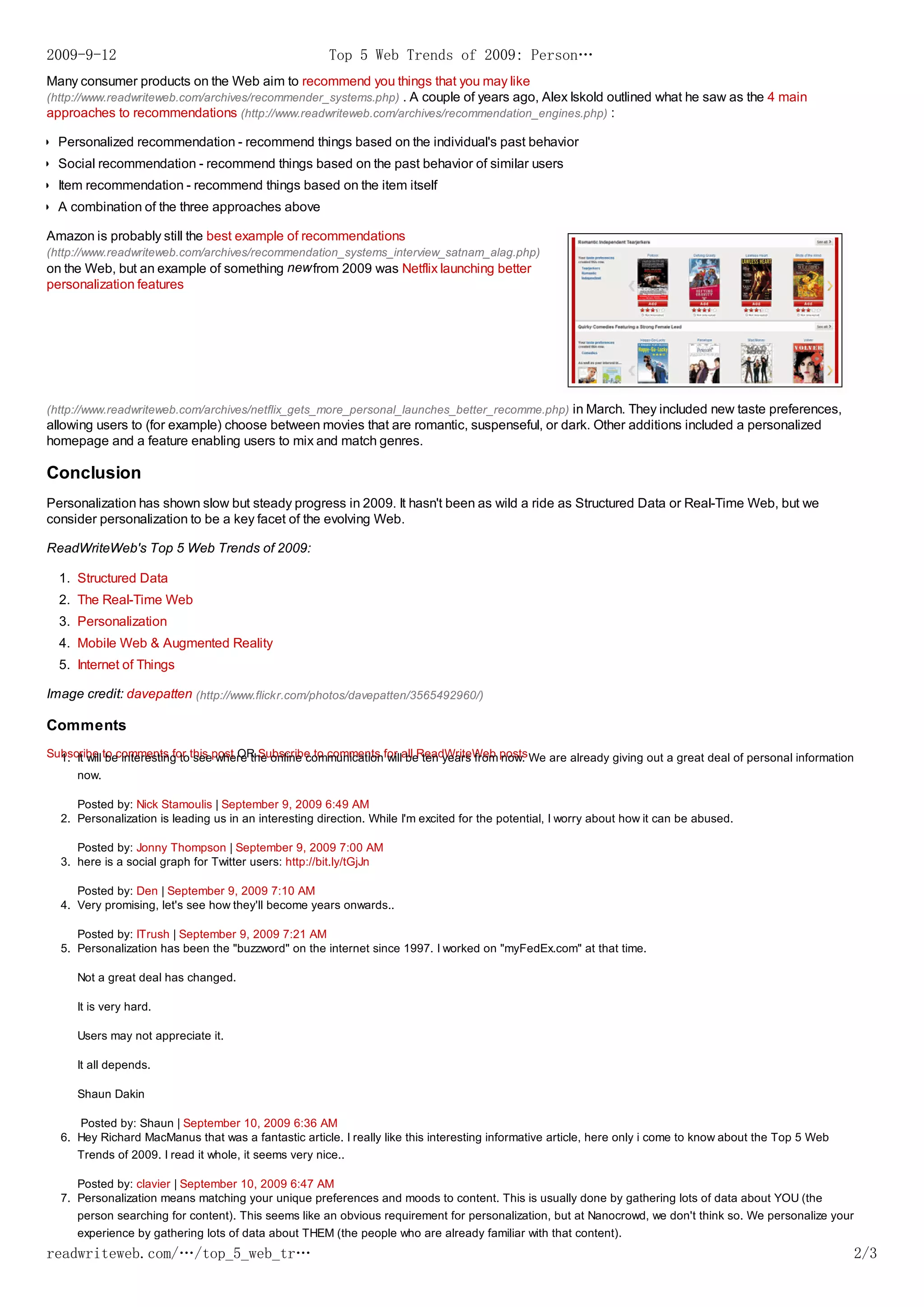
on the Web, but an example of something new from 2009 was Netflix launching better
personalization features


(http://www.readwriteweb.com/archives/netflix_gets_more_personal_launches_better_recomme.php) in March. They included new taste preferences,
allowing users to (for example) choose between movies that are romantic, suspenseful, or dark. Other additions included a personalized
homepage and a feature enabling users to mix and match genres.

Conclusion
Personalization has shown slow but steady progress in 2009. It hasn't been as wild a ride as Structured Data or Real-Time Web, but we
consider personalization to be a key facet of the evolving Web.

ReadWriteWeb's Top 5 Web Trends of 2009:

  1. Structured Data
  2. The Real-Time Web
  3. Personalization
  4. Mobile Web & Augmented Reality
  5. Internet of Things

Image credit: davepatten (http://www.flickr.com/photos/davepatten/3565492960/)

Comments
Subscribe to comments for this post OR Subscribe to comments for all ReadWriteWeb posts We are already giving out a great deal of personal information
  1. It will be interesting to see where the online communication will be ten years from now.
     now.

     Posted by: Nick Stamoulis | September 9, 2009 6:49 AM
  2. Personalization is leading us in an interesting direction. While I'm excited for the potential, I worry about how it can be abused.

     Posted by: Jonny Thompson | September 9, 2009 7:00 AM
  3. here is a social graph for Twitter users: http://bit.ly/tGjJn

     Posted by: Den | September 9, 2009 7:10 AM
  4. Very promising, let's see how they'll become years onwards..

     Posted by: ITrush | September 9, 2009 7:21 AM
  5. Personalization has been the "buzzword" on the internet since 1997. I worked on "myFedEx.com" at that time.

     Not a great deal has changed.

     It is very hard.

     Users may not appreciate it.

     It all depends.

     Shaun Dakin

     Posted by: Shaun | September 10, 2009 6:36 AM
  6. Hey Richard MacManus that was a fantastic article. I really like this interesting informative article, here only i come to know about the Top 5 Web
     Trends of 2009. I read it whole, it seems very nice..

     Posted by: clavier | September 10, 2009 6:47 AM
  7. Personalization means matching your unique preferences and moods to content. This is usually done by gathering lots of data about YOU (the
     person searching for content). This seems like an obvious requirement for personalization, but at Nanocrowd, we don't think so. We personalize your
     experience by gathering lots of data about THEM (the people who are already familiar with that content).
readwriteweb.com/…/top_5_web_tr…                                                                                                                           2/3
2009-9-12                                           Top 5 Web Trends of 2009: Person…

   By analyzing the wealth of comments and preferences left by other users, we get inside THEIR heads. We analyze and then group their reactions
   into small clusters (nanogenres), and when you see one you like, we offer up content. By breaking down the reactions of other people, we can
   suggest the things that you are uniquely interested in at the moment. The beta version of one example of this technique is available today as a
   movie search and recommendation engine: www.nanocrowd.com.

   This approach has a couple important benefits. You can make selections and get recommendations based on your mood of the moment, and most
   important we can deliver highly personalized recommendations without knowing anything about you.

   Thanks, Richard, for another great article. As always, lots of food for thought.

   Posted by: Roderic March | September 11, 2009 11:18 AM


readwriteweb.com/…/top_5_web_tr…                                                                                                                     3/3

Top 5 Web Trends Of 2009 Personalization

  • 1.
    2009-9-12 Top 5 Web Trends of 2009: Person… Top 5 Web Trends of 2009: Personalization Written by Richard MacManus / September 9, 2009 6:00 AM / 7 Comments « Prior Post Next Post » This week ReadWriteWeb (http://www.readwriteweb.com) is running a series of posts analyzing the 5 biggest Web trends of 2009. Our first post was about Structured Data (http://www.readwriteweb.com/archives/top_5_web_trends_of_2009_structured_data.php) , our second about The Real-Time Web (http://www.readwriteweb.com/archives/top_5_web_trends_of_2009_the_real-time_web.php) . The third part of our series is on Personalization. Personalization (http://en.wik ipedia.org/wik i/Personalization) has long been a buzzword on the Internet. With the glut of information on the Web circa 2009, personalization in this era means providing effective filters and recommendations. Ultimately personalization is about web sites and services giving you what you want, when you want it. That's the long-standing dream anyway. Let's see if the products of 2009 are fulfilling it. All of the trends that we're profiling overlap. This is particularly so with personalization, as we'll see. Filtering the Real-Time Firehose Personalization is often used to provide an organization layer for users on top of real-time data. As Ken Fromm put it in his primer on the Real- Time Web (http://www.readwriteweb.com/archives/the_real-time_web_a_primer_part_3.php) : "The Internet is shifting from discrete units of websites and Web pages to discrete units of information [...] organized in ways that are relevant and personal to each individual, using data gleaned from social graphs as well as recommendation and personalization services that allow users to set their preferences." If you use a dashboard product like TweetDeck, Seesmic or Peoplebrowsr to use Twitter, then you're able to group people, keywords and topics. This is effectively personalization at work. Open Web: More Data About You, Better Personalization Another aspect of personalization is the increasing prevalence of open data on the Web. A lot of companies make their data available on the Web via APIs, web services, and open data standards. And as we discussed in the first post in this series, much of that data is structured (http://www.readwriteweb.com/archives/top_5_web_trends_of_2009_structured_data.php) - allowing it to be inter-connected and re-used by third parties. How does open data lead to personalization? Simply put, the more data about you and your social graph (http://www.readwriteweb.com/archives/social_graph_concepts_and_issues.php) that is available to be used by applications, the better targeted the content and/or service will be to you. There are non-trivial privacy issues (http://www.readwriteweb.com/archives/facebook_wants_you_to_be_less_private_-_but_why.php) about this, however the personalization benefits can be significant. There are a whole host of open data standards on the Web now. They include: Data portability - taking your data and friends from one site to another. OpenID - portable identity; single sign-on. OpenSocial - Google initiative for social networks, enabling developers to create widgets with one set of code; MySpace a member, Facebook isn't. APML - growing 'Attention' standard; Your Attention Data is all the information online about what you read, write, share and consume. Recommendation Engines readwriteweb.com/…/top_5_web_tr… 1/3
  • 2.
    2009-9-12 Top 5 Web Trends of 2009: Person… Many consumer products on the Web aim to recommend you things that you may like (http://www.readwriteweb.com/archives/recommender_systems.php) . A couple of years ago, Alex Iskold outlined what he saw as the 4 main approaches to recommendations (http://www.readwriteweb.com/archives/recommendation_engines.php) : Personalized recommendation - recommend things based on the individual's past behavior Social recommendation - recommend things based on the past behavior of similar users Item recommendation - recommend things based on the item itself A combination of the three approaches above Amazon is probably still the best example of recommendations (http://www.readwriteweb.com/archives/recommendation_systems_interview_satnam_alag.php) on the Web, but an example of something new from 2009 was Netflix launching better personalization features (http://www.readwriteweb.com/archives/netflix_gets_more_personal_launches_better_recomme.php) in March. They included new taste preferences, allowing users to (for example) choose between movies that are romantic, suspenseful, or dark. Other additions included a personalized homepage and a feature enabling users to mix and match genres. Conclusion Personalization has shown slow but steady progress in 2009. It hasn't been as wild a ride as Structured Data or Real-Time Web, but we consider personalization to be a key facet of the evolving Web. ReadWriteWeb's Top 5 Web Trends of 2009: 1. Structured Data 2. The Real-Time Web 3. Personalization 4. Mobile Web & Augmented Reality 5. Internet of Things Image credit: davepatten (http://www.flickr.com/photos/davepatten/3565492960/) Comments Subscribe to comments for this post OR Subscribe to comments for all ReadWriteWeb posts We are already giving out a great deal of personal information 1. It will be interesting to see where the online communication will be ten years from now. now. Posted by: Nick Stamoulis | September 9, 2009 6:49 AM 2. Personalization is leading us in an interesting direction. While I'm excited for the potential, I worry about how it can be abused. Posted by: Jonny Thompson | September 9, 2009 7:00 AM 3. here is a social graph for Twitter users: http://bit.ly/tGjJn Posted by: Den | September 9, 2009 7:10 AM 4. Very promising, let's see how they'll become years onwards.. Posted by: ITrush | September 9, 2009 7:21 AM 5. Personalization has been the "buzzword" on the internet since 1997. I worked on "myFedEx.com" at that time. Not a great deal has changed. It is very hard. Users may not appreciate it. It all depends. Shaun Dakin Posted by: Shaun | September 10, 2009 6:36 AM 6. Hey Richard MacManus that was a fantastic article. I really like this interesting informative article, here only i come to know about the Top 5 Web Trends of 2009. I read it whole, it seems very nice.. Posted by: clavier | September 10, 2009 6:47 AM 7. Personalization means matching your unique preferences and moods to content. This is usually done by gathering lots of data about YOU (the person searching for content). This seems like an obvious requirement for personalization, but at Nanocrowd, we don't think so. We personalize your experience by gathering lots of data about THEM (the people who are already familiar with that content). readwriteweb.com/…/top_5_web_tr… 2/3
  • 3.
    2009-9-12 Top 5 Web Trends of 2009: Person… By analyzing the wealth of comments and preferences left by other users, we get inside THEIR heads. We analyze and then group their reactions into small clusters (nanogenres), and when you see one you like, we offer up content. By breaking down the reactions of other people, we can suggest the things that you are uniquely interested in at the moment. The beta version of one example of this technique is available today as a movie search and recommendation engine: www.nanocrowd.com. This approach has a couple important benefits. You can make selections and get recommendations based on your mood of the moment, and most important we can deliver highly personalized recommendations without knowing anything about you. Thanks, Richard, for another great article. As always, lots of food for thought. Posted by: Roderic March | September 11, 2009 11:18 AM readwriteweb.com/…/top_5_web_tr… 3/3