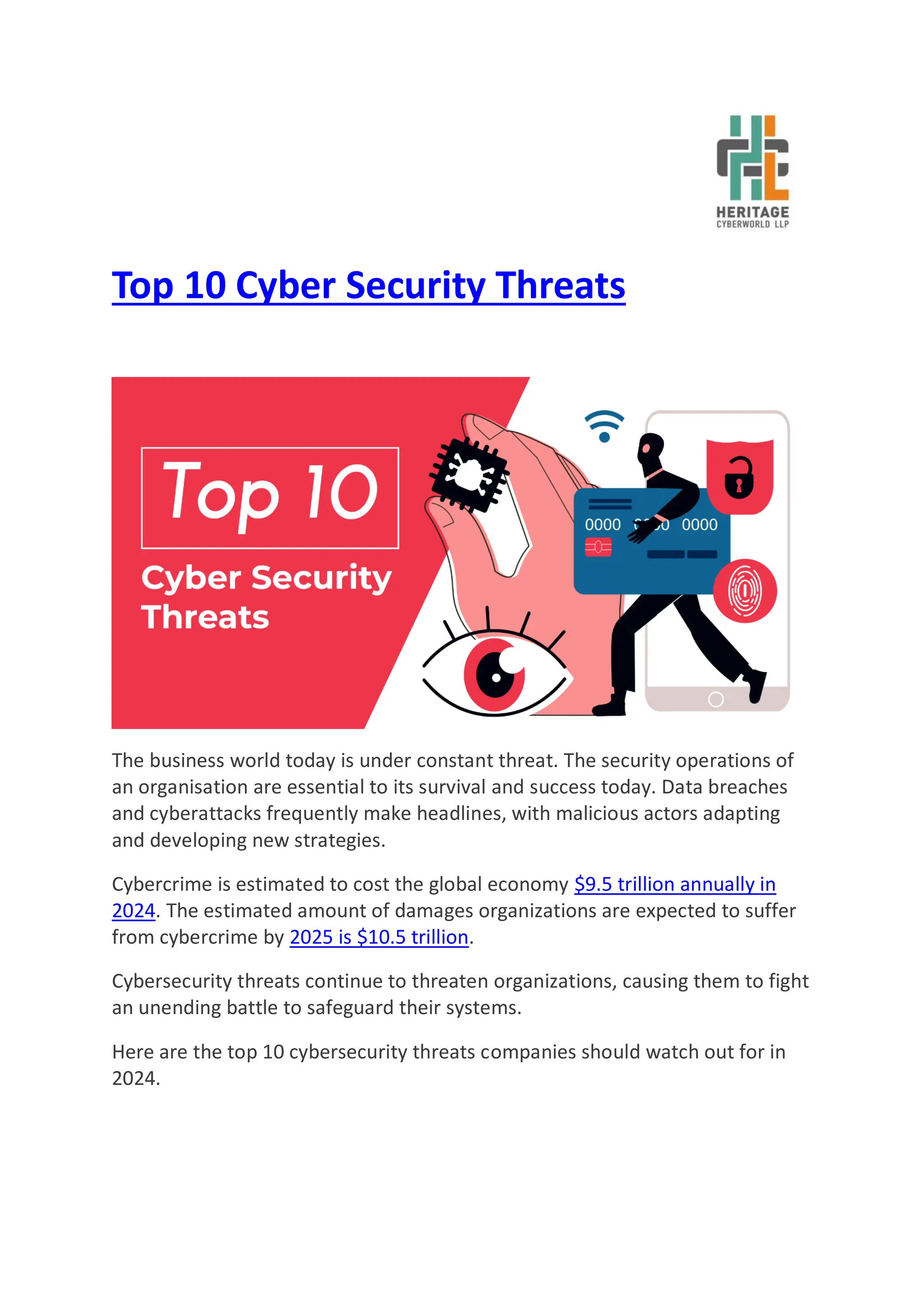
Top 10 Cyber Security Threats
The business world today is under constant threat. The security operations of
an organisation are essential to its survival and success today. Data breaches
and cyberattacks frequently make headlines, with malicious actors adapting
and developing new strategies.
Cybercrime is estimated to cost the global economy $9.5 trillion annually in
2024. The estimated amount of damages organizations are expected to suffer
from cybercrime by 2025 is $10.5 trillion.
Cybersecurity threats continue to threaten organizations, causing them to fight
an unending battle to safeguard their systems.
Here are the top 10 cybersecurity threats companies should watch out for in
2024.
10 popular cyberattacks keeping the business at risk
Ransomware
The ransomware threat is a serious cybersecurity concern that can lead to
business and individual losses. The most common way ransomware spreads is
by taking over files on your device or the entire system. This prevents the
owner from accessing the file, which can lead to problems in some industries
that require access to time-sensitive documents. The victim is forced to pay
the ransom, causing considerable financial hardship.
Data Breaches
Data protection is not only a legal requirement, it is also essential to the
survival and protection of a business. Despite its growing importance and
cybersecurity regulations, many organisations are not able to secure the data
of millions of individuals. This is where cyber security audit service plays a role
for business to boost business security and present a lot of room for
enhancement in security.
Insider Threats
An IT team focusing on identifying external adversaries only sees half the
picture. An inside threat can be defined as an internal actor, such as a former
employee or current employee, who poses a risk to a business by gaining
access to its network, intellectual property, or confidential data. An insider
might also be familiar with company policies, internal processes, or other
relevant information.
Cloud Vulnerabilities
The increasing number of organisations storing their data in the cloud has
increased the risk of cyberattacks. Vulnerabilities arise from configuration
errors, insecure encryption, a lack of security in shared technologies, and
hackers.
Data and workloads in the cloud are usually secured by cloud service providers,
but security is ultimately the responsibility of the organizations. By counting
on penetration testing services, you can show exit gate to security
vulnerabilities.
IoT Attacks
IoT (Internet of Things) is becoming increasingly common today, which makes
it attractive to cybercriminals. Attacks using smart devices can involve hacking,
forging their data, or even taking control of them.
Security measures are often lacking in IoT devices, which makes them more
vulnerable to attacks.
Malware
A malware is a harmful code that is not recognized by the security system of a
business.
There are numerous types of malware that threaten companies today, and,
sadly, they come in a wide range of shapes and sizes. Clicking on links, opening
attachments, and downloading files usually triggers these code attacks. For
preventing malware from entering your system, Malware analysis by the
security team is critical to eradicating malware attacks and giving your business
a safe stage for operation.
Poor Cyber Hygiene
The practice of cyber hygiene involves regularly using technology and taking
precautions, such as staying away from unsecured WiFi networks and using
VPNs and multi-factor authentication to safeguard data and assets. It is aimed
at enabling businesses to protect data and assets.
To reduce vulnerabilities, companies should practice good cyber hygiene by
identifying risks and mitigating or resolving them.
Artificial Intelligence (AI) Misuse
AI is beneficial in many ways, but malicious purposes can also be achieved.
Artificial intelligence misuse will pose a growing cybersecurity threat in 2024.
Automating attacks, enhancing social engineering tactics, and bypassing
security systems are all possible with AI algorithms.
Man in the Middle
A man-in-the-middle cyber attack occurs when someone eavesdrops on a
private conversation. However, hackers sometimes break into networks that
aren't protected by monitoring them.
The threat actor can insert malware into the software applications of either
party and gain access to sensitive data from inside. If they gain access
unnoticed, they can take whatever data they want.
Denial of Service
DDoS is an attack that overwhelms either a single computer or an entire
network so that it cannot process requests. A botnet is an example of a DoS
attack. The sources of DDoS attacks are diverse.
The system freezes with attack, trying to respond but failing. When a DoS
attack is launched against a business, it may completely halt operations.
Cyber threats push the business down which deeply affects the business
reputation. With various cyber threats rising, Heritage Cyber World, the
leading cybersecurity company in India, comes in to deliver expert
cybersecurity measures to prevent businesses from cyber attacks and give a
secure space to grow well and shape business reputation.
At Heritage Cyber World, we have the best security team that holds the power
to protect your business from any attacks. No more fear of cyber criminals; let
our security team be your one-stop destination to protect your business from
cyber-attacks. Contact us today and gift your business the best cyber security
services.

Top 10 Cyber security Threats | Cyber security

  • 1.
    Top 10 CyberSecurity Threats The business world today is under constant threat. The security operations of an organisation are essential to its survival and success today. Data breaches and cyberattacks frequently make headlines, with malicious actors adapting and developing new strategies. Cybercrime is estimated to cost the global economy $9.5 trillion annually in 2024. The estimated amount of damages organizations are expected to suffer from cybercrime by 2025 is $10.5 trillion. Cybersecurity threats continue to threaten organizations, causing them to fight an unending battle to safeguard their systems. Here are the top 10 cybersecurity threats companies should watch out for in 2024.
  • 2.
    10 popular cyberattackskeeping the business at risk Ransomware The ransomware threat is a serious cybersecurity concern that can lead to business and individual losses. The most common way ransomware spreads is by taking over files on your device or the entire system. This prevents the owner from accessing the file, which can lead to problems in some industries that require access to time-sensitive documents. The victim is forced to pay the ransom, causing considerable financial hardship. Data Breaches Data protection is not only a legal requirement, it is also essential to the survival and protection of a business. Despite its growing importance and cybersecurity regulations, many organisations are not able to secure the data of millions of individuals. This is where cyber security audit service plays a role for business to boost business security and present a lot of room for enhancement in security. Insider Threats An IT team focusing on identifying external adversaries only sees half the picture. An inside threat can be defined as an internal actor, such as a former employee or current employee, who poses a risk to a business by gaining access to its network, intellectual property, or confidential data. An insider might also be familiar with company policies, internal processes, or other relevant information. Cloud Vulnerabilities The increasing number of organisations storing their data in the cloud has increased the risk of cyberattacks. Vulnerabilities arise from configuration errors, insecure encryption, a lack of security in shared technologies, and hackers. Data and workloads in the cloud are usually secured by cloud service providers, but security is ultimately the responsibility of the organizations. By counting on penetration testing services, you can show exit gate to security vulnerabilities.
  • 3.
    IoT Attacks IoT (Internetof Things) is becoming increasingly common today, which makes it attractive to cybercriminals. Attacks using smart devices can involve hacking, forging their data, or even taking control of them. Security measures are often lacking in IoT devices, which makes them more vulnerable to attacks. Malware A malware is a harmful code that is not recognized by the security system of a business. There are numerous types of malware that threaten companies today, and, sadly, they come in a wide range of shapes and sizes. Clicking on links, opening attachments, and downloading files usually triggers these code attacks. For preventing malware from entering your system, Malware analysis by the security team is critical to eradicating malware attacks and giving your business a safe stage for operation. Poor Cyber Hygiene The practice of cyber hygiene involves regularly using technology and taking precautions, such as staying away from unsecured WiFi networks and using VPNs and multi-factor authentication to safeguard data and assets. It is aimed at enabling businesses to protect data and assets. To reduce vulnerabilities, companies should practice good cyber hygiene by identifying risks and mitigating or resolving them. Artificial Intelligence (AI) Misuse AI is beneficial in many ways, but malicious purposes can also be achieved. Artificial intelligence misuse will pose a growing cybersecurity threat in 2024. Automating attacks, enhancing social engineering tactics, and bypassing security systems are all possible with AI algorithms.
  • 4.
    Man in theMiddle A man-in-the-middle cyber attack occurs when someone eavesdrops on a private conversation. However, hackers sometimes break into networks that aren't protected by monitoring them. The threat actor can insert malware into the software applications of either party and gain access to sensitive data from inside. If they gain access unnoticed, they can take whatever data they want. Denial of Service DDoS is an attack that overwhelms either a single computer or an entire network so that it cannot process requests. A botnet is an example of a DoS attack. The sources of DDoS attacks are diverse. The system freezes with attack, trying to respond but failing. When a DoS attack is launched against a business, it may completely halt operations. Cyber threats push the business down which deeply affects the business reputation. With various cyber threats rising, Heritage Cyber World, the leading cybersecurity company in India, comes in to deliver expert cybersecurity measures to prevent businesses from cyber attacks and give a secure space to grow well and shape business reputation. At Heritage Cyber World, we have the best security team that holds the power to protect your business from any attacks. No more fear of cyber criminals; let our security team be your one-stop destination to protect your business from cyber-attacks. Contact us today and gift your business the best cyber security services.