CYBERSECURITY
Cybersecurity is crucial in today's digital world. Let's explore the
importance of protecting our data, the types of threats we face, and how
to stay secure.
By
G.L.Manikanta Sai(2301600176)
T.Phaneendhar Reddy(2301600163)
SK.Malik Basha(2301600161)
MCA-C
Proactive Cyber
Security: Protecting
Your Digital World
In today's digital age, cyber security has become a crucial component of
our online lives. Learn about the growing threats, common risks, and best
practices to protect yourself and your company from cyber attacks.
Understanding Cyber Security
Definition and Scope
Cyber security refers to the protection of digital devices, information, and networks from
unauthorized access, theft, and damage. Its scope includes hardware components, software
applications, and data storage systems.
Key Objectives and Principles
The goals of cyber security are to ensure confidentiality, integrity, and availability of the
information stored and transmitted. Its principles include risk assessment, defense in depth, and
incident response.
Growing Threats in the Digital Age
Cyber attacks continue to increase in sophistication and frequency. From ransomware to social
engineering, these threats pose serious risks to individuals and organizations alike.
The Importance of
Cybersecurity
In an interconnected world, cybersecurity is essential to protect sensitive
information and prevent unauthorized access to systems and networks.
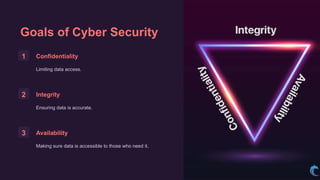
Goals of Cyber Security
1 Confidentiality
Limiting data access.
2 Integrity
Ensuring data is accurate.
3 Availability
Making sure data is accessible to those who need it.
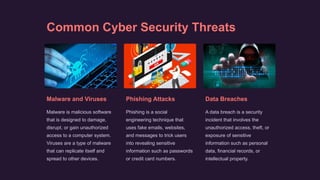
Common Cyber Security Threats
Malware and Viruses
Malware is malicious software
that is designed to damage,
disrupt, or gain unauthorized
access to a computer system.
Viruses are a type of malware
that can replicate itself and
spread to other devices.
Phishing Attacks
Phishing is a social
engineering technique that
uses fake emails, websites,
and messages to trick users
into revealing sensitive
information such as passwords
or credit card numbers.
Data Breaches
A data breach is a security
incident that involves the
unauthorized access, theft, or
exposure of sensitive
information such as personal
data, financial records, or
intellectual property.
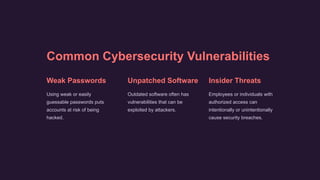
Common Cybersecurity Vulnerabilities
Weak Passwords
Using weak or easily
guessable passwords puts
accounts at risk of being
hacked.
Unpatched Software
Outdated software often has
vulnerabilities that can be
exploited by attackers.
Insider Threats
Employees or individuals with
authorized access can
intentionally or unintentionally
cause security breaches.
Protecting Against Cyber Attacks
1 Strong Passwords and
Authentication
Create strong, unique passwords and
enable two-factor authentication
whenever possible to reduce the risk of
unauthorized access.
2
Regular Software Updates
Keep your software applications up to
date with the latest security patches
and bug fixes to prevent exploitable
vulnerabilities.
3 Use of Firewalls and
Antivirus Software
Install and configure firewalls and
antivirus software to detect and block
malicious activities, such as network
intrusions and virus infections.
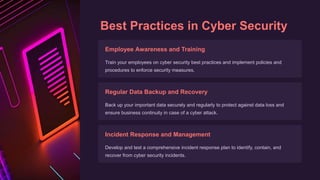
Best Practices in Cyber Security
Employee Awareness and Training
Train your employees on cyber security best practices and implement policies and
procedures to enforce security measures.
Regular Data Backup and Recovery
Back up your important data securely and regularly to protect against data loss and
ensure business continuity in case of a cyber attack.
Incident Response and Management
Develop and test a comprehensive incident response plan to identify, contain, and
recover from cyber security incidents.
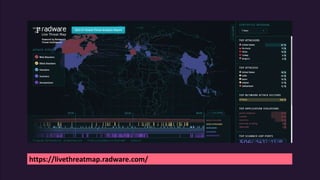
https://livethreatmap.radware.com/
Emerging Trends in Cybersecurity
Artificial Intelligence
(AI)
AI technologies can detect and
respond to evolving cyber
threats.
Internet of Things (IoT)
Securing the growing number
of connected devices is a
major challenge.
Cloud Computing
Securely managing data and
applications in cloud
environments requires robust
measures.
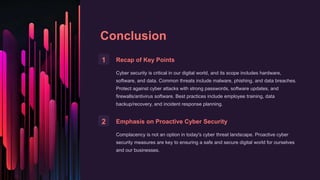
Conclusion
1 Recap of Key Points
Cyber security is critical in our digital world, and its scope includes hardware,
software, and data. Common threats include malware, phishing, and data breaches.
Protect against cyber attacks with strong passwords, software updates, and
firewalls/antivirus software. Best practices include employee training, data
backup/recovery, and incident response planning.
2 Emphasis on Proactive Cyber Security
Complacency is not an option in today's cyber threat landscape. Proactive cyber
security measures are key to ensuring a safe and secure digital world for ourselves
and our businesses.
Thanks!
Cybersecurity is an ongoing and evolving challenge. By understanding
the threats and implementing best practices, we can protect our digital
assets and maintain a secure digital ecosystem.

CYBERSECURITYcoll[1].pptx

  • 1.
    CYBERSECURITY Cybersecurity is crucialin today's digital world. Let's explore the importance of protecting our data, the types of threats we face, and how to stay secure. By G.L.Manikanta Sai(2301600176) T.Phaneendhar Reddy(2301600163) SK.Malik Basha(2301600161) MCA-C
  • 2.
    Proactive Cyber Security: Protecting YourDigital World In today's digital age, cyber security has become a crucial component of our online lives. Learn about the growing threats, common risks, and best practices to protect yourself and your company from cyber attacks.
  • 3.
    Understanding Cyber Security Definitionand Scope Cyber security refers to the protection of digital devices, information, and networks from unauthorized access, theft, and damage. Its scope includes hardware components, software applications, and data storage systems. Key Objectives and Principles The goals of cyber security are to ensure confidentiality, integrity, and availability of the information stored and transmitted. Its principles include risk assessment, defense in depth, and incident response. Growing Threats in the Digital Age Cyber attacks continue to increase in sophistication and frequency. From ransomware to social engineering, these threats pose serious risks to individuals and organizations alike.
  • 4.
    The Importance of Cybersecurity Inan interconnected world, cybersecurity is essential to protect sensitive information and prevent unauthorized access to systems and networks.
  • 5.
    Goals of CyberSecurity 1 Confidentiality Limiting data access. 2 Integrity Ensuring data is accurate. 3 Availability Making sure data is accessible to those who need it.
  • 6.
    Common Cyber SecurityThreats Malware and Viruses Malware is malicious software that is designed to damage, disrupt, or gain unauthorized access to a computer system. Viruses are a type of malware that can replicate itself and spread to other devices. Phishing Attacks Phishing is a social engineering technique that uses fake emails, websites, and messages to trick users into revealing sensitive information such as passwords or credit card numbers. Data Breaches A data breach is a security incident that involves the unauthorized access, theft, or exposure of sensitive information such as personal data, financial records, or intellectual property.
  • 7.
    Common Cybersecurity Vulnerabilities WeakPasswords Using weak or easily guessable passwords puts accounts at risk of being hacked. Unpatched Software Outdated software often has vulnerabilities that can be exploited by attackers. Insider Threats Employees or individuals with authorized access can intentionally or unintentionally cause security breaches.
  • 8.
    Protecting Against CyberAttacks 1 Strong Passwords and Authentication Create strong, unique passwords and enable two-factor authentication whenever possible to reduce the risk of unauthorized access. 2 Regular Software Updates Keep your software applications up to date with the latest security patches and bug fixes to prevent exploitable vulnerabilities. 3 Use of Firewalls and Antivirus Software Install and configure firewalls and antivirus software to detect and block malicious activities, such as network intrusions and virus infections.
  • 9.
    Best Practices inCyber Security Employee Awareness and Training Train your employees on cyber security best practices and implement policies and procedures to enforce security measures. Regular Data Backup and Recovery Back up your important data securely and regularly to protect against data loss and ensure business continuity in case of a cyber attack. Incident Response and Management Develop and test a comprehensive incident response plan to identify, contain, and recover from cyber security incidents.
  • 10.
  • 11.
    Emerging Trends inCybersecurity Artificial Intelligence (AI) AI technologies can detect and respond to evolving cyber threats. Internet of Things (IoT) Securing the growing number of connected devices is a major challenge. Cloud Computing Securely managing data and applications in cloud environments requires robust measures.
  • 12.
    Conclusion 1 Recap ofKey Points Cyber security is critical in our digital world, and its scope includes hardware, software, and data. Common threats include malware, phishing, and data breaches. Protect against cyber attacks with strong passwords, software updates, and firewalls/antivirus software. Best practices include employee training, data backup/recovery, and incident response planning. 2 Emphasis on Proactive Cyber Security Complacency is not an option in today's cyber threat landscape. Proactive cyber security measures are key to ensuring a safe and secure digital world for ourselves and our businesses.
  • 13.
    Thanks! Cybersecurity is anongoing and evolving challenge. By understanding the threats and implementing best practices, we can protect our digital assets and maintain a secure digital ecosystem.