Cybersecurity Threats &
Prevention in 2025:
Navigating a Complex
Digital Battlefield
KRISHA TRIVEDI23BIT241
The Rising Cybercrime Crisis: A $13.8 Trillion Threat
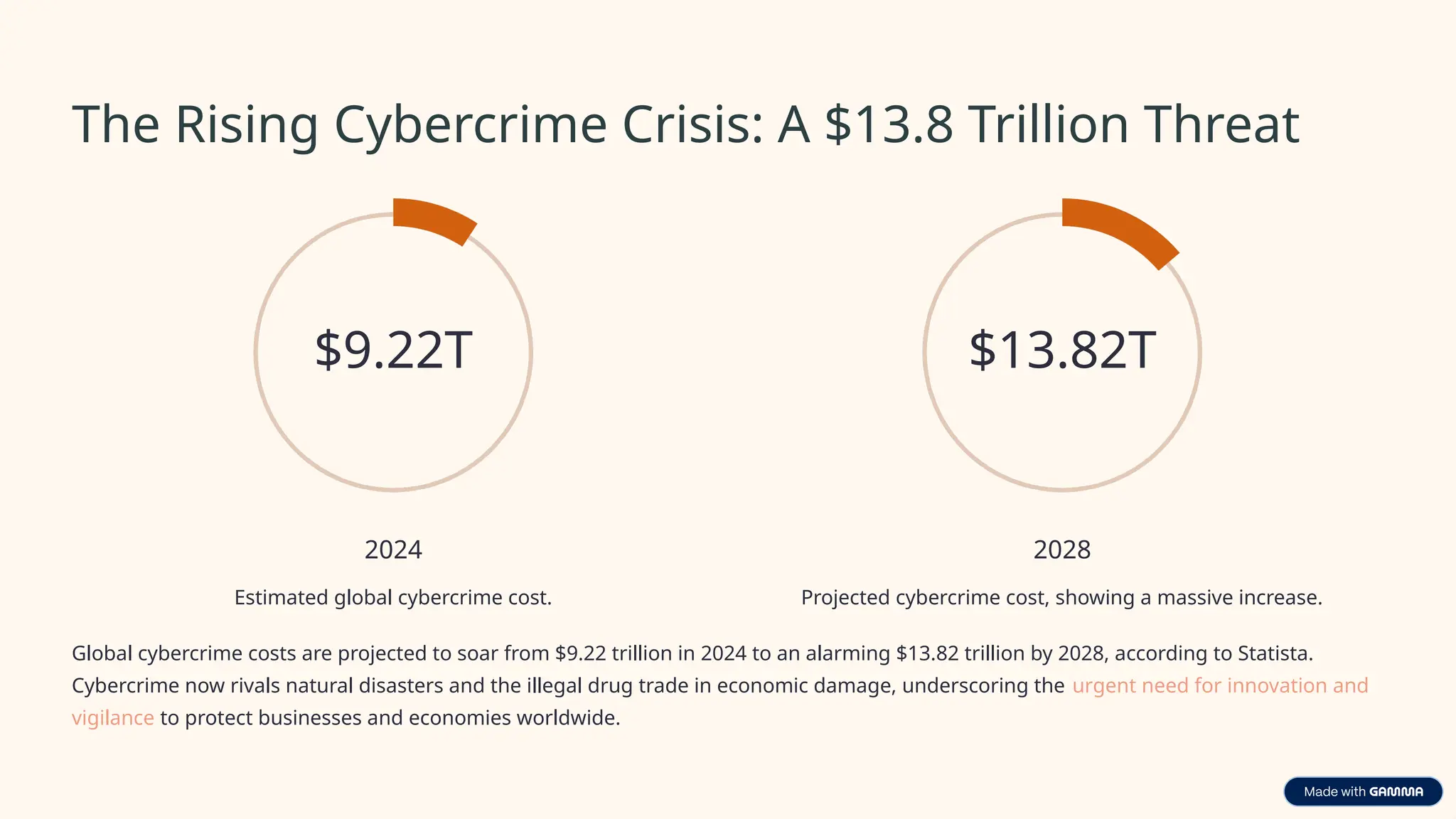
$9.22T
2024
Estimated global cybercrime cost.
$13.82T
2028
Projected cybercrime cost, showing a massive increase.
Global cybercrime costs are projected to soar from $9.22 trillion in 2024 to an alarming $13.82 trillion by 2028, according to Statista.
Cybercrime now rivals natural disasters and the illegal drug trade in economic damage, underscoring the urgent need for innovation and
vigilance to protect businesses and economies worldwide.
The New Face of Cyber Threats: AI-Powered Attacks
& Deepfakes
Automated Scaling
Cybercriminals harness AI to
automate and scale attack
vectors, deploying malicious
payloads and reconnaissance
faster than ever before.
Hyper-Realistic
Deception
Deepfake fraud and AI-
generated spear-phishing
emails are highly deceptive,
making it difficult for even
trained users to spot
anomalies.
State-Sponsored AI Use
For example, the North Korea-linked FAMOUS CHOLLIMA group is
leveraging generative AI to craft convincing insider threats and social
engineering campaigns.
Top 6 Cyber Threats Shaping 2025
Advanced Ransomware
Sophisticated attacks with "double extortion" targeting critical infrastructure and supply chains.
Supply Chain Attacks
Exploiting vulnerabilities in third-party vendors, creating widespread risk for customers.
AI-Enhanced Phishing
Highly personalized social engineering, including voice impersonation via deepfakes.
Fileless Malware
Stealthy, multi-stage campaigns that live off the land and evade traditional endpoint detection.
IoT Device Exploitation
Insecure connected devices expanding the attack surface for large-scale network breaches.
Nation-State Espionage
Cyber campaigns aimed at espionage, economic disruption, and political interference.
The Human Factor: Social Engineering & Insider
Threats
Deception Tactics
79% of malware detections are
now "malware-free," meaning
attacks rely on deception and
system tools rather than file-
based executables (CrowdStrike).
Phishing Gateway
Phishing remains the primary
gateway for breaches. Its
effectiveness is amplified by
AI-driven personalization,
making targets more
susceptible.
Internal Risks
Insider threats, whether
malicious or accidental, account
for approximately 40% of notable
cyber incidents globally.
Continuous employee training and awareness programs are the most critical defense against attacks that target human
vulnerabilities.
Prevention Strategies: Building a Resilient Cyber Defense
Continuous Monitoring
Implement AI-driven continuous monitoring and behavioral analytics to detect subtle anomalies that signal a breach in progress.
Zero Trust Architecture
Enforce network segmentation and utilize immutable, secure offline backups to effectively limit the lateral spread and impact of ransomware attacks.
Strict Access Control
Mandate Multi-Factor Authentication (MFA) and deploy advanced email filtering with sandboxing to neutralize sophisticated phishing attempts.
Supply Chain Vetting
Conduct regular, comprehensive vendor risk assessments to mitigate vulnerabilities introduced by third-party partnerships.
Preparedness & Recovery
Develop detailed incident response plans and secure appropriate cyber insurance policies as vital financial and operational safeguards.
Case Study: Thwarting a Ransomware Attack
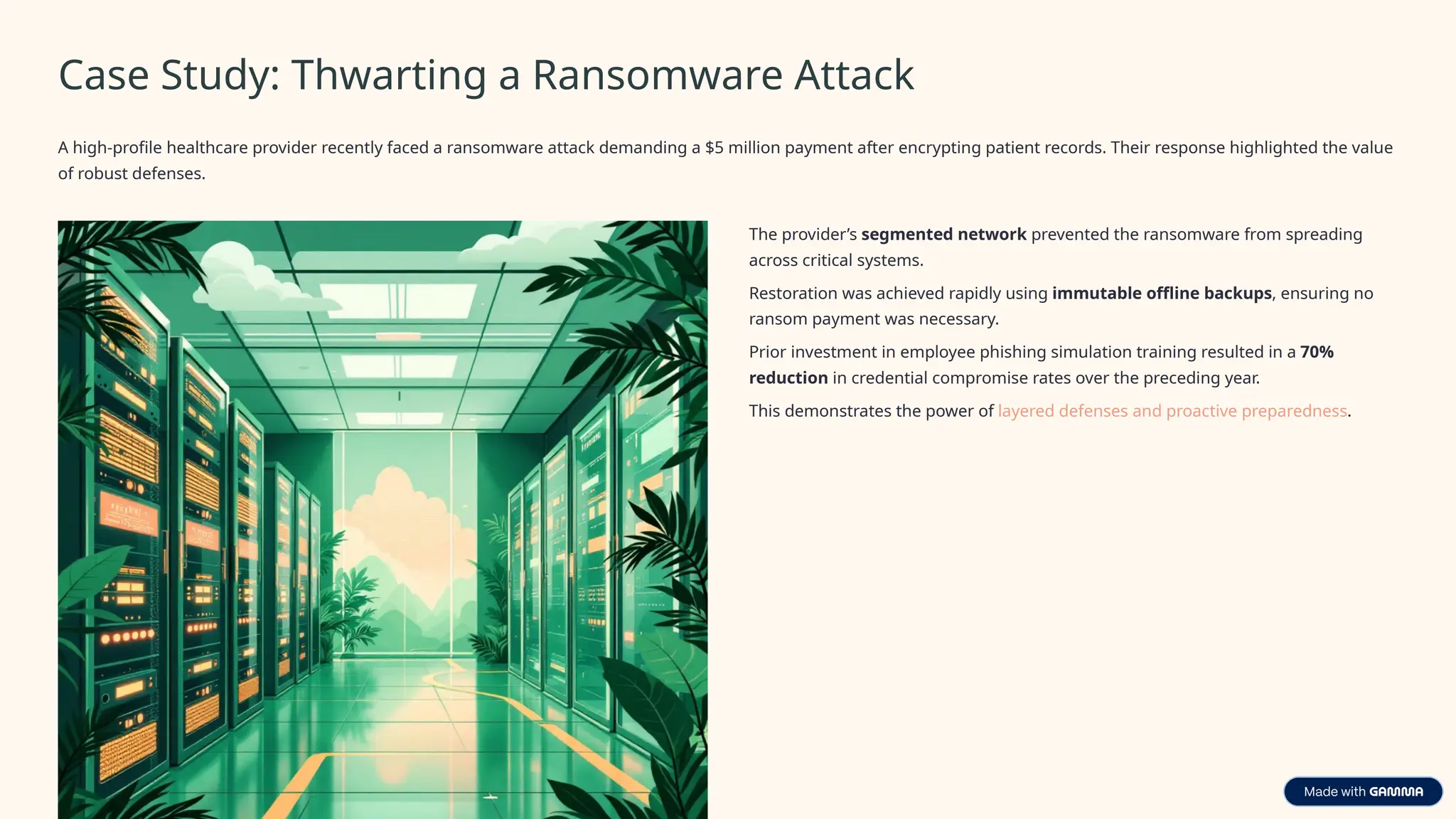
A high-profile healthcare provider recently faced a ransomware attack demanding a $5 million payment after encrypting patient records. Their response highlighted the value
of robust defenses.
The provider’s segmented network prevented the ransomware from spreading
across critical systems.
Restoration was achieved rapidly using immutable offline backups, ensuring no
ransom payment was necessary.
Prior investment in employee phishing simulation training resulted in a 70%
reduction in credential compromise rates over the preceding year.
This demonstrates the power of layered defenses and proactive preparedness.
The AI Arms Race: Defenders vs. Adversaries
Cybercriminals Security Teams
AI-driven incident response
Real-time anomaly detection
Automated exploit chains
AI-generated phishing
As cybercriminals accelerate their attacks using AI-generated content and automation, security teams must counter with their own AI and Machine Learning (ML) tools for
real-time threat detection, rapid response, and predictive analytics.
The Future Outlook: Complexity & Collaboration
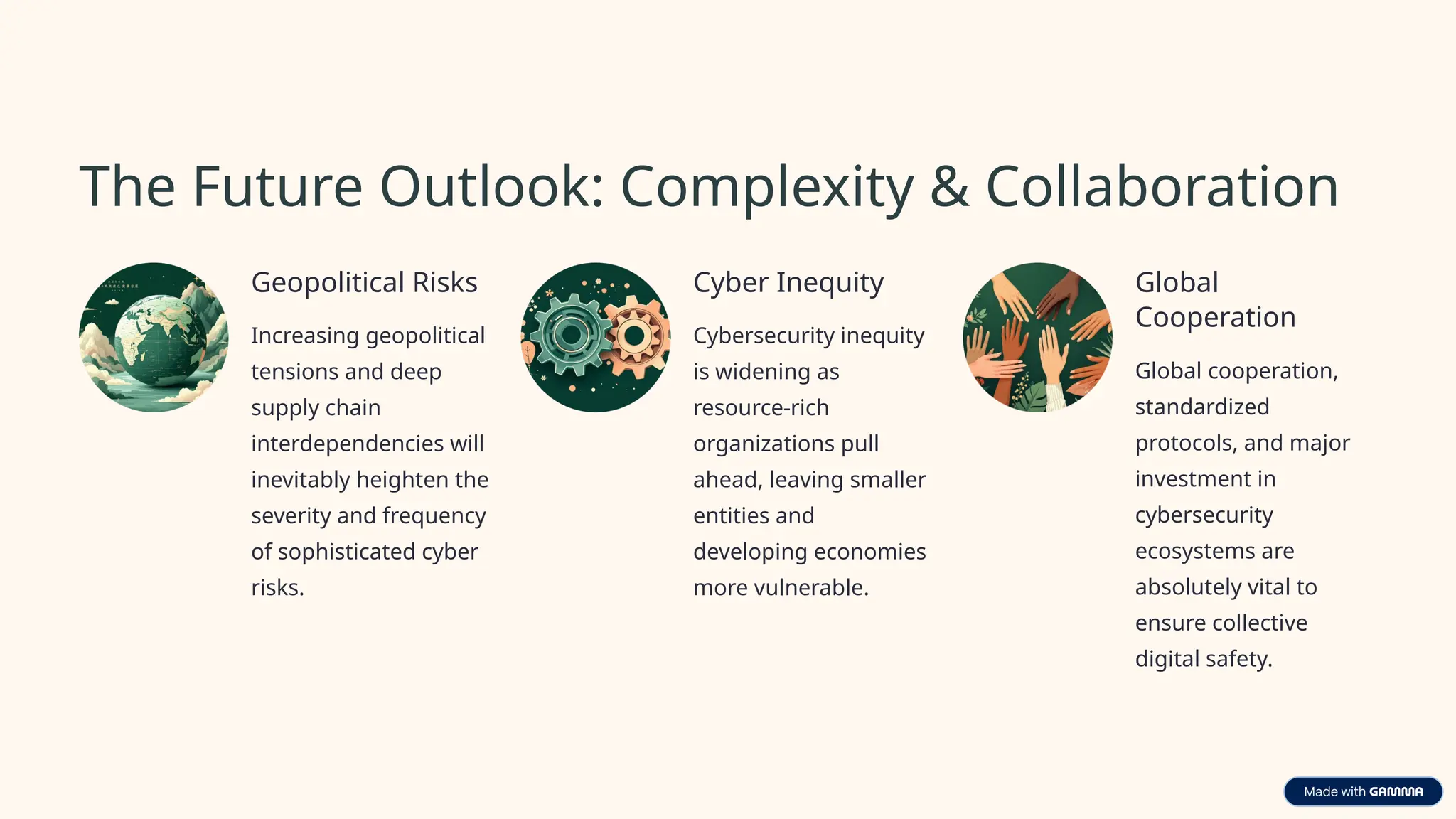
Geopolitical Risks
Increasing geopolitical
tensions and deep
supply chain
interdependencies will
inevitably heighten the
severity and frequency
of sophisticated cyber
risks.
Cyber Inequity
Cybersecurity inequity
is widening as
resource-rich
organizations pull
ahead, leaving smaller
entities and
developing economies
more vulnerable.
Global
Cooperation
Global cooperation,
standardized
protocols, and major
investment in
cybersecurity
ecosystems are
absolutely vital to
ensure collective
digital safety.
Conclusion: Empower Your Organization
The Time to Act is Now
• Understand the evolving threat landscape and invest strategically in AI-powered defense mechanisms.
• Prioritize employee security training and rigorous supply chain risk management.
• Embrace continuous monitoring, robust backup solutions, and comprehensive incident preparedness.
By working together, organizations can turn the tide in the escalating cyber war and safeguard the benefits of digital
transformation for everyone.

Cybersecurity-Threats-and-Prevention 2025

  • 1.
    Cybersecurity Threats & Preventionin 2025: Navigating a Complex Digital Battlefield KRISHA TRIVEDI23BIT241
  • 2.
    The Rising CybercrimeCrisis: A $13.8 Trillion Threat $9.22T 2024 Estimated global cybercrime cost. $13.82T 2028 Projected cybercrime cost, showing a massive increase. Global cybercrime costs are projected to soar from $9.22 trillion in 2024 to an alarming $13.82 trillion by 2028, according to Statista. Cybercrime now rivals natural disasters and the illegal drug trade in economic damage, underscoring the urgent need for innovation and vigilance to protect businesses and economies worldwide.
  • 3.
    The New Faceof Cyber Threats: AI-Powered Attacks & Deepfakes Automated Scaling Cybercriminals harness AI to automate and scale attack vectors, deploying malicious payloads and reconnaissance faster than ever before. Hyper-Realistic Deception Deepfake fraud and AI- generated spear-phishing emails are highly deceptive, making it difficult for even trained users to spot anomalies. State-Sponsored AI Use For example, the North Korea-linked FAMOUS CHOLLIMA group is leveraging generative AI to craft convincing insider threats and social engineering campaigns.
  • 4.
    Top 6 CyberThreats Shaping 2025 Advanced Ransomware Sophisticated attacks with "double extortion" targeting critical infrastructure and supply chains. Supply Chain Attacks Exploiting vulnerabilities in third-party vendors, creating widespread risk for customers. AI-Enhanced Phishing Highly personalized social engineering, including voice impersonation via deepfakes. Fileless Malware Stealthy, multi-stage campaigns that live off the land and evade traditional endpoint detection. IoT Device Exploitation Insecure connected devices expanding the attack surface for large-scale network breaches. Nation-State Espionage Cyber campaigns aimed at espionage, economic disruption, and political interference.
  • 5.
    The Human Factor:Social Engineering & Insider Threats Deception Tactics 79% of malware detections are now "malware-free," meaning attacks rely on deception and system tools rather than file- based executables (CrowdStrike). Phishing Gateway Phishing remains the primary gateway for breaches. Its effectiveness is amplified by AI-driven personalization, making targets more susceptible. Internal Risks Insider threats, whether malicious or accidental, account for approximately 40% of notable cyber incidents globally. Continuous employee training and awareness programs are the most critical defense against attacks that target human vulnerabilities.
  • 6.
    Prevention Strategies: Buildinga Resilient Cyber Defense Continuous Monitoring Implement AI-driven continuous monitoring and behavioral analytics to detect subtle anomalies that signal a breach in progress. Zero Trust Architecture Enforce network segmentation and utilize immutable, secure offline backups to effectively limit the lateral spread and impact of ransomware attacks. Strict Access Control Mandate Multi-Factor Authentication (MFA) and deploy advanced email filtering with sandboxing to neutralize sophisticated phishing attempts. Supply Chain Vetting Conduct regular, comprehensive vendor risk assessments to mitigate vulnerabilities introduced by third-party partnerships. Preparedness & Recovery Develop detailed incident response plans and secure appropriate cyber insurance policies as vital financial and operational safeguards.
  • 7.
    Case Study: Thwartinga Ransomware Attack A high-profile healthcare provider recently faced a ransomware attack demanding a $5 million payment after encrypting patient records. Their response highlighted the value of robust defenses. The provider’s segmented network prevented the ransomware from spreading across critical systems. Restoration was achieved rapidly using immutable offline backups, ensuring no ransom payment was necessary. Prior investment in employee phishing simulation training resulted in a 70% reduction in credential compromise rates over the preceding year. This demonstrates the power of layered defenses and proactive preparedness.
  • 8.
    The AI ArmsRace: Defenders vs. Adversaries Cybercriminals Security Teams AI-driven incident response Real-time anomaly detection Automated exploit chains AI-generated phishing As cybercriminals accelerate their attacks using AI-generated content and automation, security teams must counter with their own AI and Machine Learning (ML) tools for real-time threat detection, rapid response, and predictive analytics.
  • 9.
    The Future Outlook:Complexity & Collaboration Geopolitical Risks Increasing geopolitical tensions and deep supply chain interdependencies will inevitably heighten the severity and frequency of sophisticated cyber risks. Cyber Inequity Cybersecurity inequity is widening as resource-rich organizations pull ahead, leaving smaller entities and developing economies more vulnerable. Global Cooperation Global cooperation, standardized protocols, and major investment in cybersecurity ecosystems are absolutely vital to ensure collective digital safety.
  • 10.
    Conclusion: Empower YourOrganization The Time to Act is Now • Understand the evolving threat landscape and invest strategically in AI-powered defense mechanisms. • Prioritize employee security training and rigorous supply chain risk management. • Embrace continuous monitoring, robust backup solutions, and comprehensive incident preparedness. By working together, organizations can turn the tide in the escalating cyber war and safeguard the benefits of digital transformation for everyone.