Tool-supported	Collaborative	
Requirements	Prioritisation
P.	Busetta,	F.	M.	Kifetew,	D.	Muñante,	A.	Perini,	A.	Siena,	A.	Susi
6	July	2017
COMPSAC	2017
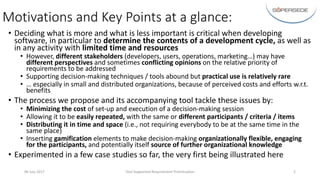
Motivations	and	Key	Points at	a	glance:
• Deciding	what	is	more	and	what	is	less	important	is	critical	when	developing	
software,	in	particular	to	determine	the	contents	of	a	development	cycle,	as	well	as	
in	any	activity	with	limited	time	and	resources
• However,	different	stakeholders	(developers,	users,	operations,	marketing…)	may	have	
different	perspectives	and	sometimes	conflicting	opinions	on	the	relative	priority	of	
requirements	to	be	addressed
• Supporting	decision-making	techniques	/	tools	abound	but	practical	use	is	relatively	rare
• … especially	in	small	and	distributed	organizations,	because	of	perceived	costs	and	efforts	w.r.t.	
benefits
• The	process	we	propose	and	its	accompanying	tool	tackle	these	issues	by:
• Minimizing	the	cost	of	set-up	and	execution	of	a	decision-making	session
• Allowing	it	to	be	easily repeated,	with	the	same	or	different	participants	/	criteria	/	items
• Distributing	it	in	time	and	space	(i.e.,	not	requiring	everybody	to	be	at	the	same	time	in	the	
same	place)
• Inserting	gamification elements	to	make	decision-making	organizationally	flexible,	engaging	
for	the	participants,	and	potentially	itself	source	of	further	organizational	knowledge
• Experimented	in	a	few	case	studies	so	far,	the	very	first	being	illustrated	here
06	July	2017 Tool-Supported	Requirement	Prioritisation 2
Outline
• Context:	Involving	the	end-users	directly	in	the	loop	and	fostering	
collaboration	within	the	development	team	and	with	stakeholders
• Introducing	gamification	in	the	process
• An	experiment:	configuration	and	conclusions
• Current	state	and	Future	work	
06	July	2017 Tool-Supported	Requirement	Prioritisation 3
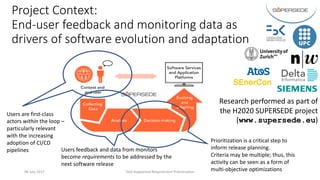
Project	Context:	
End-user	feedback	and	monitoring	data	as	
drivers	of	software	evolution	and	adaptation
06	July	2017 Tool-Supported	Requirement	Prioritisation 4
Users	are	first-class		
actors	within the	loop	–
particularly	relevant	
with	the	increasing	
adoption	of	CI/CD	
pipelines
Prioritization	is	a	critical	step	to	
inform	release	planning.	
Criteria	may	be	multiple;	thus,	this	
activity	can	be	seen	as	a	form	of	
multi-objective	optimizations
Research	performed	as	part	of	
the	H2020	SUPERSEDE	project	
(www.supersede.eu)
Users	feedback	and	data	from	monitors	
become	requirements to	be	addressed	by	the	
next	software	release
Prioritizing	in	a	collaborative	environment
• Collaboration	is	required	to	capture	different	perspectives	on	a	product,	as	
well	as	different	competences	and	experience	within	a	team
• The	process	(and	its	accompanying	tool)	should	allow	the	involvement	of	
decision-makers	that do	not	cover	any	traditional,	organization-
determined	role
• Which	may	include	more	than	the	sole	“product	owner”	(in	SCRUM	terminology)
• This	is	even	more	important	if	end-users	“sit	at	the	table”,	not	just	by	providing	
feedback	but,	indeed,	participating	to	the	decision-making	process
• On	the	other	side,	how	to	keep	participants	engaged,	willing	to	
participate?
• Especially	non-developers	or	others	that	do	not	have	a	specific	duty	in	the	
organization
06	July	2017 Tool-Supported	Requirement	Prioritisation 5
Gamifying	the	process	(1/2)
”Gamification”	simply	means	“introducing	elements	typical	of	games”	for	various	
purposes,	typically	to	make	a	process	smoother	and	more	engaging.	
We	took	a	few	to	address	the	requirements	identified	before:
• Multiple	roles	with	different	allowed	actions.	They	are	unrelated to	any	
organizational	structure,	just	local	to	a	specific	(game)	session
• Identified	so	far	are	supervisor,	opinion	provider,	negotiator,	the	latter	introducing	a	whole	
world	of	(potentially	rich)	interactions	among	players	that	goes	beyond	the	deterministic	
results	of	a	technique	or	algorithm
• A	non-linear	workflow,	where	moving	from	one	phase	to	another	is	determined	
either	by	(game)	logic	or	by	a	specific	role	while,	within	each	phase,	all	roles	
involved	can	play	their	actions	in	an	arbitrary	order	and	possibly	multiple	times
• Identified	so	far	are	(1)	set-up,	(2)	opinion	provision	and	negotiation,	(3)	closure.	Set-up	and	
closure	are	currently	for	the	supervisor	only	(but	could	be	automated	e.g.	with	reasoning	
about	the	state	of	the	game),	while	the	middle	phase	is	for	all	other	players
06	July	2017 Tool-Supported	Requirement	Prioritisation 6
Gamifying	the	process	(2/2)
• Playfulness (how	much	one	is	“entertained”	by	the	system),	to	be	introduced	in	
various	ways.	We	experimented	with:
• Competition and	Reward by	means	of	points-ification (i.e.	collection	of	points	according	to	
the	actions	performed	and	their	modality	of	execution,	in	turn	leading	to	the	introduction	of	
leaderboards,	badges	and	so	on)
• Time	pressure is	both	the	results	of	points-ification (the	faster	one	plays,	the	more	points	one	
collects)	and	by	the	bare	psychological	trick	of	showing	a	clock	ticking
• Lightweight-ness	of	gameplay	(i.e.	the	simplicity	and	speed	at	which	players	can	perform	their	
actions),	not	only	to	improve	playfulness	but	to	support	repeatability
• Easy	repeatability,	enabling	multiple	runs	with	the	same	or	different	stakeholders	
(participants),	the	same	or	different	sets	of	requirements,	the	same	or	different	
sets	of	prioritization	criteria,	and	so	on
• Further,	the	introduction	of	some	form	of	KPIs	(e.g.,	points	could	be	computed	
according	to	various	criteria	and	kept	separated)	may	be	exploited	to	let	
competence	and	engagement	emerge	over	time
06	July	2017 Tool-Supported	Requirement	Prioritisation 7
GRP	(Gamified	collaborative	Requirements	
Prioritisation):	Experimental	set-up
• The	experimented	process	is	based	on	the	well	known	AHP (Analytic	Hierarchy	Process)
• Pairwise	comparisons:	decision-maker	expresses	which	one	of	two	items	(requirements	in	our	case)	is	
preferred	according	to	a	specific	criterion	(e.g.	user	value,	development	complexity,	…)
• 9-value	scale	used	to	express	preferences,	ranging	from	“A	is	greatly	preferred	to	B”	to	“indifferent”	to	
“B	is	greatly	preferred	to	A”.
• Number	of	comparisons	=	½	items2 *	criteria
• But,	a	stopping criteria	can	be	imposed,	and	supervisor	may	decide	to	stop	anyway.	Computations	can	use	partial	
data
• All	opinion	providers	can	express	their	preferences	on	all	requirements.	Negotiation is	
automatically	requested	by	the	system	when	two	or	more	players	have	strongly	different	
opinions	(contrasting	preferences	exceed	a	threshold)
• Resolution	currently	implemented	as	negotiator	expressing	final	opinion	or	ignoring	and	letting	the	
underlying	computations	use	averages
• The	tool	provides	a	Web	interface.	Players	can	intervene	from	any	location	at	their	
leisure	but	within	a	time	window	defined	by	the	supervisor
• Gamification	thus	included	many	playfulness	aspects,	but	no	points-ification (competition	&	rewards)	
for	the	experiment	reported	here
06	July	2017 Tool-Supported	Requirement	Prioritisation 8
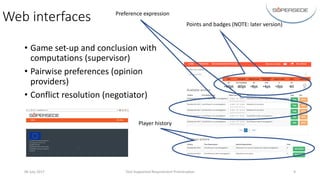
Web	interfaces
• Game	set-up	and	conclusion	with	
computations	(supervisor)
• Pairwise	preferences	(opinion	
providers)
• Conflict	resolution	(negotiator)
06	July	2017 Tool-Supported	Requirement	Prioritisation 9
Points	and	badges	(NOTE:	later	version)
Preference	expression
Player	history
The	experiment:	data	and	characteristics
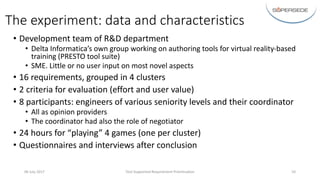
• Development	team	of	R&D	department
• Delta	Informatica’s own	group	working	on	authoring	tools	for	virtual	reality-based	
training	(PRESTO	tool	suite)
• SME.	Little	or	no	user	input	on	most	novel	aspects
• 16	requirements,	grouped	in	4	clusters
• 2	criteria	for	evaluation	(effort	and	user	value)
• 8	participants:	engineers	of	various	seniority	levels	and	their	coordinator
• All	as	opinion	providers
• The	coordinator	had	also	the	role	of	negotiator
• 24	hours	for	“playing”	4	games	(one	per	cluster)
• Questionnaires	and	interviews	after	conclusion
06	July 2017 Tool-Supported	Requirement	Prioritisation 10
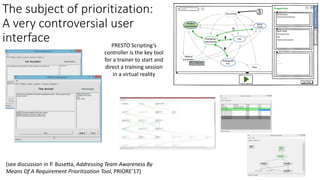
The	subject	of	prioritization:
A	very	controversial	user	
interface PRESTO	Scripting’s	
controller	is	the	key	tool	
for	a	trainer	to	start	and	
direct	a	training	session
in	a	virtual	reality
(see	discussion	in	P.	Busetta,	Addressing	Team	Awareness	By	
Means	Of	A	Requirement	Prioritization	Tool,	PRIORE’17)
Results	from	the	experiment
• GRP	perceived	as	effective for	reaching	acceptable	decisions	in	an	efficient
manner
• Participants	agreed	to	a	high	degree	with	the	final	outcome	of	the	process	for	all	
clusters	of	requirements
• This	in	spite	of	a	high	level	of	disagreement	in	pairwise	preferences
• The	comparisons	of	GRP	outcomes	before	and	after	the	negotiator’s	intervention	
showed	that	the	negotiator	plays	an	important	role in	managing	conflicting	
preferences,	affecting	results
• Reported	advantages	include	the	ability	to	track	decisions
• Suggested	potential	improvements	include	mechanisms	for	“live	
communication”	during	gameplay
• The	measured	time	required	to	express	preferences	is	quite	short
06	July	2017 Tool-Supported	Requirement	Prioritisation 12
Current	state
• Improved	prototype	and	extended	scope	of	process
• Points-ifcation fully	supported	
• Prioritization	techniques	alternative	to	AHP	have	been	introduced,	most	importantly	non-
pairwise	comparisons	(using	GAs	to	compute	agreements,	measuring	individual	choice’s	
distance	from	group’s	consensus,	…)
• Revised	the	entire	process	to	give	more	importance	to	the	supervisor	and	to	introduce	
planning	tools,	e.g.	to	select	the	most	suitable	algorithm	/	technique,	to	decide	how	many	
games	to	play	and	with	which	participants,	and	so	on
• Tried	out	in	other	experiments	and	validated	against	the	project’s	use	
cases
• Results	available	as	project’s	reports
• Overall,	approach	always	well	received
06	July	2017 Tool-Supported	Requirement	Prioritisation 13
Future	directions
• Integration	of	prioritization	process	with	some	existing	approach	/	
methodology
• Looking	in	particular	at	SCRUM	and	at	its	Sprints’	“backlog”	selection	and	
“planning”	meeting
• Integration	of	prioritization	tool	as	plug-in	of	market	tools
• Currently,	developing	plug-ins	for	Atlassian’s JIRA,	extending	its	Agile	tools
06	July	2017 Tool-Supported	Requirement	Prioritisation 14
06	July	2017 Tool-Supported	Requirement	Prioritisation 15
Thanks	for	your	attention!

Tool-supported Collaborative Requirements Prioritisation