TOMOYO Linux on Android
                                             CE Linux Forum
                                          Japan Technical Jamboree 28
                                              Osaka, 2009/06/12


     Giuseppe La Tona
     giuseppelatona@gmail.com

Copyright (C) 2009 NTT Data Corporation                        Android Goodies image is reproduced from work created and shared by Google and
                                                               used according to terms described in the Creative Commons 2.5 Attribution License
About me…

• Master Degree in Computer Engineering
  University of Catania (Italy), 2008
                                                                                        Università degli
   – Exchange student in Linköping University (Sweden), 2007                            Studi di Catania


• “Vulcanus in Japan” (Sep. 2008 – Aug. 2009)
  programme of the EU-Japan Centre for Industrial Cooperation
   – Industrial placement-oriented student exchange
   – Scholarship offered by EU and Japanese METI
   – Japanese language intensive course , cultural activities
   – Internship in NTT Data Corporation (R&D)
      (January-August 2009)


   Learning and experiencing Japanese culture, lifestyle, working way!

                    TOMOYO Linux on Android - Copyright (C) 2009 NTT Data Corporation                      2
About my internship…

• Secure OS group
   – TOMOYO Linux project

• R&D:
   – Study
     • Mandatory Access Control (MAC)
     • TOMOYO Linux
  – Porting TOMOYO Linux to Android platform
  – Analyze TOMOYO and MAC potentials on embedded Linux

                                                           Android Robot is reproduced from work created and shared by Google and used
                                                             according to terms described in the Creative Commons 2.5 Attribution License


             TOMOYO Linux on Android - Copyright (C) 2009 NTT Data Corporation                                                        3
TOMOYO Linux

• MAC implementation for Linux Operating Systems
   – pathname-based approach

• It consists of:
   – a kernel patch (ccspatch)
   – a set of utilities (ccstools), for management and
     security policy editing

• TOMOYO Linux 2.2.0 has just been merged in
  Linux kernel 2.6.30 (10 June 2009)!

             TOMOYO Linux on Android - Copyright (C) 2009 NTT Data Corporation   4
Android overview

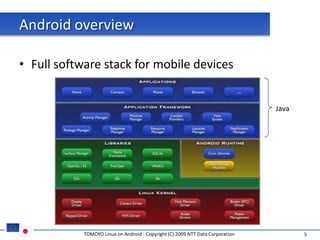
• Full software stack for mobile devices


                                                                                Java


            TOMOYO Linux on Android - Copyright (C) 2009 NTT Data Corporation          5
Android kernel

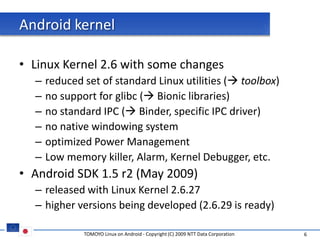
• Linux Kernel 2.6 with some changes
  –   reduced set of standard Linux utilities ( toolbox)
  –   no support for glibc ( Bionic libraries)
  –   no standard IPC ( Binder, specific IPC driver)
  –   no native windowing system
  –   optimized Power Management
  –   Low memory killer, Alarm, Kernel Debugger, etc.
• Android SDK 1.5 r2 (May 2009)
  – released with Linux Kernel 2.6.27
  – higher versions being developed (2.6.29 is ready)

              TOMOYO Linux on Android - Copyright (C) 2009 NTT Data Corporation   6
Android from boot to user (1/2)


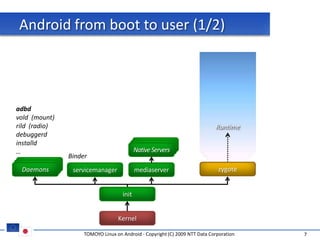
adbd
vold (mount)
rild (radio)                                                                Runtime
debuggerd
installd                                          init
                                                 init
                                           Native Servers
…
               Binder
     init
    init
 Daemons        servicemanager             mediaserver                        zygote


                                    init


                                  Kernel

                    TOMOYO Linux on Android - Copyright (C) 2009 NTT Data Corporation   7
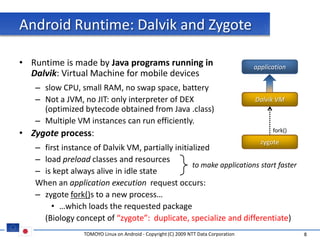
Android Runtime: Dalvik and Zygote

• Runtime is made by Java programs running in                                        application
  Dalvik: Virtual Machine for mobile devices
   – slow CPU, small RAM, no swap space, battery
   – Not a JVM, no JIT: only interpreter of DEX                                      Dalvik VM
     (optimized bytecode obtained from Java .class)
   – Multiple VM instances can run efficiently.
• Zygote process:                                                                          fork()
                                                                                       zygote
   – first instance of Dalvik VM, partially initialized
   – load preload classes and resources
                                                  to make applications start faster
   – is kept always alive in idle state
   When an application execution request occurs:
   – zygote fork()s to a new process…
       • …which loads the requested package
     (Biology concept of “zygote”: duplicate, specialize and differentiate)
                 TOMOYO Linux on Android - Copyright (C) 2009 NTT Data Corporation                  8
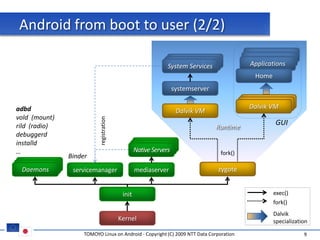
Android from boot to user (2/2)
                                                                                             service manager
                                                                service manager             service manager
                                                               service manager
                                                               System Services                Applications
                                                                                               Home
                                                                   systemserver
                                                                                              Dalvik VM
                                                                                              Dalvik VM
adbd                                                                                         Dalvik VM
                                                                    Dalvik VM
vold (mount)
                           registration


rild (radio)                                                                                          GUI
                                                                                  Runtime
debuggerd
installd                                                 init
                                                        init
                                                  Native Servers
…                                                                                  fork()
               Binder
     init
    init
 Daemons        servicemanager                    mediaserver                     zygote


                                           init                                                       exec()
                                                                                                      fork()
                                                                                                      Dalvik
                                          Kernel                                                      specialization

                    TOMOYO Linux on Android - Copyright (C) 2009 NTT Data Corporation                             9
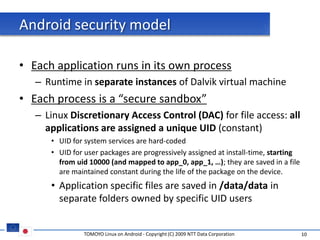
Android security model

• Each application runs in its own process
   – Runtime in separate instances of Dalvik virtual machine
• Each process is a “secure sandbox”
   – Linux Discretionary Access Control (DAC) for file access: all
     applications are assigned a unique UID (constant)
      • UID for system services are hard-coded
      • UID for user packages are progressively assigned at install-time, starting
        from uid 10000 (and mapped to app_0, app_1, …); they are saved in a file
        are maintained constant during the life of the package on the device.
      • Application specific files are saved in /data/data in
        separate folders owned by specific UID users


                TOMOYO Linux on Android - Copyright (C) 2009 NTT Data Corporation    10
Porting TOMOYO Linux to Android

• Patching Android kernel with TOMOYO patch

• Adapting TOMOYO ccstools for embedded purposes

• Cross-compiling for Android

• Integrating TOMOYO Policy Loader in Android boot

• TOMOYO policy files location


            TOMOYO Linux on Android - Copyright (C) 2009 NTT Data Corporation   11
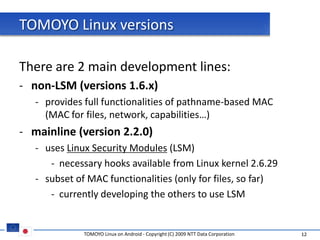
TOMOYO Linux versions

There are 2 main development lines:
- non-LSM (versions 1.6.x)
   - provides full functionalities of pathname-based MAC
     (MAC for files, network, capabilities…)
- mainline (version 2.2.0)
   - uses Linux Security Modules (LSM)
      - necessary hooks available from Linux kernel 2.6.29
   - subset of MAC functionalities (only for files, so far)
      - currently developing the others to use LSM


              TOMOYO Linux on Android - Copyright (C) 2009 NTT Data Corporation   12
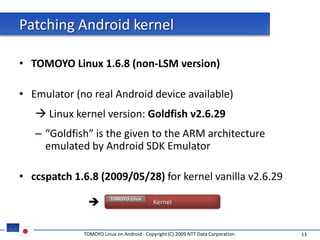
Patching Android kernel

• TOMOYO Linux 1.6.8 (non-LSM version)

• Emulator (no real Android device available)
    Linux kernel version: Goldfish v2.6.29
   – “Goldfish” is the given to the ARM architecture
     emulated by Android SDK Emulator

• ccspatch 1.6.8 (2009/05/28) for kernel vanilla v2.6.29

                       TOMOYO Linux
                                          Kernel


             TOMOYO Linux on Android - Copyright (C) 2009 NTT Data Corporation   13
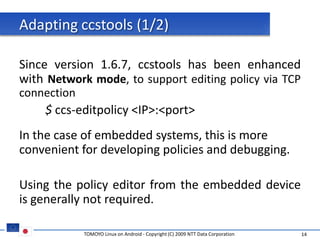
Adapting ccstools (1/2)

Since version 1.6.7, ccstools has been enhanced
with Network mode, to support editing policy via TCP
connection
    $ ccs-editpolicy <IP>:<port>
In the case of embedded systems, this is more
convenient for developing policies and debugging.

Using the policy editor from the embedded device
is generally not required.

             TOMOYO Linux on Android - Copyright (C) 2009 NTT Data Corporation   14
Adapting ccstools (2/2)

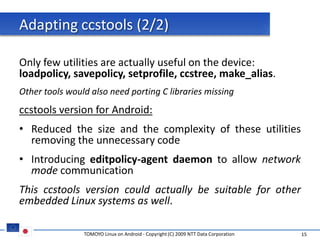
Only few utilities are actually useful on the device:
loadpolicy, savepolicy, setprofile, ccstree, make_alias.
Other tools would also need porting C libraries missing
ccstools version for Android:
• Reduced the size and the complexity of these utilities
  removing the unnecessary code
• Introducing editpolicy-agent daemon to allow network
  mode communication
This ccstools version could actually be suitable for other
embedded Linux systems as well.

                TOMOYO Linux on Android - Copyright (C) 2009 NTT Data Corporation   15
Cross-compiling for Android

• C libraries used by Android: Bionic
    – no glibc

• Toolchain
    – suite of cross-compilers for different architectures

• agcc (Perl script by Andrew Ross http://plausible.org/andy/agcc)
    – simple gcc-like front-end to compile C programs for Android
    – links Android libraries (needs Android source)
    – uses the appropriate cross-compiler from the Android
      Toolchain

                 TOMOYO Linux on Android - Copyright (C) 2009 NTT Data Corporation   16
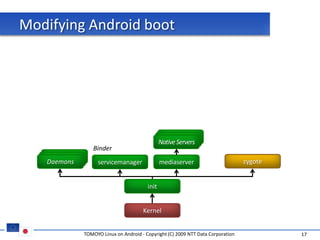
Modifying Android boot


                                                       init
                                                      init
                                                Native Servers
                 Binder
       init
      init
   Daemons          servicemanager              mediaserver                       zygote


                                         init


                                       Kernel


              TOMOYO Linux on Android - Copyright (C) 2009 NTT Data Corporation            17
Modifying Android boot

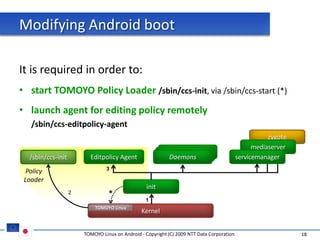
It is required in order to:
• start TOMOYO Policy Loader /sbin/ccs-init, via /sbin/ccs-start (*)
• launch agent for editing policy remotely
   /sbin/ccs-editpolicy-agent
                                                                                                       zygote
                                                                                                  mediaserver
                                                              Daemons
                                                             Daemons
   /sbin/ccs-init         Editpolicy Agent                  Daemons                         servicemanager
                                 3
  Policy
 Loader
                                                  init
                    2
                                  *               1
                            TOMOYO Linux
                                                Kernel


                        TOMOYO Linux on Android - Copyright (C) 2009 NTT Data Corporation                       18
TOMOYO policy files location (1/2)

• /data/ccs/ (at the moment)

• /data is…
  – …a readwrite partition
  – …allowed to be empty at Android boot time
  – …supposed to be wiped off if Android device is
    reset to factory default state
Not a safe place for security policy files?
  – a reset would delete them!

            TOMOYO Linux on Android - Copyright (C) 2009 NTT Data Corporation   19
TOMOYO policy files location (2/2)

A possible solution: split policy files for…
• prebuilt firmware applications
   in /system readonly partition (i.e. /system/ccs)
• other applications downloaded/installed later
   in /data readwrite partition (i.e. /data/ccs)
  – application-specific policies could be saved at
    application install-time, in /data
  – any eventual reset will wipe off those policies, but the
    related applications as well.

            TOMOYO Linux on Android - Copyright (C) 2009 NTT Data Corporation   20
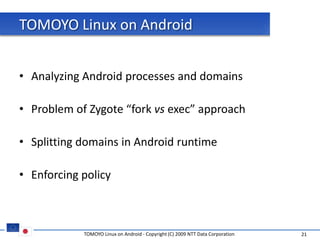
TOMOYO Linux on Android


• Analyzing Android processes and domains

• Problem of Zygote “fork vs exec” approach

• Splitting domains in Android runtime

• Enforcing policy


            TOMOYO Linux on Android - Copyright (C) 2009 NTT Data Corporation   21
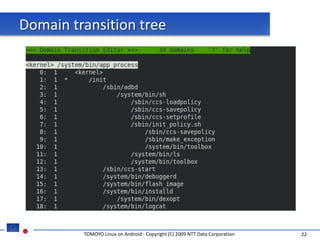
Domain transition tree


         TOMOYO Linux on Android - Copyright (C) 2009 NTT Data Corporation   22
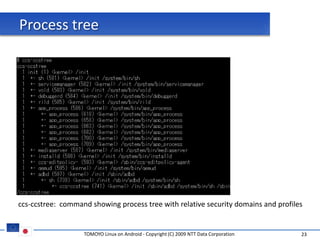
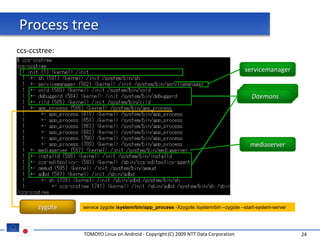
Process tree


ccs-ccstree: command showing process tree with relative security domains and profiles


                   TOMOYO Linux on Android - Copyright (C) 2009 NTT Data Corporation   23
Process tree
ccs-ccstree:

                                                                                      servicemanager


                                                                                             init
                                                                                            init
                                                                                         Daemons


                                                                                         mediaserver


      zygote   service zygote /system/bin/app_process -Xzygote /system/bin --zygote --start-system-server


               TOMOYO Linux on Android - Copyright (C) 2009 NTT Data Corporation                            24
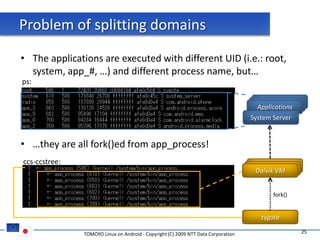
Problem of splitting domains
• The applications are executed with different UID (i.e.: root,
  system, app_#, …) and different process name, but…
ps:

                                                                                     service manager
                                                                                    service manager
                                                                                     Applications
                                                                                   System Server


• …they are all fork()ed from app_process!
ccs-ccstree:
                                                                                     Dalvik VM
                                                                                     Dalvik VM
                                                                                    Dalvik VM


                                                                                          fork()


                                                                                      zygote

               TOMOYO Linux on Android - Copyright (C) 2009 NTT Data Corporation                   25
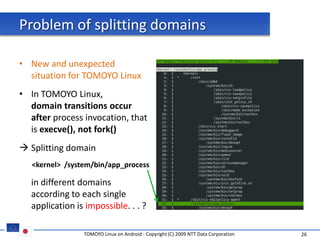
Problem of splitting domains

• New and unexpected
  situation for TOMOYO Linux
• In TOMOYO Linux,
  domain transitions occur
  after process invocation, that
  is execve(), not fork()
 Splitting domain
   <kernel> /system/bin/app_process

  in different domains
  according to each single
  application is impossible. . . ?

                 TOMOYO Linux on Android - Copyright (C) 2009 NTT Data Corporation   26
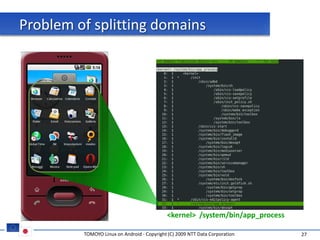
Problem of splitting domains


                                            <kernel> /system/bin/app_process

         TOMOYO Linux on Android - Copyright (C) 2009 NTT Data Corporation     27
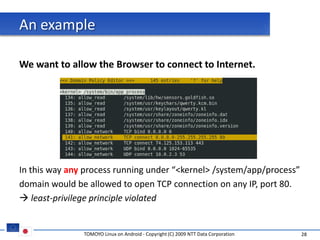
An example

We want to allow the Browser to connect to Internet.


In this way any process running under “<kernel> /system/app/process”
domain would be allowed to open TCP connection on any IP, port 80.
 least-privilege principle violated


               TOMOYO Linux on Android - Copyright (C) 2009 NTT Data Corporation   28
Solution

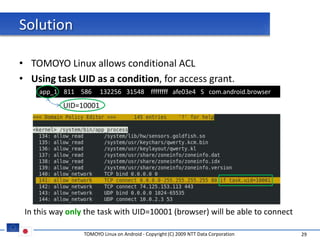
• TOMOYO Linux allows conditional ACL
• Using task UID as a condition, for access grant.
     app_1 811 586     132256 31548 ffffffff afe03e4 S com.android.browser
           UID=10001


 In this way only the task with UID=10001 (browser) will be able to connect

                 TOMOYO Linux on Android - Copyright (C) 2009 NTT Data Corporation   29
TOMOYO’s MAC and Android DAC

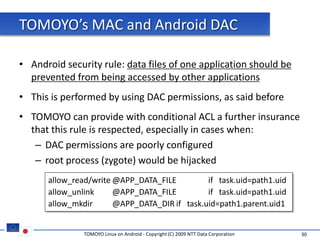
• Android security rule: data files of one application should be
  prevented from being accessed by other applications
• This is performed by using DAC permissions, as said before
• TOMOYO can provide with conditional ACL a further insurance
  that this rule is respected, especially in cases when:
   – DAC permissions are poorly configured
   – root process (zygote) would be hijacked
      allow_read/write @APP_DATA_FILE         if task.uid=path1.uid
      allow_unlink     @APP_DATA_FILE         if task.uid=path1.uid
      allow_mkdir      @APP_DATA_DIR if task.uid=path1.parent.uid1


               TOMOYO Linux on Android - Copyright (C) 2009 NTT Data Corporation   30
TOMOYO’s MAC and Android DAC

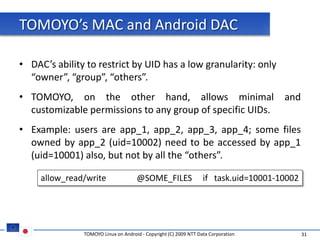
• DAC’s ability to restrict by UID has a low granularity: only
  “owner”, “group”, “others”.
• TOMOYO, on the other hand, allows minimal                                          and
  customizable permissions to any group of specific UIDs.
• Example: users are app_1, app_2, app_3, app_4; some files
  owned by app_2 (uid=10002) need to be accessed by app_1
  (uid=10001) also, but not by all the “others”.

     allow_read/write                @SOME_FILES                  if task.uid=10001-10002


               TOMOYO Linux on Android - Copyright (C) 2009 NTT Data Corporation            31
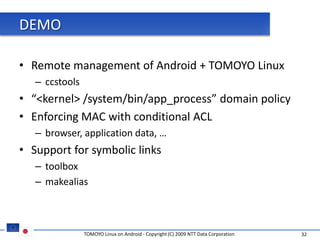
DEMO

• Remote management of Android + TOMOYO Linux
   – ccstools
• “<kernel> /system/bin/app_process” domain policy
• Enforcing MAC with conditional ACL
   – browser, application data, …
• Support for symbolic links
   – toolbox
   – makealias


                TOMOYO Linux on Android - Copyright (C) 2009 NTT Data Corporation   32
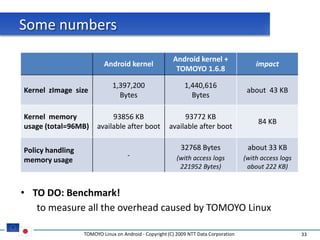
Some numbers
                                                        Android kernel +
                          Android kernel                                                  impact
                                                         TOMOYO 1.6.8

                              1,397,200                      1,440,616
Kernel zImage size                                                                     about 43 KB
                                Bytes                          Bytes

Kernel memory               93856 KB                       93772 KB
                                                                                           84 KB
usage (total=96MB)     available after boot           available after boot

Policy handling                                            32768 Bytes                 about 33 KB
                                    -                    (with access logs            (with access logs
memory usage
                                                          221952 Bytes)                about 222 KB)


• TO DO: Benchmark!
   to measure all the overhead caused by TOMOYO Linux

                  TOMOYO Linux on Android - Copyright (C) 2009 NTT Data Corporation                       33
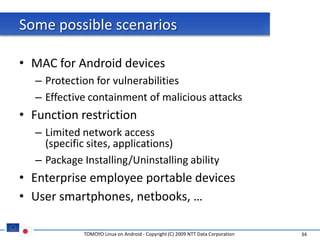
Some possible scenarios

• MAC for Android devices
  – Protection for vulnerabilities
  – Effective containment of malicious attacks
• Function restriction
  – Limited network access
    (specific sites, applications)
  – Package Installing/Uninstalling ability
• Enterprise employee portable devices
• User smartphones, netbooks, …

            TOMOYO Linux on Android - Copyright (C) 2009 NTT Data Corporation   34
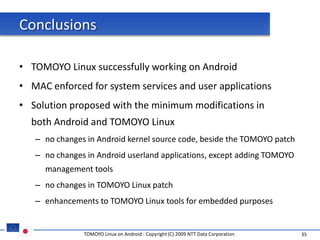
Conclusions

• TOMOYO Linux successfully working on Android
• MAC enforced for system services and user applications
• Solution proposed with the minimum modifications in
  both Android and TOMOYO Linux
   – no changes in Android kernel source code, beside the TOMOYO patch
   – no changes in Android userland applications, except adding TOMOYO
     management tools
   – no changes in TOMOYO Linux patch
   – enhancements to TOMOYO Linux tools for embedded purposes


               TOMOYO Linux on Android - Copyright (C) 2009 NTT Data Corporation   35
Conclusions

• Ideas and plans for future works
   – Benchmarking
   – Porting and testing TOMOYO Linux to other
     embedded Linux systems

• Call For Collaboration!
  Discuss and confronting with you is essential to improve
  and develop new ideas. We need your help 
  We would be glad to receive any form of feedback:
  questions, comments, critics, proposals!

             TOMOYO Linux on Android - Copyright (C) 2009 NTT Data Corporation   36
Useful links

• TOMOYO Linux
  – Wiki (english): http://tomoyo.sourceforge.jp/wiki-e/
  – compile & install manuals:
     http://tomoyo.sourceforge.jp/en/1.6.x/compile.html#2.6-vanilla
     http://tomoyo.sourceforge.jp/en/1.6.x/install.html
  – Mailing list:
    (english) http://lists.sourceforge.jp/mailman/listinfo/tomoyo-users-en
    (japanese) http://lists.sourceforge.jp/mailman/listinfo/tomoyo-users
  – @ Sourceforge: http://tomoyo.sourceforge.jp/index.html.en
• Android
  – source: http://source.android.com/download
  – kernel: http://android.git.kernel.org/?p=kernel/common.git;a=summary
  – developer’s guide: http://developer.android.com/guide/index.html

                 TOMOYO Linux on Android - Copyright (C) 2009 NTT Data Corporation   37
CE Linux Forum Japan Technical Jamboree 28                                                                              2009/06/12


                         Thank you for listening
                ご静聴どうもありがとうございました


                                                                TOMOYO is a registered trademark of NTT DATA CORPORATION in Japan.
                                                                                                 Linux is a trademark of Linus Torvalds.
                                                                Other names and trademarks are the property of their respective owners.
                         TOMOYO Linux on Android - Copyright (C) 2009 NTT Data Corporation                                         38

TOMOYO Linux on Android

  • 1.
    TOMOYO Linux onAndroid CE Linux Forum Japan Technical Jamboree 28 Osaka, 2009/06/12 Giuseppe La Tona giuseppelatona@gmail.com Copyright (C) 2009 NTT Data Corporation Android Goodies image is reproduced from work created and shared by Google and used according to terms described in the Creative Commons 2.5 Attribution License
  • 2.
    About me… • MasterDegree in Computer Engineering University of Catania (Italy), 2008 Università degli – Exchange student in Linköping University (Sweden), 2007 Studi di Catania • “Vulcanus in Japan” (Sep. 2008 – Aug. 2009) programme of the EU-Japan Centre for Industrial Cooperation – Industrial placement-oriented student exchange – Scholarship offered by EU and Japanese METI – Japanese language intensive course , cultural activities – Internship in NTT Data Corporation (R&D) (January-August 2009) Learning and experiencing Japanese culture, lifestyle, working way! TOMOYO Linux on Android - Copyright (C) 2009 NTT Data Corporation 2
  • 3.
    About my internship… •Secure OS group – TOMOYO Linux project • R&D: – Study • Mandatory Access Control (MAC) • TOMOYO Linux – Porting TOMOYO Linux to Android platform – Analyze TOMOYO and MAC potentials on embedded Linux Android Robot is reproduced from work created and shared by Google and used according to terms described in the Creative Commons 2.5 Attribution License TOMOYO Linux on Android - Copyright (C) 2009 NTT Data Corporation 3
  • 4.
    TOMOYO Linux • MACimplementation for Linux Operating Systems – pathname-based approach • It consists of: – a kernel patch (ccspatch) – a set of utilities (ccstools), for management and security policy editing • TOMOYO Linux 2.2.0 has just been merged in Linux kernel 2.6.30 (10 June 2009)! TOMOYO Linux on Android - Copyright (C) 2009 NTT Data Corporation 4
  • 5.
    Android overview • Fullsoftware stack for mobile devices Java TOMOYO Linux on Android - Copyright (C) 2009 NTT Data Corporation 5
  • 6.
    Android kernel • LinuxKernel 2.6 with some changes – reduced set of standard Linux utilities ( toolbox) – no support for glibc ( Bionic libraries) – no standard IPC ( Binder, specific IPC driver) – no native windowing system – optimized Power Management – Low memory killer, Alarm, Kernel Debugger, etc. • Android SDK 1.5 r2 (May 2009) – released with Linux Kernel 2.6.27 – higher versions being developed (2.6.29 is ready) TOMOYO Linux on Android - Copyright (C) 2009 NTT Data Corporation 6
  • 7.
    Android from bootto user (1/2) adbd vold (mount) rild (radio) Runtime debuggerd installd init init Native Servers … Binder init init Daemons servicemanager mediaserver zygote init Kernel TOMOYO Linux on Android - Copyright (C) 2009 NTT Data Corporation 7
  • 8.
    Android Runtime: Dalvikand Zygote • Runtime is made by Java programs running in application Dalvik: Virtual Machine for mobile devices – slow CPU, small RAM, no swap space, battery – Not a JVM, no JIT: only interpreter of DEX Dalvik VM (optimized bytecode obtained from Java .class) – Multiple VM instances can run efficiently. • Zygote process: fork() zygote – first instance of Dalvik VM, partially initialized – load preload classes and resources to make applications start faster – is kept always alive in idle state When an application execution request occurs: – zygote fork()s to a new process… • …which loads the requested package (Biology concept of “zygote”: duplicate, specialize and differentiate) TOMOYO Linux on Android - Copyright (C) 2009 NTT Data Corporation 8
  • 9.
    Android from bootto user (2/2) service manager service manager service manager service manager System Services Applications Home systemserver Dalvik VM Dalvik VM adbd Dalvik VM Dalvik VM vold (mount) registration rild (radio) GUI Runtime debuggerd installd init init Native Servers … fork() Binder init init Daemons servicemanager mediaserver zygote init exec() fork() Dalvik Kernel specialization TOMOYO Linux on Android - Copyright (C) 2009 NTT Data Corporation 9
  • 10.
    Android security model •Each application runs in its own process – Runtime in separate instances of Dalvik virtual machine • Each process is a “secure sandbox” – Linux Discretionary Access Control (DAC) for file access: all applications are assigned a unique UID (constant) • UID for system services are hard-coded • UID for user packages are progressively assigned at install-time, starting from uid 10000 (and mapped to app_0, app_1, …); they are saved in a file are maintained constant during the life of the package on the device. • Application specific files are saved in /data/data in separate folders owned by specific UID users TOMOYO Linux on Android - Copyright (C) 2009 NTT Data Corporation 10
  • 11.
    Porting TOMOYO Linuxto Android • Patching Android kernel with TOMOYO patch • Adapting TOMOYO ccstools for embedded purposes • Cross-compiling for Android • Integrating TOMOYO Policy Loader in Android boot • TOMOYO policy files location TOMOYO Linux on Android - Copyright (C) 2009 NTT Data Corporation 11
  • 12.
    TOMOYO Linux versions Thereare 2 main development lines: - non-LSM (versions 1.6.x) - provides full functionalities of pathname-based MAC (MAC for files, network, capabilities…) - mainline (version 2.2.0) - uses Linux Security Modules (LSM) - necessary hooks available from Linux kernel 2.6.29 - subset of MAC functionalities (only for files, so far) - currently developing the others to use LSM TOMOYO Linux on Android - Copyright (C) 2009 NTT Data Corporation 12
  • 13.
    Patching Android kernel •TOMOYO Linux 1.6.8 (non-LSM version) • Emulator (no real Android device available)  Linux kernel version: Goldfish v2.6.29 – “Goldfish” is the given to the ARM architecture emulated by Android SDK Emulator • ccspatch 1.6.8 (2009/05/28) for kernel vanilla v2.6.29  TOMOYO Linux Kernel TOMOYO Linux on Android - Copyright (C) 2009 NTT Data Corporation 13
  • 14.
    Adapting ccstools (1/2) Sinceversion 1.6.7, ccstools has been enhanced with Network mode, to support editing policy via TCP connection $ ccs-editpolicy <IP>:<port> In the case of embedded systems, this is more convenient for developing policies and debugging. Using the policy editor from the embedded device is generally not required. TOMOYO Linux on Android - Copyright (C) 2009 NTT Data Corporation 14
  • 15.
    Adapting ccstools (2/2) Onlyfew utilities are actually useful on the device: loadpolicy, savepolicy, setprofile, ccstree, make_alias. Other tools would also need porting C libraries missing ccstools version for Android: • Reduced the size and the complexity of these utilities removing the unnecessary code • Introducing editpolicy-agent daemon to allow network mode communication This ccstools version could actually be suitable for other embedded Linux systems as well. TOMOYO Linux on Android - Copyright (C) 2009 NTT Data Corporation 15
  • 16.
    Cross-compiling for Android •C libraries used by Android: Bionic – no glibc • Toolchain – suite of cross-compilers for different architectures • agcc (Perl script by Andrew Ross http://plausible.org/andy/agcc) – simple gcc-like front-end to compile C programs for Android – links Android libraries (needs Android source) – uses the appropriate cross-compiler from the Android Toolchain TOMOYO Linux on Android - Copyright (C) 2009 NTT Data Corporation 16
  • 17.
    Modifying Android boot init init Native Servers Binder init init Daemons servicemanager mediaserver zygote init Kernel TOMOYO Linux on Android - Copyright (C) 2009 NTT Data Corporation 17
  • 18.
    Modifying Android boot Itis required in order to: • start TOMOYO Policy Loader /sbin/ccs-init, via /sbin/ccs-start (*) • launch agent for editing policy remotely /sbin/ccs-editpolicy-agent zygote mediaserver Daemons Daemons /sbin/ccs-init Editpolicy Agent Daemons servicemanager 3 Policy Loader init 2 * 1 TOMOYO Linux Kernel TOMOYO Linux on Android - Copyright (C) 2009 NTT Data Corporation 18
  • 19.
    TOMOYO policy fileslocation (1/2) • /data/ccs/ (at the moment) • /data is… – …a readwrite partition – …allowed to be empty at Android boot time – …supposed to be wiped off if Android device is reset to factory default state Not a safe place for security policy files? – a reset would delete them! TOMOYO Linux on Android - Copyright (C) 2009 NTT Data Corporation 19
  • 20.
    TOMOYO policy fileslocation (2/2) A possible solution: split policy files for… • prebuilt firmware applications  in /system readonly partition (i.e. /system/ccs) • other applications downloaded/installed later  in /data readwrite partition (i.e. /data/ccs) – application-specific policies could be saved at application install-time, in /data – any eventual reset will wipe off those policies, but the related applications as well. TOMOYO Linux on Android - Copyright (C) 2009 NTT Data Corporation 20
  • 21.
    TOMOYO Linux onAndroid • Analyzing Android processes and domains • Problem of Zygote “fork vs exec” approach • Splitting domains in Android runtime • Enforcing policy TOMOYO Linux on Android - Copyright (C) 2009 NTT Data Corporation 21
  • 22.
    Domain transition tree TOMOYO Linux on Android - Copyright (C) 2009 NTT Data Corporation 22
  • 23.
    Process tree ccs-ccstree: commandshowing process tree with relative security domains and profiles TOMOYO Linux on Android - Copyright (C) 2009 NTT Data Corporation 23
  • 24.
    Process tree ccs-ccstree: servicemanager init init Daemons mediaserver zygote service zygote /system/bin/app_process -Xzygote /system/bin --zygote --start-system-server TOMOYO Linux on Android - Copyright (C) 2009 NTT Data Corporation 24
  • 25.
    Problem of splittingdomains • The applications are executed with different UID (i.e.: root, system, app_#, …) and different process name, but… ps: service manager service manager Applications System Server • …they are all fork()ed from app_process! ccs-ccstree: Dalvik VM Dalvik VM Dalvik VM fork() zygote TOMOYO Linux on Android - Copyright (C) 2009 NTT Data Corporation 25
  • 26.
    Problem of splittingdomains • New and unexpected situation for TOMOYO Linux • In TOMOYO Linux, domain transitions occur after process invocation, that is execve(), not fork()  Splitting domain <kernel> /system/bin/app_process in different domains according to each single application is impossible. . . ? TOMOYO Linux on Android - Copyright (C) 2009 NTT Data Corporation 26
  • 27.
    Problem of splittingdomains <kernel> /system/bin/app_process TOMOYO Linux on Android - Copyright (C) 2009 NTT Data Corporation 27
  • 28.
    An example We wantto allow the Browser to connect to Internet. In this way any process running under “<kernel> /system/app/process” domain would be allowed to open TCP connection on any IP, port 80.  least-privilege principle violated TOMOYO Linux on Android - Copyright (C) 2009 NTT Data Corporation 28
  • 29.
    Solution • TOMOYO Linuxallows conditional ACL • Using task UID as a condition, for access grant. app_1 811 586 132256 31548 ffffffff afe03e4 S com.android.browser UID=10001 In this way only the task with UID=10001 (browser) will be able to connect TOMOYO Linux on Android - Copyright (C) 2009 NTT Data Corporation 29
  • 30.
    TOMOYO’s MAC andAndroid DAC • Android security rule: data files of one application should be prevented from being accessed by other applications • This is performed by using DAC permissions, as said before • TOMOYO can provide with conditional ACL a further insurance that this rule is respected, especially in cases when: – DAC permissions are poorly configured – root process (zygote) would be hijacked allow_read/write @APP_DATA_FILE if task.uid=path1.uid allow_unlink @APP_DATA_FILE if task.uid=path1.uid allow_mkdir @APP_DATA_DIR if task.uid=path1.parent.uid1 TOMOYO Linux on Android - Copyright (C) 2009 NTT Data Corporation 30
  • 31.
    TOMOYO’s MAC andAndroid DAC • DAC’s ability to restrict by UID has a low granularity: only “owner”, “group”, “others”. • TOMOYO, on the other hand, allows minimal and customizable permissions to any group of specific UIDs. • Example: users are app_1, app_2, app_3, app_4; some files owned by app_2 (uid=10002) need to be accessed by app_1 (uid=10001) also, but not by all the “others”. allow_read/write @SOME_FILES if task.uid=10001-10002 TOMOYO Linux on Android - Copyright (C) 2009 NTT Data Corporation 31
  • 32.
    DEMO • Remote managementof Android + TOMOYO Linux – ccstools • “<kernel> /system/bin/app_process” domain policy • Enforcing MAC with conditional ACL – browser, application data, … • Support for symbolic links – toolbox – makealias TOMOYO Linux on Android - Copyright (C) 2009 NTT Data Corporation 32
  • 33.
    Some numbers Android kernel + Android kernel impact TOMOYO 1.6.8 1,397,200 1,440,616 Kernel zImage size about 43 KB Bytes Bytes Kernel memory 93856 KB 93772 KB 84 KB usage (total=96MB) available after boot available after boot Policy handling 32768 Bytes about 33 KB - (with access logs (with access logs memory usage 221952 Bytes) about 222 KB) • TO DO: Benchmark! to measure all the overhead caused by TOMOYO Linux TOMOYO Linux on Android - Copyright (C) 2009 NTT Data Corporation 33
  • 34.
    Some possible scenarios •MAC for Android devices – Protection for vulnerabilities – Effective containment of malicious attacks • Function restriction – Limited network access (specific sites, applications) – Package Installing/Uninstalling ability • Enterprise employee portable devices • User smartphones, netbooks, … TOMOYO Linux on Android - Copyright (C) 2009 NTT Data Corporation 34
  • 35.
    Conclusions • TOMOYO Linuxsuccessfully working on Android • MAC enforced for system services and user applications • Solution proposed with the minimum modifications in both Android and TOMOYO Linux – no changes in Android kernel source code, beside the TOMOYO patch – no changes in Android userland applications, except adding TOMOYO management tools – no changes in TOMOYO Linux patch – enhancements to TOMOYO Linux tools for embedded purposes TOMOYO Linux on Android - Copyright (C) 2009 NTT Data Corporation 35
  • 36.
    Conclusions • Ideas andplans for future works – Benchmarking – Porting and testing TOMOYO Linux to other embedded Linux systems • Call For Collaboration! Discuss and confronting with you is essential to improve and develop new ideas. We need your help  We would be glad to receive any form of feedback: questions, comments, critics, proposals! TOMOYO Linux on Android - Copyright (C) 2009 NTT Data Corporation 36
  • 37.
    Useful links • TOMOYOLinux – Wiki (english): http://tomoyo.sourceforge.jp/wiki-e/ – compile & install manuals: http://tomoyo.sourceforge.jp/en/1.6.x/compile.html#2.6-vanilla http://tomoyo.sourceforge.jp/en/1.6.x/install.html – Mailing list: (english) http://lists.sourceforge.jp/mailman/listinfo/tomoyo-users-en (japanese) http://lists.sourceforge.jp/mailman/listinfo/tomoyo-users – @ Sourceforge: http://tomoyo.sourceforge.jp/index.html.en • Android – source: http://source.android.com/download – kernel: http://android.git.kernel.org/?p=kernel/common.git;a=summary – developer’s guide: http://developer.android.com/guide/index.html TOMOYO Linux on Android - Copyright (C) 2009 NTT Data Corporation 37
  • 38.
    CE Linux ForumJapan Technical Jamboree 28 2009/06/12 Thank you for listening ご静聴どうもありがとうございました TOMOYO is a registered trademark of NTT DATA CORPORATION in Japan. Linux is a trademark of Linus Torvalds. Other names and trademarks are the property of their respective owners. TOMOYO Linux on Android - Copyright (C) 2009 NTT Data Corporation 38