Static beam tomotherapy (TD) as an
optimisation method in whole breast
radiation therapy (WBRT)
Squires, M (BMRS (RT) MA MIR JP MBA(cand.))1
Hu, Y (BMP MSc)1
Byrne, M (BSc MMP)2
Archibald-Heeren, B (BMRS (RT))2
Cheers, S (BAppSc (MRS))1
Bosco, B (BHSc, MRT)2
Teh, A (BSc(Med) MB BS (Hons) FRANZCR)1,2
Fong, A (BSc(Med) MB BS MeH FRANZCR)2
1 Radiation Oncology Centres, Gosford, New South Wales, Australia
2 Radiation Oncology Centres, Wahroonga, New South Wales, Australia
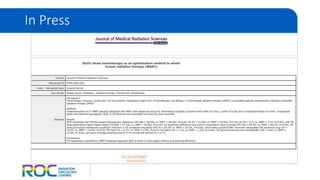
In Press
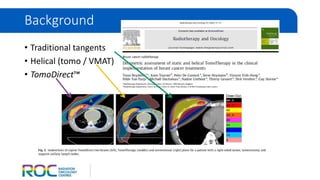
• Traditional tangents
• Helical (tomo / VMAT)
• TomoDirect™
Background
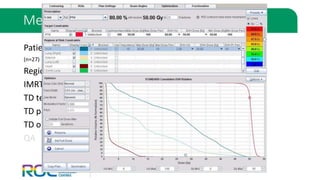
To evaluate static beam tomotherapy (TD) against a contemporary
inversely planned (IP-IMRT) approach through analysis of target and
organ at risk (OAR) doses
Aim
A secondary objective was to evaluate planning efficiency by measuring
optimisation times
Aim
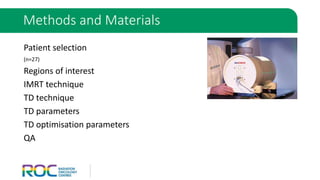
Patient selection
(n=27)
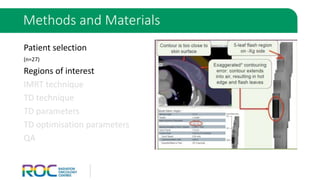
Regions of interest
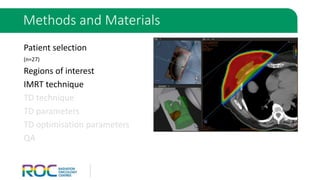
IMRT technique
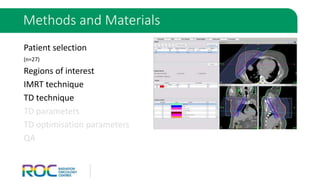
TD technique
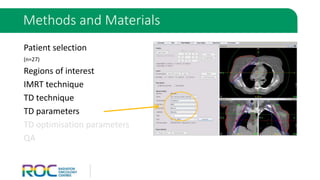
TD parameters
TD optimisation parameters
QA
Methods and Materials
Patient selection
(n=27)
Regions of interest
IMRT technique
TD technique
TD parameters
TD optimisation parameters
QA
Methods and Materials
Patient selection
(n=27)
Regions of interest
IMRT technique
TD technique
TD parameters
TD optimisation parameters
QA
Methods and Materials
Patient selection
(n=27)
Regions of interest
IMRT technique
TD technique
TD parameters
TD optimisation parameters
QA
Methods and Materials
Patient selection
(n=27)
Regions of interest
IMRT technique
TD technique
TD parameters
TD optimisation parameters
QA
Methods and Materials
Patient selection
(n=27)
Regions of interest
IMRT technique
TD technique
TD parameters
TD optimisation parameters
QA
Methods and Materials
Patient selection
(n=27)
Regions of interest
IMRT technique
TD technique
TD parameters
TD optimisation parameters
QA
Methods and Materials
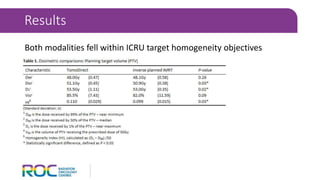
Both modalities fell within ICRU target homogeneity objectives
Results
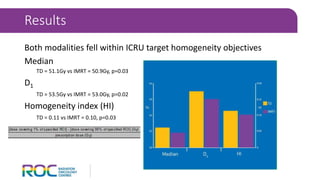
Both modalities fell within ICRU target homogeneity objectives
Median
TD = 51.1Gy vs IMRT = 50.9Gy, p=0.03
D1
TD = 53.5Gy vs IMRT = 53.0Gy, p=0.02
Homogeneity index (HI)
TD = 0.11 vs IMRT = 0.10, p=0.03
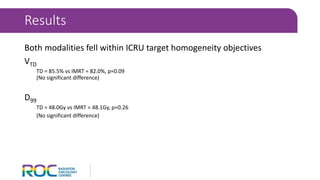
Results
Both modalities fell within ICRU target homogeneity objectives
VTD
TD = 85.5% vs IMRT = 82.0%, p=0.09
(No significant difference)
D99
TD = 48.0Gy vs IMRT = 48.1Gy, p=0.26
(No significant difference)
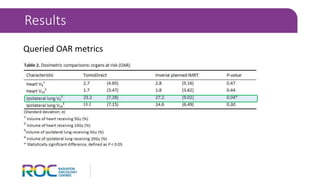
Results
Queried OAR metrics
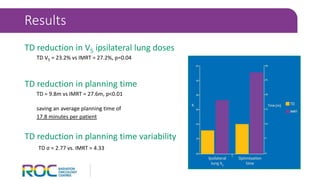
Results
TD reduction in V5 ipsilateral lung doses
TD V5 = 23.2% vs IMRT = 27.2%, p=0.04
TD reduction in planning time
TD = 9.8m vs IMRT = 27.6m, p<0.01
saving an average planning time of
17.8 minutes per patient
TD reduction in planning time variability
TD σ = 2.77 vs. IMRT = 4.33
Results
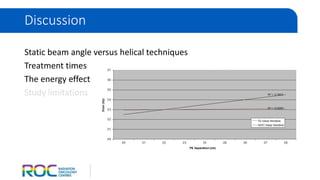
Static beam angle versus helical techniques
Treatment times
The energy effect
Study limitations
Discussion
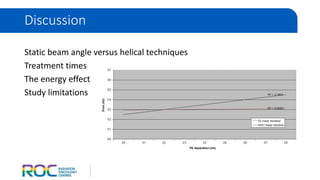
Static beam angle versus helical techniques
Treatment times
The energy effect
Study limitations
Discussion
Static beam angle versus helical techniques
Treatment times
The energy effect
Study limitations
Discussion
Static beam angle versus helical techniques
Treatment times
The energy effect
Study limitations
Discussion
Conclusion
Static beam tomotherapy (TD) represents a suitable alternative
whole breast radiation therapy (WBRT) approach
• Comparable target metrics
• Optimised flash in case of target deformation
• A reduced ipsilateral lung dose
• Improved planning efficiency
[1] Bleicher RJ, Ruth K, Sigurdson ER, et al. Breast conservation versus mastectomy for patients with T3 primary tumors (>5 cm): A review of
5685 medicare patients. Cancer 2016; 122: 42-9.
[2] Hwang E, Lichtensztajn D, Gomez S, Fowble B, Clarke C. Survival after lumpectomy and mastectomy for early stage invasive breast cancer.
Cancer 2013; 119: 1402-1411.
[3] Haciislamoglu E, Colakemail F, Canyilmazemail E, et al. Dosimetric comparison of left-sided whole-breast irradiation with 3DCRT, forward-
planned IMRT, inverse-planned IMRT, helical tomotherapy, and volumetric arc therapy. Phys Med 2015; 31: 360-367.
[4] Wu S, Lai Y, He Z, et al. Dosimetric Comparison of the Simultaneous Integrated Boost in Whole-Breast Irradiation after Breast-Conserving
Surgery: IMRT, IMRT plus an Electron Boost and VMAT. PLoS One 2015; 10: e0120811
[5] Gonzalez V, Buchholz D, Langen K, et al. Evaluation of two tomotherapy-based techniques for the delivery of whole-breast intensity-
modulated radiation therapy. Int J Radiat Oncol Biol Phys 2006; 65: 284-90.
[6] Goddu SM, Chaudhari S, Mamalui-Hunter M, et al. Helical tomotherapy planning for left-sided breast cancer patients with positive lymph
nodes: comparison to conventional multiport breast technique. Int J Radiat Oncol Biol Phys 2009; 73: 1243-51.
[7] Stovall M, Smith SA, Langholz BM, et al. Dose to the contralateral breast from radiotherapy and risk of second primary breast cancer in the
WECARE study. Int J Radiat Oncol Biol Phys 2008; 72: 1021-30.
[8] Franco P, Catuzzo P, Cante D, et al. TomoDirect: an efficient means to deliver radiation at static angles with tomotherapy. Tumori 2011; 97:
498-502.
[9] Franco P, Ricardi U. Tomo Direct to deliver static angle tomotherapy treatments. J Nucl Med Radiat Ther 2012; 3: 5.
[10] Murai T, Shibamoto Y, Manabe Y, et al. Intensity-modulated radiation therapy using ports of Tomotherapy (TomoDirect): comparison with
the TomoHelical mode. J Radiat Oncol 2013; 8: 68.
References & Acknowledgements

TomoDirect: A viable alternative?

  • 1.
    Static beam tomotherapy(TD) as an optimisation method in whole breast radiation therapy (WBRT) Squires, M (BMRS (RT) MA MIR JP MBA(cand.))1 Hu, Y (BMP MSc)1 Byrne, M (BSc MMP)2 Archibald-Heeren, B (BMRS (RT))2 Cheers, S (BAppSc (MRS))1 Bosco, B (BHSc, MRT)2 Teh, A (BSc(Med) MB BS (Hons) FRANZCR)1,2 Fong, A (BSc(Med) MB BS MeH FRANZCR)2 1 Radiation Oncology Centres, Gosford, New South Wales, Australia 2 Radiation Oncology Centres, Wahroonga, New South Wales, Australia
  • 2.
  • 3.
    • Traditional tangents •Helical (tomo / VMAT) • TomoDirect™ Background
  • 4.
    To evaluate staticbeam tomotherapy (TD) against a contemporary inversely planned (IP-IMRT) approach through analysis of target and organ at risk (OAR) doses Aim
  • 5.
    A secondary objectivewas to evaluate planning efficiency by measuring optimisation times Aim
  • 6.
    Patient selection (n=27) Regions ofinterest IMRT technique TD technique TD parameters TD optimisation parameters QA Methods and Materials
  • 7.
    Patient selection (n=27) Regions ofinterest IMRT technique TD technique TD parameters TD optimisation parameters QA Methods and Materials
  • 8.
    Patient selection (n=27) Regions ofinterest IMRT technique TD technique TD parameters TD optimisation parameters QA Methods and Materials
  • 9.
    Patient selection (n=27) Regions ofinterest IMRT technique TD technique TD parameters TD optimisation parameters QA Methods and Materials
  • 10.
    Patient selection (n=27) Regions ofinterest IMRT technique TD technique TD parameters TD optimisation parameters QA Methods and Materials
  • 11.
    Patient selection (n=27) Regions ofinterest IMRT technique TD technique TD parameters TD optimisation parameters QA Methods and Materials
  • 12.
    Patient selection (n=27) Regions ofinterest IMRT technique TD technique TD parameters TD optimisation parameters QA Methods and Materials
  • 13.
    Both modalities fellwithin ICRU target homogeneity objectives Results
  • 14.
    Both modalities fellwithin ICRU target homogeneity objectives Median TD = 51.1Gy vs IMRT = 50.9Gy, p=0.03 D1 TD = 53.5Gy vs IMRT = 53.0Gy, p=0.02 Homogeneity index (HI) TD = 0.11 vs IMRT = 0.10, p=0.03 Results
  • 15.
    Both modalities fellwithin ICRU target homogeneity objectives VTD TD = 85.5% vs IMRT = 82.0%, p=0.09 (No significant difference) D99 TD = 48.0Gy vs IMRT = 48.1Gy, p=0.26 (No significant difference) Results
  • 16.
  • 17.
    TD reduction inV5 ipsilateral lung doses TD V5 = 23.2% vs IMRT = 27.2%, p=0.04 TD reduction in planning time TD = 9.8m vs IMRT = 27.6m, p<0.01 saving an average planning time of 17.8 minutes per patient TD reduction in planning time variability TD σ = 2.77 vs. IMRT = 4.33 Results
  • 18.
    Static beam angleversus helical techniques Treatment times The energy effect Study limitations Discussion
  • 19.
    Static beam angleversus helical techniques Treatment times The energy effect Study limitations Discussion
  • 20.
    Static beam angleversus helical techniques Treatment times The energy effect Study limitations Discussion
  • 21.
    Static beam angleversus helical techniques Treatment times The energy effect Study limitations Discussion
  • 22.
    Conclusion Static beam tomotherapy(TD) represents a suitable alternative whole breast radiation therapy (WBRT) approach • Comparable target metrics • Optimised flash in case of target deformation • A reduced ipsilateral lung dose • Improved planning efficiency
  • 23.
    [1] Bleicher RJ,Ruth K, Sigurdson ER, et al. Breast conservation versus mastectomy for patients with T3 primary tumors (>5 cm): A review of 5685 medicare patients. Cancer 2016; 122: 42-9. [2] Hwang E, Lichtensztajn D, Gomez S, Fowble B, Clarke C. Survival after lumpectomy and mastectomy for early stage invasive breast cancer. Cancer 2013; 119: 1402-1411. [3] Haciislamoglu E, Colakemail F, Canyilmazemail E, et al. Dosimetric comparison of left-sided whole-breast irradiation with 3DCRT, forward- planned IMRT, inverse-planned IMRT, helical tomotherapy, and volumetric arc therapy. Phys Med 2015; 31: 360-367. [4] Wu S, Lai Y, He Z, et al. Dosimetric Comparison of the Simultaneous Integrated Boost in Whole-Breast Irradiation after Breast-Conserving Surgery: IMRT, IMRT plus an Electron Boost and VMAT. PLoS One 2015; 10: e0120811 [5] Gonzalez V, Buchholz D, Langen K, et al. Evaluation of two tomotherapy-based techniques for the delivery of whole-breast intensity- modulated radiation therapy. Int J Radiat Oncol Biol Phys 2006; 65: 284-90. [6] Goddu SM, Chaudhari S, Mamalui-Hunter M, et al. Helical tomotherapy planning for left-sided breast cancer patients with positive lymph nodes: comparison to conventional multiport breast technique. Int J Radiat Oncol Biol Phys 2009; 73: 1243-51. [7] Stovall M, Smith SA, Langholz BM, et al. Dose to the contralateral breast from radiotherapy and risk of second primary breast cancer in the WECARE study. Int J Radiat Oncol Biol Phys 2008; 72: 1021-30. [8] Franco P, Catuzzo P, Cante D, et al. TomoDirect: an efficient means to deliver radiation at static angles with tomotherapy. Tumori 2011; 97: 498-502. [9] Franco P, Ricardi U. Tomo Direct to deliver static angle tomotherapy treatments. J Nucl Med Radiat Ther 2012; 3: 5. [10] Murai T, Shibamoto Y, Manabe Y, et al. Intensity-modulated radiation therapy using ports of Tomotherapy (TomoDirect): comparison with the TomoHelical mode. J Radiat Oncol 2013; 8: 68. References & Acknowledgements