TOKUGAWA
JAPAN
FEUDAL
SYSTEM
MOBILE
SYSTEM
TOKUGAWA ERA
FEUDAL
SYSTEM
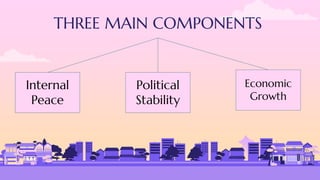
THREE MAIN COMPONENTS
Internal
Peace
Political
Stability
Economic
Growth
Internal Peace
● enforced rigid rules and repressed change
● no social mobility
● peasants
● merchants
● samurai
● foreigners (political stability)
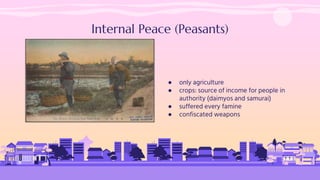
Internal Peace (Peasants)
● only agriculture
● crops: source of income for people in
authority (daimyos and samurai)
● suffered every famine
● confiscated weapons
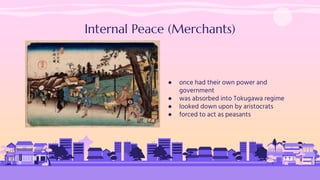
Internal Peace (Merchants)
● once had their own power and
government
● was absorbed into Tokugawa regime
● looked down upon by aristocrats
● forced to act as peasants
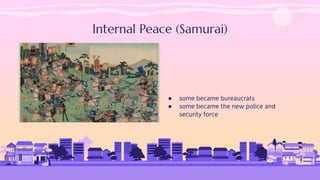
Internal Peace (Samurai)
● some became bureaucrats
● some became the new police and
security force
POLITICAL
STABILITY
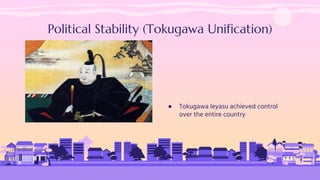
Political Stability (Tokugawa Unification)
● Tokugawa Ieyasu achieved control
over the entire country
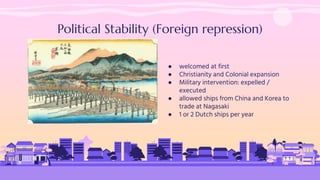
Political Stability (Foreign repression)
● welcomed at first
● Christianity and Colonial expansion
● Military intervention: expelled /
executed
● allowed ships from China and Korea to
trade at Nagasaki
● 1 or 2 Dutch ships per year
ECONOMIC
GROWTH
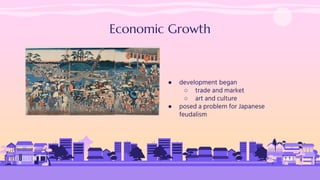
Economic Growth
● development began
○ trade and market
○ art and culture
● posed a problem for Japanese
feudalism
MORE
MOBILE
SYSTEM
Strain in Tokugawa System
Financial Problems ● agricultural productions waning
Strain in Tokugawa System
Foreign threat ● realized their defenselessness
● reluctantly opened their trade
Strain in Tokugawa System
Enemy Daimyo
Families
● new emperor Meiji which started the
Meiji restoration
CONCLUSION

Tokugawa Japan_Kas 2.pptx