KING’S COLLEGE OF MARBEL, INC.
Brgy. Morales, City of Koronadal
South Cotabato, Philippines
LEARNING PLAN IN ART 3
Subject: Arts Time Frame: 45 Mins
Quarter: 4 Cristine Joy Santiago
Pre-service Teacher
Unit Topic: Emphasis by
Variation of shapes and textures Ma. Victoria M. Macrohon
Arts 311 Instructor
Stage 1: Desired Result
Content Standard
The Learners….
 demonstrates understanding of
shapes (human and animal),
textures (visual and actual), and
the principle of emphasis through
variation of shapes and textures,
as evidenced in sculpture and
craft-making.
Performance Standard
The Learners….
 creates a three dimensional craft
(puppet or mask) that clearly shows
emphasis achieved by varying
shapes and textures, along with
contrasting colors, using recycled or
found materials.
Essential understanding
 It can make one part of our artwork
stand out by using different shapes
and textures from the rest of the
picture.
Essential Question
 How can changing shapes and
textures help make one part of an
artwork stand out?
Learning Competencies
Acquisition
The learners will be able to:
 Identify emphasis created through
varied shapes and textures,
Making
Meaning
The learners will be able to:
 combine different shapes, colors
and textures to create visual
emphasis on a puppet or mask
design.
Transfer
The learners will be able to:
 design and construct a three-
dimensional craft (puppet or mask)
using recycled or found materials.
Learning Targets At the end of the lesson, I can:
 identify emphasis created through varied shapes
and textures.
 combine different shapes, colors and textures to
create visual emphasis on a puppet or mask
design.
 design and construct a three- dimensional craft
(puppet or mask) using recycled or found
materials.
Resources needed
 Book- The Joys of MAPEH- Grade 3
 Worksheets
 Board
 Marker
 LED TV
 Laptop
 Recycled Materials
 Pencil, Artpad, glue,foil, scissors and colored
paper.
Valuing & Integration of
the Vision-Mission
 Faith - believing in God that you can surpass
whatever problems you may face in the life
 Competence - demonstrating excellence in solving
life problems
 Character – develops ambition to grow
Stage 2- Assessment Evidence
Performance Task
6 Facts of
Understanding
Other Evidences
GRASPS
Goal:
The learners understand
how to make one part of
their artwork stand out by
using different shapes
and textures. This helps
others see what is
important and makes the
artwork more creative and
interesting.
Role:
The learner is an artist
who uses different shapes
and textures to make one
part of their artwork stand
out and show what is
EXPLANATION
The learner understands
that emphasis means
making something stand
out so people can see or
feel what is most
important. In art, writing,
or design, emphasis
helps guide the viewer’s
or reader’s attention. The
learner uses things like
color, size, shape, or
texture to show what part
should be noticed first.
INTERPRETATION
The learner recognizes
and explains how
emphasis is used in art to
 Worksheet Activities
 Class Discussions
 Performance Task
important.
Audience:
The audience is the
learner’s classmates,
teachers, and school
community who will view
and appreciate the
artwork, puppet or mask
and understand the story
or message it shows.
Situation:
Our whole school is
coming together for a
special event called the
“School Green Art
Festival.” As a Grade 3
student, you are invited to
create a three-
dimensional sculpture a
puppet or mask using
recycled or found
materials like paper
scraps, bottle caps, fabric,
or cardboard.
Product/Performance
Create a 3D craft (such
as a puppet or mask).
draw attention to
important parts of a work.
They begin to understand
that artists make choices
(such as using bright
colors, large shapes, or
different textures) on
purpose to show what
matters most in the
artwork.
APPLICATION
The learner uses what
they understand about
emphasis to create a 3D
craft (such as a puppet or
mask) that shows clear
artistic choices.
PERSPECTIVE
The learner begins to
consider how others
might see or understand
their artwork. They
understand that different
people might notice
different things based on
what stands out to them.
EMPATHY
Understand and
appreciate how others
might feel when they look
at their artwork. They
recognize that art can
make people feel
something like joy,
surprise, fear, or curiosity
and they use emphasis to
help share that feeling or
idea.
SELF- KNOWLEDGE
When you make your
sculpture, you learn a lot
about yourself. You find
out what colors, shapes,
and textures you like
best. You also discover
how you like to create
and what makes your art
special.
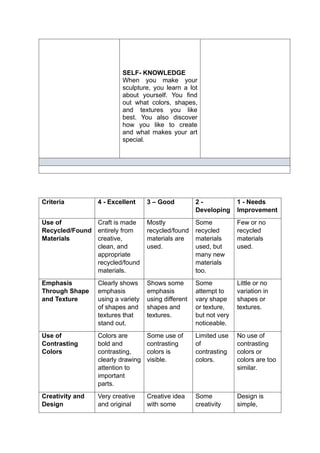
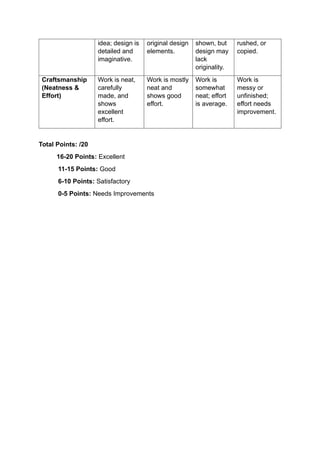
Criteria 4 - Excellent 3 – Good 2 -
Developing
1 - Needs
Improvement
Use of
Recycled/Found
Materials
Craft is made
entirely from
creative,
clean, and
appropriate
recycled/found
materials.
Mostly
recycled/found
materials are
used.
Some
recycled
materials
used, but
many new
materials
too.
Few or no
recycled
materials
used.
Emphasis
Through Shape
and Texture
Clearly shows
emphasis
using a variety
of shapes and
textures that
stand out.
Shows some
emphasis
using different
shapes and
textures.
Some
attempt to
vary shape
or texture,
but not very
noticeable.
Little or no
variation in
shapes or
textures.
Use of
Contrasting
Colors
Colors are
bold and
contrasting,
clearly drawing
attention to
important
parts.
Some use of
contrasting
colors is
visible.
Limited use
of
contrasting
colors.
No use of
contrasting
colors or
colors are too
similar.
Creativity and
Design
Very creative
and original
Creative idea
with some
Some
creativity
Design is
simple,
idea; design is
detailed and
imaginative.
original design
elements.
shown, but
design may
lack
originality.
rushed, or
copied.
Craftsmanship
(Neatness &
Effort)
Work is neat,
carefully
made, and
shows
excellent
effort.
Work is mostly
neat and
shows good
effort.
Work is
somewhat
neat; effort
is average.
Work is
messy or
unfinished;
effort needs
improvement.
Total Points: /20
16-20 Points: Excellent
11-15 Points: Good
6-10 Points: Satisfactory
0-5 Points: Needs Improvements
Stage 3- Learning Plan
Teaching Events Teacher Activity Learner’s Activity
I.PRELIMINARIE
S
A. Prayer
B. Greeting
s
C. Checkin
g of
attenda
nce
D. Review
Say: Let us all stand and may I
request ______ to lead the
prayer
Say: Good morning, Class!
Say: You may now take your
seat.
(Use seat plan to check if
there is absent)
Say: It’s good to know that no
one’s absent today.
Say: How are you today?
Say: Do you still remember our
lesson yesterday
Say: What was our lesson all
about?
Say: Very Good!
Learner 1: Let’s bow our
head and pray…. Amen
All Learner: Good morning,
Teacher!
All: Thank you, Teacher!
All: Good Teacher.
All: Yes, teacher
(A Learner will raise their
hand)
Learner 2: Our lesson
yesterday is all about
Texture.
II. LESSON
PROPER Say: Today we will have a new
Day 1
Explore
Learning Targets
At the end of the
lesson, I can:
 Identify
emphasis
created
through
varied
shapes and
textures.
lesson about the : Emphasis
by variation of shapes and
textures but first I have a
question, are you ready?
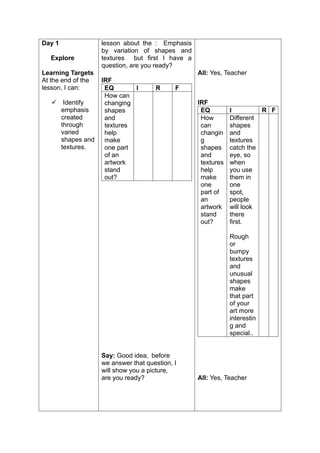
IRF
EQ I R F
How can
changing
shapes
and
textures
help
make
one part
of an
artwork
stand
out?
Say: Good idea, before
we answer that question, I
will show you a picture,
are you ready?
All: Yes, Teacher
IRF
EQ I R F
How
can
changin
g
shapes
and
textures
help
make
one
part of
an
artwork
stand
out?
Different
shapes
and
textures
catch the
eye, so
when
you use
them in
one
spot,
people
will look
there
first.
Rough
or
bumpy
textures
and
unusual
shapes
make
that part
of your
art more
interestin
g and
special..
All: Yes, Teacher
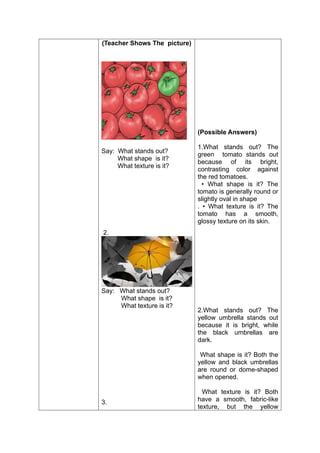
(Teacher Shows The picture)
Say: What stands out?
What shape is it?
What texture is it?
2.
Say: What stands out?
What shape is it?
What texture is it?
3.
(Possible Answers)
1.What stands out? The
green tomato stands out
because of its bright,
contrasting color against
the red tomatoes.
• What shape is it? The
tomato is generally round or
slightly oval in shape
. • What texture is it? The
tomato has a smooth,
glossy texture on its skin.
2.What stands out? The
yellow umbrella stands out
because it is bright, while
the black umbrellas are
dark.
What shape is it? Both the
yellow and black umbrellas
are round or dome-shaped
when opened.
What texture is it? Both
have a smooth, fabric-like
texture, but the yellow
FIRM-UP
Learning Targets
At the end of the
lesson, I can:
 combine
different
shapes,
colors and
textures to
create
visual
emphasis
on a puppet
or mask
design.
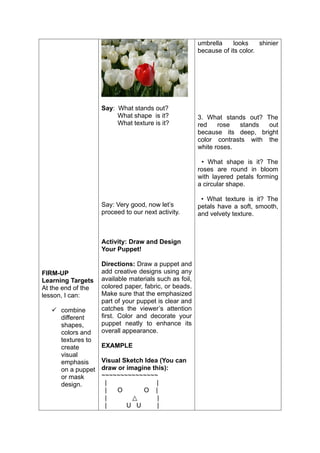
Say: What stands out?
What shape is it?
What texture is it?
Say: Very good, now let’s
proceed to our next activity.
Activity: Draw and Design
Your Puppet!
Directions: Draw a puppet and
add creative designs using any
available materials such as foil,
colored paper, fabric, or beads.
Make sure that the emphasized
part of your puppet is clear and
catches the viewer’s attention
first. Color and decorate your
puppet neatly to enhance its
overall appearance.
EXAMPLE
Visual Sketch Idea (You can
draw or imagine this):
~~~~~~~~~~~~~~~
| |
| O O |
| △ |
| U U |
umbrella looks shinier
because of its color.
3. What stands out? The
red rose stands out
because its deep, bright
color contrasts with the
white roses.
• What shape is it? The
roses are round in bloom
with layered petals forming
a circular shape.
• What texture is it? The
petals have a soft, smooth,
and velvety texture.
| |
~~~~~~~~~~~~~~~
-Big blue button eyes (circle
shape, shiny)
- Small felt triangle nose
-Red felt mouth.
|||||||||||||||
| Patchwork
-Bright red yarn hair (soft/fuzzy)
-Muted fabric clothing (rough +
smooth)
Say: Are you all happy and did
you learn something?
Say: Now, who can share to
the class on what she/he
learned for today’s lesson
Say: Thank you, based on your
answer , I can say that you
really learned a lot for today’s
lesson.
Say: Okay, very good!
Say: For our discussion for this
day, We’ve explored the
concept of emphasis in art.
Emphasis Through Shapes
and Textures in Art
Yes, teacher!
I learned that using different
shapes and textures can
help make one part of my
artwork stand out.
DEEPEN
Artists create emphasis by
using different shapes and
textures to make one part of
the artwork stand out.
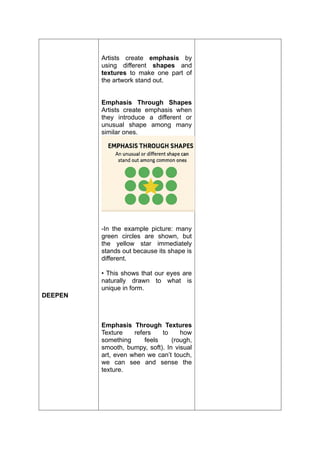
Emphasis Through Shapes
Artists create emphasis when
they introduce a different or
unusual shape among many
similar ones.
-In the example picture: many
green circles are shown, but
the yellow star immediately
stands out because its shape is
different.
• This shows that our eyes are
naturally drawn to what is
unique in form.
Emphasis Through Textures
Texture refers to how
something feels (rough,
smooth, bumpy, soft). In visual
art, even when we can’t touch,
we can see and sense the
texture.
TRANSFER
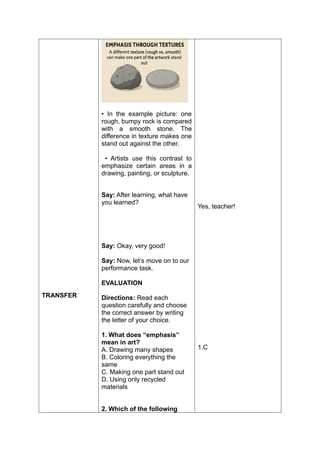
• In the example picture: one
rough, bumpy rock is compared
with a smooth stone. The
difference in texture makes one
stand out against the other.
• Artists use this contrast to
emphasize certain areas in a
drawing, painting, or sculpture.
Say: After learning, what have
you learned?
Say: Okay, very good!
Say: Now, let’s move on to our
performance task.
EVALUATION
Directions: Read each
question carefully and choose
the correct answer by writing
the letter of your choice.
1. What does “emphasis”
mean in art?
A. Drawing many shapes
B. Coloring everything the
same
C. Making one part stand out
D. Using only recycled
materials
2. Which of the following
Yes, teacher!
1.C
best shows emphasis in a
picture?
A. All shapes are the same size
B. One big red circle among
small blue ones
C. A plain background with no
shapes
D. A picture made only with
pencils
3. What can artists use to
show emphasis?
A. Repeating the same pattern
everywhere
B. Only using black and white
C. Different shapes and
textures
D. Erasing all lines
4. What kind of texture might
stand out in a smooth
artwork?
A. A bumpy or rough part
B. A circle
C. A pencil line
D. A small shape
5. Why do artists use
different shapes and textures
in one artwork?
A. To confuse people
B. To make it boring
C. To create emphasis and
interest
D. To make everything look the
same
2.B
3.C
4.A
5.C
tintinArts lesson plan (2)ed.docxhddgjshdkd

tintinArts lesson plan (2)ed.docxhddgjshdkd

  • 1.
    KING’S COLLEGE OFMARBEL, INC. Brgy. Morales, City of Koronadal South Cotabato, Philippines LEARNING PLAN IN ART 3 Subject: Arts Time Frame: 45 Mins Quarter: 4 Cristine Joy Santiago Pre-service Teacher Unit Topic: Emphasis by Variation of shapes and textures Ma. Victoria M. Macrohon Arts 311 Instructor Stage 1: Desired Result Content Standard The Learners….  demonstrates understanding of shapes (human and animal), textures (visual and actual), and the principle of emphasis through variation of shapes and textures, as evidenced in sculpture and craft-making. Performance Standard The Learners….  creates a three dimensional craft (puppet or mask) that clearly shows emphasis achieved by varying shapes and textures, along with contrasting colors, using recycled or found materials. Essential understanding  It can make one part of our artwork stand out by using different shapes and textures from the rest of the picture. Essential Question  How can changing shapes and textures help make one part of an artwork stand out? Learning Competencies Acquisition The learners will be able to:  Identify emphasis created through varied shapes and textures, Making Meaning The learners will be able to:  combine different shapes, colors and textures to create visual emphasis on a puppet or mask design. Transfer The learners will be able to:  design and construct a three- dimensional craft (puppet or mask) using recycled or found materials. Learning Targets At the end of the lesson, I can:  identify emphasis created through varied shapes and textures.
  • 2.
     combine differentshapes, colors and textures to create visual emphasis on a puppet or mask design.  design and construct a three- dimensional craft (puppet or mask) using recycled or found materials. Resources needed  Book- The Joys of MAPEH- Grade 3  Worksheets  Board  Marker  LED TV  Laptop  Recycled Materials  Pencil, Artpad, glue,foil, scissors and colored paper. Valuing & Integration of the Vision-Mission  Faith - believing in God that you can surpass whatever problems you may face in the life  Competence - demonstrating excellence in solving life problems  Character – develops ambition to grow Stage 2- Assessment Evidence Performance Task 6 Facts of Understanding Other Evidences GRASPS Goal: The learners understand how to make one part of their artwork stand out by using different shapes and textures. This helps others see what is important and makes the artwork more creative and interesting. Role: The learner is an artist who uses different shapes and textures to make one part of their artwork stand out and show what is EXPLANATION The learner understands that emphasis means making something stand out so people can see or feel what is most important. In art, writing, or design, emphasis helps guide the viewer’s or reader’s attention. The learner uses things like color, size, shape, or texture to show what part should be noticed first. INTERPRETATION The learner recognizes and explains how emphasis is used in art to  Worksheet Activities  Class Discussions  Performance Task
  • 3.
    important. Audience: The audience isthe learner’s classmates, teachers, and school community who will view and appreciate the artwork, puppet or mask and understand the story or message it shows. Situation: Our whole school is coming together for a special event called the “School Green Art Festival.” As a Grade 3 student, you are invited to create a three- dimensional sculpture a puppet or mask using recycled or found materials like paper scraps, bottle caps, fabric, or cardboard. Product/Performance Create a 3D craft (such as a puppet or mask). draw attention to important parts of a work. They begin to understand that artists make choices (such as using bright colors, large shapes, or different textures) on purpose to show what matters most in the artwork. APPLICATION The learner uses what they understand about emphasis to create a 3D craft (such as a puppet or mask) that shows clear artistic choices. PERSPECTIVE The learner begins to consider how others might see or understand their artwork. They understand that different people might notice different things based on what stands out to them. EMPATHY Understand and appreciate how others might feel when they look at their artwork. They recognize that art can make people feel something like joy, surprise, fear, or curiosity and they use emphasis to help share that feeling or idea.
  • 4.
    SELF- KNOWLEDGE When youmake your sculpture, you learn a lot about yourself. You find out what colors, shapes, and textures you like best. You also discover how you like to create and what makes your art special. Criteria 4 - Excellent 3 – Good 2 - Developing 1 - Needs Improvement Use of Recycled/Found Materials Craft is made entirely from creative, clean, and appropriate recycled/found materials. Mostly recycled/found materials are used. Some recycled materials used, but many new materials too. Few or no recycled materials used. Emphasis Through Shape and Texture Clearly shows emphasis using a variety of shapes and textures that stand out. Shows some emphasis using different shapes and textures. Some attempt to vary shape or texture, but not very noticeable. Little or no variation in shapes or textures. Use of Contrasting Colors Colors are bold and contrasting, clearly drawing attention to important parts. Some use of contrasting colors is visible. Limited use of contrasting colors. No use of contrasting colors or colors are too similar. Creativity and Design Very creative and original Creative idea with some Some creativity Design is simple,
  • 5.
    idea; design is detailedand imaginative. original design elements. shown, but design may lack originality. rushed, or copied. Craftsmanship (Neatness & Effort) Work is neat, carefully made, and shows excellent effort. Work is mostly neat and shows good effort. Work is somewhat neat; effort is average. Work is messy or unfinished; effort needs improvement. Total Points: /20 16-20 Points: Excellent 11-15 Points: Good 6-10 Points: Satisfactory 0-5 Points: Needs Improvements
  • 6.
    Stage 3- LearningPlan Teaching Events Teacher Activity Learner’s Activity I.PRELIMINARIE S A. Prayer B. Greeting s C. Checkin g of attenda nce D. Review Say: Let us all stand and may I request ______ to lead the prayer Say: Good morning, Class! Say: You may now take your seat. (Use seat plan to check if there is absent) Say: It’s good to know that no one’s absent today. Say: How are you today? Say: Do you still remember our lesson yesterday Say: What was our lesson all about? Say: Very Good! Learner 1: Let’s bow our head and pray…. Amen All Learner: Good morning, Teacher! All: Thank you, Teacher! All: Good Teacher. All: Yes, teacher (A Learner will raise their hand) Learner 2: Our lesson yesterday is all about Texture. II. LESSON PROPER Say: Today we will have a new
  • 7.
    Day 1 Explore Learning Targets Atthe end of the lesson, I can:  Identify emphasis created through varied shapes and textures. lesson about the : Emphasis by variation of shapes and textures but first I have a question, are you ready? IRF EQ I R F How can changing shapes and textures help make one part of an artwork stand out? Say: Good idea, before we answer that question, I will show you a picture, are you ready? All: Yes, Teacher IRF EQ I R F How can changin g shapes and textures help make one part of an artwork stand out? Different shapes and textures catch the eye, so when you use them in one spot, people will look there first. Rough or bumpy textures and unusual shapes make that part of your art more interestin g and special.. All: Yes, Teacher
  • 8.
    (Teacher Shows Thepicture) Say: What stands out? What shape is it? What texture is it? 2. Say: What stands out? What shape is it? What texture is it? 3. (Possible Answers) 1.What stands out? The green tomato stands out because of its bright, contrasting color against the red tomatoes. • What shape is it? The tomato is generally round or slightly oval in shape . • What texture is it? The tomato has a smooth, glossy texture on its skin. 2.What stands out? The yellow umbrella stands out because it is bright, while the black umbrellas are dark. What shape is it? Both the yellow and black umbrellas are round or dome-shaped when opened. What texture is it? Both have a smooth, fabric-like texture, but the yellow
  • 9.
    FIRM-UP Learning Targets At theend of the lesson, I can:  combine different shapes, colors and textures to create visual emphasis on a puppet or mask design. Say: What stands out? What shape is it? What texture is it? Say: Very good, now let’s proceed to our next activity. Activity: Draw and Design Your Puppet! Directions: Draw a puppet and add creative designs using any available materials such as foil, colored paper, fabric, or beads. Make sure that the emphasized part of your puppet is clear and catches the viewer’s attention first. Color and decorate your puppet neatly to enhance its overall appearance. EXAMPLE Visual Sketch Idea (You can draw or imagine this): ~~~~~~~~~~~~~~~ | | | O O | | △ | | U U | umbrella looks shinier because of its color. 3. What stands out? The red rose stands out because its deep, bright color contrasts with the white roses. • What shape is it? The roses are round in bloom with layered petals forming a circular shape. • What texture is it? The petals have a soft, smooth, and velvety texture.
  • 10.
    | | ~~~~~~~~~~~~~~~ -Big bluebutton eyes (circle shape, shiny) - Small felt triangle nose -Red felt mouth. ||||||||||||||| | Patchwork -Bright red yarn hair (soft/fuzzy) -Muted fabric clothing (rough + smooth) Say: Are you all happy and did you learn something? Say: Now, who can share to the class on what she/he learned for today’s lesson Say: Thank you, based on your answer , I can say that you really learned a lot for today’s lesson. Say: Okay, very good! Say: For our discussion for this day, We’ve explored the concept of emphasis in art. Emphasis Through Shapes and Textures in Art Yes, teacher! I learned that using different shapes and textures can help make one part of my artwork stand out.
  • 11.
    DEEPEN Artists create emphasisby using different shapes and textures to make one part of the artwork stand out. Emphasis Through Shapes Artists create emphasis when they introduce a different or unusual shape among many similar ones. -In the example picture: many green circles are shown, but the yellow star immediately stands out because its shape is different. • This shows that our eyes are naturally drawn to what is unique in form. Emphasis Through Textures Texture refers to how something feels (rough, smooth, bumpy, soft). In visual art, even when we can’t touch, we can see and sense the texture.
  • 12.
    TRANSFER • In theexample picture: one rough, bumpy rock is compared with a smooth stone. The difference in texture makes one stand out against the other. • Artists use this contrast to emphasize certain areas in a drawing, painting, or sculpture. Say: After learning, what have you learned? Say: Okay, very good! Say: Now, let’s move on to our performance task. EVALUATION Directions: Read each question carefully and choose the correct answer by writing the letter of your choice. 1. What does “emphasis” mean in art? A. Drawing many shapes B. Coloring everything the same C. Making one part stand out D. Using only recycled materials 2. Which of the following Yes, teacher! 1.C
  • 13.
    best shows emphasisin a picture? A. All shapes are the same size B. One big red circle among small blue ones C. A plain background with no shapes D. A picture made only with pencils 3. What can artists use to show emphasis? A. Repeating the same pattern everywhere B. Only using black and white C. Different shapes and textures D. Erasing all lines 4. What kind of texture might stand out in a smooth artwork? A. A bumpy or rough part B. A circle C. A pencil line D. A small shape 5. Why do artists use different shapes and textures in one artwork? A. To confuse people B. To make it boring C. To create emphasis and interest D. To make everything look the same 2.B 3.C 4.A 5.C