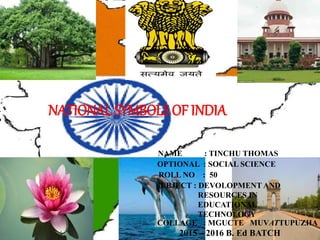
NATIONAL SYMBOLS OF INDIA
NAME : TINCHU THOMAS
OPTIONAL : SOCIAL SCIENCE
ROLL NO : 50
COLLAGE : MGUCTE MUVATTUPUZHA
2015 – 2016 B. Ed BATCH
SUBJECT : DEVOLOPMENT AND
RESOURCES IN
EDUCATIONAL
TECHNOLOGY
INTRODUCTION
• A national symbol is a symbol of any entity considering itself
and manifesting itself to the world as a national community.
• The Republic of India has several official national symbols.
• These symbols are intrinsic to the Indian identity and heritage.
• The national symbols of India are an integral part of the
country’s diversity and heritage.
• The national symbols have been chosen very carefully to
describe India, it’s characteristics, people, culture and
diversity.
NATIONAL FLAG
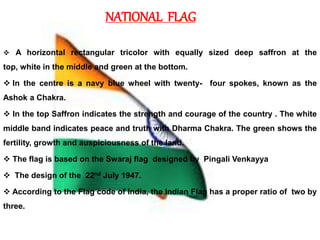
 A horizontal rectangular tricolor with equally sized deep saffron at the
top, white in the middle and green at the bottom.
 In the centre is a navy blue wheel with twenty- four spokes, known as the
Ashok a Chakra.
 In the top Saffron indicates the strength and courage of the country . The white
middle band indicates peace and truth with Dharma Chakra. The green shows the
fertility, growth and auspiciousness of the land.
 The flag is based on the Swaraj flag designed by Pingali Venkayya
 The design of the 22nd July 1947.
 According to the Flag code of India, the Indian Flag has a proper ratio of two by
three.
NATIONAL EMBLEM
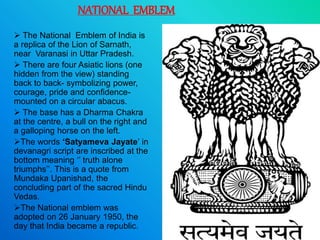
 The National Emblem of India is
a replica of the Lion of Sarnath,
near Varanasi in Uttar Pradesh.
 There are four Asiatic lions (one
hidden from the view) standing
back to back- symbolizing power,
courage, pride and confidence-
mounted on a circular abacus.
 The base has a Dharma Chakra
at the centre, a bull on the right and
a galloping horse on the left.
The words ‘Satyameva Jayate’ in
devanagri script are inscribed at the
bottom meaning ‘’ truth alone
triumphs’’. This is a quote from
Mundaka Upanishad, the
concluding part of the sacred Hindu
Vedas.
The National emblem was
adopted on 26 January 1950, the
day that India became a republic.
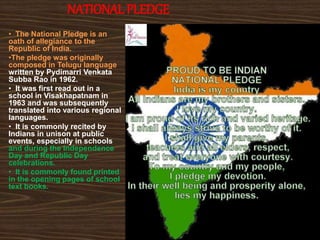
NATIONAL PLEDGE
• The National Pledge is an
oath of allegiance to the
Republic of India.
•The pledge was originally
composed in Telugu language
written by Pydimarri Venkata
Subba Rao in 1962.
• It was first read out in a
school in Visakhapatnam in
1963 and was subsequently
translated into various regional
languages.
• It is commonly recited by
Indians in unison at public
events, especially in schools
and during the Independence
Day and Republic Day
celebrations.
• It is commonly found printed
in the opening pages of school
text books.
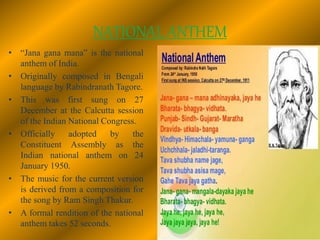
NATIONAL ANTHEM
• “Jana gana mana” is the national
anthem of India.
• Originally composed in Bengali
language by Rabindranath Tagore.
• This was first sung on 27
December at the Calcutta session
of the Indian National Congress.
• Officially adopted by the
Constituent Assembly as the
Indian national anthem on 24
January 1950.
• The music for the current version
is derived from a composition for
the song by Ram Singh Thakur.
• A formal rendition of the national
anthem takes 52 seconds.
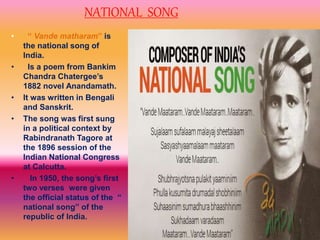
NATIONAL SONG
• “ Vande matharam” is
the national song of
India.
• Is a poem from Bankim
Chandra Chatergee’s
1882 novel Anandamath.
• It was written in Bengali
and Sanskrit.
• The song was first sung
in a political context by
Rabindranath Tagore at
the 1896 session of the
Indian National Congress
at Calcutta.
• In 1950, the song’s first
two verses were given
the official status of the “
national song” of the
republic of India.
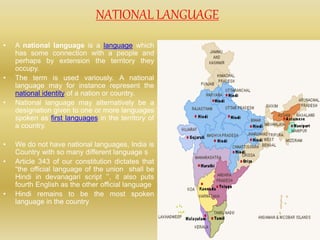
NATIONAL LANGUAGE
• A national language is a language which
has some connection with a people and
perhaps by extension the territory they
occupy.
• The term is used variously. A national
language may for instance represent the
national identity of a nation or country.
• National language may alternatively be a
designation given to one or more languages
spoken as first languages in the territory of
a country.
• We do not have national languages, India is
Country with so many different language s
• Article 343 of our constitution dictates that
“the official language of the union shall be
Hindi in devanagari script ’’, it also puts
fourth English as the other official language
• Hindi remains to be the most spoken
language in the country
NATIONAL RELIGION
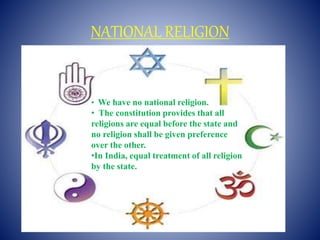
•We have no national religion.
• We have no national religion.
• The constitution provides that all
religions are equal before the state and
no religion shall be given preference
over the other.
•In India, equal treatment of all religion
by the state.
NATIONAL CALENDAR
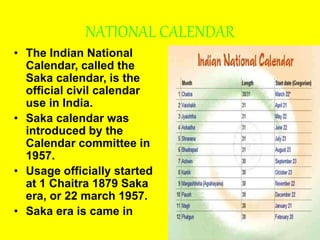
• The Indian National
Calendar, called the
Saka calendar, is the
official civil calendar
use in India.
• Saka calendar was
introduced by the
Calendar committee in
1957.
• Usage officially started
at 1 Chaitra 1879 Saka
era, or 22 march 1957.
• Saka era is came in
NATIONAL CURRENCY
• The rupee, or more specifically
the Indian rupee is the official
currency of the Republic of India.
• The issuance of the currency is
controlled by the Reserve Bank of
India.
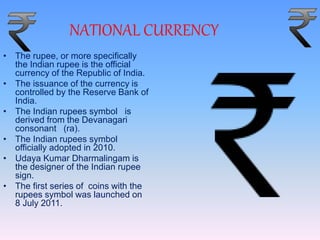
• The Indian rupees symbol is
derived from the Devanagari
consonant (ra).
• The Indian rupees symbol
officially adopted in 2010.
• Udaya Kumar Dharmalingam is
the designer of the Indian rupee
sign.
• The first series of coins with the
rupees symbol was launched on
8 July 2011.
NATIONAL GAME
• Hockey is the National
Game of India.
• Hockey when declared as
the national game was
very popular.
• The game has seen a
golden era during 1928-
1956, when India won 6
consecutive gold medals
in the Olympics.
• At that time India had
played 24 Olympic
matches and won all of
them.
NATIONAL ANIMAL
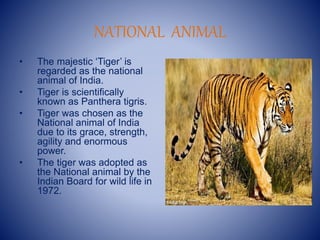
• The majestic ‘Tiger’ is
regarded as the national
animal of India.
• Tiger is scientifically
known as Panthera tigris.
• Tiger was chosen as the
National animal of India
due to its grace, strength,
agility and enormous
power.
• The tiger was adopted as
the National animal by the
Indian Board for wild life in
1972.
NATIONAL BIRD
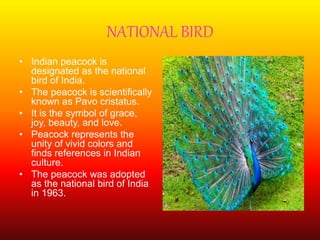
• Indian peacock is
designated as the national
bird of India.
• The peacock is scientifically
known as Pavo cristatus.
• It is the symbol of grace,
joy, beauty, and love.
• Peacock represents the
unity of vivid colors and
finds references in Indian
culture.
• The peacock was adopted
as the national bird of India
in 1963.
NATIONAL AQUATIC ANIMAL
• Gangetic Dolphin is the
National Aquatic Animal of
India.
• Gangetic dolphin is
scientifically known as
Platanista gangetica.
• This mammal is also said to
represent the purity of the holy
Ganga as it can only survive in
pure and fresh water.
• The Ministry of Environment
and Forests notified the
Ganges River Dolphin as the
National Aquatic Animal on
18, May 2010.
NATIONAL HERITAGE ANIMAL
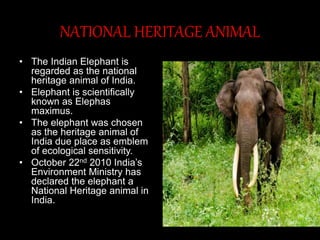
• The Indian Elephant is
regarded as the national
heritage animal of India.
• Elephant is scientifically
known as Elephas
maximus.
• The elephant was chosen
as the heritage animal of
India due place as emblem
of ecological sensitivity.
• October 22nd 2010 India’s
Environment Ministry has
declared the elephant a
National Heritage animal in
India.
NATIONAL TREE
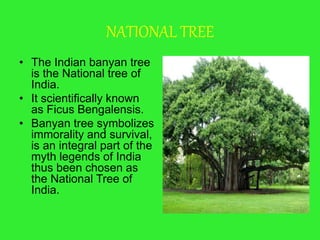
• The Indian banyan tree
is the National tree of
India.
• It scientifically known
as Ficus Bengalensis.
• Banyan tree symbolizes
immorality and survival,
is an integral part of the
myth legends of India
thus been chosen as
the National Tree of
India.
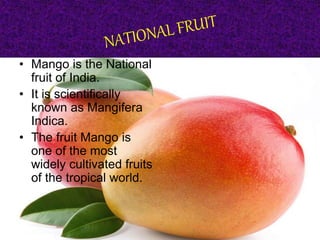
• Mango is the National
fruit of India.
• It is scientifically
known as Mangifera
Indica.
• The fruit Mango is
one of the most
widely cultivated fruits
of the tropical world.
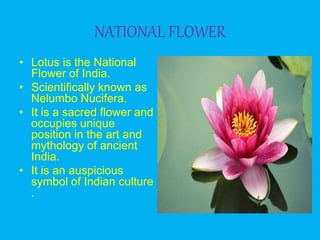
NATIONAL FLOWER
• Lotus is the National
Flower of India.
• Scientifically known as
Nelumbo Nucifera.
• It is a sacred flower and
occupies unique
position in the art and
mythology of ancient
India.
• It is an auspicious
symbol of Indian culture
.
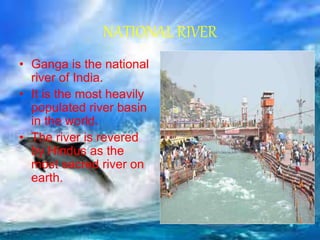
NATIONAL RIVER
• Ganga is the national
river of India.
• It is the most heavily
populated river basin
in the world.
• The river is revered
by Hindus as the
most sacred river on
earth.
CONCLUSION
The presentation on the National Symbols of India contains
brief information on various Indian National Symbols. We
have covered India’s National Flag, National Emblem,
National Pledge, National Anthem, National Song,
National Language, National Religion, National
Calendar, National Currency, National Game, National
Animal, National Bird, National Aquatic Animal, National
Heritage Animal, National Tree, National Fruit, National
Flower and National River….etc.
Indian National Symbols create the entity of the whole
nation , highlighting the pride and prestige.
Tinchu ppt

Tinchu ppt

  • 1.
    NATIONAL SYMBOLS OFINDIA NAME : TINCHU THOMAS OPTIONAL : SOCIAL SCIENCE ROLL NO : 50 COLLAGE : MGUCTE MUVATTUPUZHA 2015 – 2016 B. Ed BATCH SUBJECT : DEVOLOPMENT AND RESOURCES IN EDUCATIONAL TECHNOLOGY
  • 2.
    INTRODUCTION • A nationalsymbol is a symbol of any entity considering itself and manifesting itself to the world as a national community. • The Republic of India has several official national symbols. • These symbols are intrinsic to the Indian identity and heritage. • The national symbols of India are an integral part of the country’s diversity and heritage. • The national symbols have been chosen very carefully to describe India, it’s characteristics, people, culture and diversity.
  • 3.
    NATIONAL FLAG  Ahorizontal rectangular tricolor with equally sized deep saffron at the top, white in the middle and green at the bottom.  In the centre is a navy blue wheel with twenty- four spokes, known as the Ashok a Chakra.  In the top Saffron indicates the strength and courage of the country . The white middle band indicates peace and truth with Dharma Chakra. The green shows the fertility, growth and auspiciousness of the land.  The flag is based on the Swaraj flag designed by Pingali Venkayya  The design of the 22nd July 1947.  According to the Flag code of India, the Indian Flag has a proper ratio of two by three.
  • 4.
    NATIONAL EMBLEM  TheNational Emblem of India is a replica of the Lion of Sarnath, near Varanasi in Uttar Pradesh.  There are four Asiatic lions (one hidden from the view) standing back to back- symbolizing power, courage, pride and confidence- mounted on a circular abacus.  The base has a Dharma Chakra at the centre, a bull on the right and a galloping horse on the left. The words ‘Satyameva Jayate’ in devanagri script are inscribed at the bottom meaning ‘’ truth alone triumphs’’. This is a quote from Mundaka Upanishad, the concluding part of the sacred Hindu Vedas. The National emblem was adopted on 26 January 1950, the day that India became a republic.
  • 5.
    NATIONAL PLEDGE • TheNational Pledge is an oath of allegiance to the Republic of India. •The pledge was originally composed in Telugu language written by Pydimarri Venkata Subba Rao in 1962. • It was first read out in a school in Visakhapatnam in 1963 and was subsequently translated into various regional languages. • It is commonly recited by Indians in unison at public events, especially in schools and during the Independence Day and Republic Day celebrations. • It is commonly found printed in the opening pages of school text books.
  • 6.
    NATIONAL ANTHEM • “Janagana mana” is the national anthem of India. • Originally composed in Bengali language by Rabindranath Tagore. • This was first sung on 27 December at the Calcutta session of the Indian National Congress. • Officially adopted by the Constituent Assembly as the Indian national anthem on 24 January 1950. • The music for the current version is derived from a composition for the song by Ram Singh Thakur. • A formal rendition of the national anthem takes 52 seconds.
  • 7.
    NATIONAL SONG • “Vande matharam” is the national song of India. • Is a poem from Bankim Chandra Chatergee’s 1882 novel Anandamath. • It was written in Bengali and Sanskrit. • The song was first sung in a political context by Rabindranath Tagore at the 1896 session of the Indian National Congress at Calcutta. • In 1950, the song’s first two verses were given the official status of the “ national song” of the republic of India.
  • 8.
    NATIONAL LANGUAGE • Anational language is a language which has some connection with a people and perhaps by extension the territory they occupy. • The term is used variously. A national language may for instance represent the national identity of a nation or country. • National language may alternatively be a designation given to one or more languages spoken as first languages in the territory of a country. • We do not have national languages, India is Country with so many different language s • Article 343 of our constitution dictates that “the official language of the union shall be Hindi in devanagari script ’’, it also puts fourth English as the other official language • Hindi remains to be the most spoken language in the country
  • 9.
    NATIONAL RELIGION •We haveno national religion. • We have no national religion. • The constitution provides that all religions are equal before the state and no religion shall be given preference over the other. •In India, equal treatment of all religion by the state.
  • 10.
    NATIONAL CALENDAR • TheIndian National Calendar, called the Saka calendar, is the official civil calendar use in India. • Saka calendar was introduced by the Calendar committee in 1957. • Usage officially started at 1 Chaitra 1879 Saka era, or 22 march 1957. • Saka era is came in
  • 11.
    NATIONAL CURRENCY • Therupee, or more specifically the Indian rupee is the official currency of the Republic of India. • The issuance of the currency is controlled by the Reserve Bank of India. • The Indian rupees symbol is derived from the Devanagari consonant (ra). • The Indian rupees symbol officially adopted in 2010. • Udaya Kumar Dharmalingam is the designer of the Indian rupee sign. • The first series of coins with the rupees symbol was launched on 8 July 2011.
  • 12.
    NATIONAL GAME • Hockeyis the National Game of India. • Hockey when declared as the national game was very popular. • The game has seen a golden era during 1928- 1956, when India won 6 consecutive gold medals in the Olympics. • At that time India had played 24 Olympic matches and won all of them.
  • 13.
    NATIONAL ANIMAL • Themajestic ‘Tiger’ is regarded as the national animal of India. • Tiger is scientifically known as Panthera tigris. • Tiger was chosen as the National animal of India due to its grace, strength, agility and enormous power. • The tiger was adopted as the National animal by the Indian Board for wild life in 1972.
  • 14.
    NATIONAL BIRD • Indianpeacock is designated as the national bird of India. • The peacock is scientifically known as Pavo cristatus. • It is the symbol of grace, joy, beauty, and love. • Peacock represents the unity of vivid colors and finds references in Indian culture. • The peacock was adopted as the national bird of India in 1963.
  • 15.
    NATIONAL AQUATIC ANIMAL •Gangetic Dolphin is the National Aquatic Animal of India. • Gangetic dolphin is scientifically known as Platanista gangetica. • This mammal is also said to represent the purity of the holy Ganga as it can only survive in pure and fresh water. • The Ministry of Environment and Forests notified the Ganges River Dolphin as the National Aquatic Animal on 18, May 2010.
  • 16.
    NATIONAL HERITAGE ANIMAL •The Indian Elephant is regarded as the national heritage animal of India. • Elephant is scientifically known as Elephas maximus. • The elephant was chosen as the heritage animal of India due place as emblem of ecological sensitivity. • October 22nd 2010 India’s Environment Ministry has declared the elephant a National Heritage animal in India.
  • 17.
    NATIONAL TREE • TheIndian banyan tree is the National tree of India. • It scientifically known as Ficus Bengalensis. • Banyan tree symbolizes immorality and survival, is an integral part of the myth legends of India thus been chosen as the National Tree of India.
  • 18.
    • Mango isthe National fruit of India. • It is scientifically known as Mangifera Indica. • The fruit Mango is one of the most widely cultivated fruits of the tropical world.
  • 19.
    NATIONAL FLOWER • Lotusis the National Flower of India. • Scientifically known as Nelumbo Nucifera. • It is a sacred flower and occupies unique position in the art and mythology of ancient India. • It is an auspicious symbol of Indian culture .
  • 20.
    NATIONAL RIVER • Gangais the national river of India. • It is the most heavily populated river basin in the world. • The river is revered by Hindus as the most sacred river on earth.
  • 21.
    CONCLUSION The presentation onthe National Symbols of India contains brief information on various Indian National Symbols. We have covered India’s National Flag, National Emblem, National Pledge, National Anthem, National Song, National Language, National Religion, National Calendar, National Currency, National Game, National Animal, National Bird, National Aquatic Animal, National Heritage Animal, National Tree, National Fruit, National Flower and National River….etc. Indian National Symbols create the entity of the whole nation , highlighting the pride and prestige.

Editor's Notes

  • #11 We have no national religion. The constitution provides that all religions are equal before the state and no religion shall be given preference over the other.