Welcome to a
new learning
session!
Knowledge is Money.
By Steve F, CC BY-SA 2.0,
https://commons.wikimedia.org/w/index.php?curid=13995135
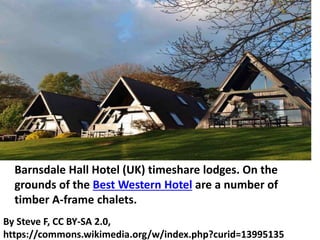
Barnsdale Hall Hotel (UK) timeshare lodges. On the
grounds of the Best Western Hotel are a number of
timber A-frame chalets.
Syllabus-1st Semester, NCHMCTAN
• Definition and types of timeshare; referral
chains & condominiums.
• Classification of timeshare.
• Types of accommodation & their size.
• Advantages & disadvantages of timeshare.
• International & national brands of timeshare.
• How is it different from hotel business?
What is Timeshare Concept?
A timeshare (or timesharing) is a form of
vacation ownership. In the most
traditional form, when you
buy timeshare, you essentially purchase
the right to vacation one week every
year, at a specific timeshare resort.
The week & room type of vacation may be
chosen by the buyer, and price of that
time period depends on the strength of
demand. Higher the demand, greater
are the prices.
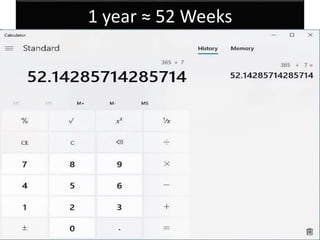
1 year ≈ 52 Weeks
What is Timeshares
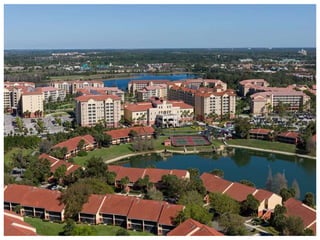
• A timeshare is a property with unique form
of ownership or user rights. These properties
are typically resort condominium units, in
which multiple parties hold rights to use the
same property, but each sharer is allotted a
specific period of time, (typically one week,
and almost always the same time every
year), in which they may use the property.
Attraction of a Timeshare
Timeshares properties are more spacious & better
equipped. They offer more flexibility than typical
vacations, and include options for points-based
memberships, and biennial usage. Additionally,
many timeshare purchases come with the ability
to exchange your vacation week, for a week at
another resort, a choice to gift or rent it out,
making timeshare a great option for many
travellers.
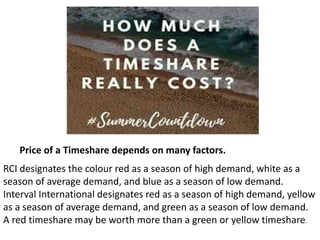
Price of a Timeshare depends on many factors.
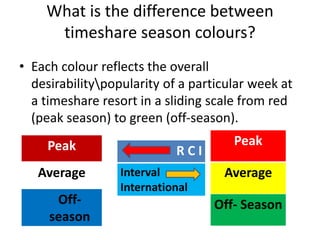
RCI designates the colour red as a season of high demand, white as a
season of average demand, and blue as a season of low demand.
Interval International designates red as a season of high demand, yellow
as a season of average demand, and green as a season of low demand.
A red timeshare may be worth more than a green or yellow timeshare.
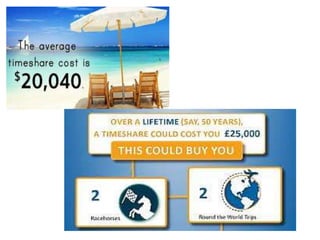
How are timeshare prices determined?
• The price of a timeshare is dependent upon a few
different factors.
• If you plan on buying timeshare weeks, consider
that these are priced according to a variety of
elements including time of year, location, resort
amenities, and size of the unit.
• Some resorts will only sell timeshare points, and
are usually priced per-point.
• Additionally, a timeshare resale (buying from an old
customer) costs much less, than one purchased
directly from the resort developer.
What is the difference between deeded,
leased, and licensed timeshare?
Most timeshare ownerships are either deeded or
leased for a specific number of years.
Deeded Timeshare – Similar to a traditional real
estate (housing) purchase, after you buy a deeded
timeshare, you own it wholly, and solely. It may be
sold, rented or even willed to your heirs. There is
no expiration date on a deeded timeshare. It is a
perpetual contract.
Timeshare Ownership Types
• Leased Timeshare – Leased timeshare (also called
right-to-use) gives you the right to use a specific
week or weeks at the property for a set number of
years (usually 20-99 years).
• The right to use the property normally returns to
the selling resort at the end of the lease period.
• If you buy a timeshare resale with a lease, be sure
to ask how many years are left on the contract.
• Many resorts will let you renew the contract on the
year it expires, but it is always a good idea to know
before you make a purchase.
Licensed Timeshare
Generally, licensed timeshare requires joining a
“vacation club”. By purchasing a membership
to a vacation club, owners receive a number
of points which, they can then use to purchase
vacations at various resorts. Some of the most
well-known vacation clubs include Disney
Vacation Club, Marriott Vacation Club,
and Hilton Grand Vacations Club.
How does timeshare exchanging work?
• One of the best reasons to buy timeshares is the
flexibility to exchange your week. As an owner, you
can join a timeshare exchange company to trade
your own week with other timeshare owners.
• This flexibility means that you may return to your
home resort year after year or trade for any of
the thousands of affiliated resorts, throughout the
world.
• You can even alternate back and forth between the
two options.
Timeshare Exchange
• The most popular timeshare exchange
companies are: RCI, Interval International,
and DAE.
• Some timeshare resorts have an internal
exchange program, but most also offer the
option to trade using an external company such
as RCI or Interval International. Typically these
third-party exchange companies require an
additional membership fee but give you the
option to cancel or renew every year.
What are timeshare use periods?
• There are four major types of timeshare use
periods.
• Fixed Weeks – Buying a fixed week timeshare
allows you the use of the unit for that specific week
each year for as long as you own the property. Fixed
weeks generally start on a Friday, Saturday, or
Sunday.
• Floating Weeks – Buying a floating week timeshare
allows you to use the unit anytime during the year
based upon a resort’s availability.
Timeshare Use Period Types
• Rotating or flex-week ownership
• Some are sold as rotating weeks, commonly
referred to as flex weeks. In an attempt to give all
owners a chance for the best weeks, the weeks
are rotated forward or backward through the
calendar, so in year 1 the owner may have use of
week 25, then week 26 in year 2, and then week
27 in year 3. This method gives each owner a fair
opportunity for prime weeks, but unlike its name,
it is not flexible.
Points programs
• Resort-based points programs are also sold as
deeded and as right to use. Points programs annually
give the owner a number of points equal to the level
of ownership. The owner in a points program can
then use these points to make travel arrangements
within the resort group. Many points programs are
affiliated with large resort groups offering a large
selection of options for destination. Many resort
point programs provide flexibility from the
traditional week stay.
• Resort point program members, such as WorldMark
by Wyndham and Diamond Resorts International,
may request from the entire available inventory of
the resort group.
Points-based Program
Points Program
• A points program member may often request
fractional weeks as well as full or multiple week
stays. The number of points required to stay at the
resort in question will vary based on a points chart.
The points chart will allow for factors such as:
• Popularity of the resort
• Size of the accommodations
• Number of nights
• Desirability of the season
What is the difference between
timeshare season colours?
• Each colour reflects the overall
desirabilitypopularity of a particular week at
a timeshare resort in a sliding scale from red
(peak season) to green (off-season).
Peak
Average
Off-
season
Peak
Average
Off- Season
R C I
Interval
International
What is the difference between a
timeshare and a hotel?
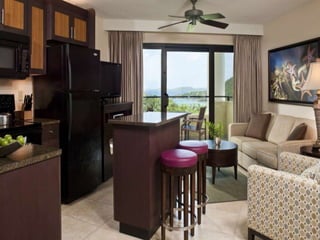
• A timeshare resort typically offers more space and
more amenities than a traditional hotel. The
average hotel room consists of a studio room with a
small bathroom, and not much else. With a
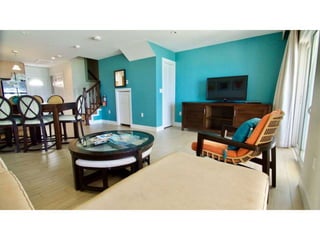
timeshare, you normally receive a condo-style unit
with multiple bedrooms, bathrooms, a separate
living room, dining area, and a full kitchen.
• Most timeshare resorts also feature an array of
amenities on the grounds of the resort. A daily
schedule of on-site sporting, recreational, and social
activities are available for both adults and children.
Methods of use
• Own personal use
• Rent through a broker, website or own contacts
• Gift to family or friends
• Exchange-internally (same company properties)
• Exchange-externally through RCI & I.I.
• Sell ownership, like a property
• Earn points if you don’t use it (to be exchanged
for some other time, place and product).
• Donate to charity
• Leave it in your last will for your children
History
• The term "timeshare" was coined in the United
Kingdom in the early 1960s expanding on a vacation
system that became popular after World War
II. Vacation home sharing, also known as holiday
home sharing, involved four European families that
would purchase a vacation cottage jointly, each
having exclusive use of the property for one of the
four seasons. They rotated seasons each year, so
each family enjoyed the best season equally. This
concept was mostly used by related families because
joint ownership requires trust and no property
manager was involved.
However, few families vacation for an entire season at
a time; so the vacation home sharing properties
were often vacant for long periods.
History of Timeshare
Enterprising minds in England decided to go
one step further and divide a resort room
into 1/50th ownership, (365 days divided by
7 days of a week=52 weeks) have two weeks
each year for repairs and upgrades, and
charge a maintenance fee to each owner. It
took almost a decade for timeshares in
Europe to evolve into a smoothly run,
successful, business venture.
What is Condominium Concept?
A condominium, often shortened to condo, is a type
of real estate property, divided into several units
that are each separately owned, surrounded by
common areas that are jointly owned.
Residential condominiums are frequently constructed
as apartment buildings, but there has been an
increase in the number of "detached
condominiums", like cottages, villas, bungalows etc.
http://www.millernash.com/what-is-a-condo-hotel-why-does-it-work-and-
why-is-it-challenging-05-24-2007/
Etymology-Origin of the Word
Condominium
• "Condominium" is a Latin word formed by adding the
prefix con- ("together") to the
word dominium ("domain, property, ownership"). Its
meaning is therefore "shared property".
• Condominia (the plural of condominium in Latin)
originally referred to territories over which two or more
countries shared joint dominion. This technique was
frequently used to settle border disputes when
multiple claimants could not agree on how to partition
the disputed territory.
• For example, from 1818 to 1846, Oregon Country was a
condominium over which both the United
States and Great Britain shared joint sovereignty,
before it joined the USA.
Apartment Versus Condominium
• Unlike apartments, which are leased by their tenants,
condominium units are owned outright. Additionally,
the owners of the individual units also collectively
own the common areas of the property, such as
hallways, walkways, laundry rooms, etc.; as well as
common utilities and amenities, such as
the HVAC system, elevators, and so on. Many
shopping malls are industrial condominiums in which
the individual retail and office spaces are owned by
the businesses that occupy them while the common
areas of the mall are collectively owned by all the
business entities that own the individual spaces.
• The common areas, amenities and utilities are
managed collectively by the owners through their
association, such as a homeowner association.
Homeowners Association (HOA)
• A homeowners association (HOA), whose members are
the unit owners, manages the condominium through a
board of directors elected by the membership. This
exists under various names depending on the
jurisdiction, such as "unit title", "sectional title",
"common hold", "strata council", or "tenant-owner's
association", "body corporate", "Owners Corporation",
"condominium corporation" or "condominium
association".
• Another variation of this concept is the "time share",
although not all time shares are condominiums, and
not all time shares involve actual ownership of (i.e.,
deeded title to) real property.
Condominium Hotels
Condo Hotels are a unique product, with a
great future.
• The owner has complete ownership, no
lease.
• Each owner can occupy or sell his unit
through the professionally managed hotel
company, and has to follow the rules laid by
the hotel management.
• He can stay, after giving a short, formal
notice to the company.
Condo Hotels
• The owner of the Condo Hotel and Hotel
Management company split the income from
rentals on an agreed basis.
• The people who check-in to a Condo Hotel
can be assured of the quality product and
services.
• The owner also leaves his botheration of
managing a complex building to expert
hoteliers.
• When the owner checks-in, he can expect 5
star treatment, too!
How condominiums are managed
• Condominium DocumentMaster Deed
• By-Laws
• Board of Directors
• Owners’ Association
• Annual Maintenance fee
• Hired ProfessionalsManagers
Non-Residential Condominiums
• Condominium ownership is also used, albeit less
frequently, for non-residential land uses: offices, hotel
rooms, retail shops, private airports, marinas, group
housing facilities (retirement homes or dormitories),
bare land (in British Columbia)) and storage. The legal
structure is the same, and many of the benefits are
similar; for instance, a non-profit corporation may face
a lower tax liability in an office condominium than in
an office rented from a taxable, for-profit company.
However, the frequent turnover of commercial land
uses in particular can make the inflexibility of
condominium arrangements problematic.
Condominium Concept in India
• In India, condominiums are known as "Apartment
Buildings" or "Flats". Each building consists of
multiple floors and flats with different
configurations. The most common configurations
are "1-BHK", "2-BHK" and "3-BHK" (BHK stands
for bedroom-hall-kitchen).
• The association of home owners is usually called
a Co-operative Housing Society (CHS) which
needs to be registered with the municipal
authorities.
• Source- Wikipedia
Types of Accommodation
The following are the types of accommodation available for
the timeshare guests:
1. Apartments (Studio Units) or Multi-Room with
KitchenKitchenette
2. Bungalows
3. Villas
4. Cottages
5. Restored farmhouses
6. Private residence clubs
7. Second homes
8. Condos
9. Marina
Size of accommodation
• Sleeps 22 (privately)
• Sleeps 42 ( ,, )
• Sleeps 64 ( ,, )
Facilities
• Fully equipped kitchens
• Dining Area
• Dishwasher machine
• Television
• DVD Players
• Washing Machine
• Crockery, cutlery, cooking utensils etc
Advantage of Timeshare
The following benefits:
A. A fast growing tourism product
B. Promotes all types –inbound , outbound and
domestic tourism
C. High potential for employment opportunities
D. Domestic tourism for India’s tourism growth
E. Full potential of domestic tourism-to be
exploited by industry and government
partnership.
Disadvantages of Timeshare
The following are:
A. The biggest disadvantage of the timeshare
business is that it has still not organized well.
B. A major portion of its cost is being spent on its
marketing and merchandizing.
Critique of timeshare
• Over-priced
• Annual maintenance fee being too high
• Value of Time Share does not appreciate like
real estate does
• High-pressure sales tactics
• Resale of Timeshare is nearly impossible!
What Are Timeshare Maintenance Fees?
• After you buy timeshare, there are some small
additional yearly expenses. Average
maintenance fees range from $500 – $1,000
annually and are the owners’ shared cost of
the upkeep of their own unit, as well as the
common-use grounds of the resort.
BRANDS
• International:
 Disney vacation club
 Embassy suite
 Four seasons
 Hilton Grand vacations
 Hyatt vacation club
 Marriott vacation club international
 Sheraton
 Shell vacation
 Suntorra Resorts
Domestic brands
http://www.airda.org/timeshare-india.html
Club Mahindra
Ffort Radisson
Holiday Inn Goa
Kamat Group
Le Royal Meridien
Royal Resorts
Sterling Days Inn
http://www.airda.org/membership-airda-
members.html
Timeshare Rating System
What is the difference between a Five-Star resort
and a Gold Crown resort?
• These titles refer to ratings from timeshare
exchange companies.
• A Five-Star Resort is the most desirable rating
appointed to a resort in the Interval
International system while a Gold Crown Resort
is the most desirable rating in the Resort
Condominium International (RCI) system.
Mixed-Use
• The scenario describes timeshare in a hotel
environment.
• Mixed-use facilities have been soaring in
popularity since the mid 1990s.
• Integrate golf courses, restaurants, swimming
pools, etc. with a hotel and timeshare
component to maximize returns.
• Marriott, Disney, Hyatt, Starwood, Four
Seasons, Ritz-Carlton, and Hilton are
companies adding the timeshare concept to
their hotel businesses.
Advantages of Mixed-Use
• Leverage hotel brand names and create cross-
utilization opportunities between traditional
hotel products and timeshare services and
products
• Creates stability and profitability
–Customers pay a sizable lump sum in advance
–Customers pay an annual contribution
• Less affected by a downturn in the economy
than conventional resort hotels
• Help lower marketing, operational, and
development costs, and maximize the yield of
the operation through shared assets and staff
Compilation & Presentation
Praveen Jha
Senior Faculty
IHM Hajipur
Vaishali, Bihar

Timeshare, Condominium & Referral Chains

  • 3.
    Welcome to a newlearning session! Knowledge is Money.
  • 4.
    By Steve F,CC BY-SA 2.0, https://commons.wikimedia.org/w/index.php?curid=13995135 Barnsdale Hall Hotel (UK) timeshare lodges. On the grounds of the Best Western Hotel are a number of timber A-frame chalets.
  • 6.
    Syllabus-1st Semester, NCHMCTAN •Definition and types of timeshare; referral chains & condominiums. • Classification of timeshare. • Types of accommodation & their size. • Advantages & disadvantages of timeshare. • International & national brands of timeshare. • How is it different from hotel business?
  • 7.
    What is TimeshareConcept? A timeshare (or timesharing) is a form of vacation ownership. In the most traditional form, when you buy timeshare, you essentially purchase the right to vacation one week every year, at a specific timeshare resort. The week & room type of vacation may be chosen by the buyer, and price of that time period depends on the strength of demand. Higher the demand, greater are the prices.
  • 8.
    1 year ≈52 Weeks
  • 9.
    What is Timeshares •A timeshare is a property with unique form of ownership or user rights. These properties are typically resort condominium units, in which multiple parties hold rights to use the same property, but each sharer is allotted a specific period of time, (typically one week, and almost always the same time every year), in which they may use the property.
  • 10.
    Attraction of aTimeshare Timeshares properties are more spacious & better equipped. They offer more flexibility than typical vacations, and include options for points-based memberships, and biennial usage. Additionally, many timeshare purchases come with the ability to exchange your vacation week, for a week at another resort, a choice to gift or rent it out, making timeshare a great option for many travellers.
  • 14.
    Price of aTimeshare depends on many factors. RCI designates the colour red as a season of high demand, white as a season of average demand, and blue as a season of low demand. Interval International designates red as a season of high demand, yellow as a season of average demand, and green as a season of low demand. A red timeshare may be worth more than a green or yellow timeshare.
  • 15.
    How are timeshareprices determined? • The price of a timeshare is dependent upon a few different factors. • If you plan on buying timeshare weeks, consider that these are priced according to a variety of elements including time of year, location, resort amenities, and size of the unit. • Some resorts will only sell timeshare points, and are usually priced per-point. • Additionally, a timeshare resale (buying from an old customer) costs much less, than one purchased directly from the resort developer.
  • 17.
    What is thedifference between deeded, leased, and licensed timeshare? Most timeshare ownerships are either deeded or leased for a specific number of years. Deeded Timeshare – Similar to a traditional real estate (housing) purchase, after you buy a deeded timeshare, you own it wholly, and solely. It may be sold, rented or even willed to your heirs. There is no expiration date on a deeded timeshare. It is a perpetual contract.
  • 18.
    Timeshare Ownership Types •Leased Timeshare – Leased timeshare (also called right-to-use) gives you the right to use a specific week or weeks at the property for a set number of years (usually 20-99 years). • The right to use the property normally returns to the selling resort at the end of the lease period. • If you buy a timeshare resale with a lease, be sure to ask how many years are left on the contract. • Many resorts will let you renew the contract on the year it expires, but it is always a good idea to know before you make a purchase.
  • 19.
    Licensed Timeshare Generally, licensedtimeshare requires joining a “vacation club”. By purchasing a membership to a vacation club, owners receive a number of points which, they can then use to purchase vacations at various resorts. Some of the most well-known vacation clubs include Disney Vacation Club, Marriott Vacation Club, and Hilton Grand Vacations Club.
  • 21.
    How does timeshareexchanging work? • One of the best reasons to buy timeshares is the flexibility to exchange your week. As an owner, you can join a timeshare exchange company to trade your own week with other timeshare owners. • This flexibility means that you may return to your home resort year after year or trade for any of the thousands of affiliated resorts, throughout the world. • You can even alternate back and forth between the two options.
  • 23.
    Timeshare Exchange • Themost popular timeshare exchange companies are: RCI, Interval International, and DAE. • Some timeshare resorts have an internal exchange program, but most also offer the option to trade using an external company such as RCI or Interval International. Typically these third-party exchange companies require an additional membership fee but give you the option to cancel or renew every year.
  • 25.
    What are timeshareuse periods? • There are four major types of timeshare use periods. • Fixed Weeks – Buying a fixed week timeshare allows you the use of the unit for that specific week each year for as long as you own the property. Fixed weeks generally start on a Friday, Saturday, or Sunday. • Floating Weeks – Buying a floating week timeshare allows you to use the unit anytime during the year based upon a resort’s availability.
  • 26.
    Timeshare Use PeriodTypes • Rotating or flex-week ownership • Some are sold as rotating weeks, commonly referred to as flex weeks. In an attempt to give all owners a chance for the best weeks, the weeks are rotated forward or backward through the calendar, so in year 1 the owner may have use of week 25, then week 26 in year 2, and then week 27 in year 3. This method gives each owner a fair opportunity for prime weeks, but unlike its name, it is not flexible.
  • 27.
    Points programs • Resort-basedpoints programs are also sold as deeded and as right to use. Points programs annually give the owner a number of points equal to the level of ownership. The owner in a points program can then use these points to make travel arrangements within the resort group. Many points programs are affiliated with large resort groups offering a large selection of options for destination. Many resort point programs provide flexibility from the traditional week stay. • Resort point program members, such as WorldMark by Wyndham and Diamond Resorts International, may request from the entire available inventory of the resort group.
  • 28.
  • 29.
    Points Program • Apoints program member may often request fractional weeks as well as full or multiple week stays. The number of points required to stay at the resort in question will vary based on a points chart. The points chart will allow for factors such as: • Popularity of the resort • Size of the accommodations • Number of nights • Desirability of the season
  • 30.
    What is thedifference between timeshare season colours? • Each colour reflects the overall desirabilitypopularity of a particular week at a timeshare resort in a sliding scale from red (peak season) to green (off-season). Peak Average Off- season Peak Average Off- Season R C I Interval International
  • 31.
    What is thedifference between a timeshare and a hotel? • A timeshare resort typically offers more space and more amenities than a traditional hotel. The average hotel room consists of a studio room with a small bathroom, and not much else. With a timeshare, you normally receive a condo-style unit with multiple bedrooms, bathrooms, a separate living room, dining area, and a full kitchen. • Most timeshare resorts also feature an array of amenities on the grounds of the resort. A daily schedule of on-site sporting, recreational, and social activities are available for both adults and children.
  • 32.
    Methods of use •Own personal use • Rent through a broker, website or own contacts • Gift to family or friends • Exchange-internally (same company properties) • Exchange-externally through RCI & I.I. • Sell ownership, like a property • Earn points if you don’t use it (to be exchanged for some other time, place and product). • Donate to charity • Leave it in your last will for your children
  • 33.
    History • The term"timeshare" was coined in the United Kingdom in the early 1960s expanding on a vacation system that became popular after World War II. Vacation home sharing, also known as holiday home sharing, involved four European families that would purchase a vacation cottage jointly, each having exclusive use of the property for one of the four seasons. They rotated seasons each year, so each family enjoyed the best season equally. This concept was mostly used by related families because joint ownership requires trust and no property manager was involved. However, few families vacation for an entire season at a time; so the vacation home sharing properties were often vacant for long periods.
  • 34.
    History of Timeshare Enterprisingminds in England decided to go one step further and divide a resort room into 1/50th ownership, (365 days divided by 7 days of a week=52 weeks) have two weeks each year for repairs and upgrades, and charge a maintenance fee to each owner. It took almost a decade for timeshares in Europe to evolve into a smoothly run, successful, business venture.
  • 35.
    What is CondominiumConcept? A condominium, often shortened to condo, is a type of real estate property, divided into several units that are each separately owned, surrounded by common areas that are jointly owned. Residential condominiums are frequently constructed as apartment buildings, but there has been an increase in the number of "detached condominiums", like cottages, villas, bungalows etc. http://www.millernash.com/what-is-a-condo-hotel-why-does-it-work-and- why-is-it-challenging-05-24-2007/
  • 37.
    Etymology-Origin of theWord Condominium • "Condominium" is a Latin word formed by adding the prefix con- ("together") to the word dominium ("domain, property, ownership"). Its meaning is therefore "shared property". • Condominia (the plural of condominium in Latin) originally referred to territories over which two or more countries shared joint dominion. This technique was frequently used to settle border disputes when multiple claimants could not agree on how to partition the disputed territory. • For example, from 1818 to 1846, Oregon Country was a condominium over which both the United States and Great Britain shared joint sovereignty, before it joined the USA.
  • 38.
    Apartment Versus Condominium •Unlike apartments, which are leased by their tenants, condominium units are owned outright. Additionally, the owners of the individual units also collectively own the common areas of the property, such as hallways, walkways, laundry rooms, etc.; as well as common utilities and amenities, such as the HVAC system, elevators, and so on. Many shopping malls are industrial condominiums in which the individual retail and office spaces are owned by the businesses that occupy them while the common areas of the mall are collectively owned by all the business entities that own the individual spaces. • The common areas, amenities and utilities are managed collectively by the owners through their association, such as a homeowner association.
  • 39.
    Homeowners Association (HOA) •A homeowners association (HOA), whose members are the unit owners, manages the condominium through a board of directors elected by the membership. This exists under various names depending on the jurisdiction, such as "unit title", "sectional title", "common hold", "strata council", or "tenant-owner's association", "body corporate", "Owners Corporation", "condominium corporation" or "condominium association". • Another variation of this concept is the "time share", although not all time shares are condominiums, and not all time shares involve actual ownership of (i.e., deeded title to) real property.
  • 40.
    Condominium Hotels Condo Hotelsare a unique product, with a great future. • The owner has complete ownership, no lease. • Each owner can occupy or sell his unit through the professionally managed hotel company, and has to follow the rules laid by the hotel management. • He can stay, after giving a short, formal notice to the company.
  • 41.
    Condo Hotels • Theowner of the Condo Hotel and Hotel Management company split the income from rentals on an agreed basis. • The people who check-in to a Condo Hotel can be assured of the quality product and services. • The owner also leaves his botheration of managing a complex building to expert hoteliers. • When the owner checks-in, he can expect 5 star treatment, too!
  • 42.
    How condominiums aremanaged • Condominium DocumentMaster Deed • By-Laws • Board of Directors • Owners’ Association • Annual Maintenance fee • Hired ProfessionalsManagers
  • 43.
    Non-Residential Condominiums • Condominiumownership is also used, albeit less frequently, for non-residential land uses: offices, hotel rooms, retail shops, private airports, marinas, group housing facilities (retirement homes or dormitories), bare land (in British Columbia)) and storage. The legal structure is the same, and many of the benefits are similar; for instance, a non-profit corporation may face a lower tax liability in an office condominium than in an office rented from a taxable, for-profit company. However, the frequent turnover of commercial land uses in particular can make the inflexibility of condominium arrangements problematic.
  • 44.
    Condominium Concept inIndia • In India, condominiums are known as "Apartment Buildings" or "Flats". Each building consists of multiple floors and flats with different configurations. The most common configurations are "1-BHK", "2-BHK" and "3-BHK" (BHK stands for bedroom-hall-kitchen). • The association of home owners is usually called a Co-operative Housing Society (CHS) which needs to be registered with the municipal authorities. • Source- Wikipedia
  • 45.
    Types of Accommodation Thefollowing are the types of accommodation available for the timeshare guests: 1. Apartments (Studio Units) or Multi-Room with KitchenKitchenette 2. Bungalows 3. Villas 4. Cottages 5. Restored farmhouses 6. Private residence clubs 7. Second homes 8. Condos 9. Marina
  • 46.
    Size of accommodation •Sleeps 22 (privately) • Sleeps 42 ( ,, ) • Sleeps 64 ( ,, )
  • 47.
    Facilities • Fully equippedkitchens • Dining Area • Dishwasher machine • Television • DVD Players • Washing Machine • Crockery, cutlery, cooking utensils etc
  • 48.
    Advantage of Timeshare Thefollowing benefits: A. A fast growing tourism product B. Promotes all types –inbound , outbound and domestic tourism C. High potential for employment opportunities D. Domestic tourism for India’s tourism growth E. Full potential of domestic tourism-to be exploited by industry and government partnership.
  • 49.
    Disadvantages of Timeshare Thefollowing are: A. The biggest disadvantage of the timeshare business is that it has still not organized well. B. A major portion of its cost is being spent on its marketing and merchandizing.
  • 50.
    Critique of timeshare •Over-priced • Annual maintenance fee being too high • Value of Time Share does not appreciate like real estate does • High-pressure sales tactics • Resale of Timeshare is nearly impossible!
  • 51.
    What Are TimeshareMaintenance Fees? • After you buy timeshare, there are some small additional yearly expenses. Average maintenance fees range from $500 – $1,000 annually and are the owners’ shared cost of the upkeep of their own unit, as well as the common-use grounds of the resort.
  • 52.
    BRANDS • International:  Disneyvacation club  Embassy suite  Four seasons  Hilton Grand vacations  Hyatt vacation club  Marriott vacation club international  Sheraton  Shell vacation  Suntorra Resorts
  • 53.
    Domestic brands http://www.airda.org/timeshare-india.html Club Mahindra FfortRadisson Holiday Inn Goa Kamat Group Le Royal Meridien Royal Resorts Sterling Days Inn http://www.airda.org/membership-airda- members.html
  • 54.
    Timeshare Rating System Whatis the difference between a Five-Star resort and a Gold Crown resort? • These titles refer to ratings from timeshare exchange companies. • A Five-Star Resort is the most desirable rating appointed to a resort in the Interval International system while a Gold Crown Resort is the most desirable rating in the Resort Condominium International (RCI) system.
  • 55.
    Mixed-Use • The scenariodescribes timeshare in a hotel environment. • Mixed-use facilities have been soaring in popularity since the mid 1990s. • Integrate golf courses, restaurants, swimming pools, etc. with a hotel and timeshare component to maximize returns. • Marriott, Disney, Hyatt, Starwood, Four Seasons, Ritz-Carlton, and Hilton are companies adding the timeshare concept to their hotel businesses.
  • 56.
    Advantages of Mixed-Use •Leverage hotel brand names and create cross- utilization opportunities between traditional hotel products and timeshare services and products • Creates stability and profitability –Customers pay a sizable lump sum in advance –Customers pay an annual contribution • Less affected by a downturn in the economy than conventional resort hotels • Help lower marketing, operational, and development costs, and maximize the yield of the operation through shared assets and staff
  • 57.
    Compilation & Presentation PraveenJha Senior Faculty IHM Hajipur Vaishali, Bihar