GUESS THE
GIBBERISH
Main need
me aunt
Management
Me and
shore
Measure
Friend see
apple
Principle
TIME
MANAGEMENT
EVERY SECOND COUNTS!
Cormier (1983) defines time management as gaining control over
what you do, when you do it, how you do it and why you do it.
What is your definition of time?
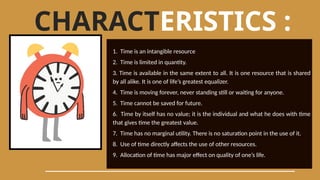
CHARACTERISTICS :
1. Time is an intangible resource
2. Time is limited in quantity.
3. Time is available in the same extent to all. It is one resource that is shared
by all alike. It is one of life’s greatest equalizer.
4. Time is moving forever, never standing still or waiting for anyone.
5. Time cannot be saved for future.
6. Time by itself has no value; it is the individual and what he does with time
that gives time the greatest value.
7. Time has no marginal utility. There is no saturation point in the use of it.
8. Use of time directly affects the use of other resources.
9. Allocation of time has major effect on quality of one’s life.
Perception
Linear separable perception: Time stretches from the
past into the future.
Circular perception: Same events are repeated
according to some cyclic pattern.
Procedural perception: Some people are procedure
driven rather than time driven.
THE BIOLOGICAL
TIME
years of infancy,
childhood, adolescence,
adulthood, and old age
are indicators of
biological time.
.
CLOCK TIME
Time is noted by
timing as hour; days,
weeks, months and
years.
PSYCHOLOGICAL TIME
the awareness of passage of
time, To an energetic
enthusiastic person, time
runs quickly, but to an
unhealthy or bored person
time runs slowly.
MEASURE OF TIME
02
01 03
TOOLS IN TIME MANAGEMENT
1. TIME NORM:
It is the average time taken for carrying out various household tasks as cooking, cleaning the
utensils, mopping the floor or caring the infant.
2. WORK UNIT:
Work unit helps to establish the time norm. Work unit is the amount of household work done
in one hour, under average conditions by an average worker.
3. WORK LOAD
The work load is the sum of work units.
4. PEAK LOAD;
For most people, activities pile on each other at certain times of the day, week, month or the
season. This is referred as peak load. The packed period may be reduced by:
a)Starting the work early
b)Completing other work in advance
c) Sharing some work with others.
TOOLS IN TIME MANAGEMENT
5. Work curve
Work curve helps in studying changes in the output of work at different stages of work period
or even a day. A typical work curve is described as Saddle-backed, starting sluggishly with a
sharp rise as the worker gets into his stride. At the end of warming up period, production
continues at a steady rate -the plateau. After the plateau, the work curve registers a decline in
productivity with a fresh spurt as the work nears its end. There arises a second plateau after
lunch or rest but it does not reach as high as the earlier one.
6. REST PERIODS
Planning for the rest period at the required time is very essential. It has a great influence on
the output of work. Rest need not be always cessation from work. The ways of taking rest are.
1.Relaxation by lying down is most relieving since it requires less expenditure of energy than
any other body position. It is desirable after heavy manual labour.
2.Complete relaxation in a sitting position gives relief.
3. Involving in alternate types of job and
4. Recreation in between as a pleasant conversation may help in providing rest period.
STRATEGIES
Rice et al (1986) states certain tools or strategies that are more specifically
related to time management:
a) Effectiveness or efficiency:- It is performing a task in the least wasteful
manner usually measured in terms of time and energy. It is selecting or
doing the most appropriate thing which requires priorities. It is essential
to achieve effectiveness while performing activities.
Pareto’s principle:- This principle theorizes that 20 percent of the
expended usually produces 80 percent of the results, while 80 percent of
the time expended produces only 20 percent of the results.
c) Parkinson’s Law:-This law stress that a job expands to fill the time
available to accomplish the task. When time seems limited and people are
busy, they tend to squeeze many activities into a short time span.
STRATEGIES
d) Prime Time:-Knowing when one is more productive can improve
both time use and output. This is internal prime time and
corresponds to the period of the day when energy is high for the
individual. This time should be preserved for high priority activities
that require concentrated effort. External prime time is the best
time to other people. This is the time that people at work should
make available to meet with staff or visitors. During the quiet time
only highest priority items should be worked on and no
interruptions should be allowed.
e) Time Logs :-Time logs are not plans for future, but are records of
how time was used in the past . Time logs help people see with
observation, the changes that are needed in their time allocation.
THANK
YOU!
Identification (5 points each)
1.What is the term for the amount of household work done in one hour under average conditions
by an average worker?
2.Which principle states that a job expands to fill the time available for its completion?
3.What is the term for the period of the day when an individual is most productive and should focus
on high-priority tasks?
4.What time management technique uses a timer to break work into intervals, typically 25 minutes
of focused work followed by a short break?
5.Which matrix categorizes tasks into four quadrants based on urgency and importance?
Essay (10 points each)
6.Explain the importance of time management in maintaining a balance between work, rest, and
leisure.
7.Describe the three perceptions of time and provide an example of each.
8.Discuss the impact of poor time management and identify at least three common constraints to
effective time use.
9.Explain how the Pareto Principle (80/20 Rule) applies to time management and productivity.
10.Describe the process of creating an effective time schedule and explain how it helps in managing
daily activities efficiently.
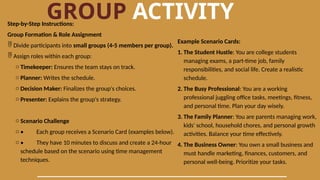
GROUP ACTIVITY
Step-by-Step Instructions:
Group Formation & Role Assignment
 Divide participants into small groups (4-5 members per group).
 Assign roles within each group:
o Timekeeper: Ensures the team stays on track.
o Planner: Writes the schedule.
o Decision Maker: Finalizes the group's choices.
o Presenter: Explains the group's strategy.
o Scenario Challenge
o • Each group receives a Scenario Card (examples below).
o • They have 10 minutes to discuss and create a 24-hour
schedule based on the scenario using time management
techniques.
Example Scenario Cards:
1. The Student Hustle: You are college students
managing exams, a part-time job, family
responsibilities, and social life. Create a realistic
schedule.
2. The Busy Professional: You are a working
professional juggling office tasks, meetings, fitness,
and personal time. Plan your day wisely.
3. The Family Planner: You are parents managing work,
kids' school, household chores, and personal growth
activities. Balance your time effectively.
4. The Business Owner: You own a small business and
must handle marketing, finances, customers, and
personal well-being. Prioritize your tasks.
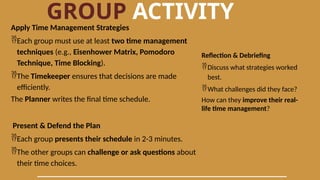
GROUP ACTIVITY
Apply Time Management Strategies
Each group must use at least two time management
techniques (e.g., Eisenhower Matrix, Pomodoro
Technique, Time Blocking).
The Timekeeper ensures that decisions are made
efficiently.
The Planner writes the final time schedule.
Present & Defend the Plan
Each group presents their schedule in 2-3 minutes.
The other groups can challenge or ask questions about
their time choices.
Reflection & Debriefing
Discuss what strategies worked
best.
What challenges did they face?
How can they improve their real-
life time management?
CRITERIA
Evaluation Criteria:
✔ Prioritization & Decision Making -10
✔ Creativity in Scheduling- 10
✔ Effective Use of Time Management Strategies- 20
✔ Presentation & Justification of Choices-10
Lorem ipsum dolor sit amet, consectetur adipiscing elit. Ut
efficitur sagittis leo, sit amet consectetur dolor dapibus
vitae. Proin odio neque, efficitur at justo et, sagittis
eleifend neque.
Lorem ipsum dolor sit amet, consectetur adipiscing
elit.
Lorem ipsum dolor sit amet, consectetur adipiscing
elit.
PROJECT 2
AUGUST, 2020
W
W
W
.
R
E
A
L
L
Y
G
R
E
A
T
S
I
T
E
.
C
O
M
Lorem ipsum dolor sit amet, consectetur adipiscing elit. Ut
efficitur sagittis leo, sit amet consectetur dolor dapibus
vitae. Proin odio neque, efficitur at justo et, sagittis
eleifend neque.
Lorem ipsum dolor sit amet, consectetur adipiscing
elit.
Lorem ipsum dolor sit amet, consectetur adipiscing
elit.
PROJECT 3
JANUARY, 2021
W
W
W
.
R
E
A
L
L
Y
G
R
E
A
T
S
I
T
E
.
C
O
M
COMPANY ADDRESS
123 Anywhere Street, Any City
PHONE NUMBER
123-456-7890
EMAIL ADDRESS
hello@reallygreatsite.com
WEBSITE
hello@reallygreatsite.com
CONTACT US
Lorem ipsum dolor sit amet, consectetur adipiscing elit. Ut efficitur
sagittis leo, sit amet consectetur dolor dapibus vitae. Proin odio
neque, efficitur at justo et, sagittis eleifend neque.

TIME MANAGEMENT RESOURCES PowerPoint PRESENTATION

  • 1.
  • 2.
  • 3.
  • 4.
  • 5.
  • 6.
  • 7.
  • 8.
  • 9.
    Cormier (1983) definestime management as gaining control over what you do, when you do it, how you do it and why you do it.
  • 10.
    What is yourdefinition of time?
  • 11.
    CHARACTERISTICS : 1. Timeis an intangible resource 2. Time is limited in quantity. 3. Time is available in the same extent to all. It is one resource that is shared by all alike. It is one of life’s greatest equalizer. 4. Time is moving forever, never standing still or waiting for anyone. 5. Time cannot be saved for future. 6. Time by itself has no value; it is the individual and what he does with time that gives time the greatest value. 7. Time has no marginal utility. There is no saturation point in the use of it. 8. Use of time directly affects the use of other resources. 9. Allocation of time has major effect on quality of one’s life.
  • 12.
    Perception Linear separable perception:Time stretches from the past into the future. Circular perception: Same events are repeated according to some cyclic pattern. Procedural perception: Some people are procedure driven rather than time driven.
  • 13.
    THE BIOLOGICAL TIME years ofinfancy, childhood, adolescence, adulthood, and old age are indicators of biological time. . CLOCK TIME Time is noted by timing as hour; days, weeks, months and years. PSYCHOLOGICAL TIME the awareness of passage of time, To an energetic enthusiastic person, time runs quickly, but to an unhealthy or bored person time runs slowly. MEASURE OF TIME 02 01 03
  • 14.
    TOOLS IN TIMEMANAGEMENT 1. TIME NORM: It is the average time taken for carrying out various household tasks as cooking, cleaning the utensils, mopping the floor or caring the infant. 2. WORK UNIT: Work unit helps to establish the time norm. Work unit is the amount of household work done in one hour, under average conditions by an average worker. 3. WORK LOAD The work load is the sum of work units. 4. PEAK LOAD; For most people, activities pile on each other at certain times of the day, week, month or the season. This is referred as peak load. The packed period may be reduced by: a)Starting the work early b)Completing other work in advance c) Sharing some work with others.
  • 15.
    TOOLS IN TIMEMANAGEMENT 5. Work curve Work curve helps in studying changes in the output of work at different stages of work period or even a day. A typical work curve is described as Saddle-backed, starting sluggishly with a sharp rise as the worker gets into his stride. At the end of warming up period, production continues at a steady rate -the plateau. After the plateau, the work curve registers a decline in productivity with a fresh spurt as the work nears its end. There arises a second plateau after lunch or rest but it does not reach as high as the earlier one. 6. REST PERIODS Planning for the rest period at the required time is very essential. It has a great influence on the output of work. Rest need not be always cessation from work. The ways of taking rest are. 1.Relaxation by lying down is most relieving since it requires less expenditure of energy than any other body position. It is desirable after heavy manual labour. 2.Complete relaxation in a sitting position gives relief. 3. Involving in alternate types of job and 4. Recreation in between as a pleasant conversation may help in providing rest period.
  • 16.
    STRATEGIES Rice et al(1986) states certain tools or strategies that are more specifically related to time management: a) Effectiveness or efficiency:- It is performing a task in the least wasteful manner usually measured in terms of time and energy. It is selecting or doing the most appropriate thing which requires priorities. It is essential to achieve effectiveness while performing activities. Pareto’s principle:- This principle theorizes that 20 percent of the expended usually produces 80 percent of the results, while 80 percent of the time expended produces only 20 percent of the results. c) Parkinson’s Law:-This law stress that a job expands to fill the time available to accomplish the task. When time seems limited and people are busy, they tend to squeeze many activities into a short time span.
  • 17.
    STRATEGIES d) Prime Time:-Knowingwhen one is more productive can improve both time use and output. This is internal prime time and corresponds to the period of the day when energy is high for the individual. This time should be preserved for high priority activities that require concentrated effort. External prime time is the best time to other people. This is the time that people at work should make available to meet with staff or visitors. During the quiet time only highest priority items should be worked on and no interruptions should be allowed. e) Time Logs :-Time logs are not plans for future, but are records of how time was used in the past . Time logs help people see with observation, the changes that are needed in their time allocation.
  • 18.
  • 19.
    Identification (5 pointseach) 1.What is the term for the amount of household work done in one hour under average conditions by an average worker? 2.Which principle states that a job expands to fill the time available for its completion? 3.What is the term for the period of the day when an individual is most productive and should focus on high-priority tasks? 4.What time management technique uses a timer to break work into intervals, typically 25 minutes of focused work followed by a short break? 5.Which matrix categorizes tasks into four quadrants based on urgency and importance? Essay (10 points each) 6.Explain the importance of time management in maintaining a balance between work, rest, and leisure. 7.Describe the three perceptions of time and provide an example of each. 8.Discuss the impact of poor time management and identify at least three common constraints to effective time use. 9.Explain how the Pareto Principle (80/20 Rule) applies to time management and productivity. 10.Describe the process of creating an effective time schedule and explain how it helps in managing daily activities efficiently.
  • 20.
    GROUP ACTIVITY Step-by-Step Instructions: GroupFormation & Role Assignment  Divide participants into small groups (4-5 members per group).  Assign roles within each group: o Timekeeper: Ensures the team stays on track. o Planner: Writes the schedule. o Decision Maker: Finalizes the group's choices. o Presenter: Explains the group's strategy. o Scenario Challenge o • Each group receives a Scenario Card (examples below). o • They have 10 minutes to discuss and create a 24-hour schedule based on the scenario using time management techniques. Example Scenario Cards: 1. The Student Hustle: You are college students managing exams, a part-time job, family responsibilities, and social life. Create a realistic schedule. 2. The Busy Professional: You are a working professional juggling office tasks, meetings, fitness, and personal time. Plan your day wisely. 3. The Family Planner: You are parents managing work, kids' school, household chores, and personal growth activities. Balance your time effectively. 4. The Business Owner: You own a small business and must handle marketing, finances, customers, and personal well-being. Prioritize your tasks.
  • 21.
    GROUP ACTIVITY Apply TimeManagement Strategies Each group must use at least two time management techniques (e.g., Eisenhower Matrix, Pomodoro Technique, Time Blocking). The Timekeeper ensures that decisions are made efficiently. The Planner writes the final time schedule. Present & Defend the Plan Each group presents their schedule in 2-3 minutes. The other groups can challenge or ask questions about their time choices. Reflection & Debriefing Discuss what strategies worked best. What challenges did they face? How can they improve their real- life time management?
  • 22.
    CRITERIA Evaluation Criteria: ✔ Prioritization& Decision Making -10 ✔ Creativity in Scheduling- 10 ✔ Effective Use of Time Management Strategies- 20 ✔ Presentation & Justification of Choices-10
  • 23.
    Lorem ipsum dolorsit amet, consectetur adipiscing elit. Ut efficitur sagittis leo, sit amet consectetur dolor dapibus vitae. Proin odio neque, efficitur at justo et, sagittis eleifend neque. Lorem ipsum dolor sit amet, consectetur adipiscing elit. Lorem ipsum dolor sit amet, consectetur adipiscing elit. PROJECT 2 AUGUST, 2020 W W W . R E A L L Y G R E A T S I T E . C O M
  • 24.
    Lorem ipsum dolorsit amet, consectetur adipiscing elit. Ut efficitur sagittis leo, sit amet consectetur dolor dapibus vitae. Proin odio neque, efficitur at justo et, sagittis eleifend neque. Lorem ipsum dolor sit amet, consectetur adipiscing elit. Lorem ipsum dolor sit amet, consectetur adipiscing elit. PROJECT 3 JANUARY, 2021 W W W . R E A L L Y G R E A T S I T E . C O M
  • 25.
    COMPANY ADDRESS 123 AnywhereStreet, Any City PHONE NUMBER 123-456-7890 EMAIL ADDRESS hello@reallygreatsite.com WEBSITE hello@reallygreatsite.com CONTACT US Lorem ipsum dolor sit amet, consectetur adipiscing elit. Ut efficitur sagittis leo, sit amet consectetur dolor dapibus vitae. Proin odio neque, efficitur at justo et, sagittis eleifend neque.