w
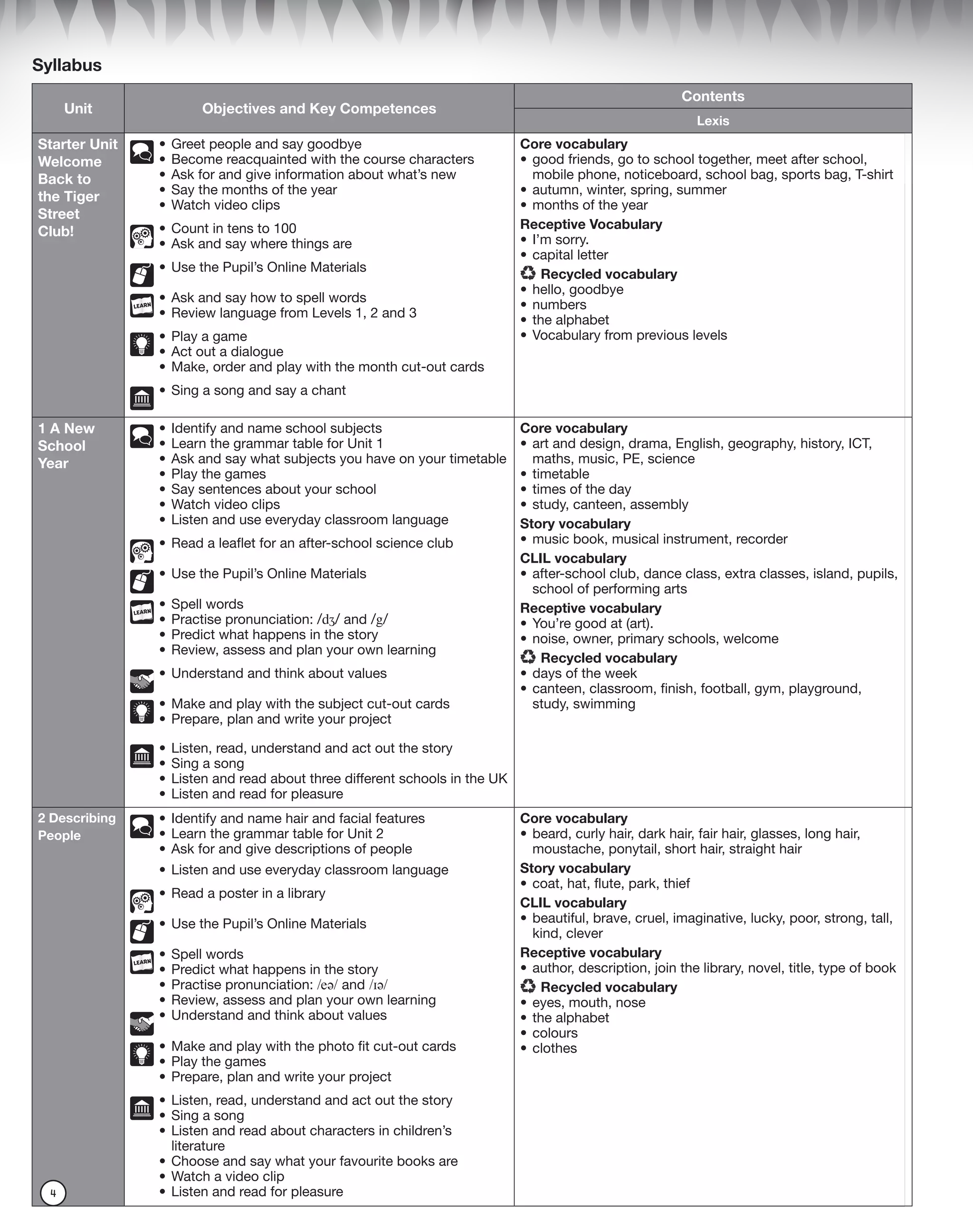
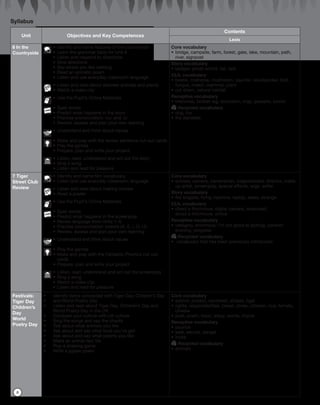
Unit Objectives and Key Competences
Contents
Lexis
Starter Unit
Welcome
Back to
the Tiger
Street
Club!
	 •	Greet people and say goodbye
	•	Become reacquainted with the course characters
	 •	Ask for and give information about what’s new
	 •	Say the months of the year
	 •	Watch video clips
	 •	Count in tens to 100
	•	Ask and say where things are
	 •	Use the Pupil’s Online Materials
	 •	Ask and say how to spell words
	•	Review language from Levels 1, 2 and 3
	 •	Play a game
	•	Act out a dialogue
	 •	Make, order and play with the month cut-out cards
	 •	Sing a song and say a chant
Core vocabulary
•	good friends, go to school together, meet after school,
mobile phone, noticeboard, school bag, sports bag, T-shirt
•	autumn, winter, spring, summer
•	months of the year
Receptive Vocabulary
•	I’m sorry.
•	capital letter
	Recycled vocabulary
•	hello, goodbye
•	numbers
•	the alphabet
•	Vocabulary from previous levels
1 A New
School
Year
	 •	Identify and name school subjects
	•	Learn the grammar table for Unit 1
	 •	Ask and say what subjects you have on your timetable
	 •	Play the games
	 •	Say sentences about your school
	 •	Watch video clips
	 •	Listen and use everyday classroom language
	 •	Read a leaflet for an after-school science club
	 •	Use the Pupil’s Online Materials
	 •	Spell words
	•	Practise pronunciation: /dZ/ and /g/
	 •	Predict what happens in the story
	 •	Review, assess and plan your own learning
	 •	Understand and think about values
	 •	Make and play with the subject cut-out cards
	•	Prepare, plan and write your project
	 •	Listen, read, understand and act out the story
	•	Sing a song
	 •	Listen and read about three different schools in the UK
	 •	Listen and read for pleasure
Core vocabulary
•	art and design, drama, English, geography, history, ICT,
maths, music, PE, science
•	timetable
•	times of the day
•	study, canteen, assembly
Story vocabulary
•	music book, musical instrument, recorder
CLIL vocabulary
•	after-school club, dance class, extra classes, island, pupils,
school of performing arts
Receptive vocabulary
•	You’re good at (art).
•	noise, owner, primary schools, welcome
	Recycled vocabulary
•	days of the week
•	canteen, classroom, finish, football, gym, playground,
study, swimming
2 Describing
People
	 •	Identify and name hair and facial features
	•	Learn the grammar table for Unit 2
	 •	Ask for and give descriptions of people
	 •	Listen and use everyday classroom language
	 •	Read a poster in a library
	 •	Use the Pupil’s Online Materials
	 •	Spell words
	•	Predict what happens in the story
	 •	Practise pronunciation: /eə/ and /ɪə/
	 •	Review, assess and plan your own learning
	 •	Understand and think about values
	 •	Make and play with the photo fit cut-out cards
	•	Play the games
	 •	Prepare, plan and write your project
	 •	Listen, read, understand and act out the story
	•	Sing a song
	 •	Listen and read about characters in children’s
		literature
	 •	Choose and say what your favourite books are
	 •	Watch a video clip
	 •	Listen and read for pleasure
Core vocabulary
•	beard, curly hair, dark hair, fair hair, glasses, long hair,
moustache, ponytail, short hair, straight hair
Story vocabulary
•	coat, hat, flute, park, thief
CLIL vocabulary
•	beautiful, brave, cruel, imaginative, lucky, poor, strong, tall,
kind, clever
Receptive vocabulary
•	author, description, join the library, novel, title, type of book
	Recycled vocabulary
•	eyes, mouth, nose
•	the alphabet
•	colours
•	clothes
4
Syllabus
tiger_TB4_text_p1-28.indd 4 20/10/2014 21:19
w
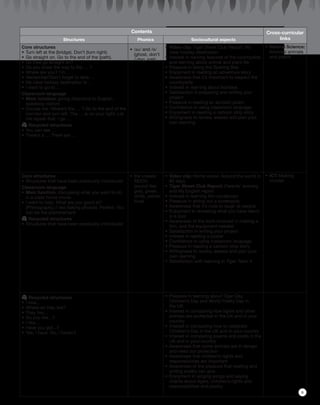
Contents Cross-curricular
linksStructures Phonics Sociocultural aspects
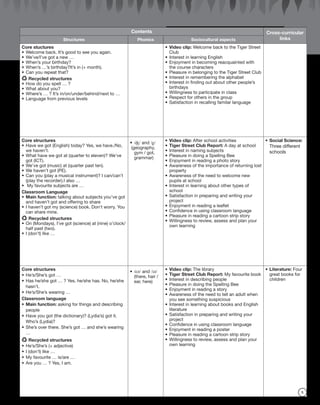
Core stuctures
•	Welcome back. It’s good to see you again.
•	We’ve/I’ve got a new …
•	When’s your birthday?
•	When’s …’s birthday?It’s in (+ month).
•	Can you repeat that?
	Recycled structures
•	How do you spell … ?
•	What about you?
•	Where’s … ? It’s in/on/under/behind/next to …
•	Language from previous levels
•	Video clip: Welcome back to the Tiger Street
Club
•	Interest in learning English
•	Enjoyment in becoming reacquainted with
the course characters
•	Pleasure in belonging to the Tiger Street Club
•	Interest in remembering the alphabet
•	Interest in finding out about other people’s
birthdays
•	Willingness to participate in class
•	Respect for others in the group
•	Satisfaction in recalling familar language
Core structures
•	Have we got (English) today? Yes, we have./No,
we haven’t.
•	What have we got at (quarter to eleven)? We’ve
got (ICT).
•	We’ve got (music) at (quarter past ten).
•	We haven’t got (PE).
•	Can you (play a musical instrument)? I can/can’t
(play the recorder).I also …
•	 My favourite subjects are …
Classroom Language
•	Main function: talking about subjects you’ve got
and haven’t got and offering to share
•	I haven’t got my (science) book. Don’t worry. You
can share mine.
	Recycled structures
•	On (Mondays), I’ve got (science) at (nine) o’clock/
half past (two).
•	I (don’t) like …
•	/ʤ/ and /g/
(geography,
gym / got,
grammar)
•	Video clip: After school activities
•	Tiger Street Club Report: A day at school
•	Interest in naming subjects
•	Pleasure in doing a Spelling Bee
•	Enjoyment in reading a photo story
•	Awareness of the importance of returning lost
property
•	Awareness of the need to welcome new
pupils at school
•	Interest in learning about other types of
school
•	Satisfaction in preparing and writing your
project
•	Enjoyment in reading a leaflet
•	Confidence in using classroom language
•	Pleasure in reading a cartoon strip story
•	Willingness to review, assess and plan your
own learning
•	Social Science:
Three different
schools
Core structures
•	He’s/She’s got …
•	Has he/she got … ? Yes, he/she has. No, he/she
hasn’t.
•	He’s/She’s wearing …
Classroom language
•	Main function: asking for things and describing
people
•	Have you got (the dictionary)? (Lydia’s) got it.
Who’s (Lydia)?
•	She’s over there. She’s got … and she’s wearing
…
	Recycled structures
•	He’s/She’s (+ adjective)
•	I (don’t) like …
•	My favourite … is/are …
•	Are you … ? Yes, I am.
•	/eə/ and /ɪə/
(there, hair /
ear, here)
•	Video clip: The library
•	Tiger Street Club Report: My favourite book
•	Interest in describing people
•	Pleasure in doing the Spelling Bee
•	Enjoyment in reading a story
•	Awareness of the need to tell an adult when
you see something suspicious
•	Interest in learning about books and English
literature
•	Satisfaction in preparing and writing your
project
•	Confidence in using classroom language
•	Enjoyment in reading a poster
•	Pleasure in reading a cartoon strip story
•	Willingness to review, assess and plan your
own learning
•	Literature: Four
great books for
children
5
tiger_TB4_text_p1-28.indd 5 20/10/2014 21:19
w
Unit Objectives and Key Competences
Contents
Lexis
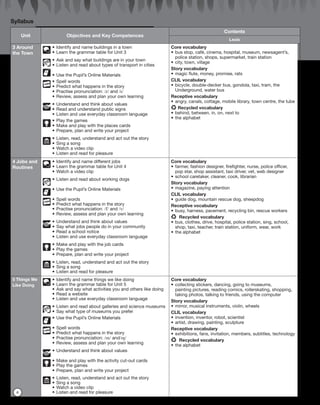
3 Around
the Town
	 •	Identify and name buildings in a town
	•	Learn the grammar table for Unit 3
	 •	Ask and say what buildings are in your town
	•	Listen and read about types of transport in cities
	•	Use the Pupil’s Online Materials
	 •	Spell words
	•	Predict what happens in the story
	 •	Practise pronunciation: /z/ and /s/
	 •	Review, assess and plan your own learning
	 •	Understand and think about values
	•	Read and understand public signs
	 •	Listen and use everyday classroom language
	 •	Play the games
	•	Make and play with the places cards
	 •	Prepare, plan and write your project
	 •	Listen, read, understand and act out the story
	•	Sing a song
	 •	Watch a video clip
	 •	Listen and read for pleasure
Core vocabulary
•	bus stop, café, cinema, hospital, museum, newsagent’s,
police station, shops, supermarket, train station
•	city, town, village
Story vocabulary
•	magic flute, money, promise, rats
CLIL vocabulary
•	bicycle, double-decker bus, gondola, taxi, tram, the
Underground, water bus
Receptive vocabulary
•	angry, canals, cottage, mobile library, town centre, the tube
	Recycled vocabulary
•	behind, between, in, on, next to
•	the alphabet
4 Jobs and
Routines
	 •	Identify and name different jobs
	•	Learn the grammar table for Unit 4
	 •	Watch a video clip
	 •	Listen and read about working dogs
	 •	Use the Pupil’s Online Materials
	 •	Spell words
	•	Predict what happens in the story
	 •	Practise pronunciation: /f/ and /v/
	 •	Review, assess and plan your own learning
	 •	Understand and think about values
	•	Say what jobs people do in your community
	 •	Read a school notice
	 •	Listen and use everyday classroom language
	 •	Make and play with the job cards
	•	Play the games
	 •	Prepare, plan and write your project
	 •	Listen, read, understand and act out the story
	•	Sing a song
	 •	Listen and read for pleasure
Core vocabulary
•	farmer, fashion designer, firefighter, nurse, police officer,
pop star, shop assistant, taxi driver, vet, web designer
•	school caretaker, cleaner, cook, librarian
Story vocabulary
•	magazine, paying attention
CLIL vocabulary
•	guide dog, mountain rescue dog, sheepdog
Receptive vocabulary
•	busy, harness, pavement, recycling bin, rescue workers
	 Recycled vocabulary
•	bus, clothes, drive, hospital, police station, sing, school,
shop, taxi, teacher, train station, uniform, wear, work
•	the alphabet
5 Things We
Like Doing
	 •	Identify and name things we like doing
	•	Learn the grammar table for Unit 5
	 •	Ask and say what activities you and others like doing
	 •	Read a website
	 •	Listen and use everyday classroom language
	 •	Listen and read about galleries and science museums	
	•	Say what type of museums you prefer
	 •	Use the Pupil’s Online Materials
	 •	Spell words
	•	Predict what happens in the story
	 •	Practise pronunciation: /ɪn/ and/ɪŋ/
	 •	Review, assess and plan your own learning
	 •	Understand and think about values
	 •	Make and play with the activity cut-out cards
	•	Play the games
	 •	Prepare, plan and write your project
	 •	Listen, read, understand and act out the story
	•	Sing a song
	 •	Watch a video clip
	 •	Listen and read for pleasure
Core vocabulary
•	collecting stickers, dancing, going to museums,
painting pictures, reading comics, rollerskating, shopping,
taking photos, talking to friends, using the computer
Story vocabulary
•	mirror, musical instruments, violin, wheels
CLIL vocabulary
•	invention, inventor, robot, scientist
•	artist, drawing, painting, sculpture
Receptive vocabulary
•	exhibitions, fans, invitation, members, subtitles, technology
	 Recycled vocabulary
•	the alphabet
6
Syllabus
tiger_TB4_text_p1-28.indd 6 20/10/2014 21:19
w
Contents Cross-curricular
linksStructures Phonics Sociocultural aspects
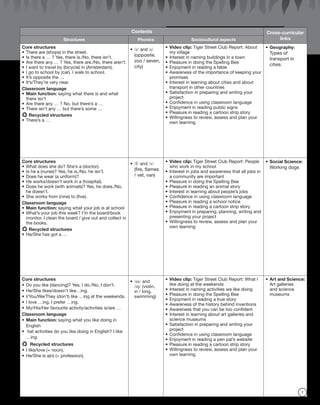
Core structures
•	There are (shops) in the street.
•	Is there a … ? Yes, there is./No, there isn’t.
•	Are there any … ? Yes, there are./No, there aren’t.
•	I want to travel by (bicycle) in (Amsterdam).
•	I go to school by (car). I walk to school.
•	It’s opposite the …
•	It’s/They’re very near.
Classroom language
•	Main function: saying what there is and what
there isn’t
•	Are there any … ? No, but there’s a …
•	There isn’t any … but there’s some …
	Recycled structures
•	There’s a …
•	/z/ and /s/
(opposite,
zoo / seven,
city)
•	Video clip: Tiger Street Club Report: About
my village
•	Interest in naming buildings in a town
•	Pleasure in doing the Spelling Bee
•	Enjoyment in reading a fable
•	Awareness of the importance of keeping your
promises
•	Interest in learning about cities and about
transport in other countries
•	Satisfaction in preparing and writing your
project
•	Confidence in using classroom language
•	Enjoyment in reading public signs
•	Pleasure in reading a cartoon strip story
•	Willingness to review, assess and plan your
own learning
•	Geography:
Types of
transport in
cities
Core structures
•	What does she do? She’s a (doctor).
•	Is he a (nurse)? Yes, he is./No, he isn’t.
•	Does he wear (a uniform)?
•	He works/doesn’t work in a (hospital).
•	Does he work (with animals)? Yes, he does./No,
he doesn’t.
•	She works from (nine) to (five).
Classroom language
•	Main function: saying what your job is at school
•	What’s your job this week? I’m the board/book
monitor. I clean the board / give out and collect in
the books.
	Recycled structures
•	He/She has got a …
•	/f/ and /v/
(fire, flames
/ vet, van)
•	Video clip: Tiger Street Club Report: People
who work in my school
•	Interest in jobs and awareness that all jobs in
a community are important
•	Pleasure in doing the Spelling Bee
•	Pleasure in reading an animal story
•	Interest in learning about people’s jobs
•	Confidence in using classroom language
•	Pleasure in reading a school notice
•	Pleasure in reading a cartoon strip story
•	Enjoyment in preparing, planning, writing and
presenting your project
•	Willingness to review, assess and plan your
own learning
•	Social Science:
Working dogs
Core structures
•	Do you like (dancing)? Yes, I do./No, I don’t.
•	He/She likes/doesn’t like…ing.
•	I/You/We/They (don’t) like …ing at the weekends.
•	I love …ing. I prefer …ing.
•	My/His/Her favourite activity/activities is/are …
Classroom language
•	Main function: saying what you like doing in
English
•	 hat activities do you like doing in English? I like
…ing.
	 Recycled structures
•	I like/love (+ noun).
•	He/She is a(n) (+ profession).
•	/ɪn/ and
/ɪŋ/ (violin,
in / king,
swimming)
•	Video clip: Tiger Street Club Report: What I
like doing at the weekends
•	Interest in naming activities we like doing
•	Pleasure in doing the Spelling Bee
•	Enjoyment in reading a true story
•	Awareness of the history behind inventions
•	Awareness that you can be too confident
•	Interest in learning about art galleries and
science museums
•	Satisfaction in preparing and writing your
project
•	Confidence in using classroom language
•	Enjoyment in reading a pen pal’s website
•	Pleasure in reading a cartoon strip story
•	Willingness to review, assess and plan your
own learning
•	Art and Science:
Art galleries
and science
museums
7
tiger_TB4_text_p1-28.indd 7 20/10/2014 21:19
w
Unit Objectives and Key Competences
Contents
Lexis
6 In the
Countryside
	 •	Identify and name features of the countryside
	•	Learn the grammar table for Unit 6
	 •	Listen and respond to directions
	 •	Give directions
	 •	Say where you like walking
	 •	Read an acrostic poem
	 •	Listen and use everyday classroom language
	 •	Listen and read about arboreal animals and plants
	•	Watch a video clip
	 •	Use the Pupil’s Online Materials
	 •	Spell words
	•	Predict what happens in the story
	 •	Practise pronunciation: /əʊ/ and /ɒ/
	 •	Review, assess and plan your own learning
	 •	Understand and think about values
	 •	Make and play with the review sentence cut-out cards
	•	Play the games
	 •	Prepare, plan and write your project
	 •	Listen, read, understand and act out the story
	•	Sing a song
	 •	Listen and read for pleasure
Core vocabulary
•	bridge, campsite, farm, forest, gate, lake, mountain, path,
river, signpost
Story vocabulary
•	badger, ghost orchid, list, rare
CLIL vocabulary
•	beetle, mistletoe, mushroom, squirrel, woodpecker, bird,
fungus, insect, mammal, plant
•	cut down, natural habitat
Receptive vocabulary
•	branches, broken leg, excursion, map, parasite, tunnel
	Recycled vocabulary
•	dog, fox
•	the alphabet
7 Tiger
Street Club
Review
	 •	Identify and name film vocabulary
	•	Listen and use everyday classroom language
	 •	Listen and read about making movies
	•	Read a poster
	 •	Use the Pupil’s Online Materials
	 •	Spell words
	•	Predict what happens in the screenplay
	 •	Revise language from Units 1–6
	 •	Practise pronunciation: vowels (A, E, I, O, U)
	 •	Review, assess and plan your own learning
	 •	Understand and think about values
	 •	Play the games
	•	Make and play with the Fantastic Phonics cut-out 		
		cards
	 •	Prepare, plan and write your project
	 •	Listen, read, understand and act out the screenplay
	•	Sing a song
	 •	Watch a video clip
	 •	Listen and read for pleasure
Core vocabulary
•	actress, camera, cameraman, clapperboard, director, make-
up artist, screenplay, special effects, wigs, writer
Story vocabulary
•	fire brigade, flying machine, laptop, seats, strange
CLIL vocabulary
•	direct a film/movie, digital camera, download,
shoot a film/movie, online
Receptive vocabulary
•	category, enormous, I’m not good at (acting), parents’
evening, progress
	Recycled vocabulary
•	 vocabulary that has been previously introduced
Festivals:
Tiger Day
Children’s
Day
World
Poetry Day
•	 Identify items connected with Tiger Day, Children’s Day
•	 and World Poetry Day
•	Listen and read about Tiger Day, Children’s Day and
World Poetry Day in the UK
•	 Compare your culture with UK culture
•	 Sing the songs and say the chants
•	 Talk about what animals you like
•	 Ask about and say what food you’ve got
•	 Ask about and say what poems you like
•	 Make an animal fact file
•	 Play a drawing game
•	 Write a jigsaw poem
Core vocabulary
•	extinct, protect, rainforest, stripes, tiger
•	rights, responsibilities, bread, olives, chicken, rice, tomato,
cheese
•	poet, poem, topic, enjoy, words, rhyme
Receptive vocabulary
•	pounce
•	safe, secure, danger
•	invite
	Recycled vocabulary
•	animals
8
Syllabus
tiger_TB4_text_p1-28.indd 8 20/10/2014 21:19
w
Contents Cross-curricular
linksStructures Phonics Sociocultural aspects
Core structures
•	Turn left at the (bridge). Don’t (turn right).
•	Go straight on. Go to the end of the (path).
•	Do I/we go straight on?
•	Do you know the way to the … ?
•	Where are you? I’m …
•	Remember/Don’t forget to take …
•	My ideal holiday destination is …
•	I want to go to …
Classroom language
•	Main function: giving directions to English-
speaking visitors
•	Excuse me. Where’s the … ? Go to the end of the
corridor and turn left. The … is on your right. Let
me repeat that. I go …
	Recycled structures
•	You can see …
•	There’s a … There are …
•	/əʊ/ and /ɒ/
(ghost, don’t
/ dog, lost)
•	Video clip: Tiger Street Club Report: My
ideal holiday destination
•	Interest in naming features of the countryside
and learning about animal and plant life
•	Pleasure in doing the Spelling Bee
•	Enjoyment in reading an adventure story
•	Awareness that it’s important to respect the
countryside
•	Interest in learning about holidays
•	Satisfaction in preparing and writing your
project
•	Pleasure in reading an acrostic poem
•	Confidence in using classroom language
•	Enjoyment in reading a cartoon strip story
•	Willingness to review, assess and plan your
own learning
•	Natural Science:
Arboreal animals
and plants
Core structures
•	Structures that have been previously introduced
Classroom language
•	Main function: discussing what you want to do
in a class home movie
•	I want to help. What are you good at?
(Photography.) I like (taking photos). Perfect. You
can be the (cameraman)!
	Recycled structures
•	Structures that have been previously introduced
•	the vowels:
AEIOU
(sound like:
grey, green,
white, yellow,
blue)
•	Video clip: Home movie: Around the world in
80 days
•	Tiger Street Club Report: Parents’ evening
and My English report
•	Interest in learning film vocabulary
•	Pleasure in acting out a screenplay
•	Awareness that it’s rude to laugh at people
•	Enjoyment in reviewing what you have learnt
in a quiz
•	Awareness of the work involved in making a
film, and the equipment needed
•	Satisfaction in writing your project
•	Interest in reading a poster
•	Confidence in using classroom language
•	Pleasure in reading a cartoon strip story
•	Willingness to review, assess and plan your
own learning
•	Satisfaction with learning in Tiger Team 4
•	ICT: Making
movies
	Recycled structures
•	I love...
•	Where do they live?
•	They live...
•	Do you like...?
•	I like...
•	Have you got...?
•	Yes, I have. No, I haven’t.
• 	Pleasure in learning about Tiger Day,
Children’s Day and World Poetry Day in
the UK
• 	Interest in comparing how tigers and other
animals are protected in the UK and in your
country
• 	Interest in comparing how to celebrate
Children’s Day in the UK and in your country
• 	Interest in comparing poems and poets in the
UK and in your country
• 	Awareness that some animals are in danger
and need our protection
• 	Awareness that children’s rights and
responsibilities are important
• 	Awareness of the pleasure that reading and
writing poetry can give
• 	Enjoyment in singing songs and saying
chants about tigers, children’s rights and
responsibilities and poetry
9
tiger_TB4_text_p1-28.indd 9 20/10/2014 21:19

Tiger time level 4 ss

  • 1.
    w Unit Objectives andKey Competences Contents Lexis Starter Unit Welcome Back to the Tiger Street Club! • Greet people and say goodbye • Become reacquainted with the course characters • Ask for and give information about what’s new • Say the months of the year • Watch video clips • Count in tens to 100 • Ask and say where things are • Use the Pupil’s Online Materials • Ask and say how to spell words • Review language from Levels 1, 2 and 3 • Play a game • Act out a dialogue • Make, order and play with the month cut-out cards • Sing a song and say a chant Core vocabulary • good friends, go to school together, meet after school, mobile phone, noticeboard, school bag, sports bag, T-shirt • autumn, winter, spring, summer • months of the year Receptive Vocabulary • I’m sorry. • capital letter Recycled vocabulary • hello, goodbye • numbers • the alphabet • Vocabulary from previous levels 1 A New School Year • Identify and name school subjects • Learn the grammar table for Unit 1 • Ask and say what subjects you have on your timetable • Play the games • Say sentences about your school • Watch video clips • Listen and use everyday classroom language • Read a leaflet for an after-school science club • Use the Pupil’s Online Materials • Spell words • Practise pronunciation: /dZ/ and /g/ • Predict what happens in the story • Review, assess and plan your own learning • Understand and think about values • Make and play with the subject cut-out cards • Prepare, plan and write your project • Listen, read, understand and act out the story • Sing a song • Listen and read about three different schools in the UK • Listen and read for pleasure Core vocabulary • art and design, drama, English, geography, history, ICT, maths, music, PE, science • timetable • times of the day • study, canteen, assembly Story vocabulary • music book, musical instrument, recorder CLIL vocabulary • after-school club, dance class, extra classes, island, pupils, school of performing arts Receptive vocabulary • You’re good at (art). • noise, owner, primary schools, welcome Recycled vocabulary • days of the week • canteen, classroom, finish, football, gym, playground, study, swimming 2 Describing People • Identify and name hair and facial features • Learn the grammar table for Unit 2 • Ask for and give descriptions of people • Listen and use everyday classroom language • Read a poster in a library • Use the Pupil’s Online Materials • Spell words • Predict what happens in the story • Practise pronunciation: /eə/ and /ɪə/ • Review, assess and plan your own learning • Understand and think about values • Make and play with the photo fit cut-out cards • Play the games • Prepare, plan and write your project • Listen, read, understand and act out the story • Sing a song • Listen and read about characters in children’s literature • Choose and say what your favourite books are • Watch a video clip • Listen and read for pleasure Core vocabulary • beard, curly hair, dark hair, fair hair, glasses, long hair, moustache, ponytail, short hair, straight hair Story vocabulary • coat, hat, flute, park, thief CLIL vocabulary • beautiful, brave, cruel, imaginative, lucky, poor, strong, tall, kind, clever Receptive vocabulary • author, description, join the library, novel, title, type of book Recycled vocabulary • eyes, mouth, nose • the alphabet • colours • clothes 4 Syllabus tiger_TB4_text_p1-28.indd 4 20/10/2014 21:19
  • 2.
    w Contents Cross-curricular linksStructures PhonicsSociocultural aspects Core stuctures • Welcome back. It’s good to see you again. • We’ve/I’ve got a new … • When’s your birthday? • When’s …’s birthday?It’s in (+ month). • Can you repeat that? Recycled structures • How do you spell … ? • What about you? • Where’s … ? It’s in/on/under/behind/next to … • Language from previous levels • Video clip: Welcome back to the Tiger Street Club • Interest in learning English • Enjoyment in becoming reacquainted with the course characters • Pleasure in belonging to the Tiger Street Club • Interest in remembering the alphabet • Interest in finding out about other people’s birthdays • Willingness to participate in class • Respect for others in the group • Satisfaction in recalling familar language Core structures • Have we got (English) today? Yes, we have./No, we haven’t. • What have we got at (quarter to eleven)? We’ve got (ICT). • We’ve got (music) at (quarter past ten). • We haven’t got (PE). • Can you (play a musical instrument)? I can/can’t (play the recorder).I also … • My favourite subjects are … Classroom Language • Main function: talking about subjects you’ve got and haven’t got and offering to share • I haven’t got my (science) book. Don’t worry. You can share mine. Recycled structures • On (Mondays), I’ve got (science) at (nine) o’clock/ half past (two). • I (don’t) like … • /ʤ/ and /g/ (geography, gym / got, grammar) • Video clip: After school activities • Tiger Street Club Report: A day at school • Interest in naming subjects • Pleasure in doing a Spelling Bee • Enjoyment in reading a photo story • Awareness of the importance of returning lost property • Awareness of the need to welcome new pupils at school • Interest in learning about other types of school • Satisfaction in preparing and writing your project • Enjoyment in reading a leaflet • Confidence in using classroom language • Pleasure in reading a cartoon strip story • Willingness to review, assess and plan your own learning • Social Science: Three different schools Core structures • He’s/She’s got … • Has he/she got … ? Yes, he/she has. No, he/she hasn’t. • He’s/She’s wearing … Classroom language • Main function: asking for things and describing people • Have you got (the dictionary)? (Lydia’s) got it. Who’s (Lydia)? • She’s over there. She’s got … and she’s wearing … Recycled structures • He’s/She’s (+ adjective) • I (don’t) like … • My favourite … is/are … • Are you … ? Yes, I am. • /eə/ and /ɪə/ (there, hair / ear, here) • Video clip: The library • Tiger Street Club Report: My favourite book • Interest in describing people • Pleasure in doing the Spelling Bee • Enjoyment in reading a story • Awareness of the need to tell an adult when you see something suspicious • Interest in learning about books and English literature • Satisfaction in preparing and writing your project • Confidence in using classroom language • Enjoyment in reading a poster • Pleasure in reading a cartoon strip story • Willingness to review, assess and plan your own learning • Literature: Four great books for children 5 tiger_TB4_text_p1-28.indd 5 20/10/2014 21:19
  • 3.
    w Unit Objectives andKey Competences Contents Lexis 3 Around the Town • Identify and name buildings in a town • Learn the grammar table for Unit 3 • Ask and say what buildings are in your town • Listen and read about types of transport in cities • Use the Pupil’s Online Materials • Spell words • Predict what happens in the story • Practise pronunciation: /z/ and /s/ • Review, assess and plan your own learning • Understand and think about values • Read and understand public signs • Listen and use everyday classroom language • Play the games • Make and play with the places cards • Prepare, plan and write your project • Listen, read, understand and act out the story • Sing a song • Watch a video clip • Listen and read for pleasure Core vocabulary • bus stop, café, cinema, hospital, museum, newsagent’s, police station, shops, supermarket, train station • city, town, village Story vocabulary • magic flute, money, promise, rats CLIL vocabulary • bicycle, double-decker bus, gondola, taxi, tram, the Underground, water bus Receptive vocabulary • angry, canals, cottage, mobile library, town centre, the tube Recycled vocabulary • behind, between, in, on, next to • the alphabet 4 Jobs and Routines • Identify and name different jobs • Learn the grammar table for Unit 4 • Watch a video clip • Listen and read about working dogs • Use the Pupil’s Online Materials • Spell words • Predict what happens in the story • Practise pronunciation: /f/ and /v/ • Review, assess and plan your own learning • Understand and think about values • Say what jobs people do in your community • Read a school notice • Listen and use everyday classroom language • Make and play with the job cards • Play the games • Prepare, plan and write your project • Listen, read, understand and act out the story • Sing a song • Listen and read for pleasure Core vocabulary • farmer, fashion designer, firefighter, nurse, police officer, pop star, shop assistant, taxi driver, vet, web designer • school caretaker, cleaner, cook, librarian Story vocabulary • magazine, paying attention CLIL vocabulary • guide dog, mountain rescue dog, sheepdog Receptive vocabulary • busy, harness, pavement, recycling bin, rescue workers Recycled vocabulary • bus, clothes, drive, hospital, police station, sing, school, shop, taxi, teacher, train station, uniform, wear, work • the alphabet 5 Things We Like Doing • Identify and name things we like doing • Learn the grammar table for Unit 5 • Ask and say what activities you and others like doing • Read a website • Listen and use everyday classroom language • Listen and read about galleries and science museums • Say what type of museums you prefer • Use the Pupil’s Online Materials • Spell words • Predict what happens in the story • Practise pronunciation: /ɪn/ and/ɪŋ/ • Review, assess and plan your own learning • Understand and think about values • Make and play with the activity cut-out cards • Play the games • Prepare, plan and write your project • Listen, read, understand and act out the story • Sing a song • Watch a video clip • Listen and read for pleasure Core vocabulary • collecting stickers, dancing, going to museums, painting pictures, reading comics, rollerskating, shopping, taking photos, talking to friends, using the computer Story vocabulary • mirror, musical instruments, violin, wheels CLIL vocabulary • invention, inventor, robot, scientist • artist, drawing, painting, sculpture Receptive vocabulary • exhibitions, fans, invitation, members, subtitles, technology Recycled vocabulary • the alphabet 6 Syllabus tiger_TB4_text_p1-28.indd 6 20/10/2014 21:19
  • 4.
    w Contents Cross-curricular linksStructures PhonicsSociocultural aspects Core structures • There are (shops) in the street. • Is there a … ? Yes, there is./No, there isn’t. • Are there any … ? Yes, there are./No, there aren’t. • I want to travel by (bicycle) in (Amsterdam). • I go to school by (car). I walk to school. • It’s opposite the … • It’s/They’re very near. Classroom language • Main function: saying what there is and what there isn’t • Are there any … ? No, but there’s a … • There isn’t any … but there’s some … Recycled structures • There’s a … • /z/ and /s/ (opposite, zoo / seven, city) • Video clip: Tiger Street Club Report: About my village • Interest in naming buildings in a town • Pleasure in doing the Spelling Bee • Enjoyment in reading a fable • Awareness of the importance of keeping your promises • Interest in learning about cities and about transport in other countries • Satisfaction in preparing and writing your project • Confidence in using classroom language • Enjoyment in reading public signs • Pleasure in reading a cartoon strip story • Willingness to review, assess and plan your own learning • Geography: Types of transport in cities Core structures • What does she do? She’s a (doctor). • Is he a (nurse)? Yes, he is./No, he isn’t. • Does he wear (a uniform)? • He works/doesn’t work in a (hospital). • Does he work (with animals)? Yes, he does./No, he doesn’t. • She works from (nine) to (five). Classroom language • Main function: saying what your job is at school • What’s your job this week? I’m the board/book monitor. I clean the board / give out and collect in the books. Recycled structures • He/She has got a … • /f/ and /v/ (fire, flames / vet, van) • Video clip: Tiger Street Club Report: People who work in my school • Interest in jobs and awareness that all jobs in a community are important • Pleasure in doing the Spelling Bee • Pleasure in reading an animal story • Interest in learning about people’s jobs • Confidence in using classroom language • Pleasure in reading a school notice • Pleasure in reading a cartoon strip story • Enjoyment in preparing, planning, writing and presenting your project • Willingness to review, assess and plan your own learning • Social Science: Working dogs Core structures • Do you like (dancing)? Yes, I do./No, I don’t. • He/She likes/doesn’t like…ing. • I/You/We/They (don’t) like …ing at the weekends. • I love …ing. I prefer …ing. • My/His/Her favourite activity/activities is/are … Classroom language • Main function: saying what you like doing in English • hat activities do you like doing in English? I like …ing. Recycled structures • I like/love (+ noun). • He/She is a(n) (+ profession). • /ɪn/ and /ɪŋ/ (violin, in / king, swimming) • Video clip: Tiger Street Club Report: What I like doing at the weekends • Interest in naming activities we like doing • Pleasure in doing the Spelling Bee • Enjoyment in reading a true story • Awareness of the history behind inventions • Awareness that you can be too confident • Interest in learning about art galleries and science museums • Satisfaction in preparing and writing your project • Confidence in using classroom language • Enjoyment in reading a pen pal’s website • Pleasure in reading a cartoon strip story • Willingness to review, assess and plan your own learning • Art and Science: Art galleries and science museums 7 tiger_TB4_text_p1-28.indd 7 20/10/2014 21:19
  • 5.
    w Unit Objectives andKey Competences Contents Lexis 6 In the Countryside • Identify and name features of the countryside • Learn the grammar table for Unit 6 • Listen and respond to directions • Give directions • Say where you like walking • Read an acrostic poem • Listen and use everyday classroom language • Listen and read about arboreal animals and plants • Watch a video clip • Use the Pupil’s Online Materials • Spell words • Predict what happens in the story • Practise pronunciation: /əʊ/ and /ɒ/ • Review, assess and plan your own learning • Understand and think about values • Make and play with the review sentence cut-out cards • Play the games • Prepare, plan and write your project • Listen, read, understand and act out the story • Sing a song • Listen and read for pleasure Core vocabulary • bridge, campsite, farm, forest, gate, lake, mountain, path, river, signpost Story vocabulary • badger, ghost orchid, list, rare CLIL vocabulary • beetle, mistletoe, mushroom, squirrel, woodpecker, bird, fungus, insect, mammal, plant • cut down, natural habitat Receptive vocabulary • branches, broken leg, excursion, map, parasite, tunnel Recycled vocabulary • dog, fox • the alphabet 7 Tiger Street Club Review • Identify and name film vocabulary • Listen and use everyday classroom language • Listen and read about making movies • Read a poster • Use the Pupil’s Online Materials • Spell words • Predict what happens in the screenplay • Revise language from Units 1–6 • Practise pronunciation: vowels (A, E, I, O, U) • Review, assess and plan your own learning • Understand and think about values • Play the games • Make and play with the Fantastic Phonics cut-out cards • Prepare, plan and write your project • Listen, read, understand and act out the screenplay • Sing a song • Watch a video clip • Listen and read for pleasure Core vocabulary • actress, camera, cameraman, clapperboard, director, make- up artist, screenplay, special effects, wigs, writer Story vocabulary • fire brigade, flying machine, laptop, seats, strange CLIL vocabulary • direct a film/movie, digital camera, download, shoot a film/movie, online Receptive vocabulary • category, enormous, I’m not good at (acting), parents’ evening, progress Recycled vocabulary • vocabulary that has been previously introduced Festivals: Tiger Day Children’s Day World Poetry Day • Identify items connected with Tiger Day, Children’s Day • and World Poetry Day • Listen and read about Tiger Day, Children’s Day and World Poetry Day in the UK • Compare your culture with UK culture • Sing the songs and say the chants • Talk about what animals you like • Ask about and say what food you’ve got • Ask about and say what poems you like • Make an animal fact file • Play a drawing game • Write a jigsaw poem Core vocabulary • extinct, protect, rainforest, stripes, tiger • rights, responsibilities, bread, olives, chicken, rice, tomato, cheese • poet, poem, topic, enjoy, words, rhyme Receptive vocabulary • pounce • safe, secure, danger • invite Recycled vocabulary • animals 8 Syllabus tiger_TB4_text_p1-28.indd 8 20/10/2014 21:19
  • 6.
    w Contents Cross-curricular linksStructures PhonicsSociocultural aspects Core structures • Turn left at the (bridge). Don’t (turn right). • Go straight on. Go to the end of the (path). • Do I/we go straight on? • Do you know the way to the … ? • Where are you? I’m … • Remember/Don’t forget to take … • My ideal holiday destination is … • I want to go to … Classroom language • Main function: giving directions to English- speaking visitors • Excuse me. Where’s the … ? Go to the end of the corridor and turn left. The … is on your right. Let me repeat that. I go … Recycled structures • You can see … • There’s a … There are … • /əʊ/ and /ɒ/ (ghost, don’t / dog, lost) • Video clip: Tiger Street Club Report: My ideal holiday destination • Interest in naming features of the countryside and learning about animal and plant life • Pleasure in doing the Spelling Bee • Enjoyment in reading an adventure story • Awareness that it’s important to respect the countryside • Interest in learning about holidays • Satisfaction in preparing and writing your project • Pleasure in reading an acrostic poem • Confidence in using classroom language • Enjoyment in reading a cartoon strip story • Willingness to review, assess and plan your own learning • Natural Science: Arboreal animals and plants Core structures • Structures that have been previously introduced Classroom language • Main function: discussing what you want to do in a class home movie • I want to help. What are you good at? (Photography.) I like (taking photos). Perfect. You can be the (cameraman)! Recycled structures • Structures that have been previously introduced • the vowels: AEIOU (sound like: grey, green, white, yellow, blue) • Video clip: Home movie: Around the world in 80 days • Tiger Street Club Report: Parents’ evening and My English report • Interest in learning film vocabulary • Pleasure in acting out a screenplay • Awareness that it’s rude to laugh at people • Enjoyment in reviewing what you have learnt in a quiz • Awareness of the work involved in making a film, and the equipment needed • Satisfaction in writing your project • Interest in reading a poster • Confidence in using classroom language • Pleasure in reading a cartoon strip story • Willingness to review, assess and plan your own learning • Satisfaction with learning in Tiger Team 4 • ICT: Making movies Recycled structures • I love... • Where do they live? • They live... • Do you like...? • I like... • Have you got...? • Yes, I have. No, I haven’t. • Pleasure in learning about Tiger Day, Children’s Day and World Poetry Day in the UK • Interest in comparing how tigers and other animals are protected in the UK and in your country • Interest in comparing how to celebrate Children’s Day in the UK and in your country • Interest in comparing poems and poets in the UK and in your country • Awareness that some animals are in danger and need our protection • Awareness that children’s rights and responsibilities are important • Awareness of the pleasure that reading and writing poetry can give • Enjoyment in singing songs and saying chants about tigers, children’s rights and responsibilities and poetry 9 tiger_TB4_text_p1-28.indd 9 20/10/2014 21:19