Ticking all the right boxes...?
I’m glad a gay man of colour will be Irish prime minister, even if I abhor his politics
by Emer O'Toole, The Guardian, June 2017
Yes, there are reasons to celebrate Leo Varadkar becoming leader of Fine Gael. But he is an austerity-
championing neoliberal who is against reproductive rights
Leo Varadkar, who is gay and half-Indian, has won the leadership contest of Ireland’s Fine Gael party,
and, aged just 38, is set to become the republic’s youngest taoiseach (ndp: the title of the prime minister
of Ireland). Around the world this has been lauded as a sign of Ireland’s progression to cosmopolitan
modernity. Reuters hails Varadkar’s leadership as a “huge generational shift”.
But Varadkar is a conservative. Left-leaning folk in Ireland are hoarse trying to explain to the faraways
that, yes, we understand the optics – but this is Ireland, land of the topsy-turvy, where the election of a
gay person of colour at the same time signals the entrenchment of anti-woman, anti-working-class
austerity-as-usual. There have been understandably frustrated reactions, not only to the tone-deaf global
coverage, but also to the ostensible “identity politics” signalled by LGBT rights groups welcoming
Varadkar’s election.
I am no fan of his. But I feel the following simple observation is necessary: we can celebrate the fact that
Ireland’s next leader will be a gay man of colour, even while we protest his politics. It’s great that Ireland
has socially evolved to the point that Varadkar’s race and sexuality are not barriers to his leadership; but
it’s sad that the next taoiseach is a cardboard-cutout neoliberal.
Ireland only decriminalised homosexuality in 1993. And it wasn’t an easy sell. The public atmosphere was
such that the Fine Gael member of parliament Paul McGrath could stand up in the Dáil and incredulously
proclaim: “Are we now to see exhibitions in public by homosexuals? Holding hands, kissing, cuddling,
etc?” (Please, no – not cuddling! Anything but cuddling!) McGrath wasn’t the fringe: he was the centre.
That’s not quite 25 years ago.
Ireland now has gay marriage (voted for, I am proud to say, by 62% of the population), some of the
world’s most progressive trans recognition legislation, and an openly gay presumptive taoiseach. When it
comes to sexuality, we are clearly shaking off the shackles of Catholic dogma.
In 2004, the Irish population voted four to one in a referendum that makes me far less proud: removing
citizenship rights from the Irish-born children of non-national parents. This implicitly racist move
accompanied the inward migration resulting from Ireland’s economic boom, and signalled a rejection of
the “new Irish”. In this context, it is a hopeful sign that our next taoiseach will be the son of an Indian
migrant, that the person representing us on the international stage will not be a Murphy or McDonagh,
but a Varadkar.
The barriers to participation placed on people by their race, sexuality, gender, class or ability are real.
And representation is important. Half of LGBT students are bullied, in school and a third of young Irish
LGBT people have attempted suicide. Varadkar’s success might help these kids to realise that many of
their fellow citizens are on their side. It could also encourage more people of colour and LGBT folk to get
into politics.
Yet Varadkar is not his sexuality or his race. In a radio interview he gave after coming out, he said: “I’m
not a half-Indian politician, or a doctor politician or a gay politician, for that matter. It’s just part of who I
am. It doesn’t define me.”
I agree that other parts of Varadkar are more helpful in defining him as a politician. Calling himself “pro-
life”, he is a disaster for Ireland’s campaign for reproductive rights, and absolutely the wrong person to
preside over the abortion referendum that he has inherited as a political inevitability.
Varadkar is intent on the project of demonising people on welfare. He recently fronted a €200,000
(£175,000) campaign with the catchy slogan Welfare Cheats Cheat Us All and a handy snitching hotline.
This is despite the fact that there has been only one case of suspected identity fraud this year.
I can feel angry about all of this even while feeling proud that Ireland is the kind of country that has a
new kind of taoiseach. The two ways of thinking don’t cancel each other out: they enrich each other,
helping us to see politics from multiple vantage points. We can acknowledge the successes of our
progressive movements even while limbering up for the next round of the fight.
Connect the words in A to their synonyms/definitions in B:
A B
abhor is determined to do
lauded detest / hate
left-leaning epitome / perfect example of
topsy-turvy a tendency to support progressive policies
entrenchment praised
tone-deaf describing someone as very bad or dangerous
cardboard cut-out anclamiento
is intent on unable to understand subtle nuances
demonising upside down
vantage points angles / perspectives
Speaking:
Do you think Riz Ahmed would approve of Leo Varadkar's election? Why?
What does Emer O' Toole mean by ostensible “identity politics”? How would you describe her tone?
Discuss the underlined paragraph. What is Varadkar trying to say?
What word that normally follows the LGBT acronym does the journalist (deliberately?) refrain from using?
People generally expect gay people to be left-leaning. Why is this?
Do you think societies tend to put people in boxes? If so, why?
In light of what you read, do these boxes make sense?
Grammar:
NPR's Ari Shapiro recently interviewed Henry McDonald, who covers Ireland for The Guardian, about the
new Irish prime minister and said the following:
I understand the controversy surrounding him in the Irish media is less about his being the son of an
immigrant or being openly gay or being young and actually more about his politics.
In pairs, paraphrase the sentence above starting with The fact that...
____________________________________________________________________________________
________________________________________________________________________________
__________________________________________________________________________________
What word form is "fact"?
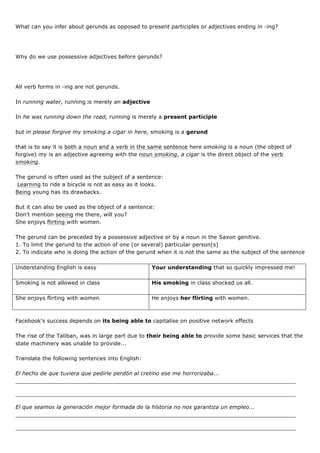
What can you infer about gerunds as opposed to present participles or adjectives ending in -ing?
Why do we use possessive adjectives before gerunds?
All verb forms in -ing are not gerunds.
In running water, running is merely an adjective
In he was running down the road, running is merely a present participle
but in please forgive my smoking a cigar in here, smoking is a gerund
that is to say it is both a noun and a verb in the same sentence here smoking is a noun (the object of
forgive) my is an adjective agreeing with the noun smoking, a cigar is the direct object of the verb
smoking.
The gerund is often used as the subject of a sentence:
Learning to ride a bicycle is not as easy as it looks.
Being young has its drawbacks.
But it can also be used as the object of a sentence:
Don't mention seeing me there, will you?
She enjoys flirting with women.
The gerund can be preceded by a possessive adjective or by a noun in the Saxon genitive.
1. To limit the gerund to the action of one (or several) particular person(s)
2. To indicate who is doing the action of the gerund when it is not the same as the subject of the sentence
Understanding English is easy Your understanding that so quickly impressed me!
Smoking is not allowed in class His smoking in class shocked us all.
She enjoys flirting with women He enjoys her flirting with women.
Facebook’s success depends on its being able to capitalise on positive network effects
The rise of the Taliban, was in large part due to their being able to provide some basic services that the
state machinery was unable to provide...
Translate the following sentences into English:
El hecho de que tuviera que pedirle perdón al cretino ese me horrorizaba...
__________________________________________________________________________________
__________________________________________________________________________________
El que seamos la generación mejor formada de la historia no nos garantiza un empleo...
__________________________________________________________________________________
__________________________________________________________________________________

Ticking all the right boxes

  • 1.
    Ticking all theright boxes...? I’m glad a gay man of colour will be Irish prime minister, even if I abhor his politics by Emer O'Toole, The Guardian, June 2017 Yes, there are reasons to celebrate Leo Varadkar becoming leader of Fine Gael. But he is an austerity- championing neoliberal who is against reproductive rights Leo Varadkar, who is gay and half-Indian, has won the leadership contest of Ireland’s Fine Gael party, and, aged just 38, is set to become the republic’s youngest taoiseach (ndp: the title of the prime minister of Ireland). Around the world this has been lauded as a sign of Ireland’s progression to cosmopolitan modernity. Reuters hails Varadkar’s leadership as a “huge generational shift”. But Varadkar is a conservative. Left-leaning folk in Ireland are hoarse trying to explain to the faraways that, yes, we understand the optics – but this is Ireland, land of the topsy-turvy, where the election of a gay person of colour at the same time signals the entrenchment of anti-woman, anti-working-class austerity-as-usual. There have been understandably frustrated reactions, not only to the tone-deaf global coverage, but also to the ostensible “identity politics” signalled by LGBT rights groups welcoming Varadkar’s election. I am no fan of his. But I feel the following simple observation is necessary: we can celebrate the fact that Ireland’s next leader will be a gay man of colour, even while we protest his politics. It’s great that Ireland has socially evolved to the point that Varadkar’s race and sexuality are not barriers to his leadership; but it’s sad that the next taoiseach is a cardboard-cutout neoliberal. Ireland only decriminalised homosexuality in 1993. And it wasn’t an easy sell. The public atmosphere was such that the Fine Gael member of parliament Paul McGrath could stand up in the Dáil and incredulously proclaim: “Are we now to see exhibitions in public by homosexuals? Holding hands, kissing, cuddling, etc?” (Please, no – not cuddling! Anything but cuddling!) McGrath wasn’t the fringe: he was the centre. That’s not quite 25 years ago. Ireland now has gay marriage (voted for, I am proud to say, by 62% of the population), some of the world’s most progressive trans recognition legislation, and an openly gay presumptive taoiseach. When it comes to sexuality, we are clearly shaking off the shackles of Catholic dogma. In 2004, the Irish population voted four to one in a referendum that makes me far less proud: removing citizenship rights from the Irish-born children of non-national parents. This implicitly racist move accompanied the inward migration resulting from Ireland’s economic boom, and signalled a rejection of the “new Irish”. In this context, it is a hopeful sign that our next taoiseach will be the son of an Indian migrant, that the person representing us on the international stage will not be a Murphy or McDonagh, but a Varadkar. The barriers to participation placed on people by their race, sexuality, gender, class or ability are real. And representation is important. Half of LGBT students are bullied, in school and a third of young Irish LGBT people have attempted suicide. Varadkar’s success might help these kids to realise that many of their fellow citizens are on their side. It could also encourage more people of colour and LGBT folk to get into politics. Yet Varadkar is not his sexuality or his race. In a radio interview he gave after coming out, he said: “I’m not a half-Indian politician, or a doctor politician or a gay politician, for that matter. It’s just part of who I am. It doesn’t define me.” I agree that other parts of Varadkar are more helpful in defining him as a politician. Calling himself “pro- life”, he is a disaster for Ireland’s campaign for reproductive rights, and absolutely the wrong person to preside over the abortion referendum that he has inherited as a political inevitability.
  • 2.
    Varadkar is intenton the project of demonising people on welfare. He recently fronted a €200,000 (£175,000) campaign with the catchy slogan Welfare Cheats Cheat Us All and a handy snitching hotline. This is despite the fact that there has been only one case of suspected identity fraud this year. I can feel angry about all of this even while feeling proud that Ireland is the kind of country that has a new kind of taoiseach. The two ways of thinking don’t cancel each other out: they enrich each other, helping us to see politics from multiple vantage points. We can acknowledge the successes of our progressive movements even while limbering up for the next round of the fight. Connect the words in A to their synonyms/definitions in B: A B abhor is determined to do lauded detest / hate left-leaning epitome / perfect example of topsy-turvy a tendency to support progressive policies entrenchment praised tone-deaf describing someone as very bad or dangerous cardboard cut-out anclamiento is intent on unable to understand subtle nuances demonising upside down vantage points angles / perspectives Speaking: Do you think Riz Ahmed would approve of Leo Varadkar's election? Why? What does Emer O' Toole mean by ostensible “identity politics”? How would you describe her tone? Discuss the underlined paragraph. What is Varadkar trying to say? What word that normally follows the LGBT acronym does the journalist (deliberately?) refrain from using? People generally expect gay people to be left-leaning. Why is this? Do you think societies tend to put people in boxes? If so, why? In light of what you read, do these boxes make sense? Grammar: NPR's Ari Shapiro recently interviewed Henry McDonald, who covers Ireland for The Guardian, about the new Irish prime minister and said the following: I understand the controversy surrounding him in the Irish media is less about his being the son of an immigrant or being openly gay or being young and actually more about his politics. In pairs, paraphrase the sentence above starting with The fact that... ____________________________________________________________________________________ ________________________________________________________________________________ __________________________________________________________________________________ What word form is "fact"?
  • 3.
    What can youinfer about gerunds as opposed to present participles or adjectives ending in -ing? Why do we use possessive adjectives before gerunds? All verb forms in -ing are not gerunds. In running water, running is merely an adjective In he was running down the road, running is merely a present participle but in please forgive my smoking a cigar in here, smoking is a gerund that is to say it is both a noun and a verb in the same sentence here smoking is a noun (the object of forgive) my is an adjective agreeing with the noun smoking, a cigar is the direct object of the verb smoking. The gerund is often used as the subject of a sentence: Learning to ride a bicycle is not as easy as it looks. Being young has its drawbacks. But it can also be used as the object of a sentence: Don't mention seeing me there, will you? She enjoys flirting with women. The gerund can be preceded by a possessive adjective or by a noun in the Saxon genitive. 1. To limit the gerund to the action of one (or several) particular person(s) 2. To indicate who is doing the action of the gerund when it is not the same as the subject of the sentence Understanding English is easy Your understanding that so quickly impressed me! Smoking is not allowed in class His smoking in class shocked us all. She enjoys flirting with women He enjoys her flirting with women. Facebook’s success depends on its being able to capitalise on positive network effects The rise of the Taliban, was in large part due to their being able to provide some basic services that the state machinery was unable to provide... Translate the following sentences into English: El hecho de que tuviera que pedirle perdón al cretino ese me horrorizaba... __________________________________________________________________________________ __________________________________________________________________________________ El que seamos la generación mejor formada de la historia no nos garantiza un empleo... __________________________________________________________________________________ __________________________________________________________________________________