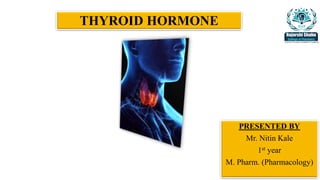
THYROID HORMONE
PRESENTED BY
Mr. Nitin Kale
1st year
M. Pharm. (Pharmacology)
Introduction
Thyroid gland
Thyroid hormones: Synthesis,Release and Physiology
Thyroid disorders
Hyperthyrodism
Hypothyrodism
Drugs for thyroid dysfunction
Contents
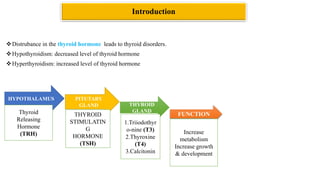
Distrubance in the thyroid hormone leads to thyroid disorders.
Hypothyroidism: decreased level of thyroid hormone
Hyperthyroidism: increased level of thyroid hormone
HYPOTHALAMUS
Thyroid
Releasing
Hormone
(TRH)
PITUTARY
GLAND
THYROID
STIMULATIN
G
HORMONE
(TSH)
THYROID
GLAND
1.Triiodothyr
o-nine (T3)
2.Thyroxine
(T4)
3.Calcitonin
FUNCTION
Increase
metabolism
Increase growth
& development
Introduction
Largest endocrine gland.
Located inferior to cricoid cartilage.
Butterfly shaped organ comprising of two lobes:
lobus dexter(right), lobus sinister(left)
Weight 15-25 gm in adult.
Histologically it is made up of follicular (T3 & T4) and parafollicular
(calcitonin) cells.
Functional unit: follicle or acinus
Thyroid Glands
• Regulation:
Thyroid Hormone Regulation
Thyroid Hormone Synthesis & Release
Triiodothyronine (T3) Thyroxine (T4)
Release pattern 15% release from glands,rest (85%) is
converted from T4
Mainly release from thyroid glands
Release amount 6ug/day 100ug/day
activity T3 has 3-5 times more active than T4
Half life <1day 5-7 days
Thyroid Hormone
Metabolic Function Growth & Developmment
 Increase the metabolism of
carbohydrate,protein & lipids.
 Increase the production of growth
hormone and potentiating its effects.
 Control the activity of other hormone
like insulin,glucagon,glucocorticoids
and acetylcholamines
 Important for skeletal development.
 Increase the oxygen consumptions
and heat productions.
 Essential for normal growth and
maturation of CNS.
 Increase the cardiac activity.
 Also affect function of kidney, liver
and muscle.
Thyroid Hormone Physiology
Hyperthyroidism Hypothyroidism
 Grave´s disease
 Toxic thyroid nodule (Adenomas)
 Thyroid storm
 Hashimotos thyroiditis
 Cretinism
 Myxoedema
 Postpratium thyoroditis
 Subacute thyroiditis
 Sick euthyrodism
Thyroid Disorders
HYPERTHYROIDISM
Hyperthyroidism or over reactive thyroid causes your thyroid to
produce more thyroid hormone (T3&T4) than demands or needs. This
inhance the metabolic and growth functions of the body.
ETIOPATHOGENES
Graves disease
Toxic adenomas: formation of nodules in the gland and being to
secrete thyroid hormone; some goitre may contains several of this
nodules.
Subacute thyroiditis : inflammation of gland ; “leak’’ excess hormone.
Increased basal metabolic rate
Weight loss, good appetite (eating more than usual)
Anxiety, restlessness, mental excitability, insomial
Alopecia (hair loss)
CVS: Tachycardia (high heart beat), atrial fibrilations
Warm sweet skin
Diarrhoea
Muscle weakness
Clinical signs & symptoms
Sometimes called Graves’ thyroiditis,
This condiction account for 75% of case of hyperthyroidism.
It affects women 5 to 10 times more than men and may occur at any age, being most
common between the ages of 30 and 50 years.
It is an autoimmune disorder in which an antibody (TSH-Receptor antibody stim)
that mimics the effects of TSH is produced,
causing:
Increased release of T3 and T4 and signs of hyperthyroidism
Goiter (visible enlargement of the gland) as the antibody stimulates thyroid growth.
Graves disease
Enlarged thyroid gland in goiter Bulging eyes in exopathalmos
Rarely occurs but life threatening
Sudden and sever exacerbation of hyperthyroidism
Etiology : precipitated by stress or infection with either unrecognised
thyrotoxicosis or inadequately treated thyrotoxicosis, trauma, pregnancy,
emotional stress.
Management
Antithyroid drugs, beta blockers, antibiotics, steroids.
Thyroid strom
Hypothyroidism or underactive thyroid is when thyroid gland unable to produce enough
amount of hormone to fulfil the demands.
This slowdown the body metabolic and growth function
Female:Male ratio(6:1)
Primary Hypothyroidism: thyroid can not produce enough hormone as per pituitary
signal. Thyroid failure
Secondary hypothyroidism: thyroid isn’t being stimulated from pituitary to produce
hormone. Pitutary failure
Hypothyroidism
Decreased metabolic rate
Weing gain, anorexia
Depressions, psychosis,mental slowness, lethargy
Dry skin, brittle hair
Bradycardia (decreased heart rate)
Feeling cold
Constipation
More menstrual bleeding
Muscle weakness
Clinical Signs & Symptom's
Iodine supplements if hypothyroidism occurs due to iodine deficiency
Hormone replacement therapy: synthetic drugs
T4(Levothyroxine): 1.6 ug/kg, aim: to achive normal TSH level (0.4-5.0 mu/L)
T3(Liothyronine):10×more potent
Mixture of T3 & T4 (Liotrix): T4:T3(4:1)
Management
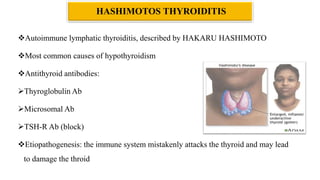
Autoimmune lymphatic thyroiditis, described by HAKARU HASHIMOTO
Most common causes of hypothyroidism
Antithyroid antibodies:
Thyroglobulin Ab
Microsomal Ab
TSH-R Ab (block)
Etiopathogenesis: the immune system mistakenly attacks the thyroid and may lead
to damage the throid
HASHIMOTOS THYROIDITIS
Hypothyroidism dating from birth (congenital)
Absence of throid hormone results in profound impairment of growth and
cognitive development
Thyroxine is essential for growth and development of brain during the first
three years. Earlier onset greater is the brain damage.
Etiology
Congenital developmental defects
Iodine deficiency
Hashimotos thyroiditis.
Cretinism
• Etiology
Severe hypothyroidism in which there is accumulation of hydrophilic
mucopolysaccharides in the skin and other tissues.
Common in women
Two varients
i. Hyperthyroid Myxedema
ii. Hypothyroid Myxoedema
Increased deposition of glucosamine glycans
Myxoedema
• Thyroid supplement: Thyroxine
Thyroid inhibitor
Antithyroid
drugs
Ionic inhibitors Inhibit hormone
release
Destroy thyroid
tissue
Propylthiouracil,
Methimazole,
carbimazole
Thiocynates,
Perchlorates,
Nitrates
Iodine, iodides of
Na & K,
Organic iodide
Radioactive iodine
(131I,125I,123I)
Drugs For Thyroid Dysfunction
Thank you……!

THYROID HORMONE.pptx by Nitin Kale

  • 1.
    THYROID HORMONE PRESENTED BY Mr.Nitin Kale 1st year M. Pharm. (Pharmacology)
  • 2.
    Introduction Thyroid gland Thyroid hormones:Synthesis,Release and Physiology Thyroid disorders Hyperthyrodism Hypothyrodism Drugs for thyroid dysfunction Contents
  • 3.
    Distrubance in thethyroid hormone leads to thyroid disorders. Hypothyroidism: decreased level of thyroid hormone Hyperthyroidism: increased level of thyroid hormone HYPOTHALAMUS Thyroid Releasing Hormone (TRH) PITUTARY GLAND THYROID STIMULATIN G HORMONE (TSH) THYROID GLAND 1.Triiodothyr o-nine (T3) 2.Thyroxine (T4) 3.Calcitonin FUNCTION Increase metabolism Increase growth & development Introduction
  • 4.
    Largest endocrine gland. Locatedinferior to cricoid cartilage. Butterfly shaped organ comprising of two lobes: lobus dexter(right), lobus sinister(left) Weight 15-25 gm in adult. Histologically it is made up of follicular (T3 & T4) and parafollicular (calcitonin) cells. Functional unit: follicle or acinus Thyroid Glands
  • 5.
  • 6.
  • 7.
    Triiodothyronine (T3) Thyroxine(T4) Release pattern 15% release from glands,rest (85%) is converted from T4 Mainly release from thyroid glands Release amount 6ug/day 100ug/day activity T3 has 3-5 times more active than T4 Half life <1day 5-7 days Thyroid Hormone
  • 8.
    Metabolic Function Growth& Developmment  Increase the metabolism of carbohydrate,protein & lipids.  Increase the production of growth hormone and potentiating its effects.  Control the activity of other hormone like insulin,glucagon,glucocorticoids and acetylcholamines  Important for skeletal development.  Increase the oxygen consumptions and heat productions.  Essential for normal growth and maturation of CNS.  Increase the cardiac activity.  Also affect function of kidney, liver and muscle. Thyroid Hormone Physiology
  • 9.
    Hyperthyroidism Hypothyroidism  Grave´sdisease  Toxic thyroid nodule (Adenomas)  Thyroid storm  Hashimotos thyroiditis  Cretinism  Myxoedema  Postpratium thyoroditis  Subacute thyroiditis  Sick euthyrodism Thyroid Disorders
  • 10.
    HYPERTHYROIDISM Hyperthyroidism or overreactive thyroid causes your thyroid to produce more thyroid hormone (T3&T4) than demands or needs. This inhance the metabolic and growth functions of the body. ETIOPATHOGENES Graves disease Toxic adenomas: formation of nodules in the gland and being to secrete thyroid hormone; some goitre may contains several of this nodules. Subacute thyroiditis : inflammation of gland ; “leak’’ excess hormone.
  • 11.
    Increased basal metabolicrate Weight loss, good appetite (eating more than usual) Anxiety, restlessness, mental excitability, insomial Alopecia (hair loss) CVS: Tachycardia (high heart beat), atrial fibrilations Warm sweet skin Diarrhoea Muscle weakness Clinical signs & symptoms
  • 12.
    Sometimes called Graves’thyroiditis, This condiction account for 75% of case of hyperthyroidism. It affects women 5 to 10 times more than men and may occur at any age, being most common between the ages of 30 and 50 years. It is an autoimmune disorder in which an antibody (TSH-Receptor antibody stim) that mimics the effects of TSH is produced, causing: Increased release of T3 and T4 and signs of hyperthyroidism Goiter (visible enlargement of the gland) as the antibody stimulates thyroid growth. Graves disease
  • 13.
    Enlarged thyroid glandin goiter Bulging eyes in exopathalmos
  • 14.
    Rarely occurs butlife threatening Sudden and sever exacerbation of hyperthyroidism Etiology : precipitated by stress or infection with either unrecognised thyrotoxicosis or inadequately treated thyrotoxicosis, trauma, pregnancy, emotional stress. Management Antithyroid drugs, beta blockers, antibiotics, steroids. Thyroid strom
  • 15.
    Hypothyroidism or underactivethyroid is when thyroid gland unable to produce enough amount of hormone to fulfil the demands. This slowdown the body metabolic and growth function Female:Male ratio(6:1) Primary Hypothyroidism: thyroid can not produce enough hormone as per pituitary signal. Thyroid failure Secondary hypothyroidism: thyroid isn’t being stimulated from pituitary to produce hormone. Pitutary failure Hypothyroidism
  • 16.
    Decreased metabolic rate Weinggain, anorexia Depressions, psychosis,mental slowness, lethargy Dry skin, brittle hair Bradycardia (decreased heart rate) Feeling cold Constipation More menstrual bleeding Muscle weakness Clinical Signs & Symptom's
  • 17.
    Iodine supplements ifhypothyroidism occurs due to iodine deficiency Hormone replacement therapy: synthetic drugs T4(Levothyroxine): 1.6 ug/kg, aim: to achive normal TSH level (0.4-5.0 mu/L) T3(Liothyronine):10×more potent Mixture of T3 & T4 (Liotrix): T4:T3(4:1) Management
  • 18.
    Autoimmune lymphatic thyroiditis,described by HAKARU HASHIMOTO Most common causes of hypothyroidism Antithyroid antibodies: Thyroglobulin Ab Microsomal Ab TSH-R Ab (block) Etiopathogenesis: the immune system mistakenly attacks the thyroid and may lead to damage the throid HASHIMOTOS THYROIDITIS
  • 19.
    Hypothyroidism dating frombirth (congenital) Absence of throid hormone results in profound impairment of growth and cognitive development Thyroxine is essential for growth and development of brain during the first three years. Earlier onset greater is the brain damage. Etiology Congenital developmental defects Iodine deficiency Hashimotos thyroiditis. Cretinism
  • 20.
    • Etiology Severe hypothyroidismin which there is accumulation of hydrophilic mucopolysaccharides in the skin and other tissues. Common in women Two varients i. Hyperthyroid Myxedema ii. Hypothyroid Myxoedema Increased deposition of glucosamine glycans Myxoedema
  • 21.
    • Thyroid supplement:Thyroxine Thyroid inhibitor Antithyroid drugs Ionic inhibitors Inhibit hormone release Destroy thyroid tissue Propylthiouracil, Methimazole, carbimazole Thiocynates, Perchlorates, Nitrates Iodine, iodides of Na & K, Organic iodide Radioactive iodine (131I,125I,123I) Drugs For Thyroid Dysfunction
  • 22.