How can leaders catalyse a thriving, sustainable future? In order for business to be a key engine of
 transformation to post-materialist, green growth economies, business leaders must change the game,
                                change the rules and change their goals.

 A new approach called “ThriveAbility” has evolved to integrate strategy, innovation, sustainability and
    design in a way that simplifies the task and gets the job done while creating shared advantage.

ThriveAbility is both descriptive and prescriptive, as well as predictive- it describes the emerging edge of
 leading practice in strategy, innovation, sustainability and design, while prescribing an approach which
          includes an equation, decision framework, process and dashboard for ThriveAbility.

ThriveAbility is predictive in the sense that it enables us to calculate the costs and benefits of different
     options and trade-offs in the design, development and scaling of new products, services and
                                                 experiences.

This short paper offers an overview of ThriveAbility, and how you can get involved in one or more of the
                                programs and events beginning in 2013.


                                   ThriveAbility
     Change the Game, Change the Rules, Change the Goals
                                Dr Robin Wood President of Renaissance2
ThriveAbility: Change the Game, Change the Rules, Change the Goals


                                                 Introduction
There are only three certainties in the 21st century: the first is that we will have exceeded the carrying
capacity of earth, and the second is that the price we pay for doing so will rise dramatically the longer we
wait to take radical action to remedy this situation. In 2050, it is increasingly likely that the 9 billion people
then alive will be struggling for survival, along with a crippled biosphere.
The third certainty is that our species is in the middle of a major evolutionary leap, which could transform
the relationship between us, our planet and each other. The associated uncertainty is whether we can
harness this shift to co-create a thriving world for all, or whether it is squandered in a series of regressive,
“too little too late” gestures because our leaders did not have the courage to grasp this opportunity and all
it implies for the steadily disintegrating status quo in the next few decades.
Scientists call the age we are now living in the “Anthropocene”- the age shaped by man. The scale and
speed of change in the last 60 years have been momentous- events since the 1950s have been called the
‘Great Acceleration’. The human population has tripled, and the global economy exploded through new
technology and a new global system of cooperation and investment. We are going to need advanced levels
of consciousness and capability in our leaders in the decades ahead, as we become like gods in our ability
to shape the world around us, while possessing feet of clay that make us highly vulnerable to catastrophic
risks.
The next few decades also present us with massive business opportunities ranging from developing and
maintaining low-carbon, zero-waste cities, to improving and managing bio capacity, ecosystems, lifestyles
and livelihoods. In today’s dollars, the market opportunities created by adapting to the new global reality
for sustainable living are somewhere between $3-$10 trillion USD per year in 2050.
If we are to realise these multi trillion dollar opportunities, we are going to have to harness the most
profound motivation of our people. We need to understand how Personal Action Logics & Collective Value
Systems drive sustainability choices.
ThriveAbility argues that breakthrough innovations at business model and ecosystem levels need to be
catalysed by top management through strategy, design and innovation processes, demonstrating that
positive impact “green” growth is achievable and highly rewarding. For this to work, business and policy
leaders need to change the game, change the rules and change their goals.


                             The Challenge of Changing the Game
Many leaders around the world understand all too well that the game we have been playing for several
centuries is over, and that a new game is emerging that requires a significant change in the rules that
govern how we conduct ourselves, our business and our governance. These new rules are still emerging, as
are the goals that they shape for each of us, our businesses and institutions. Yet they are beginning to be
articulated.
Despite this understanding, it is proving difficult for most leaders to operationalize the changes they know
are needed, due to a great deal of uncertainty around what that might mean for their most important
stakeholders and the natural resistance to change that is inherent in human systems. There is also
reluctance to damage or risk what is still working until it is definitively broken, unless there are other real
options on the table.
There are many different opinions as to what must be done. Some say that the "system" is beyond repair,
and that we must get outside of it to change it. Others believe we can accelerate what is already working in

© Renaissance2 Foundation 28/12/2012 |                                                                       1
ThriveAbility: Change the Game, Change the Rules, Change the Goals

the new, more sustainable game, and that this simply requires a better market, culture or technology to
make the old game obsolete. There is an element of truth in both of these propositions- we certainly must
shift our mind-sets to change the game, and we also have to preserve and promote the best of what is
already working to survive and thrive in the process.
The most important attribute of all at this time, is to maintain an open mind and to be as agile and creative
as possible in finding and promoting the radical new opportunities our current situation offers to
innovative, entrepreneurial minds.


                 The Slowly Disintegrating Old Game: Capitalism 1.0
In every era, how we make a living and who gets to lead the system changes as knowledge, culture,
technology and innovation co-evolve. Chieftains rule agrarian tribes, while CEO's rule corporations and
Presidents and Prime Ministers rule countries. Civilisation has always been built out of exchanges between
different peoples living in different biomes and life conditions with different natural advantages and needs.
There have always been good and bad leaders, healthy and unhealthy cultures, and this remains part of the
evolutionary process. What is certain is that the game we have been playing for the past few centuries has
to change and is changing dramatically.
Our systems of business and governance in the 20th century were driven by the perception that
competition for scarce resources and winning the race for advanced technologies were the real drivers of
progress. If a little "collateral damage" was inflicted along the way as "externalities", then that was the
problem of government and regulators, because the job of business was to produce the maximum output
with the minimum input, on the largest scale possible, thus yielding the largest profit and shareholder
return possible.
Capitalism 1.0 produced unprecedented material prosperity for the emerging middle classes, and massive
surpluses for successful investors, but also re-created a highly stratified world on a global scale. Insiders in
business, government and finance became the new "masters of the universe", while outsiders experienced
diminishing wealth as Capitalism 1.0 began to unravel, producing reactions ranging from the World Social
Forum to the Occupy movements. What began as colonisation ended as Coca-Colanisation, as corporations
extended their reach into developing markets.
Two things stand out when we look at the game of Capitalism 1.0: the first is that it assumes no limits to
economic growth, and the second is that it prioritises material wealth over human wellbeing. In the past
century both of these assumptions have been challenged, and in some parts of the world and some
businesses, successfully overturned.


                                             The New Game?
Whatever the new game that is emerging will end up being called by future historians, it is certain that it
will recognise limits to growth and prioritise people over money and material wealth. The big question is
what kind of system/s and organisations will become the dominant species in this new game. While it is
clear that the corporations, governments and banks that have played keystone roles in Capitalism 1.0 will
have to transform into different animals or become extinct, there are still few role models for the new
game with any longevity.
Capitalism 2.0 is basically a massive social, organisational and economic science experiment, as well as a
work in progress that continues to surprise. As with all radical historical and evolutionary shifts, the
transition from the old game to the new will see an accelerated cycle of creative destruction as relatively
unknown technologies and players emerge overnight to become leading players, and the incumbents in
every industry struggle to remain relevant. The playing field will become very uneven, and certainly favour
bold innovators rather than timid tinkerers.

© Renaissance2 Foundation 28/12/2012 |                                                                      2
ThriveAbility: Change the Game, Change the Rules, Change the Goals

One of the key differences between the 20th and 21st century attitudes to nature will be that instead of
merely preserving what little is left after industrialisation, we will find and apply exciting new ways to
enhance nature that can avoid the plague of side effects brought about by a poor understanding of natural,
living systems we demonstrated in the 20th century. In this synergy zone between ecophiles and
technophiles, we will find an increasingly win-win-win game being played between humans and our
biosphere.
Another major difference between this new game in this new century and the one we played in the 20th is
that for the first time in the two millennia since Aristotle pronounced happiness to be what humans strive
for, we will have reasonably accurate measures of human wellbeing and happiness. This will empower
people to make better decisions in their lives and careers based on accurate assessments of their potential,
values and strengths, not just their material needs and wants.


                                              The Transition
The transition from the old game to the new game is being shaped by three mutually reinforcing drivers:
    •   Growing Negative Outcomes for Business as Usual- The accelerating impact of the ten megaforces
        that are driving the three high risk outcomes of climate change, resource shortages and ecosystem
        decline, and the serious consequences these three outcomes have for all businesses and societies,
        will create unprecedented challenges (and opportunities) for organisations of all kinds. This driver
        influences decision makers to act through a healthy dose of fear, caution and a desire to survive
        and protect what they cherish;
    •   Accelerating Global Innovation- the biggest gift of capitalism 1.0 has been the scientific,
        technological and knowledge revolutions that emerged as a result of the first Renaissance and the
        Enlightenment. The impacts of this revolution are still reverberating around the world especially in
        developing countries, whose growth will shift from being fuelled by carbon heavy sources of energy
        and polluting industrial technologies, to renewable energies and biologically friendly technologies.
        The political and social impacts will follow next as forces for democratisation and social justice
        gather pace. This driver influences decision makers to act through a passion for excellence,
        innovation and new opportunities;
    •   Breakthroughs in Leveraging Human Potential- our species is educating and developing itself at a
        historically unprecedented pace. Such development is driving not only scientific and technological
        breakthroughs, but also social, ethical, spiritual and organisational breakthroughs. As our species
        matures from its difficult teenager phase into early adulthood, we find new levels of responsibility
        and empathy emerging around the world in billions of people. As the profile of our leaders shifts
        from autocratic to servant to integral values, we can imagine a future in which the current civic-
        minded, “We” generation now starting their careers, matures into the leadership cadre of 2030,
        informed by a worldcentric empathy that makes human thrival rather than profit and power the
        yardstick of human progress.
Imagine a world in which organisations have successfully motivated their key stakeholders to drive green
growth through sustainable innovation. Imagine that the frustrations and multiple pressures for change we
experience are actually early indications of the emergence of a new era and that many profitable,
sustainable innovations are hidden in the turmoil, just waiting for enterprising, innovative leaders to reach
out and catalyse them. This is the promise of ThriveAbility.


© Renaissance2 Foundation 28/12/2012 |                                                                   3
ThriveAbility: Change the Game, Change the Rules, Change the Goals


                                   Welcome to the Anthropocene
Since the first Renaissance began 500 years ago, the developed world has evolved into an age where
modernism is the centre of gravity. This technocratic way of thinking combined with the ethno-centric,
nationalist systems of government that peaked in the 20th century, left a deadly legacy in the first part of
the 20th century. Modernism is still peaking in the developing world so China, India, Africa and the Middle
East are flashpoints for this mixture of advanced technology and highly nationalistic thinking.
Over the past century here in Europe and in many of the world’s great cities, we have evolved beyond the
modernist worldview into the post-modernist worldview. This communitarian value system expresses
solidarity and social harmony, and has led us to create the European project that has avoided a third world
war and dramatically expanded our economies and standard of living. It has also made Europe the greenest
continent on earth relative to its economic output, and a leader in both sustainability and sustainable
development worldwide. This is a heritage we can be very proud of, but which also demands that we
ensure that Europe’s transformative potential is realised in the next few decades.
We must now move beyond the relativism and self-satisfaction of post-modernism to embrace a new
synthesis that is emerging in integral consciousness right here in Europe. There are thousands of brilliant
integral thinkers and activists across Europe, and they give us great hope for the quality of leadership for
ThriveAbility, though they are still a rare exception in the leadership teams of most organisations.
Such leaders are uniquely capable of transcending and including earlier levels of consciousness. Worldwide,
tens of millions of leaders are now developing the early stages of integral consciousness. This represents a
unique moment in history as we find this capability becoming significant in our best young leaders, fuelling
what could be a great leap forward for our species if catalysed in time.
The battle to prevent catastrophic climate change will be won or lost in our cities which account for 80% of
Greenhouse Gas (“GHG”) emissions globally and are home to more than half of the world’s population.
Copenhagen, Curitiba, Barcelona, Stockholm, Vancouver and Paris are leading the pack of cities aiming to
become resilient.
Business is a key driver in this shift to resilience. For example, a recent report, “Vision 2050”, by the World
Business Council for Sustainable Development’s (WBCSD), lays out a pathway to a world in which nine
billion people can live well, within the planet’s resources, by mid-century. The report features a set of
“must haves”, which in the next decade include:
Resilient Environment
   i.    Doubling agricultural output without increasing the amount of land or water used;
   ii.   Halting deforestation and increasing yields from planted forests;
Renewable Energy
   iii. Halving carbon emissions worldwide (based on 2005 levels) by 2050 through a shift to low-carbon
   energy systems;


Resilient Habitats
   iv.   All new buildings zero net energy,
   v.    Up to a tenfold improvement in Eco efficiency of materials
   vi.   Providing universal access to low-carbon mobility.


© Renaissance2 Foundation 28/12/2012 |                                                                     4
ThriveAbility: Change the Game, Change the Rules, Change the Goals

Wise Cultures
In social terms, Vision 2050 requires that we create wiser cultures that take a longer term perspective. To
do this we must offer people incentives for behaviour change, so that sustainable living becomes
mainstream within a decade.
Human Development - This also demands that we build trust, entrepreneurialism and inclusiveness into
our organisations and societies, enabling enterprises and ecosystems to create value and help meet the
basic needs of all.
Enlightened Enterprises & Integral Governance - will help to redefine progress, drive more inclusive
markets and take a true, value, true cost approach to arrive at true profits. In economic terms, Vision 2050
requires that we incorporate the costs of externalities, starting with carbon, ecosystem services and water,
into the structure of the marketplace.


       Business Opportunities - ThriveAbility as Competitive Advantage
Our current challenges are also major business opportunities, ranging from developing and maintaining
low-carbon, zero-waste cities, to improving and managing bio capacity, ecosystems, lifestyles and
livelihoods. In today’s dollars, the market opportunities created by adapting to the new global reality for
sustainable living are somewhere between $3-$10 trillion USD per year in 2050.
If we are to realise these multi trillion dollar opportunities and ambitious programs such as Vision 2050, we
are going to have to harness the most profound motivation of our people. We need to understand how
Personal Action Logics & Collective Value Systems drive sustainability choices. What would get the people
who lead our organizations and nations to powerfully commit to ThriveAbility? What would their dominant
action logic need to be?
Experts and Achievers- The Dominant Action Logics of Developed World Leadership
Recent surveys show that Experts and Achievers predominate in leadership positions in developed nations
both in private enterprise and government. They tend to lead diplomats and opportunists lower down in
the organisation. Individualists and Strategists already occupy leadership positions in large scale systems
with longer time horizons, and are emerging as the next wave of leadership for the future.
Finally, Alchemists capable of large system and society wide transformation are now emerging in greater
numbers and will be critical to shifting us into ThriveAbility. Given that the kinds of leaders we have in our
organisations tend to shape the organisations and societies they lead, it should come as no surprise that
the dominant social logic in the developed world shares most of the characteristics of the Experts and
Achievers who lead those organisations and nations.
Recent research shows that values alignment is key to successful sustainability initiatives in three ways:
 • The design and implementation of such initiatives must be rooted in an understanding of—and
   tailored response to vastly different stakeholder values.
 • Leaders must understand different types of values and tailor all aspects of sustainability projects
   accordingly.
 • Components of the assessment, design, implementation, evaluation, and all communications should
   align the values of all key stakeholders.


© Renaissance2 Foundation 28/12/2012 |                                                                       5
ThriveAbility: Change the Game, Change the Rules, Change the Goals

                                   The Sustainability Dilemma:
        Finding the Synergy Zone between EcoPhiles and Technophiles
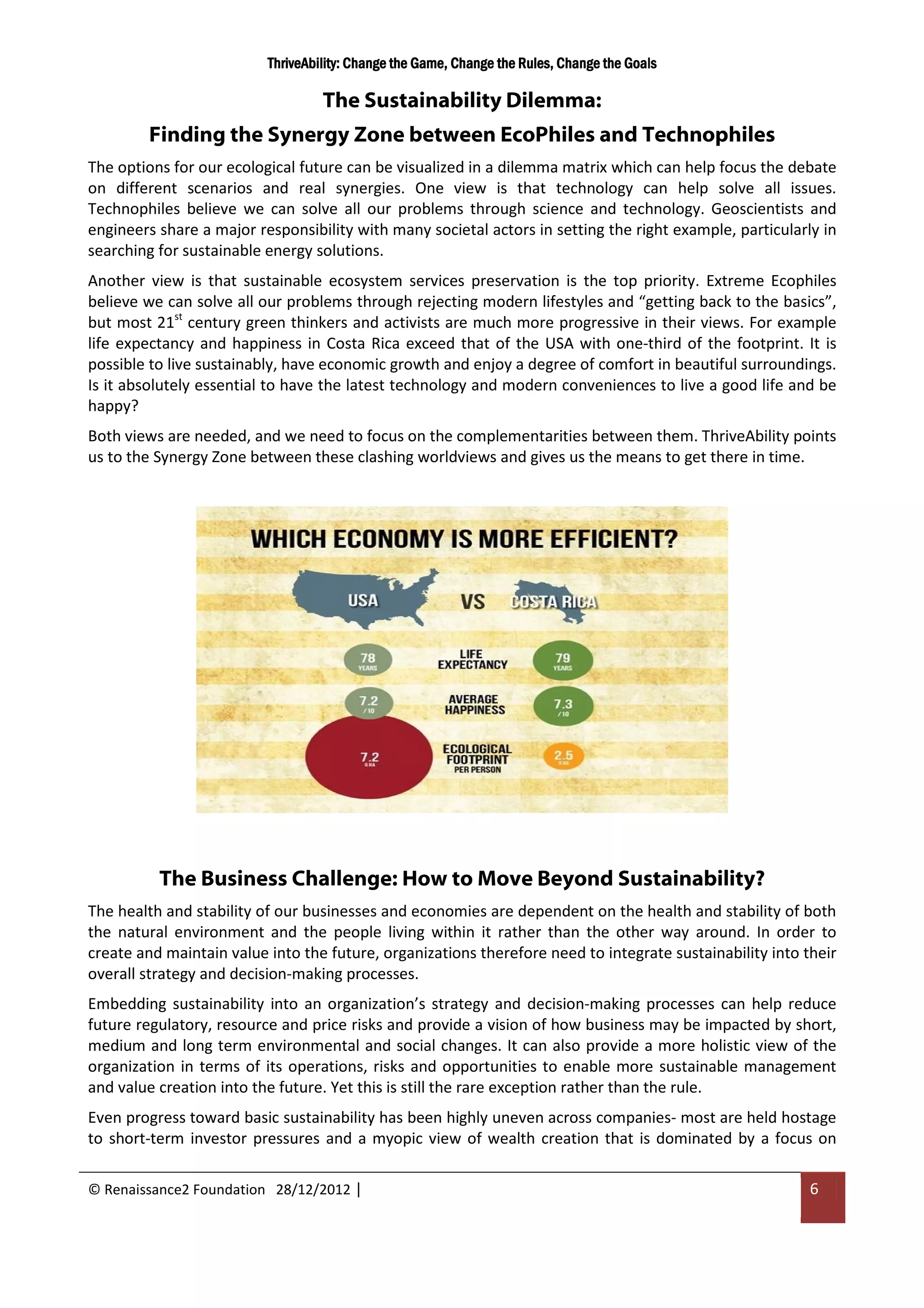
The options for our ecological future can be visualized in a dilemma matrix which can help focus the debate
on different scenarios and real synergies. One view is that technology can help solve all issues.
Technophiles believe we can solve all our problems through science and technology. Geoscientists and
engineers share a major responsibility with many societal actors in setting the right example, particularly in
searching for sustainable energy solutions.
Another view is that sustainable ecosystem services preservation is the top priority. Extreme Ecophiles
believe we can solve all our problems through rejecting modern lifestyles and “getting back to the basics”,
but most 21st century green thinkers and activists are much more progressive in their views. For example
life expectancy and happiness in Costa Rica exceed that of the USA with one-third of the footprint. It is
possible to live sustainably, have economic growth and enjoy a degree of comfort in beautiful surroundings.
Is it absolutely essential to have the latest technology and modern conveniences to live a good life and be
happy?
Both views are needed, and we need to focus on the complementarities between them. ThriveAbility points
us to the Synergy Zone between these clashing worldviews and gives us the means to get there in time.


          The Business Challenge: How to Move Beyond Sustainability?
The health and stability of our businesses and economies are dependent on the health and stability of both
the natural environment and the people living within it rather than the other way around. In order to
create and maintain value into the future, organizations therefore need to integrate sustainability into their
overall strategy and decision-making processes.
Embedding sustainability into an organization’s strategy and decision-making processes can help reduce
future regulatory, resource and price risks and provide a vision of how business may be impacted by short,
medium and long term environmental and social changes. It can also provide a more holistic view of the
organization in terms of its operations, risks and opportunities to enable more sustainable management
and value creation into the future. Yet this is still the rare exception rather than the rule.
Even progress toward basic sustainability has been highly uneven across companies- most are held hostage
to short-term investor pressures and a myopic view of wealth creation that is dominated by a focus on

© Renaissance2 Foundation 28/12/2012 |                                                                    6
ThriveAbility: Change the Game, Change the Rules, Change the Goals

financial capital to the exclusion of other “capitals” indispensable to long-term, inclusive wealth creation.
Namely: natural, human, social, and intellectual capital.
Another major challenge is that investors all take different perspectives on what sustainability excellence
means. For example, mainstream Investors, social investors and NGO’s apply very different criteria, leading
to opaque, inconsistent sustainability and CSR measures. This is not made any easier by the variety of
players and roles that are involved in setting, disclosing and assuring standards, from the standard setters
themselves to the disclosers, assurers, aggregators, analysts and rating agencies.
A recent survey by Deloitte of 65 of the leading sustainability advocates in ten industries around the world
also demonstrated how far we have to go to get to the point where even the leading organisations are all
able to bring about the transformations required in their industries to meet the 2 degree warming scenario
requirements.
The Zero Impact Growth survey found that only 6 of the 65 sustainability leaders were operating at the
business ecosystem level of transformation. Puma, Unilever, Nestle, Nike, Natura and Ricoh are all
collaborating with their industry supply chains and competitors to transform industry their value chains,
along similar lines to the initiatives recommended by the WBCSD in its Vision 2050 recommendations.
45 of these sustainability leaders were optimising their value chains at the enterprise level, while 13 were
still in the early stages of experimentation with sustainability initiatives. Clearly a whole new language and
set of concepts and skills need to be learned by organizations to make sustainability breakthroughs more
likely.
If we are to move to the sustainable economy and thriving future, a new frame of reference for decision-
making is required, involving new ways to measure progress at global, national and corporate levels. A
measurement framework which incorporates economic growth, social equity and well-being, and
environmental sustainability, is needed; one that, at the same time, provides a common set of goals for
action by business and governments at the local, national and international levels.
This emerged as a key theme of the United Nations Conference on Sustainable Development, ‘Rio+20’ held
in June 2012. The outcome document from Rio+20 includes references to performance measurement
systems at each level of an economy:
- The global level: agreement to develop a set of global Sustainable Development Goals (SDGs) in key
priority areas to complement the existing Millennium Development Goals after 2015. It was recognized that
once set, progress towards the achievement of the goals needs to be assessed and accompanied by targets
and indicators.
- The national level: recognition of the limitations of GDP as a measure of well-being and sustainable
development. Launch of a programme to develop new national indicators that go beyond GDP.
- The corporate level: acknowledgment that the implementation of sustainable development will depend
on active engagement of the private sector; recognition of the importance of corporate sustainability
reporting and encouragement of companies, where appropriate, especially publicly listed and large
companies, to consider integrating sustainability information into their reporting cycle.
The Deloitte Zero Impact Growth (“ZIG”) report reveals 4 major gaps that were visible through the ZIG
Monitor: a major comparability gap (that is why all rankings and ratings tell us different stories about best-
in-‘their’-class performance), major gaps between the overall strategy of organizations towards Zero
Impact Growth and furthermore the real capabilities of sub-strategies to deliver on the organization’s
overall strategy (it simply doesn’t add up in many cases), and finally gaps in the balance of sub-strategies
and major performance gaps in and between industries. And all of that while the report only assessed
companies that see themselves as leading in sustainability.
The Zero Impact Growth report offers us a baseline picture of where we really are, and also assesses the
brakes, accelerators and options for a ‘joint flight’ towards adapting Zero Impact Growth as the new basic
paradigm that we all need to agree on, if we are to deliver the regenerative or restorative growth we need
© Renaissance2 Foundation 28/12/2012 |                                                                    7
ThriveAbility: Change the Game, Change the Rules, Change the Goals

to survive and thrive. It’s a process that can be a door-opener for cross-industry fertilization, for social
entrepreneurship, for collaborative action to develop true costing, true pricing and true taxation initiatives
leading to true valuation of resources, goods and services. This “North Star” reality check forms an essential
part of the measures used for ThriveAbility evaluations.
The move to integrated reporting highlights an important trend: that sustainability and CSR need to be
integrated into the core of what any organisation does. As Nike’s Hannah Jones put it1:
Nike now believes that "the time is fast approaching when we will jettison the language of sustainability, and simply
talk about value creation; NPV [net present value], ROIC [return on invested capital], market share, innovation
portfolios and shareholder returns." "We have long said that things we have taken for free will become the new gold,"
she explained, "water, waste, carbon. Today, externalised costs are being forcibly internalised into cost structures,
economies and incomes. The weather is not waiting to be regulated. We believe we have entered the era of climate
adaptation, where we are no longer contemplating the potential, but beginning to grapple with the consequences.
"But," she continued, "here's the thing: to be able to deliver this transparency has required data, which in turn has the
potential to trigger innovation. We're discovering how combining different data sets can be a tool for empowerment;
social change; new insights; new solutions. What happens when we can mash up the data from these reports? How do
we apply Silicon Valley, new-business-model thinking to the data we see emerging from the sustainability world? And
in a world where open data is starting to create new businesses, new solutions to intractable problems, how do we
reap even create value from the world of reporting? How does reporting actually become the start of an innovation
story, not only the crowning of an accountability story?"
Finally, she noted that, "When we talk about sustainability without the context of value creation we diminish the
potential and the opportunity and the speed with which the transition will happen. How do we turn sustainability into
a 'pull' function, not a 'push' function, within a corporation? The answer lies in viewing sustainability as a strategic
prism through which to view the resiliency, future growth trajectory and value creation potential of a company."
This article echoes Hannah Jones, and argues for us to now move beyond the dominant role reporting has
played in the field of sustainability to date, and to embed new management practices and tools based on a
new theory of management and economics called ThriveAbility.


          Inclusive Green Growth Through Sustainable Innovation & Design
ThriveAbility argues that breakthrough innovations at business model and ecosystem levels need to be
catalysed by top management through strategy, design and innovation processes, demonstrating that
positive impact growth is achievable. There is ample evidence that investors will support initiatives that are
well thought through and highly measurable.
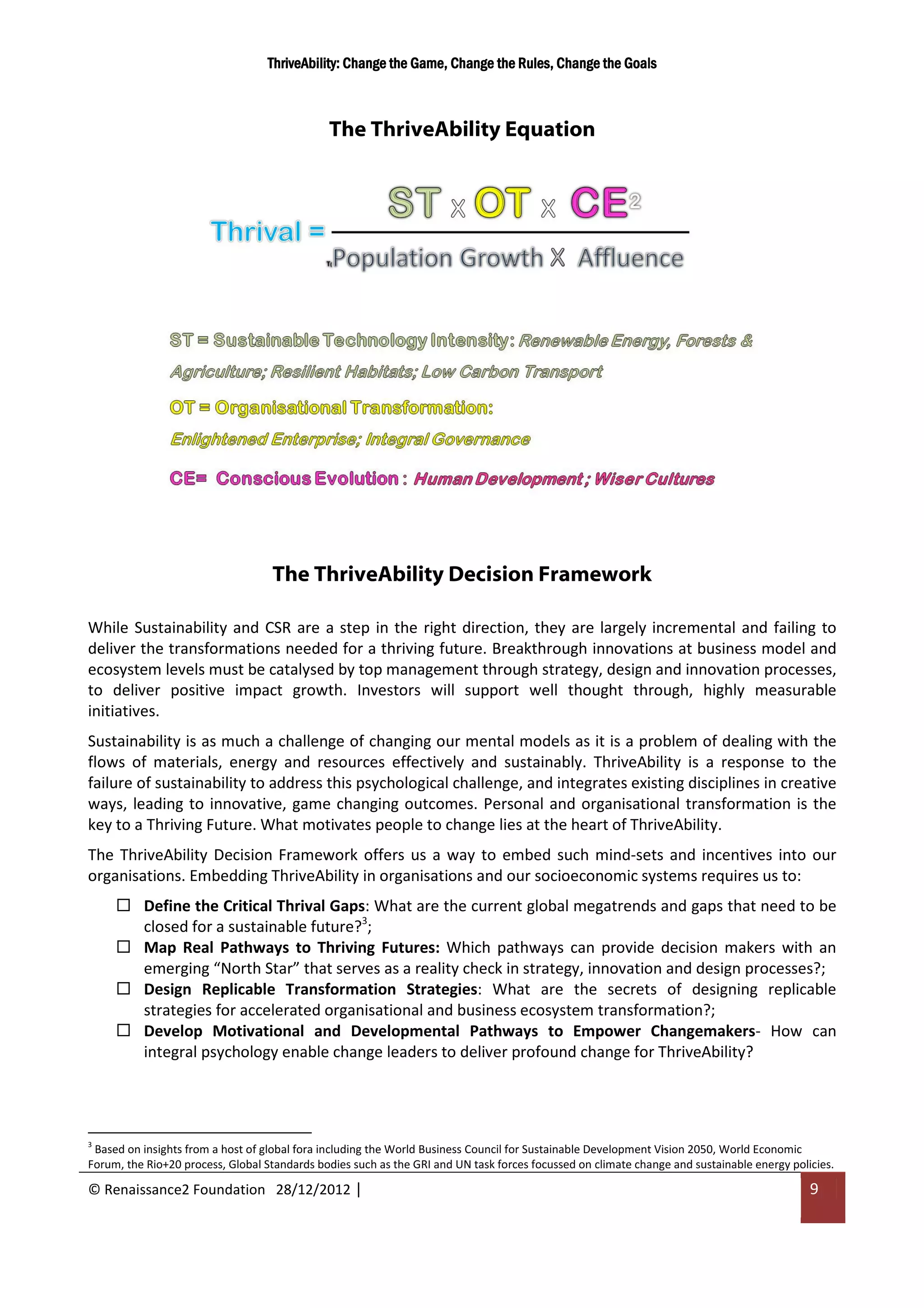
The ThriveAbility Equation and the ThriveAbility Process provide a starting point for such integration, and
explain how new measures and practices can be embedded into organisations through Profound Change,
ensuring a thriving future for us all.
At its simplest, Thrival2 can be recognised in a society by happy human beings fulfilling their potential in
ways that promote a positive state of health, security and belonging in a sustainable natural environment.
In order to promote Thrival, governments and leaders in business and civil society should invest in and
promote:
     •     Sustainable technologies (“ST” in the equation below)
     •     Organisational and governance transformation (“OT” in the equation below)
     •     Conscious evolution, through integral human development and wiser cultures. (“CE” in the
           equation below).

1
  in her acceptance speech at the 2011 Ceres-ACCA North American Awards for Sustainability Reporting as reported by John Elkington in the
Guardian of 18 May 2011.
2
   While a detailed definition of Thrival can be found in the second article in this series, we can begin with a shorthand description that will serve our
immediate purposes.

© Renaissance2 Foundation 28/12/2012 |                                                                                                              8
ThriveAbility: Change the Game, Change the Rules, Change the Goals


                                              The ThriveAbility Equation


                                   The ThriveAbility Decision Framework

While Sustainability and CSR are a step in the right direction, they are largely incremental and failing to
deliver the transformations needed for a thriving future. Breakthrough innovations at business model and
ecosystem levels must be catalysed by top management through strategy, design and innovation processes,
to deliver positive impact growth. Investors will support well thought through, highly measurable
initiatives.
Sustainability is as much a challenge of changing our mental models as it is a problem of dealing with the
flows of materials, energy and resources effectively and sustainably. ThriveAbility is a response to the
failure of sustainability to address this psychological challenge, and integrates existing disciplines in creative
ways, leading to innovative, game changing outcomes. Personal and organisational transformation is the
key to a Thriving Future. What motivates people to change lies at the heart of ThriveAbility.
The ThriveAbility Decision Framework offers us a way to embed such mind-sets and incentives into our
organisations. Embedding ThriveAbility in organisations and our socioeconomic systems requires us to:
          Define the Critical Thrival Gaps: What are the current global megatrends and gaps that need to be
          closed for a sustainable future?3;
          Map Real Pathways to Thriving Futures: Which pathways can provide decision makers with an
          emerging “North Star” that serves as a reality check in strategy, innovation and design processes?;
          Design Replicable Transformation Strategies: What are the secrets of designing replicable
          strategies for accelerated organisational and business ecosystem transformation?;
          Develop Motivational and Developmental Pathways to Empower Changemakers- How can
          integral psychology enable change leaders to deliver profound change for ThriveAbility?


3
 Based on insights from a host of global fora including the World Business Council for Sustainable Development Vision 2050, World Economic
Forum, the Rio+20 process, Global Standards bodies such as the GRI and UN task forces focussed on climate change and sustainable energy policies.

© Renaissance2 Foundation 28/12/2012 |                                                                                                      9
ThriveAbility: Change the Game, Change the Rules, Change the Goals


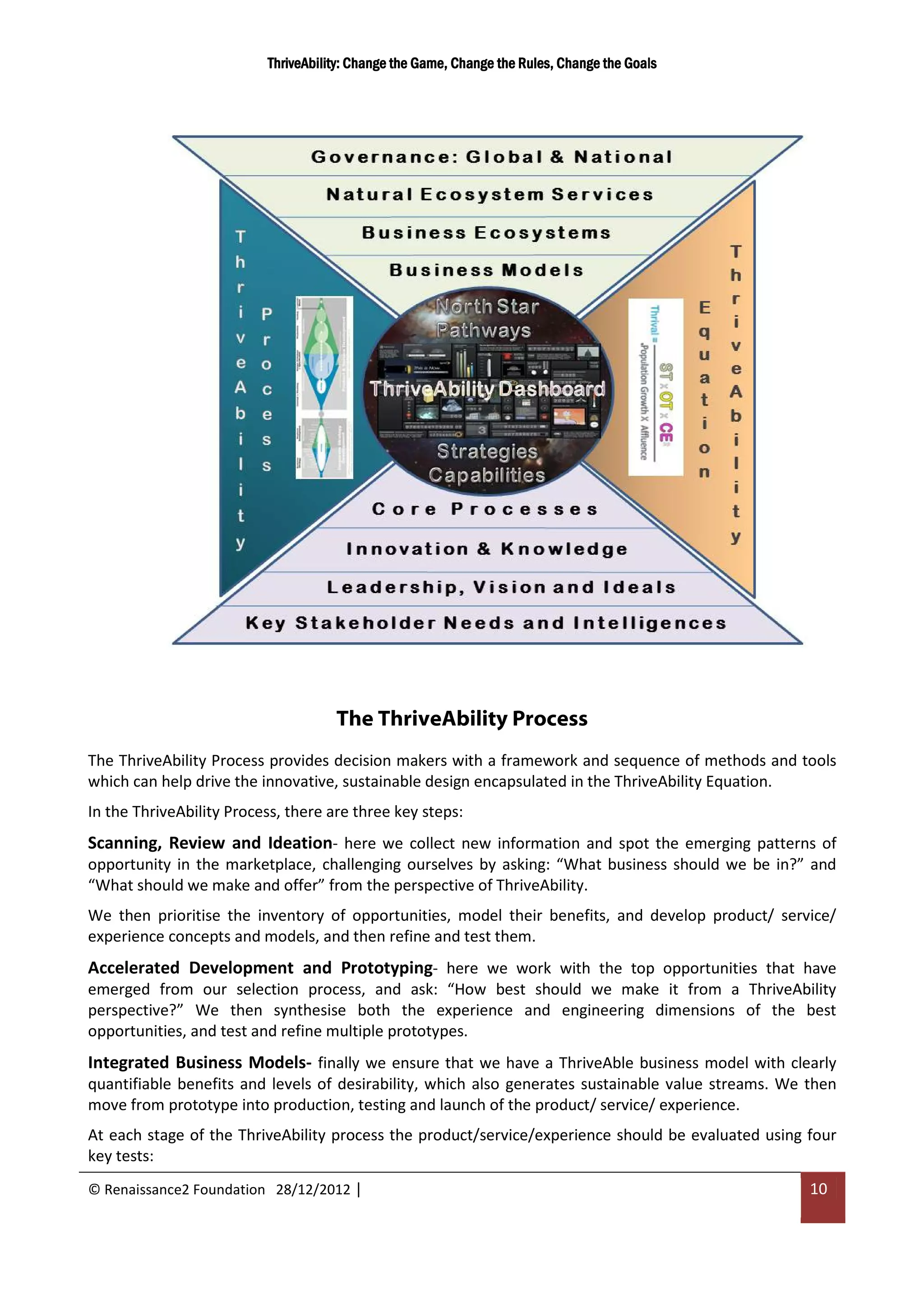
                                     The ThriveAbility Process
The ThriveAbility Process provides decision makers with a framework and sequence of methods and tools
which can help drive the innovative, sustainable design encapsulated in the ThriveAbility Equation.
In the ThriveAbility Process, there are three key steps:
Scanning, Review and Ideation- here we collect new information and spot the emerging patterns of
opportunity in the marketplace, challenging ourselves by asking: “What business should we be in?” and
“What should we make and offer” from the perspective of ThriveAbility.
We then prioritise the inventory of opportunities, model their benefits, and develop product/ service/
experience concepts and models, and then refine and test them.
Accelerated Development and Prototyping- here we work with the top opportunities that have
emerged from our selection process, and ask: “How best should we make it from a ThriveAbility
perspective?” We then synthesise both the experience and engineering dimensions of the best
opportunities, and test and refine multiple prototypes.
Integrated Business Models- finally we ensure that we have a ThriveAble business model with clearly
quantifiable benefits and levels of desirability, which also generates sustainable value streams. We then
move from prototype into production, testing and launch of the product/ service/ experience.
At each stage of the ThriveAbility process the product/service/experience should be evaluated using four
key tests:
© Renaissance2 Foundation 28/12/2012 |                                                               10
ThriveAbility: Change the Game, Change the Rules, Change the Goals

   • Sustainability & Impact- Does this product/ service/ experience provide the largest net positive
     social/ environmental impact – within its category and beyond?
   • Viability - Does this product/ service/ experience actually work in practice? Here we re-examine the
     underlying social & technical assumptions.
   • Organisation & Scalability - Does this product/ service/ experience have a solid and consistent
     implementation strategy? How easily can it be scaled up?
   • Uniqueness - Is this product/ service/ experience really unique? To what extent is it a radical
     innovation? How could it be made to offer even greater sustainable value and competitive
     advantage?


                                     Summary and Next Steps
In order for business to be a key engine of transformation to post-materialist, green growth economies,
business leaders must change the game, change the rules and change their goals.

A new approach called “ThriveAbility” has evolved to integrate strategy, innovation, sustainability and
design in a way that simplifies the task and gets the job done in time.

ThriveAbility is both descriptive and prescriptive, as well as predictive- it describes the emerging edge of
leading practice in strategy, innovation, sustainability and design, while prescribing an approach which
includes an equation, decision framework, process and dashboard for ThriveAbility.

ThriveAbility is predictive in the sense that it enables us to calculate the costs and benefits of different
options and trade-offs in the design, development and scaling of new products, services and experiences.

In 2013 a ThriveAbility Consortium is being formed, and invitations to submit expressions of interest in the
Consortium will be extended to leading global experts and corporate pathfinders who are already
experimenting with one or more of the key aspects of ThriveAbility.

Four events are also planned for the first half of 2013, during which some of the joint research programs
and training materials for the core components of ThriveAbility will begin:

    •   February 2013- Introduction to ThriveAbility- a one day introductory seminar will be held mid
        February in London at a venue to be announced shortly, for those interested in exploring how they
        might get involved.

    •   March 22-24 2013- A 3 day program on Embedding ThriveAbility will be held at Chateau La Tour
        Apollinaire in Perpignan France for leaders in business, policymaking and change.

    •   April 20 2013- As part of the Oasis of Excellence Innovation Conference at the Hotel California in
        Paris from 17-20 April, a special session will be held on the 20th of April to explore how ThriveAbility
        can integrate quality, innovation, design and sustainability in organisations.

    •   June 19 2013- Dr Robin Wood will be addressing the 500 guests expected at the 57th EOQ
        Congress: “Quality Renaissance – Co-Creating a Viable Future” in Tallinn Estonia, on the way in
        which ThriveAbility can become the 21st century equivalent of “Excellence” and “Innovation” in the
        20th century.

To find out how you can get involved in one or more of the programs and events beginning in 2013 centred
around ThriveAbility, please email: robin@renaissance2.eu

© Renaissance2 Foundation 28/12/2012 |                                                                      11
ThriveAbility: Change the Game, Change the Rules, Change the Goals

                                                  Appendix A

                        Twelve ThriveAbility Postulates
ThriveAbility proposes a radical solution to close the gap between what is needed for a thriving future and
current management practices. There are at least a dozen ThriveAbility Postulates, which can be clustered
into four key areas:

The ThriveAbility Imperative: Beyond Limits to Growth to Sustainable Innovation
   1. The critical challenges facing our natural and business ecosystems are a result of both ecological
      limits to growth for current levels of human population and consumption, and an evolutionary
      innovation challenge. Economics and sustainability theory and practice are both based upon a core
      assumption about a limited supply of resources that fails to account adequately for the
      transformative nature of human development, creativity and innovation.

   2. Innovation theory and practice demonstrate that what is considered a resource and how resources
      are generated changes regularly in evolutionary terms as natural, human and technical systems
      evolve. Sustainable innovation and design is such an evolutionary force. The focus of sustainability
      on reducing negative environmental and social impacts is an important starting point, but lacks the
      motivators that drive innovation and design to create the breakthroughs we need for Thrival.

   3. The future survival and Thrival of the human species depends upon our ability to co-create
      win/win/win social and organisational structures and habits that ensure that we can scale sufficient
      sustainable innovations to meet our basic resource needs globally, while reducing our impact on
      the hardest to replace resources through reduced population growth and harmful consumption.

The ThriveAbility Equation: Thrival Becomes the Measure of All Things
   4. Thrival is a composite measure of human and biosphere wellbeing together with measures of
      human progress and flourishing. The goal of human activity is to optimise Thrival for the maximum
      number of living creatures, with the least scarce resources. The ThriveAbility Dashboard provides
      both a snapshot of progress being made by an organisation on its ThriveAbility journey, as well as
      an interactive modelling tool to evaluate different strategic options and product/service line
      offerings.

   5. Sustainable technology is one of the three keys to a thriving future. Renewable energy, forests and
      agriculture, resilient habitats and low carbon transport are the main ingredients of sustainable
      technology. New materials and new functions using existing materials enable a virtuous circle of
      repurposing (reuse, recycling and up cycling) as well as dematerialisation and trans-materialisation,
      leading to zero waste human systems.

   6. Organisational and governance transformation is the second key to a thriving future. This involves
      changing the purpose and functioning of organisations and the governance systems with which
      they co-evolve from a focus on wealth accumulation to Thrival generation. This includes
      understanding and analysing the key Thriveability drivers for the organization, ensuring that
      ThriveAbility is the responsibility of everyone in the organization and designing effective
      mechanisms for translating strategy and top-level enthusiasm for ThriveAbility into day-to-day
      operations.


© Renaissance2 Foundation 28/12/2012 |                                                                 12
ThriveAbility: Change the Game, Change the Rules, Change the Goals

   7. Conscious evolution through integral human development and wiser cultures is the third key to a
      thriving future. Integral human development recognises the holistic interaction between and co-
      evolution of consciousness, culture, behaviour and technological systems through six basic levels of
      development leading to an integration of all six in further, all embracing integral levels of
      development. Wiser cultures are both a context for and product of such development, resulting in
      collective outcomes that are both sustainable and Thrival enhancing, both organisationally and
      socially.

ThriveAbility Thinking & Practices: Embedding Sustainable Innovation, Design & Strategy
   8. Sustainable value is created through sustainable innovation and design that generates rich
      experiences that help humans and ecosystems grow and develop so as to realise their full potential
      in sustainable ways. ThriveAbility Thinking recognises opportunities, develops innovative solutions
      and aligns key stakeholders through creative processes integrating sustainable design and rapid
      prototyping methods.

   9. To embed sustainable innovation, design and strategy practices in core business and management
      processes requires the space, time, appropriate methods and support for productive reflection in
      organisations and human activities. Such processes will enable Thriveability issues to be taken into
      account clearly and consistently in day-to-day decision-making, and ensure that ThriveAbility
      Thinking becomes the norm for better decisions.

   10. Integrated Reporting frameworks and tools provide the fact-based platforms which enable both
       incremental and breakthrough innovations in terms of science, technology, business process and
       business models. The systematic sharing of such integrated reporting platform insights between
       organisations should lead to systemic shifts in business ecosystems that enhance ThriveAbility.

Values, Leadership and Change: Leadership & Stakeholder Alignment for ThriveAbility
   11. ThriveAbility Leadership is essential to align the diverse stakeholder values that will enable
       ThriveAbility to become embedded in organisations and business ecosystems everywhere. Integral
       psychology frameworks & diagnostics are key enablers to create the maps and pathways for the
       personal and organisational shifts required for ThriveAbility. Such tools help scan leadership and
       organisational value systems using models of organisational alignment to identify the pathways of
       change and transformation that are possible in specific organisations and business ecosystems.

   12. Eliciting Transformational Values is a key role of ThriveAbility Leadership. Sustainability is as much
       a problem of changing our mental models as it is a problem of dealing with the flows of materials,
       energy and resources effectively and sustainably. ThriveAbility is a response to the failure of
       sustainability to address this psychological challenge. Transformation integrates existing disciplines
       in creative ways, leading to innovative outcomes that are game changers. Personal and
       organisational transformation is the key to a Thriving Future. What motivates people to change lies
       at the heart of ThriveAbility. We must lead our stakeholders with a clear transformational logic and
       set of incentives to make the shifts required before it is too late.


© Renaissance2 Foundation 28/12/2012 |                                                                   13

ThriveAbility - Changing the game, Rules & Goals v1

  • 1.
    How can leaderscatalyse a thriving, sustainable future? In order for business to be a key engine of transformation to post-materialist, green growth economies, business leaders must change the game, change the rules and change their goals. A new approach called “ThriveAbility” has evolved to integrate strategy, innovation, sustainability and design in a way that simplifies the task and gets the job done while creating shared advantage. ThriveAbility is both descriptive and prescriptive, as well as predictive- it describes the emerging edge of leading practice in strategy, innovation, sustainability and design, while prescribing an approach which includes an equation, decision framework, process and dashboard for ThriveAbility. ThriveAbility is predictive in the sense that it enables us to calculate the costs and benefits of different options and trade-offs in the design, development and scaling of new products, services and experiences. This short paper offers an overview of ThriveAbility, and how you can get involved in one or more of the programs and events beginning in 2013. ThriveAbility Change the Game, Change the Rules, Change the Goals Dr Robin Wood President of Renaissance2
  • 2.
    ThriveAbility: Change theGame, Change the Rules, Change the Goals Introduction There are only three certainties in the 21st century: the first is that we will have exceeded the carrying capacity of earth, and the second is that the price we pay for doing so will rise dramatically the longer we wait to take radical action to remedy this situation. In 2050, it is increasingly likely that the 9 billion people then alive will be struggling for survival, along with a crippled biosphere. The third certainty is that our species is in the middle of a major evolutionary leap, which could transform the relationship between us, our planet and each other. The associated uncertainty is whether we can harness this shift to co-create a thriving world for all, or whether it is squandered in a series of regressive, “too little too late” gestures because our leaders did not have the courage to grasp this opportunity and all it implies for the steadily disintegrating status quo in the next few decades. Scientists call the age we are now living in the “Anthropocene”- the age shaped by man. The scale and speed of change in the last 60 years have been momentous- events since the 1950s have been called the ‘Great Acceleration’. The human population has tripled, and the global economy exploded through new technology and a new global system of cooperation and investment. We are going to need advanced levels of consciousness and capability in our leaders in the decades ahead, as we become like gods in our ability to shape the world around us, while possessing feet of clay that make us highly vulnerable to catastrophic risks. The next few decades also present us with massive business opportunities ranging from developing and maintaining low-carbon, zero-waste cities, to improving and managing bio capacity, ecosystems, lifestyles and livelihoods. In today’s dollars, the market opportunities created by adapting to the new global reality for sustainable living are somewhere between $3-$10 trillion USD per year in 2050. If we are to realise these multi trillion dollar opportunities, we are going to have to harness the most profound motivation of our people. We need to understand how Personal Action Logics & Collective Value Systems drive sustainability choices. ThriveAbility argues that breakthrough innovations at business model and ecosystem levels need to be catalysed by top management through strategy, design and innovation processes, demonstrating that positive impact “green” growth is achievable and highly rewarding. For this to work, business and policy leaders need to change the game, change the rules and change their goals. The Challenge of Changing the Game Many leaders around the world understand all too well that the game we have been playing for several centuries is over, and that a new game is emerging that requires a significant change in the rules that govern how we conduct ourselves, our business and our governance. These new rules are still emerging, as are the goals that they shape for each of us, our businesses and institutions. Yet they are beginning to be articulated. Despite this understanding, it is proving difficult for most leaders to operationalize the changes they know are needed, due to a great deal of uncertainty around what that might mean for their most important stakeholders and the natural resistance to change that is inherent in human systems. There is also reluctance to damage or risk what is still working until it is definitively broken, unless there are other real options on the table. There are many different opinions as to what must be done. Some say that the "system" is beyond repair, and that we must get outside of it to change it. Others believe we can accelerate what is already working in © Renaissance2 Foundation 28/12/2012 | 1
  • 3.
    ThriveAbility: Change theGame, Change the Rules, Change the Goals the new, more sustainable game, and that this simply requires a better market, culture or technology to make the old game obsolete. There is an element of truth in both of these propositions- we certainly must shift our mind-sets to change the game, and we also have to preserve and promote the best of what is already working to survive and thrive in the process. The most important attribute of all at this time, is to maintain an open mind and to be as agile and creative as possible in finding and promoting the radical new opportunities our current situation offers to innovative, entrepreneurial minds. The Slowly Disintegrating Old Game: Capitalism 1.0 In every era, how we make a living and who gets to lead the system changes as knowledge, culture, technology and innovation co-evolve. Chieftains rule agrarian tribes, while CEO's rule corporations and Presidents and Prime Ministers rule countries. Civilisation has always been built out of exchanges between different peoples living in different biomes and life conditions with different natural advantages and needs. There have always been good and bad leaders, healthy and unhealthy cultures, and this remains part of the evolutionary process. What is certain is that the game we have been playing for the past few centuries has to change and is changing dramatically. Our systems of business and governance in the 20th century were driven by the perception that competition for scarce resources and winning the race for advanced technologies were the real drivers of progress. If a little "collateral damage" was inflicted along the way as "externalities", then that was the problem of government and regulators, because the job of business was to produce the maximum output with the minimum input, on the largest scale possible, thus yielding the largest profit and shareholder return possible. Capitalism 1.0 produced unprecedented material prosperity for the emerging middle classes, and massive surpluses for successful investors, but also re-created a highly stratified world on a global scale. Insiders in business, government and finance became the new "masters of the universe", while outsiders experienced diminishing wealth as Capitalism 1.0 began to unravel, producing reactions ranging from the World Social Forum to the Occupy movements. What began as colonisation ended as Coca-Colanisation, as corporations extended their reach into developing markets. Two things stand out when we look at the game of Capitalism 1.0: the first is that it assumes no limits to economic growth, and the second is that it prioritises material wealth over human wellbeing. In the past century both of these assumptions have been challenged, and in some parts of the world and some businesses, successfully overturned. The New Game? Whatever the new game that is emerging will end up being called by future historians, it is certain that it will recognise limits to growth and prioritise people over money and material wealth. The big question is what kind of system/s and organisations will become the dominant species in this new game. While it is clear that the corporations, governments and banks that have played keystone roles in Capitalism 1.0 will have to transform into different animals or become extinct, there are still few role models for the new game with any longevity. Capitalism 2.0 is basically a massive social, organisational and economic science experiment, as well as a work in progress that continues to surprise. As with all radical historical and evolutionary shifts, the transition from the old game to the new will see an accelerated cycle of creative destruction as relatively unknown technologies and players emerge overnight to become leading players, and the incumbents in every industry struggle to remain relevant. The playing field will become very uneven, and certainly favour bold innovators rather than timid tinkerers. © Renaissance2 Foundation 28/12/2012 | 2
  • 4.
    ThriveAbility: Change theGame, Change the Rules, Change the Goals One of the key differences between the 20th and 21st century attitudes to nature will be that instead of merely preserving what little is left after industrialisation, we will find and apply exciting new ways to enhance nature that can avoid the plague of side effects brought about by a poor understanding of natural, living systems we demonstrated in the 20th century. In this synergy zone between ecophiles and technophiles, we will find an increasingly win-win-win game being played between humans and our biosphere. Another major difference between this new game in this new century and the one we played in the 20th is that for the first time in the two millennia since Aristotle pronounced happiness to be what humans strive for, we will have reasonably accurate measures of human wellbeing and happiness. This will empower people to make better decisions in their lives and careers based on accurate assessments of their potential, values and strengths, not just their material needs and wants. The Transition The transition from the old game to the new game is being shaped by three mutually reinforcing drivers: • Growing Negative Outcomes for Business as Usual- The accelerating impact of the ten megaforces that are driving the three high risk outcomes of climate change, resource shortages and ecosystem decline, and the serious consequences these three outcomes have for all businesses and societies, will create unprecedented challenges (and opportunities) for organisations of all kinds. This driver influences decision makers to act through a healthy dose of fear, caution and a desire to survive and protect what they cherish; • Accelerating Global Innovation- the biggest gift of capitalism 1.0 has been the scientific, technological and knowledge revolutions that emerged as a result of the first Renaissance and the Enlightenment. The impacts of this revolution are still reverberating around the world especially in developing countries, whose growth will shift from being fuelled by carbon heavy sources of energy and polluting industrial technologies, to renewable energies and biologically friendly technologies. The political and social impacts will follow next as forces for democratisation and social justice gather pace. This driver influences decision makers to act through a passion for excellence, innovation and new opportunities; • Breakthroughs in Leveraging Human Potential- our species is educating and developing itself at a historically unprecedented pace. Such development is driving not only scientific and technological breakthroughs, but also social, ethical, spiritual and organisational breakthroughs. As our species matures from its difficult teenager phase into early adulthood, we find new levels of responsibility and empathy emerging around the world in billions of people. As the profile of our leaders shifts from autocratic to servant to integral values, we can imagine a future in which the current civic- minded, “We” generation now starting their careers, matures into the leadership cadre of 2030, informed by a worldcentric empathy that makes human thrival rather than profit and power the yardstick of human progress. Imagine a world in which organisations have successfully motivated their key stakeholders to drive green growth through sustainable innovation. Imagine that the frustrations and multiple pressures for change we experience are actually early indications of the emergence of a new era and that many profitable, sustainable innovations are hidden in the turmoil, just waiting for enterprising, innovative leaders to reach out and catalyse them. This is the promise of ThriveAbility. © Renaissance2 Foundation 28/12/2012 | 3
  • 5.
    ThriveAbility: Change theGame, Change the Rules, Change the Goals Welcome to the Anthropocene Since the first Renaissance began 500 years ago, the developed world has evolved into an age where modernism is the centre of gravity. This technocratic way of thinking combined with the ethno-centric, nationalist systems of government that peaked in the 20th century, left a deadly legacy in the first part of the 20th century. Modernism is still peaking in the developing world so China, India, Africa and the Middle East are flashpoints for this mixture of advanced technology and highly nationalistic thinking. Over the past century here in Europe and in many of the world’s great cities, we have evolved beyond the modernist worldview into the post-modernist worldview. This communitarian value system expresses solidarity and social harmony, and has led us to create the European project that has avoided a third world war and dramatically expanded our economies and standard of living. It has also made Europe the greenest continent on earth relative to its economic output, and a leader in both sustainability and sustainable development worldwide. This is a heritage we can be very proud of, but which also demands that we ensure that Europe’s transformative potential is realised in the next few decades. We must now move beyond the relativism and self-satisfaction of post-modernism to embrace a new synthesis that is emerging in integral consciousness right here in Europe. There are thousands of brilliant integral thinkers and activists across Europe, and they give us great hope for the quality of leadership for ThriveAbility, though they are still a rare exception in the leadership teams of most organisations. Such leaders are uniquely capable of transcending and including earlier levels of consciousness. Worldwide, tens of millions of leaders are now developing the early stages of integral consciousness. This represents a unique moment in history as we find this capability becoming significant in our best young leaders, fuelling what could be a great leap forward for our species if catalysed in time. The battle to prevent catastrophic climate change will be won or lost in our cities which account for 80% of Greenhouse Gas (“GHG”) emissions globally and are home to more than half of the world’s population. Copenhagen, Curitiba, Barcelona, Stockholm, Vancouver and Paris are leading the pack of cities aiming to become resilient. Business is a key driver in this shift to resilience. For example, a recent report, “Vision 2050”, by the World Business Council for Sustainable Development’s (WBCSD), lays out a pathway to a world in which nine billion people can live well, within the planet’s resources, by mid-century. The report features a set of “must haves”, which in the next decade include: Resilient Environment i. Doubling agricultural output without increasing the amount of land or water used; ii. Halting deforestation and increasing yields from planted forests; Renewable Energy iii. Halving carbon emissions worldwide (based on 2005 levels) by 2050 through a shift to low-carbon energy systems; Resilient Habitats iv. All new buildings zero net energy, v. Up to a tenfold improvement in Eco efficiency of materials vi. Providing universal access to low-carbon mobility. © Renaissance2 Foundation 28/12/2012 | 4
  • 6.
    ThriveAbility: Change theGame, Change the Rules, Change the Goals Wise Cultures In social terms, Vision 2050 requires that we create wiser cultures that take a longer term perspective. To do this we must offer people incentives for behaviour change, so that sustainable living becomes mainstream within a decade. Human Development - This also demands that we build trust, entrepreneurialism and inclusiveness into our organisations and societies, enabling enterprises and ecosystems to create value and help meet the basic needs of all. Enlightened Enterprises & Integral Governance - will help to redefine progress, drive more inclusive markets and take a true, value, true cost approach to arrive at true profits. In economic terms, Vision 2050 requires that we incorporate the costs of externalities, starting with carbon, ecosystem services and water, into the structure of the marketplace. Business Opportunities - ThriveAbility as Competitive Advantage Our current challenges are also major business opportunities, ranging from developing and maintaining low-carbon, zero-waste cities, to improving and managing bio capacity, ecosystems, lifestyles and livelihoods. In today’s dollars, the market opportunities created by adapting to the new global reality for sustainable living are somewhere between $3-$10 trillion USD per year in 2050. If we are to realise these multi trillion dollar opportunities and ambitious programs such as Vision 2050, we are going to have to harness the most profound motivation of our people. We need to understand how Personal Action Logics & Collective Value Systems drive sustainability choices. What would get the people who lead our organizations and nations to powerfully commit to ThriveAbility? What would their dominant action logic need to be? Experts and Achievers- The Dominant Action Logics of Developed World Leadership Recent surveys show that Experts and Achievers predominate in leadership positions in developed nations both in private enterprise and government. They tend to lead diplomats and opportunists lower down in the organisation. Individualists and Strategists already occupy leadership positions in large scale systems with longer time horizons, and are emerging as the next wave of leadership for the future. Finally, Alchemists capable of large system and society wide transformation are now emerging in greater numbers and will be critical to shifting us into ThriveAbility. Given that the kinds of leaders we have in our organisations tend to shape the organisations and societies they lead, it should come as no surprise that the dominant social logic in the developed world shares most of the characteristics of the Experts and Achievers who lead those organisations and nations. Recent research shows that values alignment is key to successful sustainability initiatives in three ways: • The design and implementation of such initiatives must be rooted in an understanding of—and tailored response to vastly different stakeholder values. • Leaders must understand different types of values and tailor all aspects of sustainability projects accordingly. • Components of the assessment, design, implementation, evaluation, and all communications should align the values of all key stakeholders. © Renaissance2 Foundation 28/12/2012 | 5
  • 7.
    ThriveAbility: Change theGame, Change the Rules, Change the Goals The Sustainability Dilemma: Finding the Synergy Zone between EcoPhiles and Technophiles The options for our ecological future can be visualized in a dilemma matrix which can help focus the debate on different scenarios and real synergies. One view is that technology can help solve all issues. Technophiles believe we can solve all our problems through science and technology. Geoscientists and engineers share a major responsibility with many societal actors in setting the right example, particularly in searching for sustainable energy solutions. Another view is that sustainable ecosystem services preservation is the top priority. Extreme Ecophiles believe we can solve all our problems through rejecting modern lifestyles and “getting back to the basics”, but most 21st century green thinkers and activists are much more progressive in their views. For example life expectancy and happiness in Costa Rica exceed that of the USA with one-third of the footprint. It is possible to live sustainably, have economic growth and enjoy a degree of comfort in beautiful surroundings. Is it absolutely essential to have the latest technology and modern conveniences to live a good life and be happy? Both views are needed, and we need to focus on the complementarities between them. ThriveAbility points us to the Synergy Zone between these clashing worldviews and gives us the means to get there in time. The Business Challenge: How to Move Beyond Sustainability? The health and stability of our businesses and economies are dependent on the health and stability of both the natural environment and the people living within it rather than the other way around. In order to create and maintain value into the future, organizations therefore need to integrate sustainability into their overall strategy and decision-making processes. Embedding sustainability into an organization’s strategy and decision-making processes can help reduce future regulatory, resource and price risks and provide a vision of how business may be impacted by short, medium and long term environmental and social changes. It can also provide a more holistic view of the organization in terms of its operations, risks and opportunities to enable more sustainable management and value creation into the future. Yet this is still the rare exception rather than the rule. Even progress toward basic sustainability has been highly uneven across companies- most are held hostage to short-term investor pressures and a myopic view of wealth creation that is dominated by a focus on © Renaissance2 Foundation 28/12/2012 | 6
  • 8.
    ThriveAbility: Change theGame, Change the Rules, Change the Goals financial capital to the exclusion of other “capitals” indispensable to long-term, inclusive wealth creation. Namely: natural, human, social, and intellectual capital. Another major challenge is that investors all take different perspectives on what sustainability excellence means. For example, mainstream Investors, social investors and NGO’s apply very different criteria, leading to opaque, inconsistent sustainability and CSR measures. This is not made any easier by the variety of players and roles that are involved in setting, disclosing and assuring standards, from the standard setters themselves to the disclosers, assurers, aggregators, analysts and rating agencies. A recent survey by Deloitte of 65 of the leading sustainability advocates in ten industries around the world also demonstrated how far we have to go to get to the point where even the leading organisations are all able to bring about the transformations required in their industries to meet the 2 degree warming scenario requirements. The Zero Impact Growth survey found that only 6 of the 65 sustainability leaders were operating at the business ecosystem level of transformation. Puma, Unilever, Nestle, Nike, Natura and Ricoh are all collaborating with their industry supply chains and competitors to transform industry their value chains, along similar lines to the initiatives recommended by the WBCSD in its Vision 2050 recommendations. 45 of these sustainability leaders were optimising their value chains at the enterprise level, while 13 were still in the early stages of experimentation with sustainability initiatives. Clearly a whole new language and set of concepts and skills need to be learned by organizations to make sustainability breakthroughs more likely. If we are to move to the sustainable economy and thriving future, a new frame of reference for decision- making is required, involving new ways to measure progress at global, national and corporate levels. A measurement framework which incorporates economic growth, social equity and well-being, and environmental sustainability, is needed; one that, at the same time, provides a common set of goals for action by business and governments at the local, national and international levels. This emerged as a key theme of the United Nations Conference on Sustainable Development, ‘Rio+20’ held in June 2012. The outcome document from Rio+20 includes references to performance measurement systems at each level of an economy: - The global level: agreement to develop a set of global Sustainable Development Goals (SDGs) in key priority areas to complement the existing Millennium Development Goals after 2015. It was recognized that once set, progress towards the achievement of the goals needs to be assessed and accompanied by targets and indicators. - The national level: recognition of the limitations of GDP as a measure of well-being and sustainable development. Launch of a programme to develop new national indicators that go beyond GDP. - The corporate level: acknowledgment that the implementation of sustainable development will depend on active engagement of the private sector; recognition of the importance of corporate sustainability reporting and encouragement of companies, where appropriate, especially publicly listed and large companies, to consider integrating sustainability information into their reporting cycle. The Deloitte Zero Impact Growth (“ZIG”) report reveals 4 major gaps that were visible through the ZIG Monitor: a major comparability gap (that is why all rankings and ratings tell us different stories about best- in-‘their’-class performance), major gaps between the overall strategy of organizations towards Zero Impact Growth and furthermore the real capabilities of sub-strategies to deliver on the organization’s overall strategy (it simply doesn’t add up in many cases), and finally gaps in the balance of sub-strategies and major performance gaps in and between industries. And all of that while the report only assessed companies that see themselves as leading in sustainability. The Zero Impact Growth report offers us a baseline picture of where we really are, and also assesses the brakes, accelerators and options for a ‘joint flight’ towards adapting Zero Impact Growth as the new basic paradigm that we all need to agree on, if we are to deliver the regenerative or restorative growth we need © Renaissance2 Foundation 28/12/2012 | 7
  • 9.
    ThriveAbility: Change theGame, Change the Rules, Change the Goals to survive and thrive. It’s a process that can be a door-opener for cross-industry fertilization, for social entrepreneurship, for collaborative action to develop true costing, true pricing and true taxation initiatives leading to true valuation of resources, goods and services. This “North Star” reality check forms an essential part of the measures used for ThriveAbility evaluations. The move to integrated reporting highlights an important trend: that sustainability and CSR need to be integrated into the core of what any organisation does. As Nike’s Hannah Jones put it1: Nike now believes that "the time is fast approaching when we will jettison the language of sustainability, and simply talk about value creation; NPV [net present value], ROIC [return on invested capital], market share, innovation portfolios and shareholder returns." "We have long said that things we have taken for free will become the new gold," she explained, "water, waste, carbon. Today, externalised costs are being forcibly internalised into cost structures, economies and incomes. The weather is not waiting to be regulated. We believe we have entered the era of climate adaptation, where we are no longer contemplating the potential, but beginning to grapple with the consequences. "But," she continued, "here's the thing: to be able to deliver this transparency has required data, which in turn has the potential to trigger innovation. We're discovering how combining different data sets can be a tool for empowerment; social change; new insights; new solutions. What happens when we can mash up the data from these reports? How do we apply Silicon Valley, new-business-model thinking to the data we see emerging from the sustainability world? And in a world where open data is starting to create new businesses, new solutions to intractable problems, how do we reap even create value from the world of reporting? How does reporting actually become the start of an innovation story, not only the crowning of an accountability story?" Finally, she noted that, "When we talk about sustainability without the context of value creation we diminish the potential and the opportunity and the speed with which the transition will happen. How do we turn sustainability into a 'pull' function, not a 'push' function, within a corporation? The answer lies in viewing sustainability as a strategic prism through which to view the resiliency, future growth trajectory and value creation potential of a company." This article echoes Hannah Jones, and argues for us to now move beyond the dominant role reporting has played in the field of sustainability to date, and to embed new management practices and tools based on a new theory of management and economics called ThriveAbility. Inclusive Green Growth Through Sustainable Innovation & Design ThriveAbility argues that breakthrough innovations at business model and ecosystem levels need to be catalysed by top management through strategy, design and innovation processes, demonstrating that positive impact growth is achievable. There is ample evidence that investors will support initiatives that are well thought through and highly measurable. The ThriveAbility Equation and the ThriveAbility Process provide a starting point for such integration, and explain how new measures and practices can be embedded into organisations through Profound Change, ensuring a thriving future for us all. At its simplest, Thrival2 can be recognised in a society by happy human beings fulfilling their potential in ways that promote a positive state of health, security and belonging in a sustainable natural environment. In order to promote Thrival, governments and leaders in business and civil society should invest in and promote: • Sustainable technologies (“ST” in the equation below) • Organisational and governance transformation (“OT” in the equation below) • Conscious evolution, through integral human development and wiser cultures. (“CE” in the equation below). 1 in her acceptance speech at the 2011 Ceres-ACCA North American Awards for Sustainability Reporting as reported by John Elkington in the Guardian of 18 May 2011. 2 While a detailed definition of Thrival can be found in the second article in this series, we can begin with a shorthand description that will serve our immediate purposes. © Renaissance2 Foundation 28/12/2012 | 8
  • 10.
    ThriveAbility: Change theGame, Change the Rules, Change the Goals The ThriveAbility Equation The ThriveAbility Decision Framework While Sustainability and CSR are a step in the right direction, they are largely incremental and failing to deliver the transformations needed for a thriving future. Breakthrough innovations at business model and ecosystem levels must be catalysed by top management through strategy, design and innovation processes, to deliver positive impact growth. Investors will support well thought through, highly measurable initiatives. Sustainability is as much a challenge of changing our mental models as it is a problem of dealing with the flows of materials, energy and resources effectively and sustainably. ThriveAbility is a response to the failure of sustainability to address this psychological challenge, and integrates existing disciplines in creative ways, leading to innovative, game changing outcomes. Personal and organisational transformation is the key to a Thriving Future. What motivates people to change lies at the heart of ThriveAbility. The ThriveAbility Decision Framework offers us a way to embed such mind-sets and incentives into our organisations. Embedding ThriveAbility in organisations and our socioeconomic systems requires us to: Define the Critical Thrival Gaps: What are the current global megatrends and gaps that need to be closed for a sustainable future?3; Map Real Pathways to Thriving Futures: Which pathways can provide decision makers with an emerging “North Star” that serves as a reality check in strategy, innovation and design processes?; Design Replicable Transformation Strategies: What are the secrets of designing replicable strategies for accelerated organisational and business ecosystem transformation?; Develop Motivational and Developmental Pathways to Empower Changemakers- How can integral psychology enable change leaders to deliver profound change for ThriveAbility? 3 Based on insights from a host of global fora including the World Business Council for Sustainable Development Vision 2050, World Economic Forum, the Rio+20 process, Global Standards bodies such as the GRI and UN task forces focussed on climate change and sustainable energy policies. © Renaissance2 Foundation 28/12/2012 | 9
  • 11.
    ThriveAbility: Change theGame, Change the Rules, Change the Goals The ThriveAbility Process The ThriveAbility Process provides decision makers with a framework and sequence of methods and tools which can help drive the innovative, sustainable design encapsulated in the ThriveAbility Equation. In the ThriveAbility Process, there are three key steps: Scanning, Review and Ideation- here we collect new information and spot the emerging patterns of opportunity in the marketplace, challenging ourselves by asking: “What business should we be in?” and “What should we make and offer” from the perspective of ThriveAbility. We then prioritise the inventory of opportunities, model their benefits, and develop product/ service/ experience concepts and models, and then refine and test them. Accelerated Development and Prototyping- here we work with the top opportunities that have emerged from our selection process, and ask: “How best should we make it from a ThriveAbility perspective?” We then synthesise both the experience and engineering dimensions of the best opportunities, and test and refine multiple prototypes. Integrated Business Models- finally we ensure that we have a ThriveAble business model with clearly quantifiable benefits and levels of desirability, which also generates sustainable value streams. We then move from prototype into production, testing and launch of the product/ service/ experience. At each stage of the ThriveAbility process the product/service/experience should be evaluated using four key tests: © Renaissance2 Foundation 28/12/2012 | 10
  • 12.
    ThriveAbility: Change theGame, Change the Rules, Change the Goals • Sustainability & Impact- Does this product/ service/ experience provide the largest net positive social/ environmental impact – within its category and beyond? • Viability - Does this product/ service/ experience actually work in practice? Here we re-examine the underlying social & technical assumptions. • Organisation & Scalability - Does this product/ service/ experience have a solid and consistent implementation strategy? How easily can it be scaled up? • Uniqueness - Is this product/ service/ experience really unique? To what extent is it a radical innovation? How could it be made to offer even greater sustainable value and competitive advantage? Summary and Next Steps In order for business to be a key engine of transformation to post-materialist, green growth economies, business leaders must change the game, change the rules and change their goals. A new approach called “ThriveAbility” has evolved to integrate strategy, innovation, sustainability and design in a way that simplifies the task and gets the job done in time. ThriveAbility is both descriptive and prescriptive, as well as predictive- it describes the emerging edge of leading practice in strategy, innovation, sustainability and design, while prescribing an approach which includes an equation, decision framework, process and dashboard for ThriveAbility. ThriveAbility is predictive in the sense that it enables us to calculate the costs and benefits of different options and trade-offs in the design, development and scaling of new products, services and experiences. In 2013 a ThriveAbility Consortium is being formed, and invitations to submit expressions of interest in the Consortium will be extended to leading global experts and corporate pathfinders who are already experimenting with one or more of the key aspects of ThriveAbility. Four events are also planned for the first half of 2013, during which some of the joint research programs and training materials for the core components of ThriveAbility will begin: • February 2013- Introduction to ThriveAbility- a one day introductory seminar will be held mid February in London at a venue to be announced shortly, for those interested in exploring how they might get involved. • March 22-24 2013- A 3 day program on Embedding ThriveAbility will be held at Chateau La Tour Apollinaire in Perpignan France for leaders in business, policymaking and change. • April 20 2013- As part of the Oasis of Excellence Innovation Conference at the Hotel California in Paris from 17-20 April, a special session will be held on the 20th of April to explore how ThriveAbility can integrate quality, innovation, design and sustainability in organisations. • June 19 2013- Dr Robin Wood will be addressing the 500 guests expected at the 57th EOQ Congress: “Quality Renaissance – Co-Creating a Viable Future” in Tallinn Estonia, on the way in which ThriveAbility can become the 21st century equivalent of “Excellence” and “Innovation” in the 20th century. To find out how you can get involved in one or more of the programs and events beginning in 2013 centred around ThriveAbility, please email: robin@renaissance2.eu © Renaissance2 Foundation 28/12/2012 | 11
  • 13.
    ThriveAbility: Change theGame, Change the Rules, Change the Goals Appendix A Twelve ThriveAbility Postulates ThriveAbility proposes a radical solution to close the gap between what is needed for a thriving future and current management practices. There are at least a dozen ThriveAbility Postulates, which can be clustered into four key areas: The ThriveAbility Imperative: Beyond Limits to Growth to Sustainable Innovation 1. The critical challenges facing our natural and business ecosystems are a result of both ecological limits to growth for current levels of human population and consumption, and an evolutionary innovation challenge. Economics and sustainability theory and practice are both based upon a core assumption about a limited supply of resources that fails to account adequately for the transformative nature of human development, creativity and innovation. 2. Innovation theory and practice demonstrate that what is considered a resource and how resources are generated changes regularly in evolutionary terms as natural, human and technical systems evolve. Sustainable innovation and design is such an evolutionary force. The focus of sustainability on reducing negative environmental and social impacts is an important starting point, but lacks the motivators that drive innovation and design to create the breakthroughs we need for Thrival. 3. The future survival and Thrival of the human species depends upon our ability to co-create win/win/win social and organisational structures and habits that ensure that we can scale sufficient sustainable innovations to meet our basic resource needs globally, while reducing our impact on the hardest to replace resources through reduced population growth and harmful consumption. The ThriveAbility Equation: Thrival Becomes the Measure of All Things 4. Thrival is a composite measure of human and biosphere wellbeing together with measures of human progress and flourishing. The goal of human activity is to optimise Thrival for the maximum number of living creatures, with the least scarce resources. The ThriveAbility Dashboard provides both a snapshot of progress being made by an organisation on its ThriveAbility journey, as well as an interactive modelling tool to evaluate different strategic options and product/service line offerings. 5. Sustainable technology is one of the three keys to a thriving future. Renewable energy, forests and agriculture, resilient habitats and low carbon transport are the main ingredients of sustainable technology. New materials and new functions using existing materials enable a virtuous circle of repurposing (reuse, recycling and up cycling) as well as dematerialisation and trans-materialisation, leading to zero waste human systems. 6. Organisational and governance transformation is the second key to a thriving future. This involves changing the purpose and functioning of organisations and the governance systems with which they co-evolve from a focus on wealth accumulation to Thrival generation. This includes understanding and analysing the key Thriveability drivers for the organization, ensuring that ThriveAbility is the responsibility of everyone in the organization and designing effective mechanisms for translating strategy and top-level enthusiasm for ThriveAbility into day-to-day operations. © Renaissance2 Foundation 28/12/2012 | 12
  • 14.
    ThriveAbility: Change theGame, Change the Rules, Change the Goals 7. Conscious evolution through integral human development and wiser cultures is the third key to a thriving future. Integral human development recognises the holistic interaction between and co- evolution of consciousness, culture, behaviour and technological systems through six basic levels of development leading to an integration of all six in further, all embracing integral levels of development. Wiser cultures are both a context for and product of such development, resulting in collective outcomes that are both sustainable and Thrival enhancing, both organisationally and socially. ThriveAbility Thinking & Practices: Embedding Sustainable Innovation, Design & Strategy 8. Sustainable value is created through sustainable innovation and design that generates rich experiences that help humans and ecosystems grow and develop so as to realise their full potential in sustainable ways. ThriveAbility Thinking recognises opportunities, develops innovative solutions and aligns key stakeholders through creative processes integrating sustainable design and rapid prototyping methods. 9. To embed sustainable innovation, design and strategy practices in core business and management processes requires the space, time, appropriate methods and support for productive reflection in organisations and human activities. Such processes will enable Thriveability issues to be taken into account clearly and consistently in day-to-day decision-making, and ensure that ThriveAbility Thinking becomes the norm for better decisions. 10. Integrated Reporting frameworks and tools provide the fact-based platforms which enable both incremental and breakthrough innovations in terms of science, technology, business process and business models. The systematic sharing of such integrated reporting platform insights between organisations should lead to systemic shifts in business ecosystems that enhance ThriveAbility. Values, Leadership and Change: Leadership & Stakeholder Alignment for ThriveAbility 11. ThriveAbility Leadership is essential to align the diverse stakeholder values that will enable ThriveAbility to become embedded in organisations and business ecosystems everywhere. Integral psychology frameworks & diagnostics are key enablers to create the maps and pathways for the personal and organisational shifts required for ThriveAbility. Such tools help scan leadership and organisational value systems using models of organisational alignment to identify the pathways of change and transformation that are possible in specific organisations and business ecosystems. 12. Eliciting Transformational Values is a key role of ThriveAbility Leadership. Sustainability is as much a problem of changing our mental models as it is a problem of dealing with the flows of materials, energy and resources effectively and sustainably. ThriveAbility is a response to the failure of sustainability to address this psychological challenge. Transformation integrates existing disciplines in creative ways, leading to innovative outcomes that are game changers. Personal and organisational transformation is the key to a Thriving Future. What motivates people to change lies at the heart of ThriveAbility. We must lead our stakeholders with a clear transformational logic and set of incentives to make the shifts required before it is too late. © Renaissance2 Foundation 28/12/2012 | 13