CONTENTS
1. INTRODUCTION
2. HISTORY
3. IN VITRO FERTILIZATION
4. MITOCHONDRIAL DISEASE
5. CYTOPLASMIC TRANSFER
6. MITOCHONDRIAL REPLACEMENT THERAPY
7. PRONUCLEAR TRANSFER
8. SPINDLE TRANSFER
9. FACTS
10. ETHICAL ISSUES
11. ADVANTAGES
12. RISKS
13. COCLUSION
14. BIBLIOGRAPHY
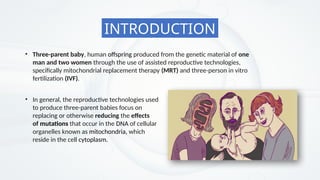
• Three-parent baby, human offspring produced from the genetic material of one
man and two women through the use of assisted reproductive technologies,
specifically mitochondrial replacement therapy (MRT) and three-person in vitro
fertilization (IVF).
• In general, the reproductive technologies used
to produce three-parent babies focus on
replacing or otherwise reducing the effects
of mutations that occur in the DNA of cellular
organelles known as mitochondria, which
reside in the cell cytoplasm.
INTRODUCTION
• The first three-parent babies were born in
the 1990s and early 2000s, the products of a
then-novel IVF-based technique known as
ooplasmic transfer (cytoplasmic transfer).
• In 2015, MRT was legalized in the United Kingdom
for the purpose of preventing genetic disease.
HISTORY
• First three parent baby was born in Mexico in
2016 a way of dodging inherited genetic disease.
• Second three parent baby was born in Ukraine in
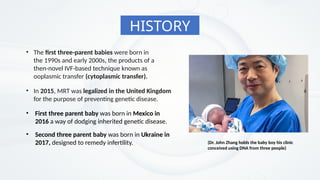
2017, designed to remedy infertility. (Dr. John Zhang holds the baby boy his clinic
conceived using DNA from three people)
IN VITRO
FERTILIZATION
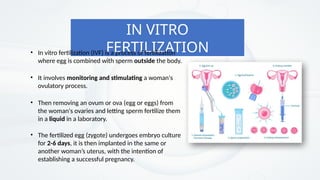
• In vitro fertilization (IVF) is a process of fertilization
where egg is combined with sperm outside the body.
• It involves monitoring and stimulating a woman's
ovulatory process.
• Then removing an ovum or ova (egg or eggs) from
the woman's ovaries and letting sperm fertilize them
in a liquid in a laboratory.
• The fertilized egg (zygote) undergoes embryo culture
for 2-6 days, it is then implanted in the same or
another woman’s uterus, with the intention of
establishing a successful pregnancy.
MITOCHONDRIAL DISEASE
• In mitochondrial diseases, the mitochondria are unable to completely burn food and
oxygen to generate energy, which is essential for normal cell function. It’s often
inherited.
• Mitochondria is one of the cell organelles that are passed from mother to child due to
cytoplasmic inheritance.
• Mutations in the 37 genes in the mitochondria can produce fatal inherited disease
(Leigh’s syndrome, Progressive infantile poliodystrophy and Barth syndrome).
• Affects the brain, muscles, heart and liver.
• Strike in childhood , only mothers can pass it.
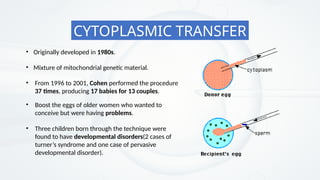
• Originally developed in 1980s.
• Mixture of mitochondrial genetic material.
• From 1996 to 2001, Cohen performed the procedure
37 times, producing 17 babies for 13 couples.
• Boost the eggs of older women who wanted to
conceive but were having problems.
• Three children born through the technique were
found to have developmental disorders(2 cases of
turner’s syndrome and one case of pervasive
developmental disorder).
CYTOPLASMIC TRANSFER
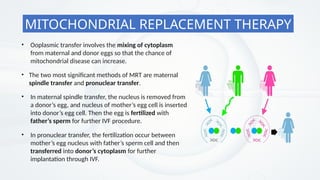
• The two most significant methods of MRT are maternal
spindle transfer and pronuclear transfer.
• Ooplasmic transfer involves the mixing of cytoplasm
from maternal and donor eggs so that the chance of
mitochondrial disease can increase.
• In maternal spindle transfer, the nucleus is removed from
a donor’s egg, and nucleus of mother’s egg cell is inserted
into donor’s egg cell. Then the egg is fertilized with
father’s sperm for further IVF procedure.
• In pronuclear transfer, the fertilization occur between
mother’s egg nucleus with father’s sperm cell and then
transferred into donor’s cytoplasm for further
implantation through IVF.
MITOCHONDRIAL REPLACEMENT THERAPY
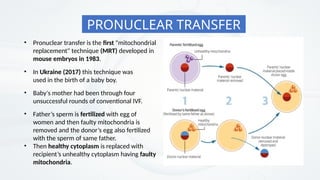
• Pronuclear transfer is the first "mitochondrial
replacement" technique (MRT) developed in
mouse embryos in 1983.
• In Ukraine (2017) this technique was
used in the birth of a baby boy.
• Baby's mother had been through four
unsuccessful rounds of conventional IVF.
• Father’s sperm is fertilized with egg of
women and then faulty mitochondria is
removed and the donor’s egg also fertilized
with the sperm of same father.
• Then healthy cytoplasm is replaced with
recipient’s unhealthy cytoplasm having faulty
mitochondria.
PRONUCLEAR TRANSFER
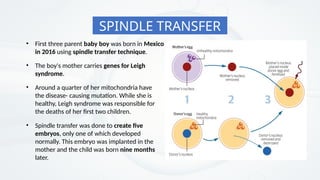
• First three parent baby boy was born in Mexico
in 2016 using spindle transfer technique.
• The boy's mother carries genes for Leigh
syndrome.
• Around a quarter of her mitochondria have
the disease- causing mutation. While she is
healthy, Leigh syndrome was responsible for
the deaths of her first two children.
• Spindle transfer was done to create five
embryos, only one of which developed
normally. This embryo was implanted in the
mother and the child was born nine months
later.
SPINDLE TRANSFER
• The average number of births per year among women at risk for transmitting mtDNA
disease is estimated to approximately 150 in the United Kingdom and 800 in the
United States.
• Prior to the development of MRT, and in places where it is not legal or feasible, the
reproductive options for women who are at risk for transmitting mtDNA disease and
who want to prevent transmission were using an egg from another woman, adoption,
or childlessness.
• In 2015 MRT was made legal in the United Kingdom.
FACTS
• Opponents argue that scientists are "playing God" and that children with three genetic
parents may suffer both psychological and physical damage.
• Using human embryos for in vitro research is controversial, as embryos are created
specifically for research and the financial compensation of egg donors.
• Implications for identity is another ethical concern with psychological and
emotional impacts on a child's life regarding of a person's sense of identity.
• It is also seen as destroying embryos.
ETHICAL ISSUES
ADVANTAGES
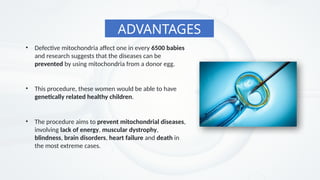
• The procedure aims to prevent mitochondrial diseases,
involving lack of energy, muscular dystrophy,
blindness, brain disorders, heart failure and death in
the most extreme cases.
• Defective mitochondria affect one in every 6500 babies
and research suggests that the diseases can be
prevented by using mitochondria from a donor egg.
• This procedure, these women would be able to have
genetically related healthy children.
• MRT involves preimplantation genetic screening of the
mother, preimplantation genetic diagnosis after the
egg is fertilized, and in vitro fertilization. It has all the
risks of those procedures.
• A bit of cytoplasm (including mitochondria) is usually
transferred along with the pronuclei.
RISKS
• It is not possible to assure that new diseases would
not come out of this treatment due to some relation
between DNA of mitochondria with the nucleus DNA.
• For example, If the procedure is relatively new, not much information about long-term health
effects are known. Therefore, no medical benefits would emerge for the child or the mother.
• The mother would be able to have genetically related healthy children, which
represents a social benefit to her, not a medical one.
CONCLUSION
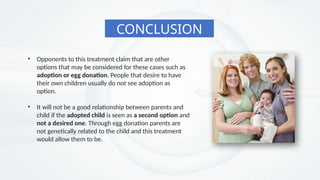
• Opponents to this treatment claim that are other
options that may be considered for these cases such as
adoption or egg donation. People that desire to have
their own children usually do not see adoption as
option.
• It will not be a good relationship between parents and
child if the adopted child is seen as a second option and
not a desired one. Through egg donation parents are
not genetically related to the child and this treatment
would allow them to be.
BIBLIOGRAPHY
• Bodkin, H. (12:09). Three-parent baby born to infertile couple in world first. The Telegraph.
Retrieved from
http://www.telegraph.co.uk/science/2017/01/18/three-parent- baby-born-infertile-couple-wo
rld-first/
• Exclusive: World's first baby born with new "3 parent" technique. (n.d.). Retrieved
March 1, 2017, from
https://www.newscientist.com/article/2107219-exclusive-worlds- first-baby-born-
with-new-3-parent-technique/
• https://www.britannica.com/science/three-parent-baby
• https://www.wired.co.uk/article/what-is-three-person-ivf
• https://www.the-scientist.com/news-opinion/opinion-three-parent-embryosa
-slippery-slope-64312
• https://www.ukessays.com/essays/sciences/parent-families-advantages-7044.php
THANK YOU

Three Parent Baby yyyyyyyyyyyyyyyNEW.pptx

  • 1.
    CONTENTS 1. INTRODUCTION 2. HISTORY 3.IN VITRO FERTILIZATION 4. MITOCHONDRIAL DISEASE 5. CYTOPLASMIC TRANSFER 6. MITOCHONDRIAL REPLACEMENT THERAPY 7. PRONUCLEAR TRANSFER 8. SPINDLE TRANSFER 9. FACTS 10. ETHICAL ISSUES 11. ADVANTAGES 12. RISKS 13. COCLUSION 14. BIBLIOGRAPHY
  • 2.
    • Three-parent baby,human offspring produced from the genetic material of one man and two women through the use of assisted reproductive technologies, specifically mitochondrial replacement therapy (MRT) and three-person in vitro fertilization (IVF). • In general, the reproductive technologies used to produce three-parent babies focus on replacing or otherwise reducing the effects of mutations that occur in the DNA of cellular organelles known as mitochondria, which reside in the cell cytoplasm. INTRODUCTION
  • 3.
    • The firstthree-parent babies were born in the 1990s and early 2000s, the products of a then-novel IVF-based technique known as ooplasmic transfer (cytoplasmic transfer). • In 2015, MRT was legalized in the United Kingdom for the purpose of preventing genetic disease. HISTORY • First three parent baby was born in Mexico in 2016 a way of dodging inherited genetic disease. • Second three parent baby was born in Ukraine in 2017, designed to remedy infertility. (Dr. John Zhang holds the baby boy his clinic conceived using DNA from three people)
  • 4.
    IN VITRO FERTILIZATION • Invitro fertilization (IVF) is a process of fertilization where egg is combined with sperm outside the body. • It involves monitoring and stimulating a woman's ovulatory process. • Then removing an ovum or ova (egg or eggs) from the woman's ovaries and letting sperm fertilize them in a liquid in a laboratory. • The fertilized egg (zygote) undergoes embryo culture for 2-6 days, it is then implanted in the same or another woman’s uterus, with the intention of establishing a successful pregnancy.
  • 5.
    MITOCHONDRIAL DISEASE • Inmitochondrial diseases, the mitochondria are unable to completely burn food and oxygen to generate energy, which is essential for normal cell function. It’s often inherited. • Mitochondria is one of the cell organelles that are passed from mother to child due to cytoplasmic inheritance. • Mutations in the 37 genes in the mitochondria can produce fatal inherited disease (Leigh’s syndrome, Progressive infantile poliodystrophy and Barth syndrome). • Affects the brain, muscles, heart and liver. • Strike in childhood , only mothers can pass it.
  • 6.
    • Originally developedin 1980s. • Mixture of mitochondrial genetic material. • From 1996 to 2001, Cohen performed the procedure 37 times, producing 17 babies for 13 couples. • Boost the eggs of older women who wanted to conceive but were having problems. • Three children born through the technique were found to have developmental disorders(2 cases of turner’s syndrome and one case of pervasive developmental disorder). CYTOPLASMIC TRANSFER
  • 7.
    • The twomost significant methods of MRT are maternal spindle transfer and pronuclear transfer. • Ooplasmic transfer involves the mixing of cytoplasm from maternal and donor eggs so that the chance of mitochondrial disease can increase. • In maternal spindle transfer, the nucleus is removed from a donor’s egg, and nucleus of mother’s egg cell is inserted into donor’s egg cell. Then the egg is fertilized with father’s sperm for further IVF procedure. • In pronuclear transfer, the fertilization occur between mother’s egg nucleus with father’s sperm cell and then transferred into donor’s cytoplasm for further implantation through IVF. MITOCHONDRIAL REPLACEMENT THERAPY
  • 8.
    • Pronuclear transferis the first "mitochondrial replacement" technique (MRT) developed in mouse embryos in 1983. • In Ukraine (2017) this technique was used in the birth of a baby boy. • Baby's mother had been through four unsuccessful rounds of conventional IVF. • Father’s sperm is fertilized with egg of women and then faulty mitochondria is removed and the donor’s egg also fertilized with the sperm of same father. • Then healthy cytoplasm is replaced with recipient’s unhealthy cytoplasm having faulty mitochondria. PRONUCLEAR TRANSFER
  • 9.
    • First threeparent baby boy was born in Mexico in 2016 using spindle transfer technique. • The boy's mother carries genes for Leigh syndrome. • Around a quarter of her mitochondria have the disease- causing mutation. While she is healthy, Leigh syndrome was responsible for the deaths of her first two children. • Spindle transfer was done to create five embryos, only one of which developed normally. This embryo was implanted in the mother and the child was born nine months later. SPINDLE TRANSFER
  • 10.
    • The averagenumber of births per year among women at risk for transmitting mtDNA disease is estimated to approximately 150 in the United Kingdom and 800 in the United States. • Prior to the development of MRT, and in places where it is not legal or feasible, the reproductive options for women who are at risk for transmitting mtDNA disease and who want to prevent transmission were using an egg from another woman, adoption, or childlessness. • In 2015 MRT was made legal in the United Kingdom. FACTS
  • 11.
    • Opponents arguethat scientists are "playing God" and that children with three genetic parents may suffer both psychological and physical damage. • Using human embryos for in vitro research is controversial, as embryos are created specifically for research and the financial compensation of egg donors. • Implications for identity is another ethical concern with psychological and emotional impacts on a child's life regarding of a person's sense of identity. • It is also seen as destroying embryos. ETHICAL ISSUES
  • 12.
    ADVANTAGES • The procedureaims to prevent mitochondrial diseases, involving lack of energy, muscular dystrophy, blindness, brain disorders, heart failure and death in the most extreme cases. • Defective mitochondria affect one in every 6500 babies and research suggests that the diseases can be prevented by using mitochondria from a donor egg. • This procedure, these women would be able to have genetically related healthy children.
  • 13.
    • MRT involvespreimplantation genetic screening of the mother, preimplantation genetic diagnosis after the egg is fertilized, and in vitro fertilization. It has all the risks of those procedures. • A bit of cytoplasm (including mitochondria) is usually transferred along with the pronuclei. RISKS • It is not possible to assure that new diseases would not come out of this treatment due to some relation between DNA of mitochondria with the nucleus DNA. • For example, If the procedure is relatively new, not much information about long-term health effects are known. Therefore, no medical benefits would emerge for the child or the mother. • The mother would be able to have genetically related healthy children, which represents a social benefit to her, not a medical one.
  • 14.
    CONCLUSION • Opponents tothis treatment claim that are other options that may be considered for these cases such as adoption or egg donation. People that desire to have their own children usually do not see adoption as option. • It will not be a good relationship between parents and child if the adopted child is seen as a second option and not a desired one. Through egg donation parents are not genetically related to the child and this treatment would allow them to be.
  • 15.
    BIBLIOGRAPHY • Bodkin, H.(12:09). Three-parent baby born to infertile couple in world first. The Telegraph. Retrieved from http://www.telegraph.co.uk/science/2017/01/18/three-parent- baby-born-infertile-couple-wo rld-first/ • Exclusive: World's first baby born with new "3 parent" technique. (n.d.). Retrieved March 1, 2017, from https://www.newscientist.com/article/2107219-exclusive-worlds- first-baby-born- with-new-3-parent-technique/ • https://www.britannica.com/science/three-parent-baby • https://www.wired.co.uk/article/what-is-three-person-ivf • https://www.the-scientist.com/news-opinion/opinion-three-parent-embryosa -slippery-slope-64312 • https://www.ukessays.com/essays/sciences/parent-families-advantages-7044.php
  • 16.