Three Levels of Management
By: http://studiousguy.com/
Meaning of Levels of Management- The term “Levels of Management’
refers to a line of demarcation between various managerial positions in
an organization. The number of levels in management increases when
the size of the business and work force increases and vice versa. The
level of management determines a chain of command, the amount of
authority & status enjoyed by any managerial position.
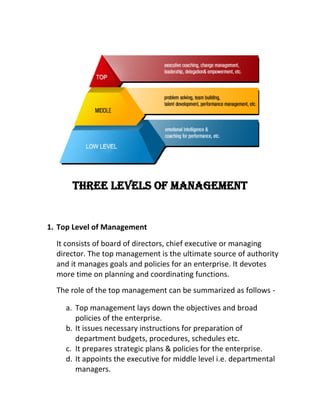
The levels of management can be classified in three broad categories:
1. Top level / Administrative level
2. Middle level / Executory
3. Low level / Supervisory / Operative / First-line managers
Three Levels of Management
1. Top Level of Management
It consists of board of directors, chief executive or managing
director. The top management is the ultimate source of authority
and it manages goals and policies for an enterprise. It devotes
more time on planning and coordinating functions.
The role of the top management can be summarized as follows -
a. Top management lays down the objectives and broad
policies of the enterprise.
b. It issues necessary instructions for preparation of
department budgets, procedures, schedules etc.
c. It prepares strategic plans & policies for the enterprise.
d. It appoints the executive for middle level i.e. departmental
managers.
e. It controls & coordinates the activities of all the
departments.
f. It is also responsible for maintaining a contact with the
outside world.
g. It provides guidance and direction.
h. The top management is also responsible towards the
shareholders for the performance of the enterprise.
2. Middle Level of Management
The branch managers and departmental managers constitute
middle level. They are responsible to the top management for the
functioning of their department. They devote more time to
organizational and directional functions. In small organization,
there is only one layer of middle level of management but in big
enterprises, there may be senior and junior middle level
management. Their role can be emphasized as -
a. They execute the plans of the organization in accordance
with the policies and directives of the top management.
b. They make plans for the sub-units of the organization.
c. They participate in employment & training of lower level
management.
d. They interpret and explain policies from top level
management to lower level.
e. They are responsible for coordinating the activities within
the division or department.
f. It also sends important reports and other important data to
top level management.
g. They evaluate performance of junior managers.
h. They are also responsible for inspiring lower level managers
towards better performance.
3. Lower Level of Management
Lower level is also known as supervisory / operative level of
management. It consists of supervisors, foreman, section officers,
superintendent etc. According to R.C. Davis, “Supervisory
management refers to those executives whose work has to be
largely with personal oversight and direction of operative
employees”. In other words, they are concerned with direction
and controlling function of management. Their activities include -
a. Assigning of jobs and tasks to various workers.
b. They guide and instruct workers for day to day activities.
c. They are responsible for the quality as well as quantity of
production.
d. They are also entrusted with the responsibility of
maintaining good relation in the organization.
e. They communicate workers problems, suggestions, and
recommendatory appeals etc to the higher level and higher
level goals and objectives to the workers.
f. They help to solve the grievances of the workers.
g. They supervise & guide the sub-ordinates.
h. They are responsible for providing training to the workers.
i. They arrange necessary materials, machines, tools etc for
getting the things done.
j. They prepare periodical reports about the performance of
the workers.
k. They ensure discipline in the enterprise.
l. They motivate workers.They are the image builders of the
enterprise because they are in direct contact with the
workers.
Top,Middle and Lower Management
Read More at:
http://studiousguy.com/three-levels-of-management/

Three levels of management

  • 1.
    Three Levels ofManagement By: http://studiousguy.com/ Meaning of Levels of Management- The term “Levels of Management’ refers to a line of demarcation between various managerial positions in an organization. The number of levels in management increases when the size of the business and work force increases and vice versa. The level of management determines a chain of command, the amount of authority & status enjoyed by any managerial position. The levels of management can be classified in three broad categories: 1. Top level / Administrative level 2. Middle level / Executory 3. Low level / Supervisory / Operative / First-line managers
  • 2.
    Three Levels ofManagement 1. Top Level of Management It consists of board of directors, chief executive or managing director. The top management is the ultimate source of authority and it manages goals and policies for an enterprise. It devotes more time on planning and coordinating functions. The role of the top management can be summarized as follows - a. Top management lays down the objectives and broad policies of the enterprise. b. It issues necessary instructions for preparation of department budgets, procedures, schedules etc. c. It prepares strategic plans & policies for the enterprise. d. It appoints the executive for middle level i.e. departmental managers.
  • 3.
    e. It controls& coordinates the activities of all the departments. f. It is also responsible for maintaining a contact with the outside world. g. It provides guidance and direction. h. The top management is also responsible towards the shareholders for the performance of the enterprise. 2. Middle Level of Management The branch managers and departmental managers constitute middle level. They are responsible to the top management for the functioning of their department. They devote more time to organizational and directional functions. In small organization, there is only one layer of middle level of management but in big enterprises, there may be senior and junior middle level management. Their role can be emphasized as - a. They execute the plans of the organization in accordance with the policies and directives of the top management. b. They make plans for the sub-units of the organization. c. They participate in employment & training of lower level management. d. They interpret and explain policies from top level management to lower level. e. They are responsible for coordinating the activities within the division or department. f. It also sends important reports and other important data to top level management. g. They evaluate performance of junior managers. h. They are also responsible for inspiring lower level managers towards better performance.
  • 4.
    3. Lower Levelof Management Lower level is also known as supervisory / operative level of management. It consists of supervisors, foreman, section officers, superintendent etc. According to R.C. Davis, “Supervisory management refers to those executives whose work has to be largely with personal oversight and direction of operative employees”. In other words, they are concerned with direction and controlling function of management. Their activities include - a. Assigning of jobs and tasks to various workers. b. They guide and instruct workers for day to day activities. c. They are responsible for the quality as well as quantity of production. d. They are also entrusted with the responsibility of maintaining good relation in the organization. e. They communicate workers problems, suggestions, and recommendatory appeals etc to the higher level and higher level goals and objectives to the workers. f. They help to solve the grievances of the workers. g. They supervise & guide the sub-ordinates. h. They are responsible for providing training to the workers. i. They arrange necessary materials, machines, tools etc for getting the things done. j. They prepare periodical reports about the performance of the workers. k. They ensure discipline in the enterprise. l. They motivate workers.They are the image builders of the enterprise because they are in direct contact with the workers.
  • 5.
    Top,Middle and LowerManagement Read More at: http://studiousguy.com/three-levels-of-management/