Session 8
Exchange Rates
Disclaimer: The views expressed are those of the presenters and do not necessarily reflect those
of the Federal Reserve Bank of Dallas or the Federal Reserve System.
TEKS
(3) Economics. The student understands the reasons for
international trade and its importance to the United States
and the global economy. The student is expected to:
(C) analyze the impact of U.S. imports and exports on the
United States and its trading partners.
(4) Economics. The student understands the issues of free
trade and the effects of trade barriers. The student is
expected to:
(C) analyze the effects of changes in exchange rates on
imports and exports.
Teaching the Terms
• Exchange rates
• Appreciate
• Depreciate
• Purchasing power parity
• Nominal values
• Real values
Foreign Exchange Market
• Derived demand
• Currencies are bought and sold
• Largest financial market in the world
• Operates 24 hours a day
Nominal Exchange Rates
• Rate at which the currency of one country can
be exchanged for the currency of another
country
• Depreciate = Weaken = Lose value
• Appreciate = Strengthen = Gain value
Exchange Rates
• One exchange rate is the reciprocal of another
exchange rate
– If €1 = $2.00, then $1 = €0.50
• As the exchange rate fluctuates, the value (or
strength) of each currency is affected
• When one currency strengthens, the other
weakens
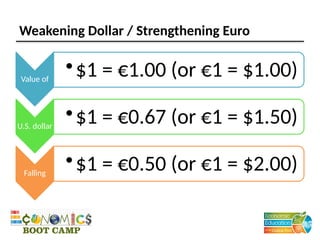
Weakening Dollar / Strengthening Euro
Value of
•$1 = €1.00 (or €1 = $1.00)
U.S. dollar
•$1 = €0.67 (or €1 = $1.50)
Falling
•$1 = €0.50 (or €1 = $2.00)
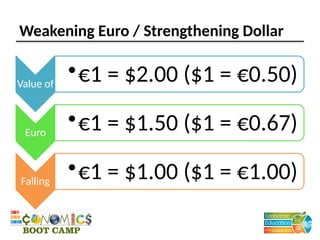
Weakening Euro / Strengthening Dollar
Value of
•€1 = $2.00 ($1 = €0.50)
Euro
•€1 = $1.50 ($1 = €0.67)
Falling
•€1 = $1.00 ($1 = €1.00)
Exchange Rates in the Short Run
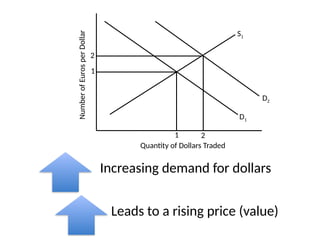
• Model with supply and demand graph
– Quantity of dollars
– Price of a dollar in a foreign currency
• Factors affecting supply of dollars
– American purchase of goods and services produced abroad
– American investment in foreign assets
• Factors affecting demand for dollars
– Foreign purchase of American goods and services
– Foreign investment in American assets
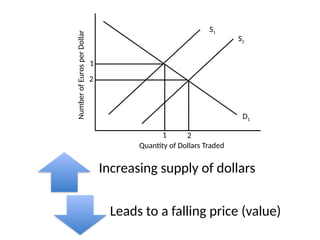
Number
of
Euros
per
Dollar
Quantity of Dollars Traded
S1
D1
1
S2
2
Increasing supply of dollars
Leads to a falling price (value)
1 2
Number
of
Euros
per
Dollar
Quantity of Dollars Traded
S1
D1
1
D2
2
Increasing demand for dollars
Leads to a rising price (value)
1 2
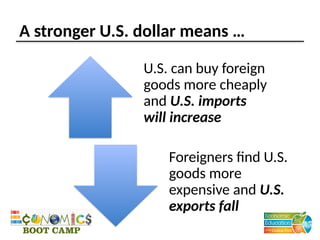
A stronger U.S. dollar means …
U.S. can buy foreign
goods more cheaply
and U.S. imports
will increase
Foreigners find U.S.
goods more
expensive and U.S.
exports fall
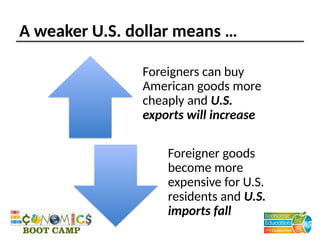
A weaker U.S. dollar means …
Foreigners can buy
American goods more
cheaply and U.S.
exports will increase
Foreigner goods
become more
expensive for U.S.
residents and U.S.
imports fall
Exchange Rates in the Long Run
• Law of one price
Identical items should sell for the same price
• Purchasing power parity (PPP)
One unit of domestic currency will buy the same
basket of goods anywhere in the world
• PPP implies that the real exchange rate will
always be 1
Exchange Rates in the Long Run
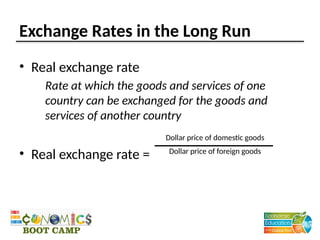
• Real exchange rate
Rate at which the goods and services of one
country can be exchanged for the goods and
services of another country
• Real exchange rate =
Dollar price of domestic goods
Dollar price of foreign goods
Questions?

This presentation is about macro economics issues

  • 1.
    Session 8 Exchange Rates Disclaimer:The views expressed are those of the presenters and do not necessarily reflect those of the Federal Reserve Bank of Dallas or the Federal Reserve System.
  • 2.
    TEKS (3) Economics. Thestudent understands the reasons for international trade and its importance to the United States and the global economy. The student is expected to: (C) analyze the impact of U.S. imports and exports on the United States and its trading partners. (4) Economics. The student understands the issues of free trade and the effects of trade barriers. The student is expected to: (C) analyze the effects of changes in exchange rates on imports and exports.
  • 3.
    Teaching the Terms •Exchange rates • Appreciate • Depreciate • Purchasing power parity • Nominal values • Real values
  • 4.
    Foreign Exchange Market •Derived demand • Currencies are bought and sold • Largest financial market in the world • Operates 24 hours a day
  • 5.
    Nominal Exchange Rates •Rate at which the currency of one country can be exchanged for the currency of another country • Depreciate = Weaken = Lose value • Appreciate = Strengthen = Gain value
  • 6.
    Exchange Rates • Oneexchange rate is the reciprocal of another exchange rate – If €1 = $2.00, then $1 = €0.50 • As the exchange rate fluctuates, the value (or strength) of each currency is affected • When one currency strengthens, the other weakens
  • 7.
    Weakening Dollar /Strengthening Euro Value of •$1 = €1.00 (or €1 = $1.00) U.S. dollar •$1 = €0.67 (or €1 = $1.50) Falling •$1 = €0.50 (or €1 = $2.00)
  • 8.
    Weakening Euro /Strengthening Dollar Value of •€1 = $2.00 ($1 = €0.50) Euro •€1 = $1.50 ($1 = €0.67) Falling •€1 = $1.00 ($1 = €1.00)
  • 9.
    Exchange Rates inthe Short Run • Model with supply and demand graph – Quantity of dollars – Price of a dollar in a foreign currency • Factors affecting supply of dollars – American purchase of goods and services produced abroad – American investment in foreign assets • Factors affecting demand for dollars – Foreign purchase of American goods and services – Foreign investment in American assets
  • 10.
    Number of Euros per Dollar Quantity of DollarsTraded S1 D1 1 S2 2 Increasing supply of dollars Leads to a falling price (value) 1 2
  • 11.
    Number of Euros per Dollar Quantity of DollarsTraded S1 D1 1 D2 2 Increasing demand for dollars Leads to a rising price (value) 1 2
  • 12.
    A stronger U.S.dollar means … U.S. can buy foreign goods more cheaply and U.S. imports will increase Foreigners find U.S. goods more expensive and U.S. exports fall
  • 13.
    A weaker U.S.dollar means … Foreigners can buy American goods more cheaply and U.S. exports will increase Foreigner goods become more expensive for U.S. residents and U.S. imports fall
  • 14.
    Exchange Rates inthe Long Run • Law of one price Identical items should sell for the same price • Purchasing power parity (PPP) One unit of domestic currency will buy the same basket of goods anywhere in the world • PPP implies that the real exchange rate will always be 1
  • 15.
    Exchange Rates inthe Long Run • Real exchange rate Rate at which the goods and services of one country can be exchanged for the goods and services of another country • Real exchange rate = Dollar price of domestic goods Dollar price of foreign goods
  • 16.