Objective:
 Give the meaning of Philosophy
 Recognize human activities that emanated from
deliberate reflection
Philosophy
What is
Philosophy?
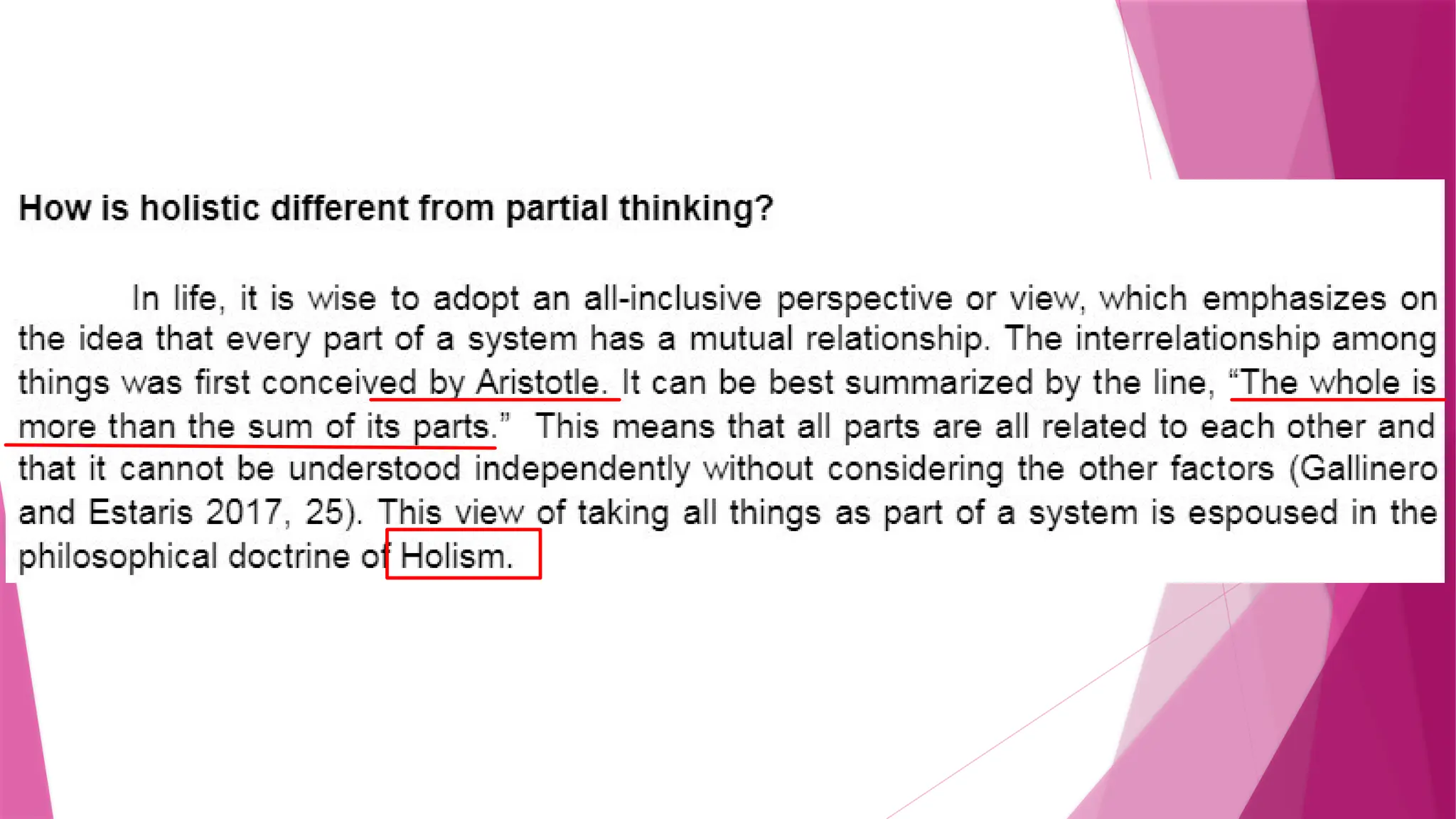
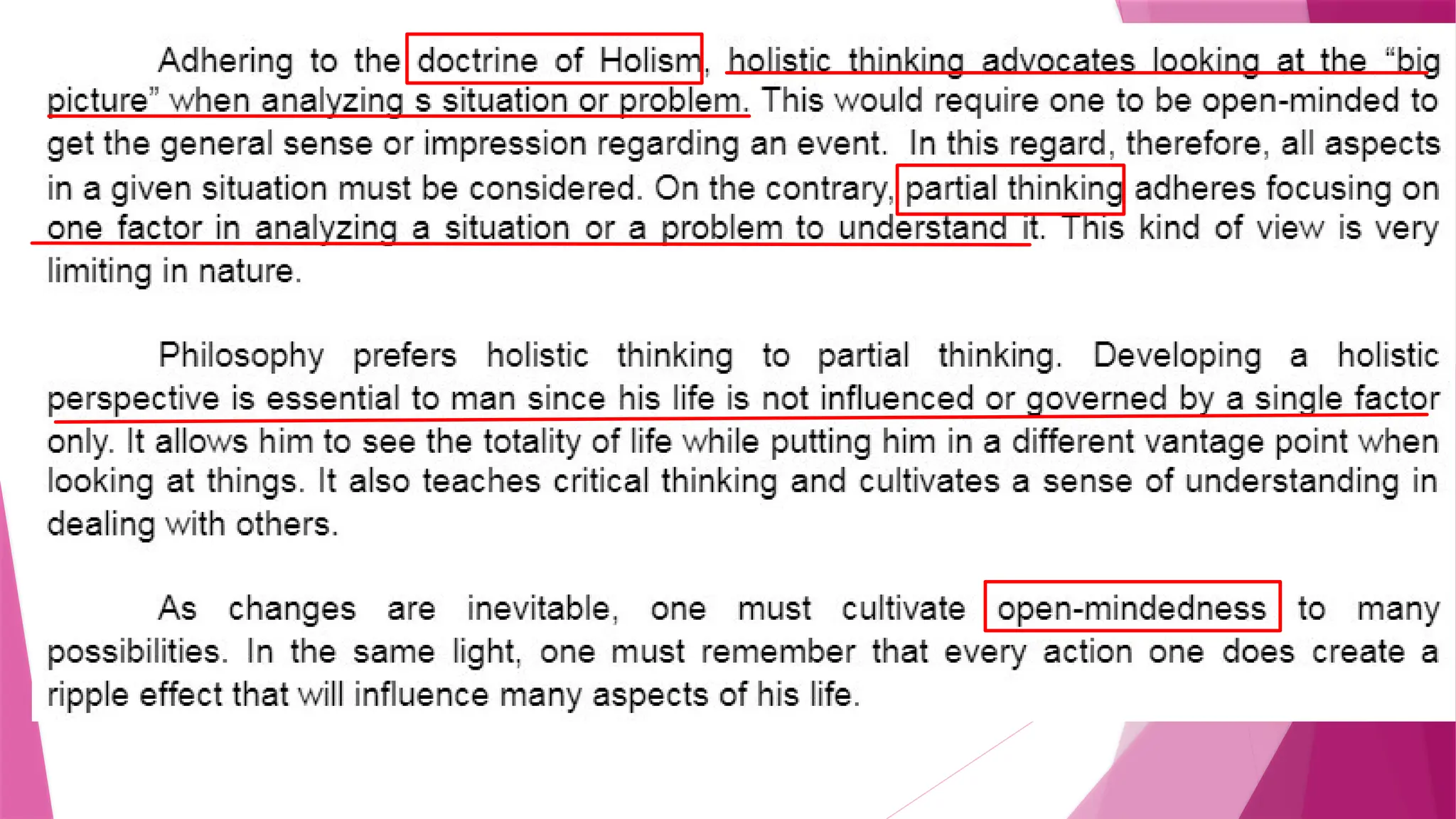
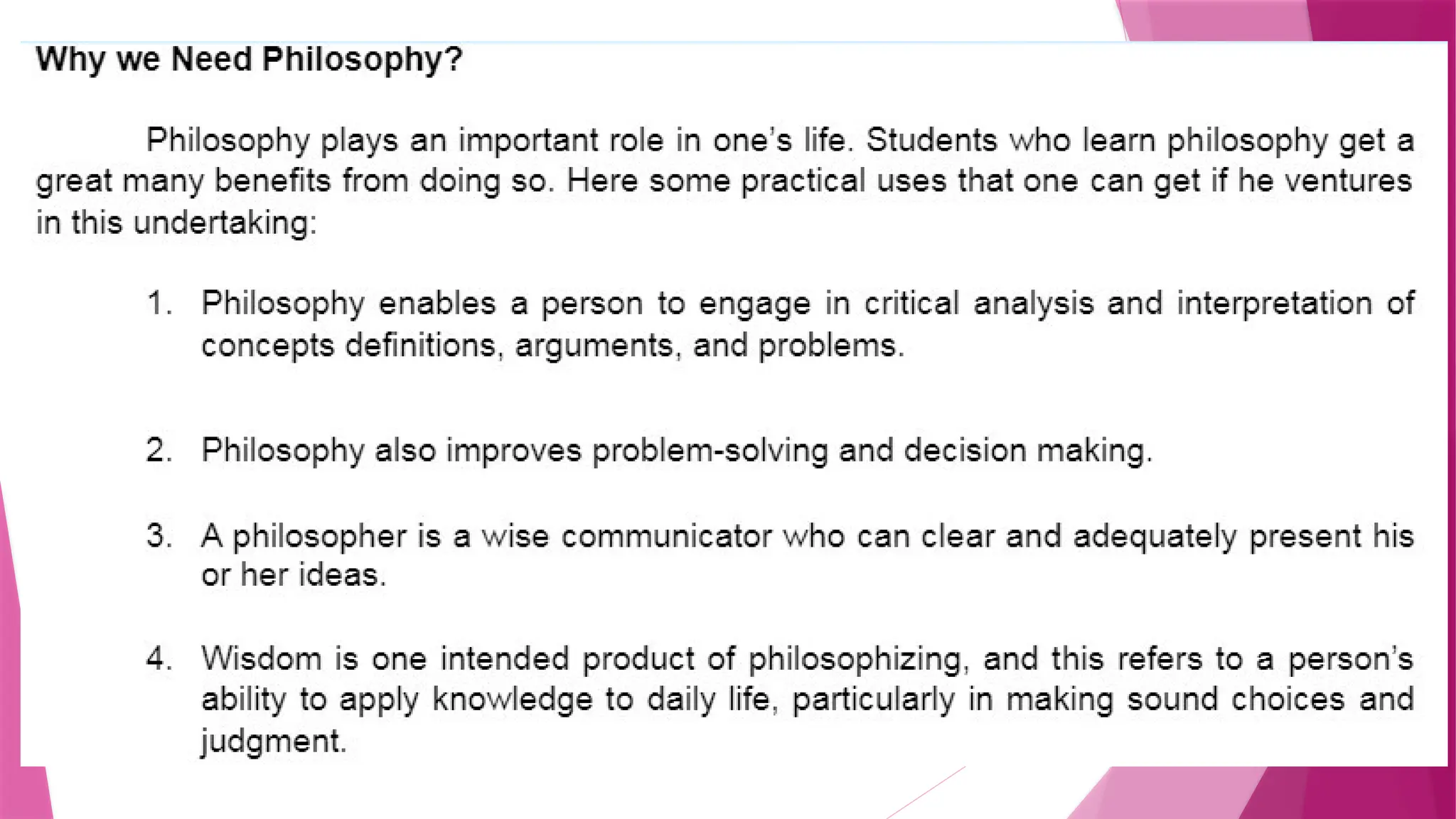
The term philosophia was probably coined first by Pythagoras (c. 570 – 495 BCE)

What is Philosophy?
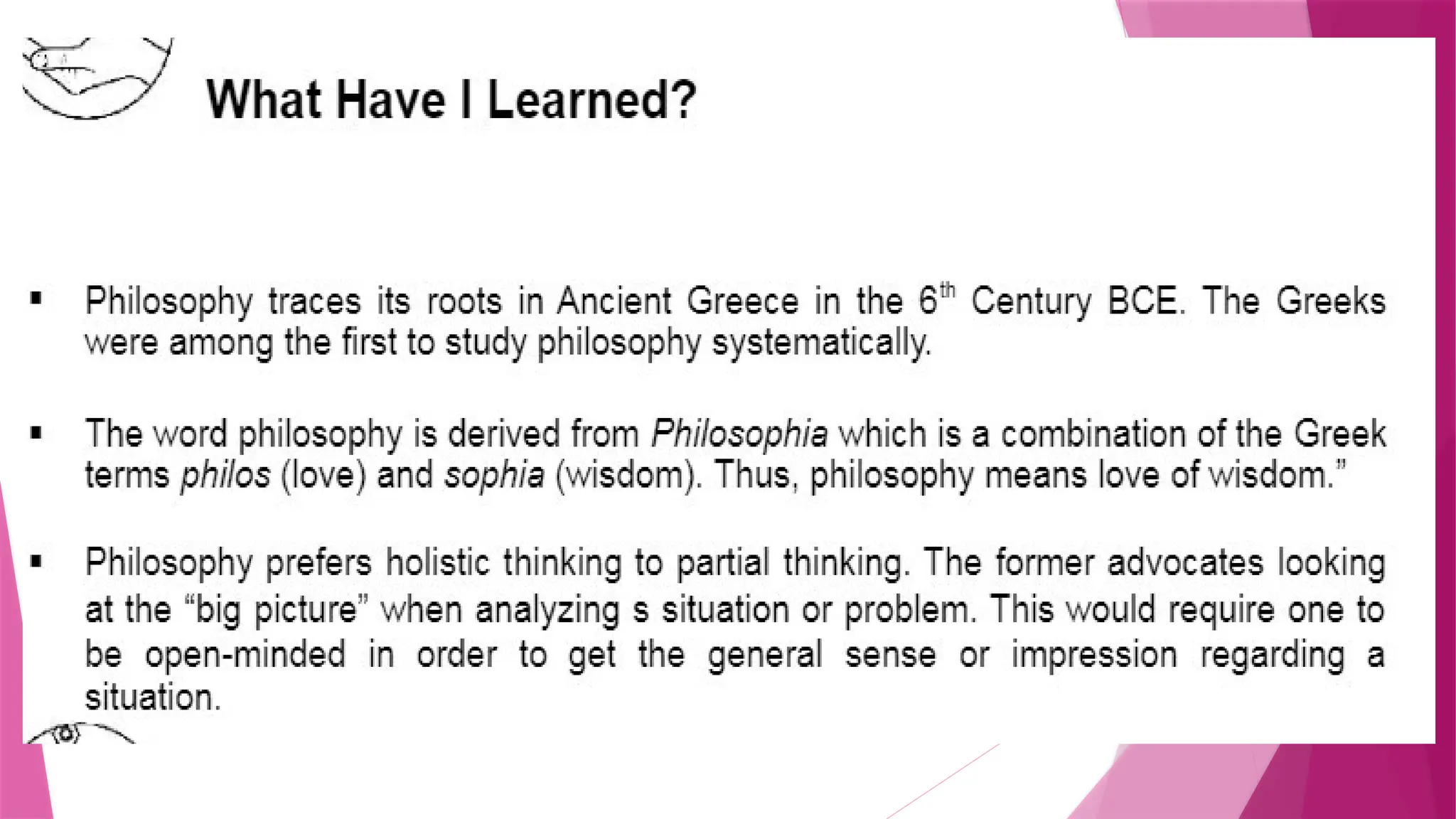
It comes from the Greek word: philos (love)
and sophia (wisdom)
Thus, philosophy means “love of wisdom”
It is soon applied to the study or discipline
that uses human reason to investigate the
ultimate causes, reasons, and principles
which govern all things.
What is Philosophy?
 people who engage in philosophy are called
philosophers or “lovers of wisdom”.
 among the ancient Greeks, the philosophers
became pioneers in various fields of knowledge
such as history, biology, medicine, mathematics,
astronomy, and even physics.
 ancient philosophers were “experts” in various
fields of learning.
Most notable ancient Greek Philosophers
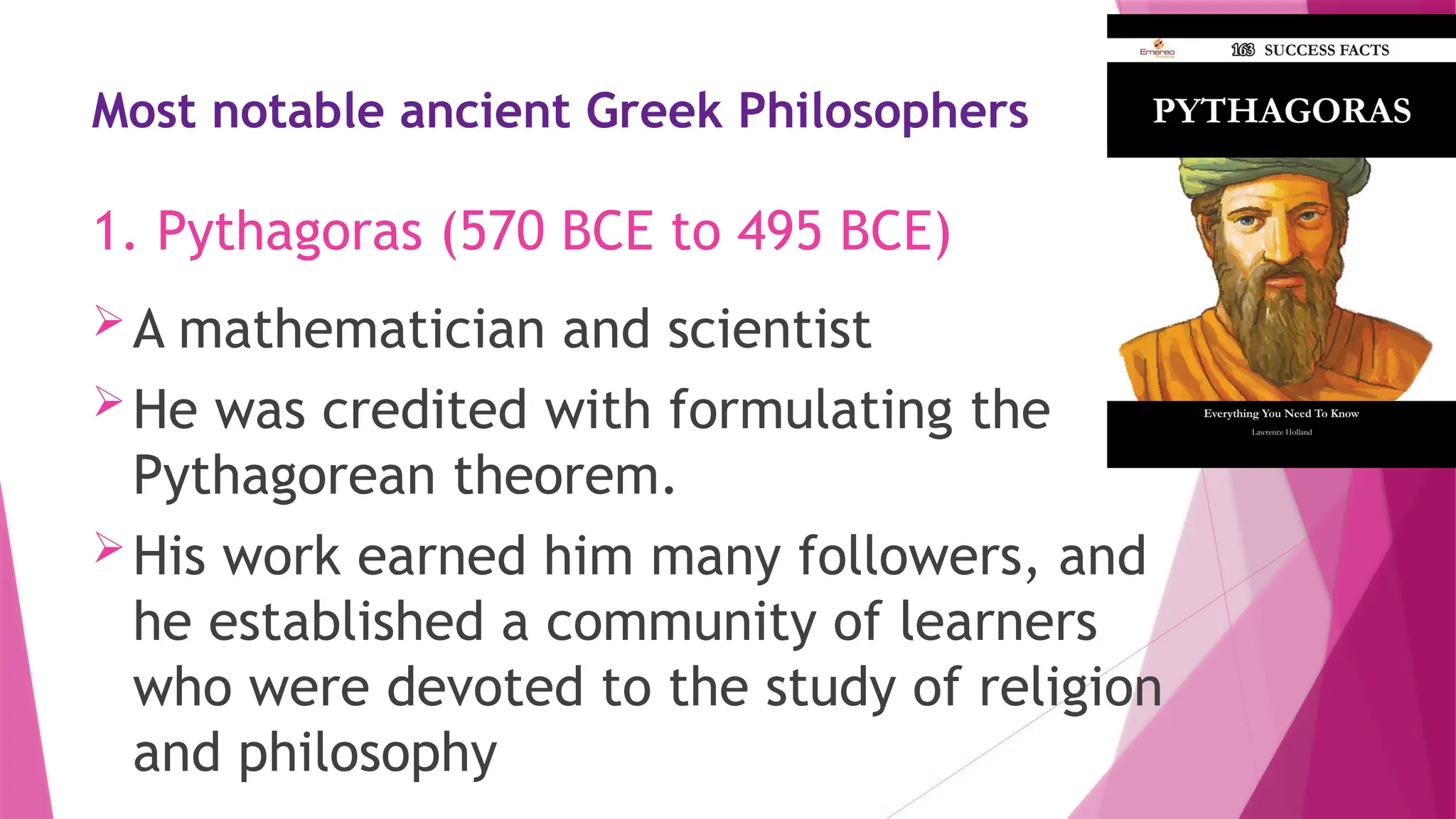
A mathematician and scientist
He was credited with formulating the
Pythagorean theorem.
His work earned him many followers, and
he established a community of learners
who were devoted to the study of religion
and philosophy
1. Pythagoras (570 BCE to 495 BCE)
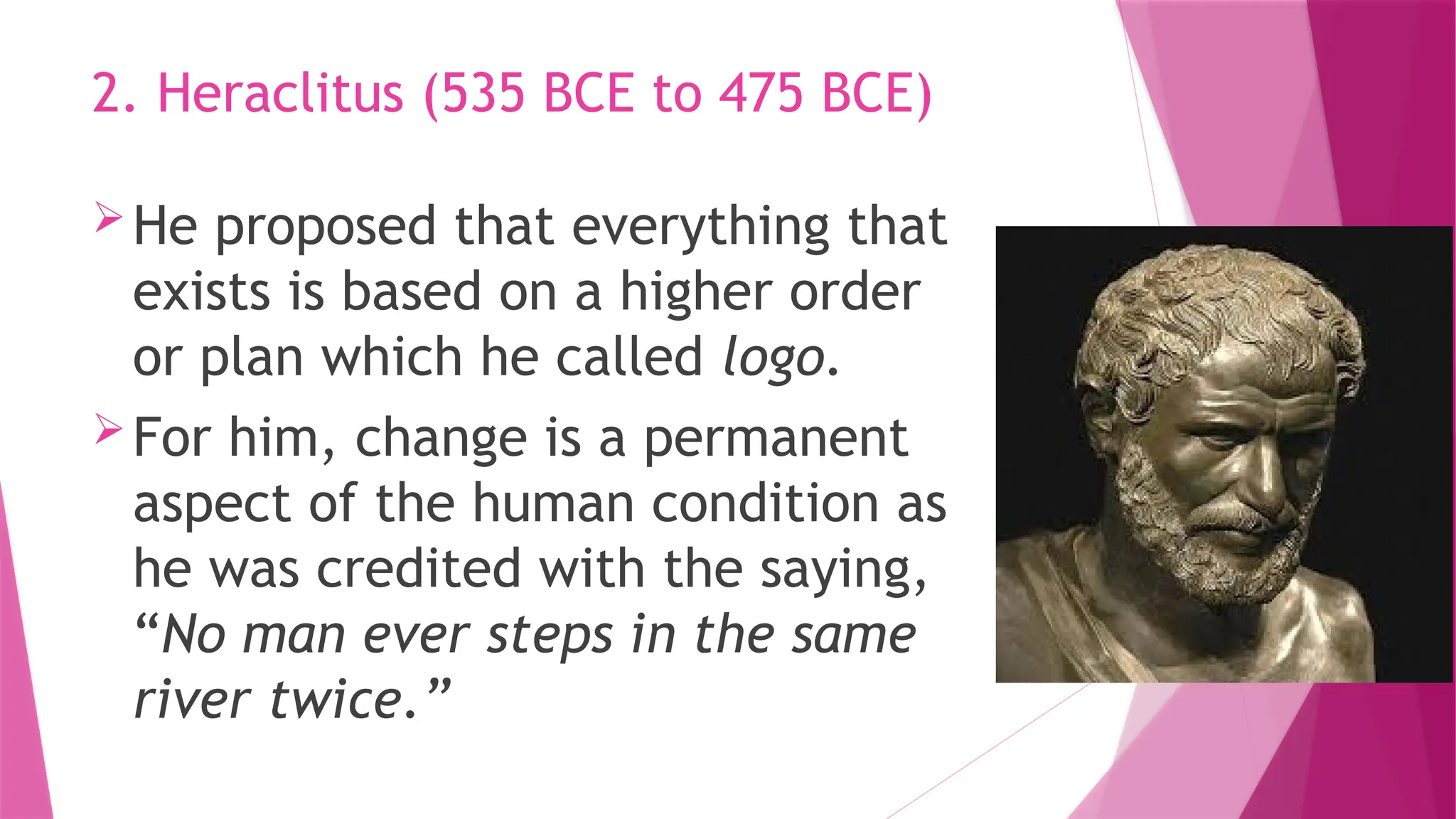
He proposed that everything that
exists is based on a higher order
or plan which he called logo.
For him, change is a permanent
aspect of the human condition as
he was credited with the saying,
“No man ever steps in the same
river twice.”
2. Heraclitus (535 BCE to 475 BCE)
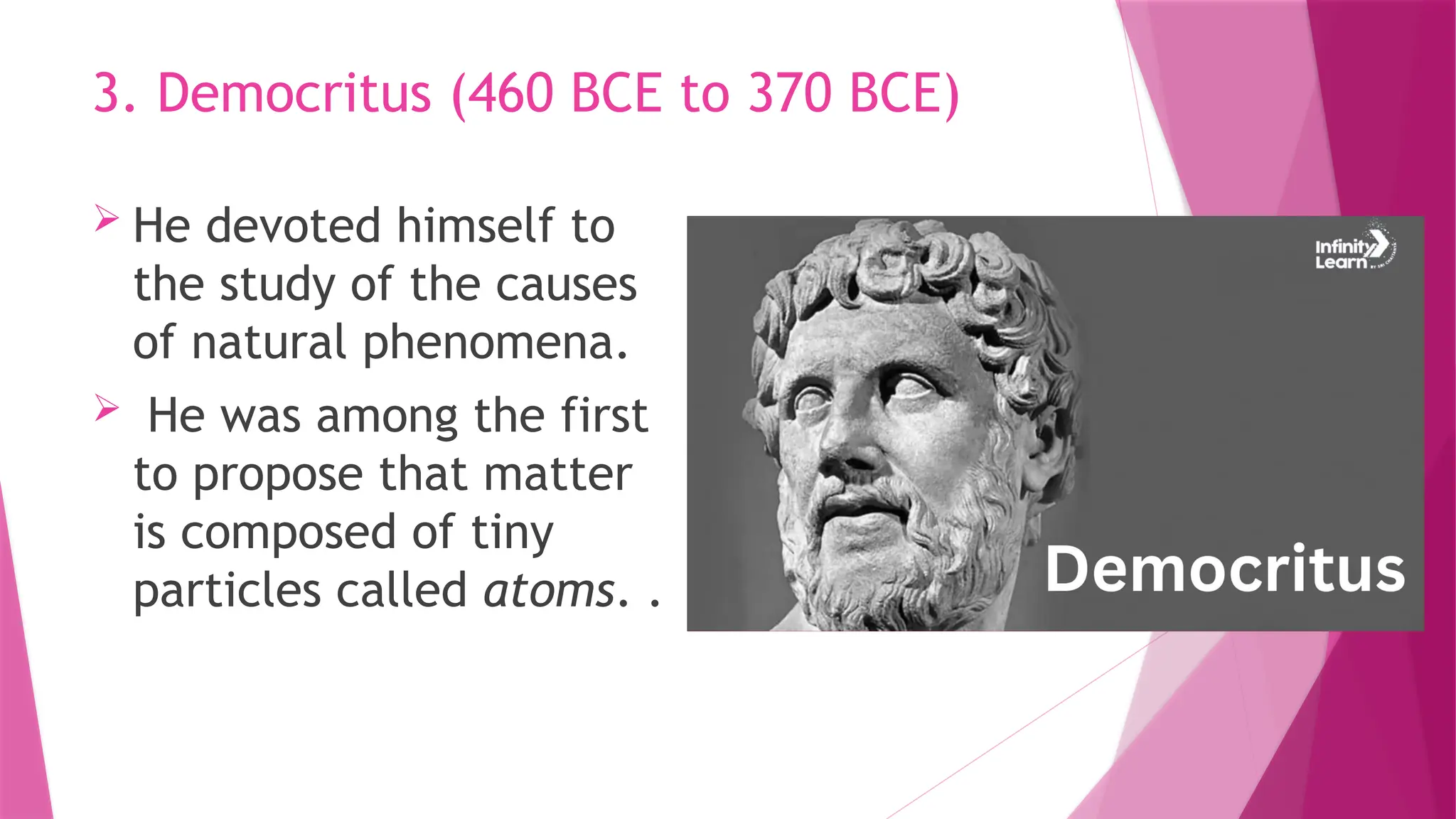
 He devoted himself to
the study of the causes
of natural phenomena.
 He was among the first
to propose that matter
is composed of tiny
particles called atoms. .
3. Democritus (460 BCE to 370 BCE)
He was known advocate of living a simple
and virtuous life. For Deogenes, one should
not only talk of virtue but should show it in
words and actions.
He was said to have lived like a beggar
because of his extreme practice of
simplicity.
Known to be the vocal critic of well-known
philosophers – Plato and Aristotle.
4. Deogenes of Sinope (412 BCE to 323 BCE)
He believed that philosophy could enable
man to live a life of happiness.
His views gave rise to Epicureanism - a
school of philosophy which believes that
wisdom and simple living will result in a life
free of fear and pain.
5. Epicurus (341 BCE to 270 BCE)
He was considered the foremost
philosopher of ancient time
He made great contributions to the field of
ethics.
He himself did not claim to be “wise” and
merely considered himself a “midwife”
that helped inquiring minds achieve
wisdom.
6. Socrates (470 BCE to 399 BCE)
Socrates Method:
A means of examining a topic by devising a
series of questions that let the learner
examine and analyze his knowledge and
views regarding the topic.
6. Socrates (470 BCE to 399 BCE)
“unexamined life is not worth living”
A student of Socrates, he wrote down his
mentor’s teachings and incorporated some
of his own ideas into them.
His teaching and writings were considered
the foundation of Western philosophy.
His ideas includes the Theory of Forms.
7. Plato (427 BCE to 347 BCE)
Theory of Forms
 It proposes that everything that exists is based on an idea or
template that can only be perceived in the mind.
7. Plato (427 BCE to 347 BCE)
Dialectic
 A method of inquiry where two opposing ideas are
discussed in an attempt to arrive at new knowledge.
Academy
 A method of inquiry where two opposing ideas are
discussed in an attempt to arrive at new knowledge.
He attended the Academy and was a
prominent student of Plato.
However, he disagreed with Plato’s theory
of forms and took a different stance in
interpreting reality.
For him, all ideas and views are based on
perception and our reality is based on what
we can sense and perceive.
8. Aristotle (384 BCE to 322 BCE)
Deductive reasoning
 the process by which specific statements
are analyzed to reach a conclusion or
generalization.
8. Aristotle (384 BCE to 322 BCE)
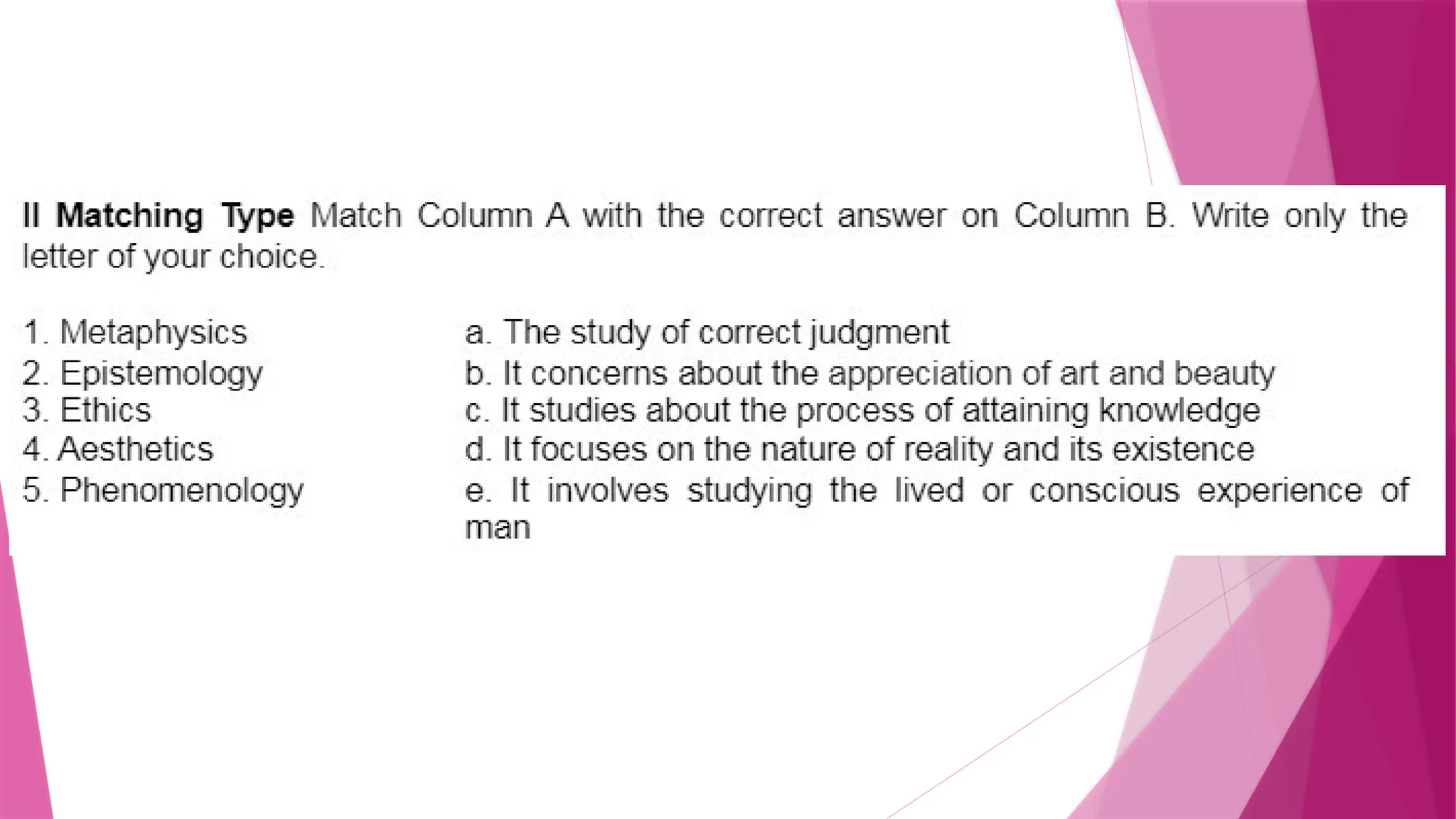
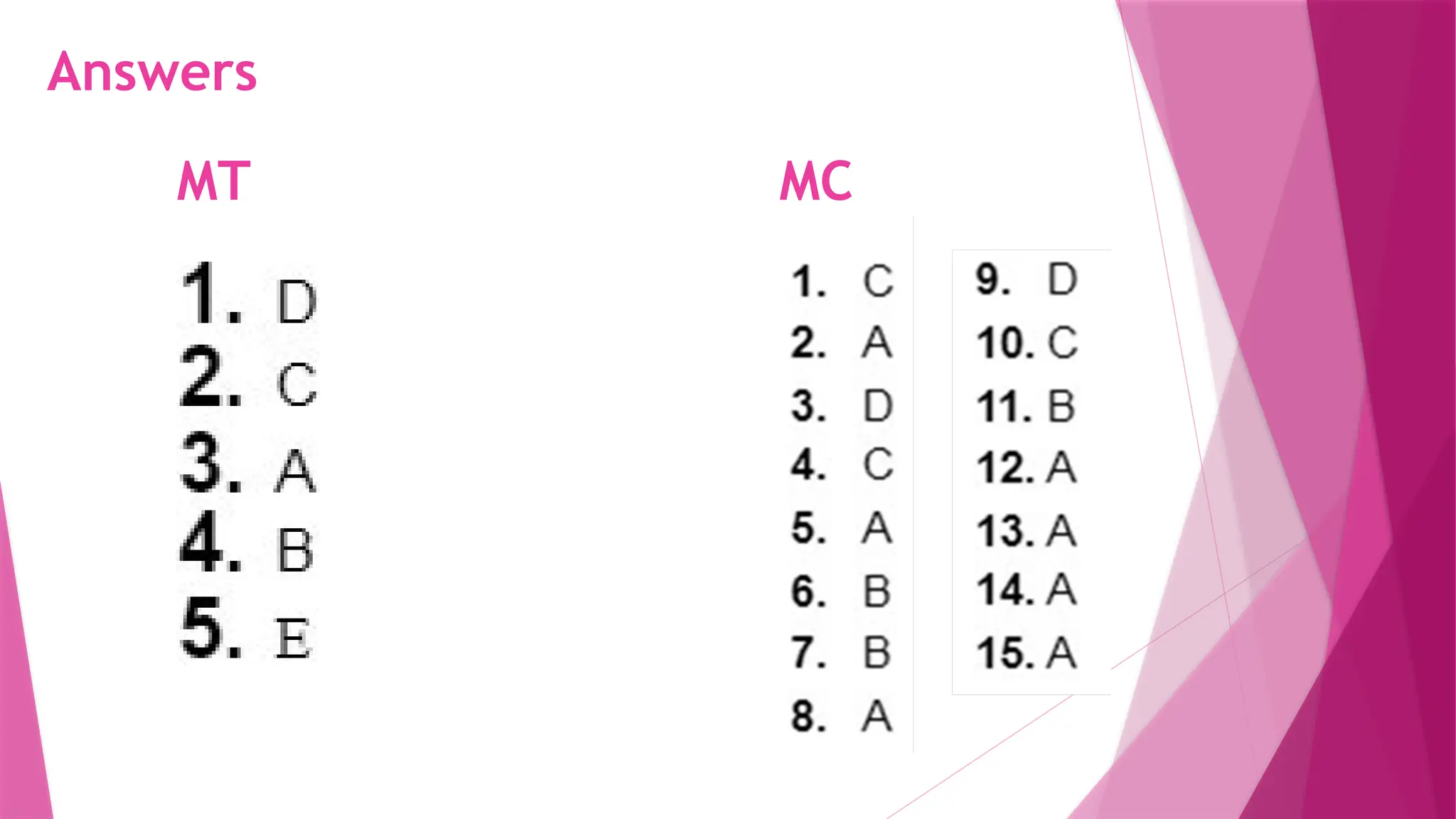
MT MC
Answers
Role of Reflection in Philosophy
This module will provide you with the importance of philosophy.

This module will provide you with the importance of philosophy.

  • 2.
    Objective:  Give themeaning of Philosophy  Recognize human activities that emanated from deliberate reflection
  • 5.
  • 8.
    The term philosophiawas probably coined first by Pythagoras (c. 570 – 495 BCE)
  • 10.
    What is Philosophy? Itcomes from the Greek word: philos (love) and sophia (wisdom) Thus, philosophy means “love of wisdom” It is soon applied to the study or discipline that uses human reason to investigate the ultimate causes, reasons, and principles which govern all things.
  • 11.
    What is Philosophy? people who engage in philosophy are called philosophers or “lovers of wisdom”.  among the ancient Greeks, the philosophers became pioneers in various fields of knowledge such as history, biology, medicine, mathematics, astronomy, and even physics.  ancient philosophers were “experts” in various fields of learning.
  • 22.
    Most notable ancientGreek Philosophers A mathematician and scientist He was credited with formulating the Pythagorean theorem. His work earned him many followers, and he established a community of learners who were devoted to the study of religion and philosophy 1. Pythagoras (570 BCE to 495 BCE)
  • 23.
    He proposed thateverything that exists is based on a higher order or plan which he called logo. For him, change is a permanent aspect of the human condition as he was credited with the saying, “No man ever steps in the same river twice.” 2. Heraclitus (535 BCE to 475 BCE)
  • 24.
     He devotedhimself to the study of the causes of natural phenomena.  He was among the first to propose that matter is composed of tiny particles called atoms. . 3. Democritus (460 BCE to 370 BCE)
  • 25.
    He was knownadvocate of living a simple and virtuous life. For Deogenes, one should not only talk of virtue but should show it in words and actions. He was said to have lived like a beggar because of his extreme practice of simplicity. Known to be the vocal critic of well-known philosophers – Plato and Aristotle. 4. Deogenes of Sinope (412 BCE to 323 BCE)
  • 26.
    He believed thatphilosophy could enable man to live a life of happiness. His views gave rise to Epicureanism - a school of philosophy which believes that wisdom and simple living will result in a life free of fear and pain. 5. Epicurus (341 BCE to 270 BCE)
  • 27.
    He was consideredthe foremost philosopher of ancient time He made great contributions to the field of ethics. He himself did not claim to be “wise” and merely considered himself a “midwife” that helped inquiring minds achieve wisdom. 6. Socrates (470 BCE to 399 BCE)
  • 28.
    Socrates Method: A meansof examining a topic by devising a series of questions that let the learner examine and analyze his knowledge and views regarding the topic. 6. Socrates (470 BCE to 399 BCE) “unexamined life is not worth living”
  • 29.
    A student ofSocrates, he wrote down his mentor’s teachings and incorporated some of his own ideas into them. His teaching and writings were considered the foundation of Western philosophy. His ideas includes the Theory of Forms. 7. Plato (427 BCE to 347 BCE)
  • 30.
    Theory of Forms It proposes that everything that exists is based on an idea or template that can only be perceived in the mind. 7. Plato (427 BCE to 347 BCE) Dialectic  A method of inquiry where two opposing ideas are discussed in an attempt to arrive at new knowledge. Academy  A method of inquiry where two opposing ideas are discussed in an attempt to arrive at new knowledge.
  • 31.
    He attended theAcademy and was a prominent student of Plato. However, he disagreed with Plato’s theory of forms and took a different stance in interpreting reality. For him, all ideas and views are based on perception and our reality is based on what we can sense and perceive. 8. Aristotle (384 BCE to 322 BCE)
  • 32.
    Deductive reasoning  theprocess by which specific statements are analyzed to reach a conclusion or generalization. 8. Aristotle (384 BCE to 322 BCE)
  • 37.
  • 39.
    Role of Reflectionin Philosophy