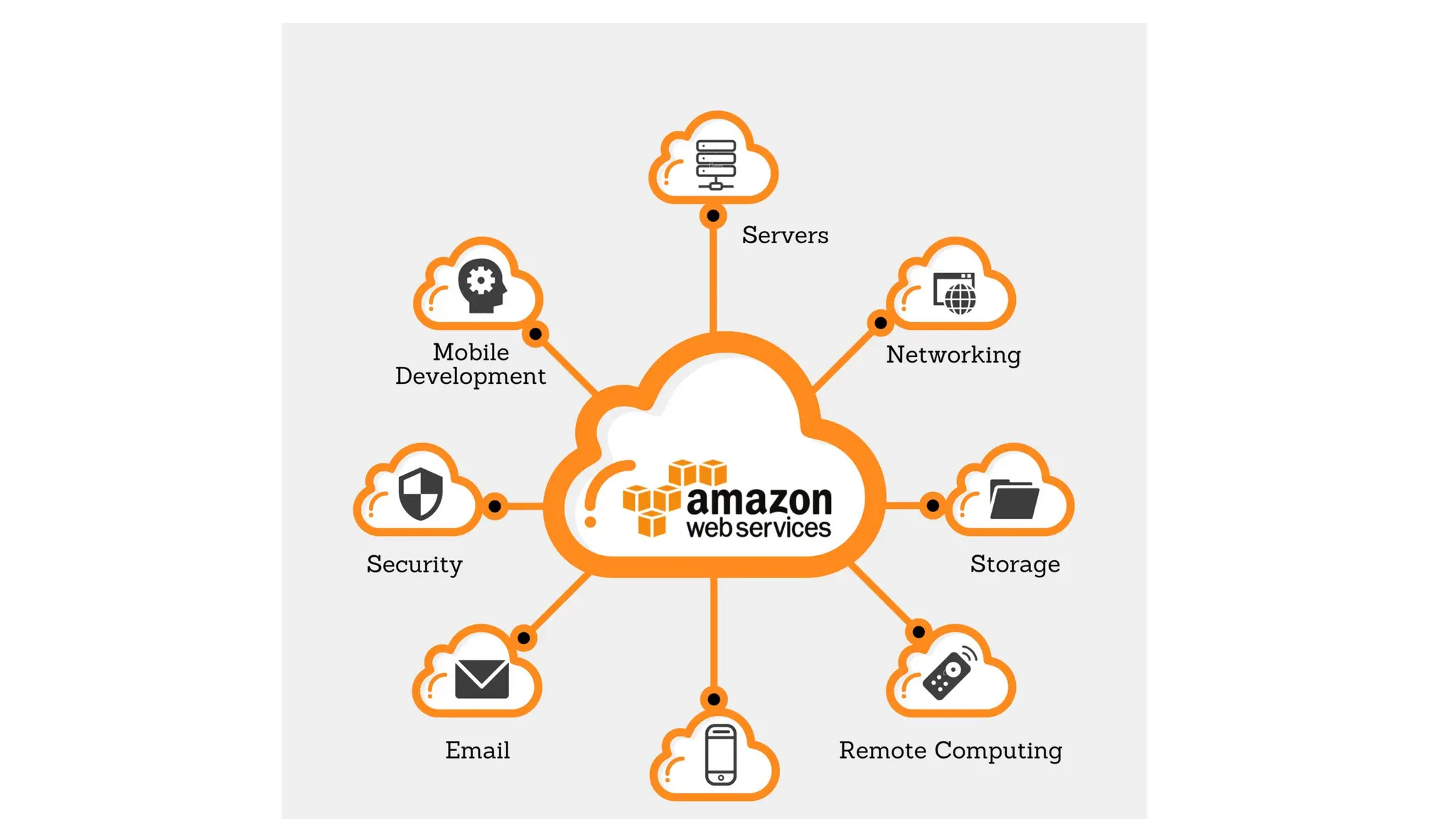
AWS Cloud
Welcome to the world of AWS Cloud, where businesses leverage the
power of cloud computing to transform their operations. Discover the
key services, benefits, and best practices.
Introduction to AWS Cloud
1 What is AWS Cloud?
Learn about the AWS Cloud platform and
how it revolutionizes IT infrastructure by
providing on-demand resources and
services.
2 Why is it important?
Understand the significance of AWS Cloud
in enabling businesses to scale and
innovate without the constraints of
traditional IT infrastructure.
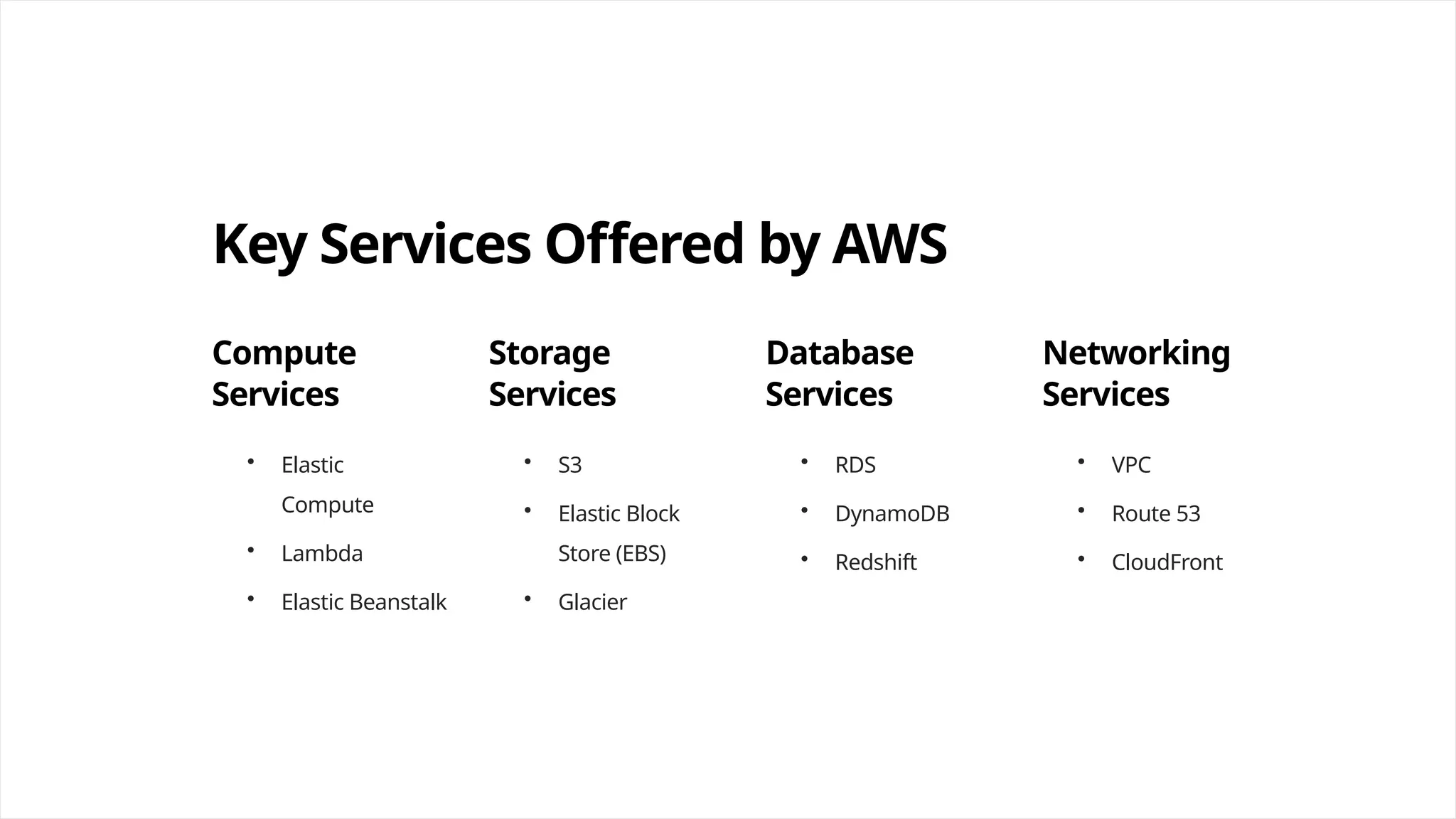
Key Services Offered by AWS
Compute
Services
• Elastic
Compute
• Lambda
• Elastic Beanstalk
Storage
Services
• S3
• Elastic Block
Store (EBS)
• Glacier
Database
Services
• RDS
• DynamoDB
• Redshift
Networking
Services
• VPC
• Route 53
• CloudFront
Benefits of Using AWS Cloud
1 Cost Savings
Discover how AWS Cloud enables businesses to reduce capital expenditure,
pay for usage, and optimize costs for IT resources.
2 Scalability and Flexibility
Explore how AWS Cloud scales dynamically to match business needs, offers
flexibility for experimentation, and supports growth.
3 Reliability and Security
Learn how AWS Cloud provides high availability, data redundancy, and
robust security measures to protect business-critical applications and data.
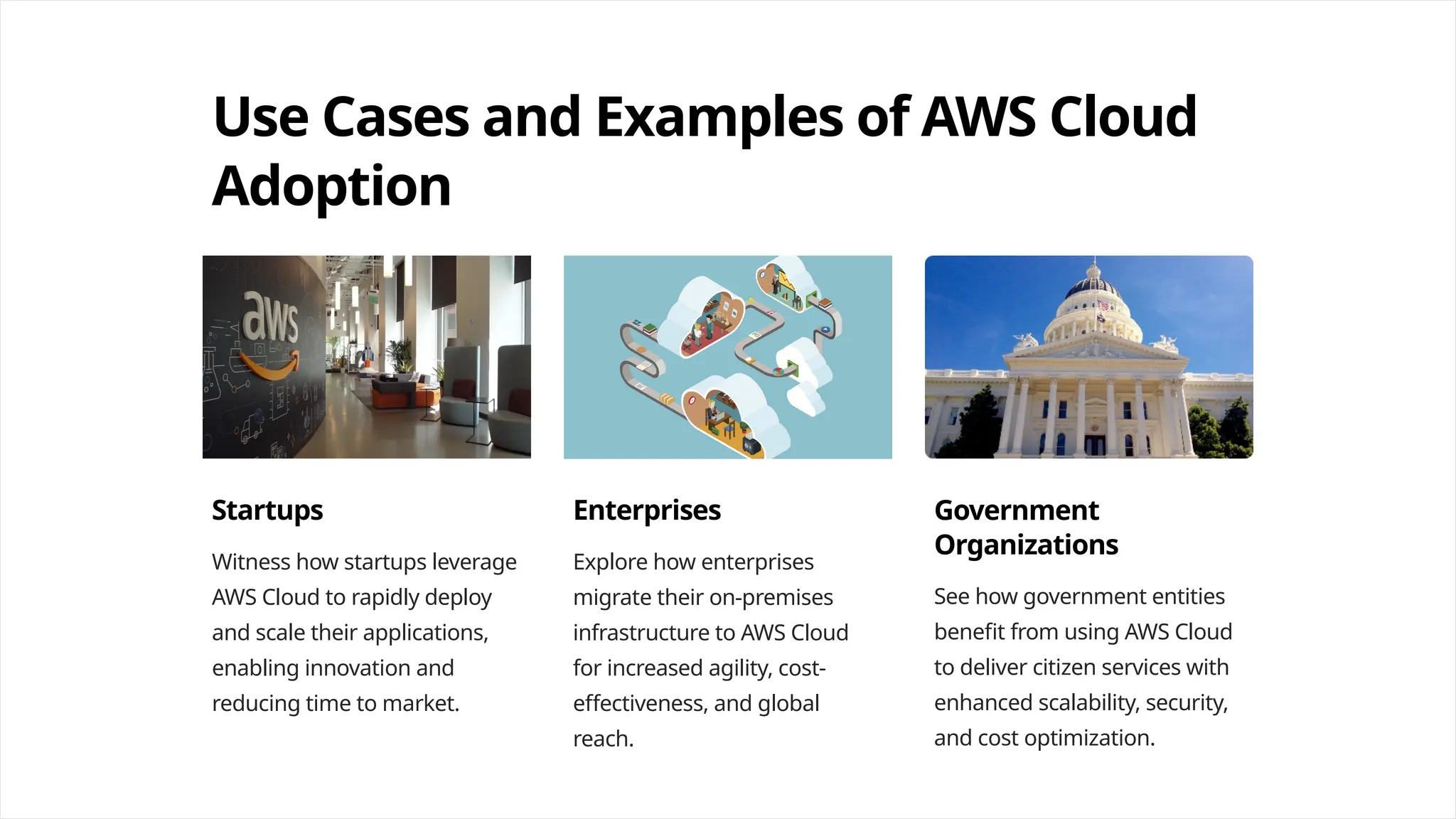
Use Cases and Examples of AWS Cloud
Adoption
Startups
Witness how startups leverage
AWS Cloud to rapidly deploy
and scale their applications,
enabling innovation and
reducing time to market.
Enterprises
Explore how enterprises
migrate their on-premises
infrastructure to AWS Cloud
for increased agility, cost-
effectiveness, and global
reach.
Government
Organizations
See how government entities
benefit from using AWS Cloud
to deliver citizen services with
enhanced scalability, security,
and cost optimization.
Best Practices for Implementing AWS
Cloud
1 Designing for Failure
Embrace the AWS Cloud
mindset and build
resilient architectures
that can withstand
failures, ensuring high
availability and fault
tolerance.
2 Security Best
Practices
Learn about security
measures, such as IAM,
encryption, and
monitoring, to protect
data and applications
against unauthorized
access and security
threats.
3 Cost Optimization
Techniques
Discover strategies to
maximize cost efficiency
by utilizing AWS Cloud
services effectively,
leveraging spot
instances, and
rightsizing resources.
Conclusion
1 Summary of key points
Recap the main takeaways from this
presentation, including an overview of
AWS Cloud, its benefits, and key services.
2 Future trends and
advancements in AWS Cloud
Explore the evolving landscape of AWS
Cloud and anticipate upcoming
innovations and trends that will shape the
future of cloud computing.
this is the presentation on the aws ppt.pptx

this is the presentation on the aws ppt.pptx

  • 2.
    AWS Cloud Welcome tothe world of AWS Cloud, where businesses leverage the power of cloud computing to transform their operations. Discover the key services, benefits, and best practices.
  • 3.
    Introduction to AWSCloud 1 What is AWS Cloud? Learn about the AWS Cloud platform and how it revolutionizes IT infrastructure by providing on-demand resources and services. 2 Why is it important? Understand the significance of AWS Cloud in enabling businesses to scale and innovate without the constraints of traditional IT infrastructure.
  • 4.
    Key Services Offeredby AWS Compute Services • Elastic Compute • Lambda • Elastic Beanstalk Storage Services • S3 • Elastic Block Store (EBS) • Glacier Database Services • RDS • DynamoDB • Redshift Networking Services • VPC • Route 53 • CloudFront
  • 5.
    Benefits of UsingAWS Cloud 1 Cost Savings Discover how AWS Cloud enables businesses to reduce capital expenditure, pay for usage, and optimize costs for IT resources. 2 Scalability and Flexibility Explore how AWS Cloud scales dynamically to match business needs, offers flexibility for experimentation, and supports growth. 3 Reliability and Security Learn how AWS Cloud provides high availability, data redundancy, and robust security measures to protect business-critical applications and data.
  • 6.
    Use Cases andExamples of AWS Cloud Adoption Startups Witness how startups leverage AWS Cloud to rapidly deploy and scale their applications, enabling innovation and reducing time to market. Enterprises Explore how enterprises migrate their on-premises infrastructure to AWS Cloud for increased agility, cost- effectiveness, and global reach. Government Organizations See how government entities benefit from using AWS Cloud to deliver citizen services with enhanced scalability, security, and cost optimization.
  • 7.
    Best Practices forImplementing AWS Cloud 1 Designing for Failure Embrace the AWS Cloud mindset and build resilient architectures that can withstand failures, ensuring high availability and fault tolerance. 2 Security Best Practices Learn about security measures, such as IAM, encryption, and monitoring, to protect data and applications against unauthorized access and security threats. 3 Cost Optimization Techniques Discover strategies to maximize cost efficiency by utilizing AWS Cloud services effectively, leveraging spot instances, and rightsizing resources.
  • 8.
    Conclusion 1 Summary ofkey points Recap the main takeaways from this presentation, including an overview of AWS Cloud, its benefits, and key services. 2 Future trends and advancements in AWS Cloud Explore the evolving landscape of AWS Cloud and anticipate upcoming innovations and trends that will shape the future of cloud computing.