M AT H E M AT I C S
Q3-GR.2-WEEK6
DAY 1
To p i c
At the end of the lesson, the learner should
be able to illustrate division by equally
distributing a set number of objects
into several groups.
Have you ever shared
something with your
friends, like food or
toys?
How did you make
sure everyone got the
same amount?
Division
(Paghahati)
Problem 1:
David has four marbles. He
wants to share them equally
between his two friends. How
many marbles should David
give to each of his friends?
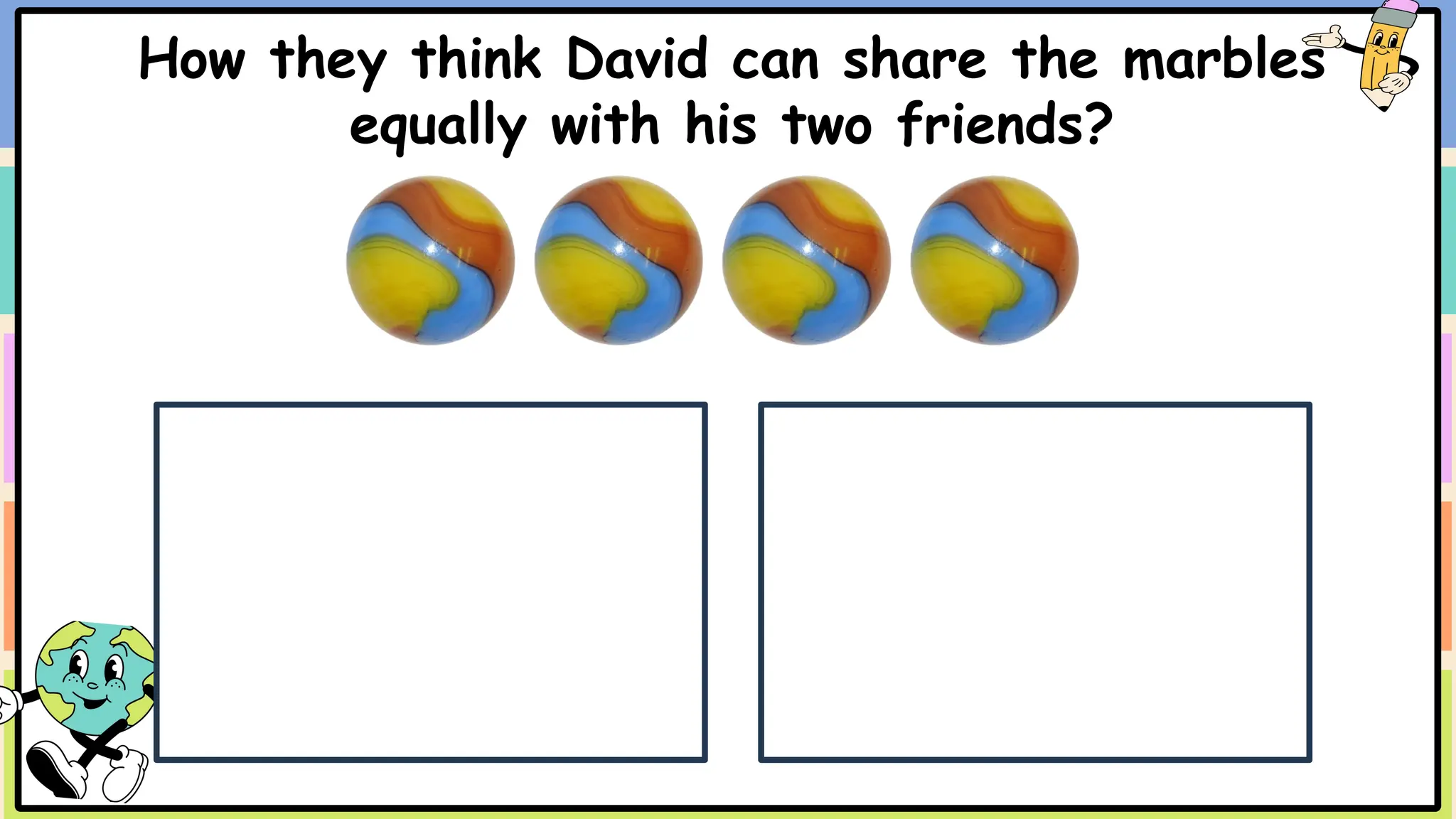
How they think David can share the marbles
equally with his two friends?
Are the marbles
equally shared?
How do you
know?
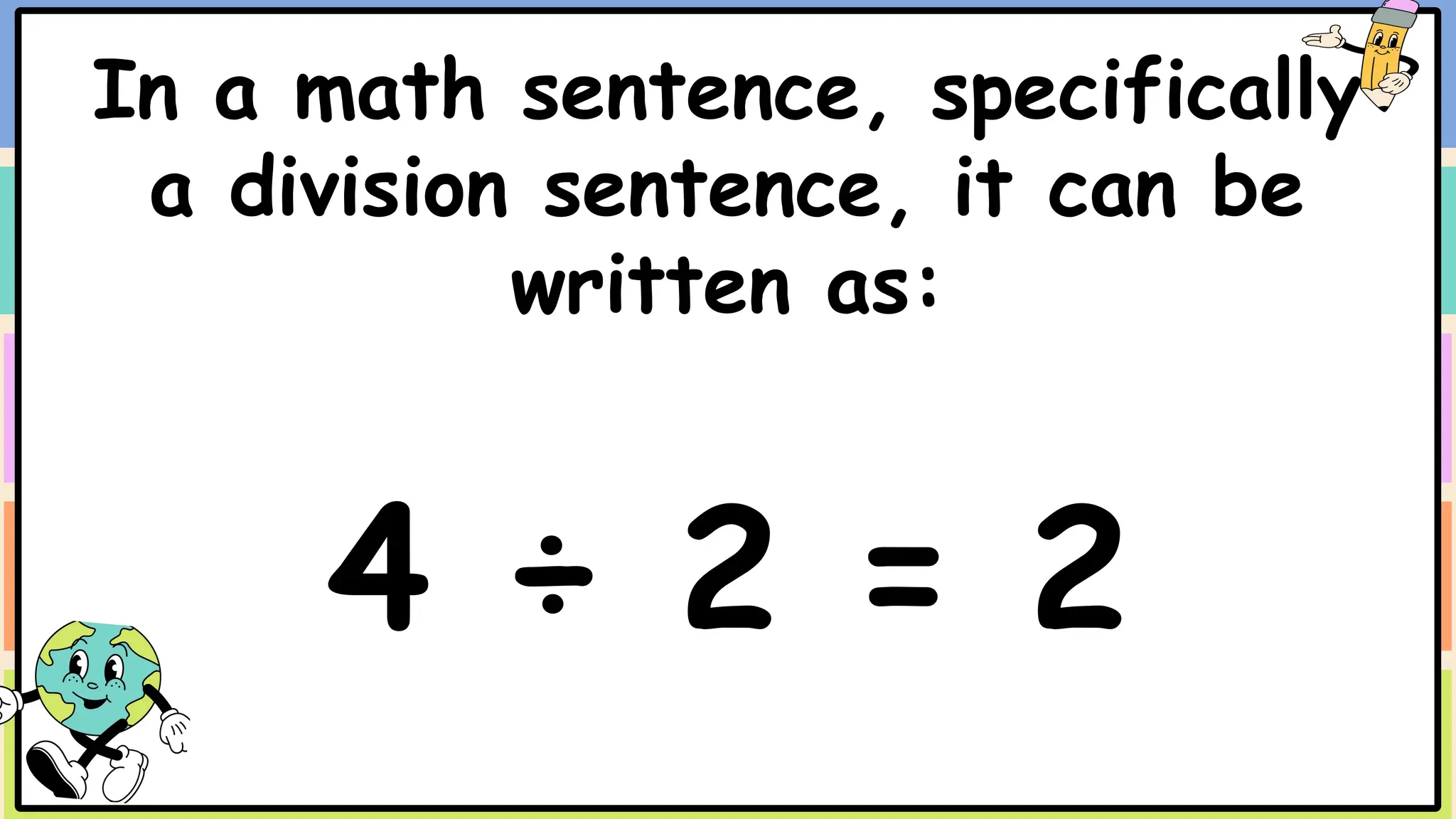
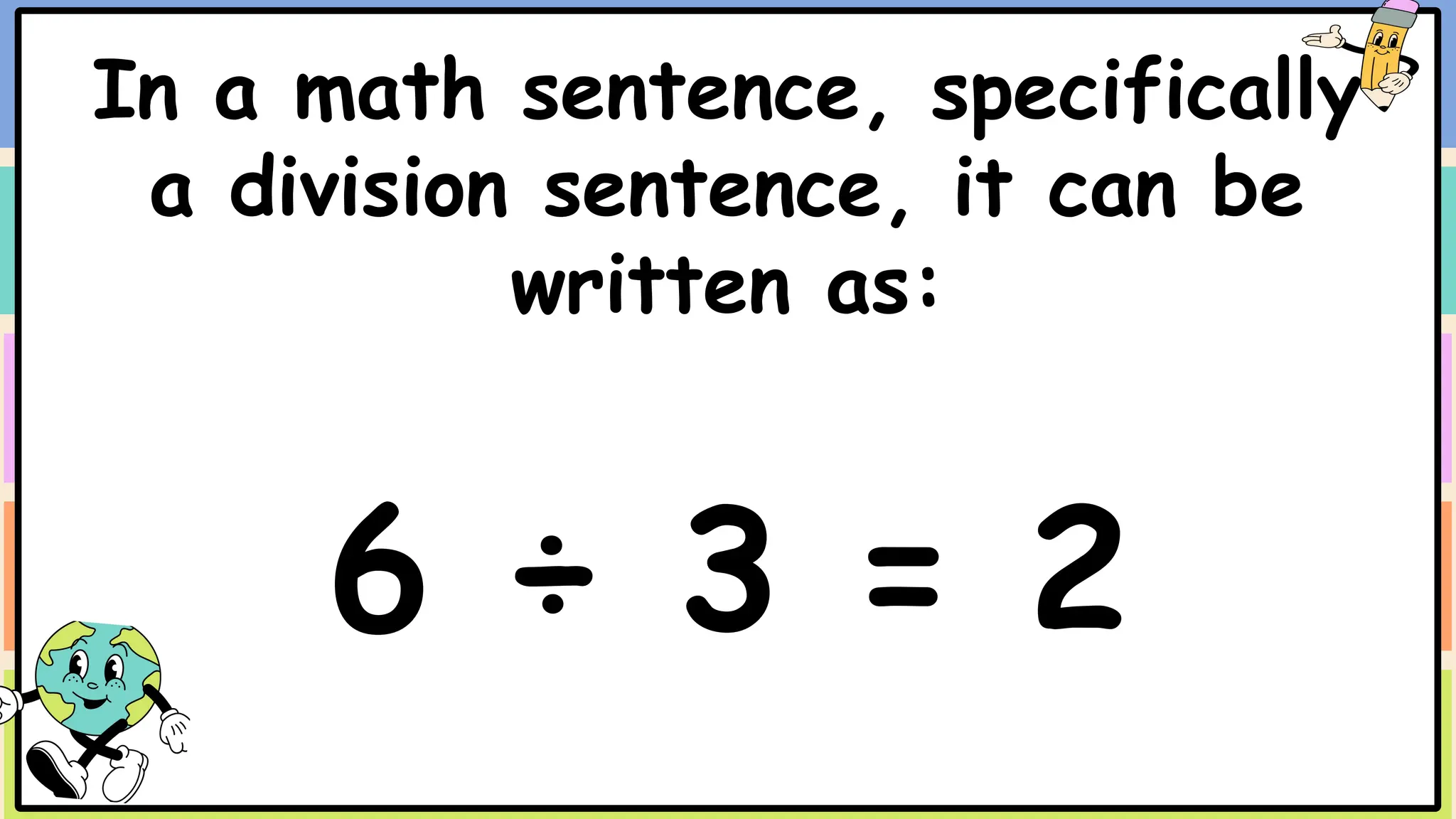
In a math sentence, specifically
a division sentence, it can be
written as:
4 ÷ 2 = 2
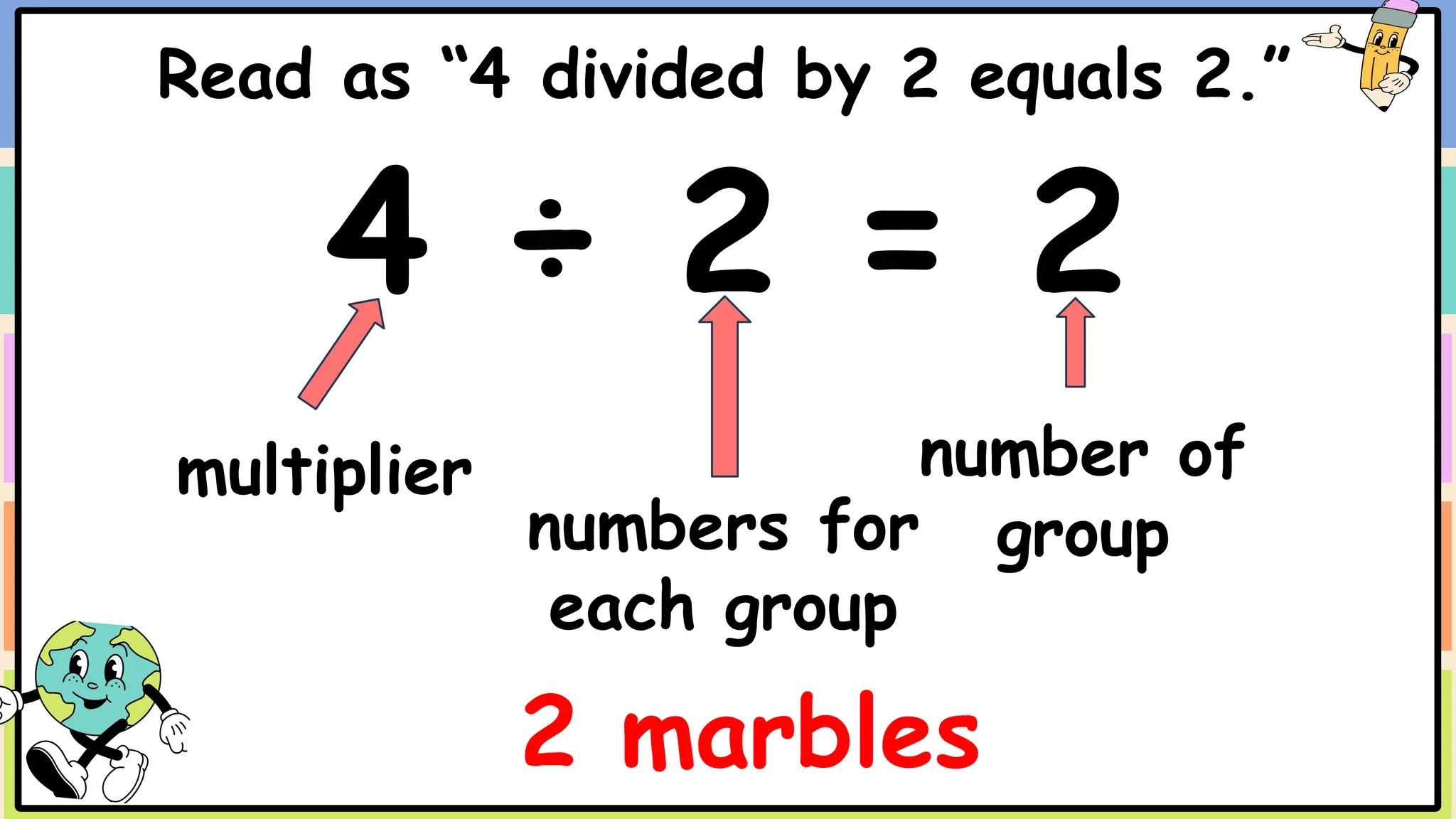
Read as “4 divided by 2 equals 2.”
4 ÷ 2 = 2
multiplier
numbers for
each group
number of
group
2 marbles
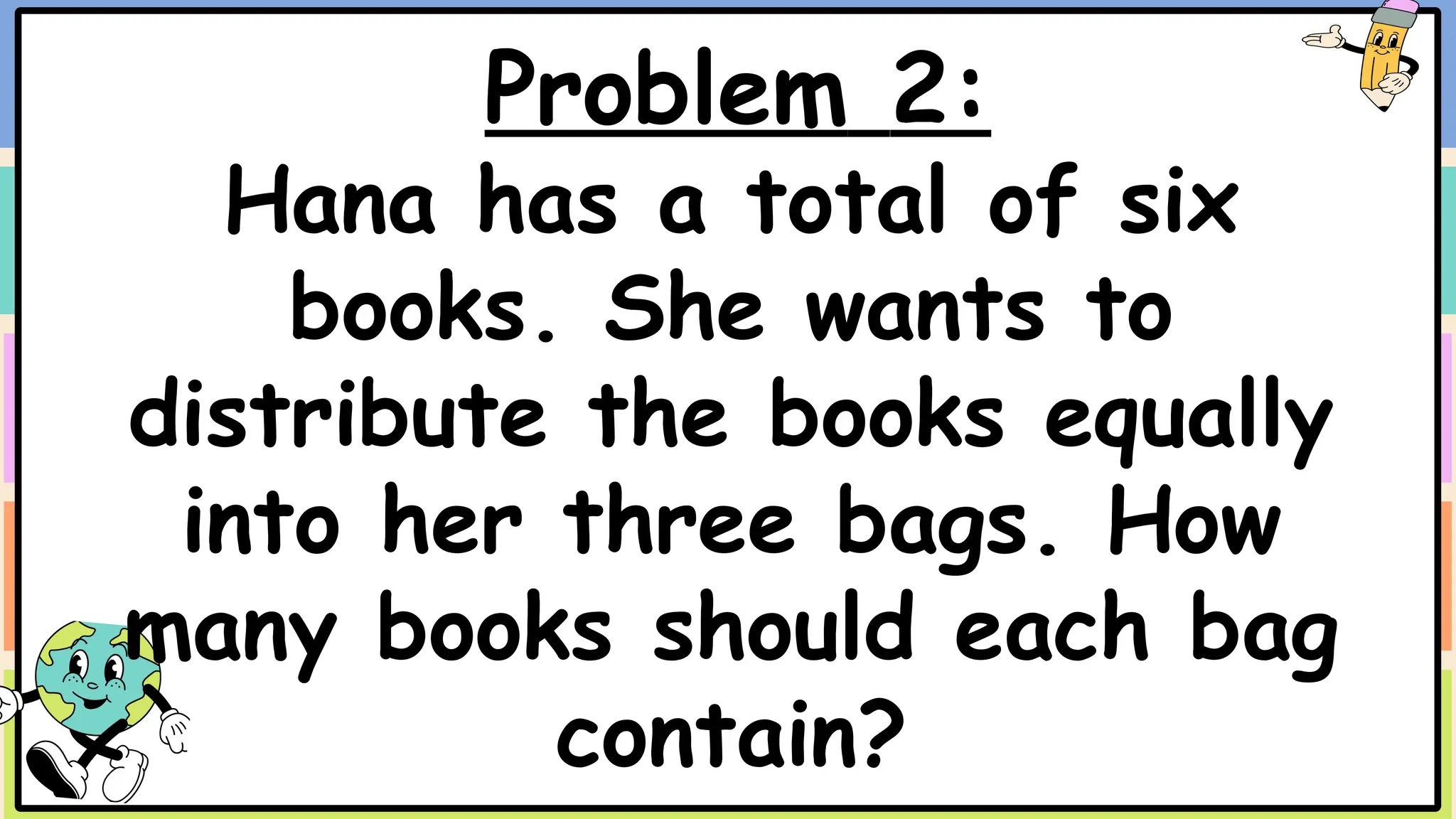
Problem 2:
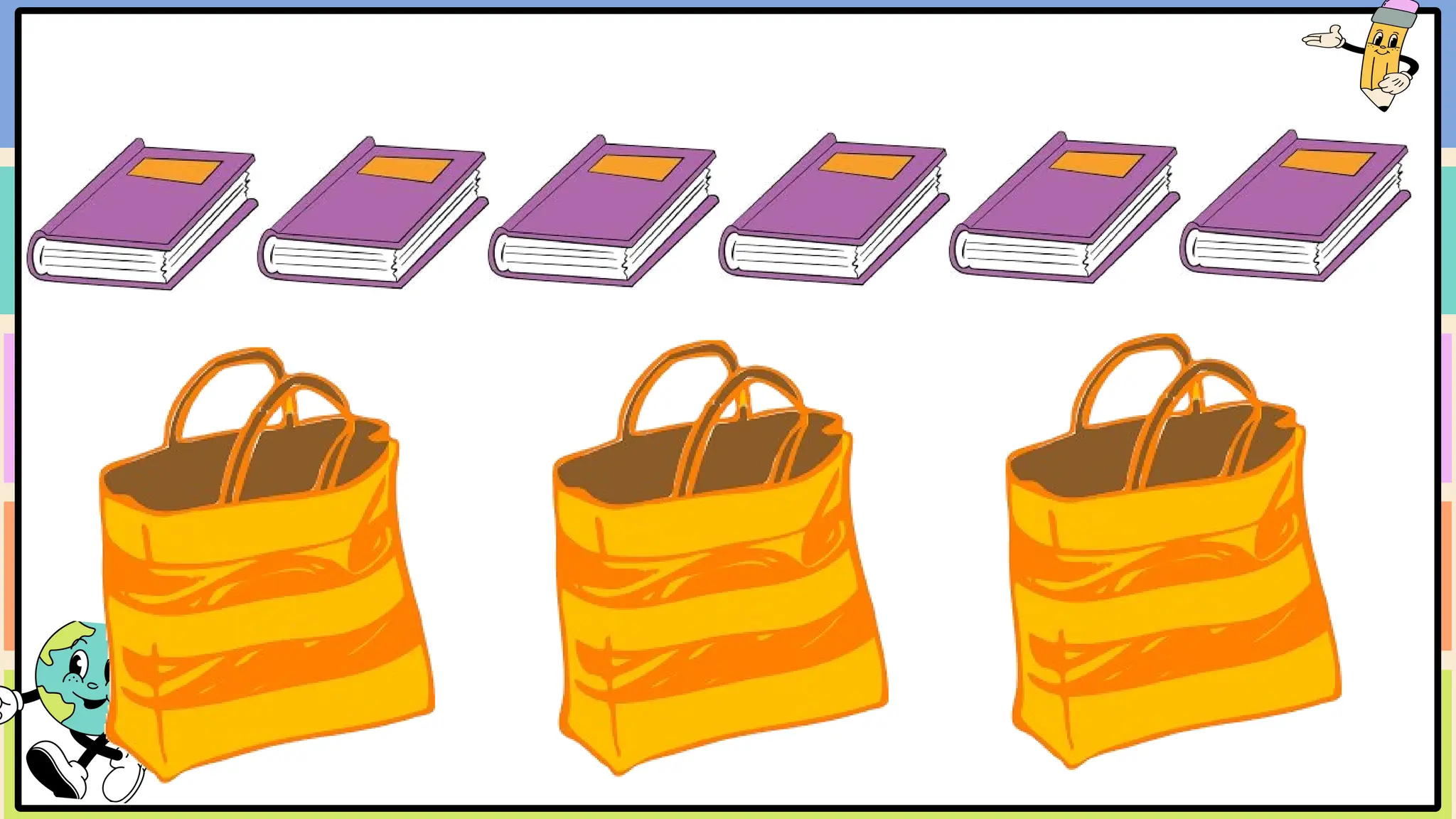
Hana has a total of six
books. She wants to
distribute the books equally
into her three bags. How
many books should each bag
contain?
In a math sentence, specifically
a division sentence, it can be
written as:
6 ÷ 3 = 2
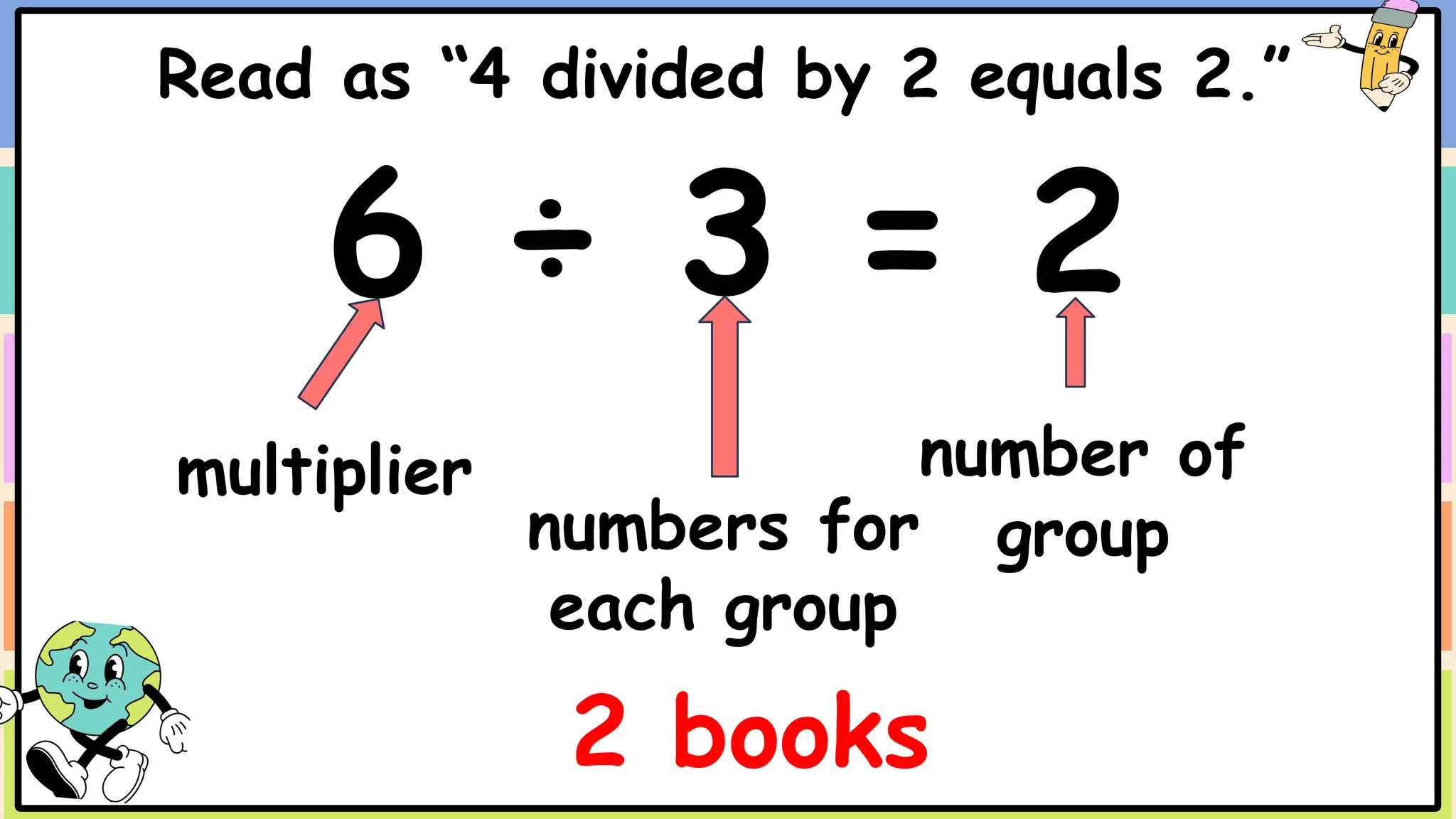
Read as “4 divided by 2 equals 2.”
6 ÷ 3 = 2
multiplier
numbers for
each group
number of
group
2 books
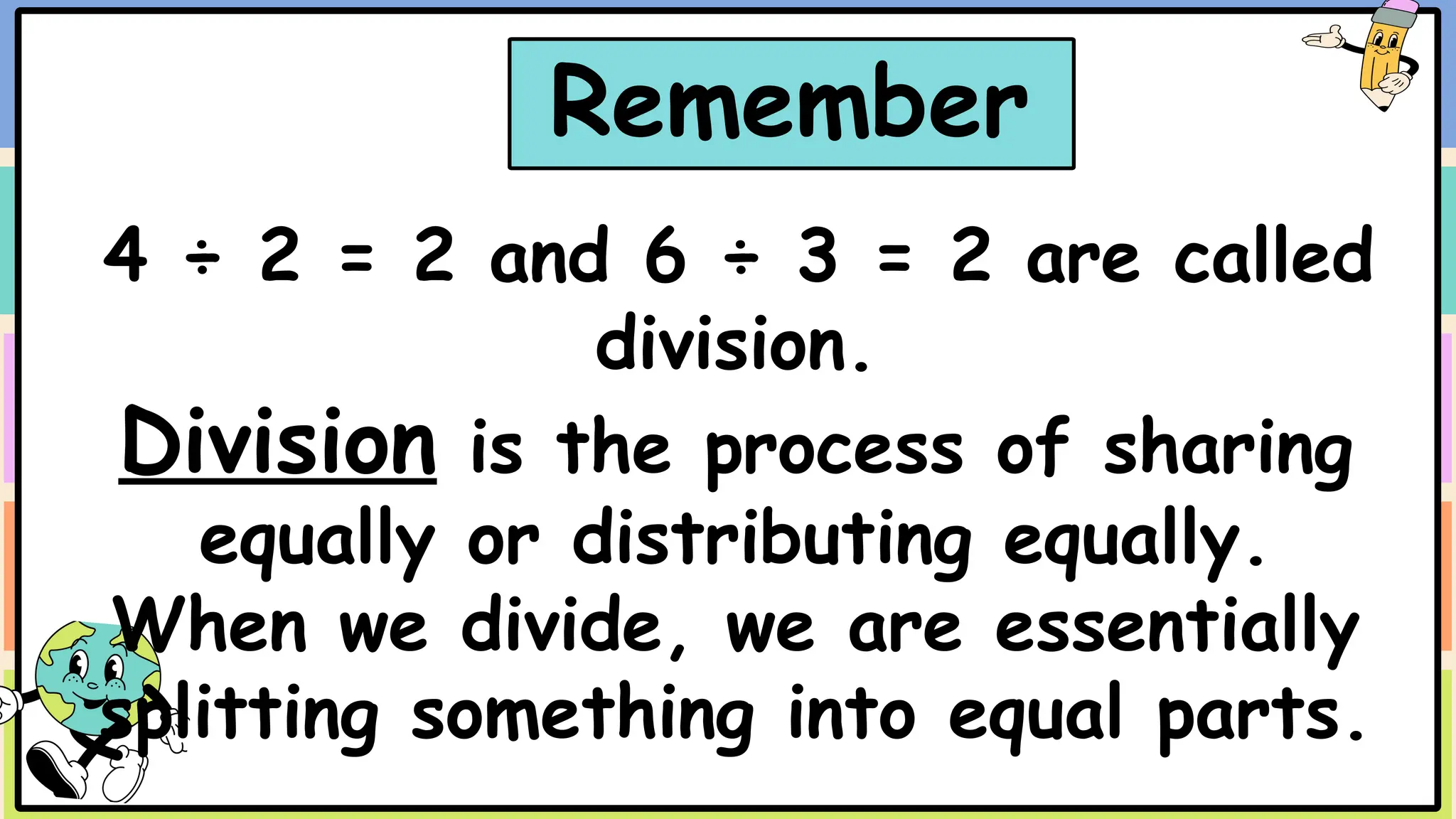
4 ÷ 2 = 2 and 6 ÷ 3 = 2 are called
division.
Division is the process of sharing
equally or distributing equally.
When we divide, we are essentially
splitting something into equal parts.
Remember
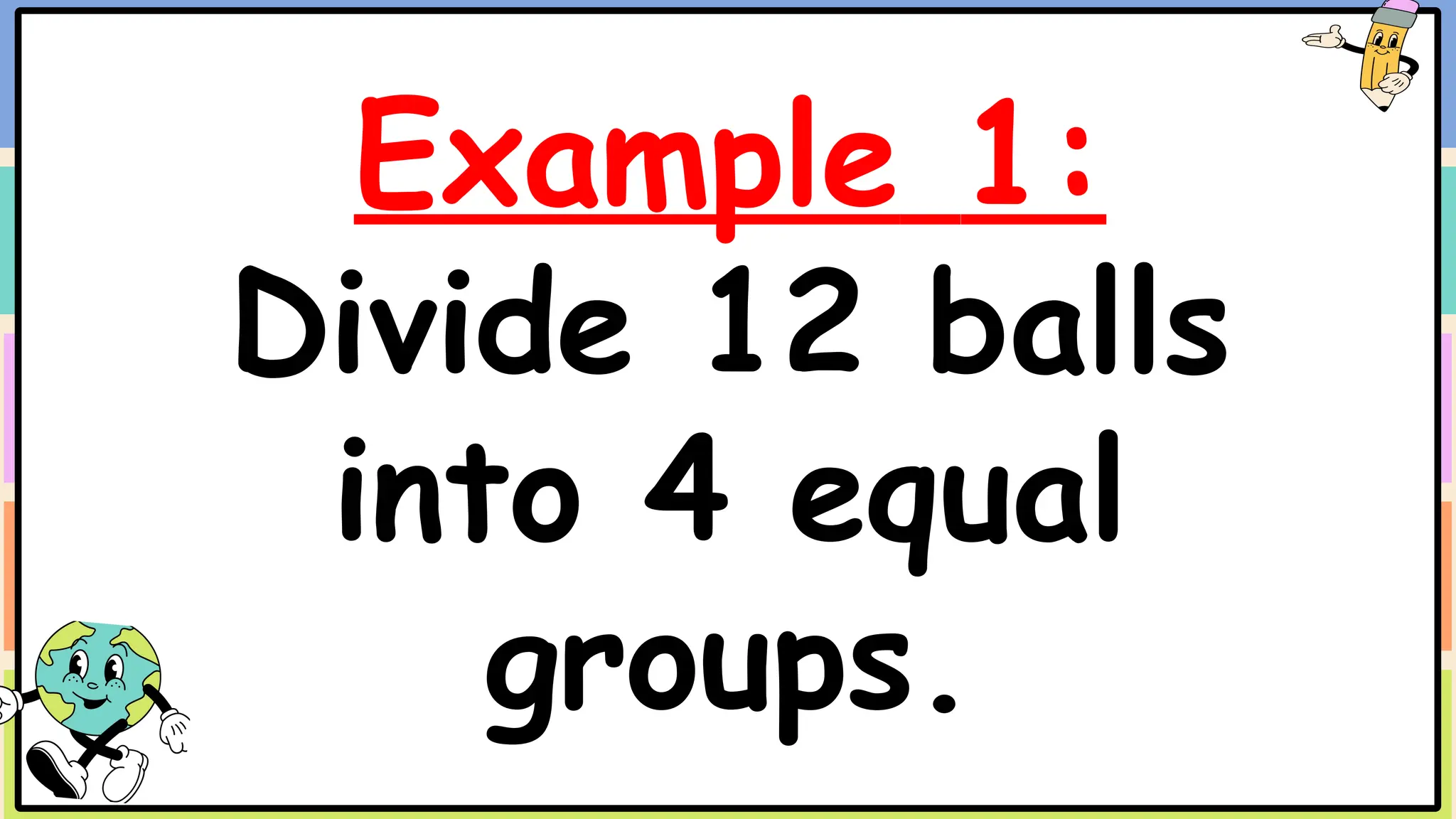
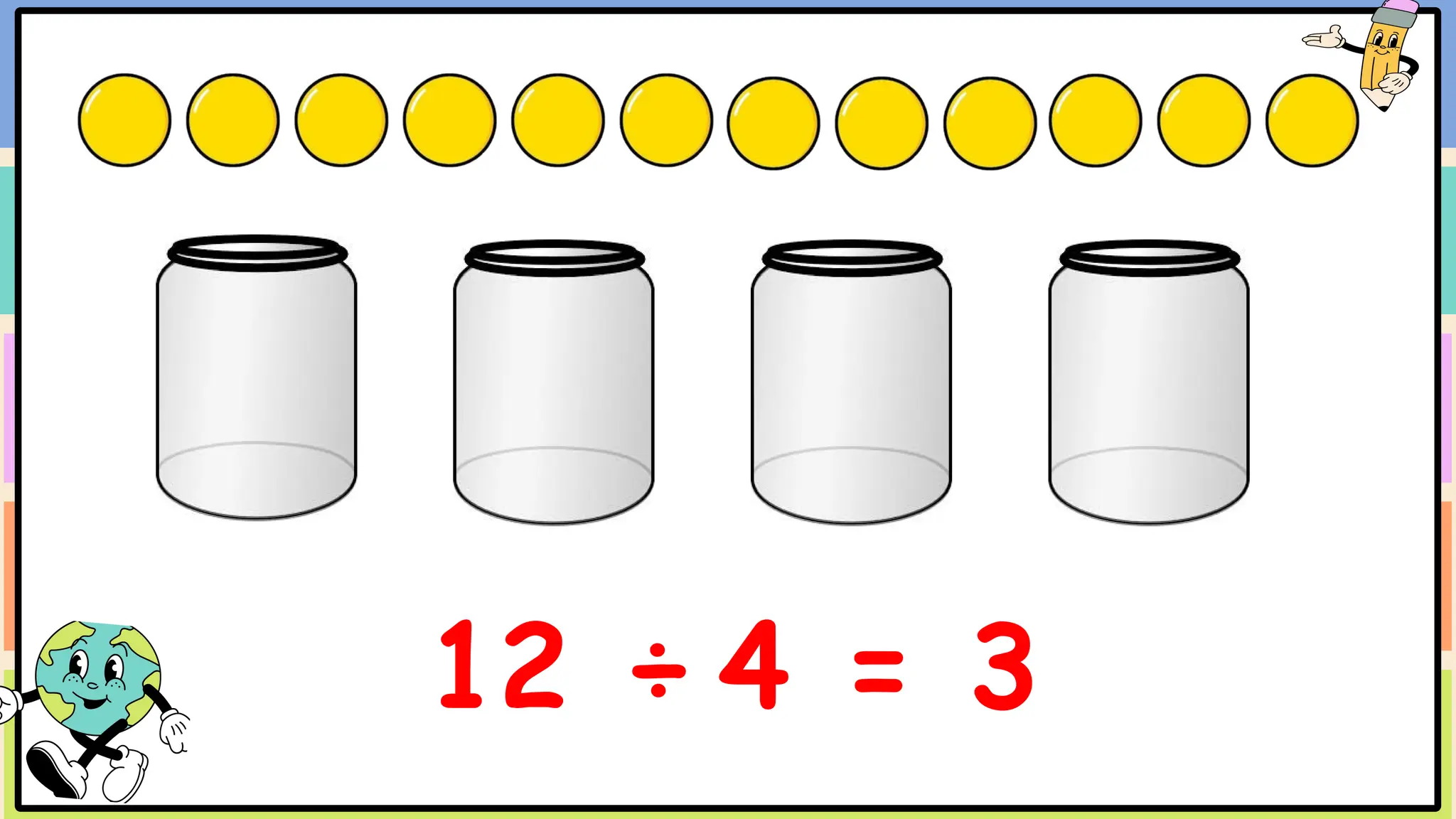
Example 1:
Divide 12 balls
into 4 equal
groups.
12 ÷ 4 = 3
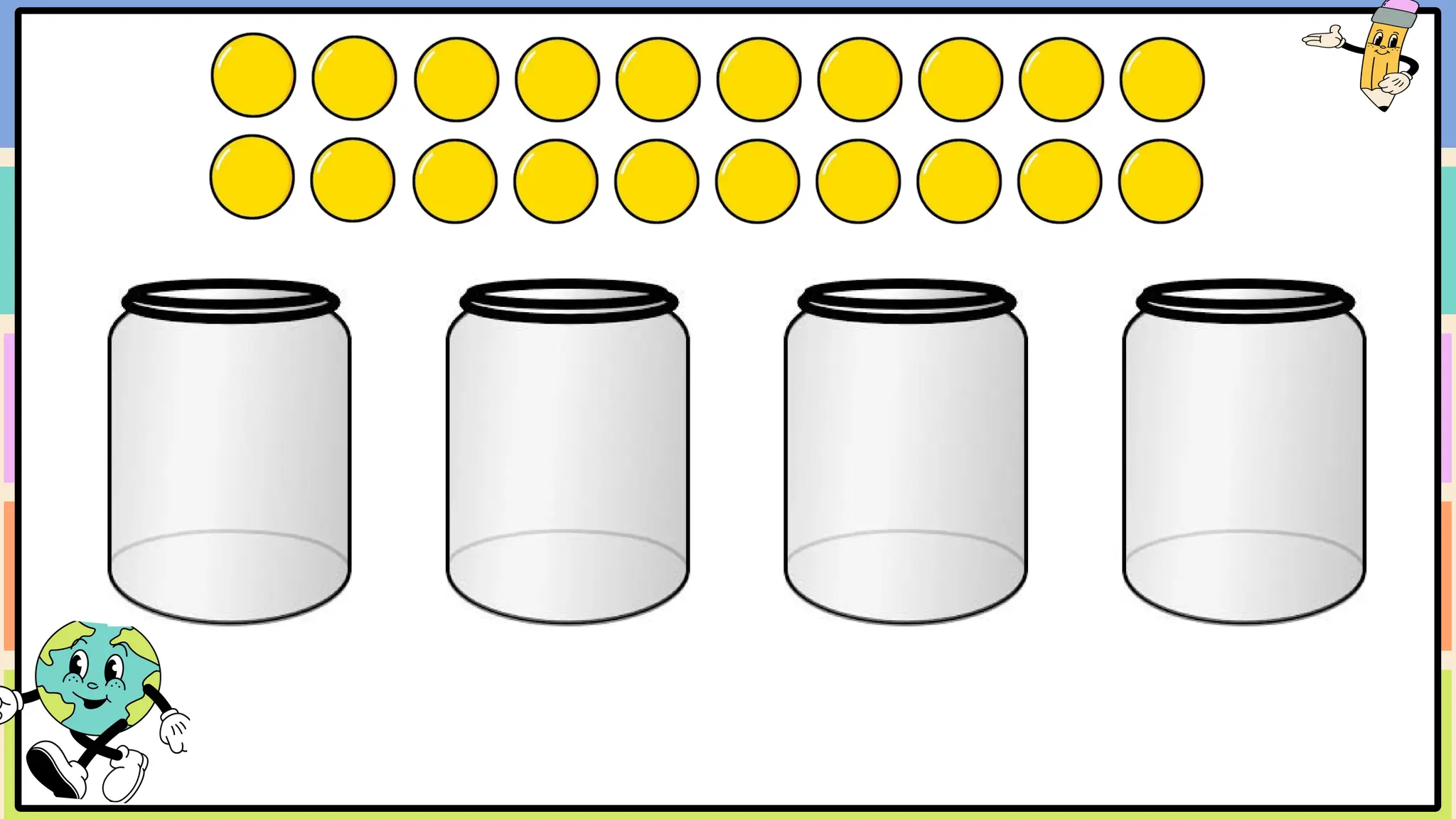
Example 2
Divide 20 balls
equally into 5
jars.
What do you call the
process of “sharing
equally” or
“distributing equally”?
It is division.
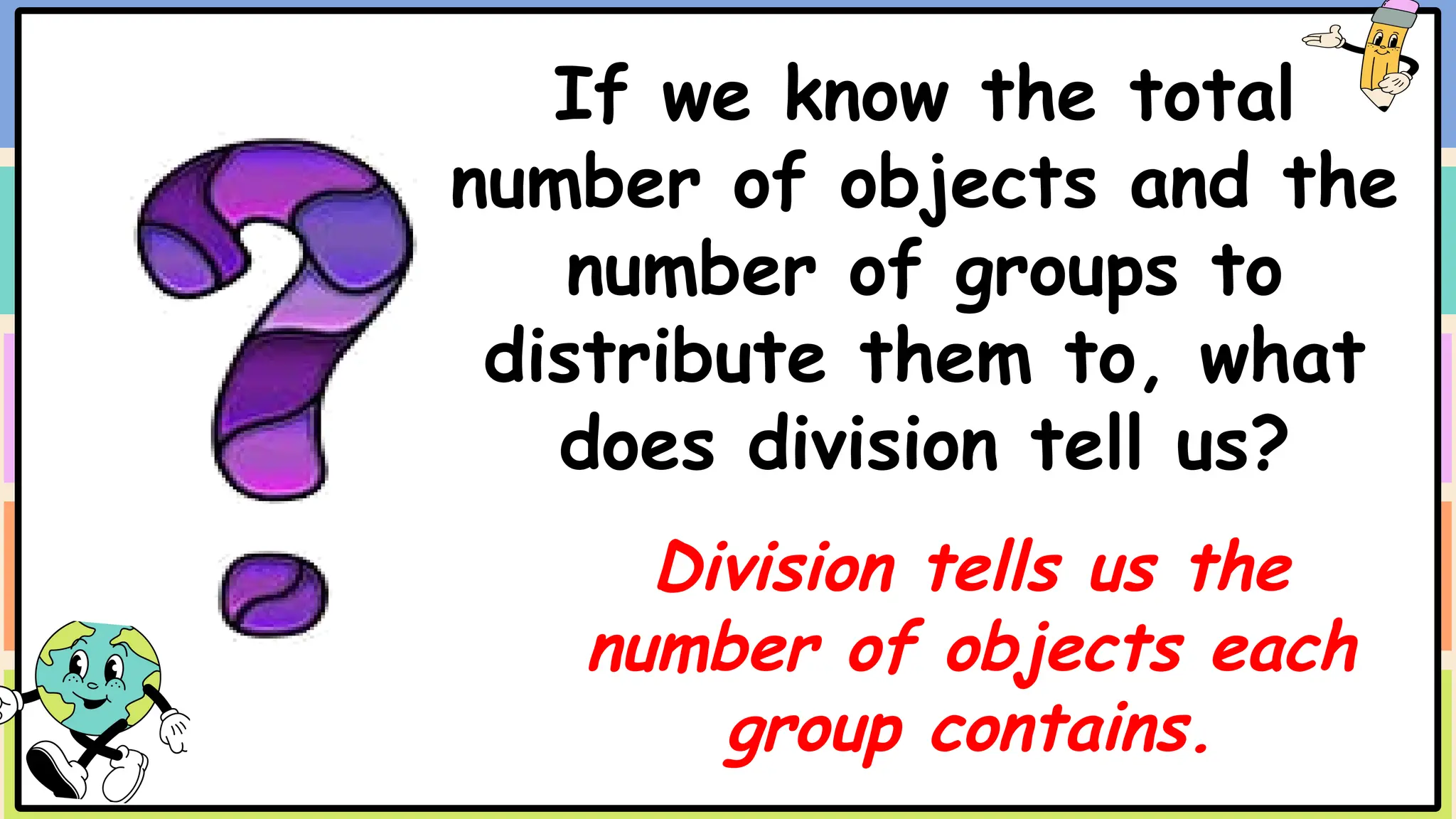
If we know the total
number of objects and the
number of groups to
distribute them to, what
does division tell us?
Division tells us the
number of objects each
group contains.
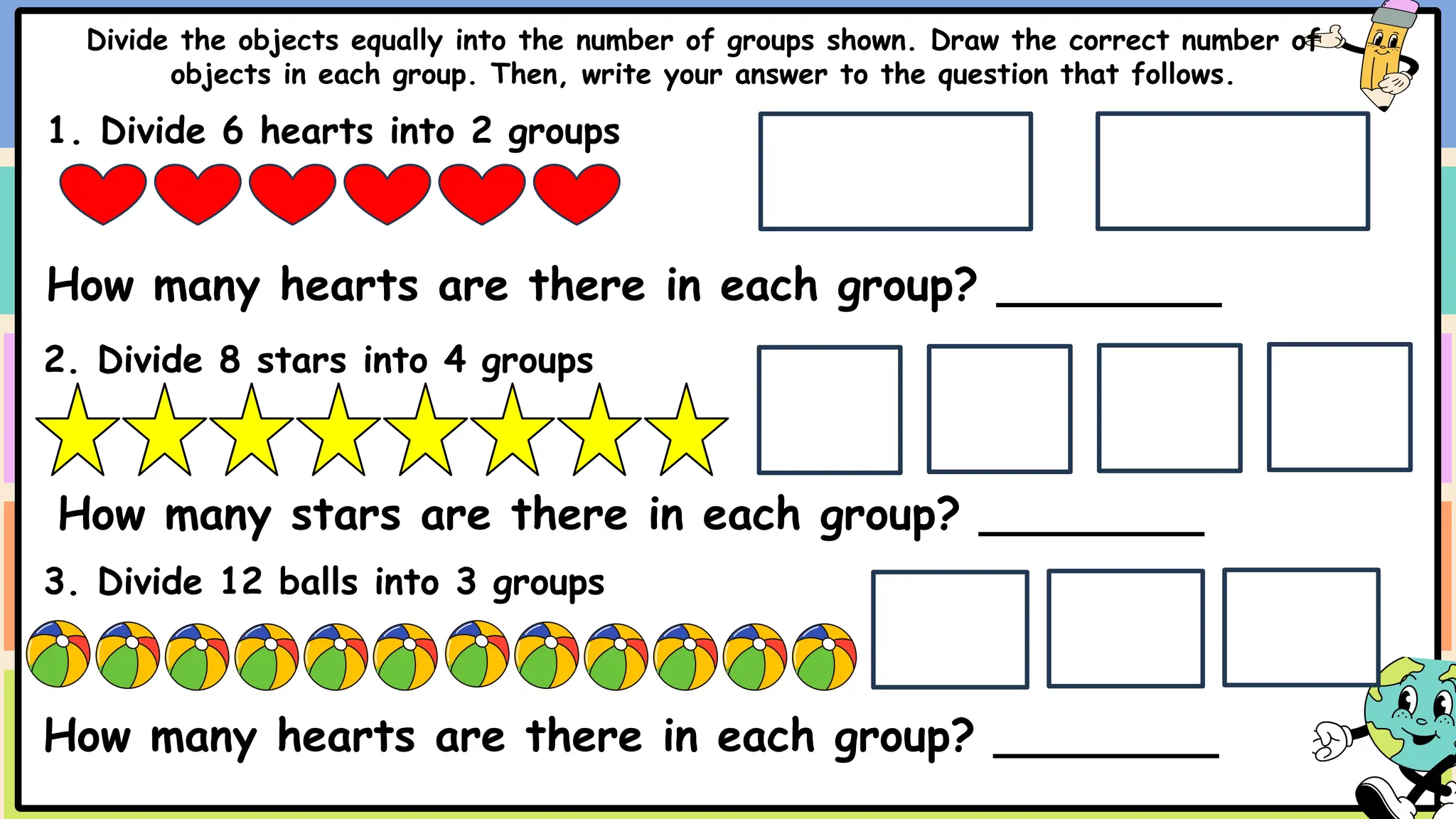
Divide the objects equally into the number of groups shown. Draw the correct number of
objects in each group. Then, write your answer to the question that follows.
1. Divide 6 hearts into 2 groups
How many hearts are there in each group? ________
2. Divide 8 stars into 4 groups
How many stars are there in each group? ________
3. Divide 12 balls into 3 groups
How many hearts are there in each group? ________
DAY 2
To p i c
At the end of the lesson, the learner
should be able to illustrate division by
forming groups with equal number of
objects.
What is division?
It is the process of
sharing equally or
distributing objects
into equal groups.
Bring out their your
show-me boards for a
short review.
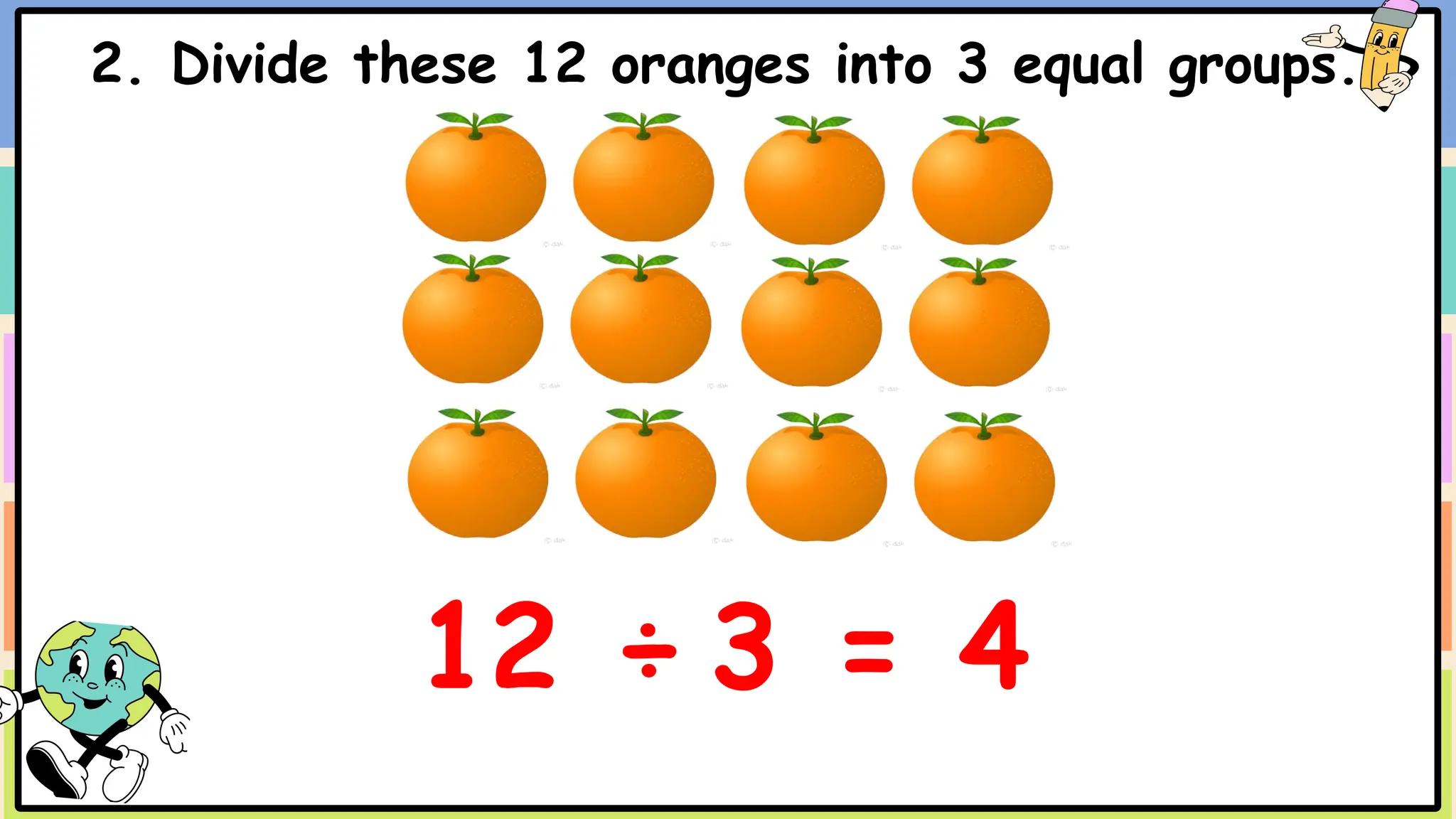
I have 12 oranges
shown on the board.
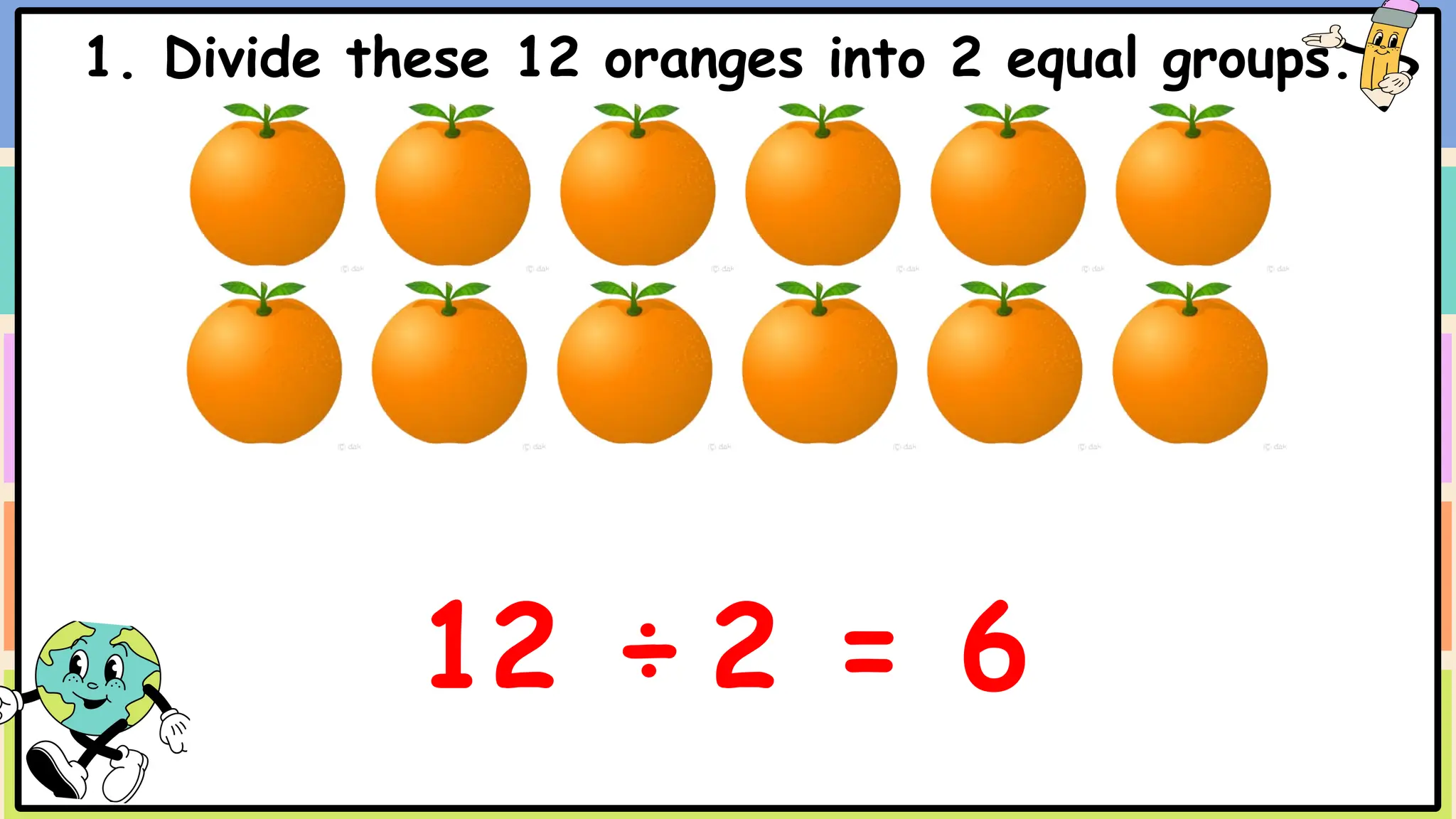
1. Divide these 12 oranges into 2 equal groups.
12 ÷ 2 = 6
How many oranges
are in each group?
There are 6
oranges in each
group.
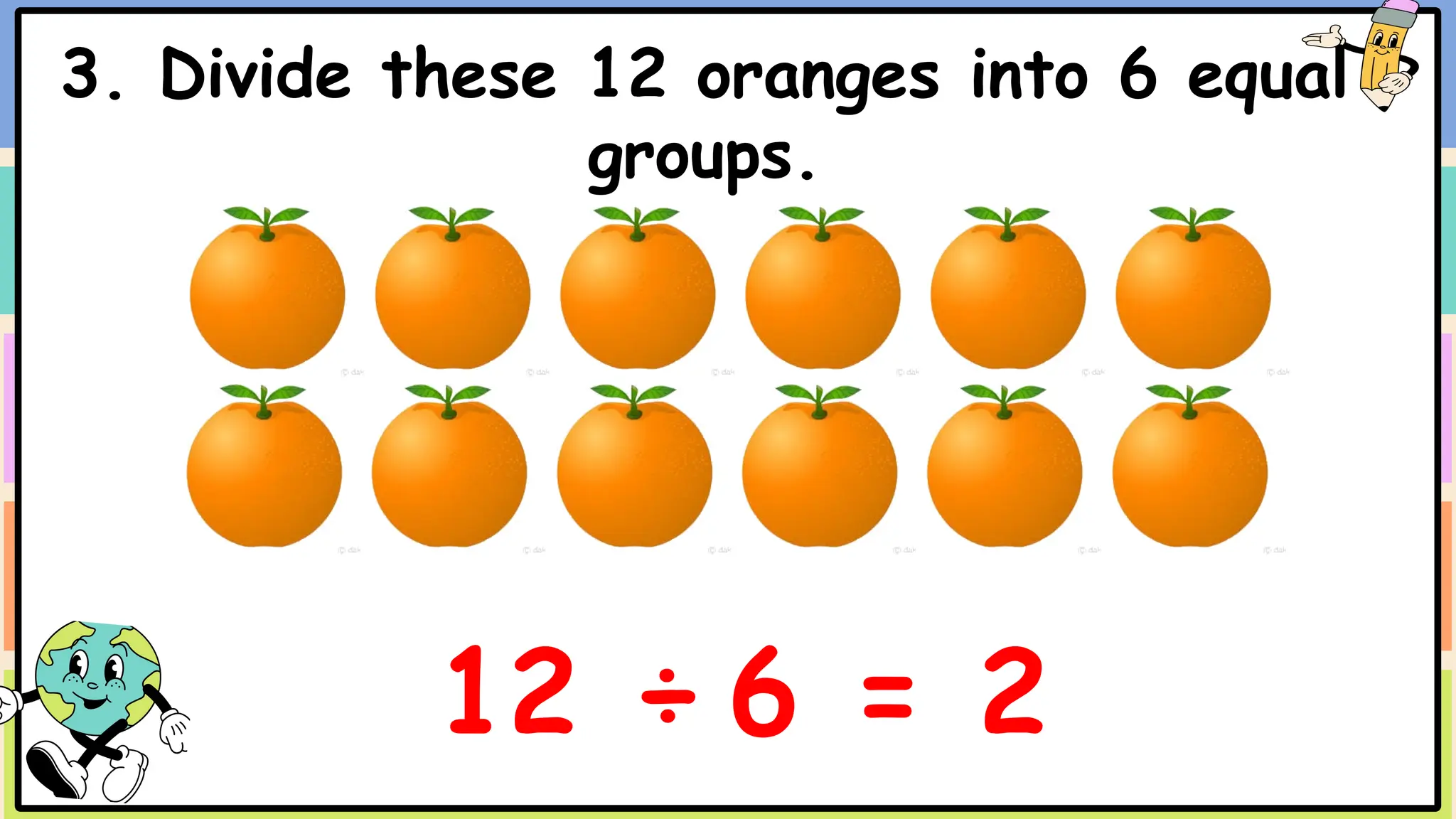
2. Divide these 12 oranges into 3 equal groups.
12 ÷ 3 = 4
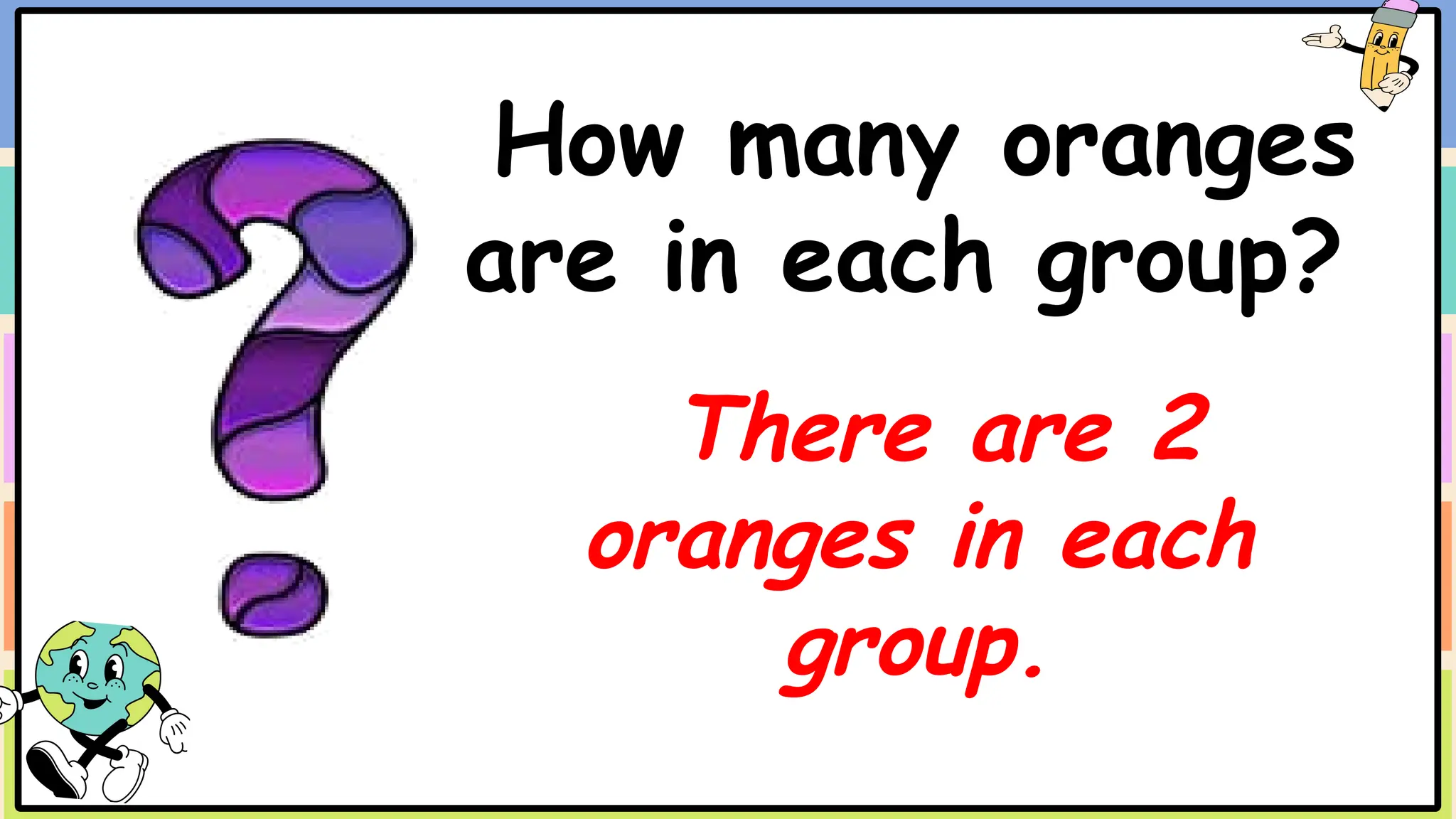
3. Divide these 12 oranges into 6 equal
groups.
12 ÷ 6 = 2
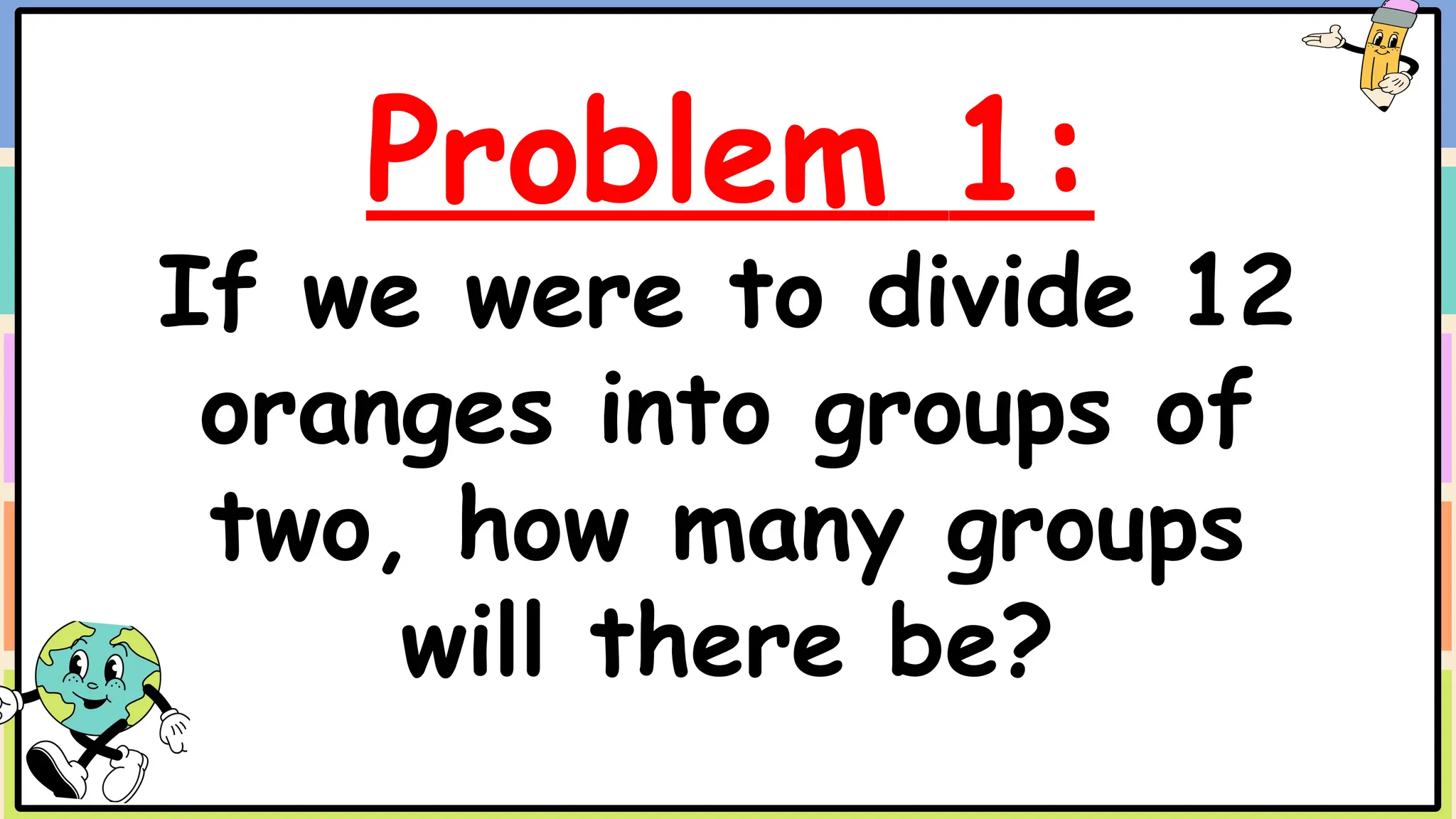
How many oranges
are in each group?
There are 2
oranges in each
group.
Problem 1:
If we were to divide 12
oranges into groups of
two, how many groups
will there be?
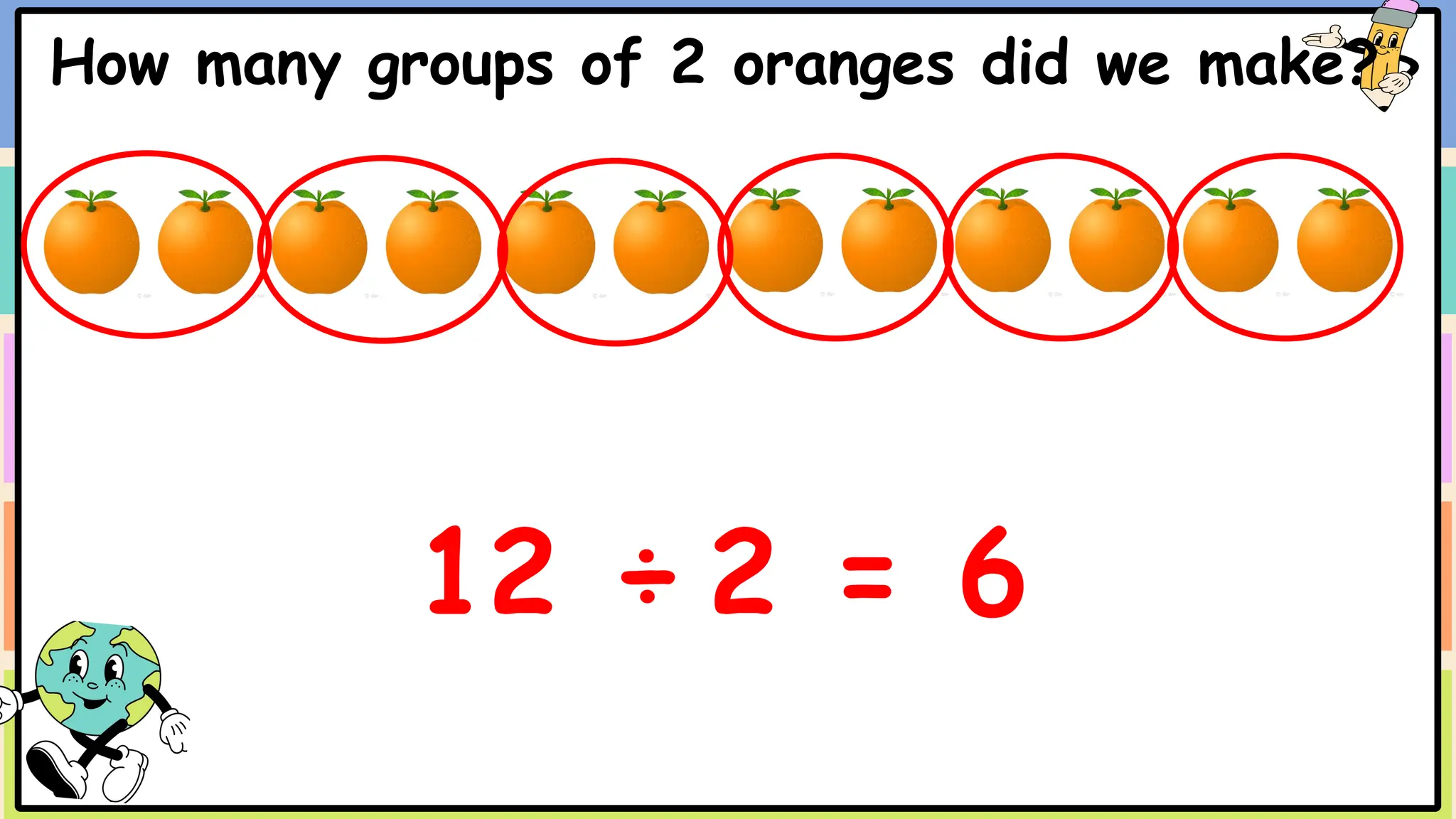
How many groups of 2 oranges did we make?
12 ÷ 2 = 6
Problem 2:
If we were to divide 12
oranges into groups of
three, how many groups
will there be?
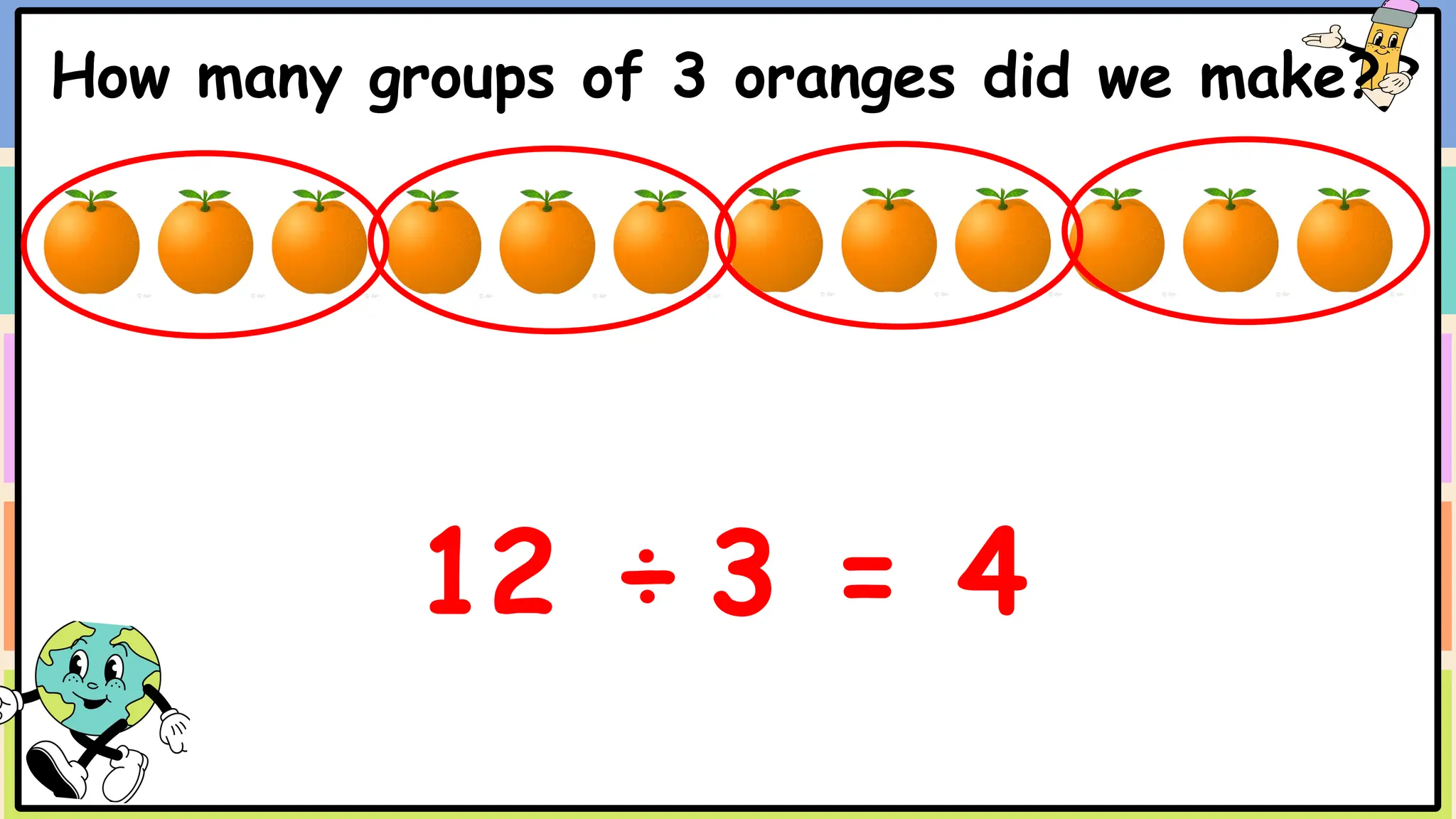
How many groups of 3 oranges did we make?
12 ÷ 3 = 4
Problem 3:
If we were to divide 12
oranges into groups of
four, how many groups
will there be?
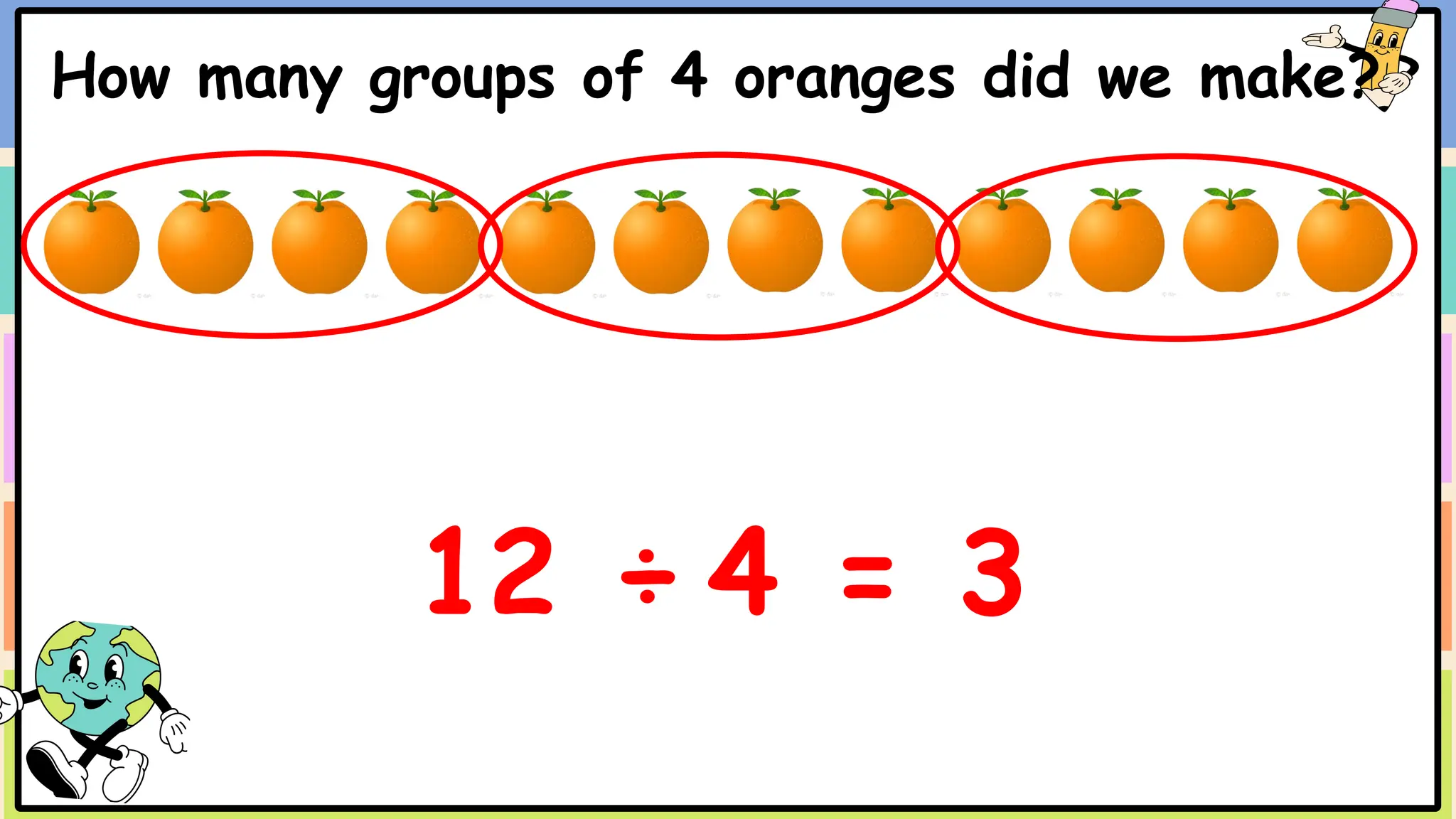
How many groups of 4 oranges did we make?
12 ÷ 4 = 3
Problem 4:
If we were to divide 12
oranges into groups of
six, how many groups will
there be?
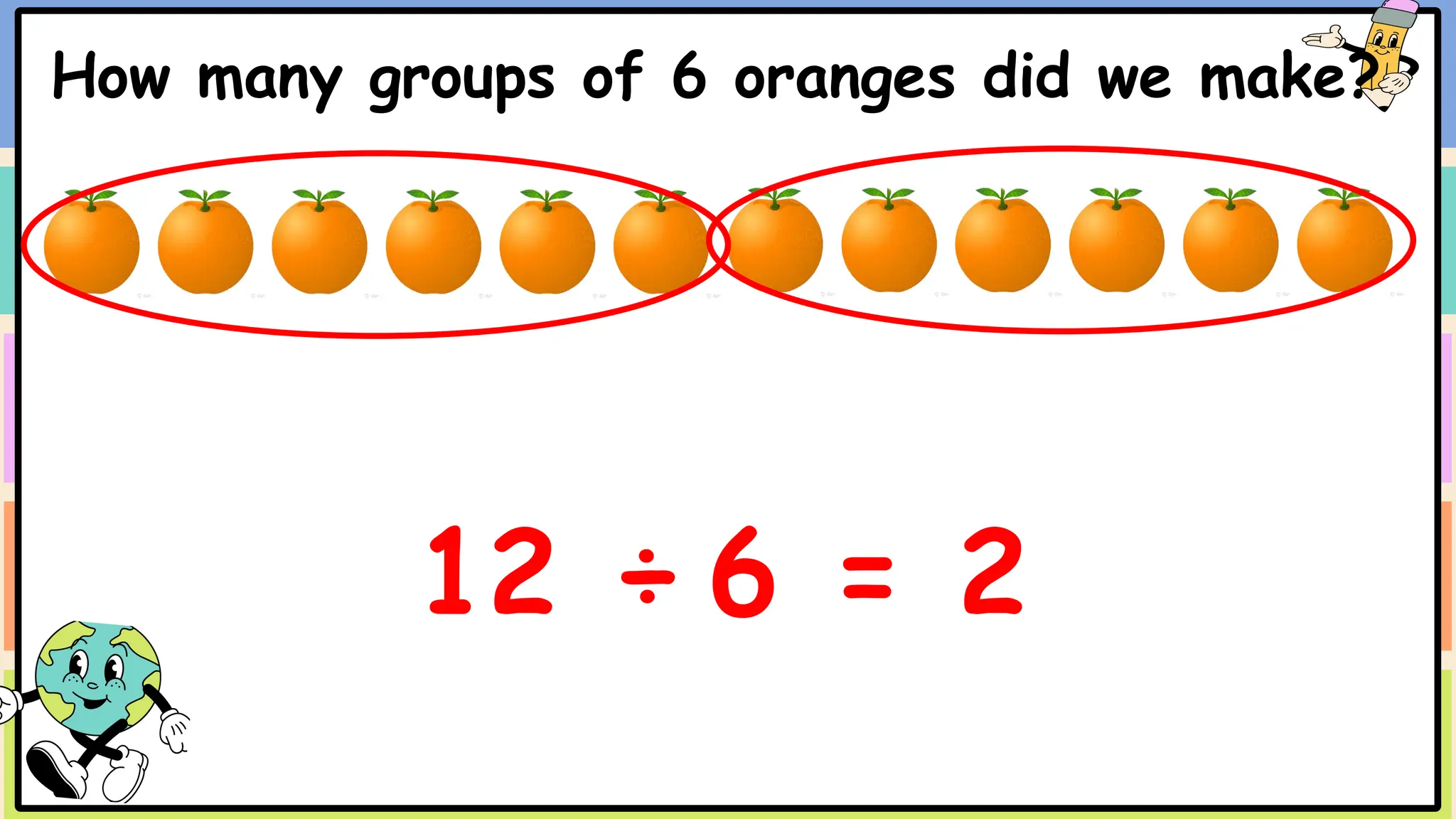
How many groups of 6 oranges did we make?
12 ÷ 6 = 2
If we know the total number
of objects and the size
(number of objects) of each
group, what does division tell
us?
Division tells us how many
groups can be made when
each group contains a
specific number of objects.
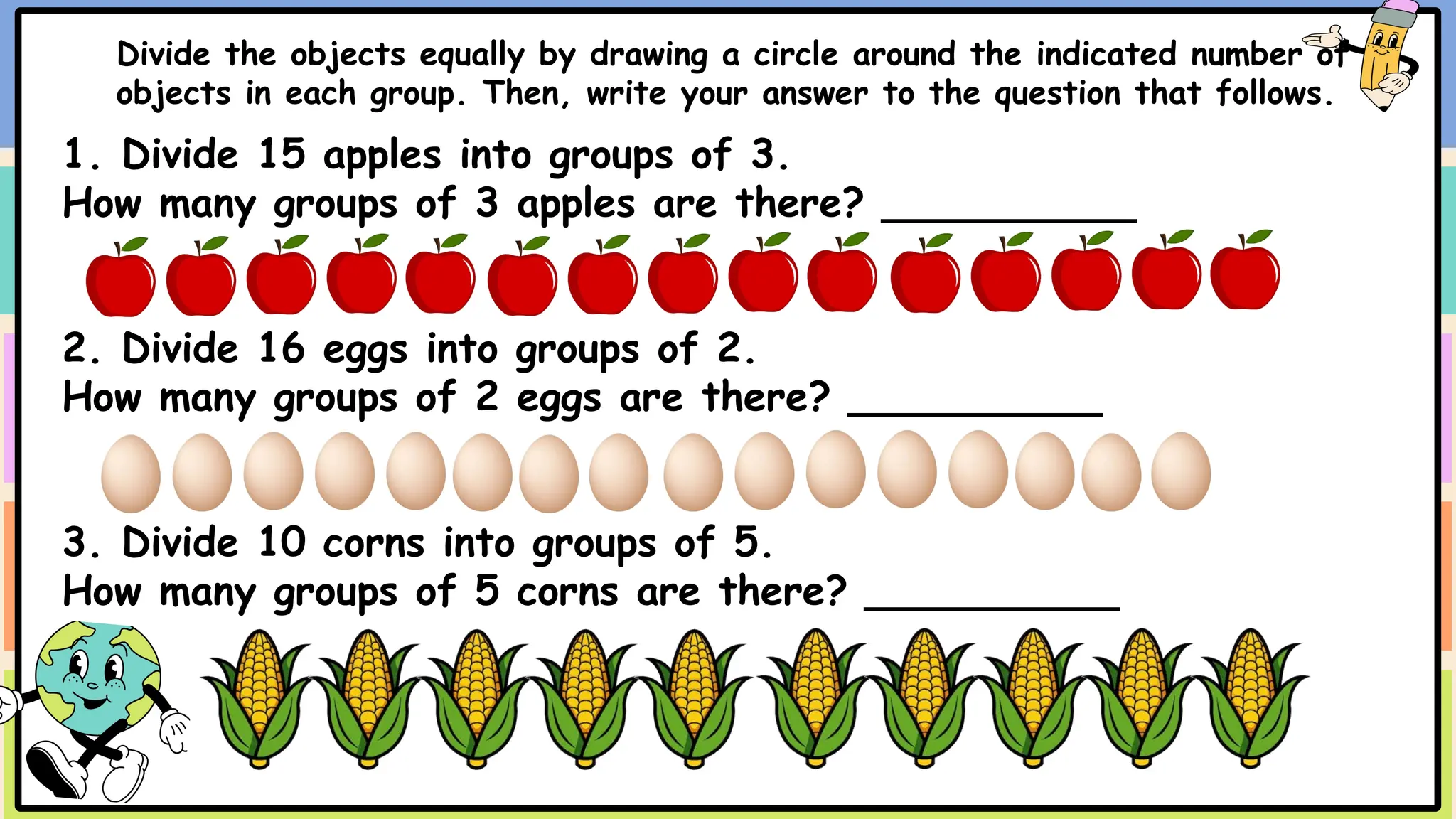
Divide the objects equally by drawing a circle around the indicated number of
objects in each group. Then, write your answer to the question that follows.
1. Divide 15 apples into groups of 3.
How many groups of 3 apples are there? __________
2. Divide 16 eggs into groups of 2.
How many groups of 2 eggs are there? __________
3. Divide 10 corns into groups of 5.
How many groups of 5 corns are there? __________
DAY 3
To p i c
At the end of the lesson, the learner
should be able to illustrate and write
division expressions as repeated
subtraction.
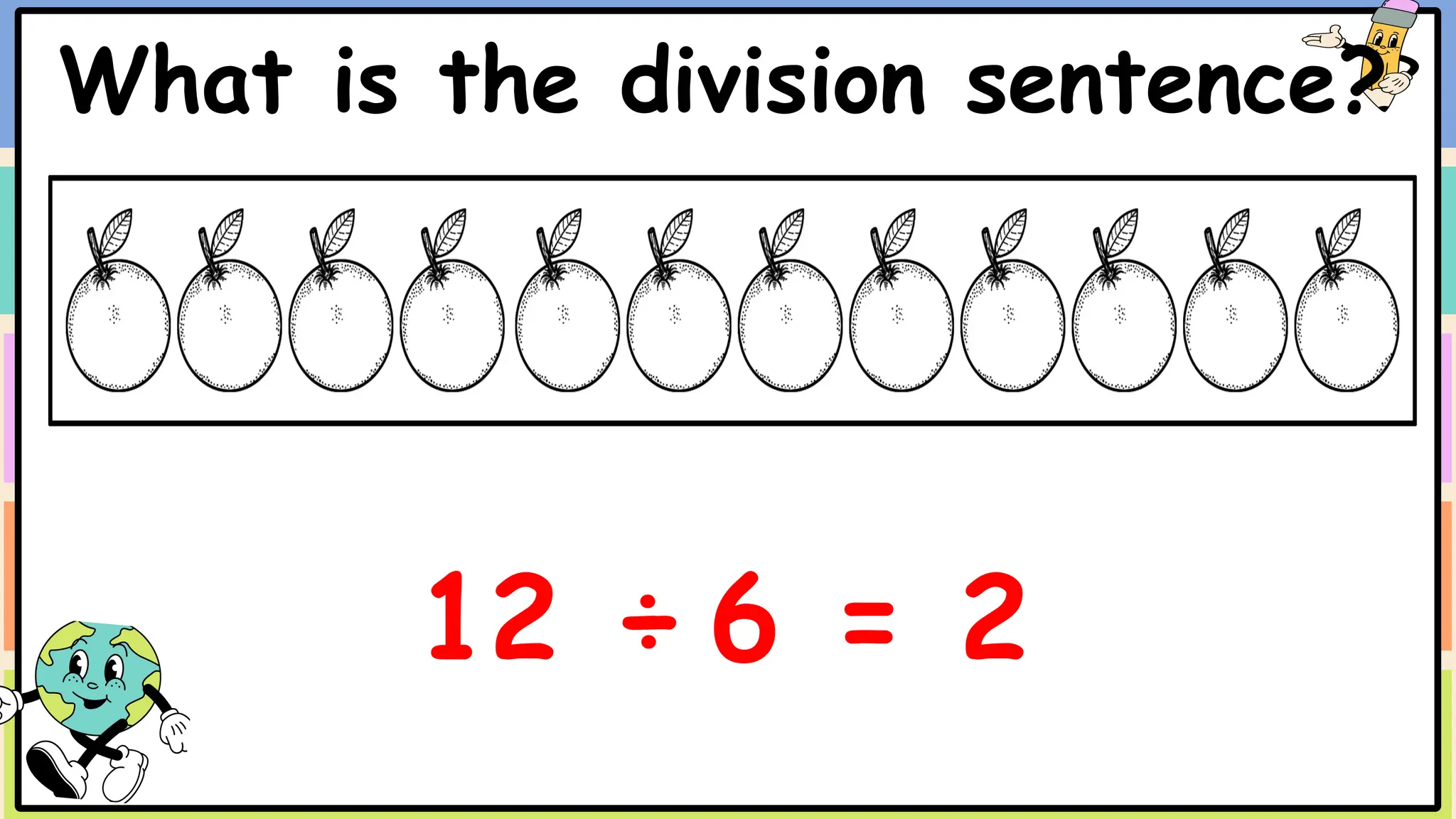
What is the division sentence?
12 ÷ 6 = 2
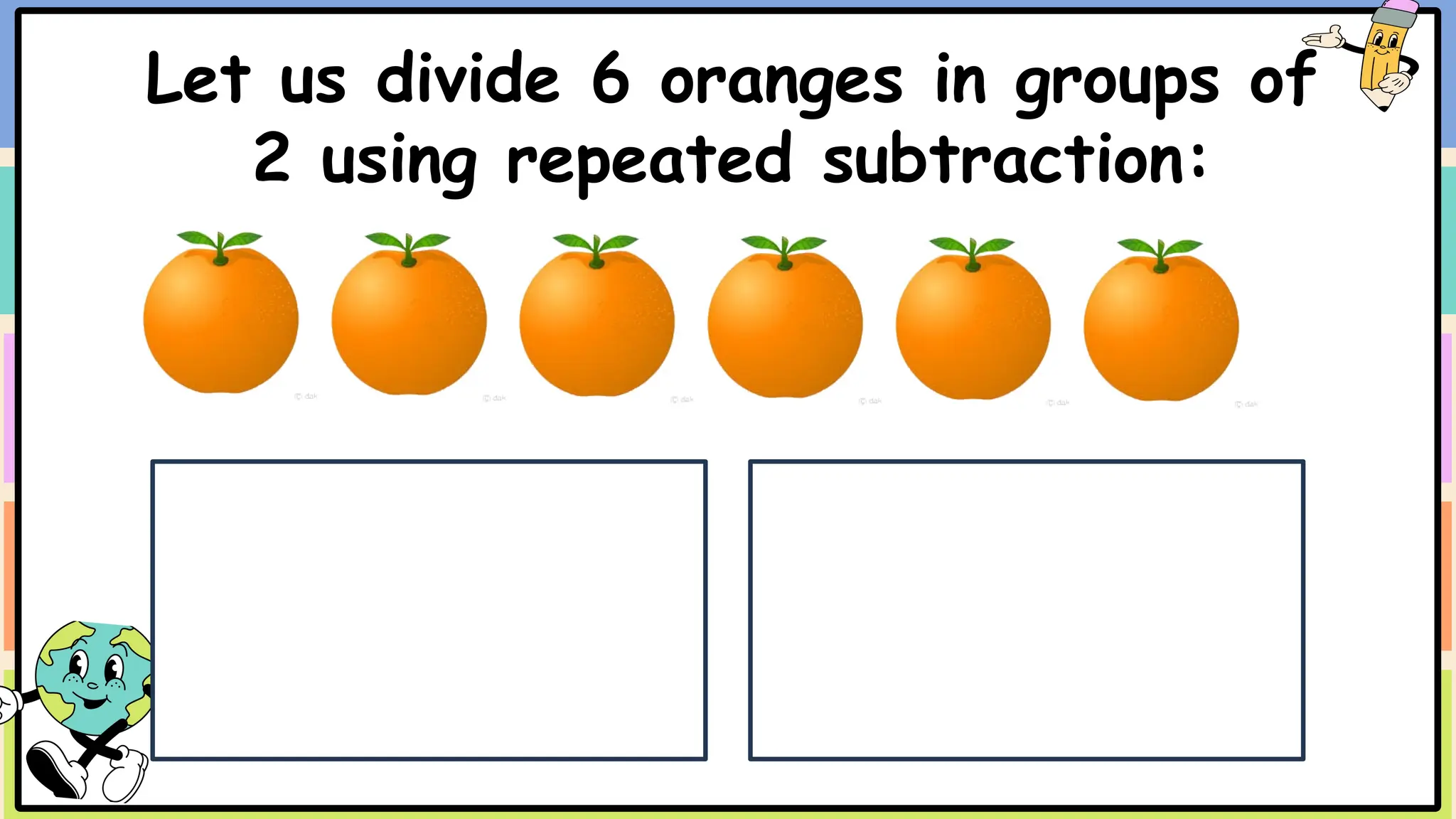
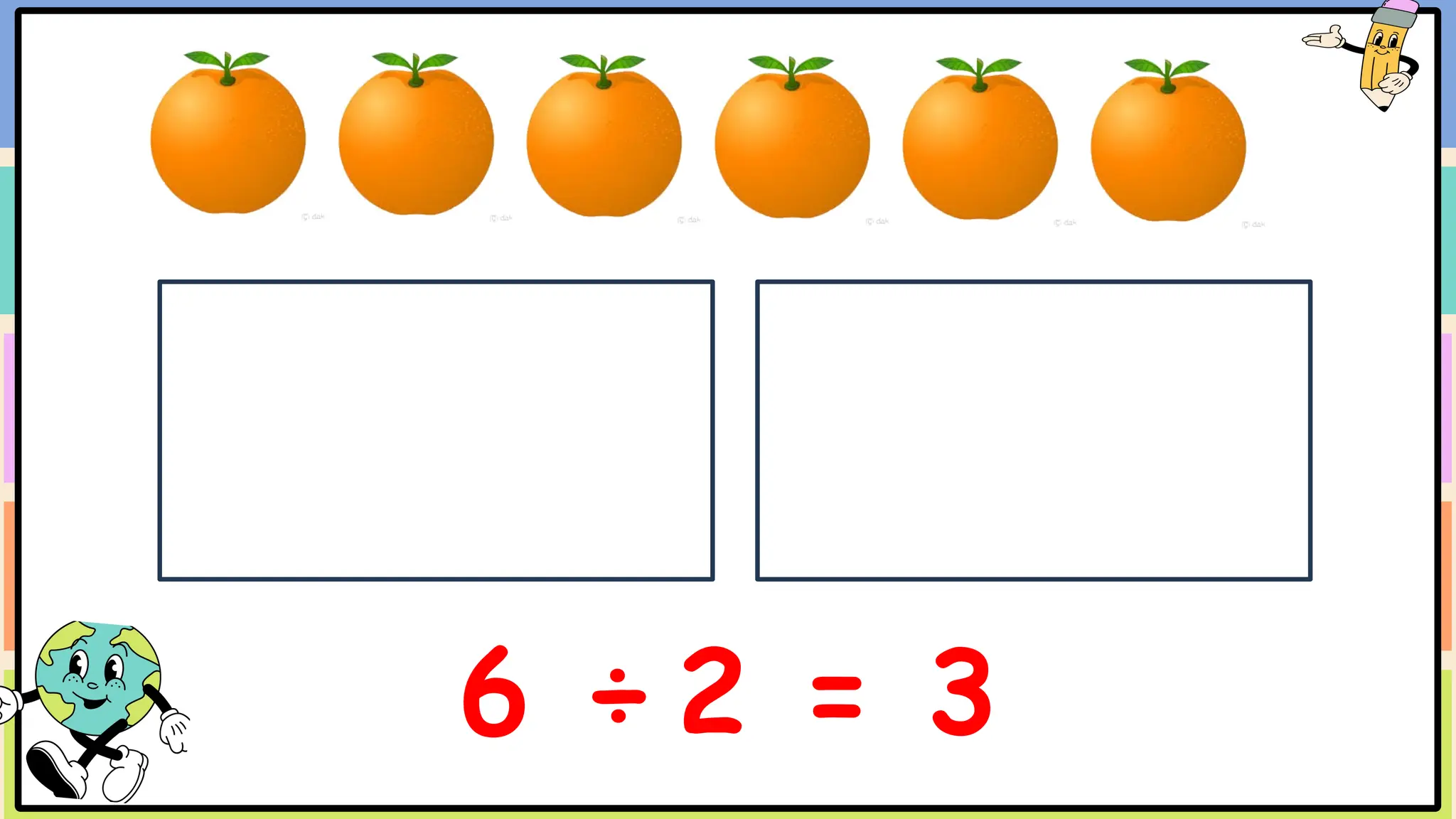
Let us divide 6 oranges in groups of
2 using repeated subtraction:
6 ÷ 2 = 3
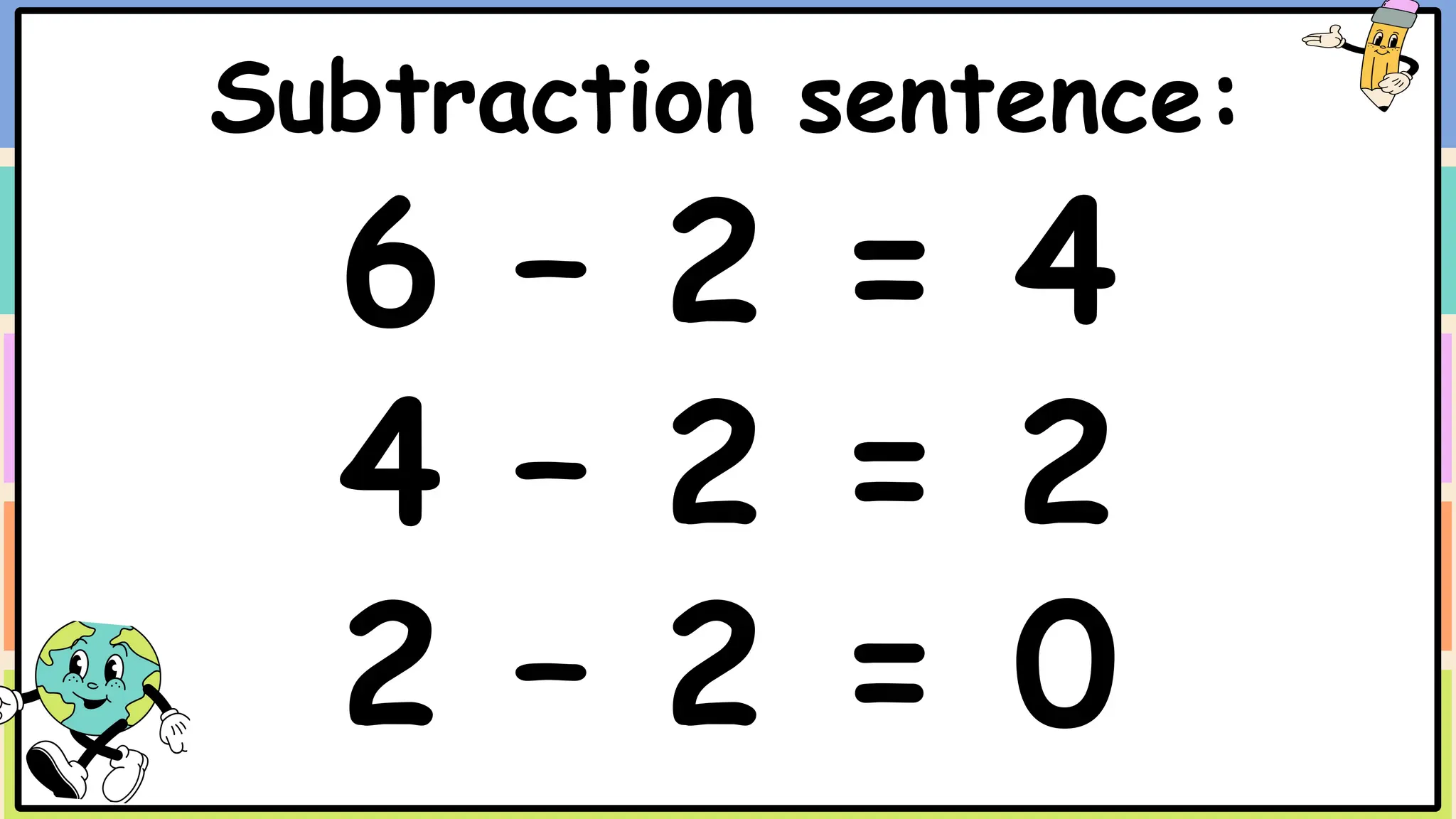
Subtraction sentence:
6 – 2 = 4
4 – 2 = 2
2 – 2 = 0
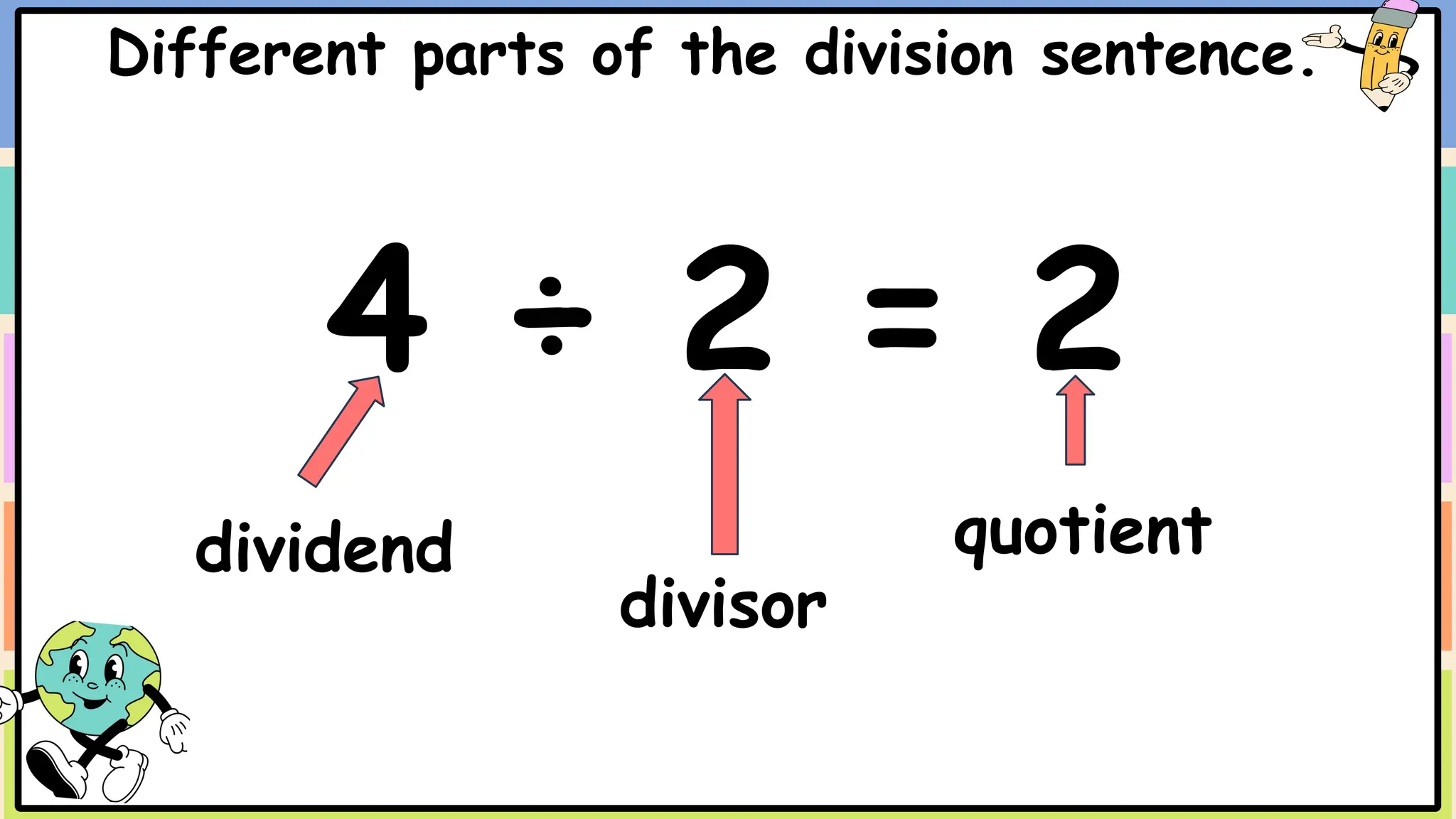
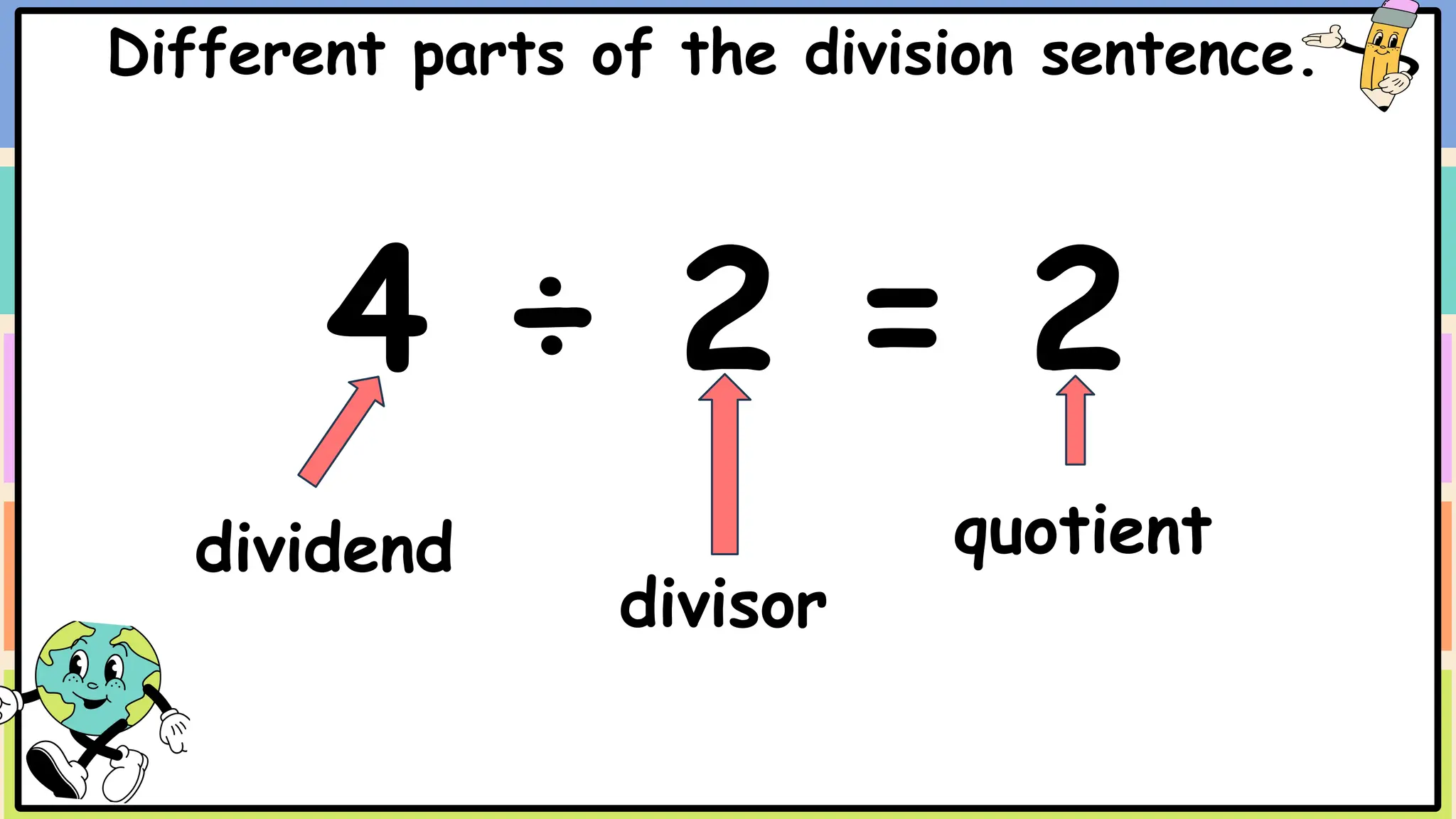
4 ÷ 2 = 2
dividend
divisor
quotient
Different parts of the division sentence.
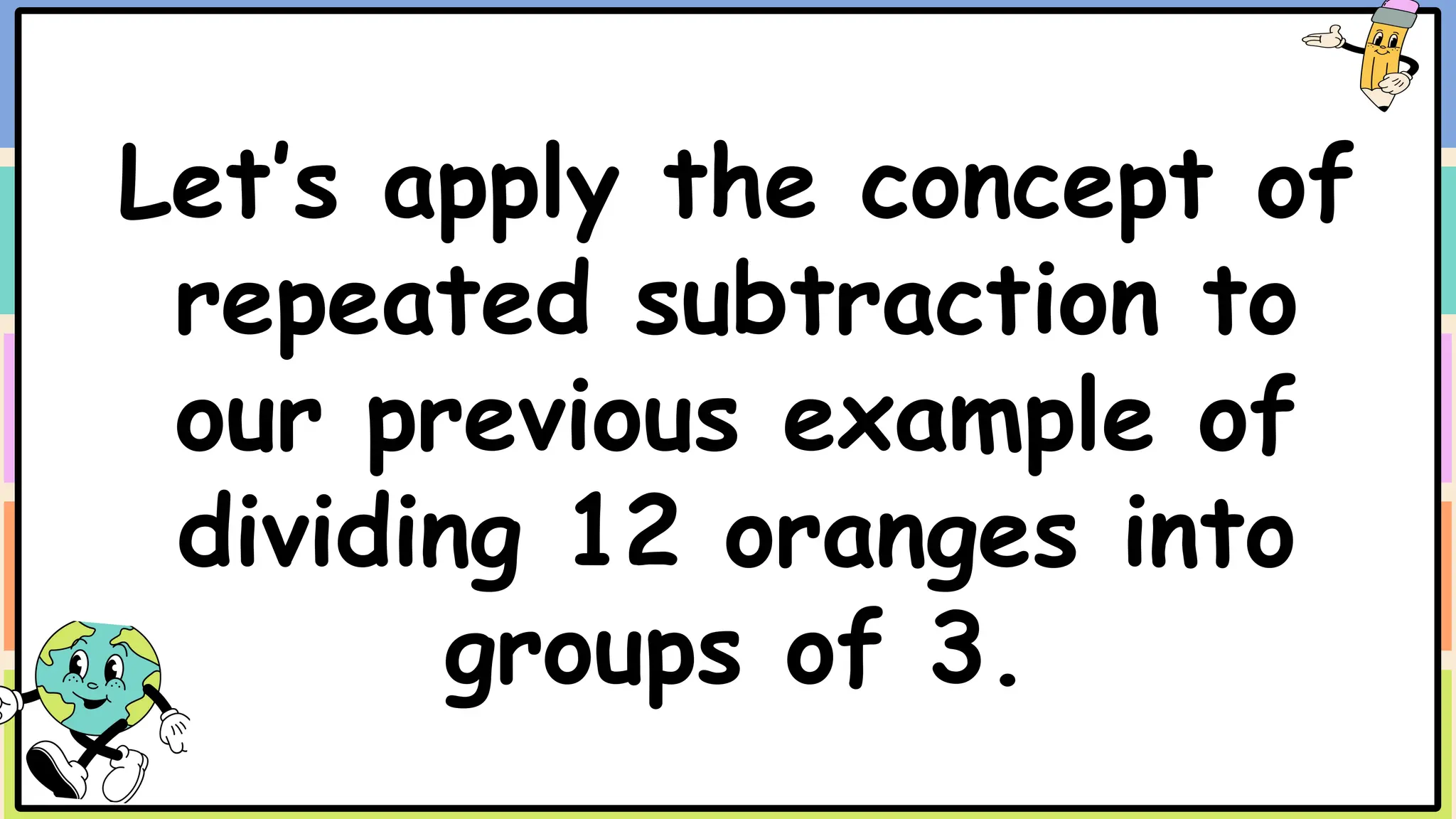
Let’s apply the concept of
repeated subtraction to
our previous example of
dividing 12 oranges into
groups of 3.
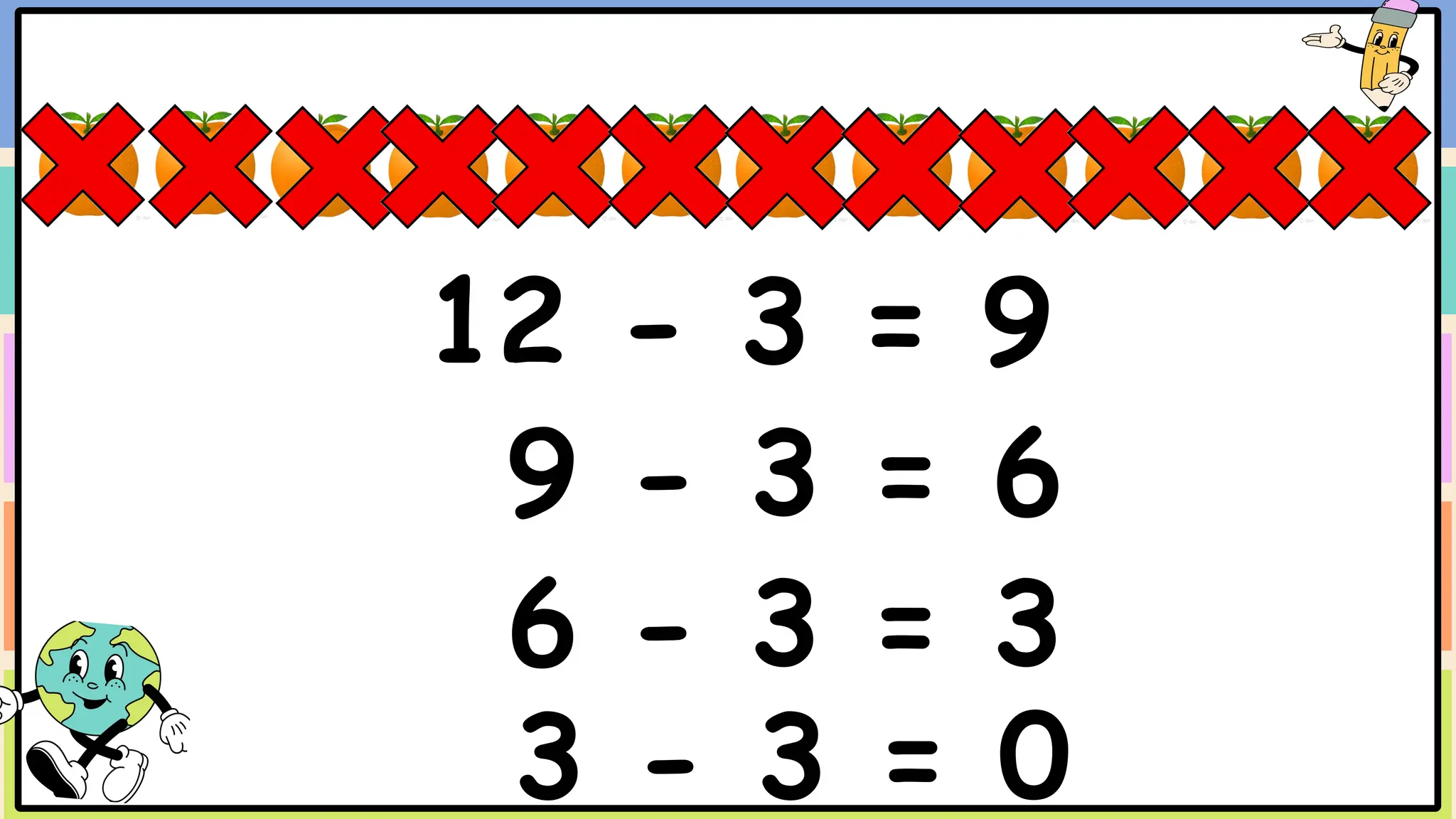
12 - 3 = 9
9 - 3 = 6
6 - 3 = 3
3 - 3 = 0
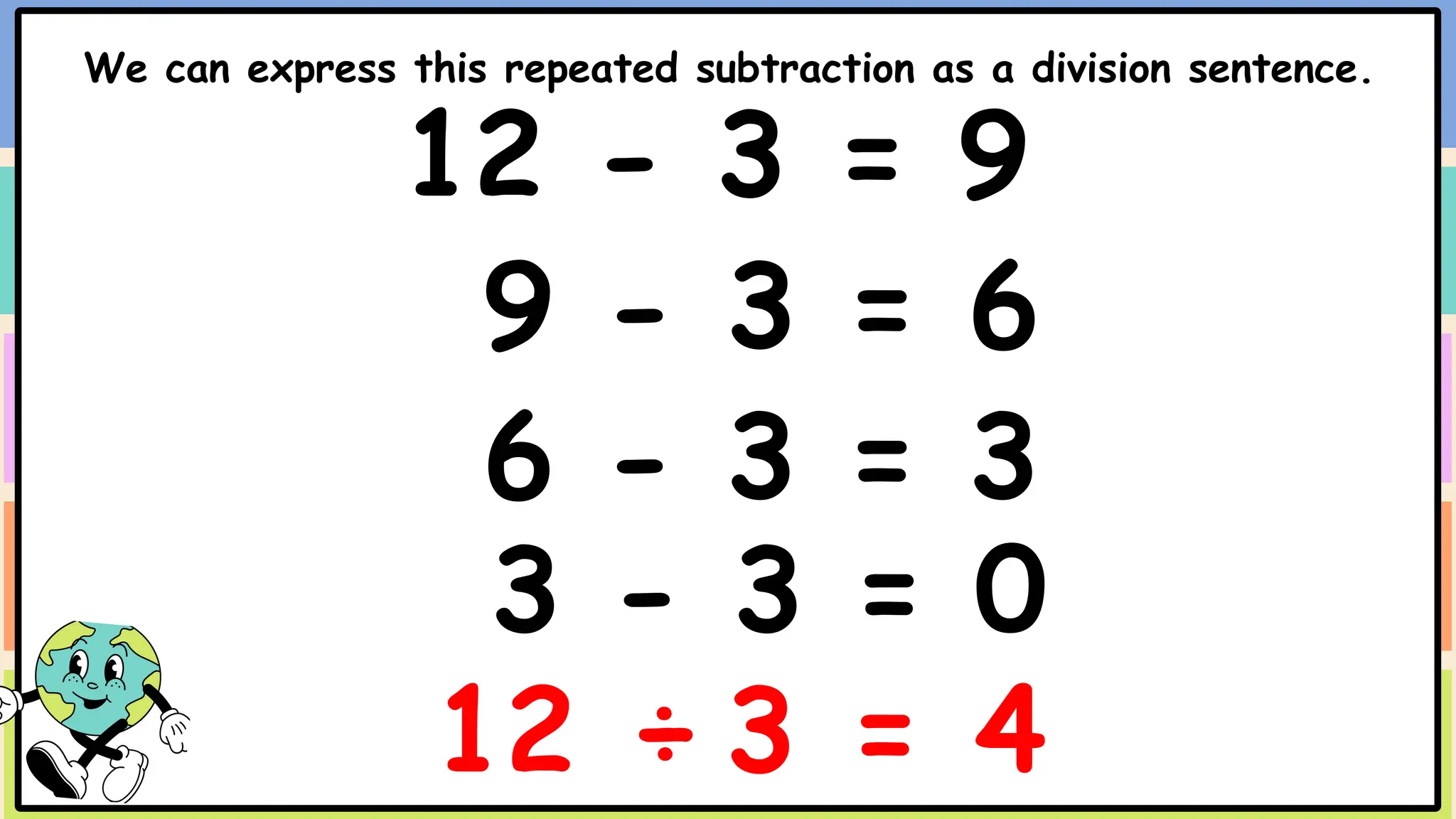
12 - 3 = 9
9 - 3 = 6
6 - 3 = 3
3 - 3 = 0
We can express this repeated subtraction as a division sentence.
12 ÷ 3 = 4
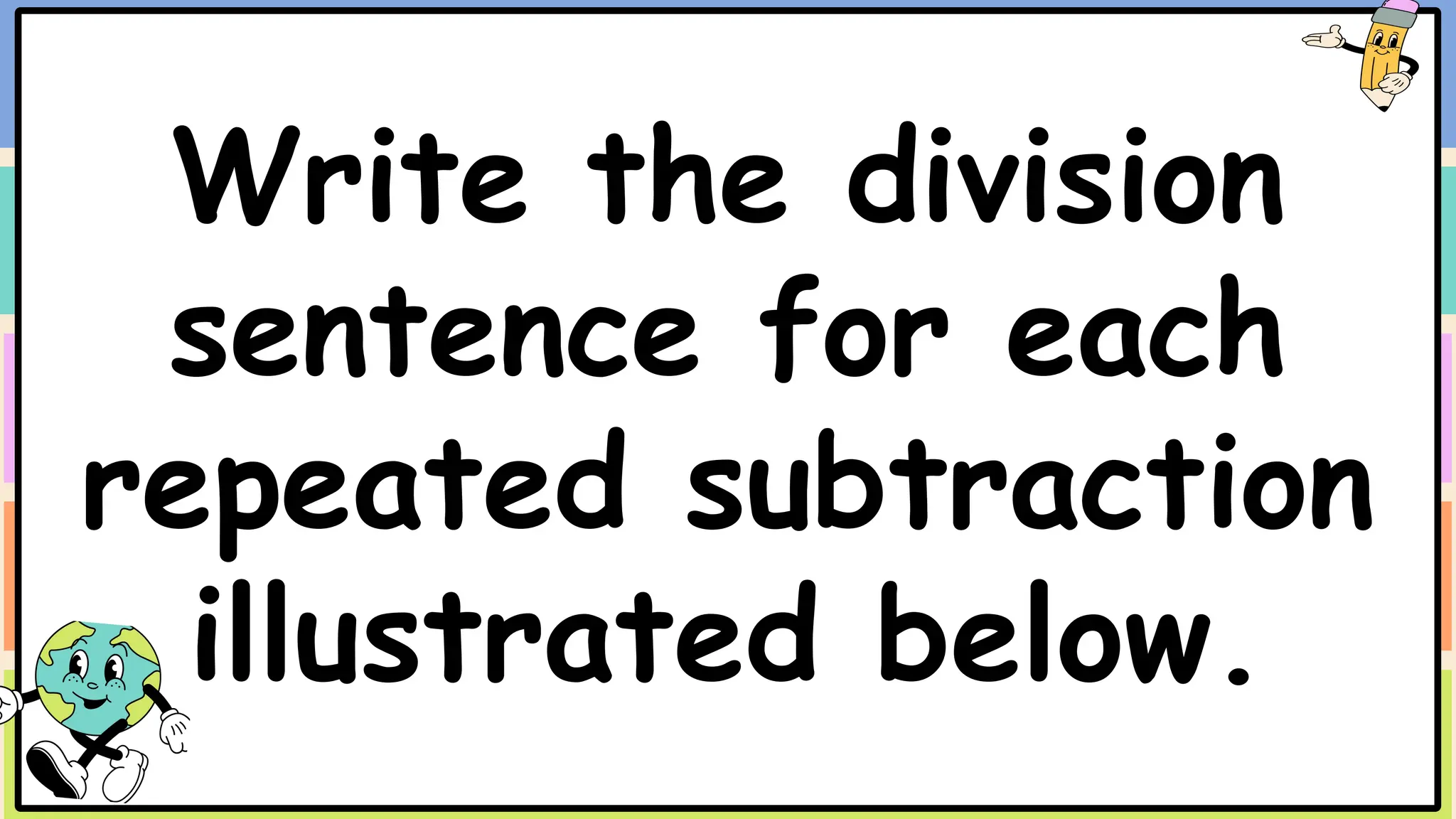
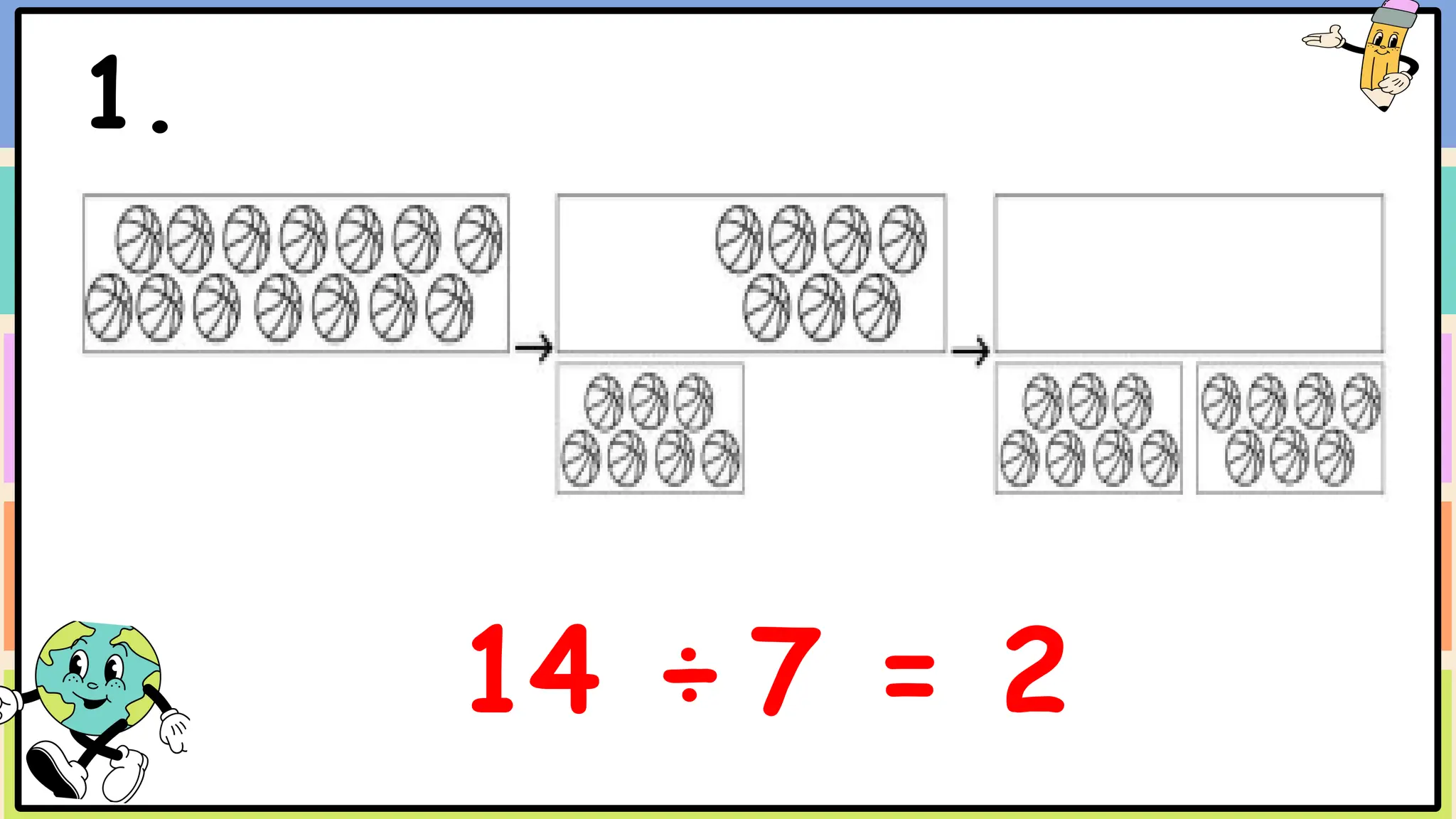
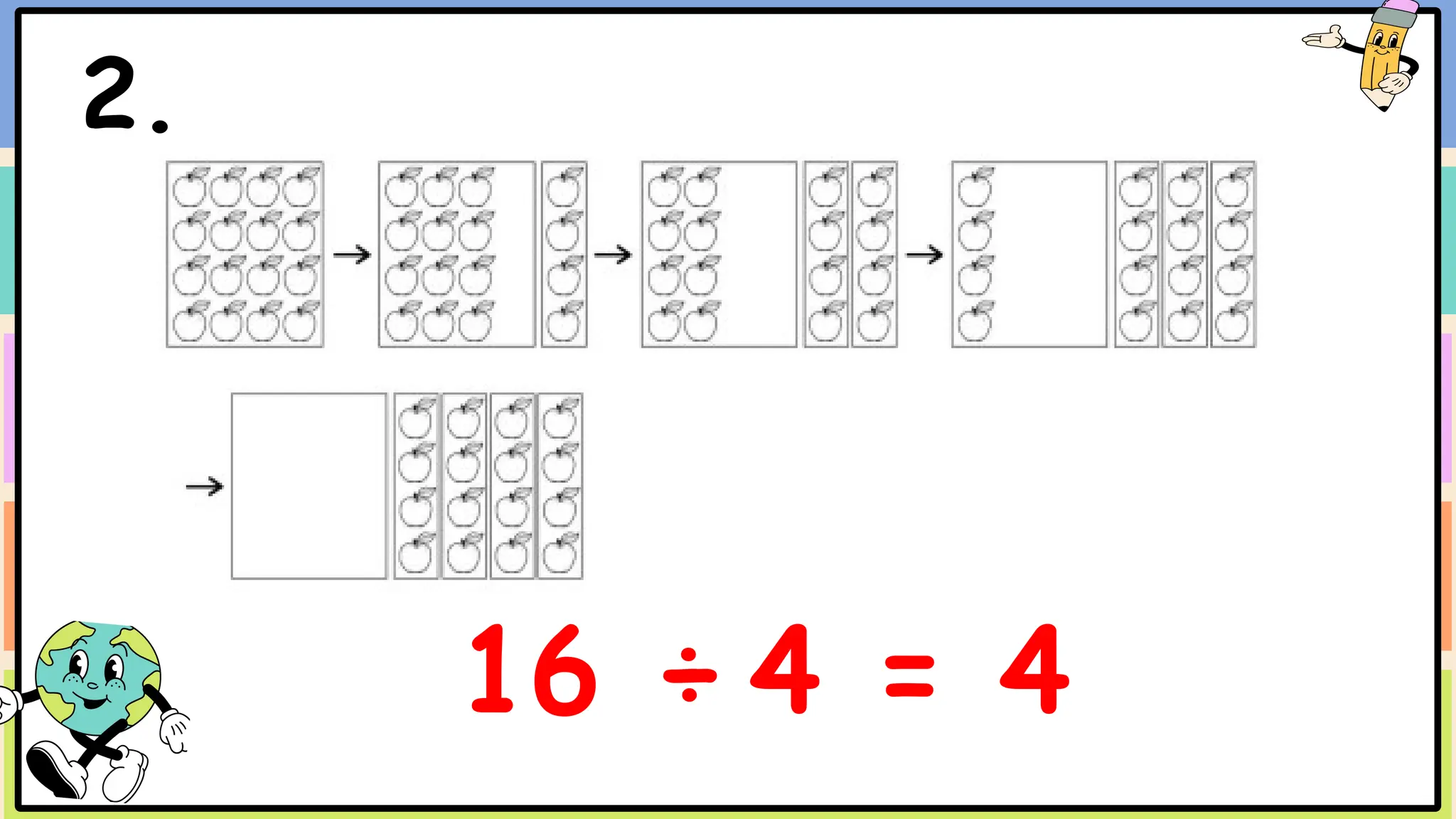
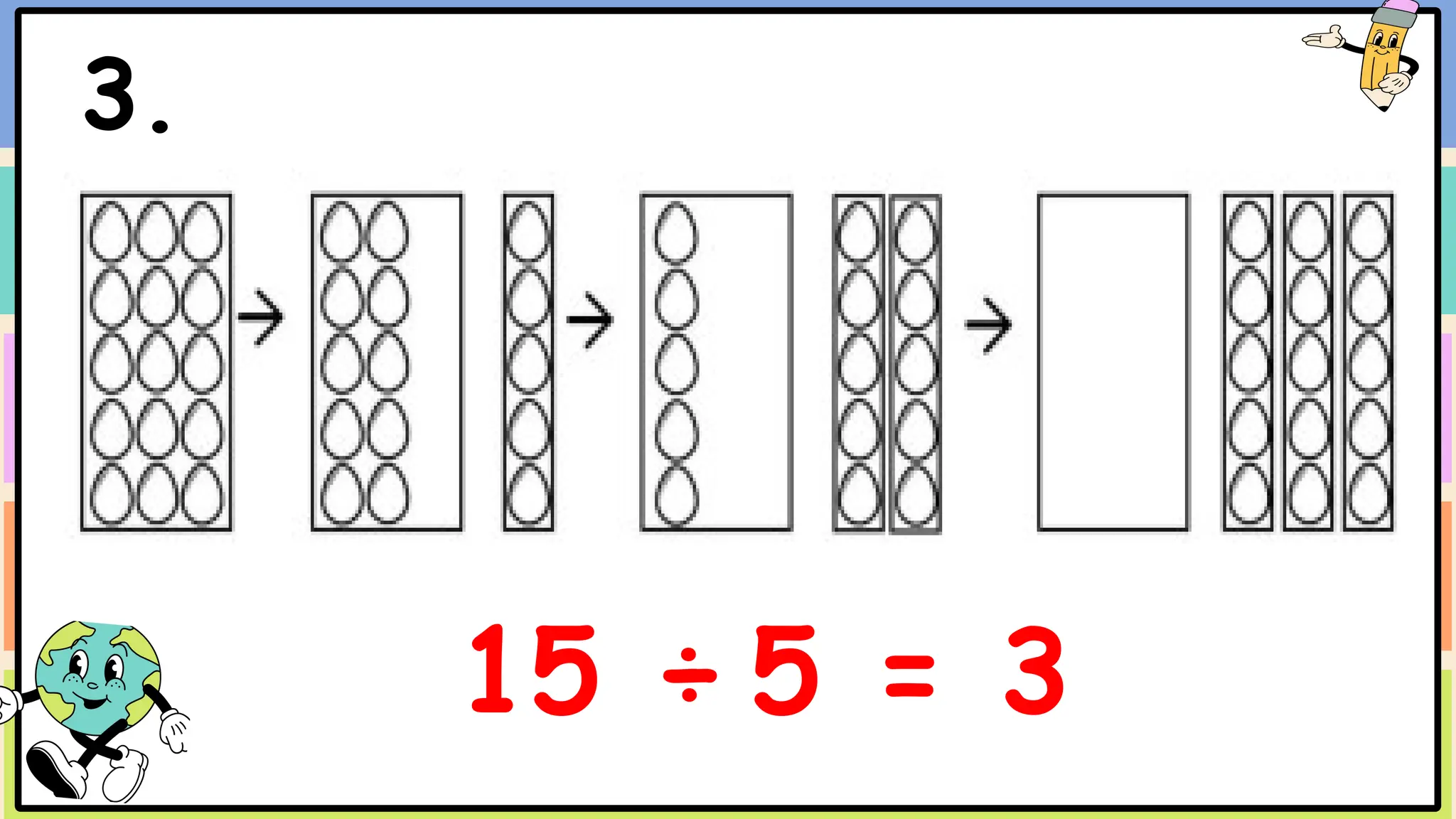
Write the division
sentence for each
repeated subtraction
illustrated below.
1.
14 ÷ 7 = 2
2.
16 ÷ 4 = 4
3.
15 ÷ 5 = 3
What do we do when
we divide using
repeated subtraction?
We subtract the same number
repeatedly until we reach 0.
The quotient is the number of
times we subtract from the
total until we reach 0.
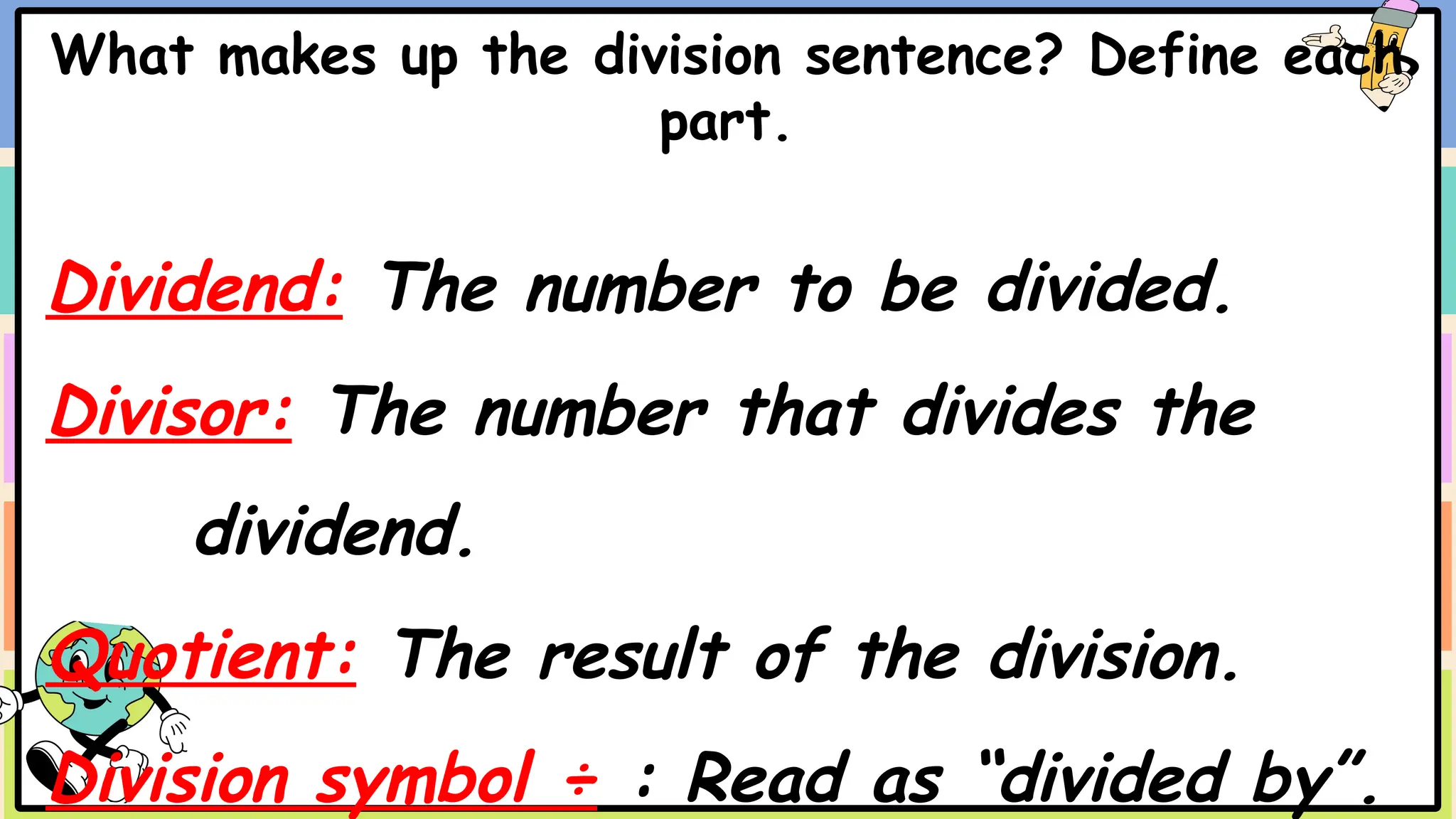
What makes up the division sentence? Define each
part.
Dividend: The number to be divided.
Divisor: The number that divides the
dividend.
Quotient: The result of the division.
Division symbol ÷ : Read as “divided by”.
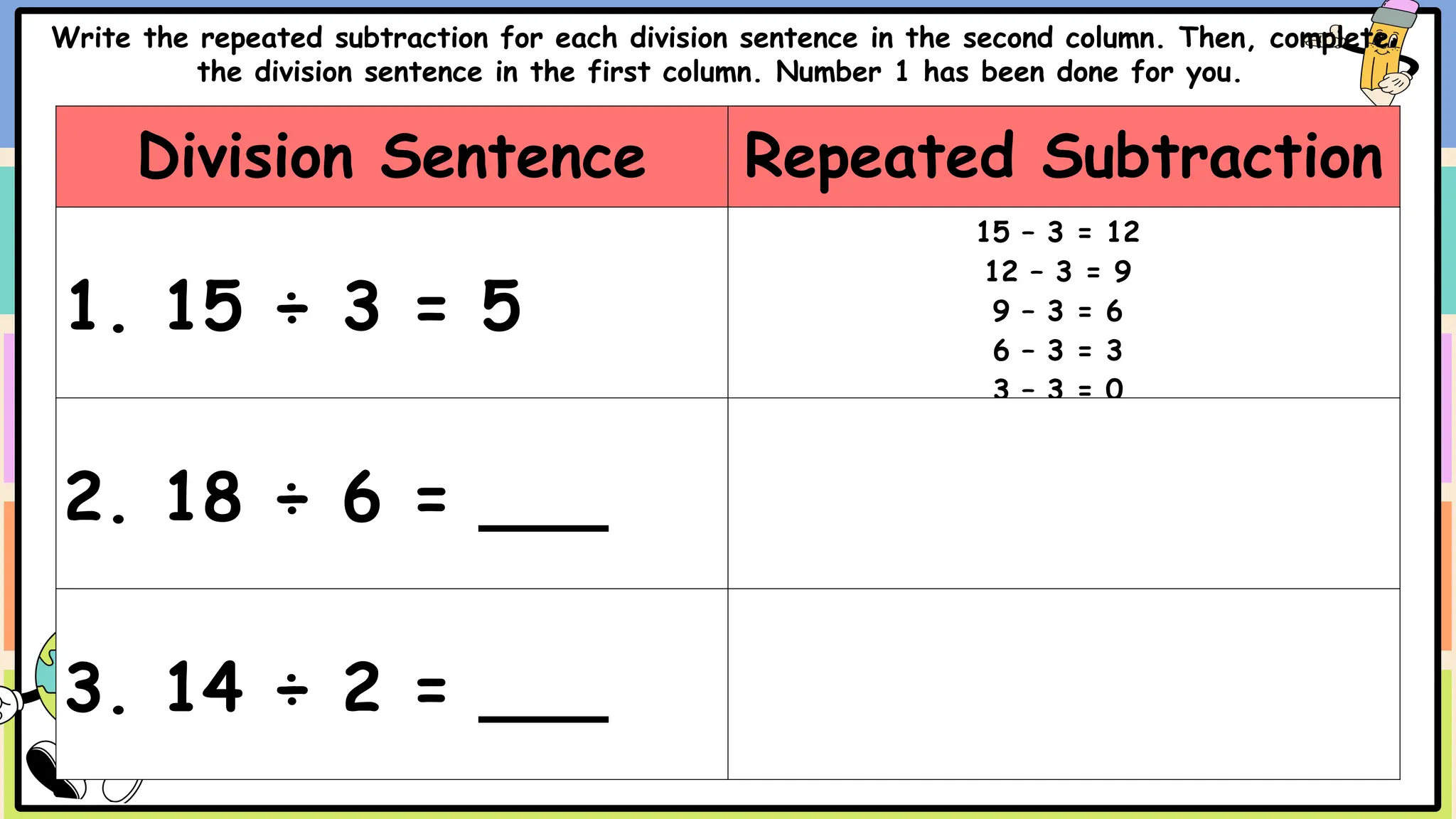
Write the repeated subtraction for each division sentence in the second column. Then, complete
the division sentence in the first column. Number 1 has been done for you.
Division Sentence Repeated Subtraction
1. 15 ÷ 3 = 5
15 – 3 = 12
12 – 3 = 9
9 – 3 = 6
6 – 3 = 3
3 – 3 = 0
2. 18 ÷ 6 = ___
3. 14 ÷ 2 = ___
DAY 4
To p i c
At the end of the lesson, the
learner should be able to divide
numbers using the multiplication
table of 2.
What is the
operation used to
represent repeated
addition?
It is multiplication.
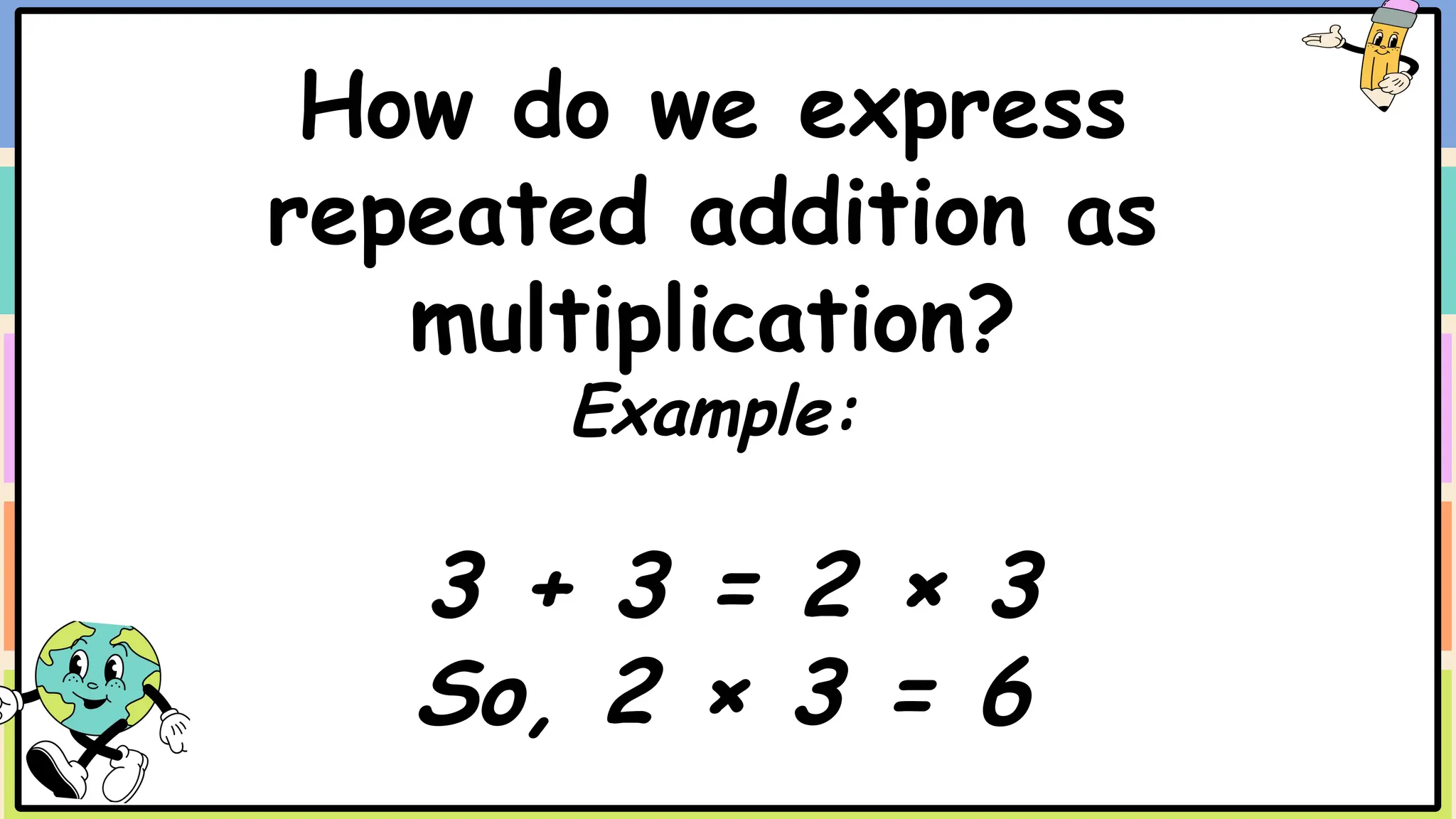
How do we express
repeated addition as
multiplication?
Example:
3 + 3 = 2 × 3
So, 2 × 3 = 6
What operation
involves subtracting
the same number
repeatedly until you
reach 0?
It is division.
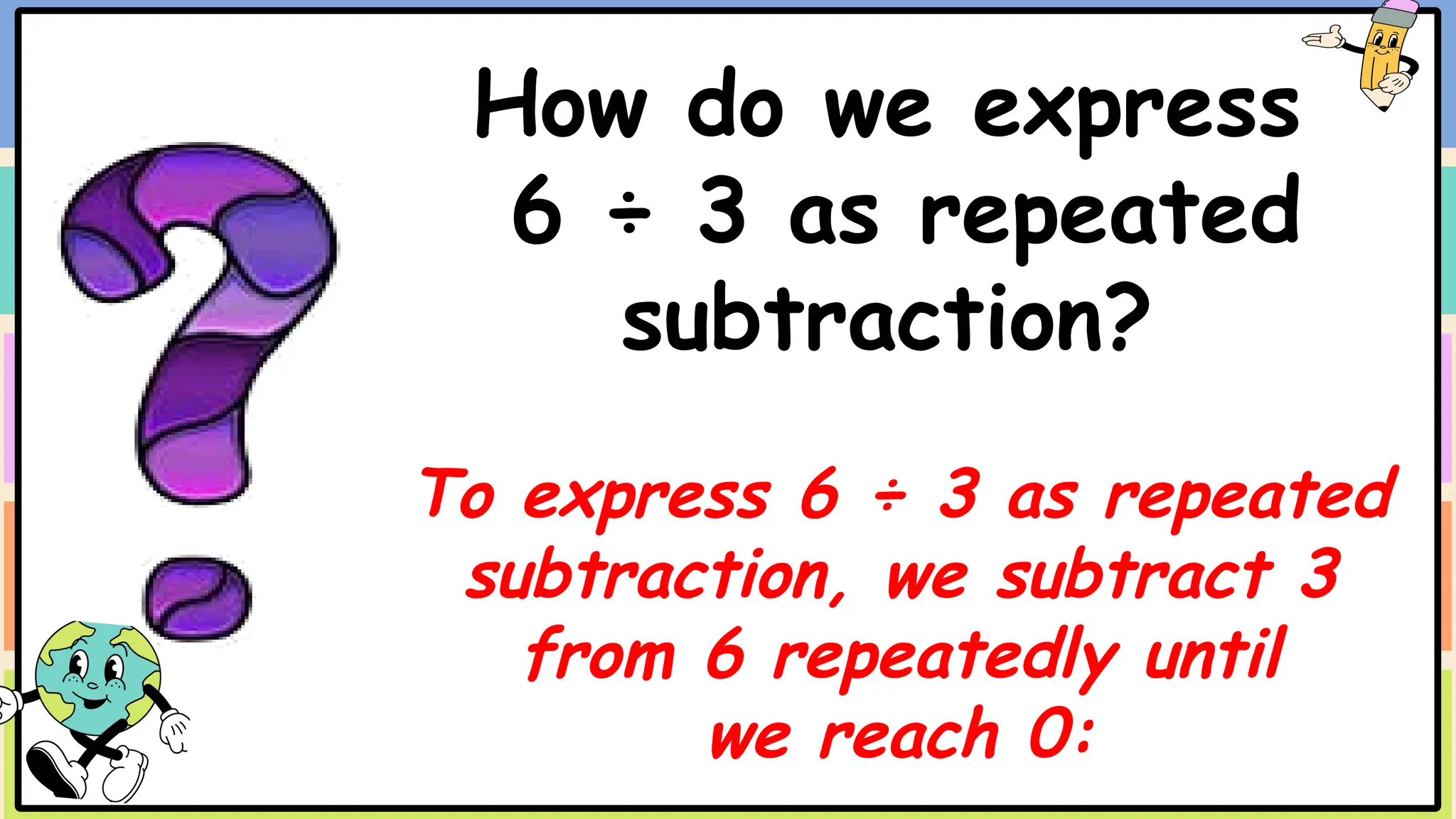
How do we express
6 ÷ 3 as repeated
subtraction?
To express 6 ÷ 3 as repeated
subtraction, we subtract 3
from 6 repeatedly until
we reach 0:
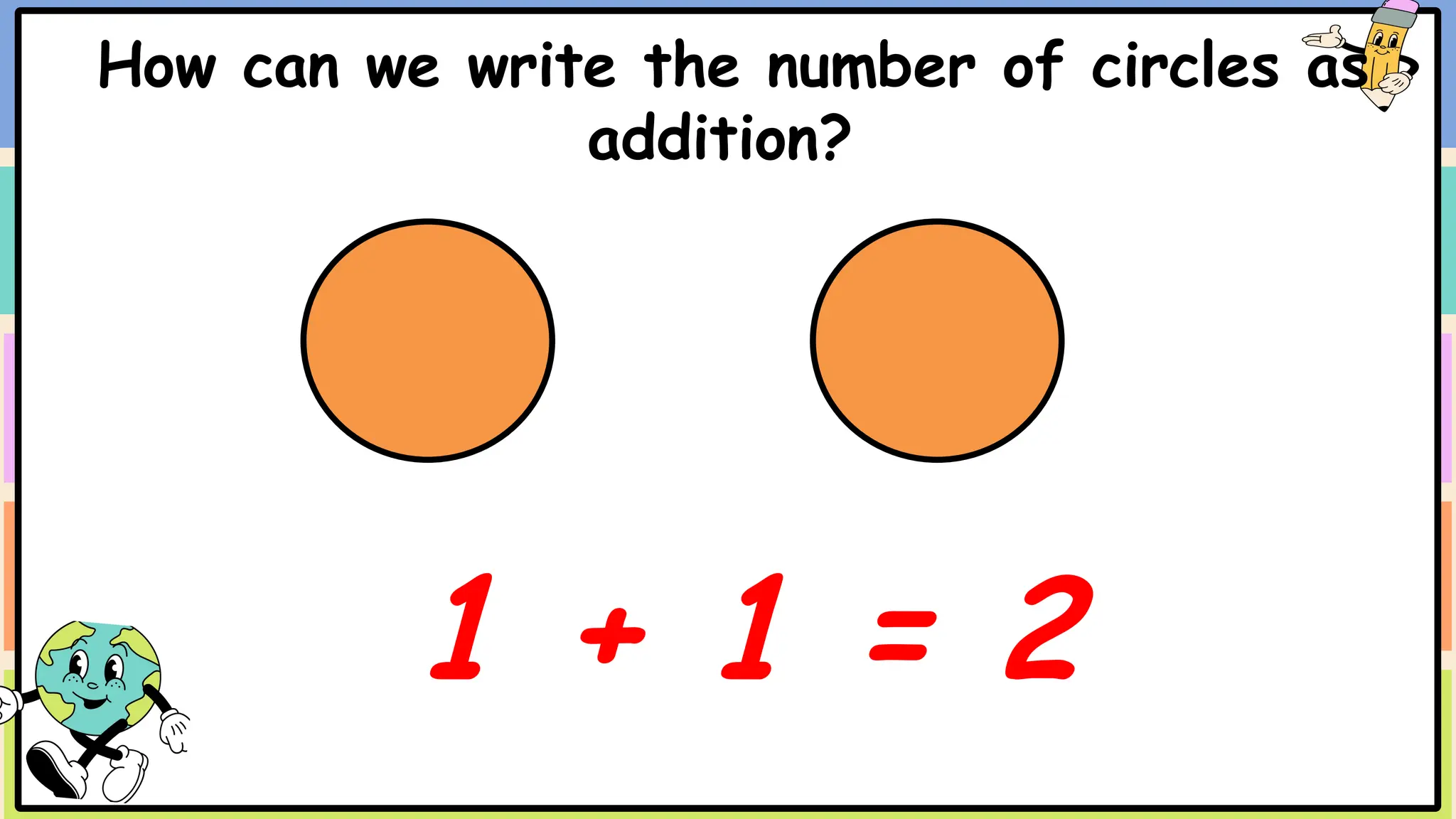
How can we write the number of circles as
addition?
1 + 1 = 2
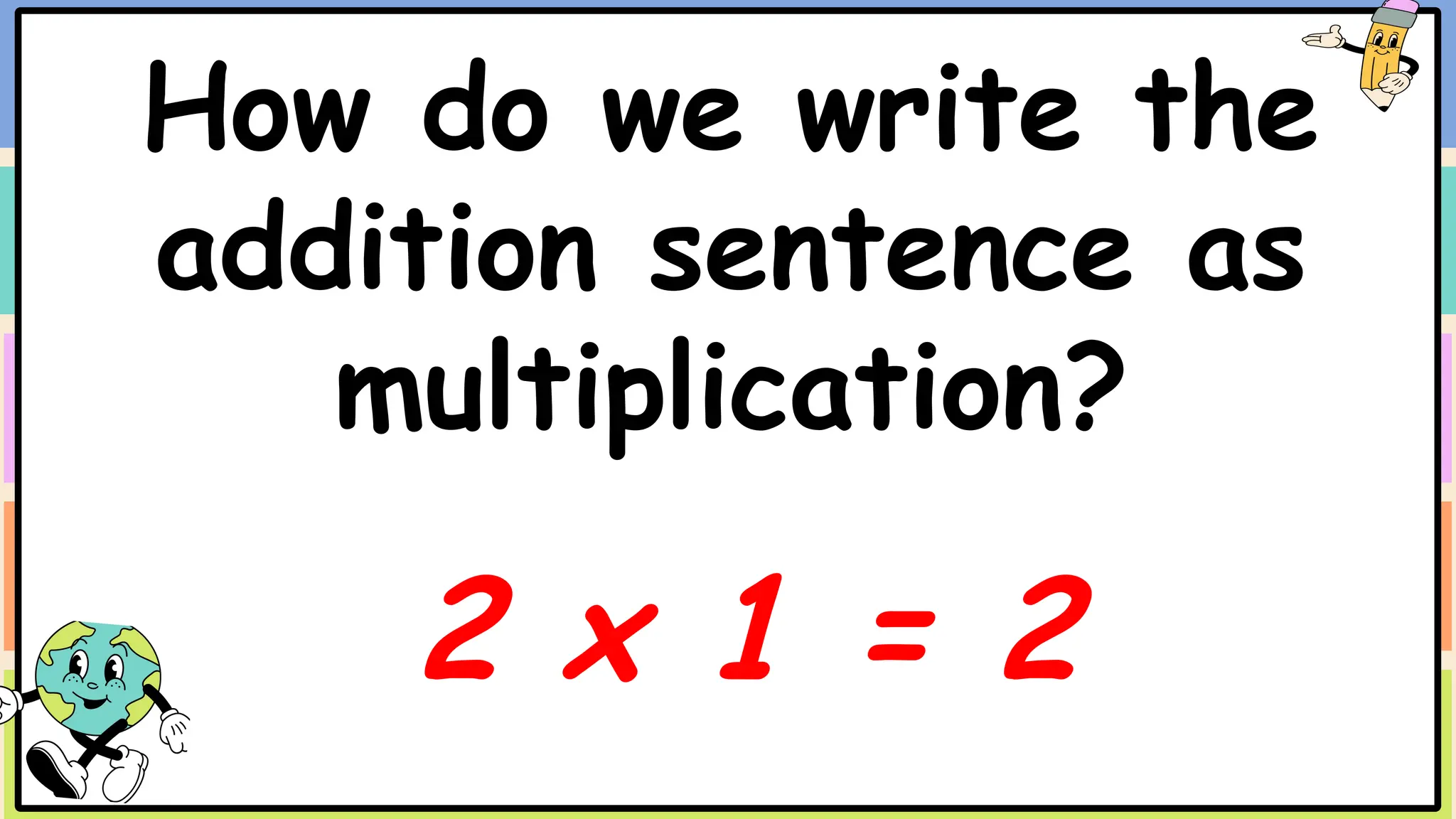
How do we write the
addition sentence as
multiplication?
2 x 1 = 2
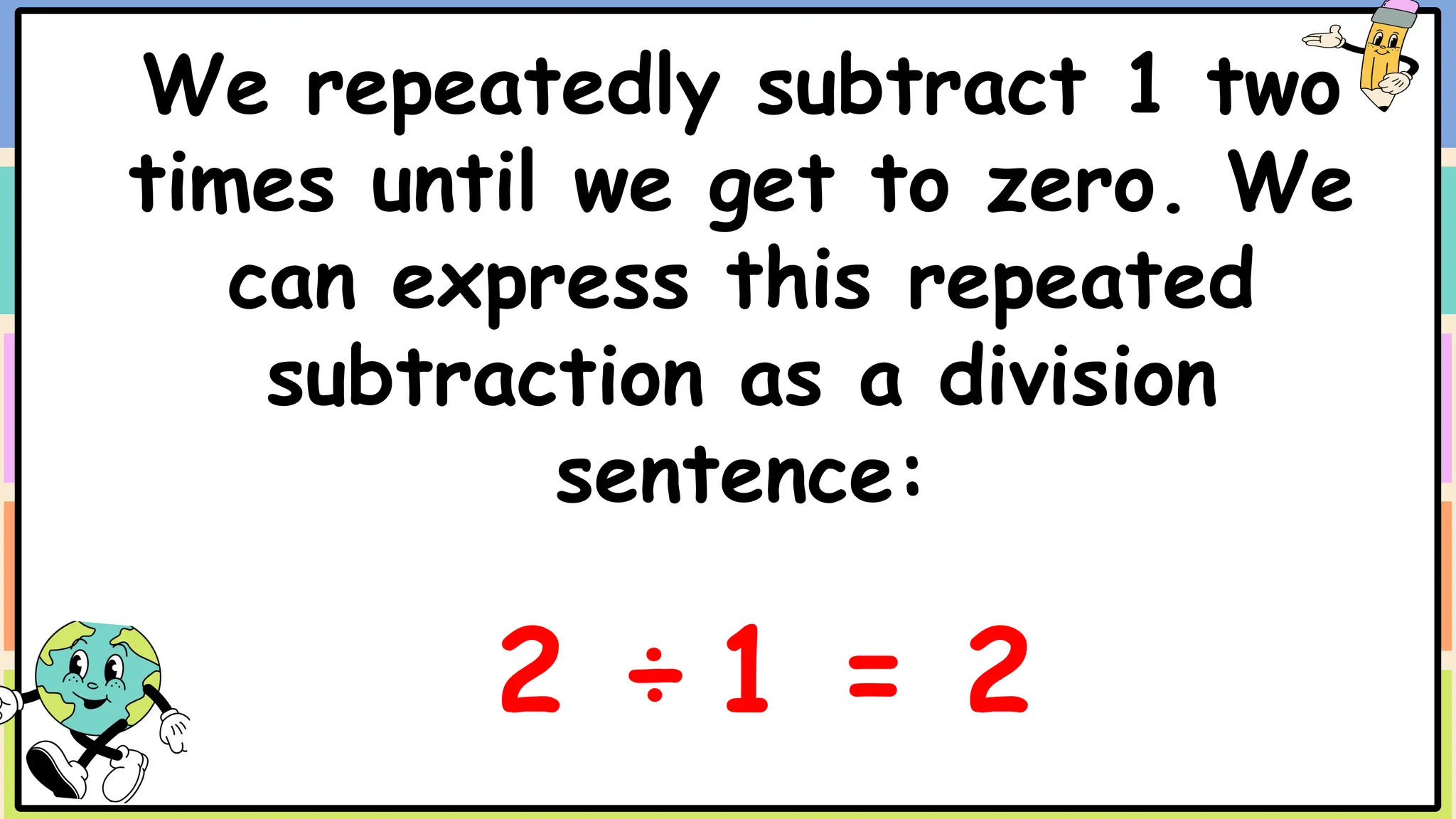
We repeatedly subtract 1 two
times until we get to zero. We
can express this repeated
subtraction as a division
sentence:
2 ÷ 1 = 2
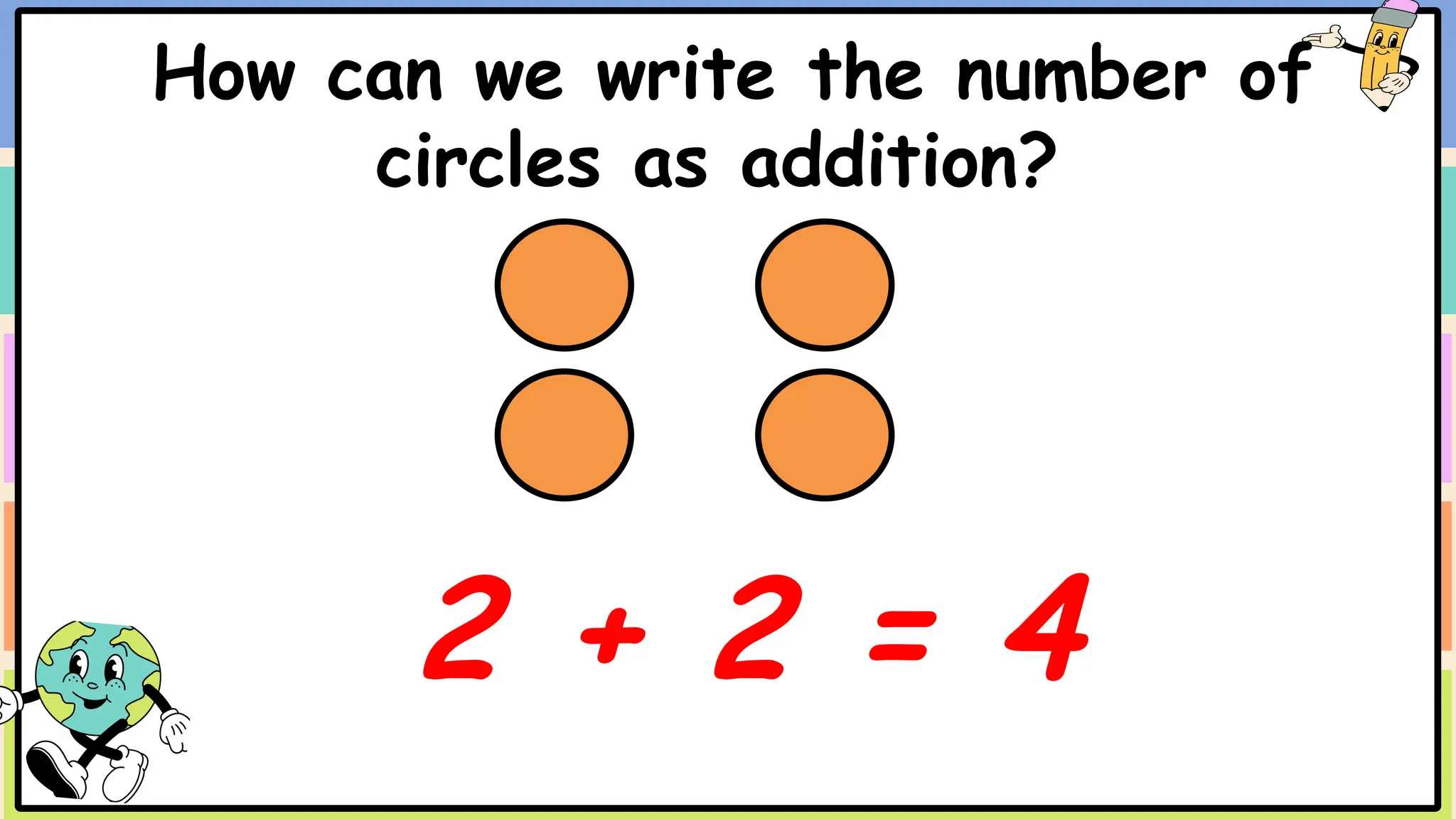
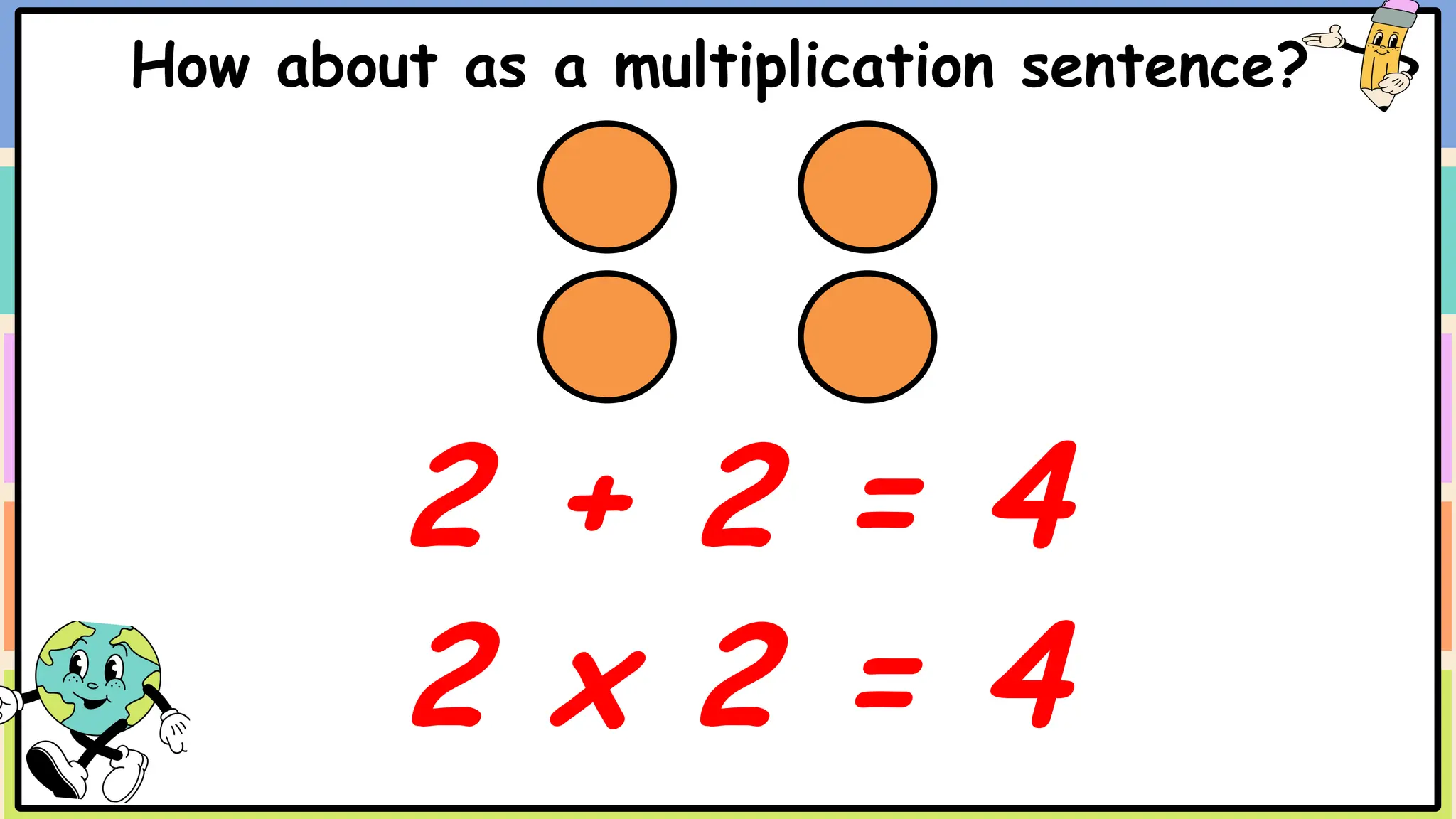
How can we write the number of
circles as addition?
2 + 2 = 4
How about as a multiplication sentence?
2 + 2 = 4
2 x 2 = 4
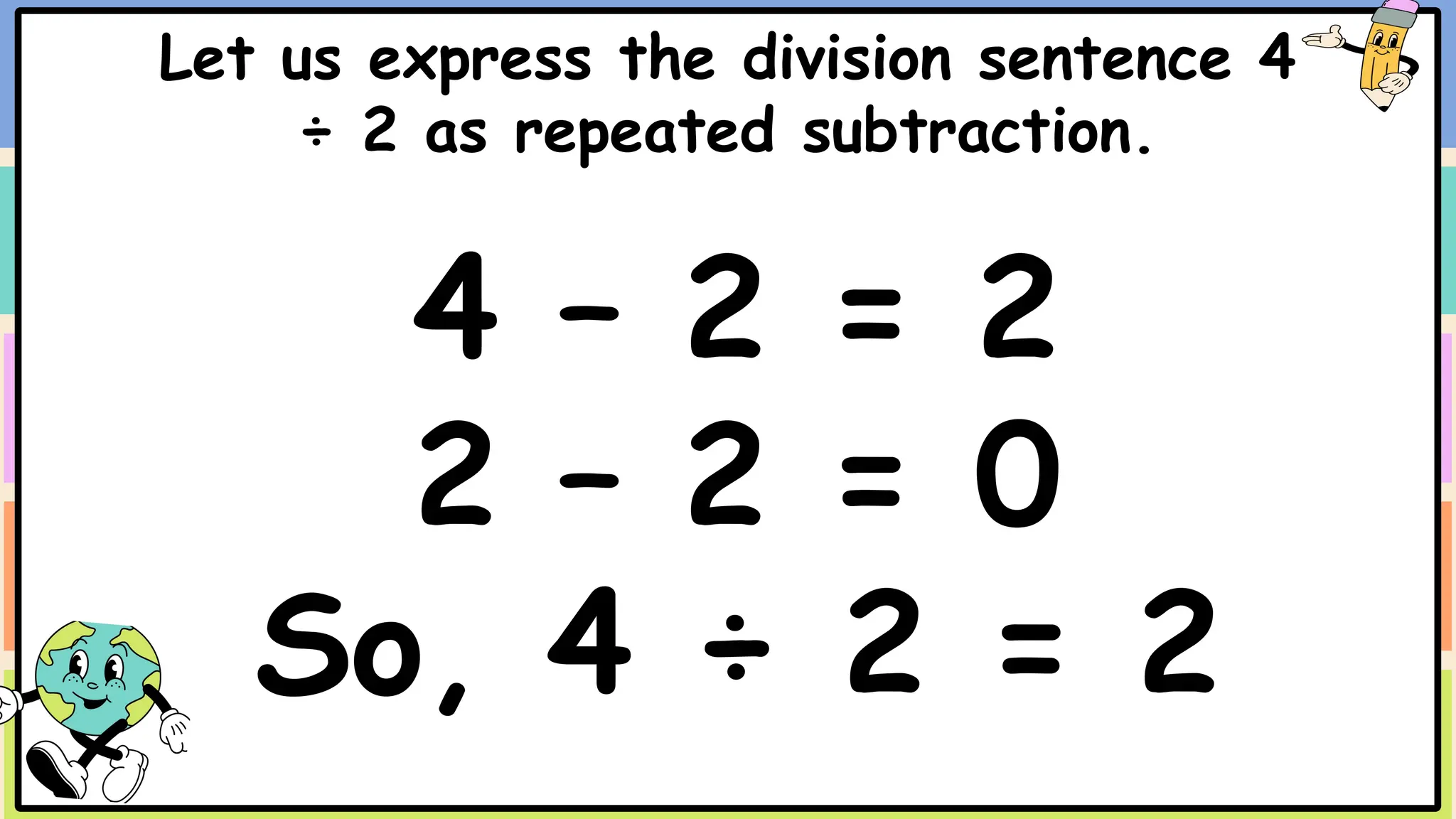
Let us express the division sentence 4
÷ 2 as repeated subtraction.
4 – 2 = 2
2 – 2 = 0
So, 4 ÷ 2 = 2
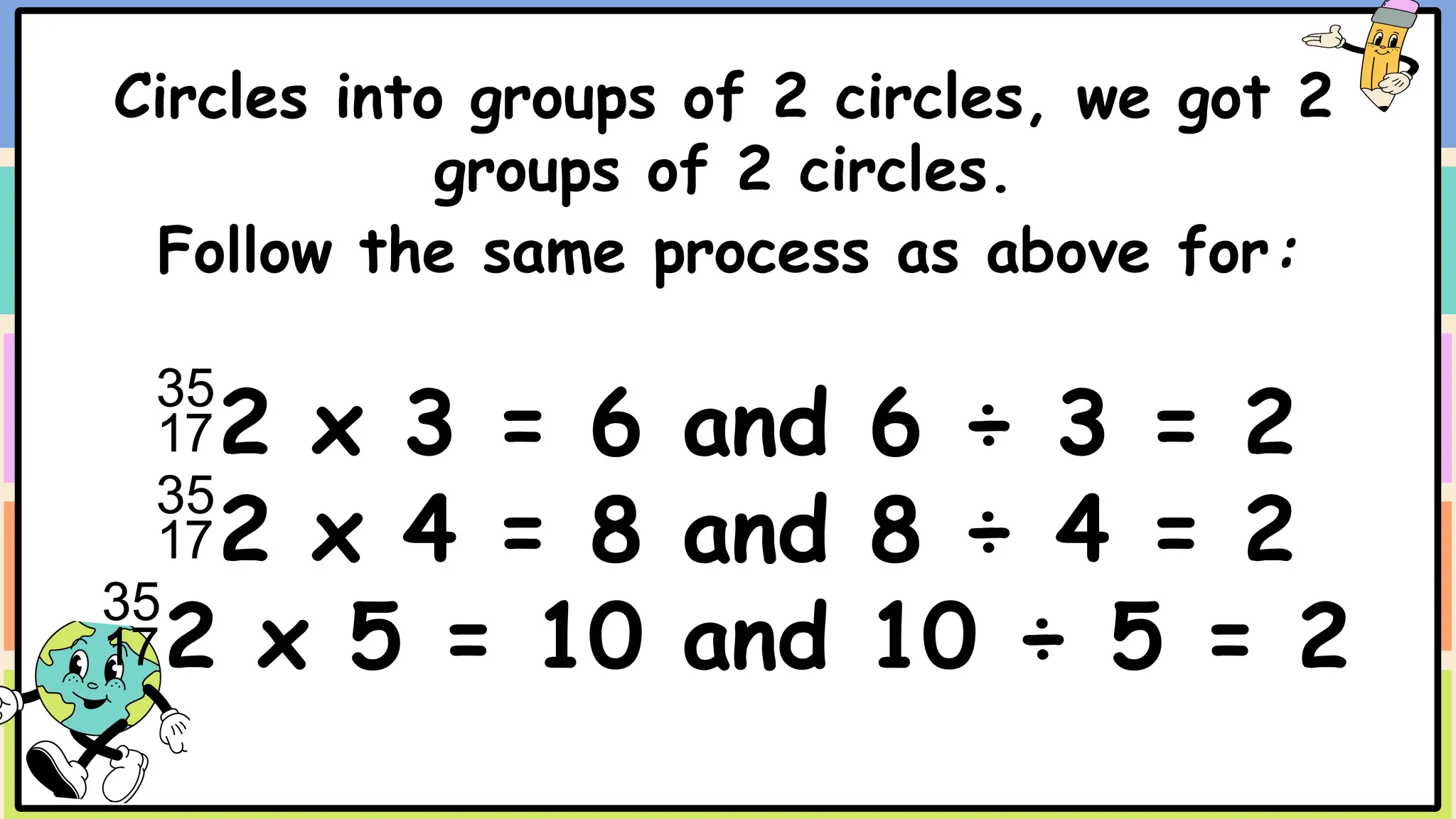
Circles into groups of 2 circles, we got 2
groups of 2 circles.
Follow the same process as above for:
2 x 3 = 6 and 6 ÷ 3 = 2
2 x 4 = 8 and 8 ÷ 4 = 2
2 x 5 = 10 and 10 ÷ 5 = 2
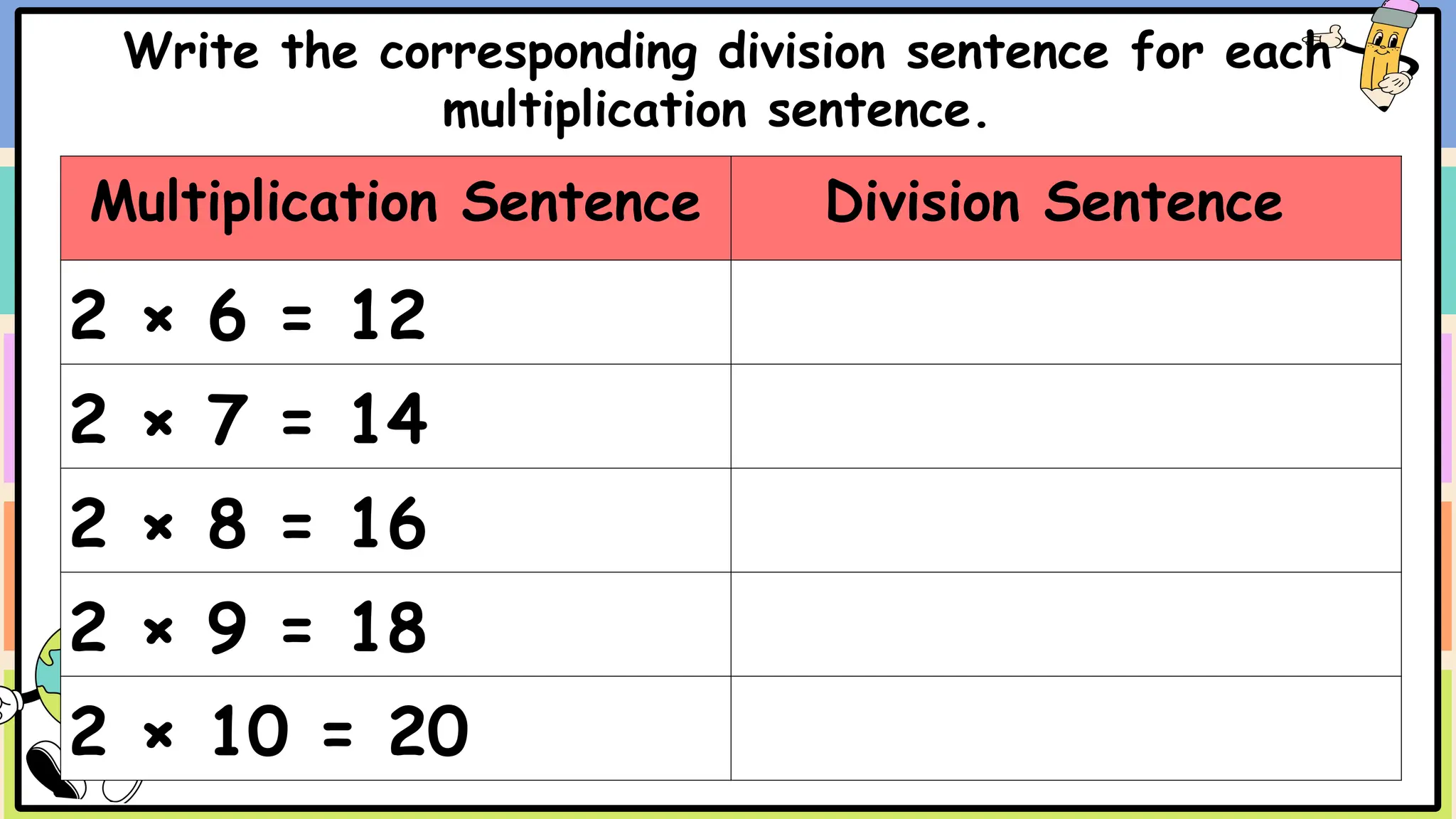
Write the corresponding division sentence for each
multiplication sentence.
Multiplication Sentence Division Sentence
2 × 6 = 12
2 × 7 = 14
2 × 8 = 16
2 × 9 = 18
2 × 10 = 20
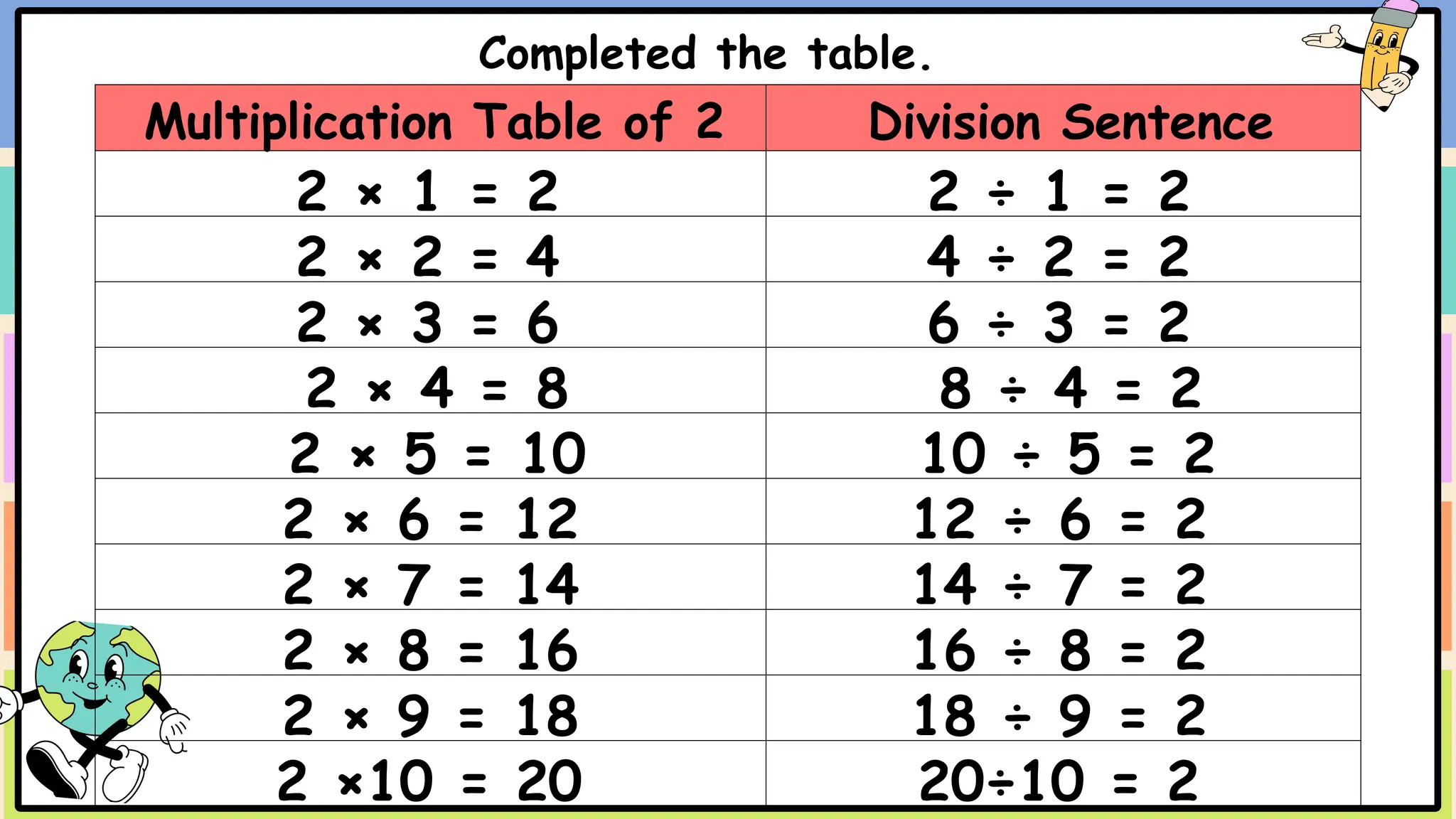
Completed the table.
Multiplication Table of 2 Division Sentence
2 × 1 = 2 2 ÷ 1 = 2
2 × 2 = 4 4 ÷ 2 = 2
2 × 3 = 6 6 ÷ 3 = 2
2 × 4 = 8 8 ÷ 4 = 2
2 × 5 = 10 10 ÷ 5 = 2
2 × 6 = 12 12 ÷ 6 = 2
2 × 7 = 14 14 ÷ 7 = 2
2 × 8 = 16 16 ÷ 8 = 2
2 × 9 = 18 18 ÷ 9 = 2
2 ×10 = 20 20÷10 = 2
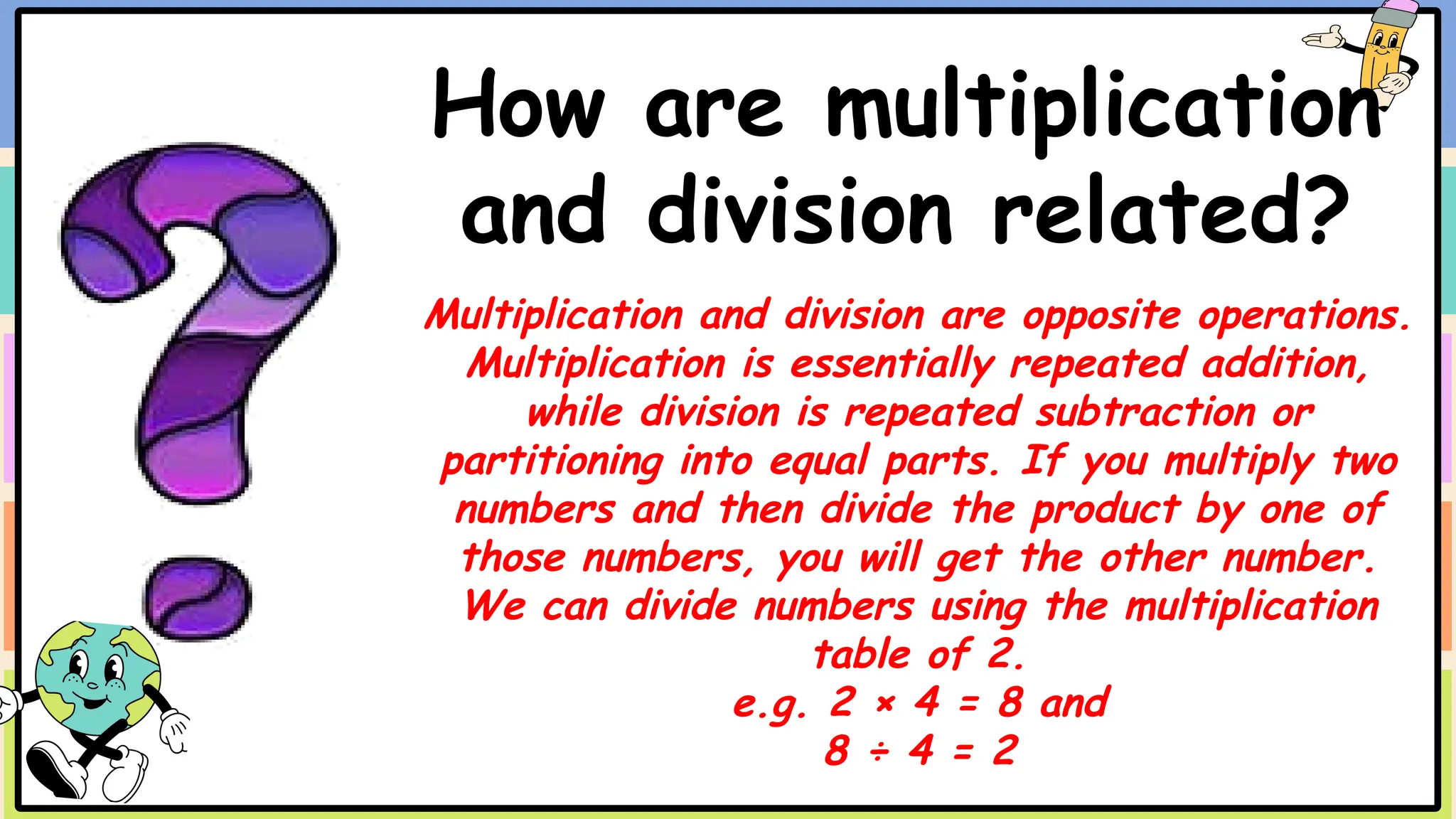
How are multiplication
and division related?
Multiplication and division are opposite operations.
Multiplication is essentially repeated addition,
while division is repeated subtraction or
partitioning into equal parts. If you multiply two
numbers and then divide the product by one of
those numbers, you will get the other number.
We can divide numbers using the multiplication
table of 2.
e.g. 2 × 4 = 8 and
8 ÷ 4 = 2
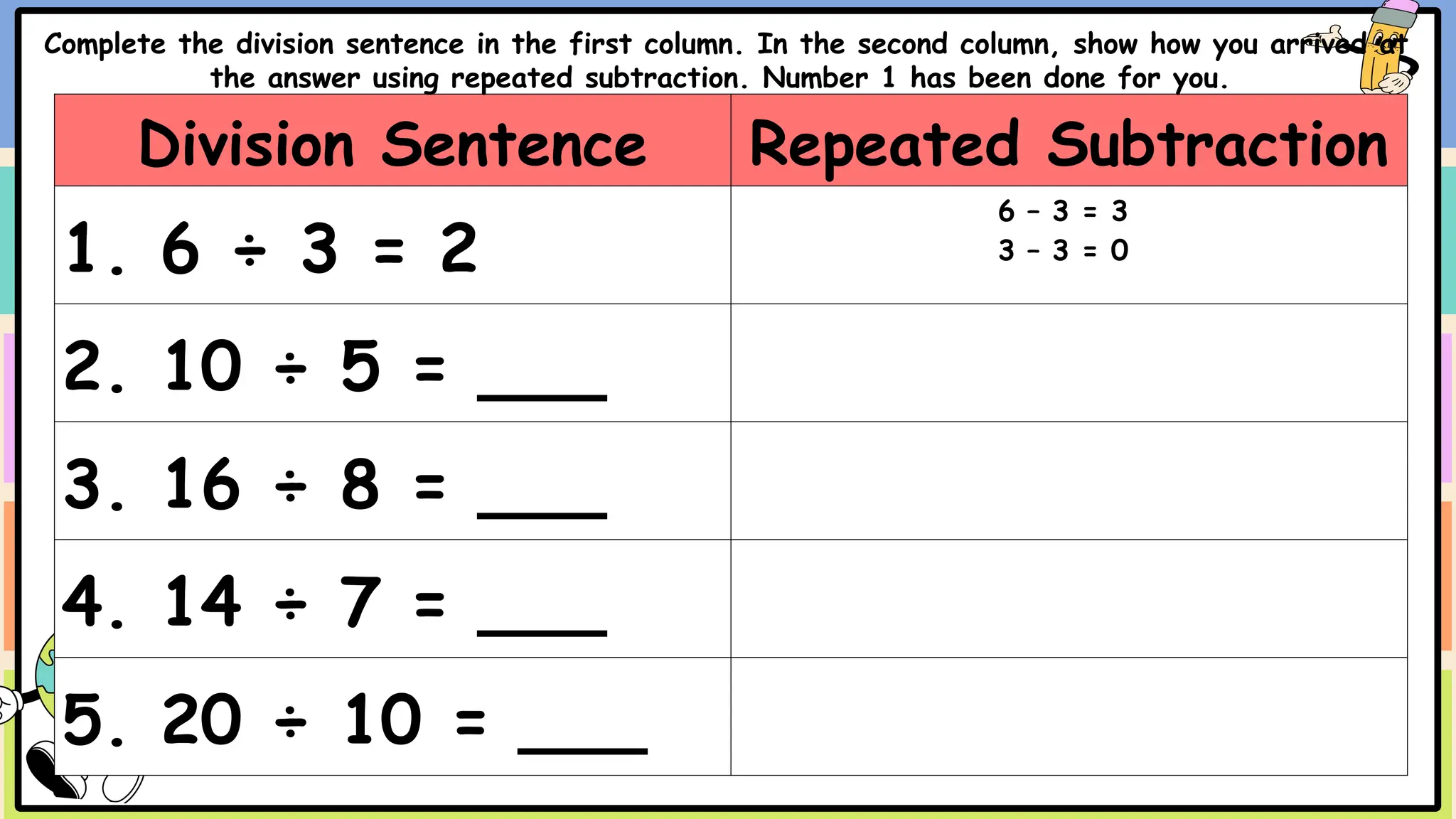
Division Sentence Repeated Subtraction
1. 6 ÷ 3 = 2
6 – 3 = 3
3 – 3 = 0
2. 10 ÷ 5 = ___
3. 16 ÷ 8 = ___
4. 14 ÷ 7 = ___
5. 20 ÷ 10 = ___
Complete the division sentence in the first column. In the second column, show how you arrived at
the answer using repeated subtraction. Number 1 has been done for you.
DAY 5
Let us review our
fast lesson.
4 ÷ 2 = 2
dividend
divisor
quotient
Different parts of the division sentence.
Parts of division sentence.
Dividend: The number to be divided.
Divisor: The number that divides the
dividend.
Quotient: The result of the division.
Division symbol ÷ : Read as “divided by”.
CAR RACING
GAME
Who will win the race?
START
CAR RACING GAME
Click to make
the violet car
move
Click to make
the blue car
move
Click to make
the yellow car
move
Click to make
the green car
move
Click to make
the red car
move
Go to
Questions
1 2 3 4 5 6
7 8 9 10 11 12
questions
13 14 15 18
16 17
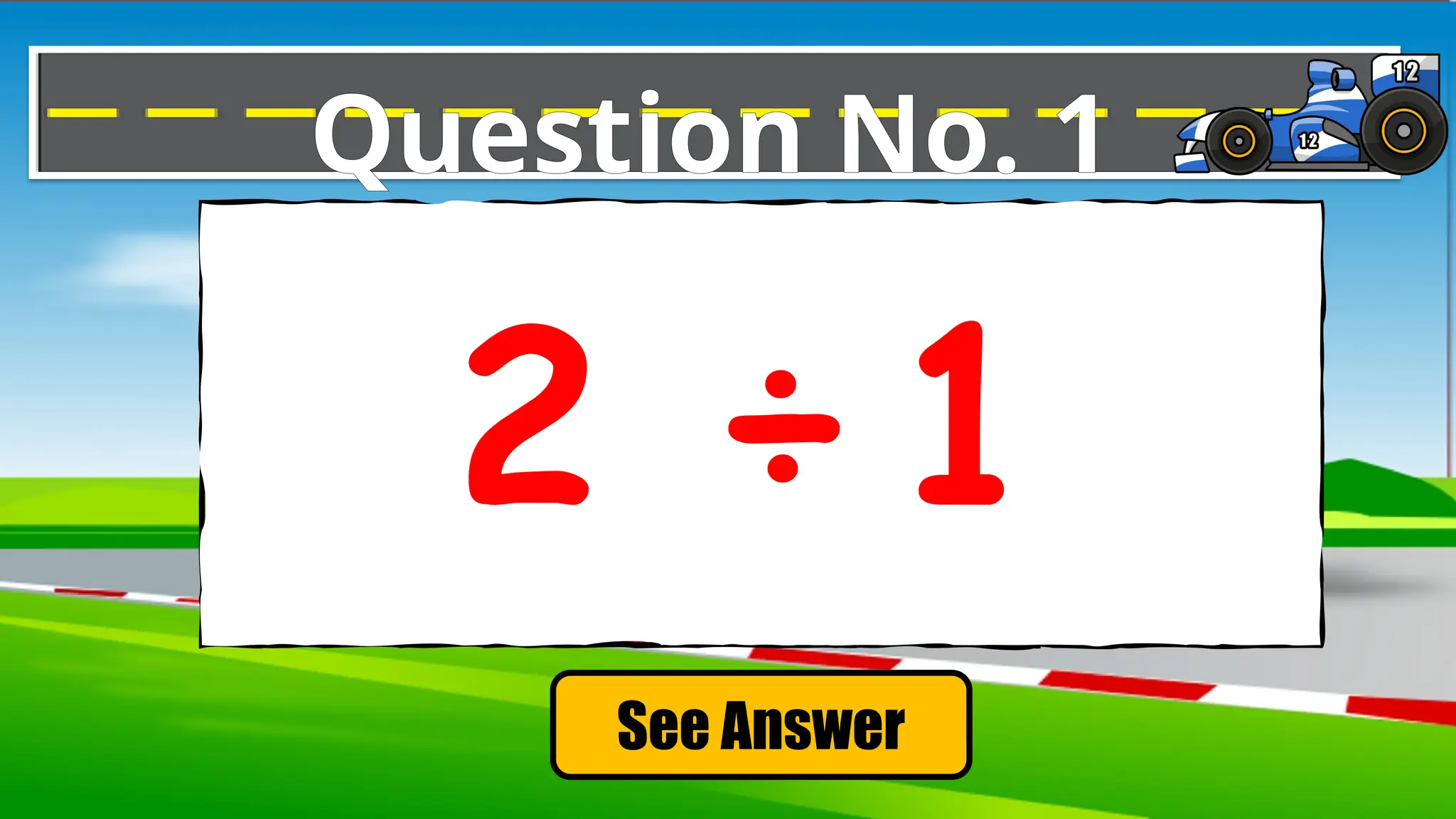
Question No. 1
See Answer
2 ÷1
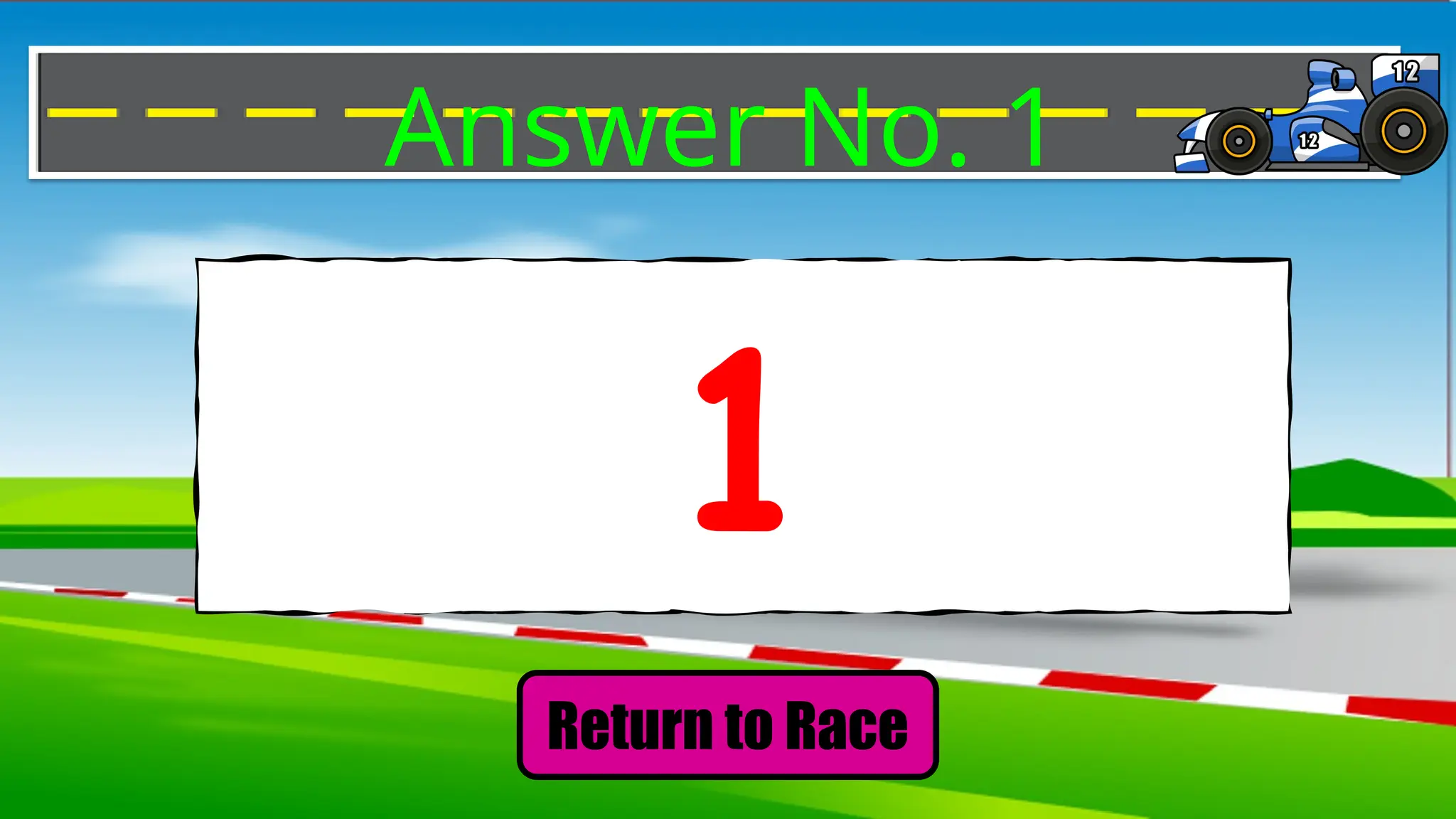
Answer No. 1
Return to Race
1
See Answer
Question No. 2
10 ÷2
Return to Race
Answer No. 2
5
See Answer
Question No. 3
6 ÷2
Return to Race
Answer No. 3
3
See Answer
Question No. 4
14 ÷7
Return to Race
Answer No. 4
2
See Answer
Question No. 5
15 ÷5
Return to Race
Answer No. 5
3
See Answer
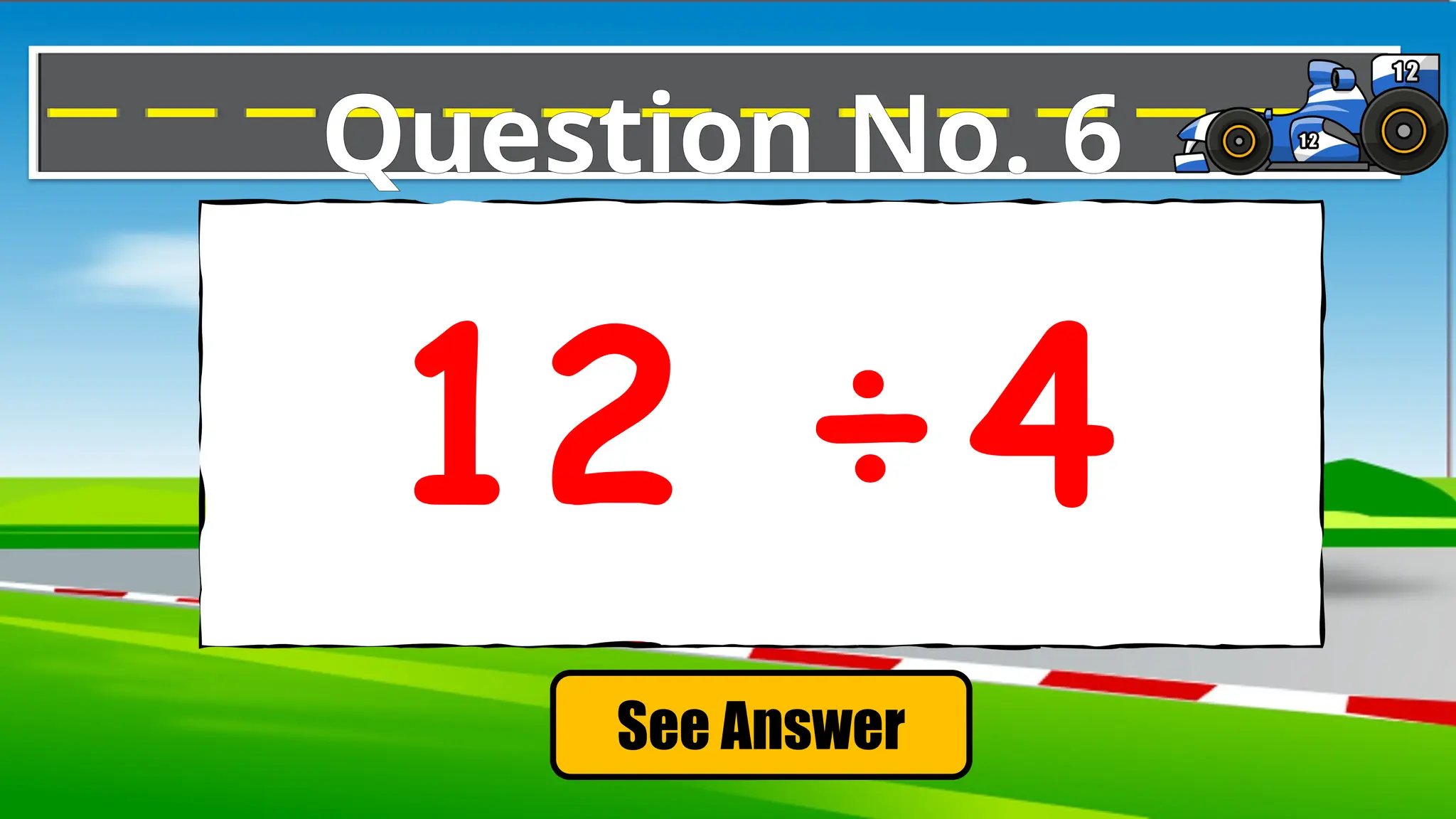
Question No. 6
12 ÷4
Return to Race
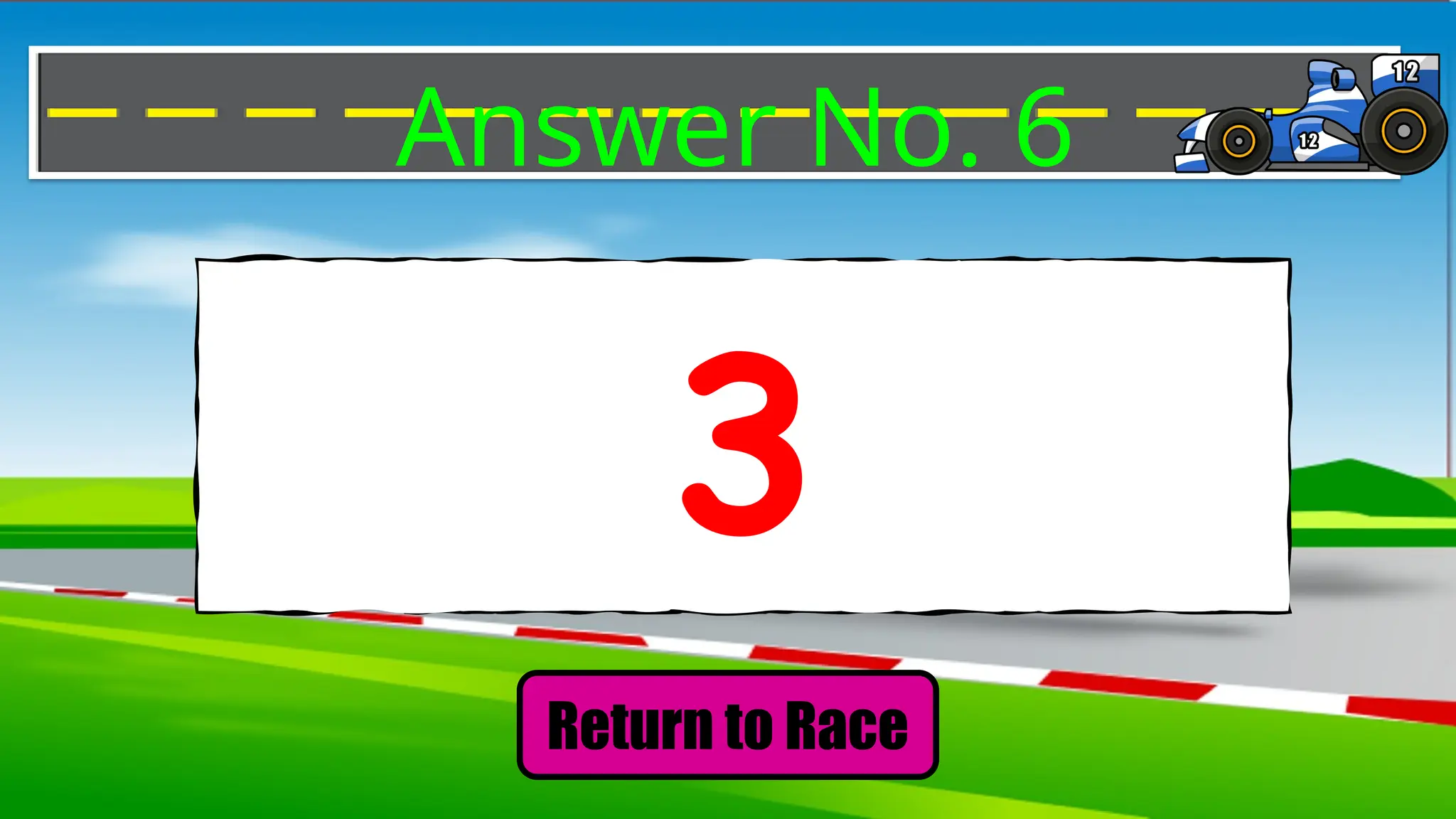
Answer No. 6
3
See Answer
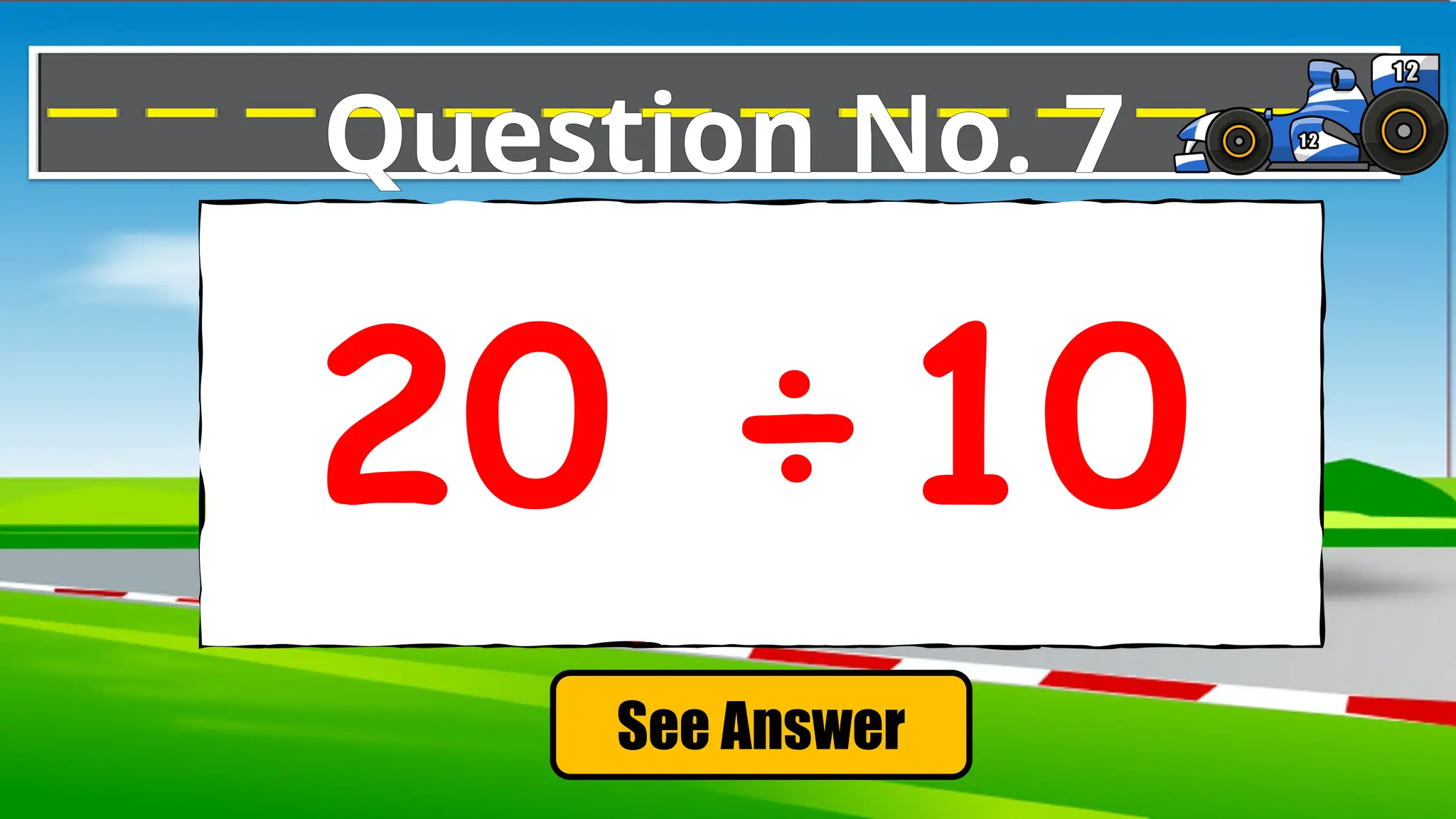
Question No. 7
20 ÷10
Return to Race
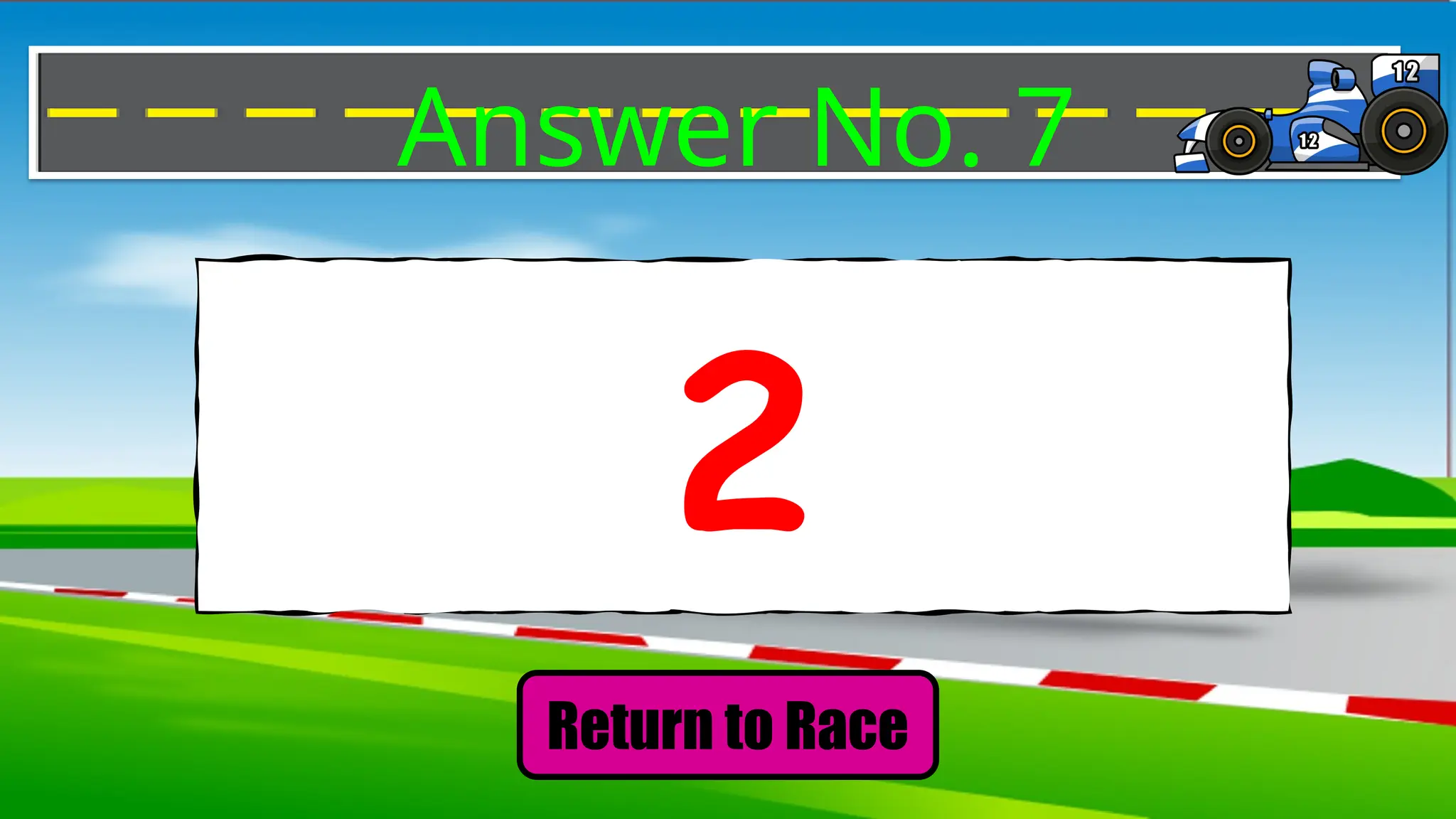
Answer No. 7
2
See Answer
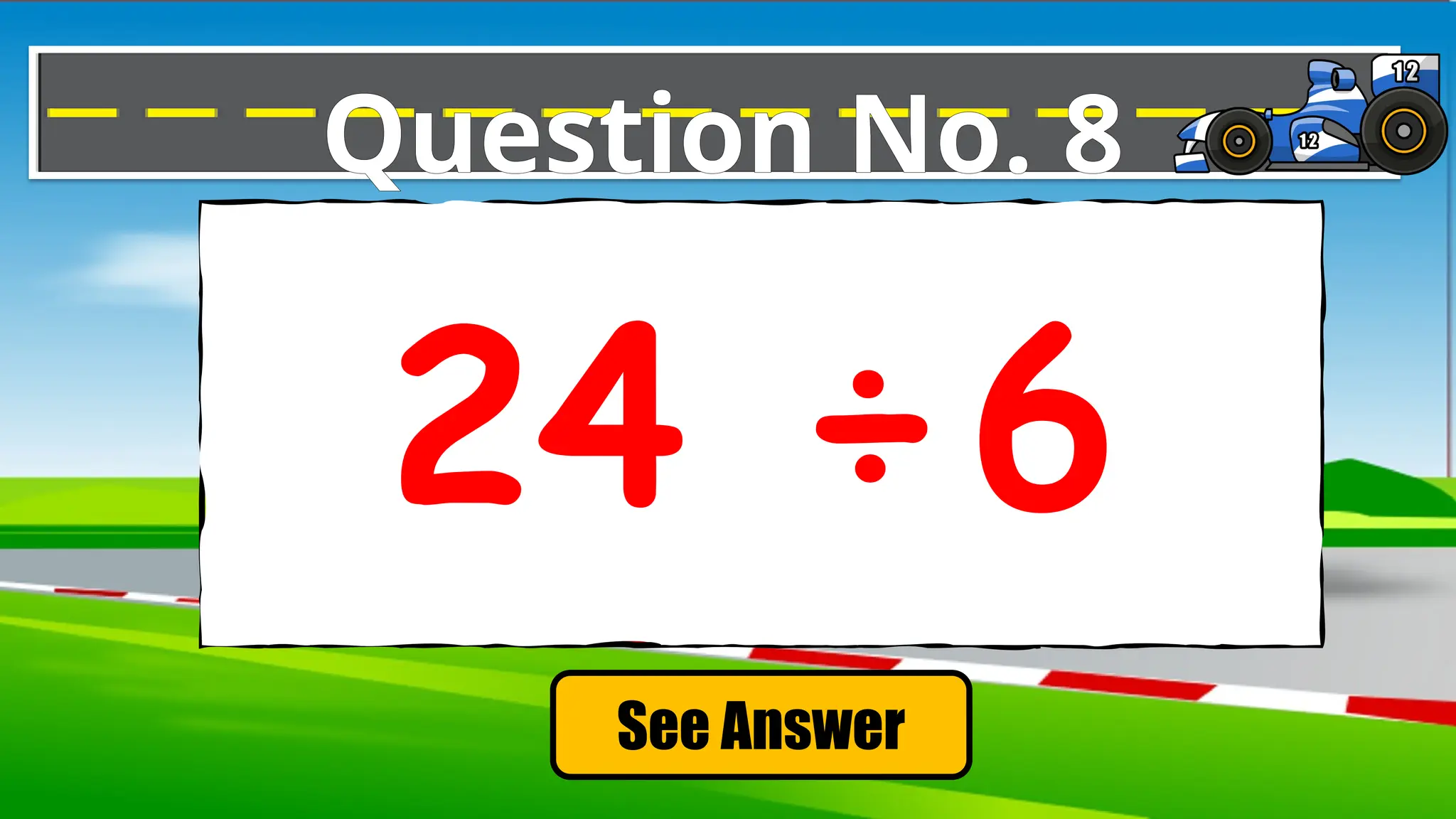
Question No. 8
24 ÷6
Return to Race
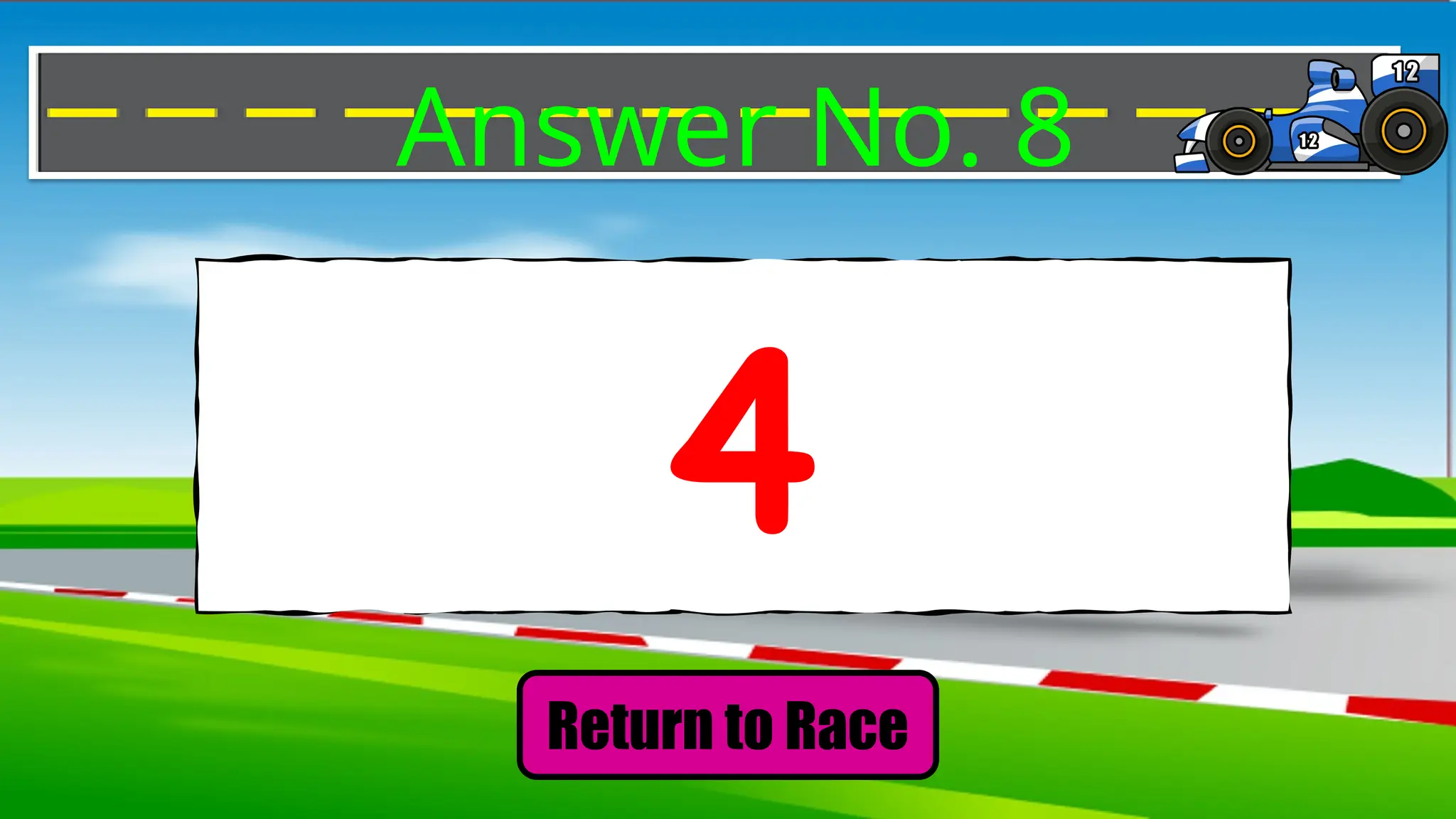
Answer No. 8
4
See Answer
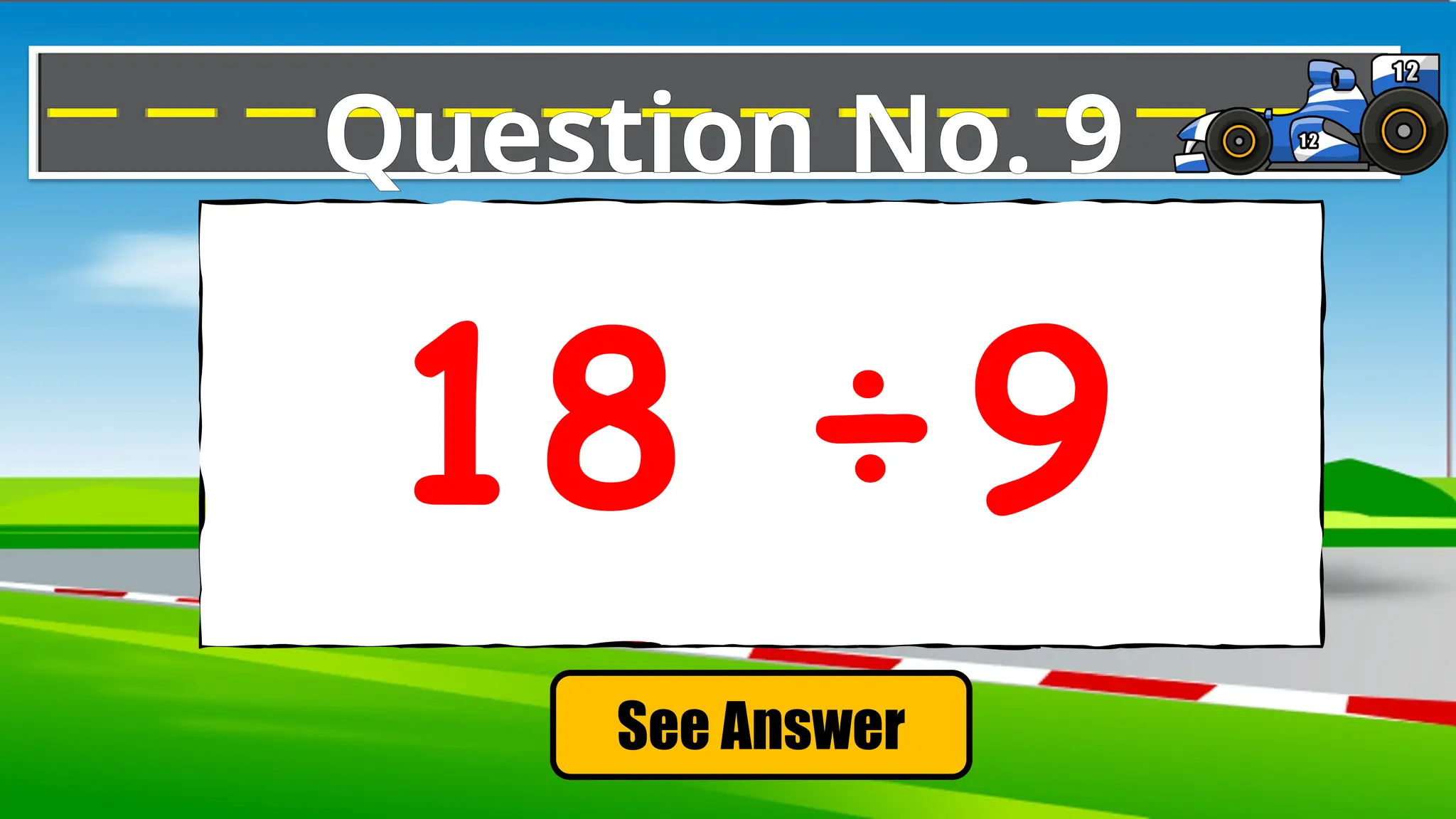
Question No. 9
18 ÷9
Return to Race
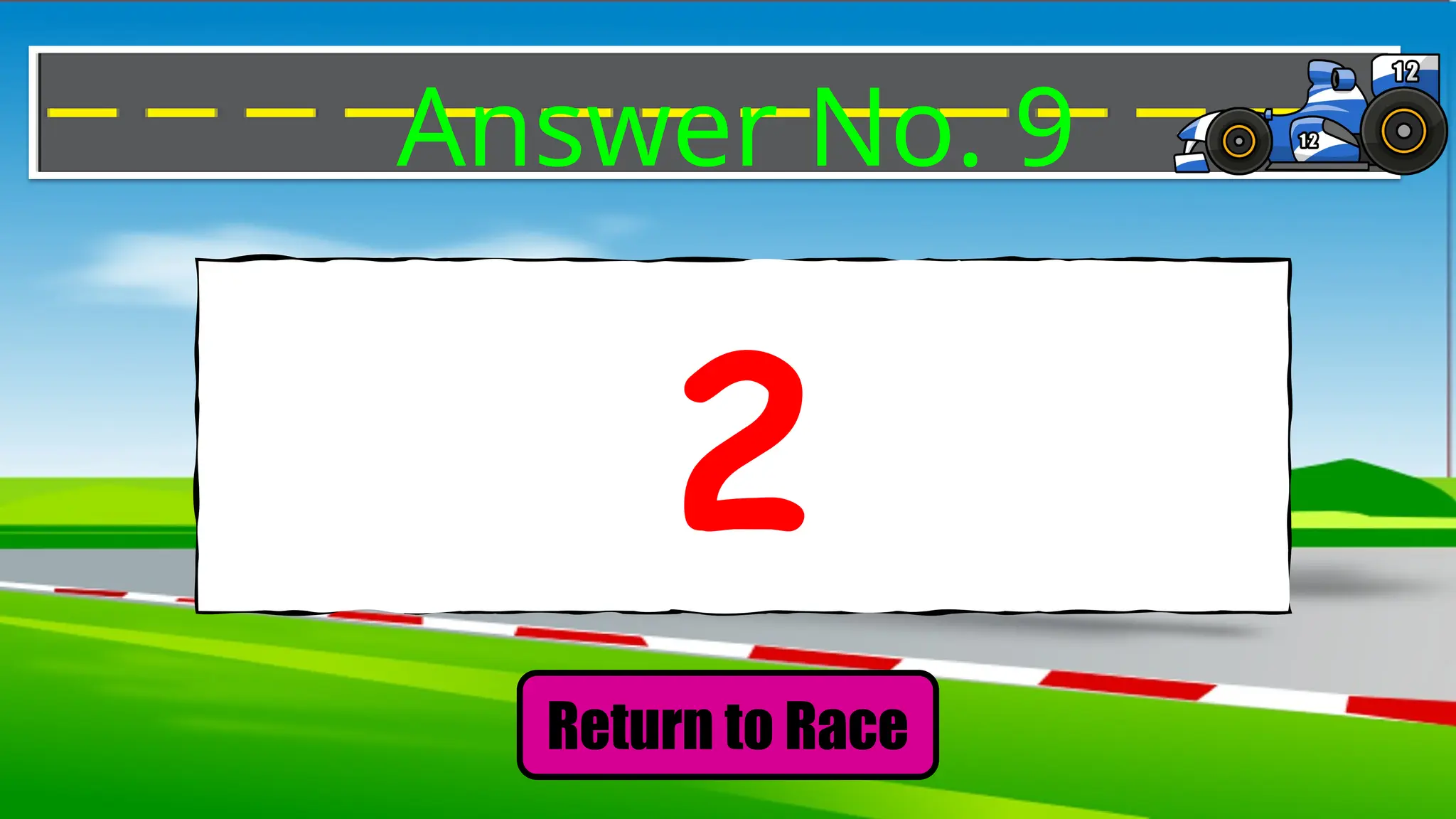
Answer No. 9
2
See Answer
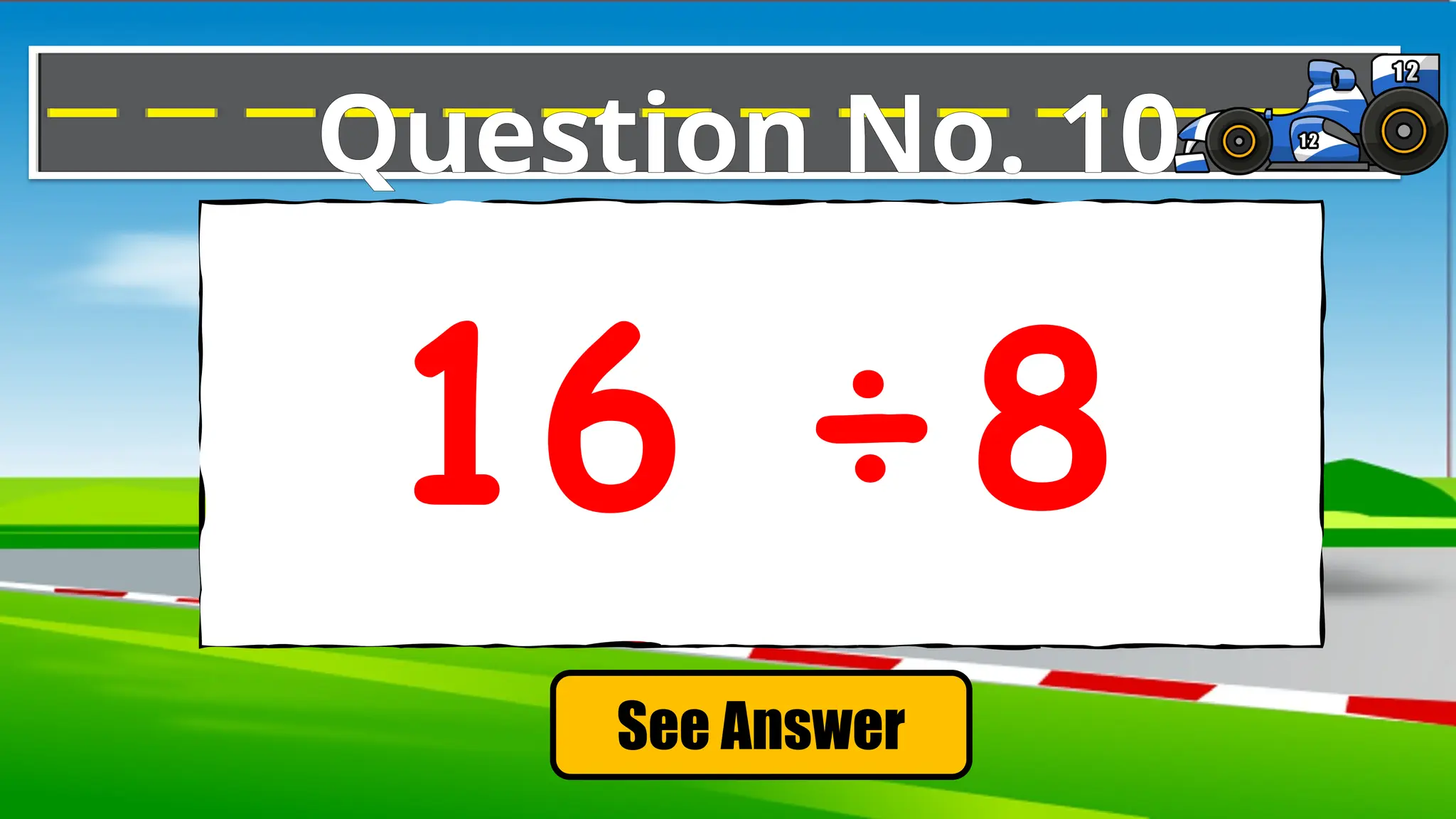
Question No. 10
16 ÷8
Return to Race
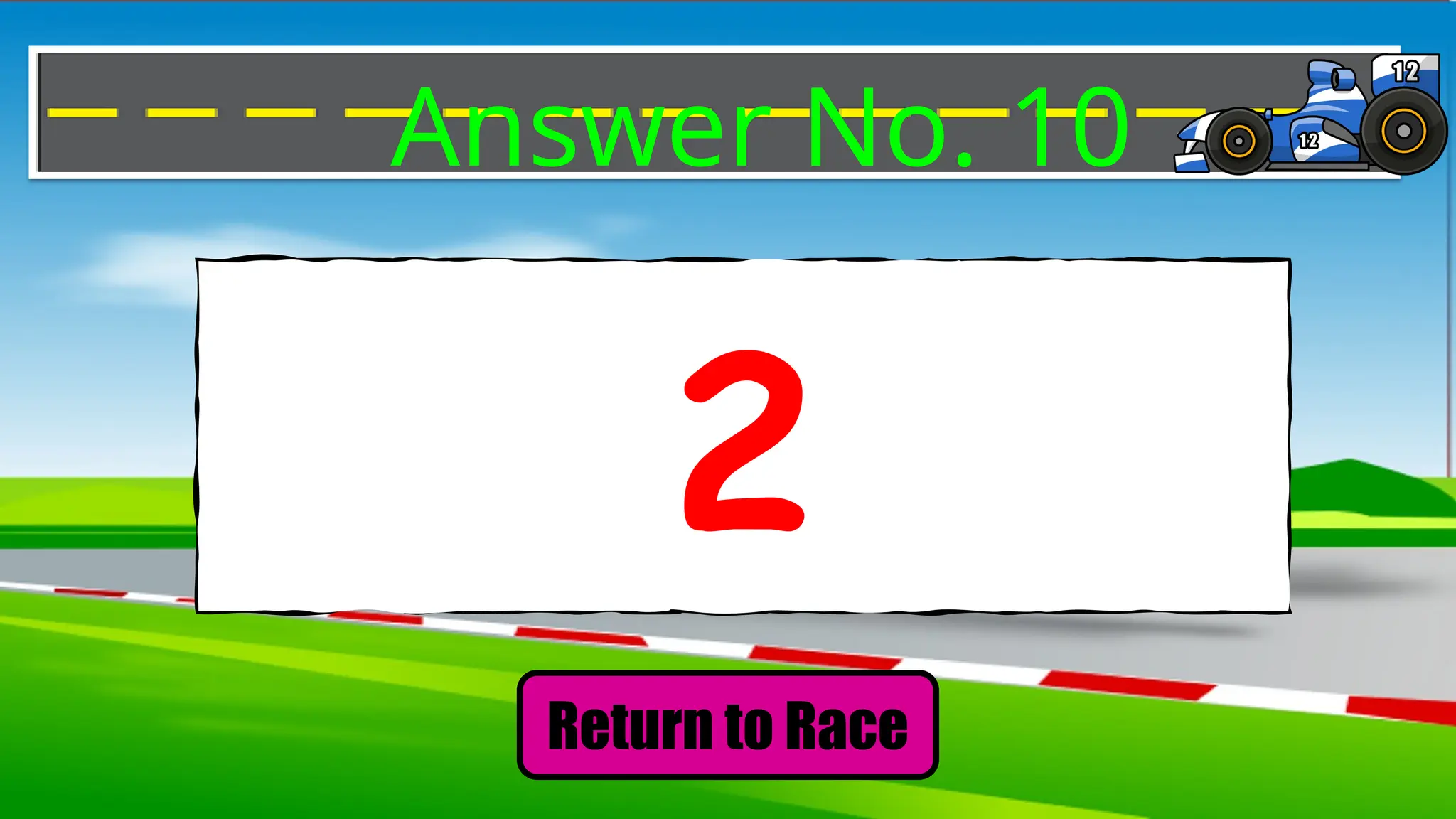
Answer No. 10
2
See Answer
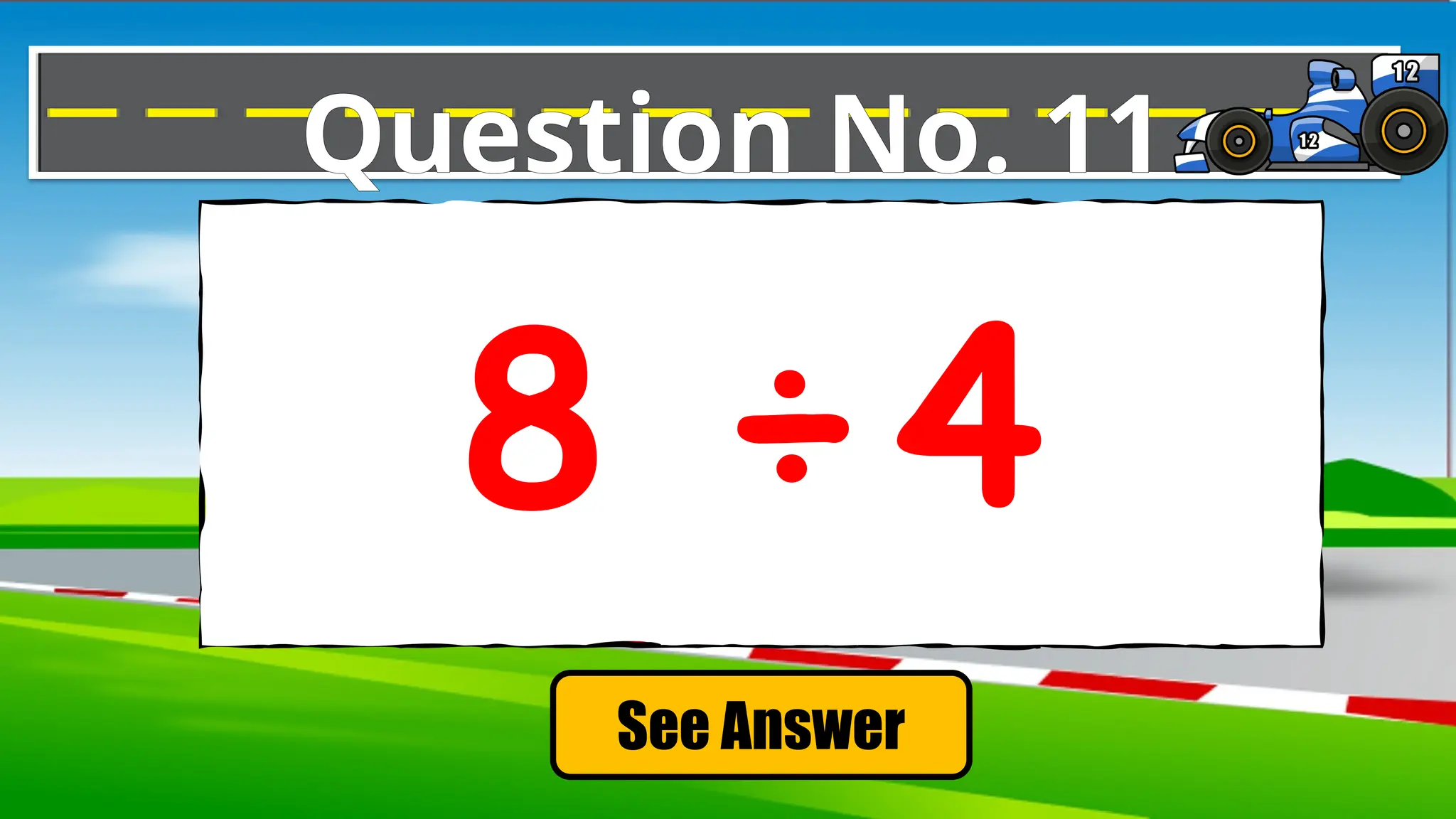
Question No. 11
8 ÷4
Return to Race
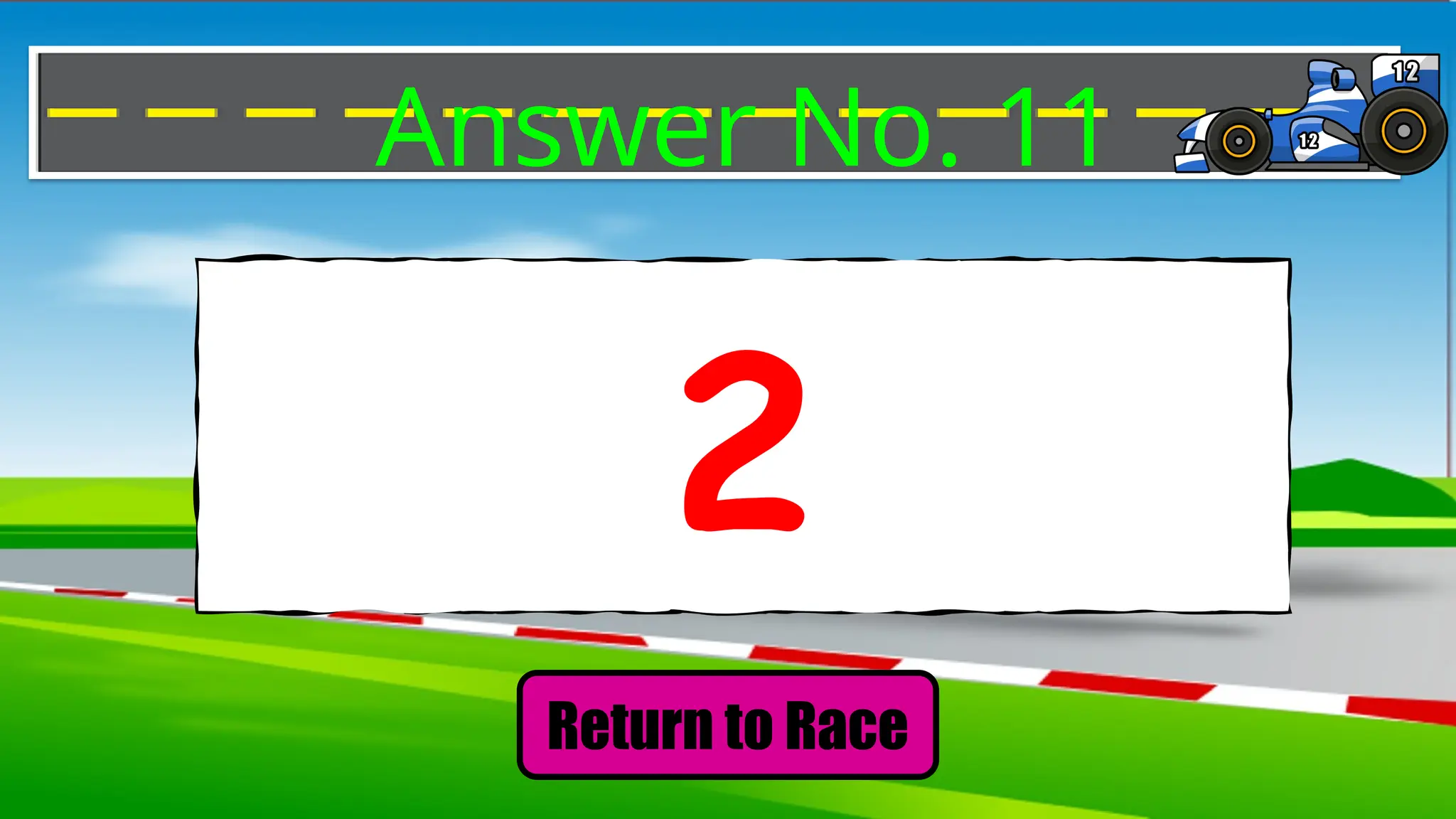
Answer No. 11
2
See Answer
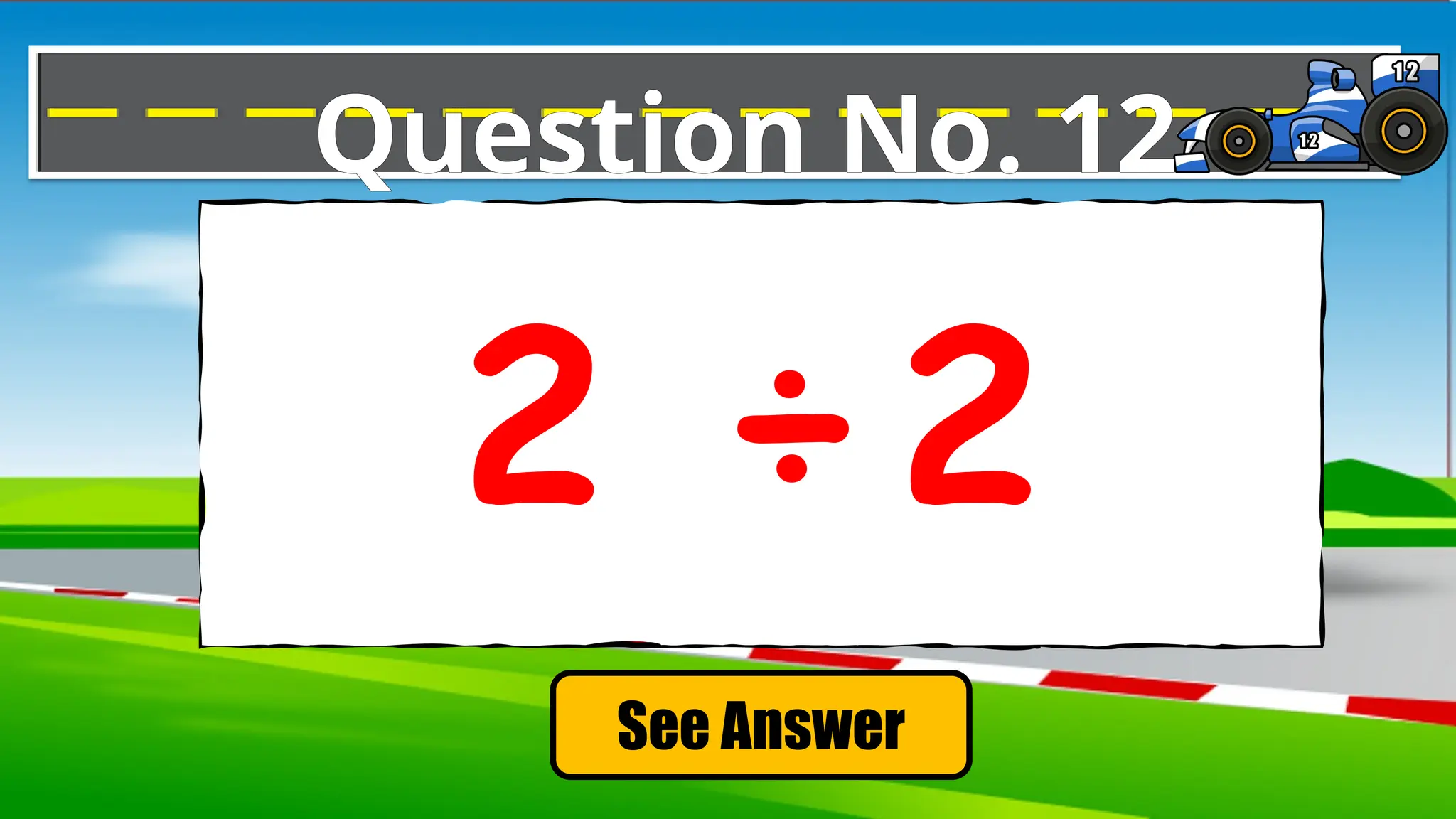
Question No. 12
2 ÷2
Return to Race
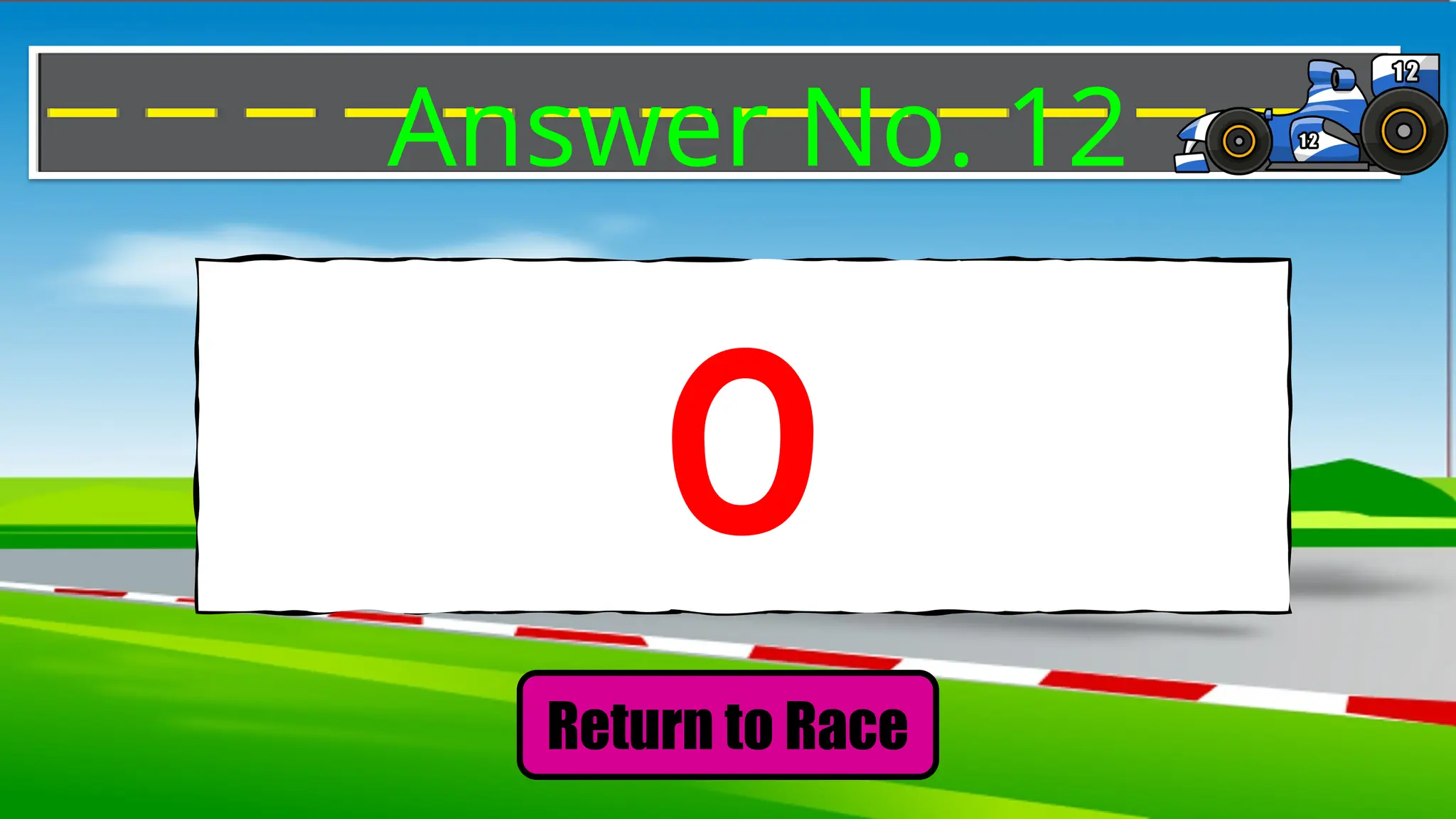
Answer No. 12
0
See Answer
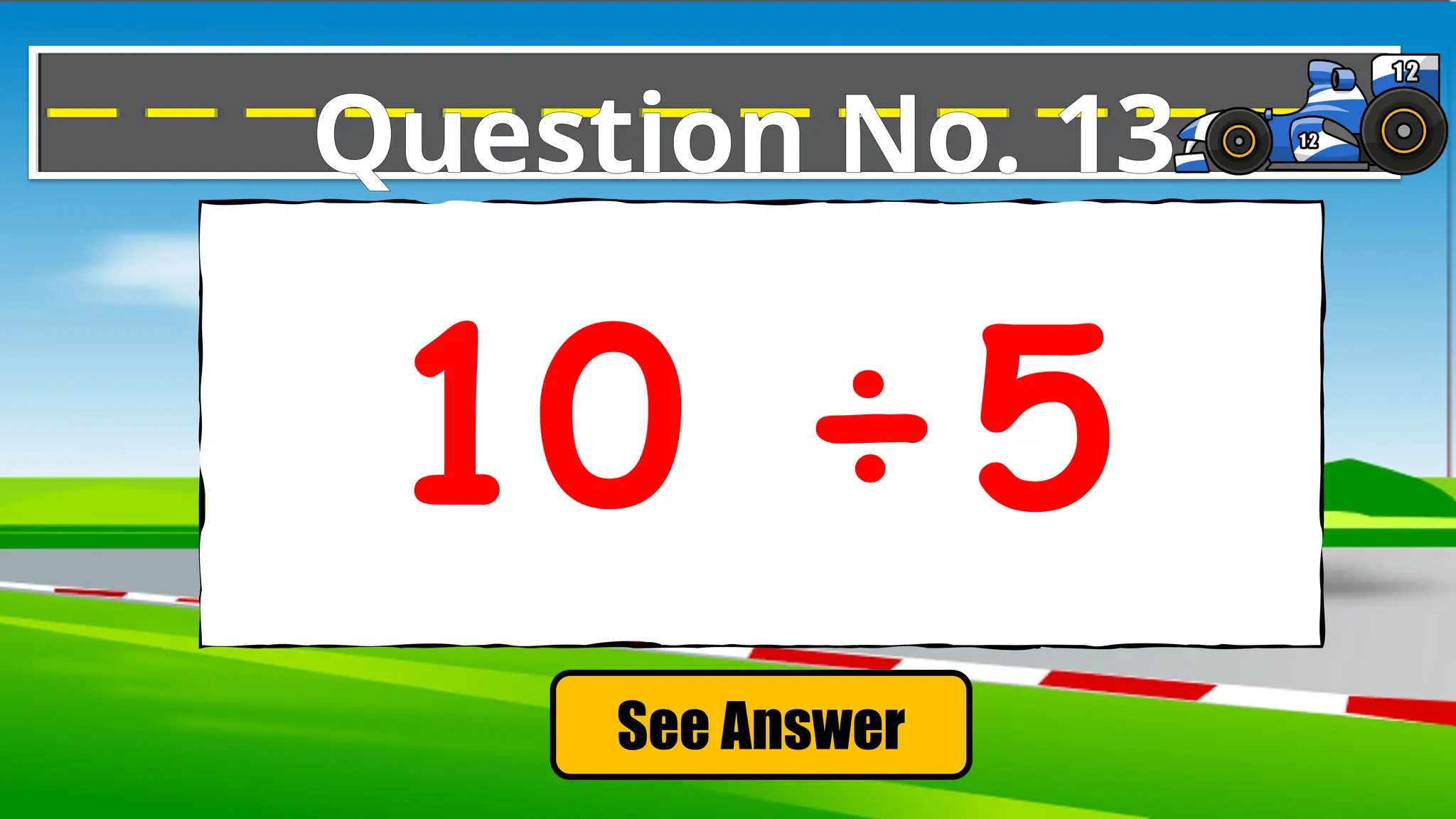
Question No. 13
10 ÷5
Return to Race
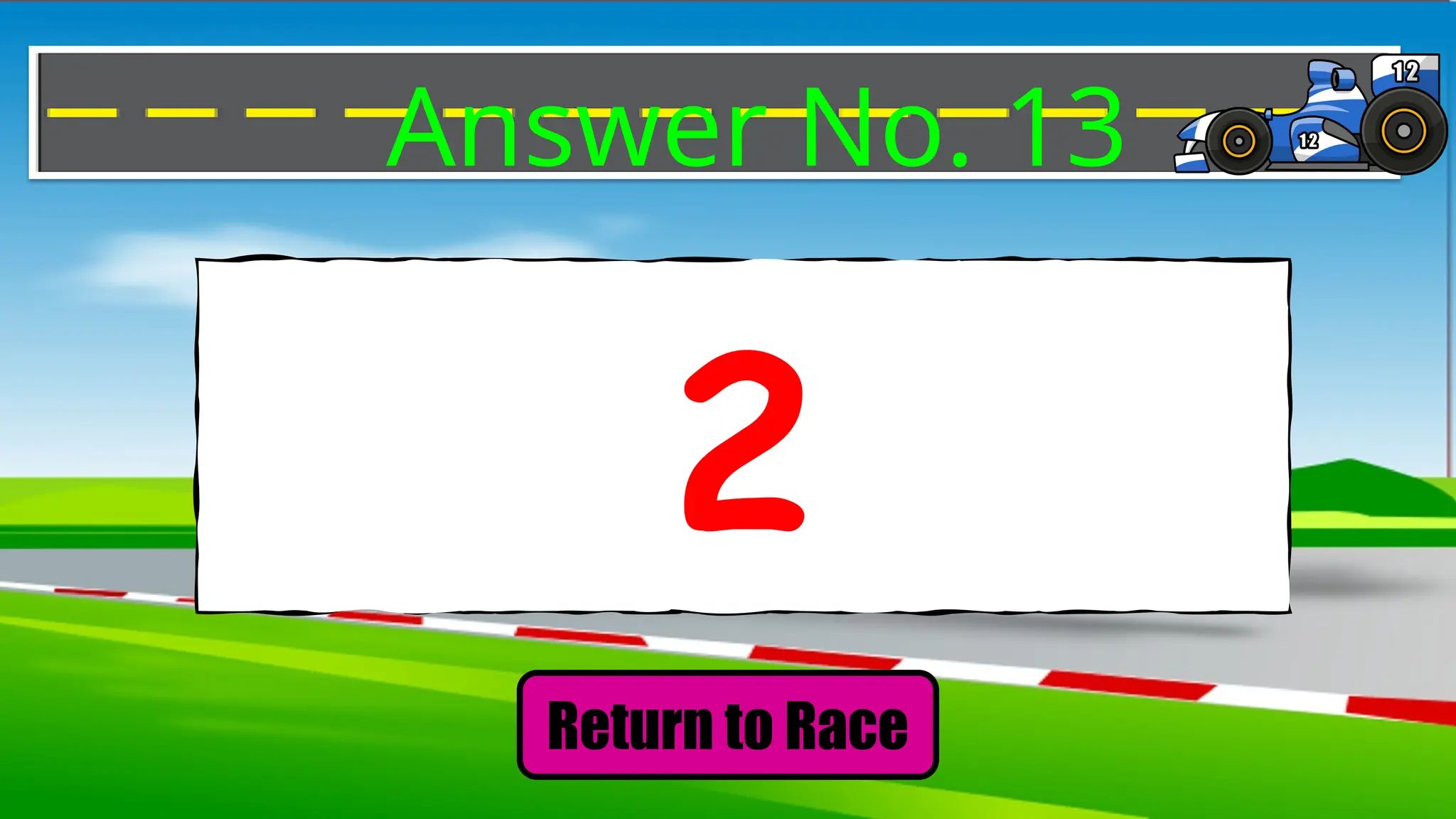
Answer No. 13
2
See Answer
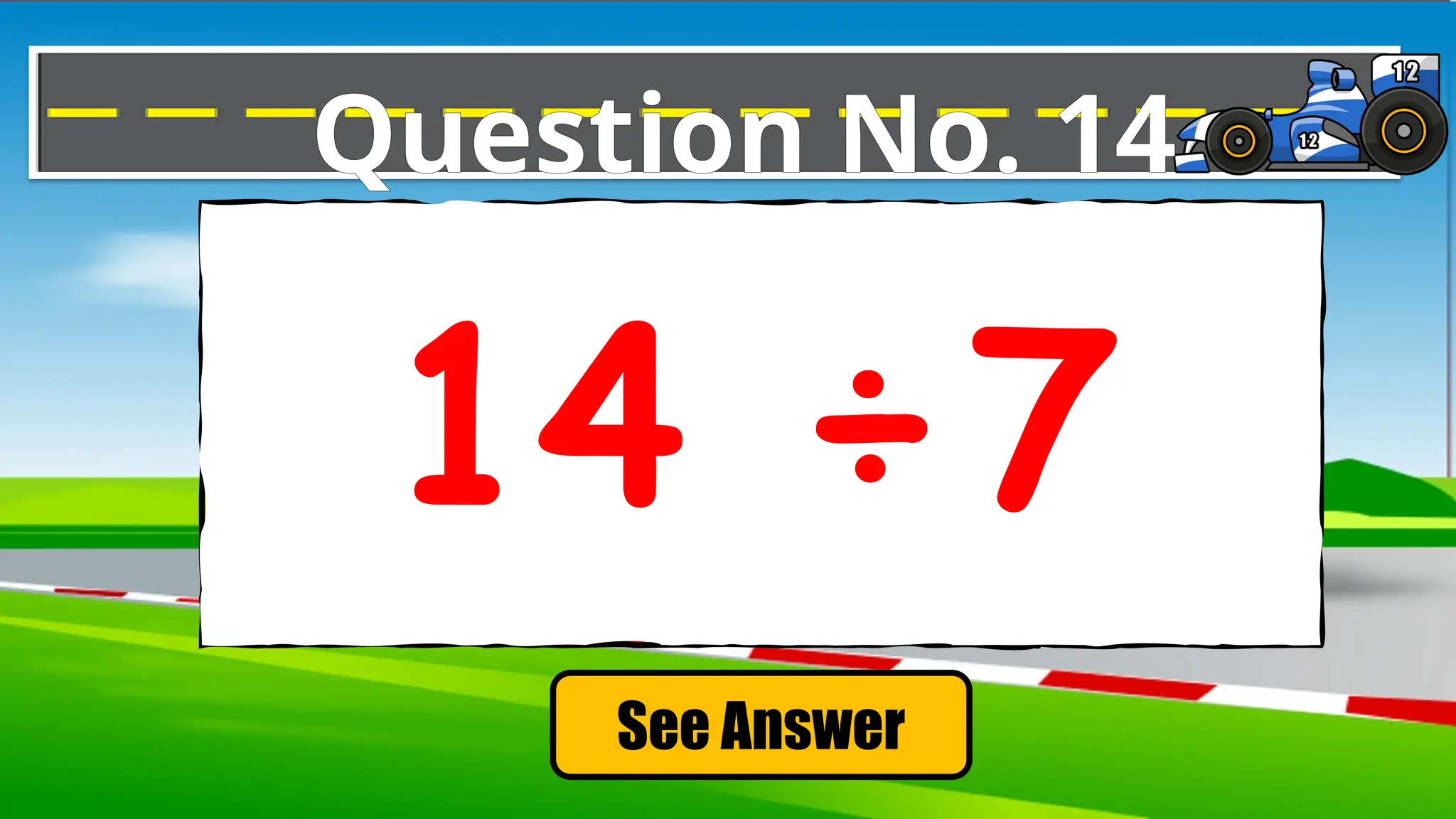
Question No. 14
14 ÷7
Return to Race
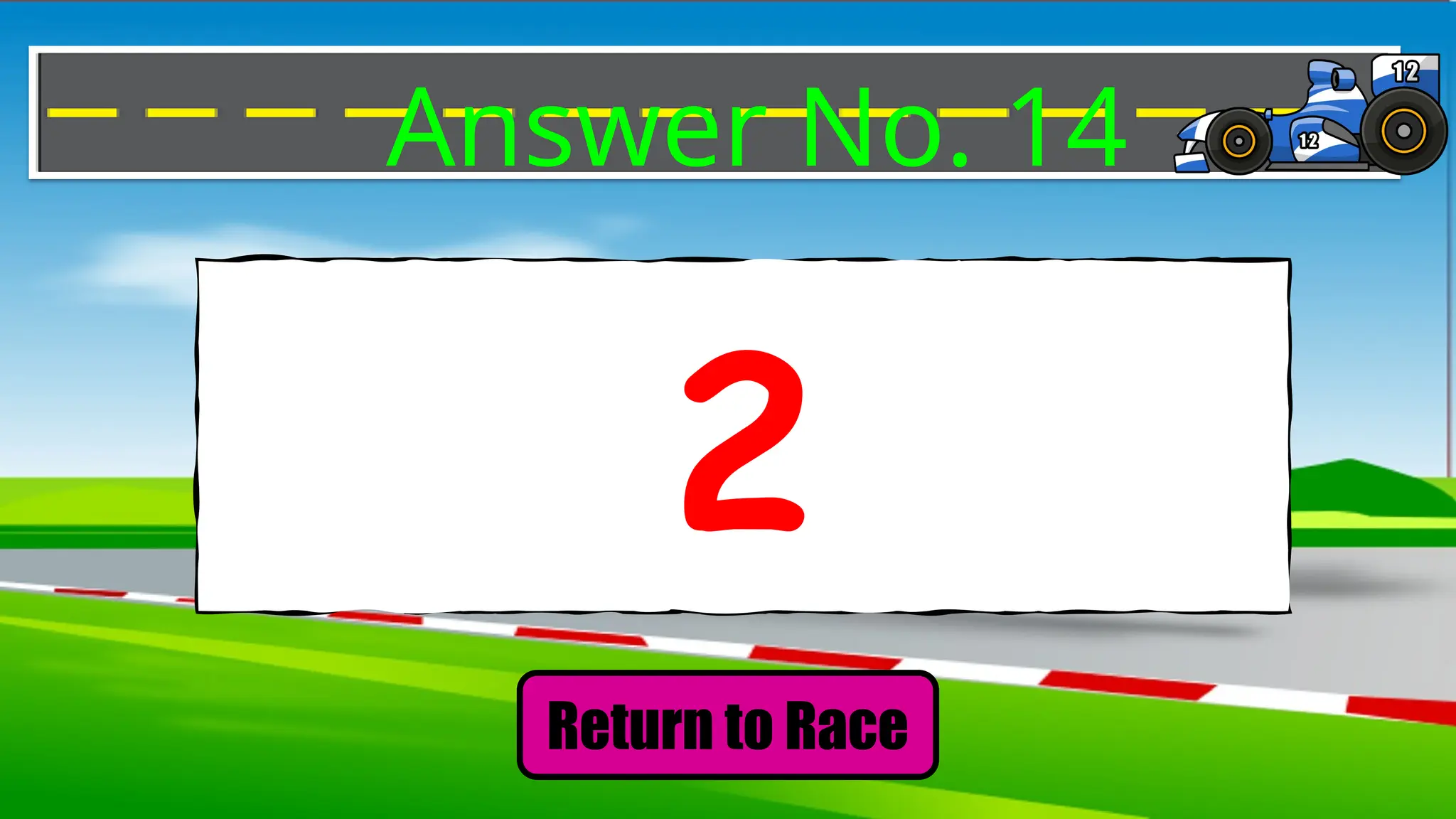
Answer No. 14
2
See Answer
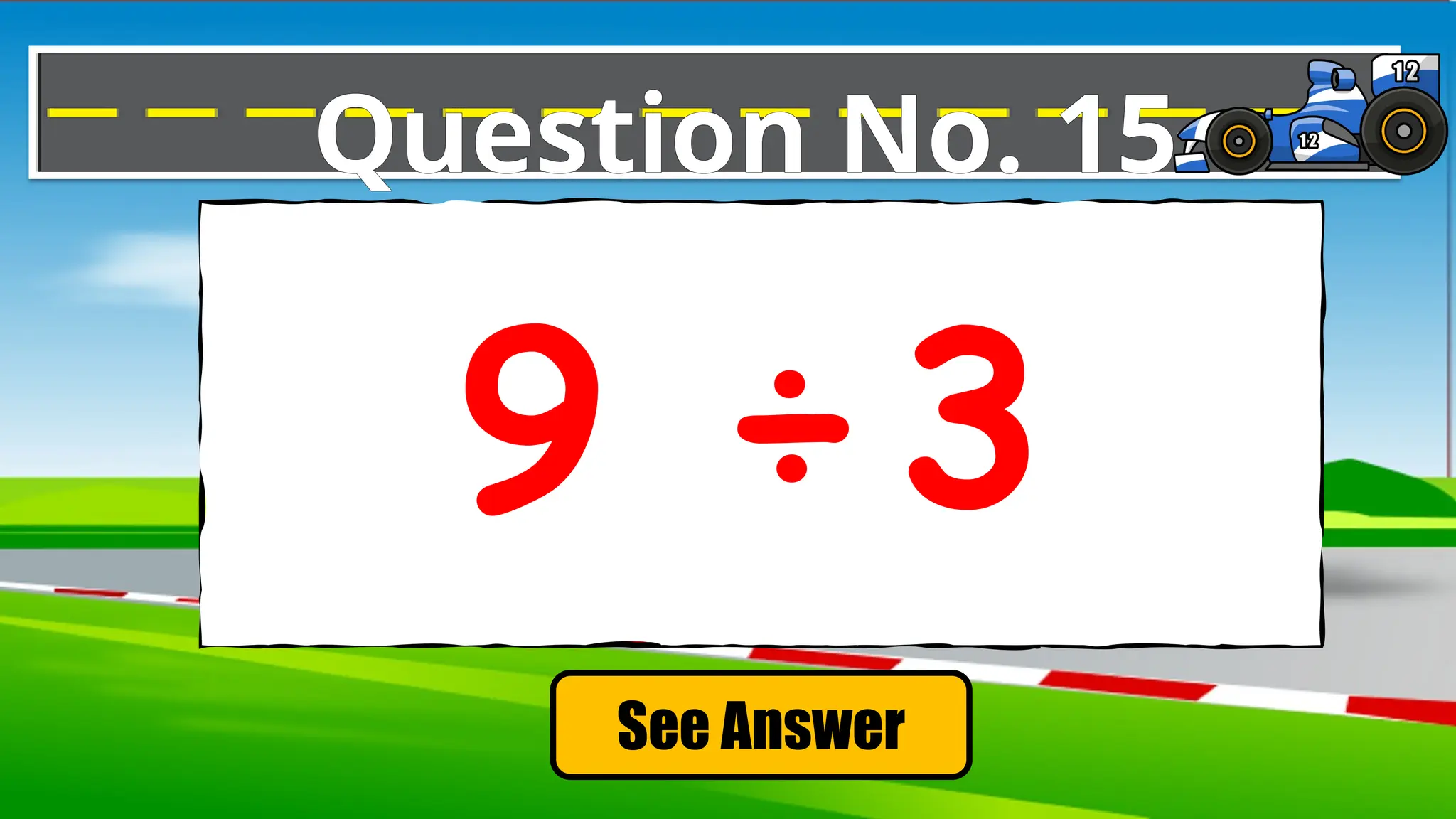
Question No. 15
9 ÷3
Return to Race
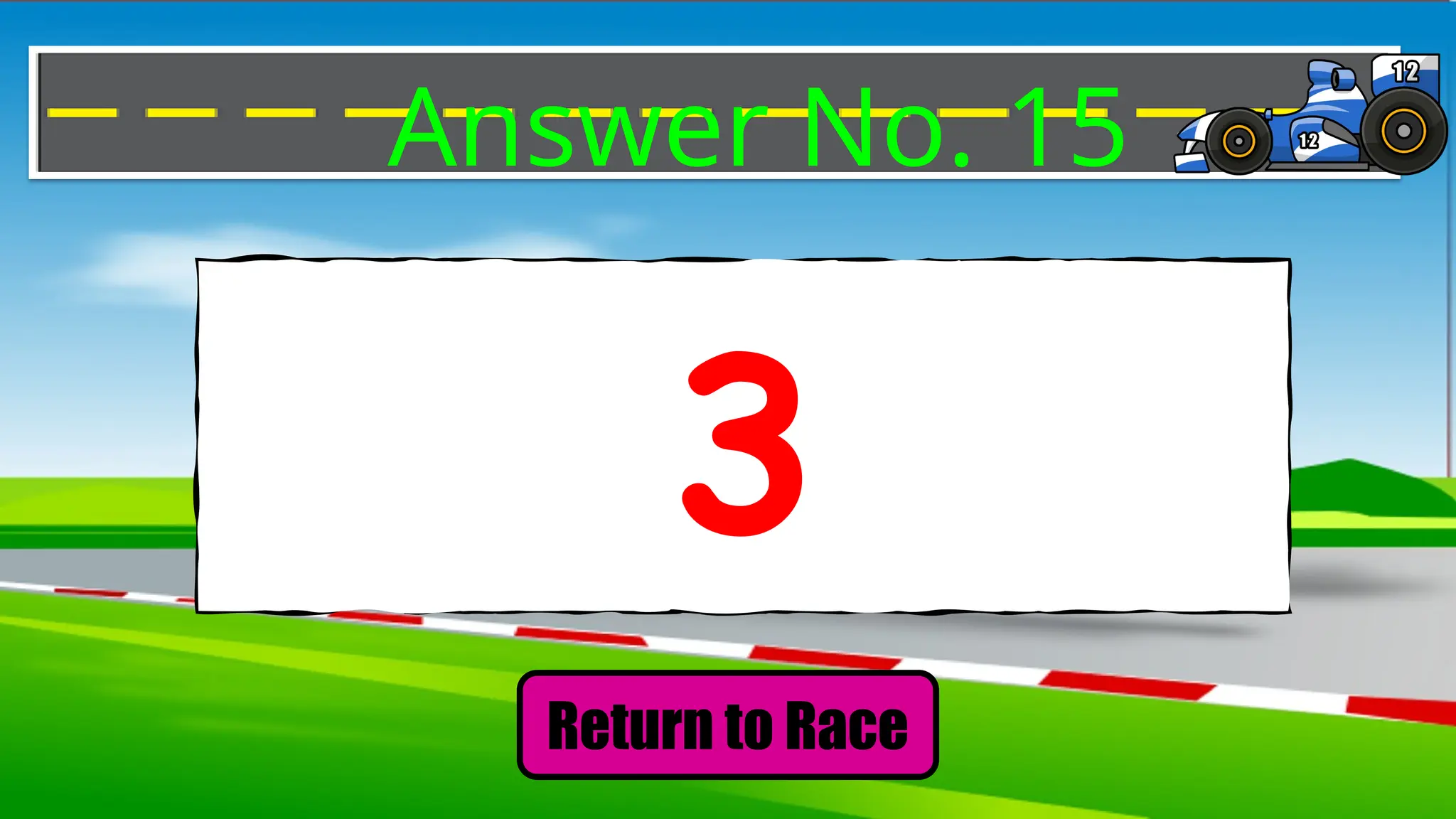
Answer No. 15
3
See Answer
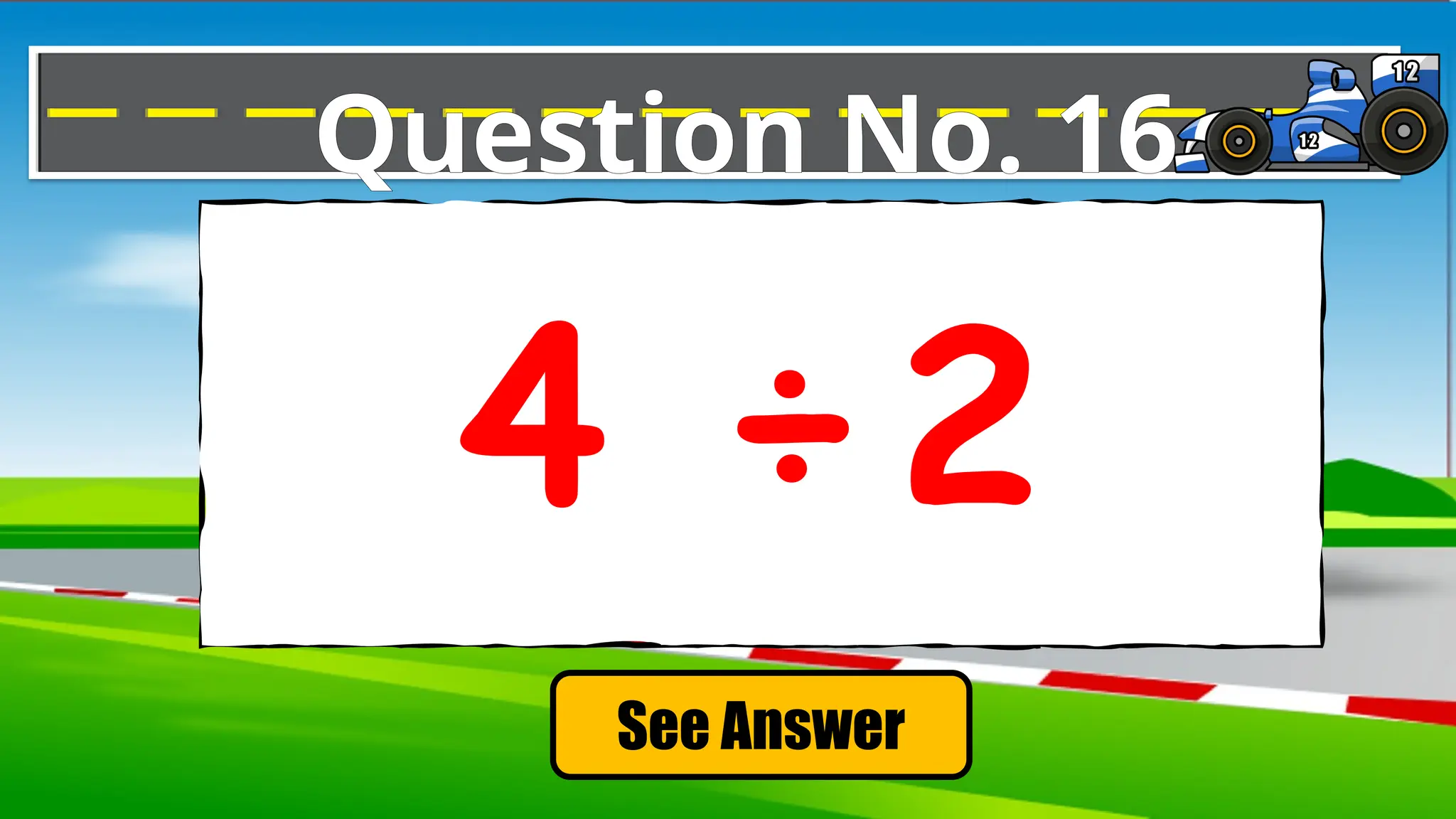
Question No. 16
4 ÷2
Return to Race
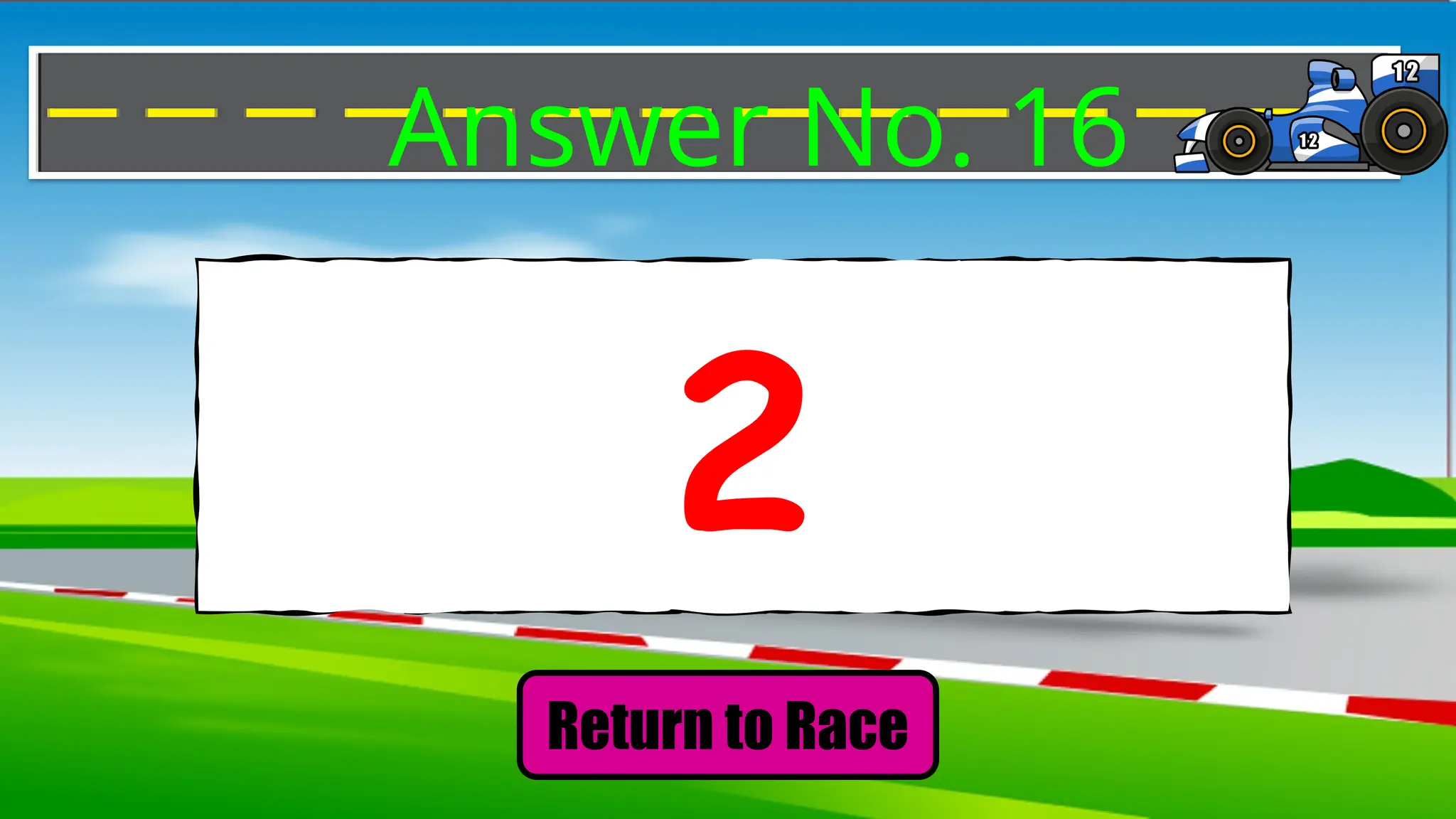
Answer No. 16
2
See Answer
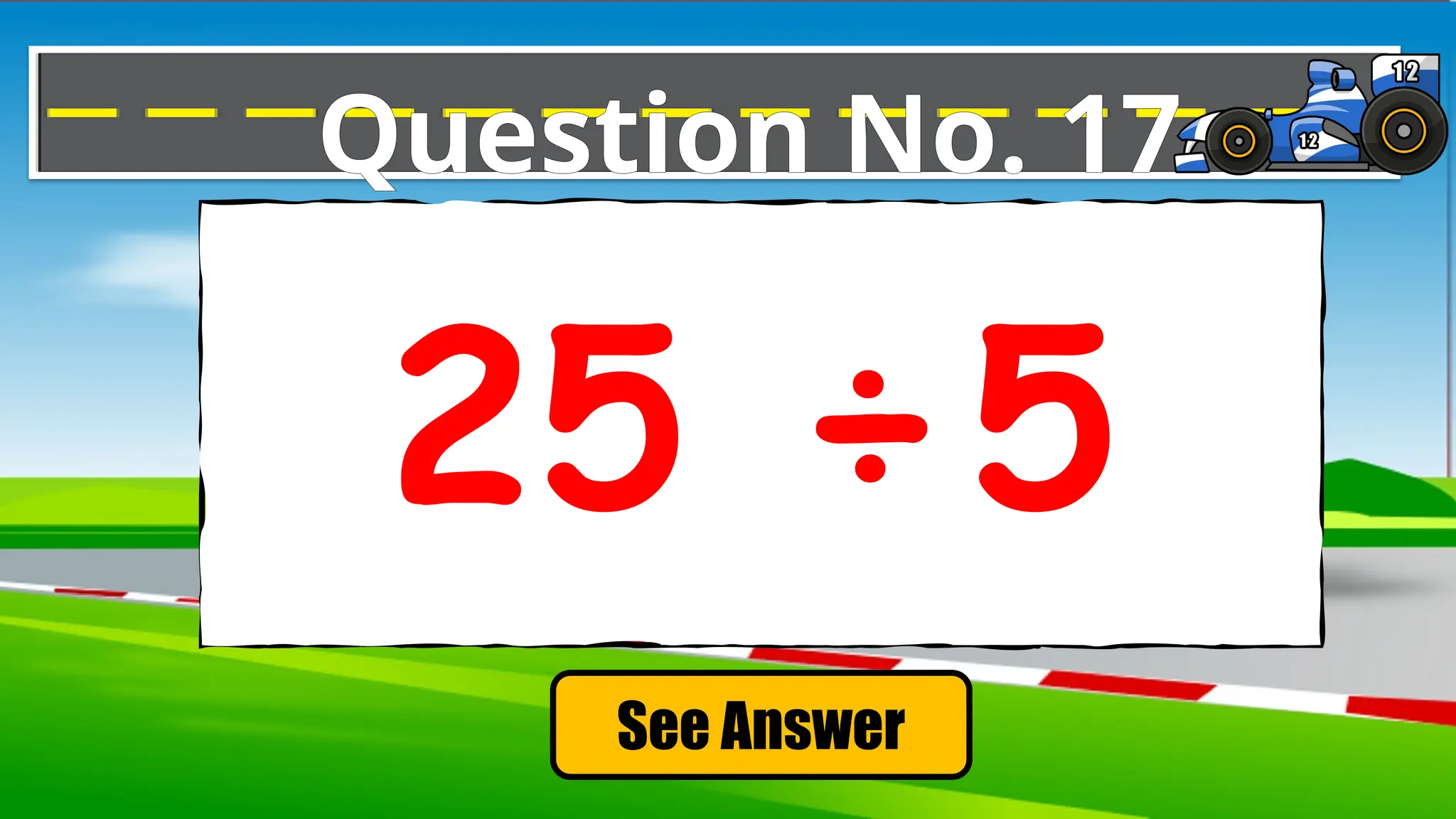
Question No. 17
25 ÷5
Return to Race
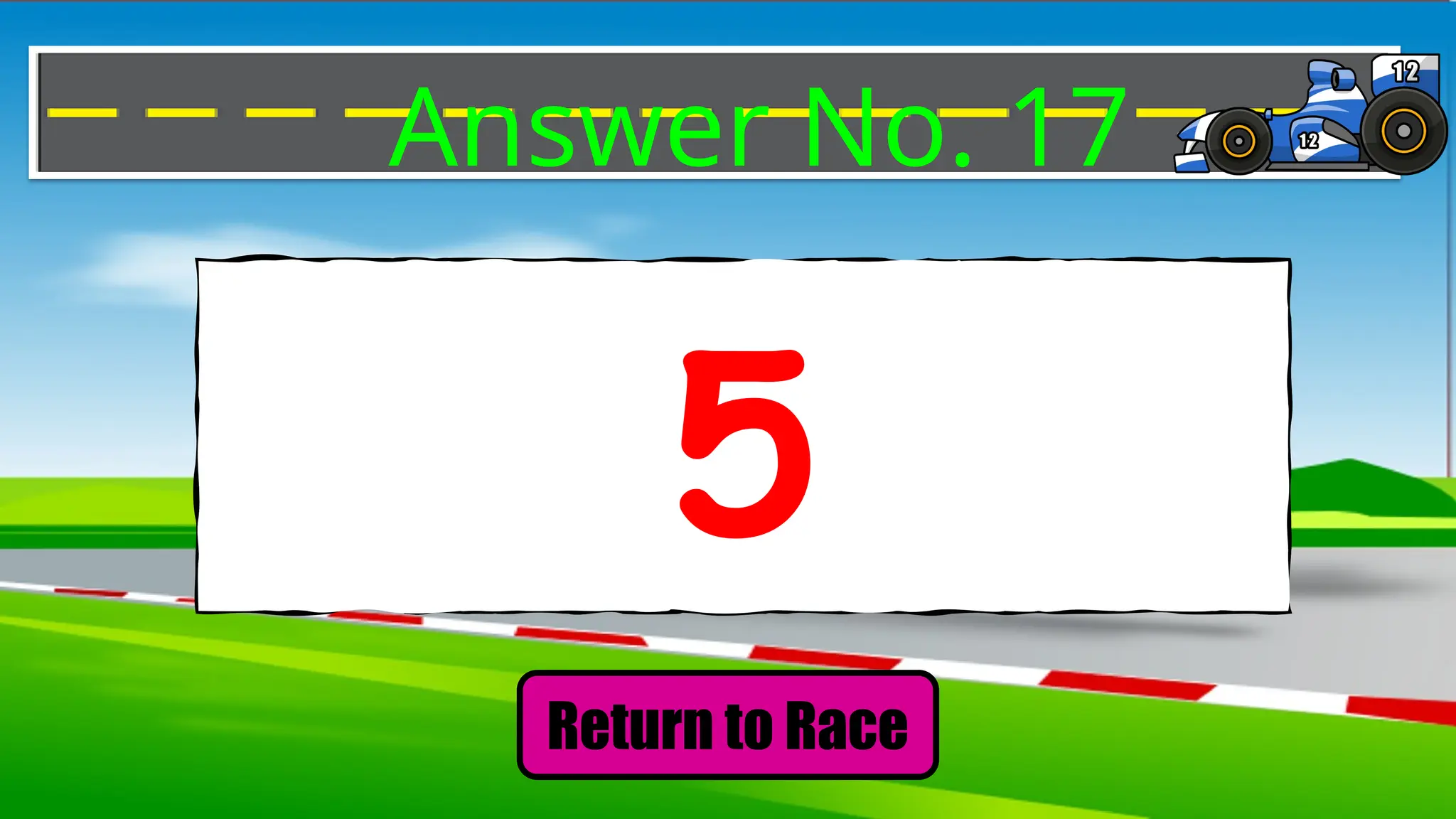
Answer No. 17
5
See Answer
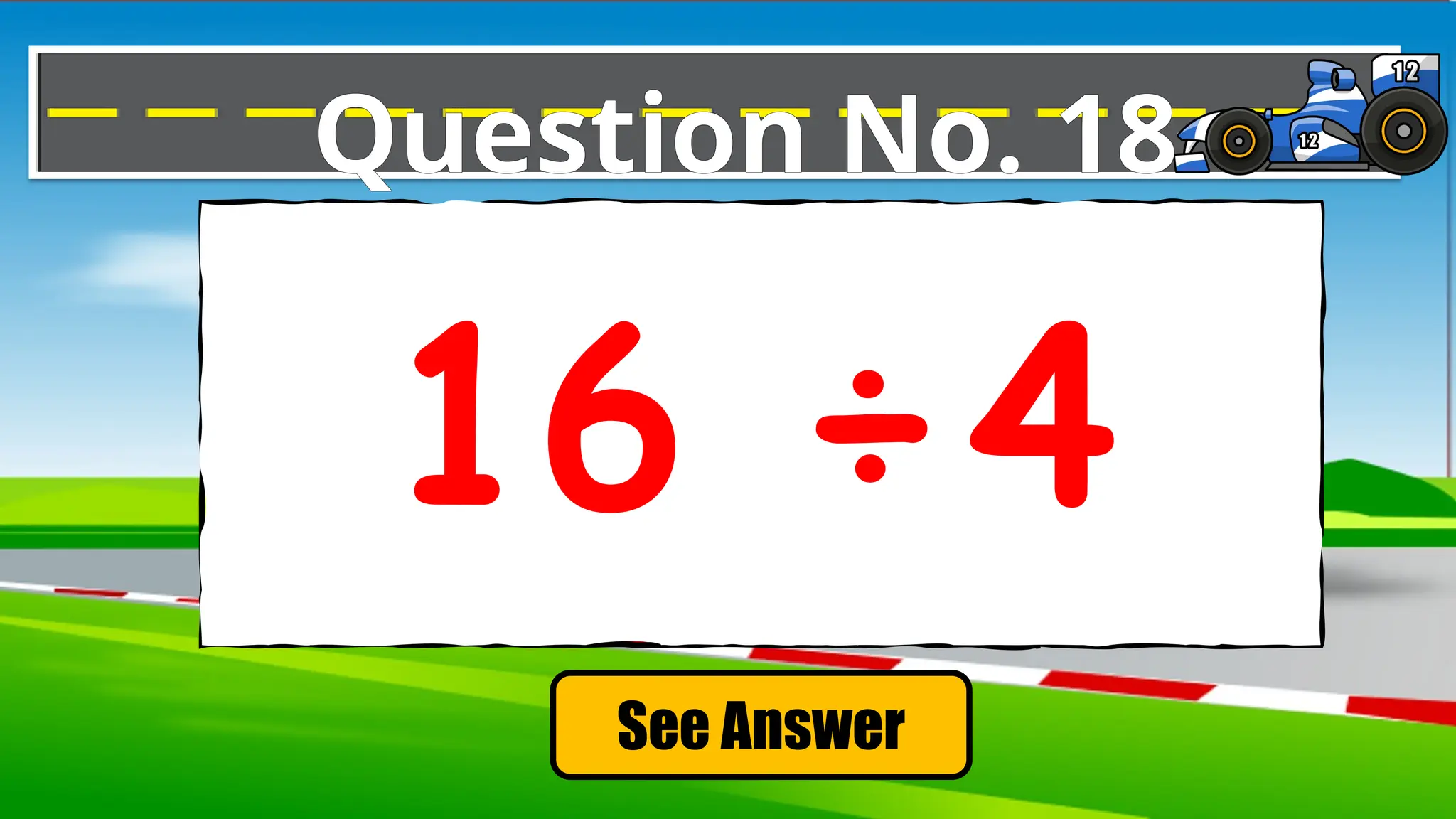
Question No. 18
16 ÷4
Return to Race
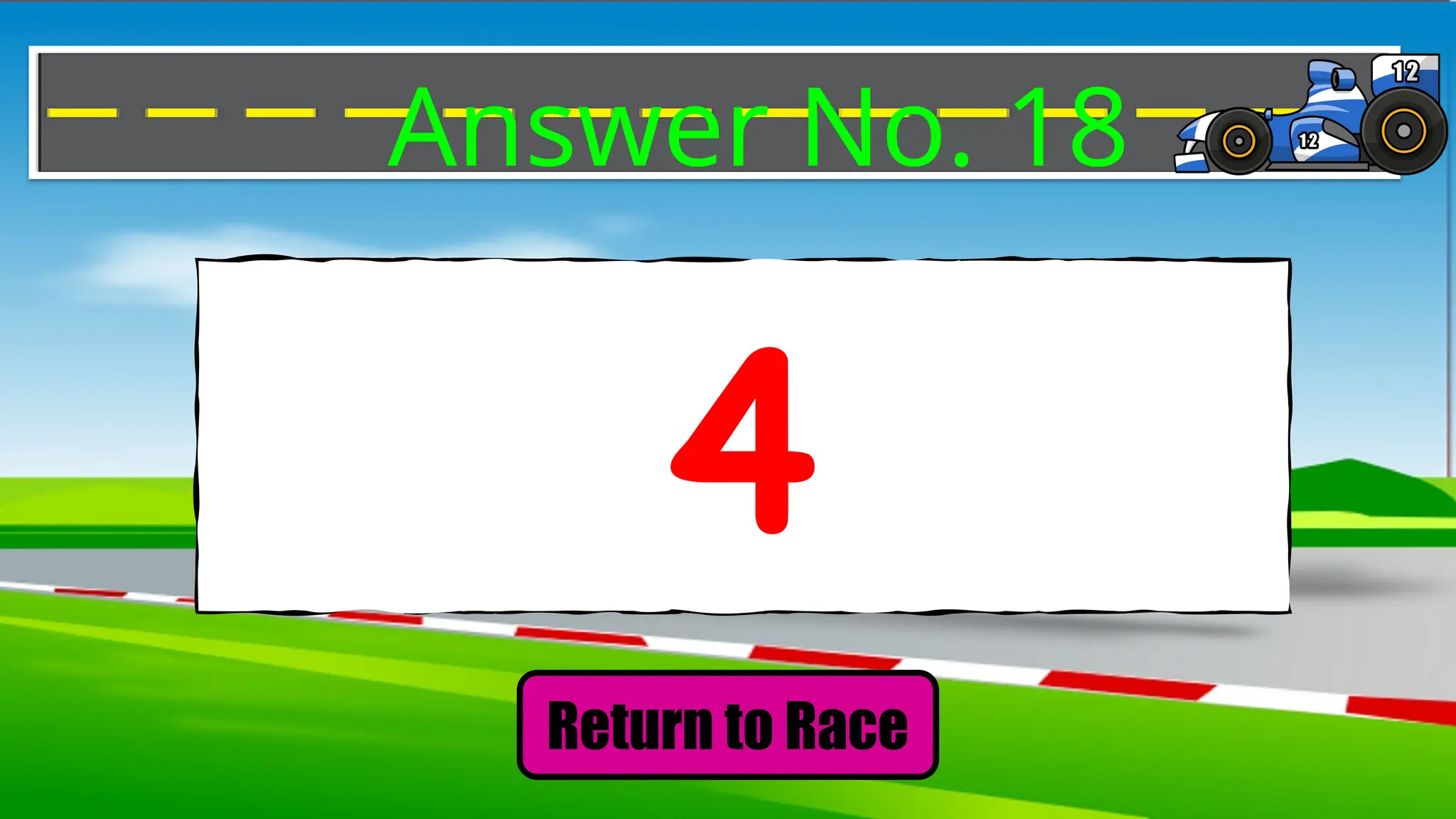
Answer No. 18
4
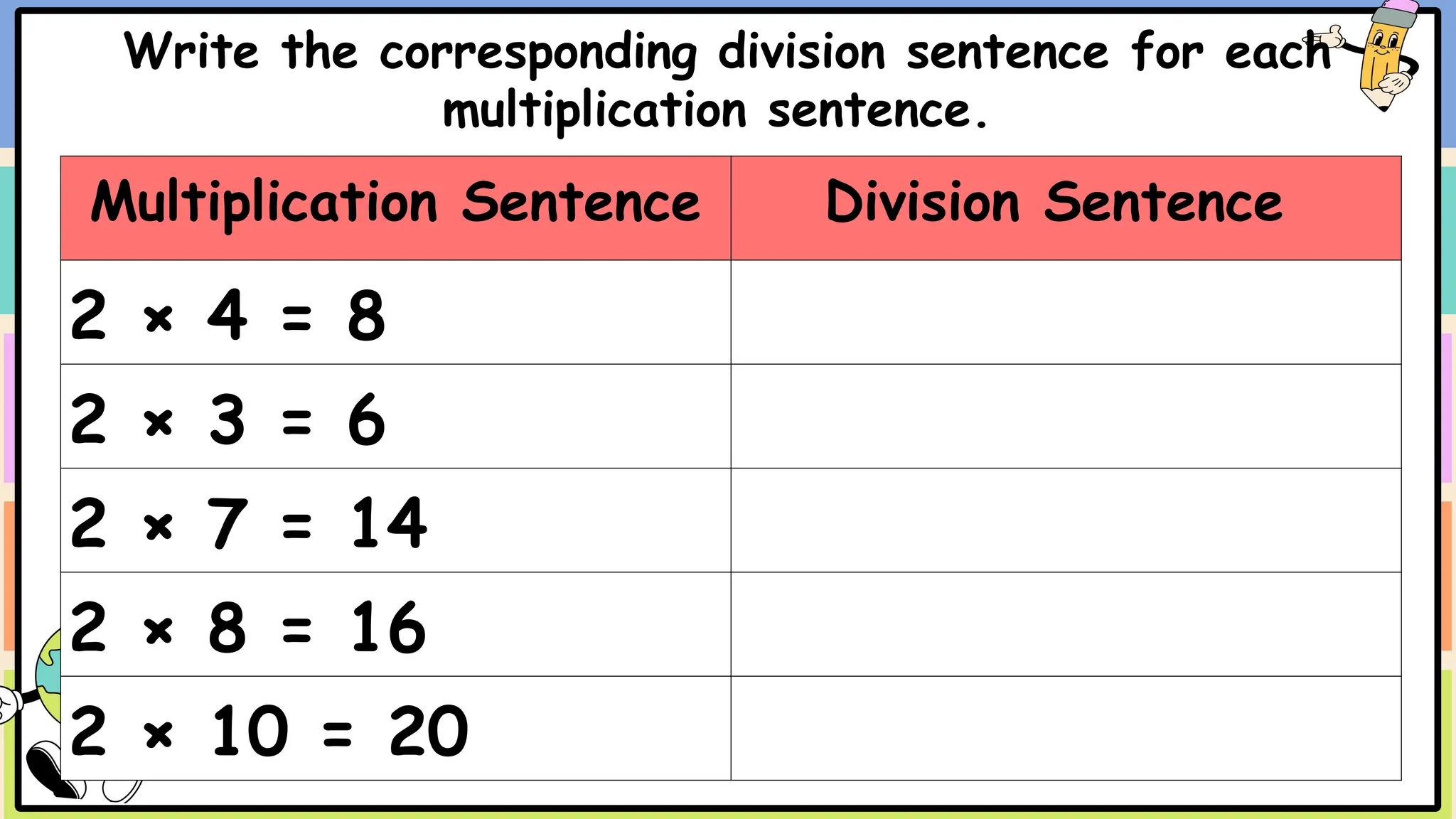
Write the corresponding division sentence for each
multiplication sentence.
Multiplication Sentence Division Sentence
2 × 4 = 8
2 × 3 = 6
2 × 7 = 14
2 × 8 = 16
2 × 10 = 20
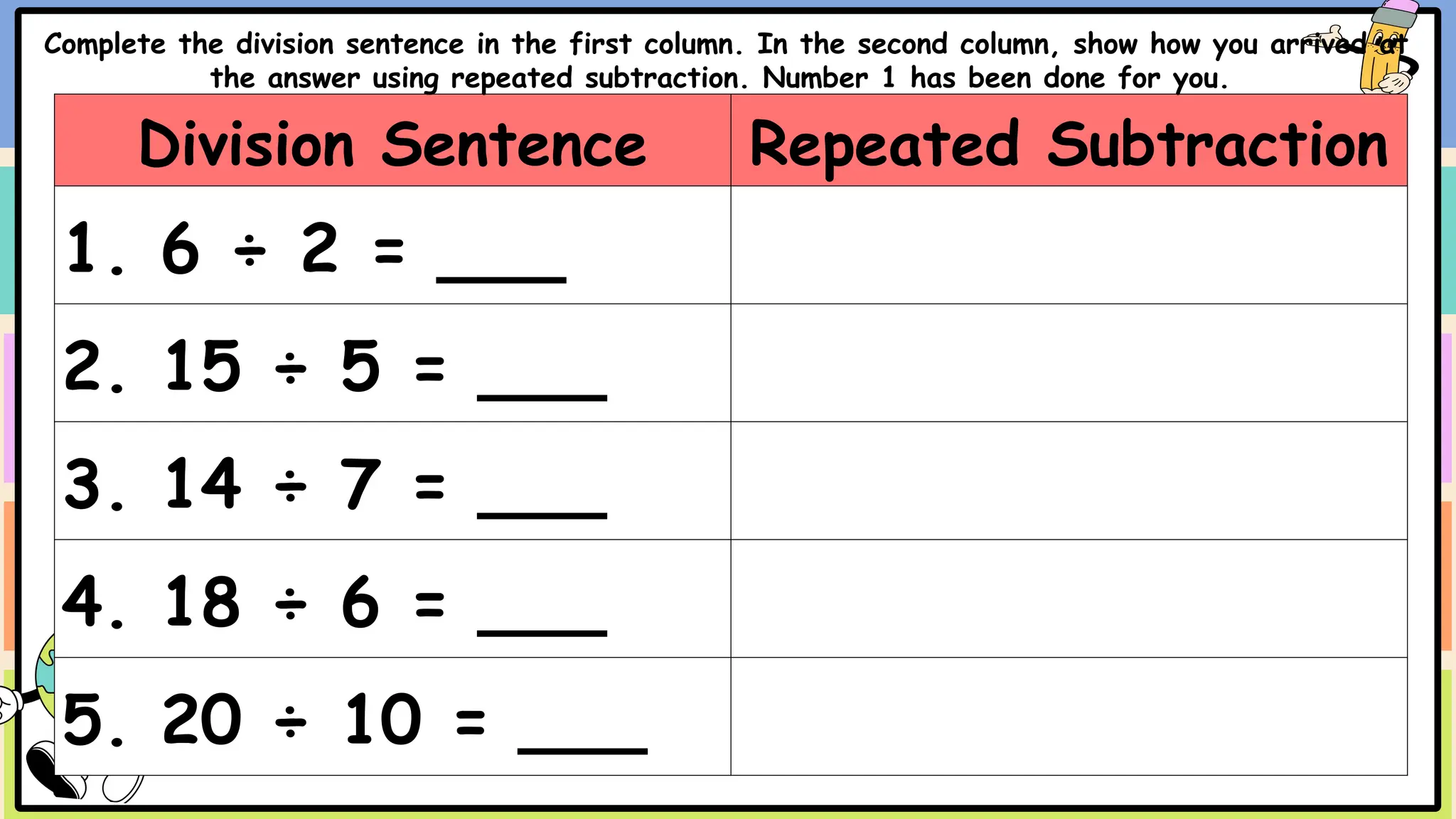
Division Sentence Repeated Subtraction
1. 6 ÷ 2 = ___
2. 15 ÷ 5 = ___
3. 14 ÷ 7 = ___
4. 18 ÷ 6 = ___
5. 20 ÷ 10 = ___
Complete the division sentence in the first column. In the second column, show how you arrived at
the answer using repeated subtraction. Number 1 has been done for you.
Any
Questions?

THIRD-QUARTER-WEEK6-MATHEMATICS-3.ppTX-GRADE-TWO

  • 1.
    M AT HE M AT I C S Q3-GR.2-WEEK6
  • 2.
  • 3.
    To p ic At the end of the lesson, the learner should be able to illustrate division by equally distributing a set number of objects into several groups.
  • 4.
    Have you evershared something with your friends, like food or toys? How did you make sure everyone got the same amount?
  • 5.
  • 6.
    Problem 1: David hasfour marbles. He wants to share them equally between his two friends. How many marbles should David give to each of his friends?
  • 7.
    How they thinkDavid can share the marbles equally with his two friends?
  • 8.
    Are the marbles equallyshared? How do you know?
  • 9.
    In a mathsentence, specifically a division sentence, it can be written as: 4 ÷ 2 = 2
  • 10.
    Read as “4divided by 2 equals 2.” 4 ÷ 2 = 2 multiplier numbers for each group number of group 2 marbles
  • 11.
    Problem 2: Hana hasa total of six books. She wants to distribute the books equally into her three bags. How many books should each bag contain?
  • 13.
    In a mathsentence, specifically a division sentence, it can be written as: 6 ÷ 3 = 2
  • 14.
    Read as “4divided by 2 equals 2.” 6 ÷ 3 = 2 multiplier numbers for each group number of group 2 books
  • 15.
    4 ÷ 2= 2 and 6 ÷ 3 = 2 are called division. Division is the process of sharing equally or distributing equally. When we divide, we are essentially splitting something into equal parts. Remember
  • 16.
    Example 1: Divide 12balls into 4 equal groups.
  • 17.
  • 18.
    Example 2 Divide 20balls equally into 5 jars.
  • 20.
    What do youcall the process of “sharing equally” or “distributing equally”? It is division.
  • 21.
    If we knowthe total number of objects and the number of groups to distribute them to, what does division tell us? Division tells us the number of objects each group contains.
  • 22.
    Divide the objectsequally into the number of groups shown. Draw the correct number of objects in each group. Then, write your answer to the question that follows. 1. Divide 6 hearts into 2 groups How many hearts are there in each group? ________ 2. Divide 8 stars into 4 groups How many stars are there in each group? ________ 3. Divide 12 balls into 3 groups How many hearts are there in each group? ________
  • 23.
  • 24.
    To p ic At the end of the lesson, the learner should be able to illustrate division by forming groups with equal number of objects.
  • 25.
    What is division? Itis the process of sharing equally or distributing objects into equal groups.
  • 26.
    Bring out theiryour show-me boards for a short review. I have 12 oranges shown on the board.
  • 27.
    1. Divide these12 oranges into 2 equal groups. 12 ÷ 2 = 6
  • 28.
    How many oranges arein each group? There are 6 oranges in each group.
  • 29.
    2. Divide these12 oranges into 3 equal groups. 12 ÷ 3 = 4
  • 30.
    3. Divide these12 oranges into 6 equal groups. 12 ÷ 6 = 2
  • 31.
    How many oranges arein each group? There are 2 oranges in each group.
  • 32.
    Problem 1: If wewere to divide 12 oranges into groups of two, how many groups will there be?
  • 33.
    How many groupsof 2 oranges did we make? 12 ÷ 2 = 6
  • 34.
    Problem 2: If wewere to divide 12 oranges into groups of three, how many groups will there be?
  • 35.
    How many groupsof 3 oranges did we make? 12 ÷ 3 = 4
  • 36.
    Problem 3: If wewere to divide 12 oranges into groups of four, how many groups will there be?
  • 37.
    How many groupsof 4 oranges did we make? 12 ÷ 4 = 3
  • 38.
    Problem 4: If wewere to divide 12 oranges into groups of six, how many groups will there be?
  • 39.
    How many groupsof 6 oranges did we make? 12 ÷ 6 = 2
  • 40.
    If we knowthe total number of objects and the size (number of objects) of each group, what does division tell us? Division tells us how many groups can be made when each group contains a specific number of objects.
  • 41.
    Divide the objectsequally by drawing a circle around the indicated number of objects in each group. Then, write your answer to the question that follows. 1. Divide 15 apples into groups of 3. How many groups of 3 apples are there? __________ 2. Divide 16 eggs into groups of 2. How many groups of 2 eggs are there? __________ 3. Divide 10 corns into groups of 5. How many groups of 5 corns are there? __________
  • 42.
  • 43.
    To p ic At the end of the lesson, the learner should be able to illustrate and write division expressions as repeated subtraction.
  • 44.
    What is thedivision sentence? 12 ÷ 6 = 2
  • 45.
    Let us divide6 oranges in groups of 2 using repeated subtraction:
  • 46.
    6 ÷ 2= 3
  • 47.
    Subtraction sentence: 6 –2 = 4 4 – 2 = 2 2 – 2 = 0
  • 48.
    4 ÷ 2= 2 dividend divisor quotient Different parts of the division sentence.
  • 49.
    Let’s apply theconcept of repeated subtraction to our previous example of dividing 12 oranges into groups of 3.
  • 50.
    12 - 3= 9 9 - 3 = 6 6 - 3 = 3 3 - 3 = 0
  • 51.
    12 - 3= 9 9 - 3 = 6 6 - 3 = 3 3 - 3 = 0 We can express this repeated subtraction as a division sentence. 12 ÷ 3 = 4
  • 52.
    Write the division sentencefor each repeated subtraction illustrated below.
  • 53.
  • 54.
  • 55.
  • 56.
    What do wedo when we divide using repeated subtraction? We subtract the same number repeatedly until we reach 0. The quotient is the number of times we subtract from the total until we reach 0.
  • 57.
    What makes upthe division sentence? Define each part. Dividend: The number to be divided. Divisor: The number that divides the dividend. Quotient: The result of the division. Division symbol ÷ : Read as “divided by”.
  • 58.
    Write the repeatedsubtraction for each division sentence in the second column. Then, complete the division sentence in the first column. Number 1 has been done for you. Division Sentence Repeated Subtraction 1. 15 ÷ 3 = 5 15 – 3 = 12 12 – 3 = 9 9 – 3 = 6 6 – 3 = 3 3 – 3 = 0 2. 18 ÷ 6 = ___ 3. 14 ÷ 2 = ___
  • 59.
  • 60.
    To p ic At the end of the lesson, the learner should be able to divide numbers using the multiplication table of 2.
  • 61.
    What is the operationused to represent repeated addition? It is multiplication.
  • 62.
    How do weexpress repeated addition as multiplication? Example: 3 + 3 = 2 × 3 So, 2 × 3 = 6
  • 63.
    What operation involves subtracting thesame number repeatedly until you reach 0? It is division.
  • 64.
    How do weexpress 6 ÷ 3 as repeated subtraction? To express 6 ÷ 3 as repeated subtraction, we subtract 3 from 6 repeatedly until we reach 0:
  • 65.
    How can wewrite the number of circles as addition? 1 + 1 = 2
  • 66.
    How do wewrite the addition sentence as multiplication? 2 x 1 = 2
  • 67.
    We repeatedly subtract1 two times until we get to zero. We can express this repeated subtraction as a division sentence: 2 ÷ 1 = 2
  • 68.
    How can wewrite the number of circles as addition? 2 + 2 = 4
  • 69.
    How about asa multiplication sentence? 2 + 2 = 4 2 x 2 = 4
  • 70.
    Let us expressthe division sentence 4 ÷ 2 as repeated subtraction. 4 – 2 = 2 2 – 2 = 0 So, 4 ÷ 2 = 2
  • 71.
    Circles into groupsof 2 circles, we got 2 groups of 2 circles. Follow the same process as above for: 2 x 3 = 6 and 6 ÷ 3 = 2 2 x 4 = 8 and 8 ÷ 4 = 2 2 x 5 = 10 and 10 ÷ 5 = 2
  • 72.
    Write the correspondingdivision sentence for each multiplication sentence. Multiplication Sentence Division Sentence 2 × 6 = 12 2 × 7 = 14 2 × 8 = 16 2 × 9 = 18 2 × 10 = 20
  • 73.
    Completed the table. MultiplicationTable of 2 Division Sentence 2 × 1 = 2 2 ÷ 1 = 2 2 × 2 = 4 4 ÷ 2 = 2 2 × 3 = 6 6 ÷ 3 = 2 2 × 4 = 8 8 ÷ 4 = 2 2 × 5 = 10 10 ÷ 5 = 2 2 × 6 = 12 12 ÷ 6 = 2 2 × 7 = 14 14 ÷ 7 = 2 2 × 8 = 16 16 ÷ 8 = 2 2 × 9 = 18 18 ÷ 9 = 2 2 ×10 = 20 20÷10 = 2
  • 74.
    How are multiplication anddivision related? Multiplication and division are opposite operations. Multiplication is essentially repeated addition, while division is repeated subtraction or partitioning into equal parts. If you multiply two numbers and then divide the product by one of those numbers, you will get the other number. We can divide numbers using the multiplication table of 2. e.g. 2 × 4 = 8 and 8 ÷ 4 = 2
  • 75.
    Division Sentence RepeatedSubtraction 1. 6 ÷ 3 = 2 6 – 3 = 3 3 – 3 = 0 2. 10 ÷ 5 = ___ 3. 16 ÷ 8 = ___ 4. 14 ÷ 7 = ___ 5. 20 ÷ 10 = ___ Complete the division sentence in the first column. In the second column, show how you arrived at the answer using repeated subtraction. Number 1 has been done for you.
  • 76.
  • 77.
    Let us reviewour fast lesson.
  • 78.
    4 ÷ 2= 2 dividend divisor quotient Different parts of the division sentence.
  • 79.
    Parts of divisionsentence. Dividend: The number to be divided. Divisor: The number that divides the dividend. Quotient: The result of the division. Division symbol ÷ : Read as “divided by”.
  • 80.
    CAR RACING GAME Who willwin the race? START
  • 81.
    CAR RACING GAME Clickto make the violet car move Click to make the blue car move Click to make the yellow car move Click to make the green car move Click to make the red car move Go to Questions
  • 82.
    1 2 34 5 6 7 8 9 10 11 12 questions 13 14 15 18 16 17
  • 83.
    Question No. 1 SeeAnswer 2 ÷1
  • 84.
  • 85.
  • 86.
  • 87.
  • 88.
  • 89.
  • 90.
  • 91.
  • 92.
  • 93.
  • 94.
  • 95.
  • 96.
  • 97.
  • 98.
  • 99.
  • 100.
  • 101.
  • 102.
  • 103.
  • 104.
  • 105.
  • 106.
  • 107.
  • 108.
  • 109.
  • 110.
  • 111.
  • 112.
  • 113.
  • 114.
  • 115.
  • 116.
  • 117.
  • 118.
  • 119.
    Write the correspondingdivision sentence for each multiplication sentence. Multiplication Sentence Division Sentence 2 × 4 = 8 2 × 3 = 6 2 × 7 = 14 2 × 8 = 16 2 × 10 = 20
  • 120.
    Division Sentence RepeatedSubtraction 1. 6 ÷ 2 = ___ 2. 15 ÷ 5 = ___ 3. 14 ÷ 7 = ___ 4. 18 ÷ 6 = ___ 5. 20 ÷ 10 = ___ Complete the division sentence in the first column. In the second column, show how you arrived at the answer using repeated subtraction. Number 1 has been done for you.
  • 121.