Mrs. Koehn’s Third Grade Class 2012
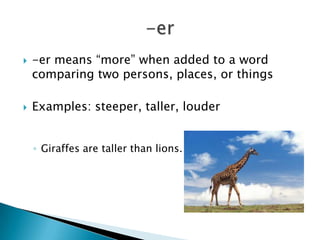
   -er means “more” when added to a word
    comparing two persons, places, or things

   Examples: steeper, taller, louder


    ◦ Giraffes are taller than lions.
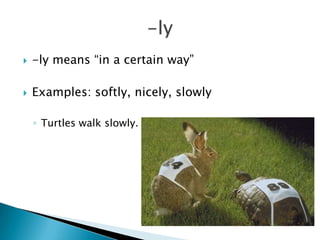
   -ly means “in a certain way”

   Examples: softly, nicely, slowly

    ◦ Turtles walk slowly.
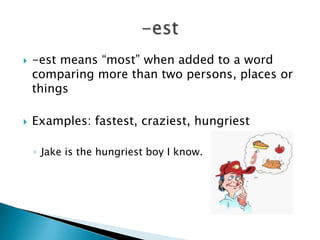
   -est means “most” when added to a word
    comparing more than two persons, places or
    things

   Examples: fastest, craziest, hungriest

    ◦ Jake is the hungriest boy I know.
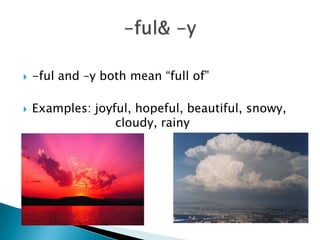
   -ful and –y both mean “full of”

   Examples: joyful, hopeful, beautiful, snowy,
                  cloudy, rainy
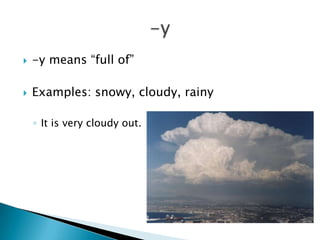
   -y means “full of”

   Examples: snowy, cloudy, rainy

    ◦ It is very cloudy out.
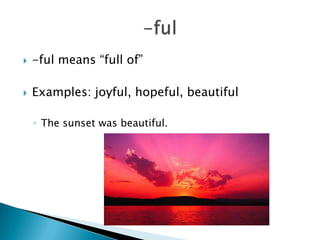
   -ful means “full of”

   Examples: joyful, hopeful, beautiful

    ◦ The sunset was beautiful.
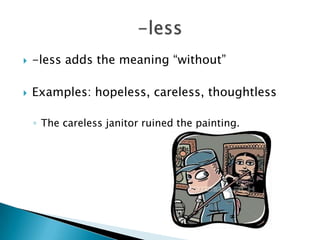
   -less adds the meaning “without”

   Examples: hopeless, careless, thoughtless

    ◦ The careless janitor ruined the painting.
   -ness changes an adjective to a noun and
    means “the condition of”

   Examples: sadness, laziness, happiness

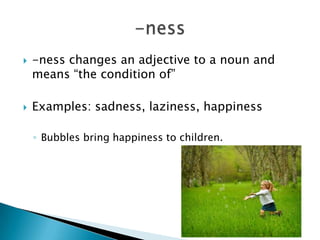
    ◦ Bubbles bring happiness to children.
   un-, dis-, non- all mean “not” or “the
    opposite of”

   Examples: undone, unsupportive, unopened
    disrespectful, disapprove, disorder,
    nontraditional, nonaggressive, nondestructive
   un- means “not” or “the opposite of”

   Examples: undone, unsupportive, unopened

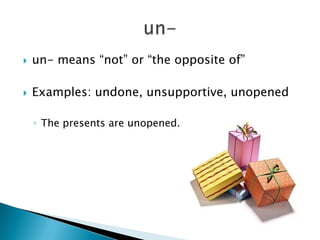
    ◦ The presents are unopened.
   dis- means “not” or “the opposite of”

   Examples: disrespectful, disapprove, disorder

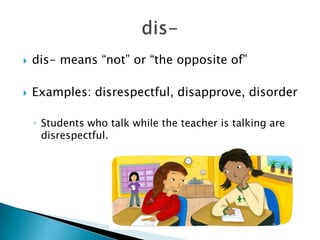
    ◦ Students who talk while the teacher is talking are
      disrespectful.
   non- means “not” or “the opposite of”

   Examples: nontraditional, nonaggressive,
    nondestructive

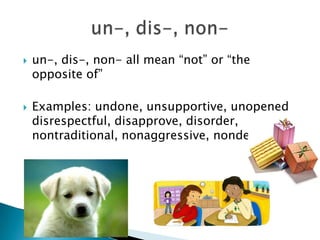
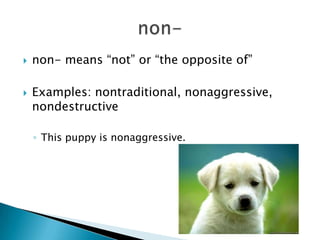
    ◦ This puppy is nonaggressive.
   re- means “again” or “back to”

   Examples: rewind, redo, repeat

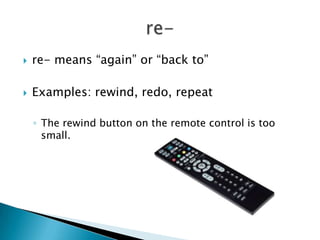
    ◦ The rewind button on the remote control is too
      small.

Third grade prefix

  • 1.
    Mrs. Koehn’s ThirdGrade Class 2012
  • 2.
    -er means “more” when added to a word comparing two persons, places, or things  Examples: steeper, taller, louder ◦ Giraffes are taller than lions.
  • 3.
    -ly means “in a certain way”  Examples: softly, nicely, slowly ◦ Turtles walk slowly.
  • 4.
    -est means “most” when added to a word comparing more than two persons, places or things  Examples: fastest, craziest, hungriest ◦ Jake is the hungriest boy I know.
  • 5.
    -ful and –y both mean “full of”  Examples: joyful, hopeful, beautiful, snowy, cloudy, rainy
  • 6.
    -y means “full of”  Examples: snowy, cloudy, rainy ◦ It is very cloudy out.
  • 7.
    -ful means “full of”  Examples: joyful, hopeful, beautiful ◦ The sunset was beautiful.
  • 8.
    -less adds the meaning “without”  Examples: hopeless, careless, thoughtless ◦ The careless janitor ruined the painting.
  • 9.
    -ness changes an adjective to a noun and means “the condition of”  Examples: sadness, laziness, happiness ◦ Bubbles bring happiness to children.
  • 10.
    un-, dis-, non- all mean “not” or “the opposite of”  Examples: undone, unsupportive, unopened disrespectful, disapprove, disorder, nontraditional, nonaggressive, nondestructive
  • 11.
    un- means “not” or “the opposite of”  Examples: undone, unsupportive, unopened ◦ The presents are unopened.
  • 12.
    dis- means “not” or “the opposite of”  Examples: disrespectful, disapprove, disorder ◦ Students who talk while the teacher is talking are disrespectful.
  • 13.
    non- means “not” or “the opposite of”  Examples: nontraditional, nonaggressive, nondestructive ◦ This puppy is nonaggressive.
  • 14.
    re- means “again” or “back to”  Examples: rewind, redo, repeat ◦ The rewind button on the remote control is too small.