Master Thesis
Using the Lower Face as a Cue of Deception
MSc: Human Decision Sciences
Master Thesis
Maastricht University
School of Business and Economics/ Faculty of Psychology and Neuroscience
Supervisor: Dr. E. H. Meijer, Faculty of Psychology and Neuroscience
Second Supervisor: G. Bogaard, Faculty of Psychology and Neuroscience
Student: Alexej Michirev, i6030632
Maastricht, 24.08.2016
Using the Lower Face as a Cue of Deception
1
Table of content
Abstract 2
Introduction 3
Methodology 10
Participants 10
Video fragments: Procedure 10
Video fragments: Material 11
Design and conditions 12
Procedure: Qualtrics 12
Results 13
Video fragments 13
Mean comparison 14
Signal Detection Theory 15
Discussion 17
References 24
Appendix 29
Using the Lower Face as a Cue of Deception
2
Abstract
The current practice around the issue of airport security involves the use of behavioral
detection programs such as Screening Passengers by Observation Techniques (SPOT). SPOT
claims to be able to identify terrorists and other criminals by using in vivo behavioral detection
techniques that involve nonverbal bodily cues and facial expressions, particularly
microexpressions. Some evidence exists showing a relationship between facial cues and
deception. In this experiment we investigated the relevance of the lower face and if it could
provide reliable predictors for deception. Using videos without sound as stimulus material, the
current experiment compared accuracy rates of observers who viewed videos that showed only
the lower face (LF) versus observers who viewed the full face (FF). Using the information
overload hypothesis that states that too much information has the potential to reduce efficiency of
decision making due to distractions from the relevant information; we expected that observers in
the LF condition would yield higher accuracy rates than observers in the FF condition. We
expected this effect to occur, because of irrelevant deception cues in the upper face, which would
not be present in the LF condition. The results, however, yielded 55.3% accuracy rates in the FF
condition and only 37% in the LF condition disconfirming the initial hypothesis. Firstly, these
findings indicate that the lower face does not make a reliable predictor for deception detection.
Secondly, relying on the face for deception detection did not prove to be an efficient approach,
that SPOT claims it is.
Keywords: nonverbal lie detection, nonverbal communication, nonverbal cues, facial
expressions, microexpressions, SPOT, lower face, information overload.
Using the Lower Face as a Cue of Deception
3
On 11 September 2011, 19 terrorists hijacked four airplanes and crashed two into the twin
towers, one outside of the pentagon and one was crashed into a field in Pennsylvania in the USA.
This was one of the most memorable terrorist attacks in the US history and triggered the
declaration of “war on terrorism”. One of the aspects that was particularly important for the
question of security and prevention measures was that all the 19 hijackers had contact with US
Government officials on at least three occasions, namely when they applied for visas, when they
entered the USA and when they boarded the four flights. If the intention of only one of these 19
people could have been determined at one of these stages, the tragic events might have been
prevented (Honts & Hartwig, 2014).
One of the results of the attacks was a spark in the demand for airport security and the
program called Screening Passengers by Observation Techniques (SPOT) was implemented in
2003 (Transportation Security Administration, 2006). In 2012, SPOT reached US1$ billion in
governmental funding and was deployed in over 176 airports involving 3000 Behavior Detection
Officers (BDOs) in the USA (Blandón-Gitlin, Fenn, Masip & Yoo, 2014). When using SPOT the
BDOs task is it to identify high- security threats by observing “deceptive behavior”. The
technique includes the use of subjective analysis of body language, facial expressions and
microexpressions (Perry & Gilbey, 2011). The basic idea of SPOT is that after the BDOs identify
someone who behaves “in a deceptive manner” they approach the person and question him/her.
Until recently, the definition of deceptive behavior was neither accessible to the public or
scientists nor did a list that defined these certain behaviors exist. However, the 92 points checklist
that SPOT is using was leaked (Winter & Currier, 2015) and revealed some cues that are disputed
by science, but nevertheless, are being used. As example, gazing down is on the list, however,
gaze aversion was found to be an unreliable deception cue (DePaulo & Pfeifer, 1986; Vrij, 2000).
In short, this paper has the goal to establish scientific evidence in favor of nonverbal lie detection,
particularly for the facial expressions. The example of SPOT is used to spotlight the contrast
between science and practice and to establish the understanding that the actual cues of deception
do not necessarily correspond to what is believed these cues are.
SPOT originated from the works of Paul Ekman who is an influential psychologist that
currently occupies the 59th
place on list of the “Eminent psychologists of the 20th century”
(American Psychological Association, 2002). His work comes from the field of behavioral lie
Using the Lower Face as a Cue of Deception
4
detection and one of the prominent ideas is the leakage hypothesis (Ekman & Friesen, 1969)
which states that high stakes lies are associated with powerful emotions such as fear, excitement
or anger that must be inhibited and not shown for the lie to be credible. According to the author’s
leakage hierarchy the behavioral channels are not under voluntarily control to the same extent;
they argue that the face leaks more cues than the body or voice due to the involuntary nature of
human emotions (Ekman 2001; Ekman, O’Sullivan & Friesen, 1988). In 2011 Ekman testified
before the Congress that peer- reviewed papers identified nonverbal behaviors needed for
successful lie detection (Blandón-Gitlin, Fenn, Masip & Yoo, 2014; Ekman, 2011). The answer
to the question whether SPOT can be improved he answered: “In my testimony I have outlined a
couple of types of research that I think could be useful if you decide you would want to do more
research. But we do not need to do more research now to feel confidence in this layer of security
provided to the American people.” (Ekman, 2011, p.49). Many researchers do not share that level
of confidence and disagree about Ekman’s statement that peer- reviewed papers identified
nonverbal behaviors that accurately distinguish between the truth and a lie. His statement is not
backed up by scientific references. In detail, SPOT operates by using in vivo behavioral
observations and questioning, and exactly this in vivo approach is not supported by any scientific
papers that would suggest its effectiveness (e.g., Bond & DePaulo, 2006; Granhag & Strömwall,
2004). The next paragraphs will examine the techniques used by SPOT and access their scientific
evidence, or the lack of it.
As mentioned above, the BDOs first need to identify a person that they think behaves
suspiciously. For that, they use nonverbal cues from their checklist. Some of these cues are
“exaggerated or repetitive grooming gestures” and “rubbing or wringing of hands”. Interestingly,
none of these or resembling cues were identified form, or are backed by scientific literature
(DePaulo, Lindsay, Malone, Muhlenbruck, Charlton & Cooper, 2003). It seems to be based on
the general assumption that liars typically fidget, adjust their body more often and move their
legs etc. (Malone, DePaulo, Adams & Cooper, 2002; Vrij, 2005; DePaulo, Lindsay, Malone,
Muhlenbruck, Charlton & Cooper, 2003; Zuckerman, DePaulo & Rosenthal, 1981). This general
view collides with scientific findings that show that liars fidget less. This is not due to the fact
that liars actively suppress their movements; it is due to an automatic response resulting in
neglecting the body movements due to the cognitive load (Ekman & Friesen, 1972). According to
Using the Lower Face as a Cue of Deception
5
the cognitive load hypothesis lying is a mentally demanding task in which one must inhibit the
truth and come up with a construction of an alibi that has to sound consistent and plausible;
meanwhile the truth teller does not undergo such a cognitive effort and only must recall certain
memories. Liars, therefore, have less spare cognitive resources and therefore fidget less (Vrij,
2008). Furthermore, liars often show behaviors that are rather rigid, rehearsed and planned, which
is called the motivational impairment effect (Vrij & Mann, 2001; DePaulo, Kirkendol, Tang &
O'Brien, 1988; DePaulo, Lanier & Davis, 1983). Taking all that information into account, tension
while “holding back” arises and produces a lack of involvement of engagement in a liar (DePaulo
et. al., 2003, DePaulo, 1992; DePaulo & Friedman, 1998).
In next step of SPOT, after the BDOs identified a “suspicious” person, they engage the
person in a short conversation for about 30- 90 seconds to uncover their motives (Ekman, 2011,
p.8). In this conversation the BDOs are asking questions and try to understand the person’s true
intentions by observing his/her facial expression, mainly by analyzing their microexpressions.
According to the leakage hypothesis Ekman (1992) argues that microexpressions are facial
expressions of emotions that are being leaked and only last for milliseconds (1-5th
to 1/ 25th
of a
second; Ekman & Friesen, 1975). Ekman states that a skilled observer can then identify these
microexpressions and use them to recognize people’s emotional states that they wish to hide, thus
recognizing and identifying deception. However, outside of the usage in SPOT, the peer-
reviewed articles do not support the theory behind miscoexpressions and do not justify their real-
life applications. For example, it was found that microexpressions are scarce and do not occur
often, thus lowering their potential to be used as cues to deception. Furthermore, it was found that
microexpressions are also present during genuine emotions at similar rates thus being in line with
the argumentation that both liars and truth tellers want to be perceived as truthful (i.e., Ekman,
2006; ten Brinke, MacDonald, Porter & O’Connor, 2012).
Ten Brinke and Porter (2012) argue that even though microexpressions are not valid
indicators, longer lasting facial responses could indicate deceit. To find reliable deception cues,
the authors analyzed the videotapes of people who were holding a plea asking the public for help
and the perpetrator to release and/ or not to harm a missing person. To establish the ground truth,
the authors relied on “overwhelming evidence” such as the “presence of the victim’s blood, other
DNA (hair, skin), forensic evidence (pollen traces, tire tracks), possession of the murder weapon,
Using the Lower Face as a Cue of Deception
6
security camera footage, phone range or tap information, confessions (not recanted), leading
police to the victim’s body, incriminating monetary transactions, inadequate alibis, and
eyewitness testimony” (p.471). After establishing their definition of truth, the authors have found
that the presence of upper face surprise, lower face disgust (a raised upper lip) and lower face
happiness (i.e., a smirk) were significant predictors of deceit. The deceptive pleaders were overall
less likely to express upper and lower face sadness and distress in contrast to the truthful pleaders
who expressed upper and lower face sadness. Interestingly, longer lasting facial expressions also
seem to be a part of SPOT, such as “exaggerated yawning” that is one of the cues on their list,
even though it remains to be found of relevance in the literature.
To provide additional evidence in favor of longer lasting facial expressions as reliable
deception cues the extensive meta- analysis on the topic was consulted (DePaulo et. al., 2003).
The authors have found that under the circumstances of “holding back” lips pressing was a
significant predictor for deceit detection. Lips apart, lips stretch, lips corner pull, lip pucker,
sneers (upper lip is raised) and biting lips all remained insignificant. As individual cues for
deception the authors found chin raise (chin and the lower lip are pressed together) and
subjective facial pleasantness to be significant. In certain contexts this finding also can be linked
to what ten Brinke and Porter (2012) have found, namely that lower face happiness was a
relevant predictor for a deceptive plea. Therefore, the authors established evidence for facial cues
that indicated deception, which will be relevant for the forming of the hypotheses later in this
paper.
In line with the leakage hypothesis Rinn (1984) and, Porter and ten Brinke (2008) found
that the face offers control over voluntarily movements hence allowing for suppression of
emotions at different degrees. For example, Ekman (2001) found that a fake smile is often used to
mask a negative emotion. More precisely, the lower face offers more options for voluntarily
control and suppression of movements, particularly more for positive and less for negative
emotions. Of particular interest are the findings about the lower face and the suppression of
emotions in it, because there is evidence that nonverbal countermeasures do work and that it is
indeed possible to inhibit certain facial movements. However, it does seem that the nonverbal
countermeasures cannot be fully applied and that leakage is still visible to a certain degree (the
effect is stronger for the face than the body; Caso, Vrij, Mann & Leo, 2006). This result was
Using the Lower Face as a Cue of Deception
7
shown by a set of studies examining the suppression of emotional facial expressions (Gross 1998;
Gross and Levenson 1993; Schmeichel, Volokhov, & Demaree, 2008; Ceschi and Scherer 2003).
In these studies the participants (adults, also one study with children) were instructed to act as if
they were feeling neutral (suppressing emotions) while watching emotional videos. In another
study the participants were instructed to disguise their emotions (Porter & ten Brinke, 2008). The
combined results led to the conclusion that it was possible to reduce expressed emotions while
being instructed, but it was not possible to fully eliminate them. In the context of instructions to
suppress smiling behavior, it was found that smiling behavior does not change between the
baseline and the critical period when the interrogator accused the participant of lying for
uninstructed people. Instructed people, however, spent more time smiling (but less intense
smiles) during the critical period (inhibition of lip corner movement; Hurley & Frank, 2011). To
summarize, there are facial cues to detect deception and there is evidence that countermeasures
do not fully work to suppress them, which makes them worthwhile to study.
After the BDOs have found their suspect, they engage in a conversation with him/her and
try to analyze their emotions to understand their true intentions. However, both truth and lie
tellers can experience the same emotions of fear and anxiety, for example, to the same degree.
The mere display of these emotions is hardly enough to trace them back to their origins and link
them to a lying or truth telling, let alone intentions (DePaulo, 1992). Also, both parties, the truth
and the lie tellers, want to be perceived as truthful and therefore the leakage of emotions will be
the same or very similar (DePaulo, 1992). As an example one could think of two people, who
both are accused of a bank robbery. Despite different motives on why they want to be perceived
as truthful, both could display very similar behaviors and emotions, because they do not want to
be imprisoned. Therefore, the BDOs task would be extremely difficult to provide accurate
judgements. It is in line with the lie detection research, that show that the average lie detection
accuracy is only slightly above chance level, namely at 54%, even for experts like police officers
and judges (Vrij, 2000; Bond & DePaulo, 2006).
Furthermore, Honts and Hartwig (2014) criticize the link between emotions and lies. They
say that lies are not about emotions but actions from the past, present and future. Consequently
the link between a lie and an emotion does not necessary always exist and thus cannot be leaked
as facial expressions. This line of reasoning corresponds to the research done by Rai and Fiske
Using the Lower Face as a Cue of Deception
8
(2011) who state that there is no good and evil, because the moral standards are different across
cultures and individuals. Therefore, a terrorist acts upon his/her own beliefs and the emotions that
he/she experiences may be unpredictable to western standards. The arousal or guilt that SPOT
tries to catch is therefore likely not to exist in the first place and if it does, then how is it different
from the arousal everyone experiences by being late for the flight, for example (Honts &
Hartwig, 2014).
After identifying the strengths and weaknesses of the nonverbal behavior as a deception
detection method, we conclude that there is evidence that nonverbal cues, especially in the face,
offer an opportunity to identify relevant predictors. The finding that countermeasures are not
fully able to mask certain emotions provides an additional argument for the reason to study
nonverbal behavior. Furthermore, the literature mentions several cues like lip pressing, raised
upper lip, smirk, chin raise (chin and the lower lip are pressed together) and facial pleasantness
that were found to be relevant predictors to identify deception in different contexts.
After establishing scientific support for some deception cues from the literature, the
author suggests that the cues derived from the face can be used as reliable deceptive predictors,
leading to the first hypothesis:
Hypothesis 1:
The face will provide reliable deception predictors that will yield accuracy rates that are higher
than chance level.
An experimental design is proposed where the cues of the lower face will be compared
against the cues from the full face across deceptive and truthful statements in terms of accuracy
rates. It is hypothesized that lower face cues alone will yield better accuracy rates due to the
theory behind the information overload hypothesis that can be defined as: “a state that disturbs
the decision making process of one individual by presenting too much relevant and/or irrelevant
information resulting in inefficiency of information processing”, because there is no agreed
definition in the literature (Bawden & Robinson, 2009). It was found that the human mind is
restricted by limited processing power and also limited working memory. Miller (1956) showed
that a human’s working memory is restricted to consciously store about seven items (plus/minus
Using the Lower Face as a Cue of Deception
9
two) simultaneously. However, this number is not strictly set, because of the existing
counterevidence indicating that it could be as low as three (Broadbent, 1975). In view of these
facts, one should be safe to assume that a human observer should, therefore, not be able to take
more information into account than as we stated above (possible variations depending on the
context). Additional information, would either be incorrectly processed or not processed at all,
resulting in potential distractions further worsening the decision making process. Information
overload in this particular paradigm of the experiment is defined as the output of the upper face
that could have the potential to be distracting by providing additional irrelevant information
resulting in wrong decisions. In their paper Lee, Loughlin and Lundberg (2002) demonstrated
how optimization processes using both, the rational models and the one-reason-decision models
based on heuristics (Gigerenzer, Todd, & the ABC Research Group, 1999) performed above
chance level in identifying relevant articles for a certain topic. However, the one-reason-decision
model that was not integrating all the information but was rather limiting itself to one predictor
outperformed the rational model that was using a complex algorithm with weights. Their finding
provided evidence that less information can be more, at least in certain cases. Cokely, Schooler
and Gigerenzer (2009) argue that the success of the heuristics lies in their simplicity by ignoring
the potentially misleading information and therefore only relying on very limited but efficient
information. The advantage of such a process would be its speed and efficiency. The authors also
state that given the right environment the simple heuristics will outperform the rational models
that are based on optimization. Based on these findings a second hypothesis is formulized:
Hypothesis 2:
The accuracy rates, thus identifying the deceptive fragment correctly as deceptive and the
truthful fragment as truthful, will be higher for the condition that displays videos where only the
lower face (limited information) is displayed instead of the full face.
Using the Lower Face as a Cue of Deception
10
Methodology
Participants
Two independent groups of participants were recruited, one group was recruited to obtain
the video stimuli and one group was recruited to judge the videos. The research was approved by
ethical committee of the Faculty of Psychology and Neuroscience.
Participants: Stimuli
Nineteen participants were recruited (mean age M= 21.74, SD= 1.58, 13 women and 6
men) to obtain the videos using the devil’s advocate approach. Everyone was a member of a
fraternity or a sorority and a student. The 13 females all belonged to one sorority and out of the 6
males 5 belonged to one fraternity and one to a different one. Every participant received an
information letter and had so sign in an informed consent. The reward was a lottery among the
nineteen people to win one of the three 25 euros vouchers.
Participants: Observers
Out of 106 people who clicked on the survey to judge the video fragments 64 participants
completed the process (age M= 25.53, SD= 6.49, 35 women and 29 men). All of the participants
were recruited using the author’s social network and advertisements on Facebook. Every
participant was allocated randomly to one of the conditions using the Qualtrics internal
randomizer. Some of the data was voluntarily given like the educational level, the nationality, the
email address and whether the participants wanted to be informed about the results by the end of
the study. This resulted in some loss of data about educational level (4/64 were missing),
nationality (1/64) and email address (16/64). The sample was very diverse consisting of 14
different nationalities (29 Germans and 13 other nationalities). The survey did not offer any sort
of compensation for the participation.
Video fragments
Procedure
The researcher came into contact with one person representing the fraternity/sorority that,
together with their fraternity/sorority identified their biggest rival fraternity/sorority that they
Using the Lower Face as a Cue of Deception
11
disliked the most. Once they agreed on a rivaling sorority for the females and a fraternity for the
males, the individual contact with the members took place. After handing out the information
letter that described the entire procedure and the ethical aspects that concerned the person, the
participant was asked to sign the informed consent. Next, the participant was given the chance to
ask some last questions and was given further instructions on the procedure. These instructions
included the distance to the camera, the distance to the wall and more importantly the information
about the statement they were about to give; namely, that they should state on why their
fraternity/sorority was the “best” one (truthful video), thus providing some arguments in favor of
their fraternity/sorority. The devil’s advocate approach was used to obtain the deceptive video.
For this, the participant was asked to pretend to be a member of their rivaling fraternity/sorority
and to argue in their favor. Furthermore it was added that the speech for both statements should
be roughly 20 seconds in length and should be held in the speaker’s mother tongue. In total, two
videos were produced per participant with a small break in-between the statements that was
terminated at the participant’s own will. Every participant was given the choice in preferences
between the truthful or the deceptive statement as the first recording; interestingly all nineteen
participants decided to start with the truthful statement and proceed with the deceptive. Upon
completion of both video recordings the procedure was finished, the participant was thanked and
the next participant was called. The recordings were held at two different locations on the same
day. All the female participants were filmed at one location and the male participants at another.
All the videos were obtained within 4 to 5 hours of time period.
Video Fragments
Material
The videos were recorded using a Galaxy S6 smartphone in a horizontal rotation and
edited with the Wondershare Filmora 7.3.1 software. Two sets of videos were created (38 videos
per set, and 76 videos in total). The audio was completely removed and the upper body was
censored in both sets (only the head and the upper part of the neck were visible). For the lower-
face set the upper face was censored additionally. The censoring was done with the mosaic option
using the 100% setting. Figure 1 and 2 in the Appendix provide an example. The instructions
given before the recording were that the person should speak for approximately 20 seconds.
Using the Lower Face as a Cue of Deception
12
However, long time differences were observed between the video fragments ranging from 5
seconds to 27 seconds.
Design and Conditions
The study used a 2x2 mixed factorial design with 2 between- subjects conditions, namely
the Full- Face condition (FF condition; N= 33) and the Lower- Face condition (LF condition; N=
31). The type of the video represented the within- subjects variable (truthful video fragments,
N=19 and deceptive video fragments, N=19). In the FF condition the participants (from here now
observers) judged videos where they could see the entire face and in the LF condition observers
judged videos where the upper face was censored. Both conditions used the exact same videos
without sound and censored upper body and lower neck with the only difference being the
censoring of the upper face (LF condition) or the lack of it (FF condition). Deceptiveness and
truthfulness were coded as a new variable “status” and were rated on an 8-point-Likert scale (1- 4
for deceptive and 5- 8 for truthful). The 8-point-Likert scale was presented after each video to
obtain these ratings. In each condition the participants were shown 38 videos in total of which 19
were truthful and 19 were deceptive. The observers were assigned randomly to the conditions and
the videos in the conditions also were presented randomly for every observer in each condition.
Both randomization procedures used the Qualtrics randomizer.
Procedure
Qualtrics
Upon clicking on the study link, the observer was greeted by the welcome screen that
provided basic information such as that the participation is voluntarily, the duration of the
participation and information regarding the videos and the advice that one should not use mobile
data. The following screen gave the detailed instructions on how to proceed with the experiment.
The participants were asked to base their judgment on the face and to ignore the background and
the pixelated areas of the videos. Furthermore, they were informed that one person could be
present in more than just one video and also asked to watch each video till the end. To ensure that
the participants would read the instructions a timer was set that allowed to progress to the next
stage only after 15 seconds. With the next click the participant were randomly allocated to either
Using the Lower Face as a Cue of Deception
13
to the FF or LF condition. Once Qualtrics randomly selected the condition the first video was
shown followed by the 8-point-Likert scale. Each condition contained 38 videos, 19 truthful and
19 deceptive and therefore also 38 Liker scales were presented, one after each video. On the
Likert scale 1 was attributed to “very deceptive” and 8 to “very truthful”. The Likert scales were
presented in a force choice manner, meaning that the participants could only progress by making
a choice. No neutral option was given; it was either 1 to 4 being in the “deceptive” range or 5 to 8
being in the “truthful” range. For every participant the order of the videos was random preventing
carryover effects of fatigues and effort, for example. To ensure that the participants would watch
each video and prevent random responses an invisible timer was set that was hiding the “further
button”. The number of seconds the “further button” was hidden equaled to the duration of that
specific video. After viewing and rating all the 38 videos, regardless of the conditions, the
participants were presented with the following questions regarding their demographics: age and
gender being force choice, and level of education, the email address and nationality being
voluntarily indications. Furthermore the participants were asked if they were interested in the
outcome of the study. The end of the survey was determined by the debriefing slide that was the
same in both condition and the participants were thanked for their effort. A graphical
representation of the Qualtrics survey design is attached in the appendix for clarification (see
Figure 3).
Results
Video fragments
The videos were all of different length ranging from 5 seconds to 27 seconds (in seconds:
truthful videos: M= 12.21, SD= 4.9; deceptive videos: M= 12, SD= 6.12). All the 19 participants
were recorded twice thus producing two videos each. One of the videos was deceptive and one
being truthful. To test if there was a difference between the duration of the deceptive and the
truthful videos a Repeated Measures ANOVA was conducted. The Test of Within- Subject
Effects, looking at Greenhouse- Geisser, revealed no significant difference F(1, 18) = 0.12, p=
0.73.
Using the Lower Face as a Cue of Deception
14
Mean comparison
A repeated measures ANOVA was conducted to compare the effects of truthful and
deceptive videos on the conditions FF and LF. The model was using two newly computed
variables with no changes to the scale (8-point); namely the mean for all the deceptive videos and
the mean for all the truthful videos that were used as the factors. An interaction took place
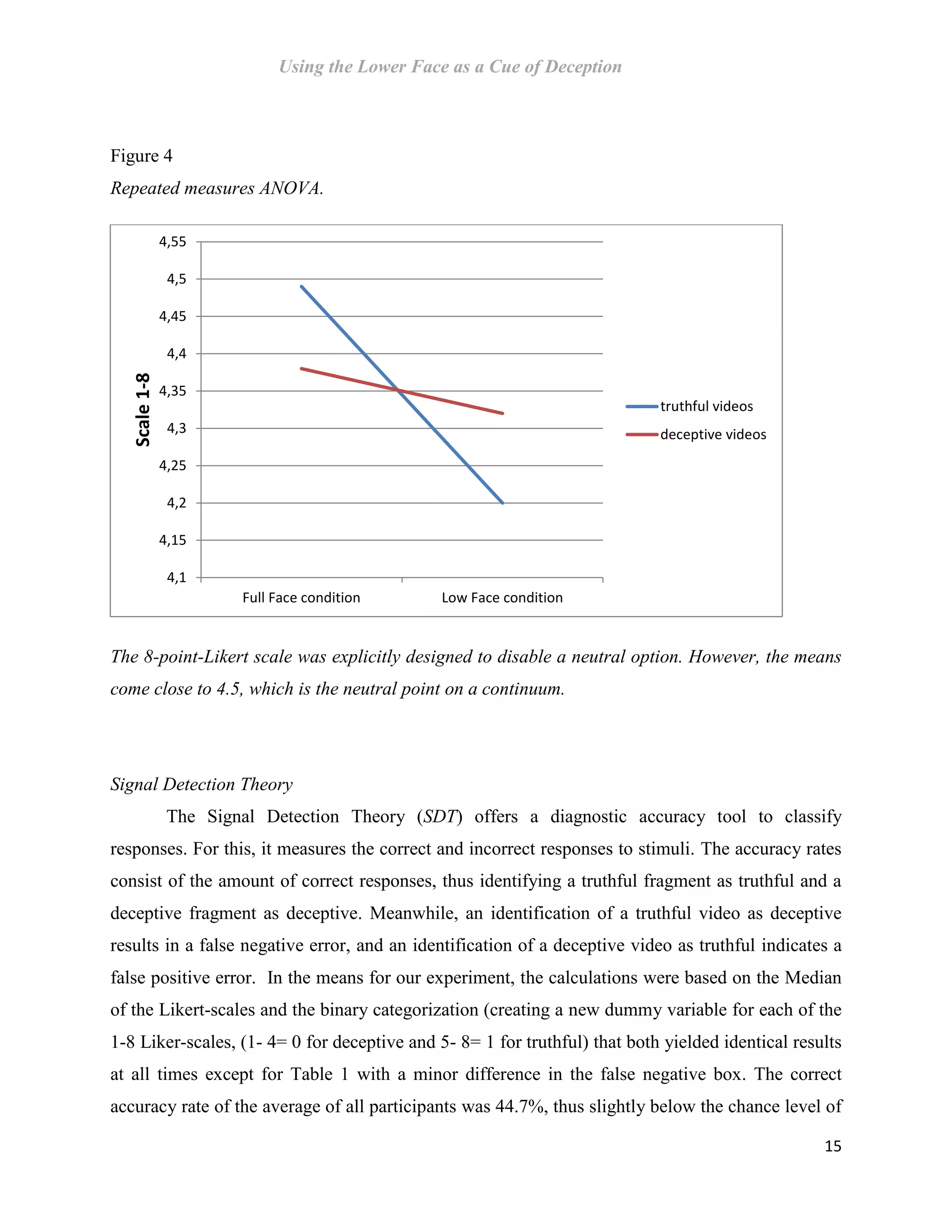
between both factors that revealed to be significant F(1, 62)= 5.78 , p= 0.02, as it is shown in
Figure 4. It shows that the truthful videos were rated more deceptive in the LF condition than in
the FF condition, while the deceptive videos were rated almost identically among both
conditions. Since an interaction took place the main effects cannot be reported, however, the
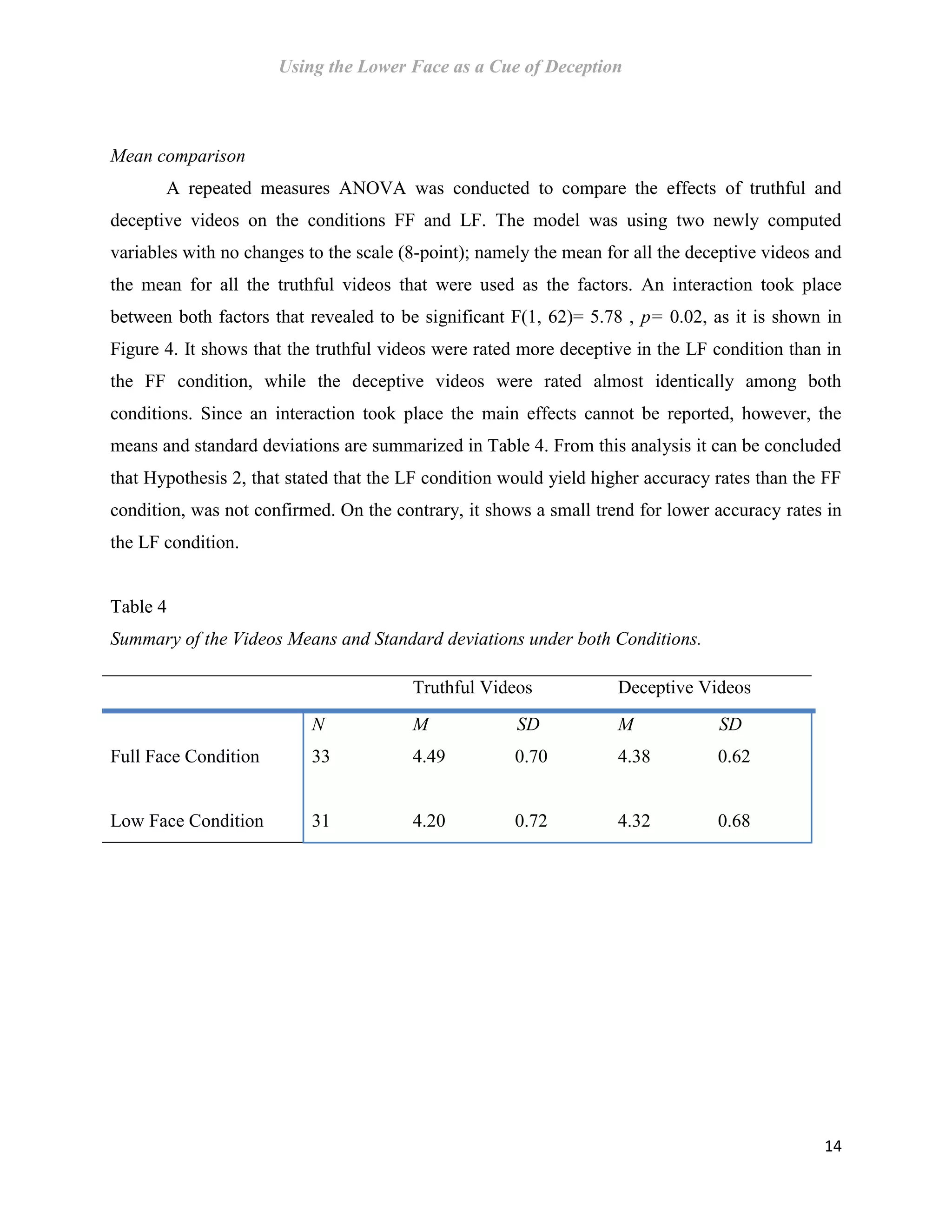
means and standard deviations are summarized in Table 4. From this analysis it can be concluded
that Hypothesis 2, that stated that the LF condition would yield higher accuracy rates than the FF
condition, was not confirmed. On the contrary, it shows a small trend for lower accuracy rates in
the LF condition.
Table 4
Summary of the Videos Means and Standard deviations under both Conditions.
Truthful Videos Deceptive Videos
Full Face Condition
Low Face Condition
N M SD M SD
33
31
4.49
4.20
0.70
0.72
4.38
4.32
0.62
0.68
Using the Lower Face as a Cue of Deception
15
Figure 4
Repeated measures ANOVA.
The 8-point-Likert scale was explicitly designed to disable a neutral option. However, the means
come close to 4.5, which is the neutral point on a continuum.
Signal Detection Theory
The Signal Detection Theory (SDT) offers a diagnostic accuracy tool to classify
responses. For this, it measures the correct and incorrect responses to stimuli. The accuracy rates
consist of the amount of correct responses, thus identifying a truthful fragment as truthful and a
deceptive fragment as deceptive. Meanwhile, an identification of a truthful video as deceptive
results in a false negative error, and an identification of a deceptive video as truthful indicates a
false positive error. In the means for our experiment, the calculations were based on the Median
of the Likert-scales and the binary categorization (creating a new dummy variable for each of the
1-8 Liker-scales, (1- 4= 0 for deceptive and 5- 8= 1 for truthful) that both yielded identical results
at all times except for Table 1 with a minor difference in the false negative box. The correct
accuracy rate of the average of all participants was 44.7%, thus slightly below the chance level of
4,1
4,15
4,2
4,25
4,3
4,35
4,4
4,45
4,5
4,55
Full Face condition Low Face condition
Scale1-8
truthful videos
deceptive videos
Using the Lower Face as a Cue of Deception
16
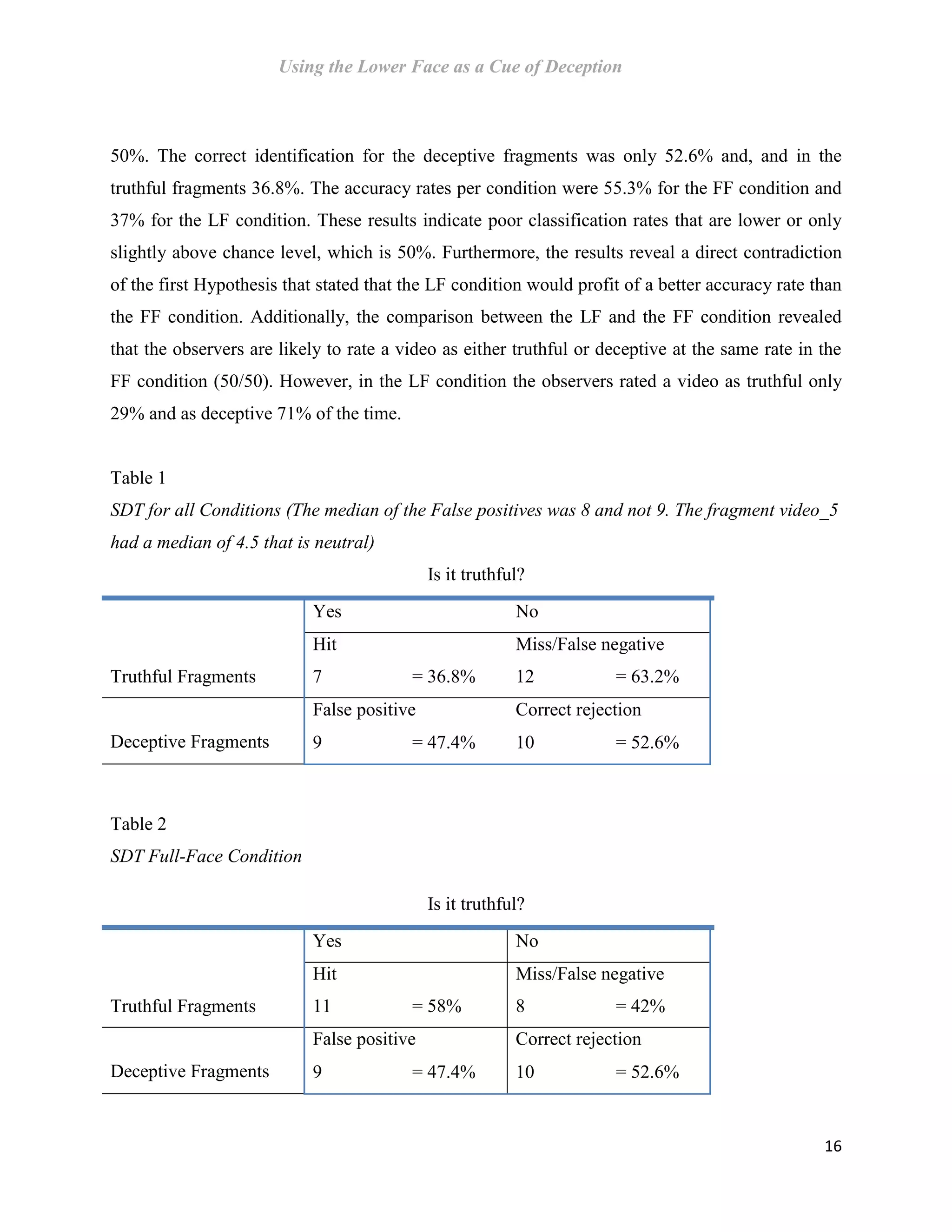
50%. The correct identification for the deceptive fragments was only 52.6% and, and in the
truthful fragments 36.8%. The accuracy rates per condition were 55.3% for the FF condition and
37% for the LF condition. These results indicate poor classification rates that are lower or only
slightly above chance level, which is 50%. Furthermore, the results reveal a direct contradiction
of the first Hypothesis that stated that the LF condition would profit of a better accuracy rate than
the FF condition. Additionally, the comparison between the LF and the FF condition revealed
that the observers are likely to rate a video as either truthful or deceptive at the same rate in the
FF condition (50/50). However, in the LF condition the observers rated a video as truthful only
29% and as deceptive 71% of the time.
Table 1
SDT for all Conditions (The median of the False positives was 8 and not 9. The fragment video_5
had a median of 4.5 that is neutral)
Is it truthful?
Yes No
Truthful Fragments
Hit Miss/False negative
7 = 36.8% 12 = 63.2%
Deceptive Fragments
False positive Correct rejection
9 = 47.4% 10 = 52.6%
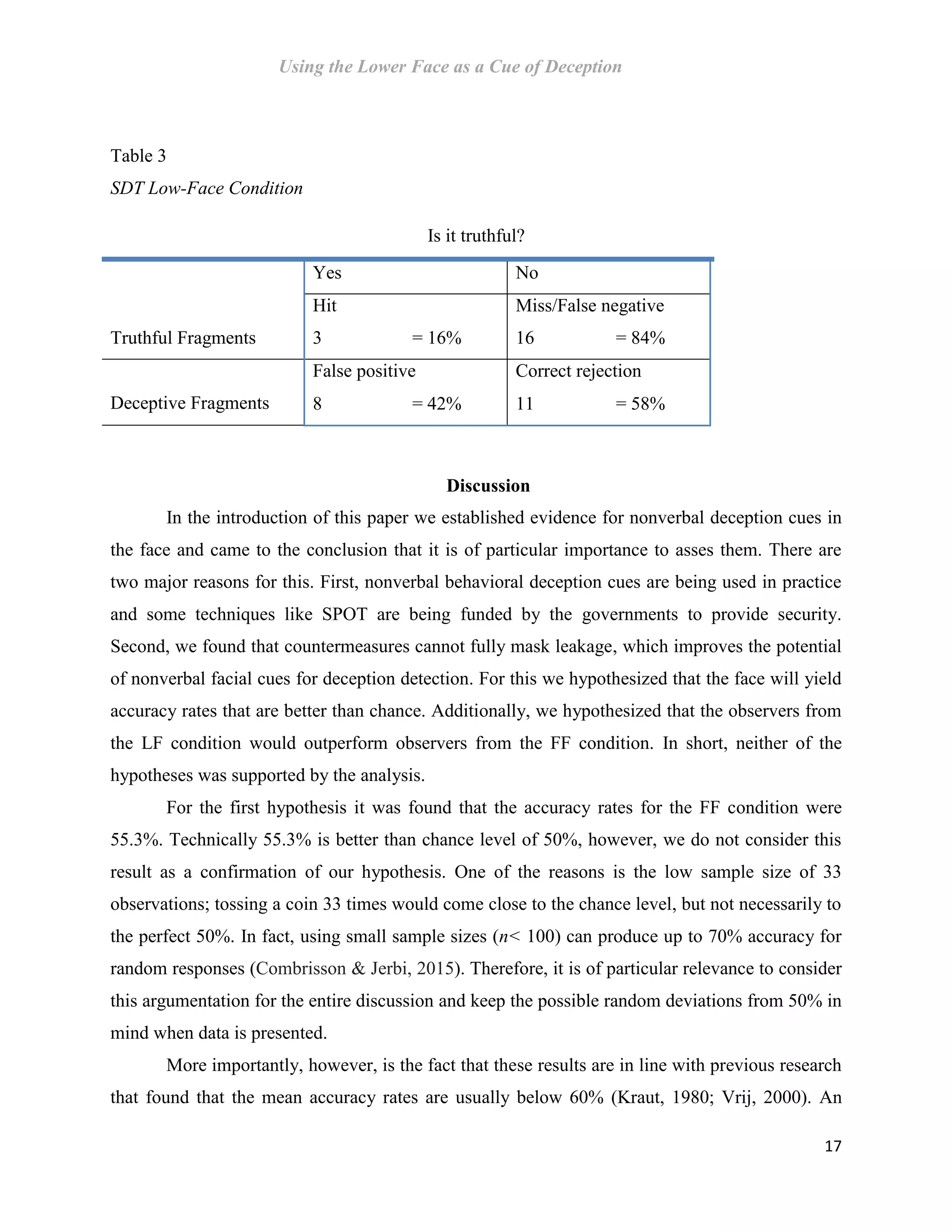
Table 2
SDT Full-Face Condition
Is it truthful?
Yes No
Truthful Fragments
Hit Miss/False negative
11 = 58% 8 = 42%
Deceptive Fragments
False positive Correct rejection
9 = 47.4% 10 = 52.6%
Using the Lower Face as a Cue of Deception
17
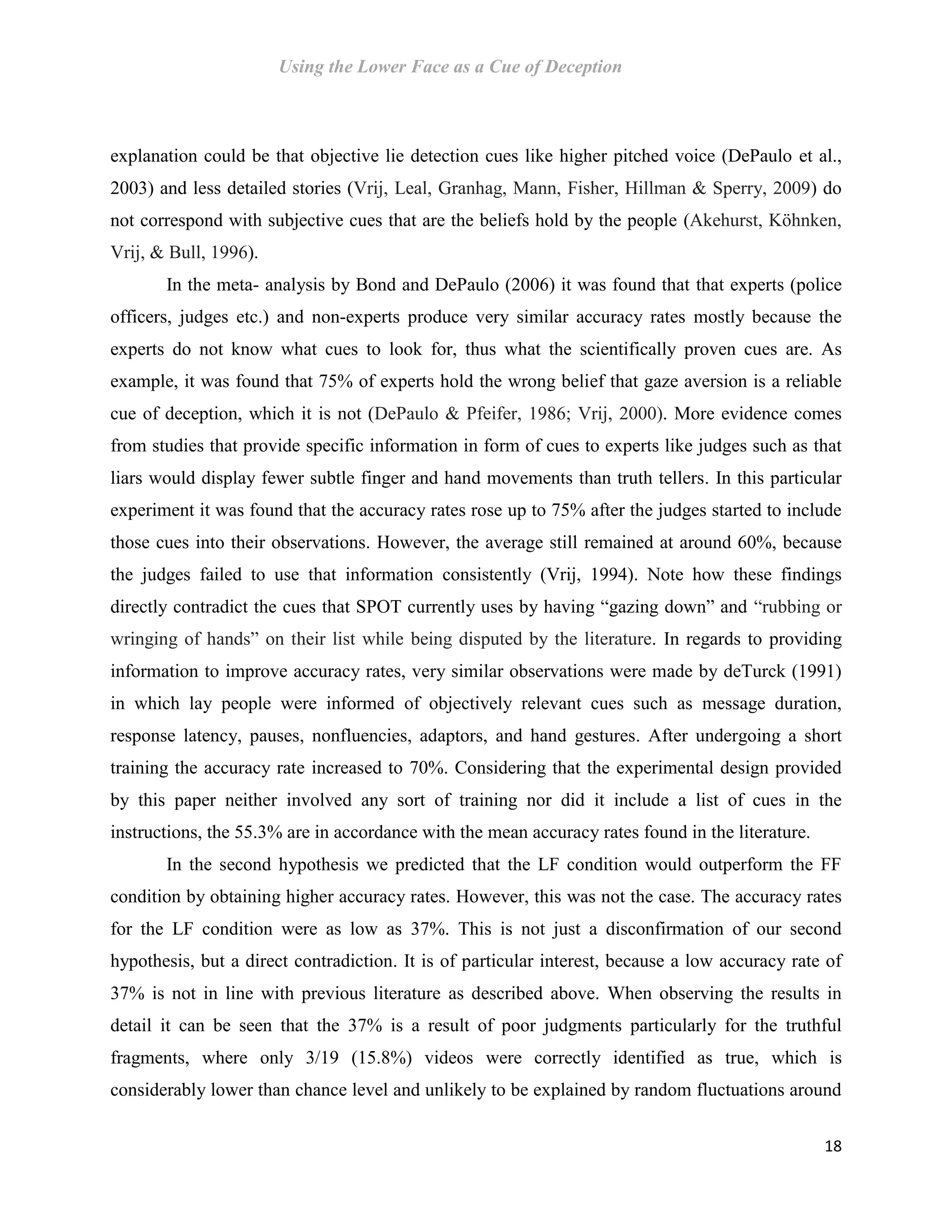
Table 3
SDT Low-Face Condition
Is it truthful?
Yes No
Truthful Fragments
Hit Miss/False negative
3 = 16% 16 = 84%
Deceptive Fragments
False positive Correct rejection
8 = 42% 11 = 58%
Discussion
In the introduction of this paper we established evidence for nonverbal deception cues in
the face and came to the conclusion that it is of particular importance to asses them. There are
two major reasons for this. First, nonverbal behavioral deception cues are being used in practice
and some techniques like SPOT are being funded by the governments to provide security.
Second, we found that countermeasures cannot fully mask leakage, which improves the potential
of nonverbal facial cues for deception detection. For this we hypothesized that the face will yield
accuracy rates that are better than chance. Additionally, we hypothesized that the observers from
the LF condition would outperform observers from the FF condition. In short, neither of the
hypotheses was supported by the analysis.
For the first hypothesis it was found that the accuracy rates for the FF condition were
55.3%. Technically 55.3% is better than chance level of 50%, however, we do not consider this
result as a confirmation of our hypothesis. One of the reasons is the low sample size of 33
observations; tossing a coin 33 times would come close to the chance level, but not necessarily to
the perfect 50%. In fact, using small sample sizes (n< 100) can produce up to 70% accuracy for
random responses (Combrisson & Jerbi, 2015). Therefore, it is of particular relevance to consider
this argumentation for the entire discussion and keep the possible random deviations from 50% in
mind when data is presented.
More importantly, however, is the fact that these results are in line with previous research
that found that the mean accuracy rates are usually below 60% (Kraut, 1980; Vrij, 2000). An
Using the Lower Face as a Cue of Deception
18
explanation could be that objective lie detection cues like higher pitched voice (DePaulo et al.,
2003) and less detailed stories (Vrij, Leal, Granhag, Mann, Fisher, Hillman & Sperry, 2009) do
not correspond with subjective cues that are the beliefs hold by the people (Akehurst, Köhnken,
Vrij, & Bull, 1996).
In the meta- analysis by Bond and DePaulo (2006) it was found that that experts (police
officers, judges etc.) and non-experts produce very similar accuracy rates mostly because the
experts do not know what cues to look for, thus what the scientifically proven cues are. As
example, it was found that 75% of experts hold the wrong belief that gaze aversion is a reliable
cue of deception, which it is not (DePaulo & Pfeifer, 1986; Vrij, 2000). More evidence comes
from studies that provide specific information in form of cues to experts like judges such as that
liars would display fewer subtle finger and hand movements than truth tellers. In this particular
experiment it was found that the accuracy rates rose up to 75% after the judges started to include
those cues into their observations. However, the average still remained at around 60%, because
the judges failed to use that information consistently (Vrij, 1994). Note how these findings
directly contradict the cues that SPOT currently uses by having “gazing down” and “rubbing or
wringing of hands” on their list while being disputed by the literature. In regards to providing
information to improve accuracy rates, very similar observations were made by deTurck (1991)
in which lay people were informed of objectively relevant cues such as message duration,
response latency, pauses, nonfluencies, adaptors, and hand gestures. After undergoing a short
training the accuracy rate increased to 70%. Considering that the experimental design provided
by this paper neither involved any sort of training nor did it include a list of cues in the
instructions, the 55.3% are in accordance with the mean accuracy rates found in the literature.
In the second hypothesis we predicted that the LF condition would outperform the FF
condition by obtaining higher accuracy rates. However, this was not the case. The accuracy rates
for the LF condition were as low as 37%. This is not just a disconfirmation of our second
hypothesis, but a direct contradiction. It is of particular interest, because a low accuracy rate of
37% is not in line with previous literature as described above. When observing the results in
detail it can be seen that the 37% is a result of poor judgments particularly for the truthful
fragments, where only 3/19 (15.8%) videos were correctly identified as true, which is
considerably lower than chance level and unlikely to be explained by random fluctuations around
Using the Lower Face as a Cue of Deception
19
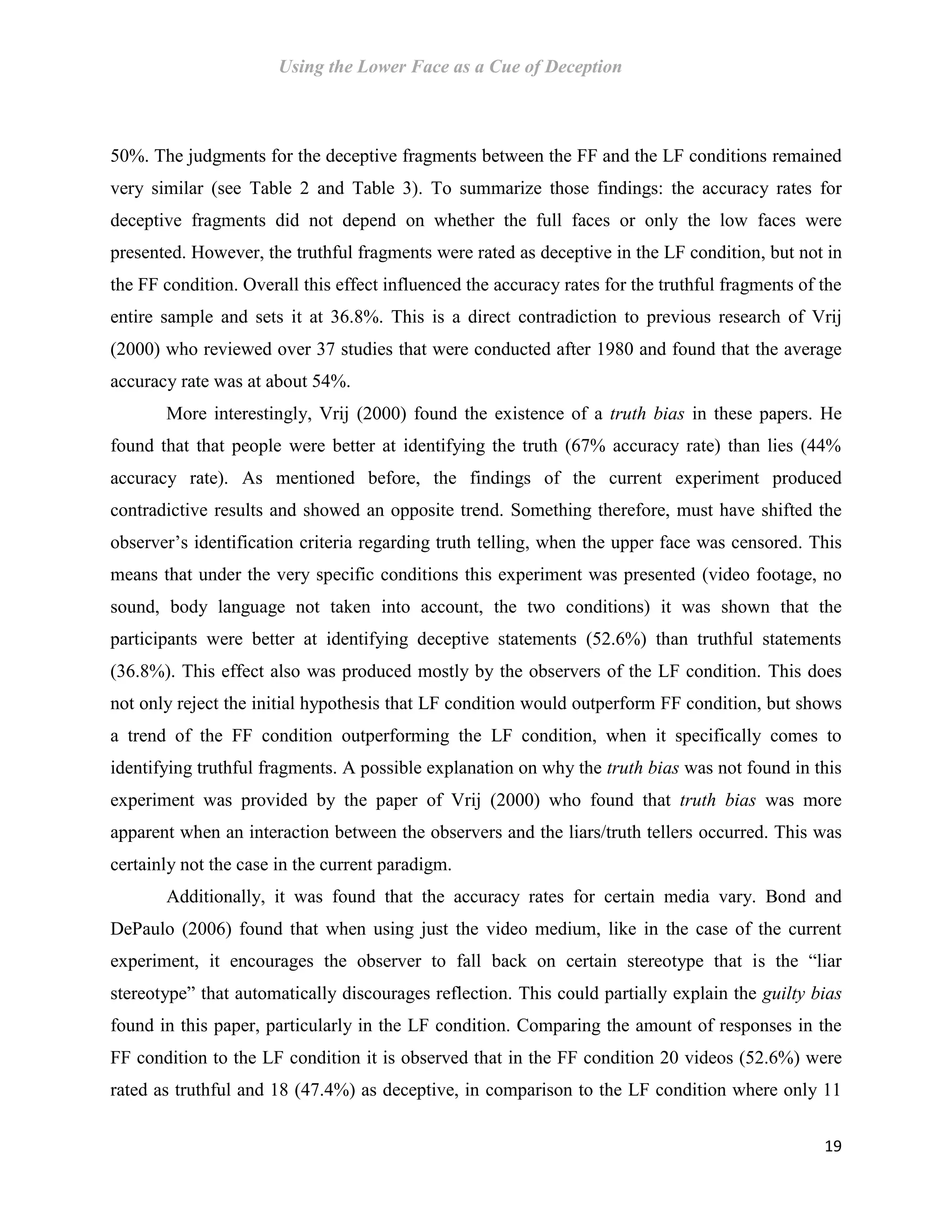
50%. The judgments for the deceptive fragments between the FF and the LF conditions remained
very similar (see Table 2 and Table 3). To summarize those findings: the accuracy rates for
deceptive fragments did not depend on whether the full faces or only the low faces were
presented. However, the truthful fragments were rated as deceptive in the LF condition, but not in
the FF condition. Overall this effect influenced the accuracy rates for the truthful fragments of the
entire sample and sets it at 36.8%. This is a direct contradiction to previous research of Vrij
(2000) who reviewed over 37 studies that were conducted after 1980 and found that the average
accuracy rate was at about 54%.
More interestingly, Vrij (2000) found the existence of a truth bias in these papers. He
found that that people were better at identifying the truth (67% accuracy rate) than lies (44%
accuracy rate). As mentioned before, the findings of the current experiment produced
contradictive results and showed an opposite trend. Something therefore, must have shifted the
observer’s identification criteria regarding truth telling, when the upper face was censored. This
means that under the very specific conditions this experiment was presented (video footage, no
sound, body language not taken into account, the two conditions) it was shown that the
participants were better at identifying deceptive statements (52.6%) than truthful statements
(36.8%). This effect also was produced mostly by the observers of the LF condition. This does
not only reject the initial hypothesis that LF condition would outperform FF condition, but shows
a trend of the FF condition outperforming the LF condition, when it specifically comes to
identifying truthful fragments. A possible explanation on why the truth bias was not found in this
experiment was provided by the paper of Vrij (2000) who found that truth bias was more
apparent when an interaction between the observers and the liars/truth tellers occurred. This was
certainly not the case in the current paradigm.
Additionally, it was found that the accuracy rates for certain media vary. Bond and
DePaulo (2006) found that when using just the video medium, like in the case of the current
experiment, it encourages the observer to fall back on certain stereotype that is the “liar
stereotype” that automatically discourages reflection. This could partially explain the guilty bias
found in this paper, particularly in the LF condition. Comparing the amount of responses in the
FF condition to the LF condition it is observed that in the FF condition 20 videos (52.6%) were
rated as truthful and 18 (47.4%) as deceptive, in comparison to the LF condition where only 11
Using the Lower Face as a Cue of Deception
20
(28.9%) videos were rated as truthful and 27 (71.1%) as deceptive. These findings indicate that
some variables in the LF conditions produced a pattern of responses in observers to indicate
deception 71.1% of the time. An explanation for this particular response trend could be
motivation.
Motivation seems to play a role for that both the lie and the truth tellers want to be
believed. If the motivation is high, then the observers could confuse the reasons behind that
appeared motivation and conclude that it must have been due to an attempt to deceive them
(DePaulo, Stone, & Lassiter, 1985). These findings are of particular importance, because they
undermine Frank and Ekman’s argument (1997) that the only way to test lie detection are high
stakes lies and that the findings of accuracy rates of just above 50% is a laboratory artifact. They
state that laboratory studies only use low stake lies and, therefore, are not applicable in the field.
However, in a recent meta- analysis Hartwig and Bond (2014) showed that leakage of deception
is a robust finding across different contexts and situations, ranging from students in the
laboratory to random people in real- life, disputing Frank and Ekman’s claims. The reason behind
it is that high stake situations influence the truth and lie tellers to the same degree. In an interview
by DePaulo, Hartwig (2014) describes a fictional case of two athletes who are both accused of
doping of whom one is innocent and one is not, however, both claim that they are telling the
truth. She further states, that both athletes are likely to experience distress associated with their
situation. For a lie catcher it would be now a difficult job to distinguish the distress that someone
has from telling the lie and the distress that is cause by apprehension for the truth teller.
Bond and DePaulo (2006) hypothesized that the motivational effects might be the most
apparent in the video medium and showed that 54.4% of the unmotivated but only 46.8% of the
motivated people were accurately classified. The stimuli in this experiment were created by
filming people who were either a member of a fraternity or a sorority. Empirical findings show
that people who highly identify themselves with an ingroup are more likely to display a higher
level of ingroup bias (e.g., Castano & Yzerbyt, 1998), that states that one favor one’s own group
to an outside group. Therefore, it is likely that our participants were more motivated to be
believed when they were giving a statement in favor of their own group (truthful videos) instead
of pretending being a member of an outgroup and favoring them (deceptive videos). The display
of motivation could have manifested itself in the lower face. Rinn (1984), Porter, and ten Brinke
Using the Lower Face as a Cue of Deception
21
(2008) provide evidence that voluntarily control in the face is more prominent for the lower face,
making the idea that the motivational display is more prominent in the lower face realistic.
Without the distracting cues from the upper face, thus in the LF condition, the observers were
more likely to spot the motivation and confused it for deception. This argumentation could
explain how only 3/19 (15.8%) of all the truthful fragments in the LF condition were correctly
identified as truthful.
The findings of this experiment provide some data that relying on facial cues to detect
deceit is not a reliable approach. The accuracy rates of the entire experiment are only at 44.7%
which is roughly chance level. Even under the assumption that the LF condition produced
unreliable data, the FF condition produced accuracy rates of only 55.3%. Therefore, our results
are in line with a body of research that shows that nonverbal cues are not reliable in indicating
deceit (Bogaard, Meijer, Vrij & Merckelbach 2016; DePaulo et al., 2003; Sporer, & Schwandt,
2007). Despite these findings, however, programs such as SPOT that are used up to this date to
provide (-a false sense of-) security at public locations and identify potential threats in large
crowds do continue to exist and receive large funding from the government despite the fact that
they are based on observing the behavior, that as mentioned above, does not provide a good
scientific basis for deceit detection.
Moreover, SPOT has flaws that are not related to its loose scientific foundations such as
discrimination, because it is thought to use racial profiling. TSA denies the acquisitions and states
that SPOT is based on behavior and therefore is not subjected to racial attributes. Kleinder (2010)
mentions that it must be difficult to be a BDO and have the knowledge that all the 19 hijackers
who participated in the terroristic events of the 9.11, were young, male Muslims, and not take this
knowledge into account while screening passengers. Meyer (2010) also stated that racial profiling
is a subjective factor that always will be part of SPOT. This, eventually could explain why TSA
is currently under investigation for racial profiling with an assistant of federal security director at
TSA reporting that he was asked, but refused, to profile Somali imams by his managers in 2016
(Zanona, 2016). Verbal lie detection on the other hand seems to be effective in identifying deceit;
in a study by Mann, Vrij and Bull (2004) it was found that police officers who relied more on
verbal cues (such as story cues) and less on cues listed by Inbau and colleagues (Inbau, Reid &
Buckley, 1986; Inbau, Reid, Buckley & Jayne, 2001), performed better than the officers who
Using the Lower Face as a Cue of Deception
22
relied on nonverbal cues. Given the argumentation provided above, the findings from the
previous studies (Bogaard et al., 2016; DePaulo et al., 2003; Sporer, & Schwandt, 2007) and the
results of this experiment the author recommendations would be to lower the trust in programs
based solely on nonverbal behavior and implement the use of other more reliable approaches
based on verbal communication (Hauch, Sporer, Michael & Meissner, 2016; Masip, Alonso,
Garrido & Antón, 2005; Vrij, 2008; 2005).
Seven limitations of this study design deserve some comments. First, the context of the
current design is very specific and may be hard to apply in real- life. Videos without a sound that
showed only the face (or only the lower face) were used. It is likely that lie catchers rely on more
than just the face and also consider other nonverbal and verbal cues. Second, our observers were
neither provided with any information on reliable cues, nor did they absolve a training. It would
be interesting to see how people or experts, who were trained in observing lip movements and
who are being familiar with all the reliable nonverbal deception cues, would perform under the
current study design. Third, the production of our stimuli involved participants that were
promised a participation in a lottery and thus no guaranteed reward. This could have produced
limited motivation to disguise the lies. Forth, the design incorporated measurements for observers
not to be able to proceed after each video and answering the Likert scale immediately. However,
there was no guarantee that the observers actually watched all the videos fully. Fifth, we do not
know what cues the observers were looking for. Theoretically it is possible that all the observers
were looking at the lips and ignored the upper face in both conditions. However, this is unlikely,
because it was found that the cue “gaze aversion” is the most subjective cue used for nonverbal
lie detection (Bogaard, Meijer, Vrij & Merckelbach 2016). Therefore, it is very likely that the
observers payed attention to the eyes, to some degree. Sixth, the design did not account for
attractiveness of the people seen in the stimuli. A more attractive person could be perceived as
more deceptive or honest, resulting in a systematic response bias. Finally, we found that the LF
condition performed worse than the FF condition, thus not only disproving our hypothesis but
reversing it. It would be interesting to include an Upper face only condition and check for the
accuracy rates for that condition.
This paper aids to the existing body of literature on nonverbal lie detection. The results
obtained in the experiment mirror the prior findings that purely nonverbal lie detection
Using the Lower Face as a Cue of Deception
23
approaches are not effective overall and should be used with caution. Additionally, it provides
new information on accuracy rates when the upper face is masked and when only the lower face
remains visible. Taking off the sunglasses therefore might enhance the truth bias, especially
when telling the truth.
Using the Lower Face as a Cue of Deception
24
References
American Psychological Association. (2002). Eminent psychologists of the 20th century.
Retrived from: http://www.apa.org/monitor/julaug02/eminent.aspx
Bawden, D., & Robinson, L. (2009). The dark side of information: overload, anxiety and other
paradoxes and pathologies. Journal of information science, 35, 180-191.
Blandón-Gitlin, I., Fenn, E., Masip, J., & Yoo, A. H. (2014). Cognitive-load approaches to detect
deception: searching for cognitive mechanisms. Trends in cognitive sciences, 18, 441-
444.
Broadbent, D. E. (1975). The magic number seven after fifteen years.
Bogaard, G., Meijer, E. H., Vrij, A., & Merckelbach, H. (2016). Strong, but wrong: lay people’s
and police officers’ beliefs about verbal and nonverbal cues to deception. PloS one, 11,
e0156615.
Bond, C. F., & DePaulo, B. M. (2006). Accuracy of deception judgments. Personality and social
psychology Review, 10, 214-234.
Ceschi, G., & Scherer, K. R. (2003). Children’s ability to control the facial expression of laughter
andsmiling: Knowledge and behaviour. Cognition and Emotion, 17, 385–411.
Caso, L., Vrij, A., Mann, S., & Leo, G. D. (2006). Deceptive responses: The impact of verbal and
non-verbal countermeasures. Legal and Criminological Psychology, 11, 99–111.
Castano, E., & Yzerbyt, V. Y. (1998). The highs and lows of group homogeneity. Behavioural
Processes, 42, 219-238.
Combrisson, E., & Jerbi, K. (2015). Exceeding chance level by chance: The caveat of theoretical
chance levels in brain signal classification and statistical assessment of decoding
accuracy. Journal of neuroscience methods, 250, 126-136.
Cokely, E. T., Schooler, L. J., & Gigerenzer, G. (2009). Information use for decision
making. Encyclopedia of library and information sciences, 2727-2734.
DePaulo, B. & Hartwig, M., (2014). Telling Lies, Fact, Fiction and Nonsense. Retrieved from:
https://www.psychologytoday.com/blog/living-single/201411/telling-lies-fact-fiction-and-
nonsense-maria-hartwig.
DePaulo, B. M., Lindsay, J. J., Malone, B. E., Muhlenbruck, L., Charlton, K., & Cooper, H.
(2003). Cues to deception. Psychological bulletin, 129, 74.
Using the Lower Face as a Cue of Deception
25
DePaulo, B. M., & Friedman, H. S. (1998). Nonverbal communication.
DePaulo, B. M. (1992). Nonverbal behavior and self-presentation. Psychological bulletin, 111,
203.
DePaulo, B. M., Stone, J. L., & Lassiter, G. D. (1985). Deceiving and detecting deceit. In B.R.
Schenkler (Ed.), The self and social life (pp. 323–370). New York: McGraw-Hill
DePaulo, B. M., Lanier, K., & Davis, T. (1983). Detecting the deceit of the motivated
liar. Journal of Personality and Social Psychology, 45, 1096.
DePaulo, B. M., Kirkendol, S. E., Tang, J., & O'Brien, T. P. (1988). The motivational impairment
effect in the communication of deception: Replications and extensions. Journal of
Nonverbal Behavior, 12, 177-202.
deTurck, M. A. (1991). Training observers to detect spontaneous deception: Effects of
gender. Communication Reports, 4, 81-89.
Ekman, P. (2011) Testimony to the Subcommittee on Investigations and Oversight Hearing –
Behavioral Science and Security: Evaluating TSA’s SPOT Program.
Ekman, P. (2006, October 29). How to spot a terrorist on the fly. Washington Post. Retrieved
from http://www.washingtonpost.com.
Ekman, P. (1992/2001). Telling lies Clues to deceit in the marketplace, politics, and marriage.
New York: Norton. American Journal of Clinical Hypnosis, 53, 287-288.
Ekman, P., & Friesen, W. V. (1975). Unmasking the face: A guide to recognising emotions from
facial expressions. Consulting Psychologists Press CA, 19, 75.
Ekman, P., & Friesen, W. V. (1972). Hand movements. Journal of communication, 22, 353-
374.
Ekman, P., & Friesen, W. V. (1969). Nonverbal leakage and clues to deception. Psychiatry, 32,
88–106.
Ekman, P., O’Sullivan, M., & Friesen, W. V. (1988). Smiles when lying. Journal of Personality
and Social Psychology, 54, 414–420.
Frank, M. G., & Ekman, P. (1997). The ability to detect deceit generalizes across different types
of high-stake lies. Journal of personality and social psychology, 72, 1429.
Gigerenzer, G., Todd, P.M., & the ABC Research Group. (1999). Simple Heuristics that make
us smart. New York: Oxford University Press.
Using the Lower Face as a Cue of Deception
26
Granhag, P. A., & Strömwall, L. A. (2004). The detection of deception in forensic contexts.
Cambridge University Press.
Gross, J. J. (1998). The emerging field of emotion regulation: An integrative review. Review of
General Psychology, 2, 271–299.
Gross, J. J., & Levenson, R. W. (1993). Emotional suppression: Physiology, self-report, and
expressive behavior. Journal of Personality and Social Psychology, 64, 970–986.
Hartwig, M., & Bond, C. F. (2014). Lie detection from multiple cues: A meta‐analysis. Applied
Cognitive Psychology, 28, 661-676.
Hauch, V., Sporer, S. L., Michael, S. W., & Meissner, C. A. (2016). Does training improve the
detection of deception? A meta-analysis. Communication Research, 43, 283-343.
Honts RC, Hartwig M. (2014) Credibility assessment at portals. In: Raskin DC, et al.,
editors. Credibility Assessment: Scientific Research and Applications. Academic
Press, pp. 37–61.
Hurley, C. M., & Frank, M. G. (2011). Executing facial control during deception
situations. Journal of Nonverbal Behavior, 35, 119-131.
Inbau, F. E., Reid, J. E., Buckley, J. P., & Jayne, B. C. (2001). Criminal Interrogation and
Confessions (4th ed.). Gaithersburg, MD: Aspen. Blundering Justice: The Schiedam Park
Murder, 227.
Inbau, F. E., Reid, J. E., & Buckley, J. P. (1986). Criminal interrogation and confessions (3rd
ed.). Baltimore: Williams & Wilkins.
Kleinder, Y. S. (2010). Racial profiling in the name of national security: Protecting minority
travelers' civil liberties in the age of terrorism. BC Third World LJ, 30, 103.
Kraut, R. (1980). Humans as lie detectors. Journal of communication, 30, 209-218.
Lee, M. D., Loughlin, N., & Lundberg, I. B. (2002). Applying one reason decision-making: the
prioritisation of literature searches. Australian Journal of Psychology, 54, 137-143.
Malone, B. E., DePaulo, B. M., Adams, R. B., & Cooper, H. (2002). Perceived cues to deception:
A meta-analytic review. Unpublished manuscript, University of Virginia, Charlottesville.
Mann, S., Vrij, A., & Bull, R. (2004). Detecting true lies: police officers' ability to detect
suspects' lies. Journal of applied psychology, 89, 137.
Using the Lower Face as a Cue of Deception
27
Masip, J., Alonso, H., Garrido, E., & Antón, C. (2005). Generalized Communicative Suspicion
(GCS) Among Police Officers: Accounting for the Investigator Bias Effect1. Journal of
Applied Social Psychology, 35, 1046-1066.
Meyer, D. L. (2010). Spot Program: Hello Racial Profiling, Goodbye Fourth Amendment,
The. U. Md. LJ Race, Religion, Gender & Class, 10, 289.
Miller, G. A. (1956). The magical number seven, plus or minus two: Some limits on our capacity
for processing information. Psychological review, 63, 81.
Perry, M., & Gilbey, A. (2011). The Screening of Passengers by Observation Techniques
Programme. Aviation Security International, 17, 12.
Porter, S., & Brinke, L. (2010). The truth about lies: What works in detecting high‐stakes
deception? Legal and Criminological Psychology, 15, 57-75.
Porter, S., & ten Brinke, L. (2008). Reading between the lies: Identifying concealed and falsified
emotions in universal facial expressions. Psychological Science, 19, 508–514.
Rai, T. S., & Fiske, A. P. (2011). Moral psychology is relationship regulation: moral motives for
unity, hierarchy, equality, and proportionality. Psychological review, 118, 57.
Rinn, W. E. (1984). The neurophysiology of facial expression: A review of the neurological and
psychological mechanisms for producing facial expressions. Psychological Bulletin, 95,
52–77.
Schmeichel, B. J., Volokhov, R. N., & Demaree, H. A. (2008). Working memory capacity and
the selfregulation of emotional expression and experience. Journal of Personality and
Social Psychology, 95, 1526–1540.
Sporer, S. L., & Schwandt, B. (2007). Moderators of nonverbal indicators of deception: A meta-
analytic synthesis. Psychology, Public Policy, and Law,13, 1.
Ten Brinke, L., MacDonald, S., Porter, S., & O'Connor, B. (2012). Crocodile tears: facial, verbal
and body language behaviours associated with genuine and fabricated remorse. Law and
human behavior, 36, 51.
Ten Brinke, L., & Porter, S. (2012). Cry me a river: Identifying the behavioral consequences of
extremely high-stakes interpersonal deception. Law and Human Behavior, 36, 469.
Transportation Security Administration. (2006). Train Police Officers to Spot Terrorist-Related
Activity: TSA designs and tests curriculum to train police officers to spot terrorist- related
Using the Lower Face as a Cue of Deception
28
activity. Department of homeland security , Transportation Security Administration press
release 6. April. Available from: https://www.tsa.gov/press
Vrij, A. (2008). Detecting lies and deceit: Pitfalls and opportunities. John Wiley & Sons.
Vrij, A. (2008b). Nonverbal dominance versus verbal accuracy in lie detection a plea to change
police practice. Criminal Justice and Behavior, 35, 1323-1336.
Vrij, A. (2005). Criteria-Based Content Analysis: A Qualitative Review of the First 3
Studies. Psychology, Public Policy, and Law, 11, 3.
Vrij, A. (1994). The impact of information and setting on detection of deception by police
detectives. Journal of Nonverbal Behavior, 18, 117-136.
Vrij, A. (2000). Detecting lies and deceit: The psychology of lying and implications for
professional practice. Wiley.
Vrij, A., Leal, S., Granhag, P. A., Mann, S., Fisher, R. P., Hillman, J., & Sperry, K. (2009).
Outsmarting the liars: The benefit of asking unanticipated questions.Law and human
behavior, 33, 159-166.
Vrij, A., & Mann, S. (2001). Telling and detecting lies in a high-stake situation: The case of a
convicted murderer. Applied Cognitive Psychology, 15, 187-203.
Winter, J., Currier, C. (2015. 27 March). Exclusive: TSA’s secret behavior checklist to spot
terrorists. Retrieved from: https://theintercept.com/2015/03/27/revealed-tsas-closely-
held- behavior-checklist-spot- terrorists/
Zanona, M. (2016). TSA under investigation for racial profiling. Retrieved from:
http://thehill.com/policy/transportation/278890-tsa-under-investigation-for-racial-
profiling.
Zuckerman, M., DePaulo, B. M., & Rosenthal, R. (1981). Verbal and nonverbal communication
of deception. Advances in experimental social psychology, 14, 1-59.
Using the Lower Face as a Cue of Deception
29
Appendix
Figure 1
Screenshot video 1: Full Face condition.
*Not included in this version due to anonymity reasons
Figure 2
Screenshot video 1: Low Face condition
*Not included in this version due to anonymity reasons
Using the Lower Face as a Cue of Deception
30
Figure 3
Qualtrics survey design.
Block: Welcome
Block:
Introduction
Full Face Condition
38 videos (randomly
presented)
Low Face Contition
38 videos (randomly
presented)
Block:
Demographical
questions
Block:
Debriefing

Thesis NonVerbal C_Alexej_Michirev_vLinkedin

  • 1.
    Master Thesis Using theLower Face as a Cue of Deception MSc: Human Decision Sciences Master Thesis Maastricht University School of Business and Economics/ Faculty of Psychology and Neuroscience Supervisor: Dr. E. H. Meijer, Faculty of Psychology and Neuroscience Second Supervisor: G. Bogaard, Faculty of Psychology and Neuroscience Student: Alexej Michirev, i6030632 Maastricht, 24.08.2016
  • 2.
    Using the LowerFace as a Cue of Deception 1 Table of content Abstract 2 Introduction 3 Methodology 10 Participants 10 Video fragments: Procedure 10 Video fragments: Material 11 Design and conditions 12 Procedure: Qualtrics 12 Results 13 Video fragments 13 Mean comparison 14 Signal Detection Theory 15 Discussion 17 References 24 Appendix 29
  • 3.
    Using the LowerFace as a Cue of Deception 2 Abstract The current practice around the issue of airport security involves the use of behavioral detection programs such as Screening Passengers by Observation Techniques (SPOT). SPOT claims to be able to identify terrorists and other criminals by using in vivo behavioral detection techniques that involve nonverbal bodily cues and facial expressions, particularly microexpressions. Some evidence exists showing a relationship between facial cues and deception. In this experiment we investigated the relevance of the lower face and if it could provide reliable predictors for deception. Using videos without sound as stimulus material, the current experiment compared accuracy rates of observers who viewed videos that showed only the lower face (LF) versus observers who viewed the full face (FF). Using the information overload hypothesis that states that too much information has the potential to reduce efficiency of decision making due to distractions from the relevant information; we expected that observers in the LF condition would yield higher accuracy rates than observers in the FF condition. We expected this effect to occur, because of irrelevant deception cues in the upper face, which would not be present in the LF condition. The results, however, yielded 55.3% accuracy rates in the FF condition and only 37% in the LF condition disconfirming the initial hypothesis. Firstly, these findings indicate that the lower face does not make a reliable predictor for deception detection. Secondly, relying on the face for deception detection did not prove to be an efficient approach, that SPOT claims it is. Keywords: nonverbal lie detection, nonverbal communication, nonverbal cues, facial expressions, microexpressions, SPOT, lower face, information overload.
  • 4.
    Using the LowerFace as a Cue of Deception 3 On 11 September 2011, 19 terrorists hijacked four airplanes and crashed two into the twin towers, one outside of the pentagon and one was crashed into a field in Pennsylvania in the USA. This was one of the most memorable terrorist attacks in the US history and triggered the declaration of “war on terrorism”. One of the aspects that was particularly important for the question of security and prevention measures was that all the 19 hijackers had contact with US Government officials on at least three occasions, namely when they applied for visas, when they entered the USA and when they boarded the four flights. If the intention of only one of these 19 people could have been determined at one of these stages, the tragic events might have been prevented (Honts & Hartwig, 2014). One of the results of the attacks was a spark in the demand for airport security and the program called Screening Passengers by Observation Techniques (SPOT) was implemented in 2003 (Transportation Security Administration, 2006). In 2012, SPOT reached US1$ billion in governmental funding and was deployed in over 176 airports involving 3000 Behavior Detection Officers (BDOs) in the USA (Blandón-Gitlin, Fenn, Masip & Yoo, 2014). When using SPOT the BDOs task is it to identify high- security threats by observing “deceptive behavior”. The technique includes the use of subjective analysis of body language, facial expressions and microexpressions (Perry & Gilbey, 2011). The basic idea of SPOT is that after the BDOs identify someone who behaves “in a deceptive manner” they approach the person and question him/her. Until recently, the definition of deceptive behavior was neither accessible to the public or scientists nor did a list that defined these certain behaviors exist. However, the 92 points checklist that SPOT is using was leaked (Winter & Currier, 2015) and revealed some cues that are disputed by science, but nevertheless, are being used. As example, gazing down is on the list, however, gaze aversion was found to be an unreliable deception cue (DePaulo & Pfeifer, 1986; Vrij, 2000). In short, this paper has the goal to establish scientific evidence in favor of nonverbal lie detection, particularly for the facial expressions. The example of SPOT is used to spotlight the contrast between science and practice and to establish the understanding that the actual cues of deception do not necessarily correspond to what is believed these cues are. SPOT originated from the works of Paul Ekman who is an influential psychologist that currently occupies the 59th place on list of the “Eminent psychologists of the 20th century” (American Psychological Association, 2002). His work comes from the field of behavioral lie
  • 5.
    Using the LowerFace as a Cue of Deception 4 detection and one of the prominent ideas is the leakage hypothesis (Ekman & Friesen, 1969) which states that high stakes lies are associated with powerful emotions such as fear, excitement or anger that must be inhibited and not shown for the lie to be credible. According to the author’s leakage hierarchy the behavioral channels are not under voluntarily control to the same extent; they argue that the face leaks more cues than the body or voice due to the involuntary nature of human emotions (Ekman 2001; Ekman, O’Sullivan & Friesen, 1988). In 2011 Ekman testified before the Congress that peer- reviewed papers identified nonverbal behaviors needed for successful lie detection (Blandón-Gitlin, Fenn, Masip & Yoo, 2014; Ekman, 2011). The answer to the question whether SPOT can be improved he answered: “In my testimony I have outlined a couple of types of research that I think could be useful if you decide you would want to do more research. But we do not need to do more research now to feel confidence in this layer of security provided to the American people.” (Ekman, 2011, p.49). Many researchers do not share that level of confidence and disagree about Ekman’s statement that peer- reviewed papers identified nonverbal behaviors that accurately distinguish between the truth and a lie. His statement is not backed up by scientific references. In detail, SPOT operates by using in vivo behavioral observations and questioning, and exactly this in vivo approach is not supported by any scientific papers that would suggest its effectiveness (e.g., Bond & DePaulo, 2006; Granhag & Strömwall, 2004). The next paragraphs will examine the techniques used by SPOT and access their scientific evidence, or the lack of it. As mentioned above, the BDOs first need to identify a person that they think behaves suspiciously. For that, they use nonverbal cues from their checklist. Some of these cues are “exaggerated or repetitive grooming gestures” and “rubbing or wringing of hands”. Interestingly, none of these or resembling cues were identified form, or are backed by scientific literature (DePaulo, Lindsay, Malone, Muhlenbruck, Charlton & Cooper, 2003). It seems to be based on the general assumption that liars typically fidget, adjust their body more often and move their legs etc. (Malone, DePaulo, Adams & Cooper, 2002; Vrij, 2005; DePaulo, Lindsay, Malone, Muhlenbruck, Charlton & Cooper, 2003; Zuckerman, DePaulo & Rosenthal, 1981). This general view collides with scientific findings that show that liars fidget less. This is not due to the fact that liars actively suppress their movements; it is due to an automatic response resulting in neglecting the body movements due to the cognitive load (Ekman & Friesen, 1972). According to
  • 6.
    Using the LowerFace as a Cue of Deception 5 the cognitive load hypothesis lying is a mentally demanding task in which one must inhibit the truth and come up with a construction of an alibi that has to sound consistent and plausible; meanwhile the truth teller does not undergo such a cognitive effort and only must recall certain memories. Liars, therefore, have less spare cognitive resources and therefore fidget less (Vrij, 2008). Furthermore, liars often show behaviors that are rather rigid, rehearsed and planned, which is called the motivational impairment effect (Vrij & Mann, 2001; DePaulo, Kirkendol, Tang & O'Brien, 1988; DePaulo, Lanier & Davis, 1983). Taking all that information into account, tension while “holding back” arises and produces a lack of involvement of engagement in a liar (DePaulo et. al., 2003, DePaulo, 1992; DePaulo & Friedman, 1998). In next step of SPOT, after the BDOs identified a “suspicious” person, they engage the person in a short conversation for about 30- 90 seconds to uncover their motives (Ekman, 2011, p.8). In this conversation the BDOs are asking questions and try to understand the person’s true intentions by observing his/her facial expression, mainly by analyzing their microexpressions. According to the leakage hypothesis Ekman (1992) argues that microexpressions are facial expressions of emotions that are being leaked and only last for milliseconds (1-5th to 1/ 25th of a second; Ekman & Friesen, 1975). Ekman states that a skilled observer can then identify these microexpressions and use them to recognize people’s emotional states that they wish to hide, thus recognizing and identifying deception. However, outside of the usage in SPOT, the peer- reviewed articles do not support the theory behind miscoexpressions and do not justify their real- life applications. For example, it was found that microexpressions are scarce and do not occur often, thus lowering their potential to be used as cues to deception. Furthermore, it was found that microexpressions are also present during genuine emotions at similar rates thus being in line with the argumentation that both liars and truth tellers want to be perceived as truthful (i.e., Ekman, 2006; ten Brinke, MacDonald, Porter & O’Connor, 2012). Ten Brinke and Porter (2012) argue that even though microexpressions are not valid indicators, longer lasting facial responses could indicate deceit. To find reliable deception cues, the authors analyzed the videotapes of people who were holding a plea asking the public for help and the perpetrator to release and/ or not to harm a missing person. To establish the ground truth, the authors relied on “overwhelming evidence” such as the “presence of the victim’s blood, other DNA (hair, skin), forensic evidence (pollen traces, tire tracks), possession of the murder weapon,
  • 7.
    Using the LowerFace as a Cue of Deception 6 security camera footage, phone range or tap information, confessions (not recanted), leading police to the victim’s body, incriminating monetary transactions, inadequate alibis, and eyewitness testimony” (p.471). After establishing their definition of truth, the authors have found that the presence of upper face surprise, lower face disgust (a raised upper lip) and lower face happiness (i.e., a smirk) were significant predictors of deceit. The deceptive pleaders were overall less likely to express upper and lower face sadness and distress in contrast to the truthful pleaders who expressed upper and lower face sadness. Interestingly, longer lasting facial expressions also seem to be a part of SPOT, such as “exaggerated yawning” that is one of the cues on their list, even though it remains to be found of relevance in the literature. To provide additional evidence in favor of longer lasting facial expressions as reliable deception cues the extensive meta- analysis on the topic was consulted (DePaulo et. al., 2003). The authors have found that under the circumstances of “holding back” lips pressing was a significant predictor for deceit detection. Lips apart, lips stretch, lips corner pull, lip pucker, sneers (upper lip is raised) and biting lips all remained insignificant. As individual cues for deception the authors found chin raise (chin and the lower lip are pressed together) and subjective facial pleasantness to be significant. In certain contexts this finding also can be linked to what ten Brinke and Porter (2012) have found, namely that lower face happiness was a relevant predictor for a deceptive plea. Therefore, the authors established evidence for facial cues that indicated deception, which will be relevant for the forming of the hypotheses later in this paper. In line with the leakage hypothesis Rinn (1984) and, Porter and ten Brinke (2008) found that the face offers control over voluntarily movements hence allowing for suppression of emotions at different degrees. For example, Ekman (2001) found that a fake smile is often used to mask a negative emotion. More precisely, the lower face offers more options for voluntarily control and suppression of movements, particularly more for positive and less for negative emotions. Of particular interest are the findings about the lower face and the suppression of emotions in it, because there is evidence that nonverbal countermeasures do work and that it is indeed possible to inhibit certain facial movements. However, it does seem that the nonverbal countermeasures cannot be fully applied and that leakage is still visible to a certain degree (the effect is stronger for the face than the body; Caso, Vrij, Mann & Leo, 2006). This result was
  • 8.
    Using the LowerFace as a Cue of Deception 7 shown by a set of studies examining the suppression of emotional facial expressions (Gross 1998; Gross and Levenson 1993; Schmeichel, Volokhov, & Demaree, 2008; Ceschi and Scherer 2003). In these studies the participants (adults, also one study with children) were instructed to act as if they were feeling neutral (suppressing emotions) while watching emotional videos. In another study the participants were instructed to disguise their emotions (Porter & ten Brinke, 2008). The combined results led to the conclusion that it was possible to reduce expressed emotions while being instructed, but it was not possible to fully eliminate them. In the context of instructions to suppress smiling behavior, it was found that smiling behavior does not change between the baseline and the critical period when the interrogator accused the participant of lying for uninstructed people. Instructed people, however, spent more time smiling (but less intense smiles) during the critical period (inhibition of lip corner movement; Hurley & Frank, 2011). To summarize, there are facial cues to detect deception and there is evidence that countermeasures do not fully work to suppress them, which makes them worthwhile to study. After the BDOs have found their suspect, they engage in a conversation with him/her and try to analyze their emotions to understand their true intentions. However, both truth and lie tellers can experience the same emotions of fear and anxiety, for example, to the same degree. The mere display of these emotions is hardly enough to trace them back to their origins and link them to a lying or truth telling, let alone intentions (DePaulo, 1992). Also, both parties, the truth and the lie tellers, want to be perceived as truthful and therefore the leakage of emotions will be the same or very similar (DePaulo, 1992). As an example one could think of two people, who both are accused of a bank robbery. Despite different motives on why they want to be perceived as truthful, both could display very similar behaviors and emotions, because they do not want to be imprisoned. Therefore, the BDOs task would be extremely difficult to provide accurate judgements. It is in line with the lie detection research, that show that the average lie detection accuracy is only slightly above chance level, namely at 54%, even for experts like police officers and judges (Vrij, 2000; Bond & DePaulo, 2006). Furthermore, Honts and Hartwig (2014) criticize the link between emotions and lies. They say that lies are not about emotions but actions from the past, present and future. Consequently the link between a lie and an emotion does not necessary always exist and thus cannot be leaked as facial expressions. This line of reasoning corresponds to the research done by Rai and Fiske
  • 9.
    Using the LowerFace as a Cue of Deception 8 (2011) who state that there is no good and evil, because the moral standards are different across cultures and individuals. Therefore, a terrorist acts upon his/her own beliefs and the emotions that he/she experiences may be unpredictable to western standards. The arousal or guilt that SPOT tries to catch is therefore likely not to exist in the first place and if it does, then how is it different from the arousal everyone experiences by being late for the flight, for example (Honts & Hartwig, 2014). After identifying the strengths and weaknesses of the nonverbal behavior as a deception detection method, we conclude that there is evidence that nonverbal cues, especially in the face, offer an opportunity to identify relevant predictors. The finding that countermeasures are not fully able to mask certain emotions provides an additional argument for the reason to study nonverbal behavior. Furthermore, the literature mentions several cues like lip pressing, raised upper lip, smirk, chin raise (chin and the lower lip are pressed together) and facial pleasantness that were found to be relevant predictors to identify deception in different contexts. After establishing scientific support for some deception cues from the literature, the author suggests that the cues derived from the face can be used as reliable deceptive predictors, leading to the first hypothesis: Hypothesis 1: The face will provide reliable deception predictors that will yield accuracy rates that are higher than chance level. An experimental design is proposed where the cues of the lower face will be compared against the cues from the full face across deceptive and truthful statements in terms of accuracy rates. It is hypothesized that lower face cues alone will yield better accuracy rates due to the theory behind the information overload hypothesis that can be defined as: “a state that disturbs the decision making process of one individual by presenting too much relevant and/or irrelevant information resulting in inefficiency of information processing”, because there is no agreed definition in the literature (Bawden & Robinson, 2009). It was found that the human mind is restricted by limited processing power and also limited working memory. Miller (1956) showed that a human’s working memory is restricted to consciously store about seven items (plus/minus
  • 10.
    Using the LowerFace as a Cue of Deception 9 two) simultaneously. However, this number is not strictly set, because of the existing counterevidence indicating that it could be as low as three (Broadbent, 1975). In view of these facts, one should be safe to assume that a human observer should, therefore, not be able to take more information into account than as we stated above (possible variations depending on the context). Additional information, would either be incorrectly processed or not processed at all, resulting in potential distractions further worsening the decision making process. Information overload in this particular paradigm of the experiment is defined as the output of the upper face that could have the potential to be distracting by providing additional irrelevant information resulting in wrong decisions. In their paper Lee, Loughlin and Lundberg (2002) demonstrated how optimization processes using both, the rational models and the one-reason-decision models based on heuristics (Gigerenzer, Todd, & the ABC Research Group, 1999) performed above chance level in identifying relevant articles for a certain topic. However, the one-reason-decision model that was not integrating all the information but was rather limiting itself to one predictor outperformed the rational model that was using a complex algorithm with weights. Their finding provided evidence that less information can be more, at least in certain cases. Cokely, Schooler and Gigerenzer (2009) argue that the success of the heuristics lies in their simplicity by ignoring the potentially misleading information and therefore only relying on very limited but efficient information. The advantage of such a process would be its speed and efficiency. The authors also state that given the right environment the simple heuristics will outperform the rational models that are based on optimization. Based on these findings a second hypothesis is formulized: Hypothesis 2: The accuracy rates, thus identifying the deceptive fragment correctly as deceptive and the truthful fragment as truthful, will be higher for the condition that displays videos where only the lower face (limited information) is displayed instead of the full face.
  • 11.
    Using the LowerFace as a Cue of Deception 10 Methodology Participants Two independent groups of participants were recruited, one group was recruited to obtain the video stimuli and one group was recruited to judge the videos. The research was approved by ethical committee of the Faculty of Psychology and Neuroscience. Participants: Stimuli Nineteen participants were recruited (mean age M= 21.74, SD= 1.58, 13 women and 6 men) to obtain the videos using the devil’s advocate approach. Everyone was a member of a fraternity or a sorority and a student. The 13 females all belonged to one sorority and out of the 6 males 5 belonged to one fraternity and one to a different one. Every participant received an information letter and had so sign in an informed consent. The reward was a lottery among the nineteen people to win one of the three 25 euros vouchers. Participants: Observers Out of 106 people who clicked on the survey to judge the video fragments 64 participants completed the process (age M= 25.53, SD= 6.49, 35 women and 29 men). All of the participants were recruited using the author’s social network and advertisements on Facebook. Every participant was allocated randomly to one of the conditions using the Qualtrics internal randomizer. Some of the data was voluntarily given like the educational level, the nationality, the email address and whether the participants wanted to be informed about the results by the end of the study. This resulted in some loss of data about educational level (4/64 were missing), nationality (1/64) and email address (16/64). The sample was very diverse consisting of 14 different nationalities (29 Germans and 13 other nationalities). The survey did not offer any sort of compensation for the participation. Video fragments Procedure The researcher came into contact with one person representing the fraternity/sorority that, together with their fraternity/sorority identified their biggest rival fraternity/sorority that they
  • 12.
    Using the LowerFace as a Cue of Deception 11 disliked the most. Once they agreed on a rivaling sorority for the females and a fraternity for the males, the individual contact with the members took place. After handing out the information letter that described the entire procedure and the ethical aspects that concerned the person, the participant was asked to sign the informed consent. Next, the participant was given the chance to ask some last questions and was given further instructions on the procedure. These instructions included the distance to the camera, the distance to the wall and more importantly the information about the statement they were about to give; namely, that they should state on why their fraternity/sorority was the “best” one (truthful video), thus providing some arguments in favor of their fraternity/sorority. The devil’s advocate approach was used to obtain the deceptive video. For this, the participant was asked to pretend to be a member of their rivaling fraternity/sorority and to argue in their favor. Furthermore it was added that the speech for both statements should be roughly 20 seconds in length and should be held in the speaker’s mother tongue. In total, two videos were produced per participant with a small break in-between the statements that was terminated at the participant’s own will. Every participant was given the choice in preferences between the truthful or the deceptive statement as the first recording; interestingly all nineteen participants decided to start with the truthful statement and proceed with the deceptive. Upon completion of both video recordings the procedure was finished, the participant was thanked and the next participant was called. The recordings were held at two different locations on the same day. All the female participants were filmed at one location and the male participants at another. All the videos were obtained within 4 to 5 hours of time period. Video Fragments Material The videos were recorded using a Galaxy S6 smartphone in a horizontal rotation and edited with the Wondershare Filmora 7.3.1 software. Two sets of videos were created (38 videos per set, and 76 videos in total). The audio was completely removed and the upper body was censored in both sets (only the head and the upper part of the neck were visible). For the lower- face set the upper face was censored additionally. The censoring was done with the mosaic option using the 100% setting. Figure 1 and 2 in the Appendix provide an example. The instructions given before the recording were that the person should speak for approximately 20 seconds.
  • 13.
    Using the LowerFace as a Cue of Deception 12 However, long time differences were observed between the video fragments ranging from 5 seconds to 27 seconds. Design and Conditions The study used a 2x2 mixed factorial design with 2 between- subjects conditions, namely the Full- Face condition (FF condition; N= 33) and the Lower- Face condition (LF condition; N= 31). The type of the video represented the within- subjects variable (truthful video fragments, N=19 and deceptive video fragments, N=19). In the FF condition the participants (from here now observers) judged videos where they could see the entire face and in the LF condition observers judged videos where the upper face was censored. Both conditions used the exact same videos without sound and censored upper body and lower neck with the only difference being the censoring of the upper face (LF condition) or the lack of it (FF condition). Deceptiveness and truthfulness were coded as a new variable “status” and were rated on an 8-point-Likert scale (1- 4 for deceptive and 5- 8 for truthful). The 8-point-Likert scale was presented after each video to obtain these ratings. In each condition the participants were shown 38 videos in total of which 19 were truthful and 19 were deceptive. The observers were assigned randomly to the conditions and the videos in the conditions also were presented randomly for every observer in each condition. Both randomization procedures used the Qualtrics randomizer. Procedure Qualtrics Upon clicking on the study link, the observer was greeted by the welcome screen that provided basic information such as that the participation is voluntarily, the duration of the participation and information regarding the videos and the advice that one should not use mobile data. The following screen gave the detailed instructions on how to proceed with the experiment. The participants were asked to base their judgment on the face and to ignore the background and the pixelated areas of the videos. Furthermore, they were informed that one person could be present in more than just one video and also asked to watch each video till the end. To ensure that the participants would read the instructions a timer was set that allowed to progress to the next stage only after 15 seconds. With the next click the participant were randomly allocated to either
  • 14.
    Using the LowerFace as a Cue of Deception 13 to the FF or LF condition. Once Qualtrics randomly selected the condition the first video was shown followed by the 8-point-Likert scale. Each condition contained 38 videos, 19 truthful and 19 deceptive and therefore also 38 Liker scales were presented, one after each video. On the Likert scale 1 was attributed to “very deceptive” and 8 to “very truthful”. The Likert scales were presented in a force choice manner, meaning that the participants could only progress by making a choice. No neutral option was given; it was either 1 to 4 being in the “deceptive” range or 5 to 8 being in the “truthful” range. For every participant the order of the videos was random preventing carryover effects of fatigues and effort, for example. To ensure that the participants would watch each video and prevent random responses an invisible timer was set that was hiding the “further button”. The number of seconds the “further button” was hidden equaled to the duration of that specific video. After viewing and rating all the 38 videos, regardless of the conditions, the participants were presented with the following questions regarding their demographics: age and gender being force choice, and level of education, the email address and nationality being voluntarily indications. Furthermore the participants were asked if they were interested in the outcome of the study. The end of the survey was determined by the debriefing slide that was the same in both condition and the participants were thanked for their effort. A graphical representation of the Qualtrics survey design is attached in the appendix for clarification (see Figure 3). Results Video fragments The videos were all of different length ranging from 5 seconds to 27 seconds (in seconds: truthful videos: M= 12.21, SD= 4.9; deceptive videos: M= 12, SD= 6.12). All the 19 participants were recorded twice thus producing two videos each. One of the videos was deceptive and one being truthful. To test if there was a difference between the duration of the deceptive and the truthful videos a Repeated Measures ANOVA was conducted. The Test of Within- Subject Effects, looking at Greenhouse- Geisser, revealed no significant difference F(1, 18) = 0.12, p= 0.73.
  • 15.
    Using the LowerFace as a Cue of Deception 14 Mean comparison A repeated measures ANOVA was conducted to compare the effects of truthful and deceptive videos on the conditions FF and LF. The model was using two newly computed variables with no changes to the scale (8-point); namely the mean for all the deceptive videos and the mean for all the truthful videos that were used as the factors. An interaction took place between both factors that revealed to be significant F(1, 62)= 5.78 , p= 0.02, as it is shown in Figure 4. It shows that the truthful videos were rated more deceptive in the LF condition than in the FF condition, while the deceptive videos were rated almost identically among both conditions. Since an interaction took place the main effects cannot be reported, however, the means and standard deviations are summarized in Table 4. From this analysis it can be concluded that Hypothesis 2, that stated that the LF condition would yield higher accuracy rates than the FF condition, was not confirmed. On the contrary, it shows a small trend for lower accuracy rates in the LF condition. Table 4 Summary of the Videos Means and Standard deviations under both Conditions. Truthful Videos Deceptive Videos Full Face Condition Low Face Condition N M SD M SD 33 31 4.49 4.20 0.70 0.72 4.38 4.32 0.62 0.68
  • 16.
    Using the LowerFace as a Cue of Deception 15 Figure 4 Repeated measures ANOVA. The 8-point-Likert scale was explicitly designed to disable a neutral option. However, the means come close to 4.5, which is the neutral point on a continuum. Signal Detection Theory The Signal Detection Theory (SDT) offers a diagnostic accuracy tool to classify responses. For this, it measures the correct and incorrect responses to stimuli. The accuracy rates consist of the amount of correct responses, thus identifying a truthful fragment as truthful and a deceptive fragment as deceptive. Meanwhile, an identification of a truthful video as deceptive results in a false negative error, and an identification of a deceptive video as truthful indicates a false positive error. In the means for our experiment, the calculations were based on the Median of the Likert-scales and the binary categorization (creating a new dummy variable for each of the 1-8 Liker-scales, (1- 4= 0 for deceptive and 5- 8= 1 for truthful) that both yielded identical results at all times except for Table 1 with a minor difference in the false negative box. The correct accuracy rate of the average of all participants was 44.7%, thus slightly below the chance level of 4,1 4,15 4,2 4,25 4,3 4,35 4,4 4,45 4,5 4,55 Full Face condition Low Face condition Scale1-8 truthful videos deceptive videos
  • 17.
    Using the LowerFace as a Cue of Deception 16 50%. The correct identification for the deceptive fragments was only 52.6% and, and in the truthful fragments 36.8%. The accuracy rates per condition were 55.3% for the FF condition and 37% for the LF condition. These results indicate poor classification rates that are lower or only slightly above chance level, which is 50%. Furthermore, the results reveal a direct contradiction of the first Hypothesis that stated that the LF condition would profit of a better accuracy rate than the FF condition. Additionally, the comparison between the LF and the FF condition revealed that the observers are likely to rate a video as either truthful or deceptive at the same rate in the FF condition (50/50). However, in the LF condition the observers rated a video as truthful only 29% and as deceptive 71% of the time. Table 1 SDT for all Conditions (The median of the False positives was 8 and not 9. The fragment video_5 had a median of 4.5 that is neutral) Is it truthful? Yes No Truthful Fragments Hit Miss/False negative 7 = 36.8% 12 = 63.2% Deceptive Fragments False positive Correct rejection 9 = 47.4% 10 = 52.6% Table 2 SDT Full-Face Condition Is it truthful? Yes No Truthful Fragments Hit Miss/False negative 11 = 58% 8 = 42% Deceptive Fragments False positive Correct rejection 9 = 47.4% 10 = 52.6%
  • 18.
    Using the LowerFace as a Cue of Deception 17 Table 3 SDT Low-Face Condition Is it truthful? Yes No Truthful Fragments Hit Miss/False negative 3 = 16% 16 = 84% Deceptive Fragments False positive Correct rejection 8 = 42% 11 = 58% Discussion In the introduction of this paper we established evidence for nonverbal deception cues in the face and came to the conclusion that it is of particular importance to asses them. There are two major reasons for this. First, nonverbal behavioral deception cues are being used in practice and some techniques like SPOT are being funded by the governments to provide security. Second, we found that countermeasures cannot fully mask leakage, which improves the potential of nonverbal facial cues for deception detection. For this we hypothesized that the face will yield accuracy rates that are better than chance. Additionally, we hypothesized that the observers from the LF condition would outperform observers from the FF condition. In short, neither of the hypotheses was supported by the analysis. For the first hypothesis it was found that the accuracy rates for the FF condition were 55.3%. Technically 55.3% is better than chance level of 50%, however, we do not consider this result as a confirmation of our hypothesis. One of the reasons is the low sample size of 33 observations; tossing a coin 33 times would come close to the chance level, but not necessarily to the perfect 50%. In fact, using small sample sizes (n< 100) can produce up to 70% accuracy for random responses (Combrisson & Jerbi, 2015). Therefore, it is of particular relevance to consider this argumentation for the entire discussion and keep the possible random deviations from 50% in mind when data is presented. More importantly, however, is the fact that these results are in line with previous research that found that the mean accuracy rates are usually below 60% (Kraut, 1980; Vrij, 2000). An
  • 19.
    Using the LowerFace as a Cue of Deception 18 explanation could be that objective lie detection cues like higher pitched voice (DePaulo et al., 2003) and less detailed stories (Vrij, Leal, Granhag, Mann, Fisher, Hillman & Sperry, 2009) do not correspond with subjective cues that are the beliefs hold by the people (Akehurst, Köhnken, Vrij, & Bull, 1996). In the meta- analysis by Bond and DePaulo (2006) it was found that that experts (police officers, judges etc.) and non-experts produce very similar accuracy rates mostly because the experts do not know what cues to look for, thus what the scientifically proven cues are. As example, it was found that 75% of experts hold the wrong belief that gaze aversion is a reliable cue of deception, which it is not (DePaulo & Pfeifer, 1986; Vrij, 2000). More evidence comes from studies that provide specific information in form of cues to experts like judges such as that liars would display fewer subtle finger and hand movements than truth tellers. In this particular experiment it was found that the accuracy rates rose up to 75% after the judges started to include those cues into their observations. However, the average still remained at around 60%, because the judges failed to use that information consistently (Vrij, 1994). Note how these findings directly contradict the cues that SPOT currently uses by having “gazing down” and “rubbing or wringing of hands” on their list while being disputed by the literature. In regards to providing information to improve accuracy rates, very similar observations were made by deTurck (1991) in which lay people were informed of objectively relevant cues such as message duration, response latency, pauses, nonfluencies, adaptors, and hand gestures. After undergoing a short training the accuracy rate increased to 70%. Considering that the experimental design provided by this paper neither involved any sort of training nor did it include a list of cues in the instructions, the 55.3% are in accordance with the mean accuracy rates found in the literature. In the second hypothesis we predicted that the LF condition would outperform the FF condition by obtaining higher accuracy rates. However, this was not the case. The accuracy rates for the LF condition were as low as 37%. This is not just a disconfirmation of our second hypothesis, but a direct contradiction. It is of particular interest, because a low accuracy rate of 37% is not in line with previous literature as described above. When observing the results in detail it can be seen that the 37% is a result of poor judgments particularly for the truthful fragments, where only 3/19 (15.8%) videos were correctly identified as true, which is considerably lower than chance level and unlikely to be explained by random fluctuations around
  • 20.
    Using the LowerFace as a Cue of Deception 19 50%. The judgments for the deceptive fragments between the FF and the LF conditions remained very similar (see Table 2 and Table 3). To summarize those findings: the accuracy rates for deceptive fragments did not depend on whether the full faces or only the low faces were presented. However, the truthful fragments were rated as deceptive in the LF condition, but not in the FF condition. Overall this effect influenced the accuracy rates for the truthful fragments of the entire sample and sets it at 36.8%. This is a direct contradiction to previous research of Vrij (2000) who reviewed over 37 studies that were conducted after 1980 and found that the average accuracy rate was at about 54%. More interestingly, Vrij (2000) found the existence of a truth bias in these papers. He found that that people were better at identifying the truth (67% accuracy rate) than lies (44% accuracy rate). As mentioned before, the findings of the current experiment produced contradictive results and showed an opposite trend. Something therefore, must have shifted the observer’s identification criteria regarding truth telling, when the upper face was censored. This means that under the very specific conditions this experiment was presented (video footage, no sound, body language not taken into account, the two conditions) it was shown that the participants were better at identifying deceptive statements (52.6%) than truthful statements (36.8%). This effect also was produced mostly by the observers of the LF condition. This does not only reject the initial hypothesis that LF condition would outperform FF condition, but shows a trend of the FF condition outperforming the LF condition, when it specifically comes to identifying truthful fragments. A possible explanation on why the truth bias was not found in this experiment was provided by the paper of Vrij (2000) who found that truth bias was more apparent when an interaction between the observers and the liars/truth tellers occurred. This was certainly not the case in the current paradigm. Additionally, it was found that the accuracy rates for certain media vary. Bond and DePaulo (2006) found that when using just the video medium, like in the case of the current experiment, it encourages the observer to fall back on certain stereotype that is the “liar stereotype” that automatically discourages reflection. This could partially explain the guilty bias found in this paper, particularly in the LF condition. Comparing the amount of responses in the FF condition to the LF condition it is observed that in the FF condition 20 videos (52.6%) were rated as truthful and 18 (47.4%) as deceptive, in comparison to the LF condition where only 11
  • 21.
    Using the LowerFace as a Cue of Deception 20 (28.9%) videos were rated as truthful and 27 (71.1%) as deceptive. These findings indicate that some variables in the LF conditions produced a pattern of responses in observers to indicate deception 71.1% of the time. An explanation for this particular response trend could be motivation. Motivation seems to play a role for that both the lie and the truth tellers want to be believed. If the motivation is high, then the observers could confuse the reasons behind that appeared motivation and conclude that it must have been due to an attempt to deceive them (DePaulo, Stone, & Lassiter, 1985). These findings are of particular importance, because they undermine Frank and Ekman’s argument (1997) that the only way to test lie detection are high stakes lies and that the findings of accuracy rates of just above 50% is a laboratory artifact. They state that laboratory studies only use low stake lies and, therefore, are not applicable in the field. However, in a recent meta- analysis Hartwig and Bond (2014) showed that leakage of deception is a robust finding across different contexts and situations, ranging from students in the laboratory to random people in real- life, disputing Frank and Ekman’s claims. The reason behind it is that high stake situations influence the truth and lie tellers to the same degree. In an interview by DePaulo, Hartwig (2014) describes a fictional case of two athletes who are both accused of doping of whom one is innocent and one is not, however, both claim that they are telling the truth. She further states, that both athletes are likely to experience distress associated with their situation. For a lie catcher it would be now a difficult job to distinguish the distress that someone has from telling the lie and the distress that is cause by apprehension for the truth teller. Bond and DePaulo (2006) hypothesized that the motivational effects might be the most apparent in the video medium and showed that 54.4% of the unmotivated but only 46.8% of the motivated people were accurately classified. The stimuli in this experiment were created by filming people who were either a member of a fraternity or a sorority. Empirical findings show that people who highly identify themselves with an ingroup are more likely to display a higher level of ingroup bias (e.g., Castano & Yzerbyt, 1998), that states that one favor one’s own group to an outside group. Therefore, it is likely that our participants were more motivated to be believed when they were giving a statement in favor of their own group (truthful videos) instead of pretending being a member of an outgroup and favoring them (deceptive videos). The display of motivation could have manifested itself in the lower face. Rinn (1984), Porter, and ten Brinke
  • 22.
    Using the LowerFace as a Cue of Deception 21 (2008) provide evidence that voluntarily control in the face is more prominent for the lower face, making the idea that the motivational display is more prominent in the lower face realistic. Without the distracting cues from the upper face, thus in the LF condition, the observers were more likely to spot the motivation and confused it for deception. This argumentation could explain how only 3/19 (15.8%) of all the truthful fragments in the LF condition were correctly identified as truthful. The findings of this experiment provide some data that relying on facial cues to detect deceit is not a reliable approach. The accuracy rates of the entire experiment are only at 44.7% which is roughly chance level. Even under the assumption that the LF condition produced unreliable data, the FF condition produced accuracy rates of only 55.3%. Therefore, our results are in line with a body of research that shows that nonverbal cues are not reliable in indicating deceit (Bogaard, Meijer, Vrij & Merckelbach 2016; DePaulo et al., 2003; Sporer, & Schwandt, 2007). Despite these findings, however, programs such as SPOT that are used up to this date to provide (-a false sense of-) security at public locations and identify potential threats in large crowds do continue to exist and receive large funding from the government despite the fact that they are based on observing the behavior, that as mentioned above, does not provide a good scientific basis for deceit detection. Moreover, SPOT has flaws that are not related to its loose scientific foundations such as discrimination, because it is thought to use racial profiling. TSA denies the acquisitions and states that SPOT is based on behavior and therefore is not subjected to racial attributes. Kleinder (2010) mentions that it must be difficult to be a BDO and have the knowledge that all the 19 hijackers who participated in the terroristic events of the 9.11, were young, male Muslims, and not take this knowledge into account while screening passengers. Meyer (2010) also stated that racial profiling is a subjective factor that always will be part of SPOT. This, eventually could explain why TSA is currently under investigation for racial profiling with an assistant of federal security director at TSA reporting that he was asked, but refused, to profile Somali imams by his managers in 2016 (Zanona, 2016). Verbal lie detection on the other hand seems to be effective in identifying deceit; in a study by Mann, Vrij and Bull (2004) it was found that police officers who relied more on verbal cues (such as story cues) and less on cues listed by Inbau and colleagues (Inbau, Reid & Buckley, 1986; Inbau, Reid, Buckley & Jayne, 2001), performed better than the officers who
  • 23.
    Using the LowerFace as a Cue of Deception 22 relied on nonverbal cues. Given the argumentation provided above, the findings from the previous studies (Bogaard et al., 2016; DePaulo et al., 2003; Sporer, & Schwandt, 2007) and the results of this experiment the author recommendations would be to lower the trust in programs based solely on nonverbal behavior and implement the use of other more reliable approaches based on verbal communication (Hauch, Sporer, Michael & Meissner, 2016; Masip, Alonso, Garrido & Antón, 2005; Vrij, 2008; 2005). Seven limitations of this study design deserve some comments. First, the context of the current design is very specific and may be hard to apply in real- life. Videos without a sound that showed only the face (or only the lower face) were used. It is likely that lie catchers rely on more than just the face and also consider other nonverbal and verbal cues. Second, our observers were neither provided with any information on reliable cues, nor did they absolve a training. It would be interesting to see how people or experts, who were trained in observing lip movements and who are being familiar with all the reliable nonverbal deception cues, would perform under the current study design. Third, the production of our stimuli involved participants that were promised a participation in a lottery and thus no guaranteed reward. This could have produced limited motivation to disguise the lies. Forth, the design incorporated measurements for observers not to be able to proceed after each video and answering the Likert scale immediately. However, there was no guarantee that the observers actually watched all the videos fully. Fifth, we do not know what cues the observers were looking for. Theoretically it is possible that all the observers were looking at the lips and ignored the upper face in both conditions. However, this is unlikely, because it was found that the cue “gaze aversion” is the most subjective cue used for nonverbal lie detection (Bogaard, Meijer, Vrij & Merckelbach 2016). Therefore, it is very likely that the observers payed attention to the eyes, to some degree. Sixth, the design did not account for attractiveness of the people seen in the stimuli. A more attractive person could be perceived as more deceptive or honest, resulting in a systematic response bias. Finally, we found that the LF condition performed worse than the FF condition, thus not only disproving our hypothesis but reversing it. It would be interesting to include an Upper face only condition and check for the accuracy rates for that condition. This paper aids to the existing body of literature on nonverbal lie detection. The results obtained in the experiment mirror the prior findings that purely nonverbal lie detection
  • 24.
    Using the LowerFace as a Cue of Deception 23 approaches are not effective overall and should be used with caution. Additionally, it provides new information on accuracy rates when the upper face is masked and when only the lower face remains visible. Taking off the sunglasses therefore might enhance the truth bias, especially when telling the truth.
  • 25.
    Using the LowerFace as a Cue of Deception 24 References American Psychological Association. (2002). Eminent psychologists of the 20th century. Retrived from: http://www.apa.org/monitor/julaug02/eminent.aspx Bawden, D., & Robinson, L. (2009). The dark side of information: overload, anxiety and other paradoxes and pathologies. Journal of information science, 35, 180-191. Blandón-Gitlin, I., Fenn, E., Masip, J., & Yoo, A. H. (2014). Cognitive-load approaches to detect deception: searching for cognitive mechanisms. Trends in cognitive sciences, 18, 441- 444. Broadbent, D. E. (1975). The magic number seven after fifteen years. Bogaard, G., Meijer, E. H., Vrij, A., & Merckelbach, H. (2016). Strong, but wrong: lay people’s and police officers’ beliefs about verbal and nonverbal cues to deception. PloS one, 11, e0156615. Bond, C. F., & DePaulo, B. M. (2006). Accuracy of deception judgments. Personality and social psychology Review, 10, 214-234. Ceschi, G., & Scherer, K. R. (2003). Children’s ability to control the facial expression of laughter andsmiling: Knowledge and behaviour. Cognition and Emotion, 17, 385–411. Caso, L., Vrij, A., Mann, S., & Leo, G. D. (2006). Deceptive responses: The impact of verbal and non-verbal countermeasures. Legal and Criminological Psychology, 11, 99–111. Castano, E., & Yzerbyt, V. Y. (1998). The highs and lows of group homogeneity. Behavioural Processes, 42, 219-238. Combrisson, E., & Jerbi, K. (2015). Exceeding chance level by chance: The caveat of theoretical chance levels in brain signal classification and statistical assessment of decoding accuracy. Journal of neuroscience methods, 250, 126-136. Cokely, E. T., Schooler, L. J., & Gigerenzer, G. (2009). Information use for decision making. Encyclopedia of library and information sciences, 2727-2734. DePaulo, B. & Hartwig, M., (2014). Telling Lies, Fact, Fiction and Nonsense. Retrieved from: https://www.psychologytoday.com/blog/living-single/201411/telling-lies-fact-fiction-and- nonsense-maria-hartwig. DePaulo, B. M., Lindsay, J. J., Malone, B. E., Muhlenbruck, L., Charlton, K., & Cooper, H. (2003). Cues to deception. Psychological bulletin, 129, 74.
  • 26.
    Using the LowerFace as a Cue of Deception 25 DePaulo, B. M., & Friedman, H. S. (1998). Nonverbal communication. DePaulo, B. M. (1992). Nonverbal behavior and self-presentation. Psychological bulletin, 111, 203. DePaulo, B. M., Stone, J. L., & Lassiter, G. D. (1985). Deceiving and detecting deceit. In B.R. Schenkler (Ed.), The self and social life (pp. 323–370). New York: McGraw-Hill DePaulo, B. M., Lanier, K., & Davis, T. (1983). Detecting the deceit of the motivated liar. Journal of Personality and Social Psychology, 45, 1096. DePaulo, B. M., Kirkendol, S. E., Tang, J., & O'Brien, T. P. (1988). The motivational impairment effect in the communication of deception: Replications and extensions. Journal of Nonverbal Behavior, 12, 177-202. deTurck, M. A. (1991). Training observers to detect spontaneous deception: Effects of gender. Communication Reports, 4, 81-89. Ekman, P. (2011) Testimony to the Subcommittee on Investigations and Oversight Hearing – Behavioral Science and Security: Evaluating TSA’s SPOT Program. Ekman, P. (2006, October 29). How to spot a terrorist on the fly. Washington Post. Retrieved from http://www.washingtonpost.com. Ekman, P. (1992/2001). Telling lies Clues to deceit in the marketplace, politics, and marriage. New York: Norton. American Journal of Clinical Hypnosis, 53, 287-288. Ekman, P., & Friesen, W. V. (1975). Unmasking the face: A guide to recognising emotions from facial expressions. Consulting Psychologists Press CA, 19, 75. Ekman, P., & Friesen, W. V. (1972). Hand movements. Journal of communication, 22, 353- 374. Ekman, P., & Friesen, W. V. (1969). Nonverbal leakage and clues to deception. Psychiatry, 32, 88–106. Ekman, P., O’Sullivan, M., & Friesen, W. V. (1988). Smiles when lying. Journal of Personality and Social Psychology, 54, 414–420. Frank, M. G., & Ekman, P. (1997). The ability to detect deceit generalizes across different types of high-stake lies. Journal of personality and social psychology, 72, 1429. Gigerenzer, G., Todd, P.M., & the ABC Research Group. (1999). Simple Heuristics that make us smart. New York: Oxford University Press.
  • 27.
    Using the LowerFace as a Cue of Deception 26 Granhag, P. A., & Strömwall, L. A. (2004). The detection of deception in forensic contexts. Cambridge University Press. Gross, J. J. (1998). The emerging field of emotion regulation: An integrative review. Review of General Psychology, 2, 271–299. Gross, J. J., & Levenson, R. W. (1993). Emotional suppression: Physiology, self-report, and expressive behavior. Journal of Personality and Social Psychology, 64, 970–986. Hartwig, M., & Bond, C. F. (2014). Lie detection from multiple cues: A meta‐analysis. Applied Cognitive Psychology, 28, 661-676. Hauch, V., Sporer, S. L., Michael, S. W., & Meissner, C. A. (2016). Does training improve the detection of deception? A meta-analysis. Communication Research, 43, 283-343. Honts RC, Hartwig M. (2014) Credibility assessment at portals. In: Raskin DC, et al., editors. Credibility Assessment: Scientific Research and Applications. Academic Press, pp. 37–61. Hurley, C. M., & Frank, M. G. (2011). Executing facial control during deception situations. Journal of Nonverbal Behavior, 35, 119-131. Inbau, F. E., Reid, J. E., Buckley, J. P., & Jayne, B. C. (2001). Criminal Interrogation and Confessions (4th ed.). Gaithersburg, MD: Aspen. Blundering Justice: The Schiedam Park Murder, 227. Inbau, F. E., Reid, J. E., & Buckley, J. P. (1986). Criminal interrogation and confessions (3rd ed.). Baltimore: Williams & Wilkins. Kleinder, Y. S. (2010). Racial profiling in the name of national security: Protecting minority travelers' civil liberties in the age of terrorism. BC Third World LJ, 30, 103. Kraut, R. (1980). Humans as lie detectors. Journal of communication, 30, 209-218. Lee, M. D., Loughlin, N., & Lundberg, I. B. (2002). Applying one reason decision-making: the prioritisation of literature searches. Australian Journal of Psychology, 54, 137-143. Malone, B. E., DePaulo, B. M., Adams, R. B., & Cooper, H. (2002). Perceived cues to deception: A meta-analytic review. Unpublished manuscript, University of Virginia, Charlottesville. Mann, S., Vrij, A., & Bull, R. (2004). Detecting true lies: police officers' ability to detect suspects' lies. Journal of applied psychology, 89, 137.
  • 28.
    Using the LowerFace as a Cue of Deception 27 Masip, J., Alonso, H., Garrido, E., & Antón, C. (2005). Generalized Communicative Suspicion (GCS) Among Police Officers: Accounting for the Investigator Bias Effect1. Journal of Applied Social Psychology, 35, 1046-1066. Meyer, D. L. (2010). Spot Program: Hello Racial Profiling, Goodbye Fourth Amendment, The. U. Md. LJ Race, Religion, Gender & Class, 10, 289. Miller, G. A. (1956). The magical number seven, plus or minus two: Some limits on our capacity for processing information. Psychological review, 63, 81. Perry, M., & Gilbey, A. (2011). The Screening of Passengers by Observation Techniques Programme. Aviation Security International, 17, 12. Porter, S., & Brinke, L. (2010). The truth about lies: What works in detecting high‐stakes deception? Legal and Criminological Psychology, 15, 57-75. Porter, S., & ten Brinke, L. (2008). Reading between the lies: Identifying concealed and falsified emotions in universal facial expressions. Psychological Science, 19, 508–514. Rai, T. S., & Fiske, A. P. (2011). Moral psychology is relationship regulation: moral motives for unity, hierarchy, equality, and proportionality. Psychological review, 118, 57. Rinn, W. E. (1984). The neurophysiology of facial expression: A review of the neurological and psychological mechanisms for producing facial expressions. Psychological Bulletin, 95, 52–77. Schmeichel, B. J., Volokhov, R. N., & Demaree, H. A. (2008). Working memory capacity and the selfregulation of emotional expression and experience. Journal of Personality and Social Psychology, 95, 1526–1540. Sporer, S. L., & Schwandt, B. (2007). Moderators of nonverbal indicators of deception: A meta- analytic synthesis. Psychology, Public Policy, and Law,13, 1. Ten Brinke, L., MacDonald, S., Porter, S., & O'Connor, B. (2012). Crocodile tears: facial, verbal and body language behaviours associated with genuine and fabricated remorse. Law and human behavior, 36, 51. Ten Brinke, L., & Porter, S. (2012). Cry me a river: Identifying the behavioral consequences of extremely high-stakes interpersonal deception. Law and Human Behavior, 36, 469. Transportation Security Administration. (2006). Train Police Officers to Spot Terrorist-Related Activity: TSA designs and tests curriculum to train police officers to spot terrorist- related
  • 29.
    Using the LowerFace as a Cue of Deception 28 activity. Department of homeland security , Transportation Security Administration press release 6. April. Available from: https://www.tsa.gov/press Vrij, A. (2008). Detecting lies and deceit: Pitfalls and opportunities. John Wiley & Sons. Vrij, A. (2008b). Nonverbal dominance versus verbal accuracy in lie detection a plea to change police practice. Criminal Justice and Behavior, 35, 1323-1336. Vrij, A. (2005). Criteria-Based Content Analysis: A Qualitative Review of the First 3 Studies. Psychology, Public Policy, and Law, 11, 3. Vrij, A. (1994). The impact of information and setting on detection of deception by police detectives. Journal of Nonverbal Behavior, 18, 117-136. Vrij, A. (2000). Detecting lies and deceit: The psychology of lying and implications for professional practice. Wiley. Vrij, A., Leal, S., Granhag, P. A., Mann, S., Fisher, R. P., Hillman, J., & Sperry, K. (2009). Outsmarting the liars: The benefit of asking unanticipated questions.Law and human behavior, 33, 159-166. Vrij, A., & Mann, S. (2001). Telling and detecting lies in a high-stake situation: The case of a convicted murderer. Applied Cognitive Psychology, 15, 187-203. Winter, J., Currier, C. (2015. 27 March). Exclusive: TSA’s secret behavior checklist to spot terrorists. Retrieved from: https://theintercept.com/2015/03/27/revealed-tsas-closely- held- behavior-checklist-spot- terrorists/ Zanona, M. (2016). TSA under investigation for racial profiling. Retrieved from: http://thehill.com/policy/transportation/278890-tsa-under-investigation-for-racial- profiling. Zuckerman, M., DePaulo, B. M., & Rosenthal, R. (1981). Verbal and nonverbal communication of deception. Advances in experimental social psychology, 14, 1-59.
  • 30.
    Using the LowerFace as a Cue of Deception 29 Appendix Figure 1 Screenshot video 1: Full Face condition. *Not included in this version due to anonymity reasons Figure 2 Screenshot video 1: Low Face condition *Not included in this version due to anonymity reasons
  • 31.
    Using the LowerFace as a Cue of Deception 30 Figure 3 Qualtrics survey design. Block: Welcome Block: Introduction Full Face Condition 38 videos (randomly presented) Low Face Contition 38 videos (randomly presented) Block: Demographical questions Block: Debriefing