College of Telecom and Electronics
Phobia of using Computer
Project.
INSA483: Research Phobia of using computer
Lecture: dr.Ibrahim
Thesis
To study the use of computer without having any fear.
Name: Abdulaziz Alnaeem
ID: 439232084
Email: azoooz-303@hotmail.com
Year of Study: 2019
For the degree of bachelor of computer
The date of submission: 2019/10/10
Dedication
This study is wholeheartedlydedicated to our
beloved parents, who have been our source of
inspiration and gave us strengthwhen we thought of
giving up, who continually provide their moral,
spiritual, emotional, and financial support.
Acknowledgement
I would like to thank the all library media specialists for
their participation in the survey who supported my
work in this way and helped me get results of better
quality. I am also grateful to the members of my
committee for their patience and support in
overcoming numerous obstacles I have been facing
through my research
Abstract
In this research I will do searching about the fears
and the concerns of using a computer for some people
who do not know much of the computer problems and
how to be totally safe with it.
INTRODUCTION
What do you fear most, more than anything else? Perhaps you
hate social media, or you don't like taking selfi. Maybe the
thought of giving someone your phone makes you nervous.
Everyone is afraid of something. These fears are all normal;
lots of other people feel the same way that you do. The
problem of computer phobia or techno phobia has been
widely researched over the last few decades, and in spite of
consistent findings, a series of myths have been perpetuated.
For example, it was commonly and erroneously believed that
women are more computer phobic than men, that older
people are more computer phobic than younger people and
that students are less computer phobic than non-students.
Many studies have shown that when previous experience is
controlled for, the between group differences disappear.
Moreover, it has been found that the percentage of students
who can be classified as computer phobic (ranging from low
to high), has been around 25%, and this does not differ
substantially from the normal population.
OBJECTIVES
What am I trying to achieve?
The study has been conducted with followingmain
objectives: -
- To study the fear of using a computer.
- To know the treatments of using a computer.
- Finally,to feel safe when using a computer.
Statement of the problem
Many people suffer from anxiety when facing difficult computing
tasks. Different people respond differently to phobia of using
computer.
Regarding of financial costs of the problem that there is non except if
he wanted to go to psychologist and scientist approved that using
PCs could lead to colour or eye blindness.
Research Question
The research question is about How
to treat and find solutions for people
who have concerns in using the
computer..?
Significantand research outcomes Objectives
I have many main objectives but the most important
one is how to face the fear and feel safe while using
computer.
Research outcomes are set at the very start of a
project to guide the research. Their main role is to
ensure you gain insights that are relevant and useful
for phobia of computer.
ABRIDGED TABLE OF CONTENTS
1. Technophobia
2.Nomophobia
3.Cyberphobia
4.Selfie phobia
5.Treatment of computer phobia
6. List OF References
7. Schedule Table
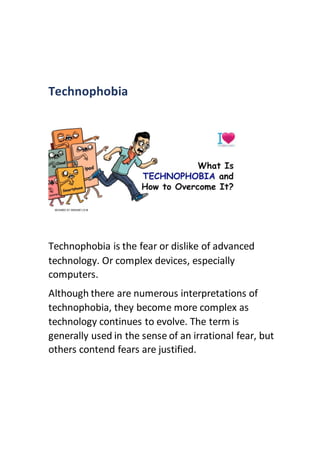
Technophobia
Technophobia is the fear or dislike of advanced
technology. Or complex devices, especially
computers.
Although there are numerous interpretations of
technophobia, they become more complex as
technology continues to evolve. The term is
generally used in the sense of an irrational fear, but
others contend fears are justified.
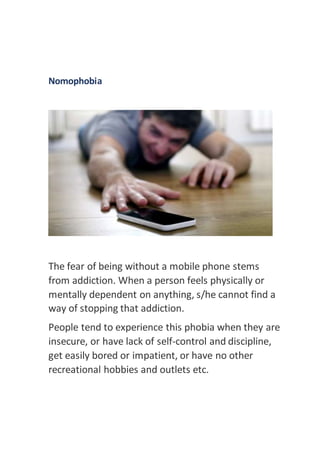
Nomophobia
The fear of being without a mobile phone stems
from addiction. When a person feels physically or
mentally dependent on anything, s/he cannot find a
way of stopping that addiction.
People tend to experience this phobia when they are
insecure, or have lack of self-control and discipline,
get easily bored or impatient, or have no other
recreational hobbies and outlets etc.
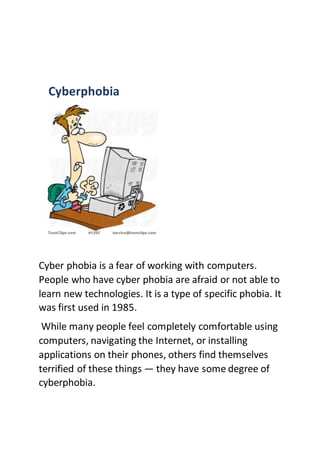
Cyberphobia
Cyber phobia is a fear of working with computers.
People who have cyber phobia are afraid or not able to
learn new technologies. It is a type of specific phobia. It
was first used in 1985.
While many people feel completely comfortable using
computers, navigating the Internet, or installing
applications on their phones, others find themselves
terrified of these things — they have some degree of
cyberphobia.
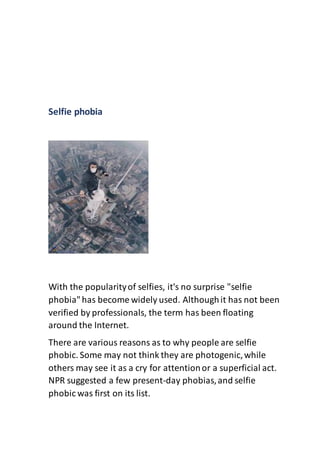
Selfie phobia
With the popularityof selfies, it's no surprise "selfie
phobia"has become widely used. Althoughit has not been
verified by professionals, the term has been floating
around the Internet.
There are various reasons as to why people are selfie
phobic. Some may not think they are photogenic,while
others may see it as a cry for attentionor a superficial act.
NPR suggested a few present-day phobias,and selfie
phobic was first on its list.
Treatments the of computer phobia
Phobias are highly treatable, and people who have them are
nearly always aware of their disorder. This helps diagnosis a
great deal.
Speaking to a psychologist or psychiatristis a useful first step in
treating a phobia that has already been identified. If the phobia
does not cause severe problems, most people find that simply
avoiding the source of their fear helps them stay in control.
Many people with specific phobias will not seek treatment as
these fears are often manageable.
It is not possible to avoid the triggers of some phobias, as is
often the case with complex phobias. In these cases, speaking to
a mental health professional can be the first step to recovery.
Most phobias can be cured with appropriate treatment. There is
no single treatment that works for every person with a phobia.
Treatment needs to be tailored to the individual for it to work.
Materials and Methods
The locationfor my materialswould be on the internet and
by individualinterview, picture story or photo voice and
group discussions on websites for collectinginformation
and time scale research should be about 7 weeks.
Simply, my method for collecting and analysingwould be
targeting ages around18 years and above also searching
on the best recommended website and make interview at
coffee and internet shops.
Results
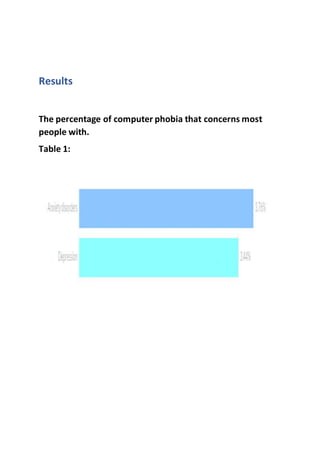
The percentage of computer phobia that concerns most
people with.
Table 1:
Discussion, conclusions and recommendations
Results reported in Table 1 demonstrate that, although 67% of
students reported no computer phobia, and 23% reported low
computer phobia, this still left 19% claiming to have moderate to
high computer phobia on the Computer Anxiety Rating Scale and
Computer Thoughts Survey measures respectively.
In conclusion, I found that phobia of the computer has been
seriously important subject to reconsider after the results that
we have seen above in table 1, I have contributed for this
research so we could feel safe when using a computer without
anxiety
There is no limitation on this research I suppose because
everyone I think wants to have and tell about these important
data for our generation
My recommendations for future work in this research that is to
make the life safe with using computer technology and know
how to use our computer and phones without fears and
concerns.
.
Ethical considerations
Ethicalconsiderationsduring the evaluationinclude:
Informed consent.
Voluntary participation.
Do no harm.
Confidentiality.
Anonymity.
Only assess relevant components
REFERENCES
Introduction:
https://www.researchgate.net/publication/223632022_Computer_phob
ia_and_computer_self-
efficacy_Their_association_with_undergraduates'_use_of_university_co
mputer_facilities
Technophobia
https://en.wikipedia.org/wiki/Technophobia
Nomophobia
https://www.fearof.net/fear-of-being-without-a-mobile-phone-phobia-
nomophobia/
Cyberphobia
https://www.vocabulary.com/dictionary/cyberphobia
Selfie phobia
https://mashable.com/2014/08/02/tech-phobias/
Treatments of the computer phobia
https://www.medicalnewstoday.com/articles/249347.php
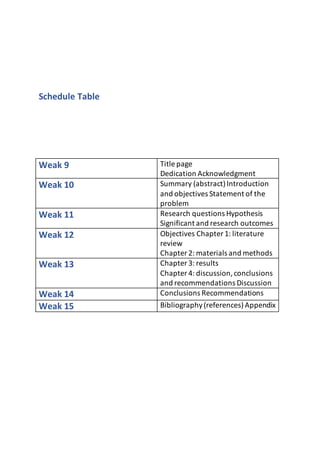
Schedule Table
Weak 9 Title page
Dedication Acknowledgment
Weak 10 Summary (abstract)Introduction
and objectives Statement of the
problem
Weak 11 Research questions Hypothesis
Significant and research outcomes
Weak 12 Objectives Chapter 1: literature
review
Chapter 2: materials and methods
Weak 13 Chapter 3: results
Chapter 4: discussion,conclusions
and recommendations Discussion
Weak 14 Conclusions Recommendations
Weak 15 Bibliography(references)Appendix

Thesis

  • 1.
    College of Telecomand Electronics Phobia of using Computer Project. INSA483: Research Phobia of using computer Lecture: dr.Ibrahim Thesis To study the use of computer without having any fear. Name: Abdulaziz Alnaeem ID: 439232084 Email: azoooz-303@hotmail.com Year of Study: 2019 For the degree of bachelor of computer The date of submission: 2019/10/10
  • 2.
    Dedication This study iswholeheartedlydedicated to our beloved parents, who have been our source of inspiration and gave us strengthwhen we thought of giving up, who continually provide their moral, spiritual, emotional, and financial support.
  • 3.
    Acknowledgement I would liketo thank the all library media specialists for their participation in the survey who supported my work in this way and helped me get results of better quality. I am also grateful to the members of my committee for their patience and support in overcoming numerous obstacles I have been facing through my research
  • 4.
    Abstract In this researchI will do searching about the fears and the concerns of using a computer for some people who do not know much of the computer problems and how to be totally safe with it.
  • 5.
    INTRODUCTION What do youfear most, more than anything else? Perhaps you hate social media, or you don't like taking selfi. Maybe the thought of giving someone your phone makes you nervous. Everyone is afraid of something. These fears are all normal; lots of other people feel the same way that you do. The problem of computer phobia or techno phobia has been widely researched over the last few decades, and in spite of consistent findings, a series of myths have been perpetuated. For example, it was commonly and erroneously believed that women are more computer phobic than men, that older people are more computer phobic than younger people and that students are less computer phobic than non-students. Many studies have shown that when previous experience is controlled for, the between group differences disappear. Moreover, it has been found that the percentage of students who can be classified as computer phobic (ranging from low to high), has been around 25%, and this does not differ substantially from the normal population.
  • 6.
    OBJECTIVES What am Itrying to achieve? The study has been conducted with followingmain objectives: - - To study the fear of using a computer. - To know the treatments of using a computer. - Finally,to feel safe when using a computer.
  • 7.
    Statement of theproblem Many people suffer from anxiety when facing difficult computing tasks. Different people respond differently to phobia of using computer. Regarding of financial costs of the problem that there is non except if he wanted to go to psychologist and scientist approved that using PCs could lead to colour or eye blindness.
  • 8.
    Research Question The researchquestion is about How to treat and find solutions for people who have concerns in using the computer..?
  • 9.
    Significantand research outcomesObjectives I have many main objectives but the most important one is how to face the fear and feel safe while using computer. Research outcomes are set at the very start of a project to guide the research. Their main role is to ensure you gain insights that are relevant and useful for phobia of computer.
  • 10.
    ABRIDGED TABLE OFCONTENTS 1. Technophobia 2.Nomophobia 3.Cyberphobia 4.Selfie phobia 5.Treatment of computer phobia 6. List OF References 7. Schedule Table
  • 11.
    Technophobia Technophobia is thefear or dislike of advanced technology. Or complex devices, especially computers. Although there are numerous interpretations of technophobia, they become more complex as technology continues to evolve. The term is generally used in the sense of an irrational fear, but others contend fears are justified.
  • 12.
    Nomophobia The fear ofbeing without a mobile phone stems from addiction. When a person feels physically or mentally dependent on anything, s/he cannot find a way of stopping that addiction. People tend to experience this phobia when they are insecure, or have lack of self-control and discipline, get easily bored or impatient, or have no other recreational hobbies and outlets etc.
  • 13.
    Cyberphobia Cyber phobia isa fear of working with computers. People who have cyber phobia are afraid or not able to learn new technologies. It is a type of specific phobia. It was first used in 1985. While many people feel completely comfortable using computers, navigating the Internet, or installing applications on their phones, others find themselves terrified of these things — they have some degree of cyberphobia.
  • 14.
    Selfie phobia With thepopularityof selfies, it's no surprise "selfie phobia"has become widely used. Althoughit has not been verified by professionals, the term has been floating around the Internet. There are various reasons as to why people are selfie phobic. Some may not think they are photogenic,while others may see it as a cry for attentionor a superficial act. NPR suggested a few present-day phobias,and selfie phobic was first on its list.
  • 15.
    Treatments the ofcomputer phobia Phobias are highly treatable, and people who have them are nearly always aware of their disorder. This helps diagnosis a great deal. Speaking to a psychologist or psychiatristis a useful first step in treating a phobia that has already been identified. If the phobia does not cause severe problems, most people find that simply avoiding the source of their fear helps them stay in control. Many people with specific phobias will not seek treatment as these fears are often manageable. It is not possible to avoid the triggers of some phobias, as is often the case with complex phobias. In these cases, speaking to a mental health professional can be the first step to recovery. Most phobias can be cured with appropriate treatment. There is no single treatment that works for every person with a phobia. Treatment needs to be tailored to the individual for it to work.
  • 16.
    Materials and Methods Thelocationfor my materialswould be on the internet and by individualinterview, picture story or photo voice and group discussions on websites for collectinginformation and time scale research should be about 7 weeks. Simply, my method for collecting and analysingwould be targeting ages around18 years and above also searching on the best recommended website and make interview at coffee and internet shops.
  • 17.
    Results The percentage ofcomputer phobia that concerns most people with. Table 1:
  • 18.
    Discussion, conclusions andrecommendations Results reported in Table 1 demonstrate that, although 67% of students reported no computer phobia, and 23% reported low computer phobia, this still left 19% claiming to have moderate to high computer phobia on the Computer Anxiety Rating Scale and Computer Thoughts Survey measures respectively. In conclusion, I found that phobia of the computer has been seriously important subject to reconsider after the results that we have seen above in table 1, I have contributed for this research so we could feel safe when using a computer without anxiety There is no limitation on this research I suppose because everyone I think wants to have and tell about these important data for our generation My recommendations for future work in this research that is to make the life safe with using computer technology and know how to use our computer and phones without fears and concerns. .
  • 19.
    Ethical considerations Ethicalconsiderationsduring theevaluationinclude: Informed consent. Voluntary participation. Do no harm. Confidentiality. Anonymity. Only assess relevant components
  • 20.
  • 21.
    Schedule Table Weak 9Title page Dedication Acknowledgment Weak 10 Summary (abstract)Introduction and objectives Statement of the problem Weak 11 Research questions Hypothesis Significant and research outcomes Weak 12 Objectives Chapter 1: literature review Chapter 2: materials and methods Weak 13 Chapter 3: results Chapter 4: discussion,conclusions and recommendations Discussion Weak 14 Conclusions Recommendations Weak 15 Bibliography(references)Appendix