The Power of h
Parameters in Transistor
Circuit Analysis
In this presentation, we will delve into the significant aspects of h
parameters in transistor circuit analysis and understand how these
parameters apply in real-world scenarios.
The Basics of h Parameters
Definition
h parameters represent the
change in transistor current
gain, input impedance,
output impedance, and
transfer impedance.
Measurement
h parameters can be
determined through static
measurements, small-
signal measurements, and
hybrid-pi models.
Application
The h parameter models
are widely used in amplifier
circuit designs and
analyzing the feedback
configurations.
hfe - The Common Emitter Current Gain
Definition
hfe is the ratio of collector
current to base current.
Measurement
hfe can be measured by
applying a small AC voltage
between the base and emitter
and analyzing the resulting
output.
Application
hfe is essential in amplifier
circuit designs, especially in
the common emitter
configuration.
hie - The Input Impedance of
Common Base Transistor
Circuit
1 Definition
hie is the ratio of base-
emitter voltage to base
current.
2 Measurement
hie can be measured by
applying a small AC
voltage between the base
and emitter and analyzing
the resulting input current.
3 Application
hie is especially useful in the common base configuration for low
input impedance design.
hre - The Reverse Voltage Feedback
Ratio
1 Definition
hre is the ratio of the change in the reverse saturation current to the change in reverse
voltage.
2 Measurement
hre can be determined through the measurement of reverse saturation current change
and reverse voltage change.
3 Application
hre is useful in the calculation of quiescent voltage and stability analysis of transistor
circuits.
hoe - The Output Conductance
Definition
hoe is the ratio of change in
collector current to the change
in collector-emitter voltage.
Measurement
hoe can be measured by
applying a small AC voltage
between the collector and
emitter and analyzing the
resulting current.
Application
hoe is essential in designing
the output circuit for transistor
amplifiers and analyzing their
output conductance.
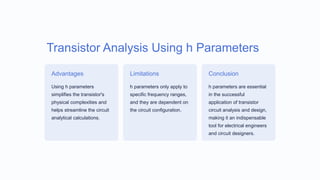
Transistor Analysis Using h Parameters
Advantages
Using h parameters
simplifies the transistor's
physical complexities and
helps streamline the circuit
analytical calculations.
Limitations
h parameters only apply to
specific frequency ranges,
and they are dependent on
the circuit configuration.
Conclusion
h parameters are essential
in the successful
application of transistor
circuit analysis and design,
making it an indispensable
tool for electrical engineers
and circuit designers.
Wrapping up
In this presentation, we have learned the basics and application of h
parameters and how they help us to analyze the complex transistor
circuits and their applications. Understanding the h parameters'
advantages and limitations is crucial in applying them effectively for
transistor circuit analysis, making them essential tools.

The-Power-of-h-Parameters-in-Transistor-Circuit-Analysis.pptx

  • 1.
    The Power ofh Parameters in Transistor Circuit Analysis In this presentation, we will delve into the significant aspects of h parameters in transistor circuit analysis and understand how these parameters apply in real-world scenarios.
  • 2.
    The Basics ofh Parameters Definition h parameters represent the change in transistor current gain, input impedance, output impedance, and transfer impedance. Measurement h parameters can be determined through static measurements, small- signal measurements, and hybrid-pi models. Application The h parameter models are widely used in amplifier circuit designs and analyzing the feedback configurations.
  • 3.
    hfe - TheCommon Emitter Current Gain Definition hfe is the ratio of collector current to base current. Measurement hfe can be measured by applying a small AC voltage between the base and emitter and analyzing the resulting output. Application hfe is essential in amplifier circuit designs, especially in the common emitter configuration.
  • 4.
    hie - TheInput Impedance of Common Base Transistor Circuit 1 Definition hie is the ratio of base- emitter voltage to base current. 2 Measurement hie can be measured by applying a small AC voltage between the base and emitter and analyzing the resulting input current. 3 Application hie is especially useful in the common base configuration for low input impedance design.
  • 5.
    hre - TheReverse Voltage Feedback Ratio 1 Definition hre is the ratio of the change in the reverse saturation current to the change in reverse voltage. 2 Measurement hre can be determined through the measurement of reverse saturation current change and reverse voltage change. 3 Application hre is useful in the calculation of quiescent voltage and stability analysis of transistor circuits.
  • 6.
    hoe - TheOutput Conductance Definition hoe is the ratio of change in collector current to the change in collector-emitter voltage. Measurement hoe can be measured by applying a small AC voltage between the collector and emitter and analyzing the resulting current. Application hoe is essential in designing the output circuit for transistor amplifiers and analyzing their output conductance.
  • 7.
    Transistor Analysis Usingh Parameters Advantages Using h parameters simplifies the transistor's physical complexities and helps streamline the circuit analytical calculations. Limitations h parameters only apply to specific frequency ranges, and they are dependent on the circuit configuration. Conclusion h parameters are essential in the successful application of transistor circuit analysis and design, making it an indispensable tool for electrical engineers and circuit designers.
  • 8.
    Wrapping up In thispresentation, we have learned the basics and application of h parameters and how they help us to analyze the complex transistor circuits and their applications. Understanding the h parameters' advantages and limitations is crucial in applying them effectively for transistor circuit analysis, making them essential tools.