Theory of Morality


                     1
We make moral judgements of behaviour by consulting
our conscience (which could be defined as “the
intersection of the mind and the soul”.)


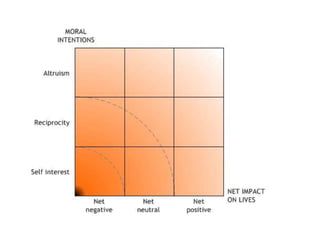
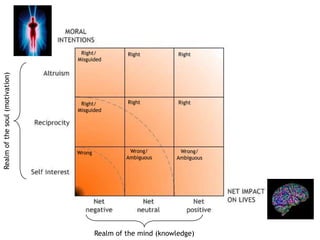
• We do this by comparing a behaviour’s motivation with its impact.
• When motivation and impact are perceived to be good, we judge
  an action to be “right”.
• When motivation and impact are perceived to be bad, we judge an
  action to be “wrong”.


                                                                  2
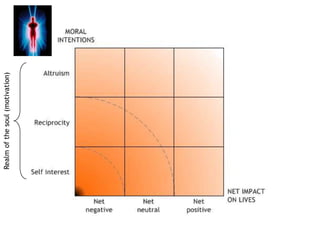
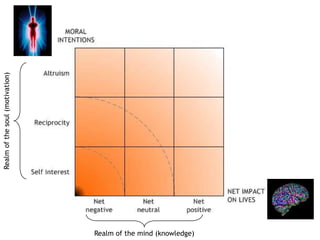
Realm of the soul (motivation)


Realm of the mind (knowledge)
Right/          Right          Right
                                 Misguided
Realm of the soul (motivation)


                                  Right/          Right          Right
                                 Misguided


                                 Wrong             Wrong/        Wrong/
                                                  Ambiguous     Ambiguous


                                         Realm of the mind (knowledge)
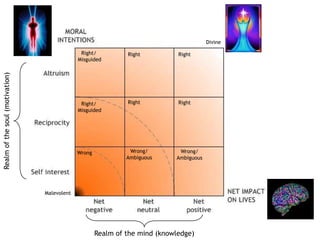
Divine

                                               Right/          Right          Right
                                              Misguided
Realm of the soul (motivation)


                                               Right/          Right          Right
                                              Misguided


                                              Wrong             Wrong/        Wrong/
                                                               Ambiguous     Ambiguous


                                 Malevolent


                                                      Realm of the mind (knowledge)
Moral judgements are not always black and
white.
• Some behaviours are hard to judge because:
   – Interactions between motivation and impact can be paradoxical.
   – We are often working with incomplete information about how a person
     has weighed the consequences of their behaviour.


                                                                       8
When we are choosing our own
behaviour, it is our conscience that guides
us.
• Our own moral intentions could be said to emanate from the
  “realm of the soul”.
• Our assessment of the net impact of our behaviour on other lives
  emanates from the “realm of the mind”.
• Individual moral decisions are therefore always personal and
  subjective, as they can only be made within the parameters of
  what is known.
• Because “what is known” can have infinite variations, there are no
  moral absolutes.
• Moral absolutes require infinite knowledge of the connection of
  all things.


                                                                   9
Self-interest

• Self interest is never good, but it doesn’t seems as bad if the
  consequences are net neutral or net positive.
• It is well known that the more we can remove ourselves from the
  consequences of our actions, the easier it is to act in self interest.
• Capitalism and globalisation remove us from the consequences of
  our actions.


                                                                       10
Lessons

• By tapping into the connectedness of all things, we can make
  better moral judgements.
• If we wish to judge, the first thing we must do is increase our
  knowledge of the unique circumstances of the moral dilemma.
• We need to build societies and ways of living in the world that
  bring us into greater contact with the consequences of our
  decisions.
• Ultimately, because we can’t know the connectedness of all
  things, we must:
    – Focus on the “now”.
    – Direct our moral intentions towards those we are with (regardless of
      species).
    – Do the right thing by them.
• If all of us do this, we will create a self-perpetuating cycle of
  good.

                                                                             11

Theory of morality

  • 1.
  • 2.
    We make moraljudgements of behaviour by consulting our conscience (which could be defined as “the intersection of the mind and the soul”.) • We do this by comparing a behaviour’s motivation with its impact. • When motivation and impact are perceived to be good, we judge an action to be “right”. • When motivation and impact are perceived to be bad, we judge an action to be “wrong”. 2
  • 4.
    Realm of thesoul (motivation)
  • 5.
    Realm of thesoul (motivation) Realm of the mind (knowledge)
  • 6.
    Right/ Right Right Misguided Realm of the soul (motivation) Right/ Right Right Misguided Wrong Wrong/ Wrong/ Ambiguous Ambiguous Realm of the mind (knowledge)
  • 7.
    Divine Right/ Right Right Misguided Realm of the soul (motivation) Right/ Right Right Misguided Wrong Wrong/ Wrong/ Ambiguous Ambiguous Malevolent Realm of the mind (knowledge)
  • 8.
    Moral judgements arenot always black and white. • Some behaviours are hard to judge because: – Interactions between motivation and impact can be paradoxical. – We are often working with incomplete information about how a person has weighed the consequences of their behaviour. 8
  • 9.
    When we arechoosing our own behaviour, it is our conscience that guides us. • Our own moral intentions could be said to emanate from the “realm of the soul”. • Our assessment of the net impact of our behaviour on other lives emanates from the “realm of the mind”. • Individual moral decisions are therefore always personal and subjective, as they can only be made within the parameters of what is known. • Because “what is known” can have infinite variations, there are no moral absolutes. • Moral absolutes require infinite knowledge of the connection of all things. 9
  • 10.
    Self-interest • Self interestis never good, but it doesn’t seems as bad if the consequences are net neutral or net positive. • It is well known that the more we can remove ourselves from the consequences of our actions, the easier it is to act in self interest. • Capitalism and globalisation remove us from the consequences of our actions. 10
  • 11.
    Lessons • By tappinginto the connectedness of all things, we can make better moral judgements. • If we wish to judge, the first thing we must do is increase our knowledge of the unique circumstances of the moral dilemma. • We need to build societies and ways of living in the world that bring us into greater contact with the consequences of our decisions. • Ultimately, because we can’t know the connectedness of all things, we must: – Focus on the “now”. – Direct our moral intentions towards those we are with (regardless of species). – Do the right thing by them. • If all of us do this, we will create a self-perpetuating cycle of good. 11