1.1 WHAT ISA THEORY?
LEARNING OUTCOMES
•Explain the role of theories in understanding child development;
•Portray the stand taken by major theories on the basic issues of
child development;
•Evaluate historical influences on modern theories of child
development, from medieval times through the early twentieth
century; and
•Describe the age periods researchers use to study child
development.
6.
WHAT IS ATHEORY?
•A theory is an orderly, integrated set of statements that describes,
explains, and predicts behaviour.
•Theories are vital tools for two reasons:
oThey guide and give meaning to what we see.
oIf verified by research, they often provide a sound basis for practical action.
•A theory is broad and guides the process of finding facts rather
than of reaching goals.
oA theory can be a body of knowledge, which may or may not be linked with
an explanatory model.
oTo theorize is to develop this body of knowledge
7.
WHAT IS ATHEORY?
•Today, the term "theory" refers to scientific theories.
oIt is based on empirical evidence, and fulfils the criteria required by modern
science.
oScientific tests should be able to provide verify or falsify it.
oScientific theories are the most reliable, and comprehensive form of
scientific knowledge.
oIn contrast, something speculative is considered as a hypothesis.
8.
WHAT IS DEVELOPMENTALPSYCHOLOGY?
Developmental psychology is the branch of psychology that focuses on how people
grow and change over the course of a lifetime. Some of the many issues that
developmental psychologists look at include:
Motor skill development;
Language acquisition;
Emotional development;
Self-awareness and self-concept;
Temperament and personality development;
Language acquisition and skills;
Cognitive development;
Moral reasoning; and
Developmental challenges and learning disabilities.
9.
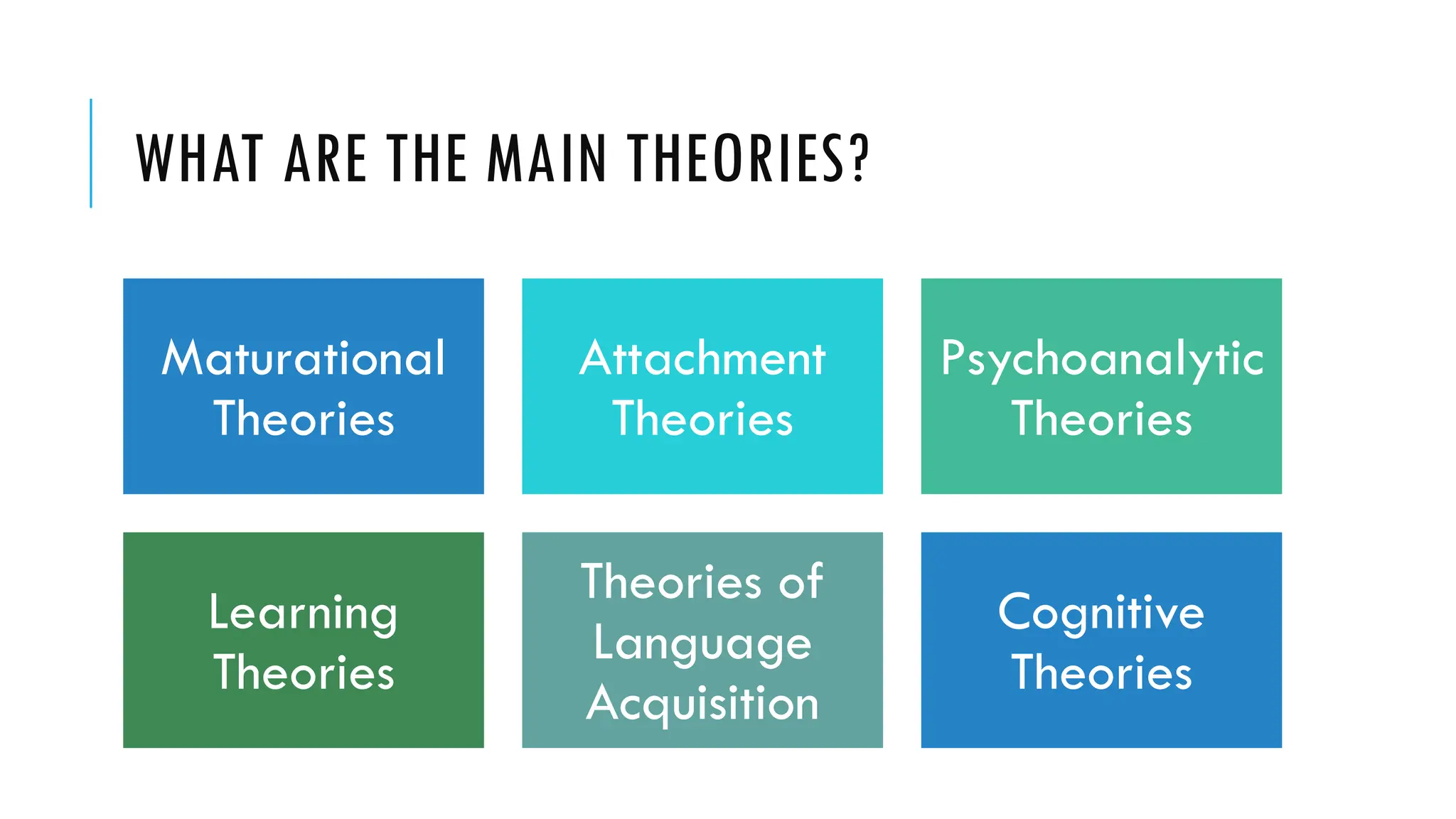
WHAT ARE THEMAIN THEORIES?
Maturational
Theories
Attachment
Theories
Psychoanalytic
Theories
Learning
Theories
Theories of
Language
Acquisition
Cognitive
Theories
10.
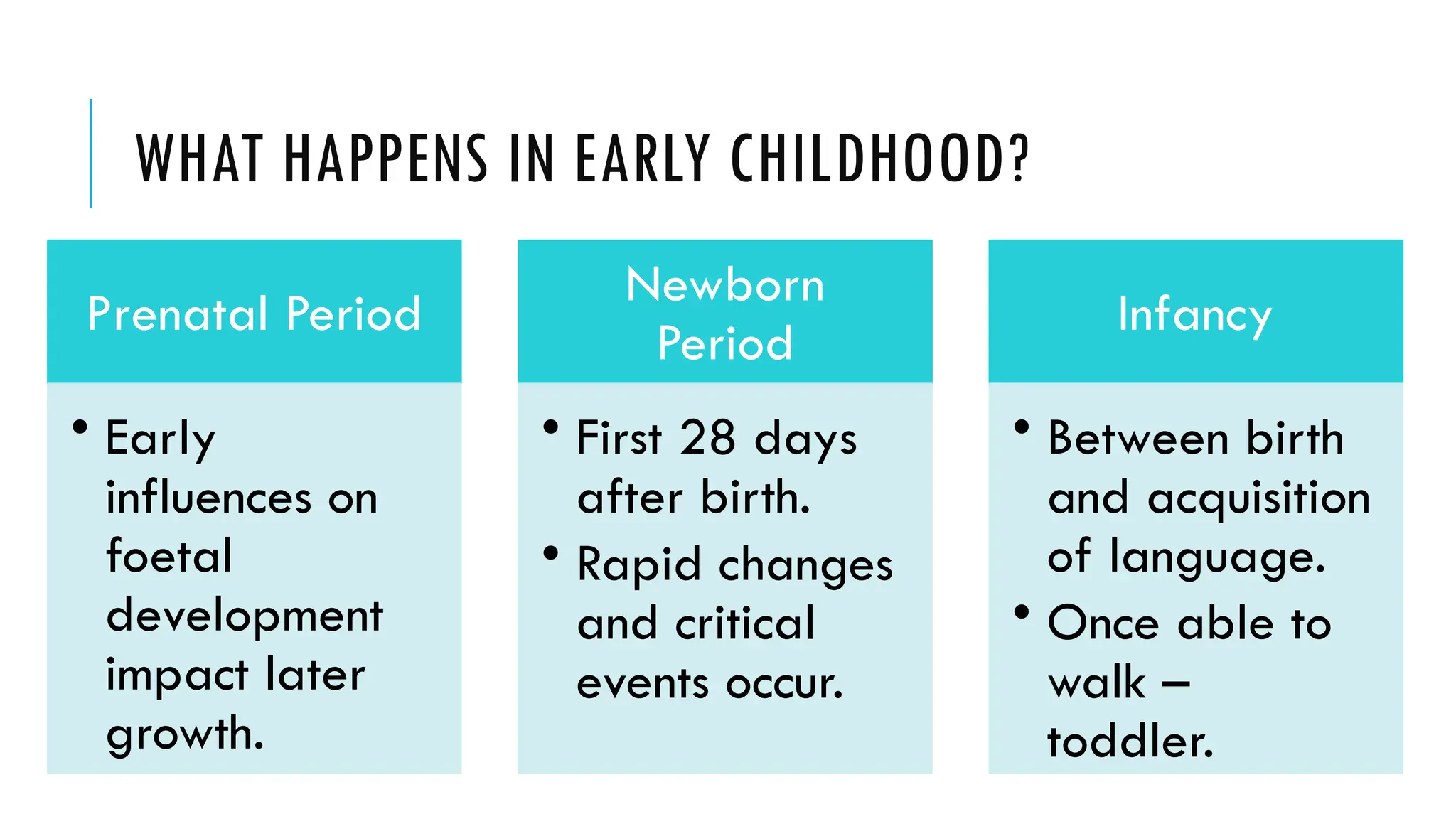
WHAT HAPPENS INEARLY CHILDHOOD?
Prenatal Period
• Early
influences on
foetal
development
impact later
growth.
Newborn
Period
• First 28 days
after birth.
• Rapid changes
and critical
events occur.
Infancy
• Between birth
and acquisition
of language.
• Once able to
walk –
toddler.
11.
WHAT HAPPENS INEARLY CHILDHOOD?
Preschool Period
• Ranging from 2-5
• Preparation for
school readiness.
• Learn through play
and communication.
Kindergarten Period
• Children begin
foundation on
becoming a
competent learner.
12.
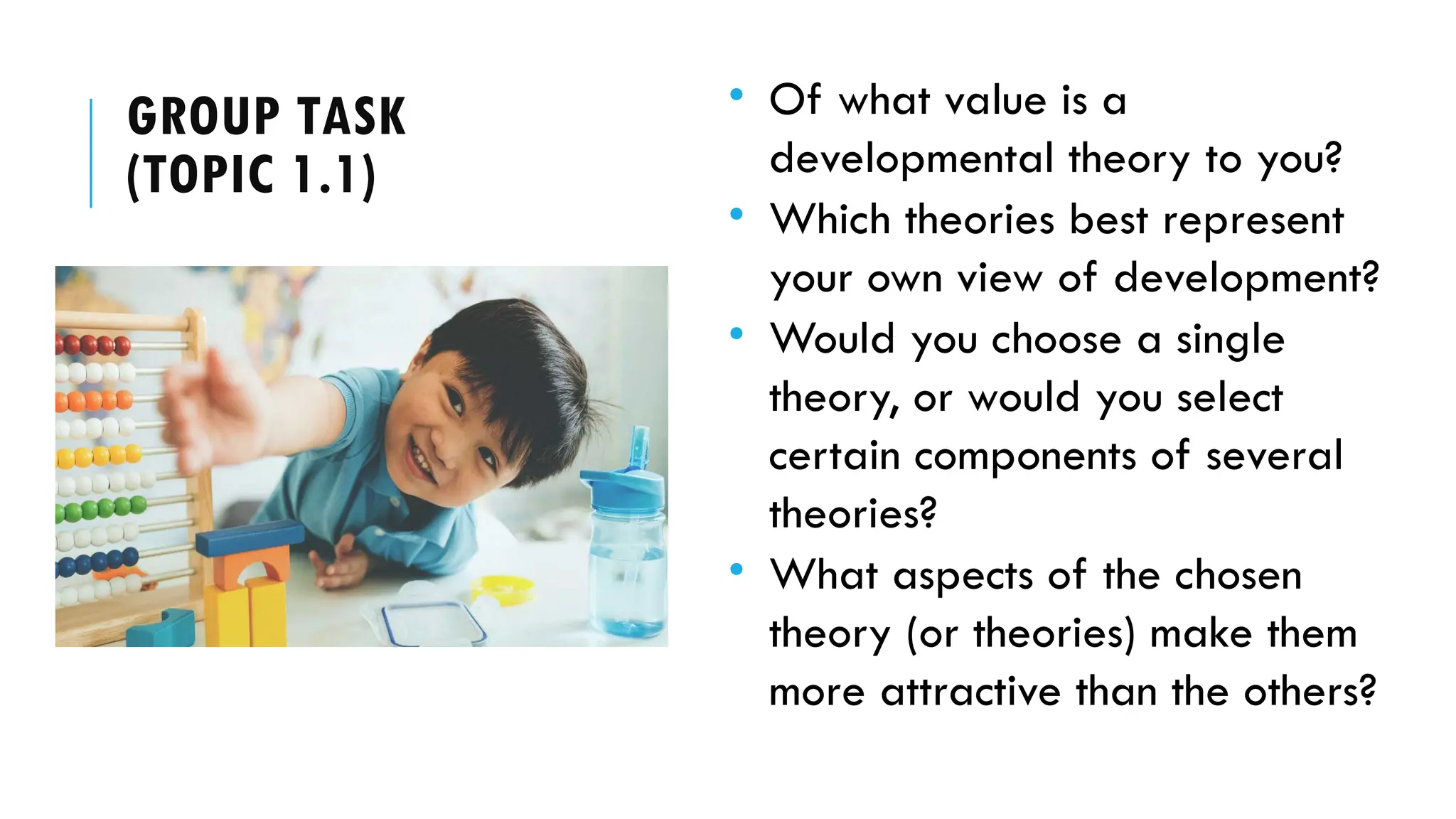
GROUP TASK
(TOPIC 1.1)
•Of what value is a
developmental theory to you?
• Which theories best represent
your own view of development?
• Would you choose a single
theory, or would you select
certain components of several
theories?
• What aspects of the chosen
theory (or theories) make them
more attractive than the others?
13.
1.2 MAIN ISSUESTHAT DEVELOPMENTAL THEORIES ADDRESS IN
CHILDREN
LEARNING OUTCOMES
Discuss the nature versus nurture debate;
Explain some of the ways heredity and environment
interact to produce individual differences in development;
Examine the importance of early experiences in an
individual’s life.
14.
NATURE VS. NURTUREDEBATE
•Are genetic or environmental factors more important in influencing
development?
•Nature refers to inborn biological heredity we receive from our parents at
conception.
•Nurture means the complex forces of the physical and social world that
influence our biological makeup and psychological experiences, both before
and after birth.
•All theories grant at least some role to both nature and nurture, but they vary
in emphasis.
•Most psychologists believe that an interaction between these two forces causes
development.
15.
EARLY EXPERIENCE VS.LATER EXPERIENCE
•Another issue revolves the value of early experiences versus those that occur
later in life.
•Psychoanalytic theories tend to focus on events that happen in early childhood.
oFreud thought that personality is almost fully formed by the age of five.
oIf this is really the case, those who have suffered deprived or abusive childhoods might
never adjust or develop normally.
•In contrast, researchers have found that many people with less-than-perfect
childhoods do become well-adjusted adults.
•Theories affect how effective intervention may be at different periods of time.
16.
CONTINUITY VS. DISCONTINUITY
•Dochanges occur smoothly over time, or do they occur in stages?
•Some theorists believe that development is continuous, a process of gradually
adding more of the same types of skills that were there to begin with.
o Vygotsky, Gardner, and Bowlby.
o They maintain that child development is simply a matter of quality and quantity.
•Other theorists believe that development is discontinuous, a process in which new
ways of understanding and responding to the world emerge at specific periods.
o Freud, Erikson, Piaget, and Kohlberg.
o They outline a sequence of stages in which specific skills emerge.
o Children undergo periods of rapid transformation as they move up to a new level of
development, alternating with plateaus during which little change occurs.
17.
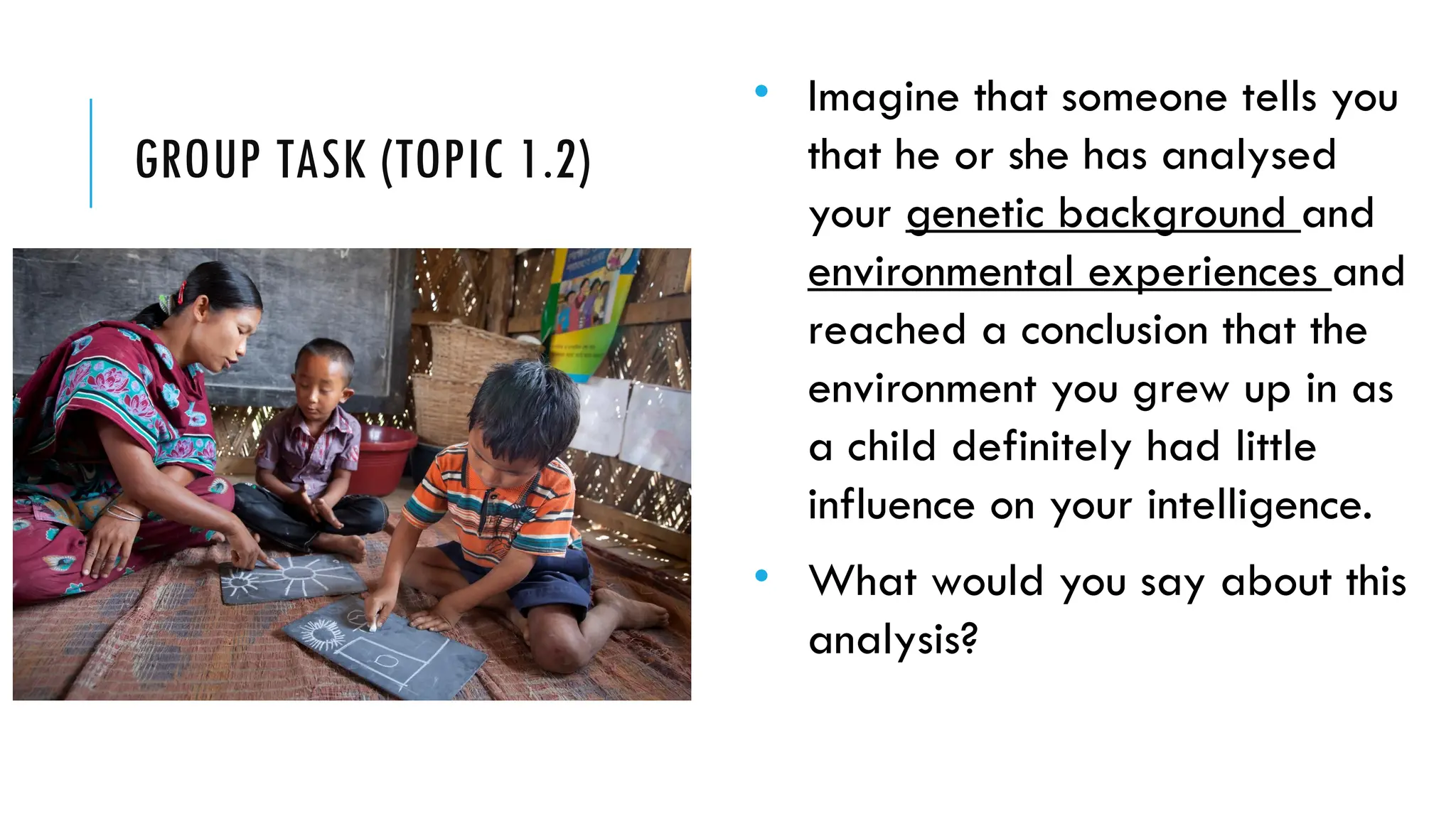
GROUP TASK (TOPIC1.2)
• Imagine that someone tells you
that he or she has analysed
your genetic background and
environmental experiences and
reached a conclusion that the
environment you grew up in as
a child definitely had little
influence on your intelligence.
• What would you say about this
analysis?