
The Little Jenkinsfile that Could
@ShelleyMLambert June 2019
Themes from the story:
 Impossible task
 Hard work
 Optimism
“I think I can, I think I can”
Outline
 Background
 History of Proprietary Tools & Technical Debt
 Scope, Stats, Ecosystem
 Design Principles for Automation
 Intentionally Simple
 Learn from Past Lessons
 Whole team involvement
 Revision Highlights of the little Jenkinsfile
 Challenges
 Future
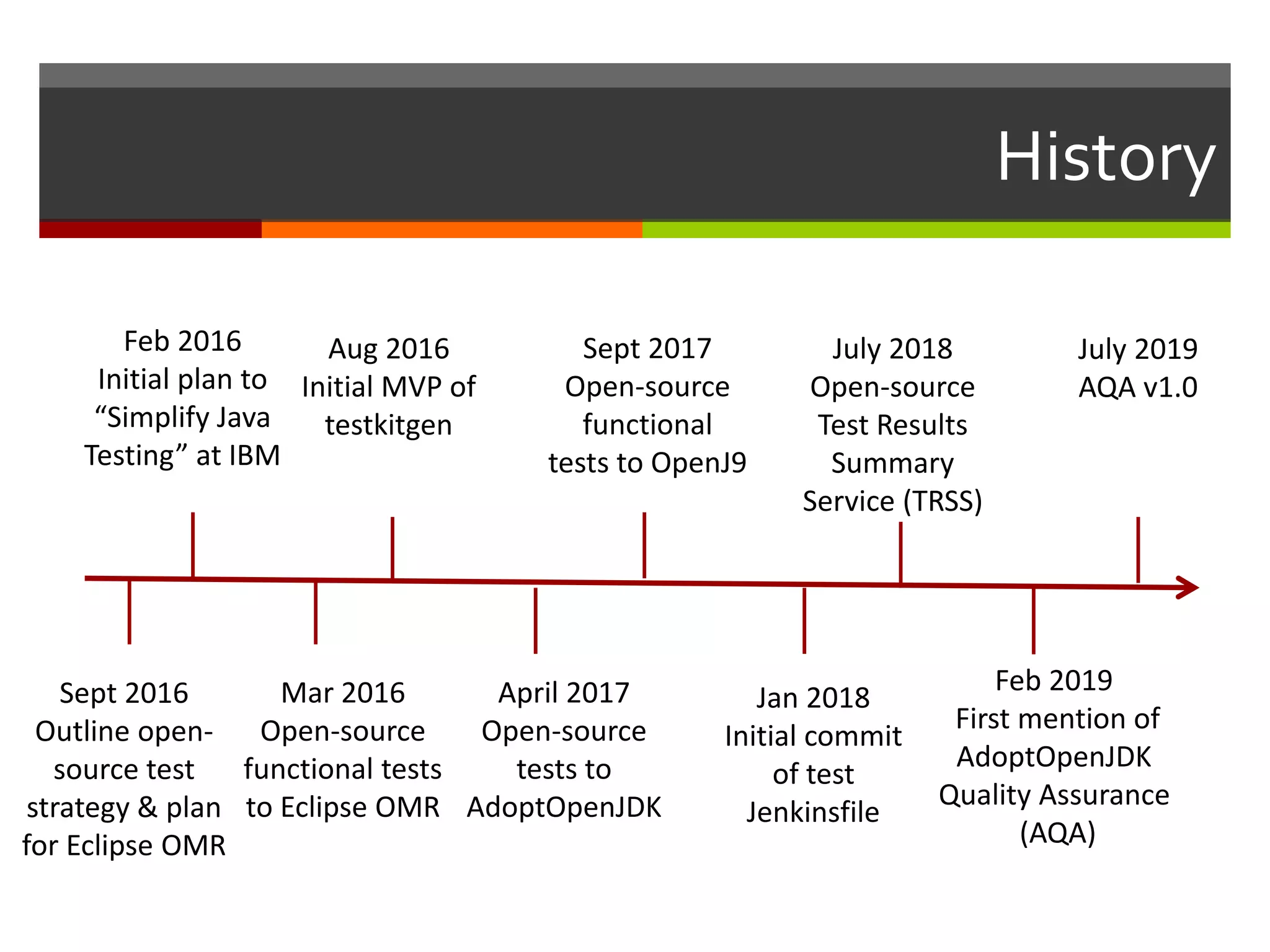
History
Feb 2019
First mention of
AdoptOpenJDK
Quality Assurance
(AQA)
July 2018
Open-source
Test Results
Summary
Service (TRSS)
April 2017
Open-source
tests to
AdoptOpenJDK
Sept 2017
Open-source
functional
tests to OpenJ9
Jan 2018
Initial commit
of test
Jenkinsfile
Feb 2016
Initial plan to
“Simplify Java
Testing” at IBM
Aug 2016
Initial MVP of
testkitgen
Sept 2016
Outline open-
source test
strategy & plan
for Eclipse OMR
Mar 2016
Open-source
functional tests
to Eclipse OMR
July 2019
AQA v1.0
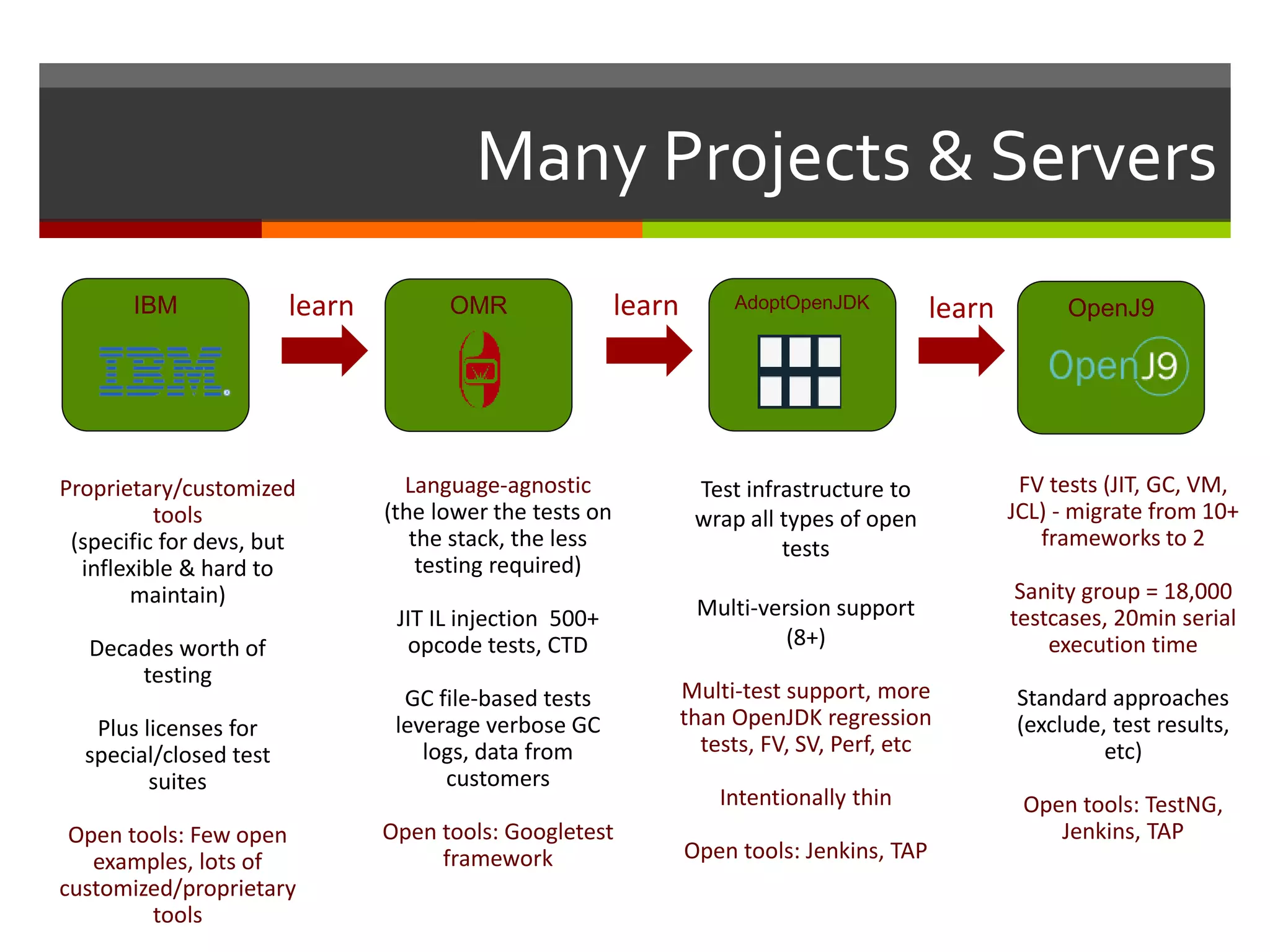
Many Projects & Servers
Language-agnostic
(the lower the tests on
the stack, the less
testing required)
JIT IL injection 500+
opcode tests, CTD
GC file-based tests
leverage verbose GC
logs, data from
customers
Open tools: Googletest
framework
AdoptOpenJDKOMR OpenJ9
Test infrastructure to
wrap all types of open
tests
Multi-version support
(8+)
Multi-test support, more
than OpenJDK regression
tests, FV, SV, Perf, etc
Intentionally thin
Open tools: Jenkins, TAP
FV tests (JIT, GC, VM,
JCL) - migrate from 10+
frameworks to 2
Sanity group = 18,000
testcases, 20min serial
execution time
Standard approaches
(exclude, test results,
etc)
Open tools: TestNG,
Jenkins, TAP
IBM learn learn learn
Proprietary/customized
tools
(specific for devs, but
inflexible & hard to
maintain)
Decades worth of
testing
Plus licenses for
special/closed test
suites
Open tools: Few open
examples, lots of
customized/proprietary
tools
Scope
OpenJ9 Hotspot IBM SAP
8 9 10 11 12 +
openjdk functional perf system external
RI
13
Implementations
Platforms
Versions
Test Categories
osxosx aix win xlinux plinux
6 versions
aarch
250000 tests
87,000,000 Tests
Plus PR builds,
promotion builds and
personal builds
58 impl_platforms
6 servers Trainload of tests!
Stats
Ecosystem
AdoptOpenJDK Quality Assurance (AQA)
 “Make quality certain to happen”
 Testing a wide criteria representing actual business requirements to identify
binaries ready for production usage
Today Roadmap (open)
Functional correctness Functional correctness
OpenJDK regression (open) OpenJDK regression
Oracle JCK (closed) Eclipse functional
Application & framework tests
Builder-specific testing (unknown) Security
Passes known vulnerability tests
Performance
Published metrics
Achieves minimum throughput scores
Scalability & durability
Load & stress testing
3-part automation story
testkitgen TRSSJenkins
Responsibilities:
- Categorize tests logically
- Generates test targets
(level/platform/version/i
mpl specific)
- Test addition via folders
- Parameters: BUILD_LIST,
EXTRA_OPTIONS,
JVM_OPTIONS,
TEST_FLAG, ITERATION
Responsibilities:
- Schedule regular
builds
- Provide multiple
nodes of all
platforms
- Parallelization
- GUI view of test
results
Responsibilities:
- Monitor multiple
servers
- Aggregate summary
- Deep history
- Search/sort/filter
- Graphs
- Pluggable parsers
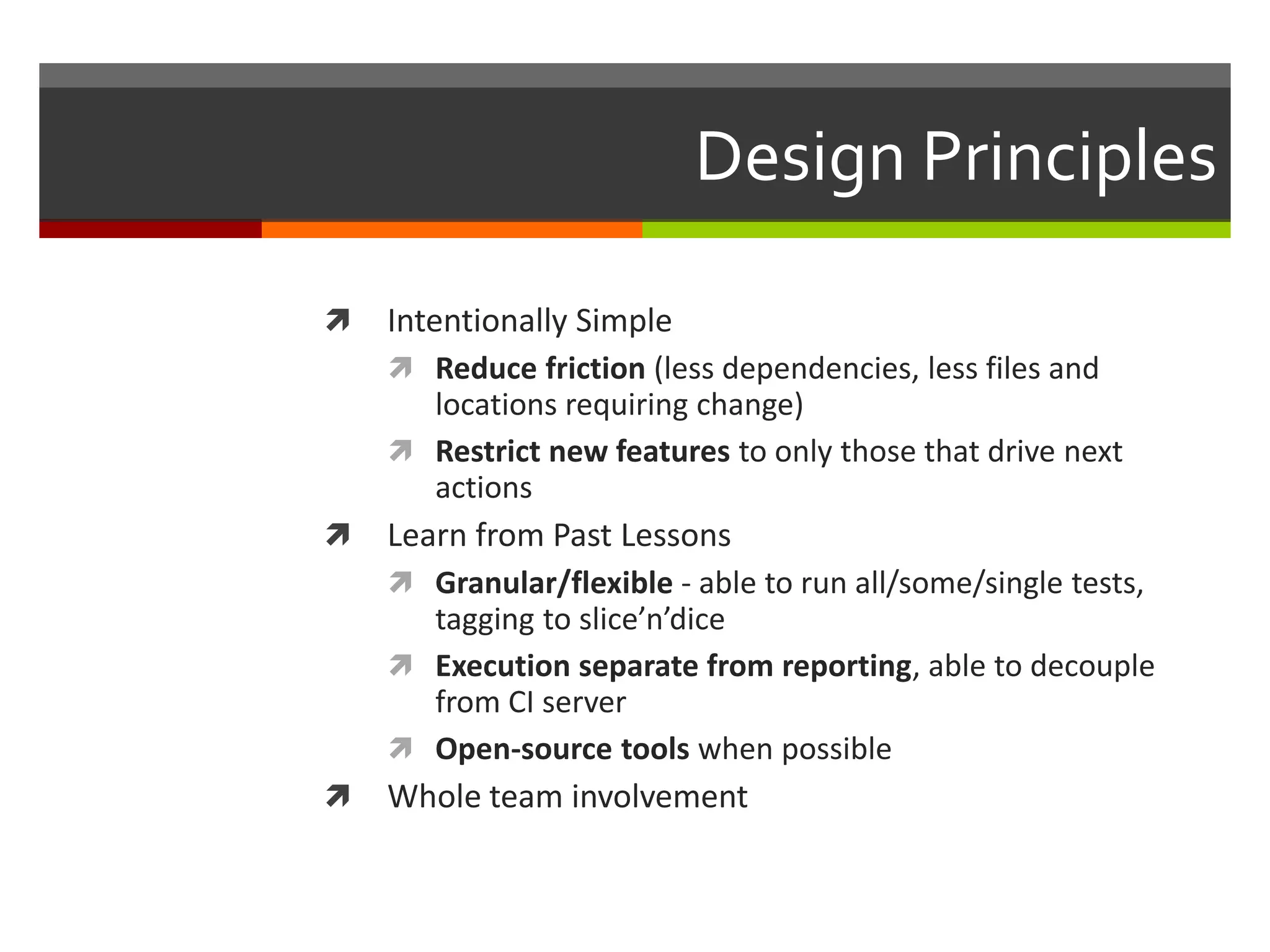
Design Principles
 Intentionally Simple
 Reduce friction (less dependencies, less files and
locations requiring change)
 Restrict new features to only those that drive next
actions
 Learn from Past Lessons
 Granular/flexible - able to run all/some/single tests,
tagging to slice’n’dice
 Execution separate from reporting, able to decouple
from CI server
 Open-source tools when possible
 Whole team involvement
https://github.com/AdoptOpenJDK/openjdk-tests
Jenkins Node Labeling
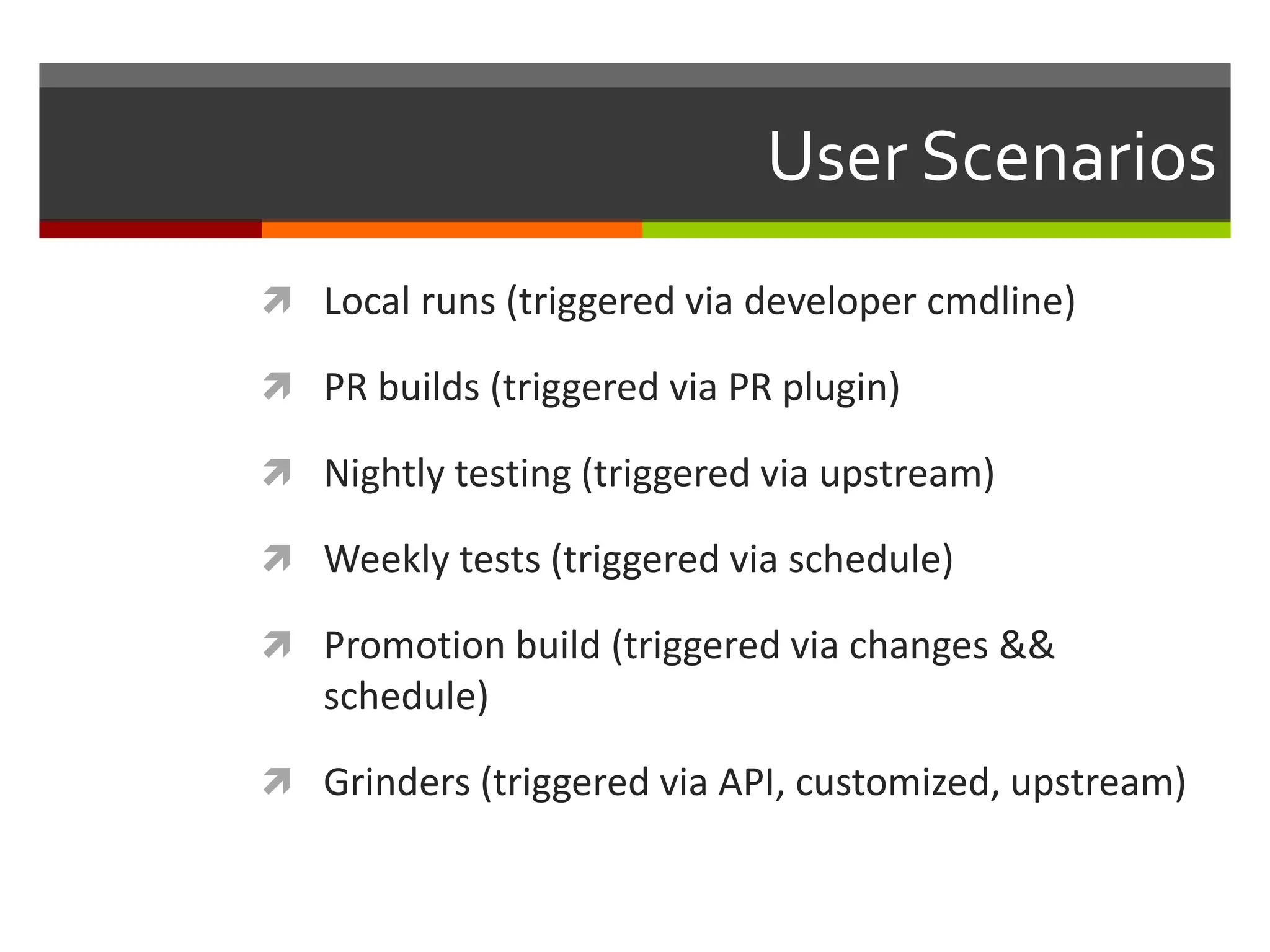
User Scenarios
 Local runs (triggered via developer cmdline)
 PR builds (triggered via PR plugin)
 Nightly testing (triggered via upstream)
 Weekly tests (triggered via schedule)
 Promotion build (triggered via changes &&
schedule)
 Grinders (triggered via API, customized, upstream)
Revision Highlights
 Initial version: 1 platform, xlinux
 SDK resource: upstream
 Label support & other platforms
 Create Grinder & merge into single Jenkinsfile
 SDK resource: nightly, release, customized
 Iterations & Custom targets
 Repos/branches params
 Pre-staged jars (test.getDependency job)
 Artifactory support
 Test parallelization
 Auto-gen jobs (partial and/or full)
Jenkins Plugins
Keep it simple, limit reliance:
 Pipeline plugin (now part of core Jenkins)
 Test results plugins: TAP, Junit
 Node & Label parameter
 Xvfb (for tests that require DISPLAY var set)
 Timestamper
 Artifactory
 Github PR builder (for PR build/test runs)
Challenges
 Feature creep
 Ownership & access
 Technical ego
 Naysayers
 Open tools churn (updates, defects, skew)
 Unstable machine layer
Human
Technical
Future
 Specialized Grinders
 less parameters in each
 less confusion for developers
 Personal Jenkins instances with Docker nodes as
additional option for local running of tests
 Plug in to other CI/CD options
 Other test-related services
 Pipeline feeds deep learning
Demo
Community building! Please join us!
AdoptOpenJDK
adoptopenjdk.net AdoptOpenJDK/openjdk-tests @adoptopenjdk
eclipse.org/openj9 eclipse/openj9 @openj9
eclipse.org/omr eclipse.org/omr @eclipseomr
Website Github Twitter
8thdaytesting.com smlambert @ShelleyMLambert
Services to Support Automation
ResultAnalytics
Data
Services
UI Layer
Cores
raw refined
custom dashboardother clients
TestGeneration BenchEngineCoreAnalytics TestSelection
BugPrediction
InputOptions ResultSummary
ResultCompare
github
repos
Jenkins
servers
DL service
 visualize & analyze data from cores
 predict crashes based on data mined from core files
Core Analytics
 Scores per file based on ‘recent’ changes due to defects (github PRs/issues),
predict based on change & defect history, other features?
Bug Prediction

The_Little_Jenkinsfile_That_Could

  • 1.
     The Little Jenkinsfilethat Could @ShelleyMLambert June 2019 Themes from the story:  Impossible task  Hard work  Optimism “I think I can, I think I can”
  • 2.
    Outline  Background  Historyof Proprietary Tools & Technical Debt  Scope, Stats, Ecosystem  Design Principles for Automation  Intentionally Simple  Learn from Past Lessons  Whole team involvement  Revision Highlights of the little Jenkinsfile  Challenges  Future
  • 3.
    History Feb 2019 First mentionof AdoptOpenJDK Quality Assurance (AQA) July 2018 Open-source Test Results Summary Service (TRSS) April 2017 Open-source tests to AdoptOpenJDK Sept 2017 Open-source functional tests to OpenJ9 Jan 2018 Initial commit of test Jenkinsfile Feb 2016 Initial plan to “Simplify Java Testing” at IBM Aug 2016 Initial MVP of testkitgen Sept 2016 Outline open- source test strategy & plan for Eclipse OMR Mar 2016 Open-source functional tests to Eclipse OMR July 2019 AQA v1.0
  • 4.
    Many Projects &Servers Language-agnostic (the lower the tests on the stack, the less testing required) JIT IL injection 500+ opcode tests, CTD GC file-based tests leverage verbose GC logs, data from customers Open tools: Googletest framework AdoptOpenJDKOMR OpenJ9 Test infrastructure to wrap all types of open tests Multi-version support (8+) Multi-test support, more than OpenJDK regression tests, FV, SV, Perf, etc Intentionally thin Open tools: Jenkins, TAP FV tests (JIT, GC, VM, JCL) - migrate from 10+ frameworks to 2 Sanity group = 18,000 testcases, 20min serial execution time Standard approaches (exclude, test results, etc) Open tools: TestNG, Jenkins, TAP IBM learn learn learn Proprietary/customized tools (specific for devs, but inflexible & hard to maintain) Decades worth of testing Plus licenses for special/closed test suites Open tools: Few open examples, lots of customized/proprietary tools
  • 5.
    Scope OpenJ9 Hotspot IBMSAP 8 9 10 11 12 + openjdk functional perf system external RI 13 Implementations Platforms Versions Test Categories osxosx aix win xlinux plinux 6 versions aarch 250000 tests 87,000,000 Tests Plus PR builds, promotion builds and personal builds 58 impl_platforms 6 servers Trainload of tests!
  • 6.
  • 7.
    Ecosystem AdoptOpenJDK Quality Assurance(AQA)  “Make quality certain to happen”  Testing a wide criteria representing actual business requirements to identify binaries ready for production usage Today Roadmap (open) Functional correctness Functional correctness OpenJDK regression (open) OpenJDK regression Oracle JCK (closed) Eclipse functional Application & framework tests Builder-specific testing (unknown) Security Passes known vulnerability tests Performance Published metrics Achieves minimum throughput scores Scalability & durability Load & stress testing
  • 8.
    3-part automation story testkitgenTRSSJenkins Responsibilities: - Categorize tests logically - Generates test targets (level/platform/version/i mpl specific) - Test addition via folders - Parameters: BUILD_LIST, EXTRA_OPTIONS, JVM_OPTIONS, TEST_FLAG, ITERATION Responsibilities: - Schedule regular builds - Provide multiple nodes of all platforms - Parallelization - GUI view of test results Responsibilities: - Monitor multiple servers - Aggregate summary - Deep history - Search/sort/filter - Graphs - Pluggable parsers
  • 9.
    Design Principles  IntentionallySimple  Reduce friction (less dependencies, less files and locations requiring change)  Restrict new features to only those that drive next actions  Learn from Past Lessons  Granular/flexible - able to run all/some/single tests, tagging to slice’n’dice  Execution separate from reporting, able to decouple from CI server  Open-source tools when possible  Whole team involvement
  • 10.
  • 11.
  • 12.
  • 13.
  • 14.
    User Scenarios  Localruns (triggered via developer cmdline)  PR builds (triggered via PR plugin)  Nightly testing (triggered via upstream)  Weekly tests (triggered via schedule)  Promotion build (triggered via changes && schedule)  Grinders (triggered via API, customized, upstream)
  • 15.
    Revision Highlights  Initialversion: 1 platform, xlinux  SDK resource: upstream  Label support & other platforms  Create Grinder & merge into single Jenkinsfile  SDK resource: nightly, release, customized  Iterations & Custom targets  Repos/branches params  Pre-staged jars (test.getDependency job)  Artifactory support  Test parallelization  Auto-gen jobs (partial and/or full)
  • 16.
    Jenkins Plugins Keep itsimple, limit reliance:  Pipeline plugin (now part of core Jenkins)  Test results plugins: TAP, Junit  Node & Label parameter  Xvfb (for tests that require DISPLAY var set)  Timestamper  Artifactory  Github PR builder (for PR build/test runs)
  • 17.
    Challenges  Feature creep Ownership & access  Technical ego  Naysayers  Open tools churn (updates, defects, skew)  Unstable machine layer Human Technical
  • 18.
    Future  Specialized Grinders less parameters in each  less confusion for developers  Personal Jenkins instances with Docker nodes as additional option for local running of tests  Plug in to other CI/CD options  Other test-related services  Pipeline feeds deep learning
  • 19.
  • 20.
    Community building! Pleasejoin us! AdoptOpenJDK adoptopenjdk.net AdoptOpenJDK/openjdk-tests @adoptopenjdk eclipse.org/openj9 eclipse/openj9 @openj9 eclipse.org/omr eclipse.org/omr @eclipseomr Website Github Twitter 8thdaytesting.com smlambert @ShelleyMLambert
  • 21.
    Services to SupportAutomation ResultAnalytics Data Services UI Layer Cores raw refined custom dashboardother clients TestGeneration BenchEngineCoreAnalytics TestSelection BugPrediction InputOptions ResultSummary ResultCompare github repos Jenkins servers DL service
  • 22.
     visualize &analyze data from cores  predict crashes based on data mined from core files Core Analytics
  • 23.
     Scores perfile based on ‘recent’ changes due to defects (github PRs/issues), predict based on change & defect history, other features? Bug Prediction

Editor's Notes

  • #2 Story about optimism and hard work Heavy train stuck in the mountains, calls for help by big strong engines, each declines… finally train asks for help from this little switch engine… A little railroad engine was employed about a station yard for such work as it was built for, pulling a few cars on and off the switches. One morning it was waiting for the next call when a long train of freight-cars asked a large engine in the roundhouse to take it over the hill. "I can't; that is too much a pull for me", said the great engine built for hard work. Then the train asked another engine, and another, only to hear excuses and be refused. In desperation, the train asked the little switch engine to draw it up the grade and down the other side. “I think I can”, puffed the little locomotive, and put itself in front of the great heavy train. As it went on the little engine kept bravely puffing faster and faster, “I think I can, I think I can, I think I can”. As it neared the top of the grade, which had so discouraged the larger engines, it went more slowly. However, it still kept saying, "I—think—I—can, I—think—I—can." It reached the top by drawing on bravery and then went on down the grade, congratulating itself by saying, "I thought I could, I thought I could." Through a solitary Jenkinsfile, we run millions of tests in daily builds, personal builds, parallel builds against different Java versions, implementations, and platforms.  This is the story of our experience leveraging continuous integration tools, iteratively simplifying our initial approach, into a solution that spans across many different servers, user scenarios, challenges and demands.  It is the journey of learning and humble revision over the course of a year.
  • #3 Through a solitary Jenkinsfile, we run millions of tests in daily builds, personal builds, parallel builds against different Java versions, implementations, and platforms.  This is the story of our experience leveraging continuous integration tools, iteratively simplifying our initial approach, into a solution that spans across many different servers, user scenarios, challenges and demands.  It is the journey of learning and humble revision over the course of a year.
  • #4 - Team of 4, effort to reorganize, share, build and run tests in a simpler, more open and agile way to make our lives inside of IBM easier… Separate execution from reporting - able to run both on dev laptop outside proprietary tools and in CI server Use widely adopted open-source tools, minimize proprietary approaches Granular - able to run all/some/single tests, tagging to slice’n’dice Volume control for test output (logging, discard green results, minimize noise) Reduce friction (less dependencies & locations requiring change) Run RI for comparison and easier triage Incremental improvements, MVPs & identify backlog items that can wait
  • #6 10 PRs per day 522, 000, 000 tests/day
  • #8 Open testing roadmap becomes AQA
  • #11 15 contributors, 150 edits
  • #16 TODO – make a timeline (and bigger font) Diagram of all Jenkins server - & all repos in play
  • #18 Trolls & naysayers
  • #22 In the past we have done various prototypes, we had ideas of services we would like to have, some of them are now in full use, some still parked… With the advent of deep learning, its an appropriate time to revisit these and think about other things that are made more feasible with DL