The EHRA Bookof
Interventional
Electrophysiology
Case-based learning with multiple choice questions
3.
European Society ofCardiology publications
The ESC Textbook of Cardiovascular Medicine (Second Edition)
Edited by A. John Camm, Thomas F. Lüscher, and Patrick
W. Serruys
The ESC Textbook of Intensive and Acute Cardiovascular Care
(Second Edition)
Edited by Marco Tubaro, Pascal Vranckx, Susanna Price, and
Christiaan Vrints
The ESC Textbook of Cardiovascular Imaging (Second Edition)
Edited by José Luis Zamorano, Jeroen Bax, Juhani Knuuti, Udo
Sechtem, Patrizio Lancellotti, and Luigi Badano
The ESC Textbook of Preventive Cardiology
Edited by Stephan Gielen, Guy De Backer, Massimo F. Piepoli, and
David Wood
The EHRA Book of Pacemaker, ICD, and CRT
Troubleshooting: Case-based learning with multiple choice
questions
Edited by Haran Burri, Carsten Israel, and Jean-Claude Deharo
The EACVI Echo Handbook
Edited by Patrizio Lancellotti and Bernard Cosyns
The ESC Handbook of Preventive Cardiology: Putting
prevention into practice
Edited by Catriona Jennings, Ian Graham, and Stephan Gielen
The EACVI Textbook of Echocardiography (Second Edition)
Edited by Patrizio Lancellotti, José Luis Zamorano, Gilbert Habib,
and Luigi Badano
The EHRA Book of Interventional Electrophysiology:
Case-based learning with multiple choice questions
Edited by Hein Heidbuchel, Mattias Duytschaever, and Haran
Burri
Forthcoming
The ESC Textbook of Vascular Biology
Edited by Robert Krams and Magnus Bäck
The ESC Textbook of Cardiovascular Development
Edited by Jose Maria Perez Pomares and Robert Kelly
4.
3
Hein Heidbuchel
University ofAntwerp and University
Hospital Antwerp, Antwerp, Belgium
Mattias Duytschaever
Sint-Jan Hospital Bruges, Department of
Cardiology, Bruges, Belgium
Haran Burri
Cardiology Department, University
Hospital of Geneva, Switzerland
The EHRA Book of
Interventional
Electrophysiology
Case-based learning with multiple choice questions
Edited by
v
Endorsements
The basics ofclinical cardiac electrophysiology set out with beautiful traces
and clear concise explanations—an excellent and efficient learning resource.
John Camm
Professor of Clinical Cardiology,
St George’s University of London,
London, UK
With great pleasure the European Heart Rhythm Association presents the
first edition of The EHRA Book of Interventional Electrophysiology. This book
closes a significant gap in the portfolio of EHRA educational products as it
presents excellent clinical cases from interventional electrophysiology in a
very practical fashion. All major fields of interventional electrophysiology
are covered with interesting ECGs and EP tracings and beautifully illustrated
clinical cases. In addition, the feature of self-assessment with multiple choice
questions and the excellent comments and explanations complete the value of
this educational tool. I would like to thank and congratulate the authors Hein
Heidbuchel, Mattias Duytschaever and Haran Burri as well as all other case
contributors for their excellent and outstanding work. This book is a ‘must
read’ for everyone interested in clinical electrophysiology and will
certainly
contribute to improve the knowledge about heart rhythm
disturbances
and thereby the quality of care for the benefit of our patients with cardiac
arrhythmias.
Gerhard Hindricks
EHRA President
The EHRA Book of Interventional Electrophysiology is a very enjoyable way to
update yourself on all major types of recordings used in the EP
laboratory.
The cases are brief and to the point with very clear electrograms. They
cover important electrogram observations, both common and uncommon.
I
recommend the text, and suspect that you will not want to put it down.
Warren M. (Sonny) Jackman, md, facc, fhrs
George Lynn Cross Research Professor of Medicine,
Heart Rhythm Institute,
University of Oklahoma Health Sciences Center,
Oklahoma City, USA
7.
vi
Preface
Our understanding ofarrhythmias has evolved considerably over the years,
as have the therapeutic options to treat our patients. Advances in mapping
and ablation techniques have helped us tackle increasingly challenging
cases in a faster, safer, and more effective manner. Despite these remark-
able technological advances, it remains crucial that electrophysiologists
fully understand fundamental principles that guide their procedures in the
electrophysiology laboratory. In addition to theoretical knowledge, a keen
sense of observation, and the ability to reason in a structured and logical
manner are the keys to success.
Case-based learning is particularly well suited to test theoretical knowl-
edge as well as to train the skills required of electrophysiologists. The cases
presented in this book are a compilation of common and more unusual situ-
ations presented by sixteen experienced electrophysiologists. The tracings of
the cases are each followed by a specific question, that is explained on a later
page. The book is intentionally not divided into sections so as not to result in
any bias when interpreting the tracings. The cases are of variable difficulty,
but all cover essential principles that should be assimilated by the reader.
The material provided here will assist those studying for the European
Heart Rhythm Association (EHRA) accreditation exam in electrophysiol-
ogy. It is also intended to be read by more advanced practitioners who enjoy
elucidating unknown tracings, and who appreciate that there is always
something to learn.
We hope that you will enjoy going through the cases, and that the book
will be of value for your clinical practice!
Hein Heidbuchel
Mattias Duytschaever
Haran Burri
8.
Contents
Contributors ix
Symbols andabbreviations xi
1 A special case of orthodromic AVRT 2
2 AV conduction during pacing 6
3 Narrow versus wide QRS 10
4 Infra-Hissian complete AV block 14
5 Para-Hisian pacing/1 18
6 Para-Hisian pacing/2 22
7 Para-Hisian pacing/3 26
8 Overdrive pacing during SVT/1 30
9 Unipolar electrogram morphology 34
10 RV pacing during orthodromic AVRT 38
11 VBP during orthodromic AVRT 42
12 A single VPB during SVT/1 46
13 Which wide complex tachycardia? 50
14 The wonderful effects of adenosine 54
15 Lower common pathway/1 58
16 Lower common pathway/2 62
17 Atrial tachycardia 66
18 Bipolar electrogram morphology 70
19 Cavo-tricuspied isthmus block? 74
20 Entry block during atrial fibrillation 78
21 A Mahaim case 82
22 Pacing during IART/1 86
23 Pacing the PV after isolation/1 90
24 Activation recovery interval 94
25 Double fire tachycardia 98
26 A single VPB during SVT/2 102
27 Sinus rhythm and something 106
28 Overdrive pacing during SVT/2 110
29 Slow pathway ablation 114
30 Is the slow pathway ablated? 118
31 Which narrow QRS tachycardia? 122
32 Block over a linear ablation line? 126
33 Pacing the PV after isolation/2 130
34 LAA or LSPV? 134
35 A right-sided bypass tract 138
36 Orthodromic AVRT 142
37 Peri-mitral flutter, or is it? 146
38 A single VPB during SVT/3 150
39 Mapping the accessory pathway 154
40 A ventricular bump during SVT 158
41 Atrial tachycardia 162
42 PV isolation 166
43 RSPV potentials 170
44 An interrupted inferior vena cava 174
45 Ventricular pacing during SVT 178
46 From narrow to wide QRS tachycardia 182
47 Where are we within the VT circuit? 186
48 Pacing manoeuvre during VT 190
49 Mapping the infarct scar 194
50 Fractionated electrograms 198
51 On the origin of VT 202
52 Fascicular VT 206
vii
9.
53 An APCduring wide-QRS tachycardia 210
54 Entraining VT 214
55 VT mapping from the coronary sinus 218
56 Looking at preexcitation 222
57 Where do these VPBs come from? 226
58 Looking closely at VPB 230
59 Enterpreting entrainment during VT 234
60 VT with alternating cycle length 238
61 Dormant conduction 242
62 2:1 block during SVT 246
63 Slow pathway ablation 250
64 Entrainment pacing during SVT 254
65 Pacing during IART/2 258
66 Ablation-resistant PVCs 262
67 SVT induction 266
68 Residual conduction 270
69 Dissociated atrial fibrillation 274
70 Catheter bumps can teach 278
71 AVNRT subforms 282
72 Late far-field in the LAA 286
73 Post-MI VT 290
74 PV exit block testing 294
75 Bundle branch reentrant VT 298
76 Slow-fast AVNRT 302
Index 306
CONTENTS
viii
xi
Symbols and abbreviations
°Cdegree Celsius
δ delta
Δ delta
= equal to
≥ equal to or greater than
≤ equal to or less than
< less than
> more than
Ω ohm
% per cent
± plus or minus
AH atrio-His (interval)
APD action potential duration
ARI activation recovery interval
ARVC arrhythmogenic right ventricular cardiomyopathy
AT atrial tachycardia
AV atrioventricular
AVNRT atrioventricular nodal re-entrant tachycardia
AVRT atrioventricular re-entrant tachycardia
BBRVT bundle branch re-entrant ventricular tachycardia
bpm beat per minute
CRT-D cardiac resynchronization therapy defibrillator
CS coronary sinus
CTI cavo-tricuspid isthmus
DCM dilated cardiomyopathy
ECG electrocardiogram
HA His-to-atrium
Hz hertz
ICD implantable cardioverter–defibrillator
JET junctional ectopic tachycardia
LAO left anterior oblique
LAVA local abnormal ventricular activity
LBB left bundle branch
LBBB left bundle branch block
LCP lower common pathway
LSPV left superior pulmonary vein
LV left ventricle/ventricular
LVEF left ventricular ejection fraction
LVOT left ventricular outflow tract
mA milliampere
MI myocardial infarction
min minute
mm millimetre
ms millisecond
mV millivolt
NYHA New York Heart Association
ORT orthodromic reciprocating tachycardia
PAC premature atrial complex
PJRT permanent junctional reciprocating tachycardia
PPI post-pacing interval
PV pulmonary vein
PVC premature ventricular contraction/complexes
PVI pulmonary vein isolation
RAO right anterior oblique
RIPV right inferior pulmonary vein
RSPV right superior pulmonary vein
13.
RV right ventricular/ventricle
RVOTright ventricular outflow tract
s second
SA sinoatrial
SVC superior vena cava
SVT supraventricular tachycardia
TCL tachycardia cycle length
VA ventriculoatrial
VF ventricular fibrillation
VPC ventricular premature complex
VT ventricular tachycardia
W watt
SYMBOLS
AND
ABBREVIATIONS
xii
15.
CASE
1
Introduction to thecase
This case presents a 44-year-old carpenter with transient left bundle branch (LBBB)
morphology during tachycardia (Figure 1.1).
aVF
CS Dist
HB Dist
II
aVR
18 19 20
CS Prox
RV Base
V1
V5
CS Mid
100ms
VA 150ms VA 75ms
Figure 1.1 Surface leads II, aVR, aVF, V1, and V5, and intracardiac recordings from the distal His bundle (HB), coronary sinus
(CS), and right ventricular (RV) base
16.
CASE
1
3
Question
In this tracing,transient left bundle branch block (LBBB) is associated with a change in
tachycardia cycle length. Which statement is true regarding this tracing?
A Cycle length prolongs during LBBB because of an ipsilateral accessory pathway
B Cycle length prolongs during LBBB because of a contralateral accessory pathway
C Cycle length prolongs and infra-His conduction resumes because of a shift to antero-
grade slow pathway conduction
D Cycle length prolongs and infra-His conduction resumes due to slowing of a left-sided
ectopic atrial tachycardia (AT)
E Cycle length prolongs and infra-His conduction ‘resumes’ due to anterograde block
over a Mahaim fibre
17.
CASE
1
4
Answer
C
Cycle length prolongsand infra-His conduction resumes because of a shift to
anterograde slow pathway conduction
Explanation
Orthodromic atrioventricular re-entrant tachycardia using
dual anterograde nodal conduction
The underlying mechanism is orthodromic atrioventricular re-entrant tachycardia
(AVRT) (anterograde nodal conduction, retrograde via left-sided bypass tract).
Conventionally, LBBB during orthodromic AVRT over a left-sided bypass tract usually
is associated with prolongation of the atrial cycle length (due to the larger circuit).
In the present case, the shorter cycle length during LBBB is somewhat paradoxical
(‘accelerating LBBB’) and needs explaining. In the left part, rate-dependent LBB aberrancy
is present. Most likely, LBB aberrancy perpetuates via concealed trans-septal retrograde
conduction until this phenomenon is interrupted by retrograde invasion of a left-sided
premature ventricular complex (PVC) into the left bundle. Moreover, this His-refractory
PVC resets the atrium (excluding AT and proving active participation of the bypass
tract). The resulting shorter A–A interval causes a shift in anterograde conduction from
the fast to the slow pathway. Together with peeling back refractoriness of the left bundle,
cycle length prolongation results in normal infra-Hisian conduction. After ablation of the
left-sided bypass tract, the patient was not inducible for atrioventricular nodal re-entrant
tachycardia (AVNRT).
Note: In this setting, measurement of the ventriculoatrial (VA) interval from QRS
onset to the earliest atrial electrogram, instead of the cycle length, is less ambiguous.
VA prolongation of 40ms provides strong evidence of a free wall accessory pathway
in ipsilateral bundle branch block in the absence of a pre-existing underlying
fascicular block.
19.
Introduction to thecase
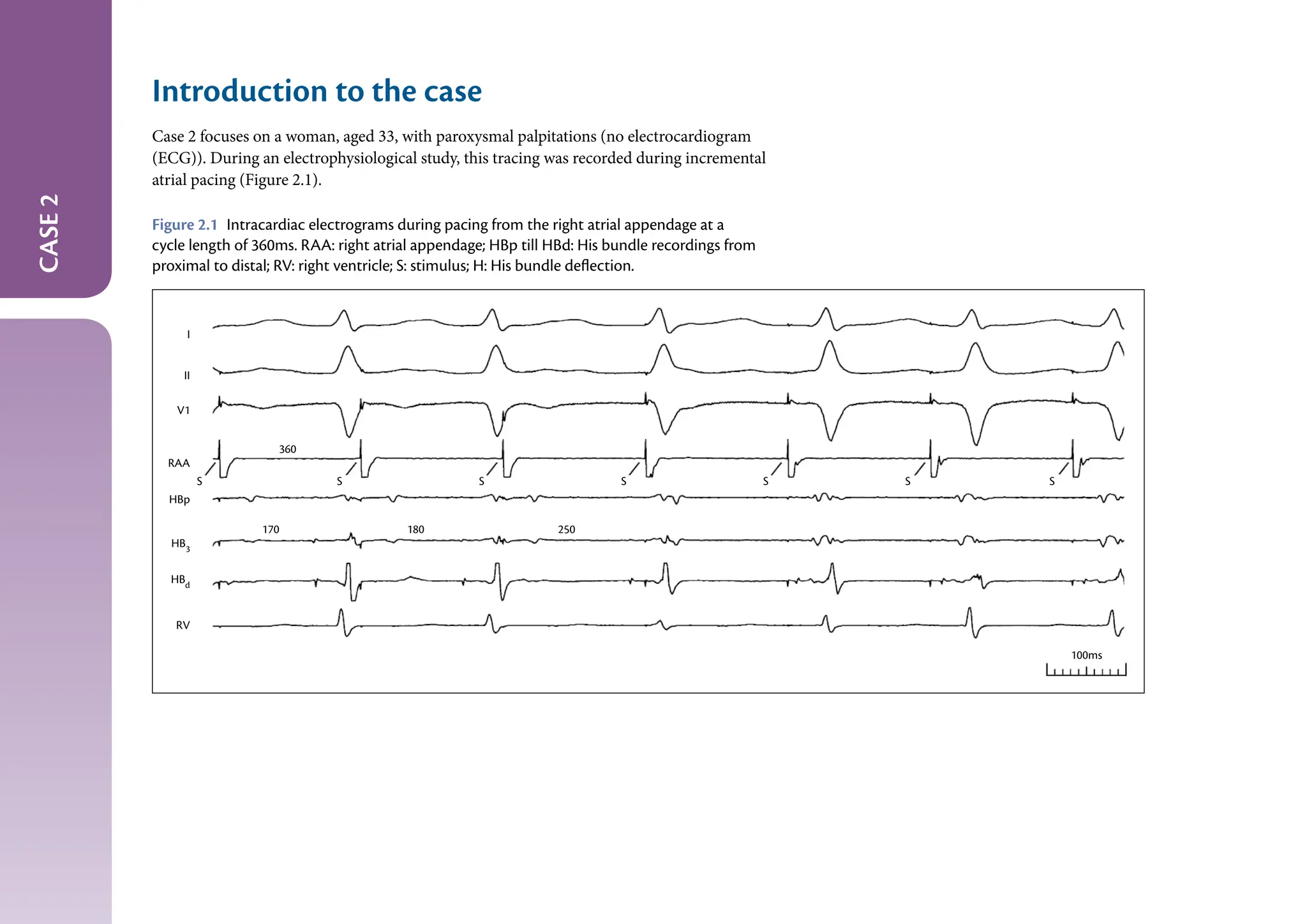
Case 2 focuses on a woman, aged 33, with paroxysmal palpitations (no electrocardiogram
(ECG)). During an electrophysiological study, this tracing was recorded during incremental
atrial pacing (Figure 2.1).
CASE
2
S S S S S S S
360
170 180 250
II
HBp
RAA
HB3
HBd
I
RV
V1
100ms
Figure 2.1 Intracardiac electrograms during pacing from the right atrial appendage at a
cycle length of 360ms. RAA: right atrial appendage; HBp till HBd: His bundle recordings from
proximal to distal; RV: right ventricle; S: stimulus; H: His bundle deflection.
20.
7
CASE
2
Question
The tracing shows:
AA jump from fast to slow pathway, with 1-to-1 antegrade conduction over the slow
pathway. This is a hallmark of AVNRT
B A jump from fast to slow pathway as can be seen in any patient—aspecific
C Conduction over a Mahaim-type accessory pathway
D Conduction over a regular-type accessory pathway
E Atrioventricular (AV) dissociation
21.
CASE
2
8
Answer
A
A jump fromfast to slow pathway, with 1-to-1 antegrade conduction over the slow
pathway. This is a hallmark of AVNRT
Explanation
Atrioventricular conduction during incremental pacing
Atrial pacing at a cycle length of 360ms leads to a rapidly progressive atrio-His (AH)
prolongation with a sudden increase of ≥50ms and with stabilization later on at a value
of 220ms (which is often seen as the maximal AH interval for conduction over the fast
pathway). From beat 3 on, there is therefore 1-to-1 conduction over the slow pathway.
While many patients show a jump to the slow pathway during incremental atrial pacing,
this usually prolongs further during the ensuing beats and is followed by AV block
(i.e. a Wenckebach sequence). The 1-to-1 conduction is often seen in patients with
AVNRT (using the slow pathway for antegrade conduction), since for the arrhythmia to
sustain, every beat needs to be conducted over the slow pathway.1
Elimination of 1-to-
1 conduction over the slow pathway is also an indirect endpoint for successful AVNRT
ablation, apart from non-inducibility.
References
1. Jackman WM, Beckman KJ, McClelland JH, et al. Treatment of supraventricular tachycardia due to
atrioventricular nodal reentry, by radiofrequency catheter ablation of slow-pathway conduction. N Engl J Med
1992; 327: 313–18.
23.
Introduction to thecase
Case 3 is regarding a 35-year-old woman with a history of recurrent palpitations. She had no
prior history of syncope and has a structurally normal heart on echocardiography. A 4-wire
electrophysiological study was performed and during an antegrade curve (S1 400ms, S2
260ms), the following tachycardia was induced (Figure 3.1). The VA intervals are outlined on
the coronary sinus (CS) channel. During tachycardia, the following phenomenon is observed.
CASE
3
Figure 3.1 Surface leads I, aVF, V1, and V4, and intracardiac recordings from the distal and
proximal bipoles of the His bundle (His), the proximal to distal bipoles of the coronary sinus (CS),
and the right ventricular apex (RV)
80ms
A H A H A H H
70
70
70 110
170
100 ms
19-HIS d
21-HIS p
26-CS 5 p
25-CS 4
24-CS 3
23-CS 2
22-CS 1 D
28-RV
1-I
6-aVF
7-V1
10-V4
32-STIM A2
200 ms
40
150ms
24.
11
CASE
3
Question
What is themechanism of tachycardia?
A AVNRT with intermittent bundle branch block
B AVRT with intermittent pre-excitation
C AT with intermittent LBBB
D Orthodromic AVRT using a left lateral pathway
E AT with intermittent pre-excitation
25.
CASE
3
12
Answer
D Orthodromic AVRTusing a left lateral pathway
Explanation
Narrow versus wide QRS during tachycardia
This tracing demonstrates an eccentric atrial activation sequence which would be
consistent with a left AT or the presence of a left lateral accessory pathway. There is one
diagnostic feature which proves that the left lateral accessory pathway is a critical part of
the circuit—there is intermittent LBBB with VA prolongation during the LBBB beats. This
phenomenon of VA prolongation during orthodromic tachycardia using an accessory
pathway ipsilateral to the bundle branch block was originally described by Coumel. Often
it prolongs the tachycardia cycle length (TCL) as the re-entrant wavefront is forced to take
a longer route via the contralateral bundle branch (right bundle in this case). However,
the cycle length may remain the same despite ipsilateral bundle branch block if the AH
interval shortens to compensate (or, in other words, no cycle length prolongation does
not exclude an ipsilateral accessory pathway). Hence, it is crucial to measure the VA
interval (from the onset of the QRS complex to the earliest atrial electrogram) to make the
diagnosis, and not just the TCL.1
VA prolongation by ≥40ms provides strong evidence of a
free wall AP in ipsilateral bundle branch block in the absence of a pre-existing underlying
fascicular block.
References
1. Yang Y, Cheng J, Glatter K, Dorostkar P, Modin GW, Scheinman MM. Quantitative effects of functional bundle
branch block in patients with atrioventricular reentrant tachycardia. Am J Cardiol 2000; 85: 826–31.
27.
CASE
4
Introduction to thecase
A 68-year-old patient with pre-existent LBBB underwent an electrophysiological study
for syncope. During placement of a catheter in the right ventricle (RV), asystole during 4s
occurred with resumption of a rhythm, as shown in Figure 4.1a. The quadripolar catheter
was retracted to the His bundle region, revealing the recording shown in Figure 4.1b.
Figure 4.1 Asystole during 4s occurred with resumption of a rhythm, as shown in (a). The quadripolar catheter was retracted to the His bundle
region, revealing the recording shown in (b). His d, distal His; His p, proximal His
His d
V6
V1
II
I
His p
16
H H
V
A A
Page BASELINE Speed 100mm/s
A
17
(b)
02
I
II
III
aVR
aVL
aVF
V1
V2
V3
V4
V5
V6
Page ECG speed 25 mm/s
03 04 05 06 07 08
(a)
28.
15
CASE
4
Question
What do youobserve?
A Third-degree AV block (supra-Hisian)
B Second-degree AV block
C Infra-Hisian block with complete dissociation
D Infra-Hisian unidirectional block
E Intra-Hisian conduction delay
29.
CASE
4
16
Answer
D Infra-Hisian unidirectionalblock
Explanation
Infra-Hisian complete atrioventricular block with VA
conduction
The tracings show infra-Hisian antegrade AV block, with a ventricular escape rhythm
probably originating from a left septal fascicle (judging by the typical right bundle branch
block pattern). The last cycle of this ventricular escape rhythm is followed by an early
atrial event with negative P-wave morphology in lead II, compatible with retrograde
conduction, indicating preserved VA conduction. The other QRS complexes are not
followed by a retrograde P-wave, due to closely spaced sinus P-waves rendering the atrium
refractory. It is impossible to ascertain whether there is intra-Hisian conduction delay, as
a His deflection is not visible on the proximal His recording, but the fact that the block
occurred during placement of the right ventricular catheter is strongly suggestive of
traumatic right bundle branch block. This case illustrates how care should be taken when
placing the RV catheter in patients with an underlying LBBB (which was thus shown
to be indeed complete in our patient), due to the risk of traumatic right bundle branch
block with resulting complete heart block. AV conduction resumed in our patient after
10 minutes, and a pacemaker was implanted under the assumption that syncope had
occurred due to paroxysmal complete AV block.
31.
Introduction to thecase
Case 5 studies a man, aged 42 years, who had an electrophysiological study for paroxysmal
supraventricular tachycardia. At the beginning of the study, pacing is performed from the
distal His bundle electrode, while the output of the pacing impulse is switched between
20mA (@ 2ms; left side of the tracing) and 2mA (right side of the tracing) (Figure 5.1).
What diagnostic information can be retrieved from the tracing?
CASE
5
Figure 5.1 The output of the pacing impulse is switched between 20mA (@ 2ms; left side of
the tracing) and 2mA (right side of the tracing). RAA: right atrial appendage; HBp till HBd: His
bundle recordings from proximal to distal; PS: posteroseptal position (between tricuspid an-
nulus and coronary sinus ostium); CS: coronary sinus; S: stimulus
A A
S
S 580
100 ms
II
HBp
RAA
HB3
HB2
HBd
PSp
PSd
CSp
CSd
I
V1
32.
19
CASE
5
Question
The information fromthe tracing is:
A Nothing relevant
B That the patient has atrial tachycardia
C That the patient has retrograde conduction over the fast pathway
D That the patient had retrograde conduction over the slow pathway
E That the patient has retrograde conduction over an accessory pathway
33.
CASE
5
20
Answer
E
That thepatient has retrograde conduction over an accessory
pathway
Explanation
Para-Hisian pacing/1
It can be readily observed that the QRS complex on the left side is
narrower than that on the right side (Figure 5.2). While pacing at a high
output, not only is the ventricular septum captured, but the distal right
bundle itself also is.1,2
Therefore, part of the ventricles is activated via the
His–Purkinje system, explaining the narrower QRS. In the electrograms
on the right side, a retrograde His bundle deflection can be appreciated
after the local ventricular electrogram in the His bundle electrodes, due
to the fact that only the ventricular myocardium is captured with the low
output of 2mA. Since the ventricular activation has to proceed first to the
apex before it can enter the Purkinje system and conduct retrogradely,
the activation of the proximal His bundle (which is the input to the AV
node) is delayed; while the S–S interval is 580ms, the interval between
consecutive proximal His bundle activations is 635ms. Nevertheless, the
interval between both atrial activation sequences (which are identical in
both beats, with first atrial activation at the proximal CS catheter) is nearly
the same as the pacing interval (585ms). This can only be explained if
atrial activation is not dependent on His bundle activation, i.e. when it is
not proceeding over the AV node. Retrograde conduction is proceeding
over a direct connection between the ventricle and atrium, i.e. an accessory
pathway, since the timing of ventricular activation at the base of the
ventricles is identical in both paced beats (Figure 5.3). The slight delay in
atrial activation is due to the fact that ventricular activation at the insertion
of the accessory pathway may be reached slightly faster in case the His–
Purkinje system is involved in ventricular activation as in the left-sided
beat. Earliest atrial activation points to a posteroseptal accessory pathway
(concealed or overt, which cannot be distinguished from this tracing).
Figure 5.2 Same figure as Figure 5.1, but now including annotations on
timing, electrograms, and the tissues being captured in the 1st and 2nd beats.
II
HBp
RAA
HB3
HB2
HBd
PSp
PSd
CSp
CSd
A A
S
635
585
∆H: 55
∆A: 5
S
H
H
H+V V
H
580
100 ms
I
V1
34.
21
Figure 5.3 (a)Capture of the His bundle/proximal right bundle and local ventricular myocardium. (b) Capture of only the local
ventricular myocardium
References
1. Hirao K, Otomo K, Wang X, et al. Para-Hisian pacing: a new method for differentiating retrograde conduction
over an accessory AV pathway from conduction over the AV node. Circulation 1996; 94: 1027–35.
2. Heidbuchel H, Ector H, Adams J, Van de Werf F. Use of only a regular diagnostic His-bundle catheter for both
fast and reproducible “para-Hisian pacing” and stable right ventricular pacing. J Cardiovasc Electrophysiol 1997; 8:
1121–32.
(a) (b)
CASE
5
35.
Introduction to thecase
Case 6 discusses a woman, aged 18, regarding an electrophysiological study for paroxysmal
supraventricular tachycardia. At the beginning of the study, pacing is performed from the
distal His bundle electrode, while the output of the pacing impulse is switched between
20mA (@ 2ms; left side of the tracing) and 2mA (right side of the tracing) (Figure 6.1).
What diagnostic information can be retrieved from the tracing?
CASE
6
Figure 6.1 The left panel shows a sinus beat. In the right panel, pacing is performed from the
distal His bundle electrode, while the output of the pacing impulse is switched between 20mA
(@ 2ms; left side of the tracing) and 2mA (right side of the tracing). RAA: right atrial appendage;
HBp till HBd: His bundle recordings from proximal to distal; PS: posteroseptal position
(between the tricuspid annulus and coronary sinus ostium); CS: coronary sinus; S: stimulus
S
S 580
100 ms
II
HBp
RAA
I
V1
HB3
HB2
HBd
PSp
PSd
CSp
CSd
36.
23
CASE
6
Question
The information fromthe tracing is:
A Nothing relevant
B That the patient has atrial tachycardia
C That the patient has retrograde conduction over the fast pathway
D That the patient has retrograde conduction over the slow pathway
E That the patient has retrograde conduction over an accessory pathway
37.
CASE
6
24
Answer
C That thepatient has retrograde conduction over the fast pathway
Explanation
Para-Hisian pacing/2
This is another example of para-Hisian pacing with a narrower QRS
complex on the left side and a wider one on the right side, due to capture
of both the right bundle and the ventricular myocardium, respectively,
of only the ventricular myocardium (Figure 6.2).1,2
Again, the timing of
retrograde His bundle activation is changed, appreciable in the proximal
His bundle electrodes. In this case, however: (1) earliest retrograde atrial
activation is occurring at the anterior septum (apparent from the His
bundle electrodes), and (2) the timing of the whole atrial activation is
delayed just as much as the His bundle timing is delayed. This indicates
that this retrograde activation is occurring over the fast AV nodal pathway.
While this proves that the observed activation is occurring over the fast
AV nodal pathway, this does not 100% exclude the presence of a concealed
accessory pathway. Especially for accessory pathways with a long retrograde
conduction time or that are located far from the stimulation site (e.g. left
lateral), conduction of the fast pathway may still be faster than conduction
over the accessory pathway, even with a delay in His bundle activation as in
the beats without His bundle capture.
References
1. Hirao K, Otomo K, Wang X, et al. Para-Hisian pacing: a new method for differentiating
retrograde conduction over an accessory AV pathway from conduction over the AV node.
Circulation 1996; 94: 1027–35.
2. Heidbuchel H, Ector H, Adams J, Van de Werf F. Use of only a regular diagnostic His-bundle
catheter for both fast and reproducible ‘para-Hisian pacing’ and stable right ventricular
pacing. J Cardiovasc Electrophysiol 1997; 8: 1121–32.
Figure 6.2 Same figure as Figure 6.1, but with extra annotations and timings.
See text for explanation.
II
HBp
RAA
HB3
HB2
HBd
PSp
PSd
CSp
CSd
S
635
635
A A
H
ΔH: 55
ΔA: 5
S
H+V V
580
100 ms
I
V1
39.
Introduction to thecase
A woman, aged 28, with an electrophysiological study for paroxysmal supraventricular
tachycardia is the focus for Case 7. At the beginning of the study, pacing is performed
from the distal His bundle electrode, while the output of the pacing impulse is switched
between 20mA (@ 2ms; left side of the tracing) and 2mA (right side of the tracing)
(Figure 7.1). What diagnostic information can be retrieved from the tracing?
CASE
7
Figure 7.1 Paroxysmal supraventricular tachycardia. RAA: right atrial appendage; HBp till
HBd: His bundle recordings from proximal to distal; CS: coronary sinus; S: stimulus
S
S 580
100 ms
II
HBp
RAA
I
V1
HB3
HB2
HBd
CSp
CS5
CS4
CS3
CS2
CSd
40.
27
CASE
7
Question
The information fromthe tracing is:
A That the patient has retrograde conduction over the fast pathway
B That the patient has retrograde conduction over the slow pathway
C That the patient has retrograde conduction over an accessory pathway
D That the patient has retrograde conduction over an accessory pathway and the fast
pathway
E That the patient has retrograde conduction over an accessory pathway and the slow
pathway
41.
CASE
7
28
Answer
D
That the patienthas retrograde conduction over an accessory
pathway and the fast pathway
Explanation
Para-Hisian pacing/3
Again this is an example of para-Hisian pacing.1,2
In contrast to the
two previous examples, the retrograde atrial activation is not the same
during both beats (Figure 7.2). This indicates that there must be some
form of fusion explaining one or both beats of the tracing. A close look
at the timing of retrograde His bundle activation and those of the atrial
electrograms at different locations shows that the anteroseptal atrial
electrogram ‘moves out’ with the same amount as the proximal His bundle
itself, indicating that it depends on His bundle input and thus is due to
nodal conduction. In contrast, the electrogram in the distal CS moves
out much less when His bundle capture is lost (and His bundle activation
is delayed) in the right beat. This proves that it does not depend on His
bundle timing and is due to conduction over an accessory pathway.
As explained earlier, the A–A interval in the CS (where the left-sided
accessory pathway is located) is somewhat longer than the H–H interval,
which is due to faster left lateral ventricular activation when the His
bundle is captured (in the beat on the left), and the His–Purkinje system
helps swifter activation of the left ventricular (LV) lateral wall.
References
1. Hirao K, Otomo K, Wang X, et al. Para-Hisian pacing: a new method for differentiating
retrograde conduction over an accessory AV pathway from conduction over the AV node.
Circulation 1996; 94: 1027–35.
2. Heidbuchel H, Ector H, Adams J, Van de Werf F. Use of only a regular diagnostic His-bundle
catheter for both fast and reproducible “para-Hisian pacing” and stable right ventricular
pacing. J Cardiovasc Electrophysiol 1997; 8: 1121–32.
II
HBp
RAA
A A
H
655
620
ΔH : 75
ΔA (anteroseptal) : 75
ΔA (left anterolateral): 40
A A
HB3
HB2
HBd
CSp
CS5
CS4
CS3
CS2
CSd
S
S 580
100 ms
I
V1
Figure 7.2 Same figure as Figure 7.1, but now including annotations on
timing, electrograms, and the tissues being captured in the 1st and 2nd beats.
43.
Introduction to thecase
Case 8 discusses a woman who is 58 years old, presenting with regular palpitations and
documented narrow QRS complex tachycardia. During an electrophysiological study,
a sustained tachycardia with a cycle length of 380ms with a long VA interval (277ms)
was induced. Overdrive ventricular pacing was performed and the following result was
obtained reproducibly (Figure 8.1).
CASE
8
S S S
360
I
S1: 360 200 ms
277 msec
II
V1
V6
HIS d
HIS p
CS 9, 10
CS 3,4
CS 5,6
CS 7,8
380
360
CS 1,2
RVa d
Figure 8.1 Regular palpitations and documented narrow QRS complex tachycardia. CS 9, 10: proximal
coronary sinus; CS 5, 6: middle coronary sinus; CS 1, 2: distal coronary sinus; RVA: right ventricular apex;
His d: distal bipole of His catheter; His p: proximal bipole of His catheter
44.
31
CASE
8
Question
The response ofthis pacing manoeuvre is suggestive that the mechanism of the tachycardia
is:
A Atrial tachycardia
B Typical AVNRT
C Atypical AVNRT
D AVRT using a concealed accessory pathway
E The tachycardia was not entrained
45.
CASE
8
32
Answer
A Atrial tachycardia
Explanation
Ventricularoverdrive pacing during supraventricular tachycardia
Entrainment of the tachycardia by ventricular pacing (the atrial cycle length was
accelerated to the pacing cycle length, and the tachycardia continues after pacing was
stopped) reveals a VAAV response, following cessation of overdrive ventricular pacing,
and is typical for the diagnosis of AT.1,2
References
1. Veenhuyzen GD, Quinn FR, Wilton SB, Clegg R, Mitchell LB. Diagnostic pacing maneuvers for supraventricular
tachycardia: part 1. Pacing Clin Electrophysiol 2011; 34: 767–82.
2. Josephson ME (2002). Clinical Cardiac Electrophysiology, 3rd edn. Philadelphia: Lippincott, Williams, Wilkins.
47.
Introduction to thecase
The configuration of the unipolar electrogram (Figure 9.1) provides information about the
movement of the activation front at the recording site. At the site where activation arises,
the unipolar electrogram only has a negative deflection. If the activation front is passing
the recording site, the unipolar electrogram is biphasic, whereas the configuration is only
positive at a site where activation comes to an end.
CASE
9
Figure 9.1 Configuration of the unipolar electrogram
a) b) c) d)
48.
35
CASE
9
Question
Which configuration ofthe unipolar electrograms shown in the figure occurs at the ‘origin’
(exit site) of an infarct-related re-entrant tachycardia?
A A negative deflection only
B A biphasic deflection
C A biphasic deflection with a small initial negative component
D A positive deflection only
49.
CASE
9
36
Answer
A A negativedeflection only
Explanation
Unipolar electrogram morphology
In the unipolar electrogram, a positive deflection is generated by the approaching
wavefront, whereas the receding wavefront produces a negative deflection.1
Infarct-
related tachycardias are usually based on re-entry where the re-entrant circuit consists
of small surviving myocardial bundles in the infarcted zone and remaining healthy
myocardium (Figure 9.2). Because at all recording sites along a re-entrant circuit the
wavefront is passing, a biphasic deflection would be expected to occur at all sites. The site
where activation in the surviving bundle within the infarction leaves the infarcted zone
and activates the remaining healthy myocardium is the exit site. Because the diameter of
the myocardial bundle is usually very small, the positive deflection of the approaching
wavefront is virtually missing (the few myocardial cells in the bundle generate hardly any
current). Only the large receding wavefront in the adjacent healthy myocardium generates
a large negative deflection.2–4
References
1. de Bakker JMT, Hauer RNW, Simmers TA (1995). Activation mapping: unipolar versus bipolar recording. In:
DP Zipes, J Jalife (eds.). Cardiac Electrophysiology: From Cell to Bedside, 2nd edn. Philadelphia: WB Saunders
Company, pp. 1068–78.
2. Durrer D, Formijne P, van Dam R, van Lier A, Buller J, Meyler FL. The electrocardiogram in normal and some
abnormal conditions in revived human fetal heart and in acute and chronic coronary occlusion. Am Heart J 1961;
61: 303–16.
3. Spach MS, Barr RC, Johnson EA, Kootsey JM. Cardiac extracellular potentials: analysis of complex wave forms
about the Purkinje networks in dogs. Circ Res 1973; 33: 465–73.
4. Stevenson WG, Soejima K. Recording techniques for clinical electrophysiology. J Cardiovasc Electrophysiol 2005;
16: 1017–22.
Figure 9.2 Depiction of re-entrant circuit within the
myocardial scar
Myocardium
Exit site
Re-entrant circuit
Fibrosis
Fibrosis
51.
Introduction to thecase
This case presents a 67-year-old with documented wide QRS complex tachycardia. During
the electrophysiological study, a wide QRS complex regular tachycardia was reproducibly
induced (Figure 10.1). The tachycardia had an LBBB morphology, with 1:1 VA
relationship, an HV interval of 55ms, and an eccentric atrial activation, all consistent with
a left free wall accessory pathway-mediated tachycardia. However, look at the response
to continuous ventricular pacing during tachycardia. An RV pacing train (cycle length
410) was delivered during tachycardia. The end of the pacing train is showed, followed by
continuation of the tachycardia.
CASE
10
Figure 10.1 Wide QRS complex tachycardia. CS, coronary sinus; RV, right ventricle; SA,
interval from stimulus to atrial electrogram; VA, interval from QRS onset to atrial electrogram
II
CS p
CS d
RV d
RV p
His p
H
St
14.50 15 15.50 16 16.50
St
H
His d
SA=180
410 410 410
VA=175
468 ms
164 ms 150 ms
440 ms
I
V1
aVF
V5
52.
39
CASE
10
Question
The tracing showsan orthodromic tachycardia mediated by a left-sided accessory pathway.
The QRS displays LBBB. What can be considered unexpected in this tracing?
A The atrial activation sequence during pacing and that during tachycardia are identical
B The His bundle electrogram is antegrade during ventricular pacing
C The AH during ventricular pacing is longer than that during tachycardia
D The stimulus-A (SA) interval and the VA interval are almost identical
E All the above are unexpected
53.
CASE
10
40
Answer
D The stimulus-A(SA) interval and the VA interval are almost identical
Explanation
Entrainment of orthodromic atrioventricular re-entrant
tachycardia by right ventricular pacing in the presence of left
bundle branch block
The tracing shows that ventricular pacing at a constant rate produces transient
entrainment of the tachycardia. For that to be the case, each paced ventricular wavefront
is colliding with the antegrade wavefront propagating through the AV conducting system,
probably at the level of the right bundle branch. In such a scenario, atrial activation occurs
exclusively via the accessory pathway, so its activation sequence should be identical as
that during tachycardia. The His bundle is activated by the descending wavefront of the
tachycardia, so it is an antegrade His. As a consequence, the AH interval is similar as
that during tachycardia, but usually a bit longer since the pacing rate is faster than the
tachycardia rate. It has been observed that, in orthodromic tachycardias mediated by left-
sided accessory pathways, the SA interval is longer than the VA interval (mean difference
in the range of 70ms), although the difference is less than in AV nodal re-entry.1,2
So
almost identical SA and VA intervals are unexpected. The explanation for this unexpected
finding in this case is that the SA interval normally exceeds the VA interval because
pacing occurs at a distance from the pathway (RV pacing, left-sided pathway), but in this
case the circuit has become bigger due to the LBBB, so the RV pacing site is close to the
re-entrant circuit.
References
1. Almendral J. Resetting and entrainment of reentrant arrhythmias: part II: informative content and practical use of
these responses. Pacing Clin Electrophysiol 2013; 36: 641–61.
2. González-Torrecilla E, Almendral J, García-Fernández FJ, et al. Differences in ventriculoatrial intervals during
entrainment and tachycardia: a simpler method for distinguishing paroxysmal supraventricular tachycardia with
long ventriculoatrial intervals. J Cardiovasc Electrophysiol 2011; 22: 915–21.
55.
Introduction to thecase
A 44-year-old man with recurrent episodes of tachycardia in the absence of structural
heart disease underwent an electrophysiological evaluation. A regular, sustained nar-
row QRS tachycardia was induced at a cycle length of 420ms. However, RV extrastimuli,
despite advancing the atrium, could not be proven to do so during a refractory His.
In the electrophysiology lab, as in real life, any unexpected event should be looked at
(Figure 11.1). Can a spontaneous ventricular premature complex (VPC) that occurred
during tachycardia help?
CASE
11
Figure 11.1 Documented regular narrow QRS tachycardias. ABLA, ablation catheter located
at the AV junction; HRA, high right atrium; VD, right ventricle
I 15.50 16 16.50
380 ms
132 ms
164 ms
426 ms 426 ms
17
II
V1
ABLA D
ABLA P
HRA 1-2
HRA 3-4
RV 1-2
RV 3-4
56.
43
CASE
11
Question
What is themost likely mechanism of this tachycardia?
A AV nodal re-entry
B Orthodromic, mediated by a right-sided accessory pathway
C Orthodromic, mediated by a left-sided accessory pathway
D Orthodromic, but there is no clue as to the location of the accessory pathway
E The tracing is not conclusive, since not all ventricular tissue is captured by the VPC:
the RV electrogram is not advanced
57.
CASE
11
44
Answer
C Orthodromic, mediatedby a left-sided accessory pathway
Explanation
Atrial reset by a ventricular fusion beat during orthodromic
atrioventricular re-entrant tachycardia and importance of
ventricular premature beat location
The VPC clearly advances the atria without advancing the His bundle recording,
establishing the presence of an accessory pathway. The fact that the RV electrogram is
not advanced at the time of the VPC is actually important because it establishes that
there is ventricular fusion. Advancing the atria by a ventricular depolarization with
fusion provides further evidence of the presence of an accessory pathway.1
It has been
reported that RV stimulation with fused beats can advance the atria during orthodromic
tachycardia in the presence of septal or right-sided accessory pathways (pacing close to
their ventricular insertion), but not in the presence of left-sided accessory pathways.2
It
has also been reported that LV pacing produces entrainment with fusion of orthodromic
tachycardias mediated by left-sided accessory pathways. In this tracing, the VPC has a
right bundle configuration (and is negative in lead I), presumably coming from the LV
and producing resetting with fusion, so it is more likely that the accessory pathway is
left-sided.
References
1. Ormaetxe JM, Almendral J, Arenal A, et al. Ventricular fusion during resetting and entrainment of orthodromic
supraventricular tachycardia involving septal accessory pathways. Implications for the differential diagnosis with
atrioventricular nodal reentry. Circulation 1993; 88: 2623–31.
2. Suyama K, Ohe T, Kurita T, et al. Significance of ventricular pacing site in manifest entrainment during
orthodromic atrioventricular reentrant tachycardia with left-sided accessory pathway. Pacing Clin Electrophysiol
1992; 15: 1114–21.
59.
Introduction to thecase
A 32-year-old man is presented with recurrent palpitations and documented narrow QRS
tachycardia. During an electrophysiological study, after induction of the tachycardia, the
introduction of a PVC during His refractoriness was performed, and the result was conse-
quently reproducible (Figure 12.1).
CASE
12
Figure 12.1 PVC during His refractoriness. CS 9, 10: proximal coronary sinus; CS 5, 6: middle coronary sinus; CS 1, 2: distal coronary
sinus; H: His electrogram; His d, distal; His p, proximal bipoles of a catheter in the His region; RVA, right ventricular apex; S, stimulation
artefact
280ms
H
I
II
200 ms
V1
V6
His d
His p
CS 9, 10
CS 7, 8
CS 5, 6
CS 3, 4
CS 1, 2
RVa d
8:55:42 AM 8:55:43 AM
H H
S
S
60.
47
CASE
12
Question
What is mostlikely mechanism of the tachycardia?
A Typical AVNRT
B Atypical AVNRT
C AVRT using an accessory pathway
D Atrial tachycardia
E There are not enough data
61.
CASE
12
48
Answer
C AVRT usingan accessory pathway
Explanation
A single ventricular extrastimulus during supraventricular
tachycardia/1
The tachycardia is a narrow complex supraventricular tachycardia. The fact that the PVC
during His refractoriness terminates the tachycardia without conduction to the atrium
indicates that an accessory pathway is present and is participating in the re-entry circuit.
This cannot be the case in AT or AVNRT, not even over a bystander pathway.1,2
References
1. Veenhuyzen GD, Quinn FR, Wilton SB, Clegg R, Mitchell LB. Diagnostic pacing maneuvers for supraventricular
tachycardias: part 2. Pacing Clin Electrophysiol 2012; 35: 757–69.
2. Huang SKS, Wood MA (2011). Catheter Ablation of Cardiac Arrhythmias, 2nd edn. Philadelphia: Elsevier
Saunders.
63.
Introduction to thecase
During atrial pacing, the following tachycardia is induced (Figure 13.1).
CASE
13
Figure 13.1 Top surface ECG lead I, aVF, V1, and V6. HRA, high right atrium; RVA, right ventricular apex
I
avF
200 ms
S1 : 500
S2 : 380
V1
V6
HRA p
HIS p
HIS d
RVa
08:07:39 08:07:40
CASE
13
52
Answer
E Other
Explanation
Differentiating widecomplex tachycardia
During atrial pacing (the 1st beat), the His catheter has the activation sequence proximal
to distal (antegrade His activation). During the 2nd paced beat, the His deflection (on
proximal His) gets buried within the ventricle (block of the AV node, maximal pre-
excitation) and antidromic tachycardia is induced. During tachycardia, the His activation
sequence is reversed, and distal His is before proximal His. Therefore, the activation of the
His bundle is retrograde during tachycardia, but still before ventricular activation. This is
only possible in the presence of an extranodal pathway inserting in the fascicle just below
the His bundle, most frequently the right bundle (Mahaim). Careful examination of the
sequence of His bundle activation can lead to the correct diagnosis already at first glance
in an otherwise highly complex diagnostic challenge.
The differential diagnosis of bundle branch re-entrant ventricular tachycardia (BBRVT)
(number 4) is theoretically not fully excluded by this tracing. However, the induction with
a relatively long AV interval (not so different from the basic interval seen at the first RR
interval) makes it highly unlikely that only the right bundle is activated and the left bundle
is completely blocked and able to conduct retrogradely for the re-entry circuit. Moreover,
in BBRVT, the HV interval is not expected to be so short. The shortening of HV intervals
during tachycardia and the reversal of His to proximal right bundle activation further
argue against BBRVT where the HV interval would be equal to or longer than in sinus
rhythm/atrial pacing.
67.
Introduction to thecase
Case 14 considers an 18-year-old male patient with paroxysmal palpitations. Adenosine
injection (12mg bolus) was performed to evaluate the suspicion of pre-excitation on the
ECG (Figure 14.1).
CASE
14
Figure 14.1 ECG—adenosine injection
aVL
aVF
mVR
I
II
III
V1
V2
V3
V4
V5
V6
CASE
14
56
Answer
C Both
Explanation
The wonderfuleffects of
adenosine
The presence of an antegradely conducting
extranodal accessory pathway was proven
by demonstration of a pathway potential
and successful ablation with loss of
pre-excitation after 2s of radiofrequency
delivery (Figure 14.2).
The initial beat shows an already slight
pre-excitation. The QRS broadens in the
2nd and 3rd beats due to AV conduction
slowing (with increased pre-excitation)
and complete AV block (with full pre-
excitation), respectively. Then total AV
block ensues because also the accessory
pathway is adenosine-sensitive and
blocked. In the last four beats, AV nodal
conduction resumes, but with persistent
AP block; therefore, there is no pre-
excitation during these final beats.
aVL
R-R: -25 500 ms
V3
ABL d
26 ms
1942 ms
ABL p
ABL dU
CS 9, 10
CS 7, 8
CS 5, 6
CS 3, 4
CS 1, 2
RVa d
08:23:24 08:23:25 08:23:26 08:23:27 08:23:28
III
Figure 14.2 Presence of an antegradely conducting extranodal accessory pathway
71.
Introduction to thecase
A woman, aged 35, with a long-standing history of paroxysmal SVT is admitted for an
electrophysiological study (Figure 15.1). AVNRT with a cycle length of 450ms is easily
induced (left panel). A concealed pathway is excluded by para-Hisian pacing and timed
ventricular extrastimuli during tachycardia. Immediately after atrial burst pacing termi-
nates the AVNRT, ventricular pacing at a para-Hisian position (i.e. from the distal pole
of the His bundle catheter) is initiated at exactly the same cycle length as the tachycardia
(right panel).
CASE
15
Figure 15.1 Comparison of timing and activation during AVNRT (left) and ventricular pacing
at a para-Hisian site with the same cycle length as tachycardia. RAA: right atrial appendage;
HBp till HBd: His bundle recordings from proximal to distal; PS: posteroseptal recording; CS:
coronary sinus; A: atrial electrogram; H: His bundle deflection
I
H
450 450
50 45
S
100 ms
A H A
II
V1
RAA
HBp
PS
HB3
HB2
HBd
CSp
72.
59
CASE
15
Question
When comparing theatrial activation sequence and HA interval during tachycardia and
during ventricular pacing, the following conclusion can be made:
A There is evidence for a lower common pathway (LCP). The tachycardia is typical
AVNRT
B There is no evidence for an LCP. The tachycardia is typical AVNRT
C There is evidence for an LCP. The tachycardia is atypical AVNRT
D There is no evidence for an LCP. The tachycardia is typical AVNRT
E It is circus movement tachycardia over a concealed accessory pathway after all
73.
CASE
15
60
Answer
B There isno evidence for an LCP. The tachycardia is typical AVNRT
Explanation
Lower common pathway/1
The earliest atrial activation is present in the His bundle recording. That was not clear
during tachycardia but became obvious during ventricular pacing, during which the atrial
activation sequence was identical as that during tachycardia. The His-to-atrium (HA)
interval during tachycardia, measured from the beginning of the most proximal antegrade
His bundle potential (H) to the earliest atrial activation in the anterior septal area (A), was
50ms (HAt). During RV pacing at the same cycle length (right panel), the interval from
the end of the most proximal retrograde His bundle potential (H) to the earliest atrial
activation was 45ms (HAp). The difference (often labelled as ΔHA) was −5ms, which,
together with the short HAp, excludes an LCP. This is a common finding in typical slow/
fast AVNRT but requires recording of the most proximal His bundle recording, which is
only possible when pacing from a para-Hisian position.1,2
Compare also with Case 16.
References
1. Heidbüchel H, Jackman WM. Characterization of subforms of AV nodal reentrant tachycardia. Europace 2004; 6:
316–29.
2. Miller JM, Rosenthal ME, Vassallo JA, Josephson ME. Atrioventricular nodal reentrant tachycardia: studies on
upper and lower ‘common pathways’. Circulation 1987; 75: 930–40.
75.
CASE
16
Introduction to thecase
A woman with two recent admissions for sustained paroxysmal supraventricu-
lar tachycardia requiring intravenous conversion with adenosine is admitted for an
electrophysiological study (Figure 16.1). AVNRT with a cycle length of 290ms is induced
(left panel). A concealed pathway is excluded by para-Hisian pacing and timed ventricular
extrastimuli during tachycardia. Immediately after atrial burst pacing terminates the
AVNRT, ventricular pacing at a para-Hisian position (i.e. from the distal pole of the His
bundle catheter) is initiated at exactly the same cycle length as the tachycardia (right
panel). Pacing is performed with a low output (usually 2mA) to prevent direct capture
of the His bundle. Therefore, retrograde His bundle activation can be discerned after the
local ventricular electrogram during pacing.
II
V1
RAA
HBp
H
H
S
S
290 290
90
55
100 ms
PS
I
CSp
CSd
HBd
HB2
HB3
Figure 16.1 Comparison of timing and activation during AVNRT (left) and ventricular pacing
at a para-Hisian site with the same cycle length as tachycardia. RAA: right atrial appendage;
HBp till HBd: His bundle recordings from proximal to distal; PS: posteroseptal recording; CS:
coronary sinus; A: atrial electrogram; H: His bundle deflection
76.
63
CASE
16
Question
When comparing theatrial activation sequence and HA interval during tachycardia and
during ventricular pacing, the following conclusion can be made in this case:
A There is evidence for an LCP. The tachycardia is typical AVNRT
B There is no evidence for an LCP. The tachycardia is typical AVNRT
C There is evidence for an LCP. The tachycardia is atypical AVNRT
D There is no evidence for an LCP. The tachycardia is typical AVNRT
E It is circus movement tachycardia over a concealed accessory pathway after all
77.
CASE
16
64
Answer
C There isevidence for an LCP. The tachycardia is atypical AVNRT
Explanation
Lower common pathway/2
The earliest retrograde atrial activation is present in the proximal CS
recording, before the atrial activation in the His bundle recording. That
was not clear during tachycardia but became obvious during ventricular
pacing, during which the atrial activation sequence was identical as that
during tachycardia. The HA interval during tachycardia, measured from
the beginning of the most proximal antegrade His bundle potential
(H) to the earliest atrial activation in the posterior septal area (A), was
55ms (HAt). During right ventricular pacing at the same cycle length
(right panel), the interval from the end of the most proximal retrograde
His bundle potential (H) to the earliest atrial activation was 90ms
(HAp). The difference (often labelled as ΔHA) was 35ms. A ΔHA 15ms
is indicative of an LCP in the nodal tissue between the turnaround
point of the tachycardia and the His. The earliest atrial activation site
and the long HAp indicate slow/slow AVNRT. Another sign for the
presence of an LCP is Wenckebach VA conduction at a cycle length
longer than, or equal to, the AVNRT cycle length (with 1:1 retrograde
conduction).
The rationale for using the HA comparison technique is explained in
Figures 16.21
and 16.3.2
It requires recording of the most proximal His
bundle recording, which is only possible when pacing from a para-Hisian
position and an immediate transition from tachycardia to ventricular pacing
to ensure a comparable autonomic tone during tachycardia and pacing.
(Note: because of the need for recording the most proximal His bundle
recording, ventricular pacing needs to be performed from a para-Hisian
position. If pacing is performed from the right ventricular apex, there is a
high likelihood that retrograde His bundle deflection and local ventricular
electrogram will overlap, often leading to using a more distal right bundle
potential as the ‘His bundle’. This will lead to a false LCP, since in fact the
proximal part of the right bundle will falsely be measured as the ‘LCP’).
An LCP is present in 84% of slow/slow AVNRT and in all patients with
fast/slow AVNRT, but is absent in 90% of patients with typical slow/fast
AVNRT.2
Compare also with Case 15.
78.
65
CASE
16
Figure 16.3 HA:His-to-atrium interval; rP: retrograde nodal conduction
pathway (fast pathway or slow pathway); LCP: lower common pathway
S V T
ATRIUM
ATRIUM
HIS
HA 50
HA 20
HA 50
NO LCP:
LCP PRESENT:
HASVT
= HAPACE
HASVT
HAPACE
HA 80
HIS
L C P
AVN
CIRCUIT
AVN
CIRCUIT
VENTRICULAR PACE
Figure 16.2 The concept of ΔHA measurements.
Reproduced from J M Miller et al, Atrioventricular nodal reentrant tachycardia: studies on upper and lower
‘common pathways’. Circulation, 1987 Vol. 75, No.5, with permission from Wolters Kluwer
Lower Common Pathway
Conduction time
His bundle
Lower common pathway
CS
HApacing - HAtachycardia
= HAp- HAt
= ∆HA
= (rP + LCP) – (rP-LCP)
= 2 x LCP
References
1. Miller JM, Rosenthal ME, Vassallo JA, Josephson ME. Atrioventricular nodal reentrant
tachycardia: studies on upper and lower ‘common pathways’. Circulation 1987; 75: 930–40.
2. Heidbüchel H, Jackman WM. Characterization of subforms of AV nodal reentrant
tachycardia. Europace 2004; 6: 316–29.
79.
CASE
17
Introduction to thecase
This case discusses a 28-year-old woman with paroxysmal palpitations and spontaneous
termination of clinical tachycardia with a non-conducted atrial beat (Figure 17.1).
CS Dist
HB Dist
II
RVA
V1
HRA
CS Prox
100ms
25
24
Figure 17.1 Surface leads II and V1 and intracardiac recordings from the high right atrium (HRA), His
bundle (HB), coronary sinus (CS), and right ventricular apex (RVA)
80.
67
CASE
17
Question
In this tracing,termination of the wide complex QRS tachycardia with a non-conducted
atrial beat:
A Excludes AT as the mechanism
B Suggests ventricular tachycardia (VT)
C Could be compatible with AVNRT, orthodromic AVRT, as well as AT
D Could be compatible with AT
E Indicates infra-Hisian conduction block
81.
CASE
17
68
Answer
D Could becompatible with AT
Explanation
Atrial tachycardia
This wide complex tachycardia is based upon an SVT with a right bundle block (A V
and 2:1 relation). Orthodromic AVRT is excluded because of the 2:1 A–V relation. Despite
a rather simultaneous activation of the CS, the earliest A seems to be at the proximal CS.
This SVT could be due to AVNRT with 2:1 conduction (in the presence of an LCP) or due
to AT with 2:1 conduction.
Spontaneous termination of tachycardia with AV block occurs in 28% of tachycardias. It is
a basic electrophysiology rule that, if tachycardia terminates with a non-conducted atrial
beat, atrial tachycardia is excluded (because fortuitous occurrence of both termination
of AT and AV block is highly unlikely). However, this basic rule only applies to SVT
with 1:1 A–V conduction. During AT with spontaneous 2:1 AV block, the likelihood
of termination by a non-conducted atrial beat is 50%, and therefore spontaneous
termination of tachycardia with AV block does not exclude AT. In this patient, an ectopic
AT was successfully ablated (right superior pulmonary vein (RSPV)).
83.
CASE
18
Introduction to thecase
A bipolar recording is often preferred in the catheterization laboratory because it reduces
both 50/60Hz interference and remote activation, compared to a unipolar recording.
The bipolar recording also has, however, several disadvantages. The interpretation of the
configuration of a bipolar electrogram (Figure 18.1) is not as straightforward as that of a
unipolar one, and the signal is direction-dependent. This hampers detection of the activa-
tion time in the bipolar electrogram.
Figure 18.1 Activation time in the bipolar electrogram
Unipolar
Bipolar
Wavefront
∞
+
–
+
–
a
b
c
d
84.
71
CASE
18
Question
Where is theactivation time in the bipolar electrogram shown in the figure (green tracing)?
A At the beginning of the electrogram
B At the point of the steepest negative dV/dt
C At the time of the peak negative value
D At the end of the signal
85.
CASE
18
72
Answer
C At thetime of the peak negative value
Explanation
Bipolar electrogram morphology
If the poles of a bipolar electrode are close together, a bipolar electrogram is virtually
the first derivative (dV/dt) of the unipolar electrogram.1
The simultaneous recording
of intracellular and extracellular electrograms from the same site has shown that the
point of the fastest upstroke of the action potential (which marks the depolarization of
the myocardial cell) corresponds with the point of the steepest negative downstroke in
the unipolar extracellular electrogram.2
The latter corresponds with the largest negative
value in the bipolar electrogram. One should realize that if the wavefront comes from
the opposite direction, the unipolar electrogram remains virtually the same, whereas the
bipolar signal inverts and the activation time corresponds with the peak positive value.
References
1. de Bakker JMT, Hauer RNW, Simmers TA (1995). Activation mapping: unipolar versus bipolar recording. In:
DP Zipes, J Jalife (eds.). Cardiac Electrophysiology: From Cell to Bedside, 2nd edn. Philadelphia: WB Saunders
Company, pp. 1068–78.
2. Janse MJ (1986). Electrophysiology and electrocardiology of acute myocardial ischemia. Can J Cardiol Suppl A:
46A–52A.
87.
CASE
19
Introduction to thecase
Differential pacing manoeuvres were performed to evaluate bidirectional cavo-tricuspid
isthmus conduction block for typical flutter ablation. The catheters were positioned as
shown in Figure 19.1.
Figure 19.1 Differential pacing manoeuvre to evaluate bidirectional cavo-tricuspid isthmus conduction block. The ablation catheter
was placed medially from the line and pulled back slightly to record the electrograms in the upper panel (a-c) and pushed further
towards the ventricle to record the electrograms in the lower panel (e-g). ABL D: distal ablation; ABL P: proximal ablation; LRA D: distal
low right atrium; LRA P: proximal low right atrium; Ω: pacing channel
II
170 ms 160 ms
74 ms
58 ms
90 ms 108 ms
ABL D
ABL P
LRA P
LRA D
(a) (b) (c) (d)
(e) (f) (g) (h)
II II II
ABL D ABL D ABL D
ABL P ABL P ABL P
LRA P
LRA P
LRA P
LRA D LRA D
LRA D
II
V6
V6
V6 V6 V6
ABL D
ABL P
LRA P
LRA D
II
V6
ABL D
LAO 60
PA
ABL P
LRA P
LRA D
100mm/s 100mm/s
100mm/s 100mm/s 200mm/s
200mm/s
Ω
Ω
Ω
Ω
Ω
Ω
88.
75
CASE
19
Question
What do youobserve?
A Unidirectional block shown on the caval aspect of the isthmus
B Unidirectional block shown on the ventricular aspect of the isthmus
C Bidirectional block shown on the ventricular aspect of the isthmus
D Bidirectional conduction shown on the ventricular aspect of the isthmus
E Bidirectional block shown on the caval and ventricular aspects of the isthmus
89.
CASE
19
76
Answer
D
Bidirectional conduction shownon the ventricular aspect of the
isthmus
Explanation
Evaluation of bidirectional cavo-tricuspid isthmus
block by differential pacing manoeuvres
The differential pacing manoeuvre at the caval aspect of the isthmus
suggests bidirectional block (in the top panels, note the far-field double
potential on ABL P and ABL D). However, differential pacing manoeuvres
from the ventricular aspect of the isthmus show residual conduction (in the
bottom panels, the stimulus to atrial potential interval on ABL is shorter
when pacing from LRA D, compared to LRA P, with a distal to proximal
sequence on the LRA catheter when pacing from ABL D medially to the
line of ablation). This example shows the importance of mapping the entire
ablation line to confirm bidirectional block. When performing differential
pacing, the LRA catheter should be positioned close to the ablation line,
ideally with a stimulus to first potential duration of 50ms, otherwise
residual conduction may be missed.1,2
It was not possible in this case to
position the non-steerable quadripolar diagnostic catheter in a stable
position closer to the line of ablation (the stimulus to first potential interval
was 58ms). Additional radiofrequency applications were performed on the
ventricular aspect of the line, resulting in bidirectional block (Figure 19.2).
References
1. Shah DC, Takahashi A, Jaïs P, Hocini M, Clémenty J, Haïssaguerre M. Local electrogram-
based criteria of cavotricuspid isthmus block.
J Cardiovasc Electrophysiol 1999; 10: 662–9.
2. Shah D, Haïssaguerre M, Takahashi A, Jaïs P, Hocini M, Clémenty J. Differential pacing for
distinguishing block from persistent conduction through an ablation line. Circulation 2000;
102: 1517–22.
90.
II
ABL D
ABL P
LRAP
LRA D
V6
160 ms
156 ms
II
ABL D
ABL P
LRA P
LRA D
V6
II
ABL D
ABL P
LRA P
LRA D
V6
100mm/s 100mm/s 200mm/s
Ω
Ω
Ω
(a) (b) (c)
Figure 19.2 Differential pacing manoeuvre showing bidirectional block of the cavo-tricuspid
isthmus. ABL D: distal ablation; ABL P: proximal ablation; LRA D: distal low right atrium; LRA
P: proximal low right atrium; Ω: pacing channel
91.
CASE
20
Introduction to thecase
This case describes a 53-year-old woman and the evaluation of isolation of the RSPV at the
end of encircling the right veins (pacing during ongoing atrial fibrillation) (Figure 20.1).
Figure 20.1 (a) RSPV after encircling (during atrial fibrillation). (b) Slow pacing (S1S1 600ms) from within the encircled
pulmonary veins (PVs). Surface leads II and V2, and intracardiac recordings from the coronary sinus (CS), Lasso catheter at
the LA–PV junction of the RSPV, and the ablation catheter positioned within the circle (ABLC)
II
(a)
RSPV
RSPV 9-10
22
1-2
V2
CSP
CSD
circle
Ω
100ms
(b)
600
s
s s
600 600
03
100 ms
92.
79
CASE
20
Question
The tracings show:
AThe RSPV is not isolated (no entry block)
B The RSPV is characterized by exit block
C The RSPV is isolated (entry block during atrial fibrillation)
D The diagnosis of entry block cannot be verified during atrial fibrillation
E The RSPV reveals bigeminy
93.
CASE
20
80
Answer
C The RSPVis isolated (entry block during atrial fibrillation)
Explanation
Entry block during atrial fibrillation
Figure 20.1a: the Lasso was positioned at the RSPV after encircling the right veins
during atrial fibrillation. The residual atrial potentials are either PV potentials or far-
field potentials. The longer cycle length (compared to the atrial fibrillation cycle length)
suggests an ablation-induced LA–PV delay (no entry block).
Figure 20.1b: slow pacing (S1S1 600ms) from within the circle is characterized by pacing
spikes instantaneously followed by local high-frequency potentials on the Lasso catheter
(capture of PV sleeves). Capture of PV sleeves during atrial fibrillation can only be
obtained if the encircled area is completely isolated (entry block). This indicates that the
residual atrial potentials are far-field recordings (in this case proven to originate from the
superior vena cava (SVC)). Isolation of the encircled area (downstream electrical silence
beyond the line of block) can also be appreciated by the absence of any recording of local
atrial potentials on the ablation catheter (even beyond the saturation window).
Note: variable degrees of entry block from the right atrium to the SVC are a consistent
finding during atrial fibrillation.
95.
CASE
21
Introduction to thecase
Case 21 discusses a 34-year-old man with recurrent palpitations (Figure 21.1).
100 ms
10:03:03 AM 10:03:04 AM 10:03:05 AM 10:03:06 AM 10:03:07 AM
500 ms
I
His
III
aVL
V1
Figure 21.1 Intravenous administration of adenosine bolus. Surface leads I, III, aVL, and V1,
and intracardiac recording from His
96.
83
CASE
21
Question
This tracing iscompatible with:
A Atrio-fascicular pathway
B Progressive aberrancy over the left bundle
C Nodo-fascicular pathway
D Right-sided PVCs
E None of the above answers
97.
CASE
21
84
Answer
A Atrio-fascicular pathway
Explanation
Mahaim
Mahaimfibre physiology during administration of adenosine. In sinus rhythm, there is
typically little or no pre-excitation (1st sinus beat is characterized by right bundle branch
block morphology, and normal AH and HV intervals).
The 2nd beat is characterized by adenosine-induced prolongation of the AH and A-delta
interval with signs of pre-excitation and shortening of the HV interval.
The 3rd and 4th beats are maximally pre-excited (most likely nodal block), while the
isoelectric A-delta and AH intervals further prolong.
The His deflection gets buried within the V deflection (conform with retrograde His
bundle activation). The onset of QRS precedes HB activation.
The 5th beat is characterized by block at the atrio-fascicular pathway (and node).
99.
CASE
22
Introduction to thecase
Case 22 discusses a 48-year-old woman with persistent AT. The patient
underwent prior mitral valve annulovalvuloplasty (rheumatic stenosis),
surgical exclusion of the left atrial appendage, and intraoperative isolation
Figure 22.1 (a) Surface leads I, II, V1, and V6, and intracardiac recordings from the distal to proximal bipoles of the coronary sinus
(Dec 1-2: distal CS; Dec 9-10: proximal CS). (b) Idem as (a). (c) Surface lead V1 and intracardiac recordings from the distal to proximal
bipoles of the coronary sinus (Dec 1-2: distal CS; Dec 7-8: proximal CS). Intracardiac recordings from distal and proximal bipoles of
the ablation catheter (ABL); paper speed: 100mm/s
I
II
V1
300 300
s
s s s s s
s
s
352 ms
344 ms
V6
Dec 1-2
(a)
(c)
(b)
Dec 3-4
Dec 5-6
Dec 7-8
Dec 9-10
I
II
V1
V6
Dec 1-2
Dec 3-4
Dec 5-6
Dec 7-8
Dec 9-10
Dec 7-8
ABL D
ABL P
Dec 1-2
V1
300
300 300 300 300
358 ms 350 ms
300
350 ms 330 ms
s s
of the PVs and posterior wall (‘box lesion’). During an electrophysiological
study, atrial pacing was performed from the proximal CS (Figure 22.1a),
distal CS (Figure 22.1b), and left atrial anterior wall (Figure 22.1c).
Mitral
annulus
LSPV
RSPV
100.
87
CASE
22
Question
The following istrue:
A Entrainment pacing is consistent with left septal re-entry
B Entrainment pacing is compatible with right-sided flutter
C Posterior left atrial wall entrainment should be assessed to define diagnosis
D The anterior wall or mitral isthmus should be considered for ablation
E Entrainment mapping is consistent with clockwise perimitral atrial flutter
101.
CASE
22
88
Answer
D The anteriorwall or mitral isthmus should be considered for ablation
Explanation
Entrainment pacing to differentiate intra-atrial re-entrant
tachycardia/1
Entrainment mapping shows a post-pacing interval (PPI)-TCL within 30ms at all pacing
sites, indicating that perimitral atrial flutter is the diagnosis, without the need for further
pacing manoeuvres.
CS recordings indicate a counterclockwise perimitral activation.
Typically, the ablation target for perimitral flutter is the mitral isthmus. This, however, can
be difficult to achieve, warranting epicardial ablation via the CS in up to 30% of cases.
In this case, the anterior wall can be considered for ablation as well. The local recording
(Figure 22.1c) is consistent with the critical isthmus (note the mesodiastolic potential on
the mapping tracing) that was found to be a quite narrow site of slow conduction between
the anterior mitral annulus and the scarred area caused by the roof line (as part of the box
lesion) and left atrial appendage suture.
A few radiofrequency pulses at this site allowed tachycardia termination with persistent
non-inducibility.
This case underlines how matching electrophysiological findings with the clinical context is
of paramount importance to choose the best ablation strategy (the maximum result with the
lowest radiofrequency application).
103.
CASE
23
Introduction to thecase
A 10-pole circular mapping catheter (Figure 23.1) is positioned in the RSPV after PV
isolation and proven entrance block. Pacing at decremental pacing outputs via the circular
mapping catheter is shown.
Figure 23.1 A: bipolar electrograms from the 10-pole ablation catheter; CS: coronary sinus catheter
high output (10mA/2.0ms) reduced output (10mA/1.0ms)
I
II
III
A 1
A 2
A 3
A 4
A 5
CS 7, 8
CS 5, 6
CS 3, 4
CS 1, 2
104.
CASE
23
91
Question
What happens duringpacing with high output (A) and then with reduced output (B)?
A (A) local capture with conduction to the left atrium (exit conduction) and (B) loss
of capture
B (A) far-field capture and (B) local capture with exit conduction
C (A) far-field capture and (B) local capture with exit block
D (A) local capture with exit block and (B) far-field capture with exit block
E (A) local capture with exit block and (B) far-field capture with exit conduction
105.
CASE
23
92
Answer
C
(A) far-fieldcapture and (B) local capture with exit block
Explanation
Pulmonary vein capture with exit block and intermittent
far-field atrial capture
(A) The first part indicates far-field capture during high-output PV pacing, capturing not
only local tissue, but also far-field left atrial tissue with 1:1 activation and short conduction
time to the CS electrograms.
(B) Lowering pacing output indicates local capture of near-field PV–myocardial sleeves
with exit block to the left atrium. During sinus rhythm, the electrodes facing the posterior
wall (A3, A4) reveal far-field electrograms from the adjacent posterior left atrium. This
case illustrates that proof of exit block can be hidden by far-field capture.
107.
CASE
24
Introduction to thecase
Dispersion of the action potential duration (APD) is considered to be a parameter for ar-
rhythmogenicity. Detection of the action potential requires intracellular recordings, which
are not feasible in the clinical setting. As a substitute for the APD, the activation recovery
interval (ARI) is used (Figure 24.1), which can be derived from unipolar recordings as the
interval from the depolarization to the repolarization. Although the depolarization can be
determined easily in a unipolar recording, the point of repolarization is less clear.
Figure 24.1 Activation recovery interval (ARI)
0 100 200 300 400 458
–15
–10
–5
0
5
10
milliseconds
millivolts
QRS
stim
T-wave
1020 1100 1200 1300 1400 1531
–15
–10
–5
0
5
10
milliseconds
millivolts
108.
CASE
24
95
Question
Which interval inthe electrograms marks the ARI?
A The interval from the white to the green dot
B The interval from the white to the red dot
C The interval from the white to the blue dot
D The interval from the white to the red dot for the left tracing and the interval from the
white to the green dot for the right tracing.
109.
CASE
24
96
Answer
B
The interval fromthe white to the red dot
Explanation
Activation recovery interval
In a unipolar electrogram, the activation time is the point of the steepest negative
deflection in the depolarizing phase of the signal (the white dot in the signals).
Simultaneous intra- and extracellular recordings have shown that the repolarization
corresponds to the point of the steepest positive deflection in the repolarizing phase of the
unipolar electrogram.1
It does not matter whether the configuration of the repolarization
wave is only positive (right tracing), negative (left tracing), or biphasic; the time of
repolarization always corresponds with the point of the steepest upstroke.2,3
In this case,
the repolarization (T-wave) is flat, and the point of repolarization cannot be determined.
References
1. Coronel R, de Bakker JM, Wilms-Schopman FJ, et al. Monophasic action potentials and activation recovery
intervals as measures of ventricular action potential duration: experimental evidence to resolve some
controversies. Heart Rhythm 2006; 3: 1043–50.
2. Gepstein L, Hayam G, Ben Haim SA. Activation-repolarization coupling in the normal swine myocardium.
Circulation 1997; 96: 4036–43.
3. Haws CW, Lux RL. Correlation between in vivo transmembrane action potential duration and activation-recovery
intervals from electrograms. Effects of interventions that alter repolarization time. Circulation 1990; 81: 281–8.
111.
CASE
25
Introduction to thecase
A 69-year-old patient with palpitations had the following recording during an electro-
physiological study (Figure 25.1). The sustained narrow complex tachycardia was initiated
spontaneously.
Figure 25.1 Electrophysiological study
HRA D
HRA P
50 mm/s
25mm/s
1s
500 ms
(a)
(b)
I
I
II
V1
V6
HIS
II
III
aVR
aVL
aVF
V1
V2
V3
V4
V5
V6
112.
CASE
25
99
Question
What is themost likely diagnosis?
A AT
B AVNRT with 2:1 retrograde block
C Automatic junctional tachycardia with 2:1 retrograde block
D Junctional bigeminy
E Non-re-entrant atrioventricular nodal tachycardia
113.
CASE
25
100
Answer
E
Non-re-entrant atrioventricular nodaltachycardia
Explanation
Double fire tachycardia
The tracing shows a narrow complex tachycardia with a 1:2 A:V ratio
(ruling out AT). AVNRT or junctional tachycardia with a 2:1 retrograde
block (which is extremely rare) are incompatible with the P-wave
morphology (which are positive in the inferior leads), as well as the
repetitive ‘long–short’ H–H intervals. Junctional bigeminy is unlikely, given
the sustained nature of the tachycardia and the absence of any retrograde
P-waves. Non-re-entrant atrioventricular nodal tachycardia (otherwise
known as ‘double fire tachycardia’) is due to dual AV nodal conduction,
with anterograde conduction via both a fast and a slow pathway (the
100mm/s
500ms
HRA D
HIS
V6
V1
88 ms
596 ms
II
I
HRA P
Figure 25.2 AH intervals
AH intervals are shown in Figure 25.2), resulting in ‘double fire’ of each
P-wave.1,2
The finding often coexists with AVNRT and is treated in the
same manner by radiofrequency modification of the slow pathway.
References
1. Burri H, Hoffmann J, Zimmermann M. Double fire tachycardia. Heart 2012; 98: 958.
2. Zimmermann M, Testuz A, Schmutz M, et al. Narrow-complex tachycardia with cycle length
alternans: what is the mechanism? Heart Rhythm 2009; 6: 1238–9.
115.
CASE
26
Introduction to thecase
A 36-year-old woman had an electrophysiological study performed for palpitations. Atrial
pacing with one premature beat triggered a narrow complex tachycardia, which was inter-
rupted by an intrinsic ventricular premature beat (Figure 26.1).
Figure 26.1 Interruption of tachycardia by a ventricular premature beat. His d: distal His; His p: proximal His; LRA d: distal low right
atrium; LRA p: proximal low right atrium; RV: right ventricle
I
aVF
V1
His d
His p
RV
LRA d
LRA p
50mm/s
200ms
116.
CASE
26
103
Question
Which of thefollowing statements is true?
A AT can be excluded
B AVNRT can be excluded
C AVRT can be excluded
D Answers A and C are correct
E None of the above are correct
117.
CASE
26
104
Answer
A
AT can beexcluded
Explanation
Interruption of a supraventricular tachycardia by a ventricular
premature beat
A regular SVT with an RP PR interval can be observed, with a caudo-cranial atrial
activation sequence. The septal VA interval is 70ms, with a differential diagnosis
comprising AT, AVNRT, and AVRT. However, the ventricular premature beat (which is
probably mechanical from the RV catheter as electrical activity in this channel is early and
the surface ECG is compatible with an RV apical origin) interrupts the arrhythmia without
activating the atrium. This rules out AT, which may only be interrupted by a ventricular
premature beat if there is retrograde conduction. AVNRT may only be excluded if the
ventricular premature beat occurs during the His refractory period (which would result
in an entrance block into the AV node). The His potential is, however, not clearly seen
on the catheter, but the premature beat is probably early enough and close enough to
the conduction tissue to conduct retrogradely into the AV node, thus interrupting the
tachycardia. AVRT would have been excluded if the VA interval during tachycardia
(measured from the onset of the QRS to the earliest A) had been 70ms,1,2
which is not
the case here. The tachycardia in this instance may be interrupted by the same mechanism
as for AVNRT, or otherwise by a retrograde block of the accessory pathway.
References
1. Benditt DG, Pritchett EL, Smith WM, Gallagher JJ. Ventriculoatrial intervals: diagnostic use in paroxysmal
supraventricular tachycardia. Ann Intern Med 1979; 91: 161–6.
2. Knight BP, Ebinger M, Oral H, et al. Diagnostic value of tachycardia features and pacing maneuvers during
paroxysmal supraventricular tachycardia. J Am Coll Cardiol 2000; 36: 574–82.
119.
CASE
27
Introduction to thecase
This case shows an example of a 23-year-old man with short palpitations at rest
(Figure 27.1).
Figure 27.1 Short palpitations at rest
I
II
V1
HRA
HIS
CSp
CSm
450
770
A
12:47:22 PM 12:47:23 PM 12:47:24 PM 12:47:25 PM
HF HF HF AHF 96 AHF 150 AHF 270
AHS 520 AHS 590
HS HS
A A
770 770 770 770
430 470 490 450 430 470 490
500 ms
120.
CASE
27
107
Question
The mechanism oftachycardia is:
A VT
B AVNRT with an upper common pathway
C Sinus rhythm with an intermittent dual ventricular response
D Atrial fibrillation
E Junctional tachycardia
121.
CASE
27
108
Answer
C
Sinus rhythm withan intermittent dual ventricular response
Explanation
Sinus rhythm with dual nodal response
The presence of (1) more QRS complexes than regular P-waves and (2) group beating with
regular irregularity suggests the presence of a dual ventricular response with Wenckebach
behaviour during normal sinus rhythm. The intracardiac high right atrium recording
indeed shows regular AA intervals. The 1st P-wave initiates a double His response due
to conduction over a fast pathway (AHf = 96ms) and a slow pathway (Ahs = 520ms).
The 2nd P-wave also conducts over the fast and slow pathways with an AH interval of,
respectively, 150ms and 590ms, suggesting Wenckebach behaviour in these pathways. The
3rd P-wave blocks in the slow pathway and only conducts over the fast pathway with an
AHf of 270ms. The 4th P-wave conducts again over both pathways, but surprisingly the
AHf is again 96ms. This suggests that the progressive increase of the AHf interval within
a group is dependent upon conduction over the slow pathway in the previous beat and
is not due to Wenckebach behaviour in the fast pathway per se. A possible explanation
could be the presence of an LCP with decremental conduction properties. A block in the
slow pathway prevents activation of the LCP, facilitating conduction of the next impulse
coming over the fast pathway.
123.
CASE
28
Introduction to thecase
This case is about a 45-year-old woman with palpitations and documented
narrow complex tachycardia. The following observations are made at an
electrophysiological study after a narrow QRS tachycardia with a cycle
Figure 28.1 Surface leads II, aVF, V1, and V6, and intracardiac recordings from the high right atrium (HRA), the proximal,
mid, and distal bipoles of the His bundle (His), the proximal to distal bipoles of the coronary sinus (CS), and the right
ventricular apex (RVA)
II
aVF
V1
V6
HRA
200 ms
370
370 370
612 msec 400 msec
370 370 400
HIS p
HIS m
HIS d
CS 9,10
CS 7,8
CS 5,6
CS 3,4
CS 1,2
RVa
length of 400ms had been induced. Ventricular overdrive pacing is per-
formed at 30ms faster than the TCL. The tracing (Figure 28.1) shows the
termination of overdrive pacing.
124.
CASE
28
111
Question
The tracing proves:
AThe tachycardia is atypical (fast/slow) AVNRT
B The tachycardia is AVRT
C The tachycardia is AT
D Failure of atrial entrainment with ventricular overdrive pacing
E The tachycardia is typical (slow/fast) AVNRT
125.
CASE
28
112
Answer
A
The tachycardia isatypical (fast/slow) AVNRT
Explanation
Ventricular overdrive pacing during supraventricular
tachycardia/2
The tracing demonstrates ventricular overdrive pacing at 30ms faster than the TCL,
with acceleration of the atrium to the same rate. On termination of pacing, there is an
apparent VAAV response. However, on closer inspection of the AA timing post-pacing,
it is evident that the 2nd atrial beat after the last stimulated beat is still following the
pacing cycle length (370ms). This is a pseudo-VAAV response as the atrium had been
captured by either the slow pathway or a slowly conducting bypass tract retrogradely to
match the ventricular pacing rate. The pseudo-VAAV response is typically seen with long
RP tachycardias. Given that this is in essence a VAV response, the differential diagnosis
lies between AVNRT or AVRT (over an accessory pathway with a long conduction time).
The tachycardia has a short AH interval and a long VA interval, with the earliest atrial
activation at the proximal CS. AVRT would constitute participation of the ventricles to
the tachycardia circuit. Since the retrograde activation sequence is earliest septally, the
PPI and stimulus-to-A intervals can be employed to differentiate between the two, even
with pacing from the RV apex, as in this case—a PPI-TCL of 115ms with apical pacing is
consistent with AVNRT, as in this case (PPI = 212ms).1
Alternatively, one could introduce
ventricular extrastimuli from the posterobasal RV at the time of His refractoriness or
entrainment from that site, which would differentiate even more clearly. The slow pathway
was successfully ablated in this patient with an atypical fast/slow AVNRT.
References
1. Michaud GF, Tada H, Chough S, et al. Differentiation of atypical atrioventricular node re-entrant tachycardia
from orthodromic reciprocating tachycardia using a septal accessory pathway by the response to ventricular
pacing. J Am Coll Cardiol 2001; 38: 1163–7.
127.
CASE
29
Introduction to thecase
A woman, aged 41, with AVNRT is discussed in this case. Twenty seconds after starting
ablation of the slow pathway (over the posteroseptal area, between the tricuspid annulus
and the ostium of the CS) and immediately inducing junctional rhythm, suddenly the
following tracing (Figure 29.1) is recorded.
Figure 29.1 Intracardiac recordings 20s after the start of ablation of the slow pathway in a
patient with AVNRT. RAA: right atrial appendage; HBp till HBd: His bundle recordings from
proximal to distal; PS: posteroseptal position (between tricuspid annulus and coronary sinus
ostium); CS: coronary sinus; rA: retrograde atrial activation; SR: sinus rhythm
I
II
V1
RAA
70
SR
rA
200 ms
PS
HBp
HB3
HB2
HBd
CSp
CS7
CS6
CS5
CS4
CS3
CS2
CSd
128.
CASE
29
115
Question
Which action cannotbe recommended?
A Immediate termination of energy delivery
B Immediate termination. Only when (a) absence of ablation endpoint (non-inducibility
and/or absence of 1:1 antegrade conduction over the slow pathway), (b) certainty that
the AVNRT subform is slow/slow, and (c) the energy is delivered not higher than the
upper margin of the CS ostium—consider continuation
C Immediate termination. Only when (a) absence of ablation endpoint (non-inducibility
and/or absence of 1:1 antegrade conduction over the slow pathway), (b) certainty that
the AVNRT subform is fast/slow, and (c) the energy is delivered not higher than the
upper margin of the CS ostium—consider continuation
D Immediate termination. Only when (a) absence of ablation endpoint (non-inducibility
and/or absence of 1:1 antegrade conduction over the slow pathway), (b) certainty that
the AVNRT subform is slow/fast, and (c) the energy is delivered not higher than the
upper margin of the CS ostium—consider continuation
E Continuation after starting atrial pacing at a slightly faster rate
129.
CASE
29
116
Answer
D
Immediate termination. Onlywhen (a) absence of ablation endpoint (non-
inducibility and/or absence of 1:1 antegrade conduction over the slow pathway),
(b) certainty that the AVNRT subform is slow/fast, and (c) the energy is delivered
not higher than the upper margin of the CS ostium—consider continuation
Explanation
Slow pathway ablation
Induction of junctional rhythm during ablation of the slow AV nodal pathway, as is
occurring in this tracing, indicates heating of the approaches of the AV node and is often a
sign (albeit not very specific) for effective slow pathway ablation. This automaticity usually
conducts both towards the ventricles and the atrium. In the tracing, the junctional beats
are suddenly not conducted to the atrium anymore. This indicates that the retrograde
conduction path is compromised. Since most AVNRT forms are typical slow/fast, the
retrograde conduction path usually is the fast (physiologic) pathway. Hence, non-
conduction signals imminent damage to the fast pathway which could result in AV block.
Therefore, immediate cessation of energy delivery is mandatory if the AV subform is
typical slow/fast and continued radiofrequency delivery is highly contraindicated.
However, if prior evaluation of the AVNRT subform (before the 1st ablation attempt!)
indicated an atypical form (fast/slow or slow/slow), junctional rhythm with retrograde block
can be anticipated during ablation, since the junctional rhythm has to use the same pathway
that is being ablated for retrograde conduction to the atrium. In such circumstances, a block
towards the atrium may even be required for effective ablation of the arrhythmia circuit.
Nevertheless, one should assure that energy delivery is not higher than the upper margin of
the CS ostium and that there was no retrograde fast pathway conduction during ventricular
pacing at the same cycle length as the junctional rhythm before the ablation. This calls for
good AVNRT subform differentiation before the start of radiofrequency delivery!
Finally, after interruption of the initial radiofrequency delivery, it is recommended to be
prepared during the next radiofrequency application to immediately start atrial pacing at
a slightly faster rate than the junctional rhythm, as is shown in Figure 29.2, in which the
last two beats show AV conduction over the fast pathway. This enables online evaluation
of the integrity of antegrade AV nodal conduction and safe continuation of the ablation to
reach the desired endpoint.
130.
CASE
29
117
Figure 29.2 Radiofrequencyapplication and atrial pacing at a slightly faster rate than the junctional rhythm
I
II
V1
RAAp
HBE p
HBE 3
HBE 2
HBE d
TA p
TA d
CS p
CS 4
CS 3
CS 2
CS d
S1 S1 S1
131.
CASE
30
Introduction to thecase
This case discusses a 42-year-old schoolteacher. The patient underwent slow pathway
ablation for AVNRT and during post-ablation testing developed this tachycardia. A
His-refractory premature atrial complex (PAC) was delivered during the tachycardia
(Figure 30.1). What is the most likely mechanism of the tachycardia and would you
continue ablation of the slow pathway?
Figure 30.1 His-refractory PAC delivered during tachycardia
I
03
S2
H H H
A
H H
480ms 436ms 472ms 480ms
04
II
V1
HRA
HBEP
HBED
RV
CASE
30
120
Answer
C
Junctional tachycardia
Explanation
Is theslow pathway ablated, or isn’t it?
The PAC (S2) advances the immediate His by 44ms, and the tachycardia continues. The
red arrow indicates the local atrial activation on the His recording catheter that occurs
before the His bundle activation. This advancement of the immediate His by a PAC with
continuation of tachycardia indicates junctional tachycardia as the mechanism, and
further ablations are not necessary.1
This is because the advancement of the His requires
fast pathway activation. If the tachycardia was AVNRT, then it would be terminated by the
PAC as the fast pathway would still be refractory. The tachycardia cannot be an AVRT, as
the VA time is too short during tachycardia (simultaneous activation of V and A 60ms
on the His), and an atrio-fascicular tachycardia would have evidence of pre-excitation
both during tachycardia and particularly post-PAC.
References
1. Padanilam BJ, Manfredi JA, Steinberg LA, Olson JA, Fogel RI, Prystowsky EN. Differentiating junctional
tachycardia and atrioventricular node re-entry tachycardia based on response to atrial extrastimulus pacing.
J Am Coll Cardiol 2008; 52: 1711–17.
135.
Introduction to thecase
An 8-year-old girl with recurrent palpitations is discussed in Case 31. There is no overt
cardiomyopathy or evident P-wave enlargement. During an electrophysiological study, the
following tracings are recorded at induction (Figure 31.1a) and termination (Figure 31.1b)
of the clinical tachycardia. Catheters are placed as shown in the left anterior oblique
(LAO) fluoroscopic image (Figure 31.1c).
CASE
31
Figure 31.1 Surface leads I and III, and intracardiac recordings from the distal to proximal bipoles of the coronary sinus. DCS 1: distal CS; MCS 2–4: middle CS;
PCS 5: proximal CS; HBE: distal and proximal His; ABL: distal and proximal bipoles of the ablation catheter
I
III
36 37
DCS 1
MCS 2
MCS 3
MCS 4
PCS 5
HBED
HBEP
ABLD
ABLP
208 ms
S1
S1
230 ms 230 ms
(a)
180 ms
(100 mm/s)
290 ms
(b)
458 ms
220 ms 222 ms 232 ms
412 ms
440 ms
462 ms 478 ms
214 ms
440 ms 422 ms 460 ms
49 50
(100 mm/s)
(c)
136.
CASE
31
123
Question
Which is themost likely diagnosis?
A Fast/slow AVNRT
B PJRT (orthodromic AVRT associated with a concealed slow posteroseptal
accessory pathway)
C AT
D Dual nodal response
E None of the above
137.
CASE
31
124
Answer
B
PJRT (orthodromic AVRTassociated with a concealed slow
posteroseptal accessory pathway)
Explanation
Differentiating narrow QRS tachycardia
The tracing shows induction and termination of a long R–P tachycardia,
with inferoseptal earliest atrial activation, near the CS os (ABLd); this
can be caused by fast/slow AVNRT, slow/slow AVNRT, PJRT, and AT.1–3
However, a differential diagnosis in this case can be obtained with the
subsequent observations:
◆
◆ AT is ruled out because tachycardia terminates with atrial activation;
furthermore, just before termination, cycle length variation is evident,
with V–V variations that precede coherent A–A variations.
◆
◆ Differentiating atypical AVNRT from PJRT might be more challenging.
In both cases, a decremental V–A conduction can be seen (also in
this case, an inverse correlation with the preceding V–V cycle length
is shown); the site of earliest atrial activation is most frequently at the
CS os/posteroseptal right atrium, and induction with both atrial and
ventricular extrastimuli can be obtained.
◆
◆ However, concerning this case, (a) the AH interval during tachycardia
is excessively long to characterize a ‘fast’ antegrade limb conduction;
(b) during fast/slow AVNRT, cycle length variations are caused by
higher variability in slow pathway retrograde conduction, so that atrial
retrograde activation comes first (A–A change) and V–V changing
follows.
◆
◆ A long R–P tachycardia due to AVRT associated with a concealed
decremental posteroseptal accessory pathway, especially in a child,
accomplishes the characteristics of PJRT, so that is the most likely
diagnosis. Also the mode of repetitive initiation (without any
extrastimulus and without any noticeable A–H delay) is compatible with
the incessant character of PJRT.
Nonetheless, a definite diagnosis (including differentiation with slow/slow
AVNRT) requires further confirmation (e.g. resetting with V stimulation,
His refractory ventricular stimulation, V entrainment).
References
1. Heidbuchel H, Jackman WM. Characterization of subforms of AV nodal reentrant
tachycardia. Europace 2004; 6: 316–29.
2. Crawford TC, Mukerji S, Good E, et al. Utility of atrial and ventricular cycle length variability
in determining the mechanism of paroxysmal supraventricular tachycardia. J Cardiovasc
Electrophysiol 2007; 18: 698–703.
3. Katritsis DG, Camm AJ. Atrioventricular nodal reentrant tachycardia. Circulation 2010; 122:
831–84.
139.
Figure 32.2 Surfacelead V1 and intracardiac recordings from the distal to proximal bipoles
of the CS and distal and proximal bipoles of the ablation catheter (ABL). Abl: roving mapping
catheter into the left atrium (position indicated in figure); ∏: pacing site
Introduction to the case
Case 32 focuses on a woman aged 48. After perimitral atrial flutter ablation (Figure 32.1),
by means of a linear ablation along the anterior left atrial wall, running from the roof
line of the block (box lesion) to the mitral anterior annulus, some pacing (Figure 32.2)
manoeuvres were performed in order to validate the isthmus block.
CASE
32
ABL
CS
Figure 32.1 Electro-anatomical activation map of the left
atrium with the deployed radiofrequency lesions (red tags).
(a)
V1
Dec 1-2
110 ms
56 ms
48 ms
S1
Dec 7-8
ABL D
ABL P
(b)
108 ms
128 ms
50 ms
05
V1
Dec 1-2
Dec 3-4
Dec 5-6
Dec 7-8
Dec 9-10
ABL D
ABL P
140.
CASE
32
127
Question
Which of thefollowing is true?
A Both clockwise and counterclockwise blocks are present
B There is clockwise block, but still counterclockwise conduction is present
C There is counterclockwise block, but still clockwise conduction is present
D Bidirectional residual conduction across the ablation line is present
E Validation of bidirectional block needs confirmation with differential pacing
141.
CASE
32
128
Answer
A
Both clockwise andcounterclockwise blocks are
present
Explanation
Pacing to validate block over an ablation
line
Pacing from the tip of the mapping catheter (Figure
32.3a) is followed by activation of the proximal dipole
and proximal CS, and at last distal CS (positioned next to
the line); this implies clockwise conduction block (and not
only delay) across the ablation line.1
Conversely, pacing from the distal CS (Figure 32.3b) is
followed by activation of the proximal CS; the anterior
wall is activated late after the CS, from septal to lateral.
This is consistent with counterclockwise block (and not
only delay) across the ablation line.1
References
1. Jais P, Hocini M, Hsu LF, et al. Techniques and results of linear ablation
at the mitral isthmus. Circulation 2004; 110: 2996–3002.
Figure 32.3 (a) Mapping catheter. (b) Distal CS
(a)
V1
Dec 1-2
Dec 7-8
ABL D
ABL P
(b)
143.
Introduction to thecase
This case describes electrogram recordings from a 57-year-old woman (Figure 33.1)
during control of PV isolation of the left superior PV (LSPV), using a 10-pole non-
irrigated circular ablation and mapping catheter (PVAC) positioned deep inside the PV.
Electrograms show pacing of A5 (bipolar pacing from PVAC electrodes 9/10).
CASE
33
Figure 33.1 Bipolar electrograms from a 10-pole ablation catheter. CS: coronary sinus catheter
I
II
V6
A1
A2
A3
A4
A5
CS 7,8
CS 5,6
CS 3,4
CS 1,2
RV
11:26:22 11:26:23 11:26:24 11:26:25
CASE
33
132
Answer
D
PV exit block
Explanation
Exitblock from an isolated left superior pulmonary vein
The electrogram shows high-output pacing of the circular mapping catheter deep inside
the LSPV. Local (near-field) capture is indicated by the electrograms following each
PV-pacing stimulus. No conduction to the left atrium can be identified, indicating local
capture of the PV myocardial sleeves with exit block. Indeed, the P-waves are compatible
with sinus rhythm.
Exit block evaluation may be a helpful tool with single-shot radiofrequency ablation
devices if interpretation of the entrance block may be unclear.1–3
Usually single-shot
radiofrequency ablation devices (like PVAC or nMARQ) have larger electrodes, compared
to a regular circular mapping catheter, and far-field electrogram components need to be
interpreted more carefully.
References
1. Nentwich K, Duytshaever M, Deneke T. Pulmonary vein isolation: does bidirectional conduction block matter?
Herzschritttmacherther Elektrophysiol 2014; 25: 121–2.
2. Duytschaever M, De Meyer G, Acena M, et al. Lessons from dissociated pulmonary vein potentials: entry block
implies exit block. Europace 2013; 15: 805–12.
3. Vijayaraman P, Dandamudi G, Naperkoski A, Oren J, Storm R, Ellenbogen KA. Assessment of exit block following
pulmonary vein isolation: far-field capture masquerading as entrance without exit block. Heart Rhythm 2012;
9: 1653–9.
147.
Introduction to thecase
This case describes differential pacing during PV isolation. The Lasso catheter is
positioned in the LSPV (Figures 34.1, 34.2, and 34.3).
CASE
34
Figure 34.1 SR
I
II
V1
ABL 1/2
ABL 3/4
LASSO 1/2
LASSO 2/3
LASSO 3/4
LASSO 4/5
LASSO 5/6
LASSO 6/7
LASSO 7/8
LASSO 8/9
LASSO 10/1
CS 7,8
CS 5,6
CS 3,4
CS 1,2
Figure 34.2 Distal CS pace
200 ms
14:41:18
Figure 34.3 LAA pace
I
II
V1
ABL1/2
ABL3/4
LASSO 1/2
LASSO 2/3
LASSO 3/4
LASSO 4/5
LASSO 5/6
LASSO 6/7
LASSO 7/8
LASSO 8/9
LASSO 10/1
CS 7,8
CS 5,6
CS 3,4
CS 1,2
SR: sinus rhythm; LAA: left atrial appendage; Abl: ablation/mapping catheter; Lasso: circular mapping catheter inside the LSPV; CS: coronary
sinus catheter
148.
CASE
34
135
Question
In these tracings,differential pacing is used to:
A Differentiate local from near-field electrograms
B Differentiate PV exit block
C Induce atrial fibrillation
D Prove entrance block
E Eliminate near-field capture
149.
CASE
34
136
Answer
A
Differentiate local fromnear-field electrograms
Explanation
Differentiating left atrial appendage and left superior pulmonary
vein potentials
Pacing of the CS and the left atrial appendage via the ablation catheter is used
to differentiate local PV from far-field electrograms. During sinus rhythm, a
multicomponent (‘confluent’) electrogram is recorded in the LSPV. During distal CS
pacing, the left atrial far-field signals (blue arrow) are drawn in towards the pacing spike,
allowing for differentiation of far-field and local electrogram components (red arrows).
Pacing of the site of the far-field electrogram origin (left atrial appendage usually in
the case of the LSPV) allows further differentiation of far-field (blue arrow) and local
electrograms (red arrows). The far-field electrogram component is drawn in towards the
left atrial appendage pacing spike and the PV potential component spreads out.
151.
Introduction to thecase
Case 35 shows an 18-year-old man having palpitations during volleyball. Figure 35.1a
shows S1S2 interval of 410ms during regular pacing at the high right atrium (S1S1 600ms),
and Figure 35.1b shows S1S2 interval of 400ms during regular pacing at the high right
atrium (S1S1 600ms).
CASE
35
Figure 35.1 (a) S1S2 interval of 410ms. (b) S1S2 interval of 400ms. Surface leads I, II, aVF, and V1, and intracardiac recordings from the high right atrium (HRA),
the proximal and distal bipoles of the His bundle (HB), the proximal and distal bipoles of the coronary sinus (CS), and the right ventricular apex (RVA). AH:
atrio-His interval; CL: cycle length of tachycardia
I
09 10
II
155
155
AH 155
SV
S1 S1 S2
178 178 178
aVF
V1
HRA
HB Prox
HB Dist
CS Prox
CS Dist
RVA
(a) 18 19
100ms
178 178
152 152 230
CL 450ms
AH
SV
(b)
S1 S1 S2
152.
139
CASE
35
Question
The mechanism oftachycardia (panel b) is:
A Atypical AVNRT in a patient with LBBB
B Ectopic right AT in a patient with LBBB
C AVNRT in a patient with a slow-conducting right-sided bypass tract
D Orthodromic AVRT using a slow-conducting right-sided bypass tract
E BBRVT
153.
CASE
35
140
Answer
D
Orthodromic AVRT usinga slow-conducting right-sided bypass tract
Explanation
Slow-conducting right-sided bypass tract
Figure 35.1a: during regular pacing at the high right atrium (S1S1 600ms), the QRS
complex is characterized by a broad V1-negative and lead I-positive QRS complex.
The onset of QRS precedes His bundle activation (negative HV interval). Together
with the short local HV interval at the His bundle electrogram, this is indicative of
the presence of a right-sided bypass tract. The presence of an isoelectric PR segment
with a relatively long stimulus-to-onset QRS (S-δ of 178ms), despite pacing nearby
the bypass tract and despite the short local HV, suggests the presence of a slow
anterograde conducting bypass tract. After introducing an S2 stimulus with a
coupling interval of 410ms, the QRS morphology is unchanged (i.e. maximal pre-
excitation). Also the S-δ interval (178ms) is unchanged. One observation though
warrants further clarification—why does the A–H interval remain fixed at 155ms
despite prematurity of the extrastimulus (why is the A–H interval not decremental)?
Figure 35.1b: after introducing an S2 stimulus with a coupling interval of 400ms,
the bypass tract is refractory (no pre-excitation) and the atrium is conducted to
the ventricle using a slow nodal pathway. Apparently, the prolongation of the
A–H interval from 152ms to 230ms can be explained by a block in the fast nodal
pathway (jump). Slow anterograde conduction over the slow pathway allows
retrograde conduction via the right-sided bypass tract, with subsequent initiation
of an orthodromic AVRT. The activation at the high right atrium (early compared
to the CS and His, but late compared to QRS, VA 190ms) is compatible with
orthodromic AVRT via the slow-conducting and right-sided bypass tract. One
other puzzling observation still needs further clarification—what is the likelihood
of the unique event that an extrastimulus blocks at the same coupling interval
both in the fast nodal pathway and the bypass tract?
The present findings are compatible with a slow-conducting right-sided bypass tract
with both anterograde and retrograde conduction. During the narrow complex
tachycardia and the S2 of 400ms, there is clear proximal-to-distal activation of
the His bundle. In contrast, during regular pacing and the S2 of 410ms (maximal
pre-excitation), there is distal-to-proximal His bundle activation (Figure 35.2a and
b). This is indicative of retrograde His bundle activation. This explains the fixed
A–H interval of 155ms (the A–H interval is determined by the accessory pathway,
and not by the anterograde His bundle activation via the node). The hypothesis
of retrograde His bundle activation also allows us to explain the initiation of the
tachycardia by one single event only during the S2 of 400ms, i.e. block at the
bypass tract with unmasking of block at the fast nodal pathway (already present
but concealed during regular pacing and an S2 of 410ms). The right-sided bypass
tract might be an atrio-fascicular or a ‘Mahaim’ pathway. Whereas bidirectional
conduction and absence of decremental properties (Figure 35.2a and b) is atypical
for an atrio-fascicular pathway, some features are typical for a Mahaim fibre: little or
no pre-excitation at rest, isoelectric S-δ interval at maximal pre-excitation, typical
left bundle branch morphology without slurring, retrograde His bundle activation,
and a Mahaim potential with late V at the tricuspid annulus (not shown).
Further explanation
The concept of a right-sided accessory pathway with retrograde His bundle
activation is further illustrated during slower regular pacing (S1S1 800ms)
(Figure 35.2).
Figure 35.2a: during regular pacing at the high right atrium (S1S1 800ms), the QRS
complex is characterized by a fused QRS complex (less pre-excited than in panels (a)
and (b)). The His bundle, like during tachycardia, is now activated from proximal to
distal (A–H interval during anterograde fast nodal conduction of 120ms). Discrete
pre-excitation despite pacing at the high right atrium (near the atrial insertion of the
bypass tract) is compatible with the slow-conducting properties of the bypass tract.
After introducing an S2 stimulus with a coupling interval of 580ms, pre-excitation
is again maximal. Now there is retrograde distal-to-proximal activation of the His
bundle, again with an A–H interval of 152ms (identical to that during regular pacing
in panels (a) and (b)). Most likely, there is a block of the anterograde fast nodal
pathway at this coupling interval (concealed block).
154.
141
CASE
35
Figure 35.2b: afterintroducing an S2 stimulus with a coupling interval of 570ms,
there is again maximal pre-excitation and the A–H interval remains fixed
despite a greater prematurity of the extrastimulus. Again this is compatible with
retrograde activation of the His bundle via the bypass tract.
Retrograde His bundle activation has been well described during atrial pacing in
patients with a left lateral bypass tract. In the atrio-fascicular accessory pathway
(Mahaim pathway), the distal insertion of the bypass tract (into the right bundle)
allows retrograde His bundle activation, characterized by a fixed and short
V–H interval. Also the relatively early activation of the RV apical electrogram,
compared to the delta wave on the surface electrogram, is compatible with an
atrio-fascicular, rather than a slowly conducting right free wall AV, pathway.
Anterograde decremental properties of the atrio-fascicular pathway (fixed S-δ
with increased pre-excitation) were not observed, most likely because of the
relatively late coupled premature beats. The patient was successfully ablated at
the tricuspid annulus (7 o’ clock) where a clear Mahaim potential was recorded.
After delivering radiofrequency energy (and elimination of the accessory
pathway), there was anterograde nodal conduction with VA block. Bidirectionally
conducting Mahaim fibres (with orthodromic AVRT) have been described.
The hypotheses of a ‘non-Mahaim’ slow-conducting right-sided bypass tract
or the coexistence of an anterograde atrio-fascicular pathway together with a
retrograde neighbouring Kent bundle cannot be ruled out but is difficult to accept
due to the ablation effect.
Figure 35.2 (a) S1S2 interval of 580ms during regular pacing at the high right atrium (S1S1 800ms). (b) S1S2 interval of 570ms during regular pacing at the high right
atrium (S1S1 800ms). Surface leads I, II, aVF, and V1, and intracardiac recordings from the high right atrium (HRA), the proximal and distal bipoles of the His bundle
(HB), the proximal and distal bipoles of the coronary sinus (CS), and the right ventricular apex (RVA). AH: atrio-His interval, S-δ: stimulus-to-onset QRS
I
25
II
S-δ
S1 S1 S2
176
H
AH 120 152
H H
176
aVF
V1
HRA
HB Prox
HB Dist
CS Prox
CS Dist
RVA
(a)
35 36
S-δ 176
H H H
174
AH 120 152
(b)
100ms
S1 S1 S2
155.
Introduction to thecase
Case 36 sees a 27-year-old woman with no structural heart disease. Initiation of continuous
pacing (300ms) from the RV apex during narrow QRS tachycardia (325ms) is shown in
Figure 36.1.
CASE
36
Figure 36.1 Surface leads II, III, and V1, and intracardiac recordings from the distal bipole of the His bundle
(HB), the proximal, mid, and distal bipoles of the coronary sinus (CS), and the right ventricular apex (RVA). ‘HB’
Dist: recording at the distal tip of the His bundle catheter in a too distal position; CS: coronary sinus; RVA: right
ventricular apex
CS Dist
‘HB’ Dist
II
09 10
III
CS Prox
RVA
V1
CS Mid
100ms
300ms 300ms
325ms
325ms 300ms
1st 2nd 3rd 4th
156.
CASE
36
143
Question
This pacing manoeuvreshows:
A Overdrive of right AT
B Entrainment of fast/slow AVNRT
C Entrainment of orthodromic AVRT
D Overdrive of septal AT
E Inconclusive pacing manoeuvre
157.
CASE
36
144
Answer
C
Entrainment of orthodromicAVRT
Explanation
Orthodromic atrioventricular re-entrant tachycardia
During continuous ventricular pacing, tachycardia is entrained starting from the 2nd
paced beat (the 1st paced beat does not conduct to the atrium, no reset). Apparently
(limited number of electrodes), atrial activation seems unaltered during pacing. This
observation reduces the likelihood of AT (with the exception of low septal origin).
The QRS morphology of the 2nd paced beat is different from the 3rd, 4th, etc. beat.
Nevertheless, the atrial activation following this 2nd paced beat is already reset
(advanced). In this setting, the QRS morphology change is a sign of progressive and
manifest fusion. Reset of the atrium together with fusion can only happen in AVRT
(fusion between the orthodromic wavefront of AVRT and part of the ventricle activated by
pacing).
In case of entrainment of AVNRT or overdrive of AT, fusion between intrinsic AV
conduction and ventricular pacing may occur as well, but once the atrium is reset, the
QRS complex preceding (and following) the 1st reset atrium can only have a ‘pure’ paced
morphology.
In this patient, the bypass tract was located and successfully ablated at the tricuspid
annulus (12 o’ clock).
Note: the fact that a late-coupled ‘premature beat’ from the RV apex (His refractoriness
can be assumed despite the absence of a clear His bundle recording) advances the atrium
is compatible with a right-sided bypass tract.
159.
Introduction to thecase
This case presents counterclockwise mitral flutter that slowed during mitral isthmus ablation
(from 232 to 251ms) but that did not terminate despite extensive ablation (Figure 37.1). A
remap of the flutter (cycle length 251ms) revealed the correct diagnosis (Figure 37.2).
CASE
37
Figure 37.1 Mitral flutter slowed during mitral isthmus ablation from 232 to 251ms
Figure 37.2 A remap of the flutter (cycle length 251ms) revealed the correct diagnosis
I
aVF
V1
V6
CS 9,10
CS 7,8
CS 5,6
CS 3,4
CS 1,2
232 ms
258 /min
I
aVF
V1
V6
CS 9,10
CS 7,8
CS 5,6
CS 3,4
CS 1,2
251 ms
239 /min
160.
CASE
37
147
Question
What is themechanism of the tachycardia (cycle length 251ms)?
A AT from the LSPV
B Atrial tachycardia around the mitral isthmus
C Atrial tachycardia involving the CS
D Atrial tachycardia involving another epicardial structure
E None of the above
161.
CASE
37
148
Answer
D
Atrial tachycardia involvinganother epicardial structure
Explanation
Perimitral flutter, or is it?
In Figure 37.2, the latest activation is seen near the upper part of the
posterior left atrium. Therefore, the flutter does not involve the CS as an
epicardial structure, which is situated at the lower left atrium in the AV
groove. The only anatomical structure going from the ridge between the
LSPV and the appendage is the ligament of Marshall, which inserts in
the mid-posterior CS and can serve as an electrical conduit refractory
to endocardial radiofrequency application. This is proven during
contrast injection of the vein that led to conversion of the tachycardia
Figure 37.3 Flutter converted during contrast injection into the vein of Marshall
500 ms
I
aVF
V1
V6
CS 9,10
CS 7,8
Vein of Marshall
TERMINATION
CS 5,6
CS 3,4
CS 1,2
60 mmhg
(Figure 37.3), and by pacing from the left atrial appendage (Figure 37.4).
Ethanol injection into the vein of Marshall could induce complete isthmus
block over the mitral isthmus (Figure 37.4, lower panel).
In this case the flutter terminated during contrast injection into the vein of
Marshall using a right coronary catheter (Figure 37.3). Mitral conduction
was demonstrated by pacing in the left atrial appendage (Figure 37.4 a).
After ethanol injection into the vein of Marshall (1cc, two injections),
mitral block was demonstrated (Figure 37.4b).
162.
CASE
37
149
Figure 37.4 (a)Mitral conduction was demonstrated by pacing in the left atrial appendage. (b) After ethanol injection into the vein of
Marshall (1cc, two injections), mitral block was demonstrated. Ethanol injection into the vein of Marshall has been proved to facilitate mitral
block.
Reproduced from José L. Báez-Escudero et al, ethanol infusion in the vein of Marshall facilitates mitral isthmus ablation. Heart Rhythm. 2012 Vol. 9, No. 8 with permission from Elsevier
(a)
I
aVF
97 ms
100 ms
V1
V6
CS 9,10
CS 7,8
CS 5,6
CS 3,4
CS 1,2
CS2 3,4
CS2 1,2
BEFORE ETHANOL
LAA
CS
(b)
AFTER ETHANOL TERMINATION
I
aVF
100 ms
V1
V6
CS 9,10
123 ms
CS 7,8
CS 5,6
CS 3,4
CS 1,2
CS2 3,4
CS2 1,2
60 mmhg
LAA
CS
163.
Introduction to thecase
After continuation of induced tachycardia for more than a minute, the following
manoeuvre (Figure 38.1) is performed on a woman aged 17.
CASE
38
Figure 38.1 Pacing manoeuvre during narrow QRS tachycardia. RAA: right atrial appendage;
HBp till HBd: His bundle recordings from proximal to distal; PS: posteroseptal recording;
CS: coronary sinus; A: atrial electrogram; H: His bundle deflection; S: stimulus
I
II
V1
295
295 310
S
200 ms
295 295
310
H A A A A A
H H H
310 295 310 310
295 295
RAA
PS
HBp
HB3
HB2
HBd
CSp
CSd
164.
CASE
38
151
Question
Which statement describesbest what happens during the recording?
A A ventricular extrastimulus induces Mahaim tachycardia
B A ventricular extrastimulus induces AVNRT
C A ventricular extrastimulus induces bundle branch re-entrant tachycardia
D A ventricular extrastimulus recruits distal right bundle branch conduction
E A ventricular extrastimulus induces distal LBBB
165.
CASE
38
152
Answer
D
A ventricular extrastimulusrecruits distal right bundle branch
conduction
Explanation
A single ventricular extrastimulus during
supraventricular tachycardia/2
The 2:1 block in this patient with AVNRT is clearly infra-His, since a
proximal potential is still present. There must be a concomitant block in
the distal right and left bundles to explain the 2:1 AV block. A ventricular
extrastimulus (S) is delivered from the tip of the His bundle catheter,
i.e. stimulating the proximal interventricular septum. There is no
direct capture of the His bundle/right bundle itself, proven by the early
retrograde activation of the right bundle that can be seen shortly after the
stimulus artefact in HB2 (Figure 38.2).1
(Note also that there is retrograde
conduction to the atrium, with the same atrial activation sequence, which
makes AT highly unlikely.) The premature retrograde activation of the right
bundle (305ms) leads to the subsequent lengthening of the H–H interval
(315ms) which is just enough to enable resumption of 1:1 conduction over
the right bundle (but with persistent LBBB). This leads to a shortening of
the distal right bundle activation (now at ±300ms vs ±600ms in the initial
part of the tracing). The shortened activation leads also to a shortening of
the distal right bundle refractory period, which explains the ensuing 1:1
conduction in the right bundle. While at the left of the tracing there was
a simultaneous 2:1 block in both bundle branches, now the right bundle
regained 1:1 conduction. The same phenomenon did not occur in the left
bundle (pacing was delivered on the right side). Moreover, also concealed
retrograde penetration of the left bundle will maintain persistent LBBB.
Figure 38.2 provides some further explanation.
References
1. Heidbuchel H, Jackman WM. Characterization of subforms of AV nodal reentrant
tachycardia. Europace 2004; 6: 316–29.
I
II
V1
295
295 310
305
rH 315
S
200 ms
295 295
310
H A A A A A
H H H
310 295 310 310
295 295
RAA
HBp
HB3
HB2
HBd
CSp
CSd
PS
Figure 38.2 Same figure as Figure 38.1, but with added annotations. RAA:
right atrial appendage; HBp till HBd: His bundle recordings from proximal to
distal; PS: posteroseptal recording; CS: coronary sinus; A: atrial electrogram; H:
His bundle deflection; S: stimulus
167.
CASE
39
Introduction to thecase
The patient, a woman aged 59, was admitted for ablation of circus move-
ment tachycardia over a left anterolateral accessory pathway. A mapping
and ablation catheter (Figure 39.1) is introduced into the left atrium via a
Figure 39.1 A mapping and ablation catheter is introduced into the left
atrium via a trans-septal sheath and positioned at two positions, 2 mm apart,
alongside the mitral annulus during ventricular pacing
RAA
Map
CS
HB
RAO
RAA
CS
MAP
HB
LAO
Figure 39.2 Electrograms on the mapping catheter at the two positions
alongside the mitral annulus during ventricular pacing. RAA: right atrial
appendage; HBp till HBd: His bundle recordings from proximal to distal; Map:
mapping catheter (bipolar electrogram); CS: coronary sinus; H: His bundle
deflection; S: stimulus
I
II
V1
RAA
HBp
HB3
HB2
H
S
H
S
HBd
CSp
CSd
Mapp
Mapd
145 145 100 ms
trans-septal sheath and positioned at two positions, 2mm apart, alongside
the mitral annulus during ventricular pacing (Figure 39.2) from a para-
Hisian position.
168.
155
CASE
39
Question
A mapping andablation catheter is introduced into the left atrium via a trans-septal
sheath and positioned alongside the mitral annulus during ventricular pacing from a
para-Hisian position. At which position would you ablate?
A Based on the electrogram in Figure 39.3a
B Based on the electrogram in Figure 39.3b
Figure 39.3a Figure 39.3b
(a)
–
+
(b)
+
+
169.
CASE
39
156
Answer
B Based onthe electrogram in Figure 39.3b
Explanation
Electrograms during accessory pathway ablation
The timing of the earliest atrial activation on the ablation bipole (Map
d) is similar in both panels. The atrial electrograms are smaller than
the ventricular electrograms, as is desired for ablation. In the left panel,
there is a clear polarity reversal of the atrial electrograms, being initially
positive in the proximal mapping bipole and negative in the distal bipole.
This indicates that the insertion of the accessory pathway is located in the
middle between both bipoles. Delivering energy from the 4mm ablation
tip would be too inferior in relation to the insertion and hence would fail
to ablate the accessory pathway. At the right side, the catheter tip has been
Figure 39.4 Same figures as Figures 39.1 and 39.2, but with extra annotations. RAA: right atrial appendage; HBp till HBd: His bundle
recordings from proximal to distal; CS: coronary sinus; Map: mapping catheter; A: atrial electrogram; H: His bundle deflection; S: stimulus
I
II
145 145 100 ms
V1
(a)
RAA
HBp
HB3 H
S
A A
“Polarity
Reversal”
Small initial positive A
S
H
HB2
HBd
CSp
CSd
Mapp
Mapd
(b)
RAA
right
left
HB
RAO
(c)
RAA
HB
LAO
withdrawn a few millimetres more towards the anterior mitral annulus.
The timing of the earliest atrial activation is the same, but there is now a
small initial positive deflection on the distal ablation bipole. Therefore, the
ablation tip now resides over the atrial insertion of the accessory pathway
itself. Such finely titrated ablation position will usually lead to a block of
the accessory pathway conduction within a few seconds after initiation of
energy delivery.
Figure 39.4 helps to explain further.
171.
Introduction to thecase
During His catheter insertion for a diagnostic electrophysiological study, the following
tachycardia (Figure 40.1) was observed. What is the tachycardia mechanism?
CASE
40
Figure 40.1 Surface ECG leads; HRA: high right atrium
I
aVF
200 ms
363 ms
165 /min
07:43:53 07:43:54
III
II
V1
V6
HRA d
HRA p
172.
159
CASE
40
Question
The correct diagnosisis:
A Atrial tachycardia with 2:1 AV block
B Atrial flutter with 2:1 conduction
C AVNRT
D Orthodromic reciprocating tachycardia (ORT)
E Other
173.
CASE
40
160
Answer
C AVNRT
Explanation
A ventricularbump during supraventricular tachycardia
This case illustrates that electrophysiological workout should start already at the beginning
of the procedure (even in the presence of a minimal amount of catheters). Orthodromic
AV re-entry tachycardia is excluded, because more atrial than ventricular activations
are present.1
The SVT has a rate of 166/min (cycle length of 363ms), which is unusual
for right-sided flutter. Atrial tachycardia (AV) (originating from the lower septum, see
narrow negative P-waves) with 2:1 conduction could be possible. Two observations speak
against this hypothesis: (1) the 2:1 fixed block with an AV interval of 360ms and the AV
node very poorly conducting with only 720ms cycle length of the RR interval. One would
rather expect Wenckebach-type prolongation and blocking in the AV node at this rate; (2)
in addition, termination by a ventricular extrasystole without affecting atrial activation
makes AT almost impossible. The termination then would not be caused by premature
depolarization of tissue surrounding the focus, but only by an increase in atrial pressure
caused by the PVC. This is known, but rare.
The most likely mechanism is AVNRT with 2:1 block in the lower common pathway
(LCP) or 2:1 intra- or infra-His block, caused by mechanical block during His catheter
insertion.1
The mechanism of termination is concealed conduction into the slow
pathway of the AV node, rendering this part of the re-entry circuit refractory for the next
tachycardia beat.
The tachycardia was easily inducible during the electrophysiological study with frequent
LCP block and became non-inducible after ablation of the slow pathway.
References
1. Knight BP1, Ebinger M, Oral H, et al. Diagnostic value of tachycardia features and pacing maneuvers during
paroxysmal supraventricular tachycardia. J Am Coll Cardiol 2000; 36: 574–82.
175.
CASE
41
Introduction to thecase
This case discusses a 46-year-old woman with corrected Graves’ hyperthyroidism
(Figure 41.1).
Figure 41.1 (a) Slow tachycardia (cycle length, CL = 500ms) with long VA interval. (b) Atrial overdrive pacing (CL = 490ms) was performed,
after which the tachycardia continued. Surface leads II and V1 and intracardiac recordings from the ablation catheter at the low right atrial
(RA) septum, His bundle (HB), coronary sinus (CS), and right ventricular apex (RVA)
II
V1
V-to-A: 420 ms
CL: 500ms
22
low RA
septum
HB prox
HB Dist
CS Prox
CS Mid
CS Dist
RVA
(a)
II
21
CL: 490ms
V1
low RA
septum
HB prox
HB Dist
CS Prox
CS Mid
CS Dist
RVA
(b)
176.
163
CASE
41
Question
The underlying mechanismof the tachycardia is:
A Atypical AVNRT
B Fascicular VT
C AT
D Orthodromic AVRT using a slow-conducting accessory pathway (PJRT)
E Inconclusive pacing manoeuvre
177.
CASE
41
164
Answer
C AT
Explanation
Atrial tachycardia
Thepatient has a long RP tachycardia (V-to-A interval of 420ms) with a negative P-wave
in the inferior leads. Together with atrial activation being earlier at the low right atrial
septum than at the His bundle region, this could be explained by atypical AVNRT (fast/
slow), orthodromic AVRT using a slow-conducting posteroseptal bypass tract (PJRT), or
septal AT.
Upon cessation of atrial overdrive pacing, tachycardia continues. The V-to-A interval of
the return cycle (525ms) is markedly longer than the V-to-A interval during tachycardia
(420ms). A variable V-to-A interval (difference in V-to-A of 14ms) suggests atrial
tachycardia. In AVNRT or orthodromic AVRT, the V-to-A interval is expected to be
fixed (difference within 10ms) because the timing of atrial activation is dependent on
ventricular activation (VA linking).
In the present case, the diagnosis of AT was confirmed and successfully ablated.
Note: in AT, one can observe a fixed V-to-A interval if pacing is performed next to the
focus (with a short return cycle). To reduce this ambiguity, it is better to pace remote from
the site of earliest activation or to pace from two sites.
Note: in AVNRT or PJRT, a variable V-to-A interval can be observed in the case of pacing-
induced decremental VA conduction. To reduce this ambiguity, it is essential to pace the
atrium only slightly faster than the tachycardia rate. In the present case, it seems unlikely
that shortening of the atrial cycle length by 10ms would account for a decrement in VA
conduction of 100ms.
179.
CASE
42
Introduction to thecase
The patient, a 65-year-old male, underwent catheter ablation for paroxysmal atrial fi-
brillation, aiming at circumferential PV isolation (PVI). Electrogram recordings during
circumferential ablation of the left-sided PVs are shown (Figure 42.1). Radiofrequency
delivery is started anteriorly at the ridge in between the LSPV and left atrial appendage.
Figure 42.1 Electrogram recording during ablation of the left-sided PVs. The circular mapping catheter is positioned in the
LSPV. LASSO: circular PV mapping catheter; Abl EIN: onset of radiofrequency delivery; ABL: ablation catheter; CS: coronary
sinus catheter
LASSO 1/
LASSO 2/
LASSO 3/
* * #
LASSO 4/
LASSO 5/
LASSO 6/
LASSO 7/
LASSO 8/
LASSO 9/
LASSO 10
ABL 1/2
CS 7.8
CS 5.6
CS 3.4
CS 1.2
Carto Pa Abl:EIN
I
II
V1
180.
167
CASE
42
Question
What happens afteronset of ablation?
A Occurrence of dissociated PV activity
B Occurrence of PV exit block
C Occurrence of PV entrance block
D PV tachycardia
E Far-field oversensing
181.
CASE
42
168
Answer
C Occurrence ofPV entrance block
Explanation
Isolation of the left superior pulmonary vein
During the last two beats before ablation, each far-field atrial electrogram is followed
by a sharp near-field potential (*) from the PV. This local PV potential disappears
instantaneously after onset of ablation, indicating conduction block into the PV (entrance
block). The next beat is characterized by resumption of LA–PV conduction, as evidenced
by delayed PV potential (#, identical morphology), after which permanent entrance block
is observed. Entry block is almost invariably associated with exit block.
The alternative hypothesis that the delayed PV potential (#) is due to spontaneous or
dissociated PV activity is unlikely because of the isolated nature of this beat and because
of its identical activation pattern compared to entrance conduction.
183.
CASE
43
Introduction to thecase
A woman’s RSPV is evaluated during ongoing PV ablation. The Lasso catheter (bipolar
electrograms) is positioned at the LA–PV junction. Unipolar electrograms are recorded at
the SVC (Figure 43.1).
Figure 43.1 Circular mapping (Lasso) catheter recordings positioned at the LA–PV junction of the RSPV.
RSPV: right superior pulmonary vein; SVC: superior vena cava; CS: coronary sinus; LAS: Lasso catheter; MAP:
mapping catheter
SCV
20 ms
HRA
RVa
CS 1,2
CS 3,4
CS 5,6
CS 7,8
LAS 1,2
LAS 2,3
LAS 3,4
LAS 4,5
LAS 5,6
LAS 6,7
LAS 7,8
LAS 8,9
LAS 10,1
LAS 9,10
MAP 1,2
MAP 1
MAP 2
I
II
V1
RSPV
184.
171
CASE
43
Question
Local electrical activityis recorded with a Lasso catheter in the RSPV during AT (bold arrows).
On Lasso 4-5 and 5-6, deflections are recorded at a slow, regular rate as well (open arrows).
These deflections are caused by:
A Spontaneous ectopic activity in the PV
B Activity in the PV triggered by AT-related activation
C Remote activity in the superior vena cava (SVC) (far-field)
D Activity in the CS
185.
CASE
43
172
Answer
C Remote activityin the superior vena cava (SVC) (far-field)
Explanation
Far-field superior vena cava potentials recorded from
the right superior pulmonary vein
Compared to unipolar recordings, bipolar recordings reduce deflections
caused by remote activity more, but not completely. If excitable structures
are adjacent, activation in one structure may cause a related deflection in
a bipolar electrode positioned in the other structure.1,2
The SVC is located
adjacent to the RSPV (Figure 43.2). Next to atrial tachycardia-induced
deflections in the RSPV (bold arrows), additional deflections in the RSPV
occur (open arrows) in a 2-to-1 way that coincide with SVC deflections,
supporting their SVC origin.3,4
Such remote deflections in the RSPV (or
other PVs) might erroneously be interpreted as failed isolation of the
RSPV.
Note: the regular rhythm in the SVC is caused by physiological 2:1 block
at the right atrial–SVC junction during AT.
Figure 43.2 The superior vena cava
LSPV
LIPV
RSPV
RIPV
Right
atrium
CS
ICV
Left atrium
SVC
References
1. Brouwer J, Nagelkerke D, den Heijer P, et al. Analysis of atrial sensed far-field ventricular
signals: a reassessment. Pacing Clin Electrophysiol 1997; 20: 916–22.
2. de Bakker JM, Wittkampf FH. The pathophysiologic basis of fractionated and complex
electrograms and the impact of recording techniques on their detection and interpretation.
Circ Arrhythm Electrophysiol 2010; 3: 204–13.
3. Ho SY, Cabrera JA, Tran VH, Farre J, Anderson RH, Sanchez-Quintana D. Architecture of the
pulmonary veins: relevance to radiofrequency ablation. Heart 2001; 86: 265–70.
4. Hocini M, Ho SY, Kawara T, et al. Electrical conduction in canine pulmonary veins:
electrophysiological and anatomic correlation. Circulation 2002; 105: 2442–8.
187.
CASE
44
Introduction to thecase
A 72-year-old woman with severe dilated cardiomyopathy and cardiac resynchronization
therapy defibrillator (CRT-D) implantation had persistent atrial fibrillation with rapid
ventricular response. She was scheduled to undergo AV nodal ablation. The ablation cath-
eter was advanced to the level of the cardiac silhouette (Figure 44.1a) but was impossible
to advance into the RV and no near-field electrograms were recorded (Figure 44.1b).
Figure 44.1 Procedural findings. (a) The ablation catheter advanced to the level of the cardiac silhouette .
(b) Electrogram of the ablation catheter
PA
LL
(a)
ABL D
ABL P
25mm/ s
V6
II
(b)
188.
175
CASE
44
Question
Where is theablation catheter positioned?
A Right atrium with atrial standstill
B Descending aorta
C Azygos vein
D Thoracic vein
E Mediastinal space
189.
CASE
44
176
Answer
C Azygos vein
Explanation
Azygoscontinuation of an interrupted inferior vena
cava
The catheter is too posterior to be in the right atrium (LL view). The
descending aorta is posterior, but the catheter would be more to the patient’s
left in the PA view. This patient has azygos continuation of an interrupted
inferior vena cava. This anomaly occurs in 0.8% of the population requiring
electrophysiological procedures1
and is due to agenesis of the hepatic
tract of the inferior vena cava. The caudal segment of the inferior vena
cava reaches the azygos system via a persistent right supracardinal vein.2
The anomaly has no functional consequences, other than rendering some
ablation procedures difficult via an inferior access (e.g. in case a trans-septal
puncture is required). Procedures such as cavotricuspid isthmus ablation
(a) (b)
PA
LL
or slow pathway modification are, however, relatively easily performed,
as was ablation of the AV node in our patient (the position of the catheter
advanced into the heart is shown in Figure 44.2).
References
1. Minniti S, Visentini S, Procacci C. Congenital anomalies of the venae cavae: embryological
origin, imaging features and report of three new variants. Eur Radiol 2002; 12: 2040–55.
2. Perez-Silva A, Merino JL, Peinado R, Lopez-Sendon J. Atrial flutter ablation through the
azygous continuation in a patient with inferior vena cava interruption. Europace 2011; 13:
442–3.
Figure 44.2 Position of catheters
191.
CASE
45
Introduction to thecase
A 26-year-old woman with a history of SVT underwent an electrophysiological procedure,
with repeated induction of a narrow complex tachycardia by premature atrial stimulation.
During a diagnostic ventricular overdrive manoeuvre, the tracing (Figure 45.1) in the
figure was recorded.
Figure 45.1 Diagnostic RV overdrive pacing manoeuvre performed during tachycardia. Note: The RV
channel is saturated by the pacing artefact. RV: right ventricle; HRA p: high right atrium proximal; HRA d:
high right atrium distal
HRA p
HRA d
100mms/s
266 ms 266 ms
250 ms 250 ms
266 ms
RV
V1
aVF
I
192.
179
CASE
45
Question
Which of thefollowing statements is true?
A AT can be excluded
B AVNRT can be excluded
C AVRT can be excluded
D Answers A and C are correct
E None of the above are correct
193.
CASE
45
180
Answer
D Answers Aand C are correct
Explanation
Interruption of a supraventricular tachycardia by a ventricular
overdrive pacing manoeuvre
The tachycardia is interrupted by ventricular overdrive pacing, without atrial reset, thus
ruling out AT.1
AVRT can be ruled out because there is no consistent retrograde VA
conduction. The diagnosis must therefore be AVNRT. Although coincident termination
of AT cannot be ruled out entirely, the exact similar atrial activation sequence and
electrogram morphology during ventricular pacing as during tachycardia make AT
unlikely. In case the tachycardia had been interrupted with atrial reset, the differential
diagnosis would have remained AT, AVNRT, or AVRT. AV dissociation during ventricular
overdrive pacing without interruption of the tachycardia would have ruled out AVRT.
References
1. Knight BP, Ebinger M, Oral H,et al. Diagnostic value of tachycardia features and pacing maneuvers during
paroxysmal supraventricular tachycardia. J Am Coll Cardiol 2000; 36: 574–82.
195.
CASE
46
Introduction to thecase
Case 46 presents a 58-year-old man who has been referred for catheter ablation of recur-
rent symptomatic tachycardias. He had a history of inferior wall myocardial infarction
(MI) 15 years ago and coronary artery bypass graft 9 years ago. Tracing was recorded
(Figure 46.1) during isoproterenol infusion at the end of a train of atrial stimulation with
an extrastimulus (230ms; last S at beginning of tracing).
Figure 46.1 Electrophysiological study: pacing during isoproterenol infusion. HIS d: distal His
bundle; HIS p: proximal His bundle; HRA: high right atrium; P1 art: arterial line; S: stimulus;
H: His; V: ventricle; A: atrium
S1: 400
S2: 230
I
II
III
V1
V5
S H V
A H
HIS d
HIS p
HRA
P1 ART
196.
183
CASE
46
Question
The tracing shows:
AAVNRT with progressive conduction aberrancy
B AT with progressive conduction over an accessory pathway
C Orthodromic tachycardia changing for antidromic tachycardia
D Fascicular VT
E SVT inducing VT
197.
CASE
46
184
Answer
E SVT inducingVT
Explanation
From narrow to wide QRS tachycardia
Under isoproterenol infusion, a train of atrial stimulation with an extrastimulus (230ms)
induces a narrow QRS tachycardia.
The differential diagnosis for the narrow QRS tachycardia is AVNRT, AVRT, or AT. Based
on the tracing,1
the diagnosis cannot be definitively determined. Initiation of tachycardia
was preceded by only a modest increase in AH interval (from 106 to 146ms), not
diagnostic of dual AV nodal pathways. The septal VA time of 75ms is non-diagnostic and
is not sufficiently short (e.g. 70ms) to exclude the presence of an accessory pathway. The
TCL does oscillate with H–H interval oscillations anticipating AA oscillations in some
beats, consistent with involvement of the AV node in the arrhythmia, but the VA time is
not fixed, so that fortuitous occurrence of this finding with an AT would be a concern.
The high right atrium appears relatively early, but these recordings are from the proximal
electrodes that were close to the atrial septum.
The wide QRS tachycardia occurs with gradual fusion between activation over the His–
Purkinje system and the ventricles, as evident from a progressive decrease in HV interval
until the His is no longer visible. Thus, aberrancy due to bundle branch block is excluded.
The absence of pre-excitation during atrial pacing is not in favour of pre-excitation.
Mapping and entrainment led to the diagnosis of scar-related VT due to prior MI.
References
1. Sacher F, Vest J, Raymond JM, Stevenson WG. Atrial pacing inducing narrow QRS tachycardia followed by wide
complex tachycardia. J Cardiovasc Electrophysiol 2007; 18: 1213–15.
199.
CASE
47
Introduction to thecase
Case 47 looks at a woman, aged 42, with recurrent implantable cardioverter–defibrillator
(ICD) shocks. She was diagnosed with arrhythmogenic right ventricular cardiomyopathy
(ARVC) at age 20. Because of recurrent VT despite beta-blocker therapy, she was im-
planted with an ICD at age 30. One year ago, she underwent an endocardial VT ablation
procedure that was not successful and was therefore referred for epicardial ablation. Pacing
(Figure 47.1) from the ablation catheter was 450ms, whereas TCL was 470ms.
Figure 47.1 Pacing manoeuvres. RFd: distal bipole of the ablation catheter; RFp: proximal bipole of
the ablation catheter; RVd: distal bipole of the catheter placed at the RV apex; CSd: distal bipole of
the catheter placed in the coronary sinus
V5
RFd
RFp
RVd
CSd
448 ms
468 ms 464 ms
S1
S1
V1
I
II
200.
187
CASE
47
Question
Which part ofthe VT circuit is paced?
A Not possible to say since it is not captured
B The exit of the VT isthmus
C An outer loop
D The entrance of the VT isthmus
E A bystander area
201.
CASE
47
188
Answer
B The exitof the VT isthmus
Explanation
Where are we within the ventricular tachycardia
circuit?
1.
The potential is captured with acceleration of the cycle length (CL) to
448ms (Figure 47.2).
2. The return CL is equal to the TCL; the pacing site is in the circuit.
3.
The captured potential is just before the QRS and the S–QRS/VT CL is
30%.
4.
The 12-leads is not shown, but the morphology is identical during
VT and pacing (concealed fusion), meaning that the pacing site is in
the protected area with the same exit site as the VT, even if there is a
slight change in V5 (one QRS out of two), possibly indicating a slightly
different exit because of the different refractory period of the exit path.
5.
Finally, in term of the ablation target, a site where a mid-diastolic
potential can be found should be tried first, probably by going more
inside the scar.1–4
References
1. Stevenson WG, Khan H, Sager P, et al. Identification of reentry circuit sites during catheter
mapping and radiofrequency ablation of ventricular tachycardia late after myocardial
infarction. Circulation 1993; 88: 1647–70.
2. Stevenson WG, Friedman PL, Sager PT, et al. Exploring postinfarction reentrant ventricular
tachycardia with entrainment mapping. J Am Coll Cardiol 1997; 29: 1180–9.
3. Raymond JM, Sacher F, Winslow R, Tedrow U, Stevenson WG. Catheter ablation for scar-
related ventricular tachycardias. Curr Probl Cardiol 2009; 34: 225–70.
4. Josephson ME, Almendral J, Callans DJ. Resetting and entrainment of reentrant ventricular
tachycardia associated with myocardial infarction. Heart Rhythm 2014; 11: 1239–49.
With concealed fusion with QRS fusion
PPI-VTCL ≤30ms PPI-VTCL ≤30ms
No Yes
Adjacent bystander S – QRS / VTCL (%)
30% 30-50% 50-70% 70%
Exit Central Entrance Inner loop
No Yes
Remote bystander Outer loop
* Adjacent bystander ISTHMUS
Entrance
Exit
Inner loop
Isthmus
*
Outer loop
Entrainment during VT
*
*
Figure 47.2 Entrainment during VT
Adapted from Stevenson WG, Friedman PL, Sager PT, Saxon LA, Kocovic D, Harada T, Wiener I,
Khan H. Exploring postinfarction reentrant ventricular tachycardia with entrainment mapping.
J Am Coll Cardiol. 1997 May;29(6):1180–9 with permission from Elsevier.
203.
CASE
48
Introduction to thecase
A man, aged 63, with ischaemic and valvular cardiomyopathy (prosthetic mitral valve),
left ventricular ejection fraction (LVEF) of 30%, and complete AV block is shown in this
case. Figure 48.1a shows an electrogram during pacing with his device (underlying AV
block) just before ventricular stimulation. Figure 48.1b shows a train of RV apex stimula-
tion at a cycle length of 600ms with S2/S3 coupling intervals of 240 and 280ms, respec-
tively. The ablation catheter (RFd) is located at the inferior wall of the LV within the scar.
Figure 48.1 (a) Electrogram during pacing before ventricular stimulation. (b) A train of RV apex stimulation at a cycle length of 600ms.
RFd: distal bipole of the ablation catheter; RFp: proximal bipole of the ablation catheter; RV 1-2: distal bipole of the catheter placed at the
RV apex
(a) (b) I
II
III
V1
RFd
RFp
RV1-2
204.
191
CASE
48
Question
What happens onpanel B?
A Return to device pacing due to underlying AV block
B Probable local functional delay during S2/S3 in a ventricular scar inducing VT
C AT induction
D Antidromic tachycardia induction through an accessory pathway
E Bundle branch re-entrant tachycardia
205.
CASE
48
192
Answer
B
Probable local functionaldelay during S2/S3 in a ventricular scar
inducing VT
Explanation
Pacing manoeuvre during ventricular tachycardia
Figure 48.2 shows the baseline electrogram with a high-frequency, low-
voltage signal after the V electrogram that corresponds to poorly coupled
ventricular activity (scar area).1
During RV pacing, the delay between the
normal and abnormal electrograms increases and is accentuated with a
shorter coupling interval S2, and an important delay (as a jump) occurs
on S3 (probable functional conduction delay in the scar area). This is
in fact the mechanism responsible for the VT initiation. The sharp low-
voltage potential (arrow) is situated just before QRS onset during VT with
reversed polarity, compared to pacing train, possibly indicating a reversed
I
II
III
V1
Fd
1-2
1-4
S1 S2 S3
Figure 48.2 Baseline electrogram with a high-frequency, low-voltage signal
activation. Together with entrainment manoeuvres (not shown, but there
were concealed fusion and a perfect return cycle length), the catheter was
localized between the central part and the exit of the isthmus responsible
of this VT.
References
1. Jaïs P, Maury P, Khairy P, et al. Elimination of local abnormal ventricular activities: a new
end point for substrate modification in patients with scar-related ventricular tachycardia.
Circulation 2012; 125: 2184–96.
207.
I
II
III
aVR
aVL
aVF
V1
V2
V3
V4
V5
V6
Map d
292 msec
205BPM
292 msec
205 BPM
344 msec
174 BPM
Map p
Map uni
CASE
49
Introduction to the case
This case shows a patient with recurrent VTs after MI. LV endocardial mapping in sinus
rhythm revealed the following electrograms (Figure 49.1).
Figure 49.1 Electrogram recordings of the LV endocardium in sinus rhythm. Map: proximal,
distal, and unipolar signal from the mapping catheter
208.
195
CASE
49
Question
Electrograms annotated byarrows are:
A Artefacts—due to absence of fixed relation to the QRS complex
B Atrial potentials
C Electrograms from the conduction system
D Late potentials within the dense scar region
E Late potentials at the periphery of the scar
209.
CASE
49
196
Answer
D Late potentialswithin the dense scar region
Explanation
Late potentials with decremental conduction in post-myocardial
infarction scar
The electrograms represent late potentials recorded over the narrow channel of slow
conduction within the dense post-infarction scar (only far-field ventricular electrograms
corresponding to the QRS complex are recorded). Note the decremental conduction
within the channel that manifests after a premature atrial beat (3rd complex of the
recording).
When isoprenaline was administered, the coupling interval of the late potential shortened
to 155ms and slow VT could be induced.
Catheter ablation focused on elimination of all late potentials could be one of the
endpoints of an ablation procedure for VT in structural heart disease.1–5
References
1. Aliot EM, Stevenson WG, Almendral-Garrote JM et al. EHRA/HRS expert consensus on catheter ablation of
ventricular arrhythmias. Heart Rhythm 2009; 6: 886–933.
2. Jaïs P, Maury P, Khairy P, et al. Elimination of local abnormal ventricular activities: a new end point for substrate
modification in patients with scar-related ventricular tachycardia. Circulation 2012; 125: 2184–96.
3. Tilz RR, Makimoto H, Rillig A, et al. Electrical isolation of a substrate after myocardial infarction: a novel ablation
strategy for unmappable ventricular tachycardias—feasibility and clinical outcome. Europace 2014; 16: 1040–52.
4. Mountantonakis SE, Park RE, Frankel DS, et al. Relationship between voltage map ‘channels’ and the location
of critical isthmus sites in patients with post-infarction cardiomyopathy and ventricular tachycardia. J Am Coll
Cardiol 2013; 61: 2088–95.
5. Vergara P, Trevisi N, Ricco A, et al. Late potentials abolition as an additional technique for reduction of
arrhythmia recurrence in scar related ventricular tachycardia ablation. J Cardiovasc Electrophysiol 2012; 23: 621–7.
211.
stim.
10 ms
1 23 4 5 6
CASE
50
Introduction to the case
Fractionated electrograms are frequently recorded in infarcted myocardium and are
caused by asynchronous activation in areas where myocardial and collagen fibres inter-
mingle (Figure 50.1). Selection of the activation time in a unipolar fractionated electro-
gram is a challenge.
Figure 50.1 Depiction of a fractionated unipolar electrogram. stim: stimulation artefact;
ms: milliseconds
212.
199
CASE
50
Question
The local activationtime in the fractionated electrogram shown is:
A The 1st deflection (1)
B The deflection with the steepest negative dV/dt (5)
C The 4th deflection
D The last deflection (6)
E Impossible to define
213.
CASE
50
200
Answer
E Impossible todefine
Explanation
Fractionated electrograms
It is impossible to determine the activation time in a fractionated
electrogram from a single recording.1–4
The tracings (Figure 50.2) show
the original tracing (tracing b) together with a recording made at a
site 1mm above (tracing a) and 1mm below (tracing c) the recording
site of tracing b. The deflection marked with the white dot in tracing b
has corresponding deflections (occurring at exactly the same time) in
tracings a and c. These are, however, lower in amplitude in tracings a and
c, indicating that they are remote and caused by the activation running
underneath electrode b. The same applies for the deflection in tracing
b marked by the blue dot, indicating that this deflection too is a local
one. All other deflections in tracing b have similar deflections in the two
neighbouring tracings, but the amplitude in tracing b is always lower
than the corresponding deflection in tracing a or c, indicating that these
Figure 50.2 The original tracing (Figure 50.1) together with a recording made
at a site 1mm above and 1mm below the recording site of the original tracing
deflections of tracing b are remote. Thus, in this example, there are two
local deflections (4 and 5) in tracing b.
References
1. Anderson KP, Walker R, Ershler PR, et al. Determination of local myocardial electrical
activation for activation sequence mapping: a statistical approach. Circ Res 1991; 69: 898–917.
2. de Bakker JMT, Hauer RNW, Simmers TA (1995). Activation mapping: unipolar versus
bipolar recording. In: DP Zipes, J Jalife (eds.). Cardiac Electrophysiology: From Cell to Bedside,
2nd edn. Philadelphia: WB Saunders Company, pp. 1068–78.
3. de Bakker JM, Wittkampf FH. The pathophysiologic basis of fractionated and complex
electrograms and the impact of recording techniques on their detection and interpretation.
Circ Arrhythm Electrophysiol 2010; 3: 204–13.
4. Jacquemet V, Henriquez CS. Genesis of complex fractionated atrial electrograms in zones of
slow conduction: a computer model of microfibrosis. Heart Rhythm 2009; 6: 803–10.
10 ms
stim.
6
a
b
c
5
4
3
2
1
215.
Introduction to thecase
This case presents a 61-year-old woman with ischaemic
cardiomyopathy and palpitations (Figure 51.1).
During an electrophysiological study (Figure 51.2), clinical
narrow complex tachycardia was induced.
CASE
51
Figure 51.1 (a) Spontaneous narrow complex (104ms), ‘irregular’ tachycardia. (b) Sinus rhythm
Figure 51.2 Surface leads II and V3 and intracardiac recordings from the high right atrium
(HRA), His bundle (HB), coronary sinus (CS), and right ventricular apex (RVA)
31
II
V3
HB Prox
HRA
A
396ms 402ms 392ms 390ms
H H H H H H
A A A
HB Dist
CS Prox
CS Dist
RVA
32 33 100ms
I V1
(a)
V2
V3
V4
V5
V6
II
III
aVR
aVL
aVF
I
(b)
II
III
aVR
aVL
aVF
V1
V2
V3
V4
V5
V6
216.
CASE
51
203
Question
The mechanism oftachycardia is:
A VT from the proximal His–Purkinje system
B BBRVT
C AVNRT or junctional ectopic tachycardia
D Orthodromic AVRT via nodo-fascicular pathway
E Pre-excited tachycardia
217.
CASE
51
204
Answer
A VT fromthe proximal His–Purkinje system
Explanation
Ventricular tachycardia from the proximal His–Purkinje system
This patient presented with a tachycardia with borderline QRS width. The narrower
QRS complex (3rd beat) is the result of a sinus impulse with His bundle (HB) capture.
The salient features of this tachycardia are: (1) the relatively narrow QRS complex
configuration (near-identical to sinus rhythm); (2) VA dissociation with capture beats;
and (3) the positive, but short, local HV interval. The differential diagnosis of narrow
complex tachycardia with VA dissociation includes junctional ectopic tachycardia (JET),
AVNRT with block in the upper common pathway, orthodromic nodo-fascicular (NF)/
nodo-ventricular (NV) re-entry, and a focal tachycardia from the proximal or distal
His–Purkinje system. JET, based upon abnormal automaticity originating above the
bifurcation of the HB, is normally seen in children, and VA conduction can be observed
transiently in the majority of cases. Moreover, during JET originating above the HB, the
HV interval is expected to be similar to that during sinus rhythm. AVNRT with block
to the atria and orthodromic re-entry involving a NF/NV pathway (both rare) are ruled
out by the shortening of the HV interval during tachycardia. Most likely, this narrow
complex tachycardia with VA dissociation and short local HV interval can be explained by
a focal tachycardia from the proximal His–Purkinje system. Because of the infra-Hisian
origin, VA dissociation can occur without interrupting the tachycardia. The short local
HV interval is only a reflection of the shorter time it takes the focus to get retrogradely to
the HB versus its exit site to the ventricle. The relative narrowness of the QRS complexes
(and near-identical morphology as during sinus rhythm) is explained by its origin in (or
exit close to) the proximal His–Purkinje network (proximal left bundle). The capture
cycles also favour the involvement of the normal conduction system in the tachycardia
mechanism.
Note: proof that the initial sharp deflection indicated by ‘H’ really is a His potential
is given by the absence of this potential during the captured complex (the negative
component can easily be seen to be absent).
219.
Introduction to thecase
Case 12 introduces a 14-year-old boy with no structural heart disease but recurrent
episodes of wide complex, AV synchronous tachycardia (390ms). Because of the inces-
sant nature, catheters were placed during tachycardia. No clear His was recorded (Figure
52.1a). Atrial overdrive pacing (320ms) was performed, after which the tachycardia con-
tinued (Figure 52.1b).
CASE
52
Figure 52.1 (a) No clear His was recorded. (b) Atrial overdrive pacing. Surface leads II, V1, and V6 and
intracardiac recordings from the high right atrium (HRA), His bundle (HB), coronary sinus (CS), and right
ventricular apex (RVA)
HR A
CS Dist
HB Pr ox
II
(a)
V6
CS Pr ox
RVA
V1
390ms
29
HB Dist
S1 S1
HR A
CS Dist
HB Pr ox
HB Dist
II
(b)
V6
CS Pr ox
RVA
V1
320ms
23 24
320ms
100m s
220.
CASE
52
207
Question
In this adolescent,the mechanism of tachycardia is:
A AT with right bundle branch aberrancy
B Fascicular left VT
C AVNRT with right bundle branch aberrancy
D Antidromic AVRT
E BBRVT
221.
CASE
52
208
Answer
B Fascicular leftVT
Explanation
Fascicular ventricular tachycardia
This patient presented with an incessant tachycardia with a right bundle branch block
morphology. No His deflection was recorded despite a correct fluoroscopic position.
There was a 1-to-1 relation between the atrium and ventricle with the earliest A (small
deflection) at the His catheter. Together with the young age of the patient, the finding of
an AV synchronous tachycardia may suggest AVNRT (or AT) with right bundle branch
aberrancy. During atrial overdrive pacing (Figure 52.1b), there was acceleration of the
ventricle, with normalization of the QRS morphology and appearance of a distinct His
before the local ventricular deflection. After cessation of pacing, tachycardia continued
with a long PPI interval and an ‘AVVA’ response. The above pacing manoeuvre is
indicative for VT and is explained by a continuous reset of the VT by atrial overdrive
pacing (equivalent of constant capture beats). In fact, the ‘AVVA’ response is the reciprocal
image of a ‘VAAV’ response observed after overdrive pacing of atrial tachycardia. There is
no evidence of fusion (entrainment). The diagnosis of VT explains the disappearance of a
His deflection during tachycardia (i.e. masked within the V deflection during retrograde
conduction from the focus, over the node to the atrium). The absence of a His deflection
cannot be explained by AVNRT, AT, orthodromic AVRT, or BBRVT in which a clear His
is expected to precede the local V. Only during antidromic AVRT can a His get buried into
the ventricular deflection (during retrograde His bundle activation). This case, however, is
not an antidromic AVRT (not a pre-excitated QRS, normalization of the QRS during atrial
overdrive pacing, AVVA response, etc.).
The final diagnosis was fascicular left VT with 1-to-1 VA conduction. During adenosine
challenge, the tachycardia continued with a VA block. This case illustrates the diagnostic
utility of atrial pacing manoeuvres during wide complex tachycardia.
223.
Introduction to thecase
Case 53 refers to a 25-year-old teacher with palpitations and who has intermittent LBBB
on ECG recordings. He develops the following tachycardia at an electrophysiologi-
cal study. During sinus rhythm without bundle branch block, a clear His electrogram
was visible but always ‘disappeared’ during tachycardia since it coincided with the local
ventricular electrograms. A diagnostic manoeuvre (Figure 53.1) is performed with a PAC
delivered from the high right atrium.
CASE
53
Figure 53.1 Surface leads II, aVF, V1, and V6 and intracardiac recordings from the high right
atrium (HRA), the proximal, mid, and distal bipoles of the His bundle (His), the proximal to
distal bipoles of the coronary sinus (CS), and the right ventricular apex (RVA).
350
350 350 328 350
328
350
350
250
350
39 40
350
HRA p
His p
His 3-4
His d
CS 7-8
CS 5-6
CS 3-4
CS d
RAV p
aVF
II
V6
V1
224.
CASE
53
211
Question
The tracing demonstrates:
AAn AT with bundle branch block
B Termination of the tachycardia and re-initiation of a 2nd tachycardia
C BBRVT
D Resetting of an atrio-fascicular AVRT
E Resetting of AVNRT
225.
CASE
53
212
Answer
D Resetting ofan atrio-fascicular AVRT
Explanation
An atrial extrastimulus during wide complex tachycardia
The surface ECG demonstrates an LBBB tachycardia with no clear His electrogram despite
its presence in sinus rhythm. The differential is that of VT or an antidromic AVRT. The
left bundle pattern looks like a typical LBBB, and the RV apex activates before the onset
of the surface QRS and the His bundle ventricular electrogram. The premature atrial beat
delivered during AV nodal refractoriness advances the RV apical electrogram and resets
the tachycardia with advancement of the next atrial electrogram (CS prox), with the same
retrograde activation sequence. This resetting of the tachycardia circuit by a premature
atrial beat, with the RV apex preceding surface ECG QRS and His ventricular electrogram,
is a diagnostic feature of an atrio-fascicular pathway (Mahaim pathway).1
For atrial
tachycardia and AVNRT, the His bundle deflection had to come in front of the ventricular
electrogram and QRS. Also for BBRVT, the His bundle should precede the QRS. It is not
possible that a 2nd tachycardia has been initiated as there is no change in the surface ECG
or activation sequence on the intracardiac electrograms.
References
1. Tchou P, Lehman MH, Jazayeri M, et al Atriofascicular connection or a nodoventricular Mahaim fiber?
Electrophysiological elucidation of the pathway and associated reentrant circuit. Circulation 1988; 77: 837–48.
227.
Introduction to thecase
Case 54 involves a patient after previous MI with tolerated VT. During programmed
ventricular stimulation, clinical VT with a cycle length of 510ms was induced. LV map-
ping within the scar region revealed discrete diastolic potentials. At this site, pacing was
performed (at rate of 30ms shorter than TCL) (Figure 54.1).
CASE
54
Figure 54.1 Entrainment manoeuvre from the LV endocardium during VT. Abl:
mapping catheter; RVA: right ventricular apex
510ms 510ms
480ms
Diastolic potential
I
II
200 ms
III
V1
V6
Abl d
Abl p
RVA
Press
228.
CASE
54
215
Question
What is thecorrect statement?
A The manoeuvre shows entrainment with fusion
B The catheter is positioned within the outer loop of the re-entrant circuit
C The catheter is positioned in the remote bystander region
D The catheter is positioned within the exit zone of slow conduction
E Termination of arrhythmia by ablation at this site is likely
229.
CASE
54
216
Answer
E Termination ofarrhythmia by ablation at this site is likely
Explanation
Entrainment with concealed fusion of a ventricular tachycardia
VT is entrained without change of QRS morphology which is called entrainment with
concealed fusion. Entrainment with fusion (i.e. change of QRS morphology) is typical for
outer loop and/or remote bystander region.
The PPI matches the cycle length of the tachycardia which confirms active participation of
the site in the re-entrant circuit.
The catheter is located inside the central zone of slow conduction since S–QRS is within
31–50% of the VT cycle length. For the exit site, the S–QRS interval should be 30% of
the VT cycle length.1–3
Pacing manoeuvre identifies the protected isthmus of slow conduction of the re-entrant
circuit and ablation at this site is very likely to terminate the arrhythmia.
References
1. Stevenson WG, Sager PT, Friedman PL. Entrainment techniques for mapping atrial and ventricular tachycardias.
J Cardiovasc Electrophysiol 1995; 6: 201–16.
2. Waldo AL. From bedside to bench: entrainment and other stories. Heart Rhythm 2004; 1: 94–106.
3. Stevenson WG, Friedman PL, Sager PT,et al. Exploring postinfarction reentrant ventricular tachycardia with
entrainment mapping. J Am Coll Cardiol 1997; 29: 1180–9.
231.
Papillary
muscle
(a)
LV
62.86mV
230 Points
0.05mV
Apex
(b)
Thrombus
S
e
p
t
u
m
L
Map d
I
II
(c)
III
aVR
aVL
aVF
V1
V2
V3
V4
V5
V6
Mapp
Introduction to the case
The patient in Case 55 shows recurrent post-MI VT and
documented aneurysm of the LV inferior wall filled with
an old organized thrombus. Endocardial activation map-
ping revealed no mid-diastolic activity either in the LV or
RV (only signals corresponding with entrance or exit sites
on both sides of the thrombus). The depicted electrogram
(Figure 55.1) was recorded within the proximal CS.
CASE
55
Figure 55.1 (a) Intracardiac echocardiogram depicting an old organized thrombus (arrows)
in the LV aneurysm. (b) LV electroanatomical voltage map (LV inferior view) showing scar
region with superimposed thrombus (grey area). (c) Intracardiac recordings during VT
(proximal CS)
232.
CASE
55
219
Question
The signals markedby arrows represent:
A Atrial potentials within the CS
B Electrograms originating in the conduction system
C Mid-diastolic potentials suggestive of critical zone of slow conduction of re-entrant
circuit (protected isthmus)
D Far-field electrograms from the LV endocardium
E Electrograms corresponding to entrance zone of slow conduction of re-entrant circuit
233.
CASE
55
220
Answer
C
Mid-diastolic potentials suggestiveof critical zone of slow conduction of re-entrant
circuit (protected isthmus)
Explanation
Mid-diastolic potentials during ventricular tachycardia recorded
from the coronary sinus
The timing of the local electrogram corresponds to the central zone of the re-entrant
circuit that could be epicardial in patients after an inferior wall MI. Pacing at this site
showed concealed entrainment. Catheter ablation terminated VT within a few seconds.
The presence of a thrombus did not affect the result of catheter ablation. Mapping in the
CS and/or venous tributaries should be considered before epicardial access.1–4
References
1. Kautzner J, Bytesník J, Cihák R, Vancura V. Radiofrequency catheter ablation of postinfarction ventricular
tachycardia from the proximal coronary sinus. J Cardiovasc Electrophysiol 2001; 12: 363–6.
2. Doppalapudi H, Yamada T, Ramaswamy K, et al. Idiopathic focal epicardial ventricular tachycardia originating
from the crux of the heart. Heart Rhythm 2009; 6: 44–50.
3. Baher A, Shah DJ, Valderrabano M. Coronary venous ethanol infusion for the treatment of refractory ventricular
tachycardia. Heart Rhythm 2012; 9: 1637–9.
4. Reithmann C, Fiek M, Hahnefeld A, et al. Recording of low-amplitude diastolic electrograms through the
coronary veins: a guide for epicardial ventricular tachycardia ablation. Europace 2012; 14: 865–71.
235.
Introduction to thecase
A 15-year-old male presenting for follow-up is discussed in this case. This surface
ECG (Figure 56.1) was recorded 1 year following the ablation of a posteroseptal accessory
pathway. Because of his ECG, a new EP study was planned.
The tracings in Figure 56.2 were recorded during incremental atrial pacing.
CASE
56
Figure 56.1 Surface ECG. 25mm/s, 10mm/mV
I V1
V2
V3
V4
V5
V6
II
III
aVR
aVL
aVF
25 mm/s, 10 mm/mV
236.
CASE
56
223
Figure 56.2 Incrementalatrial pacing. (a) 450ms. (b) 420ms. (c) 390ms. CS 9,10: proximal coronary sinus; CS 5,6: middle coronary sinus; CS 1,2: distal coronary
sinus; RVa: right ventricular apex; ABL d: ablation catheter distal bipole in the His region
I
(a) (b) (c)
II
V1
V6
ABL d
ABL p
CS 9, 10
CS 7, 8
CS 5, 6
CS 3, 4
CS 1, 2
RVa d
I
II
V1
V6
ABL d
ABL p
CS 9, 10
CS 7, 8
CS 5, 6
CS 3, 4
CS 1, 2
RVa d
I
II
V1
V6
ABL d
ABL p
27 msec
78 msec 91 msec
27 msec 27 msec
100 msec 100 msec
47 msec
390 ms
420 ms
450 ms
CS 9, 10
CS 7, 8
CS 5, 6
CS 3, 4
CS 1, 2
RVa d
Question
Which is the best explanation for this finding?
A The posteroseptal accessory pathway recurred
B There is a 2nd AV accessory pathway and the ablation should be performed in the
para-His region
C There is no need for ablation because this pathway is not capable of sustaining tachycardia
D There is no pre-excitation
E Dual AV nodal pathways
237.
CASE
56
224
Answer
C
There is noneed for ablation because this pathway is not capable of sustaining
tachycardia
Explanation
Looking at pre-excitation
During atrial pacing at progressively shorter cycle lengths, the AH interval prolonged and
the HV interval remained the same at 27ms. Also the QRS configuration during atrial
pacing at increasing rates remained unaltered. At 390ms, there is block in the pathway
with conduction through the AV node with a normal HV interval of 47ms on the last
tracing. All these findings support a fasciculo-ventricular pathway. Fasciculo-ventricular
pathways are rare variants of ventricular pre-excitation. They take off from the His bundle
or bundle branch and insert into the ventricular septum, are not capable of sustaining re-
entry, and do not participate in re-entrant circuits. They are considered an ECG curiosity.1
It is important to identify a fasciculo-ventricular pathway and avoid ablation because of
possible damage to the AV node.2, 3
References
1. Josephson ME (2002). Clinical Cardiac Electrophysiology: Techniques and Interpretations, 3rd edn. Philadelphia:
Lippincott, Williams, Wilkins.
2. Sternick EB, Gerken LM, Vrandecic MO, Wellens HJJ. Fasciculoventricular pathways: clinical and
electrophysiologic characteristics of a variant of preexcitation. J Cardiovasc Electrophysiol 2003; 14: 1057–63.
3. Sternick EB, Oliva A, Wellens HJJ, et al. Clinical, electrocardiographic, and electrophysiologic characteristics of
patients with a fasciculoventricular pathway: the role of PRKAG2 mutation. Heart Rhythm 2011; 8: 58–64.
239.
Introduction to thecase
This case discusses a PVC tracing. Figure 57.1 displays this.
CASE
57
Figure 57.1 PVC tracing
REF
12:58.19
12:58.17 12:58.21 12:58.23 12:58.25
1000 ms
I
II
III
aVR
aVL
aVF
V1
V2
V3
V4
V5
V6
240.
CASE
57
227
Question
What is theorigin of the PVC? The correct diagnosis is:
A Right ventricular outflow tract (RVOT)
B Aortic cusps or left ventricular outflow tract (LVOT)
C Aortic–mitral continuity
D Epicardial perivascular (distal CS)
E Aortic cusps or LVOT or epicardial perivascular (distal CS, AIV)
241.
228
CASE
57
Answer
E Aortic cuspsor LVOT or epicardial perivascular (distal CS)
Explanation
Where do these VPBs come from?
The positive R wave on V1 and V2–3 rules out the RVOT as the origin
of the PVC (Figure 57.2 and Figure 57.3). The mitral valve is also not
possible, because V1 is not entirely positive. This PVC could originate
from the aortic cusps, LVOT, or epicardium. This case was found slightly
I
II
III
aVR
aVL
aVF
V1
V2
V3
V4
V5
V6
ABL d
ABL p
ABL du
–36 ms
13:35:35
I
II
III
aVR
aVL
aVF
V1
V2
V3
V4
V5
V6
ABL d
ABL p
5831 ms
13:35:59
13:35:54
13:35:49
13:35:44
13:35:39
2000 ms
ABL du
below the cusp (Figure 57.4). Often, despite the presence of good
algorithms in literature, it is better to anticipate mapping in the RV, LV,
aorta, and CS in most of outflow tract cases (Figure 57.5).
Figure 57.2 PVC Figure 57.3 PVC
242.
CASE
57
229
Ant RVOT
D.F.
nMAYO
2006
Ec300322-001-1
Tabatabaei andAsirvatham: Circ Arrhyth 2009
Post RVOT
1
1
2
3
4
5
2
3
4
5
L R
N
H
MV
TV
AlluraXper
AlluraXper
RAO LAO
AlluraXper
LAO
Figure 57.4 (a) Right anterior oblique
Figure 57.4 (b) Left anterior oblique
Figure 57.5 Surface lead recordings during sinus rhythm and monomorphic
premature ventricular contractions (PVC). Niloufar Tabatabaei and Samuel J.
Asirvatham, Supravalvular Arrhythmia: Identifying and Ablating the Substrate;
Circulation: Arrhythmia and Electrophysiology Vol. 2, No. 3, 2009 with
permission from Wolters Kluwer.
243.
Introduction to thecase
A 24-year-old woman with recurrent ventricular fibrillation (VF) is presented in Case 58.
The patient had been resuscitated after a sudden cardiac arrest 3 years ago. There was no
underlying structural heart disease present and she was implanted with an ICD. She did
suffer from multiple ICD shocks (Figure 58.1) and has now been referred for VF ablation.
CASE
58
Figure 58.1 Abl d: distal ablation catheter; His d: distal
His bundle; His p: proximal His bundle
I
II
III
V1
Abl d
His d
His p
244.
CASE
58
231
Question
Where does the2nd beat come from?
A Right bundle branch
B CS
C Left Purkinje network
D Left lateral ventricle close to the mitral annulus
E LVOT
245.
CASE
58
232
Answer
C Left Purkinjenetwork
Explanation
Looking closely at ventricular premature beats
The 1st beat is a sinus beat. The ablation catheter (Abl dist) displays a
sharp potential (Figure 58.2) (Purkinje potential, shown by the arrow)1
of 15ms before the ventricular electrogram. During the PVC, the sharp
potential becomes earlier and is situated before QRS onset. Typically seen
in left Purkinje PVC, the QRS is pretty narrow. Targeting PVC initiating
VF may suppress VF episodes.2
Figure 58.2 Purkinje potential
References
1. Haïssaguerre M, Shah DC, Jaïs P, et al. Role of Purkinje conducting system in triggering of
idiopathic ventricular fibrillation. Lancet 2002; 359: 677–8.
2. Haïssaguerre M, Shoda M, Jaïs P, et al. Mapping and ablation of idiopathic ventricular
fibrillation. Circulation 2002; 106: 962–7.
247.
Introduction to thecase
A 67-year-old man referred for VT ablation is discussed in this case. This patient had an
inferior MI 10 years ago. No revascularization was attempted at that time. His LVEF is
now 30%. Because of recurrent ICD therapies despite beta-blockers and amiodarone, he
was referred for VT ablation. Ventricular TCL was 520ms; pacing was at 450ms from the
tip of the ablation catheter (Figure 59.1).
CASE
59
Figure 59.1 Electrophysiological study during entrainment manoeuvres. RFd: distal bipole
of the ablation catheter; RFp: proximal bipole of the ablation catheter; RV 1-2: distal bipole of
the catheter placed at the RV apex; CS 1-2: distal bipole of the catheter placed in the coronary
sinus; S: stimulation
570 ms
520 ms
I
II
III
V1
RFd
RFp
RV 1-2
GS 1-2 S S S S
520 ms
248.
CASE
59
235
Question
Which part ofthe VT circuit is paced?
A Not possible to say as there is no capture
B At the exit of the VT isthmus
C In an outer loop
D At the entrance of the VT isthmus
E In a bystander area
249.
CASE
59
236
Answer
A Not possibleto say as there is no capture
Explanation
Interpreting entrainment during ventricular tachycardia
The TCL remains at 520ms during pacing despite a pacing interval at 450ms. There is no
ventricular capture or entrainment of the tachycardia, and the measured return cycle of
570ms after the last pacing cycle is meaningless. Therefore, there is no usable information
and entrainment should be redone.1,2
References
1. Stevenson WG, Khan H, Sager P, et al. Identification of reentry circuit sites during catheter mapping and
radiofrequency ablation of ventricular tachycardia late after myocardial infarction. Circulation 1993; 88: 1647–70.
2. Stevenson WG, Friedman PL, Sager PT, et al. Exploring postinfarction reentrant ventricular tachycardia with
entrainment mapping. J Am Coll Cardiol 1997; 29: 1180–9.
251.
Introduction to thecase
Case 60 discusses a patient after an anterior and inferior MI, a coronary artery bypass graft,
and a cardiac arrest, and with recurrent VTs in the ICD memory. LV endocardial mapping
during arrhythmia (cycle length 420ms) revealed an entrance zone in the low septum with
concealed entrainment. Ablation at this site terminated VT. However, the following VT
(Figure 60.1) was induced after ablation with these electrograms higher at the septum.
CASE
60
Figure 60.1 Ventricular tachycardia. Abl: proximal, distal, and unipolar signal
from the mapping catheter; RVA: catheter in RV apex
534 ms 481 ms
I
200 ms
II
V1
V3
V6
Abl d
Abl p
RVA
III
252.
CASE
60
239
Question
Electrograms annotated byarrows are most likely:
A Artefacts due to its inconsistent appearance
B Far-field atrial signals during 2:1 VA conduction
C Mid-diastolic potentials that do not participate in documented VT due to 2:1 conduc-
tion
D Electrograms originating in the conduction system (late activation)
E Mid-diastolic potentials suggesting the presence of two channels of slow conduction
with one common exit site
253.
CASE
60
240
Answer
E
Mid-diastolic potentials suggestingthe presence of two channels of slow
conduction with one common exit site
Explanation
Ventricular tachycardia with alternating cycle lengths
After ablation within the entrance zone in the low septum, VT has alternating cycle
lengths with two different rates, but the same QRS morphology. This suggests the presence
of two separate protected channels with different conduction properties, but with a
common exit site.1–3
The mid-diastolic potentials recorded higher on the septum are present only for one VT
cycle length and reflect the activation of one channel of slow conduction.
The catheter was moved even higher at the septum and mid-diastolic signals were present
at a 1:1 ratio (i.e. closer to the exit site). Pacing manoeuvres were difficult to apply due to
alternating cycle lengths. Catheter ablation terminated the VT.
References
1. Stevenson WG, Sager PT, Friedman PL. Entrainment techniques for mapping atrial and ventricular tachycardias.
J Cardiovasc Electrophysiol 1995; 6: 201–16.
2. Waldo AL. From bedside to bench: entrainment and other stories. Heart Rhythm 2004; 1: 94–106.
3. Stevenson WG, Friedman PL, Sager PT et al. Exploring postinfarction reentrant ventricular tachycardia with
entrainment mapping. J Am Coll Cardiol 1997; 29: 1180–9.
255.
Pacing on Pacingoff Pacing on
A B C D
Pacing CSp (d)
Sinus rhythm (c)
Pacing CSp (b)
Sinus rhythm (a)
II
V1
CS 9 10
LASSO 1-2
LASSO 2-3
LASSO 3-4
LASSO 4-5
LASSO 5-6
LASSO 6-7
LASSO 7-8
LASSO 8-9
LASSO 9-10
LASSO 9-10
1V Stim Mon
Recorded on May 29, 2013 at 16:02:37 Recorded on May 29, 2013 at 16:03:11 Recorded on May 29, 2013 at 16:03:42
04 38 09 10 36
20 21 22 23 24 2526 27 28 29 30 31 32 33 34 35 36 3738 39 41
40 42 43 44 22 23 24 2526 27 28 29 30 31 32 33 34 35 36 3738 39 41
40 42 43 44
45 46 47 4849 50 51 5253 54 55 56 57 58 59 00 01 020304 05 06 07 08 09 1011 12 13 14 15 16 17 18 19 20 21
CASE
61
Introduction to the case
This case presents a man of 69 years with bronchial asthma and his evaluation of the
RSPV at the end of ipsilateral vein encircling (pacing at the proximal CS is switched on
and off) (Figure 61.1).
Figure 61.1 (a) Sinus rhythm. (b) Pacing at CSp. (c) Sinus rhythm. (d) Pacing at CSp
256.
243
CASE
61
Question
The tracings show:
AThe RSPV is characterized by exit block
B The RSPV is not isolated (no entry block) and additional ablation is required
C The RSPV is definitely isolated (entry block both during sinus rhythm and pacing at
CSp)
D The right inferior pulmonary vein (RIPV) is not isolated
E A and C
257.
CASE
61
244
Answer
B The RSPVis not isolated (no entry block) and additional ablation is required
Explanation
Dormant conduction requiring additional ablation
At first glance, isolation was observed, as evidenced by the absence of PV potentials
during sinus rhythm (cycle length of 1320ms) (Figure 61.1a). Interestingly however,
immediately thereafter pacing at CSp (cycle length of 700ms) unmasked residual entry
conduction into the RSPV, as evidenced by delayed PV potentials at Lasso (Figure 61.1b).
Dormant PV conduction was reconfirmed by ‘switching off (Figure 61.1c) and on’
(Figure 61.1d) pacing at the CSp, proving that the observation was not just a time-
dependent reconnection.
Additional ablation at the gap in the anterior part of the circle (not shown) completely
eliminated entry conduction into the RSPV, as evidenced by the disappearance of PV
potentials at Lasso during pacing at the CSp. The underlying mechanism is unproven,
but it is likely to be caused by ablation-induced anisotropy at the ‘gap’. Therefore, one may
observe residual (but delayed) conduction into the PV during CSp pacing (uniform and
linear wavefront), without conduction (entrance block) during sinus rhythm (curved and
elliptical wavefront).
Note: the alternative hypothesis of intra-atrial block (i.e. region of CS and veins isolated
from the rest of the left atrium) is unlikely, given the presence of CS potentials during
sinus rhythm.
259.
I
II
V1
RAA
H 290 HV 370 290 325 325
200 ms
A
A A
H A V H H A
A H A
V
PS
S1 S2
CSp
CSd
HBp
HB3
HB2
HBd
CASE
62
Introduction to the case
During an electrophysiological study in a woman aged 17, SVT was induced by programmed
stimulation. The onset of one of the episodes of tachycardia is shown (Figure 62.1).
Figure 62.1 First beats of an episode of SVT, induced by rapid atrial pacing. RAA: right atrial
appendage; HBp till HBd: His bundle recordings from proximal to distal; PS: posteroseptal
recording; CS: coronary sinus; A: atrial electrogram; H: His bundle deflection; S: stimulus
260.
247
CASE
62
Question
What describes thetracing best?
A AT is induced
B AVRT with (nodal) Wenckebach block
C AVRT with infra-nodal block
D Slow/fast AVNRT with (nodal) Wenckebach block
E Slow/fast AVNRT with infra-nodal block
261.
CASE
62
248
Answer
E Slow/fast AVNRTwith infra-nodal block
Explanation
2:1 block during supraventricular tachycardia
An atrial extrastimulus (S2
) during right atrial pacing (S1
) at a cycle length of 600ms
induces an SVT with an irregular cycle length and variable AV conduction (A V). AVRT
is excluded because of the AV dissociation. The mode of initiation, the atrial activation
sequence, and the fact that A–A oscillations follow, rather than precede, H–H oscillations
are all arguments against an AT.
The earliest atrial activation at the anterior septum is compatible with slow/fast AVNRT.
Oscillations in the A–H interval with a long–short sequence lead to A–V block in the
beat with a shorter H–H interval (290ms) after a longer H–H interval (370ms; beat three
of the tachycardia). A proximal abortive His bundle (H) potential is recorded in the
blocked complexes, while activation along the full right bundle branch can be seen in the
conducted beats.
Although the H–H interval before the last beat of the tachycardia is similar to the last but
one, infra-His block occurs due to the long–short sequence as a result of the preceding
blocked beat. Once initiated, such 2:1 block can continue for a long time due to the
persistent long–short alternation, resulting in long Purkinje system refractoriness after
long H–H intervals.
Since typical slow/fast AVNRT has no LCP, if 2:1 AV block during tachycardia is present,
it is always infra-nodal in nature.1
The abortive proximal His bundle electrograms can be
much smaller than in this example but can always be found. In contrast, atypical AVNRT
which has an LCP can show 2:1 AV conduction due to low nodal block.
References
1. Heidbuchel H, Jackman WM. Characterization of subforms of AV nodal reentrant tachycardia. Europace 2004; 6:
316–29.
263.
CASE
63
Introduction to thecase
A woman, aged 33, with paroxysmal SVT is referred for ablation. Typical slow/fast AVNRT
is diagnosed and characterized during an electrophysiological study. Figure 63.1 shows the
position of the catheters inside the heart during the diagnostic study, both in the RAO and
LAO projections. The figure also shows five locations to choose from in order to ablate the
slow AV nodal pathway.
Figure 63.1 (a) RAO. (b) LAO. RAA: right atrial appendage; HB: His bundle; CS: coronary sinus; Map: mapping
catheter; RAO: right anterior oblique; LAO: left anterior oblique. The blue circle denotes the ostium of the
coronary sinus.
RAA
CS
HB
Map
5
3
2
1
RAO
4
(a)
RAA
CS
HB
Map
5
2
1
LAO
LAO
4
(b)
3
264.
251
CASE
63
Question
Regardless of electrograms,which anatomical site is the best one to start ablation, since it
is most likely to induce junctional rhythm and ablate antegrade slow pathway conduction,
with the lowest risk to harm the fast AV nodal pathway?
A Site 1
B Site 2
C Site 3
D Site 4
E Site 5
265.
CASE
63
252
Answer
B Site 2
Explanation
Theradiological anatomy of slow pathway ablation
The connection of the slow AV pathway and the atrium runs alongside the
tricuspid annulus, in between the tricuspid annulus and the CS ostium
(Figure 63.2). Although it is often believed that the anterior edge of the
CS ostium (location 3 in Figure 63.1) is the location where the slow
pathway can best be targeted, more recent data from three-dimensional
right atrial visualization and overlay with fluoroscopy have indicated that
the part of the atrium just inside the tricuspid annulus is the location
Figure 63.2 Overlay of the three-dimensional anatomy of the right atrium with real-time fluoroscopy made with LARCA software, after three-dimensional
rotational angiography on a syngo DynaCT (Siemens AG, Erlangen, Germany)
Reproduced from Stijn De Buck et al, Asymmetric collimation can significantly reduce patient radiation dose during pulmonary vein isolation, Europace, Vol. 14, No. 3 (2012) with permission from Oxford University Press
where a junctional rhythm is most often induced with successful ensuing
slow pathway ablation (location 2; see also Figure 63.2 in another patient,
in which the pink dot was the site of junctional rhythm induction and
successful ablation).1,2
Starting too far away from the septum (location 1) makes no sense since
this will not be able to interrupt the slow pathway conduction. Although
applications inside the CS (location 5) may sometimes be required (in
266.
253
CASE
63
case of aso-called left-sided variant of AVNRT), this occurs only in 2%
of AVNRT. In some patients, applications higher on the septum, at the
level of the upper margin of the CS ostium (location 4 in Figure 63.1) are
needed for success, but this location is associated with a higher risk of
damage to the AV node and should only be considered if well-delivered
applications over locations 2, 3, and 5 have not resulted in elimination of
1:1 conduction of the slow pathway.
References
1. Lockwood D, Nakagawa H, Dyer J, Jackman X (2014). Electrophysiological characteristics of
atrioventricular nodal reentrant tachycardia: implications for the arrhythmia circuits. In: DP
Zipes, J Jalife (eds.). Cardiac Electrophysiology: From Cell to Bedside, 3rd edn. Philadelphia:
Elsevier Saunders, pp. 767–88.
2. Heidbuchel H. How to ablate typical ‘slow/fast’ AV nodal reentry tachycardia. Europace 2000;
2: 15–19.
267.
CASE
64
Introduction to thecase
A 62-year-old male who presented with palpitations and shortness of
breath is shown in Case 64. Six months ago, the patient underwent mitral
valve repair, and 2 months ago a typical flutter ablation. An electrophysio-
logical study was undertaken and three catheters (two decapolars and one
mapping) were inserted for entrainment mapping in the CS (bipol 9-10
Figure 64.1 Entrainment results from the CS distal (a) and proximal poles (b), RA catheter (c), and mapping (CTI) catheter (d)
at the os), on the tricuspid ring (RA), and on the cavo-tricuspid isthmus
(CTI). During tachycardia with a cycle length of 480ms, the activation on
the CS catheter was distal to proximal. The tracing (Figure 64.1) shows the
entrainment results from the CS distal (a) and proximal poles (b), the RA
catheter (c), and the mapping (CTI) catheter (d).
I
II
V1
V6
RA 9,10
RA 7,8
RA 5,6
RA 3,4
RA 1,2
Map d
Map p
CS 9,10
CS 7,8
CS 5,6
CS 3,4
CS 1,2 S S S
450
450
576
480
(a) S1: 450 200 ms
I
II
V1
V6
RA 9,10
RA 7,8
RA 5,6
RA 3,4
RA 1,2
Map d
Map p
CS 9,10
CS 7,8
CS 5,6
CS 3,4
CS 1,2
(b) S1: 450 200 ms
S S
450 539 480
450
I
II
V1
V6
RA 9,10
RA 7,8
RA 5,6
RA 3,4
RA 1,2
Map d
Map p
CS 9,10
CS 7,8
CS 5,6
CS 3,4
CS 1,2
(c) S1: 450 200 ms
S
S 450
450 480
494
I
II
V1
V6
RA 9,10
RA 7,8
RA 5,6
RA 3,4
RA 1,2
Map d
Map p
CS 9,10
CS 7,8
CS 5,6
CS 3,4
CS 1,2
(d) S1: 450 200 ms
S
S
450 S S 573
450 480
494
268.
255
CASE
64
Question
What is themost likely diagnosis of the tachycardia?
A Left atrial tachycardia
B CTI-dependent flutter
C Right atrial free wall tachycardia
D Focal atrial tachycardia
E AVRT using a left accessory pathway
269.
CASE
64
256
Answer
C Right atrialfree wall tachycardia
Explanation
Entrainment pacing during supraventricular tachycardia
Intracardiac recordings show tachycardia with a cycle length of 480ms, and earliest atrial
activation at the distal CS suggests a left atrial circuit.1
However, entrainment pacing from
the distal and proximal CS demonstrated a long PPI, excluding participation of both left
atrial sites to the arrhythmia circuit. However, entrainment pacing from the right atrial
catheter showed a short difference between the PPI and the TCL (PPI-TCL 30ms) with
the same intra-atrial activation sequence during pacing as that during tachycardia, both
of which are consistent with a right AT. Entrainment from the CTI revealed a long PPI,
excluding isthmus-dependent atrial flutter. It is known that conduction from the right
atrium to the left atrium occurs over multiple pathways, including Bachmann’s bundle, the
foramen ovale, and the CS.2
Due to block in the CTI as a result of the prior ablation and
the presence of a surgical scar in the right atrium, conduction through Bachmann’s bundle
was more rapid than via the lower septal sites, resulting in distal to proximal left atrial
activation, as seen on the CS catheter.
References
1. Pascale P, Shah A, Roten L, et al. Pattern and timing of the coronary sinus activation to guide rapid diagnosis of
atrial tachycardia after atrial fibrillation ablation. Circ Arrhythm Electrophysiol 2013; 6: 481–90.
2. Roithinger FX, Cheng J, Sippens Groenewegen A, et al. Use of electroanatomic mapping to delineate transseptal
atrial conduction in humans. Circulation 1999; 100: 1791–7.
271.
CASE
65
Introduction to thecase
A 75-year-old male with recurrent AT is referred to in Case 65. There was
no previous cardiac surgery or ablations. Recurrence was observed after
two successful cardioversions and amiodarone. During tachycardia, the
Figure 65.1 At the (a) proximal CS and (b) distal CS. A schematic representation of right atrium and mapping catheter positions in the LAO projection is also
depicted (c). CS1-10: distal to proximal CS; DEC 1-10: anterolateral right atrial wall (see schematic catheters representations in the LAO projection); ∏: pacing site
III
II
V1
V6
CS 1-2
CS 3-4
230 230 230 230
254 ms 248 ms
S1
S1
S1
S1
CS 5-6
CS 7-8
CS 9-10
DEC 1-2
DEC 3-4
DEC 5-6
DEC 7-8
DEC 9-10
(a)
III
II
V1
V6
CS 1-2
CS 3-4
230 230 230 230
328 ms 250 ms
S1
S1
S1
S1
CS 5-6
CS 7-8
CS 9-10
DEC 1-2
DEC 3-4
DEC 5-6
DEC 7-8
DEC 9-10
(b)
(c)
DEC 9-10
DEC 1-2
CS
CSP
CSD
following tracing were recorded during pacing (Figure 65.1) at the (a)
proximal CS and (b) distal CS. A schematic representation of right atrium
and mapping catheter positions in the LAO projection is also depicted (c).
272.
259
CASE
65
Question
Which of thefollowing is the most likely mechanism of the arrhythmia?
A Septal macro re-entry
B ‘Lower loop’ atrial flutter
C Left atrial re-entry with bystander clockwise right atrial activation
D Counterclockwise (common) atrial flutter
E Clockwise (reverse common) atrial flutter
273.
CASE
65
260
Answer
E Clockwise (reversecommon) atrial flutter
Explanation
Entrainment pacing to differentiate intra-atrial re-entrant
tachycardia/2
Activation of the right atrium shows caudo-cranial activation f the anterolateral wall of
the right atrium, compatible with clockwise progression of the depolarization wavefront.
Entrainment mapping at CS distal excludes a left atrial circuit due to a very long PPI.
Conversely, entrainment from the inferoseptal wall reveals a ‘positive’ PPI-TCL (i.e.
30ms), confirming that clockwise atrial flutter is the putative mechanism of the
tachycardia.
275.
CASE
66
Introduction to the
case
Case66 refers to a 71-year-old male with
dilated cardiomyopathy (DCM), LBBB,
New York Heart Association (NYHA)
class III heart failure, and frequent mono-
morphic premature ventricular complexes
(PVCs). The patient’s dual chamber ICD
was considered for CRT-D upgrading, but
PVCs would preclude optimal biventricu-
lar pacing. Radiofrequency ablation (con-
trolled target temperature 55°C, power
limit 40W), was attempted at the site of
the earliest activity and perfect pacemap
(Figure 66.1). After cessation of radio
frequency energy (Figure 66.2, Table 66.1)
the PVCs resumed.
Figure 66.1 PVCs (a) would preclude optimal biventricular pacing rate. Ablation was attempted to overcome
the condition. (b) Electro-anatomical mapping confirmed a RV basal free wall origin of ectopics. (c) Site of
earliest activation. (d) Pacemap at the site of earliest activation. ABL D: distal bipole of ablation recording; ABL
P: proximal bipole recording; ABL UNI: unipolar ablation recording
(a)
(25 mm/s)
I
II
III
aVR
aVL
aVF
V1
V2
V3
V4
V5
V6
Pulmonary Valve
Activation map
(isochrone step: 5 ms)
Modified
RAO projection
(b)
Tricuspid Annulus
I
(c)
II
III
aVR
aVL
aVF
ABLd
ABL UNI
ABLp
(100 mm/s)
42 ms
54 56
V1
V2
V3
V4
V5
V6
I
38 39 40 41 42 43 44 45
(25 mm/s)
46
II
(d)
III
aVR
aVL
aVF
V1
V2
V3
V4
V5
V6
ABLd
S1 S1
276.
263
CASE
66
II
V1
ABLd
ABLUNI
ABLp
BASAL RF 10”RF 15-85”
Figure 66.2 Radiofrequency ablation
Table 66.1 Radiofrequency ablation
BASAL RF 10“ RF 15–85”
Impedance (Ω) 126 122 120
Temperature (°C) 37 45 55
Power (W) - 25 11
Question
Considering failed ablation, which of the following consideration is right?
A High likelihood of clinical success due to radiofrequency-induced accelerated VT
B Ablation with an epicardial approach should be considered
C A shift towards an open-irrigated catheter should be considered
D VT induction suggests a re-entrant mechanism; a substrate mapping should be per-
formed before further radiofrequency delivery
E Despite good pacemap, the ablation site is probably close but not exactly correspond-
ing to the origin of ectopics
277.
264
CASE
66
Answer
C A shifttowards an open-irrigated catheter should be considered
Explanation
Ablation-resistant premature ventricular complexes
Pacemap, local anticipation of the bipolar electrogram on the surface ECG, and steep
QS morphology of the unipolar potential are consistent with the site of origin of the
ectopic beats; this is confirmed by immediate induction of accelerated VT early after
radiofrequency on-switching.
Ablation is ineffective in this case, most probably due to low power delivery; in fact,
radiofrequency parameters are indicating a low-grade impedance drop, along with limited
power delivery due to a temperature rise to the maximum cut-off.
RV basal free wall is characterized by low hematic flow and heavy trabeculation; the
catheter tip can easily be ‘entrapped’ and surrounded by tissue, leading to further
reduction of blood cooling, generating an excessive temperature rise and consequent
power limit.
Although ‘irritative’ VT during ablation is considered a good predictor of the correct
ablation site and of efficacy in the long term, in this case, the result must be considered
unsatisfactory, and switching to an open-irrigated catheter should be considered.
In this case, after a change to such a catheter, a single radiofrequency application (power
35W, temperature cut-off 42°C, saline flow 30mL/min) led to immediate cessation
of ectopics, and impedance dropped gradually from 120Ω to 98Ω over a 2-minute
application with a constant power delivery of 33–35W, resulting in persistent abolition of
ventricular ectopic beats (Figure 66.3).1
References
1. Baser K, Bas HD, Belardi D, et al. Predictors of outcome after catheter ablation of premature ventricular
complexes. J Cardiovasc Electrophysiol 2014; 2014: 597–601.
Figure 66.3 A 2-minute application with a constant power
delivery of 33–35W, resulting in persistent abolition of
ventricular ectopic beats
I
II
RF ON
III
V1
ABLD
279.
II
I
V1
RAA
S S
A
H
A
A AA A
-55 110 110 110
200 ms
H H
A A A
300
PS
HBp
HB3
HB2
HBd
CSp
CSd
CASE
67
Introduction to the case
During an electrophysiological study in a woman aged 67 with a long-standing history
of paroxysmal SVT, tachycardia is induced by atrial burst pacing. The last two beats of an
induction train are shown in Figure 67.1, together with the 1st four beats of tachycardia.
Tachycardia episodes always stopped with an atrial electrogram.
Figure 67.1 Induction train. RAA: right atrial appendage; HBp till HBd: His bundle recordings
from proximal to distal; PS: posteroseptal recording; CS: coronary sinus; A: atrial electrogram;
H: His bundle deflection; S: stimulus
280.
267
CASE
67
Question
The tracing shows:
AInduction of AT
B Induction of AVRT
C Induction of typical slow/fast AVNRT
D Induction of atypical fast/slow AVNRT
E Induction of atypical slow/slow AVNRT
281.
CASE
67
268
Answer
E Induction ofatypical slow/slow AVNRT
Explanation
An unusual supraventricular tachycardia induction sequence
Rapid atrial pacing results in progressive lengthening of AH intervals at the onset of
tachycardia, with an AH interval after the last stimulus of up to 450ms (i.e. the AH
interval before the 3rd QRS complex). However, during the 1st tachycardia beat, an
unusual pattern occurs of A-before-H, a retrograde atrial activation of the 1st tachycardia
beat (A) that precedes the last antegrade His bundle activation (H) by 55ms. The atrial
activation sequence reveals the earliest atrial activation in the proximal CS (CSp) and
this activation sequence is the same as during the ensuing beats of the tachycardia. In the
subsequent beats, atrial activation follows His bundle activation by 110ms.
AT is excluded by the repetitive termination with antegrade block in the AV node.
AVRT is impossible, given the coinciding A and V during tachycardia, and certainly with
the A-before-H beat at initiation. The present findings are compatible with slow/slow
AVNRT. The negative initial HA interval is the result of delay in the timing of His bundle
activation due to a prolonged conduction time through a long LCP. This phenomenon is
sometimes present at the initiation of atypical AVNRT (and may oscillate with variable
HA intervals during the 1st beats) but is never seen in typical slow/fast AVNRT which has
no LCP.1
The atypical AVNRT in this example is slow/slow AVNRT, since the long AH
interval indicates antegrade conduction over the slow pathway.
References
1. Heidbuchel H, Jackman WM. Characterization of subforms of AV nodal reentrant tachycardia. Europace 2004; 6:
316–29.
283.
II
06 07 0809 10 11 12
RIPV1-2
RIPV9-10
Speed: 33 mm/s Current Event: Unspecified
V1
CSP
CSD
CASE
68
Introduction to the case
Case 68 discusses a 42-year-old male with a prior ablation for paroxysmal atrial fibrillation.
He undergoes a repeat ablation for symptomatic persisting PACs. The Lasso catheter is
positioned in the RIPV at the start of the procedure (Figure 68.1).
Figure 68.1 Surface leads II and V1 and intracardiac recordings from the coronary sinus (CS) and Lasso catheter at the left
atrium (LA)–PV junction of the right inferior pulmonary vein (RIPV)
284.
271
CASE
68
Question
What is themechanism of the atrial premature beats in this patient?
A Residual bidirectional conduction at the LA–PV junction of the RIPV
B Atrial premature beats from the CS ostium
C Atrial premature beats from the SVC
D Atrial premature beats from the posterior wall of the left atrium
E Reconnection of the RSPV
285.
CASE
68
272
Answer
A Residual bidirectionalconduction at the LA–PV junction of the RIPV
Explanation
Residual bidirectional conduction
The RIPV is characterized by reconnection with residual bidirectional conduction. The
3rd and 6th beats (asterisks) are PACs. The underlying mechanism for the PAC is exit
conduction from spontaneous PV beats within the RIPV. These PV beats arise after a
specific sequence—the 1st sinus beat is conducted to the RIPV (recording of far-field
together with local delayed PV potential); the 2nd sinus beat is blocked at the LA–PV
junction (2:1 block) with recording of far-field only (typically from the posterior left
atrium in the RIPV). After entry block at the LA–PV junction, a spontaneous PV
beat arises (with a different activation pattern of the PV sleeves, compared to entry
conduction) which conducts to the left atrium (reversal of activation, i.e. PV potential
followed by far-field) and conducts to the ventricle (conducted atrial premature beat
with a negative P-wave in lead II and more upright P-wave in V1). After this PAC, the
sequence of LA–PV entry conduction, LA–PV entry block, and spontaneous PV beat
with exit conduction is repeated. This spontaneous PV beat again is characterized by
a manifest different activation pattern of the PV sleeves (now earliest at RIPV3–4
). The
coupling interval of the spontaneous PV beat determines the difference in prematurity of
the PAC (whereas the morphology of the P-wave is identical to the 1st premature beat).
After closing the gap near RIPV5–6
, we obtained complete entry block at the LA–PV
junction. PV beats continued to exist within the encircled region, but atrial premature
beats were eliminated (exit block). The alternative hypothesis that the PACs were due to a
marked conduction delay at the LA–PV junction (in contrast to block) with re-entry and
exit conduction is unlikely for three reasons: (1) marked shift in PV activation, especially
during the 2nd PAC; (2) lack of continuous electrograms compatible with re-entry; and
(3) persistence of PV beats after isolation.
287.
CartoStim 1 mm/mVKan1
0 100 ms 1000 2000
! I 20 mm/mV
! II 20 mm/mV A
! V1 20 mm/mV
Lasso1-2 10 mm/mV
Lasso3-4 10 mm/mV
Lasso5-6 10 mm/mV
Lasso7-8 10 mm/mV
Lasso9-10 10 mm/mV
AbI1-2 10 mm/mV
AbI 3-4 10 mm/mV
CS7-8 10 mm/mV
CS5-6 10 mm/mV
CS3-4 10 mm/mV
CS1-2 10 mm/mV
CS9-10 10 mm/mV
100 mm/s
Lasso 2/3 10 mm/mV
Lasso 4/5 10 mm/mV
Lasso 6/7 10 mm/mV
Lasso 8/9 10 mm/mV
CASE
69
Introduction to the case
This case presents a 72-year-old male patient with a 12-month history of persisting atrial
fibrillation. The recorded electrograms after circumferential isolation of the left-sided PVs
are shown in Figure 69.1.
Figure 69.1 Electrogram recordings after circumferential isolation of the left-sided PVs. The circular mapping catheter is positioned in the
LSPV. Lasso: circular mapping catheter inside the LSPV; Abl: ablation/mapping catheter; CS: coronary sinus catheter
288.
275
CASE
69
Question
The tracing shows:
AOngoing fibrillation of the LSPV, but regular sinus activation of the rest of the atria
B Noise detection on the Lasso catheter
C Far-field sensing of atrial fibrillation, but PV isolation
D Persistent atrial fibrillation
E Nothing of the above
289.
CASE
69
276
Answer
A Ongoing fibrillationof the LSPV, but regular sinus activation of the rest of the atria.
Explanation
Dissociated atrial fibrillation within an isolated pulmonary vein
The Lasso catheter positioned in the LSPV shows atrial fibrillation, while surface ECG and
CS catheter electrograms indicate stable sinus rhythm.
This indicates at least exit block at the LA–PV junction. Exit block is almost invariably
associated with entry block.
291.
CASE
70
Introduction
to the case
Agirl, aged 15, with
manifest pre-excitation
on the ECG (indicating a
posteroseptal accessory
pathway) and paroxysmal
palpitations, undergoes an
electrophysiological study.
An attempt is made to per-
form para-Hisian pacing
from the distal His bundle
electrode, but with dif-
ficulty to capture. During
the attempts, some direct
bumps of the His bundle/
right bundle branch occur
(Figure 70.1).
Figure 70.1 (a) and (b) Direct bumps from the distal His bundle catheter during attempts to pace from it. (c) X-ray of the
position of the catheters during recordings. RAA: right atrial appendage; HBE p till HBE d: His bundle recordings from proximal
to distal; TA: mapping catheter on the tricuspid annulus; CS: coronary sinus; RAO: right anterior oblique projection; LAO: left
anterior oblique projection; red asterisk: site of stimulation
II
V1
RAAp
(a)
HBE p
HBE 3
HBE 2
HBE d
TA p
TA d
CS p
CS 4
CS 3
CS 2
CS d
100 ms
II
V1
RAAp
HBE p
HBE 3
HBE 2
HBE d
TA p
TA d
CS p
CS 4
CS 3
CS 2
CS d
100 ms
(b)
RAA
RAA
HB HB
TA
CS
LAO
CS
TA
RAO
(c)
292.
279
CASE
70
Question
What happens duringthe His bundle bumps in panels (a) and (b)?
A These are not bumps, but His bundle automaticity instead.
B These are not bumps, but retrograde conduction after antegrade Mahaim conduction.
C Both are associated with retrograde conduction over the accessory pathway.
D One is associated with retrograde conduction over the AV node, while the other con-
ducts over an accessory pathway.
E Both are associated with retrograde conduction over the fast AV nodal pathway.
293.
CASE
70
280
Answer
D
One is associatedwith retrograde conduction over the AV node, while the other
conducts over an accessory pathway.
Explanation
How catheter bumps can teach us something
His bundle automaticity is excluded because of the clearly different coupling intervals with
the foregoing beats. Beats with antegrade conduction over a decrementally conducting
accessory pathway (‘Mahaim physiology’) can result in retrograde right bundle and His
bundle activation, but the antegrade conduction over the AV node and His bundle in the
foregoing sinus beats, the very long V–H intervals, the variable V–H intervals, and the
different atrial retrograde activation sequences all argue against such an explanation.
It is common that during positioning of the His bundle catheter, direct bumps of the His
bundle occur. This is associated with a perfectly normal QRS complex, which contrasts
with the pre-excited QRS complex in the prior sinus beats (since there is no ventricular
capture by the stimulation). The retrograde atrial activation sequence is different,
however, in both beats—in the left-sided one, the earliest atrial activation is seen on the
posteroseptally located mapping catheter (close to the accessory pathway, as evident from
the short A–V during the sinus beats), and the atrial activation at the anterior septum
(in the His bundle electrodes) is late. Also, there is a much longer H–A interval than in
the right-sided beat (Figure 70.2). The latter shows the earliest atrial activation which
is nearly simultaneous in the anterior septum and CS4, while being much later in the
mapping catheter (note: right atrial appendage activation may be somewhat shorter than
expected, based on retrograde conduction only, and may be explained by fusion with a
sinus beat; this, however, has no implications for the interpretation of the tracing). The
shorter coupling interval between the last sinus beat and the His bundle bump in panel
(a) resulted in a retrograde block in the fast pathway and hence retrograde conduction
over the accessory pathway, while in panel (b) (with a much longer coupling interval),
there is retrograde conduction over the fast AV nodal pathway. Such conduction is often
associated with earliest activation at CS4, via the left side of the atrial septum.
Figure 70.2 further explains the answer.
294.
281
II
V1
RAAp
HBE p
HBE 3
HBE2
HBE d
TA p
TA d
CS p
CS 4
CS 3
CS 2
CS d
100 ms
II
V1
RAAp
HBE p
HBE 3
HBE 2
HBE d
TA p
TA d
CS p
CS 4
CS 3
CS 2
CS d
100 ms
RAA
RAA
HB
HB
TA
CS
LAO
CS
TA
RAO
Figure 70.2 Same tracings at a higher magnification. RAA: right atrial appendage; HBE p till HBE d: His bundle recordings from proximal to distal;
TA: mapping catheter on the tricuspid annulus; CS: coronary sinus; RAO: right anterior oblique projection; LAO: left anterior oblique projection; red
asterisk: site of stimulation
CASE
70
295.
CASE
71
Introduction to thecase
A cyclist, aged 27, recorded on his heart rhythm monitor sudden heart rate jumps during
exercise, from around 160/min to 220/min, coinciding with symptomatic palpitations and
slight dyspnoea. During an electrophysiological study, atrial extrastimuli during isopro-
terenol administration induced non-sustained episodes of SVT with a cycle length of
280ms, coinciding with jumps in the A–H interval and terminating spontaneously with an
antegrade block (Figure 71.1).
Figure 71.1 Episodes of SVT with a cycle length of 280ms. RAA: right atrial appendage; HBp
till HBd: His bundle recordings from proximal to distal; A: atrial electrogram; H: His bundle
deflection
I
II
V1
RAA
HBd
CSd
CSp
A A
H
H
A A
280
100 ms
HBp
HB3
HB2
296.
283
CASE
71
Question
Which form ofSVT is present in this patient?
A AVRT over an accessory pathway
B Slow/fast AVNRT
C Fast/slow AVNRT
D Slow/slow AVNRT
E The subform of AVNRT cannot be determined since it is not clear which is the atrial
deflection in the His bundle electrograms
297.
CASE
71
284
Answer
E
The subform ofAVNRT cannot be determined since it is not clear which is the
atrial deflection in the His bundle electrograms
Explanation
Differentiating atrioventricular nodal re-entrant tachycardia
subforms
AVRT is impossible when retrograde atrial activation is already occurring at the onset of
the QRS complex (or if septal VA 70ms, measured from the onset of the surface QRS to
septal A). Assuming that AT is ruled out, the tachycardia must be AVNRT.
As often during AVNRT, atrial retrograde activation coincides with ventricular activation.
Hence, the site of earliest retrograde atrial activation cannot be determined (it is unclear at
this stage whether the terminal deflection on HBp is an atrial potential or a fragmentation
of the ventriculogram).
When atrial and ventricular potentials are superimposed, a ventricular extrastimulus
delivered to the para-Hisian region through the distal pair of electrodes on the His bundle
catheter (HBd), just after antegrade activation of the His bundle, will advance local
ventricular, but not atrial, activation (Figure 71.2). This allows distinctive identification of
the atrial potential in all electrograms, showing earliest activation in the proximal CS (CSp).
Hence, the tachycardia is Slow/Slow AVNRT. This manoeuvre proved that the terminal
deflection on the HBp was an atrial potential. Without the ventricular extrastimulus, the
tachycardia mimicked slow/fast AVNRT (long A–H interval and short H–A interval). The
latter is due to the presence of a long LCP below the turnaround point of the tachycardia in
the nodal tissue, which delays anterograde activation of the His (see also Case 5). Earliest
atrial activation in the proximal CS indicates retrograde conduction over (a second) slow
pathway, excluding typical slow/fast AVNRT, in which earliest atrial retrograde activation is
present in the anterior septum close to the His bundle (Figure 71.2).1
References
1. Heidbuchel H, Jackman WM. Characterization of subforms of AV nodal reentrant tachycardia. Europace 2004; 6:
316–29.
298.
I
II
V1
A
A A A
100ms
280 280
40
280
A
A?
A
A
A
H
H
S
H
RAA
HBp
HB3
HB2
HBd
CSd
CSp
Figure 71.2 Delivery of a ventricular extrastimulus during tachycardia. RAA:
right atrial appendage; HBp till HBd: His bundle recordings from proximal to
distal; A: atrial electrogram; H: His bundle deflection
285
CASE
71
299.
CASE
72
Introduction to thecase
The case describes a 64-year-old woman and the evaluation of isolation of the LSPV at the
end of the atrial fibrillation ablation procedure (PVI and linear lesions) (Figure 72.1: Pacing
distal CS (a), pacing with ablation catheter positioned in LAA (b)).
Figure 72.1 Surface leads II and V1 and intracardiac recordings from the coronary sinus (CS)
and Lasso catheter at the LA–PV junction of the left superior pulmonary vein (LSPV); ABLC:
ablation catheter; LAA: left atrial appendage
(a) (b)
Ω
Ω
100ms
160ms 160ms
58
17
II
CSP
CSD
V1 V1
LSPV2-3
LSPV3-4
LSPV4-5
LSPV5-6
LSPV6-7
LSPV7-8
LSPV8-9
LSPV9-10
II
CSP
CSD
ABLC at
LAA
STIM
LSPV1-2
LSPV2-3
LSPV3-4
LSPV4-5
LSPV5-6
LSPV6-7
LSPV7-8
LSPV8-9
LSPV9-10
LSPV1-2
58
300.
287
CASE
72
Question
The tracing shows:
AThe LSPV is not isolated (no entry block), and the late atrial potentials (S–A of 160ms)
recorded by the Lasso catheter at the LA–PV junction indicate ablation-induced de-
layed LA–PV conduction
B The LSPV is characterized by entry block with residual exit conduction
C The LSPV is isolated, and the late potentials recorded by the Lasso catheter at the LA–
PV junction (S–A of 160ms) are far-field recordings of the ventricle
D The LSPV is isolated, and the late potentials recorded by the Lasso catheter at the LA–
PV junction (S–A of 160ms) are far-field recordings of the left atrial appendage in the
presence of prior linear ablation
E The Lasso catheter cannot be in the LSPV
301.
CASE
72
288
Answer
D
The LSPV isisolated, and the late potentials recorded by the Lasso catheter at
the LA–PV junction (S–A of 160ms) are far-field recordings of the left atrial
appendage in the presence of prior linear ablation
Explanation
‘Late’ far-field from the left atrial appendage
Panel (a): the Lasso was positioned at the LSPV after encircling of the left veins and after
linear lesions (roof and mitral isthmus). During regular pacing at the CS (distal bipole),
the Lasso recording is characterized by residual atrial potentials (either PV potentials or
far-field from the left atrial appendage). The marked delay of 160ms suggests ablation-
induced LA–PV delay. Conventionally, however, far-field from the left atrial appendage is
picked up within 100ms after the pacing spike during CS pacing.
Panel (b): differential pacing at the left atrial appendage completely ‘pulls in’ the atrial
potentials on the Lasso. This indicates that the residual atrial potentials are far-field
recordings from the left atrial appendage. The late left atrial appendage activation during
distal CS pacing (160ms) is explained by the presence of block at the mitral isthmus. Block
can be appreciated by the proximal to distal activation of the CS during pacing at the left
atrial appendage.
Note: the long PR interval is suggestive of prior substrate modification at the septum as well.
303.
CASE
73
Introduction to thecase
A 72-year-old patient with a prior inferolateral MI had an ICD implanted for sustained
VT. He received multiple shocks, preceded by malaise/syncope, for VTs of different cycle
lengths and underwent radiofrequency ablation with substrate modification. An electro-
gram recorded during mapping of the LV endocardium (during atrial pacing by the ICD
at 60 bpm) is shown in Figure 73.1.
Figure 73.1 An electrogram recorded during mapping of the LV endocardium. ABL D: distal
ablation; ABL P: proximal ablation; RV: right ventricular apex
RV
ABL P
ABL D
V1
II
50mm/s
500ms
304.
291
CASE
73
Question
Which of thefollowing statement is false?
A The QRS morphology may be explained by the MI
B A 2:1 late potential is visualized
C Local abnormal ventricular activities (LAVAs) are visible
D The site is certainly part of a re-entry circuit
E This is a suitable site for ablation
305.
CASE
73
292
Answer
D The siteis certainly part of a re-entry circuit
Explanation
Substrate modification for post-myocardial
infarction ventricular tachycardia
The CARTO voltage map is shown in Figure 73.2. The left axis deviation
and R-wave in lead V1 may be explained by the inferolateral scar (although
intraventricular conduction delay is also present due to a QRS duration of
140ms). The electrogram on the ablation catheter was recorded in region
of scar. Late potentials indicate slow local conduction and are targets for
substrate modification.1
The 2:1 local conduction of the late potentials,
however, make it unlikely that these potentials are a critical part of the
re-entrant circuit. The electrogram, however, also shows fractionated and
Figure 73.2 The CARTO voltage map
split potentials that are compatible with LAVAs, which may be associated
with re-entrant circuits (but this is not for certain) and are also targets for
radiofrequency ablation aiming to eliminate these potentials.
References
1. Jais P, Maury P, Khairy P. Elimination of local abnormal ventricular activities. A new end
point for substrate modification in patients with scar-related ventricular tachycardia.
Circulation 2012; 125: 2184–96.
307.
CASE
74
Introduction to thecase
Because of an unclear entrance block of the LSPV, this pacing is performed from the
10-pole Lasso catheter positioned within the encircled PV (distal to the ablation site)
(Figure 74.1). Pacing is performed at Lasso bipole A4 with high and low output.
Figure 74.1 Pacing is performed at Lasso bipole A4 with high and low output. A: bipolar
electrograms from the 10-pole ablation catheter; CS: coronary sinus catheter
10mA/2.0ms
I
II
III
A 1
A 2
A 3
A 4
A 5
CS 7,8
CS 5,6
CS 4,3
CS 2,1
5mA/2.0ms
308.
295
CASE
74
Question
The pacing manoeuvreindicates residual exit conduction based on the finding that:
A High- and low-output PV pacing produces no capture
B High- and low-output PV pacing shows far-field capture but no PV capture
C Low-output exit pacing shows a 1:1 relation to the CS
D Only low-output pacing provides far-field capture
E Low-output pacing shows no conduction to the left atrium
309.
CASE
74
296
Answer
C Low-output exitpacing shows a 1:1 relation to the CS
Explanation
Pulmonary vein exit block testing with residual conduction
High-output PV pacing (10mA/2.0ms) leads to far-field capture of left atrial tissue (short
conduction time to CS 1/2), which makes evaluation of exit conduction impossible.
With lower pacing output (5mA/2.0ms), the delay in conduction time to CS 1/2 indicates a
shift to near-field PV capture only. This manoeuvre shows residual exit conduction (no exit
block). The finding of exit conduction in the presence of ‘unclear’ entrance block makes the
diagnosis of residual entry conduction very likely.
311.
CASE
75
Introduction to thecase
This case describes a 66-year-old woman who was implanted with a CRT-D and recording
a regular wide QRS tachycardia (175 bpm) (Figure 75.1).
Figure 75.1 Recording of a regular wide QRS tachycardia. Surface leads V1 and intracardiac
recordings from the proximal and distal bipoles of the His bundle (HB) and right ventricular
apex (RVA)
HB Prox
A A A A
300 ms
V
H
V V V V V V V V
330
350
315
330
335 335 340
330
350
315
330
335 335 340
H H H H H H H
V V V V V V V
His p
His d
HB Dist
V1
V1
RVA
312.
299
CASE
75
Question
The mechanism oftachycardia is:
A AVNRT in the presence of pre-existing LBBB
B Orthodromic AVRT via the nodo-fascicular pathway
C Pre-excited tachycardia
D BBRVT
E AT in the presence of pre-existing LBBB
313.
CASE
75
300
Answer
D BBRVT
Explanation
Bundle branchre-entrant ventricular tachycardia
BBRVT was diagnosed based upon the following findings on the intracardiac bipolar
electrograms: (1) AV dissociation (atrial activation can be detected on the proximal
recording of the His bundle catheter); (2) His deflections present 102ms before the onset
of each QRS (during sinus rhythm, the HV interval was already prolonged at 72ms; not
shown); and (3) cycle length oscillations (315–350ms) with changes in the HH interval
preceding changes in the VV interval. Catheter ablation was performed with a 4-mm non-
irrigated tip catheter and consisted of radiofrequency ablation of the right bundle branch
during sinus rhythm.
315.
CASE
76
Introduction to thecase
Case 76 shows a 20-year-old woman with palpitations. Transition from a 2:1 narrow com-
plex tachycardia to a 1:1 wide complex tachycardia is shown in Figure 76.1.
Figure 76.1 Transition from a 2:1 narrow complex tachycardia to a 1:1 wide complex tachycardia.
Surface leads II and V1 and intracardiac recordings from the high right atrium (HRA), His bundle (HB),
coronary sinus (CS), and right ventricular apex (RVA)
HRA
CS Dist
HB Dist
II
V1
CS Prox
RVA
100ms
316.
303
CASE
76
Question
What is themechanism of transition?
A SVT with a spontaneous PVC inducing VT
B Atrial flutter inducing AVNRT
C AVNRT with resumption of 1:1 infra-Hisian conduction after a PVC
D AVNRT with resumption of 1:1 conduction over the LCP after a PVC
E Atypical AVNRT inducing atrial flutter
317.
CASE
76
304
Answer
C AVNRT withresumption of 1:1 infra-Hisian conduction after a PVC
Explanation
Slow/fast atrioventricular nodal re-entrant tachycardia and
infra-Hisian block
Figure 76.1 (left): 2:1 tachycardia compatible with AVNRT or AT (cycle length of 286ms).
Orthodromic AVRT and VT are excluded. There is 2:1 infra-Hisian AV block. A His
bundle potential is recorded in the blocked complexes.
Figure 76.1 (middle): a spontaneous premature ventricular beat from the RV with early
precocity advances His and atrial activation. Advancement of atrial activation by a PVC
occurs in AVRT, but also in cases of early precocity in AVNRT and AT. The PVC unmasks
the atrium at the His bundle electrogram (after the retrograde H deflection). The earliest
A at the His bundle electrogram (anterior septum) suggests slow/fast AVNRT. In slow/
fast AVNRT, 2:1 AV block is due to infra-Hisian block (absence of LCP) and maintained
by long refractoriness at the proximal His–Purkinje system (prolonged refractoriness is
explained by the 2-fold longer cycle length just distal from the site block).
Figure 76.1 (right): the PVC results in early retrograde activation of the His bundle.
Together with delayed conduction over the slow pathway, this lengthens the H–H interval,
enabling resumption of 1:1 AV conduction. Because of a prolonged A–H interval over the
slow pathway, the cycle length is prolonged during the next AVNRT beats (cycle length of
298ms). This facilitates 1:1 infra-Hisian AV conduction (longer H–H interval), now with
block in the right bundle (whereas before there was block in both bundles).
After ablation of the slow pathway, the tachycardia was rendered non-inducible.
319.
Index
A
abbreviations xi–xii
ablation
ablation-resistant PVCs262–4
accessory pathway 154–6, 222–4
atrial fibrillation 166–8, 174–6, 270, 286–8
atrioventricular (AV) nodal 174–6
catheter position identification 174–6
cavo-tricuspid isthmus block
evaluation 74–6
epicardial 186–8
isthmus block validation after linear 126–8
linear 126–8, 286–8
mitral isthmus 146–9
post-MI VT 234–40, 290–2
pulmonary vein see pulmonary vein (PV)
isolation/ablation
site selection 250–3
slow pathway 114–20, 250–3
typical flutter 74–6, 254
ventricular fibrillation (VF) 230–2
accessory pathway 154–6, 222–4, 278–81
left-sided accessory pathway-mediated
tachycardia 38–40
action potential duration (APD) 94
activation
asynchronous 198
remote 70
activation front 34–6
activation recovery interval (ARI) 94–6
activation sequence, atrial 59–60, 63–5
activation time
bipolar electrogram 70–2
fractionated electrograms 198–200
adenosine 54–6, 62, 82–4
adolescents see paediatric cases
aneurysm 218–20
annulovalvuloplasty (mitral valve)/mitral
valve repair 86, 254
antegrade curve, tachycardia induction
during 10
arrhythmogenic right ventricular
cardiomyopathy (ARVC) 186
asthma, bronchial 242
asynchronous activation 198
asystole, pre-existent left bundle branch block
(LBBB) and 14–16
during catheter placement in 14–16
atrial activation sequence 59–60, 63–5
atrial anterior wall, pacing from left 86–8
atrial appendage
late far-field in left (LAA) 286–8
left superior pulmonary vein (LSPV) and
LAA differentiation 134–6
pacing from right (RAA) 6
surgical exclusion of 86
atrial fibrillation
ablation 166–8, 174–6, 270, 286–8
dissociated 274–6
pacing during 78–80
atrial flutter, perimitral 126–8, 146–9
atrial pacing
2:1 block during SVT case 246–8
AV conduction during incremental 6–8
burst pacing 58, 62, 266–8
during intra-atrial re-entrant tachycardia
(IART) 86–8, 258–60
during isoproterenol infusion 182–4
at high right atrium (HRA) 138–41
overdrive pacing 162–4, 206–8
post-MI VT case 290
pre-excitation study and
incremental 222–4
single VPB during SVT case 102–4
SVT induction case 266–8
wide complex tachycardia during 50–2
see also pacing
atrial tachycardia 66–8, 86–8, 162–4, 171,
258–60
intra-atrial re-entrant tachycardia
(IART) 86–8, 258–60
atrioventricular (AV) block 14–16, 190,
246–8
atrioventricular (AV) conduction, during
pacing 6–8
atrioventricular (AV) nodal ablation 174–6
atrioventricular nodal re-entrant tachycardia
(AVNRT)
lower common pathway cases 58–65
slow/fast 302–4
slow pathway ablation 114–20, 250–3
subforms 282–4
atrioventricular re-entrant tachycardia
(AVRT)
orthodromic 2–4, 38–44, 142–4
RV pacing during 38–40
B
biphasic deflection 34–6
bipolar electrogram morphology 70–2
box lesion 86
bundle branch re-entrant VT
(BBRVT) 298–300
bypass tract, right-sided 138–41
C
cardiac arrest 230, 238
cardiac resynchronization therapy
defibrillator (CRT-D) 174, 262
cardiomyopathy
arrhythmogenic right ventricular
(ARVC) 186
dilated (DCM) 174, 262
ischaemic 190, 202
valvular 190
catheter bumps 278–81
catheter placement/positioning
ablation site selection 250–3
asystole during RV 14–16
position identification 174–6
tachycardia during His catheter
insertion 158–60
cavo-tricuspid isthmus block 74–6
children see paediatric cases
circular mapping catheter 90–2, 134, 166,
274; see also Lasso catheter
circus movement tachycardia 154–6
concealed entrainment 238
coronary artery bypass graft 182, 238
coronary sinus (CS)
mapping VT from 218–20
pacing at 86–8, 258–60, 286–8
cycle length, tachycardia (TCL) 3–4, 162–4,
234–40
D
depolarization, determination of 94–6
diastolic potentials, discrete 214
dilated cardiomyopathy (DCM)
174, 262
dormant conduction 242–4
double fire tachycardia 98–100
dyspnoea/shortness of breath 254, 282
E
electroanatomical mapping 218, 262
endocardial mapping 194–6, 218–20, 238,
290–2
entrainment
concealed 238
during SVT 254–6
during VT 214–16, 234
entry block, during atrial fibrillation
78–80
epicardial ablation 186–8
exit block testing, pulmonary vein
(PV) 294-6
F
fainting (syncope) 14, 290
far-field, late 286–8
fascicular VT 206–8
fibrillation
atrial see atrial fibrillation
ventricular (VF) 230–2
flutter
mitral/perimitral 126–8, 146–9
typical flutter ablation 74–6, 254
fractionated electrograms 198–200
G
Graves’ hyperthyroidism 162–4
306
320.
H
heart failure 262
Hisbundle activation, retrograde 62
His bundle catheter, catheter bumps 278–81
His bundle electrode, pacing from the distal
18–28, 278–81; see also para-Hisian
pacing
His catheter insertion, tachycardia
during 158–60
His recording, absence of 206–12
His-refractoriness
His-refractory premature atrial complex
(PAC) 117–20
premature ventricular contraction (PVC)
introduction during 46–8
His-to-atrium (HA) interval 59–60, 63–5
hyperthyroidism 162–4
I
implantable cardioverter-defibrillator
(ICD) 238, 262
recurrent shocks 186–8, 230, 234, 290
infarction see myocardial infarction (MI)
inferior vena cava, interrupted 174–6
intra-atrial re-entrant tachycardia
(IART) 86–8, 258–60
infra-Hisian complete AV block 14–16
interference, 50/60Hz 70
isoproterenol 182–4, 282–4
isthmus block validation 126–8
cavo-tricuspid 74–6
L
Lasso catheter 78, 170–1, 242, 270, 286, 294;
see also circular mapping catheter
left atrial appendage (LAA)
late far-field in the 286–8
left superior pulmonary vein (LSPV)
differentiation 134–6
left bundle branch block (LBBB)
ablation-resistant PVCs case 262
asystole during syncope study 14–16
palpitations and intermittent 210–12
tachycardia with LBBB morphology 2–4,
38–40
left superior pulmonary vein (LSPV)
isolation 130–6, 166–8, 286–8
left atrial appendage (LAA)
differentiation 134–6
unclear entrance block 294–6
see also pulmonary vein isolation (PVI)/
ablation; pulmonary veins (PVs)
left ventricular ejection fraction (LVEF),
low 190, 234
lower common pathway (LCP) 58–65
M
mahaim 82–4
malaise 290
mapping
accessory pathway 154–6
circular mapping catheter 90–2, 134, 166,
274; see also Lasso catheter
electroanatomical 218, 262
endocardial 194–6, 218–20, 238, 290–2
post-MI scar 194–6, 214–16
mitral isthmus ablation 146–9
mitral/perimitral flutter 126–8, 146–9
mitral valve repair/annulovalvuloplasty 86, 254
myocardial infarction (MI)
fractionated electrograms 198–200
post-MI scar mapping 194–6, 214–16
unipolar electrograms and infarct-related
re-entrant tachycardia 35–6
VT post-MI 194–6, 214–20, 234, 238,
290–2
N
negative deflection 34–6
P
pacing
2:1 block during SVT case 246–8
AV conduction during 6–8
differential pacing during PV
isolation 134–6
during atrial fibrillation 78–80
during intra-atrial re-entrant tachycardia
(IART) 86–8, 258–60
during isoproterenol infusion 182–4
entrainment (during SVT) 254–6
entrainment (during VT) 214–16, 234
isthmus block evaluation 74–6, 126–8
orthodromic AVRT cases 38–44, 142–4
overdrive 30–2, 110–12, 162–4, 178–80,
206–8
para-Hisian 18–28, 58–60, 62, 154–6,
278–81
post-pulmonary vein isolation (PVI) 78–
80, 90–2, 130–2, 242–4, 294–6
pre-excitation studies 222–4, 278–81
right-sided bypass tract case 138–41
RV apex stimulation train during
VT 190–2
single VPB during SVT cases 46–8, 102–4,
150–2
slow pacing from within encircled
PVs 78–80
VT circuit location 186–8
see also atrial pacing; ventricular pacing
paediatric cases
2:1 block during SVT 246–8
catheter bumps 278–81
fascicular VT 206–8
narrow QRS tachycardia
differentiation 122–4
pre-excitation 222–4
palpitations (as a presenting symptom)
adenosine injection case 54–6
AV conduction during pacing case 6–8
AVNRT subforms case 282–4
double fire tachycardia case 98–100
during exercise 138–41, 282–4
entrainment pacing during SVT case
254–6
mahaim case 82–4
narrow QRS tachycardia differentiation
case 122–4
narrow versus wide QRS case 10–12
overdrive pacing during SVT case 30–2
pre-excitation 54–6, 278–81
premature atrial complex (PAC) during
wide-QRS tachycardia 210–12
right-sided bypass tract case 138–41
short palpitations at rest 106–8
shortness of breath/dyspnoea and 254,
282–4
single VPB during SVT case 46–8
slow/fast AVNRT case 302–4
para-Hisian pacing 18–28, 58–60, 62, 154–6,
278–81
perimitral/mitral flutter 126–8, 146–9
positive deflection 34–6
pre-excitation 54–6, 222–4, 278–81
premature atrial complex (PAC)
during wide-QRS tachycardia 210–12
post-atrial fibrillation ablation 270
slow pathway ablation testing case 118–20
premature ventricular contraction/complexes
(PVC)
ablation-resistant 262–4
tracing 226–9
see also ventricular premature beat (VPB)/
complex (VPC)
pulmonary veins (PVs)
differentiation of left atrial appendage and
left superior 134–6
isolation/ablation see pulmonary vein
isolation (PVI)/ablation
potentials 170–2
slow pacing from within encircled 78–80
see also left superior pulmonary vein
(LSPV); right superior pulmonary vein
(RSPV)
pulmonary vein isolation (PVI)/
ablation 166–8
dissociated atrial fibrillation 274–6
dormant conduction 242–4
evaluation of left superior (LSPV) 286–8
evaluation of right superior (RSPV)
78–80, 242–4
exit block testing 294–6
left atrial appendage (LAA) and LSPV
differentiation 134–6
pacing after 78–80, 90–2, 130–2, 242–4,
294–6
residual conduction case 270–2
right superior pulmonary vein (RSPV)
potentials 170–2
Q
QRS complex tachycardia (narrow) 122–4
double fire tachycardia case 98–100
from narrow to wide 182–4, 302–4
overdrive pacing during SVT cases 30–2,
110–12
orthodromic AVRT cases 42–4, 142–4
ventricular pacing during SVT case
178–80
versus wide 10–12
VPB during SVT cases 46–8, 102–4,
150–2
VT origin identification case 202–4
QRS complex tachycardia (wide)
bundle branch reentrant VT case
298–300
differentiation 50–2
fascicular VT case 206–8
from narrow to wide 182–4, 302–4
narrow versus 10–12
INDEX
307
321.
premature atrial complex(PAC)
during 210–12
RV pacing during orthodromic AVRT
case 38–40
termination with a non-conducted atrial
beat 67–8
R
remote activation 70
repolarization, point of 94–6
residual conduction 270–2, 295–6
rheumatic stenosis 86
right atrial appendage (RAA), pacing from 6
right bundle branch, catheter bumps 278
right inferior pulmonary vein (RIPV),
residual conduction case 270–2
right superior pulmonary vein (RSPV)
isolation evaluation 78–80, 242–4
potentials 170–2
right ventricle (RV)
arrhythmogenic right ventricular
cardiomyopathy (ARVC) 186
S
scarring, post-MI 194–6, 214–16
shortness of breath/dyspnoea 254, 282
slow pathway ablation 114–20, 250–3
substrate modification 290–2
superior vena cava (SVC), recordings
at 170–2
supraventricular tachycardia (SVT)
2:1 block during 246–8
atrial burst pacing-induced 266–8
entrainment pacing during 254–6
isoproterenol-induced 282–4
lower common pathway case 28–60
overdrive pacing during 30–2, 110–12,
178–80
para-hisian pacing 18–28, 58–60, 62
paroxysmal 18–28, 58–60, 250–3, 266–8
single ventricular premature beat (VPB)
during 46–8, 102–4, 150–2
slow pathway ablation 250–3
sustained paroxysmal 62
ventricular bump during 158–60
ventricular pacing during 178–80
symbols xi–xii
syncope 14, 290
T
tachycardia
atrial 66–8, 86–8, 162–4, 171, 258–60
atrioventricular nodal re-entrant
see atrioventricular nodal re-entrant
tachycardia (AVNRT)
atrioventricular re-entrant
see atrioventricular re-entrant
tachycardia (AVRT)
circus movement 154–6
cycle length (TCL) 3–4, 162–4, 234–40
double fire 98–100
interruption by ventricular premature
beat 102–4
intra-atrial re-entrant (IART) 86–8, 258–60
left-sided accessory pathway-
mediated 38–40
QRS complex see QRS complex
tachycardia (narrow); QRS complex
tacychardia (wide)
supraventricular see supraventricular
tachycardia (SVT)
termination with non-conducted atrial
beat 66–8
transient left bundle branch block (LBBB)
during 2–4
unipolar electrograms and infarct-related
re-entrant 35–6
ventricular see ventricular
tachycardia (VT)
thrombus 218–20
U
unipolar electrogram 34–6
fractionated 198–200
V
ventricular bump, during SVT 158–60
ventricular fibrillation (VF) 230–2
ventricular pacing
accessory pathway mapping case 154–6
lower common pathway cases 58–65
orthodromic AVRT cases 38–44, 142–4
overdrive pacing 30–2, 110–12, 178–80
see also pacing
ventricular premature beat (VPB)/complex
(VPC)
during orthodromic AVRT 42–4
origin of 226–32
single VPB during SVT 46–8, 102–4,
150–2
see also premature ventricular contraction/
complex (PVC)
ventricular tachycardia (VT)
alternating cycle length 238–40
bundle branch re-entrant (BBRVT)
298–300
entraining 214–16, 234–6
fascicular 206–8
location in VT circuit of pacing 186–8
mapping from the coronary sinus 218–20
origin of 202–4
post-MI 194–6, 214–20, 234, 238, 290–2
RV apex stimulation train during 190–2
ventricular wall, aneurysm of left 218–20
ventriculoatrial (VA) intervals
induced sustained tachycardia with
long 30
narrow versus wide QRS case 10–12
slow tachycardia with long 162–4
INDEX
308