X-Windows P.K.K.Thambi
The X Window System
Module 5
X-Windows P.K.K.Thambi
X Window System
 The X Window system was developed as part of
Project Athena at MIT. In 1987, X Version 11 is
released. X is now controlled and maintained by the
Open Group.
 The X Windows System, also referred to as ‘X’ or
“X11”, is the standard graphical engine for Unix ,
Linux and Sun workstations.
 It is largely OS and hardware independent, it is
network-transparent, and it supports many different
desktops.
X-Windows P.K.K.Thambi
The Graphic User Interface in X
 X Window uses a bit-mapped display where each
pixel can be manipulated individually.
 The entire display is known as the root window, and
individual applications are displayed as windows on
this root window.
 X is started with the startx or xinit commands.
– X can also be invoked during system startup
X-Windows P.K.K.Thambi
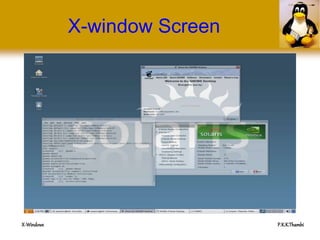
X-window Screen
X-Windows P.K.K.Thambi
Client / Server Architecture
Separate programs that talks together for
a specific aim.
Server will be the program that supplies
the services and the client is who make
the requests.
X-Windows P.K.K.Thambi
X Window Clients and Servers
 Although you can easily use the X Window system to run
programs stored on your local computer, you can also run
applications over the network
 X Window uses a client/server model in which a program can run
on one computer but display its output on another
 The desktop system from which you run a program is called the
X server, the system that hosts and executes the program is called
the X client (this is opposite of normal networking)
X-Windows P.K.K.Thambi
X Protocol
Based on TCP/IP stack
The X Protocol provides a client-server architecture at
the application level:
The X client is the processing part of the application
and often runs on a remote machine.
The X server is the display and interaction system.
X-Windows P.K.K.Thambi
X Protocol cont’d
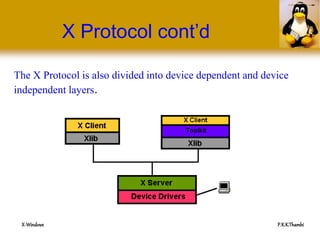
The X Protocol is also divided into device dependent and device
independent layers.
X-Windows P.K.K.Thambi
X architecture
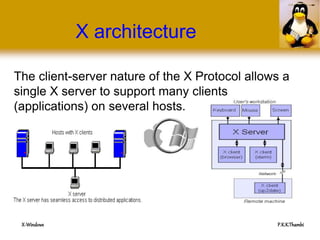
The client-server nature of the X Protocol allows a
single X server to support many clients
(applications) on several hosts.
X-Windows P.K.K.Thambi
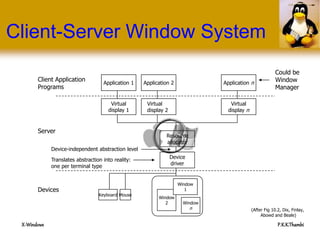
Client-Server Window System
Application 1 Application 2 Application n
Client Application
Programs
Virtual
display 1
Virtual
display n
Resource
allocator
Device
driver
Window
2 Window
n
Window
1
Mouse
Keyboard
(After Fig 10.2, Dix, Finlay,
Abowd and Beale)
Virtual
display 2
Server
Devices
Device-independent abstraction level
Translates abstraction into reality:
one per terminal type
Could be
Window
Manager
X-Windows P.K.K.Thambi
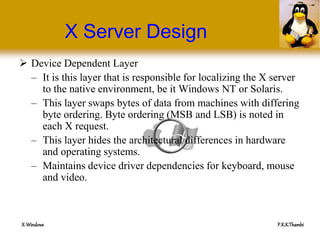
X Server Design
 Device Dependent Layer
– It is this layer that is responsible for localizing the X server
to the native environment, be it Windows NT or Solaris.
– This layer swaps bytes of data from machines with differing
byte ordering. Byte ordering (MSB and LSB) is noted in
each X request.
– This layer hides the architectural differences in hardware
and operating systems.
– Maintains device driver dependencies for keyboard, mouse
and video.
X-Windows P.K.K.Thambi
X Server
The X server therefore:
 displays drawing requests on the screen.
 replies to information requests.
 reports an error in a request.
 Manages the keyboard, mouse and display device.
– Multiplexes keyboard and mouse input onto the network (or
via local IPC) to the respective X clients. (X events)
 creates, maps and destroys windows.
– writes and draws in windows
X-Windows P.K.K.Thambi
X Client
• sends requests to the server.
• receives events from server.
• receives errors from the server
X-Windows P.K.K.Thambi
X Protocol
 X client communicate with X server using the X protocol.
 Data is exchanged in an asynchronous manner over a two-way
communication path that enables transmission of a stream of 8
–bit bytes.
 X protocol is the machine language for the X Window system
X-Windows P.K.K.Thambi
X Protocol messages
Requests – client sends requests to the server (e.g.
create window)
Replies – server response to client requests
Events – server forwards events (such as mouse clicks
or keyboard entry) to the client
Errors – server reports errors to the client
X-Windows P.K.K.Thambi
Protocol Messages - Requests
Requests
 X clients make requests to the X server for a certain action to
take place. i.e.: Create Window
 To enhance performance, the X client normally does not
expect nor wait for a response. The request is typically left to
the reliable network layer to deliver.
X-Windows P.K.K.Thambi
Protocol Messages - Replies
Replies
 The X Server will respond to certain X client requests that
require a reply. As noted, not all requests require a reply.
X-Windows P.K.K.Thambi
Protocol Messages - Events
Events
 The X server will forward to the X client an event that the
application is expecting. This could include keyboard or
mouse input. To minimize network traffic, only expected
events are sent to X clients.
 X events are 32 bytes
X-Windows P.K.K.Thambi
Protocol Messages - Errors
Errors
 The X server will report errors in requests to the X client.
Errors are like an event but are handled differently.
 X errors are the same size as events to simplify their handling.
They are sent to the error handling routine of the X client.
X-Windows P.K.K.Thambi
Xlib: The Assemble language of X
 A set of C library of X window system
 Xlib gives you access to the X protocol through more than 300
utility routines.
 It is the The Assemble language of X Window System.
X-Windows P.K.K.Thambi
X Toolkit: The High level language of X
 XToolkit Intrinsic (Xt Intrinsic) – an object- oriented
approach to implement the basic building blocks called
widgets
X-Windows P.K.K.Thambi
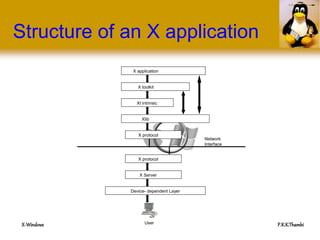
Structure of an X application
X application
X toolkit
Xt intrinsic
Xlib
X protocol
X Server
Device- dependent Layer
X protocol
Network
Interface
User

The X Window System Graphical User Interface

  • 1.
    X-Windows P.K.K.Thambi The XWindow System Module 5
  • 2.
    X-Windows P.K.K.Thambi X WindowSystem  The X Window system was developed as part of Project Athena at MIT. In 1987, X Version 11 is released. X is now controlled and maintained by the Open Group.  The X Windows System, also referred to as ‘X’ or “X11”, is the standard graphical engine for Unix , Linux and Sun workstations.  It is largely OS and hardware independent, it is network-transparent, and it supports many different desktops.
  • 3.
    X-Windows P.K.K.Thambi The GraphicUser Interface in X  X Window uses a bit-mapped display where each pixel can be manipulated individually.  The entire display is known as the root window, and individual applications are displayed as windows on this root window.  X is started with the startx or xinit commands. – X can also be invoked during system startup
  • 4.
  • 5.
    X-Windows P.K.K.Thambi Client /Server Architecture Separate programs that talks together for a specific aim. Server will be the program that supplies the services and the client is who make the requests.
  • 6.
    X-Windows P.K.K.Thambi X WindowClients and Servers  Although you can easily use the X Window system to run programs stored on your local computer, you can also run applications over the network  X Window uses a client/server model in which a program can run on one computer but display its output on another  The desktop system from which you run a program is called the X server, the system that hosts and executes the program is called the X client (this is opposite of normal networking)
  • 7.
    X-Windows P.K.K.Thambi X Protocol Basedon TCP/IP stack The X Protocol provides a client-server architecture at the application level: The X client is the processing part of the application and often runs on a remote machine. The X server is the display and interaction system.
  • 8.
    X-Windows P.K.K.Thambi X Protocolcont’d The X Protocol is also divided into device dependent and device independent layers.
  • 9.
    X-Windows P.K.K.Thambi X architecture Theclient-server nature of the X Protocol allows a single X server to support many clients (applications) on several hosts.
  • 10.
    X-Windows P.K.K.Thambi Client-Server WindowSystem Application 1 Application 2 Application n Client Application Programs Virtual display 1 Virtual display n Resource allocator Device driver Window 2 Window n Window 1 Mouse Keyboard (After Fig 10.2, Dix, Finlay, Abowd and Beale) Virtual display 2 Server Devices Device-independent abstraction level Translates abstraction into reality: one per terminal type Could be Window Manager
  • 11.
    X-Windows P.K.K.Thambi X ServerDesign  Device Dependent Layer – It is this layer that is responsible for localizing the X server to the native environment, be it Windows NT or Solaris. – This layer swaps bytes of data from machines with differing byte ordering. Byte ordering (MSB and LSB) is noted in each X request. – This layer hides the architectural differences in hardware and operating systems. – Maintains device driver dependencies for keyboard, mouse and video.
  • 12.
    X-Windows P.K.K.Thambi X Server TheX server therefore:  displays drawing requests on the screen.  replies to information requests.  reports an error in a request.  Manages the keyboard, mouse and display device. – Multiplexes keyboard and mouse input onto the network (or via local IPC) to the respective X clients. (X events)  creates, maps and destroys windows. – writes and draws in windows
  • 13.
    X-Windows P.K.K.Thambi X Client •sends requests to the server. • receives events from server. • receives errors from the server
  • 14.
    X-Windows P.K.K.Thambi X Protocol X client communicate with X server using the X protocol.  Data is exchanged in an asynchronous manner over a two-way communication path that enables transmission of a stream of 8 –bit bytes.  X protocol is the machine language for the X Window system
  • 15.
    X-Windows P.K.K.Thambi X Protocolmessages Requests – client sends requests to the server (e.g. create window) Replies – server response to client requests Events – server forwards events (such as mouse clicks or keyboard entry) to the client Errors – server reports errors to the client
  • 16.
    X-Windows P.K.K.Thambi Protocol Messages- Requests Requests  X clients make requests to the X server for a certain action to take place. i.e.: Create Window  To enhance performance, the X client normally does not expect nor wait for a response. The request is typically left to the reliable network layer to deliver.
  • 17.
    X-Windows P.K.K.Thambi Protocol Messages- Replies Replies  The X Server will respond to certain X client requests that require a reply. As noted, not all requests require a reply.
  • 18.
    X-Windows P.K.K.Thambi Protocol Messages- Events Events  The X server will forward to the X client an event that the application is expecting. This could include keyboard or mouse input. To minimize network traffic, only expected events are sent to X clients.  X events are 32 bytes
  • 19.
    X-Windows P.K.K.Thambi Protocol Messages- Errors Errors  The X server will report errors in requests to the X client. Errors are like an event but are handled differently.  X errors are the same size as events to simplify their handling. They are sent to the error handling routine of the X client.
  • 20.
    X-Windows P.K.K.Thambi Xlib: TheAssemble language of X  A set of C library of X window system  Xlib gives you access to the X protocol through more than 300 utility routines.  It is the The Assemble language of X Window System.
  • 21.
    X-Windows P.K.K.Thambi X Toolkit:The High level language of X  XToolkit Intrinsic (Xt Intrinsic) – an object- oriented approach to implement the basic building blocks called widgets
  • 22.
    X-Windows P.K.K.Thambi Structure ofan X application X application X toolkit Xt intrinsic Xlib X protocol X Server Device- dependent Layer X protocol Network Interface User