Lucas Jellema (AMIS, The Netherlands)
THE VERY, VERY LATEST IN
ORACLE DATABASE DEVELOPMENT


Oracle Open World 2012, San Francisco
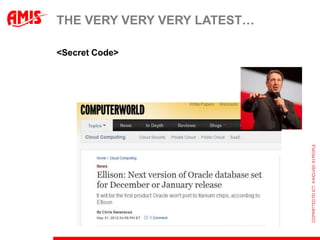
THE VERY VERY VERY LATEST…

<Secret Code>
THE DATABASE
IN MODERN ARCHITECTURES


Oracle Open World 2012, San Francisco
NO SQL
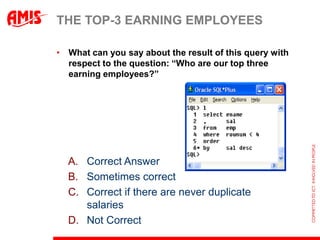
THE TOP-3 EARNING EMPLOYEES

• What can you say about the result of this query with
  respect to the question: “Who are our top three
  earning employees?”


  A. Correct Answer
  B. Sometimes correct
  C. Correct if there are never duplicate
     salaries
  D. Not Correct
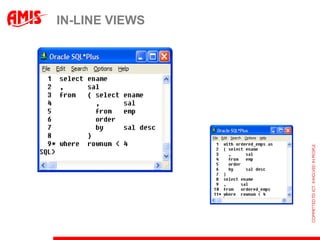
IN-LINE VIEWS
SPECIAL „BUSINESS RULE‟: DEFAULT VALUE

• The default values is the value that should be inserted
  for a column when the client has ignored the column
   – not provided a value nor indicated NULL
• The default value is applied prior to the execution of
  the Before Row trigger
   – So :new.<column_value> has the value that will be
      inserted
   – The Before Row trigger has no built in way to telling
      whether the value was provided by the client or
      supplied as default by the database
• Default value is typically used for auditing purposes
   – Note: default values for columns exposed in UI should
      be set in the client
COLUMN DEFAULT

• Columns can have default values
   – Static or literals
   – SQL expressions evaluating to a static
   – Pseudo-columns like USER and CURRENT_DATE
      • DO NOT USE SYSDATE! DO NOT USE USER!
   – References to Application Context parameters
      • sys_context(‘USERENV’, ‘IP_ADDRESS’)..
   – Some funny value to let the before row trigger know
     that the real (complex) default must be calculated
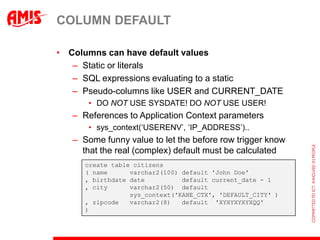
      create table citizens
      ( name      varchar2(100) default 'John Doe'
      , birthdate date          default current_date - 1
      , city      varchar2(50) default
                  sys_context('KANE_CTX', 'DEFAULT_CITY' )
      , zipcode   varchar2(8)   default 'XYXYXYXYXQQ'
      )
APPLICATION CONTEXT

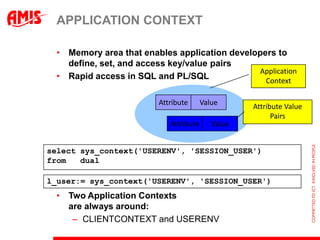
  • Memory area that enables application developers to
    define, set, and access key/value pairs
                                               Application
  • Rapid access in SQL and PL/SQL               Context

                         Attribute      Value      Attribute Value
                                                         Pairs
                            Attribute      Value


select sys_context('USERENV', 'SESSION_USER')
from   dual

l_user:= sys_context('USERENV', 'SESSION_USER')
  • Two Application Contexts
    are always around:
     – CLIENTCONTEXT and USERENV
APPLICATION CONTEXT APPEARANCES

• Per session (default)
   – Stored in UGA, just like package state
• Globally Accessible (shared across all sessions)
   – Stored in SGA
• Associated with a Client Identifier
   – Attributes in a Globally Accessible Application Context
     can explicitly be tied to the Client Identifier
   – And are only accessible to sessions with that Client
     Identifier
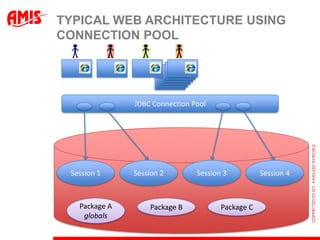
TYPICAL WEB ARCHITECTURE USING
CONNECTION POOL


               JDBC Connection Pool


 Session 1     Session 2        Session 3          Session 4


   Package A       Package B           Package C
    globals
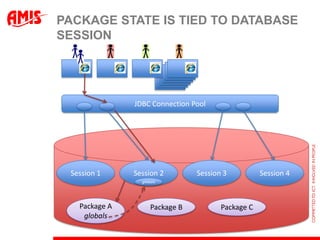
PACKAGE STATE IS TIED TO DATABASE
SESSION


               JDBC Connection Pool


 Session 1     Session 2         Session 3          Session 4
                 globals


   Package A         Package B          Package C
    globals
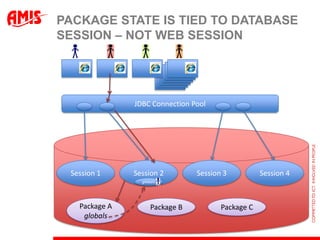
PACKAGE STATE IS TIED TO DATABASE
SESSION – NOT WEB SESSION


               JDBC Connection Pool


 Session 1     Session 2         Session 3          Session 4
                 globals


   Package A         Package B          Package C
    globals
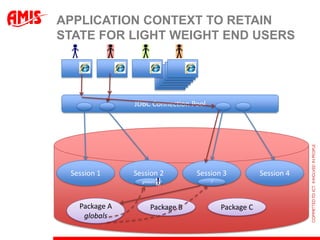
APPLICATION CONTEXT TO RETAIN
STATE FOR LIGHT WEIGHT END USERS


               JDBC Connection Pool


 Session 1     Session 2         Session 3            Session 4
                 globals              ?


   Package A         Package B            Package C
    globals
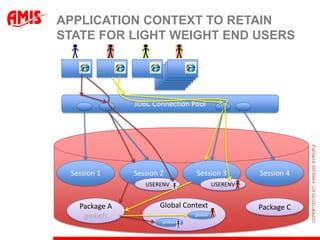
APPLICATION CONTEXT TO RETAIN
STATE FOR LIGHT WEIGHT END USERS


               JDBC Connection Pool


 Session 1     Session 2         Session 3           Session 4
                  USERENV                  USERENV


   Package A          Global Context                 Package C
    globals                      globals
                       globals
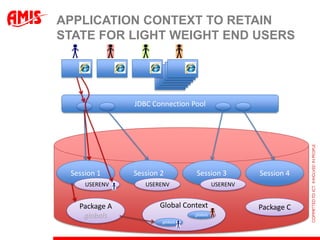
APPLICATION CONTEXT TO RETAIN
STATE FOR LIGHT WEIGHT END USERS


               JDBC Connection Pool


 Session 1     Session 2         Session 3           Session 4
     USERENV      USERENV                  USERENV


   Package A          Global Context                 Package C
    globals                      globals
                       globals
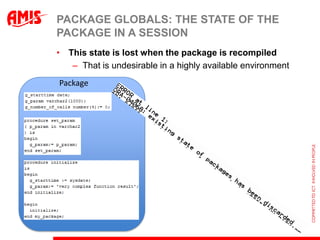
PACKAGE GLOBALS: THE STATE OF THE
PACKAGE IN A SESSION
• This state is lost when the package is recompiled
   – That is undesirable in a highly available environment
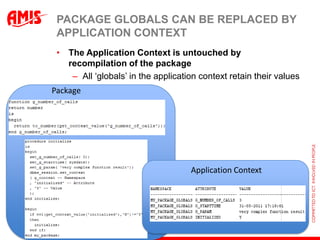
Package
PACKAGE GLOBALS CAN BE REPLACED BY
 APPLICATION CONTEXT
 • The Application Context is untouched by
   recompilation of the package
    – All ‘globals’ in the application context retain their values
Package


                                    Application Context
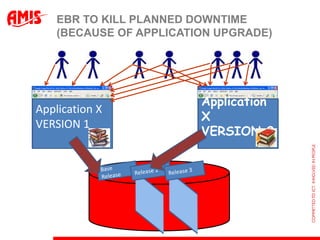
EBR TO KILL PLANNED DOWNTIME
    (BECAUSE OF APPLICATION UPGRADE)


                         Application
Application X
                         X
VERSION 1
                         VERSION 2
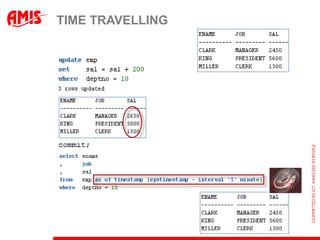
TIME TRAVELLING
FLASHBACK

• Introduced in 9i
• Based on UNDO
• Initially only for recovery
• As of 11g – Total Recall option with
  Flashback Data Archive
   – Controlled history keeping
• Look back into history
   – Query trends (version history)
   – Difference reporting
   – Audit trails (Replace journaling tables)
        • Require trick for transaction history: WHO?
• Also: when is the start of history?
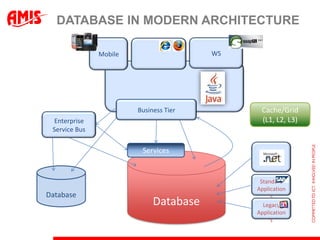
DATABASE IN MODERN ARCHITECTURE

               Mobile                   WS


                        Business Tier         Cache/Grid
 Enterprise                                   (L1, L2, L3)
 Service Bus

                         Services


                                              Standard
                                             Application
Database                                          s
                             Database          Legacy
                                             Application
                                                  s
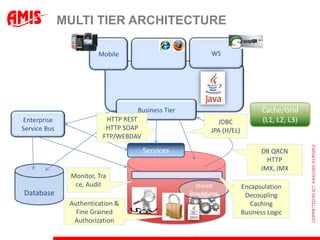
MULTI TIER ARCHITECTURE

                        Mobile                           WS


                                  Business Tier                              Cache/Grid
Enterprise                HTTP REST                        JDBC              (L1, L2, L3)
Service Bus               HTTP SOAP                      JPA (H/EL)
                         FTP/WEBDAV

                                      Services                              DB QRCN
                                                                              HTTP
                                                                            JMX, JMX
               Monitor, Tra
                ce, Audit                           Stored            Encapsulation
Database                                          Procedures           Decoupling
               Authentication &                                          Caching
                 Fine Grained                                         Business Logic
                Authorization
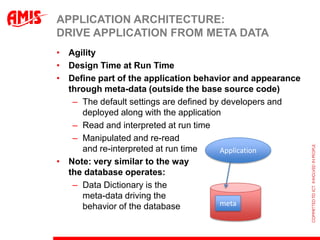
APPLICATION ARCHITECTURE:
DRIVE APPLICATION FROM META DATA
• Agility
• Design Time at Run Time
• Define part of the application behavior and appearance
  through meta-data (outside the base source code)
   – The default settings are defined by developers and
     deployed along with the application
   – Read and interpreted at run time
   – Manipulated and re-read
     and re-interpreted at run time     Application
• Note: very similar to the way
  the database operates:
   – Data Dictionary is the
     meta-data driving the
     behavior of the database           meta
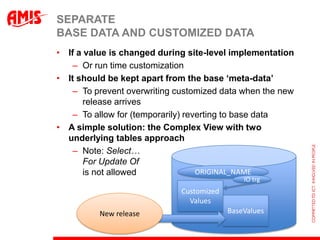
SEPARATE
BASE DATA AND CUSTOMIZED DATA
• If a value is changed during site-level implementation
    – Or run time customization
• It should be kept apart from the base „meta-data‟
    – To prevent overwriting customized data when the new
       release arrives
    – To allow for (temporarily) reverting to base data
• A simple solution: the Complex View with two
  underlying tables approach
    – Note: Select…
       For Update Of
       is not allowed               ORIGINAL_NAME
                                              IO trg
                             Customized
                               Values
          New release                     BaseValues
REPLACE THE ORIGINAL SINGLE TABLE
WITH A TWO-TABLE BASE/CUSTOM SPLIT
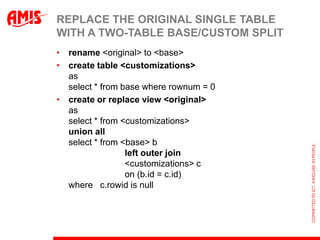
• rename <original> to <base>
• create table <customizations>
  as
  select * from base where rownum = 0
• create or replace view <original>
  as
  select * from <customizations>
  union all
  select * from <base> b
                 left outer join
                 <customizations> c
                 on (b.id = c.id)
  where c.rowid is null
REPLACE THE ORIGINAL SINGLE TABLE
WITH A TWO-TABLE BASE/CUSTOM SPLIT (2)
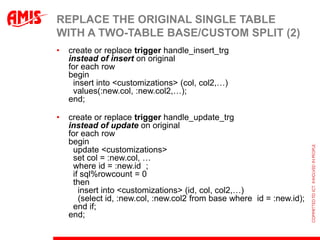
•   create or replace trigger handle_insert_trg
    instead of insert on original
    for each row
    begin
     insert into <customizations> (col, col2,…)
     values(:new.col, :new.col2,…);
    end;

•   create or replace trigger handle_update_trg
    instead of update on original
    for each row
    begin
     update <customizations>
     set col = :new.col, …
     where id = :new.id ;
     if sql%rowcount = 0
     then
       insert into <customizations> (id, col, col2,…)
       (select id, :new.col, :new.col2 from base where id = :new.id);
     end if;
    end;
APPLICATION ARCHITECTURE: NO SQL

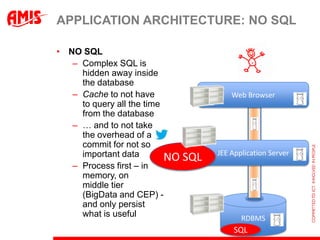
• NO SQL
   – Complex SQL is
     hidden away inside
     the database
   – Cache to not have                    Web Browser
     to query all the time
     from the database
   – … and to not take
     the overhead of a
     commit for not so
     important data                   JEE Application Server
                           NO   SQL
   – Process first – in
     memory, on
     middle tier
     (BigData and CEP) -
     and only persist
     what is useful                          RDBMS
                                           SQL
QUERY RESULT CHANGE NOTIFICATION

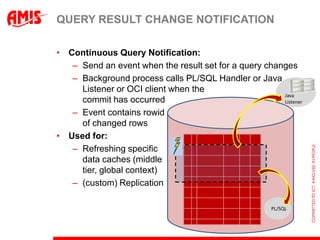
• Continuous Query Notification:
   – Send an event when the result set for a query changes
   – Background process calls PL/SQL Handler or Java
     Listener or OCI client when the
                                                       Java
     commit has occurred                               Listener

   – Event contains rowid
     of changed rows
• Used for:
   – Refreshing specific
     data caches (middle
     tier, global context)
   – (custom) Replication

                                                       PL/SQL
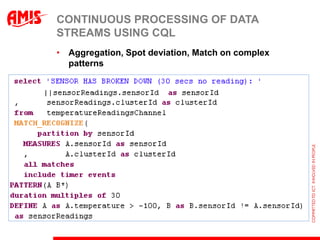
CONTINUOUS PROCESSING OF DATA
STREAMS USING CQL
• Aggregation, Spot deviation, Match on complex
  patterns
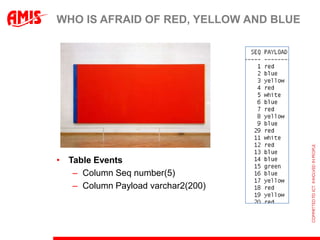
WHO IS AFRAID OF RED, YELLOW AND BLUE


• Table Events
   – Column Seq number(5)
   – Column Payload varchar2(200)
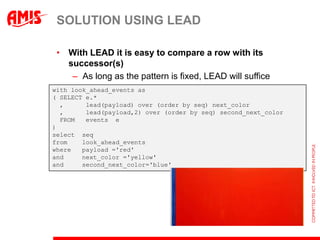
SOLUTION USING LEAD

 • With LEAD it is easy to compare a row with its
   successor(s)
    – As long as the pattern is fixed, LEAD will suffice
with look_ahead_events as
( SELECT e.*
  ,      lead(payload) over (order by seq) next_color
  ,      lead(payload,2) over (order by seq) second_next_color
  FROM   events e
)
select seq
from    look_ahead_events
where   payload ='red'
and     next_color ='yellow'
and     second_next_color='blue'
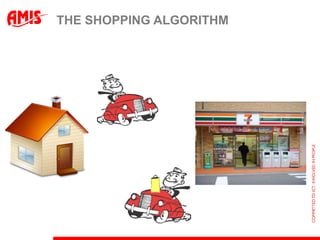
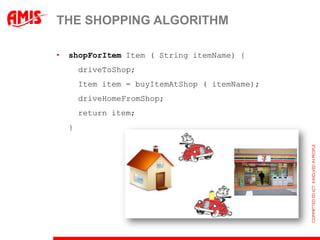
THE SHOPPING ALGORITHM

•   shopForItem Item ( String itemName) {
        driveToShop;
        Item item = buyItemAtShop ( itemName);
        driveHomeFromShop;
        return item;
    }
GET THIS WEEK‟S GROCERIES

getGroceries Item[] ( String[] shoppingList) {
    Item[] items = new Item[ shoppingList.length];
    for (int i=0; i < shoppingList.length; i++) {
        items[i] = shopForItem (shoppingList[i]);
    }
    return items;
}
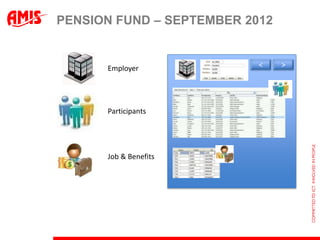
PENSION FUND – SEPTEMBER 2012


      Employer             <    >


      Participants


      Job & Benefits
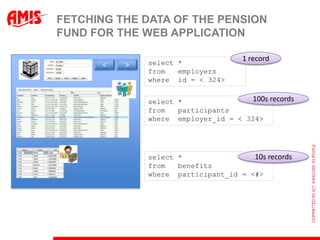
FETCHING THE DATA OF THE PENSION
FUND FOR THE WEB APPLICATION

              select *
                                    1 record
      <   >
              from   employers
              where id = < 324>


              select *               100s records
              from   participants
              where employer_id = < 324>


              select *                10s records
              from   benefits
              where participant_id = <#>
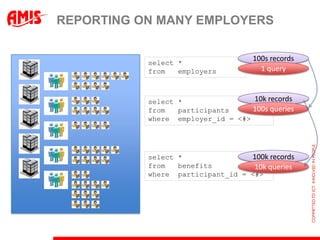
REPORTING ON MANY EMPLOYERS


           select *
                                    100s records
           from   employers           1 query


           select *                10k records
           from   participants     100s queries
           where employer_id = <#>


           select *               100k records
           from   benefits         10k queries
           where participant_id = <#>
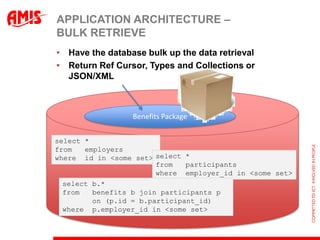
APPLICATION ARCHITECTURE –
BULK RETRIEVE
• Have the database bulk up the data retrieval
• Return Ref Cursor, Types and Collections or
  JSON/XML


                 Benefits Package


select *
from   employers
where id in <some set> select *
                       from   participants
                       where employer_id in <some set>
 select b.*
 from   benefits b join participants p
        on (p.id = b.participant_id)
 where p.employer_id in <some set>
APPLICATION ARCHITECTURE –
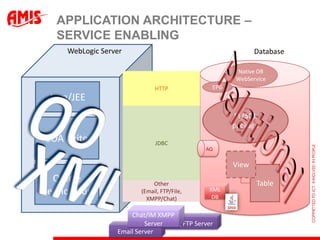
   SERVICE ENABLING
     WebLogic Server                                         Database

                                                      Native DB
                                                      WebService
                              HTTP              EPG
 Java/JEE
                                                      PL/SQL
                                                      package
SOA Suite                     JDBC
                                              AQ


                                                      View
  Oracle                     Other                           Table
Service Bus              (Email, FTP/File,     XML
                                                DB
                           XMPP/Chat)

                      Chat/IM XMPP
                           Server File/FTP Server
                  Email Server
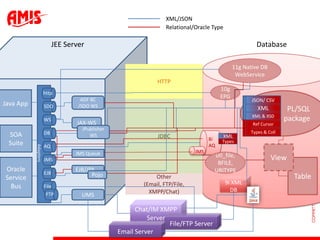
XML/JSON
                                                                   Relational/Oracle Type

                            JEE Server                                                                 Database

                                                                                               11g Native DB
                                                                                                WebService
                                                               HTTP
                                                                                         10g
                      http
                                     ADF BC
                                                                                         EPG
                                                                                                      JSON/ CSV
Java App              SDO           /SDO WS                                                             XML          PL/SQL
                                                                                                      XML & XSD
                      WS
                                   JAX-WS
                                                                                                                    package
                                                                                                      Ref Cursor
                                     JPublisher
                      DB                                                                             Types & Coll
 SOA                                    WS                     JDBC                      XML
                                                                                    8i   Types
 Suite                                                                              AQ
           Adapters


                      AQ
                                   JMS Queue                                  JMS
                                                                                     utl_file,                 View
                      JMS
                                                                                      BFILE,
Oracle                EJB
                                   EJB/JPA                                           URITYPE
Service                                  Pojo                 Other                                                   Table
                                                          (Email, FTP/File,                 9i XML
  Bus                 File
                                                            XMPP/Chat)                        DB
                       FTP           UMS

                                                        Chat/IM XMPP
                                                            Server
                                                                   File/FTP Server
                                                  Email Server
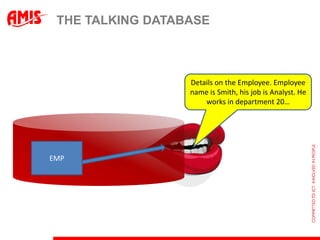
THE TALKING DATABASE


                  Details on the Employee. Employee
                  name is Smith, his job is Analyst. He
                      works in department 20…


EMP
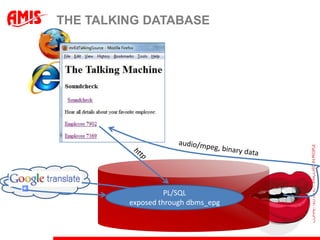
THE TALKING DATABASE


                   PL/SQL
         exposed through dbms_epg
BUSINESS RULES

• Data Oriented Rules or Data Constraints
• Declarative support in database
   – For referential integrity
       • Order must be for a Customer
   – For attribute and tuple rules
       • Salary must be numeric,
       • Hiredate may not be in the future,
       • End date must come after begin date
• No declarative support for complex data rules – across
  multiple records and tables
   – A department in France may not have less then 20%
     female employees
   – Order items of type weapon may not be part of an
     order that ships around Christmas
BUSINESS RULES –
WHERE AND HOW TO IMPLEMENT
• Criteria:
   – Safe
   – Well performant
   – Reusable and maintainable
   – Productive to implement
• Options
   – Client side
       • JavaScript
   – Middle-tier
       • Java, Enterprise Service Bus
   – Database
       • Constraints and triggers are statement level – i/o
         transaction level
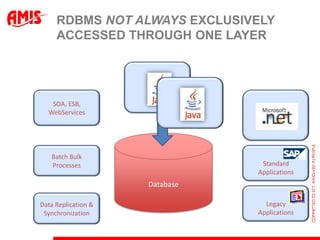
RDBMS NOT ALWAYS EXCLUSIVELY
     ACCESSED THROUGH ONE LAYER


   SOA, ESB,
  WebServices


   Batch Bulk
   Processes                     Standard
                                Applications
                     Database

Data Replication &                Legacy
 Synchronization                Applications
11G VIRTUAL COLUMNS

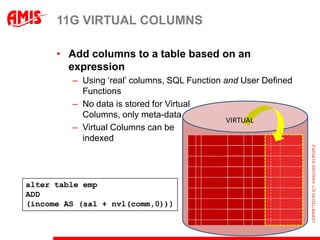
      • Add columns to a table based on an
        expression
         – Using ‘real’ columns, SQL Function and User Defined
           Functions
         – No data is stored for Virtual
           Columns, only meta-data
                                               VIRTUAL
         – Virtual Columns can be
           indexed


alter table emp
ADD
(income AS (sal + nvl(comm,0)))
UNIQUENESS RULES
    USING VIRTUAL COLUMNS
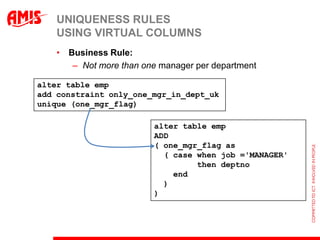
    • Business Rule:
       – Not more than one manager per department

alter table emp
add constraint only_one_mgr_in_dept_uk
unique (one_mgr_flag)

                         alter table emp
                         ADD
                         ( one_mgr_flag as
                           ( case when job ='MANAGER'
                                  then deptno
                             end
                           )
                         )
CHALLENGE: ORDERS BELONG TO A
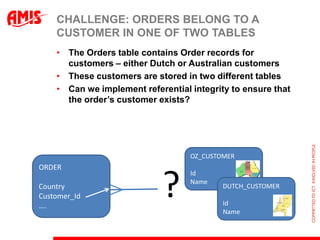
    CUSTOMER IN ONE OF TWO TABLES
    • The Orders table contains Order records for
      customers – either Dutch or Australian customers
    • These customers are stored in two different tables
    • Can we implement referential integrity to ensure that
      the order‟s customer exists?


                                   OZ_CUSTOMER
ORDER


                            ?
                                   Id
                                   Name
Country                                    DUTCH_CUSTOMER
Customer_Id
….                                         Id
                                           Name
USING VIRTUAL COLUMNS
     IN FOREIGN KEY RELATIONS
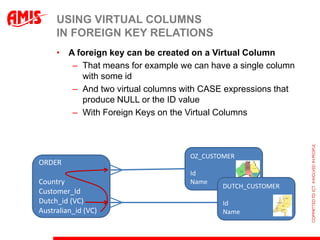
     • A foreign key can be created on a Virtual Column
        – That means for example we can have a single column
          with some id
        – And two virtual columns with CASE expressions that
          produce NULL or the ID value
        – With Foreign Keys on the Virtual Columns


                                   OZ_CUSTOMER
ORDER
                                   Id
Country                            Name
                                           DUTCH_CUSTOMER
Customer_Id
Dutch_id (VC)                              Id
Australian_id (VC)                         Name
USING VIRTUAL COLUMNS
             IN FOREIGN KEY RELATIONS

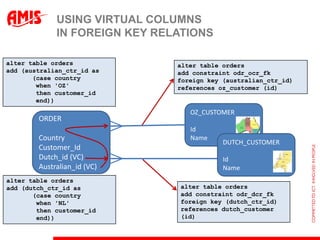
alter table orders             alter table orders
add (australian_ctr_id as      add constraint odr_ocr_fk
       (case country           foreign key (australian_ctr_id)
        when 'OZ'              references oz_customer (id)
        then customer_id
        end))
                                  OZ_CUSTOMER
        ORDER
                                  Id
        Country                   Name
                                           DUTCH_CUSTOMER
        Customer_Id
        Dutch_id (VC)                      Id
        Australian_id (VC)                 Name
alter table orders
add (dutch_ctr_id as           alter table orders
       (case country           add constraint odr_dcr_fk
        when 'NL'              foreign key (dutch_ctr_id)
        then customer_id       references dutch_customer
        end))                  (id)
FOREIGN KEY SHOULD ONLY REFER TO
CERTAIN RECORDS USING VC
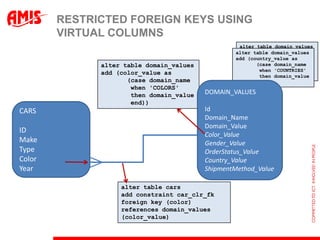
• Foreign Key can reference a UK based on a Virtual
  Column
• That allows a „conditional foreign key‟ or a foreign key
  that can only reference specific records in the
  referenced table
   – Only refer to Women in the PEOPLE table for the
      Mother Foreign Key
   – Only refer to Values in the Domain Values table for the
      Domain Name == ‘COLORS’
RESTRICTED FOREIGN KEYS USING
        VIRTUAL COLUMNS
                                                   alter table domain_values
                                                  alter (country_value as
                                                   add table domain_values
                                                           (case domain_name
                                                  add (country_value as
              alter table domain_values                     when 'COUNTRIES'
                                                          (case domain_name
                                                            then domain_value
                                                           when 'COUNTRIES'
              add (color_value as                           end))
                                                           then domain_value
                     (case domain_name                     end))
                      when 'COLORS'
                      then domain_value   DOMAIN_VALUES
                      end))
CARS                                      Id
                                          Domain_Name
                                          Domain_Value
ID
                                          Color_Value
Make                                      Gender_Value
Type                                      OrderStatus_Value
Color                                     Country_Value
Year                                      ShipmentMethod_Value

                   alter table cars
                   add constraint car_clr_fk
                   foreign key (color)
                   references domain_values
                   (color_value)
LACK OF WATERTIGHTNESS
IN TRIGGER BASED RULE VALIDATOIN
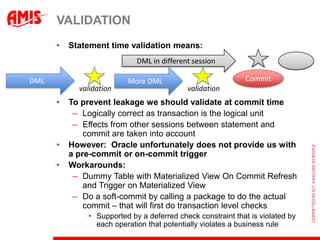
VALIDATION
      •   Statement time validation means:
                            DML in different session

DML                      More DML                           Commit
            validation                     validation
      •   To prevent leakage we should validate at commit time
           – Logically correct as transaction is the logical unit
           – Effects from other sessions between statement and
              commit are taken into account
      •   However: Oracle unfortunately does not provide us with
          a pre-commit or on-commit trigger
      •   Workarounds:
           – Dummy Table with Materialized View On Commit Refresh
              and Trigger on Materialized View
           – Do a soft-commit by calling a package to do the actual
              commit – that will first do transaction level checks
              • Supported by a deferred check constraint that is violated by
                each operation that potentially violates a business rule
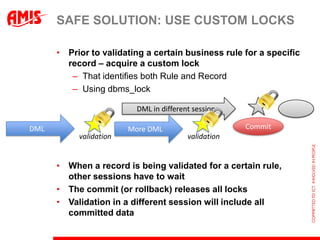
SAFE SOLUTION: USE CUSTOM LOCKS

      • Prior to validating a certain business rule for a specific
        record – acquire a custom lock
         – That identifies both Rule and Record
         – Using dbms_lock

                          DML in different session

DML                     More DML                      Commit
           validation                    validation


      • When a record is being validated for a certain rule,
        other sessions have to wait
      • The commit (or rollback) releases all locks
      • Validation in a different session will include all
        committed data
SUMMARY

•   Inline Views
•   Defaulting
•   Application Context
•   Flashback and the time dimension
•   NoSQL means smart SQL
     – Cache refresh driven by change notification
     – Streaming analysis before persisting
•   Decoupling galore
     – Bulk retrieval
     – Service enabling
•   Business Rules
•   EBR
•   12c promises even more

The Very Very Latest in Database Development - Oracle Open World 2012

  • 1.
    Lucas Jellema (AMIS,The Netherlands) THE VERY, VERY LATEST IN ORACLE DATABASE DEVELOPMENT Oracle Open World 2012, San Francisco
  • 2.
    THE VERY VERYVERY LATEST… <Secret Code>
  • 3.
    THE DATABASE IN MODERNARCHITECTURES Oracle Open World 2012, San Francisco
  • 4.
  • 5.
    THE TOP-3 EARNINGEMPLOYEES • What can you say about the result of this query with respect to the question: “Who are our top three earning employees?” A. Correct Answer B. Sometimes correct C. Correct if there are never duplicate salaries D. Not Correct
  • 6.
  • 7.
    SPECIAL „BUSINESS RULE‟:DEFAULT VALUE • The default values is the value that should be inserted for a column when the client has ignored the column – not provided a value nor indicated NULL • The default value is applied prior to the execution of the Before Row trigger – So :new.<column_value> has the value that will be inserted – The Before Row trigger has no built in way to telling whether the value was provided by the client or supplied as default by the database • Default value is typically used for auditing purposes – Note: default values for columns exposed in UI should be set in the client
  • 8.
    COLUMN DEFAULT • Columnscan have default values – Static or literals – SQL expressions evaluating to a static – Pseudo-columns like USER and CURRENT_DATE • DO NOT USE SYSDATE! DO NOT USE USER! – References to Application Context parameters • sys_context(‘USERENV’, ‘IP_ADDRESS’).. – Some funny value to let the before row trigger know that the real (complex) default must be calculated create table citizens ( name varchar2(100) default 'John Doe' , birthdate date default current_date - 1 , city varchar2(50) default sys_context('KANE_CTX', 'DEFAULT_CITY' ) , zipcode varchar2(8) default 'XYXYXYXYXQQ' )
  • 9.
    APPLICATION CONTEXT • Memory area that enables application developers to define, set, and access key/value pairs Application • Rapid access in SQL and PL/SQL Context Attribute Value Attribute Value Pairs Attribute Value select sys_context('USERENV', 'SESSION_USER') from dual l_user:= sys_context('USERENV', 'SESSION_USER') • Two Application Contexts are always around: – CLIENTCONTEXT and USERENV
  • 10.
    APPLICATION CONTEXT APPEARANCES •Per session (default) – Stored in UGA, just like package state • Globally Accessible (shared across all sessions) – Stored in SGA • Associated with a Client Identifier – Attributes in a Globally Accessible Application Context can explicitly be tied to the Client Identifier – And are only accessible to sessions with that Client Identifier
  • 11.
    TYPICAL WEB ARCHITECTUREUSING CONNECTION POOL JDBC Connection Pool Session 1 Session 2 Session 3 Session 4 Package A Package B Package C globals
  • 12.
    PACKAGE STATE ISTIED TO DATABASE SESSION JDBC Connection Pool Session 1 Session 2 Session 3 Session 4 globals Package A Package B Package C globals
  • 13.
    PACKAGE STATE ISTIED TO DATABASE SESSION – NOT WEB SESSION JDBC Connection Pool Session 1 Session 2 Session 3 Session 4 globals Package A Package B Package C globals
  • 14.
    APPLICATION CONTEXT TORETAIN STATE FOR LIGHT WEIGHT END USERS JDBC Connection Pool Session 1 Session 2 Session 3 Session 4 globals ? Package A Package B Package C globals
  • 15.
    APPLICATION CONTEXT TORETAIN STATE FOR LIGHT WEIGHT END USERS JDBC Connection Pool Session 1 Session 2 Session 3 Session 4 USERENV USERENV Package A Global Context Package C globals globals globals
  • 16.
    APPLICATION CONTEXT TORETAIN STATE FOR LIGHT WEIGHT END USERS JDBC Connection Pool Session 1 Session 2 Session 3 Session 4 USERENV USERENV USERENV Package A Global Context Package C globals globals globals
  • 17.
    PACKAGE GLOBALS: THESTATE OF THE PACKAGE IN A SESSION • This state is lost when the package is recompiled – That is undesirable in a highly available environment Package
  • 18.
    PACKAGE GLOBALS CANBE REPLACED BY APPLICATION CONTEXT • The Application Context is untouched by recompilation of the package – All ‘globals’ in the application context retain their values Package Application Context
  • 19.
    EBR TO KILLPLANNED DOWNTIME (BECAUSE OF APPLICATION UPGRADE) Application Application X X VERSION 1 VERSION 2
  • 20.
  • 21.
    FLASHBACK • Introduced in9i • Based on UNDO • Initially only for recovery • As of 11g – Total Recall option with Flashback Data Archive – Controlled history keeping • Look back into history – Query trends (version history) – Difference reporting – Audit trails (Replace journaling tables) • Require trick for transaction history: WHO? • Also: when is the start of history?
  • 22.
    DATABASE IN MODERNARCHITECTURE Mobile WS Business Tier Cache/Grid Enterprise (L1, L2, L3) Service Bus Services Standard Application Database s Database Legacy Application s
  • 23.
    MULTI TIER ARCHITECTURE Mobile WS Business Tier Cache/Grid Enterprise HTTP REST JDBC (L1, L2, L3) Service Bus HTTP SOAP JPA (H/EL) FTP/WEBDAV Services DB QRCN HTTP JMX, JMX Monitor, Tra ce, Audit Stored Encapsulation Database Procedures Decoupling Authentication & Caching Fine Grained Business Logic Authorization
  • 24.
    APPLICATION ARCHITECTURE: DRIVE APPLICATIONFROM META DATA • Agility • Design Time at Run Time • Define part of the application behavior and appearance through meta-data (outside the base source code) – The default settings are defined by developers and deployed along with the application – Read and interpreted at run time – Manipulated and re-read and re-interpreted at run time Application • Note: very similar to the way the database operates: – Data Dictionary is the meta-data driving the behavior of the database meta
  • 25.
    SEPARATE BASE DATA ANDCUSTOMIZED DATA • If a value is changed during site-level implementation – Or run time customization • It should be kept apart from the base „meta-data‟ – To prevent overwriting customized data when the new release arrives – To allow for (temporarily) reverting to base data • A simple solution: the Complex View with two underlying tables approach – Note: Select… For Update Of is not allowed ORIGINAL_NAME IO trg Customized Values New release BaseValues
  • 26.
    REPLACE THE ORIGINALSINGLE TABLE WITH A TWO-TABLE BASE/CUSTOM SPLIT • rename <original> to <base> • create table <customizations> as select * from base where rownum = 0 • create or replace view <original> as select * from <customizations> union all select * from <base> b left outer join <customizations> c on (b.id = c.id) where c.rowid is null
  • 27.
    REPLACE THE ORIGINALSINGLE TABLE WITH A TWO-TABLE BASE/CUSTOM SPLIT (2) • create or replace trigger handle_insert_trg instead of insert on original for each row begin insert into <customizations> (col, col2,…) values(:new.col, :new.col2,…); end; • create or replace trigger handle_update_trg instead of update on original for each row begin update <customizations> set col = :new.col, … where id = :new.id ; if sql%rowcount = 0 then insert into <customizations> (id, col, col2,…) (select id, :new.col, :new.col2 from base where id = :new.id); end if; end;
  • 28.
    APPLICATION ARCHITECTURE: NOSQL • NO SQL – Complex SQL is hidden away inside the database – Cache to not have Web Browser to query all the time from the database – … and to not take the overhead of a commit for not so important data JEE Application Server NO SQL – Process first – in memory, on middle tier (BigData and CEP) - and only persist what is useful RDBMS SQL
  • 29.
    QUERY RESULT CHANGENOTIFICATION • Continuous Query Notification: – Send an event when the result set for a query changes – Background process calls PL/SQL Handler or Java Listener or OCI client when the Java commit has occurred Listener – Event contains rowid of changed rows • Used for: – Refreshing specific data caches (middle tier, global context) – (custom) Replication PL/SQL
  • 30.
    CONTINUOUS PROCESSING OFDATA STREAMS USING CQL • Aggregation, Spot deviation, Match on complex patterns
  • 31.
    WHO IS AFRAIDOF RED, YELLOW AND BLUE • Table Events – Column Seq number(5) – Column Payload varchar2(200)
  • 32.
    SOLUTION USING LEAD • With LEAD it is easy to compare a row with its successor(s) – As long as the pattern is fixed, LEAD will suffice with look_ahead_events as ( SELECT e.* , lead(payload) over (order by seq) next_color , lead(payload,2) over (order by seq) second_next_color FROM events e ) select seq from look_ahead_events where payload ='red' and next_color ='yellow' and second_next_color='blue'
  • 33.
  • 34.
    THE SHOPPING ALGORITHM • shopForItem Item ( String itemName) { driveToShop; Item item = buyItemAtShop ( itemName); driveHomeFromShop; return item; }
  • 35.
    GET THIS WEEK‟SGROCERIES getGroceries Item[] ( String[] shoppingList) { Item[] items = new Item[ shoppingList.length]; for (int i=0; i < shoppingList.length; i++) { items[i] = shopForItem (shoppingList[i]); } return items; }
  • 36.
    PENSION FUND –SEPTEMBER 2012 Employer < > Participants Job & Benefits
  • 37.
    FETCHING THE DATAOF THE PENSION FUND FOR THE WEB APPLICATION select * 1 record < > from employers where id = < 324> select * 100s records from participants where employer_id = < 324> select * 10s records from benefits where participant_id = <#>
  • 38.
    REPORTING ON MANYEMPLOYERS select * 100s records from employers 1 query select * 10k records from participants 100s queries where employer_id = <#> select * 100k records from benefits 10k queries where participant_id = <#>
  • 39.
    APPLICATION ARCHITECTURE – BULKRETRIEVE • Have the database bulk up the data retrieval • Return Ref Cursor, Types and Collections or JSON/XML Benefits Package select * from employers where id in <some set> select * from participants where employer_id in <some set> select b.* from benefits b join participants p on (p.id = b.participant_id) where p.employer_id in <some set>
  • 40.
    APPLICATION ARCHITECTURE – SERVICE ENABLING WebLogic Server Database Native DB WebService HTTP EPG Java/JEE PL/SQL package SOA Suite JDBC AQ View Oracle Other Table Service Bus (Email, FTP/File, XML DB XMPP/Chat) Chat/IM XMPP Server File/FTP Server Email Server
  • 41.
    XML/JSON Relational/Oracle Type JEE Server Database 11g Native DB WebService HTTP 10g http ADF BC EPG JSON/ CSV Java App SDO /SDO WS XML PL/SQL XML & XSD WS JAX-WS package Ref Cursor JPublisher DB Types & Coll SOA WS JDBC XML 8i Types Suite AQ Adapters AQ JMS Queue JMS utl_file, View JMS BFILE, Oracle EJB EJB/JPA URITYPE Service Pojo Other Table (Email, FTP/File, 9i XML Bus File XMPP/Chat) DB FTP UMS Chat/IM XMPP Server File/FTP Server Email Server
  • 42.
    THE TALKING DATABASE Details on the Employee. Employee name is Smith, his job is Analyst. He works in department 20… EMP
  • 43.
    THE TALKING DATABASE PL/SQL exposed through dbms_epg
  • 44.
    BUSINESS RULES • DataOriented Rules or Data Constraints • Declarative support in database – For referential integrity • Order must be for a Customer – For attribute and tuple rules • Salary must be numeric, • Hiredate may not be in the future, • End date must come after begin date • No declarative support for complex data rules – across multiple records and tables – A department in France may not have less then 20% female employees – Order items of type weapon may not be part of an order that ships around Christmas
  • 45.
    BUSINESS RULES – WHEREAND HOW TO IMPLEMENT • Criteria: – Safe – Well performant – Reusable and maintainable – Productive to implement • Options – Client side • JavaScript – Middle-tier • Java, Enterprise Service Bus – Database • Constraints and triggers are statement level – i/o transaction level
  • 46.
    RDBMS NOT ALWAYSEXCLUSIVELY ACCESSED THROUGH ONE LAYER SOA, ESB, WebServices Batch Bulk Processes Standard Applications Database Data Replication & Legacy Synchronization Applications
  • 47.
    11G VIRTUAL COLUMNS • Add columns to a table based on an expression – Using ‘real’ columns, SQL Function and User Defined Functions – No data is stored for Virtual Columns, only meta-data VIRTUAL – Virtual Columns can be indexed alter table emp ADD (income AS (sal + nvl(comm,0)))
  • 48.
    UNIQUENESS RULES USING VIRTUAL COLUMNS • Business Rule: – Not more than one manager per department alter table emp add constraint only_one_mgr_in_dept_uk unique (one_mgr_flag) alter table emp ADD ( one_mgr_flag as ( case when job ='MANAGER' then deptno end ) )
  • 49.
    CHALLENGE: ORDERS BELONGTO A CUSTOMER IN ONE OF TWO TABLES • The Orders table contains Order records for customers – either Dutch or Australian customers • These customers are stored in two different tables • Can we implement referential integrity to ensure that the order‟s customer exists? OZ_CUSTOMER ORDER ? Id Name Country DUTCH_CUSTOMER Customer_Id …. Id Name
  • 50.
    USING VIRTUAL COLUMNS IN FOREIGN KEY RELATIONS • A foreign key can be created on a Virtual Column – That means for example we can have a single column with some id – And two virtual columns with CASE expressions that produce NULL or the ID value – With Foreign Keys on the Virtual Columns OZ_CUSTOMER ORDER Id Country Name DUTCH_CUSTOMER Customer_Id Dutch_id (VC) Id Australian_id (VC) Name
  • 51.
    USING VIRTUAL COLUMNS IN FOREIGN KEY RELATIONS alter table orders alter table orders add (australian_ctr_id as add constraint odr_ocr_fk (case country foreign key (australian_ctr_id) when 'OZ' references oz_customer (id) then customer_id end)) OZ_CUSTOMER ORDER Id Country Name DUTCH_CUSTOMER Customer_Id Dutch_id (VC) Id Australian_id (VC) Name alter table orders add (dutch_ctr_id as alter table orders (case country add constraint odr_dcr_fk when 'NL' foreign key (dutch_ctr_id) then customer_id references dutch_customer end)) (id)
  • 52.
    FOREIGN KEY SHOULDONLY REFER TO CERTAIN RECORDS USING VC • Foreign Key can reference a UK based on a Virtual Column • That allows a „conditional foreign key‟ or a foreign key that can only reference specific records in the referenced table – Only refer to Women in the PEOPLE table for the Mother Foreign Key – Only refer to Values in the Domain Values table for the Domain Name == ‘COLORS’
  • 53.
    RESTRICTED FOREIGN KEYSUSING VIRTUAL COLUMNS alter table domain_values alter (country_value as add table domain_values (case domain_name add (country_value as alter table domain_values when 'COUNTRIES' (case domain_name then domain_value when 'COUNTRIES' add (color_value as end)) then domain_value (case domain_name end)) when 'COLORS' then domain_value DOMAIN_VALUES end)) CARS Id Domain_Name Domain_Value ID Color_Value Make Gender_Value Type OrderStatus_Value Color Country_Value Year ShipmentMethod_Value alter table cars add constraint car_clr_fk foreign key (color) references domain_values (color_value)
  • 54.
    LACK OF WATERTIGHTNESS INTRIGGER BASED RULE VALIDATOIN
  • 55.
    VALIDATION • Statement time validation means: DML in different session DML More DML Commit validation validation • To prevent leakage we should validate at commit time – Logically correct as transaction is the logical unit – Effects from other sessions between statement and commit are taken into account • However: Oracle unfortunately does not provide us with a pre-commit or on-commit trigger • Workarounds: – Dummy Table with Materialized View On Commit Refresh and Trigger on Materialized View – Do a soft-commit by calling a package to do the actual commit – that will first do transaction level checks • Supported by a deferred check constraint that is violated by each operation that potentially violates a business rule
  • 56.
    SAFE SOLUTION: USECUSTOM LOCKS • Prior to validating a certain business rule for a specific record – acquire a custom lock – That identifies both Rule and Record – Using dbms_lock DML in different session DML More DML Commit validation validation • When a record is being validated for a certain rule, other sessions have to wait • The commit (or rollback) releases all locks • Validation in a different session will include all committed data
  • 57.
    SUMMARY • Inline Views • Defaulting • Application Context • Flashback and the time dimension • NoSQL means smart SQL – Cache refresh driven by change notification – Streaming analysis before persisting • Decoupling galore – Bulk retrieval – Service enabling • Business Rules • EBR • 12c promises even more

Editor's Notes

  • #2 Process
  • #8 http://technology.amis.nl/blog/?p=2530
  • #50 http://technology.amis.nl/blog/2424/oracle-11g-virtual-columns-to-publish-derived-column-values-without-storing-them-and-more
  • #51 http://technology.amis.nl/blog/2424/oracle-11g-virtual-columns-to-publish-derived-column-values-without-storing-them-and-more
  • #52 http://technology.amis.nl/blog/2424/oracle-11g-virtual-columns-to-publish-derived-column-values-without-storing-them-and-more
  • #54 http://technology.amis.nl/blog/2424/oracle-11g-virtual-columns-to-publish-derived-column-values-without-storing-them-and-more