1
<Insert Picture Here>


The Native NDB Engine for Memcached
John David Duncan
john.duncan@oracle.com

                                      2
Program Agenda


                                   <Insert Picture Here>


•   MySQL Cluster Today
•   A little bit about memcached
•   Design Decisions
•   Configuration
•   Performance
•   Links
•   Demo


                                                           3
The following is intended to outline our general
product direction. It is intended for information
purposes only, and may not be incorporated into any
contract. It is not a commitment to deliver any
material, code, or functionality, and should not be
relied upon in making purchasing decisions.
The development, release, and timing of any features
or functionality described for Oracle’s products
remains at the sole discretion of Oracle.


                                                       4
<Insert Picture Here>


MySQL Cluster Today


                                              5
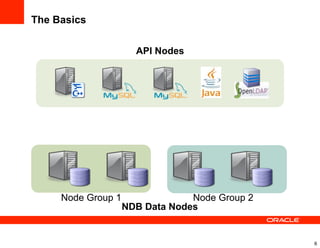
The Basics

                      API Nodes


     Node Group 1                Node Group 2
                    NDB Data Nodes


                                                6
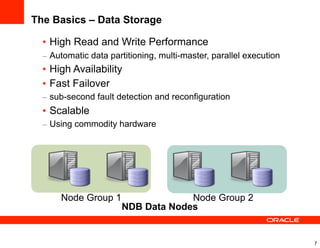
The Basics – Data Storage

  • High Read and Write Performance
  – Automatic data partitioning, multi-master, parallel execution
  • High Availability
  • Fast Failover
  – sub-second fault detection and reconfiguration
  • Scalable
  – Using commodity hardware


      Node Group 1                  Node Group 2
                       NDB Data Nodes


                                                                    7
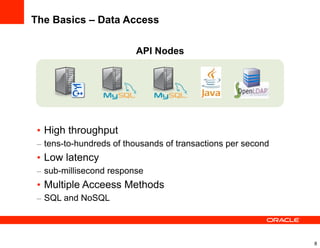
The Basics – Data Access

                         API Nodes


 • High throughput
 – tens-to-hundreds of thousands of transactions per second
 • Low latency
 – sub-millisecond response
 • Multiple Acceess Methods
 – SQL and NoSQL


                                                              8
Recent History

• Cluster 6.3 (2008)
  – multi-master replication, key-distribution awareness
• Cluster 7.0 (2009)
  – Multi-threaded NDB nodes
  – Ability to add nodes online to a running cluster
• Cluster 7.1 (2010)
  –   ClusterJ
  –   MySQL Cluster Manager
  –   ndbinfo (and then MEM support for Cluster)
  –   Windows support
• Plus
  – Extensive improvements to BLOB performance, locking
    behavior, node restart times, etc. in monthly releases


                                                             9
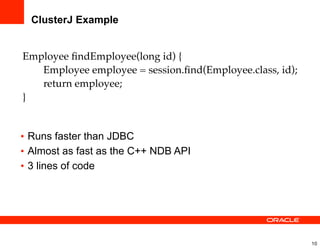
ClusterJ Example


Employee findEmployee(long id) {
   Employee employee = session.find(Employee.class, id);
   return employee;
}


• Runs faster than JDBC
• Almost as fast as the C++ NDB API
• 3 lines of code


                                                          10
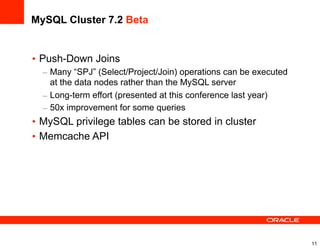
MySQL Cluster 7.2 Beta


• Push-Down Joins
  – Many “SPJ” (Select/Project/Join) operations can be executed
    at the data nodes rather than the MySQL server
  – Long-term effort (presented at this conference last year)
  – 50x improvement for some queries
• MySQL privilege tables can be stored in cluster
• Memcache API


                                                                  11
<Insert Picture Here>


About memcache


           • It’s a cache!
           • It’s not your data store!
           • If it fails, you get a cache miss!


                                                                  12
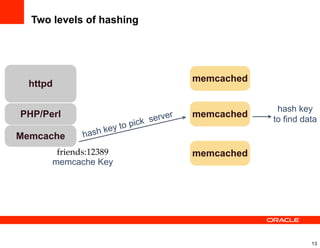
Two levels of hashing


                                           memcached
  httpd

                                                        hash key
PHP/Perl                               r   memcached
                               k serve                 to find data
                      y to pic
Memcache     ha sh ke

       friends:12389                       memcached
      memcache Key


                                                                 13
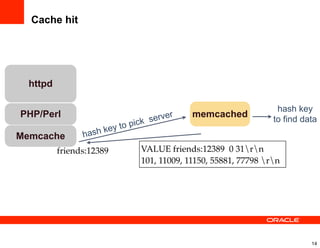
Cache hit


  httpd

                                                                    hash key
PHP/Perl                                  r   memcached
                                  k serve                          to find data
                         y to pic
Memcache        ha sh ke

          friends:12389          VALUE friends:12389 0 31rn
                                 101, 11009, 11150, 55881, 77798 rn


                                                                             14
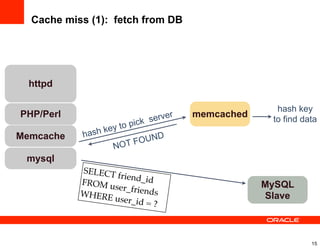
Cache miss (1): fetch from DB


  httpd

                                                       hash key
PHP/Perl                             r   memcached
                             k serve                  to find data
                    y to pic
Memcache   ha sh ke
                          F OUND
                    NOT
 mysql
           SELECT
                   friend_id
           FROM u                                    MySQL
                  ser_frien
           WHERE            ds
                 user_id =                           Slave
                             ?


                                                                15
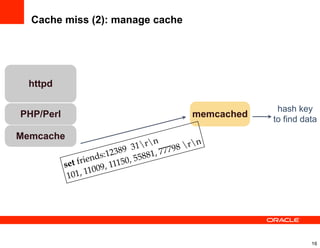
Cache miss (2): manage cache


  httpd

                                                               hash key
PHP/Perl                                          memcached
                                                              to find data
Memcache
                                     n             n
                              9 31r        9 8 r
                       : 1238      81 , 777
                  iends 1150, 558
           set fr 09, 1
            10 1, 110


                                                                        16
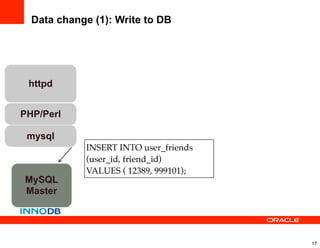
Data change (1): Write to DB


 httpd


PHP/Perl

 mysql
            INSERT INTO user_friends
            (user_id, friend_id)
            VALUES ( 12389, 999101);
MySQL
Master


                                       17
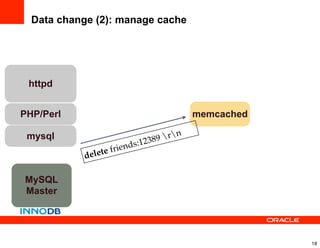
Data change (2): manage cache


 httpd


PHP/Perl                                   memcached

 mysql                                n
                              3 89 r
                       nds:12
           dele te frie


MySQL
Master


                                                       18
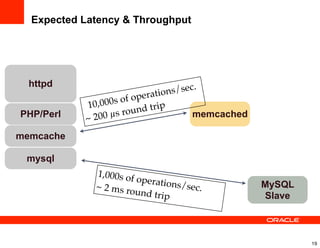
Expected Latency & Throughput


  httpd
                                ons/sec.
                      f operati
           10 ,000s o
                        u nd trip
PHP/Perl   ~2 00 µs ro                 memcached

memcache

 mysql
             1,000s of
                       operatio
             ~ 2 ms ro          ns/sec.            MySQL
                       und trip                    Slave


                                                           19
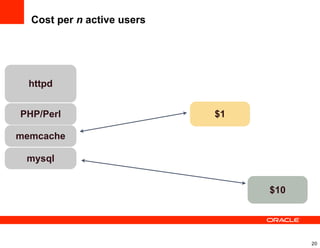
Cost per n active users


  httpd


PHP/Perl                    $1

memcache

 mysql


                                 $10


                                       20
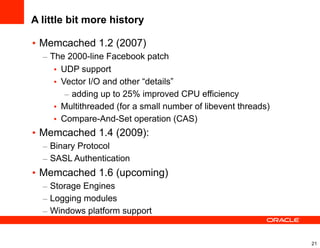
A little bit more history

• Memcached 1.2 (2007)
  – The 2000-line Facebook patch
     • UDP support
     • Vector I/O and other “details”
        – adding up to 25% improved CPU efficiency
     • Multithreaded (for a small number of libevent threads)
     • Compare-And-Set operation (CAS)
• Memcached 1.4 (2009):
  – Binary Protocol
  – SASL Authentication
• Memcached 1.6 (upcoming)
  – Storage Engines
  – Logging modules
  – Windows platform support


                                                                21
<Insert Picture Here>


Design Decisions


                                           22
Goals


• Access NDB data from memcache clients

 – Memcached perspective:
   • NDB is a reliable, write-scalable, replicated data store

 – MySQL Cluster perspective:
   • memcache is an easy-to-use high performance API


                                                                23
Goals

• Support existing schemas and all MySQL data types

• Cache NDB data inside memcached
  – with automatic cache management
  – and flexibility to fine-tune (or disable) the cache policies


• Support the whole memcache protocol

• Acheive superior performance
  – latency as expected from memcached
  – throughput as expected from memcached


                                                                   24
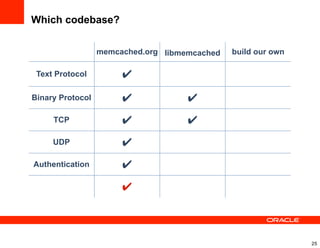
Which codebase?

                  memcached.org libmemcached   build our own

 Text Protocol         ✔

Binary Protocol        ✔             ✔
     TCP               ✔             ✔
     UDP               ✔
Authentication         ✔
                       ✔


                                                               25
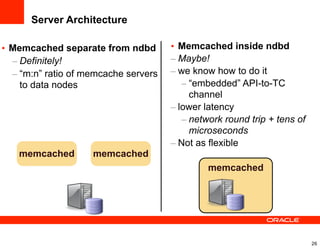
Server Architecture

• Memcached separate from ndbd        • Memcached inside ndbd
  – Definitely!                       – Maybe!
  – “m:n” ratio of memcache servers   – we know how to do it
    to data nodes                        – “embedded” API-to-TC
                                           channel
                                      – lower latency
                                         – network round trip + tens of
                                           microseconds
                                      – Not as flexible
   memcached        memcached
                                               memcached


                                                                          26
Decisions


• Use memcached 1.6 tree
• Isolate the NDB-specific code into an ndb_engine
  – which currently exists outside the memcached source tree
  – and runs in an unmodified memcached server
• Build a standalone server binary
• Possibly also build an ndbmtd-embedded server
• Share code with InnoDB Memcache team
  – on basic configuration and user-visible concepts
  – and on changes that would allow a memcache server module
    to be loaded into either ndbmtd or mysqld


                                                               27
Other decisions


• Memcache INCR & DECR
  – Fully supported
  – Atomic operations
  – Performed at the data node
• Memcache CAS (version id check)
  – Fully Supported
     • either at local cache or at database
  – CAS check is pushed down to the data node
  – Ideally an update that comes from a non-memcache API node
    should invalidate the CAS
     • we still need to decide the best design for this


                                                                28
Limitations


• The size of stored values is limited to the NDB row size
  – currently just less than 8 KB
  – vs. 1 MB typical limit for memcached
  – due to the lack of BLOB support in the async NDB API


                                                             29
Architecture Overview

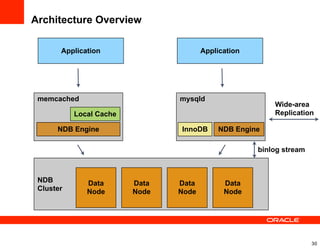
       Application                     Application


 memcached                      mysqld
                                                         Wide-area
           Local Cache                                   Replication

      NDB Engine                InnoDB     NDB Engine

                                                     binlog stream


 NDB          Data       Data   Data         Data
 Cluster      Node       Node   Node         Node


                                                                     30
<Insert Picture Here>


Configuring It


                                         31
What’s Configurable


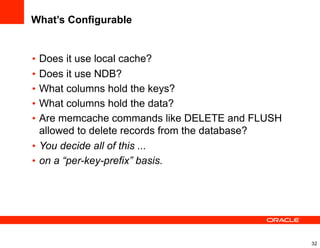
• Does it use local cache?
• Does it use NDB?
• What columns hold the keys?
• What columns hold the data?
• Are memcache commands like DELETE and FLUSH
  allowed to delete records from the database?
• You decide all of this ...
• on a “per-key-prefix” basis.


                                                 32
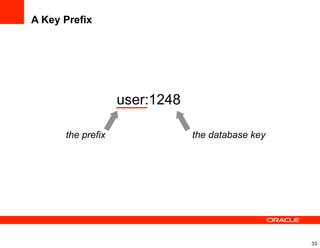
A Key Prefix


                   user:1248

      the prefix               the database key


                                                  33
Fundamentals


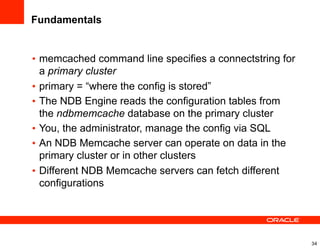
• memcached command line specifies a connectstring for
  a primary cluster
• primary = “where the config is stored”
• The NDB Engine reads the configuration tables from
  the ndbmemcache database on the primary cluster
• You, the administrator, manage the config via SQL
• An NDB Memcache server can operate on data in the
  primary cluster or in other clusters
• Different NDB Memcache servers can fetch different
  configurations


                                                         34
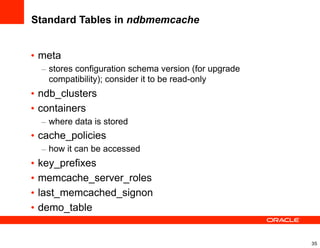
Standard Tables in ndbmemcache


• meta
    – stores configuration schema version (for upgrade
      compatibility); consider it to be read-only
• ndb_clusters
• containers
    – where data is stored
• cache_policies
    – how it can be accessed
•   key_prefixes
•   memcache_server_roles
•   last_memcached_signon
•   demo_table


                                                         35
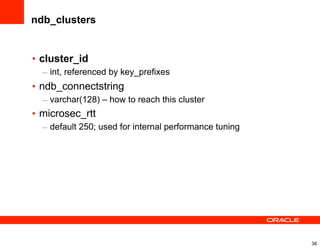
ndb_clusters


• cluster_id
  – int, referenced by key_prefixes
• ndb_connectstring
  – varchar(128) – how to reach this cluster
• microsec_rtt
  – default 250; used for internal performance tuning


                                                        36
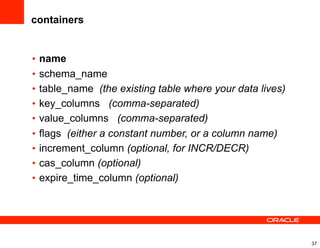
containers


•   name
•   schema_name
•   table_name (the existing table where your data lives)
•   key_columns (comma-separated)
•   value_columns (comma-separated)
•   flags (either a constant number, or a column name)
•   increment_column (optional, for INCR/DECR)
•   cas_column (optional)
•   expire_time_column (optional)


                                                            37
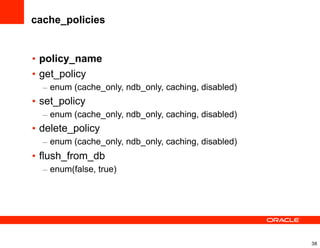
cache_policies


• policy_name
• get_policy
  – enum (cache_only, ndb_only, caching, disabled)
• set_policy
  – enum (cache_only, ndb_only, caching, disabled)
• delete_policy
  – enum (cache_only, ndb_only, caching, disabled)
• flush_from_db
  – enum(false, true)


                                                     38
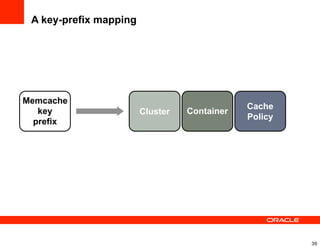
A key-prefix mapping


Memcache
                                              Cache
   key                  Cluster   Container
                                              Policy
  prefix


                                                       39
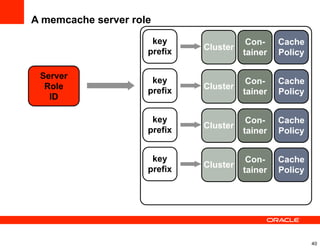
A memcache server role
                      key                Con-    Cache
                              Cluster
                     prefix             tainer   Policy

 Server               key                Con-    Cache
  Role                        Cluster
                     prefix             tainer   Policy
   ID

                      key                Con-    Cache
                              Cluster
                     prefix             tainer   Policy


                      key                Con-    Cache
                              Cluster
                     prefix             tainer   Policy


                                                          40
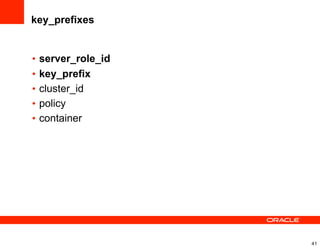
key_prefixes


•   server_role_id
•   key_prefix
•   cluster_id
•   policy
•   container


                     41
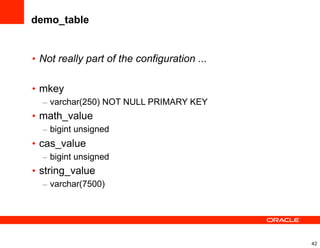
demo_table


• Not really part of the configuration ...

• mkey
  – varchar(250) NOT NULL PRIMARY KEY
• math_value
  – bigint unsigned
• cas_value
  – bigint unsigned
• string_value
  – varchar(7500)


                                             42
<Insert Picture Here>


Performance


                                      43
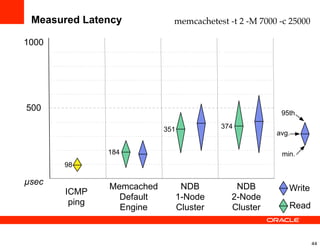
Measured Latency            memcachetest -t 2 -M 7000 -c 25000

1000


500
                                                        95th

                           351             374
                                                       avg.

               184                                      min.
       98

!sec
               Memcached          NDB         NDB         Write
       ICMP
                 Default         1-Node      2-Node
        ping                                              Read
                 Engine          Cluster     Cluster


                                                                  44
Links
• This Presentation
  – http://en.oreilly.com/mysql2011/

• Memcached 1.6 development tree
  – git clone git://github.com/memcached/memcached
  – cd memcached
  – git checkout -t origin/engine-pu

• MySQL Cluster 7.2 with Memcached Engine
  – bzr clone lp:~mysql/mysql-server/mysql-cluster-7.2-labs-memcached
  – or look for it at labs.mysql.com

• Mailing List
  – cluster@lists.mysql.com


                                                                    45
Demo


• What we’ll see:
  – Memcache Server Window
     • start memcached “sandbox”
        – default role (NDB-only)
        – mc-only role (plain memcached)
        – ndb-caching role (NDB with local cache)
  – Client Window
     • run memcapable
  – MyQSL Window
     • examine data and configuration


                                                    46
47