i
THE UTILIZATION OF VIRTUAL LEARNING
ENVIRONMENT (VLE) TO IMPROVE MATHEMATICS
EDUCATION STUDENTS’ ACHIEVEMENT AND INTEREST
IN MATHEMATICS IN FEDERAL UNIVERSITY OF
AGRICULTURE, MAKURDI
BY
OLA STEPHEN ONUH
(UE/24294/12)
DEPARTMENT OF SCIENCE EDUCATION, FEDERAL
UNIVERSITY OF AGRICULTURE, MAKURDI, BENUE
STATE.
APRIL, 2016.
ii
TITLE PAGE
THE UTILIZATION OF VIRTUAL LEARNING
ENVIRONMENT (VLE) TO IMPROVE MATHEMATICS
EDUCATION STUDENTS’ ACHIEVEMENT AND INTEREST
IN MATHEMATICS IN FEDERAL UNIVERSITY OF
AGRICULTURE, MAKURDI
BY
OLA STEPHEN ONUH
(UE/24294/12)
A RESEARCHWORK PRESENTED TO THE DEPARTMENT
OF SCIENCE EDUCATION, FEDERAL UNIVERSITY OF
AGRICULTURE, MAKURDI, BENUE STATE.
IN PARTIAL FULFILLMENT OF THE REQUIREMENTS
FOR THE AWARD OF BACHELOR OF SCIENCE
EDUCATION DEREEIN BSC(ED)
MATHEMATICS/STATISTICS.
APRIL, 2016.
iii
DECLARATION
I hereby declare that this project work represented my originalwork and
has notbeen previously submitted for any degree University or similar
institution.
Name of Student: Ola, Stephen Onuh
Singnatureof Student: ………………………………………
Date: ……………………………………….
iv
APPROVAL PAGE
This is to certify that this project work has been read and
approved by the under signed as meeting the requirement for the
award of bachelor of science education in Mathematics/Statistics
(B.Sc Ed).University of Agriculture, Makurdi.
…………………………………………….. ………………………………
Professor Iji, C. O. Date
(Project supervisor)
…………………………………………….. …………………....................
Dr. Okwara, O.K. Date
(Head of Department)
……………………………………………… ………………………………
(External supervisor) Date
v
DEDICATION
This research project is dedicated to the Almighty God, in whom I lay my trust,
who turned all my impossibilities into possible which enabled me achieve this
academic fit and made my dream come true.
vi
ACKNOWLEDGEMENTS
My heartfelt appreciation goes to my supervisor Professor Iji, C.O. for his
fatherly advice, encouragement, moral and all kinds of assistance leading to the
successful completion of this project. Thank you Sir for your patience, sense of
direction and the pains you took to make necessary corrections in my work, may God
replenish you in thousand folds, Amen.
I express deep appreciation to all my lecturers and Lab technologies for their
contribution to the success in my academic pursuit through my stay as a student of the
department.
I am highly indebted to my parents Mr & Mrs Emmaneul who has been
working round the clock to see that my programme is successfully completed. Thank
you for your parental care, words of advice and encouragement. I also express my
deep appreciation to my siblings Frank, Andrew and Victoria for their support in
various ways during this programme.
I also appreciate profusely, the untiring efforts of my spiritual parents Rev.
Fr. Dr. Didacus Kajo, Rev. Fr. A. P. Mom and Rev. Fr. Boniface Idoko for their
advice, support and prayers all the way to this point. My special thanks also go to
Prof. & Mrs N. Agbulu and Mr & Mrs I. Okachi for their guidance and care.
I am appreciating the effort of The Catholic Communication Office of
Makurdi for their support and understanding in years working with them even as a
student. And the Members and staffs of Server Zero Technologies for their help and
support in the development of the software aspect of this work.
I am sincerely grateful to my friends Egbe, Chris, Emmanuel, John, Samuel,
Peter, Kamalu, Martha, Gabriel, Douglas, Paul, Hycent, Mathew and my pets Change,
Jaddy and Blondy. I am sincerelygrateful to all of you for your contributions in
different capacities leading to the successful completion of this programme. May the
Almighty God grant you all your heart desire, Amen.
vii
TABLE OF CONTENTS
Cover page i
Title page ii
Certification iii
Approval iv
Dedication v
Acknowledgements vi
Table of Contents vii
List of Tables x
List of Figures xi
List of Appendices xii
Abstract xiii
CHAPTER ONE:INTRODUCTION
1.1 Background of the study 1
1.2 Statement of the Problem 5
1.3 Purposeof the Study 6
1.4 Research question 7
1.5 Research hypothesis 7
1.6 Significance of the Study 8
1.7 Scopeof the Study 8
CHAPTER TWO: LITERATURE REVIEW
2.1 Theoretical framework 10
2.1.1 Information processing theory 10
viii
2.1.2 Basic assumptions of information processing theory 13
2.2 Conceptual Framework 19
2.2.1 Virtual Learning Environment (VLE) 19
2.2.2 Students’ Mathematics Achievement 22
2.2.3 Students’ Mathematics Interest 23
2.2.4 Gender and Students’ Mathematics Achievement 24
2.2.5 Gender and Student’s Mathematics Interest 25
2.3 Empirical Studies 26
2.4 Summary 30
CHAPTER THREE:METHODOLOGY
3.1 Research Design 32
3.2 Area of the Study 32
3.3 Population of the Study 32
3.4 Sample and Sampling Technique 33
3.5 Instrument of the Study 33
3.6 Validity of Instrument 34
3.7 Method of Data Collection 34
3.8 Method of Data Analysis 34
CHAPTER FOUR: DATA PRESENTATION ANALYSIS,
INTERPRETATIONAND DISCUSSION
ix
4.1 Research Question One 35
4.2 Research Question Two 36
4.3 Research Question Three 38
4.4 Research Question Four 39
4.5 Research Hypothesis I 41
4.6 Research Hypothesis II 42
4.7 Research Hypothesis III 42
4.8 Research Hypothesis IV 43
4.9 Major Finding 44
4.10 Discussion of findings 45
CHAPTER FIVE: SUMMARY, CONCLUSION,
RECOMMENDATION AND SUGGESTION
5.1 Summary 47
5.2 Conclusions 48
5.3 Recommendations 48
5.4 Suggestions for further study 49
References 50
x
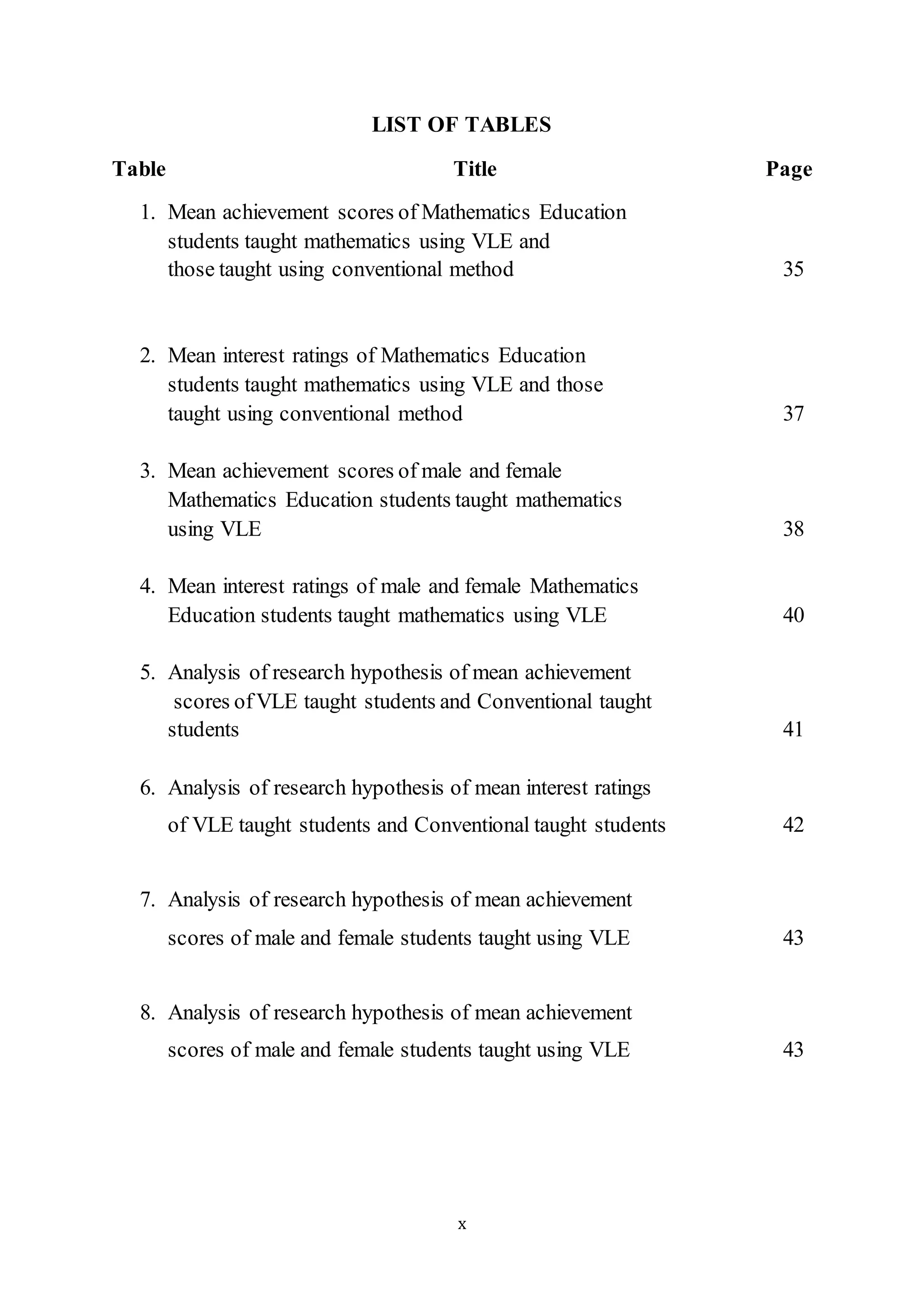
LIST OF TABLES
Table Title Page
1. Mean achievement scores of Mathematics Education
students taught mathematics using VLE and
those taught using conventional method 35
2. Mean interest ratings of Mathematics Education
students taught mathematics using VLE and those
taught using conventional method 37
3. Mean achievement scores of male and female
Mathematics Education students taught mathematics
using VLE 38
4. Mean interest ratings of male and female Mathematics
Education students taught mathematics using VLE 40
5. Analysis of research hypothesis of mean achievement
scores ofVLE taught students and Conventional taught
students 41
6. Analysis of research hypothesis of mean interest ratings
of VLE taught students and Conventional taught students 42
7. Analysis of research hypothesis of mean achievement
scores of male and female students taught using VLE 43
8. Analysis of research hypothesis of mean achievement
scores of male and female students taught using VLE 43
xi
LIST OF FIGURES
Figure Title Page
3.1 The information processingsystem 14
xii
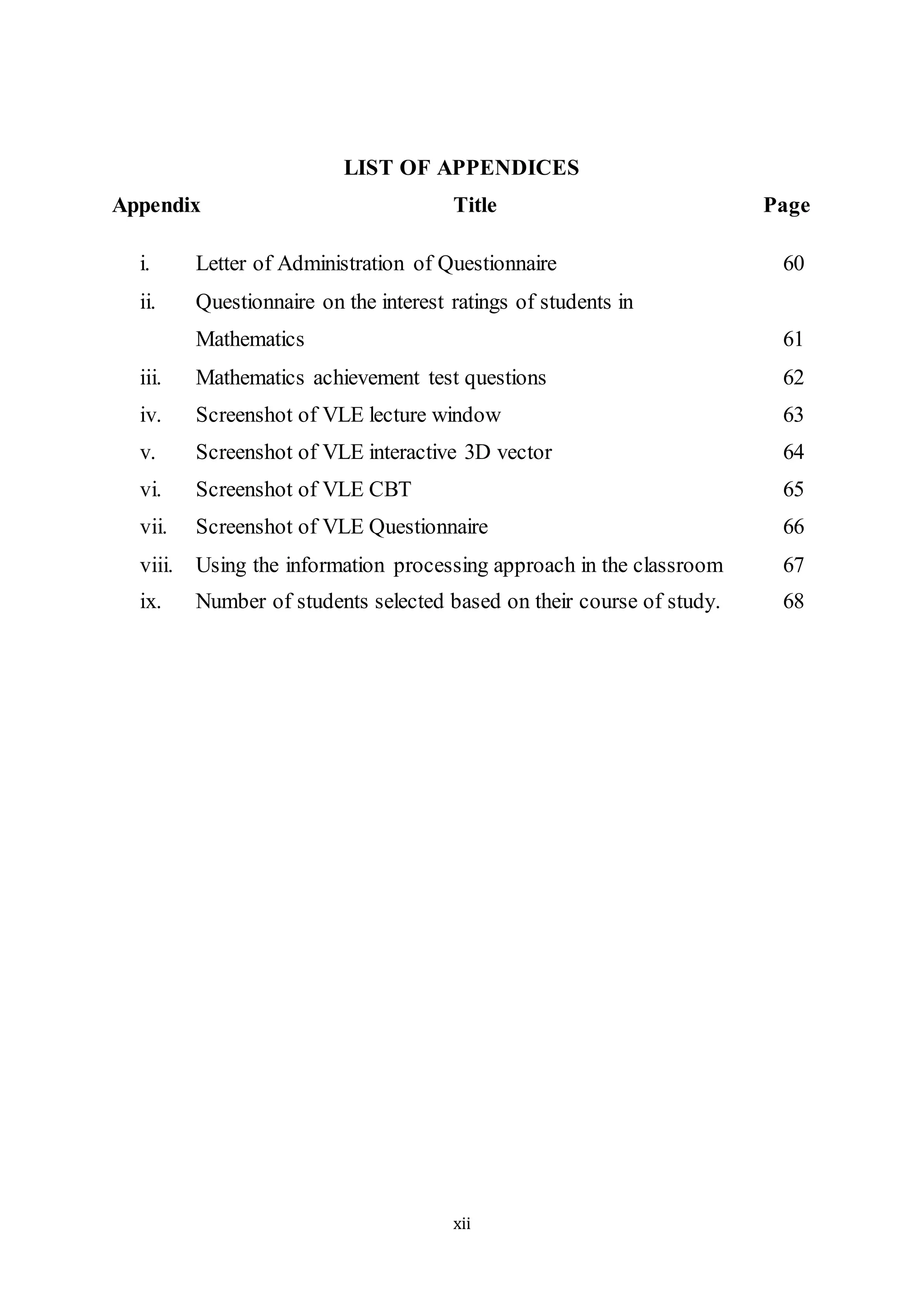
LIST OF APPENDICES
Appendix Title Page
i. Letter of Administration of Questionnaire 60
ii. Questionnaire on the interest ratings of students in
Mathematics 61
iii. Mathematics achievement test questions 62
iv. Screenshot of VLE lecture window 63
v. Screenshot of VLE interactive 3D vector 64
vi. Screenshot of VLE CBT 65
vii. Screenshot of VLE Questionnaire 66
viii. Using the information processing approach in the classroom 67
ix. Number of students selected based on their course of study. 68
xiii
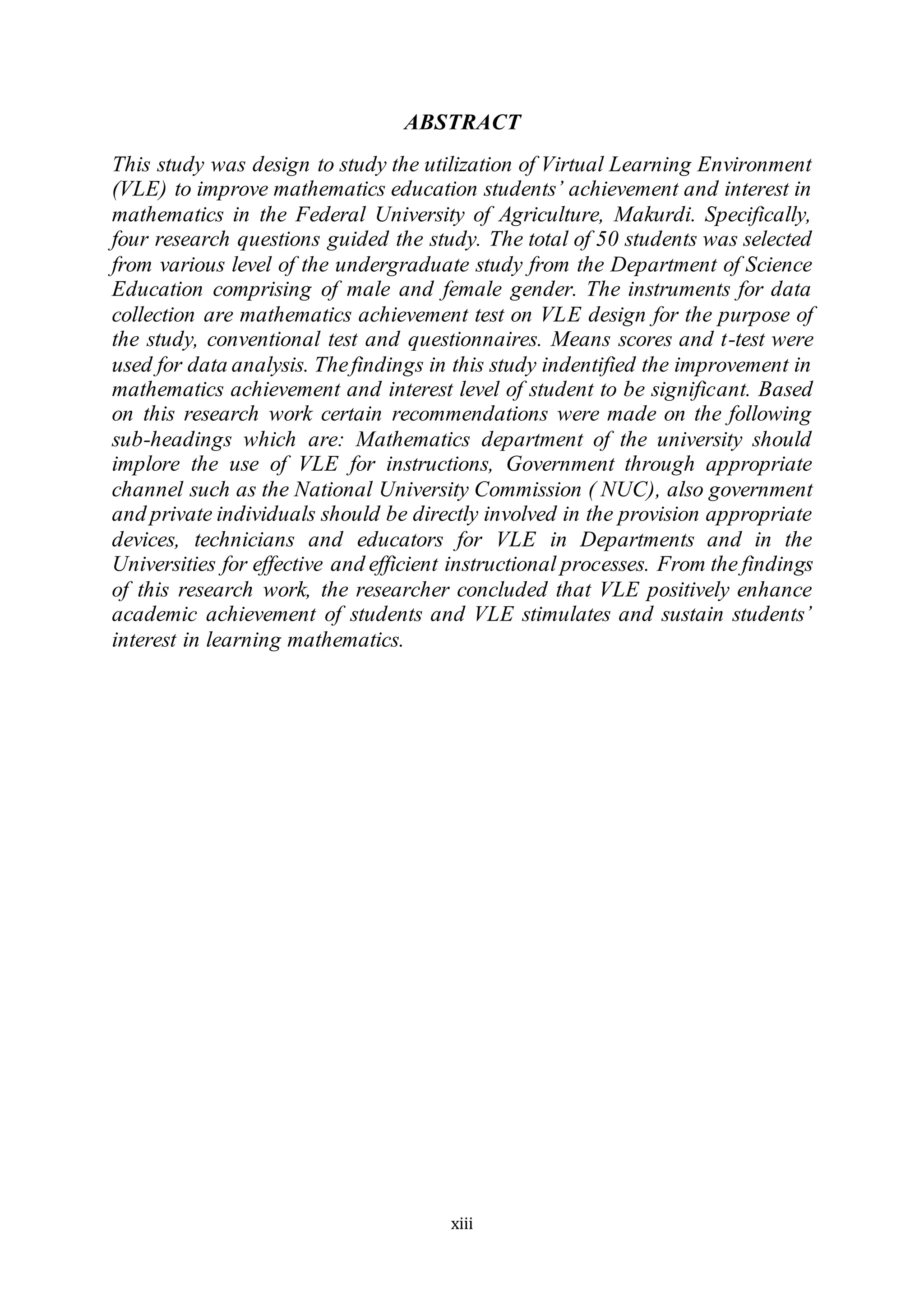
ABSTRACT
This study was design to study the utilization of Virtual Learning Environment
(VLE) to improve mathematics education students’ achievement and interest in
mathematics in the Federal University of Agriculture, Makurdi. Specifically,
four research questions guided the study. The total of 50 students was selected
from various level of the undergraduate study from the Department of Science
Education comprising of male and female gender. The instruments for data
collection are mathematics achievement test on VLE design for the purpose of
the study, conventional test and questionnaires. Means scores and t-test were
used for data analysis. Thefindings in this study indentified the improvement in
mathematics achievement and interest level of student to be significant. Based
on this research work certain recommendations were made on the following
sub-headings which are: Mathematics department of the university should
implore the use of VLE for instructions, Government through appropriate
channel such as the National University Commission ( NUC), also government
and private individuals should be directly involved in the provision appropriate
devices, technicians and educators for VLE in Departments and in the
Universities for effective and efficient instructional processes. From the findings
of this research work, the researcher concluded that VLE positively enhance
academic achievement of students and VLE stimulates and sustain students’
interest in learning mathematics.

The utilization of virtual learning environment (vle) to improve mathematics education students’ achievement and interest in mathematics (1)

  • 1.
    i THE UTILIZATION OFVIRTUAL LEARNING ENVIRONMENT (VLE) TO IMPROVE MATHEMATICS EDUCATION STUDENTS’ ACHIEVEMENT AND INTEREST IN MATHEMATICS IN FEDERAL UNIVERSITY OF AGRICULTURE, MAKURDI BY OLA STEPHEN ONUH (UE/24294/12) DEPARTMENT OF SCIENCE EDUCATION, FEDERAL UNIVERSITY OF AGRICULTURE, MAKURDI, BENUE STATE. APRIL, 2016.
  • 2.
    ii TITLE PAGE THE UTILIZATIONOF VIRTUAL LEARNING ENVIRONMENT (VLE) TO IMPROVE MATHEMATICS EDUCATION STUDENTS’ ACHIEVEMENT AND INTEREST IN MATHEMATICS IN FEDERAL UNIVERSITY OF AGRICULTURE, MAKURDI BY OLA STEPHEN ONUH (UE/24294/12) A RESEARCHWORK PRESENTED TO THE DEPARTMENT OF SCIENCE EDUCATION, FEDERAL UNIVERSITY OF AGRICULTURE, MAKURDI, BENUE STATE. IN PARTIAL FULFILLMENT OF THE REQUIREMENTS FOR THE AWARD OF BACHELOR OF SCIENCE EDUCATION DEREEIN BSC(ED) MATHEMATICS/STATISTICS. APRIL, 2016.
  • 3.
    iii DECLARATION I hereby declarethat this project work represented my originalwork and has notbeen previously submitted for any degree University or similar institution. Name of Student: Ola, Stephen Onuh Singnatureof Student: ……………………………………… Date: ……………………………………….
  • 4.
    iv APPROVAL PAGE This isto certify that this project work has been read and approved by the under signed as meeting the requirement for the award of bachelor of science education in Mathematics/Statistics (B.Sc Ed).University of Agriculture, Makurdi. …………………………………………….. ……………………………… Professor Iji, C. O. Date (Project supervisor) …………………………………………….. ………………….................... Dr. Okwara, O.K. Date (Head of Department) ……………………………………………… ……………………………… (External supervisor) Date
  • 5.
    v DEDICATION This research projectis dedicated to the Almighty God, in whom I lay my trust, who turned all my impossibilities into possible which enabled me achieve this academic fit and made my dream come true.
  • 6.
    vi ACKNOWLEDGEMENTS My heartfelt appreciationgoes to my supervisor Professor Iji, C.O. for his fatherly advice, encouragement, moral and all kinds of assistance leading to the successful completion of this project. Thank you Sir for your patience, sense of direction and the pains you took to make necessary corrections in my work, may God replenish you in thousand folds, Amen. I express deep appreciation to all my lecturers and Lab technologies for their contribution to the success in my academic pursuit through my stay as a student of the department. I am highly indebted to my parents Mr & Mrs Emmaneul who has been working round the clock to see that my programme is successfully completed. Thank you for your parental care, words of advice and encouragement. I also express my deep appreciation to my siblings Frank, Andrew and Victoria for their support in various ways during this programme. I also appreciate profusely, the untiring efforts of my spiritual parents Rev. Fr. Dr. Didacus Kajo, Rev. Fr. A. P. Mom and Rev. Fr. Boniface Idoko for their advice, support and prayers all the way to this point. My special thanks also go to Prof. & Mrs N. Agbulu and Mr & Mrs I. Okachi for their guidance and care. I am appreciating the effort of The Catholic Communication Office of Makurdi for their support and understanding in years working with them even as a student. And the Members and staffs of Server Zero Technologies for their help and support in the development of the software aspect of this work. I am sincerely grateful to my friends Egbe, Chris, Emmanuel, John, Samuel, Peter, Kamalu, Martha, Gabriel, Douglas, Paul, Hycent, Mathew and my pets Change, Jaddy and Blondy. I am sincerelygrateful to all of you for your contributions in different capacities leading to the successful completion of this programme. May the Almighty God grant you all your heart desire, Amen.
  • 7.
    vii TABLE OF CONTENTS Coverpage i Title page ii Certification iii Approval iv Dedication v Acknowledgements vi Table of Contents vii List of Tables x List of Figures xi List of Appendices xii Abstract xiii CHAPTER ONE:INTRODUCTION 1.1 Background of the study 1 1.2 Statement of the Problem 5 1.3 Purposeof the Study 6 1.4 Research question 7 1.5 Research hypothesis 7 1.6 Significance of the Study 8 1.7 Scopeof the Study 8 CHAPTER TWO: LITERATURE REVIEW 2.1 Theoretical framework 10 2.1.1 Information processing theory 10
  • 8.
    viii 2.1.2 Basic assumptionsof information processing theory 13 2.2 Conceptual Framework 19 2.2.1 Virtual Learning Environment (VLE) 19 2.2.2 Students’ Mathematics Achievement 22 2.2.3 Students’ Mathematics Interest 23 2.2.4 Gender and Students’ Mathematics Achievement 24 2.2.5 Gender and Student’s Mathematics Interest 25 2.3 Empirical Studies 26 2.4 Summary 30 CHAPTER THREE:METHODOLOGY 3.1 Research Design 32 3.2 Area of the Study 32 3.3 Population of the Study 32 3.4 Sample and Sampling Technique 33 3.5 Instrument of the Study 33 3.6 Validity of Instrument 34 3.7 Method of Data Collection 34 3.8 Method of Data Analysis 34 CHAPTER FOUR: DATA PRESENTATION ANALYSIS, INTERPRETATIONAND DISCUSSION
  • 9.
    ix 4.1 Research QuestionOne 35 4.2 Research Question Two 36 4.3 Research Question Three 38 4.4 Research Question Four 39 4.5 Research Hypothesis I 41 4.6 Research Hypothesis II 42 4.7 Research Hypothesis III 42 4.8 Research Hypothesis IV 43 4.9 Major Finding 44 4.10 Discussion of findings 45 CHAPTER FIVE: SUMMARY, CONCLUSION, RECOMMENDATION AND SUGGESTION 5.1 Summary 47 5.2 Conclusions 48 5.3 Recommendations 48 5.4 Suggestions for further study 49 References 50
  • 10.
    x LIST OF TABLES TableTitle Page 1. Mean achievement scores of Mathematics Education students taught mathematics using VLE and those taught using conventional method 35 2. Mean interest ratings of Mathematics Education students taught mathematics using VLE and those taught using conventional method 37 3. Mean achievement scores of male and female Mathematics Education students taught mathematics using VLE 38 4. Mean interest ratings of male and female Mathematics Education students taught mathematics using VLE 40 5. Analysis of research hypothesis of mean achievement scores ofVLE taught students and Conventional taught students 41 6. Analysis of research hypothesis of mean interest ratings of VLE taught students and Conventional taught students 42 7. Analysis of research hypothesis of mean achievement scores of male and female students taught using VLE 43 8. Analysis of research hypothesis of mean achievement scores of male and female students taught using VLE 43
  • 11.
    xi LIST OF FIGURES FigureTitle Page 3.1 The information processingsystem 14
  • 12.
    xii LIST OF APPENDICES AppendixTitle Page i. Letter of Administration of Questionnaire 60 ii. Questionnaire on the interest ratings of students in Mathematics 61 iii. Mathematics achievement test questions 62 iv. Screenshot of VLE lecture window 63 v. Screenshot of VLE interactive 3D vector 64 vi. Screenshot of VLE CBT 65 vii. Screenshot of VLE Questionnaire 66 viii. Using the information processing approach in the classroom 67 ix. Number of students selected based on their course of study. 68
  • 13.
    xiii ABSTRACT This study wasdesign to study the utilization of Virtual Learning Environment (VLE) to improve mathematics education students’ achievement and interest in mathematics in the Federal University of Agriculture, Makurdi. Specifically, four research questions guided the study. The total of 50 students was selected from various level of the undergraduate study from the Department of Science Education comprising of male and female gender. The instruments for data collection are mathematics achievement test on VLE design for the purpose of the study, conventional test and questionnaires. Means scores and t-test were used for data analysis. Thefindings in this study indentified the improvement in mathematics achievement and interest level of student to be significant. Based on this research work certain recommendations were made on the following sub-headings which are: Mathematics department of the university should implore the use of VLE for instructions, Government through appropriate channel such as the National University Commission ( NUC), also government and private individuals should be directly involved in the provision appropriate devices, technicians and educators for VLE in Departments and in the Universities for effective and efficient instructional processes. From the findings of this research work, the researcher concluded that VLE positively enhance academic achievement of students and VLE stimulates and sustain students’ interest in learning mathematics.