research


How Manual Tasks Sabotage the Potential of
       Natural Search Marketers
The Unoptimized SEO                                                         www.conductor.com


                  Executive Summary
                  Due to the technical nature of the SEO industry and its immaturity relative to other
                  marketing disciplines, many SEOs spend a significant percentage of their time on
                  manual tasks. Conductor analyzed the day-to-day life of an SEO, determined the
                  tasks they engage in that could be automated and examined how technology
                  could increase their output.

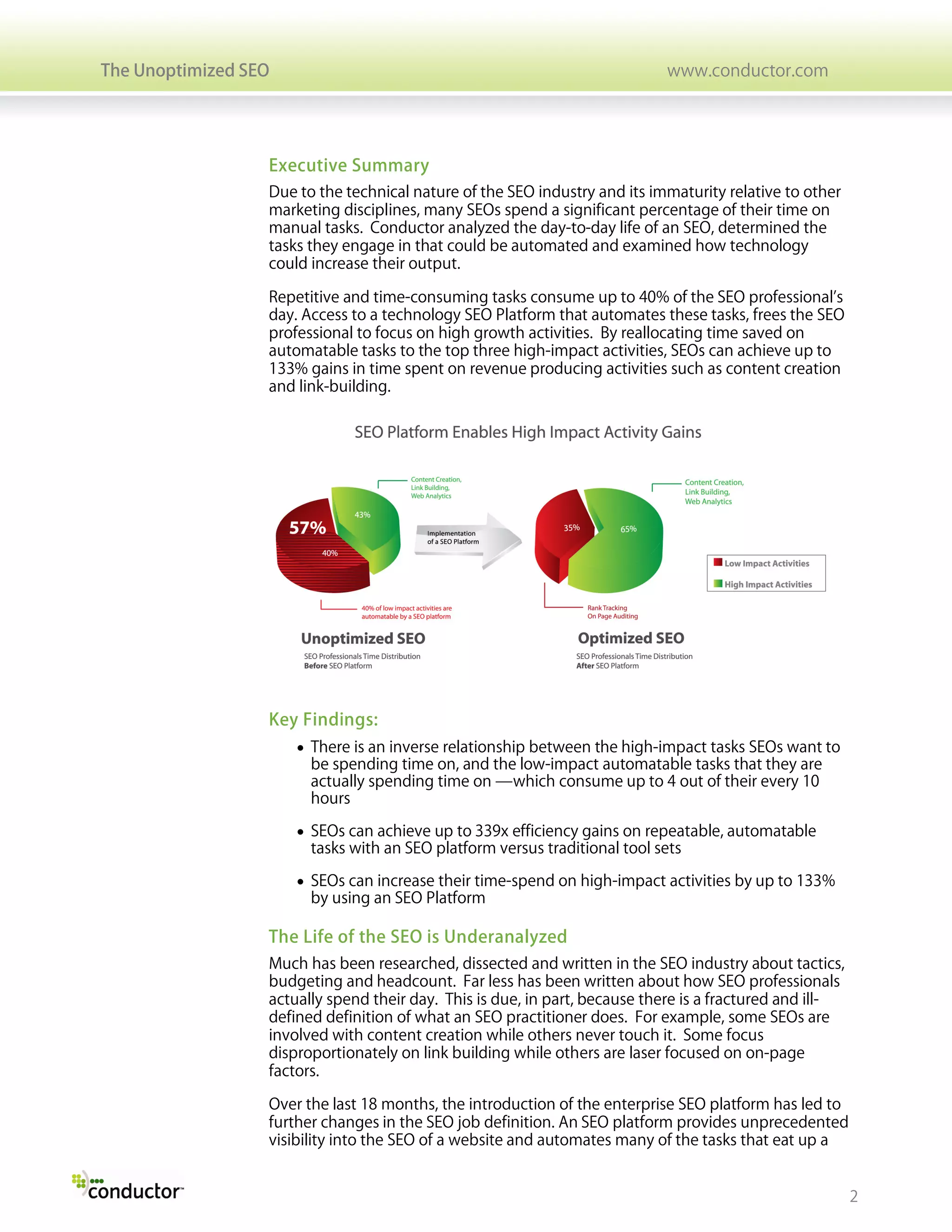
                  Repetitive and time-consuming tasks consume up to 40% of the SEO professional’s
                  day. Access to a technology SEO Platform that automates these tasks, frees the SEO
                  professional to focus on high growth activities. By reallocating time saved on
                  automatable tasks to the top three high-impact activities, SEOs can achieve up to
                  133% gains in time spent on revenue producing activities such as content creation
                  and link-building.


                  Key Findings:
                      • There is an inverse relationship between the high-impact tasks SEOs want to
                        be spending time on, and the low-impact automatable tasks that they are
                        actually spending time on —which consume up to 4 out of their every 10
                        hours

                      • SEOs can achieve up to 339x efficiency gains on repeatable, automatable
                        tasks with an SEO platform versus traditional tool sets

                      • SEOs can increase their time-spend on high-impact activities by up to 133%
                        by using an SEO Platform

                  The Life of the SEO is Underanalyzed
                  Much has been researched, dissected and written in the SEO industry about tactics,
                  budgeting and headcount. Far less has been written about how SEO professionals
                  actually spend their day. This is due, in part, because there is a fractured and ill-
                  defined definition of what an SEO practitioner does. For example, some SEOs are
                  involved with content creation while others never touch it. Some focus
                  disproportionately on link building while others are laser focused on on-page
                  factors.

                  Over the last 18 months, the introduction of the enterprise SEO platform has led to
                  further changes in the SEO job definition. An SEO platform provides unprecedented
                  visibility into the SEO of a website and automates many of the tasks that eat up a


                                                                                                          2
The Unoptimized SEO                                                         www.conductor.com


                  large percentage of the SEO professional’s time, permanently altering the way SEOs
                  do their job.

                  With this paper, for the first time in the industry, Conductor will formally quantify
                  how an SEO’s task breakdown changes when they have access to the efficiencies of
                  an SEO platform.

                  SEOs Surveyed About How They Spend Their Time
                  To gather conclusive data about how an SEO professional spends their day,
                  Conductor surveyed 65 Enterprise Marketers with ‘SEO’ in their job title about the
                  percentage of time they spend on various SEO tasks. Respondents were asked to
                  indicate the percentage of their time they spend on each of the following activities:

                      • Content Creation

                      • Keyword Research

                      • Link Building

                      • On Page Auditing

                      • On Page Changes

                      • Rank Tracking

                      • Technical Issues

                      • Web Analytics

                  Manual Tasks Consume the SEO
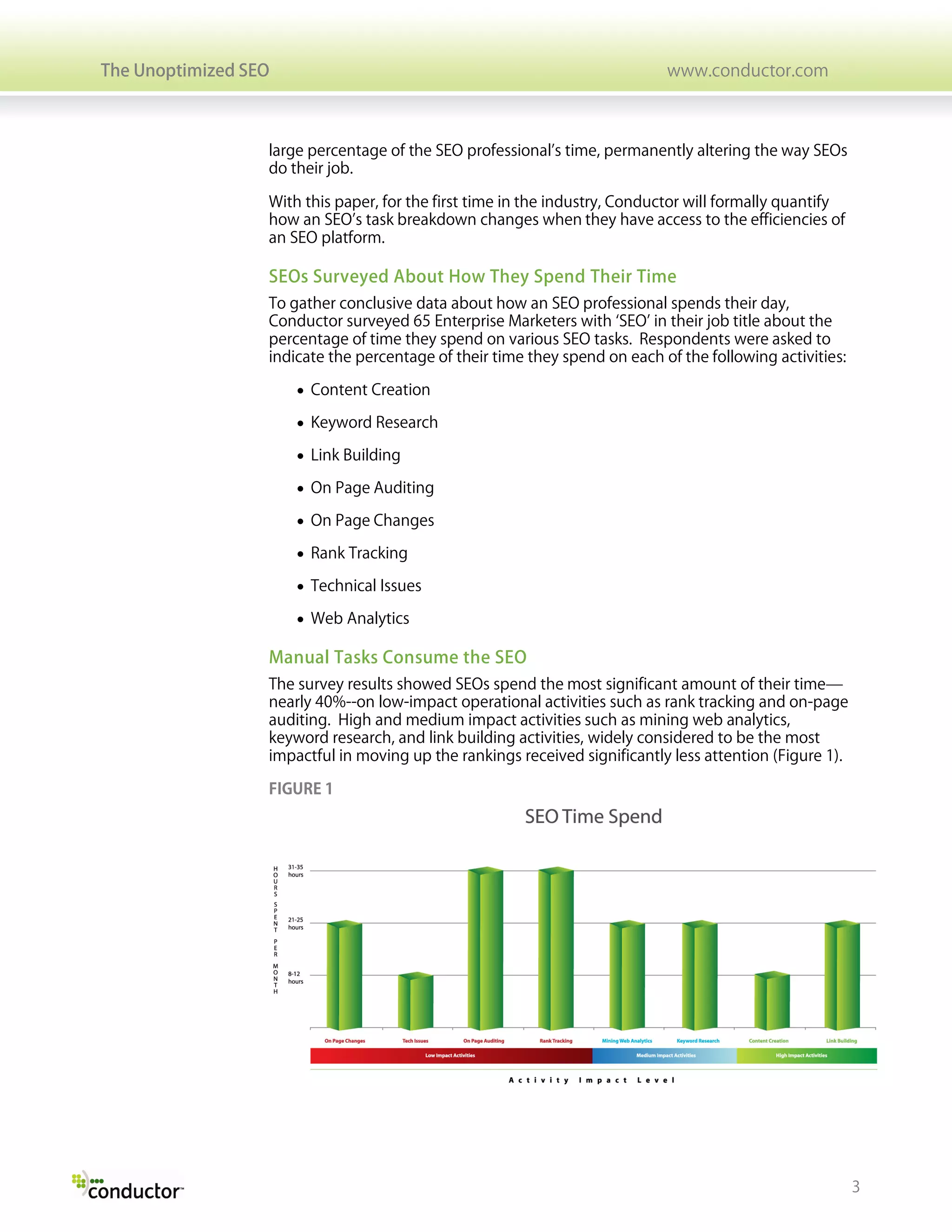
                  The survey results showed SEOs spend the most significant amount of their time—
                  nearly 40%--on low-impact operational activities such as rank tracking and on-page
                  auditing. High and medium impact activities such as mining web analytics,
                  keyword research, and link building activities, widely considered to be the most
                  impactful in moving up the rankings received significantly less attention (Figure 1).

                  FIGURE 1


                                                                                                          3
The Unoptimized SEO                                                       www.conductor.com


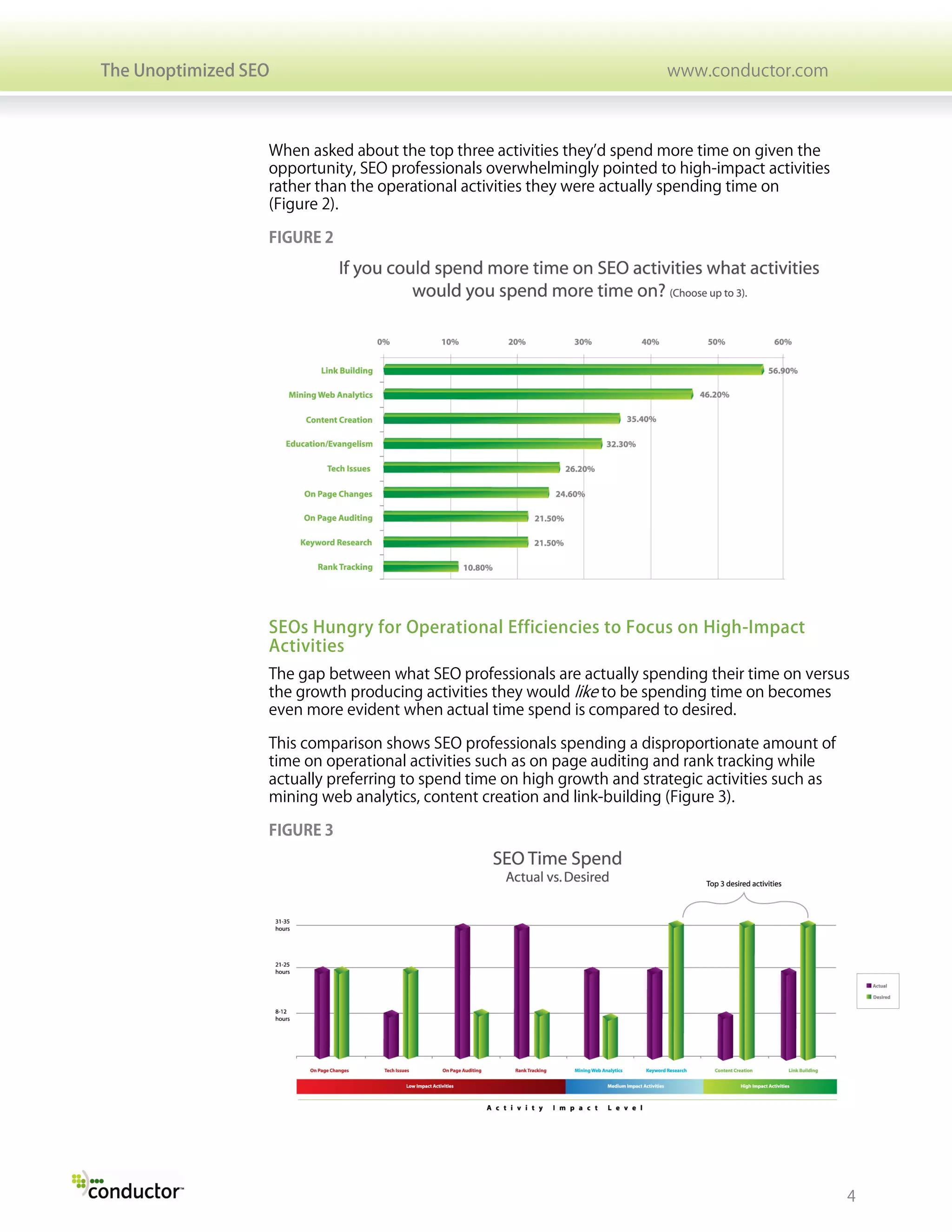
                  When asked about the top three activities they’d spend more time on given the
                  opportunity, SEO professionals overwhelmingly pointed to high-impact activities
                  rather than the operational activities they were actually spending time on
                  (Figure 2).

                  FIGURE 2


                  SEOs Hungry for Operational Efficiencies to Focus on High-Impact
                  Activities
                  The gap between what SEO professionals are actually spending their time on versus
                  the growth producing activities they would like to be spending time on becomes
                  even more evident when actual time spend is compared to desired.

                  This comparison shows SEO professionals spending a disproportionate amount of
                  time on operational activities such as on page auditing and rank tracking while
                  actually preferring to spend time on high growth and strategic activities such as
                  mining web analytics, content creation and link-building (Figure 3).

                  FIGURE 3


                                                                                                      4
The Unoptimized SEO                                                         www.conductor.com


                  Quantify Potential Time Savings with Operational Efficiencies
                  To determine how the enterprise SEO professional’s day changes with efficiencies in
                  their operational activities, Conductor designed a series of experiments to simulate
                  their weekly rank tracking activities. The target of the simulation is to end up with
                  the basic metrics required to effectively run an SEO campaign, which include:

                      • Search engine ranking data from Google and Bing

                      • Basic competitor data

                      • Basic keyword trending data

                  The timed experiments simulated an SEO gathering rank data every week over a
                  four-week period. To adequately represent SEO professionals from the broad
                  spectrum of SEO technology maturity, experiments were run using:

                      • Manual tools (a web browser and Excel)

                      • Semi-automatic tools (rank-tracking software)

                      • Fully automatic SEO automation platform

                  To simulate the described activities the experimenter:

                      1. Gathered rank for target keywords in Google and Bing up to position 50

                      2. Gathered rank for each keyword for up to 5 competitors

                      3. Did light trend analysis to expose week over week trends

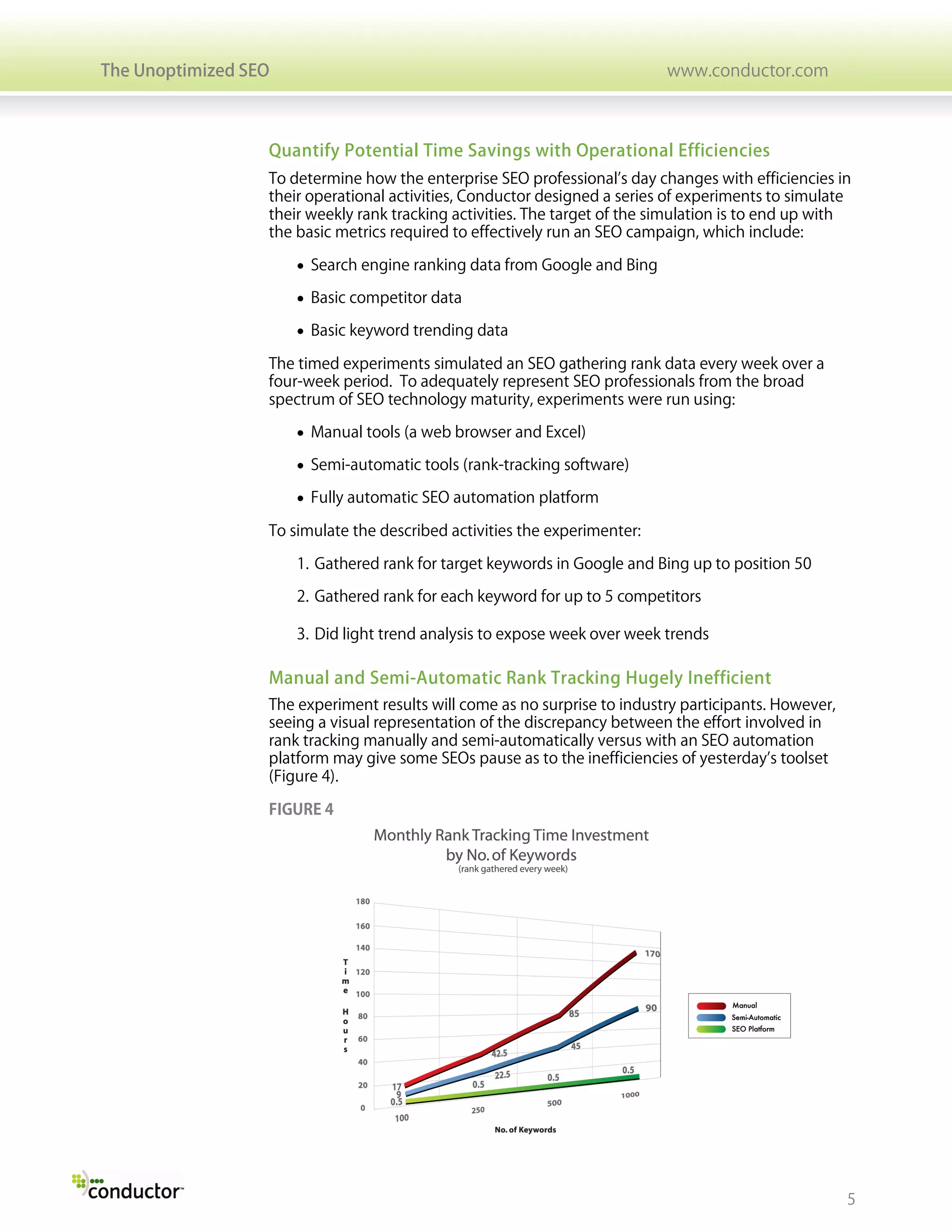
                  Manual and Semi-Automatic Rank Tracking Hugely Inefficient
                  The experiment results will come as no surprise to industry participants. However,
                  seeing a visual representation of the discrepancy between the effort involved in
                  rank tracking manually and semi-automatically versus with an SEO automation
                  platform may give some SEOs pause as to the inefficiencies of yesterday’s toolset
                  (Figure 4).

                  FIGURE 4


                                                                                                       5
The Unoptimized SEO                                                           www.conductor.com


                  Manual
                  The results highlighted the inefficiencies in gathering and analyzing key ranking
                  metrics using manual and semi-automated tools. No SEO in their right mind would
                  manually track rank for a thousand keywords every week, but we talked with SEOs
                  that still do so for hundreds of keywords. Conductor included manual rank tracking
                  for up to 1,000 keywords for illustrative purposes.

                  Semi-Automated
                  While semi-automated tools do a reasonable job of gathering basic rank data on a
                  one-time basis they are not designed to effectively rank-track over time. Exposing
                  rank change trends requires an export to Excel and labor intensive data
                  manipulation. Conductor encountered these limitations in our experimentation,
                  and this accounts for semi-automatic’s ‘up and to the right’ data series reflected in
                  the chart below.

                  SEO Platform
                  The SEO automation platform, on the other hand, effectively tracks rank for up to
                  thousands of keywords and multiple competitors, and does automatic trend
                  analysis for target keywords and competitors. The time investment is unchanged
                  even as keywords scale, requiring little more than half an hour for initial loading of
                  keywords in the system.

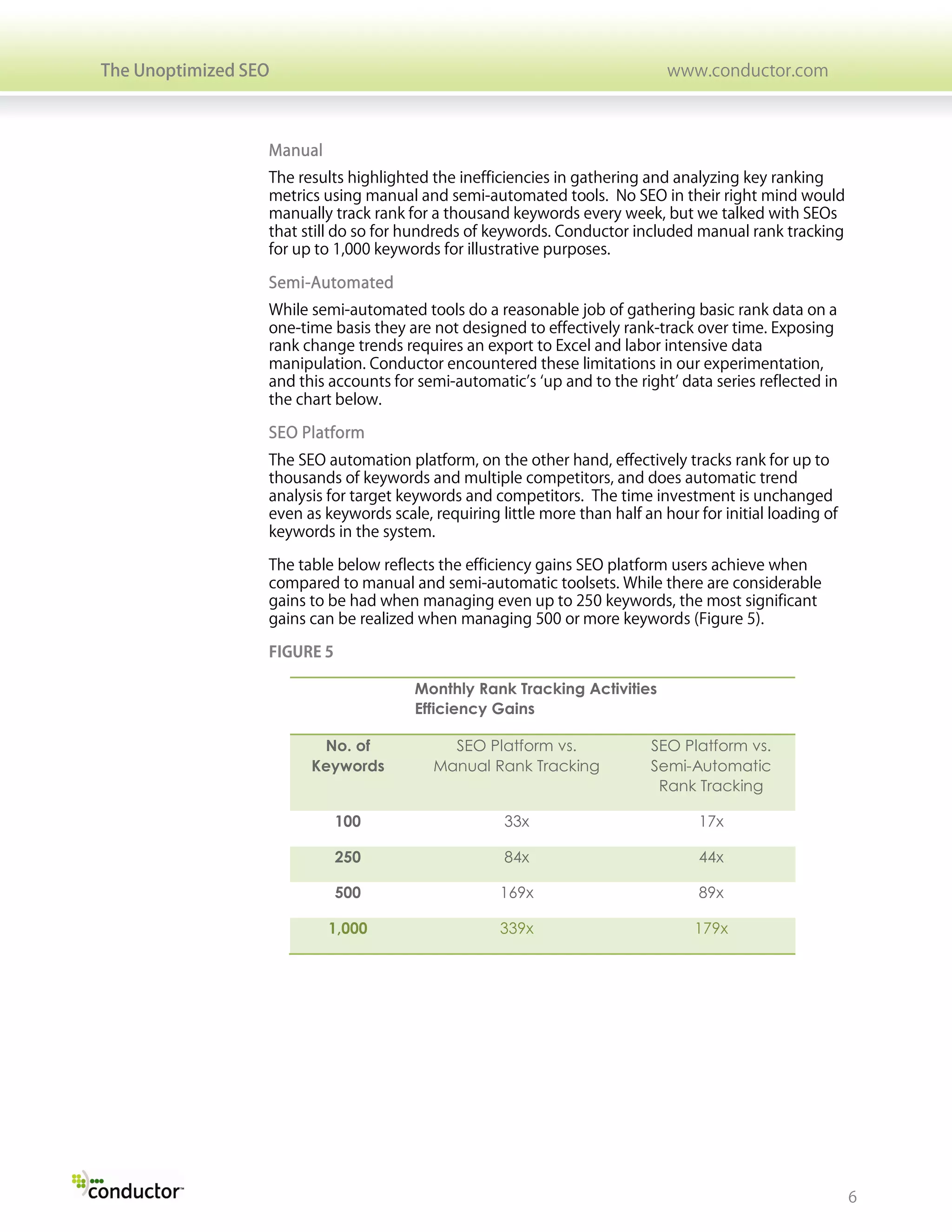
                  The table below reflects the efficiency gains SEO platform users achieve when
                  compared to manual and semi-automatic toolsets. While there are considerable
                  gains to be had when managing even up to 250 keywords, the most significant
                  gains can be realized when managing 500 or more keywords (Figure 5).

                  FIGURE 5

                                        Monthly Rank Tracking Activities
                                        Efficiency Gains

                         No. of             SEO Platform vs.               SEO Platform vs.
                        Keywords          Manual Rank Tracking             Semi-Automatic
                                                                            Rank Tracking

                             100                     33x                          17x

                             250                     84x                          44x

                             500                    169x                          89x

                           1,000                    339x                          179x


                                                                                                           6
The Unoptimized SEO                                                         www.conductor.com


                  SEO Platform Operational Efficiencies Enable High-Impact Activity
                  Focus
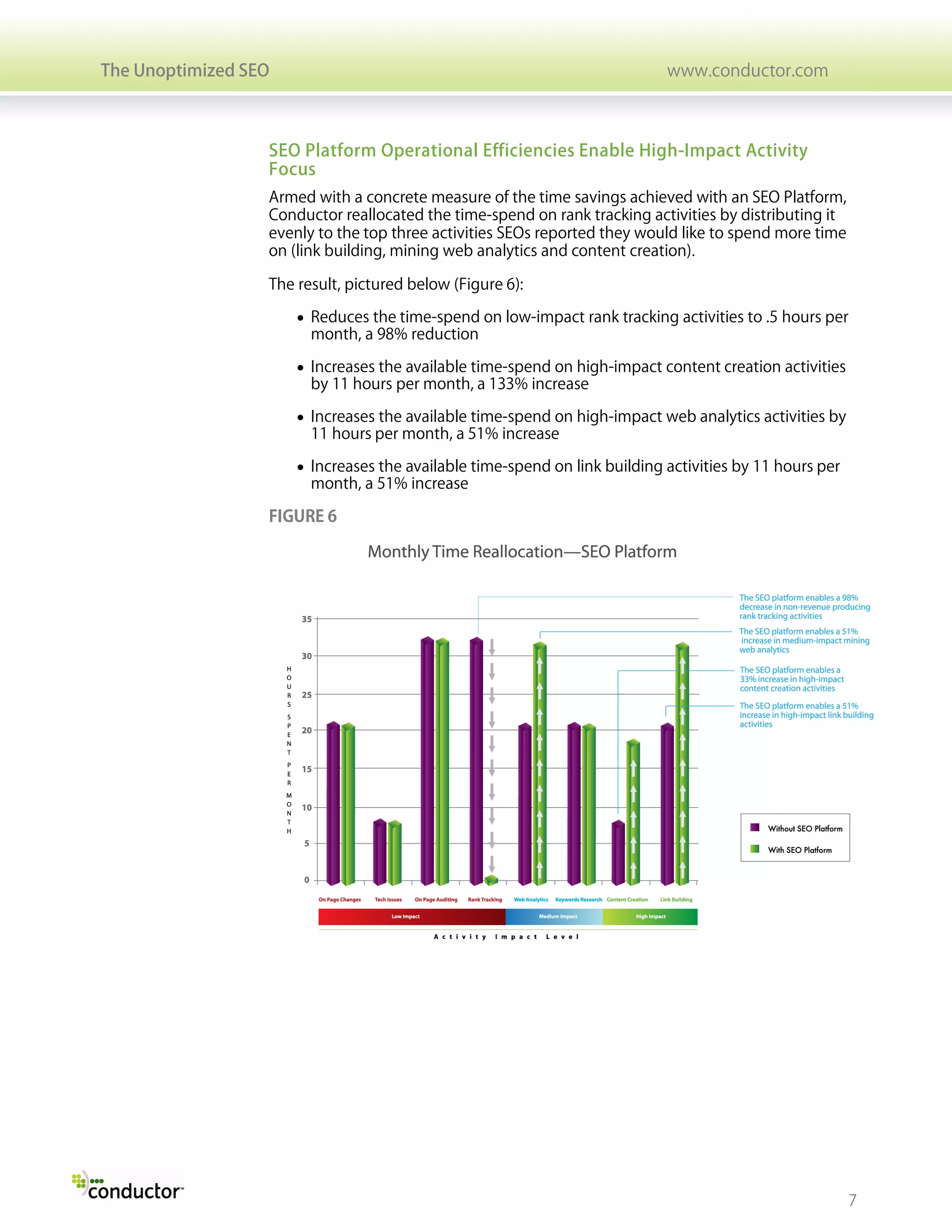
                  Armed with a concrete measure of the time savings achieved with an SEO Platform,
                  Conductor reallocated the time-spend on rank tracking activities by distributing it
                  evenly to the top three activities SEOs reported they would like to spend more time
                  on (link building, mining web analytics and content creation).

                  The result, pictured below (Figure 6):

                      • Reduces the time-spend on low-impact rank tracking activities to .5 hours per
                        month, a 98% reduction

                      • Increases the available time-spend on high-impact content creation activities
                        by 11 hours per month, a 133% increase

                      • Increases the available time-spend on high-impact web analytics activities by
                        11 hours per month, a 51% increase

                      • Increases the available time-spend on link building activities by 11 hours per
                        month, a 51% increase

                  FIGURE 6


                                                                                                         7
The Unoptimized SEO                                                          www.conductor.com


                  Summary
                  Our previous white paper demonstrated how the SEO Platform is bringing SEO
                  considerably closer to the technology maturity of other online marketing
                  disciplines. This paper takes us one step further by quantifying the efficiencies the
                  SEO platform bring the SEO professional. Specifically, how does the day of the SEO
                  professional change given the introduction of the SEO platform?

                  Survey data demonstrates conclusively that SEOs hunger for operational
                  efficiencies in their day so they can focus on growth activities. Conductor showed,
                  with an experiment based approach, how the SEO Platform can give the SEO
                  professional these efficiencies in rank-tracking activities – up to 340x more efficient
                  than manual or semi-automatic toolsets. By applying the newfound efficiencies to
                  the top three activities SEOs want to spend more time on, Conductor demonstrated
                  how they can focus a significantly larger percentage of their time on strategic and
                  growth oriented activities that will actually have a material impact on natural search
                  visibility.

                  In the next paper in our ongoing series on the SEO platform, Conductor will apply a
                  similar experiment-based approach to calculating efficiency gains in on-page
                  auditing that can be achieved with an SEO platform. To close the loop, Conductor
                  will then apply those gains to the ones described in this paper to obtain a complete
                  picture of the operational efficiencies attainable with an SEO platform.


                                                                                                            8

The Unoptimized SEO

  • 1.
    research How Manual TasksSabotage the Potential of Natural Search Marketers
  • 2.
    The Unoptimized SEO www.conductor.com Executive Summary Due to the technical nature of the SEO industry and its immaturity relative to other marketing disciplines, many SEOs spend a significant percentage of their time on manual tasks. Conductor analyzed the day-to-day life of an SEO, determined the tasks they engage in that could be automated and examined how technology could increase their output. Repetitive and time-consuming tasks consume up to 40% of the SEO professional’s day. Access to a technology SEO Platform that automates these tasks, frees the SEO professional to focus on high growth activities. By reallocating time saved on automatable tasks to the top three high-impact activities, SEOs can achieve up to 133% gains in time spent on revenue producing activities such as content creation and link-building. Key Findings: • There is an inverse relationship between the high-impact tasks SEOs want to be spending time on, and the low-impact automatable tasks that they are actually spending time on —which consume up to 4 out of their every 10 hours • SEOs can achieve up to 339x efficiency gains on repeatable, automatable tasks with an SEO platform versus traditional tool sets • SEOs can increase their time-spend on high-impact activities by up to 133% by using an SEO Platform The Life of the SEO is Underanalyzed Much has been researched, dissected and written in the SEO industry about tactics, budgeting and headcount. Far less has been written about how SEO professionals actually spend their day. This is due, in part, because there is a fractured and ill- defined definition of what an SEO practitioner does. For example, some SEOs are involved with content creation while others never touch it. Some focus disproportionately on link building while others are laser focused on on-page factors. Over the last 18 months, the introduction of the enterprise SEO platform has led to further changes in the SEO job definition. An SEO platform provides unprecedented visibility into the SEO of a website and automates many of the tasks that eat up a 2
  • 3.
    The Unoptimized SEO www.conductor.com large percentage of the SEO professional’s time, permanently altering the way SEOs do their job. With this paper, for the first time in the industry, Conductor will formally quantify how an SEO’s task breakdown changes when they have access to the efficiencies of an SEO platform. SEOs Surveyed About How They Spend Their Time To gather conclusive data about how an SEO professional spends their day, Conductor surveyed 65 Enterprise Marketers with ‘SEO’ in their job title about the percentage of time they spend on various SEO tasks. Respondents were asked to indicate the percentage of their time they spend on each of the following activities: • Content Creation • Keyword Research • Link Building • On Page Auditing • On Page Changes • Rank Tracking • Technical Issues • Web Analytics Manual Tasks Consume the SEO The survey results showed SEOs spend the most significant amount of their time— nearly 40%--on low-impact operational activities such as rank tracking and on-page auditing. High and medium impact activities such as mining web analytics, keyword research, and link building activities, widely considered to be the most impactful in moving up the rankings received significantly less attention (Figure 1). FIGURE 1 3
  • 4.
    The Unoptimized SEO www.conductor.com When asked about the top three activities they’d spend more time on given the opportunity, SEO professionals overwhelmingly pointed to high-impact activities rather than the operational activities they were actually spending time on (Figure 2). FIGURE 2 SEOs Hungry for Operational Efficiencies to Focus on High-Impact Activities The gap between what SEO professionals are actually spending their time on versus the growth producing activities they would like to be spending time on becomes even more evident when actual time spend is compared to desired. This comparison shows SEO professionals spending a disproportionate amount of time on operational activities such as on page auditing and rank tracking while actually preferring to spend time on high growth and strategic activities such as mining web analytics, content creation and link-building (Figure 3). FIGURE 3 4
  • 5.
    The Unoptimized SEO www.conductor.com Quantify Potential Time Savings with Operational Efficiencies To determine how the enterprise SEO professional’s day changes with efficiencies in their operational activities, Conductor designed a series of experiments to simulate their weekly rank tracking activities. The target of the simulation is to end up with the basic metrics required to effectively run an SEO campaign, which include: • Search engine ranking data from Google and Bing • Basic competitor data • Basic keyword trending data The timed experiments simulated an SEO gathering rank data every week over a four-week period. To adequately represent SEO professionals from the broad spectrum of SEO technology maturity, experiments were run using: • Manual tools (a web browser and Excel) • Semi-automatic tools (rank-tracking software) • Fully automatic SEO automation platform To simulate the described activities the experimenter: 1. Gathered rank for target keywords in Google and Bing up to position 50 2. Gathered rank for each keyword for up to 5 competitors 3. Did light trend analysis to expose week over week trends Manual and Semi-Automatic Rank Tracking Hugely Inefficient The experiment results will come as no surprise to industry participants. However, seeing a visual representation of the discrepancy between the effort involved in rank tracking manually and semi-automatically versus with an SEO automation platform may give some SEOs pause as to the inefficiencies of yesterday’s toolset (Figure 4). FIGURE 4 5
  • 6.
    The Unoptimized SEO www.conductor.com Manual The results highlighted the inefficiencies in gathering and analyzing key ranking metrics using manual and semi-automated tools. No SEO in their right mind would manually track rank for a thousand keywords every week, but we talked with SEOs that still do so for hundreds of keywords. Conductor included manual rank tracking for up to 1,000 keywords for illustrative purposes. Semi-Automated While semi-automated tools do a reasonable job of gathering basic rank data on a one-time basis they are not designed to effectively rank-track over time. Exposing rank change trends requires an export to Excel and labor intensive data manipulation. Conductor encountered these limitations in our experimentation, and this accounts for semi-automatic’s ‘up and to the right’ data series reflected in the chart below. SEO Platform The SEO automation platform, on the other hand, effectively tracks rank for up to thousands of keywords and multiple competitors, and does automatic trend analysis for target keywords and competitors. The time investment is unchanged even as keywords scale, requiring little more than half an hour for initial loading of keywords in the system. The table below reflects the efficiency gains SEO platform users achieve when compared to manual and semi-automatic toolsets. While there are considerable gains to be had when managing even up to 250 keywords, the most significant gains can be realized when managing 500 or more keywords (Figure 5). FIGURE 5 Monthly Rank Tracking Activities Efficiency Gains No. of SEO Platform vs. SEO Platform vs. Keywords Manual Rank Tracking Semi-Automatic Rank Tracking 100 33x 17x 250 84x 44x 500 169x 89x 1,000 339x 179x 6
  • 7.
    The Unoptimized SEO www.conductor.com SEO Platform Operational Efficiencies Enable High-Impact Activity Focus Armed with a concrete measure of the time savings achieved with an SEO Platform, Conductor reallocated the time-spend on rank tracking activities by distributing it evenly to the top three activities SEOs reported they would like to spend more time on (link building, mining web analytics and content creation). The result, pictured below (Figure 6): • Reduces the time-spend on low-impact rank tracking activities to .5 hours per month, a 98% reduction • Increases the available time-spend on high-impact content creation activities by 11 hours per month, a 133% increase • Increases the available time-spend on high-impact web analytics activities by 11 hours per month, a 51% increase • Increases the available time-spend on link building activities by 11 hours per month, a 51% increase FIGURE 6 7
  • 8.
    The Unoptimized SEO www.conductor.com Summary Our previous white paper demonstrated how the SEO Platform is bringing SEO considerably closer to the technology maturity of other online marketing disciplines. This paper takes us one step further by quantifying the efficiencies the SEO platform bring the SEO professional. Specifically, how does the day of the SEO professional change given the introduction of the SEO platform? Survey data demonstrates conclusively that SEOs hunger for operational efficiencies in their day so they can focus on growth activities. Conductor showed, with an experiment based approach, how the SEO Platform can give the SEO professional these efficiencies in rank-tracking activities – up to 340x more efficient than manual or semi-automatic toolsets. By applying the newfound efficiencies to the top three activities SEOs want to spend more time on, Conductor demonstrated how they can focus a significantly larger percentage of their time on strategic and growth oriented activities that will actually have a material impact on natural search visibility. In the next paper in our ongoing series on the SEO platform, Conductor will apply a similar experiment-based approach to calculating efficiency gains in on-page auditing that can be achieved with an SEO platform. To close the loop, Conductor will then apply those gains to the ones described in this paper to obtain a complete picture of the operational efficiencies attainable with an SEO platform. 8