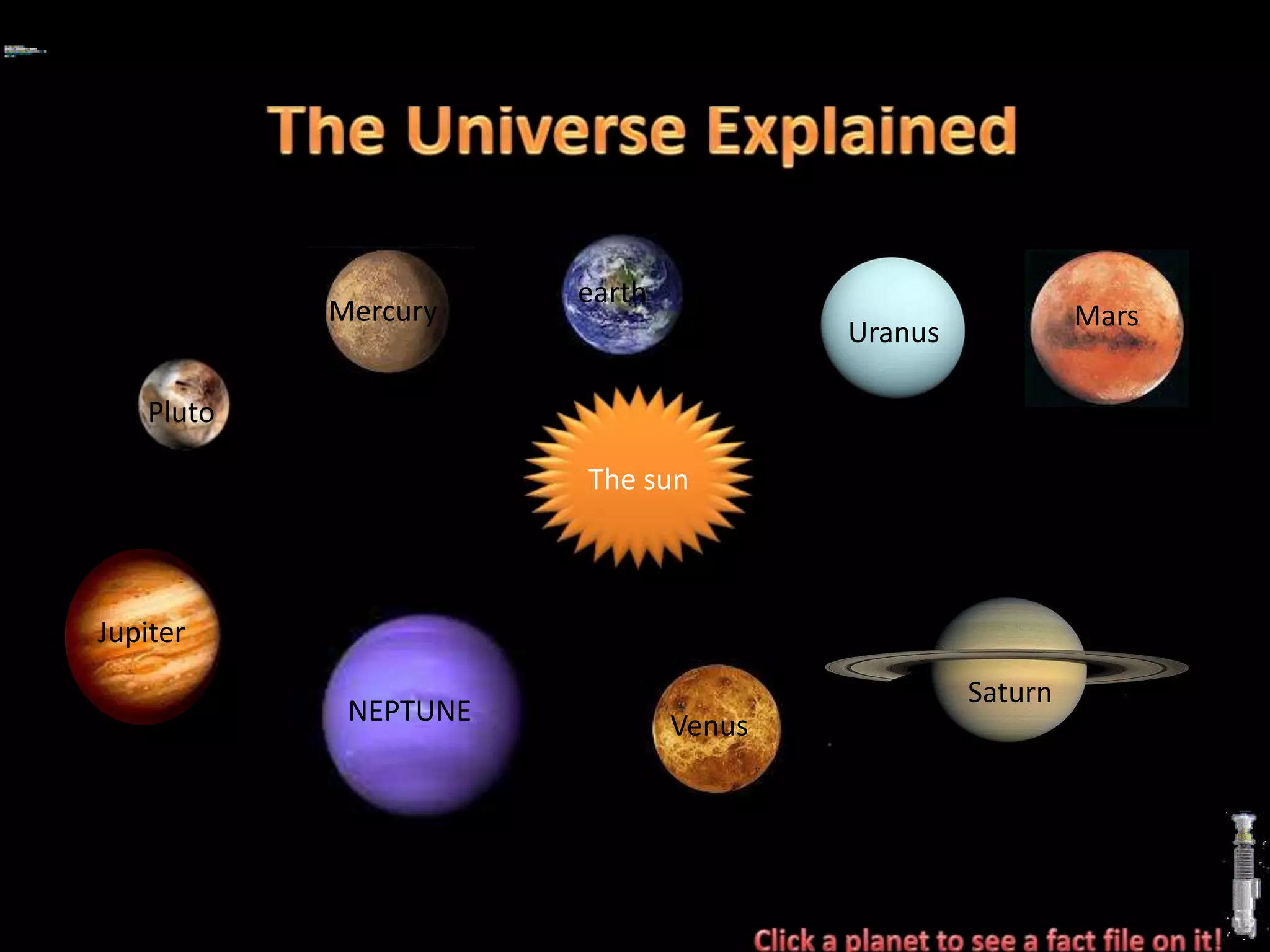
earth
           Mercury                                      Mars
                                      Uranus

   Pluto

                      The sun


Jupiter
                                               Saturn
            NEPTUNE           Venus
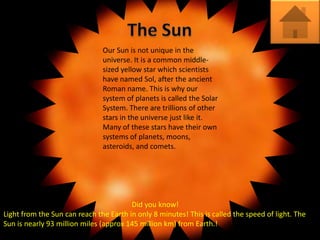
Our Sun is not unique in the
                               universe. It is a common middle-
                               sized yellow star which scientists
                               have named Sol, after the ancient
                               Roman name. This is why our
                               system of planets is called the Solar
                               System. There are trillions of other
                               stars in the universe just like it.
                               Many of these stars have their own
                               systems of planets, moons,
                               asteroids, and comets.


                                        Did you know!
Light from the Sun can reach the Earth in only 8 minutes! This is called the speed of light. The
Sun is nearly 93 million miles (approx 145 million km) from Earth.!
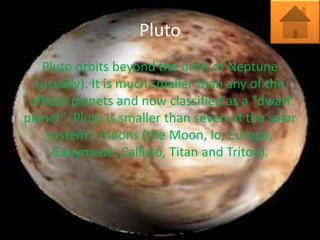
Pluto
   Pluto orbits beyond the orbit of Neptune
  (usually). It is much smaller than any of the
 official planets and now classified as a "dwarf
planet". Pluto is smaller than seven of the solar
     system's moons (the Moon, Io, Europa,
      Ganymede, Callisto, Titan and Triton).
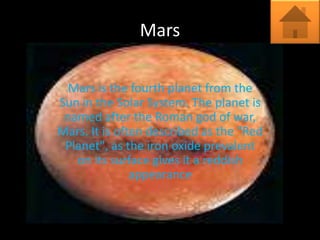
Mars

  Mars is the fourth planet from the
Sun in the Solar System. The planet is
 named after the Roman god of war,
Mars. It is often described as the "Red
 Planet", as the iron oxide prevalent
   on its surface gives it a reddish
               appearance
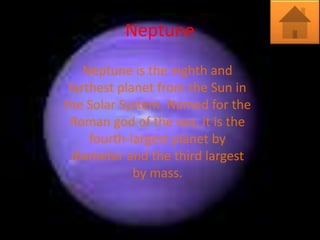
Neptune
    Neptune is the eighth and
 farthest planet from the Sun in
the Solar System. Named for the
 Roman god of the sea, it is the
     fourth-largest planet by
  diameter and the third largest
             by mass.
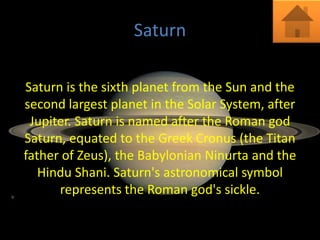
Saturn

Saturn is the sixth planet from the Sun and the
second largest planet in the Solar System, after
 Jupiter. Saturn is named after the Roman god
Saturn, equated to the Greek Cronus (the Titan
father of Zeus), the Babylonian Ninurta and the
   Hindu Shani. Saturn's astronomical symbol
      represents the Roman god's sickle.
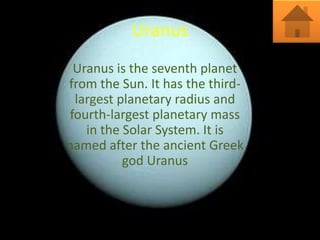
Uranus
 Uranus is the seventh planet
from the Sun. It has the third-
 largest planetary radius and
fourth-largest planetary mass
   in the Solar System. It is
named after the ancient Greek
          god Uranus
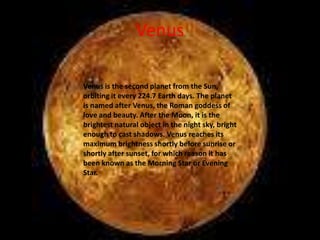
Venus

Venus is the second planet from the Sun,
orbiting it every 224.7 Earth days. The planet
is named after Venus, the Roman goddess of
love and beauty. After the Moon, it is the
brightest natural object in the night sky, bright
enough to cast shadows. Venus reaches its
maximum brightness shortly before sunrise or
shortly after sunset, for which reason it has
been known as the Morning Star or Evening
Star.
Jupiter
• Jupiter is the fifth planet from the
  Sun and the largest planet within
  the Solar System.[13] It is a gas
  giant with mass one-thousandth
  that of the Sun but is two and a
  half times the mass of all the
  other planets in our Solar System
  combined. Jupiter is classified as
  a gas giant along with Saturn,
  Uranus and Neptune. Together,
  these four planets are sometimes
  referred to as the Jovian or outer
  planets.
Mercury
• Mercury is the smallest planet in the
  Solar System, orbiting the Sun once
  every 87.969 Earth days. The orbit of
  Mercury has the highest eccentricity of
  all the Solar System planets, and it has
  the smallest axial tilt. It completes
  three rotations about its axis for every
  two orbits. The perihelion of Mercury's
  orbit processes around the Sun at an
  excess of 43 arc seconds per century, a
  phenomenon that was explained in the
  20th century by Albert Einstein's
  General Theory of Relativity.[11]
  Mercury is bright when viewed from
  Earth, ranging from −2.3 to 5.7 in
  apparent magnitude
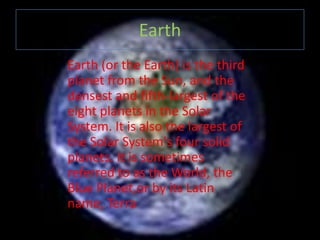
Earth
Earth (or the Earth) is the third
planet from the Sun, and the
densest and fifth-largest of the
eight planets in the Solar
System. It is also the largest of
the Solar System's four solid
planets. It is sometimes
referred to as the World, the
Blue Planet,or by its Latin
name, Terra

The universe explained

  • 1.
    earth Mercury Mars Uranus Pluto The sun Jupiter Saturn NEPTUNE Venus
  • 2.
    Our Sun isnot unique in the universe. It is a common middle- sized yellow star which scientists have named Sol, after the ancient Roman name. This is why our system of planets is called the Solar System. There are trillions of other stars in the universe just like it. Many of these stars have their own systems of planets, moons, asteroids, and comets. Did you know! Light from the Sun can reach the Earth in only 8 minutes! This is called the speed of light. The Sun is nearly 93 million miles (approx 145 million km) from Earth.!
  • 3.
    Pluto Pluto orbits beyond the orbit of Neptune (usually). It is much smaller than any of the official planets and now classified as a "dwarf planet". Pluto is smaller than seven of the solar system's moons (the Moon, Io, Europa, Ganymede, Callisto, Titan and Triton).
  • 4.
    Mars Marsis the fourth planet from the Sun in the Solar System. The planet is named after the Roman god of war, Mars. It is often described as the "Red Planet", as the iron oxide prevalent on its surface gives it a reddish appearance
  • 5.
    Neptune Neptune is the eighth and farthest planet from the Sun in the Solar System. Named for the Roman god of the sea, it is the fourth-largest planet by diameter and the third largest by mass.
  • 6.
    Saturn Saturn is thesixth planet from the Sun and the second largest planet in the Solar System, after Jupiter. Saturn is named after the Roman god Saturn, equated to the Greek Cronus (the Titan father of Zeus), the Babylonian Ninurta and the Hindu Shani. Saturn's astronomical symbol represents the Roman god's sickle.
  • 7.
    Uranus Uranus isthe seventh planet from the Sun. It has the third- largest planetary radius and fourth-largest planetary mass in the Solar System. It is named after the ancient Greek god Uranus
  • 8.
    Venus Venus is thesecond planet from the Sun, orbiting it every 224.7 Earth days. The planet is named after Venus, the Roman goddess of love and beauty. After the Moon, it is the brightest natural object in the night sky, bright enough to cast shadows. Venus reaches its maximum brightness shortly before sunrise or shortly after sunset, for which reason it has been known as the Morning Star or Evening Star.
  • 9.
    Jupiter • Jupiter isthe fifth planet from the Sun and the largest planet within the Solar System.[13] It is a gas giant with mass one-thousandth that of the Sun but is two and a half times the mass of all the other planets in our Solar System combined. Jupiter is classified as a gas giant along with Saturn, Uranus and Neptune. Together, these four planets are sometimes referred to as the Jovian or outer planets.
  • 10.
    Mercury • Mercury isthe smallest planet in the Solar System, orbiting the Sun once every 87.969 Earth days. The orbit of Mercury has the highest eccentricity of all the Solar System planets, and it has the smallest axial tilt. It completes three rotations about its axis for every two orbits. The perihelion of Mercury's orbit processes around the Sun at an excess of 43 arc seconds per century, a phenomenon that was explained in the 20th century by Albert Einstein's General Theory of Relativity.[11] Mercury is bright when viewed from Earth, ranging from −2.3 to 5.7 in apparent magnitude
  • 11.
    Earth Earth (or theEarth) is the third planet from the Sun, and the densest and fifth-largest of the eight planets in the Solar System. It is also the largest of the Solar System's four solid planets. It is sometimes referred to as the World, the Blue Planet,or by its Latin name, Terra