THE  SUPER 6Understanding and Comprehending Reading in Content-Area Classes
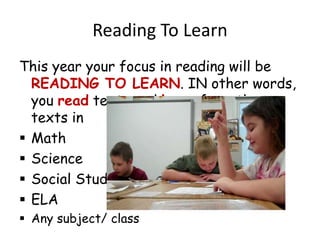
Reading To LearnThis year your focus in reading will be READING TO LEARN. IN other words, you read texts and learn from these texts inMath
Science
Social Studies
ELA
Any subject/ classWe read to learn from many different texts.
Good readers use many strategies to make sense of text.
GOOD READERS …Make connectionsMake predictionsAsk questions before, during, and after readingClarifySummarize what was readVisualize or “picture in their head”SynthesizeEvaluate
What can a reader do to read and learn from difficult texts?SUPER SIX GROUPS TO THE RESCUE!
The SUPER SIX are parts of a TEAM.Together Everyone Achieves More
PREDICTOR
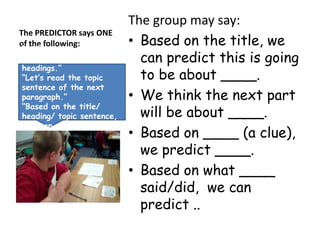
The PREDICTOR says ONE of the following:The group may say:Based on the title, we can predict this is going to be about ____.We think the next part will be about ____.Based on ____ (a clue),  we predict ____.Based on what ____ said/did,  we can predict ..“Let’s  get started by reading the titles and headings.”“Let’s read the topic sentence of the next paragraph.”“Based on the title/ heading/ topic sentence, who can make a prediction?”
LEAD  READER
The LEAD  READER says:The lead reader will choose HOW the group will read and may say :“Let’s read  this next part…SilentlyTogether quietly in a whisperTo a partner”Can you read the next paragraph, please ?Help everyone read in the BEST way to reach your goal.
QUESTIONER
The QUESTIONER may ask:The group asks a few questions that they THINK they may need to answer to understand  this text:Who is ____?What is/does ____?When is ____?Where is ____?Why is ____ important?Why does ____ happen?How is ____ like ____?What caused ____ to ____?Why does the author ____?Which sentence best tells ____?How is ___ an example of ___?Based on our reading, what do you think we are expected to know?
CLARIFIER 
The CLARIFIER says:To make words and ideas clear, the group may try a fix-it strategy:RereadLook for little words inside big wordsLook for root words, prefixes orsuffixesLook for commas, parentheses, orbold-face typeThink of a similar wordSubstitute a wordUse a referenceAskWhat parts do we need to make clear?
Sometimes to clarify, you need to look up a word.
DOES IT LOOK RIGHT?  DOES IT SOUND RIGHT?  DOES IT MAKE SENSE?References like dictionaries, encyclopedias, and maps are useful to have on hand.  Using other “fix it “ strategies help the group clear up any confusion about new words and ideas. Solving problems on your own within the group is a great  teamwork tool.
SUMMARIZER
The SUMMARIZER says:A group member may use a summary frame to say:SUMMARY FRAME:This story/passage about _________ begins with _________, discusses (or develops) theidea that _________, and ends with _________.“Please state the most important facts or parts of this passage.”
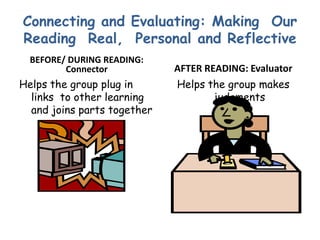
Connecting and Evaluating: Making  Our Reading  Real,  Personal and ReflectiveBEFORE/ DURING READING: ConnectorAFTER READING: EvaluatorHelps the group makes judgmentsHelps the group plug in  links  to other learning and joins parts together

The Super Six

  • 1.
    THE SUPER6Understanding and Comprehending Reading in Content-Area Classes
  • 2.
    Reading To LearnThisyear your focus in reading will be READING TO LEARN. IN other words, you read texts and learn from these texts inMath
  • 3.
  • 4.
  • 5.
  • 6.
    Any subject/ classWeread to learn from many different texts.
  • 7.
    Good readers usemany strategies to make sense of text.
  • 8.
    GOOD READERS …MakeconnectionsMake predictionsAsk questions before, during, and after readingClarifySummarize what was readVisualize or “picture in their head”SynthesizeEvaluate
  • 9.
    What can areader do to read and learn from difficult texts?SUPER SIX GROUPS TO THE RESCUE!
  • 10.
    The SUPER SIXare parts of a TEAM.Together Everyone Achieves More
  • 11.
  • 12.
    The PREDICTOR saysONE of the following:The group may say:Based on the title, we can predict this is going to be about ____.We think the next part will be about ____.Based on ____ (a clue), we predict ____.Based on what ____ said/did, we can predict ..“Let’s get started by reading the titles and headings.”“Let’s read the topic sentence of the next paragraph.”“Based on the title/ heading/ topic sentence, who can make a prediction?”
  • 13.
  • 14.
    The LEAD READER says:The lead reader will choose HOW the group will read and may say :“Let’s read this next part…SilentlyTogether quietly in a whisperTo a partner”Can you read the next paragraph, please ?Help everyone read in the BEST way to reach your goal.
  • 15.
  • 16.
    The QUESTIONER mayask:The group asks a few questions that they THINK they may need to answer to understand this text:Who is ____?What is/does ____?When is ____?Where is ____?Why is ____ important?Why does ____ happen?How is ____ like ____?What caused ____ to ____?Why does the author ____?Which sentence best tells ____?How is ___ an example of ___?Based on our reading, what do you think we are expected to know?
  • 17.
  • 18.
    The CLARIFIER says:Tomake words and ideas clear, the group may try a fix-it strategy:RereadLook for little words inside big wordsLook for root words, prefixes orsuffixesLook for commas, parentheses, orbold-face typeThink of a similar wordSubstitute a wordUse a referenceAskWhat parts do we need to make clear?
  • 19.
    Sometimes to clarify,you need to look up a word.
  • 20.
    DOES IT LOOKRIGHT? DOES IT SOUND RIGHT? DOES IT MAKE SENSE?References like dictionaries, encyclopedias, and maps are useful to have on hand. Using other “fix it “ strategies help the group clear up any confusion about new words and ideas. Solving problems on your own within the group is a great teamwork tool.
  • 21.
  • 22.
    The SUMMARIZER says:Agroup member may use a summary frame to say:SUMMARY FRAME:This story/passage about _________ begins with _________, discusses (or develops) theidea that _________, and ends with _________.“Please state the most important facts or parts of this passage.”
  • 23.
    Connecting and Evaluating:Making Our Reading Real, Personal and ReflectiveBEFORE/ DURING READING: ConnectorAFTER READING: EvaluatorHelps the group makes judgmentsHelps the group plug in links to other learning and joins parts together