Download to read offline
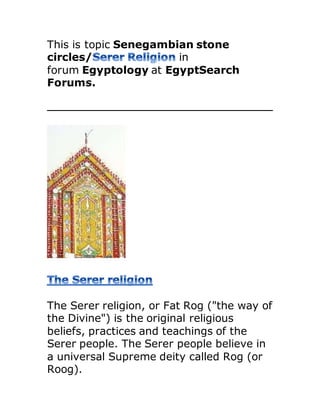
![The Serer people are found throughout
the Senegambia Region. Serer religious
beliefs encompass ancient chants and
poems; veneration and offerings to the
Serer Gods, Goddesses, ancient Serer
Saints and ancestral spirits (Pangool);
astronomy; initiation rites; medicine;
cosmology and history of the Serer
people. Rog is both everywhere and
nowhere. That is why there is no house of
Rog. The Serers pray to Rog (through
intercessors), but do not make direct
animal sacrifices to Rog
Beliefs
[edit]Divinity
The Serer people believe in a universal
Supreme Deity called Rog (or Roog) and
sometimes referred to as Rog Sene ("Rog
The Immensity" or "The Merciful God").[5]
Serer tradition deals with various
dimensions of life, death, space and time,
ancestral spirit communications and
cosmology.](https://image.slidesharecdn.com/thesererreligion-170512023405/85/The-serer-religion-2-320.jpg)
![There are also other lesser gods,
goddesses and supernatural spirits or
genie such as the spirit Mendis (or
Mindiss), a female protector of Fatick (a
region of Senegal) and the arm of the sea
that bears her name; the god Thiorak or
Tulrakh (god of Wealth) and the god
Taahkarr or Takhar (God of Justice or
Vengeance).[4][6] Rog Sene is the creator
deity and is neither the devil nor a genie,
but the Lord of the creature.[7]
Rog is the very embodiment of both male
and female to whom offerings are made at
the foot of trees, such as the sacred
baobab tree, the sea, the river such as the
sacred River Sine, in people's own homes
or community shrine etc. Rog Sene is
unreachable perhaps to a lesser extend by
the Serer high priests and priestesses
(Saltigue), who have been initiated and
possess the knowledge and power to
organise their thoughts into a single
cohesive unit.](https://image.slidesharecdn.com/thesererreligion-170512023405/85/The-serer-religion-3-320.jpg)
![[edit]Ancestral spirits and saints
See also: Intercession of saints#Serer
religion
For the ordinary Serers, they addressed
their prayers to the pangool (ancestral
spirits) as they are the intermediaries
between the living world and the Divine.
The pangool have both a historical
significance as well as a religious one.
They are connected to the history of the
Serer by virtue of the fact that, the
pangool is associated with the founding of
Serer villages and towns as a group of
pangool would accompany village
founders called "Lamane" (or Laman -
who were their ancient kings) as they
make their journey looking for land to
exploit. Without them, the Lamane
exploits would not have been possible. In](https://image.slidesharecdn.com/thesererreligion-170512023405/85/The-serer-religion-4-320.jpg)
![the religious sense, these ancient
Lamanes created shrines to these
pangool, thereby becoming the priests
and custodians of the shrine. As such,
"they became the intermediaries among
the land, the people and the Pangool".[8]
In addressing their prayers to the
pangool, the Serers chant ancient songs
and offer sacrifices such as bull, sheep,
goat, chicken or harvested crops.
[edit]Divinity and humanity.](https://image.slidesharecdn.com/thesererreligion-170512023405/85/The-serer-religion-5-320.jpg)
![In Serer, Rog Sene is the lifeblood to
which the incorruptible and sanctified soul
returns to eternal peace after they depart
the living world.
Rog Sene sees, knows and hears
everything, but does not interfere in the
day to day affairs of the living world.
Instead, lesser gods and goddesses act as
Rog's assistants in the physical world.
Individuals have the free will to either live
a good and spiritually fulfilled life in
accordance with Serer religious doctrines
or waver from such doctrines by living an
unsanctified lifestyle in the physical world.
Those who live their lives contrary to the
teachings will be rightfully judged in the
afterlife.[9]
There is no heaven or hell in the Serer
religion. The immortality of the soul and
reincarnation (ciiɗ in Serer language[10])
is a strongly held belief in Serer religion.](https://image.slidesharecdn.com/thesererreligion-170512023405/85/The-serer-religion-6-320.jpg)
![The pangool are canonised as Holy Saints,
and will be called upon and venerated,
and have the power to intercede between
the living and the Divine. Acceptance by
the ancestors who have long departed and
the ability to intercede with the Divine is
as close to heaven after one passes over.
Rejection by the ancestors and becoming
a lost and wondering soul is as close to
hell in Serer Religion.[7][11]
[edit]Family totems
Each Serer family has a totem ("Taana").
Totems are prohibitions as well as
guardians. They can be animals, plants
etc. For example the totem of the Joof
family is the antelope. Any brutality
against this animal by the Joof family is
prohibited. This respect gives the Joof
family holy protection. The totem of the
Njie family is the lion; the totem of the
Sène family is the hare and for the Sarr
family is the giraffe and the camel.
The secret order of the Saltigue
Main article: Saltigue](https://image.slidesharecdn.com/thesererreligion-170512023405/85/The-serer-religion-7-320.jpg)
![See also: Divination#Serer religion and
Traditional African religion#Rainmaker
Both men and women can be initiated into
the secret order of the Saltigue. In
accordance with Serer religious doctrines,
for one to become a Spiritual Elder
(Saltigue), one must be initiated which is
somewhat reserved for a small number of
insiders, particularly in the mysteries of
the universe and the unseen world. The
Xoy (or Khoy) ceremony is a religious
event and a special event in the Serer
religious calendar. It is the time when the
initiated Saltigue (Serer High Priests and
Priestesses) comes together to literally
predict the future in front of the
community. These diviners and healers
deliver sermons at the Xoy Ceremony
which relates to the future weather,
politics, economics, and so on.[14] It is a
very special event which brings together
thousands of people to Holy Sine from all
over the world. Ultra orthodox Serers and
Serers who "syncretise" (converts to Islam
or Christianity and who mix their newly
found religion with the old Serer religion)](https://image.slidesharecdn.com/thesererreligion-170512023405/85/The-serer-religion-8-320.jpg)
![as well as non-Serers such as the Lebou
people (who are a distinct group but still
revere the ancient religious practices of
their Serer ancestors) among others
gather at Sine for this ancient ceremony.
Serers who live in the West sometimes
spend months planning for the pilgrimage.
The event goes on for several days where
the Saltigue take centre stage and predict
the future. The ceremony usually begins
in the first week of June at Fatick.
[edit]Holy ceremonies and festivals
Raan Festival.
The Raan festival of Tukar takes place in
the old village of Tukar founded by
Lamane Jegan Joof (or Lamane Djigan
Diouf in French speaking Senegal) around
the 11th century.[17][18] It is headed by
his descendants, the (Lamanic lineage).
The Raan occurs every year on the second
Thursday after the appearance of the new
moon in April. On the morning of Raan,
the Lamane would prepare offerings of
millet, sour milk and sugar. After sunrise,
the Lamane makes a visit to the sacred](https://image.slidesharecdn.com/thesererreligion-170512023405/85/The-serer-religion-9-320.jpg)
![pond - the shrine of Saint Luguuñ Joof
who guided Lamane Jegan Joof after he
migrated from Lambaye (north of Sine).
The Lamane would make an offering to
Saint Luguuñ and spends the early
morning in ritual prayer and meditation.
After that, he makes a tour of Tukar and
perform ritual offerings of milk, millet and
wine as well as small animals at key
shrines, trees, and sacred locations. The
people make their way to the compound
of the chief Saltigue (the Serer high
priests and priestess - who are the
"hereditary rain priests selected from the
Lamane's lineage for their oracular
talent").[19]
[edit]Religious law](https://image.slidesharecdn.com/thesererreligion-170512023405/85/The-serer-religion-10-320.jpg)

The document summarizes key aspects of Serer religion, which originated from the Serer people of Senegambia. Some of the main beliefs discussed include: - Belief in a supreme deity called Rog (or Roog) who is everywhere and nowhere. Lesser gods and goddesses act in the physical world on Rog's behalf. - Ancestral spirits called pangool who serve as intermediaries between the living world and the divine. Families have totems and prohibitions connected to animals and plants. - Initiated priests and priestesses called Saltigue who have special religious and divination knowledge and powers. - Important religious ceremonies and festivals like the annual Raan festival held in


