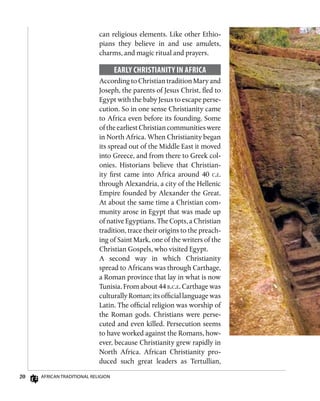
AFRICAN TRADITIONAL
RELIGION
WORLD  RELIGIONS
THIRD EDITION
WORLD RELIGIONS
African Traditional Religion
Baha’i Faith
Buddhism
Catholicism & Orthodox Christianity
Confucianism
Daoism
Hinduism
Islam
Judaism
Native American Religions
Protestantism
Shinto
Sikhism
Zoroastrianism
by
Aloysius M. Lugira
Series Editors: Joanne O’Brien and Martin Palmer
WORLD  RELIGIONS
AFRICAN TRADITIONAL
RELIGION
THIRD EDITION
African Traditional Religion, Third Edition
Copyright © 2009, 2004, 1999 by Infobase Publishing
		
All rights reserved. No part of this book may be reproduced or utilized in any form or by any means, electronic
or mechanical, including photocopying, recording, or by any information storage or retrieval systems, without
permission in writing from the publisher. For information contact:
			
Chelsea House
An imprint of Infobase Publishing
132West 31st Street
NewYork NY 10001
Library of Congress Cataloging-in-Publication Data
Lugira, Aloysius Muzzanganda.
African traditional religion / by Aloysius M. Lugira. —3rd ed.
p. cm. — (World religions)
Includes bibliographical references and index.
ISBN 978-1-60413-103-1
1. Africa—Religion. 2. Africa—Religious life and customs. I.
Title. II. Series.
BL2400.L84 2009
299.6—dc22
	 2008051188
Chelsea House books are available at special discounts when purchased in bulk quantities for businesses,
associations, institutions, or sales promotions. Please call our Special Sales Department in NewYork at
(212) 967-8800 or (800) 322-8755.
You can find Chelsea House on theWorldWideWeb at http://www.chelseahouse.com
This book was produced for Chelsea House by Bender RichardsonWhite, Uxbridge, U.K.
Project Editor: Lionel Bender
Text Editor: Ronne Randall
Designer: BenWhite
Picture Researchers: Joanne O’Brien and Kim Richardson
Maps and symbols: Stefan Chabluk
		
Printed in China
CP BRW 10 9 8 7 6 5 4 3 2 1
This book is printed on acid-free paper.
All links andWeb addresses were checked and verified to be correct at the time of publication. Because of the
dynamic nature of theWeb, some addresses and links may have changed since publication and may no longer
be valid.
CONTENTS
	 Preface	 6
CHAPTER 1	 Introduction: Africa and Its People	 8
CHAPTER 2	 The Beginning of Time: 	
	 The Oral Tradition	 26
CHAPTER 3	 The Supreme Being	 36
CHAPTER 4	 The Spirit World	 46
CHAPTER 5	 Rites and Ritual in African Religion 	 64
CHAPTER 6	 Sacred Spaces and Places 	 88
CHAPTER 7	 Mystical Forces	 96
CHAPTER 8	 African Religion in Today’s World    	 104
CHAPTER 9	 African Religion Past, Present, and Future   	 116
	 Fact File and Bibliography	 132
	 Further Reading 	 134
	 Web Sites	 135
	 Glossary	 136
	 Index	 140
	 About the Author and Series Editors	 144
	 Picture Credits 	 144
African Traditional Religion
Preface
Almostfromthestartofcivilization,more
than 10,000 years ago, religion has shaped
human history. Today more than half the
world’s population practice a major reli-
gion or indigenous spiritual tradition. In
many 21st-century societies, including
the United States, religion still shapes peo-
ple’s lives and plays a key role in politics
and culture. And in societies throughout
the world increasing ethnic and cultural
diversity has led to a variety of religions
being practiced side by side. This makes
it vital that we understand as much as we
can about the world’s religions.
The World Religions series, of which
this book is a part, sets out to achieve this
aim. It is written and designed to appeal
to both students and general readers. The
books offer clear, accessible overviews of
the major religious traditions and insti-
tutions of our time. Each volume in the
seriesdescribeswhereaparticularreligion
is practiced, its origins and history, its cen-
tral beliefs and important rituals, and its
contributions to world civilization. Care-
fully chosen photographs complement
the text, and sidebars, a map, fact file, glos-
sary, bibliography, and index are included
to help readers gain a more complete
understanding of the subject at hand.
These books will help clarify what
religion is all about and reveal both the
similarities and differences in the great
spiritual traditions practiced around the
world today.
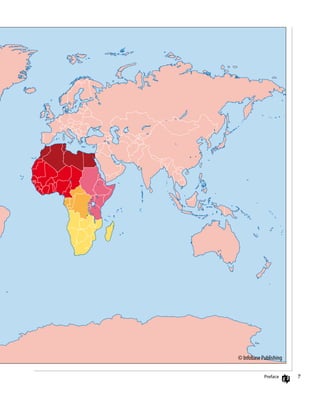
Religions of Africa
Northern Africa
Western Africa
Eastern Africa
Central Africa
Southern Africa
© Infobase Publishing
Preface
CHAPTER 1
African Traditional Religion
INTRODUCTION:
AFRICA AND
ITS PEOPLE
Iwa ni csin
“Character is religion.”
This proverb of the Yoruba people of Nigeria, West Africa,
expresses a fundamental truth about the character of the
African people. When they are in need they turn to superhuman
powersforhelp.TheyaddresstheirprayerstoaGod,eitherdirect-
ly or indirectly, through lesser gods or spiritual go-betweens.
When they address their God the elders of the Kikuyu peo-
ple of Kenya, for example, gather the people of the community
together under a sacred tree. A procession arrives. At its head are
two children. A boy carries a calabash, or gourd, filled with milk;
a girl carries a calabash of honey-beer. A lamb follows them, and
last come the elders. When the procession reaches the base of the
sacred tree, the leading elder takes the calabashes from the chil-
dren. Facing Mount Kenya, he raises the calabashes and addresses
God with the following prayer.
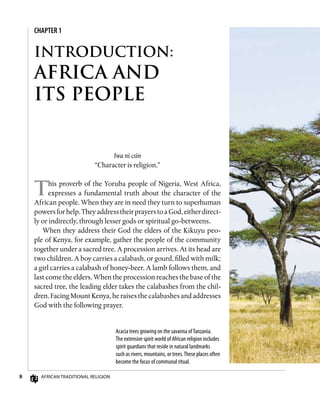
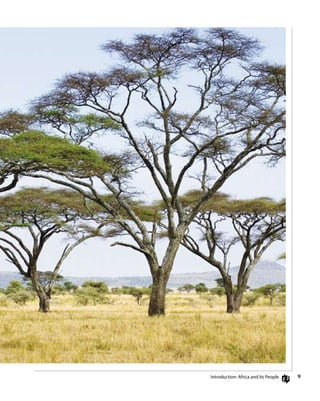
Acacia trees growing on the savanna ofTanzania.
The extensive spirit world of African religion includes
spirit guardians that reside in natural landmarks
such as rivers, mountains, or trees.These places often
become the focus of communal ritual.
Introduction: Africa and Its People
10 AfricAn TrAdiTionAl religion
“Reverend Elder who lives on Kere-Nyaga (‘Mountain of
Brightness,’ which is the Kikuyu name for Mount Kenya). You
who make mountains tremble and rivers flood; we offer you
this sacrifice that you may bring us rain. People and children are
crying; sheep, goats, and cattle are crying. Mwene-Nyaga (‘Pos-
sessor of Brightness,’ the Kikuyu name for God), we beseech you,
with the blood of this lamb, which we are going to sacrifice to
you. Refined honey and milk we have brought for you. We praise
you in the same way as our forefathers used to praise you under
this very same tree, and you heard them and brought them rain.
We beseech you to accept this, our sacrifice, and bring us rain of
prosperity.” The people respond, “Peace, we beseech you, Ngai,
peace be with us.”
More than 930 million people live on the African continent.
Many are at home in the bustling cities of the north—Cairo, Trip-
oli, Tunis, Algiers—where the religion today is predominantly
Islam. In sub-Saharan Africa, especially in the eastern and west-
ern coastal countries and in southern Africa, Christianity is the
predominant religion. However throughout Africa, especially in
central Saharan regions, many people live in communities that
at least to some extent follow traditional
ways of life that stretch back thousands
of years.
Beginning in prehistoric times the peo-
ple of Africa gathered in groups related
by family ties and similar needs. These
communities developed their own indi-
vidual languages, cultures, practices, and
religions. Although waves of exploration
and modernization have had their impact
on the traditional African way of life, it is
estimated that there are more than 6,000
different peoples in Africa today. Many of
these people continue to live by the spiri-
tual influence of their ancestral way of life.
Even after they have left their native vil-
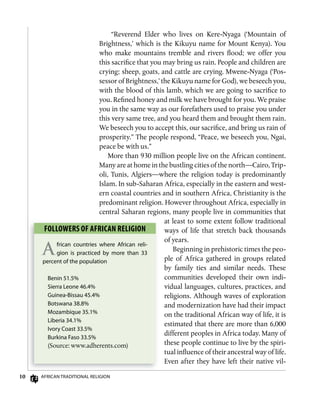
foLLowERs of AfRiCAn RELigion
African countries where African reli-
gion is practiced by more than 33
percent of the population
Benin 51.5%
Sierra leone 46.4%
guinea-Bissau 45.4%
Botswana 38.8%
Mozambique 35.1%
liberia 34.1%
ivory coast 33.5%
Burkina faso 33.5%
(Source: www.adherents.com)
11
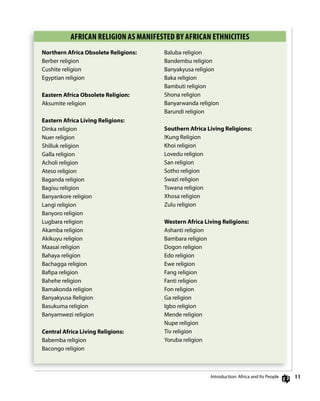
AfRiCAn RELigion As mAnifEsTED By AfRiCAn EThniCiTiEs
Northern Africa Obsolete Religions:
Berber religion
cushite religion
egyptian religion
Eastern Africa Obsolete Religion:
Aksumite religion
Eastern Africa Living Religions:
dinka religion
nuer religion
Shilluk religion
galla religion
Acholi religion
Ateso religion
Baganda religion
Bagisu religion
Banyankore religion
langi religion
Banyoro religion
lugbara religion
Akamba religion
Akikuyu religion
Maasai religion
Bahaya religion
Bachagga religion
Bafipa religion
Bahehe religion
Bamakonda religion
Banyakyusa religion
Basukuma religion
Banyamwezi religion
Central Africa Living Religions:
Babemba religion
Bacongo religion
Baluba religion
Bandembu religion
Banyakyusa religion
Baka religion
Bambuti religion
Shona religion
Banyarwanda religion
Barundi religion
Southern Africa Living Religions:
!Kung religion
Khoi religion
lovedu religion
San religion
Sotho religion
Swazi religion
Tswana religion
Xhosa religion
Zulu religion
Western Africa Living Religions:
Ashanti religion
Bambara religion
dogon religion
edo religion
ewe religion
fang religion
fanti religion
fon religion
ga religion
igbo religion
Mende religion
nupe religion
Tiv religion
Yoruba religion
introduction: Africa and its People
12 African Traditional Religion
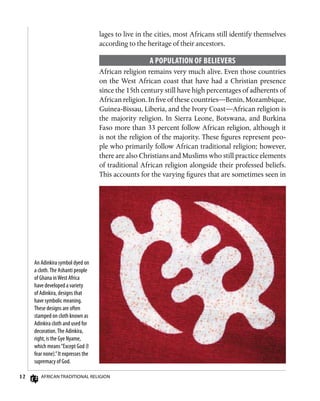
An Adinkira symbol dyed on
a cloth.The Ashanti people
of Ghana inWest Africa
have developed a variety
of Adinkira, designs that
have symbolic meaning.
These designs are often
stamped on cloth known as
Adinkira cloth and used for
decoration.The Adinkira,
right, is the Gye Nyame,
which means“Except God (I
fear none).”It expresses the
supremacy of God.
lages to live in the cities, most Africans still identify themselves
according to the heritage of their ancestors.
A Population of Believers
African religion remains very much alive. Even those countries
on the West African coast that have had a Christian presence
since the 15th century still have high percentages of adherents of
African religion. In five of these countries—Benin, Mozambique,
Guinea-Bissau, Liberia, and the Ivory Coast—African religion is
the majority religion. In Sierra Leone, Botswana, and Burkina
Faso more than 33 percent follow African religion, although it
is not the religion of the majority. These figures represent peo-
ple who primarily follow African traditional religion; however,
there are also Christians and Muslims who still practice elements
of traditional African religion alongside their professed beliefs.
This accounts for the varying figures that are sometimes seen in
13
numbers of adherents of African religion. In addition there is a
sizable number of adherents in African-influenced religions in
the Americas and elsewhere in the world. If numbers of adher-
ents are indicative of the continued existence of a religion, then
the numbers of adherents of African religion ensure its continu-
ation in the future.
For many people, combining traditional religion with either
Christianity or Islam is also a way of life. In particular, what is
known variously as indigenous Christianity or independent
churches have arisen throughout sub-Saharan Africa and prob-
ably represent the largest current manifestation of traditional
African religion, albeit in a pluralist context.
The African Continent
To understand African religion, it helps to look at Africa itself.
AfricaisthesecondlargestcontinentonEarth.OnlyAsiaislarger.
Africa’s 11.7 million square miles make it about three times the
size of Europe and twice the size of the United States, including
Alaska. On the north, where it shares the waters of the Mediterra-
neanSeawithSpain,Italy,andGreece,itliesclosetoEurope.Only
the narrow Red Sea separates it from the Middle East. Its western
shore stretches along the North and South Atlantic Ocean, and
its eastern shore the entire length of the Indian Ocean.
Because of its vast size Africa is a land of contrasts. It contains
one of the world’s greatest deserts, the Sahara, which stretches
across the north-central part of the continent, dividing north
from south. North of the Sahara lie countries rich with ancient
tradition. Ancient Egypt, whose pharaoh once ruled vast hold-
ings in the Middle East, was one of the most powerful countries
in the world. Carthage, a great city-state centuries before the
Roman Empire, lay in what is now Tunisia. Trading with Greece
and Rome, and with Asia to the east, the North Africans devel-
oped cosmopolitan cultures. They built large cities, erected
monuments, and developed written language. They worshipped
their own ancient gods. Later their traditional religions would be
swept aside by first Christianity and then Islam.
Introduction: Africa and Its People
14 AfricAn TrAdiTionAl religion
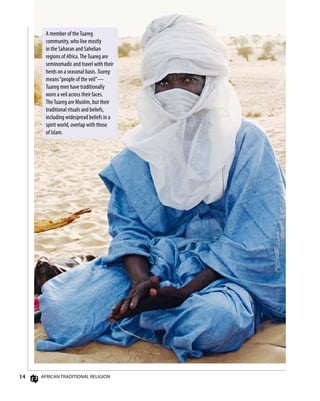
A member of theTuareg
community, who live mostly
in the Saharan and Sahelian
regions of Africa.TheTuareg are
seminomadic and travel with their
herds on a seasonal basis. Tuareg
means“people of the veil”—
Tuareg men have traditionally
worn a veil across their faces.
TheTuareg are Muslim, but their
traditional rituals and beliefs,
including widespread beliefs in a
spirit world, overlap with those
of Islam.
15
ThE suB-sAhARA
Below the Sahara is a land of enormous variety, from snow-cov-
ered mountains and deep valleys with great rivers to open grass-
lands to rainforest. Cut off from known civilization by the huge,
empty Sahara, these lands remained largely untouched by out-
side exploration for centuries. However they were not uninhab-
ited. Indeed humanity as we know it may have sprung from deep
within the African continent. Recent scientific studies in Kenya
and elsewhere in Africa strongly suggest that Africa may be the
birthplace of the human race.
AfRiCAn PEoPLEs AnD ThEiR RELigions
Over many centuries the African peoples below the Sahara lived
in close relationship with the land. Some were nomads—wan-
derers—who followed the animals they hunted or established
camps where their herds could graze. Others farmed or lived off
the land, gathering native plants for food. Often they were widely
separated from their closest neighbors. Living more or less in iso-
lation, they developed their own languages and customs. They
also developed religious practices that served their particular
lives and needs.
African religion is not the only religion found in Africa today.
However, it is the only religion that can claim to have originated
in Africa. Other religions found in Africa
have their origins in other parts of the
world.
AfRiCAn RELigion AnD oThER
RELigions
African religion differs from religions
such as Judaism, Christianity, and Islam
in a number of ways. Although individual
peoples may remember legendary figures
from their history, African religion has no
single founder or central historical figure.
Like Native American religions and Asian
Physical	and	Spiritual	Suffering	
African religion teaches that people
are made up of moral, social,
spiritual, and physical parts. These
parts function together. If any part
is out of balance, the person may
become physically ill or suffer
spiritually. That is why a conflict with
another person may make someone
sick, or a moral misdeed may bring
about misfortune.
introduction: Africa and its People
16 AfricAn TrAdiTionAl religion
religions such as Shinto and Daoism, it
originates with the people themselves. It is
an expression of many thousands of years
of living close to the land and of seeking
answers to the mysteries of life: Why are
we here? How do we live well? Why do
we die? African religion has no churches
or mosques like those of Christianity or
Islam. Instead it has shrines constructed
according to the traditions of the particu-
largeographicalarea.Peoplemayalsoturn
to a geographical or natural feature, such
as a mountain or a large tree, as a focus for
worship.
In African religion there is no single
ordained priesthood. Religious duties are
carried out by a variety of religious lead-
ers. There are priests and priestesses, heal-
ers, diviners, mediums, seers, rainmakers,
elders, and rulers, each with a special role
in maintaining the spiritual life of the
community and its people.
ThE oRAL TRADiTion
Traditional African lore has always been
passed down orally. There is no written set
of beliefs, no “holy book” such as the Bible
or the Quran. Cultural beliefs and rules for
living are passed down from generation to
generation by word of mouth. Most Afri-
can peoples have no written language, but
members of the community are trained
from childhood to perform prodigious
acts of memorization, reciting the whole
history of the community for successive
generations.
Common ThEmEs in AfRiCAn LifE
Although traditional African religion
varies widely from region to region
and people to people, there are a number
of things that they all have in common.
• All things in the universe are part of a
whole. There is no sharp distinction be-
tween the sacred and the nonsacred.
• in most African traditions there is a Su-
preme Being: a creator, sustainer, pro-
vider, and controller of all creation.
• Serving with the creator are a variety of
lesser and intermediary gods and guard-
ian spirits. These lesser gods are con-
stantly involved in human affairs. People
communicate with these gods through
rituals, sacrifices, and prayers.
• The human condition is imperfect and
always will be. Sickness, suffering, and
death are all fundamental parts of life.
Suffering is caused by sins and misdeeds
that offend the gods and ancestors, or by
being out of harmony with society.
• ritual actions may relieve the problems
and sufferings of human life, either by
satisfying the offended gods or by resolv-
ing social conflicts. rituals help to restore
people to the traditional values and
renew their commitment to a spiritual life.
• Human society is communal. Ancestors,
the living, the living-dead, and those yet
to be born are all an important part of the
community. The relationships between
the worldly and the otherworldly help to
guide and balance the lives of the com-
munity. Humans need to interact with the
spirit world, which is all around them.
17
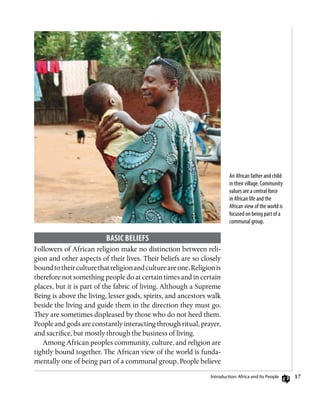
An African father and child
in their village. Community
values are a central force
in African life and the
African view of the world is
focused on being part of a
communal group.
Basic Beliefs
Followers of African religion make no distinction between reli-
gion and other aspects of their lives. Their beliefs are so closely
boundtotheirculturethatreligionandcultureareone.Religionis
therefore not something people do at certain times and in certain
places, but it is part of the fabric of living. Although a Supreme
Being is above the living, lesser gods, spirits, and ancestors walk
beside the living and guide them in the direction they must go.
They are sometimes displeased by those who do not heed them.
People and gods are constantly interacting through ritual, prayer,
and sacrifice, but mostly through the business of living.
Among African peoples community, culture, and religion are
tightly bound together. The African view of the world is funda-
mentally one of being part of a communal group. People believe
Introduction: Africa and Its People
18 African Traditional Religion
in sharing their property and services, and they expect the other
members of the community to share with them. According to
noted scholar John Mbiti they believe that “whatever happens to
the individual happens to the whole group, and whatever hap-
pens to the group happens to the individual. The individual can
only say, ‘I am, because we are, and since
we are, therefore I am.’” In this communi-
ty spirit lies their security. (In John Mbiti,
African Religions  Philosophy.)
Africa and Its History
Although much of Africa was isolated
from the rest of the world, the areas along
the coasts developed important cultures.
By 3400 b.c.e. Egypt was a flourishing
empire with a highly developed religion.
The pyramids are its most visible and last-
ingtestimony.Howeveralthoughtheyrep-
resent a triumph of technology, Egyptian
pyramids are more than just great won-
ders of the world. They are also religious
structures. Spiritually pyramids are ritual
objects that reflect the ancient connection
of kingship to African religion, along with
belief in life hereafter and immortality.
Egyptian religion was not the only reli-
gion in ancient Africa. Judaism originated
intheMiddleEast,butasearlyas1300b.c.e.
groups of Hebrew peoples were living on
the African continent, primarily in Egypt.
Since biblical times in Ethiopia, there have
lived thousands of African Jews, known
to Ethiopians as Falashas. These so-called
Black Jews of Ethiopia practice a religion
based entirely on the Old Testament of the
Bible but including certain Ethiopian Afri-
19
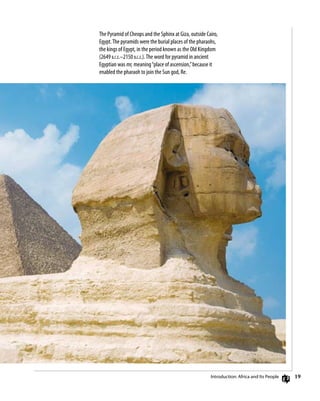
The Pyramid of Cheops and the Sphinx at Giza, outside Cairo,
Egypt.The pyramids were the burial places of the pharaohs,
the kings of Egypt, in the period known as the Old Kingdom
(2649 b.c.e.–2150 b.c.e.).The word for pyramid in ancient
Egyptian was mr, meaning“place of ascension,”because it
enabled the pharaoh to join the Sun god, Re.
Introduction: Africa and Its People
20 African Traditional Religion
can religious elements. Like other Ethio-
pians they believe in and use amulets,
charms, and magic ritual and prayers.
Early Christianity in Africa
According to Christian tradition Mary and
Joseph, the parents of Jesus Christ, fled to
Egypt with the baby Jesus to escape perse-
cution. So in one sense Christianity came
to Africa even before its founding. Some
oftheearliestChristiancommunitieswere
in North Africa. When Christianity began
its spread out of the Middle East it moved
into Greece, and from there to Greek col-
onies. Historians believe that Christian-
ity first came into Africa around 40 c.e.
through Alexandria, a city of the Hellenic
Empire founded by Alexander the Great.
At about the same time a Christian com-
munity arose in Egypt that was made up
of native Egyptians. The Copts, a Christian
tradition, trace their origins to the preach-
ing of Saint Mark, one of the writers of the
Christian Gospels, who visited Egypt.
A second way in which Christianity
spread to Africans was through Carthage,
a Roman province that lay in what is now
Tunisia. From about 44 b.c.e. Carthage was
culturally Roman; its official language was
Latin. The official religion was worship of
the Roman gods. Christians were perse-
cuted and even killed. Persecution seems
to have worked against the Romans, how-
ever, because Christianity grew rapidly in
North Africa. African Christianity pro-
duced such great leaders as Tertullian,
21
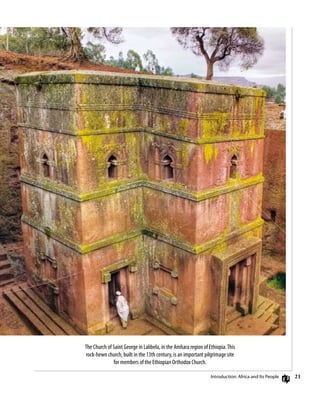
The Church of Saint George in Lalibela, in the Amhara region of Ethiopia.This
rock-hewn church, built in the 13th century, is an important pilgrimage site
for members of the Ethiopian Orthodox Church.
Introduction: Africa and Its People
22 African Traditional Religion
Saint Augustine, Saint Cyprian, and Saints Perpetua and Feli­-
city. At least one writer, Tertullian, recognized the impor-
tance of the African religious concepts of God to developing
Christianity.
In 350 c.e. the ancient kingdom of Aksum, known as Ethiopia
today, officially embraced Christianity. At that time the Aksumite
king Ezana, originally a strong adherent of his African religion,
convertedtoChristianity.AksumiteChris-
tianity, later called Ethiopian Christianity,
has its roots in the Coptic Christianity of
Egypt.
African Religion and Islam
Islam means “submission to the will of
God.” The creed of Islam is “There is no
god but Allah [God], and Muhammad is
His prophet.” When Muslims arrived in
Africa in the seventh century c.e. they did
not identify African religion as a religion.
They called the native people kaffirs, which
means “infidels”— people who have no
faith, or unbelievers. The name stuck, and
Africans came to be known as people with
no faith.
The early Muslims did not wage a holy
war against African religion or prac-
tice forced conversions. However, Islam
proved to be an attractive religion to many
Africans, particularly in the north, who
may have found similarities between their
religion and Islam. Today Islam is one of
the most dynamic religions in Africa. It is
well represented in practically all African
nations. In some African countries such
as Libya and Morocco it is the predomi-
nant religion.
23
The Arrival of the Portuguese
The Portuguese came to Africa during the 15th century. Prince
Henry the Navigator hoped to find a safe new access to Asia and
Africa and their treasures, which included pepper, spices, gold,
ivory, and precious gems. He received the blessing of the pope,
who authorized Portugal and Spain to conquer and possess lands
and their riches as well as to pass on the message of Christianity.
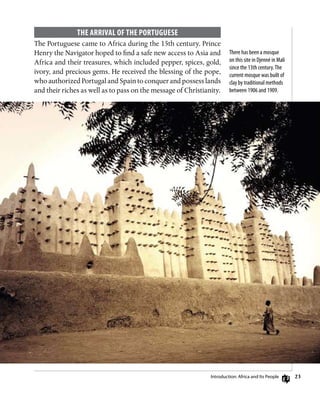
There has been a mosque
on this site in Djenné in Mali
since the 13th century.The
current mosque was built of
clay by traditional methods
between 1906 and 1909.
Introduction: Africa and Its People
24 African Traditional Religion
Cultural Misunderstandings
The expeditions usually included chaplains and priests. Sailing
along the West and East African coasts, they preached the Chris-
tian message to the people they met and took advantage of Afri-
can hospitality. Eventually they established African Christian
communities. However they were to be disappointed. African
peoples had welcomed them warmly. But that did not mean that
they were ready to give up their cultures and beliefs. The mis-
sionaries failed to appreciate the African religion and culture on
which the welcome was based, and misunderstanding arose. In
frustration the missionaries developed hostile attitudes toward
the people. Finally they succumbed to the temptations of the
slave trade. Portuguese-sponsored Christianity in Africa ended
badly.
European Missionary Activity
During the 19th century European countries staked claims to
African lands in the rush to build empires. This so-called scram-
ble for Africa saw African countries divided among the British,
the French, the Germans, and the Dutch, among others. Over-
whelmingly Christian, they invited a new wave of Christian mis-
sionaries, who came bringing “missions Christianity” with them.
Missionaries to Africa included not only Roman Catholic priests,
as in the case of the Portuguese and Spanish, but also clerics and
laypeople of various Protestant denominations.
Understanding African Culture
The missionaries established schools and hospitals and began
preaching the Gospel of Christianity. They were well-meaning,
but they had little understanding of the cultures they were enter-
ing. Their intent was to bring Christianity to a continent they
believed to have no true religion. They meant to stamp out Afri-
can religious practices they saw as superstition and ignorance.
Living and working among the African people, some mem-
bers of missionary societies began to appreciate Africans and
African religion. They began to make the effort to understand the
25
culture. From this effort they could finally begin to establish a
Christian relationship with African religion. Christianity is now
the majority religion within Africa followed by more than 46
percent of the continent’s population.
Unity and Diversity in African Religions
Although it is possible to make some generalizations about Afri-
can religion, it is important to remember that African religions
are not one, but many. African religions have a great variety of
rituals, myths, beliefs, and deities. Yet in spite of their differences
from each other and from many other world religions, they share
with each other and with most other faiths the goal of guiding
individuals safely through the passages of life, from birth and
puberty, marriage and maturity, to death and ancestorhood.
They mark not only the seasons of life, each with its particular
responsibilities and duties, but also the seasons of the year and
the cycles of time. They answer the questions of why there is
suffering and death in the world and offer ways of dealing with
human pain. Finally they provide a way for the people who fol-
low them to be in touch with the spiritual in themselves and in
the universe.
There are as many African religions as there are African peo-
ples. However in their diversity they are one. Whether African
religion is based in Central Africa, eastern Africa, western Africa,
or southern Africa, the belief in a Supreme Being, superhuman
beings, and honoring ancestors are its cornerstones. They point
to the same understanding.
Introduction: Africa and Its People
26 African Traditional Religion
African peoples have wonderful tales to tell about the begin-
ning of time. Traditionally the elders of the village gather
the children and tell them about times when the world was
young, when animals could talk, when heroes walked among
humankind, when their God made the Earth and everything in it.
In the hands of the skilled storyteller the characters come alive,
and the children will never forget them. The stories are entertain-
ing, but entertainment is not their primary goal. As they listen,
the children are absorbing the myths and the culture of their
community.
How Tradition Is Passed On
Living close to nature, Africans have always observed the world
around them. Looking up, they saw the vast expanse of the sky.
Aroundthemtheysawoceans,seas,lakes,rivers,forests,animals,
and many other marvels of creation. They pondered the kinds of
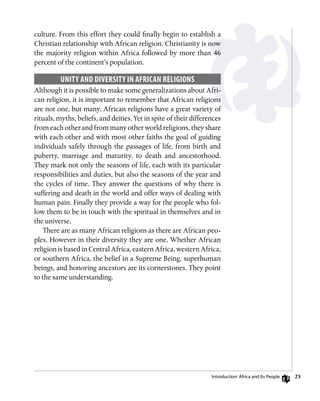
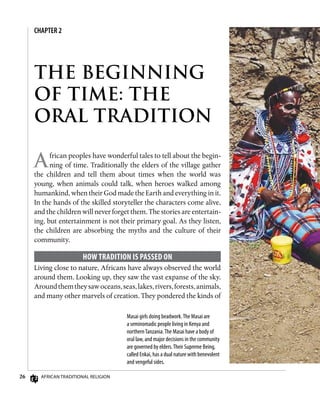
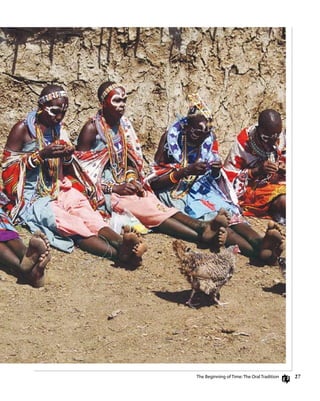
Masai girls doing beadwork.The Masai are
a seminomadic people living in Kenya and
northernTanzania.The Masai have a body of
oral law, and major decisions in the community
are governed by elders.Their Supreme Being,
called Enkai, has a dual nature with benevolent
and vengeful sides.
THE BEGINNING
OF TIME: THE
ORAL TRADITION
CHAPTER 2
27The Beginning of Time: The Oral Tradition
28 AfricAn TrAdiTionAl religion
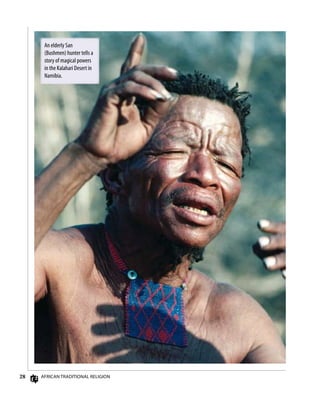
An elderly San
(Bushmen) hunter tells a
story of magical powers
in the Kalahari Desert in
Namibia.
29
questions that humankind has asked for untold centuries. How
did the world come to be? What hand fashioned us and put us
here? What does it mean to be alive?
Overcenturiespeoplehaveformedanswerstosuchquestions,
often in the form of stories, myths, and proverbs. These answers
were passed down by word of mouth from one generation to the
next. In this way oral traditions, many of which address ques-
tions of existence from the beginning of time, are established.
The oral traditions constitute the method of transmitting history
and religious traditions by spoken rather than written means. In
African traditional communities it was part of home education
to memorize those traditions with great accuracy.
Oral traditions are passed on in a variety of forms—in myths,
legends, stories, and proverbs. Stories generally say something
about life in order to educate and entertain the community.
Myths deal with the divine. They have religious subjects, such as
the origin of the universe and of nature. They address and answer
questions like, Where did humankind come from? How are
human beings expected to act as they travel through life? What
is the destiny of the human race? Legends are a body of stories
about families, people, and particularly heroes of the communi-
ty. Often based on real people and facts, they have been told and
retold until they become part of the lore of the community as a
whole. Proverbs are short statements that express wisdom about
creation and human experience.
Creation Myths and the Fall of Humankind
From their earliest beginnings, African people have asked ques-
tions about their existence. Such questions as, Who are we? How
did we come to be here? How should we understand our place in
this world? have given rise to the rich and varied creation myths
of African peoples.
Myths of creation tell of the sacred beginnings of the people.
They usually center on a Supreme Being who, according to Afri-
can oral tradition, created the world. They recognize the special
position the Creator has given to humankind. In the creation
The Beginning of Time: The Oral Tradition
30 African Traditional Religion
myth of the Yoruba people, for example, the Supreme Being,
Olodumare, enlists the help of Orisha Nla (“the Great God”) to
make a world out of “magic earth.” Orisha Nla fashions human
beings out of earth, but only Olodumare knows the secret of
how to give the bodies life. “To this day,” the myth ends, “Orisha
Nla, through the agency of parents, makes the body, but only the
Supreme Being can give it life.” (In J. F. Bierlein, Parallel Myths.)
African creation myths often tell about the special relation-
ship between a God and the first people, when the heavens were
very close to Earth. However humankind, being imperfect, made
mistakes for which they must be punished. The Dinka people say
that once a rope hung down from heaven for people to climb up
when they wanted to talk to their God. But an old woman mash-
ing yams kept hitting the underside of heaven with her pestle and,
weary of the noise, the God pulled up the rope and withdrew the
heavens to a higher plane. Still, people are always encouraged to
make up for their failures. African myths commonly conclude
with a lesson about the importance of people living well in this
world.
Heroes and Legends
Human life is generally marked by success and failure as well as
a variety of minor ups and downs. Hero tales and legends focus
on success, encouraging a positive group image. In African tra-
ditions, many heroes are human beings who are deified, that is,
elevated to the status of gods. Through their acts on Earth they
become associates of the Supreme Being. A hero may be some-
one who does a great deed for the community or someone who
seems touched by the gods, especially chosen from childhood for
some higher purpose.
Lubaale Mukasa, a god of the Baganda people of East Africa,
is an example of a deified hero, a human who has become a god.
(The title Lubaale refers to a spiritual being.) When, as a child,
he disappeared from his home and appeared mysteriously on
another island, the people there thought he must be superhuman
to have appeared, seemingly out of nowhere. He refused to eat
31
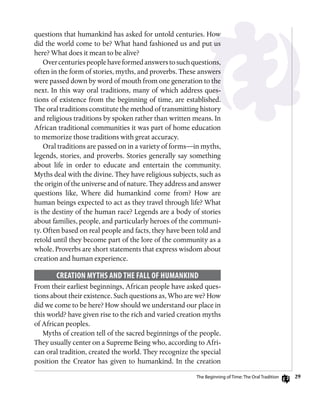
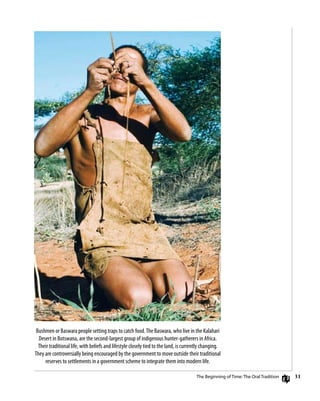
Bushmen or Baswara people setting traps to catch food.The Baswara, who live in the Kalahari
Desert in Botswana, are the second-largest group of indigenous hunter-gatherers in Africa.
Their traditional life, with beliefs and lifestyle closely tied to the land, is currently changing.
They are controversially being encouraged by the government to move outside their traditional
reserves to settlements in a government scheme to integrate them into modern life.
The Beginning of Time: The Oral Tradition
32 AfricAn TrAdiTionAl religion
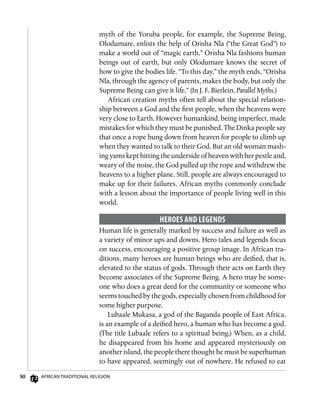
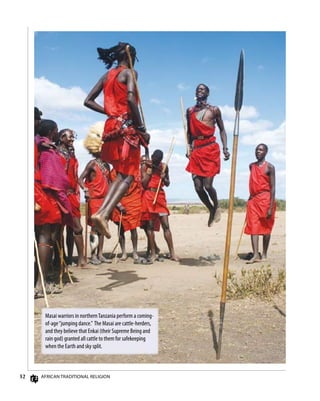
Masai warriors in northernTanzania perform a coming-
of-age“jumping dance.” The Masai are cattle-herders,
and they believe that Enkai (their Supreme Being and
rain god) granted all cattle to them for safekeeping
when the Earth and sky split.
33
anything but the heart and liver of an ox, and he drank its blood,
confirming the people’s opinion that he was a god. The people
soon began consulting him on matters of health and money.
When he disappeared as mysteriously as he had arrived, Lubaale
Mukasa was acknowledged as one of the highest-ranking gods
of their people.
sToRiEs AnD fABLEs
Stories and fables usually illustrate some truth about human
nature and end with a stated or unstated moral. Such stories are
partly for entertainment, but they are more than just amusing
tales. They are the African way of teaching and passing down eth-
ics, or right behavior, to the next genera-
tion. One of the most famous African folk
heroes is Ananse, the spider. Ananse is the
hero of many folktales of the Akan people
of West Africa. The Ananse tales have
crossed from West Africa to the Americas,
where they are familiar to many children.
Ananse is a trickster. Tricksters may be
human or animal or a little of both, but
they all have superhuman powers that
they can use for good or for harm. They
also suffer from many of the character
flaws that ordinary humans have, such as
greed and envy. As a result, they are often
caught in their own snares. Stories about
Ananse, or as he is usually called, Father
Ananse, attribute great skill and ingenu-
ity to him. In one tale Ananse tries to take
back the wisdom he has distributed in the
world by storing it in a large pot. However,
when he is challenged by his son Ntikuma,
Ananse angrily allows the pot to fall from
the top of a tree, and human beings are
able to gather it up for themselves.
Proverbs	in	African	Society
Proverbs teach reverence for and
appreciation of authority; the realization
that God the Creator is a supreme being,
reverence for justice, human sympathy
and fellow feeling among individuals, the
ability to [turn away from] bitterness and
learn from painful experiences, and the
futility of envy and competitiveness. They
help you to understand that if you twist
the arm of justice, you twist the morals
of the society. We cannot all hope to be
like the maize (corn). The maize has good
luck all the time. It goes to the soil naked
and returns with good luck with hundreds
of children. Look at your five fingers. Are
they equal? So are human beings. The old
man is wise because he is in his second
childhood and, like a child, he is always
ready to learn.
(In Ryszard Pachocinski, Proverbs of
Africa: Human Nature in the Nigerian
Oral Tradition.)
The Beginning of Time: The oral Tradition
34 African Traditional Religion
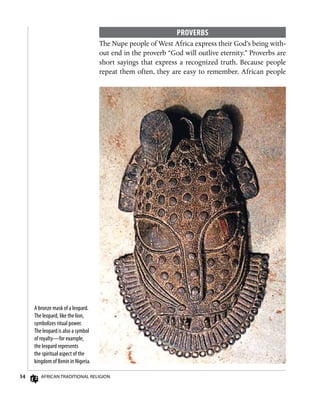
A bronze mask of a leopard.
The leopard, like the lion,
symbolizes ritual power.
The leopard is also a symbol
of royalty—for example,
the leopard represents
the spiritual aspect of the
kingdom of Benin in Nigeria.
Proverbs
The Nupe people of West Africa express their God’s being with-
out end in the proverb “God will outlive eternity.” Proverbs are
short sayings that express a recognized truth. Because people
repeat them often, they are easy to remember. African people
35
express their belief in their God and his
works through proverbs that remind them
constantly of his power.
AfRiCAn RELigions AnD
ThE oRAL TRADiTion
The African oral tradition, with its myths,
legends, stories, and proverbs, instills
the important elements of religion and
culture in the minds and hearts of the
African people all the way across the con-
tinent. The stories, myths, and tales that
they hear and repeat from early childhood
teach them about the ethics, beliefs, and
traditions of their community. From their
oral literature they learn why things are
as they are and how life is to be lived on
this Earth. Perhaps most importantly they
learn of the power and majesty of a God,
the Supreme Being, and of their special
relationship to him, their Creator and the
giver of all life.
The	Shining	One
The Akan people of West Africa
have many proverbs that are related
to their creation myths. Their name
for God is Nyame, which means
“the Supreme Being,” “the Shining
One,” “the Originator,” and “first
mover of everything.” Here are
some of the ways in which their
proverbs depict him:
No one points out the Nyame to a child.
The Earth is wide, but Nyame is chief.
All people are Nyame’s offspring; no one
is the offspring of Earth.
Says Hawk: All Nyame did is good.
The order Nyame has settled, living
people cannot subvert.
There is no by-pass to Nyame’s destiny.
The Beginning of Time: The oral Tradition
36 African Traditional Religion
CHAPTER 3
THE SUPREME
BEING
In the Adinkira patterns of Akan art, there is a pattern that is
called Gye Nyame, meaning “Except God.” When it appeared
on a Ghana postage stamp, it was called “The Omniscience of
God,” referring to God’s quality of omniscience, or knowing all
things. A stamp collector remarked: “How apt that an African
country should be the first to remind the world of God’s power
[on a stamp].” “Except God” is an end of a proverb that goes, “No
one saw the beginning, none shall see the end, except God.” That is
to say that no one saw the beginning of creation, and no one will
see its end, except God. (In Noel Q. King, Religions of Africa.)
Most African oral traditions have pointed to the existence of
a power above which there is no other power, a Supreme Being,
Creator, and Originator of the World.
The African Concept of Monotheism
In Western religion religious systems are usually classified as
either monotheistic, that is, believing in one God, or polytheis-
tic, believing in many gods. In African religion monotheism and
polytheism exist side by side.
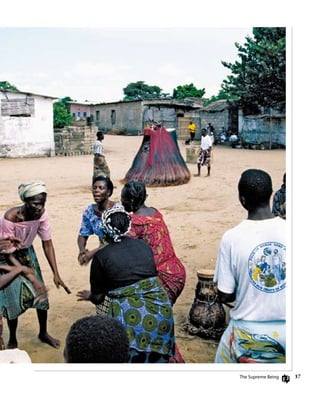
A spirit ceremony is held by the Fon people of Benin, Nigeria, to contact the
spirit world. In African traditional religion the spirits are always present, and
requests and offerings are made to them for health, prosperity, and protection.
37The Supreme Being
38 African Traditional Religion
Often the African concept of monotheism is one of a hierar-
chy with a Supreme Being at its head. In this system the Supreme
Being rules over a vast number of divinities who are considered
to be the associates of the God. African understanding of the
structure of the heavenly kingdom might be compared to the
Christian concept of God ruling over the saints and angels. The
divine hierarchy in African religion makes it possible to classify
them as both monotheistic and polytheistic at once (monothe-
ism with polytheism).
The Nature of the Supreme Being
How the many different African peoples conceive of God usu-
ally follows the social structure of a particular locality or culture.
African people whose cultures are organized as monarchies with
a king at the head usually conceive of their God as the supreme
king. As there can be only one supreme king in a community,
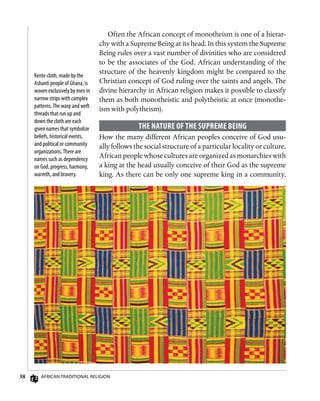
Kente cloth, made by the
Ashanti people of Ghana, is
woven exclusively by men in
narrow strips with complex
patterns.The warp and weft
threads that run up and
down the cloth are each
given names that symbolize
beliefs, historical events,
and political or community
organizations.There are
names such as dependency
on God, progress, harmony,
warmth, and bravery.
39
Africans have traditionally concluded that
there can be only one Supreme Being for
the entire human race.
The majority of African peoples con-
ceive of God as one. However, among the
Fon people of Benin in West Africa, Nana-
Buluku, the name for God, expresses one
God in duality, or two. In the Fon religion
God is two beings, male and female.
The most complex concept of God is
that of the BambarapeopleofWestAfrica.
The Supreme God of the Bambara is called
Bemba or Ngala. Bemba has, in a way, cre-
ated himself as a quarternity (a union of a
group of four). The four aspects of Bemba
are Bemba, Nyale, Faro, and Ndomadyiri.
The Bambara people understand these
aspects of their God to be pure creative
energy that is expressed as four “persons.”
Each plays a different role in the creation
of the universe. This concept of a single
God having a multiple nature is somewhat
similar to the Christian doctrine of God as
a trinity, or three in one—father, son, and
holy spirit.
ATTRiBuTEs of goD
People in African religious traditions fre-
quently associate their Supreme Being
with certain basic attributes. These are:
• God is the Creator of all things.
• God is the absolute controller and
sustainer of the universe.
• God provides for what he created.
• God possesses all that he created.
The	Aspects	of	Bemba
The Supreme Being of the Bambara,
Bemba or Ngala, is one God in four.
As the Supreme Being, he is master
of all creation. Yet he has created
himself in four aspects. They are:
• Bemba, master of air
• Nyale, also known as Mousso
Koroni Koundye, master of fire
• Faro, master of water
• Ndomadyiri, master of Earth
Together as one, the four aspects of
Bemba rule all of the elements on
which life is based.
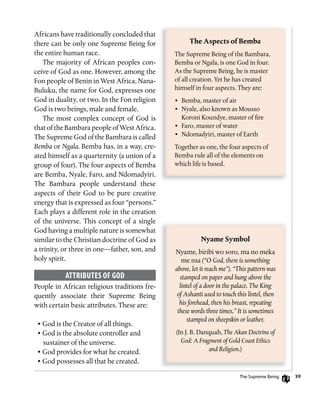
Nyame	Symbol
Nyame, biribi wo soro, ma no meka
me nsa (“O God, there is something
above, let it reach me”). “This pattern was
stamped on paper and hung above the
lintel of a door in the palace. The King
of Ashanti used to touch this lintel, then
his forehead, then his breast, repeating
these words three times.” It is sometimes
stamped on sheepskin or leather.
(In J. B. Danquah, The Akan Doctrine of
God: A Fragment of Gold Coast Ethics
and Religion.)
The Supreme Being
40 AfricAn TrAdiTionAl religion
ThE CREAToR of ALL Things
Both African oral traditions and later writ-
ten sources indicate that all African peo-
ples believe that power of creation is the
foremost attribute of the Supreme Being.
African myths of creation strongly sup-
port the idea that all Africans at all times
from prehistory to the present-day have
recognized a Supreme Being as the Cre-
ator of all things. In addition the names
by which many different groups across
Africa call the Supreme Being express the
idea of God as the “Originator,” Creator of
everything.
ConTRollER And susTAinER
of THE univERsE
In most African tradition and thought
one’s God has absolute control of the
universe and all that it contains. This is
because all other beings exist because of
him. As Originator of the universe, God is
the ultimate fountainhead of all power of
all natural rules for orderly existence.
Peoples of the different regions of Afri-
ca express God’s controlling and sustaining role of creation in
various ways. The Ashanti of Ghana in West Africa regard God
as the “Supreme Being, upon whom men lean and do not fall.”
The Nandi of Kenya in Eastern Africa believe that God “is the far-
off driving force behind everything, the balance of nature.” The
Bambuti of Congo in Central Africa express the control and sus-
tenance of God in the saying “If God should die, the world would
also collapse,” which expresses their belief in the controlling and
sustaining power of God. From South Africa the Zulu say that
God “made us, and is, as it were, in us his work. We exist because
He existed.”
The	Originator
The Banyarwanda of Rwanda in
Central Africa speak simply of
creation by saying, “There was
nothing before God created the
world.” In the same region the Baila
of Zambia call God “Creator.” The
Baila name is derived from the verb
that means “to make, to originate,
to be the first to do anything.” So
God is thought of as the Originator
of all things. The Ngoni people of
Southern Africa call God as Creator
“the Original Source,” and the Zulu of
South Africa believe that God “made
all things”; pointing to heaven they
say, “the Creator of all things is in
heaven.” The Banyankore of Uganda
in eastern Africa refer to God as “the
Creator who sets things in order,
creates everything and gives new life,”
while the Akan of Western Africa
refer to God as “He who alone created
the world.”
41
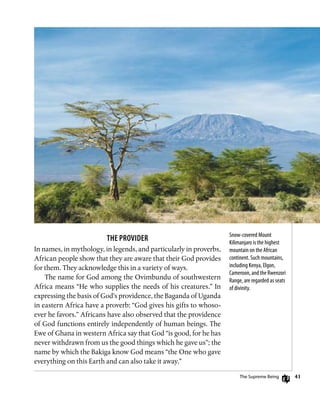
Snow-covered Mount
Kilimanjaro is the highest
mountain on the African
continent. Such mountains,
including Kenya, Elgon,
Cameroon, and the Rwenzori
Range, are regarded as seats
of divinity.
The Provider
In names, in mythology, in legends, and particularly in proverbs,
African people show that they are aware that their God provides
for them. They acknowledge this in a variety of ways.
The name for God among the Ovimbundu of southwestern
Africa means “He who supplies the needs of his creatures.” In
expressing the basis of God’s providence, the Baganda of Uganda
in eastern Africa have a proverb: “God gives his gifts to whoso-
ever he favors.” Africans have also observed that the providence
of God functions entirely independently of human beings. The
Ewe of Ghana in western Africa say that God “is good, for he has
never withdrawn from us the good things which he gave us”; the
name by which the Bakiga know God means “the One who gave
everything on this Earth and can also take it away.”
The Supreme Being
42 African Traditional Religion
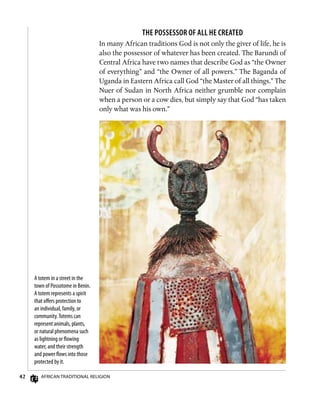
A totem in a street in the
town of Possotome in Benin.
A totem represents a spirit
that offers protection to
an individual, family, or
community.Totems can
represent animals, plants,
or natural phenomena such
as lightning or flowing
water, and their strength
and power flows into those
protected by it.
The Possessor of All He Created
In many African traditions God is not only the giver of life, he is
also the possessor of whatever has been created. The Barundi of
Central Africa have two names that describe God as “the Owner
of everything” and “the Owner of all powers.” The Baganda of
Uganda in Eastern Africa call God “the Master of all things.” The
Nuer of Sudan in North Africa neither grumble nor complain
when a person or a cow dies, but simply say that God “has taken
only what was his own.”
43
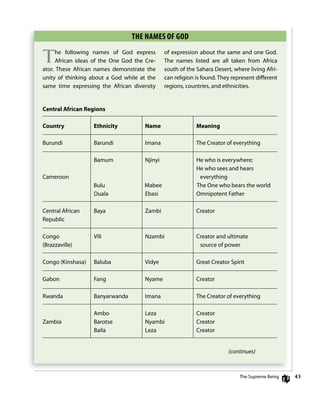
ThE nAmEs of goD
The following names of god express
African ideas of the one god the cre-
ator. These African names demonstrate the
unity of thinking about a god while at the
same time expressing the African diversity
of expression about the same and one god.
The names listed are all taken from Africa
south of the Sahara desert, where living Afri-
can religion is found. They represent different
regions, countries, and ethnicities.
Central African Regions
Country Ethnicity Name Meaning
Burundi Barundi imana The creator of everything
Bamum njinyi He who is everywhere;
He who sees and hears
cameroon everything
Bulu Mabee The one who bears the world
duala ebasi omnipotent father
central African Baya Zambi creator
republic
congo Vili nzambi creator and ultimate
(Brazzaville) source of power
congo (Kinshasa) Baluba Vidye great creator Spirit
gabon fang nyame creator
rwanda Banyarwanda imana The creator of everything
Ambo leza creator
Zambia Barotse nyambi creator
Baila leza creator
The Supreme Being
(continues)
44 AfricAn TrAdiTionAl religion
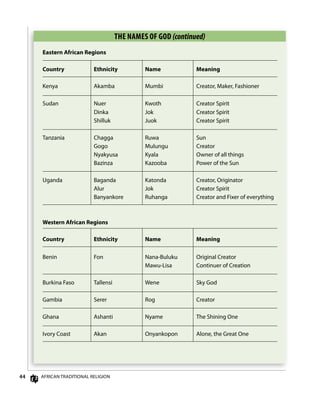
ThE nAmEs of goD (continued)
Eastern African Regions
Country Ethnicity Name Meaning
Kenya Akamba Mumbi creator, Maker, fashioner
Sudan nuer Kwoth creator Spirit
dinka Jok creator Spirit
Shilluk Juok creator Spirit
Tanzania chagga ruwa Sun
gogo Mulungu creator
nyakyusa Kyala owner of all things
Bazinza Kazooba Power of the Sun
Uganda Baganda Katonda creator, originator
Alur Jok creator Spirit
Banyankore ruhanga creator and fixer of everything
Western African Regions
Country Ethnicity Name Meaning
Benin fon nana-Buluku original creator
Mawu-lisa continuer of creation
Burkina faso Tallensi Wene Sky god
gambia Serer rog creator
ghana Ashanti nyame The Shining one
ivory coast Akan onyankopon Alone, the great one
45
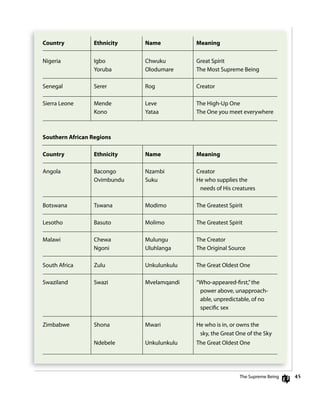
Country Ethnicity Name Meaning
nigeria igbo chwuku great Spirit
Yoruba olodumare The Most Supreme Being
Senegal Serer rog creator
Sierra leone Mende leve The High-Up one
Kono Yataa The one you meet everywhere
Southern African Regions
Country Ethnicity Name Meaning
Angola Bacongo nzambi creator
ovimbundu Suku He who supplies the
needs of His creatures
Botswana Tswana Modimo The greatest Spirit
lesotho Basuto Molimo The greatest Spirit
Malawi chewa Mulungu The creator
ngoni Uluhlanga The original Source
South Africa Zulu Unkulunkulu The great oldest one
Swaziland Swazi Mvelamqandi “Who-appeared-first,”the
power above, unapproach-
able, unpredictable, of no
specific sex
Zimbabwe Shona Mwari He who is in, or owns the
sky, the great one of the Sky
ndebele Unkulunkulu The great oldest one
The Supreme Being
46 African Traditional Religion
In African religion the Supreme Being reigns as the chief god in
heaven. However, in most traditions he is not involved in the
day-to-day affairs of human beings. This function he delegates to
the less important gods of African belief who occupy the spirit
world. The spirit world is made up of superhuman beings, beings
that occupy the spiritual universe between gods and humanity, the
space between heaven and Earth. They invisibly tread the Earth
so that they are continually present. It is to these lesser gods that
people turn in times of joy and sorrow. It is to them that they make
requests concerning their needs and desires, and to them that they
make offerings and sacrifices for health and happiness, successful
crops, the birth of healthy children, and protection from evil.
Superhuman beings exist in a hierarchy—that is, they are
ranked according to their nearness and importance to the
Supreme Being. The most important superhuman beings may be
called associates of God. These are lesser gods who rank below
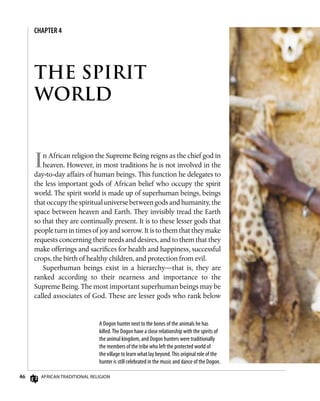
A Dogon hunter next to the bones of the animals he has
killed.The Dogon have a close relationship with the spirits of
the animal kingdom, and Dogon hunters were traditionally
the members of the tribe who left the protected world of
the village to learn what lay beyond.This original role of the
hunter is still celebrated in the music and dance of the Dogon.
THE SPIRIT
WORLD
CHAPTER 4
47The Spirit World
48 AfricAn TrAdiTionAl religion
the Supreme Being but who often work jointly with him. Other
influential spirits of the community are intermediaries, guard-
ians, and ancestors. Intermediaries are spirit agents that act as
go-betweens between divinities and humans. Spiritual guardians
and ancestors are protectors and advocates for humans, spiritu-
ally positioned between superhuman beings and human beings.
sPiRiTs of ThE sPiRiT woRLD
African tradition and thought consider spirits to be elements of
power, force, authority, and vital energy underlying all existence.
Invisible though this power may be, Africans perceive it directly.
People know and believe that spirits are there. In their daily lives
they point to a variety of actions that verify the existence of spir-
its. They also know that spirits are to be handled with care. Hence
the variety of rituals and taboos that acknowledge the existence
of spirits.
Spirits are found everywhere. And where they are considered
to be, people feel their presence. There is no object or creature,
there is no corner of the Earth, that is not inhabited by spirits.
The more something commands awe—by its size, beauty, or
power—the more that thing becomes identified with spirits.
sPiRiTuAL guARDiAns
Spirits, no matter at which level they may be, inspire some sense
of superhumanity. One example of this
is those spirits designated as spiritual
guardians. Spiritual guardians are a varied
group. Among them are ancestors and the
spirits of departed heroes. Another type
of spirit resides in natural landmarks. A
nearby mountain may be the abode of the
spirit that is guardian to the community.
The spirit of a river may be identified as
guardian of that area. An extraordinarily
huge tree in a village may be considered
the abode of a local spiritual guardian.
Protection	from	Enemies
The Galla people of Ethiopia and
Kenya in East Africa call on spiritual
guardians of the community for
protection against enemies with the
following prayer:
If enemies would come,
let not your small worm die,
but stretch your hand over him.
49
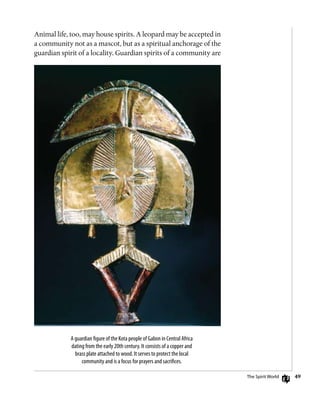
Animal life, too, may house spirits. A leopard may be accepted in
a community not as a mascot, but as a spiritual anchorage of the
guardian spirit of a locality. Guardian spirits of a community are
A guardian figure of the Kota people of Gabon in Central Africa
dating from the early 20th century. It consists of a copper and
brass plate attached to wood. It serves to protect the local
community and is a focus for prayers and sacrifices.
The Spirit World
50 AfricAn TrAdiTionAl religion
identifiedinnumerousways.Theybecome
a focus of communal ritual.
sPiRiTs of ThE DEPARTED
The spirits of the dead are part of the spirit
world. Some are ancestors and others are
the spirits of the ordinary dead—that is,
the dead of the community who are nei-
ther ancestors nor identified as outstand-
ing members of the community. Africans
do not worship their dead ancestors, but
they do venerate and respect them. The
ordinary dead are respected as well, with
due ritual observations by all the mem-
bers of the community. In African reli-
gious belief, when a person dies his or her
soul separates from the body and changes
from being a soul to being a spirit. Becoming a spirit is a social
elevation. What was human becomes superhuman. At this point
the spirit enters the state of immortality. The living are expected
to take note of this development and render due respect to the
departed through ritual.
Peopleexpectancestorstobeunceasingguardiansoftheliving.
The Edo people of Nigeria bury their dead with their feet point-
ing west, toward the Ughoton, the old port
of Benin on the West African coast. From
Ughoton the dead are believed to embark
in canoes and cross the sea to the spirit
world that lies in the dome of the sky.
ThE sPiRiTuAL hiERARChy
Imagine the universe as being like a gov-
ernment. At the head is the Creator, the
SupremeBeing.Heiseverpresentbutdoes
not manage the daily affairs of human
beings. This responsibility he delegates to
Crossing	to	the	Spirit	World
Among the Edo people of Nigeria,
when someone dies senior family
members speak prayers at the
burial. One such prayer
is the following:
Your children whom you have left here,
you should order money for them. You
should send them children. You should
send them everything That is used in
the world . . . As they have lived to do
this for you. Let their children live to do
it for them . . . As you looked after your
children. When you were in the world, So
you should look after them Unceasingly.
African	Polytheism
The term polytheism is derived from
two Greek words: polus, meaning
“many,” and theos, “god.” With
regard to African religion, it means a
system of belief that recognizes and
venerates many gods. These are the
gods with a lowercase g, who are also
described as associates of a Supreme
Being, a God with a capital G.
51
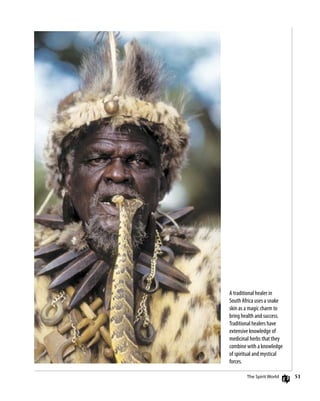
A traditional healer in
South Africa uses a snake
skin as a magic charm to
bring health and success.
Traditional healers have
extensive knowledge of
medicinal herbs that they
combine with a knowledge
of spiritual and mystical
forces.
The Spirit World
52 AfricAn TrAdiTionAl religion
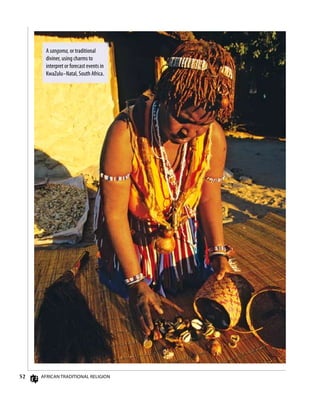
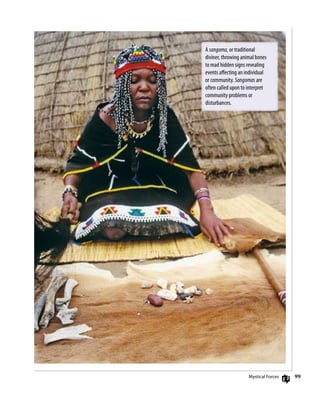
A sangoma, or traditional
diviner, using charms to
interpret or forecast events in
KwaZulu–Natal, South Africa.
53
his associates—also divine, but of a lesser order. The associates
of God are spiritually made to head departments. These gods
have been brought into being as functionaries in the God-cen-
tered government of the universe. They are the divinities who do
the spiritual work of managing the human world, and they are
the ones people call on in times of trouble. They are local gods,
intimately connected with local situations. Each of them is the
god of a particular people with a specific function in ordering
the total life of the community. Under their various names and
functions the divinities form the pantheon of gods in each par-
ticular locality. Pantheon is the term for all the gods of a particu-
lar people taken together. The pantheons of the different African
religions differ somewhat according to the needs and character
of the people.
ThE yoRuBA PAnThEon: oRisA
The Yoruba are a Nigerian ethnic group of
12 million people with a rich religious tra-
dition. At the top of their religious ranking
is Olodumare, the Supreme Being. Next
are the associates of God known as divini-
ties, gods, or deities. These are ranked
according to the importance of the func-
tion they oversee. Next are the spirits of
ancestors and those of the ordinary dead.
The pantheon of Yoruba gods is known as
the Orisa. It has a membership of as many
as 1,700 divinities. Examples of a few of
the most important follow.
oRisAnlA
Orisanla or, as he is sometimes called,
Obatala, is the second in command in the
Yoruba pantheon. Yoruba tradition refers
to Orisanla as the offspring of Olodumare.
He has many of Olodumare’s attributes,
Iwa
Among the Yoruba, morality is
summed up in the word iwa, which
can be translated as “character.” Iwa,
according to the Yoruba, is the very
stuff that makes life a joy, because
it is pleasing to God. Orunmilla
once sought the means of success
in life and was told that the only
way was for him to marry Iwa.
He accordingly married Iwa and
became very successful.
The Yoruba people say:
Character is all that is requisite.
There is no destiny to be called
unhappy in Ife city.
Character is all that is requisite.
(In E. Bolaji Idowu, Olodumare:
God in Yoruba Belief.)
The Spirit World
54 African Traditional Religion
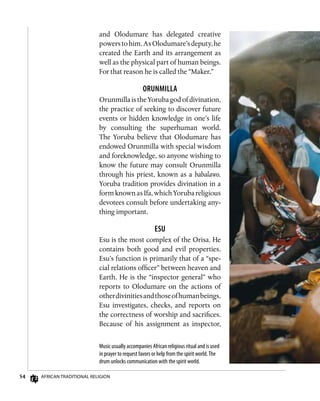
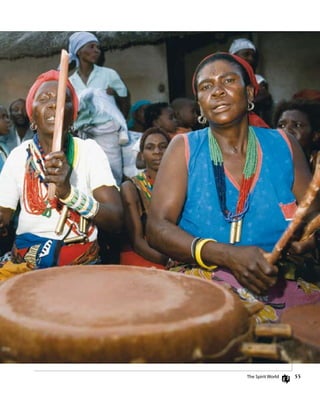
Music usually accompanies African religious ritual and is used
in prayer to request favors or help from the spirit world.The
drum unlocks communication with the spirit world.
and Olodumare has delegated creative
powerstohim.AsOlodumare’sdeputy,he
created the Earth and its arrangement as
well as the physical part of human beings.
For that reason he is called the “Maker.”
Orunmilla
Orunmilla is the Yoruba god of divination,
the practice of seeking to discover future
events or hidden knowledge in one’s life
by consulting the superhuman world.
The Yoruba believe that Olodumare has
endowed Orunmilla with special wisdom
and foreknowledge, so anyone wishing to
know the future may consult Orunmilla
through his priest, known as a babalawo.
Yoruba tradition provides divination in a
form known as Ifa, which Yoruba religious
devotees consult before undertaking any-
thing important.
Esu
Esu is the most complex of the Orisa. He
contains both good and evil properties.
Esu’s function is primarily that of a “spe-
cial relations officer” between heaven and
Earth. He is the “inspector general” who
reports to Olodumare on the actions of
otherdivinitiesandthoseofhumanbeings.
Esu investigates, checks, and reports on
the correctness of worship and sacrifices.
Because of his assignment as inspector,
55The Spirit World
56 African Traditional Religion
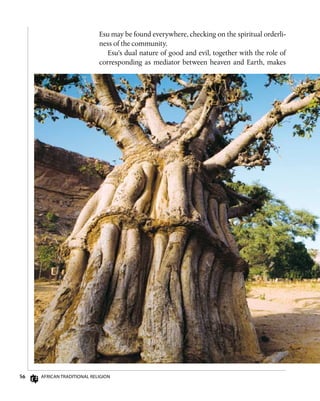
Esu may be found everywhere, checking on the spiritual orderli-
ness of the community.
Esu’s dual nature of good and evil, together with the role of
corresponding as mediator between heaven and Earth, makes
57
him a “trickster” figure, a kind of mischievous superhuman
being. He is believed to hold the power of life and death, depend-
ing on the kind of reports he makes to Olodumare. Consequently
Yoruba people seek to be on good terms with him. They vener-
ate him whenever they venerate any other
Orisa. Because of this Esu has a place in
every shrine.
People strive to be on good terms with
Esu by being constantly vigilant. They try
to avoid anything that may annoy him.
For example, should some mishap occur,
they are quick to make good what may
have gone wrong. They also make sure
that Esu’s portions of sacrifices are duly
offered to him.
Ogun
Ogun is another associate of God who
ranks high in the Yoruba pantheon. He
is the divinity of war and of iron. Ogun
exists on the edge of society. He is as hard
and tough as steel, and all iron and steel
are his spiritual possessions. He rules over
oaths, covenant making, and the cement-
ing of pacts. In local courts, instead of
swearing “to speak the truth and nothing
but the truth” by holding the Bible or the
Quran, Yoruba people take oaths by kiss-
ing a piece of iron, usually a machete, in
recognition of Ogun’s spiritual authority.
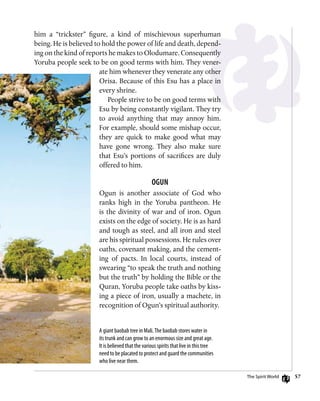
A giant baobab tree in Mali.The baobab stores water in
its trunk and can grow to an enormous size and great age.
It is believed that the various spirits that live in this tree
need to be placated to protect and guard the communities
who live near them.
The Spirit World
58 African Traditional Religion
Ogun is recognized as the patron of warriors, hunters, arti-
sans, blacksmiths, goldsmiths, engineers, mechanics, barbers,
butchers, truck and taxi drivers, and ironworkers of all kinds.
Such people often visit Ogun’s shrine in search of spiritual assur-
ances for their work.
Jakuta and Sango
The expression the wrath of God is represented by the gods Jakuta
and Sango. Jakuta is one of the lesser divinities of heaven, where-
as Sango is believed to have once been a human being who was
raised to the status of a divinity. Jakuta literally means “the one
who fights with stones” or “the one who hurls stones,” and origi-
nally the commandments against stealing, falsehood, and poi-
soning were his.
Jakuta and Sango are regarded as coworkers in creating light-
ning and thunder. The Yoruba have such a sense of their God’s
wrath that during a thunderstorm people who have reason to
fear God begin to tremble. It is in this sense that Yoruba tradition
regards Jakuta and Sango as being functionaries of God’s minis-
try of justice.
The Baganda Pantheon: Lubaale
The Baganda are an ethnic group of Uganda. Their pantheon is
called Lubaale, or beings from Olubaale, the dome of the sky. It
contains about 70 divinities. They know the Supreme Being as
Katonda, which means “Creator.” The Baganda speak of Katon-
da as the father of the gods, because he created all things. While
some Baganda divinities are connected to nature, the majority
are hero or ancestor gods who have been raised to the status of
divinity.
Ggulu
Literally, Ggulu means “sky,” “heaven.” It is the name both of heav-
en and of the sky god. Ggulu is thus the divinity next to Katonda,
the Supreme Being. In Buganda lore the wife of the founder of
the Buganda kingdom was the daughter of Ggulu, who came
59
to Earth from heaven with her brother Walumbe. The Buganda
people originate with her, and therefore from heaven.
Kiwanuka
Kiwanuka means ”something that descends at a great speed.”
Kiwanuka is god of thunder and lightning. He is also a god of
fertility whom couples consult when they wish to have a child.
When their prayers are successful parents often name their child
for the god: Kiwanuka for a son, or Nakiwanuka for a daughter.
Kitaka
Kitaka is believed to be Mother Earth. The king consulted this
divinity in cases of capital punishment so that the spirits of the
dead would not return to harm him. People also consult Kitaka
about cultivating the land, in order to have abundant crops.
Walumbe
The literal translation of this god’s name is “Mr. Death.” Walumbe
is the son of Ggulu, the sky god, and the brother-in-law of Kintu,
the first king of Buganda. When Walumbe’s sister, the king’s wife,
made the mistake of forgetting to bring some provisions to Earth
and went back to the sky to fetch them, Walumbe, her brother,
returned to Earth with her. Since then Mr. Death has lived in the
underworld as the divinity of death. A temple to him, built and
cared for at Tanda in Uganda, reminds the population of the exis-
tence of death.
Wanga
Wanga is one of the oldest of the population of the deified heroes
of the Baganda. These “terrestrial gods,” lower ranking than the
“sky gods” who rule in heaven, are the ones to whom the Baganda
turn on a daily basis with their prayers and concerns. In the tradi-
tions of the Baganda people, the Sun once fell from the sky. The
kingcalleduponWanga.Herosetothechallengeandrestoredthe
Sun in its place in the heavens. As a reward the king allotted an
estate to Wanga and built a temple there. People consult Wanga
The Spirit World
60 AfricAn TrAdiTionAl religion
about sickness and disease. He also fore-
tells how people may turn aside calamities
and troubles that befall communities.
Musisi
Musisi is the son of Wanga. His name
means “earthquake.” The Baganda peo-
ple turn to him during natural calamities
such as earthquakes.
MukAsA
Mukasa is a deified hero of the Baganda.
Of all the superhuman beings within the
Lubaale who invisibly populate the Earth
and are in daily contact with humans, he
ranks highest. People turn to Mukasa with
concerns for health and fertility.
kibuukA
Kibuuka, the brother of Mukasa, is the war god of the Baganda.
Consultation regarding warfare and national defense is directed
to him, together with his nephew Nende, also a divinity of war.
ThE fon PAnThEon: voDun
The Fon pantheon is known as the Vodun. Vodun may mean “god”
in the sense of a divinity, and it may also mean a pantheon. Vodun
worship is the religion of the Dahomey, or Fon, people in West
Africa. All of the Fon gods are members of the Vodun, includ-
ing the dead, who are elevated to the level of gods. The Vodun
includes both the great gods and also lesser gods who stem from
the greater pantheon.
The great gods are included in three pantheons. These are the
Sky Pantheon, the Earth Pantheon, and the Thunder Pantheon.
The Supreme Being of the Fon, Nana-Buluku, rules over all as
the Originator, Creator of the beginnings of the universe. Priests
of the Fon religion teach that Nana-Buluku was at once both
Baganda	Prayer
O Muwanga, who ordered this land, we
kneel and pray Thee so to order it again
as Thou didst order it in ages past. Guard
our Kabaka and the Throne, together
with the ancient traditions of our people,
that they may again become as they were
in the beginning. Forever and ever. Amen.
O Muwanga, have mercy upon us.
O blessed Mukasa of the lake,
have mercy upon us.
(In Frederick B. Welbourn, Religion
and Politics in Uganda, 1952–62.)
61
male and female. This Creator is also believed to be the parent of
Mawu-Lisa.
The Sky Pantheon: Mawu-Lisa
Mawu-Lisa is a complex god whose most striking feature is a
dual nature. This twin god was born to Nana-Buluku, the Cre-
ator, who also represents the duality of female and male. Mawu
is female, associated with aspects of the world that relate to the
Earth, the west, the Moon, the night, and the rising Sun. Lisa is
male, representing the sky, the east, the Sun, the day, and the set-
ting Sun.
In addition to representing the dualities of the physical world,
Mawu-Lisa symbolizes opposing aspects of human life. Mawu,
the female principle, reflects fertility, motherhood, gentleness,
and forgiveness. Lisa, the male principle, reflects strength and
toughness. Mawu-Lisa together expresses the unity and duality
of the physical world.
The Earth Pantheon: Sagbata
The deity Sagbata is known as the “king of the Earth.” Sometimes
he is referred to as the “owner of the soil.” According to tradition
veneration of Sagbata arose after an epidemic of smallpox. Thus
Sagbata came to be the divinity who protects against smallpox.
The Thunder and the Sea Pantheon: Sogbo
To the people of Benin the sea, thunder, and lightning represent
mysterious forces that are seen in terms of superhuman powers.
Therefore anything to do with thunder and the sea is addressed
through the pantheon whose head is Sogbo.
The Fon Pantheon of Lesser Gods
AmongtheFonpantheonoflessergods,themostnotableinclude
Legba, the divine trickster; Se, the souls of man; Fa, fate and divi-
nation; and Da, the cult of the serpent. Legba was the youngest
of the 12 children of Mawu-Lisa. When they divided the universe
amongtheiroffspringtherewasnodomainleftforLegba.Instead
The Spirit World
62 African Traditional Religion
A traditional mask from
Benin inWest Africa
worn during the Gelede
ceremony.The masks are
worn by men during a ritual
performance that takes
place between March and
May at the beginning of the
new agricultural season.
The ritual pays tribute to
the special power of women
elders and ancestors.
The lower mask depicts a
woman’s face and the upper
part of the mask often
depicts humans or animals
such as birds or snakes. In
African religion each ethnic
group has its own deities,
spirits, and ancestors; in
addition there are local
spirits or guardians that may
be linked to a village
or a family.
63
they gave Legba the role of messenger between his siblings and
parents. Legba’s domain is therefore communication. Nothing
happens without his awareness. Importantly, Legba conveys the
wishes and desires of human beings to the Vodun.
People sacrifice to Legba, fearing that if he does not receive
the sacrifices he demands he can prevent the Vodun from hear-
ing their supplications. However they also mistrust him, and they
may hold him responsible for the misfortunes of life. They also
characterize him as a trickster. However, Legba is an important
figure in determining the fortunes of human beings, who can
normally approach Mawu-Lisa only through him.
African Peoples and the Spirit World
Associates of one’s God, natural spirits, the spirits of departed
heroes, ancestors, and other members of the community all
join together to create a sense of living in a spiritually charged
universe. For African believers the spirit world is never very far
away. It is present in sky and sea, Earth and all creation, and in
the memory of those who have gone before. People feel com-
munion with the spirits all around them and communicate with
them regularly through sacrifice, offering, worship, and simple
conversation. The gods of African religion are as near to them as
their family, friends, and neighbors.
The Spirit World
64 African Traditional Religion
CHAPTER 5
RITES AND RITUAL
IN AFRICAN
RELIGION
To Africans belief without ritual action would take away
much of religion’s natural power. Rites and ritual punctuate
all aspects of African religious life. Religion is so deeply ingrained
in the daily life of traditional Africa that it is all but impossible to
separate it from other aspects of the culture. In an African com-
munity religion is the strongest influence on people’s thoughts,
acts, and lives. Rites of passage and other communal rites are the
clearest examples of how religion permeates all aspects of Afri-
can life.
Rites of Passage
Rites of passage are rites that have to do with the human life cycle.
Theyarepractices,customs,andceremoniesthatpeopleperform
to move people smoothly through the stages of life from begin-
ning to end. These stages include birth and childhood, puberty
and initiation, marriage, aging, and death.
In Eastern Cape Province, South Africa, a young Xhosa
boy, his body smeared with gray clay, sits in the bush as
part of a manhood initiation rite. Every year, thousands
of Xhosa boys go to the bush for about four weeks to
become men.They are usually circumcized the first day
and are not allowed to eat for the first seven days.
65Rites and Ritual in African Religion
66 AfricAn TrAdiTionAl religion
BiRTh AnD ChiLDhooD
The early stages of the life cycle include
conception, the period of pregnancy, the
actual birth of the child, its naming, and
its childhood. The rites of birth begin with
the mother’s pregnancy. Some African
traditions regard conception as a coopera-
tive venture between the parents-to-be,
their God, and the associate gods.
PREgnAnCy
When the time for the birth comes, expe-
rienced elderly women act as midwives to
help the mother deliver the child. The role
of midwife is considered the sacred calling
of a medicine woman. In African religion
healing is a religious activity. The birth
may take place in the house or nearby in a
secure area of the garden.
Along with the newborn baby, the
placenta and umbilical cord receive spe-
cial consideration. These two items, so
closely related to the newly born, require
religious care. The ritual disposal of the
placenta and the umbilical cord indicates
that the child has died to the state of preg-
nancy and is now alive in another state of
existence. The child is born into the new
life as part of human society.
biRTH sPiRiT
The Baganda of Uganda believe that a child is born with a double,
or twin, called a mulongo. This twin consists of the placenta and
umbilical cord. After the birth the mother wraps the placenta in
banana leaves and buries it at the foot of a banana tree in such
a way as to protect it from wild animals. The tree then assumes
“goD’s wATER”
Atradition of the Banyarwanda and
Barundi of central Africa illustrates
the idea of god’s participation in concep-
tion. They have a custom and rite known
in their language as Amazi y’imana, which
means “god’s Water.” They keep a little
water in the house at night. every woman
whohopestobearachildwillalwaysmake
sure that the water is there before she
goes to bed. Starting from the moment of
conception, imana, or god, is supposed to
use the water in his work of creation.
The religious reliance on god and other
superhuman powers only becomes more
important when a couple fails to conceive.
Then they turn to the designated divini-
ties in charge of fertility. The couple and
their supporters approach the divinities
with prayers and sacrifices as a means of
requesting the favor of pregnancy. When
the favor is granted and the woman
announces that she is pregnant, there
is rejoicing. Both spiritual and medical
precautions are taken to ensure normal
pregnancy and delivery. Those involved
offer a sacrifice to the Supreme Being, the
national gods, or the ancestors and guard-
ian spirits, who have an interest in seeing
that the community continues through
the birth of new members.
67
A mother and child of the Himba people living in northern
Namibia. In African traditional society a child is delivered by
a midwife, who is usually a medicine woman considered to
have healing powers.
Rites and Ritual in African Religion
68 AfricAn TrAdiTionAl religion
sacred significance until the fruit matures.
When the bananas ripen the child’s pater-
nal grandmother uses them to prepare a
sacred feast marking the occasion.
In addition the mother preserves the
part of the umbilical cord that remains
attached to the child after birth. It is
believed to contain a protective spirit.
When it drops off she wraps it in bark
cloth and preserves it. At the time of the
child’s naming it is dropped in a container
of banana wine, milk, and water. If it floats
the child is considered legitimate, and the
naming proceeds. If the cord sinks the
child is considered illegitimate, and the
mother is punished.
nAMing THE CHild
The name a child receives is expected to
express the very essence of the person
who bears it. Names individualize chil-
dren, give them a standing, and incorpo-
rate them into the community. Parents
take much care, therefore, in name giving.
Naming ceremonies in Africa dif-
fer from people to people, but the names
themselves have a number of things in
common. All African names have specific
meanings. Most African personal names
at least indirectly reflect religious belief,
and some have strongly religious themes.
Countless personal names in African reli-
gious traditions express religious ideas.
Some are connected with divinities, and
many are related to spiritual and human circumstance. Others
relate to attributes of the Supreme Being. For instance the Luo-
TABoos
African people consider a pregnant
woman to be chosen for a duty—
motherhood—that is a sacred calling. She
is therefore subject to a variety of taboos.
A taboo is the custom of putting someone
or something under prohibition.The preg-
nant woman is encouraged and some-
times instructed to refrain from various
activities. Some taboos have to do with
her diet. during pregnancy women are
forbidden salt, because it may harm the
child’s skin. eggs and pork are also taboo
in order to protect the child’s appear-
ance and shape. other taboos regulate
the woman’s personal habits on religious
grounds or to check her sexual behavior.
All are aimed at bringing about the safe
birth of the child, though there are also in
some cultures underlying and increasingly
contentious issues of the role of women
and their autonomy.
Igbo	Names	Honoring	God
Chukwudi, “God lives”
Ifeanyichukwu, “nothing impossible
with God”
Chukwunwke, “God creates”
Kenechukwu, “thank God”
Chukwuemeka, “God has been very
kind”
Chukwuka, “God is great”
69
speaking people of Kenya, Sudan, Tanzania, and Uganda fre-
quently name children Ojok, related to Jok, or God. The Igbo
parents of Nigeria honor Chukwu—that is, God—by naming
their children in praise of his power.
fRom PuBERTy inTo ADuLThooD
Puberty rites are ceremonies performed to mark the time during
which young people move from childhood to adolescence. They
initiate young people into the adult world, marking the physical
changes that signal the transition from the asexual world of child-
hood to the sexual world of adulthood.
iniTiATion
The approach, timing, and places for the
rites of initiation vary from people to peo-
ple.Youngpeoplemaybeinitiatedthrough
either physical initiation or instructional
retreats. Physical initiation usually means
circumcision, or the removal of the fore-
skin of the penis for boys, and an opera-
tion to remove the clitoris for girls. This
so-called female circumcision is now an
issue of deep controversy. Its antifemale
emphasis and the not-infrequent deaths
caused by this painful operation on young
girls have led to international agencies and
manytraditionaleldersdemandingthatthe
practice cease. Yet it has also now become
an issue by which hard-line traditionalists
express their opposition to modern trends
such as the rights of women.
Apart from their drama and impact,
initiation rites convey many religious
meanings. Elders take young people to
retreats away from home where they
learn the arts of communal living. They
Ashanti	Prayer	for	a	
Girl’s	Puberty
At the time of a girl’s first
menstruation her mother pours a
little wine on the ground and speaks
this prayer:
Nyankopon Tweaduapon Nyame
(Supreme Sky God, who alone is Great)
upon whom men lean and do not fall,
receive this wine and drink
Earth Goddess, whose day of worship is
a Thursday, receive this wine and drink.
Spirit of our ancestors, receive this wine
and drink.
This girl child whom God has given
to me, today the Bara (first menstrual
period) state has come upon her.
O mother who dwells in the land of
ghosts, do not come and take her away.
And do not have permitted her to
menstruate only to die.
(In Robert S. Rattray, Religion and
Art in Ashanti.)
rites and ritual in African religion
70 African Traditional Religion
are introduced to the basic facts of adult
life. They are taught the sharing of privi-
leges, rights, duties, and responsibilities of
the community. The initiation rites give
them instruction in matters of sexual life,
marriage, procreation, and family respon-
sibilities. Through this initiation they
are prepared as adults to shed blood for
their people. They are also encouraged to
accept the responsibility of planting their
biological seed as a way of contributing
toward a new generation of the commu-
nity through marriage.
Marriage
Marriage is a starting point for a new gen-
eration, as it is a starting point for personal
immortality through offspring. In African
thought marriage is a religious obligation.
Without marriage there is no assurance of
having descendants. The departed count
on being taken care of by, and are assured
of being reincarnated or reborn through,
their descendants. A person who has no
descendants in effect disrupts the chain of
reincarnation, to the great annoyance of
the superhuman beings. Marriage there-
fore is a sacred undertaking that must not
be neglected.
The families gather in a wide circle. The
men, wearing Zulu costume, dance. Then
there is an exchange of presents from the
In Bedik village, Senegal, Bassari boys encircle a hut where
an initiation ceremony is taking place to mark a young man’s
transition into adult life.
71Rites and Ritual in African Religion
2 AfricAn TrAdiTionAl religion
bride to members of the groom’s family.
These are usually blankets and mats. The
recipients dance or sing their thanks. The
groom’sgift,ablanket,comeslast.Itispre-
sented to him in a skit, where it is thrown
over his head. The bride’s friends beat him
playfully, indicating what they will do if
he does not treat the bride well, until he
escapes. With the exchange of gifts over,
the feast begins. The feast seals the mar-
riage. When the two families have eaten
together the couple is joined as one.
Aging
As they advance in age people are deemed
togrowinexperienceandwisdom.Parents
are expected to bear the torch that helps
enlighten the young. They take part in the
expectations as observed in the African
proverb “It takes a village to raise a child.”
In time they come to old age and qualify to
be addressed as elders, among whom are
found the sages and seers of the commu-
nity. However, in recent decades there has
been a decline in traditional respect for the
eldersduetosuchfactorsasthemovefrom
rural to urban areas and the resulting weakening of family struc-
tures. In addition many families have been broken up by deaths
caused by the AIDS virus, civil strife, or natural disasters. There
is also the influence of a growing global youth culture accessed
through improved communications such as the Internet, with an
emphasis on consumerism rather than traditional values.
DEATh
Death is the time when the soul leaves the body to become a spir-
it. African mythology allots a great deal of space to the subject of
A zuLu wEDDing
Before a couple marry, their families
negotiate the traditional bride pay-
ment, or lobola. People believe that the
groom respects the bride more if he must
pay for her. Traditionally the lobola was
paid in cows, but now it is usually paid
in cash. After the groom pays the lobola,
there are other ceremonies in which gifts
are exchanged. At the end the groom
receives a sheep or a goat. This gift shows
that the bride’s family has accepted him.
early on the wedding morning the
groom’s family slaughters a cow, which is
cooked and eaten for the wedding feast.
The bride’s family watches, making sure
that the meat is divided equally between
the two families. They sing and exchange
gifts. in the afternoon the bride arrives.
She wears the traditional Zulu costume
with a leopard-skin neckpiece and a bead-
ed hat and skirt. With her family carrying
her hope chest, she tours the groom’s
property. This symbolically introduces her
to the groom’s family.
73
death. Usually the same myths of creation that trace the origin of
human beings include the origin of death. In these myths death
often comes to the world because of human misdeeds. Although
African people accept death as a natural part of the life cycle they
generally feel that each individual death always has a cause asso-
ciated with supernatural powers. These include mystical powers
like magic, witchcraft, and sorcery. The understanding of death
brings with it the realization that a person’s body and soul are no
longer one. In dying, the individual has joined the world of the
departed. This fact usually evokes sorrow for those left behind. A
spiritual period of mourning sets in, with funeral rites that vary
by ethnic group.
Members of the Karamojong
of northeastern Uganda
carry a portable granary
along the road near Kotido
town.The granary is given
by the bride’s family as part
of her dowry when she
marries.
Rites and Ritual in African Religion
74 African Traditional Religion
Death calls for a ritual disposal of the body of the deceased.
Burial rites are performed by the community. Those attending
the burial bid farewell to the deceased by throwing a bit of soil or
flower petals into the grave before the burial is completed. People
are very attentive to giving the departed a proper funeral. It is
important that the spirit of the departed be content in the world
beyond and not come back as a dissatisfied ghost to plague those
left behind.
In many African traditions there are final funeral rites. These
mark the end of the time of mourning. At this time the desig-
nated heir of the deceased is officially declared, installed, and
invested with the ritual instruments that entitle him or her to
the inheritance. Connected to the final funeral rites is the idea
that the deceased may be reincarnated, or reborn, into a new life
through naming. During this time the deceased becomes increas-
ingly identified with the world of the spirits among whom he or
she now dwells.
Ritual
Rituals are religiously meaningful acts that people perform in
appropriate circumstances, usually following strictly prescribed
patterns. Rituals are the concrete expression of belief. African
believers, and indeed believers of all religions, feel that they have
to show their belief in some way. They do this by worshipping the
Supreme Being, by doing reverence to superhuman beings, and
by paying due respect to their fellow humans.
Prayer, music, and dancing enhance the effectiveness of ritual
acts. Sacrifices and offerings help to confirm the relationship
between the Supreme Being, superhumanity, and humanity.
Rituals take place during community celebrations and festivals
for the purpose of thanksgiving, purification, and communion.
Their performance helps to link humanity with superhumanity.
Prayer
In African religion there are countless prayers. Like other African
religious literature they are handed down orally from generation
5
to generation. Many prayers are tradi-
tional and centuries old. Most are recited
by people in official capacities. These
include priests and priestesses, diviners,
rainmakers, medicine men and women,
kings, chiefs, ritual and family elders, and
heads of organized groups such as hunt-
ers. Prayers are usually addressed to God,
superhuman beings, and ancestors.
People in search of spiritual assistance
for a variety of human needs address their
prayers to the powers above. People pray
for life, health, healing, wealth, and pros-
perity. They pray for success at work. They
pray to be delivered from difficulties. They
address prayers either directly or indirectly through intermediar-
ies for all spiritual assistance possible. They pray in praise, they
pray in joy, and they pray in thanksgiving.
MusiC
Music is an audible expression of African
prayer. There are many religious songs
in praise of one’s God and superhuman
beings. There are many songs intended
to express joy for spiritual blessings.
There are songs asking favors from above.
And there are songs exuberantly sung in
thanksgiving. Songs are usually accompa-
nied by the beating of drums and the play-
ing of other instruments.
dAnCE
Whereas song is religious expression in
voice, dancing concentrates on expressing
religious emotions, elegance, and dyna-
mism through bodily movement. African
Let	Us	Lift	Our	
Voices	in	Prayer
Let us lift our voices in prayer,
Offering up an ox to the Creator.
May this ox be permitted to grow old,
That we may gain good health.
Let us lift our voices in prayer,
Offering up an ox to the Creator.
The Creator of the sky gives us peace.
Gives us food.
(In Alfonso M. Di Nola and Patrick
O’Connor, The Prayers of Man.)
“Let	a	Fruitful	Year	
Come	upon	Me”
In preparing the field a farmer in
Ghana brings offerings of a fowl
and cooked yam for the spirit of the
Earth and for his ancestors. As the
blood of the fowl drips on the Earth
and the yam he says, “Grandfather
(mentions the name), you once came
and hoed here and then you left it to
me. You also, Earth, Ya, on whose soil
I am going to hoe, the yearly cycle
has come around and I am going to
cultivate; when I work, let a fruitful
year come upon me, do not let a knife
cut me, do not let a tree break and fall
upon me, do not let a snake bite me.”
rites and ritual in African religion
76 African Traditional Religion
religious ritual would be lifeless without the accompaniment of
music and dancing. These are powerful means of African reli-
gious expression.
Sacrifice
Sacrifice is giving up something valuable in order to render hom-
age to some superior being. A sacrifice is thus a gift offered to
God or to a superhuman being in recognition of their superior-
ity over humanity. Of all acts of worship to the Supreme Being,
sacrifices and offerings are emphasized most in African religion.
The Abaluyia of Kenya refer to God as “the One to whom sacred
rites and sacrifices are made.” Animal sacrifice is the usual way
of offering praise. Bulls, goats, or chickens are the most common
objects of sacrifice, offered at every stage of the rites of passage.
Communal Ritual
Prayer, music, songs, drums, other musical instruments, danc-
ing, and sacrifice come together in vividly orchestrated commu-
nal ritual. These rituals celebrate such things as purification rites,
communion rites, and agricultural rites.
Bringing Rain
Agricultural rites have to do with the way people use land for the
production of food. Farming is one of the greatest preoccupa-
tions of the people. Its importance requires the blessings of God
and those of the superhuman guardians of the people. For that
reason each stage of agricultural development calls for spiritual
assistance. Most important is the need for rain. Rain is so vital
that there are certain rites, and ritual specialists, whose main
function is to bring about rain at crucial times.
Planting and Harvest Rites
There are also rites concerned with the preparation of new fields,
planting rites, and harvest rites. At the time of sowing and har-
vesting, African religious traditions have important communal
ceremonies that link the people’s agricultural activities with the
77Rites and Ritual in African Religion
Dogon masked dancers from Mali performing
the Dana dance.The Dogon believe that this
dance creates a bridge into the world of the
spirits. Their masks are believed to have
magical powers.
8 AfricAn TrAdiTionAl religion
A cow slaughtered at the
marriage of Princess Nyawo
to NkoseTembe, king of
Tsonga, in KwaZulu–Natal,
South Africa. During the
ceremony, which took
place on April 3, 2004,
the princess ceremonially
assisted in skinning the cow
to mark her entrance into
the royal family.
79
spirits of the community. When the land is tilled and planted
people of all African cultures ask blessings from the superhuman
beings. At the time of ripening and harvest they hold “first fruits”
ceremonies.
According to tradition, superhuman powers must eat of the
first fruits of harvest before human beings partake of them. They
must receive their share in offering before anything is given to
anyone else. To deprive them of their important place in the
hierarchy would induce them to take revenge by threatening the
future harvest. The first fruits ceremonies are festival times for
offering thanksgiving to the superhuman powers for the new
harvest.
Ritual Leaders
Ritual leaders are those members of the community who preside
over and conduct particular religious rituals. They come to their
leadership roles in different ways. Some positions are hereditary.
Others are the result of a special spiritual calling along with spe-
cial training. This category of African ritual leaders includes rul-
ers, priests, mediums, diviners, healers, rainmakers, elders, and
sages.
Rulers and Leaders
African kings, queens, and chiefs have both privileges and duties.
Their position carries with it outstanding power, authority, and
influence. However although rulers are endowed with power
and prerogative, they are also bound by obligations and kept in
check by taboos. The ruler is the father/mother of the people and
the symbol of their ethnic unity. He or she must therefore solve
human problems and give an ear to all subjects, as well as repre-
senting the people in contact with other powers.
In many countries where African traditional religion is strong,
the king is the high priest of the people. As high priest he is not
only in charge of matters of government, but also of religious
matters. For example, in Buganda, part of Uganda in East Africa,
the veneration of the national gods is under the immediate con-
Rites and Ritual in African Religion
80 African Traditional Religion
trol of the kabaka, or king. By his authority temples are built to
the different gods. He has the ultimate power to confirm or reject
the choice of priests made by the clans according to the traditions
surrounding the different gods.
81
Besides being the primary religious leader of the people, the
ruler is closely connected with ritual traditions. Ritual occa-
sions connected with kingship or chiefdom, such as coronation,
enthronement, and funeral rites, connect strongly to the sacred-
A Himba chief with
members of his family in the
Kunene region of northern
Namibia. African people
consider the authority of
their leaders to come from
their God.Their rulers are
political leaders, but they
are also true religious
leaders. In African traditions
there is no such thing as
separation of church and
state. Religion and human
affairs, such as politics, by
African religious standards
go hand in hand.
Rites and Ritual in African Religion
82 AfricAn TrAdiTionAl religion
ness of the ruler. Rulers are regarded as a God’s earthly represen-
tatives. They are the reflection of the God’s rule in the universe.
To many African peoples rulers are not ordinary men or women.
They are living symbols of the connection between the Supreme
Being, the superhuman beings, and the human beings.
PRiEsTs
In African religious tradition a priest is a ritual leader who over-
sees, administers, and coordinates religious matters for the com-
Father	of	Mysteries
In some African traditions the work
of diviners is so revered that they are
elevated to the position of divinities.
For instance in the Yoruba religion
the diviner is known as the Father
of Mysteries, with no less a spiritual
patron than Orinmilla, the Yoruba
deity of divination.
People usually become diviners
either by training or by inheritance.
Diviners-to-be are privately trained
by experienced diviners. In many
cases the training period may last
from three to seven years. They must
master the oral tradition, which
involves memorizing names and
signs of divination as well as figures,
proverbs, and stories connected
with them. They learn to use the
instruments of divination, including
pebbles, seeds, gourds, numbers, and
cowrie shells. They also learn how to
read animal entrails, to read palms, to
form images or use images in pots of
water, and to interpret sounds.
83
Sangomas, or traditional
diviners, gathered to
perform a ritual at Saltpeter
Cave, near Clarence, eastern
Free State, South Africa.
These diviners are believed
to have the skills to read
hidden signs about the past,
present, and future.
munity. Priests may be men or women. Priests are key figures in
maintaining the religious affairs of an African ethnic group.
Priestsareusuallyattachedtoatempleofagodandarecharged
with its care. People become priests by both vocation and train-
ing. However, there are a few African societies like the Baamba,
the Banyankore, and the Basoga of Uganda, the Bavenda of South
Africa, the Binawa and the Srubu of Nigeria, and the Sonjo of
Tanzania, in which priesthood is hereditary. People believe that
priests and priestesses are called by the gods. Some are said to
Rites and Ritual in African Religion
84 AfricAn TrAdiTionAl religion
have been set aside from birth. Others are
said to have been called by a god through
beingpossessedbyhisorherspirit.Atoth-
er times parents send a child to be trained
as a priest because the child was born in
answer to prayer, and so is dedicated to the
service of the gods. Trainees are submitted
to the guidance of an older priest. Training
is usually arduous. It may last some years,
during which the child learns the secrets
of serving a god.
divinERs
Diviners are ritual leaders whose special
position is to unveil the mysteries of the
past and future. In so doing they pro-
nounce what may be causing problems
in the community. Diviners not only read
the signs of the present but also have techniques by which they
discover hidden knowledge about the past, the present, and the
future of those who consult them. To find out the unknown for a
client diviners may use shells, pebbles, water, animal entrails, and
many other objects regarded as “mirrors.” From these they read
why something has gone wrong.
HEAlERs
In some parts of Africa a healer is called musawo, “a person with a
bag.” Healers are easily distinguished by the bag they carry and by
their attire. Healers customarily wear amulets, shells, and other
decorative accessories that ordinary people do not wear. The bag
that they carry is their trademark. In it are all types of medicines.
In a broad sense healers are ritual leaders whose service relies on
supernatural powers. They come to the aid of the community in
matters of health and well-being. Healers work in conjunction
with other ritual leaders to keep the members of the community
physically and spiritually healthy.
mEDiums
Mediums are people who can con-
tact the spirit world, usually by
being possessed by spirits. As a rule they
become mediums through being pos-
sessed by superhuman beings, after which
they undergo training. Mediums are usu-
ally women. They are attached either to a
priest at a temple or to a diviner. They sink
into a trance, usually induced by music,
drumming, and singing, and become
possessed. The spirit speaks through the
medium, transmitting messages from the
spirit world to human beings. Sometimes
the message may be in a strange lan-
guage, and the priest or an assistant may
be called to interpret.
85
In African thought illness is always caused by superhuman
agencies or by extrahuman forces such as magic, witchcraft, and
sorcery. Therefore someone who is sick must determine the spir-
itual cause of an illness in order to cure it. Answers to the ques-
tion of why an illness has occurred may come from the spirit
world in oracles or divine pronouncements through the coop-
eration of a priest and a medium. Or they may come from the
superhuman and extrahuman world through the cooperation of
a diviner. Oracles and divination are the means of identifying the
cause of illness and the illness itself. When the illness is identi-
fied the healer can devise the cure. Healers then turn to the spirit
world for help in getting and administering the right medicine.
Healers are often specialists. Some focus on performing heal-
ing rituals in combination with other ritual leaders. Others may
concentrate on one aspect of healing such as bonesetting, herbal
remedies, or dietary prescriptions. Their specialties depend on
how the healer received his or her calling. Some healers are heal-
ers by inheritance. Their craft is handed down from parents or
relatives. Others learn the trade from experienced healers with
whom they study and work for a substantial length of time before
they are allowed to practice on their own.
These powers can also be used to bring
suffering, by cursing someone who is
thought to be behaving in an inappropri-
ate way. Fear of such curses and belief in
their efficacy is widespread throughout
Africa and can cause real distress, men-
tal breakdown, or even death. Its role is
intended to be one that places the safety
of the community above the safety of the
individual.
RAinmAkERs
Rain, so essential to agriculture and there-
fore to survival, is closely connected to
African religion. Rain is viewed as divine
mEDiCinE mEn AnD womEn
Healers are variously referred to as
medicine men or women, herbal-
ists, and sometimes as witch doctors.They
are some of the most influential people
in an African community. Their influence
comes from their important work of cur-
ing members of the community of illness
and disease. Their gifts are both material
and spiritual. Materially they have wide
knowledge of healing herbs and medica-
tions. Spiritually they heal the underlying
spiritual causes of illness.
rites and ritual in African religion
86 African Traditional Religion
influence that descends to Earth. The continued fertility of the
land requires rain. When it fails to fall people begin to wonder
what they may have done wrong. They feel a need to put right
whatever has caused a problem between them and the Supreme
Being or the spirit world. They call for the ritual leadership that
comes from those known as rainmakers.
Rainmakers are specialists in religious matters pertaining to
rain. They determine the reasons why rain fails to fall or why
there is too much rain. Rainmakers perform rites of prayer or
sacrifices offered to ensure that enough rain will fall at the proper
times. They also preside over prayers and sacrifices offered to
check excessive rainfall. They are thus both rainmakers and rain
stoppers.
A person may become a rainmaker either by training or by
inheritance.Throughmessagesfromthespiritworldandthrough
dreams a person may find a call to become a rainmaker. Then
that person may train under an experienced rainmaker. A fairly
African women herding
livestock in a canyon in
Debre Libanos, Ethiopia.
Rural life and the survival
of livestock and crops is
dependent on the rains,
which is why the role
of rainmaker is highly
regarded.
8
long period of training is required before
the person can enter a serious practice.
There are also rainmakers who achieve
this religious and ritual position by inheri-
tance.Mostrenownedoftheseisthequeen
of the Balovedu of southern Africa, who is
called a “rain queen.” She is not primarily
a ruler, but a rainmaker. People rely on her
for their security not in regard to regimen-
tation, armies, and organization, but on
her power to make rain for them and to
withhold rain from their enemies.
“goD’s BLEssings ARE fALLing”
The dinka of Sudan know their chief
deity as deng or dengdit, which lit-
erally means “rain.” The Kikuyu of Kenya
know their key god as ngai. ngai has three
capacities. By the first he sends rain and
riches, by the second he sends good wives
and healthy children, by the third sickness
and loss. it is in the first capacity that ngai
is considered to be the Supreme Being
and is credited with divine powers. The
churi and Masai of eastern Africa and the
ewe of western Africa say of rain, “god is
falling” or “god is weeping.” other African
people say“god’s blessings are falling.”
rites and ritual in African religion
88 African Traditional Religion
SACRED SPACES
AND PLACES
CHAPTER 6
The places where the rites and rituals of African religion are
carried out are African sacred space. Some of these places
are constructed specifically for religious purposes, but others are
natural places in the environment where people come together
for ritual purposes. There are also places that would normally be
regarded as nonsacred but that may on occasion serve as ritual
spaces. These are often homes in which senior family members
may officiate as ritual elders.
Sacred Space
Some places are made sacred through the relics of divine beings.
For example, the Uganda Museum in Uganda is only a museum
to the general visitor. However since British colonial times rel-
ics of the local gods have been confined there. For local people
this building is therefore a sacred space. When they visit the
The Kasubi Mausoleum is a huge thatched
burial place of four kings of Buganda in
Uganda. Religious functions are held there
around the time of the new Moon throughout
the year. Built on the outskirts of Kampala, the
capital of Uganda, it attracts many local and
international visitors.
89Sacred Spaces and Places
90 AfricAn TrAdiTionAl religion
museum they do so with care and with a
sense of awe and mystery. So a museum
visit becomes a casual sort of ritual. The
gods may also signal the special sanctity
of a place in some way. Animals, by their
symbolic relationships to the gods as well
as by their ritual guardianship of a local-
ity, often are signs of communication
from the spirit world. Their appearance in
a certain locality may mark that place as
sacred.
In a larger sense people understand the
whole land of their particular culture and
ethnic group to be sacred. The narratives
of the sacred origins of the land and its
people communicate this sacredness. For
this reason present-day political leaders
who ignore the sacredness of a people’s
lands often become the cause of unrest.
sPiRiTuAL gEogRAPhy
Africans have long associated the wonders of nature with reli-
gion. In African tradition anything that
seems to be shrouded in mystery has
tended to evoke a sense of the religious,
and the natural world is filled with beauty
and mystery.
For African people the whole universe
is filled with religious spirit. In African
religion all elements of the universe are
regarded as symbols of the divine. The
sacred space of the universe has three
parts. Above the Earth is the sky, or heav-
en, the home of the supreme being. Below
the Earth is the realm of the spirits, which
keeps humanity connected to the land.
Earth	as	Mother	of	Humanity
In many African traditions the idea
of the Supreme Being combines both
masculine and feminine. The Sun
represents the masculine element in
the God, while the Moon represents
the feminine. However in some
African societies these gender roles
change, so the Moon is masculine.
In any case, positioned between the
Sun and the Moon, the Earth has the
symbolic role of mother to humanity.
viEwing ThE univERsE: ThE zuLu
According to the Zulu of South Africa
the Zulu people were not specifically
created but originated in heaven. in their
language zulu means “sky and/or heaven.”
Zulu also means “the Zulu people” or “the
Zulu ethnic group.” iNkosi yeZulu means
“the lord of the Sky/Heaven”in whom the
Zulu originate. in other words the very
being of anything pertaining to the Zulu
is regarded as originating in heaven, or
ezulwini, which might be translated as the
“above.”from there the process of origina-
tion continues down to earth and below
the surface of the earth in the region of
the universe called phansi, which means
“the habitation place of spirits.”
91
In the middle is the Earth, the world of humanity and the here
and now.
ThE sky
The African sky inspires much religious feeling. High in the heav-
ens the blazing Sun and glowing Moon inspire humanity with
awe. The night sky is embellished with thousands upon thou-
sands of twinkling stars that, on a clear night, can leave observers
in a state of wonder.
Sun, Moon, and Earth carry aspects of divinity. Among Afri-
can peoples in all corners of the African continent, the Sun is a
symbol of the Supreme Being. In general the Moon is recognized
as a natural phenomenon that carries sacredness, serenity, and
tenderness. For that reason Africans mark the appearance of the
new Moon with rituals that express the sacredness of the Moon.
ThE nATuRAL woRLD
The Earth, too, is a source of wonder. Africa’s geography is
extremely varied. Natural landmarks include mountains, oceans,
lakes, rivers, waterfalls, forests, rocks,
caves, and trees, any or all of which may
inspire religious feelings. The forest and
plains are alive with a great variety of
animals: chattering birds, creeping rep-
tiles, spiders, and insects, all of which, by
inhabiting the world with humans, beg the
question of their place in the universe.
RiTuAL PLACEs AnD oBjECTs
For Africans ritual places are human-
made structures or marked areas at which
religious rites may be observed. These
include shrines, tombs, temples, and
sacred localities. Since the beginning of
time Africans have sensed a great invisible
power, a vital force that surrounds and is
sACRED mounTAins AnD hiLLs
Althoughalmostanygeographicalfea-
ture in Africa may become the focus
of worship, mountains and hills are the
features usually identified as being sacred.
The people who live near the great Afri-
can mountains such as Mount Kilimanjaro,
Mount Kenya, the rwenzori Mountains or
the Mountains of the Moon, Mount elgon,
and Mount cameroon, make sacrifices
and offerings, perform rituals, and offer
prayers to the Supreme Being and other
spiritual powers on or beside such places.
other natural sites such as trees, islands,
lakes, rivers, and waterfalls may also be
designated as sacred spaces.
Sacred Spaces and Places
92 AfricAn TrAdiTionAl religion
ThE mAgiC of gREAT zimBABwE
The name “great Zimbabwe” is given to
ancientstoneruinsinthecountryofZim-
babwe. These ruins, which include massive
walls, a stone tower, an acropolis, or cluster
of buildings on a hilltop, go back many hun-
dreds of years and testify to Africa’s ancient
culture.
i think the place is well over a thou-
sand years old. Somewhere some day
we may argue the case. Here is where
we redeem the half promise. Any book
about the magic of Africa that did
not include a word about the great
Zimbabwe, as it is called, would be
unthinkable.
Thefirstthingwhichstrikesoneisthe
large expanse of ruined stone dwell-
ings, huddled together at a respectful
distance from the great buildings of
the temple and fort, reminding one
irresistibly of the silent city of the dead
sprawling in its solitary decrepitude
under the serene gaze of the Sphinx.
(In Frederick Kaigh, Witchcraft and
Magic of Africa.)
A section of the Great
Zimbabwe, massive
stone ruins dating
back a thousand or
more years.Traditions
of the Shona people
of Zimbabwe, who
worship Mwari as the
Supreme Being, connect
religious practices to the
Great Zimbabwe.
93
part of all nature. To help themselves come to terms with this
power Africans have devised ways of containing it by inviting
it to reside in human-made places and objects, so that they may
perceive it in smaller doses.
Places built for religious purposes may be temples and other
constructed shrines. Temples are architectural structures that
vary in size and shape. Other constructed shrines may vary from
a pillar or monument to a small stone or an iron or wooden
marker. Examples of such shrines include the Staff of Oranyan
and the Central Shrine of the powerful Ogun in Ile Ife.
TEmPLEs
A temple is a place or a building where people congregate to wor-
ship, to pray, and to ask for favors from spiritual powers. There
are numerous types of temples in Africa constructed accord-
ing to the various traditions of different peoples. There are large
temples, small ones, and even miniature ones. Many have been
overwhelmed by the appearance in Africa of religions like Chris-
tianity and Islam, but others have persisted and have been adapt-
ed to contemporary colonial types of architecture.
Temples in other parts of Africa, built by the people and
attended by priests and priestesses, often follow the pattern of
local construction. In the kingdom of Buganda in Uganda these
may be conical and thatched. Some Nigerian temples, like the
Obatala and the Ifa temples of Ife, repre-
sent African religious temples built on the
basis of Western architectural influence.
One of the most conspicuous temple
buildings in Africa south of the Sahara is
connected with Great Zimbabwe. This is
a stone building of complex construction
possibly devoted to the worship of Mwari,
the Shona name of their Supreme Being,
and cults of the mhondoro, the spirits asso-
ciated with the ruling dynasties in this
southern African area.
Shrines
In African religion a shrine is any
container, box, or receptacle that
may receive and contain superhuman
power. A shrine is therefore an
anchorage, or place of rest, for
spiritual powers. As a constructed
structure, in addition to natural
landmarks, a shrine marks the sacred
geography of a religious tradition.
Sacred Spaces and Places
94 African Traditional Religion
An akuaba figure is a symbol of fertility for the Ashanti people
of Ghana.They are carved as wood statuettes and worn by
girls and women to assure childbearing.
Tombs
The tradition of tomb building in Africa
goes back millennia, including tombs
such as the pyramids of ancient Egypt and
Nubia. Helping us to trace back some vital
religious ideas, the Great Pyramids at Giza
express belief in divinity of the king as
representative of the Sun god Re and the
place where he ascended to join the Sun
god in the afterlife. There are many other
representative types of religiously expres-
sive tombs, among which are the Kasubi
Tombs of the Kabakas of Buganda in
Uganda. These tombs are tended by young
priestesses, who keep the fires within
them and perform rites that worshippers
may attend. The tombs thus serve as plac-
es where ordinary people may be in touch
with the higher powers.
Marked Localities of
Religious Significance
In many African religious traditions there
are localities that are identified as shrines
without the construction of elaborate
buildings or structures. For example, the
shrine of Ogun, a Yoruba divinity consid-
ered to be one of the most powerful as the
chief blacksmith in heaven and a blood-
thirsty hunter on Earth, is a locality in Ife
marked by stumps of wood and by stones.
It is at such a shrine that his followers, who
include hunters, blacksmiths, engineers,
mechanics, drivers, artisans, and all peo-
ple who deal in iron, steel, or other metals,
go to seek spiritual help.
95
RiTuAL oBjECTs
Ritual objects such as talismans or statues
are used in observing African religious
rites. The use of ritual places and objects
goes far back in African tradition. Ritual
objects are comparatively small human-
made items. One such item is a shrine
object, a small amulet or charm that is
believed to carry spiritual power. These
objects may be produced in a multitude of
forms. They may be owned communally
or personally. Other religious objects are
usually works of art with religious themes,
such as masks or statues of gods. They
may also be items intended for utilitar-
ian purposes, like pitchers or pots, which
because of religious decoration or form may spontaneously be
considered religious objects.
sACRED sPACE in AfRiCAn LifE
At home, in temples and shrines, and in the countryside, African
people are aware of the sacredness around them. Although they
may congregate in a particular place or turn toward a particular
geographical feature during prayer, they have a continuing sense
that superhuman beings walk beside them in their daily lives.
Their presence makes all places potentially sacred. Sacredness
may be more concentrated in a place built or designated as such,
but in fact it is everywhere. The objects that African people create
and place on shrines and in their homes are continuing remind-
ers of this sacredness.
Sculptures	as	Ritual	Objects
Lacking writing, Africans carried their
mythology—their literature—in their
heads, transmitting the legends orally
from generation to generation. Sculpture
was an additional language through
which they expressed their inner life and
communicated with the invisible world, a
language of emotional communication,
used from birth to death. Virtually every
act in the life of the African had its ritual,
and every rite had its appropriate image.
(In Ladislas Segy, African
Sculpture Speaks.)
Sacred Spaces and Places
96 African Traditional Religion
CHAPTER 7
MYSTICAL
FORCES
African people feel the power and energy of the spirit world
that is all around them. They experience the actions of gods
and ancestors in everything they do. African people are deeply
aware of the powerful force of creation that put them on the
Earth and guides their footsteps. They are closely attuned to the
mystical and mysterious superhuman powers in their lives. In
addition to their sense of the vital force of the universe, Africans
recognize other types of forces that are neither superhuman nor
simply human but lie somewhere between. These mystical forces
include magic, witchcraft, and sorcery. Like spiritual forces, they
affect people’s lives and the lives of their community.
Magic, Witchcraft, and Sorcery
Magic is the practice of manipulating mysterious forces for prac-
tical purposes. People who are able to bring about magic are
known as magicians. In African belief magic is a far cry from the
smoke and mirrors of the Western theater stage. African magic
does not have to do with illusion or trickery. It is a true religious
A traditional healer selling medicines and herbs in
Durban, KwaZulu–Natal, South Africa.The healer’s
practice of medicine combines knowledge of
medicinal herbs with spiritual and mystical forces.
97Mystical Forces
98 AfricAn TrAdiTionAl religion
element. Africans believe that magic is neutral. It may be used
for either good or evil purposes. African religion is mainly con-
cerned with asking the cooperation of one’s Supreme Being and
superhuman beings for the well-being of humanity. In the sense
that ritual leaders are able to call upon the higher powers effec-
tively, there is always something of a magician in the personality
of a ritual leader.
Magic in African religion, as in many other religions, makes
the unknown less threatening and provides psychological reas-
surances for potentially difficult or even dangerous situations.
Although Westerners do not call it magic, there are many things
people do, often without knowing they are doing them, that an
African would consider to be magic at work. They believe it is
magic when a baseball player crosses himself before stepping up
to the plate in order to get a hit. It is for magical protection that a
truck driver places a rosary on the dashboard. Ritual acts and tal-
ismans provide magical protection from
unknown dangers around the world.
wiTCHCRAfT
Traditionally African people believe that
witchcraft is one of the causes of misfor-
tunes in a community. Witchcraft is a
dreaded element in African society. Peo-
ple define witchcraft as the state of being
possessed by extrahuman forces that can
do evil or harm. A sizable population of
Africans at all levels of society believe in
witchcraft. They hold witchcraft responsi-
ble for such misfortunes as failure to bear
children, diseases, failure in life, illness,
and death.
People have a variety of views about
how someone becomes a witch. The most
commonly belief is that the trait is inherit-
edfromaparent.Inthatsensesomepeople
RECEiving ThE gifT of mAgiC
To the peoples of Africa magic and reli-
gion are so closely related as almost
to be one. The ewe of ghana believe that
god sent magic power into the world
after he had created the first person. The
langi of Uganda add that the art of magic
originated partly in god and partly in the
spirits. However, they are not certain as
to when this took place. The Azande of
Sudan note that the art of magic, together
with the knowledge of making medicines
and the ability to avenge crimes, were
given to humanity by god. The Bemba of
central Africa simply say that magic is a
gift from their god. Behind these beliefs
about magic is the general belief that god
is the creator of everything, including this
puzzling force of magic.
A sangoma, or traditional
diviner, throwing animal bones
to read hidden signs revealing
events affecting an individual
or community. Sangomas are
often called upon to interpret
community problems or
disturbances.
Mystical forces 99
100 AfricAn TrAdiTionAl religion
The	Magician	and	the	Sorcerer
Although in the broadest sense the field
of magic might be said to include sorcery
. . . for the sake of simplicity we shall call
magic that which is intended to have
beneficial effects, and sorcery that which
is intended to do harm. The magician
mainly serves the community; he or she
performs rites to promote fertility and
avert misfortune. The sorcerer on the
other hand is employed privately, serving
one person in order to harm the enemy.
(In Ladislas Segy,
African Sculpture Speaks.)
are born witches. In the case of hereditary
witchcraft it is possible for someone to be
a witch and not know it, although eventu-
ally the witch notices his or her powers.
These powers can be used to cast a spell
and do harm to someone. Not all witch-
craft is hereditary, however. People also
feel that witchcraft can be “caught” like an
infection, or that someone who wants to
be a witch can buy the power from anoth-
er witch.
Witchcraft causes evil and unrest in
a community. The community fights its
influence by calling on healers who spe-
cialize in curing the effects of witchcraft.
These healers have come to be known as
“witch doctors,” a term that is often mis-
understood both in Africa and in the wid-
er world. Witch doctors are not witches
themselves. That is, they are not evil peo-
ple who want to harm their neighbors.
They are respected members of society
whose function is not to harm but to heal.
A witch doctor helps those who believe
they have been bewitched. The possibility
of witchcraft is everywhere. People seek
protection against it in a variety of ways.
On the personal level they may use amu-
lets, charms, or talismans to help ward off
the presence of evil. A hunter, for exam-
ple, may wear a piece of a tooth of a lion
as protection against witchcraft during a
hunting expedition. A pregnant woman
may wear a talisman around her waist to
protect her unborn child against witch-
craft. The head of a household may hang
Magic
In magic certain gestures, words, or
acts, separately or together, are believed
to invoke the direct assistance of
supernatural powers in human affairs
or to give people control over the secret
powers of Nature. In another sense magic
may be defined as the art of living in
intimate union with Nature and sharing
and using its secrets through
ritual or “doing.”
The profession of magician is held in
esteem. It is passed on from father to son.
As priest the magician promoted the
welfare of the community; as medicine
man he healed the ailing.
(In Ladislas Segy,
African Sculpture Speaks.)
101
an amulet on the doorpost of his house for
protection of those within.
soRCERy
The Oxford English Dictionary traces the
word sorcery to 1330 b.c.e. It means “the
use of magic or enchantment; the practice
of magic arts; witchcraft.” To Africans,
however, the “magic arts” are nothing
artistic or enchanting. The African under-
standing of sorcery is as something darker
and more dangerous. It is the use of magic
to do harm. Sorcery shares this quality
withwitchcraft.Thedifferenceisindegree.
Witchcraft may be defined as a mystical
and innate power, which can be used by its
possessor to harm other people, whereas
sorcery is evil magic against others.
Sorcerers set out to do harm. Unlike
witches, who may cast spells or call on
mystical forces to do their mischief, sor-
cerers resort to artificial mean, such as
poison to ply their craft. For example,
they grow long fingernails in which to
hide the harmful potions that they may
drop in someone’s food or drink. In Afri-
can understanding sorcerers are evil. They
cause much trouble in a community in the
formofdiscontent,illness,andevendeath.
Some African societies specifically refer to sorcerers or sorcer-
esses as “poisoners.” Theirs is evil magic, deliberately aimed at
harming people and communities. As in the case of witchcraft,
people turn to healers for defenses against sorcery.
ToAfricanbelieversthereisnothingimaginaryaboutextrahu-
man forces. People believe deeply in the influence of these forces
on their lives. Extrahuman forces are not to be ignored or taken
goD’s CREATion AnD PRoTECTion
African people understand witchcraft
to be part of the religious forces that
surround them. The nupe of nigeria say
that in the context of creation, “god also
put the power of witchcraft in the world.”
The Barundi of Burundi add, “god gives
power to the magicians and witches.” But
although witchcraft may be a creation of
god, he also protects against it. The igbo
of nigeria assert that“god punishes those
who do evil and protects people against
witchcraft.”The nyakyusa ofTanzania note
that “god has the power to drive away
witches.”Witches are men or women who
have within themselves the power to prac-
tice witchcraft.
Witchcraft and magic are related, but
they are distinct from each other. The
Azande people, for example, make a firm
distinction between magic (ngwa) and
witchcraft (mangu). Mangu is hereditary.
it can be traced to a substance that can
be found by autopsy in the stomach of a
witch. it exerts a sinister influence over the
lives of others in the community when it
is roused by bad intentions. Ngwa is not
identified with any special substance. it is
divided into good magic and bad magic.
Mystical forces
102 African Traditional Religion
A Masai woman wearing jewelry, including protective amulets or charms on her ears, to help
ward off danger or evil spirits.Women make elaborate colored beadwork traditionally worn as
bangles and necklaces, while both men and women wear earrings that stretch the earlobes.
103
lightly. The following event, reported as
fact, illustrates just how powerful these
forces and the belief in them can be.
During the early 1960s an incident
occurred through a combination of influ-
ences of superhuman and extrahuman
powers. A husband and wife were quarrel-
ing. The situation deteriorated to the point
that the husband consulted a medicine
man.Thismedicineman,whosenamewas
Kigangali, lived in a village called Mushan-
ga, in the district of Ankore in Uganda.
No ordinary medicine man, Kigangali
was known for his remarkable command
of mystical forces. Kigangali told the hus-
band of Nzeera, the quarrelsome wife, that
he would take care of the situation. Exact-
ly what Kigangali did is unknown, but the
effect of his magical manipulations was
that Nzeera was turned into a lion.
Perhaps in the hope that she could be
turned back into a woman through exor-
cism, people captured the lion and dragged it to the Christian
parish center in Mushanga. Observers came from all over the
area to witness what had happened. Before anything could be
done, however, the lion died, and the woman’s soul with it. The
lion was buried with the rites due a human being; the woman
was never seen again.
Almost 40 years later this extraordinary event is still discussed
because of the sense of awe and wonder it created. To call down
such powerful mystical forces is both terrible and wonderful,
repellent and attractive. Yet those who believe in them have no
doubt that such powers are real, and the changing of a woman
into a lion is clear proof.
PRoTECTion ThRough PRAyER
People may seek protection from
witchcraft for their community
through prayer. The following is a prayer
against witchcraft.
Be Good to Us
I offer thee this dege, this d’lo (nut), and
this chicken in the sacrifice that I carry
out in my name and in the name of my
children.
Keep us safe from the suba (witches)
0, from all evil and ugly spirits.
Be good to us, keep us from sickness, give
us women, healthy children,
and take care to send us rain; give us
physical vigor and in all ways preserve
us that we may gather a
bountiful crop.
(In Alfonso M. Di Nola and Patrick
O’Connor, The Prayers of Man.)
Mystical forces
104 African Traditional Religion
AFRICAN
RELIGION IN
TODAY’S WORLD
Throughout history people from outside the African conti-
nent have tended to misunderstand and to dismiss African
religion, often because of stereotyping and prejudice. One clear
indicationofthisisthatuntilquiterecentlyAfricanreligionswere
not considered “true” religions, not included on the list of world
religions. Only lately has African religion received serious recog-
nition as a world religion. The followers of Islam who established
their influence on Africa’s east coast in the 10th century called
Africans kaffirs, or unbelievers. In the 15th century, when the
Christians arrived, they accepted the term, and even went so far
as to call the entire region Kaffraria. The idea that Africans were
a people with no religion was widely accepted. African religious
practices became known as fetishism—superstition and magic.
CHAPTER 8
Celebrations at a gathering of the Nazareth
Baptist Church in Gingindlovu, KwaZulu–Natal,
South Africa.This indigenous Christian church
has more than 700,000 members in South
Africa.The church was founded in 1910 by
a Zulu healer, Isaiah Shembe, who sought
to infuse traditional African religion into
Christianity. African traditional dance and
music continue to be widely used in worship.
105African Religion in Today’s World
106 African Traditional Religion
Recognition as a True Religion
It took some 300 years for scholars to recognize African religion
as a true religion. At first they called African beliefs and prac-
tices “primitive religion.” This term recognized African beliefs as
valid, yet “primitive” suggests something crude and unformed,
whereas African religious practices were often highly refined.
Eventually the religions of Africa came to be known simply as
“African religion.”
In 1957 Ghana in West Africa shook off the shackles of colo-
nialism and became independent. This began a general move-
ment toward independence in Africa. Political independence
meant a return to African roots and a new appreciation of things
African. It restored the “Africanness” of the African people. One
outcome was that African religion experienced a comeback. By
this time, too, the Western world had come to a greater apprecia-
tion and understanding of the value of African religion.
In the 1964 Vatican II Council, Roman Catholic bishops from
all over the world met in Rome. They accepted African religion
as a full partner among world religions. The influence of Vati-
can II spread well beyond the Catholic Church. Observers from
almost all Christian denominations attended and carried its mes-
sage back to their churches. They also quickly accepted African
religion in its many manifestations as a full partner among world
religions.
Influence on Religion Worldwide
African religion has great influence on African society and on
African people throughout the world. All people of African heri-
tage are tied to African religion by the bonds of culture. Their
environment shapes their religious feelings and ideas. Although
they may convert to other religions, people cannot give up their
Africanness. It is too much a part of them. And a part of that
Africanness is African religion. Even if they are Catholic, Protes-
tant, or Orthodox Christians or Muslims, as many Africans are,
they have formed their feelings about religion in general on the
basis of their African roots.
10
UBUNTU
African religion is deeply and funda-
mentally humanistic, centered on the
human condition. This humanism colors all
of life and its relationships. African human-
ism may be summarized in the principle of
Ubuntu. Ubuntu is difficult to translate, but as
South Africa’s Archbishop desmond Tutu, the
nobel Prize–winning churchman, has said,
“You know when it is there, and it is obvious
when it is absent. it has to do with what it
means to be truly human, it refers to gentle-
ness, to compassion, to hospitality, to open-
ness to others, to vulnerability, to be available
for others and to know that you are bound up
with them in the bundle of life, for a person
is only a person through other persons.” This
is the principle behind African religion. Ulti-
mately this is the principle that empowers
African religion to exert worldwide influence.
Archbishop DesmondTutu, the Nobel Peace Prize winner, is
recognized for his campaigning work on peace and justice
issues not only within Christianity but among communities of
many religious traditions and with secular governments.
African religion in Today’s World
108 AfricAn TrAdiTionAl religion
kwAnzAA
Kwanzaa is an African-American holi-
day. it was begun in 1966 by Maulana
Karenga. This holiday pays tribute to the rich
cultural roots of African Americans. Kwanzaa
is an African word meaning “the first fruits of
the harvest,”and the holiday is based on Afri-
can first-fruits celebrations. These are yearly
celebrations with a fourfold purpose: To
bring people together; to honor and pay rev-
erence to the creator and creation; to com-
memorate the past; and to give the people
the opportunity to recommit themselves to
the highest ideals of the community. These
ideals are summarized in the seven principles
of unity, self-determination, collective work
and responsibility, cooperative economics,
purpose, creativity, and faith. Kwanzaa is cel-
ebrated annually from december 26 through
January 1. Kwanzaa is usually presented as
a unique holiday—not religious, political, or
heroic,butcultural.However,aswithallthings
African, it is impossible to separate religion
from culture, and Kwanzaa carries religious
associations along with cultural ones.
The ritual instruments of Kwanzaa festival include a straw place mat, a seven-branched candlestick, seven
candles, a variety of fruits, a symbolic representation of the number of children in the home by ears of corn, a
communal cup that represents unity, and a drink that is poured and shared together.
109
African Religion in the Americas
The influence of African religion goes beyond the African conti-
nent. In the Western Hemisphere, for example, elements of Afri-
can religion appear in a number of local religious traditions. In
Brazil Candomblé and Macumba are two religions whose back-
bone is African. In the Caribbean religions with strong African
roots include Haitian Voodoo, which is based on the Fon Vodun
worship;CubanSanteria,ablendofAfricanandChristianbeliefs;
Trinidadian Shango; and Jamaican Rastafarianism. Emigration
has carried all of these to the United States. In addition traditions
like the African Methodist Episcopal Church, which traces its
beginnings to the time of slavery, incorporate elements of Afri-
can religion.
Indigenous African Churches
Within Africa people have adapted Christian beliefs and rituals
to fit their own needs, establishing churches of their own. Many
of these churches have strong elements of African religion. Peo-
ple felt that Christianity, with its emphasis on salvation in the
next world, was not meeting their needs for the here and now.
It did not, for example, offer protection against witches, ways of
divining the future, and healing, which the new churches offer.
The Aladura Church of Yoruba, with a membership of around
1.5 million, features leaders who act as healers and diviners. By
some estimates more than 80 million Africans belong to the new
churches; for example, the Church of Zion in South Africa has
5 million adherents and in Zaire, the Church of Jesus Christ on
Earth through the Prophet Simon Kimbangu (Kimbanguists) has
7 million. Another factor in the development of the new church-
es has been people’s need to shake off outside influences and take
local control of their religion.
African Music
Music, either vocal or instrumental, usually accompanies Afri-
can religious ritual. Music is used to praise the Supreme Being,
the superhuman beings, and the ancestors. It is used as prayer in
African Religion in Today’s World
110 African Traditional Religion
111
Singers at a community celebration in Nampula province,
northeastern Mozambique. In traditional African religion
instrumental or vocal music are used both in religious ritual
and as an expression of community identity.
supplication for favors from heaven. The
drum is the primary instrument. It is a
key that unlocks communication with the
spirit world. People beat or play drums to
induce oracles from high above, through
mediums.
African Americans originated one of
America’s earliest original musical forms,
the Negro spiritual. Negro spirituals, now
familiar worldwide, were the creation of
African Americans during the time of
slavery. People sang them to express the
grief and suffering to which they were
often subject. The music soothed their
own souls and those of their listeners. It
presentedreligious,usuallyChristian,sen-
timents in a distinctly African style. From
the United States to Europe and to the rest
of the world, Negro spirituals have made a
special mark on world music.
The Visual Arts
From their beginnings the people of Afri-
ca have expressed themselves through the
visual arts. Rock paintings from ancient
times have been discovered in many
parts of Africa. Stone and wood carvings
abound in African villages and homes.
True works of art, they have found places
in museums and in the homes of Ameri-
can and European collectors as well.
African Religion in Today’s World
112 AfricAn TrAdiTionAl religion
Originally all of these objects had a religious purpose. Afri-
can religion is a religion without scripture and originally without
written records. At one time people therefore concluded that it
was a religion of illiteracy and without any kind of record. How-
ever in fact records of African religion are many. Some of the
most important of these are its visual arts.
African visual arts have influenced some of the great Western
artists of the 20th century. Among these were Pablo Picasso and
Henri Matisse. Matisse recalled how an African statuette, with its
strong character and purity of line, influenced Picasso’s style and
led to the birth of cubism, one of the most important movements
of modern art.
AfRiCAn RELigion AnD oThER RELigions
African religion is a vital part of the African heritage, and Afri-
cans who live on the African continent
belong to that heritage. They are cultur-
ally connected to African religion. How-
ever, not all African people today claim to
be adherents of African religion. Many of
them are declared Christians, Muslims, or
members of other religions.
Today leaders from other religions
understand that they must first be able to
talk meaningfully with others about the
religion they have grown up in as well as
the one they are adopting. Not long ago
the missionary effort was aimed at eras-
ing African religion from the African
continent and the world. Today, however,
the message is one of dialogue. That this
is happening is a further assurance that
African religion will continue to prosper.
Far from being wiped out by the influx of
other religions, African religion continues
to thrive.
The	Infl	uence	of	African	
Religion	on	20th-Century	
Visual	Arts
It was the spirit . . . not merely African
but universal, which was truly captured by
modern Cubist artists. The fact that they
collected African sculptures meant that
these moderns lived with them sufficiently
to absorb the sculptures’ radiance, and
not merely to “borrow” forms. They did
not divide the form from the content,
any more than the human body can
be separated from the mind. It was an
“influence,” if one wishes to use this word;
but an influence of the content which was
first digested in its essence by the artists,
and then recreated by them.
(In Ladislas Segy,
African Sculpture Speaks.)
113
PiCAsso AnD sACRED ART
PabloPicassowellunderstoodtheconnec-
tion between African art and religion. He
wrote, “My greatest artistic revelation came
about when i was suddenly struck by the
sublime beauty of the sculpture done by the
anonymous artists of Africa. in their passion-
ate and rigorous logic, these works of sacred
art are the most powerful and beautiful prod-
ucts of the human imagination.”
(in John richardson, A Life of Picasso.)
A handmade wooden mask from Nubia, southern Egypt.
African religion in Today’s World
114 African Traditional Religion
African Religion as a Subject of Study
Only recently has African religion become a serious subject for
study. Early students of African culture tended to see only what
they wanted to see—exotic ritual and mysterious rites that meant
nothing to them. They reported on its color and strangeness, but
without understanding. Since that time anthropologists, scien-
tists who study humans and their societies and cultures, have
conducted many studies of African religion that have promoted
a better understanding. They have greatly contributed to assur-
ing African religion a place among world religions.
During the late 1950s, along with African independence Afri-
cans developed a keen awareness of their religion. They began to
study it as never before. Books and textbooks appeared on the
subject. In the United States Harvard University inaugurated the
teaching of African religion in 1977. Since that time African reli-
gion has become a popular subject of study at colleges and uni-
versities and at the high school level.
African Religion as an Organization
African religion is usually called a “traditional religion,” one that
is spontaneously passed down from generation to generation.
It has not been considered an “organized religion” in the sense
that it does not have an elected church leader, a church hierar-
chy, or elected officials to run the business of the church and rule
on matters of doctrine. However, African religion does have an
internal structure. It is first of all a dynamic and living religion.
Its leaders regard their religion as a whole consisting of interde-
pendently coordinated parts. In recent years leaders of African
religion have begun to apply practices of organization and asso-
ciation to African religion. For that reason, today in Africa and
in other countries where African religion exists, it is becoming
increasingly organized.
Other aspects of African religion are becoming increasingly
organized as well. One of these is healing. Practically all African
countries have taken initiatives to establish organizations and
associations through which members of the healing communi-
ties may work together, for example by exchanging notes for the
material and spiritual well-being of the people. Organizations
such as the Uganda Herbalists and Cultural Association in Ugan-
da and the Traditional Doctors’ Association in South Africa are
two of these.
International drug companies are working to understand
the healing knowledge that the medicine men and women pos-
sess, particularly with regard to healing herbs. In the invaluable
knowledge of the African healers may lie the treasure that sets off
the new “scramble for Africa.”
Importantly for African religion, the knowledge and secrets of
the healers cannot be cut away from their religious connections.
There is the opportunity here for the knowledge and the secrets
of the African healers to be preserved for the future but there is
also a real risk. Outside organizations, especially multination-
al companies, are not interested in this vital link. How healing
knowledge can maintain its religious ties in the face of this medi-
cal exploration poses a great challenge to contemporary African
religion.
African Religion in Today’s World 115
116 African Traditional Religion
CHAPTER 9
AFRICAN
RELIGION PAST,
PRESENT, AND
FUTURE
Study has shown that besides being rational, humans are also
social and religious by nature. For ages inhabitants of Africa
chose their elders to be their religious leaders and sages. These
leaders and sages have been the custodians of and consultants
to the religious needs of a community. And there is no reason
to believe that such cornerstones of African religion will cease
to exist in the near future. The influence of religion among Afri-
cans is powerful. Geoffrey Parrinder wrote that many colonial-
ist administrators described Africans as an “incurably religious
people.” With this in mind the history of African religion can be
organized in terms of precolonialist times, colonialist times, and
postcolonialist times.
Prehistoric paintings of early San people (Bushmen)
herding cattle, on the walls of a cave in the
Cederberg region of South Africa. San rock paintings
believed to date back 25,000 years have been
discovered at more than 2,500 sites.The San were
the first inhabitants of the Cape in South Africa.
117African Religion Past, Present, and Future
118 AfricAn TrAdiTionAl religion
ThE LAnD of ThE AfRi
In latin Africa (i.e., terra Africa) means
“the land of the Afri.” This name des-
ignated only the area that contained the
roman province, while the rest of the
landmasswassimplyconsideredunknown
land. in latin this unknown land was called
terra incognita. The incorrect translation of
that latin phrase later became “the dark
continent.”over time Africa—the name for
the roman province only—was extended
to include the entire continent as we know
it today.
The Antonius Pius arch
of the second-century
Roman city of Sufetula
near present-day Sbeitla in
Tunisia.The city was built on
an area once inhabited by
nomadic tribes, especially
Berber people.
PRECoLoniALisT TimEs
Africanreligioncannotbediscussedwith-
out looking at the origins ofthe nameAfri-
ca. From a geographic point of view Africa
refers to the second largest of the seven
continents. In early times, around 264–
146 b.c.e., inhabitants of northern Africa
lived within the borders of the political
influences of the city-state of Carthage;
they were known as Afri. In 146 b.c.e. the
Romans conquered Carthage and coined a
new name for the area: Africa.
The phrase African traditional religion,
then, is meant to include the obsolete and
thelivingreligionsofAfrica.Itincludesthe
indigenous religions of Africans as experi-
enced in all five regions of the continent of
Africa, as well as the fundamentally basic
units of the religious expressions of Afri-
cans. While the label indigenous religions of
Africa refers to religions that originate in
Africa, the five regions of the continent
119African Religion Past, Present, and Future
120 AfricAn TrAdiTionAl religion
represent the geographical bases of the
diversity of African ethnicity. We speak
of African religion both in the singular
and in the plural. The singular represents
the oneness of the religion of Africa as far
as the spirit of the religion is concerned.
However African religion can also be
expressed in the plural with respect to the
expressions of the religion of Africa by the
many African ethnicities.
oLD AnD nEw AfRiCAn RELigion
For a very long time before the colonialist
occupation, people in sub-Saharan Africa
practiced religion. The existence of those
religions is evident in ancient African art—particularly in rock
engravings and paintings, sculptures, and buildings—as well as
in the traditions of African folklore. Both artistic objects and oral
traditions were created to reflect the religious fabric of the people
who created them. It is helpful to look at some examples in the
different regions of sub-Saharan Africa.
AnCiEnT EAsTERn AfRiCA
Eastern Africa is not known for ancient artworks such as rock
engravings. It is, however, well known as the source of the Nile
River. Peoples from Burundi to Egypt consider the Nile to be the
personification of a river god. As such, they regard the river with
religious admiration and respect. Also, contemporary eastern
African paleoanthropologists such as Dr. Richard E. F. Leakey
have publicized the region as the home of the “East African Man.”
Dr. Leakey’s discovery of this important fossil has led many to
regard eastern Africa as the place where humankind originated.
AnCiEnT souTHERn AfRiCA
African religion in southern Africa is expressed through oral tra-
dition and art. Southern Africa has ages-old art records in the
oBsoLETE AfRiCAn RELigions
In some areas of the African continent,
especially in the north, indigenous reli-
gions became obsolete because they were
no longer practiced. egypt was home to
a now-outdated ancient egyptian reli-
gion; the Berber religion was found in the
northern part of Africa, west of egypt; the
cushite religion was practiced south of
egypt; the Aksumite religion in the south-
east area of present-day ethiopia. These
religions have fallen into disuse for many
centuries and are now obsolete.
121
form of buildings and utensils. These are functionally related
to the systems of beliefs and modes of thinking of the people of
southern Africa. The San people of southern Africa have excelled
in rock art in the form of engravings and paintings that reflect the
life they lived long ago. Archaeologists, anthropologists, and art
historians believe that the rock art of the San people was pro-
duced some 25,000 years ago.
AnCiEnT wEsTERn AfRiCA
Several art forms—ancient sculptures in particular—give evi-
dence to the rich religious expressions of the peoples of western
Africa. A serious study of western African sculpture is likely to
challenge the observer with a sense of religiosity revealed in the
art. In 2002 the Metropolitan Museum of Art in New York City
opened an exhibition of African sculpture titled “Genesis: Ideas
of Origin in African Sculpture,” and described the exhibit in this
way: “The works relate to traditions that interweave elements of
myth, history, religion, and contemporary experience to address
universal questions: How did the world
begin? What is our ancestry? What is the
source of agriculture, kingship, and other
societal institutions?”
In western Africa there are many tra-
ditions of sculpture that enshrine the
spirituality and religiosity of the people.
Perhapsthemostvisibleofthosetraditions
is that of the Yoruba people. Ile Ife, the
capital of Yorubaland, is said to have been
in existence since around 350 b.c.e. and is
believed to be the center of the world.
One of the most impressive things in
Ile Ife is the sculptured granite monolith
known as Opa Oranyan, which means
“the staff of Oranyan.” As oral tradition
has it Oranyan was the hero warrior and
son of Oduduwa. Oduduwa was associat-
Ancestral	Home	and	Holy	City
The Yoruba people of western Africa
believe that Ife is the center of the
world. E. Bolaji Idowu, one of the most
outstanding writers on Yoruba religion,
summarizes the relationship between Ile
Ife and Yoruba religion in the following
way: “In order to reach the heart of the
Yoruba in this way, the first place of
importance for us to go is Ile Ife, their
Ancestral Home, and their Holy City.
After this, and only after it, should we
look elsewhere. And so let us pay a visit to
that Ancient City!”
(In E. Bolaji Idowu, Olodumare: God
in Yoruba Belief.)
African religion Past, Present, and future
122 African Traditional Religion
ed with Olodumare, the Supreme Being in matters that relate to
creation. He is the progenitor of the Yoruba people and heritage
that originate in Ile Ife.
Yoruba religious heritage has extended to many corners of the
world. In particular it has made notable contributions to the cul-
tures of Brazil, Cuba, and the United States. Many modern people
recognize Ile Ife to be central to their roots.
Ancient Central Africa
Christianity, at its entry point in ancient Central Africa, testifies
to the presence of African religion since ancient times. In 1491
King Nzinga of the kingdom of Kongo in Central Africa convert-
ed to Christianity through contacts with the Portuguese adven-
turers. He encouraged the Kongo nobility and peasants to follow
his example. African Christianity lasted in Kongo for 200 years.
The strength of African religion accounts for the swift embrace
of Christianity by the people of the Kongo kingdom.
In African religion a king is not only a ruler; he is also a reli-
gious leader. When their king converted to Christianity it was
obvious that his subjects would follow suit. The highly central-
ized and hierarchically structured society helped information
flow throughout the kingdom. Christian doctrine was easily
translated into Kikongo, the local language. Concepts like god,
spirit, and holiness easily found equivalents with concepts in Kon-
go religion. Portuguese missionaries helped establish a spirit of
cooperation.
Colonialist Times
The Portuguese exercised navigational prowess along the west-
ern and eastern coast of the African continent. What they saw of
African religious practice in coastal areas led them to conclude
that Africans worshipped fetishes. The interior of Africa, how-
ever, continued to remain a mystery to Europeans. Stories about
the Mountains of the Moon, suppositions about raw materials in
the interior of the continent, and pagans who remained uncon-
verted attracted much speculation and attention in Europe. The
123
situation encouraged Europeans to consider exploring the inte-
rior of Africa. Between 1768 and 1892, 10 European explorers
went to Africa. Seven of these were British, one was French, one
was German (working for the British government), and one was
Anglo-American.
Europeans learned about Africa from the explorers and this
knowledge led to European ideas about colonialism. (The term
colonization refers to acts of settling on a given piece of land, while
colonialism is the system in which a nation imposes its authority
over other peoples’ territory.) The European scramble for Africa
that ended in the Berlin Conference of 1884–85 arbitrarily divid-
ed Africa among European colonialist powers. Colonialism left
all parts of African native cultures, including religion, fractured
and bleeding.
During colonialist times African reli-
gion was thought of as a “less-than” reli-
gion—on a par with paganism, fetishism,
primitive religion, and animism. Before
and during the times of colonialism Afri-
can religion was dismissed as being unim-
portant to the development of modern
society. And even to those with less criti-
cal views African religion was often toler-
ated rather than accepted.
PosTCoLoniALisT TimEs
By the time World War II began about
80 percent of the African continent was
under European colonialist rule. During
the war many African men were recruited
into serving in the armies of the colonial-
ist countries. African soldiers served in
many different corners of the world for
long periods of time. The length of their
service and the experiences they gained
made them think differently about the
Dismissing BELiEfs
Under colonialism African belief sys-
tems and modes of thought became
subjects of ridicule. explorer Samuel Baker
was among those who thought that Afri-
can belief systems did not even exist. in
an 1867 article (“race of the nile Basin”)
he said, “Without any exception [Africans]
are without a belief in a Supreme Being,
neither have they any form of worship or
idolatry; nor is the darkness of their minds
enlightened by even a ray of superstition.
The mind is as stagnant as the morass
which forms its puny world.” Some colo-
nialist administrators spoke with disgust
about Africans, whom they called “these
incurably religious” folk. Some missionar-
ies wished to destroy what they thought
of as devilish and superstitious beliefs and
replace them with what they considered
to be true religion.
African religion Past, Present, and future
124 African Traditional Religion
A drawing of the Anglo-American explorer Henry Morton Stanley approaching Lake
Tanganyika. In 1869 Stanley was commissioned by the New York Herald to search for the
missing Scottish explorer and missionary David Livingstone, whom he finally found at Lake
Tanganyika in 1871. In the years that followed Stanley continued to explore
large areas of Central Africa.
125
future of their countries when they returned home. As war vet-
erans Africans now had the knowledge and experience to work
for the end of colonialism in Africa.
In 1945 the United Nations was formed to promote peace,
security, and cooperation, and in 1948 it issued the Universal
Declaration of Human Rights. Africans started demanding polit-
ical independence from European colonialist administrators. In
some cases Africans demanded the return of religious objects
that had been sent to Europe. For example, the Baganda in Ugan-
da demanded the return of the relics of Kibuuka, the Buganda
god of war, from the United Kingdom. The relics were returned.
In 1957 Ghana in western Africa was the first African country to
gain political independence from the government of Her Majesty
Queen Elizabeth II of the United Kingdom.
Independent Africa
Colonialist administrators and missionaries had put many Afri-
can religious practitioners under watch. As a result people prac-
ticed religion secretly and under the cover of the night. Many
Africans practiced Christianity during the day while they attend-
ed African religious sessions at night. Political independence
brought about change, however. It made people feel confident
about themselves—not only politically, but also in terms of their
relationship to African religion. Many postindependent Afri-
can governments protected the practices of African religion and
many African governments have declared African religions to be
official religions.
Education and Renewed Confidence
Since independence many Africans have rediscovered the worth
of their religion and have stopped feeling insecure about their
religious heritage. Such insecurity was instilled in them by out-
side religious and colonialist rule that had viewed African reli-
gion as being inferior.
To deal with challenges and doubts about African religion,
African leaders looked to education. Departments of religious
African Religion Past, Present, and Future
126 African Traditional Religion
studies were first introduced in the top universities in sub-Saha-
ran Africa, including the University of Ibadan in Nigeria, the
University of Ghana, the University of Sierra Leone, Makerere
University in Uganda, and the University of Nairobi in Kenya.
These institutions paved the way for the teaching of what came
to be African Traditional Religion.
Catholic lay missionaries working on an educational training program with children
in Nairobi whose parents have died from AIDS. Members of various religious
traditions, including indigenous African religion, are increasingly working together
in Africa on health and community programs.
12
islAM And CHRisTiAniTy in indEPEndEnT AfRiCA
The first outside religion to find its way into Africa south of the
equator was Islam. Muslims first arrived in eastern Africa from
southern Arabia in the eighth century. The newly arrived Mus-
lims considered Africans to be unbelievers.
From the late 15th century onward Christianity began to
arrive in sub-Saharan Africa. Long established in countries such
as Egypt and Ethiopia, it was the European journeys of discovery
starting with the Portuguese that brought Catholicism, and then
from the 17th century Protestantism, to Africa. Many missionar-
ies, both Catholic and Protestant, regard-
ed as devilish anything that had elements
of African belief. As John Baur states in
his book 2000 Years of Christianity in Africa:
“This was due to two misconceptions: on
the one hand, there was the unfortunate
but quite general European prejudice that
Africans were a primitive people without
religion; on the other hand it had become
generally accepted in Europe that all mag-
ic and all spirits were devilish.”
TolERAnCE, undERsTAnding,
And diAloguE
Both Christianity and Islam were essen-
tiallyhostiletotraditionalAfricanreligion,
destroying statues and shrines and over-
turning ancient customs as devil worship
or as being of no significance any longer.
In recent decades attitudes have changed,
ledinparticularbythetheologicalchanges
within the Catholic Church after Vatican
II, which encouraged Catholics to see God
within all religions; and by changes within
Protestantism brought about by the rise
of the anti-imperialism movement associ-
PRiEsT, hEALER, AnD DoCToR
In addition to the many local religious
officiants, there are many outstand-
ing healers and priests of international
importance in Africa. one of them is dr.
erickV. A. gbodossou. He is an ob-gyn and
psychiatrist who holds a joint degree in
medicine and pharmacy. His experience
in traditional medicine goes back to child-
hood. At the age of two he was chosen to
be trained as a healer under the direction
of his grandfather and a team of elders.
dr. gbodossou is now a healer and priest.
His spiritual beliefs are based on a saying
by Hippocrates: “one cannot be a good
physician without being a good priest.”
He considers this to be the African ancient
ideal and one that a traditional healer
should not lose sight of. dr. gbodossou
is the president of ProMeTrA interna-
tional—the Association for the Promotion
of Traditional Medicine—in dakar, Sen-
egal. ceMeTrA—experimental center for
Traditional Medicine—is his medical and
research complex; it attracts professionals
from all over the world.
African religion Past, Present, and future
128 African Traditional Religion
Members of the Zion Christian Church at an open-air prayer
meeting in the streets of Gugulethu, a black township outside
CapeTown, South Africa.The Zionist Church is particularly
strong in South Africa, with more than 5 million members
drawn largely from the Zulu and Swazi people.The church
has Protestant mission origins but has blended itself into
traditional African culture within a generation. Its practice
emphasizes healing and spiritual experience and draws upon
elements of traditional African religion.
ated with the World Council of Churches.
Now there is a much greater appreciation
of the spirituality of African traditional
religion and apologies have been made for
past actions and insensitivity.
Meeting Needs and
Facing Challenges
In Africa people turn to African religion
for their spiritual needs at a variety of lev-
els. Healers, mediums, diviners, rainmak-
ers,priests,elders,rulers,queens,andkings
all serve the religious needs of the people.
They attain their positions by inheritance
or by apprenticeship. In the past they were
usually traditional, in the sense that they
were not formally educated. Today there
are many African religious service provid-
ers who hold academic degrees, including
PhDs, who serve communities both in
Africa and abroad.
However alongside its development
and spread, African religion is also subject
to many of the problems that affect oth-
er religious traditions. For example, the
rise of feminism is challenging the male-
dominated structures and taboos of much
129African Religion Past, Present, and Future
130 African Traditional Religion
of African religion. Whether this is to do with female circumci-
sion—now more commonly and controversially called “female
genital mutilation”—or the traditional authority given primar-
ily to men, or the abuse of women within traditional notions of
female subservience to men, feminism presents as many chal-
lenges to African religion as it does to other faiths.
Youth Culture
The drift of young people away from traditional cultures and
models of authority is another problem. The role of the elder is
no longer one that can be assumed. The urbanization of much
of the African population means that many young people have
never known the traditional structures of family, tribe, or village
that are the mainstays of African religion. Growing global com-
munications, such as the Internet, offer an influential youth cul-
ture that so many young urban Africans desire, and ultimately
shrinks or even denies the role of elders and collective ancient
wisdom. This is not only breaking the ties that bound people
to traditional religion, it is also placing strains on other religious
communities such as the Christian churches.
Exploitation of Traditional Practices
The lack of clear structures of authority also poses problems for
African religion, because it leaves it open to exploitation by peo-
ple who abuse its power and structures of power. Because of the
informalnatureofAfricanreligion,itisdifficulttocounterclaims
by groups that call themselves traditional African religion, even
if they seem to be clear aberrations. For example, issues such as
the supposed ritual use of bush meat, for which wildlife such as
gorillas and chimpanzees are slain, featured in a 2006 trial in the
United States, where differing understandings of African tradi-
tion were argued in court.
Holding on to African Identity
The rise of a more fundamentalist Islam in some parts of Africa
has led to the suppression of many elements of traditional Afri-
131
can religion that formerly found a home or at least an umbrella
in Islam. Within Christianity the degree to which African tradi-
tional religion maintains a distinct identity is increasingly look-
ing doubtful. The same Westernizing influences that turn young
people away from tradition are likewise affecting these indige-
nous churches. Nevertheless it is perhaps within such churches
that African religion can best hold on in areas where it is no lon-
ger the dominant tradition.
Worldwide, traditional religions are losing ground to other
faiths or simply to secularism and Westernization. In 1993 the
State of Religion Atlas (Simon and Schuster) listed eight African
countries in which traditional beliefs were the majority religion.
By the 2007 edition this had dropped to five.
Despite some degree of decline in Africa, however, African
religion continues to be practiced widely and is finding a place
outside Africa. Priests of African religion appear to be in demand
for their spiritual service internationally. The popularity of Web
sites such as “Outstanding Priests of Traditional African Reli-
gion” indicates that the Americas and the United Kingdom are
increasingly becoming homes of the religion.
African Religion Past, Present, and Future
132
FACT FILE
Worldwide Numbers
Of Africa’s population of more than 930 million people,
most are influenced by African traditional religion and a
significant proportion practice some form of it.
Holy Symbol
The Adinkira symbol is one expression of the supremacy
of God in traditional beliefs.
Asihene, EmmanuelV. Traditional Folk-Tales of Ghana.
Lewiston, N.Y.:The Edwin Mellen Press, 1997.
Baker, Sir SamuelWhite.“The Races of the Nile Basin,”in
Transactions of the Ethnological Society of London, N.S.
v (1867), p.231.
Baur, John. 2000 Years of Christianity in Africa: An African
Church History. Nairobi, Kenya: Paulines, 1998.
Bierlein, J.F. Parallel Myths. NewYork: Ballantine Books,
1994.
Boadle, Anthony.“Yoruba DeityWorshipers Open
Congress in Havana,”in Havana Journal. URL: http://
havanajournal.com/culture/entry/yoruba_deity_
BIBLIOGRAPHY
worshipers_open_congress_in_havana. Accessed on
February 10, 2009.
Danquah, J. B. The Akan Doctrine of God: A Fragment
of Gold Coast Ethics and Religion. London: Cass,
1968.
di Nola, A.M., and Patrick O’Connor. The Prayers of Man.
London:William Heinemann, 1962.
Idowu, E. Bolaji. Olodumare: God in Yoruba Belief. London:
Longmans, 1966.
Kaigh, Frederick. Witchcraft and Magic of Africa. [London]:
R. Lesley, 1947.
African Traditional Religion
Holy Writings
The religion is based on oral traditions:There are no
specific holy writings.
Holy Places
There are no specific pilgrimage sites.
Founders
There is no specific founder of African traditional religion.
Festivals
In Africa, each tribal community has it own celebrations.
These are mainly related to coming-of-age, the seasons,
and harvests. Kwanzaa is an African-American holiday
celebrated annually (December 26–January 1) in the
United States to pay tribute to the cultural roots of
African Americans.
133
King, Noel Q. Religions of Africa. NewYork: Harper  Row,
1970.
Lienhardt, G. Divinity and Experience: The Religion of the
Dinka. Oxford: Clarendon Press, 1961.
Pachocinski, Ryszard. Proverbs of Africa: Human Nature in
the Nigerian Oral Tradition ; an Exposition and Analysis
of 2,600 Proverbs from 64 Peoples. St. Paul, Minn.:
ProfessorsWorld Peace Academy, 1996.
Parrinder, Geoffrey. African Traditional Religion. NewYork:
Harper  Row, 1962.
Potter, Paul. Hippocrates, Volume VIII. Cambridge, Mass.:
Harvard University Press, 1995.
Rattray, R. S. Religion  Art in Ashanti. NewYork: AMS
Press, 1979.
Richardson, John. A Life of Picasso. NewYork: Random
House, 1991.
Roscoe, John. The Baganda: An Account of Their Native
Customs and Beliefs. London: Macmillan  Co. Ltd.,
1911.
Segy, Ladislas. African Sculpture Speaks. NewYork: Da Capo
Press, 1975.
Sproul, Barbara. Primal Myths: Creation Myths Around the
World. San Francisco: Harper San Francisco, 1991.
Vatican Council, andWalter M. Abbott. The Documents of
Vatican II. NewYork: Guild Press, 1966.
Welbourn, Frederick Burkewood. Religion and Politics in
Uganda, 1952–1962. Nairobi: East African Pub. House,
1965.
African Traditional Religion
134 African Traditional Religion
FURTHER READING
Achebe, Chinua. Things Fall Apart. NewYork: Doubleday
and Company, 1994.
Bellegarde-Smith, Patrick. Fragments of Bone: Neo-African
Religions in a New World. Urbana: University of Illinois
Press, 2005.
Bohannan, Paul. Africa and Africans, 4th ed. Prospect
Heights, Ill.:Waveland Press, 1999.
Breuilly, Elizabeth, Joanne O’Brien, Martin Palmer, and
Martin E. Marty. Religions of the World: The Illustrated
Guide to Origins, Beliefs, Traditions  Festivals. NewYork:
Checkmark Books, 2005.
Brodd, Jeffrey. World Religions: A Voyage of Discovery.
Winona, Minn.: Saint Mary’s Press, 2003.
Clarke, Peter B. New Trends and Developments in African
Religions. Conn.: Greenwood Press, 1998.
Fisher, Robert B. West African Religions Traditions: Focus on
the Akan of Ghana. NewYork: Orbis Books, 1998.
Isichei, Elizabeth. A History of Christianity in Africa. Grand
Rapids, Mich.:Wm. B. Eerdmans Publishing Co., 1995.
Kinsley, David R. Health, Healing and Religion: A Cross
Cultural Perspective. Upper Saddle River, N.J.: Prentice
Hall, 1995.
Lawson, E.Thomas. Religions of Africa: Traditions in
Transformation, 2nd ed. Prospect Heights, Ill.:Waveland
Press, 1998.
Lewis-Williams, J. David. A Cosmos In Stone: Interpreting
Religion and Society Through Rock Art.Walnut Creek,
Calif.: AltaMira Press, 2002.
Magesa, Laurenti. African Religion: The Moral Traditions of
Abundant Life. NewYork: Orbis Books, 1997.
Mbiti, John S. African Religions  Philosophy. Portsmouth,
N.H.: Heinemann, 1992.
Murphy, Larry. Down by the Riverside: Readings in African
American Religion. NewYork: NewYork University Press,
2000.
O’Brien, Joanne, Martin Palmer, David B. Barrett, and
Joanne O’Brien. The Atlas of Religion. Berkeley, Calif.:
University of California Press, 2007.
Ray, Benjamin C. African Religions: Symbol, Ritual,
and Community, 2nd ed. Cambridge, U.K.: Pearson
Education, 1999.
Some, Malidoma Patrice. The Healing Wisdom of Africa:
Finding Life Purpose Through Nature, Ritual, and
Community. NewYork: Penguin Putnam Inc., 1998.
Tutu, Desmond, ed. The African Prayer Book. NewYork:
Doubleday and Company, 1995.
135
Further facts and figures, history, and current status of
the religion can be found on the followingWeb sites:
www.afrikaworld.net/afrel
A major source of information on AfricanTraditional
Religion. Provides topical information and an insight
into the relationships with Christianity and Islam.
www.sacred-texts.com/afr/index.htm
An electronic version of rare public-domain books about
African traditional religion.
www.africa.upenn.edu/About_African/ww_relig.
html
A broad-based resource on African traditional religion
from the University of Pennsylvania’s African Studies
Center.
www.nationmaster.com/encyclopedia/African-
traditional-religion
An outline of the faith.
WEB SITES
African Traditional Religion
136 African Traditional Religion
GLOSSARY
extrahuman forces—Mystical forces that include
magic, witchcraft, and sorcery.
Fa—The Fon divinity of divination.
Falasha—A member of the African Ethiopian
Jewish community.
Fon—A people of Benin, formerly known as
Dahomey, whose religion on the basis of its
concept of Vodun has had a noticeable influ-
ence in the Western Hemisphere.
Ggulu—The divinity of the sky in the Baganda
pantheon of gods.
guardian spirit—A spirit identified as watching
over the interests of a group of people, such as
an extended family, a clan, or an ethnic group.
Such spirits are symbolized by mountains,
extraordinary trees, rocks, waterfalls, animals,
reptiles, and so on.
healer—A ritual leader who is endowed with the
knowledge of herbal medicine by superhu-
man powers, inheritance, and training. He or
she may be referred to as a medicine man or
woman, an herbalist, or many other familiar
names in local languages.
herbalist—A person who conducts healing prac-
tices with superhuman assistance, mainly by
using herbal medicine.
heroes—Legendary people whose feats in a
community have distinguished them, some-
times to the extent of being made into
gods.
Imana—The primary name used by the Ban-
yarwanda and Barundi of Central Africa to
express their concept of the Supreme Being.
iNkosi yeZulu—In the language of the Zulu peo-
ple of South Africa, “the Lord of the sky or
heaven.”
Jakuta—The divinity and functionary of the
Supreme Being’s ministry of justice in the Yor-
uba pantheon of gods.
kaffir—A term of abuse from Islam used to
describe a person who has no faith; an infidel,
unbeliever.
Kaffraria—A land of unbelievers.
Aksum or Axum—The name of a capital and of
an ancient kingdom of Ethiopia.
ancestors—Forebears whose distinguished posi-
tion in a community qualify their spirits to be
regarded with veneration.
associates of the Supreme Being—In African
religion these are the deities, divinities, or gods
holding spiritual power that is subordinated to
the power of the Supreme Being.
Candomblé—A Brazilian version of Yoruba
religion.
Chukwu—The name by which the Igbo people of
Nigeria call God. It means the “Great Spirit.”
Copts—Indigenous Egyptians.
cubism—A style of painting and sculpture noted
for the reduction of natural forms to geomet-
ric ones, which, to a certain extent, was influ-
enced by African art.
Da—The Fon divinity of the cult of the serpent.
divination—The art of interpreting human
events and situations, discovering the past,
revealing future events, and obtaining any
required information by using specified
techniques.
diviner—A ritual leader who is qualified to con-
duct the art of divination.
duality—A term applied to the African concept
of the Supreme Being, in which the Supreme
Being is understood to be one but in two
constituents.
Ebasi—The name of the Supreme Being for the
Duala people of Cameroon. It means “the
Omnipotent Father.”
Esu—The divinity in the Yoruba pantheon of gods
who is charged with the office of inspector
general in the theocratic government of the
Supreme Being.
ethnic group—A community or a people that
shares a common distinctive culture, religion,
language, and other connecting links. In an
African context the term is preferred as a sub-
stitute for the colonially loaded and misused
word tribe.
137
Katonda—The name by which the Baganda of
Uganda call the Supreme Being. It means “Cre-
ator,” “Originator.”
Kazooba—The name for God used by some Afri-
can peoples, such as the Bazinza of Tanzania,
Banyankore, and the Baganda of Uganda. The
name means “the Sun,” which is used here
metaphorically to mean the Supreme Being.
Kibuuka—The divinity of war in the Baganda
pantheon of gods.
Kiwanuka—The divinity of thunder, lightning,
and fertility in the Baganda pantheon of gods.
Kwanzaa—TheholidaybasedontheAfricanfirst-
fruits celebrations, intended to pay tribute to
the rich cultural roots of African Americans.
Kwoth—The name used by the Nuer of Sudan to
express their concept of the Supreme Being. It
means “spirit.”
Kyala—The name for the Supreme Being among
the Nyakyusa of Tanzania. It means “Owner of
all things.”
Legba—The divine trickster in the Fon religion.
Legba determines the fortunes and misfor-
tunes of people; he is the messenger between
the Supreme Being and other gods.
Leve—The name for the Supreme Being among
the Mende of Sierra Leone.
Leza—The primary name used by the Ambo and
Baila of Zambia to express their concept of the
Supreme Being. It means “Creator.”
Lubaale—The pantheon of the Baganda religion
of Uganda. Katonda, the Baganda name for the
Supreme Being, is not strictly part of Lubaale.
He is above Lubaale as the Creator and meta-
phorical father of the Balubaale, the plural
form of Lubaale.
Mabee—The name by which the Bulu people of
Cameroon call the Supreme Being. It means
“the One who bears the world.”
Macumba—A Brazilian version of the Yoruba
religion.
magic—The ability and practice of manipulating
mysterious forces for practical ends.
mangu—An innate substance in a person’s
body that is believed to carry the germ of
witchcraft.
Mawu-Lisa—The hyphenated divinity that
makes up the Fon pantheon of the sky gods.
Mawu is female and Lisa is male; together
they advance the work of creation initiated by
Nana-Buluku.
medium—A person who is capable of being pos-
sessed by a spirit.
mhondoro—Spirits that were associated with the
ruling dynasties of Great Zimbabwe.
Modimo—ThenamefortheSupremeBeingamong
the Tswana people of Botswana in Southern
Africa. It means “Greatest Ancestral Spirit.”
monotheism—A system of a belief in one God.
Mukasa—The divinity of fertility, health, wealth,
and general welfare in the Baganda pantheon
of gods.
Mulungu—The name for the Supreme Being
among the Gogo ethnic group of Tanzania
and the Chewa ethnic group of Malawi.
Musisi—The divinity in charge of earthquakes in
the Baganda pantheon of gods.
Musoke—The rainbow spirit in the Baganda pan-
theon of gods.
Mvelamqandi—The name for the Supreme Being
among the Swazi people of Swaziland. It
means “the One who appears first.”
Mwari—The name of the Supreme Being among
the Shona people of Zimbabwe.
Nana-Buluku—The name used by the Fon people
of Benin to express the idea of the Supreme
Being as the Creator.
Ngai—The name for God used by the Kikuyu and
Akamba ethnic groups of Kenya. It is also used
bytheMasai,wholivebothinKenyaandTanza-
nia. The name means “the Creator, the Divider,
the Benefactor, the Possessor of Brightness.”
Nyambi—The name for the Supreme Being and
Creator of everything among the Barotse peo-
ple of Zambia. Their concept of the Supreme
Being is distinguished by their belief that
Nyambi had a wife, whose name is Nasilele.
Nyame—The name for the Supreme Being among
the Ashanti of Ghana. It means “Shining One.”
Nzambi—The name by which the Vili people of
the Congo know the Supreme Being. It means
“Creator and Ultimate Source of Power.”
African Traditional Religion
138 African Traditional Religion
Ruwa—The name by which the Chagga of Tan-
zania know the Supreme Being. It means “the
Sun.”
Sagbata—The Fon divinity of the Earth.
Sango—Like Jakuta, a Yoruba divinity and func-
tionary in God’s ministry of justice.
Se—The Fon divinity of the souls of human
beings.
Sogbo—The Fon divinity of thunder and the sea.
sorcery—Wicked magic intended to hurt others.
spirit—A bodiless and superhuman power, force,
or vital element, which human beings are
mindful of with reverence.
spirit world—Spirits collectively considered.
spirits of the departed—The souls of par-
ticular human beings and other animated
creatures, which are transformed into spir-
its at the moment when they are separated
from the body, and which are regarded with
reverence.
spiritual guardian—A spirit identified as watch-
ing over the interests of a group of people.
Suku—The name for the Supreme Being among
the Ovimbundu of Angola. It means “He who
supplies the needs of His creatures.”
superhuman beings—Gods, ancestors, guard-
ian spirits, and spirits of the departed, who are
regarded as powers above human beings.
Supreme Being—the unique power above which
there is no other.
taboo—A prohibition from doing something or
using something because of its reverential
nature.
ubuntu—Being truly human.
Uluhlanga—The name for the Supreme Being
used by the Ngoni people of Malawi. It means
“the Original Source.”
unity—A term applied to the ideas and concept
of the Supreme Being to reflect the Supreme
Being as one and uniquely one.
Unkulunkulu—The name for the Supreme Being
used by the Zulu of South Africa and the Nde-
bele of Zimbabwe. It means “the Great Oldest
One.”
Vidye—The name by which the Baluba of Congo
know the Supreme Being. It means “Great Cre-
ator Spirit.”
Ogun—The divinity of war and iron in the Yoruba
pantheon of gods; patron of all works con-
nected with iron, and presiding divinity over
matters concerned with oaths, covenants, and
pacts.
Olodumare—The name for the Supreme Being
among the Yoruba people. It means “Most
Supreme Being.”
Onyankopon—The name for the Supreme Being
among the Akan people of Ivory Coast and
Ghana. It means “Alone the Great One.”
Orisa—The pantheon of the Yoruba religion.
Orisanla—Second in command in the Yoruba
pantheon of gods. Also known as Obatala,
this divinity holds the position of associate
creator.
Orunmilla—The divinity of divination in the Yor-
uba pantheon of gods.
pantheon—In the context of African religion, all
national gods collectively considered.
phansi—Thehabitationplaceofspirits,believedby
the Zulu to be below the surface of the Earth.
polytheism—Belief in a hierarchy of many gods.
priest—The overseer, administrator, and coordi-
nator of matters that relate to divine premises,
such as temple of a god. The priest officiates
over the rites pertaining to the temple and
sacred grounds.
rainmaker—A person capable of effectively pray-
ing for the rain to fall and for it to stop.
rites—Ceremonial, customary, and prescribed
practices that punctuate all aspects of life in
African religion.
rites of passage—The ceremonies, customs,
and practices that are performed in order to
religiously enable people to move smoothly
through turning points of their lives, from
their earliest to their last moment of existence
on Earth.
ritual—The actualization of a belief system; a cer-
emonial act.
Rog—The name for the Supreme Being among
the Serer of Gambia and Senegal. It means
“Creator.”
Ruhanga—ThenamebywhichtheBanyankoreand
Banyoro of Uganda know the Supreme Being. It
means “Creator and Fixer of everything.”
139
vital force—The invisible power that is believed
to underlie and energize a variety of objects of
the Supreme Being’s creation.
Vodun—The Fon pantheon of gods.
Walumbe—The divinity of death in the Baganda
pantheon of gods.
Wanga—The divinity charged with fixing what
goes wrong in the Baganda pantheon of gods.
Wene—The name for the Supreme Being among
the Tallensi of Burkina Faso. It means “sky
god.”
witch—A person who has in himself or herself an
innate power or force of witchcraft.
witchcraft—A cause of misfortune in a
community.
Yala—The name for the Supreme Being among
the Kpelle of Liberia.
Yataa—The name for the Supreme Being among
the Kono people of Sierra Leone. It means “the
One you meet everywhere.”
Zambi—The name by which the Baya of the
Central African Republic know the Supreme
Being. It means “Creator.”
zulu—The sky or heaven.
African Traditional Religion
140 African Traditional Religion
INDEX
A
Abaluyia people of Kenya:
sacrifices 76
Africa: the arts 13, 111–112,
120–121; culture 106;
European explorers
24–25, 122–123; geog-
raphy of 91, 118–122;
history of 13–15, 18–20,
116–125; independence
106, 114, 125–128;
Kwanzaa 108; mission-
aries in 24–25; modern
Africa 128–131; music
75, 109–110; the oral
tradition 16, 26–35; slave
trade in 24; spread of
religion in 10–13, 15–18,
20–25, 112
African Sculpture Speaks (Segy)
95, 100, 112
AIDS virus 72
Akamba people of Kenya:
Mumbi (god) 44
Akan people of Ivory Coast:
Ananse, the spider 33; art
36; god as the origina-
tor 40; Nyame (god) 35;
Onyankopan (god) 44;
proverbs 35
Alur people of Uganda: Jok
(god) 44
Ambo people of Zambia:
Leza (god) 43
Angola: Bacongo people of
45; Ovimbundu people
of 41, 45
animals, as spirits 49, 90
arts, the 13, 111–112,
120–121
Ashanti people of Ghana 40;
Nyame (god) 44; puberty
rites 69
Azande people of Sudan:
magic and witchcraft 98,
101
B
Baamba people: priests 83
Bacongo people of Angola:
Nzambi (god) 45
Baganda people of Uganda
42; birth and 66–68;
Ggulu (god) 58–59;
Katonda (god) 44;
Kibuuka (god) 60, 125;
Kitaka (god) 59; Kiwa-
nuka (god) 59; Lubaale
Mukasa 30–32, 58–60;
proverb 41; Mukasa
(god) 30, 33, 60; Musisi
(god) 60; return of relics
125; Walumbe (god) 59;
Wanga (god) 59–60
Baila people of Zambia 40;
Leza (god) 43
Bakiga people 41
Baluba people of Congo:
Vidye (god) 43
Bambara people of West
Africa: Bemba or Ngala
(god) 39
Bambuti people of Congo 40
Bamum people of Camer-
oon: Njinyi (god) 43
Banyankore people of
Uganda 40; priests 83;
Ruhanga (god) 44
Banyarwanda people of
Rwanda: conception
and creation 66; and 40;
Imana (god) 43
Barotse people of Zambia:
Nyambi (god) 43
Barundi people of Central
Africa 42; conception
and creation 66; Imana
(god) 43; and magic 101
Basuto people of Lesotho:
Molimo (god) 45
Bavenda people of South
Africa: priests 83
Baya people of Central
Africa: Zambi (god) 43
Bazinza people of Tanzania:
Kazooba (god) 44
Bemba (god) 39
Bemba people of Central
Africa: and magic 98
Benin 12; Fon people of 39,
44, 60–63
Binawa people of Nigeria:
priests 83
birth, rituals for 66–69
Black Jews 18–20
Botswana 12; Tswana people
of 45
bride payment (lobola) 72
Bulu people of Cameroon:
Mabee (god) 43
burial 50, 74
Burkina Faso 12; Tallensi
people of 44
C
Cameroon: Bamum people
of 43; Bulu people of 43;
Duala people of 43
Chagga people of Tanzania:
Ruwa (god) 44
141
Chewa people of Malawi:
Mulungu (god) 45
children, naming 68–69
Christianity 10, 12–13, 15,
16, 20–22, 23–25, 106,
122, 127–128, 131
Churi people of eastern
Africa: rain and 87
Chwuku (god) 45
circumcision 69
colonial rule 123–125
community 16, 17–18; burial
rites 74; communal
rituals 76–79; guardian
spirits and 49–50; and
legends 29, 30–32
Congo: Baluba people of 43;
Bambuti people of 40;
Vili people of 43
Copts, the 20, 22
creation, myths of 29–30,
35, 40
D
Da (god) 61–63
dance 75–76
death 72–74; prayers 50;
Walumbe 59
Deng (god) 87
Dinka people of Sudan 30;
Deng (god) 87; Jok (god)
44
diviners 82, 84
Duala people of Cameroon:
Ebasi (god) 43
E
Ebasi (god) 43
Edo people of Nigeria: and
death 50
education 125–126
Egypt 13, 94, 120; Christian-
ity in 20; history of 18
Esu (god) 54–57
ethics 15, 33
Ethiopia 18–20; Christianity
in 22; Galla people of 49
Ewe people of Ghana 41;
magic and 98; rain and
87
F
Fa (god) 61–63
Fang people of Gabon:
Nyame (god) 43
female circumcision 69, 130
Fon people of Benin: Da (god)
61–63; Fa (god) 61–63;
Legba (god) 61–63;
Mawu-Lisa (god) 44, 61–
63; Nana-Buluku (god)
39, 44, 60–61; Sagbata
(god) 61; Se (god) 61–63;
the Vodun 60–63
G
Gabon, Fang people of 43
Galla people of Ethiopia:
spiritual guardians and
49
Gambia, Serer people of 44
Ggulu 58–59
Ghana: Ashanti people of 40,
44, 69; Ewe people of 41,
87, 98; independence of
106, 125
God, names of 43–45 See also
separate entries
Gogo people of Tanzania:
Mulungu (god) 44
“Great Zimbabwe” 92
guardians, spiritual 48–50
H
harvest rites 76–79
healers 84–85, 115, 127
herbalists 85, 115
heroes and legends 30–32
I
Igbo people of Nigeria:
Chwuku (god) 45; and
magic 101; naming a
child 68, 69
Imana (god) 43
initiation rites 69–70
Islam 10, 12–13, 15, 16, 22,
104, 127, 131
Ivory Coast 12; Akan people
of 33, 35, 36, 40, 44
J
Jakuta (god) 58
Jok (god) 44
Judaism 15, 18–20
Juok (god) 44
K
Kabakas people of Uganda:
Kasubi Tombs 94
kaffirs 22, 104
Kasubi Tombs, Uganda 94
Katonda (god) 44, 58–60
Kazooba (god) 44
Kenya 15; Abaluyia people
76; Akamba people 44;
Kikuyu people 8–10, 87;
Nandi people 40
Kibuuka (god) 60, 125
Kikuyu people of Kenya:
Ngai (god) 87; rituals and
prayer 8–10
Kitaka (god) 59
Kiwanuka (god) 59
Kono people of Sierra Leone:
Yataa (god) 45
Kwanzaa 108
Kwoth (god) 44
Kyala (god) 44
African Traditional Religion
142 African Traditional Religion
L
Langi people of Uganda: and
magic 98
Legba (god) 61–63
legends 29, 30–32
Lesotho, Basuto people of 45
Leve (god) 45
Leza (god) 43
Libya, Islam in 22
lobola (bride payment) 72
Lubaale Mukasa 30–32
M
Mabee (god) 43
magic 97–98
Malawi: Chewa people of 45;
Ngoni people of 40, 45
marriage 70–72
Masai people of eastern
Africa: rain and 87
Mawu-Lisa (god) 44, 61–63
medicine men or women 85,
115
mediums 84
Mende people of Sierra
Leone: Leve (god) 45
missionaries 24–25, 125
Modimo (god) 45
Molimo (god) 45
Moon, the 90, 91
morality 15, 33
Morocco, Islam in 22
Mukasa 60
mulongo 66–68
Mulungu (god) 44, 45
Mumbi (god) 44
musawo (healer) 84
Musisi (god) 60
music 75, 109–110
Mvelamqandi (god) 45
Mwari (god) 45, 93
Mwene-Nyaga (god) 10
mystical sources 96–103
myths 29–30
N
naming children 68–69
Nana-Buluku (god) 44, 60–63
Nandi people of Kenya 40
Native American religions
15–16
nature 26–29, 91; spirits and
48–49
Ndebele people of Zimba-
bwe: Unkulunkulu (god)
45
Negro spirituals 111
Ngai (god) 87
Ngala (god) 39
Ngoni people of Malawi 40;
Uluhlanga (god) 45
Nigeria: Binawa people of
83; Edo people of 50;
Igbo people of 45, 68,
69, 101; Srubu people
of 83; Yoruba people of
8, 30, 45, 53–58, 82, 94,
121–122
Njinyi (god) 43
Nuer people of Sudan 42;
Kwoth (god) 44
Nupe people of West Africa:
proverbs 33–34
Nyakyusa people of Tanza-
nia: Kyala (god) 44; and
witchcraft 101
Nyambi (god) 43
Nyame (god) 35, 43, 44
Nyame symbol 39
Nzambi (god) 43, 45
Nzinga, King of Kongo 122
O
Ogun (god) 57–58
Olodumare: god in Yoruba
Belief (Idowu) 53, 121
Olodumare (god) 30, 45
Onyankopan (god) 44
oral tradition, the 16, 26–35
Orisa, the 53–58
Orisanla (god) 53–54
Orisha Nila (“the Great god”)
30
Orunmilla (god) 53, 54, 82
Ovimbundu people of
Angola 41; Suku (god) 45
P
physical suffering: healers
84–85; morality and 15,
16
planting rites 76–79
Portuguese, the 23–24, 122
prayers 16, 74–75; Ashanti
prayer for puberty 69;
for the dead 50; Kikuyu
people of Kenya 10;
against witchcraft 103
pregnancy, rituals for 66
proverbs 29, 33–34, 36, 72
puberty rites 69–70
R
rain, rituals for 76
rainmakers 85–87
reincarnation 74
relics 88–90
religious leaders 16, 116;
babalawo 54; prayer and
75; rituals and 79–85
rites of passage 25; aging 72;
birth 66–69; death 50,
72–74; marriage 70–72;
naming a child 68–69;
pregnancy 66; puberty
rites 69–70
rituals 16; communal rituals
76–79; dance 75–76;
on death 50; music
143
75; objects for 18, 95;
prayers 10, 16, 50, 69,
74–75, 103; rainmak-
ers 85–87; ritual leaders
79–85; sacred spaces
88–95; sacrifices 16, 54,
63, 76, 91; spirits and 48
Rog (god) 44, 45
Ruhanga (god) 44
Ruwa (god) 44
Rwanda, Banyarwanda
people of 40, 43, 66
S
sacred space 88–95
sacrifices 16, 54, 63, 76, 91
Sagbata (god) 61
Sango (god) 58
San people of southern
Africa 121
Se (god) 61–63
sculptures 121–122; as ritual
objects 95
Segy, Ladislas 95, 100, 112
Serer people 44, 45
Shilluk people of Sudan:
Juok (god) 44
Shona people of Zimbabwe:
Mwari (god) 45, 93
shrines 16, 91–93, 94
Sierra Leone 12; Kono
people of 45; Mende
people of 45
slave trade, the 24
Sonjo people of Tanzania:
priests 83
sorcery 101–103
spirits 46–63; animal spirits
49, 90
spiritual suffering 15
Srubu people of Nigeria:
priests 83
Sudan: Azande people of 98;
Dinka people of 30, 44,
87; Nuer people of 42,
44; Shilluk people of 44
Suku (god) 45
Sun, the 90, 91
Supreme Being 35, 46–47;
attributes of 39; mono-
theism 36–37; nature of
38–39; originator of the
universe 29–30, 40; the
possessor 42; prayers
to 75; the provider 41;
sacrifices to 66, 76, 91 see
also god (names for)
Swazi people of Swaziland:
Mvelamqandi (god) 45
T
taboos, during pregnancy 68
Tallensi people of Burkina
Faso: Wene (god) 44
Tanzania: Bazinza people
of 44; Chagga people of
44; Gogo people of 44;
Nyakyusa people of 44,
101; Sonjo people of 83
temples and tombs 93, 94
Tswana people of Botswana:
Modimo (god) 45
Tunisia 13; Christianity in 20
U
Uganda: Alur people of
44; Baganda people of
30–32, 41, 42, 44, 58–60,
66–68, 125; Banyankore
people of 40, 44, 83;
Kabakas people of 94;
Langi people of 98
Uluhlanga (god) 45
United States, African reli-
gions in 109, 111, 114
Unkulunkulu (god) 45
V
Vidye (god) 43
Vili people of Congo: Nzam-
bi (god) 43
W
Walumbe (god) 59
Wanga (god) 59–60
weddings 71–72
Wene (god) 44
witch doctors 85, 100, 115
witchcraft 98–101, 103
women: female circumcision
69, 130; feminism and
128–130
Y
Yataa (god) 45
Yoruba people of Nigeria:
diviners 82; Esu (god)
54–57; Jakuta 58; Ogun
(god) 57; Olodumare
(god) 30, 45; Orisana
53–54; Orunmilla 53, 54;
the Orisa 53–58; proverb
8; sculptures 121–122;
Sango (god) 58; shrine of
Ogun 94
Z
Zambi (god) 43
Zambia: Ambo people of 43;
Baila people of 40, 43;
Barotse people of 43
Zimbabwe: “Great Zimba-
bwe” 92; Ndebele people
of 45; Shona people of
45, 93
Zulu people of Southern
Africa 40; marriage
71, 72; origination 90;
Unkulunkulu (god) 45
African Traditional Religion
144 African Traditional Religion
ABOUT THE AUTHOR
Aloysius M. Lugira is adjunct associate professor of theology and religion at Bos-
ton College in Chestnut Hill, Massachusetts. He has authored numerous books
and articles on African religion.
PICTURE CREDITS
Title Page: © iStockphoto.com/Alena Yaroslavtseva; Table of Contents: © iStockphoto.com/Alan Tobey; Pages 8–9: © iStockphoto.com/Chris Crafter;
12: © iStockphoto.com/Peeter Viisimaa; 14: © iStockphoto.com/Alan Tobey; 17: © iStockphoto.com/Peeter Viisimaa; 18–19: © iStockphoto.com/
paul kline; 20–21: © iStockphoto.com/Klaas Lingbeek- van Kranen; 22–23: © iStockphoto.com/Ellen Ebenau; 26–27: © Dave Estment/Independent
Contributors/africanpictures.net; 28: © Anthony Bannister/Gallo/Corbis; 31: © iStockphoto.com/Angel Herrero de Frutos; 33: © www.shutterstock.
com/Steffen Foerster Photography; 34: © iStockphoto.com/Peeter Viisimaa; 36–37: © Atlantide Phototravel/Corbis; 38: © iStockphoto.com/Alan
Tobey; 41: © iStockphoto.com/Markus Divis; 42: © iStockphoto.com/Peeter Viisimaa; 46–47: © iStockphoto.com/David Kerkhoff; 49: © Werner
Forman Archive/Courtesy Entwistle Gallery, London; 51: © Roger de la Harpe/Africa Imagery/africanpictures.net; 52: © Roger de la Harpe/Africa
Imagery/africanpictures.net; 54–55: © Guy Stubbs/Independent Contributors/africanpictures.net; 56–57: © iStockphoto.com/David Kerkhoff; 62:
© iStockphoto.com/Alan Tobey; 64–65: © Getty Images; 67: © iStockphoto.com/Angel Herrero de Fruto; 70–71: © Ariadne Van Zandbergen/Africa
Imagery/africanpictures.net; 73: © Colin Walker/Independent Contributors/africanpictures.net; 77: © iStockphoto.com/Alan Tobey; 78: © Chris
Kerkhoff/South Photographs/africanpictures.net; 80–81: © Karin Duffie/Illustrative options/africanpictures.net; 82–83: © Roger de la Harpe/Africa
Imagery/africanpictures.net; 86: © iStockphoto.com/Klaas Lingbeek-van Kranen; 88–89: © iStockphoto.com/Frank van den Bergh; 92: © Robert
Aberman/Werner Forman Archive; 94: © Judy Dillon/BigStockPhoto.com; 96–97: © Roger de la Harpe/Africa Imagery/africanpictures.net; 99: ©
Roger de la Harpe/Africa Imagery/africanpictures.net; 102: © Graeme Williams/South Photographs/africanpictures.net; 104–105: © David Larsen/
The Media Bank/africanpictures.net; 107: © Oryx Media Archive/africanpictures.net; 108: © Bernardo Martino/BigStockPhoto.com; 110–111: © ilam
archive/ILAM/africanpictures.net; 113: © iStockphoto.com/Luke Daniek; 116–117: © www.dreamstime.com; 118–119: © iStockphoto.com; 124: ©
Stapleton/HIP/TopFoto; 126: © ImageWorks/Topfoto; 131: ©TopFoto/ImageWorks; 129: © Oryx media/africanpictures.net
ABOUT THE SERIES EDITORS
Martin Palmer is the founder of ICOREC (International Consultancy on Reli-
gion, Education, and Culture) in 1983 and is the secretary-general of the Alliance
of Religions and Conservation (ARC). He is the author of many books on world
religions.
Joanne O’Brien has an M.A. degree in theology and has written a range of edu-
cational and general reference books on religion and contemporary culture. She is
co-author, with Martin Palmer and Elizabeth Breuilly, of Religions of the World and
Festivals of the World published by Facts On File Inc.

African traditional-religion

  • 2.
  • 3.
    WORLD RELIGIONS African TraditionalReligion Baha’i Faith Buddhism Catholicism & Orthodox Christianity Confucianism Daoism Hinduism Islam Judaism Native American Religions Protestantism Shinto Sikhism Zoroastrianism
  • 4.
    by Aloysius M. Lugira SeriesEditors: Joanne O’Brien and Martin Palmer WORLD  RELIGIONS AFRICAN TRADITIONAL RELIGION THIRD EDITION
  • 5.
    African Traditional Religion,Third Edition Copyright © 2009, 2004, 1999 by Infobase Publishing All rights reserved. No part of this book may be reproduced or utilized in any form or by any means, electronic or mechanical, including photocopying, recording, or by any information storage or retrieval systems, without permission in writing from the publisher. For information contact: Chelsea House An imprint of Infobase Publishing 132West 31st Street NewYork NY 10001 Library of Congress Cataloging-in-Publication Data Lugira, Aloysius Muzzanganda. African traditional religion / by Aloysius M. Lugira. —3rd ed. p. cm. — (World religions) Includes bibliographical references and index. ISBN 978-1-60413-103-1 1. Africa—Religion. 2. Africa—Religious life and customs. I. Title. II. Series. BL2400.L84 2009 299.6—dc22 2008051188 Chelsea House books are available at special discounts when purchased in bulk quantities for businesses, associations, institutions, or sales promotions. Please call our Special Sales Department in NewYork at (212) 967-8800 or (800) 322-8755. You can find Chelsea House on theWorldWideWeb at http://www.chelseahouse.com This book was produced for Chelsea House by Bender RichardsonWhite, Uxbridge, U.K. Project Editor: Lionel Bender Text Editor: Ronne Randall Designer: BenWhite Picture Researchers: Joanne O’Brien and Kim Richardson Maps and symbols: Stefan Chabluk Printed in China CP BRW 10 9 8 7 6 5 4 3 2 1 This book is printed on acid-free paper. All links andWeb addresses were checked and verified to be correct at the time of publication. Because of the dynamic nature of theWeb, some addresses and links may have changed since publication and may no longer be valid.
  • 6.
    CONTENTS Preface 6 CHAPTER1 Introduction: Africa and Its People 8 CHAPTER 2 The Beginning of Time: The Oral Tradition 26 CHAPTER 3 The Supreme Being 36 CHAPTER 4 The Spirit World 46 CHAPTER 5 Rites and Ritual in African Religion 64 CHAPTER 6 Sacred Spaces and Places 88 CHAPTER 7 Mystical Forces 96 CHAPTER 8 African Religion in Today’s World 104 CHAPTER 9 African Religion Past, Present, and Future 116 Fact File and Bibliography 132 Further Reading 134 Web Sites 135 Glossary 136 Index 140 About the Author and Series Editors 144 Picture Credits 144
  • 7.
    African Traditional Religion Preface Almostfromthestartofcivilization,more than10,000 years ago, religion has shaped human history. Today more than half the world’s population practice a major reli- gion or indigenous spiritual tradition. In many 21st-century societies, including the United States, religion still shapes peo- ple’s lives and plays a key role in politics and culture. And in societies throughout the world increasing ethnic and cultural diversity has led to a variety of religions being practiced side by side. This makes it vital that we understand as much as we can about the world’s religions. The World Religions series, of which this book is a part, sets out to achieve this aim. It is written and designed to appeal to both students and general readers. The books offer clear, accessible overviews of the major religious traditions and insti- tutions of our time. Each volume in the seriesdescribeswhereaparticularreligion is practiced, its origins and history, its cen- tral beliefs and important rituals, and its contributions to world civilization. Care- fully chosen photographs complement the text, and sidebars, a map, fact file, glos- sary, bibliography, and index are included to help readers gain a more complete understanding of the subject at hand. These books will help clarify what religion is all about and reveal both the similarities and differences in the great spiritual traditions practiced around the world today. Religions of Africa Northern Africa Western Africa Eastern Africa Central Africa Southern Africa
  • 8.
  • 9.
    CHAPTER 1 African TraditionalReligion INTRODUCTION: AFRICA AND ITS PEOPLE Iwa ni csin “Character is religion.” This proverb of the Yoruba people of Nigeria, West Africa, expresses a fundamental truth about the character of the African people. When they are in need they turn to superhuman powersforhelp.TheyaddresstheirprayerstoaGod,eitherdirect- ly or indirectly, through lesser gods or spiritual go-betweens. When they address their God the elders of the Kikuyu peo- ple of Kenya, for example, gather the people of the community together under a sacred tree. A procession arrives. At its head are two children. A boy carries a calabash, or gourd, filled with milk; a girl carries a calabash of honey-beer. A lamb follows them, and last come the elders. When the procession reaches the base of the sacred tree, the leading elder takes the calabashes from the chil- dren. Facing Mount Kenya, he raises the calabashes and addresses God with the following prayer. Acacia trees growing on the savanna ofTanzania. The extensive spirit world of African religion includes spirit guardians that reside in natural landmarks such as rivers, mountains, or trees.These places often become the focus of communal ritual.
  • 10.
  • 11.
    10 AfricAn TrAdiTionAlreligion “Reverend Elder who lives on Kere-Nyaga (‘Mountain of Brightness,’ which is the Kikuyu name for Mount Kenya). You who make mountains tremble and rivers flood; we offer you this sacrifice that you may bring us rain. People and children are crying; sheep, goats, and cattle are crying. Mwene-Nyaga (‘Pos- sessor of Brightness,’ the Kikuyu name for God), we beseech you, with the blood of this lamb, which we are going to sacrifice to you. Refined honey and milk we have brought for you. We praise you in the same way as our forefathers used to praise you under this very same tree, and you heard them and brought them rain. We beseech you to accept this, our sacrifice, and bring us rain of prosperity.” The people respond, “Peace, we beseech you, Ngai, peace be with us.” More than 930 million people live on the African continent. Many are at home in the bustling cities of the north—Cairo, Trip- oli, Tunis, Algiers—where the religion today is predominantly Islam. In sub-Saharan Africa, especially in the eastern and west- ern coastal countries and in southern Africa, Christianity is the predominant religion. However throughout Africa, especially in central Saharan regions, many people live in communities that at least to some extent follow traditional ways of life that stretch back thousands of years. Beginning in prehistoric times the peo- ple of Africa gathered in groups related by family ties and similar needs. These communities developed their own indi- vidual languages, cultures, practices, and religions. Although waves of exploration and modernization have had their impact on the traditional African way of life, it is estimated that there are more than 6,000 different peoples in Africa today. Many of these people continue to live by the spiri- tual influence of their ancestral way of life. Even after they have left their native vil- foLLowERs of AfRiCAn RELigion African countries where African reli- gion is practiced by more than 33 percent of the population Benin 51.5% Sierra leone 46.4% guinea-Bissau 45.4% Botswana 38.8% Mozambique 35.1% liberia 34.1% ivory coast 33.5% Burkina faso 33.5% (Source: www.adherents.com)
  • 12.
    11 AfRiCAn RELigion AsmAnifEsTED By AfRiCAn EThniCiTiEs Northern Africa Obsolete Religions: Berber religion cushite religion egyptian religion Eastern Africa Obsolete Religion: Aksumite religion Eastern Africa Living Religions: dinka religion nuer religion Shilluk religion galla religion Acholi religion Ateso religion Baganda religion Bagisu religion Banyankore religion langi religion Banyoro religion lugbara religion Akamba religion Akikuyu religion Maasai religion Bahaya religion Bachagga religion Bafipa religion Bahehe religion Bamakonda religion Banyakyusa religion Basukuma religion Banyamwezi religion Central Africa Living Religions: Babemba religion Bacongo religion Baluba religion Bandembu religion Banyakyusa religion Baka religion Bambuti religion Shona religion Banyarwanda religion Barundi religion Southern Africa Living Religions: !Kung religion Khoi religion lovedu religion San religion Sotho religion Swazi religion Tswana religion Xhosa religion Zulu religion Western Africa Living Religions: Ashanti religion Bambara religion dogon religion edo religion ewe religion fang religion fanti religion fon religion ga religion igbo religion Mende religion nupe religion Tiv religion Yoruba religion introduction: Africa and its People
  • 13.
    12 African TraditionalReligion An Adinkira symbol dyed on a cloth.The Ashanti people of Ghana inWest Africa have developed a variety of Adinkira, designs that have symbolic meaning. These designs are often stamped on cloth known as Adinkira cloth and used for decoration.The Adinkira, right, is the Gye Nyame, which means“Except God (I fear none).”It expresses the supremacy of God. lages to live in the cities, most Africans still identify themselves according to the heritage of their ancestors. A Population of Believers African religion remains very much alive. Even those countries on the West African coast that have had a Christian presence since the 15th century still have high percentages of adherents of African religion. In five of these countries—Benin, Mozambique, Guinea-Bissau, Liberia, and the Ivory Coast—African religion is the majority religion. In Sierra Leone, Botswana, and Burkina Faso more than 33 percent follow African religion, although it is not the religion of the majority. These figures represent peo- ple who primarily follow African traditional religion; however, there are also Christians and Muslims who still practice elements of traditional African religion alongside their professed beliefs. This accounts for the varying figures that are sometimes seen in
  • 14.
    13 numbers of adherentsof African religion. In addition there is a sizable number of adherents in African-influenced religions in the Americas and elsewhere in the world. If numbers of adher- ents are indicative of the continued existence of a religion, then the numbers of adherents of African religion ensure its continu- ation in the future. For many people, combining traditional religion with either Christianity or Islam is also a way of life. In particular, what is known variously as indigenous Christianity or independent churches have arisen throughout sub-Saharan Africa and prob- ably represent the largest current manifestation of traditional African religion, albeit in a pluralist context. The African Continent To understand African religion, it helps to look at Africa itself. AfricaisthesecondlargestcontinentonEarth.OnlyAsiaislarger. Africa’s 11.7 million square miles make it about three times the size of Europe and twice the size of the United States, including Alaska. On the north, where it shares the waters of the Mediterra- neanSeawithSpain,Italy,andGreece,itliesclosetoEurope.Only the narrow Red Sea separates it from the Middle East. Its western shore stretches along the North and South Atlantic Ocean, and its eastern shore the entire length of the Indian Ocean. Because of its vast size Africa is a land of contrasts. It contains one of the world’s greatest deserts, the Sahara, which stretches across the north-central part of the continent, dividing north from south. North of the Sahara lie countries rich with ancient tradition. Ancient Egypt, whose pharaoh once ruled vast hold- ings in the Middle East, was one of the most powerful countries in the world. Carthage, a great city-state centuries before the Roman Empire, lay in what is now Tunisia. Trading with Greece and Rome, and with Asia to the east, the North Africans devel- oped cosmopolitan cultures. They built large cities, erected monuments, and developed written language. They worshipped their own ancient gods. Later their traditional religions would be swept aside by first Christianity and then Islam. Introduction: Africa and Its People
  • 15.
    14 AfricAn TrAdiTionAlreligion A member of theTuareg community, who live mostly in the Saharan and Sahelian regions of Africa.TheTuareg are seminomadic and travel with their herds on a seasonal basis. Tuareg means“people of the veil”— Tuareg men have traditionally worn a veil across their faces. TheTuareg are Muslim, but their traditional rituals and beliefs, including widespread beliefs in a spirit world, overlap with those of Islam.
  • 16.
    15 ThE suB-sAhARA Below theSahara is a land of enormous variety, from snow-cov- ered mountains and deep valleys with great rivers to open grass- lands to rainforest. Cut off from known civilization by the huge, empty Sahara, these lands remained largely untouched by out- side exploration for centuries. However they were not uninhab- ited. Indeed humanity as we know it may have sprung from deep within the African continent. Recent scientific studies in Kenya and elsewhere in Africa strongly suggest that Africa may be the birthplace of the human race. AfRiCAn PEoPLEs AnD ThEiR RELigions Over many centuries the African peoples below the Sahara lived in close relationship with the land. Some were nomads—wan- derers—who followed the animals they hunted or established camps where their herds could graze. Others farmed or lived off the land, gathering native plants for food. Often they were widely separated from their closest neighbors. Living more or less in iso- lation, they developed their own languages and customs. They also developed religious practices that served their particular lives and needs. African religion is not the only religion found in Africa today. However, it is the only religion that can claim to have originated in Africa. Other religions found in Africa have their origins in other parts of the world. AfRiCAn RELigion AnD oThER RELigions African religion differs from religions such as Judaism, Christianity, and Islam in a number of ways. Although individual peoples may remember legendary figures from their history, African religion has no single founder or central historical figure. Like Native American religions and Asian Physical and Spiritual Suffering African religion teaches that people are made up of moral, social, spiritual, and physical parts. These parts function together. If any part is out of balance, the person may become physically ill or suffer spiritually. That is why a conflict with another person may make someone sick, or a moral misdeed may bring about misfortune. introduction: Africa and its People
  • 17.
    16 AfricAn TrAdiTionAlreligion religions such as Shinto and Daoism, it originates with the people themselves. It is an expression of many thousands of years of living close to the land and of seeking answers to the mysteries of life: Why are we here? How do we live well? Why do we die? African religion has no churches or mosques like those of Christianity or Islam. Instead it has shrines constructed according to the traditions of the particu- largeographicalarea.Peoplemayalsoturn to a geographical or natural feature, such as a mountain or a large tree, as a focus for worship. In African religion there is no single ordained priesthood. Religious duties are carried out by a variety of religious lead- ers. There are priests and priestesses, heal- ers, diviners, mediums, seers, rainmakers, elders, and rulers, each with a special role in maintaining the spiritual life of the community and its people. ThE oRAL TRADiTion Traditional African lore has always been passed down orally. There is no written set of beliefs, no “holy book” such as the Bible or the Quran. Cultural beliefs and rules for living are passed down from generation to generation by word of mouth. Most Afri- can peoples have no written language, but members of the community are trained from childhood to perform prodigious acts of memorization, reciting the whole history of the community for successive generations. Common ThEmEs in AfRiCAn LifE Although traditional African religion varies widely from region to region and people to people, there are a number of things that they all have in common. • All things in the universe are part of a whole. There is no sharp distinction be- tween the sacred and the nonsacred. • in most African traditions there is a Su- preme Being: a creator, sustainer, pro- vider, and controller of all creation. • Serving with the creator are a variety of lesser and intermediary gods and guard- ian spirits. These lesser gods are con- stantly involved in human affairs. People communicate with these gods through rituals, sacrifices, and prayers. • The human condition is imperfect and always will be. Sickness, suffering, and death are all fundamental parts of life. Suffering is caused by sins and misdeeds that offend the gods and ancestors, or by being out of harmony with society. • ritual actions may relieve the problems and sufferings of human life, either by satisfying the offended gods or by resolv- ing social conflicts. rituals help to restore people to the traditional values and renew their commitment to a spiritual life. • Human society is communal. Ancestors, the living, the living-dead, and those yet to be born are all an important part of the community. The relationships between the worldly and the otherworldly help to guide and balance the lives of the com- munity. Humans need to interact with the spirit world, which is all around them.
  • 18.
    17 An African fatherand child in their village. Community values are a central force in African life and the African view of the world is focused on being part of a communal group. Basic Beliefs Followers of African religion make no distinction between reli- gion and other aspects of their lives. Their beliefs are so closely boundtotheirculturethatreligionandcultureareone.Religionis therefore not something people do at certain times and in certain places, but it is part of the fabric of living. Although a Supreme Being is above the living, lesser gods, spirits, and ancestors walk beside the living and guide them in the direction they must go. They are sometimes displeased by those who do not heed them. People and gods are constantly interacting through ritual, prayer, and sacrifice, but mostly through the business of living. Among African peoples community, culture, and religion are tightly bound together. The African view of the world is funda- mentally one of being part of a communal group. People believe Introduction: Africa and Its People
  • 19.
    18 African TraditionalReligion in sharing their property and services, and they expect the other members of the community to share with them. According to noted scholar John Mbiti they believe that “whatever happens to the individual happens to the whole group, and whatever hap- pens to the group happens to the individual. The individual can only say, ‘I am, because we are, and since we are, therefore I am.’” In this communi- ty spirit lies their security. (In John Mbiti, African Religions Philosophy.) Africa and Its History Although much of Africa was isolated from the rest of the world, the areas along the coasts developed important cultures. By 3400 b.c.e. Egypt was a flourishing empire with a highly developed religion. The pyramids are its most visible and last- ingtestimony.Howeveralthoughtheyrep- resent a triumph of technology, Egyptian pyramids are more than just great won- ders of the world. They are also religious structures. Spiritually pyramids are ritual objects that reflect the ancient connection of kingship to African religion, along with belief in life hereafter and immortality. Egyptian religion was not the only reli- gion in ancient Africa. Judaism originated intheMiddleEast,butasearlyas1300b.c.e. groups of Hebrew peoples were living on the African continent, primarily in Egypt. Since biblical times in Ethiopia, there have lived thousands of African Jews, known to Ethiopians as Falashas. These so-called Black Jews of Ethiopia practice a religion based entirely on the Old Testament of the Bible but including certain Ethiopian Afri-
  • 20.
    19 The Pyramid ofCheops and the Sphinx at Giza, outside Cairo, Egypt.The pyramids were the burial places of the pharaohs, the kings of Egypt, in the period known as the Old Kingdom (2649 b.c.e.–2150 b.c.e.).The word for pyramid in ancient Egyptian was mr, meaning“place of ascension,”because it enabled the pharaoh to join the Sun god, Re. Introduction: Africa and Its People
  • 21.
    20 African TraditionalReligion can religious elements. Like other Ethio- pians they believe in and use amulets, charms, and magic ritual and prayers. Early Christianity in Africa According to Christian tradition Mary and Joseph, the parents of Jesus Christ, fled to Egypt with the baby Jesus to escape perse- cution. So in one sense Christianity came to Africa even before its founding. Some oftheearliestChristiancommunitieswere in North Africa. When Christianity began its spread out of the Middle East it moved into Greece, and from there to Greek col- onies. Historians believe that Christian- ity first came into Africa around 40 c.e. through Alexandria, a city of the Hellenic Empire founded by Alexander the Great. At about the same time a Christian com- munity arose in Egypt that was made up of native Egyptians. The Copts, a Christian tradition, trace their origins to the preach- ing of Saint Mark, one of the writers of the Christian Gospels, who visited Egypt. A second way in which Christianity spread to Africans was through Carthage, a Roman province that lay in what is now Tunisia. From about 44 b.c.e. Carthage was culturally Roman; its official language was Latin. The official religion was worship of the Roman gods. Christians were perse- cuted and even killed. Persecution seems to have worked against the Romans, how- ever, because Christianity grew rapidly in North Africa. African Christianity pro- duced such great leaders as Tertullian,
  • 22.
    21 The Church ofSaint George in Lalibela, in the Amhara region of Ethiopia.This rock-hewn church, built in the 13th century, is an important pilgrimage site for members of the Ethiopian Orthodox Church. Introduction: Africa and Its People
  • 23.
    22 African TraditionalReligion Saint Augustine, Saint Cyprian, and Saints Perpetua and Feli­- city. At least one writer, Tertullian, recognized the impor- tance of the African religious concepts of God to developing Christianity. In 350 c.e. the ancient kingdom of Aksum, known as Ethiopia today, officially embraced Christianity. At that time the Aksumite king Ezana, originally a strong adherent of his African religion, convertedtoChristianity.AksumiteChris- tianity, later called Ethiopian Christianity, has its roots in the Coptic Christianity of Egypt. African Religion and Islam Islam means “submission to the will of God.” The creed of Islam is “There is no god but Allah [God], and Muhammad is His prophet.” When Muslims arrived in Africa in the seventh century c.e. they did not identify African religion as a religion. They called the native people kaffirs, which means “infidels”— people who have no faith, or unbelievers. The name stuck, and Africans came to be known as people with no faith. The early Muslims did not wage a holy war against African religion or prac- tice forced conversions. However, Islam proved to be an attractive religion to many Africans, particularly in the north, who may have found similarities between their religion and Islam. Today Islam is one of the most dynamic religions in Africa. It is well represented in practically all African nations. In some African countries such as Libya and Morocco it is the predomi- nant religion.
  • 24.
    23 The Arrival ofthe Portuguese The Portuguese came to Africa during the 15th century. Prince Henry the Navigator hoped to find a safe new access to Asia and Africa and their treasures, which included pepper, spices, gold, ivory, and precious gems. He received the blessing of the pope, who authorized Portugal and Spain to conquer and possess lands and their riches as well as to pass on the message of Christianity. There has been a mosque on this site in Djenné in Mali since the 13th century.The current mosque was built of clay by traditional methods between 1906 and 1909. Introduction: Africa and Its People
  • 25.
    24 African TraditionalReligion Cultural Misunderstandings The expeditions usually included chaplains and priests. Sailing along the West and East African coasts, they preached the Chris- tian message to the people they met and took advantage of Afri- can hospitality. Eventually they established African Christian communities. However they were to be disappointed. African peoples had welcomed them warmly. But that did not mean that they were ready to give up their cultures and beliefs. The mis- sionaries failed to appreciate the African religion and culture on which the welcome was based, and misunderstanding arose. In frustration the missionaries developed hostile attitudes toward the people. Finally they succumbed to the temptations of the slave trade. Portuguese-sponsored Christianity in Africa ended badly. European Missionary Activity During the 19th century European countries staked claims to African lands in the rush to build empires. This so-called scram- ble for Africa saw African countries divided among the British, the French, the Germans, and the Dutch, among others. Over- whelmingly Christian, they invited a new wave of Christian mis- sionaries, who came bringing “missions Christianity” with them. Missionaries to Africa included not only Roman Catholic priests, as in the case of the Portuguese and Spanish, but also clerics and laypeople of various Protestant denominations. Understanding African Culture The missionaries established schools and hospitals and began preaching the Gospel of Christianity. They were well-meaning, but they had little understanding of the cultures they were enter- ing. Their intent was to bring Christianity to a continent they believed to have no true religion. They meant to stamp out Afri- can religious practices they saw as superstition and ignorance. Living and working among the African people, some mem- bers of missionary societies began to appreciate Africans and African religion. They began to make the effort to understand the
  • 26.
    25 culture. From thiseffort they could finally begin to establish a Christian relationship with African religion. Christianity is now the majority religion within Africa followed by more than 46 percent of the continent’s population. Unity and Diversity in African Religions Although it is possible to make some generalizations about Afri- can religion, it is important to remember that African religions are not one, but many. African religions have a great variety of rituals, myths, beliefs, and deities. Yet in spite of their differences from each other and from many other world religions, they share with each other and with most other faiths the goal of guiding individuals safely through the passages of life, from birth and puberty, marriage and maturity, to death and ancestorhood. They mark not only the seasons of life, each with its particular responsibilities and duties, but also the seasons of the year and the cycles of time. They answer the questions of why there is suffering and death in the world and offer ways of dealing with human pain. Finally they provide a way for the people who fol- low them to be in touch with the spiritual in themselves and in the universe. There are as many African religions as there are African peo- ples. However in their diversity they are one. Whether African religion is based in Central Africa, eastern Africa, western Africa, or southern Africa, the belief in a Supreme Being, superhuman beings, and honoring ancestors are its cornerstones. They point to the same understanding. Introduction: Africa and Its People
  • 27.
    26 African TraditionalReligion African peoples have wonderful tales to tell about the begin- ning of time. Traditionally the elders of the village gather the children and tell them about times when the world was young, when animals could talk, when heroes walked among humankind, when their God made the Earth and everything in it. In the hands of the skilled storyteller the characters come alive, and the children will never forget them. The stories are entertain- ing, but entertainment is not their primary goal. As they listen, the children are absorbing the myths and the culture of their community. How Tradition Is Passed On Living close to nature, Africans have always observed the world around them. Looking up, they saw the vast expanse of the sky. Aroundthemtheysawoceans,seas,lakes,rivers,forests,animals, and many other marvels of creation. They pondered the kinds of Masai girls doing beadwork.The Masai are a seminomadic people living in Kenya and northernTanzania.The Masai have a body of oral law, and major decisions in the community are governed by elders.Their Supreme Being, called Enkai, has a dual nature with benevolent and vengeful sides. THE BEGINNING OF TIME: THE ORAL TRADITION CHAPTER 2
  • 28.
    27The Beginning ofTime: The Oral Tradition
  • 29.
    28 AfricAn TrAdiTionAlreligion An elderly San (Bushmen) hunter tells a story of magical powers in the Kalahari Desert in Namibia.
  • 30.
    29 questions that humankindhas asked for untold centuries. How did the world come to be? What hand fashioned us and put us here? What does it mean to be alive? Overcenturiespeoplehaveformedanswerstosuchquestions, often in the form of stories, myths, and proverbs. These answers were passed down by word of mouth from one generation to the next. In this way oral traditions, many of which address ques- tions of existence from the beginning of time, are established. The oral traditions constitute the method of transmitting history and religious traditions by spoken rather than written means. In African traditional communities it was part of home education to memorize those traditions with great accuracy. Oral traditions are passed on in a variety of forms—in myths, legends, stories, and proverbs. Stories generally say something about life in order to educate and entertain the community. Myths deal with the divine. They have religious subjects, such as the origin of the universe and of nature. They address and answer questions like, Where did humankind come from? How are human beings expected to act as they travel through life? What is the destiny of the human race? Legends are a body of stories about families, people, and particularly heroes of the communi- ty. Often based on real people and facts, they have been told and retold until they become part of the lore of the community as a whole. Proverbs are short statements that express wisdom about creation and human experience. Creation Myths and the Fall of Humankind From their earliest beginnings, African people have asked ques- tions about their existence. Such questions as, Who are we? How did we come to be here? How should we understand our place in this world? have given rise to the rich and varied creation myths of African peoples. Myths of creation tell of the sacred beginnings of the people. They usually center on a Supreme Being who, according to Afri- can oral tradition, created the world. They recognize the special position the Creator has given to humankind. In the creation The Beginning of Time: The Oral Tradition
  • 31.
    30 African TraditionalReligion myth of the Yoruba people, for example, the Supreme Being, Olodumare, enlists the help of Orisha Nla (“the Great God”) to make a world out of “magic earth.” Orisha Nla fashions human beings out of earth, but only Olodumare knows the secret of how to give the bodies life. “To this day,” the myth ends, “Orisha Nla, through the agency of parents, makes the body, but only the Supreme Being can give it life.” (In J. F. Bierlein, Parallel Myths.) African creation myths often tell about the special relation- ship between a God and the first people, when the heavens were very close to Earth. However humankind, being imperfect, made mistakes for which they must be punished. The Dinka people say that once a rope hung down from heaven for people to climb up when they wanted to talk to their God. But an old woman mash- ing yams kept hitting the underside of heaven with her pestle and, weary of the noise, the God pulled up the rope and withdrew the heavens to a higher plane. Still, people are always encouraged to make up for their failures. African myths commonly conclude with a lesson about the importance of people living well in this world. Heroes and Legends Human life is generally marked by success and failure as well as a variety of minor ups and downs. Hero tales and legends focus on success, encouraging a positive group image. In African tra- ditions, many heroes are human beings who are deified, that is, elevated to the status of gods. Through their acts on Earth they become associates of the Supreme Being. A hero may be some- one who does a great deed for the community or someone who seems touched by the gods, especially chosen from childhood for some higher purpose. Lubaale Mukasa, a god of the Baganda people of East Africa, is an example of a deified hero, a human who has become a god. (The title Lubaale refers to a spiritual being.) When, as a child, he disappeared from his home and appeared mysteriously on another island, the people there thought he must be superhuman to have appeared, seemingly out of nowhere. He refused to eat
  • 32.
    31 Bushmen or Baswarapeople setting traps to catch food.The Baswara, who live in the Kalahari Desert in Botswana, are the second-largest group of indigenous hunter-gatherers in Africa. Their traditional life, with beliefs and lifestyle closely tied to the land, is currently changing. They are controversially being encouraged by the government to move outside their traditional reserves to settlements in a government scheme to integrate them into modern life. The Beginning of Time: The Oral Tradition
  • 33.
    32 AfricAn TrAdiTionAlreligion Masai warriors in northernTanzania perform a coming- of-age“jumping dance.” The Masai are cattle-herders, and they believe that Enkai (their Supreme Being and rain god) granted all cattle to them for safekeeping when the Earth and sky split.
  • 34.
    33 anything but theheart and liver of an ox, and he drank its blood, confirming the people’s opinion that he was a god. The people soon began consulting him on matters of health and money. When he disappeared as mysteriously as he had arrived, Lubaale Mukasa was acknowledged as one of the highest-ranking gods of their people. sToRiEs AnD fABLEs Stories and fables usually illustrate some truth about human nature and end with a stated or unstated moral. Such stories are partly for entertainment, but they are more than just amusing tales. They are the African way of teaching and passing down eth- ics, or right behavior, to the next genera- tion. One of the most famous African folk heroes is Ananse, the spider. Ananse is the hero of many folktales of the Akan people of West Africa. The Ananse tales have crossed from West Africa to the Americas, where they are familiar to many children. Ananse is a trickster. Tricksters may be human or animal or a little of both, but they all have superhuman powers that they can use for good or for harm. They also suffer from many of the character flaws that ordinary humans have, such as greed and envy. As a result, they are often caught in their own snares. Stories about Ananse, or as he is usually called, Father Ananse, attribute great skill and ingenu- ity to him. In one tale Ananse tries to take back the wisdom he has distributed in the world by storing it in a large pot. However, when he is challenged by his son Ntikuma, Ananse angrily allows the pot to fall from the top of a tree, and human beings are able to gather it up for themselves. Proverbs in African Society Proverbs teach reverence for and appreciation of authority; the realization that God the Creator is a supreme being, reverence for justice, human sympathy and fellow feeling among individuals, the ability to [turn away from] bitterness and learn from painful experiences, and the futility of envy and competitiveness. They help you to understand that if you twist the arm of justice, you twist the morals of the society. We cannot all hope to be like the maize (corn). The maize has good luck all the time. It goes to the soil naked and returns with good luck with hundreds of children. Look at your five fingers. Are they equal? So are human beings. The old man is wise because he is in his second childhood and, like a child, he is always ready to learn. (In Ryszard Pachocinski, Proverbs of Africa: Human Nature in the Nigerian Oral Tradition.) The Beginning of Time: The oral Tradition
  • 35.
    34 African TraditionalReligion A bronze mask of a leopard. The leopard, like the lion, symbolizes ritual power. The leopard is also a symbol of royalty—for example, the leopard represents the spiritual aspect of the kingdom of Benin in Nigeria. Proverbs The Nupe people of West Africa express their God’s being with- out end in the proverb “God will outlive eternity.” Proverbs are short sayings that express a recognized truth. Because people repeat them often, they are easy to remember. African people
  • 36.
    35 express their beliefin their God and his works through proverbs that remind them constantly of his power. AfRiCAn RELigions AnD ThE oRAL TRADiTion The African oral tradition, with its myths, legends, stories, and proverbs, instills the important elements of religion and culture in the minds and hearts of the African people all the way across the con- tinent. The stories, myths, and tales that they hear and repeat from early childhood teach them about the ethics, beliefs, and traditions of their community. From their oral literature they learn why things are as they are and how life is to be lived on this Earth. Perhaps most importantly they learn of the power and majesty of a God, the Supreme Being, and of their special relationship to him, their Creator and the giver of all life. The Shining One The Akan people of West Africa have many proverbs that are related to their creation myths. Their name for God is Nyame, which means “the Supreme Being,” “the Shining One,” “the Originator,” and “first mover of everything.” Here are some of the ways in which their proverbs depict him: No one points out the Nyame to a child. The Earth is wide, but Nyame is chief. All people are Nyame’s offspring; no one is the offspring of Earth. Says Hawk: All Nyame did is good. The order Nyame has settled, living people cannot subvert. There is no by-pass to Nyame’s destiny. The Beginning of Time: The oral Tradition
  • 37.
    36 African TraditionalReligion CHAPTER 3 THE SUPREME BEING In the Adinkira patterns of Akan art, there is a pattern that is called Gye Nyame, meaning “Except God.” When it appeared on a Ghana postage stamp, it was called “The Omniscience of God,” referring to God’s quality of omniscience, or knowing all things. A stamp collector remarked: “How apt that an African country should be the first to remind the world of God’s power [on a stamp].” “Except God” is an end of a proverb that goes, “No one saw the beginning, none shall see the end, except God.” That is to say that no one saw the beginning of creation, and no one will see its end, except God. (In Noel Q. King, Religions of Africa.) Most African oral traditions have pointed to the existence of a power above which there is no other power, a Supreme Being, Creator, and Originator of the World. The African Concept of Monotheism In Western religion religious systems are usually classified as either monotheistic, that is, believing in one God, or polytheis- tic, believing in many gods. In African religion monotheism and polytheism exist side by side. A spirit ceremony is held by the Fon people of Benin, Nigeria, to contact the spirit world. In African traditional religion the spirits are always present, and requests and offerings are made to them for health, prosperity, and protection.
  • 38.
  • 39.
    38 African TraditionalReligion Often the African concept of monotheism is one of a hierar- chy with a Supreme Being at its head. In this system the Supreme Being rules over a vast number of divinities who are considered to be the associates of the God. African understanding of the structure of the heavenly kingdom might be compared to the Christian concept of God ruling over the saints and angels. The divine hierarchy in African religion makes it possible to classify them as both monotheistic and polytheistic at once (monothe- ism with polytheism). The Nature of the Supreme Being How the many different African peoples conceive of God usu- ally follows the social structure of a particular locality or culture. African people whose cultures are organized as monarchies with a king at the head usually conceive of their God as the supreme king. As there can be only one supreme king in a community, Kente cloth, made by the Ashanti people of Ghana, is woven exclusively by men in narrow strips with complex patterns.The warp and weft threads that run up and down the cloth are each given names that symbolize beliefs, historical events, and political or community organizations.There are names such as dependency on God, progress, harmony, warmth, and bravery.
  • 40.
    39 Africans have traditionallyconcluded that there can be only one Supreme Being for the entire human race. The majority of African peoples con- ceive of God as one. However, among the Fon people of Benin in West Africa, Nana- Buluku, the name for God, expresses one God in duality, or two. In the Fon religion God is two beings, male and female. The most complex concept of God is that of the BambarapeopleofWestAfrica. The Supreme God of the Bambara is called Bemba or Ngala. Bemba has, in a way, cre- ated himself as a quarternity (a union of a group of four). The four aspects of Bemba are Bemba, Nyale, Faro, and Ndomadyiri. The Bambara people understand these aspects of their God to be pure creative energy that is expressed as four “persons.” Each plays a different role in the creation of the universe. This concept of a single God having a multiple nature is somewhat similar to the Christian doctrine of God as a trinity, or three in one—father, son, and holy spirit. ATTRiBuTEs of goD People in African religious traditions fre- quently associate their Supreme Being with certain basic attributes. These are: • God is the Creator of all things. • God is the absolute controller and sustainer of the universe. • God provides for what he created. • God possesses all that he created. The Aspects of Bemba The Supreme Being of the Bambara, Bemba or Ngala, is one God in four. As the Supreme Being, he is master of all creation. Yet he has created himself in four aspects. They are: • Bemba, master of air • Nyale, also known as Mousso Koroni Koundye, master of fire • Faro, master of water • Ndomadyiri, master of Earth Together as one, the four aspects of Bemba rule all of the elements on which life is based. Nyame Symbol Nyame, biribi wo soro, ma no meka me nsa (“O God, there is something above, let it reach me”). “This pattern was stamped on paper and hung above the lintel of a door in the palace. The King of Ashanti used to touch this lintel, then his forehead, then his breast, repeating these words three times.” It is sometimes stamped on sheepskin or leather. (In J. B. Danquah, The Akan Doctrine of God: A Fragment of Gold Coast Ethics and Religion.) The Supreme Being
  • 41.
    40 AfricAn TrAdiTionAlreligion ThE CREAToR of ALL Things Both African oral traditions and later writ- ten sources indicate that all African peo- ples believe that power of creation is the foremost attribute of the Supreme Being. African myths of creation strongly sup- port the idea that all Africans at all times from prehistory to the present-day have recognized a Supreme Being as the Cre- ator of all things. In addition the names by which many different groups across Africa call the Supreme Being express the idea of God as the “Originator,” Creator of everything. ConTRollER And susTAinER of THE univERsE In most African tradition and thought one’s God has absolute control of the universe and all that it contains. This is because all other beings exist because of him. As Originator of the universe, God is the ultimate fountainhead of all power of all natural rules for orderly existence. Peoples of the different regions of Afri- ca express God’s controlling and sustaining role of creation in various ways. The Ashanti of Ghana in West Africa regard God as the “Supreme Being, upon whom men lean and do not fall.” The Nandi of Kenya in Eastern Africa believe that God “is the far- off driving force behind everything, the balance of nature.” The Bambuti of Congo in Central Africa express the control and sus- tenance of God in the saying “If God should die, the world would also collapse,” which expresses their belief in the controlling and sustaining power of God. From South Africa the Zulu say that God “made us, and is, as it were, in us his work. We exist because He existed.” The Originator The Banyarwanda of Rwanda in Central Africa speak simply of creation by saying, “There was nothing before God created the world.” In the same region the Baila of Zambia call God “Creator.” The Baila name is derived from the verb that means “to make, to originate, to be the first to do anything.” So God is thought of as the Originator of all things. The Ngoni people of Southern Africa call God as Creator “the Original Source,” and the Zulu of South Africa believe that God “made all things”; pointing to heaven they say, “the Creator of all things is in heaven.” The Banyankore of Uganda in eastern Africa refer to God as “the Creator who sets things in order, creates everything and gives new life,” while the Akan of Western Africa refer to God as “He who alone created the world.”
  • 42.
    41 Snow-covered Mount Kilimanjaro isthe highest mountain on the African continent. Such mountains, including Kenya, Elgon, Cameroon, and the Rwenzori Range, are regarded as seats of divinity. The Provider In names, in mythology, in legends, and particularly in proverbs, African people show that they are aware that their God provides for them. They acknowledge this in a variety of ways. The name for God among the Ovimbundu of southwestern Africa means “He who supplies the needs of his creatures.” In expressing the basis of God’s providence, the Baganda of Uganda in eastern Africa have a proverb: “God gives his gifts to whoso- ever he favors.” Africans have also observed that the providence of God functions entirely independently of human beings. The Ewe of Ghana in western Africa say that God “is good, for he has never withdrawn from us the good things which he gave us”; the name by which the Bakiga know God means “the One who gave everything on this Earth and can also take it away.” The Supreme Being
  • 43.
    42 African TraditionalReligion A totem in a street in the town of Possotome in Benin. A totem represents a spirit that offers protection to an individual, family, or community.Totems can represent animals, plants, or natural phenomena such as lightning or flowing water, and their strength and power flows into those protected by it. The Possessor of All He Created In many African traditions God is not only the giver of life, he is also the possessor of whatever has been created. The Barundi of Central Africa have two names that describe God as “the Owner of everything” and “the Owner of all powers.” The Baganda of Uganda in Eastern Africa call God “the Master of all things.” The Nuer of Sudan in North Africa neither grumble nor complain when a person or a cow dies, but simply say that God “has taken only what was his own.”
  • 44.
    43 ThE nAmEs ofgoD The following names of god express African ideas of the one god the cre- ator. These African names demonstrate the unity of thinking about a god while at the same time expressing the African diversity of expression about the same and one god. The names listed are all taken from Africa south of the Sahara desert, where living Afri- can religion is found. They represent different regions, countries, and ethnicities. Central African Regions Country Ethnicity Name Meaning Burundi Barundi imana The creator of everything Bamum njinyi He who is everywhere; He who sees and hears cameroon everything Bulu Mabee The one who bears the world duala ebasi omnipotent father central African Baya Zambi creator republic congo Vili nzambi creator and ultimate (Brazzaville) source of power congo (Kinshasa) Baluba Vidye great creator Spirit gabon fang nyame creator rwanda Banyarwanda imana The creator of everything Ambo leza creator Zambia Barotse nyambi creator Baila leza creator The Supreme Being (continues)
  • 45.
    44 AfricAn TrAdiTionAlreligion ThE nAmEs of goD (continued) Eastern African Regions Country Ethnicity Name Meaning Kenya Akamba Mumbi creator, Maker, fashioner Sudan nuer Kwoth creator Spirit dinka Jok creator Spirit Shilluk Juok creator Spirit Tanzania chagga ruwa Sun gogo Mulungu creator nyakyusa Kyala owner of all things Bazinza Kazooba Power of the Sun Uganda Baganda Katonda creator, originator Alur Jok creator Spirit Banyankore ruhanga creator and fixer of everything Western African Regions Country Ethnicity Name Meaning Benin fon nana-Buluku original creator Mawu-lisa continuer of creation Burkina faso Tallensi Wene Sky god gambia Serer rog creator ghana Ashanti nyame The Shining one ivory coast Akan onyankopon Alone, the great one
  • 46.
    45 Country Ethnicity NameMeaning nigeria igbo chwuku great Spirit Yoruba olodumare The Most Supreme Being Senegal Serer rog creator Sierra leone Mende leve The High-Up one Kono Yataa The one you meet everywhere Southern African Regions Country Ethnicity Name Meaning Angola Bacongo nzambi creator ovimbundu Suku He who supplies the needs of His creatures Botswana Tswana Modimo The greatest Spirit lesotho Basuto Molimo The greatest Spirit Malawi chewa Mulungu The creator ngoni Uluhlanga The original Source South Africa Zulu Unkulunkulu The great oldest one Swaziland Swazi Mvelamqandi “Who-appeared-first,”the power above, unapproach- able, unpredictable, of no specific sex Zimbabwe Shona Mwari He who is in, or owns the sky, the great one of the Sky ndebele Unkulunkulu The great oldest one The Supreme Being
  • 47.
    46 African TraditionalReligion In African religion the Supreme Being reigns as the chief god in heaven. However, in most traditions he is not involved in the day-to-day affairs of human beings. This function he delegates to the less important gods of African belief who occupy the spirit world. The spirit world is made up of superhuman beings, beings that occupy the spiritual universe between gods and humanity, the space between heaven and Earth. They invisibly tread the Earth so that they are continually present. It is to these lesser gods that people turn in times of joy and sorrow. It is to them that they make requests concerning their needs and desires, and to them that they make offerings and sacrifices for health and happiness, successful crops, the birth of healthy children, and protection from evil. Superhuman beings exist in a hierarchy—that is, they are ranked according to their nearness and importance to the Supreme Being. The most important superhuman beings may be called associates of God. These are lesser gods who rank below A Dogon hunter next to the bones of the animals he has killed.The Dogon have a close relationship with the spirits of the animal kingdom, and Dogon hunters were traditionally the members of the tribe who left the protected world of the village to learn what lay beyond.This original role of the hunter is still celebrated in the music and dance of the Dogon. THE SPIRIT WORLD CHAPTER 4
  • 48.
  • 49.
    48 AfricAn TrAdiTionAlreligion the Supreme Being but who often work jointly with him. Other influential spirits of the community are intermediaries, guard- ians, and ancestors. Intermediaries are spirit agents that act as go-betweens between divinities and humans. Spiritual guardians and ancestors are protectors and advocates for humans, spiritu- ally positioned between superhuman beings and human beings. sPiRiTs of ThE sPiRiT woRLD African tradition and thought consider spirits to be elements of power, force, authority, and vital energy underlying all existence. Invisible though this power may be, Africans perceive it directly. People know and believe that spirits are there. In their daily lives they point to a variety of actions that verify the existence of spir- its. They also know that spirits are to be handled with care. Hence the variety of rituals and taboos that acknowledge the existence of spirits. Spirits are found everywhere. And where they are considered to be, people feel their presence. There is no object or creature, there is no corner of the Earth, that is not inhabited by spirits. The more something commands awe—by its size, beauty, or power—the more that thing becomes identified with spirits. sPiRiTuAL guARDiAns Spirits, no matter at which level they may be, inspire some sense of superhumanity. One example of this is those spirits designated as spiritual guardians. Spiritual guardians are a varied group. Among them are ancestors and the spirits of departed heroes. Another type of spirit resides in natural landmarks. A nearby mountain may be the abode of the spirit that is guardian to the community. The spirit of a river may be identified as guardian of that area. An extraordinarily huge tree in a village may be considered the abode of a local spiritual guardian. Protection from Enemies The Galla people of Ethiopia and Kenya in East Africa call on spiritual guardians of the community for protection against enemies with the following prayer: If enemies would come, let not your small worm die, but stretch your hand over him.
  • 50.
    49 Animal life, too,may house spirits. A leopard may be accepted in a community not as a mascot, but as a spiritual anchorage of the guardian spirit of a locality. Guardian spirits of a community are A guardian figure of the Kota people of Gabon in Central Africa dating from the early 20th century. It consists of a copper and brass plate attached to wood. It serves to protect the local community and is a focus for prayers and sacrifices. The Spirit World
  • 51.
    50 AfricAn TrAdiTionAlreligion identifiedinnumerousways.Theybecome a focus of communal ritual. sPiRiTs of ThE DEPARTED The spirits of the dead are part of the spirit world. Some are ancestors and others are the spirits of the ordinary dead—that is, the dead of the community who are nei- ther ancestors nor identified as outstand- ing members of the community. Africans do not worship their dead ancestors, but they do venerate and respect them. The ordinary dead are respected as well, with due ritual observations by all the mem- bers of the community. In African reli- gious belief, when a person dies his or her soul separates from the body and changes from being a soul to being a spirit. Becoming a spirit is a social elevation. What was human becomes superhuman. At this point the spirit enters the state of immortality. The living are expected to take note of this development and render due respect to the departed through ritual. Peopleexpectancestorstobeunceasingguardiansoftheliving. The Edo people of Nigeria bury their dead with their feet point- ing west, toward the Ughoton, the old port of Benin on the West African coast. From Ughoton the dead are believed to embark in canoes and cross the sea to the spirit world that lies in the dome of the sky. ThE sPiRiTuAL hiERARChy Imagine the universe as being like a gov- ernment. At the head is the Creator, the SupremeBeing.Heiseverpresentbutdoes not manage the daily affairs of human beings. This responsibility he delegates to Crossing to the Spirit World Among the Edo people of Nigeria, when someone dies senior family members speak prayers at the burial. One such prayer is the following: Your children whom you have left here, you should order money for them. You should send them children. You should send them everything That is used in the world . . . As they have lived to do this for you. Let their children live to do it for them . . . As you looked after your children. When you were in the world, So you should look after them Unceasingly. African Polytheism The term polytheism is derived from two Greek words: polus, meaning “many,” and theos, “god.” With regard to African religion, it means a system of belief that recognizes and venerates many gods. These are the gods with a lowercase g, who are also described as associates of a Supreme Being, a God with a capital G.
  • 52.
    51 A traditional healerin South Africa uses a snake skin as a magic charm to bring health and success. Traditional healers have extensive knowledge of medicinal herbs that they combine with a knowledge of spiritual and mystical forces. The Spirit World
  • 53.
    52 AfricAn TrAdiTionAlreligion A sangoma, or traditional diviner, using charms to interpret or forecast events in KwaZulu–Natal, South Africa.
  • 54.
    53 his associates—also divine,but of a lesser order. The associates of God are spiritually made to head departments. These gods have been brought into being as functionaries in the God-cen- tered government of the universe. They are the divinities who do the spiritual work of managing the human world, and they are the ones people call on in times of trouble. They are local gods, intimately connected with local situations. Each of them is the god of a particular people with a specific function in ordering the total life of the community. Under their various names and functions the divinities form the pantheon of gods in each par- ticular locality. Pantheon is the term for all the gods of a particu- lar people taken together. The pantheons of the different African religions differ somewhat according to the needs and character of the people. ThE yoRuBA PAnThEon: oRisA The Yoruba are a Nigerian ethnic group of 12 million people with a rich religious tra- dition. At the top of their religious ranking is Olodumare, the Supreme Being. Next are the associates of God known as divini- ties, gods, or deities. These are ranked according to the importance of the func- tion they oversee. Next are the spirits of ancestors and those of the ordinary dead. The pantheon of Yoruba gods is known as the Orisa. It has a membership of as many as 1,700 divinities. Examples of a few of the most important follow. oRisAnlA Orisanla or, as he is sometimes called, Obatala, is the second in command in the Yoruba pantheon. Yoruba tradition refers to Orisanla as the offspring of Olodumare. He has many of Olodumare’s attributes, Iwa Among the Yoruba, morality is summed up in the word iwa, which can be translated as “character.” Iwa, according to the Yoruba, is the very stuff that makes life a joy, because it is pleasing to God. Orunmilla once sought the means of success in life and was told that the only way was for him to marry Iwa. He accordingly married Iwa and became very successful. The Yoruba people say: Character is all that is requisite. Character is all that is requisite. There is no destiny to be called unhappy in Ife city. Character is all that is requisite. (In E. Bolaji Idowu, Olodumare: God in Yoruba Belief.) The Spirit World
  • 55.
    54 African TraditionalReligion Music usually accompanies African religious ritual and is used in prayer to request favors or help from the spirit world.The drum unlocks communication with the spirit world. and Olodumare has delegated creative powerstohim.AsOlodumare’sdeputy,he created the Earth and its arrangement as well as the physical part of human beings. For that reason he is called the “Maker.” Orunmilla Orunmilla is the Yoruba god of divination, the practice of seeking to discover future events or hidden knowledge in one’s life by consulting the superhuman world. The Yoruba believe that Olodumare has endowed Orunmilla with special wisdom and foreknowledge, so anyone wishing to know the future may consult Orunmilla through his priest, known as a babalawo. Yoruba tradition provides divination in a form known as Ifa, which Yoruba religious devotees consult before undertaking any- thing important. Esu Esu is the most complex of the Orisa. He contains both good and evil properties. Esu’s function is primarily that of a “spe- cial relations officer” between heaven and Earth. He is the “inspector general” who reports to Olodumare on the actions of otherdivinitiesandthoseofhumanbeings. Esu investigates, checks, and reports on the correctness of worship and sacrifices. Because of his assignment as inspector,
  • 56.
  • 57.
    56 African TraditionalReligion Esu may be found everywhere, checking on the spiritual orderli- ness of the community. Esu’s dual nature of good and evil, together with the role of corresponding as mediator between heaven and Earth, makes
  • 58.
    57 him a “trickster”figure, a kind of mischievous superhuman being. He is believed to hold the power of life and death, depend- ing on the kind of reports he makes to Olodumare. Consequently Yoruba people seek to be on good terms with him. They vener- ate him whenever they venerate any other Orisa. Because of this Esu has a place in every shrine. People strive to be on good terms with Esu by being constantly vigilant. They try to avoid anything that may annoy him. For example, should some mishap occur, they are quick to make good what may have gone wrong. They also make sure that Esu’s portions of sacrifices are duly offered to him. Ogun Ogun is another associate of God who ranks high in the Yoruba pantheon. He is the divinity of war and of iron. Ogun exists on the edge of society. He is as hard and tough as steel, and all iron and steel are his spiritual possessions. He rules over oaths, covenant making, and the cement- ing of pacts. In local courts, instead of swearing “to speak the truth and nothing but the truth” by holding the Bible or the Quran, Yoruba people take oaths by kiss- ing a piece of iron, usually a machete, in recognition of Ogun’s spiritual authority. A giant baobab tree in Mali.The baobab stores water in its trunk and can grow to an enormous size and great age. It is believed that the various spirits that live in this tree need to be placated to protect and guard the communities who live near them. The Spirit World
  • 59.
    58 African TraditionalReligion Ogun is recognized as the patron of warriors, hunters, arti- sans, blacksmiths, goldsmiths, engineers, mechanics, barbers, butchers, truck and taxi drivers, and ironworkers of all kinds. Such people often visit Ogun’s shrine in search of spiritual assur- ances for their work. Jakuta and Sango The expression the wrath of God is represented by the gods Jakuta and Sango. Jakuta is one of the lesser divinities of heaven, where- as Sango is believed to have once been a human being who was raised to the status of a divinity. Jakuta literally means “the one who fights with stones” or “the one who hurls stones,” and origi- nally the commandments against stealing, falsehood, and poi- soning were his. Jakuta and Sango are regarded as coworkers in creating light- ning and thunder. The Yoruba have such a sense of their God’s wrath that during a thunderstorm people who have reason to fear God begin to tremble. It is in this sense that Yoruba tradition regards Jakuta and Sango as being functionaries of God’s minis- try of justice. The Baganda Pantheon: Lubaale The Baganda are an ethnic group of Uganda. Their pantheon is called Lubaale, or beings from Olubaale, the dome of the sky. It contains about 70 divinities. They know the Supreme Being as Katonda, which means “Creator.” The Baganda speak of Katon- da as the father of the gods, because he created all things. While some Baganda divinities are connected to nature, the majority are hero or ancestor gods who have been raised to the status of divinity. Ggulu Literally, Ggulu means “sky,” “heaven.” It is the name both of heav- en and of the sky god. Ggulu is thus the divinity next to Katonda, the Supreme Being. In Buganda lore the wife of the founder of the Buganda kingdom was the daughter of Ggulu, who came
  • 60.
    59 to Earth fromheaven with her brother Walumbe. The Buganda people originate with her, and therefore from heaven. Kiwanuka Kiwanuka means ”something that descends at a great speed.” Kiwanuka is god of thunder and lightning. He is also a god of fertility whom couples consult when they wish to have a child. When their prayers are successful parents often name their child for the god: Kiwanuka for a son, or Nakiwanuka for a daughter. Kitaka Kitaka is believed to be Mother Earth. The king consulted this divinity in cases of capital punishment so that the spirits of the dead would not return to harm him. People also consult Kitaka about cultivating the land, in order to have abundant crops. Walumbe The literal translation of this god’s name is “Mr. Death.” Walumbe is the son of Ggulu, the sky god, and the brother-in-law of Kintu, the first king of Buganda. When Walumbe’s sister, the king’s wife, made the mistake of forgetting to bring some provisions to Earth and went back to the sky to fetch them, Walumbe, her brother, returned to Earth with her. Since then Mr. Death has lived in the underworld as the divinity of death. A temple to him, built and cared for at Tanda in Uganda, reminds the population of the exis- tence of death. Wanga Wanga is one of the oldest of the population of the deified heroes of the Baganda. These “terrestrial gods,” lower ranking than the “sky gods” who rule in heaven, are the ones to whom the Baganda turn on a daily basis with their prayers and concerns. In the tradi- tions of the Baganda people, the Sun once fell from the sky. The kingcalleduponWanga.Herosetothechallengeandrestoredthe Sun in its place in the heavens. As a reward the king allotted an estate to Wanga and built a temple there. People consult Wanga The Spirit World
  • 61.
    60 AfricAn TrAdiTionAlreligion about sickness and disease. He also fore- tells how people may turn aside calamities and troubles that befall communities. Musisi Musisi is the son of Wanga. His name means “earthquake.” The Baganda peo- ple turn to him during natural calamities such as earthquakes. MukAsA Mukasa is a deified hero of the Baganda. Of all the superhuman beings within the Lubaale who invisibly populate the Earth and are in daily contact with humans, he ranks highest. People turn to Mukasa with concerns for health and fertility. kibuukA Kibuuka, the brother of Mukasa, is the war god of the Baganda. Consultation regarding warfare and national defense is directed to him, together with his nephew Nende, also a divinity of war. ThE fon PAnThEon: voDun The Fon pantheon is known as the Vodun. Vodun may mean “god” in the sense of a divinity, and it may also mean a pantheon. Vodun worship is the religion of the Dahomey, or Fon, people in West Africa. All of the Fon gods are members of the Vodun, includ- ing the dead, who are elevated to the level of gods. The Vodun includes both the great gods and also lesser gods who stem from the greater pantheon. The great gods are included in three pantheons. These are the Sky Pantheon, the Earth Pantheon, and the Thunder Pantheon. The Supreme Being of the Fon, Nana-Buluku, rules over all as the Originator, Creator of the beginnings of the universe. Priests of the Fon religion teach that Nana-Buluku was at once both Baganda Prayer O Muwanga, who ordered this land, we kneel and pray Thee so to order it again as Thou didst order it in ages past. Guard our Kabaka and the Throne, together with the ancient traditions of our people, that they may again become as they were in the beginning. Forever and ever. Amen. O Muwanga, have mercy upon us. O blessed Mukasa of the lake, have mercy upon us. (In Frederick B. Welbourn, Religion and Politics in Uganda, 1952–62.)
  • 62.
    61 male and female.This Creator is also believed to be the parent of Mawu-Lisa. The Sky Pantheon: Mawu-Lisa Mawu-Lisa is a complex god whose most striking feature is a dual nature. This twin god was born to Nana-Buluku, the Cre- ator, who also represents the duality of female and male. Mawu is female, associated with aspects of the world that relate to the Earth, the west, the Moon, the night, and the rising Sun. Lisa is male, representing the sky, the east, the Sun, the day, and the set- ting Sun. In addition to representing the dualities of the physical world, Mawu-Lisa symbolizes opposing aspects of human life. Mawu, the female principle, reflects fertility, motherhood, gentleness, and forgiveness. Lisa, the male principle, reflects strength and toughness. Mawu-Lisa together expresses the unity and duality of the physical world. The Earth Pantheon: Sagbata The deity Sagbata is known as the “king of the Earth.” Sometimes he is referred to as the “owner of the soil.” According to tradition veneration of Sagbata arose after an epidemic of smallpox. Thus Sagbata came to be the divinity who protects against smallpox. The Thunder and the Sea Pantheon: Sogbo To the people of Benin the sea, thunder, and lightning represent mysterious forces that are seen in terms of superhuman powers. Therefore anything to do with thunder and the sea is addressed through the pantheon whose head is Sogbo. The Fon Pantheon of Lesser Gods AmongtheFonpantheonoflessergods,themostnotableinclude Legba, the divine trickster; Se, the souls of man; Fa, fate and divi- nation; and Da, the cult of the serpent. Legba was the youngest of the 12 children of Mawu-Lisa. When they divided the universe amongtheiroffspringtherewasnodomainleftforLegba.Instead The Spirit World
  • 63.
    62 African TraditionalReligion A traditional mask from Benin inWest Africa worn during the Gelede ceremony.The masks are worn by men during a ritual performance that takes place between March and May at the beginning of the new agricultural season. The ritual pays tribute to the special power of women elders and ancestors. The lower mask depicts a woman’s face and the upper part of the mask often depicts humans or animals such as birds or snakes. In African religion each ethnic group has its own deities, spirits, and ancestors; in addition there are local spirits or guardians that may be linked to a village or a family.
  • 64.
    63 they gave Legbathe role of messenger between his siblings and parents. Legba’s domain is therefore communication. Nothing happens without his awareness. Importantly, Legba conveys the wishes and desires of human beings to the Vodun. People sacrifice to Legba, fearing that if he does not receive the sacrifices he demands he can prevent the Vodun from hear- ing their supplications. However they also mistrust him, and they may hold him responsible for the misfortunes of life. They also characterize him as a trickster. However, Legba is an important figure in determining the fortunes of human beings, who can normally approach Mawu-Lisa only through him. African Peoples and the Spirit World Associates of one’s God, natural spirits, the spirits of departed heroes, ancestors, and other members of the community all join together to create a sense of living in a spiritually charged universe. For African believers the spirit world is never very far away. It is present in sky and sea, Earth and all creation, and in the memory of those who have gone before. People feel com- munion with the spirits all around them and communicate with them regularly through sacrifice, offering, worship, and simple conversation. The gods of African religion are as near to them as their family, friends, and neighbors. The Spirit World
  • 65.
    64 African TraditionalReligion CHAPTER 5 RITES AND RITUAL IN AFRICAN RELIGION To Africans belief without ritual action would take away much of religion’s natural power. Rites and ritual punctuate all aspects of African religious life. Religion is so deeply ingrained in the daily life of traditional Africa that it is all but impossible to separate it from other aspects of the culture. In an African com- munity religion is the strongest influence on people’s thoughts, acts, and lives. Rites of passage and other communal rites are the clearest examples of how religion permeates all aspects of Afri- can life. Rites of Passage Rites of passage are rites that have to do with the human life cycle. Theyarepractices,customs,andceremoniesthatpeopleperform to move people smoothly through the stages of life from begin- ning to end. These stages include birth and childhood, puberty and initiation, marriage, aging, and death. In Eastern Cape Province, South Africa, a young Xhosa boy, his body smeared with gray clay, sits in the bush as part of a manhood initiation rite. Every year, thousands of Xhosa boys go to the bush for about four weeks to become men.They are usually circumcized the first day and are not allowed to eat for the first seven days.
  • 66.
    65Rites and Ritualin African Religion
  • 67.
    66 AfricAn TrAdiTionAlreligion BiRTh AnD ChiLDhooD The early stages of the life cycle include conception, the period of pregnancy, the actual birth of the child, its naming, and its childhood. The rites of birth begin with the mother’s pregnancy. Some African traditions regard conception as a coopera- tive venture between the parents-to-be, their God, and the associate gods. PREgnAnCy When the time for the birth comes, expe- rienced elderly women act as midwives to help the mother deliver the child. The role of midwife is considered the sacred calling of a medicine woman. In African religion healing is a religious activity. The birth may take place in the house or nearby in a secure area of the garden. Along with the newborn baby, the placenta and umbilical cord receive spe- cial consideration. These two items, so closely related to the newly born, require religious care. The ritual disposal of the placenta and the umbilical cord indicates that the child has died to the state of preg- nancy and is now alive in another state of existence. The child is born into the new life as part of human society. biRTH sPiRiT The Baganda of Uganda believe that a child is born with a double, or twin, called a mulongo. This twin consists of the placenta and umbilical cord. After the birth the mother wraps the placenta in banana leaves and buries it at the foot of a banana tree in such a way as to protect it from wild animals. The tree then assumes “goD’s wATER” Atradition of the Banyarwanda and Barundi of central Africa illustrates the idea of god’s participation in concep- tion. They have a custom and rite known in their language as Amazi y’imana, which means “god’s Water.” They keep a little water in the house at night. every woman whohopestobearachildwillalwaysmake sure that the water is there before she goes to bed. Starting from the moment of conception, imana, or god, is supposed to use the water in his work of creation. The religious reliance on god and other superhuman powers only becomes more important when a couple fails to conceive. Then they turn to the designated divini- ties in charge of fertility. The couple and their supporters approach the divinities with prayers and sacrifices as a means of requesting the favor of pregnancy. When the favor is granted and the woman announces that she is pregnant, there is rejoicing. Both spiritual and medical precautions are taken to ensure normal pregnancy and delivery. Those involved offer a sacrifice to the Supreme Being, the national gods, or the ancestors and guard- ian spirits, who have an interest in seeing that the community continues through the birth of new members.
  • 68.
    67 A mother andchild of the Himba people living in northern Namibia. In African traditional society a child is delivered by a midwife, who is usually a medicine woman considered to have healing powers. Rites and Ritual in African Religion
  • 69.
    68 AfricAn TrAdiTionAlreligion sacred significance until the fruit matures. When the bananas ripen the child’s pater- nal grandmother uses them to prepare a sacred feast marking the occasion. In addition the mother preserves the part of the umbilical cord that remains attached to the child after birth. It is believed to contain a protective spirit. When it drops off she wraps it in bark cloth and preserves it. At the time of the child’s naming it is dropped in a container of banana wine, milk, and water. If it floats the child is considered legitimate, and the naming proceeds. If the cord sinks the child is considered illegitimate, and the mother is punished. nAMing THE CHild The name a child receives is expected to express the very essence of the person who bears it. Names individualize chil- dren, give them a standing, and incorpo- rate them into the community. Parents take much care, therefore, in name giving. Naming ceremonies in Africa dif- fer from people to people, but the names themselves have a number of things in common. All African names have specific meanings. Most African personal names at least indirectly reflect religious belief, and some have strongly religious themes. Countless personal names in African reli- gious traditions express religious ideas. Some are connected with divinities, and many are related to spiritual and human circumstance. Others relate to attributes of the Supreme Being. For instance the Luo- TABoos African people consider a pregnant woman to be chosen for a duty— motherhood—that is a sacred calling. She is therefore subject to a variety of taboos. A taboo is the custom of putting someone or something under prohibition.The preg- nant woman is encouraged and some- times instructed to refrain from various activities. Some taboos have to do with her diet. during pregnancy women are forbidden salt, because it may harm the child’s skin. eggs and pork are also taboo in order to protect the child’s appear- ance and shape. other taboos regulate the woman’s personal habits on religious grounds or to check her sexual behavior. All are aimed at bringing about the safe birth of the child, though there are also in some cultures underlying and increasingly contentious issues of the role of women and their autonomy. Igbo Names Honoring God Chukwudi, “God lives” Ifeanyichukwu, “nothing impossible with God” Chukwunwke, “God creates” Kenechukwu, “thank God” Chukwuemeka, “God has been very kind” Chukwuka, “God is great”
  • 70.
    69 speaking people ofKenya, Sudan, Tanzania, and Uganda fre- quently name children Ojok, related to Jok, or God. The Igbo parents of Nigeria honor Chukwu—that is, God—by naming their children in praise of his power. fRom PuBERTy inTo ADuLThooD Puberty rites are ceremonies performed to mark the time during which young people move from childhood to adolescence. They initiate young people into the adult world, marking the physical changes that signal the transition from the asexual world of child- hood to the sexual world of adulthood. iniTiATion The approach, timing, and places for the rites of initiation vary from people to peo- ple.Youngpeoplemaybeinitiatedthrough either physical initiation or instructional retreats. Physical initiation usually means circumcision, or the removal of the fore- skin of the penis for boys, and an opera- tion to remove the clitoris for girls. This so-called female circumcision is now an issue of deep controversy. Its antifemale emphasis and the not-infrequent deaths caused by this painful operation on young girls have led to international agencies and manytraditionaleldersdemandingthatthe practice cease. Yet it has also now become an issue by which hard-line traditionalists express their opposition to modern trends such as the rights of women. Apart from their drama and impact, initiation rites convey many religious meanings. Elders take young people to retreats away from home where they learn the arts of communal living. They Ashanti Prayer for a Girl’s Puberty At the time of a girl’s first menstruation her mother pours a little wine on the ground and speaks this prayer: Nyankopon Tweaduapon Nyame (Supreme Sky God, who alone is Great) upon whom men lean and do not fall, receive this wine and drink Earth Goddess, whose day of worship is a Thursday, receive this wine and drink. Spirit of our ancestors, receive this wine and drink. This girl child whom God has given to me, today the Bara (first menstrual period) state has come upon her. O mother who dwells in the land of ghosts, do not come and take her away. And do not have permitted her to menstruate only to die. (In Robert S. Rattray, Religion and Art in Ashanti.) rites and ritual in African religion
  • 71.
    70 African TraditionalReligion are introduced to the basic facts of adult life. They are taught the sharing of privi- leges, rights, duties, and responsibilities of the community. The initiation rites give them instruction in matters of sexual life, marriage, procreation, and family respon- sibilities. Through this initiation they are prepared as adults to shed blood for their people. They are also encouraged to accept the responsibility of planting their biological seed as a way of contributing toward a new generation of the commu- nity through marriage. Marriage Marriage is a starting point for a new gen- eration, as it is a starting point for personal immortality through offspring. In African thought marriage is a religious obligation. Without marriage there is no assurance of having descendants. The departed count on being taken care of by, and are assured of being reincarnated or reborn through, their descendants. A person who has no descendants in effect disrupts the chain of reincarnation, to the great annoyance of the superhuman beings. Marriage there- fore is a sacred undertaking that must not be neglected. The families gather in a wide circle. The men, wearing Zulu costume, dance. Then there is an exchange of presents from the In Bedik village, Senegal, Bassari boys encircle a hut where an initiation ceremony is taking place to mark a young man’s transition into adult life.
  • 72.
    71Rites and Ritualin African Religion
  • 73.
    2 AfricAn TrAdiTionAlreligion bride to members of the groom’s family. These are usually blankets and mats. The recipients dance or sing their thanks. The groom’sgift,ablanket,comeslast.Itispre- sented to him in a skit, where it is thrown over his head. The bride’s friends beat him playfully, indicating what they will do if he does not treat the bride well, until he escapes. With the exchange of gifts over, the feast begins. The feast seals the mar- riage. When the two families have eaten together the couple is joined as one. Aging As they advance in age people are deemed togrowinexperienceandwisdom.Parents are expected to bear the torch that helps enlighten the young. They take part in the expectations as observed in the African proverb “It takes a village to raise a child.” In time they come to old age and qualify to be addressed as elders, among whom are found the sages and seers of the commu- nity. However, in recent decades there has been a decline in traditional respect for the eldersduetosuchfactorsasthemovefrom rural to urban areas and the resulting weakening of family struc- tures. In addition many families have been broken up by deaths caused by the AIDS virus, civil strife, or natural disasters. There is also the influence of a growing global youth culture accessed through improved communications such as the Internet, with an emphasis on consumerism rather than traditional values. DEATh Death is the time when the soul leaves the body to become a spir- it. African mythology allots a great deal of space to the subject of A zuLu wEDDing Before a couple marry, their families negotiate the traditional bride pay- ment, or lobola. People believe that the groom respects the bride more if he must pay for her. Traditionally the lobola was paid in cows, but now it is usually paid in cash. After the groom pays the lobola, there are other ceremonies in which gifts are exchanged. At the end the groom receives a sheep or a goat. This gift shows that the bride’s family has accepted him. early on the wedding morning the groom’s family slaughters a cow, which is cooked and eaten for the wedding feast. The bride’s family watches, making sure that the meat is divided equally between the two families. They sing and exchange gifts. in the afternoon the bride arrives. She wears the traditional Zulu costume with a leopard-skin neckpiece and a bead- ed hat and skirt. With her family carrying her hope chest, she tours the groom’s property. This symbolically introduces her to the groom’s family.
  • 74.
    73 death. Usually thesame myths of creation that trace the origin of human beings include the origin of death. In these myths death often comes to the world because of human misdeeds. Although African people accept death as a natural part of the life cycle they generally feel that each individual death always has a cause asso- ciated with supernatural powers. These include mystical powers like magic, witchcraft, and sorcery. The understanding of death brings with it the realization that a person’s body and soul are no longer one. In dying, the individual has joined the world of the departed. This fact usually evokes sorrow for those left behind. A spiritual period of mourning sets in, with funeral rites that vary by ethnic group. Members of the Karamojong of northeastern Uganda carry a portable granary along the road near Kotido town.The granary is given by the bride’s family as part of her dowry when she marries. Rites and Ritual in African Religion
  • 75.
    74 African TraditionalReligion Death calls for a ritual disposal of the body of the deceased. Burial rites are performed by the community. Those attending the burial bid farewell to the deceased by throwing a bit of soil or flower petals into the grave before the burial is completed. People are very attentive to giving the departed a proper funeral. It is important that the spirit of the departed be content in the world beyond and not come back as a dissatisfied ghost to plague those left behind. In many African traditions there are final funeral rites. These mark the end of the time of mourning. At this time the desig- nated heir of the deceased is officially declared, installed, and invested with the ritual instruments that entitle him or her to the inheritance. Connected to the final funeral rites is the idea that the deceased may be reincarnated, or reborn, into a new life through naming. During this time the deceased becomes increas- ingly identified with the world of the spirits among whom he or she now dwells. Ritual Rituals are religiously meaningful acts that people perform in appropriate circumstances, usually following strictly prescribed patterns. Rituals are the concrete expression of belief. African believers, and indeed believers of all religions, feel that they have to show their belief in some way. They do this by worshipping the Supreme Being, by doing reverence to superhuman beings, and by paying due respect to their fellow humans. Prayer, music, and dancing enhance the effectiveness of ritual acts. Sacrifices and offerings help to confirm the relationship between the Supreme Being, superhumanity, and humanity. Rituals take place during community celebrations and festivals for the purpose of thanksgiving, purification, and communion. Their performance helps to link humanity with superhumanity. Prayer In African religion there are countless prayers. Like other African religious literature they are handed down orally from generation
  • 76.
    5 to generation. Manyprayers are tradi- tional and centuries old. Most are recited by people in official capacities. These include priests and priestesses, diviners, rainmakers, medicine men and women, kings, chiefs, ritual and family elders, and heads of organized groups such as hunt- ers. Prayers are usually addressed to God, superhuman beings, and ancestors. People in search of spiritual assistance for a variety of human needs address their prayers to the powers above. People pray for life, health, healing, wealth, and pros- perity. They pray for success at work. They pray to be delivered from difficulties. They address prayers either directly or indirectly through intermediar- ies for all spiritual assistance possible. They pray in praise, they pray in joy, and they pray in thanksgiving. MusiC Music is an audible expression of African prayer. There are many religious songs in praise of one’s God and superhuman beings. There are many songs intended to express joy for spiritual blessings. There are songs asking favors from above. And there are songs exuberantly sung in thanksgiving. Songs are usually accompa- nied by the beating of drums and the play- ing of other instruments. dAnCE Whereas song is religious expression in voice, dancing concentrates on expressing religious emotions, elegance, and dyna- mism through bodily movement. African Let Us Lift Our Voices in Prayer Let us lift our voices in prayer, Offering up an ox to the Creator. May this ox be permitted to grow old, That we may gain good health. Let us lift our voices in prayer, Offering up an ox to the Creator. The Creator of the sky gives us peace. Gives us food. (In Alfonso M. Di Nola and Patrick O’Connor, The Prayers of Man.) “Let a Fruitful Year Come upon Me” In preparing the field a farmer in Ghana brings offerings of a fowl and cooked yam for the spirit of the Earth and for his ancestors. As the blood of the fowl drips on the Earth and the yam he says, “Grandfather (mentions the name), you once came and hoed here and then you left it to me. You also, Earth, Ya, on whose soil I am going to hoe, the yearly cycle has come around and I am going to cultivate; when I work, let a fruitful year come upon me, do not let a knife cut me, do not let a tree break and fall upon me, do not let a snake bite me.” rites and ritual in African religion
  • 77.
    76 African TraditionalReligion religious ritual would be lifeless without the accompaniment of music and dancing. These are powerful means of African reli- gious expression. Sacrifice Sacrifice is giving up something valuable in order to render hom- age to some superior being. A sacrifice is thus a gift offered to God or to a superhuman being in recognition of their superior- ity over humanity. Of all acts of worship to the Supreme Being, sacrifices and offerings are emphasized most in African religion. The Abaluyia of Kenya refer to God as “the One to whom sacred rites and sacrifices are made.” Animal sacrifice is the usual way of offering praise. Bulls, goats, or chickens are the most common objects of sacrifice, offered at every stage of the rites of passage. Communal Ritual Prayer, music, songs, drums, other musical instruments, danc- ing, and sacrifice come together in vividly orchestrated commu- nal ritual. These rituals celebrate such things as purification rites, communion rites, and agricultural rites. Bringing Rain Agricultural rites have to do with the way people use land for the production of food. Farming is one of the greatest preoccupa- tions of the people. Its importance requires the blessings of God and those of the superhuman guardians of the people. For that reason each stage of agricultural development calls for spiritual assistance. Most important is the need for rain. Rain is so vital that there are certain rites, and ritual specialists, whose main function is to bring about rain at crucial times. Planting and Harvest Rites There are also rites concerned with the preparation of new fields, planting rites, and harvest rites. At the time of sowing and har- vesting, African religious traditions have important communal ceremonies that link the people’s agricultural activities with the
  • 78.
    77Rites and Ritualin African Religion Dogon masked dancers from Mali performing the Dana dance.The Dogon believe that this dance creates a bridge into the world of the spirits. Their masks are believed to have magical powers.
  • 79.
    8 AfricAn TrAdiTionAlreligion A cow slaughtered at the marriage of Princess Nyawo to NkoseTembe, king of Tsonga, in KwaZulu–Natal, South Africa. During the ceremony, which took place on April 3, 2004, the princess ceremonially assisted in skinning the cow to mark her entrance into the royal family.
  • 80.
    79 spirits of thecommunity. When the land is tilled and planted people of all African cultures ask blessings from the superhuman beings. At the time of ripening and harvest they hold “first fruits” ceremonies. According to tradition, superhuman powers must eat of the first fruits of harvest before human beings partake of them. They must receive their share in offering before anything is given to anyone else. To deprive them of their important place in the hierarchy would induce them to take revenge by threatening the future harvest. The first fruits ceremonies are festival times for offering thanksgiving to the superhuman powers for the new harvest. Ritual Leaders Ritual leaders are those members of the community who preside over and conduct particular religious rituals. They come to their leadership roles in different ways. Some positions are hereditary. Others are the result of a special spiritual calling along with spe- cial training. This category of African ritual leaders includes rul- ers, priests, mediums, diviners, healers, rainmakers, elders, and sages. Rulers and Leaders African kings, queens, and chiefs have both privileges and duties. Their position carries with it outstanding power, authority, and influence. However although rulers are endowed with power and prerogative, they are also bound by obligations and kept in check by taboos. The ruler is the father/mother of the people and the symbol of their ethnic unity. He or she must therefore solve human problems and give an ear to all subjects, as well as repre- senting the people in contact with other powers. In many countries where African traditional religion is strong, the king is the high priest of the people. As high priest he is not only in charge of matters of government, but also of religious matters. For example, in Buganda, part of Uganda in East Africa, the veneration of the national gods is under the immediate con- Rites and Ritual in African Religion
  • 81.
    80 African TraditionalReligion trol of the kabaka, or king. By his authority temples are built to the different gods. He has the ultimate power to confirm or reject the choice of priests made by the clans according to the traditions surrounding the different gods.
  • 82.
    81 Besides being theprimary religious leader of the people, the ruler is closely connected with ritual traditions. Ritual occa- sions connected with kingship or chiefdom, such as coronation, enthronement, and funeral rites, connect strongly to the sacred- A Himba chief with members of his family in the Kunene region of northern Namibia. African people consider the authority of their leaders to come from their God.Their rulers are political leaders, but they are also true religious leaders. In African traditions there is no such thing as separation of church and state. Religion and human affairs, such as politics, by African religious standards go hand in hand. Rites and Ritual in African Religion
  • 83.
    82 AfricAn TrAdiTionAlreligion ness of the ruler. Rulers are regarded as a God’s earthly represen- tatives. They are the reflection of the God’s rule in the universe. To many African peoples rulers are not ordinary men or women. They are living symbols of the connection between the Supreme Being, the superhuman beings, and the human beings. PRiEsTs In African religious tradition a priest is a ritual leader who over- sees, administers, and coordinates religious matters for the com- Father of Mysteries In some African traditions the work of diviners is so revered that they are elevated to the position of divinities. For instance in the Yoruba religion the diviner is known as the Father of Mysteries, with no less a spiritual patron than Orinmilla, the Yoruba deity of divination. People usually become diviners either by training or by inheritance. Diviners-to-be are privately trained by experienced diviners. In many cases the training period may last from three to seven years. They must master the oral tradition, which involves memorizing names and signs of divination as well as figures, proverbs, and stories connected with them. They learn to use the instruments of divination, including pebbles, seeds, gourds, numbers, and cowrie shells. They also learn how to read animal entrails, to read palms, to form images or use images in pots of water, and to interpret sounds.
  • 84.
    83 Sangomas, or traditional diviners,gathered to perform a ritual at Saltpeter Cave, near Clarence, eastern Free State, South Africa. These diviners are believed to have the skills to read hidden signs about the past, present, and future. munity. Priests may be men or women. Priests are key figures in maintaining the religious affairs of an African ethnic group. Priestsareusuallyattachedtoatempleofagodandarecharged with its care. People become priests by both vocation and train- ing. However, there are a few African societies like the Baamba, the Banyankore, and the Basoga of Uganda, the Bavenda of South Africa, the Binawa and the Srubu of Nigeria, and the Sonjo of Tanzania, in which priesthood is hereditary. People believe that priests and priestesses are called by the gods. Some are said to Rites and Ritual in African Religion
  • 85.
    84 AfricAn TrAdiTionAlreligion have been set aside from birth. Others are said to have been called by a god through beingpossessedbyhisorherspirit.Atoth- er times parents send a child to be trained as a priest because the child was born in answer to prayer, and so is dedicated to the service of the gods. Trainees are submitted to the guidance of an older priest. Training is usually arduous. It may last some years, during which the child learns the secrets of serving a god. divinERs Diviners are ritual leaders whose special position is to unveil the mysteries of the past and future. In so doing they pro- nounce what may be causing problems in the community. Diviners not only read the signs of the present but also have techniques by which they discover hidden knowledge about the past, the present, and the future of those who consult them. To find out the unknown for a client diviners may use shells, pebbles, water, animal entrails, and many other objects regarded as “mirrors.” From these they read why something has gone wrong. HEAlERs In some parts of Africa a healer is called musawo, “a person with a bag.” Healers are easily distinguished by the bag they carry and by their attire. Healers customarily wear amulets, shells, and other decorative accessories that ordinary people do not wear. The bag that they carry is their trademark. In it are all types of medicines. In a broad sense healers are ritual leaders whose service relies on supernatural powers. They come to the aid of the community in matters of health and well-being. Healers work in conjunction with other ritual leaders to keep the members of the community physically and spiritually healthy. mEDiums Mediums are people who can con- tact the spirit world, usually by being possessed by spirits. As a rule they become mediums through being pos- sessed by superhuman beings, after which they undergo training. Mediums are usu- ally women. They are attached either to a priest at a temple or to a diviner. They sink into a trance, usually induced by music, drumming, and singing, and become possessed. The spirit speaks through the medium, transmitting messages from the spirit world to human beings. Sometimes the message may be in a strange lan- guage, and the priest or an assistant may be called to interpret.
  • 86.
    85 In African thoughtillness is always caused by superhuman agencies or by extrahuman forces such as magic, witchcraft, and sorcery. Therefore someone who is sick must determine the spir- itual cause of an illness in order to cure it. Answers to the ques- tion of why an illness has occurred may come from the spirit world in oracles or divine pronouncements through the coop- eration of a priest and a medium. Or they may come from the superhuman and extrahuman world through the cooperation of a diviner. Oracles and divination are the means of identifying the cause of illness and the illness itself. When the illness is identi- fied the healer can devise the cure. Healers then turn to the spirit world for help in getting and administering the right medicine. Healers are often specialists. Some focus on performing heal- ing rituals in combination with other ritual leaders. Others may concentrate on one aspect of healing such as bonesetting, herbal remedies, or dietary prescriptions. Their specialties depend on how the healer received his or her calling. Some healers are heal- ers by inheritance. Their craft is handed down from parents or relatives. Others learn the trade from experienced healers with whom they study and work for a substantial length of time before they are allowed to practice on their own. These powers can also be used to bring suffering, by cursing someone who is thought to be behaving in an inappropri- ate way. Fear of such curses and belief in their efficacy is widespread throughout Africa and can cause real distress, men- tal breakdown, or even death. Its role is intended to be one that places the safety of the community above the safety of the individual. RAinmAkERs Rain, so essential to agriculture and there- fore to survival, is closely connected to African religion. Rain is viewed as divine mEDiCinE mEn AnD womEn Healers are variously referred to as medicine men or women, herbal- ists, and sometimes as witch doctors.They are some of the most influential people in an African community. Their influence comes from their important work of cur- ing members of the community of illness and disease. Their gifts are both material and spiritual. Materially they have wide knowledge of healing herbs and medica- tions. Spiritually they heal the underlying spiritual causes of illness. rites and ritual in African religion
  • 87.
    86 African TraditionalReligion influence that descends to Earth. The continued fertility of the land requires rain. When it fails to fall people begin to wonder what they may have done wrong. They feel a need to put right whatever has caused a problem between them and the Supreme Being or the spirit world. They call for the ritual leadership that comes from those known as rainmakers. Rainmakers are specialists in religious matters pertaining to rain. They determine the reasons why rain fails to fall or why there is too much rain. Rainmakers perform rites of prayer or sacrifices offered to ensure that enough rain will fall at the proper times. They also preside over prayers and sacrifices offered to check excessive rainfall. They are thus both rainmakers and rain stoppers. A person may become a rainmaker either by training or by inheritance.Throughmessagesfromthespiritworldandthrough dreams a person may find a call to become a rainmaker. Then that person may train under an experienced rainmaker. A fairly African women herding livestock in a canyon in Debre Libanos, Ethiopia. Rural life and the survival of livestock and crops is dependent on the rains, which is why the role of rainmaker is highly regarded.
  • 88.
    8 long period oftraining is required before the person can enter a serious practice. There are also rainmakers who achieve this religious and ritual position by inheri- tance.Mostrenownedoftheseisthequeen of the Balovedu of southern Africa, who is called a “rain queen.” She is not primarily a ruler, but a rainmaker. People rely on her for their security not in regard to regimen- tation, armies, and organization, but on her power to make rain for them and to withhold rain from their enemies. “goD’s BLEssings ARE fALLing” The dinka of Sudan know their chief deity as deng or dengdit, which lit- erally means “rain.” The Kikuyu of Kenya know their key god as ngai. ngai has three capacities. By the first he sends rain and riches, by the second he sends good wives and healthy children, by the third sickness and loss. it is in the first capacity that ngai is considered to be the Supreme Being and is credited with divine powers. The churi and Masai of eastern Africa and the ewe of western Africa say of rain, “god is falling” or “god is weeping.” other African people say“god’s blessings are falling.” rites and ritual in African religion
  • 89.
    88 African TraditionalReligion SACRED SPACES AND PLACES CHAPTER 6 The places where the rites and rituals of African religion are carried out are African sacred space. Some of these places are constructed specifically for religious purposes, but others are natural places in the environment where people come together for ritual purposes. There are also places that would normally be regarded as nonsacred but that may on occasion serve as ritual spaces. These are often homes in which senior family members may officiate as ritual elders. Sacred Space Some places are made sacred through the relics of divine beings. For example, the Uganda Museum in Uganda is only a museum to the general visitor. However since British colonial times rel- ics of the local gods have been confined there. For local people this building is therefore a sacred space. When they visit the The Kasubi Mausoleum is a huge thatched burial place of four kings of Buganda in Uganda. Religious functions are held there around the time of the new Moon throughout the year. Built on the outskirts of Kampala, the capital of Uganda, it attracts many local and international visitors.
  • 90.
  • 91.
    90 AfricAn TrAdiTionAlreligion museum they do so with care and with a sense of awe and mystery. So a museum visit becomes a casual sort of ritual. The gods may also signal the special sanctity of a place in some way. Animals, by their symbolic relationships to the gods as well as by their ritual guardianship of a local- ity, often are signs of communication from the spirit world. Their appearance in a certain locality may mark that place as sacred. In a larger sense people understand the whole land of their particular culture and ethnic group to be sacred. The narratives of the sacred origins of the land and its people communicate this sacredness. For this reason present-day political leaders who ignore the sacredness of a people’s lands often become the cause of unrest. sPiRiTuAL gEogRAPhy Africans have long associated the wonders of nature with reli- gion. In African tradition anything that seems to be shrouded in mystery has tended to evoke a sense of the religious, and the natural world is filled with beauty and mystery. For African people the whole universe is filled with religious spirit. In African religion all elements of the universe are regarded as symbols of the divine. The sacred space of the universe has three parts. Above the Earth is the sky, or heav- en, the home of the supreme being. Below the Earth is the realm of the spirits, which keeps humanity connected to the land. Earth as Mother of Humanity In many African traditions the idea of the Supreme Being combines both masculine and feminine. The Sun represents the masculine element in the God, while the Moon represents the feminine. However in some African societies these gender roles change, so the Moon is masculine. In any case, positioned between the Sun and the Moon, the Earth has the symbolic role of mother to humanity. viEwing ThE univERsE: ThE zuLu According to the Zulu of South Africa the Zulu people were not specifically created but originated in heaven. in their language zulu means “sky and/or heaven.” Zulu also means “the Zulu people” or “the Zulu ethnic group.” iNkosi yeZulu means “the lord of the Sky/Heaven”in whom the Zulu originate. in other words the very being of anything pertaining to the Zulu is regarded as originating in heaven, or ezulwini, which might be translated as the “above.”from there the process of origina- tion continues down to earth and below the surface of the earth in the region of the universe called phansi, which means “the habitation place of spirits.”
  • 92.
    91 In the middleis the Earth, the world of humanity and the here and now. ThE sky The African sky inspires much religious feeling. High in the heav- ens the blazing Sun and glowing Moon inspire humanity with awe. The night sky is embellished with thousands upon thou- sands of twinkling stars that, on a clear night, can leave observers in a state of wonder. Sun, Moon, and Earth carry aspects of divinity. Among Afri- can peoples in all corners of the African continent, the Sun is a symbol of the Supreme Being. In general the Moon is recognized as a natural phenomenon that carries sacredness, serenity, and tenderness. For that reason Africans mark the appearance of the new Moon with rituals that express the sacredness of the Moon. ThE nATuRAL woRLD The Earth, too, is a source of wonder. Africa’s geography is extremely varied. Natural landmarks include mountains, oceans, lakes, rivers, waterfalls, forests, rocks, caves, and trees, any or all of which may inspire religious feelings. The forest and plains are alive with a great variety of animals: chattering birds, creeping rep- tiles, spiders, and insects, all of which, by inhabiting the world with humans, beg the question of their place in the universe. RiTuAL PLACEs AnD oBjECTs For Africans ritual places are human- made structures or marked areas at which religious rites may be observed. These include shrines, tombs, temples, and sacred localities. Since the beginning of time Africans have sensed a great invisible power, a vital force that surrounds and is sACRED mounTAins AnD hiLLs Althoughalmostanygeographicalfea- ture in Africa may become the focus of worship, mountains and hills are the features usually identified as being sacred. The people who live near the great Afri- can mountains such as Mount Kilimanjaro, Mount Kenya, the rwenzori Mountains or the Mountains of the Moon, Mount elgon, and Mount cameroon, make sacrifices and offerings, perform rituals, and offer prayers to the Supreme Being and other spiritual powers on or beside such places. other natural sites such as trees, islands, lakes, rivers, and waterfalls may also be designated as sacred spaces. Sacred Spaces and Places
  • 93.
    92 AfricAn TrAdiTionAlreligion ThE mAgiC of gREAT zimBABwE The name “great Zimbabwe” is given to ancientstoneruinsinthecountryofZim- babwe. These ruins, which include massive walls, a stone tower, an acropolis, or cluster of buildings on a hilltop, go back many hun- dreds of years and testify to Africa’s ancient culture. i think the place is well over a thou- sand years old. Somewhere some day we may argue the case. Here is where we redeem the half promise. Any book about the magic of Africa that did not include a word about the great Zimbabwe, as it is called, would be unthinkable. Thefirstthingwhichstrikesoneisthe large expanse of ruined stone dwell- ings, huddled together at a respectful distance from the great buildings of the temple and fort, reminding one irresistibly of the silent city of the dead sprawling in its solitary decrepitude under the serene gaze of the Sphinx. (In Frederick Kaigh, Witchcraft and Magic of Africa.) A section of the Great Zimbabwe, massive stone ruins dating back a thousand or more years.Traditions of the Shona people of Zimbabwe, who worship Mwari as the Supreme Being, connect religious practices to the Great Zimbabwe.
  • 94.
    93 part of allnature. To help themselves come to terms with this power Africans have devised ways of containing it by inviting it to reside in human-made places and objects, so that they may perceive it in smaller doses. Places built for religious purposes may be temples and other constructed shrines. Temples are architectural structures that vary in size and shape. Other constructed shrines may vary from a pillar or monument to a small stone or an iron or wooden marker. Examples of such shrines include the Staff of Oranyan and the Central Shrine of the powerful Ogun in Ile Ife. TEmPLEs A temple is a place or a building where people congregate to wor- ship, to pray, and to ask for favors from spiritual powers. There are numerous types of temples in Africa constructed accord- ing to the various traditions of different peoples. There are large temples, small ones, and even miniature ones. Many have been overwhelmed by the appearance in Africa of religions like Chris- tianity and Islam, but others have persisted and have been adapt- ed to contemporary colonial types of architecture. Temples in other parts of Africa, built by the people and attended by priests and priestesses, often follow the pattern of local construction. In the kingdom of Buganda in Uganda these may be conical and thatched. Some Nigerian temples, like the Obatala and the Ifa temples of Ife, repre- sent African religious temples built on the basis of Western architectural influence. One of the most conspicuous temple buildings in Africa south of the Sahara is connected with Great Zimbabwe. This is a stone building of complex construction possibly devoted to the worship of Mwari, the Shona name of their Supreme Being, and cults of the mhondoro, the spirits asso- ciated with the ruling dynasties in this southern African area. Shrines In African religion a shrine is any container, box, or receptacle that may receive and contain superhuman power. A shrine is therefore an anchorage, or place of rest, for spiritual powers. As a constructed structure, in addition to natural landmarks, a shrine marks the sacred geography of a religious tradition. Sacred Spaces and Places
  • 95.
    94 African TraditionalReligion An akuaba figure is a symbol of fertility for the Ashanti people of Ghana.They are carved as wood statuettes and worn by girls and women to assure childbearing. Tombs The tradition of tomb building in Africa goes back millennia, including tombs such as the pyramids of ancient Egypt and Nubia. Helping us to trace back some vital religious ideas, the Great Pyramids at Giza express belief in divinity of the king as representative of the Sun god Re and the place where he ascended to join the Sun god in the afterlife. There are many other representative types of religiously expres- sive tombs, among which are the Kasubi Tombs of the Kabakas of Buganda in Uganda. These tombs are tended by young priestesses, who keep the fires within them and perform rites that worshippers may attend. The tombs thus serve as plac- es where ordinary people may be in touch with the higher powers. Marked Localities of Religious Significance In many African religious traditions there are localities that are identified as shrines without the construction of elaborate buildings or structures. For example, the shrine of Ogun, a Yoruba divinity consid- ered to be one of the most powerful as the chief blacksmith in heaven and a blood- thirsty hunter on Earth, is a locality in Ife marked by stumps of wood and by stones. It is at such a shrine that his followers, who include hunters, blacksmiths, engineers, mechanics, drivers, artisans, and all peo- ple who deal in iron, steel, or other metals, go to seek spiritual help.
  • 96.
    95 RiTuAL oBjECTs Ritual objectssuch as talismans or statues are used in observing African religious rites. The use of ritual places and objects goes far back in African tradition. Ritual objects are comparatively small human- made items. One such item is a shrine object, a small amulet or charm that is believed to carry spiritual power. These objects may be produced in a multitude of forms. They may be owned communally or personally. Other religious objects are usually works of art with religious themes, such as masks or statues of gods. They may also be items intended for utilitar- ian purposes, like pitchers or pots, which because of religious decoration or form may spontaneously be considered religious objects. sACRED sPACE in AfRiCAn LifE At home, in temples and shrines, and in the countryside, African people are aware of the sacredness around them. Although they may congregate in a particular place or turn toward a particular geographical feature during prayer, they have a continuing sense that superhuman beings walk beside them in their daily lives. Their presence makes all places potentially sacred. Sacredness may be more concentrated in a place built or designated as such, but in fact it is everywhere. The objects that African people create and place on shrines and in their homes are continuing remind- ers of this sacredness. Sculptures as Ritual Objects Lacking writing, Africans carried their mythology—their literature—in their heads, transmitting the legends orally from generation to generation. Sculpture was an additional language through which they expressed their inner life and communicated with the invisible world, a language of emotional communication, used from birth to death. Virtually every act in the life of the African had its ritual, and every rite had its appropriate image. (In Ladislas Segy, African Sculpture Speaks.) Sacred Spaces and Places
  • 97.
    96 African TraditionalReligion CHAPTER 7 MYSTICAL FORCES African people feel the power and energy of the spirit world that is all around them. They experience the actions of gods and ancestors in everything they do. African people are deeply aware of the powerful force of creation that put them on the Earth and guides their footsteps. They are closely attuned to the mystical and mysterious superhuman powers in their lives. In addition to their sense of the vital force of the universe, Africans recognize other types of forces that are neither superhuman nor simply human but lie somewhere between. These mystical forces include magic, witchcraft, and sorcery. Like spiritual forces, they affect people’s lives and the lives of their community. Magic, Witchcraft, and Sorcery Magic is the practice of manipulating mysterious forces for prac- tical purposes. People who are able to bring about magic are known as magicians. In African belief magic is a far cry from the smoke and mirrors of the Western theater stage. African magic does not have to do with illusion or trickery. It is a true religious A traditional healer selling medicines and herbs in Durban, KwaZulu–Natal, South Africa.The healer’s practice of medicine combines knowledge of medicinal herbs with spiritual and mystical forces.
  • 98.
  • 99.
    98 AfricAn TrAdiTionAlreligion element. Africans believe that magic is neutral. It may be used for either good or evil purposes. African religion is mainly con- cerned with asking the cooperation of one’s Supreme Being and superhuman beings for the well-being of humanity. In the sense that ritual leaders are able to call upon the higher powers effec- tively, there is always something of a magician in the personality of a ritual leader. Magic in African religion, as in many other religions, makes the unknown less threatening and provides psychological reas- surances for potentially difficult or even dangerous situations. Although Westerners do not call it magic, there are many things people do, often without knowing they are doing them, that an African would consider to be magic at work. They believe it is magic when a baseball player crosses himself before stepping up to the plate in order to get a hit. It is for magical protection that a truck driver places a rosary on the dashboard. Ritual acts and tal- ismans provide magical protection from unknown dangers around the world. wiTCHCRAfT Traditionally African people believe that witchcraft is one of the causes of misfor- tunes in a community. Witchcraft is a dreaded element in African society. Peo- ple define witchcraft as the state of being possessed by extrahuman forces that can do evil or harm. A sizable population of Africans at all levels of society believe in witchcraft. They hold witchcraft responsi- ble for such misfortunes as failure to bear children, diseases, failure in life, illness, and death. People have a variety of views about how someone becomes a witch. The most commonly belief is that the trait is inherit- edfromaparent.Inthatsensesomepeople RECEiving ThE gifT of mAgiC To the peoples of Africa magic and reli- gion are so closely related as almost to be one. The ewe of ghana believe that god sent magic power into the world after he had created the first person. The langi of Uganda add that the art of magic originated partly in god and partly in the spirits. However, they are not certain as to when this took place. The Azande of Sudan note that the art of magic, together with the knowledge of making medicines and the ability to avenge crimes, were given to humanity by god. The Bemba of central Africa simply say that magic is a gift from their god. Behind these beliefs about magic is the general belief that god is the creator of everything, including this puzzling force of magic.
  • 100.
    A sangoma, ortraditional diviner, throwing animal bones to read hidden signs revealing events affecting an individual or community. Sangomas are often called upon to interpret community problems or disturbances. Mystical forces 99
  • 101.
    100 AfricAn TrAdiTionAlreligion The Magician and the Sorcerer Although in the broadest sense the field of magic might be said to include sorcery . . . for the sake of simplicity we shall call magic that which is intended to have beneficial effects, and sorcery that which is intended to do harm. The magician mainly serves the community; he or she performs rites to promote fertility and avert misfortune. The sorcerer on the other hand is employed privately, serving one person in order to harm the enemy. (In Ladislas Segy, African Sculpture Speaks.) are born witches. In the case of hereditary witchcraft it is possible for someone to be a witch and not know it, although eventu- ally the witch notices his or her powers. These powers can be used to cast a spell and do harm to someone. Not all witch- craft is hereditary, however. People also feel that witchcraft can be “caught” like an infection, or that someone who wants to be a witch can buy the power from anoth- er witch. Witchcraft causes evil and unrest in a community. The community fights its influence by calling on healers who spe- cialize in curing the effects of witchcraft. These healers have come to be known as “witch doctors,” a term that is often mis- understood both in Africa and in the wid- er world. Witch doctors are not witches themselves. That is, they are not evil peo- ple who want to harm their neighbors. They are respected members of society whose function is not to harm but to heal. A witch doctor helps those who believe they have been bewitched. The possibility of witchcraft is everywhere. People seek protection against it in a variety of ways. On the personal level they may use amu- lets, charms, or talismans to help ward off the presence of evil. A hunter, for exam- ple, may wear a piece of a tooth of a lion as protection against witchcraft during a hunting expedition. A pregnant woman may wear a talisman around her waist to protect her unborn child against witch- craft. The head of a household may hang Magic In magic certain gestures, words, or acts, separately or together, are believed to invoke the direct assistance of supernatural powers in human affairs or to give people control over the secret powers of Nature. In another sense magic may be defined as the art of living in intimate union with Nature and sharing and using its secrets through ritual or “doing.” The profession of magician is held in esteem. It is passed on from father to son. As priest the magician promoted the welfare of the community; as medicine man he healed the ailing. (In Ladislas Segy, African Sculpture Speaks.)
  • 102.
    101 an amulet onthe doorpost of his house for protection of those within. soRCERy The Oxford English Dictionary traces the word sorcery to 1330 b.c.e. It means “the use of magic or enchantment; the practice of magic arts; witchcraft.” To Africans, however, the “magic arts” are nothing artistic or enchanting. The African under- standing of sorcery is as something darker and more dangerous. It is the use of magic to do harm. Sorcery shares this quality withwitchcraft.Thedifferenceisindegree. Witchcraft may be defined as a mystical and innate power, which can be used by its possessor to harm other people, whereas sorcery is evil magic against others. Sorcerers set out to do harm. Unlike witches, who may cast spells or call on mystical forces to do their mischief, sor- cerers resort to artificial mean, such as poison to ply their craft. For example, they grow long fingernails in which to hide the harmful potions that they may drop in someone’s food or drink. In Afri- can understanding sorcerers are evil. They cause much trouble in a community in the formofdiscontent,illness,andevendeath. Some African societies specifically refer to sorcerers or sorcer- esses as “poisoners.” Theirs is evil magic, deliberately aimed at harming people and communities. As in the case of witchcraft, people turn to healers for defenses against sorcery. ToAfricanbelieversthereisnothingimaginaryaboutextrahu- man forces. People believe deeply in the influence of these forces on their lives. Extrahuman forces are not to be ignored or taken goD’s CREATion AnD PRoTECTion African people understand witchcraft to be part of the religious forces that surround them. The nupe of nigeria say that in the context of creation, “god also put the power of witchcraft in the world.” The Barundi of Burundi add, “god gives power to the magicians and witches.” But although witchcraft may be a creation of god, he also protects against it. The igbo of nigeria assert that“god punishes those who do evil and protects people against witchcraft.”The nyakyusa ofTanzania note that “god has the power to drive away witches.”Witches are men or women who have within themselves the power to prac- tice witchcraft. Witchcraft and magic are related, but they are distinct from each other. The Azande people, for example, make a firm distinction between magic (ngwa) and witchcraft (mangu). Mangu is hereditary. it can be traced to a substance that can be found by autopsy in the stomach of a witch. it exerts a sinister influence over the lives of others in the community when it is roused by bad intentions. Ngwa is not identified with any special substance. it is divided into good magic and bad magic. Mystical forces
  • 103.
    102 African TraditionalReligion A Masai woman wearing jewelry, including protective amulets or charms on her ears, to help ward off danger or evil spirits.Women make elaborate colored beadwork traditionally worn as bangles and necklaces, while both men and women wear earrings that stretch the earlobes.
  • 104.
    103 lightly. The followingevent, reported as fact, illustrates just how powerful these forces and the belief in them can be. During the early 1960s an incident occurred through a combination of influ- ences of superhuman and extrahuman powers. A husband and wife were quarrel- ing. The situation deteriorated to the point that the husband consulted a medicine man.Thismedicineman,whosenamewas Kigangali, lived in a village called Mushan- ga, in the district of Ankore in Uganda. No ordinary medicine man, Kigangali was known for his remarkable command of mystical forces. Kigangali told the hus- band of Nzeera, the quarrelsome wife, that he would take care of the situation. Exact- ly what Kigangali did is unknown, but the effect of his magical manipulations was that Nzeera was turned into a lion. Perhaps in the hope that she could be turned back into a woman through exor- cism, people captured the lion and dragged it to the Christian parish center in Mushanga. Observers came from all over the area to witness what had happened. Before anything could be done, however, the lion died, and the woman’s soul with it. The lion was buried with the rites due a human being; the woman was never seen again. Almost 40 years later this extraordinary event is still discussed because of the sense of awe and wonder it created. To call down such powerful mystical forces is both terrible and wonderful, repellent and attractive. Yet those who believe in them have no doubt that such powers are real, and the changing of a woman into a lion is clear proof. PRoTECTion ThRough PRAyER People may seek protection from witchcraft for their community through prayer. The following is a prayer against witchcraft. Be Good to Us I offer thee this dege, this d’lo (nut), and this chicken in the sacrifice that I carry out in my name and in the name of my children. Keep us safe from the suba (witches) 0, from all evil and ugly spirits. Be good to us, keep us from sickness, give us women, healthy children, and take care to send us rain; give us physical vigor and in all ways preserve us that we may gather a bountiful crop. (In Alfonso M. Di Nola and Patrick O’Connor, The Prayers of Man.) Mystical forces
  • 105.
    104 African TraditionalReligion AFRICAN RELIGION IN TODAY’S WORLD Throughout history people from outside the African conti- nent have tended to misunderstand and to dismiss African religion, often because of stereotyping and prejudice. One clear indicationofthisisthatuntilquiterecentlyAfricanreligionswere not considered “true” religions, not included on the list of world religions. Only lately has African religion received serious recog- nition as a world religion. The followers of Islam who established their influence on Africa’s east coast in the 10th century called Africans kaffirs, or unbelievers. In the 15th century, when the Christians arrived, they accepted the term, and even went so far as to call the entire region Kaffraria. The idea that Africans were a people with no religion was widely accepted. African religious practices became known as fetishism—superstition and magic. CHAPTER 8 Celebrations at a gathering of the Nazareth Baptist Church in Gingindlovu, KwaZulu–Natal, South Africa.This indigenous Christian church has more than 700,000 members in South Africa.The church was founded in 1910 by a Zulu healer, Isaiah Shembe, who sought to infuse traditional African religion into Christianity. African traditional dance and music continue to be widely used in worship.
  • 106.
    105African Religion inToday’s World
  • 107.
    106 African TraditionalReligion Recognition as a True Religion It took some 300 years for scholars to recognize African religion as a true religion. At first they called African beliefs and prac- tices “primitive religion.” This term recognized African beliefs as valid, yet “primitive” suggests something crude and unformed, whereas African religious practices were often highly refined. Eventually the religions of Africa came to be known simply as “African religion.” In 1957 Ghana in West Africa shook off the shackles of colo- nialism and became independent. This began a general move- ment toward independence in Africa. Political independence meant a return to African roots and a new appreciation of things African. It restored the “Africanness” of the African people. One outcome was that African religion experienced a comeback. By this time, too, the Western world had come to a greater apprecia- tion and understanding of the value of African religion. In the 1964 Vatican II Council, Roman Catholic bishops from all over the world met in Rome. They accepted African religion as a full partner among world religions. The influence of Vati- can II spread well beyond the Catholic Church. Observers from almost all Christian denominations attended and carried its mes- sage back to their churches. They also quickly accepted African religion in its many manifestations as a full partner among world religions. Influence on Religion Worldwide African religion has great influence on African society and on African people throughout the world. All people of African heri- tage are tied to African religion by the bonds of culture. Their environment shapes their religious feelings and ideas. Although they may convert to other religions, people cannot give up their Africanness. It is too much a part of them. And a part of that Africanness is African religion. Even if they are Catholic, Protes- tant, or Orthodox Christians or Muslims, as many Africans are, they have formed their feelings about religion in general on the basis of their African roots.
  • 108.
    10 UBUNTU African religion isdeeply and funda- mentally humanistic, centered on the human condition. This humanism colors all of life and its relationships. African human- ism may be summarized in the principle of Ubuntu. Ubuntu is difficult to translate, but as South Africa’s Archbishop desmond Tutu, the nobel Prize–winning churchman, has said, “You know when it is there, and it is obvious when it is absent. it has to do with what it means to be truly human, it refers to gentle- ness, to compassion, to hospitality, to open- ness to others, to vulnerability, to be available for others and to know that you are bound up with them in the bundle of life, for a person is only a person through other persons.” This is the principle behind African religion. Ulti- mately this is the principle that empowers African religion to exert worldwide influence. Archbishop DesmondTutu, the Nobel Peace Prize winner, is recognized for his campaigning work on peace and justice issues not only within Christianity but among communities of many religious traditions and with secular governments. African religion in Today’s World
  • 109.
    108 AfricAn TrAdiTionAlreligion kwAnzAA Kwanzaa is an African-American holi- day. it was begun in 1966 by Maulana Karenga. This holiday pays tribute to the rich cultural roots of African Americans. Kwanzaa is an African word meaning “the first fruits of the harvest,”and the holiday is based on Afri- can first-fruits celebrations. These are yearly celebrations with a fourfold purpose: To bring people together; to honor and pay rev- erence to the creator and creation; to com- memorate the past; and to give the people the opportunity to recommit themselves to the highest ideals of the community. These ideals are summarized in the seven principles of unity, self-determination, collective work and responsibility, cooperative economics, purpose, creativity, and faith. Kwanzaa is cel- ebrated annually from december 26 through January 1. Kwanzaa is usually presented as a unique holiday—not religious, political, or heroic,butcultural.However,aswithallthings African, it is impossible to separate religion from culture, and Kwanzaa carries religious associations along with cultural ones. The ritual instruments of Kwanzaa festival include a straw place mat, a seven-branched candlestick, seven candles, a variety of fruits, a symbolic representation of the number of children in the home by ears of corn, a communal cup that represents unity, and a drink that is poured and shared together.
  • 110.
    109 African Religion inthe Americas The influence of African religion goes beyond the African conti- nent. In the Western Hemisphere, for example, elements of Afri- can religion appear in a number of local religious traditions. In Brazil Candomblé and Macumba are two religions whose back- bone is African. In the Caribbean religions with strong African roots include Haitian Voodoo, which is based on the Fon Vodun worship;CubanSanteria,ablendofAfricanandChristianbeliefs; Trinidadian Shango; and Jamaican Rastafarianism. Emigration has carried all of these to the United States. In addition traditions like the African Methodist Episcopal Church, which traces its beginnings to the time of slavery, incorporate elements of Afri- can religion. Indigenous African Churches Within Africa people have adapted Christian beliefs and rituals to fit their own needs, establishing churches of their own. Many of these churches have strong elements of African religion. Peo- ple felt that Christianity, with its emphasis on salvation in the next world, was not meeting their needs for the here and now. It did not, for example, offer protection against witches, ways of divining the future, and healing, which the new churches offer. The Aladura Church of Yoruba, with a membership of around 1.5 million, features leaders who act as healers and diviners. By some estimates more than 80 million Africans belong to the new churches; for example, the Church of Zion in South Africa has 5 million adherents and in Zaire, the Church of Jesus Christ on Earth through the Prophet Simon Kimbangu (Kimbanguists) has 7 million. Another factor in the development of the new church- es has been people’s need to shake off outside influences and take local control of their religion. African Music Music, either vocal or instrumental, usually accompanies Afri- can religious ritual. Music is used to praise the Supreme Being, the superhuman beings, and the ancestors. It is used as prayer in African Religion in Today’s World
  • 111.
  • 112.
    111 Singers at acommunity celebration in Nampula province, northeastern Mozambique. In traditional African religion instrumental or vocal music are used both in religious ritual and as an expression of community identity. supplication for favors from heaven. The drum is the primary instrument. It is a key that unlocks communication with the spirit world. People beat or play drums to induce oracles from high above, through mediums. African Americans originated one of America’s earliest original musical forms, the Negro spiritual. Negro spirituals, now familiar worldwide, were the creation of African Americans during the time of slavery. People sang them to express the grief and suffering to which they were often subject. The music soothed their own souls and those of their listeners. It presentedreligious,usuallyChristian,sen- timents in a distinctly African style. From the United States to Europe and to the rest of the world, Negro spirituals have made a special mark on world music. The Visual Arts From their beginnings the people of Afri- ca have expressed themselves through the visual arts. Rock paintings from ancient times have been discovered in many parts of Africa. Stone and wood carvings abound in African villages and homes. True works of art, they have found places in museums and in the homes of Ameri- can and European collectors as well. African Religion in Today’s World
  • 113.
    112 AfricAn TrAdiTionAlreligion Originally all of these objects had a religious purpose. Afri- can religion is a religion without scripture and originally without written records. At one time people therefore concluded that it was a religion of illiteracy and without any kind of record. How- ever in fact records of African religion are many. Some of the most important of these are its visual arts. African visual arts have influenced some of the great Western artists of the 20th century. Among these were Pablo Picasso and Henri Matisse. Matisse recalled how an African statuette, with its strong character and purity of line, influenced Picasso’s style and led to the birth of cubism, one of the most important movements of modern art. AfRiCAn RELigion AnD oThER RELigions African religion is a vital part of the African heritage, and Afri- cans who live on the African continent belong to that heritage. They are cultur- ally connected to African religion. How- ever, not all African people today claim to be adherents of African religion. Many of them are declared Christians, Muslims, or members of other religions. Today leaders from other religions understand that they must first be able to talk meaningfully with others about the religion they have grown up in as well as the one they are adopting. Not long ago the missionary effort was aimed at eras- ing African religion from the African continent and the world. Today, however, the message is one of dialogue. That this is happening is a further assurance that African religion will continue to prosper. Far from being wiped out by the influx of other religions, African religion continues to thrive. The Infl uence of African Religion on 20th-Century Visual Arts It was the spirit . . . not merely African but universal, which was truly captured by modern Cubist artists. The fact that they collected African sculptures meant that these moderns lived with them sufficiently to absorb the sculptures’ radiance, and not merely to “borrow” forms. They did not divide the form from the content, any more than the human body can be separated from the mind. It was an “influence,” if one wishes to use this word; but an influence of the content which was first digested in its essence by the artists, and then recreated by them. (In Ladislas Segy, African Sculpture Speaks.)
  • 114.
    113 PiCAsso AnD sACREDART PabloPicassowellunderstoodtheconnec- tion between African art and religion. He wrote, “My greatest artistic revelation came about when i was suddenly struck by the sublime beauty of the sculpture done by the anonymous artists of Africa. in their passion- ate and rigorous logic, these works of sacred art are the most powerful and beautiful prod- ucts of the human imagination.” (in John richardson, A Life of Picasso.) A handmade wooden mask from Nubia, southern Egypt. African religion in Today’s World
  • 115.
    114 African TraditionalReligion African Religion as a Subject of Study Only recently has African religion become a serious subject for study. Early students of African culture tended to see only what they wanted to see—exotic ritual and mysterious rites that meant nothing to them. They reported on its color and strangeness, but without understanding. Since that time anthropologists, scien- tists who study humans and their societies and cultures, have conducted many studies of African religion that have promoted a better understanding. They have greatly contributed to assur- ing African religion a place among world religions. During the late 1950s, along with African independence Afri- cans developed a keen awareness of their religion. They began to study it as never before. Books and textbooks appeared on the subject. In the United States Harvard University inaugurated the teaching of African religion in 1977. Since that time African reli- gion has become a popular subject of study at colleges and uni- versities and at the high school level. African Religion as an Organization African religion is usually called a “traditional religion,” one that is spontaneously passed down from generation to generation. It has not been considered an “organized religion” in the sense that it does not have an elected church leader, a church hierar- chy, or elected officials to run the business of the church and rule on matters of doctrine. However, African religion does have an internal structure. It is first of all a dynamic and living religion. Its leaders regard their religion as a whole consisting of interde- pendently coordinated parts. In recent years leaders of African religion have begun to apply practices of organization and asso- ciation to African religion. For that reason, today in Africa and in other countries where African religion exists, it is becoming increasingly organized. Other aspects of African religion are becoming increasingly organized as well. One of these is healing. Practically all African countries have taken initiatives to establish organizations and associations through which members of the healing communi-
  • 116.
    ties may worktogether, for example by exchanging notes for the material and spiritual well-being of the people. Organizations such as the Uganda Herbalists and Cultural Association in Ugan- da and the Traditional Doctors’ Association in South Africa are two of these. International drug companies are working to understand the healing knowledge that the medicine men and women pos- sess, particularly with regard to healing herbs. In the invaluable knowledge of the African healers may lie the treasure that sets off the new “scramble for Africa.” Importantly for African religion, the knowledge and secrets of the healers cannot be cut away from their religious connections. There is the opportunity here for the knowledge and the secrets of the African healers to be preserved for the future but there is also a real risk. Outside organizations, especially multination- al companies, are not interested in this vital link. How healing knowledge can maintain its religious ties in the face of this medi- cal exploration poses a great challenge to contemporary African religion. African Religion in Today’s World 115
  • 117.
    116 African TraditionalReligion CHAPTER 9 AFRICAN RELIGION PAST, PRESENT, AND FUTURE Study has shown that besides being rational, humans are also social and religious by nature. For ages inhabitants of Africa chose their elders to be their religious leaders and sages. These leaders and sages have been the custodians of and consultants to the religious needs of a community. And there is no reason to believe that such cornerstones of African religion will cease to exist in the near future. The influence of religion among Afri- cans is powerful. Geoffrey Parrinder wrote that many colonial- ist administrators described Africans as an “incurably religious people.” With this in mind the history of African religion can be organized in terms of precolonialist times, colonialist times, and postcolonialist times. Prehistoric paintings of early San people (Bushmen) herding cattle, on the walls of a cave in the Cederberg region of South Africa. San rock paintings believed to date back 25,000 years have been discovered at more than 2,500 sites.The San were the first inhabitants of the Cape in South Africa.
  • 118.
    117African Religion Past,Present, and Future
  • 119.
    118 AfricAn TrAdiTionAlreligion ThE LAnD of ThE AfRi In latin Africa (i.e., terra Africa) means “the land of the Afri.” This name des- ignated only the area that contained the roman province, while the rest of the landmasswassimplyconsideredunknown land. in latin this unknown land was called terra incognita. The incorrect translation of that latin phrase later became “the dark continent.”over time Africa—the name for the roman province only—was extended to include the entire continent as we know it today. The Antonius Pius arch of the second-century Roman city of Sufetula near present-day Sbeitla in Tunisia.The city was built on an area once inhabited by nomadic tribes, especially Berber people. PRECoLoniALisT TimEs Africanreligioncannotbediscussedwith- out looking at the origins ofthe nameAfri- ca. From a geographic point of view Africa refers to the second largest of the seven continents. In early times, around 264– 146 b.c.e., inhabitants of northern Africa lived within the borders of the political influences of the city-state of Carthage; they were known as Afri. In 146 b.c.e. the Romans conquered Carthage and coined a new name for the area: Africa. The phrase African traditional religion, then, is meant to include the obsolete and thelivingreligionsofAfrica.Itincludesthe indigenous religions of Africans as experi- enced in all five regions of the continent of Africa, as well as the fundamentally basic units of the religious expressions of Afri- cans. While the label indigenous religions of Africa refers to religions that originate in Africa, the five regions of the continent
  • 120.
    119African Religion Past,Present, and Future
  • 121.
    120 AfricAn TrAdiTionAlreligion represent the geographical bases of the diversity of African ethnicity. We speak of African religion both in the singular and in the plural. The singular represents the oneness of the religion of Africa as far as the spirit of the religion is concerned. However African religion can also be expressed in the plural with respect to the expressions of the religion of Africa by the many African ethnicities. oLD AnD nEw AfRiCAn RELigion For a very long time before the colonialist occupation, people in sub-Saharan Africa practiced religion. The existence of those religions is evident in ancient African art—particularly in rock engravings and paintings, sculptures, and buildings—as well as in the traditions of African folklore. Both artistic objects and oral traditions were created to reflect the religious fabric of the people who created them. It is helpful to look at some examples in the different regions of sub-Saharan Africa. AnCiEnT EAsTERn AfRiCA Eastern Africa is not known for ancient artworks such as rock engravings. It is, however, well known as the source of the Nile River. Peoples from Burundi to Egypt consider the Nile to be the personification of a river god. As such, they regard the river with religious admiration and respect. Also, contemporary eastern African paleoanthropologists such as Dr. Richard E. F. Leakey have publicized the region as the home of the “East African Man.” Dr. Leakey’s discovery of this important fossil has led many to regard eastern Africa as the place where humankind originated. AnCiEnT souTHERn AfRiCA African religion in southern Africa is expressed through oral tra- dition and art. Southern Africa has ages-old art records in the oBsoLETE AfRiCAn RELigions In some areas of the African continent, especially in the north, indigenous reli- gions became obsolete because they were no longer practiced. egypt was home to a now-outdated ancient egyptian reli- gion; the Berber religion was found in the northern part of Africa, west of egypt; the cushite religion was practiced south of egypt; the Aksumite religion in the south- east area of present-day ethiopia. These religions have fallen into disuse for many centuries and are now obsolete.
  • 122.
    121 form of buildingsand utensils. These are functionally related to the systems of beliefs and modes of thinking of the people of southern Africa. The San people of southern Africa have excelled in rock art in the form of engravings and paintings that reflect the life they lived long ago. Archaeologists, anthropologists, and art historians believe that the rock art of the San people was pro- duced some 25,000 years ago. AnCiEnT wEsTERn AfRiCA Several art forms—ancient sculptures in particular—give evi- dence to the rich religious expressions of the peoples of western Africa. A serious study of western African sculpture is likely to challenge the observer with a sense of religiosity revealed in the art. In 2002 the Metropolitan Museum of Art in New York City opened an exhibition of African sculpture titled “Genesis: Ideas of Origin in African Sculpture,” and described the exhibit in this way: “The works relate to traditions that interweave elements of myth, history, religion, and contemporary experience to address universal questions: How did the world begin? What is our ancestry? What is the source of agriculture, kingship, and other societal institutions?” In western Africa there are many tra- ditions of sculpture that enshrine the spirituality and religiosity of the people. Perhapsthemostvisibleofthosetraditions is that of the Yoruba people. Ile Ife, the capital of Yorubaland, is said to have been in existence since around 350 b.c.e. and is believed to be the center of the world. One of the most impressive things in Ile Ife is the sculptured granite monolith known as Opa Oranyan, which means “the staff of Oranyan.” As oral tradition has it Oranyan was the hero warrior and son of Oduduwa. Oduduwa was associat- Ancestral Home and Holy City The Yoruba people of western Africa believe that Ife is the center of the world. E. Bolaji Idowu, one of the most outstanding writers on Yoruba religion, summarizes the relationship between Ile Ife and Yoruba religion in the following way: “In order to reach the heart of the Yoruba in this way, the first place of importance for us to go is Ile Ife, their Ancestral Home, and their Holy City. After this, and only after it, should we look elsewhere. And so let us pay a visit to that Ancient City!” (In E. Bolaji Idowu, Olodumare: God in Yoruba Belief.) African religion Past, Present, and future
  • 123.
    122 African TraditionalReligion ed with Olodumare, the Supreme Being in matters that relate to creation. He is the progenitor of the Yoruba people and heritage that originate in Ile Ife. Yoruba religious heritage has extended to many corners of the world. In particular it has made notable contributions to the cul- tures of Brazil, Cuba, and the United States. Many modern people recognize Ile Ife to be central to their roots. Ancient Central Africa Christianity, at its entry point in ancient Central Africa, testifies to the presence of African religion since ancient times. In 1491 King Nzinga of the kingdom of Kongo in Central Africa convert- ed to Christianity through contacts with the Portuguese adven- turers. He encouraged the Kongo nobility and peasants to follow his example. African Christianity lasted in Kongo for 200 years. The strength of African religion accounts for the swift embrace of Christianity by the people of the Kongo kingdom. In African religion a king is not only a ruler; he is also a reli- gious leader. When their king converted to Christianity it was obvious that his subjects would follow suit. The highly central- ized and hierarchically structured society helped information flow throughout the kingdom. Christian doctrine was easily translated into Kikongo, the local language. Concepts like god, spirit, and holiness easily found equivalents with concepts in Kon- go religion. Portuguese missionaries helped establish a spirit of cooperation. Colonialist Times The Portuguese exercised navigational prowess along the west- ern and eastern coast of the African continent. What they saw of African religious practice in coastal areas led them to conclude that Africans worshipped fetishes. The interior of Africa, how- ever, continued to remain a mystery to Europeans. Stories about the Mountains of the Moon, suppositions about raw materials in the interior of the continent, and pagans who remained uncon- verted attracted much speculation and attention in Europe. The
  • 124.
    123 situation encouraged Europeansto consider exploring the inte- rior of Africa. Between 1768 and 1892, 10 European explorers went to Africa. Seven of these were British, one was French, one was German (working for the British government), and one was Anglo-American. Europeans learned about Africa from the explorers and this knowledge led to European ideas about colonialism. (The term colonization refers to acts of settling on a given piece of land, while colonialism is the system in which a nation imposes its authority over other peoples’ territory.) The European scramble for Africa that ended in the Berlin Conference of 1884–85 arbitrarily divid- ed Africa among European colonialist powers. Colonialism left all parts of African native cultures, including religion, fractured and bleeding. During colonialist times African reli- gion was thought of as a “less-than” reli- gion—on a par with paganism, fetishism, primitive religion, and animism. Before and during the times of colonialism Afri- can religion was dismissed as being unim- portant to the development of modern society. And even to those with less criti- cal views African religion was often toler- ated rather than accepted. PosTCoLoniALisT TimEs By the time World War II began about 80 percent of the African continent was under European colonialist rule. During the war many African men were recruited into serving in the armies of the colonial- ist countries. African soldiers served in many different corners of the world for long periods of time. The length of their service and the experiences they gained made them think differently about the Dismissing BELiEfs Under colonialism African belief sys- tems and modes of thought became subjects of ridicule. explorer Samuel Baker was among those who thought that Afri- can belief systems did not even exist. in an 1867 article (“race of the nile Basin”) he said, “Without any exception [Africans] are without a belief in a Supreme Being, neither have they any form of worship or idolatry; nor is the darkness of their minds enlightened by even a ray of superstition. The mind is as stagnant as the morass which forms its puny world.” Some colo- nialist administrators spoke with disgust about Africans, whom they called “these incurably religious” folk. Some missionar- ies wished to destroy what they thought of as devilish and superstitious beliefs and replace them with what they considered to be true religion. African religion Past, Present, and future
  • 125.
    124 African TraditionalReligion A drawing of the Anglo-American explorer Henry Morton Stanley approaching Lake Tanganyika. In 1869 Stanley was commissioned by the New York Herald to search for the missing Scottish explorer and missionary David Livingstone, whom he finally found at Lake Tanganyika in 1871. In the years that followed Stanley continued to explore large areas of Central Africa.
  • 126.
    125 future of theircountries when they returned home. As war vet- erans Africans now had the knowledge and experience to work for the end of colonialism in Africa. In 1945 the United Nations was formed to promote peace, security, and cooperation, and in 1948 it issued the Universal Declaration of Human Rights. Africans started demanding polit- ical independence from European colonialist administrators. In some cases Africans demanded the return of religious objects that had been sent to Europe. For example, the Baganda in Ugan- da demanded the return of the relics of Kibuuka, the Buganda god of war, from the United Kingdom. The relics were returned. In 1957 Ghana in western Africa was the first African country to gain political independence from the government of Her Majesty Queen Elizabeth II of the United Kingdom. Independent Africa Colonialist administrators and missionaries had put many Afri- can religious practitioners under watch. As a result people prac- ticed religion secretly and under the cover of the night. Many Africans practiced Christianity during the day while they attend- ed African religious sessions at night. Political independence brought about change, however. It made people feel confident about themselves—not only politically, but also in terms of their relationship to African religion. Many postindependent Afri- can governments protected the practices of African religion and many African governments have declared African religions to be official religions. Education and Renewed Confidence Since independence many Africans have rediscovered the worth of their religion and have stopped feeling insecure about their religious heritage. Such insecurity was instilled in them by out- side religious and colonialist rule that had viewed African reli- gion as being inferior. To deal with challenges and doubts about African religion, African leaders looked to education. Departments of religious African Religion Past, Present, and Future
  • 127.
    126 African TraditionalReligion studies were first introduced in the top universities in sub-Saha- ran Africa, including the University of Ibadan in Nigeria, the University of Ghana, the University of Sierra Leone, Makerere University in Uganda, and the University of Nairobi in Kenya. These institutions paved the way for the teaching of what came to be African Traditional Religion. Catholic lay missionaries working on an educational training program with children in Nairobi whose parents have died from AIDS. Members of various religious traditions, including indigenous African religion, are increasingly working together in Africa on health and community programs.
  • 128.
    12 islAM And CHRisTiAniTyin indEPEndEnT AfRiCA The first outside religion to find its way into Africa south of the equator was Islam. Muslims first arrived in eastern Africa from southern Arabia in the eighth century. The newly arrived Mus- lims considered Africans to be unbelievers. From the late 15th century onward Christianity began to arrive in sub-Saharan Africa. Long established in countries such as Egypt and Ethiopia, it was the European journeys of discovery starting with the Portuguese that brought Catholicism, and then from the 17th century Protestantism, to Africa. Many missionar- ies, both Catholic and Protestant, regard- ed as devilish anything that had elements of African belief. As John Baur states in his book 2000 Years of Christianity in Africa: “This was due to two misconceptions: on the one hand, there was the unfortunate but quite general European prejudice that Africans were a primitive people without religion; on the other hand it had become generally accepted in Europe that all mag- ic and all spirits were devilish.” TolERAnCE, undERsTAnding, And diAloguE Both Christianity and Islam were essen- tiallyhostiletotraditionalAfricanreligion, destroying statues and shrines and over- turning ancient customs as devil worship or as being of no significance any longer. In recent decades attitudes have changed, ledinparticularbythetheologicalchanges within the Catholic Church after Vatican II, which encouraged Catholics to see God within all religions; and by changes within Protestantism brought about by the rise of the anti-imperialism movement associ- PRiEsT, hEALER, AnD DoCToR In addition to the many local religious officiants, there are many outstand- ing healers and priests of international importance in Africa. one of them is dr. erickV. A. gbodossou. He is an ob-gyn and psychiatrist who holds a joint degree in medicine and pharmacy. His experience in traditional medicine goes back to child- hood. At the age of two he was chosen to be trained as a healer under the direction of his grandfather and a team of elders. dr. gbodossou is now a healer and priest. His spiritual beliefs are based on a saying by Hippocrates: “one cannot be a good physician without being a good priest.” He considers this to be the African ancient ideal and one that a traditional healer should not lose sight of. dr. gbodossou is the president of ProMeTrA interna- tional—the Association for the Promotion of Traditional Medicine—in dakar, Sen- egal. ceMeTrA—experimental center for Traditional Medicine—is his medical and research complex; it attracts professionals from all over the world. African religion Past, Present, and future
  • 129.
    128 African TraditionalReligion Members of the Zion Christian Church at an open-air prayer meeting in the streets of Gugulethu, a black township outside CapeTown, South Africa.The Zionist Church is particularly strong in South Africa, with more than 5 million members drawn largely from the Zulu and Swazi people.The church has Protestant mission origins but has blended itself into traditional African culture within a generation. Its practice emphasizes healing and spiritual experience and draws upon elements of traditional African religion. ated with the World Council of Churches. Now there is a much greater appreciation of the spirituality of African traditional religion and apologies have been made for past actions and insensitivity. Meeting Needs and Facing Challenges In Africa people turn to African religion for their spiritual needs at a variety of lev- els. Healers, mediums, diviners, rainmak- ers,priests,elders,rulers,queens,andkings all serve the religious needs of the people. They attain their positions by inheritance or by apprenticeship. In the past they were usually traditional, in the sense that they were not formally educated. Today there are many African religious service provid- ers who hold academic degrees, including PhDs, who serve communities both in Africa and abroad. However alongside its development and spread, African religion is also subject to many of the problems that affect oth- er religious traditions. For example, the rise of feminism is challenging the male- dominated structures and taboos of much
  • 130.
    129African Religion Past,Present, and Future
  • 131.
    130 African TraditionalReligion of African religion. Whether this is to do with female circumci- sion—now more commonly and controversially called “female genital mutilation”—or the traditional authority given primar- ily to men, or the abuse of women within traditional notions of female subservience to men, feminism presents as many chal- lenges to African religion as it does to other faiths. Youth Culture The drift of young people away from traditional cultures and models of authority is another problem. The role of the elder is no longer one that can be assumed. The urbanization of much of the African population means that many young people have never known the traditional structures of family, tribe, or village that are the mainstays of African religion. Growing global com- munications, such as the Internet, offer an influential youth cul- ture that so many young urban Africans desire, and ultimately shrinks or even denies the role of elders and collective ancient wisdom. This is not only breaking the ties that bound people to traditional religion, it is also placing strains on other religious communities such as the Christian churches. Exploitation of Traditional Practices The lack of clear structures of authority also poses problems for African religion, because it leaves it open to exploitation by peo- ple who abuse its power and structures of power. Because of the informalnatureofAfricanreligion,itisdifficulttocounterclaims by groups that call themselves traditional African religion, even if they seem to be clear aberrations. For example, issues such as the supposed ritual use of bush meat, for which wildlife such as gorillas and chimpanzees are slain, featured in a 2006 trial in the United States, where differing understandings of African tradi- tion were argued in court. Holding on to African Identity The rise of a more fundamentalist Islam in some parts of Africa has led to the suppression of many elements of traditional Afri-
  • 132.
    131 can religion thatformerly found a home or at least an umbrella in Islam. Within Christianity the degree to which African tradi- tional religion maintains a distinct identity is increasingly look- ing doubtful. The same Westernizing influences that turn young people away from tradition are likewise affecting these indige- nous churches. Nevertheless it is perhaps within such churches that African religion can best hold on in areas where it is no lon- ger the dominant tradition. Worldwide, traditional religions are losing ground to other faiths or simply to secularism and Westernization. In 1993 the State of Religion Atlas (Simon and Schuster) listed eight African countries in which traditional beliefs were the majority religion. By the 2007 edition this had dropped to five. Despite some degree of decline in Africa, however, African religion continues to be practiced widely and is finding a place outside Africa. Priests of African religion appear to be in demand for their spiritual service internationally. The popularity of Web sites such as “Outstanding Priests of Traditional African Reli- gion” indicates that the Americas and the United Kingdom are increasingly becoming homes of the religion. African Religion Past, Present, and Future
  • 133.
    132 FACT FILE Worldwide Numbers OfAfrica’s population of more than 930 million people, most are influenced by African traditional religion and a significant proportion practice some form of it. Holy Symbol The Adinkira symbol is one expression of the supremacy of God in traditional beliefs. Asihene, EmmanuelV. Traditional Folk-Tales of Ghana. Lewiston, N.Y.:The Edwin Mellen Press, 1997. Baker, Sir SamuelWhite.“The Races of the Nile Basin,”in Transactions of the Ethnological Society of London, N.S. v (1867), p.231. Baur, John. 2000 Years of Christianity in Africa: An African Church History. Nairobi, Kenya: Paulines, 1998. Bierlein, J.F. Parallel Myths. NewYork: Ballantine Books, 1994. Boadle, Anthony.“Yoruba DeityWorshipers Open Congress in Havana,”in Havana Journal. URL: http:// havanajournal.com/culture/entry/yoruba_deity_ BIBLIOGRAPHY worshipers_open_congress_in_havana. Accessed on February 10, 2009. Danquah, J. B. The Akan Doctrine of God: A Fragment of Gold Coast Ethics and Religion. London: Cass, 1968. di Nola, A.M., and Patrick O’Connor. The Prayers of Man. London:William Heinemann, 1962. Idowu, E. Bolaji. Olodumare: God in Yoruba Belief. London: Longmans, 1966. Kaigh, Frederick. Witchcraft and Magic of Africa. [London]: R. Lesley, 1947. African Traditional Religion Holy Writings The religion is based on oral traditions:There are no specific holy writings. Holy Places There are no specific pilgrimage sites. Founders There is no specific founder of African traditional religion. Festivals In Africa, each tribal community has it own celebrations. These are mainly related to coming-of-age, the seasons, and harvests. Kwanzaa is an African-American holiday celebrated annually (December 26–January 1) in the United States to pay tribute to the cultural roots of African Americans.
  • 134.
    133 King, Noel Q.Religions of Africa. NewYork: Harper Row, 1970. Lienhardt, G. Divinity and Experience: The Religion of the Dinka. Oxford: Clarendon Press, 1961. Pachocinski, Ryszard. Proverbs of Africa: Human Nature in the Nigerian Oral Tradition ; an Exposition and Analysis of 2,600 Proverbs from 64 Peoples. St. Paul, Minn.: ProfessorsWorld Peace Academy, 1996. Parrinder, Geoffrey. African Traditional Religion. NewYork: Harper Row, 1962. Potter, Paul. Hippocrates, Volume VIII. Cambridge, Mass.: Harvard University Press, 1995. Rattray, R. S. Religion Art in Ashanti. NewYork: AMS Press, 1979. Richardson, John. A Life of Picasso. NewYork: Random House, 1991. Roscoe, John. The Baganda: An Account of Their Native Customs and Beliefs. London: Macmillan Co. Ltd., 1911. Segy, Ladislas. African Sculpture Speaks. NewYork: Da Capo Press, 1975. Sproul, Barbara. Primal Myths: Creation Myths Around the World. San Francisco: Harper San Francisco, 1991. Vatican Council, andWalter M. Abbott. The Documents of Vatican II. NewYork: Guild Press, 1966. Welbourn, Frederick Burkewood. Religion and Politics in Uganda, 1952–1962. Nairobi: East African Pub. House, 1965. African Traditional Religion
  • 135.
    134 African TraditionalReligion FURTHER READING Achebe, Chinua. Things Fall Apart. NewYork: Doubleday and Company, 1994. Bellegarde-Smith, Patrick. Fragments of Bone: Neo-African Religions in a New World. Urbana: University of Illinois Press, 2005. Bohannan, Paul. Africa and Africans, 4th ed. Prospect Heights, Ill.:Waveland Press, 1999. Breuilly, Elizabeth, Joanne O’Brien, Martin Palmer, and Martin E. Marty. Religions of the World: The Illustrated Guide to Origins, Beliefs, Traditions Festivals. NewYork: Checkmark Books, 2005. Brodd, Jeffrey. World Religions: A Voyage of Discovery. Winona, Minn.: Saint Mary’s Press, 2003. Clarke, Peter B. New Trends and Developments in African Religions. Conn.: Greenwood Press, 1998. Fisher, Robert B. West African Religions Traditions: Focus on the Akan of Ghana. NewYork: Orbis Books, 1998. Isichei, Elizabeth. A History of Christianity in Africa. Grand Rapids, Mich.:Wm. B. Eerdmans Publishing Co., 1995. Kinsley, David R. Health, Healing and Religion: A Cross Cultural Perspective. Upper Saddle River, N.J.: Prentice Hall, 1995. Lawson, E.Thomas. Religions of Africa: Traditions in Transformation, 2nd ed. Prospect Heights, Ill.:Waveland Press, 1998. Lewis-Williams, J. David. A Cosmos In Stone: Interpreting Religion and Society Through Rock Art.Walnut Creek, Calif.: AltaMira Press, 2002. Magesa, Laurenti. African Religion: The Moral Traditions of Abundant Life. NewYork: Orbis Books, 1997. Mbiti, John S. African Religions Philosophy. Portsmouth, N.H.: Heinemann, 1992. Murphy, Larry. Down by the Riverside: Readings in African American Religion. NewYork: NewYork University Press, 2000. O’Brien, Joanne, Martin Palmer, David B. Barrett, and Joanne O’Brien. The Atlas of Religion. Berkeley, Calif.: University of California Press, 2007. Ray, Benjamin C. African Religions: Symbol, Ritual, and Community, 2nd ed. Cambridge, U.K.: Pearson Education, 1999. Some, Malidoma Patrice. The Healing Wisdom of Africa: Finding Life Purpose Through Nature, Ritual, and Community. NewYork: Penguin Putnam Inc., 1998. Tutu, Desmond, ed. The African Prayer Book. NewYork: Doubleday and Company, 1995.
  • 136.
    135 Further facts andfigures, history, and current status of the religion can be found on the followingWeb sites: www.afrikaworld.net/afrel A major source of information on AfricanTraditional Religion. Provides topical information and an insight into the relationships with Christianity and Islam. www.sacred-texts.com/afr/index.htm An electronic version of rare public-domain books about African traditional religion. www.africa.upenn.edu/About_African/ww_relig. html A broad-based resource on African traditional religion from the University of Pennsylvania’s African Studies Center. www.nationmaster.com/encyclopedia/African- traditional-religion An outline of the faith. WEB SITES African Traditional Religion
  • 137.
    136 African TraditionalReligion GLOSSARY extrahuman forces—Mystical forces that include magic, witchcraft, and sorcery. Fa—The Fon divinity of divination. Falasha—A member of the African Ethiopian Jewish community. Fon—A people of Benin, formerly known as Dahomey, whose religion on the basis of its concept of Vodun has had a noticeable influ- ence in the Western Hemisphere. Ggulu—The divinity of the sky in the Baganda pantheon of gods. guardian spirit—A spirit identified as watching over the interests of a group of people, such as an extended family, a clan, or an ethnic group. Such spirits are symbolized by mountains, extraordinary trees, rocks, waterfalls, animals, reptiles, and so on. healer—A ritual leader who is endowed with the knowledge of herbal medicine by superhu- man powers, inheritance, and training. He or she may be referred to as a medicine man or woman, an herbalist, or many other familiar names in local languages. herbalist—A person who conducts healing prac- tices with superhuman assistance, mainly by using herbal medicine. heroes—Legendary people whose feats in a community have distinguished them, some- times to the extent of being made into gods. Imana—The primary name used by the Ban- yarwanda and Barundi of Central Africa to express their concept of the Supreme Being. iNkosi yeZulu—In the language of the Zulu peo- ple of South Africa, “the Lord of the sky or heaven.” Jakuta—The divinity and functionary of the Supreme Being’s ministry of justice in the Yor- uba pantheon of gods. kaffir—A term of abuse from Islam used to describe a person who has no faith; an infidel, unbeliever. Kaffraria—A land of unbelievers. Aksum or Axum—The name of a capital and of an ancient kingdom of Ethiopia. ancestors—Forebears whose distinguished posi- tion in a community qualify their spirits to be regarded with veneration. associates of the Supreme Being—In African religion these are the deities, divinities, or gods holding spiritual power that is subordinated to the power of the Supreme Being. Candomblé—A Brazilian version of Yoruba religion. Chukwu—The name by which the Igbo people of Nigeria call God. It means the “Great Spirit.” Copts—Indigenous Egyptians. cubism—A style of painting and sculpture noted for the reduction of natural forms to geomet- ric ones, which, to a certain extent, was influ- enced by African art. Da—The Fon divinity of the cult of the serpent. divination—The art of interpreting human events and situations, discovering the past, revealing future events, and obtaining any required information by using specified techniques. diviner—A ritual leader who is qualified to con- duct the art of divination. duality—A term applied to the African concept of the Supreme Being, in which the Supreme Being is understood to be one but in two constituents. Ebasi—The name of the Supreme Being for the Duala people of Cameroon. It means “the Omnipotent Father.” Esu—The divinity in the Yoruba pantheon of gods who is charged with the office of inspector general in the theocratic government of the Supreme Being. ethnic group—A community or a people that shares a common distinctive culture, religion, language, and other connecting links. In an African context the term is preferred as a sub- stitute for the colonially loaded and misused word tribe.
  • 138.
    137 Katonda—The name bywhich the Baganda of Uganda call the Supreme Being. It means “Cre- ator,” “Originator.” Kazooba—The name for God used by some Afri- can peoples, such as the Bazinza of Tanzania, Banyankore, and the Baganda of Uganda. The name means “the Sun,” which is used here metaphorically to mean the Supreme Being. Kibuuka—The divinity of war in the Baganda pantheon of gods. Kiwanuka—The divinity of thunder, lightning, and fertility in the Baganda pantheon of gods. Kwanzaa—TheholidaybasedontheAfricanfirst- fruits celebrations, intended to pay tribute to the rich cultural roots of African Americans. Kwoth—The name used by the Nuer of Sudan to express their concept of the Supreme Being. It means “spirit.” Kyala—The name for the Supreme Being among the Nyakyusa of Tanzania. It means “Owner of all things.” Legba—The divine trickster in the Fon religion. Legba determines the fortunes and misfor- tunes of people; he is the messenger between the Supreme Being and other gods. Leve—The name for the Supreme Being among the Mende of Sierra Leone. Leza—The primary name used by the Ambo and Baila of Zambia to express their concept of the Supreme Being. It means “Creator.” Lubaale—The pantheon of the Baganda religion of Uganda. Katonda, the Baganda name for the Supreme Being, is not strictly part of Lubaale. He is above Lubaale as the Creator and meta- phorical father of the Balubaale, the plural form of Lubaale. Mabee—The name by which the Bulu people of Cameroon call the Supreme Being. It means “the One who bears the world.” Macumba—A Brazilian version of the Yoruba religion. magic—The ability and practice of manipulating mysterious forces for practical ends. mangu—An innate substance in a person’s body that is believed to carry the germ of witchcraft. Mawu-Lisa—The hyphenated divinity that makes up the Fon pantheon of the sky gods. Mawu is female and Lisa is male; together they advance the work of creation initiated by Nana-Buluku. medium—A person who is capable of being pos- sessed by a spirit. mhondoro—Spirits that were associated with the ruling dynasties of Great Zimbabwe. Modimo—ThenamefortheSupremeBeingamong the Tswana people of Botswana in Southern Africa. It means “Greatest Ancestral Spirit.” monotheism—A system of a belief in one God. Mukasa—The divinity of fertility, health, wealth, and general welfare in the Baganda pantheon of gods. Mulungu—The name for the Supreme Being among the Gogo ethnic group of Tanzania and the Chewa ethnic group of Malawi. Musisi—The divinity in charge of earthquakes in the Baganda pantheon of gods. Musoke—The rainbow spirit in the Baganda pan- theon of gods. Mvelamqandi—The name for the Supreme Being among the Swazi people of Swaziland. It means “the One who appears first.” Mwari—The name of the Supreme Being among the Shona people of Zimbabwe. Nana-Buluku—The name used by the Fon people of Benin to express the idea of the Supreme Being as the Creator. Ngai—The name for God used by the Kikuyu and Akamba ethnic groups of Kenya. It is also used bytheMasai,wholivebothinKenyaandTanza- nia. The name means “the Creator, the Divider, the Benefactor, the Possessor of Brightness.” Nyambi—The name for the Supreme Being and Creator of everything among the Barotse peo- ple of Zambia. Their concept of the Supreme Being is distinguished by their belief that Nyambi had a wife, whose name is Nasilele. Nyame—The name for the Supreme Being among the Ashanti of Ghana. It means “Shining One.” Nzambi—The name by which the Vili people of the Congo know the Supreme Being. It means “Creator and Ultimate Source of Power.” African Traditional Religion
  • 139.
    138 African TraditionalReligion Ruwa—The name by which the Chagga of Tan- zania know the Supreme Being. It means “the Sun.” Sagbata—The Fon divinity of the Earth. Sango—Like Jakuta, a Yoruba divinity and func- tionary in God’s ministry of justice. Se—The Fon divinity of the souls of human beings. Sogbo—The Fon divinity of thunder and the sea. sorcery—Wicked magic intended to hurt others. spirit—A bodiless and superhuman power, force, or vital element, which human beings are mindful of with reverence. spirit world—Spirits collectively considered. spirits of the departed—The souls of par- ticular human beings and other animated creatures, which are transformed into spir- its at the moment when they are separated from the body, and which are regarded with reverence. spiritual guardian—A spirit identified as watch- ing over the interests of a group of people. Suku—The name for the Supreme Being among the Ovimbundu of Angola. It means “He who supplies the needs of His creatures.” superhuman beings—Gods, ancestors, guard- ian spirits, and spirits of the departed, who are regarded as powers above human beings. Supreme Being—the unique power above which there is no other. taboo—A prohibition from doing something or using something because of its reverential nature. ubuntu—Being truly human. Uluhlanga—The name for the Supreme Being used by the Ngoni people of Malawi. It means “the Original Source.” unity—A term applied to the ideas and concept of the Supreme Being to reflect the Supreme Being as one and uniquely one. Unkulunkulu—The name for the Supreme Being used by the Zulu of South Africa and the Nde- bele of Zimbabwe. It means “the Great Oldest One.” Vidye—The name by which the Baluba of Congo know the Supreme Being. It means “Great Cre- ator Spirit.” Ogun—The divinity of war and iron in the Yoruba pantheon of gods; patron of all works con- nected with iron, and presiding divinity over matters concerned with oaths, covenants, and pacts. Olodumare—The name for the Supreme Being among the Yoruba people. It means “Most Supreme Being.” Onyankopon—The name for the Supreme Being among the Akan people of Ivory Coast and Ghana. It means “Alone the Great One.” Orisa—The pantheon of the Yoruba religion. Orisanla—Second in command in the Yoruba pantheon of gods. Also known as Obatala, this divinity holds the position of associate creator. Orunmilla—The divinity of divination in the Yor- uba pantheon of gods. pantheon—In the context of African religion, all national gods collectively considered. phansi—Thehabitationplaceofspirits,believedby the Zulu to be below the surface of the Earth. polytheism—Belief in a hierarchy of many gods. priest—The overseer, administrator, and coordi- nator of matters that relate to divine premises, such as temple of a god. The priest officiates over the rites pertaining to the temple and sacred grounds. rainmaker—A person capable of effectively pray- ing for the rain to fall and for it to stop. rites—Ceremonial, customary, and prescribed practices that punctuate all aspects of life in African religion. rites of passage—The ceremonies, customs, and practices that are performed in order to religiously enable people to move smoothly through turning points of their lives, from their earliest to their last moment of existence on Earth. ritual—The actualization of a belief system; a cer- emonial act. Rog—The name for the Supreme Being among the Serer of Gambia and Senegal. It means “Creator.” Ruhanga—ThenamebywhichtheBanyankoreand Banyoro of Uganda know the Supreme Being. It means “Creator and Fixer of everything.”
  • 140.
    139 vital force—The invisiblepower that is believed to underlie and energize a variety of objects of the Supreme Being’s creation. Vodun—The Fon pantheon of gods. Walumbe—The divinity of death in the Baganda pantheon of gods. Wanga—The divinity charged with fixing what goes wrong in the Baganda pantheon of gods. Wene—The name for the Supreme Being among the Tallensi of Burkina Faso. It means “sky god.” witch—A person who has in himself or herself an innate power or force of witchcraft. witchcraft—A cause of misfortune in a community. Yala—The name for the Supreme Being among the Kpelle of Liberia. Yataa—The name for the Supreme Being among the Kono people of Sierra Leone. It means “the One you meet everywhere.” Zambi—The name by which the Baya of the Central African Republic know the Supreme Being. It means “Creator.” zulu—The sky or heaven. African Traditional Religion
  • 141.
    140 African TraditionalReligion INDEX A Abaluyia people of Kenya: sacrifices 76 Africa: the arts 13, 111–112, 120–121; culture 106; European explorers 24–25, 122–123; geog- raphy of 91, 118–122; history of 13–15, 18–20, 116–125; independence 106, 114, 125–128; Kwanzaa 108; mission- aries in 24–25; modern Africa 128–131; music 75, 109–110; the oral tradition 16, 26–35; slave trade in 24; spread of religion in 10–13, 15–18, 20–25, 112 African Sculpture Speaks (Segy) 95, 100, 112 AIDS virus 72 Akamba people of Kenya: Mumbi (god) 44 Akan people of Ivory Coast: Ananse, the spider 33; art 36; god as the origina- tor 40; Nyame (god) 35; Onyankopan (god) 44; proverbs 35 Alur people of Uganda: Jok (god) 44 Ambo people of Zambia: Leza (god) 43 Angola: Bacongo people of 45; Ovimbundu people of 41, 45 animals, as spirits 49, 90 arts, the 13, 111–112, 120–121 Ashanti people of Ghana 40; Nyame (god) 44; puberty rites 69 Azande people of Sudan: magic and witchcraft 98, 101 B Baamba people: priests 83 Bacongo people of Angola: Nzambi (god) 45 Baganda people of Uganda 42; birth and 66–68; Ggulu (god) 58–59; Katonda (god) 44; Kibuuka (god) 60, 125; Kitaka (god) 59; Kiwa- nuka (god) 59; Lubaale Mukasa 30–32, 58–60; proverb 41; Mukasa (god) 30, 33, 60; Musisi (god) 60; return of relics 125; Walumbe (god) 59; Wanga (god) 59–60 Baila people of Zambia 40; Leza (god) 43 Bakiga people 41 Baluba people of Congo: Vidye (god) 43 Bambara people of West Africa: Bemba or Ngala (god) 39 Bambuti people of Congo 40 Bamum people of Camer- oon: Njinyi (god) 43 Banyankore people of Uganda 40; priests 83; Ruhanga (god) 44 Banyarwanda people of Rwanda: conception and creation 66; and 40; Imana (god) 43 Barotse people of Zambia: Nyambi (god) 43 Barundi people of Central Africa 42; conception and creation 66; Imana (god) 43; and magic 101 Basuto people of Lesotho: Molimo (god) 45 Bavenda people of South Africa: priests 83 Baya people of Central Africa: Zambi (god) 43 Bazinza people of Tanzania: Kazooba (god) 44 Bemba (god) 39 Bemba people of Central Africa: and magic 98 Benin 12; Fon people of 39, 44, 60–63 Binawa people of Nigeria: priests 83 birth, rituals for 66–69 Black Jews 18–20 Botswana 12; Tswana people of 45 bride payment (lobola) 72 Bulu people of Cameroon: Mabee (god) 43 burial 50, 74 Burkina Faso 12; Tallensi people of 44 C Cameroon: Bamum people of 43; Bulu people of 43; Duala people of 43 Chagga people of Tanzania: Ruwa (god) 44
  • 142.
    141 Chewa people ofMalawi: Mulungu (god) 45 children, naming 68–69 Christianity 10, 12–13, 15, 16, 20–22, 23–25, 106, 122, 127–128, 131 Churi people of eastern Africa: rain and 87 Chwuku (god) 45 circumcision 69 colonial rule 123–125 community 16, 17–18; burial rites 74; communal rituals 76–79; guardian spirits and 49–50; and legends 29, 30–32 Congo: Baluba people of 43; Bambuti people of 40; Vili people of 43 Copts, the 20, 22 creation, myths of 29–30, 35, 40 D Da (god) 61–63 dance 75–76 death 72–74; prayers 50; Walumbe 59 Deng (god) 87 Dinka people of Sudan 30; Deng (god) 87; Jok (god) 44 diviners 82, 84 Duala people of Cameroon: Ebasi (god) 43 E Ebasi (god) 43 Edo people of Nigeria: and death 50 education 125–126 Egypt 13, 94, 120; Christian- ity in 20; history of 18 Esu (god) 54–57 ethics 15, 33 Ethiopia 18–20; Christianity in 22; Galla people of 49 Ewe people of Ghana 41; magic and 98; rain and 87 F Fa (god) 61–63 Fang people of Gabon: Nyame (god) 43 female circumcision 69, 130 Fon people of Benin: Da (god) 61–63; Fa (god) 61–63; Legba (god) 61–63; Mawu-Lisa (god) 44, 61– 63; Nana-Buluku (god) 39, 44, 60–61; Sagbata (god) 61; Se (god) 61–63; the Vodun 60–63 G Gabon, Fang people of 43 Galla people of Ethiopia: spiritual guardians and 49 Gambia, Serer people of 44 Ggulu 58–59 Ghana: Ashanti people of 40, 44, 69; Ewe people of 41, 87, 98; independence of 106, 125 God, names of 43–45 See also separate entries Gogo people of Tanzania: Mulungu (god) 44 “Great Zimbabwe” 92 guardians, spiritual 48–50 H harvest rites 76–79 healers 84–85, 115, 127 herbalists 85, 115 heroes and legends 30–32 I Igbo people of Nigeria: Chwuku (god) 45; and magic 101; naming a child 68, 69 Imana (god) 43 initiation rites 69–70 Islam 10, 12–13, 15, 16, 22, 104, 127, 131 Ivory Coast 12; Akan people of 33, 35, 36, 40, 44 J Jakuta (god) 58 Jok (god) 44 Judaism 15, 18–20 Juok (god) 44 K Kabakas people of Uganda: Kasubi Tombs 94 kaffirs 22, 104 Kasubi Tombs, Uganda 94 Katonda (god) 44, 58–60 Kazooba (god) 44 Kenya 15; Abaluyia people 76; Akamba people 44; Kikuyu people 8–10, 87; Nandi people 40 Kibuuka (god) 60, 125 Kikuyu people of Kenya: Ngai (god) 87; rituals and prayer 8–10 Kitaka (god) 59 Kiwanuka (god) 59 Kono people of Sierra Leone: Yataa (god) 45 Kwanzaa 108 Kwoth (god) 44 Kyala (god) 44 African Traditional Religion
  • 143.
    142 African TraditionalReligion L Langi people of Uganda: and magic 98 Legba (god) 61–63 legends 29, 30–32 Lesotho, Basuto people of 45 Leve (god) 45 Leza (god) 43 Libya, Islam in 22 lobola (bride payment) 72 Lubaale Mukasa 30–32 M Mabee (god) 43 magic 97–98 Malawi: Chewa people of 45; Ngoni people of 40, 45 marriage 70–72 Masai people of eastern Africa: rain and 87 Mawu-Lisa (god) 44, 61–63 medicine men or women 85, 115 mediums 84 Mende people of Sierra Leone: Leve (god) 45 missionaries 24–25, 125 Modimo (god) 45 Molimo (god) 45 Moon, the 90, 91 morality 15, 33 Morocco, Islam in 22 Mukasa 60 mulongo 66–68 Mulungu (god) 44, 45 Mumbi (god) 44 musawo (healer) 84 Musisi (god) 60 music 75, 109–110 Mvelamqandi (god) 45 Mwari (god) 45, 93 Mwene-Nyaga (god) 10 mystical sources 96–103 myths 29–30 N naming children 68–69 Nana-Buluku (god) 44, 60–63 Nandi people of Kenya 40 Native American religions 15–16 nature 26–29, 91; spirits and 48–49 Ndebele people of Zimba- bwe: Unkulunkulu (god) 45 Negro spirituals 111 Ngai (god) 87 Ngala (god) 39 Ngoni people of Malawi 40; Uluhlanga (god) 45 Nigeria: Binawa people of 83; Edo people of 50; Igbo people of 45, 68, 69, 101; Srubu people of 83; Yoruba people of 8, 30, 45, 53–58, 82, 94, 121–122 Njinyi (god) 43 Nuer people of Sudan 42; Kwoth (god) 44 Nupe people of West Africa: proverbs 33–34 Nyakyusa people of Tanza- nia: Kyala (god) 44; and witchcraft 101 Nyambi (god) 43 Nyame (god) 35, 43, 44 Nyame symbol 39 Nzambi (god) 43, 45 Nzinga, King of Kongo 122 O Ogun (god) 57–58 Olodumare: god in Yoruba Belief (Idowu) 53, 121 Olodumare (god) 30, 45 Onyankopan (god) 44 oral tradition, the 16, 26–35 Orisa, the 53–58 Orisanla (god) 53–54 Orisha Nila (“the Great god”) 30 Orunmilla (god) 53, 54, 82 Ovimbundu people of Angola 41; Suku (god) 45 P physical suffering: healers 84–85; morality and 15, 16 planting rites 76–79 Portuguese, the 23–24, 122 prayers 16, 74–75; Ashanti prayer for puberty 69; for the dead 50; Kikuyu people of Kenya 10; against witchcraft 103 pregnancy, rituals for 66 proverbs 29, 33–34, 36, 72 puberty rites 69–70 R rain, rituals for 76 rainmakers 85–87 reincarnation 74 relics 88–90 religious leaders 16, 116; babalawo 54; prayer and 75; rituals and 79–85 rites of passage 25; aging 72; birth 66–69; death 50, 72–74; marriage 70–72; naming a child 68–69; pregnancy 66; puberty rites 69–70 rituals 16; communal rituals 76–79; dance 75–76; on death 50; music
  • 144.
    143 75; objects for18, 95; prayers 10, 16, 50, 69, 74–75, 103; rainmak- ers 85–87; ritual leaders 79–85; sacred spaces 88–95; sacrifices 16, 54, 63, 76, 91; spirits and 48 Rog (god) 44, 45 Ruhanga (god) 44 Ruwa (god) 44 Rwanda, Banyarwanda people of 40, 43, 66 S sacred space 88–95 sacrifices 16, 54, 63, 76, 91 Sagbata (god) 61 Sango (god) 58 San people of southern Africa 121 Se (god) 61–63 sculptures 121–122; as ritual objects 95 Segy, Ladislas 95, 100, 112 Serer people 44, 45 Shilluk people of Sudan: Juok (god) 44 Shona people of Zimbabwe: Mwari (god) 45, 93 shrines 16, 91–93, 94 Sierra Leone 12; Kono people of 45; Mende people of 45 slave trade, the 24 Sonjo people of Tanzania: priests 83 sorcery 101–103 spirits 46–63; animal spirits 49, 90 spiritual suffering 15 Srubu people of Nigeria: priests 83 Sudan: Azande people of 98; Dinka people of 30, 44, 87; Nuer people of 42, 44; Shilluk people of 44 Suku (god) 45 Sun, the 90, 91 Supreme Being 35, 46–47; attributes of 39; mono- theism 36–37; nature of 38–39; originator of the universe 29–30, 40; the possessor 42; prayers to 75; the provider 41; sacrifices to 66, 76, 91 see also god (names for) Swazi people of Swaziland: Mvelamqandi (god) 45 T taboos, during pregnancy 68 Tallensi people of Burkina Faso: Wene (god) 44 Tanzania: Bazinza people of 44; Chagga people of 44; Gogo people of 44; Nyakyusa people of 44, 101; Sonjo people of 83 temples and tombs 93, 94 Tswana people of Botswana: Modimo (god) 45 Tunisia 13; Christianity in 20 U Uganda: Alur people of 44; Baganda people of 30–32, 41, 42, 44, 58–60, 66–68, 125; Banyankore people of 40, 44, 83; Kabakas people of 94; Langi people of 98 Uluhlanga (god) 45 United States, African reli- gions in 109, 111, 114 Unkulunkulu (god) 45 V Vidye (god) 43 Vili people of Congo: Nzam- bi (god) 43 W Walumbe (god) 59 Wanga (god) 59–60 weddings 71–72 Wene (god) 44 witch doctors 85, 100, 115 witchcraft 98–101, 103 women: female circumcision 69, 130; feminism and 128–130 Y Yataa (god) 45 Yoruba people of Nigeria: diviners 82; Esu (god) 54–57; Jakuta 58; Ogun (god) 57; Olodumare (god) 30, 45; Orisana 53–54; Orunmilla 53, 54; the Orisa 53–58; proverb 8; sculptures 121–122; Sango (god) 58; shrine of Ogun 94 Z Zambi (god) 43 Zambia: Ambo people of 43; Baila people of 40, 43; Barotse people of 43 Zimbabwe: “Great Zimba- bwe” 92; Ndebele people of 45; Shona people of 45, 93 Zulu people of Southern Africa 40; marriage 71, 72; origination 90; Unkulunkulu (god) 45 African Traditional Religion
  • 145.
    144 African TraditionalReligion ABOUT THE AUTHOR Aloysius M. Lugira is adjunct associate professor of theology and religion at Bos- ton College in Chestnut Hill, Massachusetts. He has authored numerous books and articles on African religion. PICTURE CREDITS Title Page: © iStockphoto.com/Alena Yaroslavtseva; Table of Contents: © iStockphoto.com/Alan Tobey; Pages 8–9: © iStockphoto.com/Chris Crafter; 12: © iStockphoto.com/Peeter Viisimaa; 14: © iStockphoto.com/Alan Tobey; 17: © iStockphoto.com/Peeter Viisimaa; 18–19: © iStockphoto.com/ paul kline; 20–21: © iStockphoto.com/Klaas Lingbeek- van Kranen; 22–23: © iStockphoto.com/Ellen Ebenau; 26–27: © Dave Estment/Independent Contributors/africanpictures.net; 28: © Anthony Bannister/Gallo/Corbis; 31: © iStockphoto.com/Angel Herrero de Frutos; 33: © www.shutterstock. com/Steffen Foerster Photography; 34: © iStockphoto.com/Peeter Viisimaa; 36–37: © Atlantide Phototravel/Corbis; 38: © iStockphoto.com/Alan Tobey; 41: © iStockphoto.com/Markus Divis; 42: © iStockphoto.com/Peeter Viisimaa; 46–47: © iStockphoto.com/David Kerkhoff; 49: © Werner Forman Archive/Courtesy Entwistle Gallery, London; 51: © Roger de la Harpe/Africa Imagery/africanpictures.net; 52: © Roger de la Harpe/Africa Imagery/africanpictures.net; 54–55: © Guy Stubbs/Independent Contributors/africanpictures.net; 56–57: © iStockphoto.com/David Kerkhoff; 62: © iStockphoto.com/Alan Tobey; 64–65: © Getty Images; 67: © iStockphoto.com/Angel Herrero de Fruto; 70–71: © Ariadne Van Zandbergen/Africa Imagery/africanpictures.net; 73: © Colin Walker/Independent Contributors/africanpictures.net; 77: © iStockphoto.com/Alan Tobey; 78: © Chris Kerkhoff/South Photographs/africanpictures.net; 80–81: © Karin Duffie/Illustrative options/africanpictures.net; 82–83: © Roger de la Harpe/Africa Imagery/africanpictures.net; 86: © iStockphoto.com/Klaas Lingbeek-van Kranen; 88–89: © iStockphoto.com/Frank van den Bergh; 92: © Robert Aberman/Werner Forman Archive; 94: © Judy Dillon/BigStockPhoto.com; 96–97: © Roger de la Harpe/Africa Imagery/africanpictures.net; 99: © Roger de la Harpe/Africa Imagery/africanpictures.net; 102: © Graeme Williams/South Photographs/africanpictures.net; 104–105: © David Larsen/ The Media Bank/africanpictures.net; 107: © Oryx Media Archive/africanpictures.net; 108: © Bernardo Martino/BigStockPhoto.com; 110–111: © ilam archive/ILAM/africanpictures.net; 113: © iStockphoto.com/Luke Daniek; 116–117: © www.dreamstime.com; 118–119: © iStockphoto.com; 124: © Stapleton/HIP/TopFoto; 126: © ImageWorks/Topfoto; 131: ©TopFoto/ImageWorks; 129: © Oryx media/africanpictures.net ABOUT THE SERIES EDITORS Martin Palmer is the founder of ICOREC (International Consultancy on Reli- gion, Education, and Culture) in 1983 and is the secretary-general of the Alliance of Religions and Conservation (ARC). He is the author of many books on world religions. Joanne O’Brien has an M.A. degree in theology and has written a range of edu- cational and general reference books on religion and contemporary culture. She is co-author, with Martin Palmer and Elizabeth Breuilly, of Religions of the World and Festivals of the World published by Facts On File Inc.