The Secret Life of CQ Dispatcher
Venu Gummadala
What is a Dispatcher?
➲ A load balancing &
➲ A caching tool
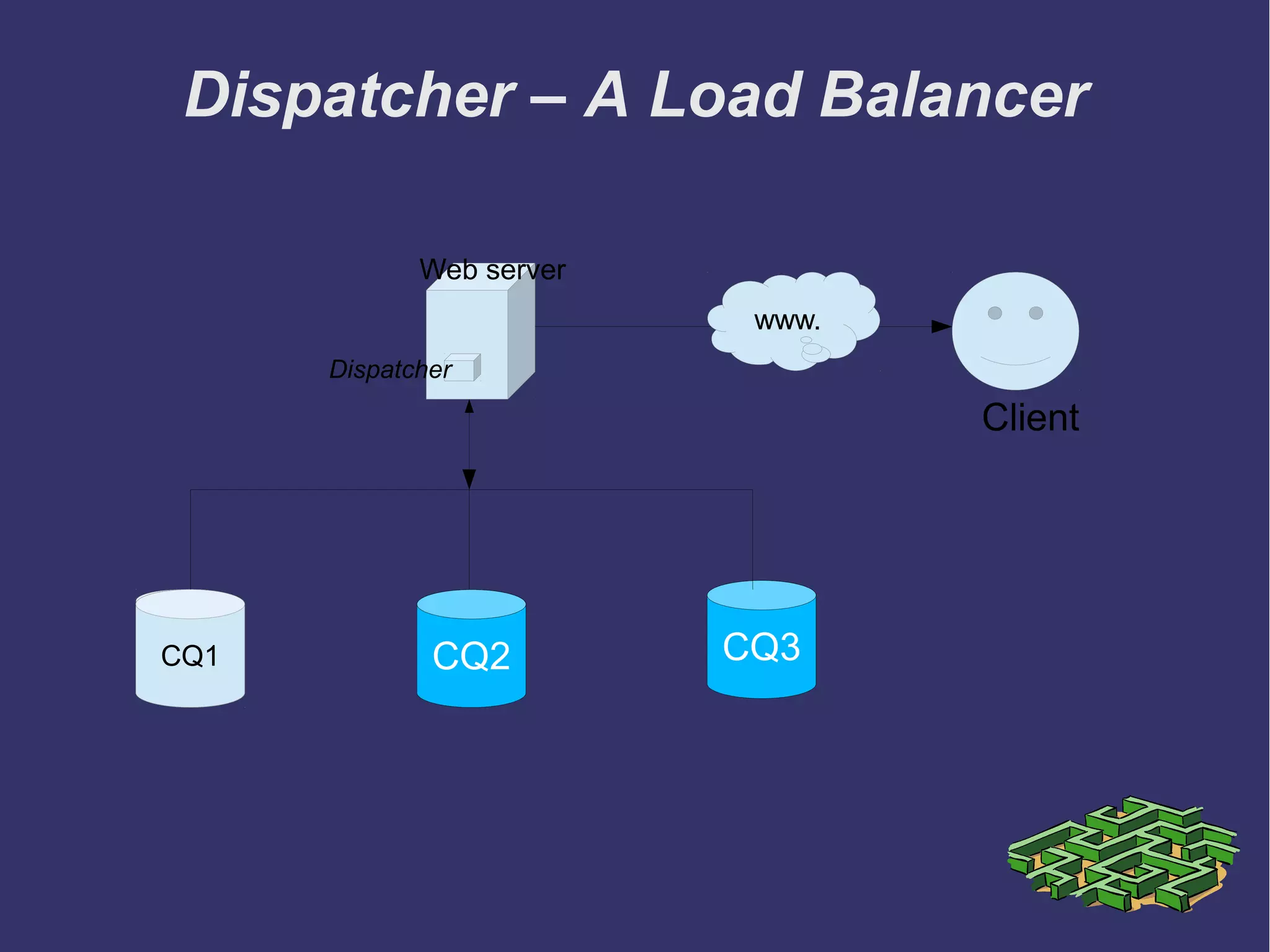
Dispatcher – A Load Balancer
CQ1CQ1CQ1 CQ3CQ2
Web server
Dispatcher
Client
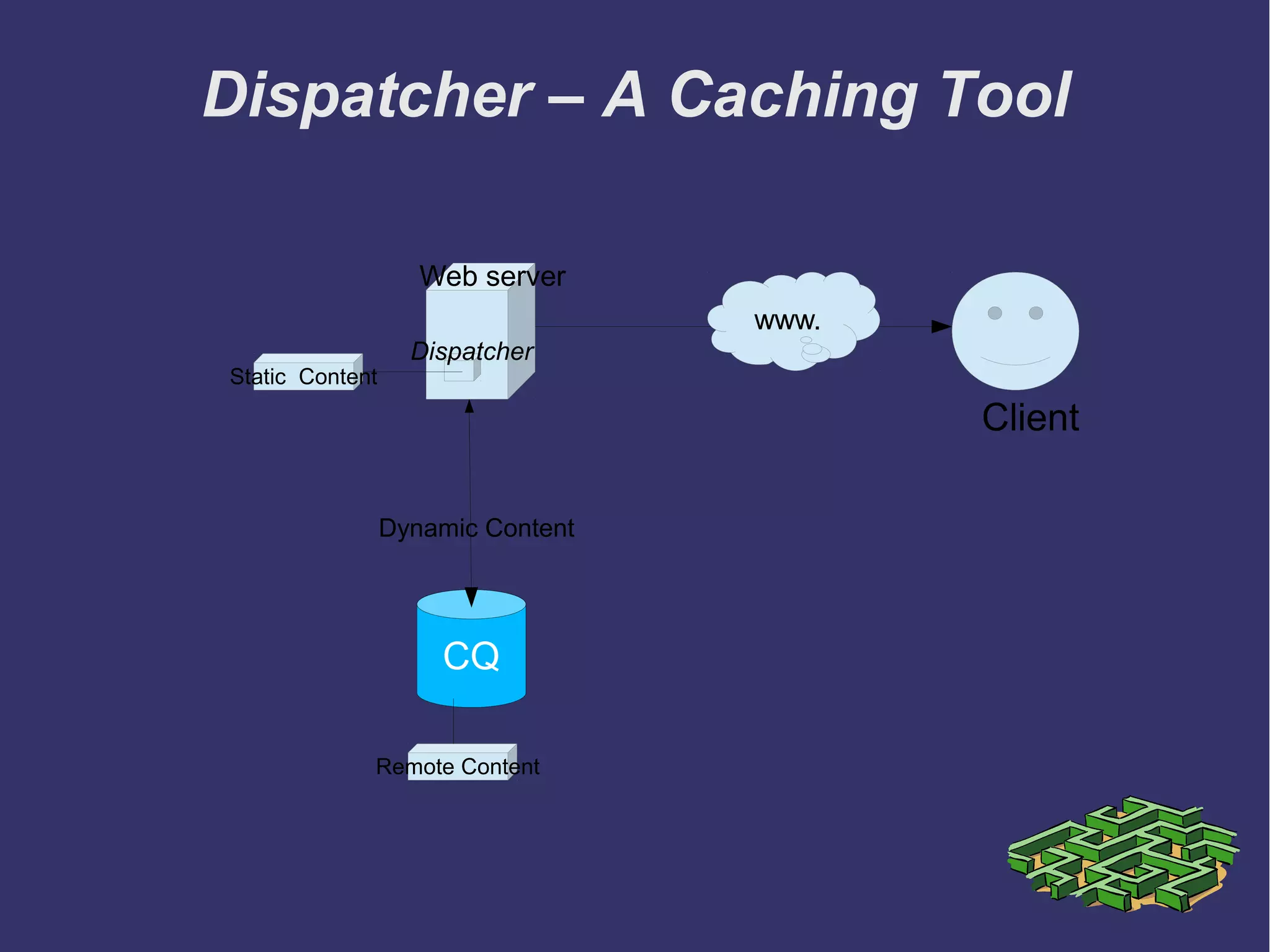
Dispatcher – A Caching Tool
CQ
Web server
Dispatcher
Client
Dynamic Content
Remote Content
Static Content
Why Use It ?
➲ As a load balancer prevents system from
crashing by distributing requests among cq
server instances.
➲ As a caching tool improves performance by
serving static content locally from your web
server.
But …
➲ You can also use it behind a physical load
balancer.
➲ You can also use it for a single CQ
instance.
➲ It is also valid for both Author & Publisher
environments.
But .. why not CDNs?
*should not be compared with CDNs … really
➲ CDNs are also caching tools
➲ CDNs serve digital assets from a
geographical location near to you
➲ CDN is a implemented using a Provider
➲ Dispatcher is OTB and made for CQ
more than a CDN
➲ By serving static content from Web server
process it reduces load on CQ server
➲ By enforcing rules it filters un-wanted traffic
at the web server level itself
➲ By re-writing urls it protects CQ from
hackers realizing the content paths
➲ By blocking url patterns, headers ensures
added protection & system failure.
more than a CDN... Continued
➲ Gives the ability to include SSIs before
request goes to CQ instance
➲ Improves User Experience on the site by
responding quickly when serving static
content
➲ Finally .. gives more control how you mange
(delete or retain) cached files
➲ Just a module and a config file to be used
on a web server
➲ Usually obtained from daycare
➲ Supported web servers :-
Apache Web Server – 2.0, 2.2 & 2.4
Microsoft IIS – 7.0, 7.5 & 8.0
& Oracle iPlanet Web server – 7.0
➲ Instructions to install
dev.day.com/install
How to install?
How to configure?
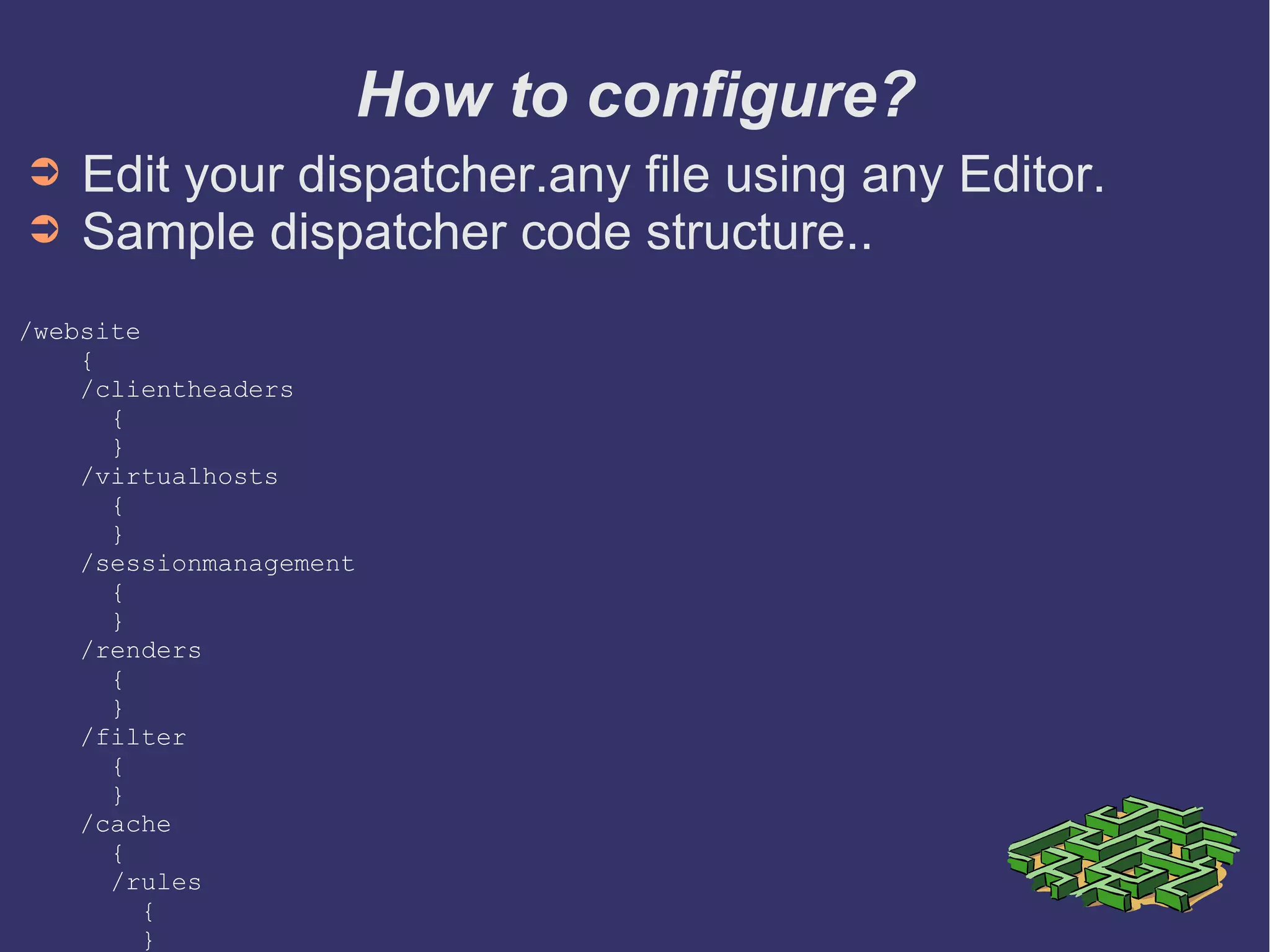
➲ Edit your dispatcher.any file using any Editor.
➲ Sample dispatcher code structure..
/website
{
/clientheaders
{
}
/virtualhosts
{
}
/sessionmanagement
{
}
/renders
{
}
/filter
{
}
/cache
{
/rules
{
}
➲ * preconfigured sample file here
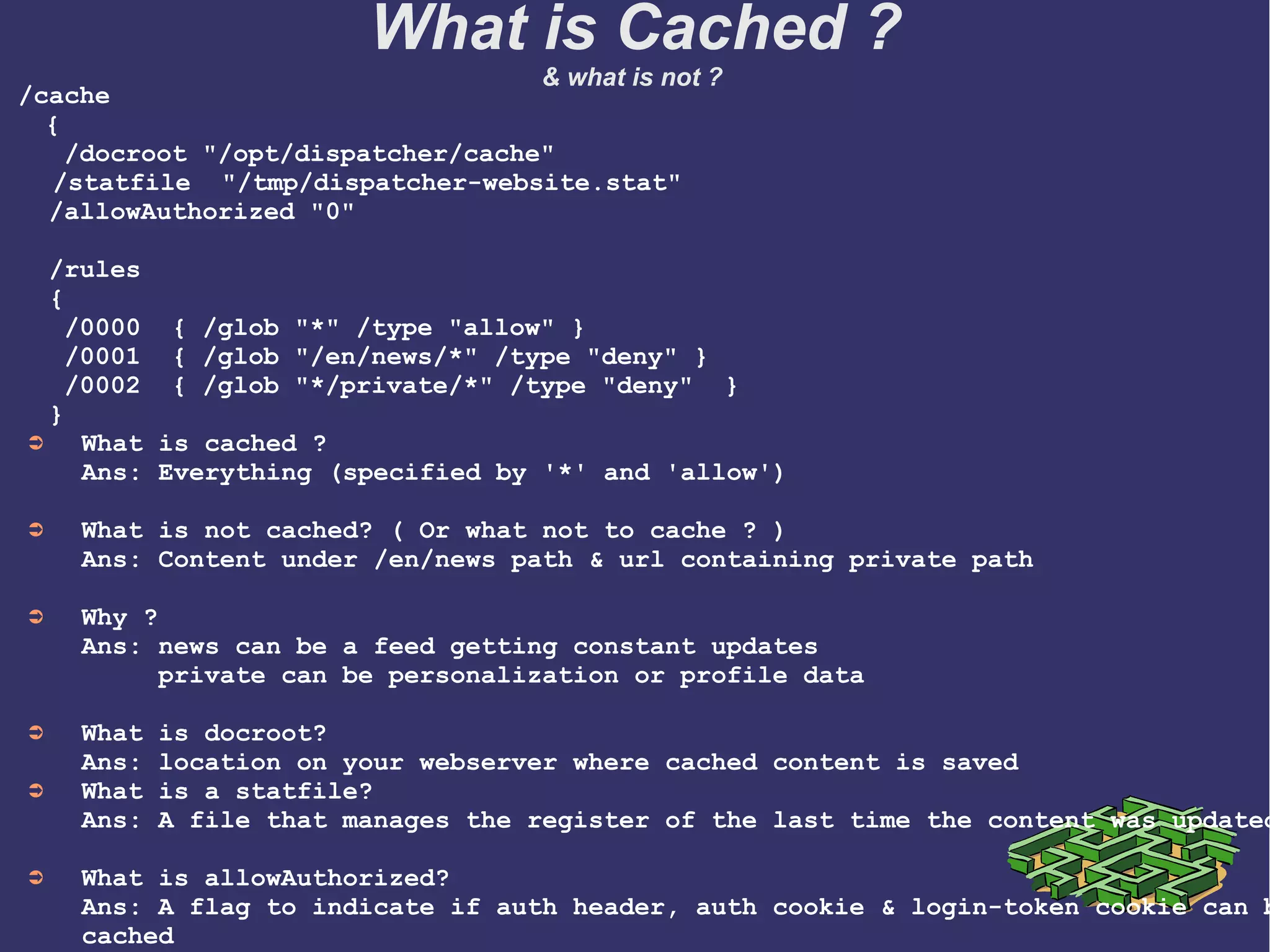
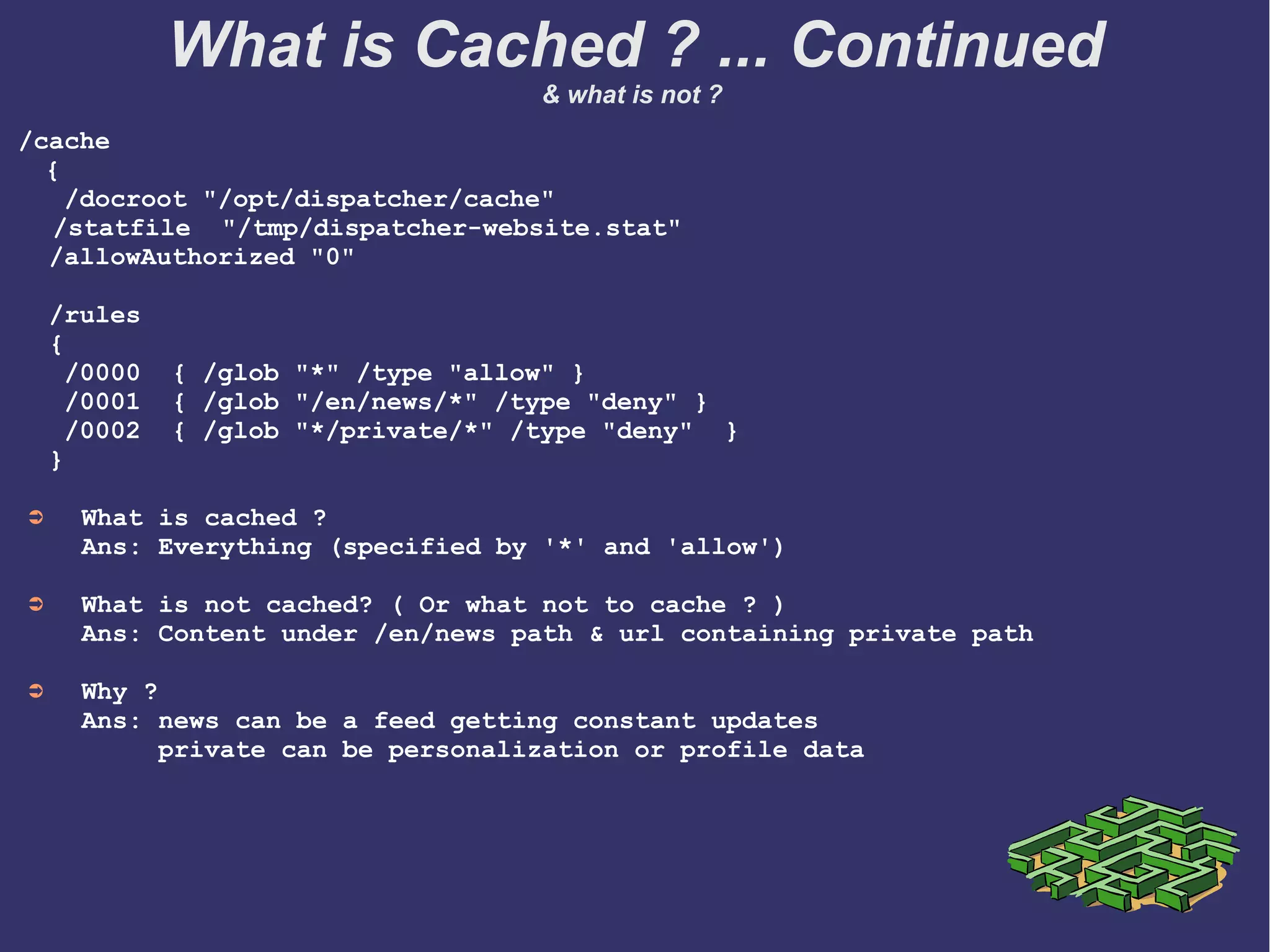
/cache
  {
   /docroot "/opt/dispatcher/cache"
   /statfile  "/tmp/dispatcher-website.stat"          
  /allowAuthorized "0"
  /rules
  {
   /0000  { /glob "*" /type "allow" }
   /0001  { /glob "/en/news/*" /type "deny" }
   /0002  { /glob "*/private/*" /type "deny"  }   
  }
➲ What is cached ?
Ans: Everything (specified by '*' and 'allow') 
➲ What is not cached? ( Or what not to cache ? )
Ans: Content under /en/news path & url containing private path
➲ Why ? 
Ans: news can be a feed getting constant updates 
     private can be personalization or profile data
➲ What is docroot?
Ans: location on your webserver where cached content is saved
➲ What is a statfile?
Ans: A file that manages the register of the last time the content was updated
➲ What is allowAuthorized?
Ans: A flag to indicate if auth header, auth cookie & login-token cookie can b
cached  
What is Cached ?
& what is not ?
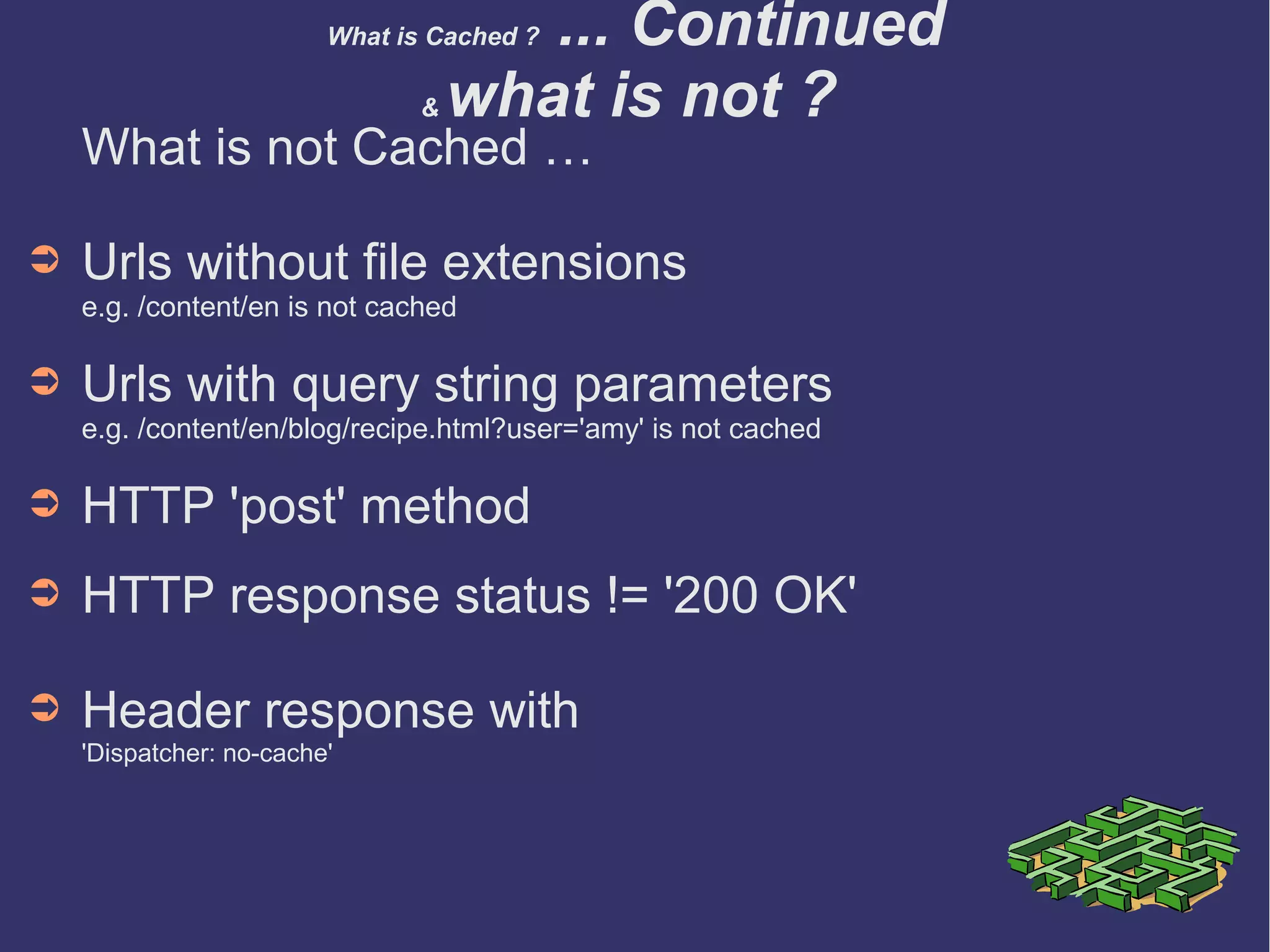
What is not Cached …
➲ Urls without file extensions
e.g. /content/en is not cached
➲ Urls with query string parameters
e.g. /content/en/blog/recipe.html?user='amy' is not cached
➲ HTTP 'post' method
➲ HTTP response status != '200 OK'
➲ Header response with
'Dispatcher: no-cache'
What is Cached ? ... Continued
& what is not ?
Dispatcher As a Security Tool
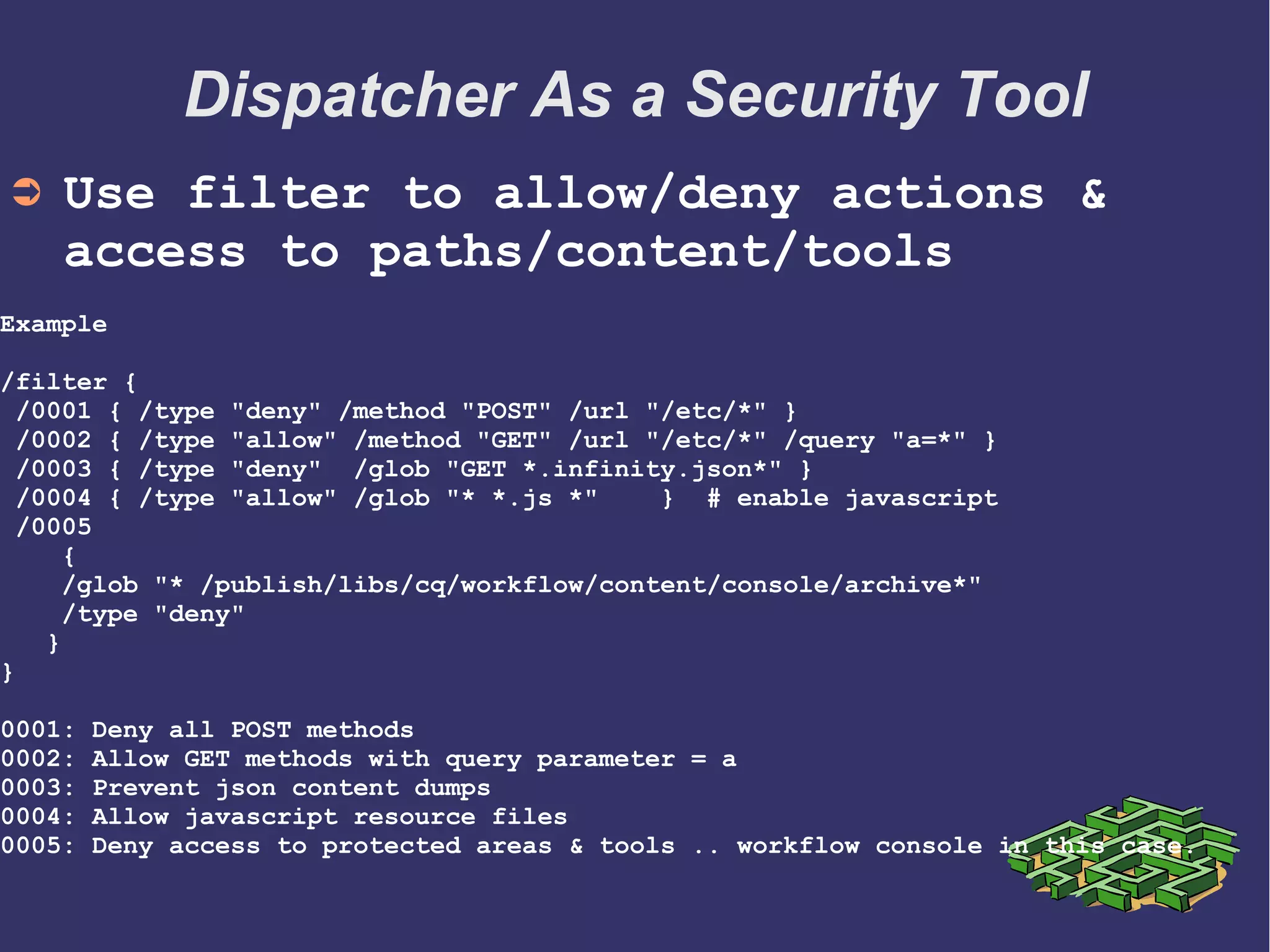
➲ Use filter to allow/deny actions & 
access to paths/content/tools 
 
Example
/filter {
 /0001 { /type "deny" /method "POST" /url "/etc/*" }
 /0002 { /type "allow" /method "GET" /url "/etc/*" /query "a=*" }
 /0003 { /type "deny"  /glob "GET *.infinity.json*" }
 /0004 { /type "allow" /glob "* *.js *"    }  # enable javascript
 /0005
    {
    /glob "* /publish/libs/cq/workflow/content/console/archive*"
    /type "deny"
   }
}
0001: Deny all POST methods
0002: Allow GET methods with query parameter = a
0003: Prevent json content dumps
0004: Allow javascript resource files 
0005: Deny access to protected areas & tools .. workflow console in this case. 
Dispatcher As a Security Tool
 
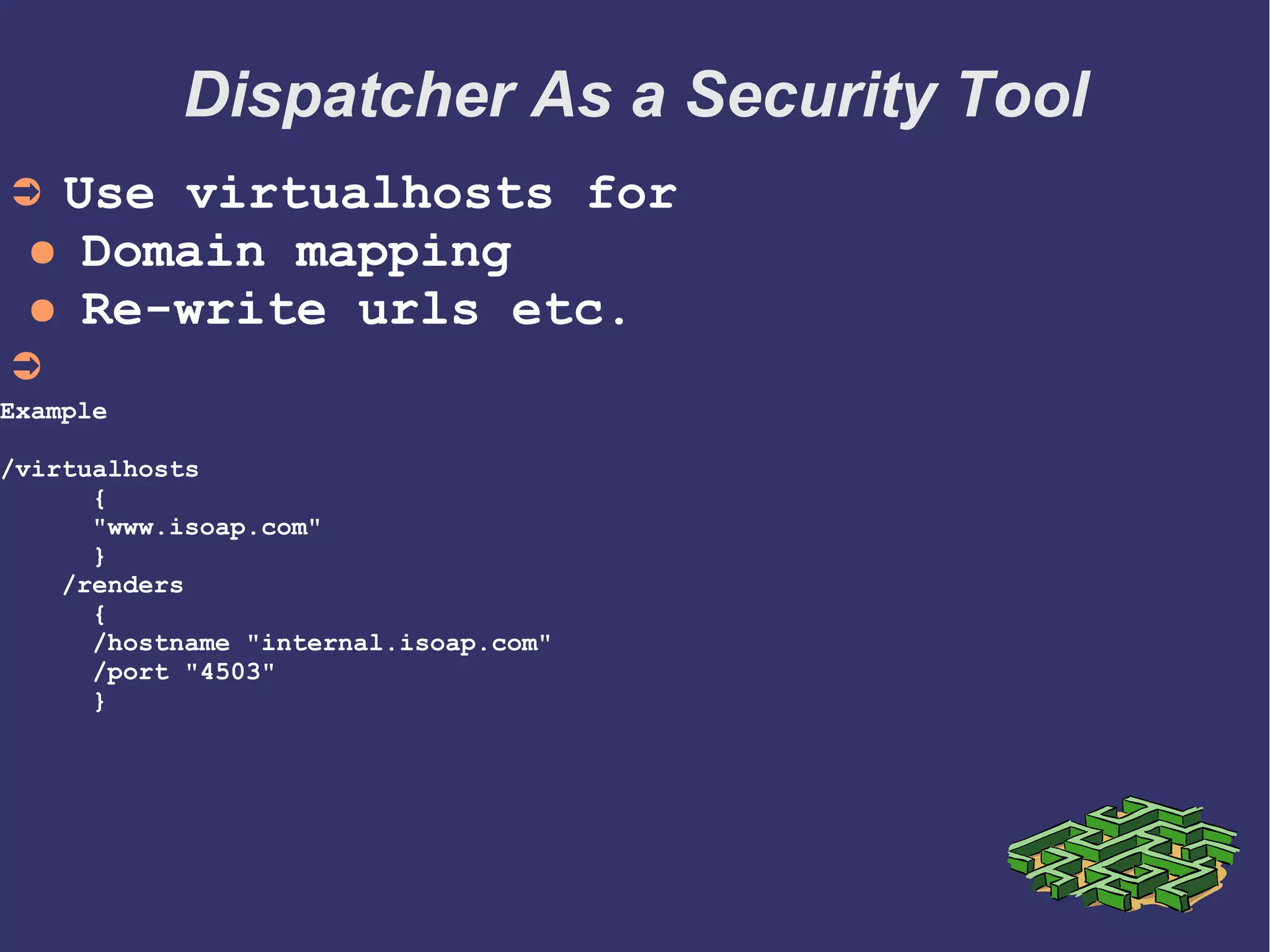
➲ Use virtualhosts for
● Domain mapping
● Re-write urls etc.
➲
Example
/virtualhosts
      {
      "www.isoap.com"
      }
    /renders
      {
      /hostname "internal.isoap.com"
      /port "4503"
      }
Appendix
➲ What is static content ?
Content which may remain un-changed for a specific amount of
time. For e.g. images, scripts, error pages etc.
➲ What is Dynamic Content?
Content which may change with time such as a Sports Score
Card, User Blogs, News etc.
More ?
➲ dev.day.com/more
➲ Even more ?
➲ How to configure a publisher environment ?
➲ Even more performance tweaks ?
➲ Deployment landscape & process ?
➲ For commercial implementations
Contact: Venu.Gummadala@gmail.com
Thank you ...

The secret life of a dispatcher (Adobe CQ AEM)

  • 1.
    The Secret Lifeof CQ Dispatcher Venu Gummadala
  • 2.
    What is aDispatcher? ➲ A load balancing & ➲ A caching tool
  • 3.
    Dispatcher – ALoad Balancer CQ1CQ1CQ1 CQ3CQ2 Web server Dispatcher Client
  • 4.
    Dispatcher – ACaching Tool CQ Web server Dispatcher Client Dynamic Content Remote Content Static Content
  • 5.
    Why Use It? ➲ As a load balancer prevents system from crashing by distributing requests among cq server instances. ➲ As a caching tool improves performance by serving static content locally from your web server.
  • 6.
    But … ➲ Youcan also use it behind a physical load balancer. ➲ You can also use it for a single CQ instance. ➲ It is also valid for both Author & Publisher environments.
  • 7.
    But .. whynot CDNs? *should not be compared with CDNs … really ➲ CDNs are also caching tools ➲ CDNs serve digital assets from a geographical location near to you ➲ CDN is a implemented using a Provider ➲ Dispatcher is OTB and made for CQ
  • 8.
    more than aCDN ➲ By serving static content from Web server process it reduces load on CQ server ➲ By enforcing rules it filters un-wanted traffic at the web server level itself ➲ By re-writing urls it protects CQ from hackers realizing the content paths ➲ By blocking url patterns, headers ensures added protection & system failure.
  • 9.
    more than aCDN... Continued ➲ Gives the ability to include SSIs before request goes to CQ instance ➲ Improves User Experience on the site by responding quickly when serving static content ➲ Finally .. gives more control how you mange (delete or retain) cached files
  • 10.
    ➲ Just amodule and a config file to be used on a web server ➲ Usually obtained from daycare ➲ Supported web servers :- Apache Web Server – 2.0, 2.2 & 2.4 Microsoft IIS – 7.0, 7.5 & 8.0 & Oracle iPlanet Web server – 7.0 ➲ Instructions to install dev.day.com/install How to install?
  • 11.
    How to configure? ➲Edit your dispatcher.any file using any Editor. ➲ Sample dispatcher code structure.. /website { /clientheaders { } /virtualhosts { } /sessionmanagement { } /renders { } /filter { } /cache { /rules { } ➲ * preconfigured sample file here
  • 12.
    /cache   {    /docroot "/opt/dispatcher/cache"    /statfile  "/tmp/dispatcher-website.stat"             /allowAuthorized "0"   /rules   {    /0000  { /glob "*" /type "allow" }    /0001  { /glob "/en/news/*" /type "deny" }    /0002  { /glob "*/private/*" /type "deny"  }      } ➲ What is cached ? Ans: Everything (specified by '*' and 'allow')  ➲ What is not cached? ( Or what not to cache ? ) Ans: Content under /en/news path & url containing private path ➲Why ?  Ans: news can be a feed getting constant updates       private can be personalization or profile data ➲ What is docroot? Ans: location on your webserver where cached content is saved ➲ What is a statfile? Ans: A file that manages the register of the last time the content was updated ➲ What is allowAuthorized? Ans: A flag to indicate if auth header, auth cookie & login-token cookie can b cached   What is Cached ? & what is not ?
  • 13.
    What is notCached … ➲ Urls without file extensions e.g. /content/en is not cached ➲ Urls with query string parameters e.g. /content/en/blog/recipe.html?user='amy' is not cached ➲ HTTP 'post' method ➲ HTTP response status != '200 OK' ➲ Header response with 'Dispatcher: no-cache' What is Cached ? ... Continued & what is not ?
  • 14.
    Dispatcher As aSecurity Tool ➲ Use filter to allow/deny actions &  access to paths/content/tools    Example /filter {  /0001 { /type "deny" /method "POST" /url "/etc/*" }  /0002 { /type "allow" /method "GET" /url "/etc/*" /query "a=*" }  /0003 { /type "deny"  /glob "GET *.infinity.json*" }  /0004 { /type "allow" /glob "* *.js *"    }  # enable javascript  /0005     {     /glob "* /publish/libs/cq/workflow/content/console/archive*"     /type "deny"    } } 0001: Deny all POST methods 0002: Allow GET methods with query parameter = a 0003: Prevent json content dumps 0004: Allow javascript resource files  0005: Deny access to protected areas & tools .. workflow console in this case. 
  • 15.
    Dispatcher As aSecurity Tool   ➲ Use virtualhosts for ● Domain mapping ● Re-write urls etc. ➲ Example /virtualhosts       {       "www.isoap.com"       }     /renders       {       /hostname "internal.isoap.com"       /port "4503"       }
  • 16.
    Appendix ➲ What isstatic content ? Content which may remain un-changed for a specific amount of time. For e.g. images, scripts, error pages etc. ➲ What is Dynamic Content? Content which may change with time such as a Sports Score Card, User Blogs, News etc.
  • 17.
    More ? ➲ dev.day.com/more ➲Even more ? ➲ How to configure a publisher environment ? ➲ Even more performance tweaks ? ➲ Deployment landscape & process ? ➲ For commercial implementations Contact: Venu.Gummadala@gmail.com Thank you ...