Analyzed by:
Farida nur’aini (2311007)
Putri lailatul
maghfiroh(2311022)
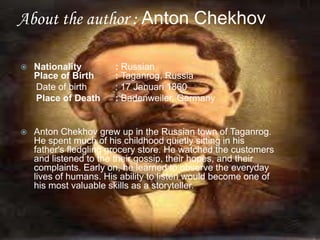
About the author : Anton Chekhov


Nationality
Place of Birth
Date of birth
Place of Death

: Russian
: Taganrog, Russia
: 17 Januari 1860
: Badenweiler, Germany



Anton Chekhov grew up in the Russian town of Taganrog.
He spent much of his childhood quietly sitting in his
father's fledgling grocery store. He watched the customers
and listened to the their gossip, their hopes, and their
complaints. Early on, he learned to observe the everyday
lives of humans. His ability to listen would become one of
his most valuable skills as a storyteller.
The seagull

















full title · The Seagull
author · Anton Chekhov
type of work · Play
genre · Tragic-Comedy
language · Russian. English Translation by Paul Schmidt
time and place written · Written in 1895, Russia
date of first publication · Not applicable (drama)
publisher · HarperCollins, HarperFlamingo edition
point of view · Not applicable (drama)
tone · Absurd; Existential
tense · Not applicable (drama)
settings (times) · Around 1895, summer; Then, two years later
setting (place) · Sorin's estate and farm
protagonists · Konstantin Treplev; Irina Arkadina; Nina; Boris
Trigorin
symbols · The seagull; the lake; weather
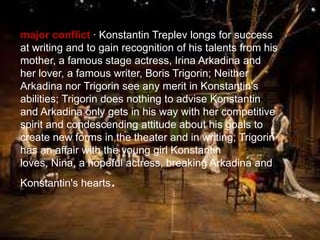
major conflict · Konstantin Treplev longs for success
at writing and to gain recognition of his talents from his
mother, a famous stage actress, Irina Arkadina and
her lover, a famous writer, Boris Trigorin; Neither
Arkadina nor Trigorin see any merit in Konstantin's
abilities; Trigorin does nothing to advise Konstantin
and Arkadina only gets in his way with her competitive
spirit and condescending attitude about his goals to
create new forms in the theater and in writing; Trigorin
has an affair with the young girl Konstantin
loves, Nina, a hopeful actress, breaking Arkadina and
Konstantin's hearts

.
The semiotic
approach/pendekatan semiotik
Pendekatan yang memandang karya
sastra sebagai sistem tanda
 •Sebagai ilmu tanda, semiotik secara
sistematik mempelajari tanda-tanda dan
lambang (semeion, bahasa Yunani yang
berarti tanda), sistem-sistem lambang
dan proses-proses perlambangan
(Luxemburg, 1984)

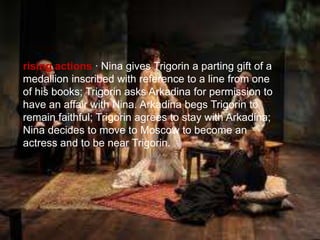
rising actions · Nina gives Trigorin a parting gift of a
medallion inscribed with reference to a line from one
of his books; Trigorin asks Arkadina for permission to
have an affair with Nina. Arkadina begs Trigorin to
remain faithful; Trigorin agrees to stay with Arkadina;
Nina decides to move to Moscow to become an
actress and to be near Trigorin.
Simbols:
The Seagull
 The seagull is the first symbol Chekhov
used to title a play, written before The
Cherry Orchard. The image of the seagull
changes meaning over the course of the
play. First, in Act One, Nina uses a seagull
to describe the way she is drawn to the
lake of her childhood home and her
neighbors on Sorin's estate. In this
case, the seagull represents freedom and
security.



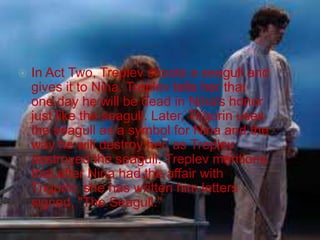
In Act Two, Treplev shoots a seagull and
gives it to Nina. Treplev tells her that
one day he will be dead in Nina's honor
just like the seagull. Later, Trigorin uses
the seagull as a symbol for Nina and the
way he will destroy her, as Treplev
destroyed the seagull. Treplev mentions
that after Nina had the affair with
Trigorin, she has written him letters
signed, "The Seagull."


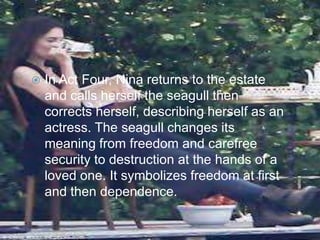
In Act Four, Nina returns to the estate
and calls herself the seagull then
corrects herself, describing herself as an
actress. The seagull changes its
meaning from freedom and carefree
security to destruction at the hands of a
loved one. It symbolizes freedom at first
and then dependence.


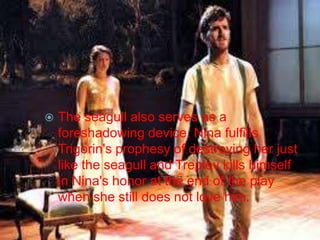
The seagull also serves as a
foreshadowing device. Nina fulfills
Trigorin's prophesy of destroying her just
like the seagull and Treplev kills himself
in Nina's honor at the end of the play
when she still does not love him.
The lake






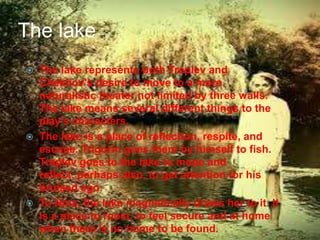
The lake represents both Treplev and
Chekhov's desire to move to a more
naturalistic theater not limited by three walls.
The lake means several different things to the
play's characters.
The lake is a place of reflection, respite, and
escape. Trigorin goes there by himself to fish.
Treplev goes to the lake to mope and
reflect, perhaps also, to get attention for his
bruised ego.
To Nina, the lake magnetically draws her to it. It
is a place to roost, to feel secure and at home
when there is no home to be found.






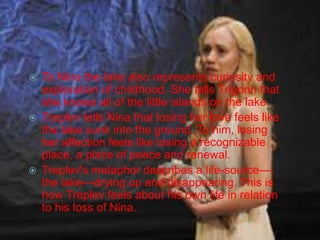
To Nina the lake also represents curiosity and
exploration of childhood. She tells Trigorin that
she knows all of the little islands on the lake.
Treplev tells Nina that losing her love feels like
the lake sunk into the ground. To him, losing
her affection feels like losing a recognizable
place, a place of peace and renewal.
Treplev's metaphor describes a life-source—
the lake—drying up and disappearing. This is
how Treplev feels about his own life in relation
to his loss of Nina.
Weather


Chekhov uses weather to create the tone
for his stories and in his plays. The weather
reflects the characters' state of mind and
foreshadows upcoming events. For
instance, before Nina returns to visit
Treplev the weather is stormy and windy as
if the storm conjured up Nina and brought
her to the estate. Storms usually reflect a
change in temperature and
likewise, weather is a signal for change in
The Seagull
The seagull ppt by Putri Laila

The seagull ppt by Putri Laila

  • 1.
    Analyzed by: Farida nur’aini(2311007) Putri lailatul maghfiroh(2311022)
  • 2.
    About the author: Anton Chekhov  Nationality Place of Birth Date of birth Place of Death : Russian : Taganrog, Russia : 17 Januari 1860 : Badenweiler, Germany  Anton Chekhov grew up in the Russian town of Taganrog. He spent much of his childhood quietly sitting in his father's fledgling grocery store. He watched the customers and listened to the their gossip, their hopes, and their complaints. Early on, he learned to observe the everyday lives of humans. His ability to listen would become one of his most valuable skills as a storyteller.
  • 3.
    The seagull                full title· The Seagull author · Anton Chekhov type of work · Play genre · Tragic-Comedy language · Russian. English Translation by Paul Schmidt time and place written · Written in 1895, Russia date of first publication · Not applicable (drama) publisher · HarperCollins, HarperFlamingo edition point of view · Not applicable (drama) tone · Absurd; Existential tense · Not applicable (drama) settings (times) · Around 1895, summer; Then, two years later setting (place) · Sorin's estate and farm protagonists · Konstantin Treplev; Irina Arkadina; Nina; Boris Trigorin symbols · The seagull; the lake; weather
  • 4.
    major conflict ·Konstantin Treplev longs for success at writing and to gain recognition of his talents from his mother, a famous stage actress, Irina Arkadina and her lover, a famous writer, Boris Trigorin; Neither Arkadina nor Trigorin see any merit in Konstantin's abilities; Trigorin does nothing to advise Konstantin and Arkadina only gets in his way with her competitive spirit and condescending attitude about his goals to create new forms in the theater and in writing; Trigorin has an affair with the young girl Konstantin loves, Nina, a hopeful actress, breaking Arkadina and Konstantin's hearts .
  • 5.
    The semiotic approach/pendekatan semiotik Pendekatanyang memandang karya sastra sebagai sistem tanda  •Sebagai ilmu tanda, semiotik secara sistematik mempelajari tanda-tanda dan lambang (semeion, bahasa Yunani yang berarti tanda), sistem-sistem lambang dan proses-proses perlambangan (Luxemburg, 1984) 
  • 6.
    rising actions ·Nina gives Trigorin a parting gift of a medallion inscribed with reference to a line from one of his books; Trigorin asks Arkadina for permission to have an affair with Nina. Arkadina begs Trigorin to remain faithful; Trigorin agrees to stay with Arkadina; Nina decides to move to Moscow to become an actress and to be near Trigorin.
  • 7.
    Simbols: The Seagull  Theseagull is the first symbol Chekhov used to title a play, written before The Cherry Orchard. The image of the seagull changes meaning over the course of the play. First, in Act One, Nina uses a seagull to describe the way she is drawn to the lake of her childhood home and her neighbors on Sorin's estate. In this case, the seagull represents freedom and security. 
  • 8.
     In Act Two,Treplev shoots a seagull and gives it to Nina. Treplev tells her that one day he will be dead in Nina's honor just like the seagull. Later, Trigorin uses the seagull as a symbol for Nina and the way he will destroy her, as Treplev destroyed the seagull. Treplev mentions that after Nina had the affair with Trigorin, she has written him letters signed, "The Seagull."
  • 9.
     In Act Four,Nina returns to the estate and calls herself the seagull then corrects herself, describing herself as an actress. The seagull changes its meaning from freedom and carefree security to destruction at the hands of a loved one. It symbolizes freedom at first and then dependence.
  • 10.
     The seagull alsoserves as a foreshadowing device. Nina fulfills Trigorin's prophesy of destroying her just like the seagull and Treplev kills himself in Nina's honor at the end of the play when she still does not love him.
  • 11.
    The lake    The lakerepresents both Treplev and Chekhov's desire to move to a more naturalistic theater not limited by three walls. The lake means several different things to the play's characters. The lake is a place of reflection, respite, and escape. Trigorin goes there by himself to fish. Treplev goes to the lake to mope and reflect, perhaps also, to get attention for his bruised ego. To Nina, the lake magnetically draws her to it. It is a place to roost, to feel secure and at home when there is no home to be found.
  • 12.
       To Nina thelake also represents curiosity and exploration of childhood. She tells Trigorin that she knows all of the little islands on the lake. Treplev tells Nina that losing her love feels like the lake sunk into the ground. To him, losing her affection feels like losing a recognizable place, a place of peace and renewal. Treplev's metaphor describes a life-source— the lake—drying up and disappearing. This is how Treplev feels about his own life in relation to his loss of Nina.
  • 13.
    Weather  Chekhov uses weatherto create the tone for his stories and in his plays. The weather reflects the characters' state of mind and foreshadows upcoming events. For instance, before Nina returns to visit Treplev the weather is stormy and windy as if the storm conjured up Nina and brought her to the estate. Storms usually reflect a change in temperature and likewise, weather is a signal for change in The Seagull