The Russian
           Revolution


                    


Scott Masters
Crestwood College
Pre-Revolutionary Russia
               Only true autocracy
                left in Europe
               No type of
                representative
                political institutions
               Nicholas II became
                tsar in 1884
               Believed he was the
                absolute ruler
                anointed by God
               Russo-Japanese War
                (1904) – defeat led to
                pol. instability
   conditions deteriorated,
    rev. became possible,
    esp. w/ Lenin’s
    involvement
   he had gravitated towards
    the Social Dem. Workers’
    Party of George
    Plekhanov – they believed
    in dialectical materialism
    and thus favoured
    modernization/capitalism
    (which the czars also
    favoured as a measure to
    catch up w/ the w. Europe,
    esp. after the Crimean
    and Russo-Japanese
    Wars)
The Revolution of 1905
              Rapid growth of
               (discontented) working
               class
              Vast majority of workers
               concentrated in St.
               Petersburg and Moscow
              Little help from the
               countryside:
               impoverished peasants –
               Populist Movements of
               the 1870s and later had
               done little to improve
               their lot
               – No individual land
                 ownership
               – Rural Famine
   Tsar paid no
Conservatism        attention to the
   Continues:       Duma; it was
                    harassed and
   1905-1917        political parties
                    suppressed –
                    only token land
                    reform was
                    passed
                   Nicholas was
                    personally a very
                    weak man; he
                    became
                    increasingly
                    remote as a ruler
                   Numerous
                    soviets thus
                    began to appear
Alexandra: The Power Behind the
            Throne
                      Even more blindly
                       committed to
                       autocracy than her
                       husband
                      She was under the
                       influence of Rasputin
                      Origins of Rasputin’s
                       power - ?


                      Scandals surrounding
                       Rasputin served to
                       discredit the
                       monarchy
Alexis: Alexandra’s Son with
         Hemophilia
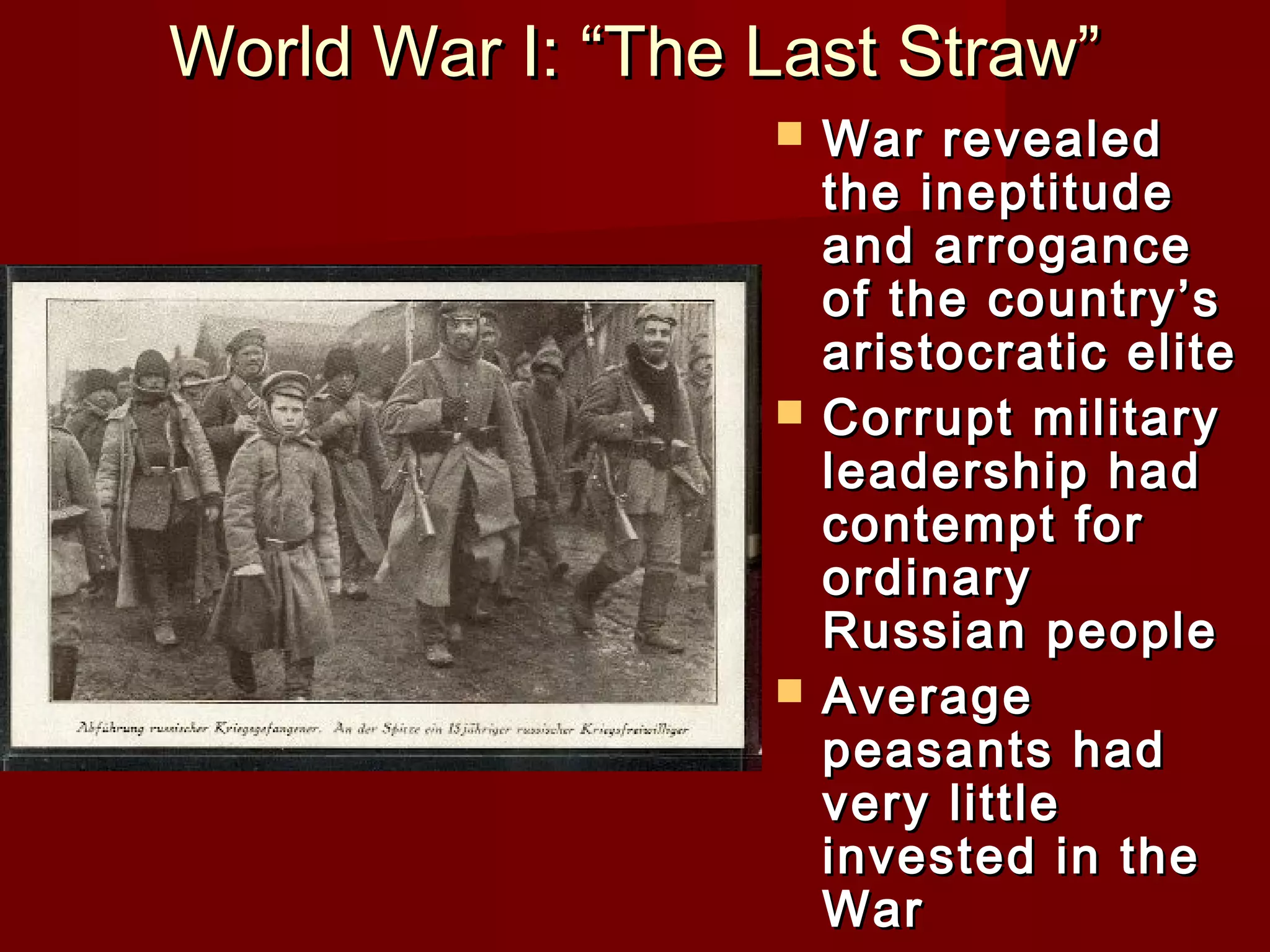
World War I: “The Last Straw”
                     War revealed
                      the ineptitude
                      and arrogance
                      of the country’s
                      aristocratic elite
                     Corrupt military
                      leadership had
                      contempt for
                      ordinary
                      Russian people
                     Average
                      peasants had
                      very little
                      invested in the
                      War
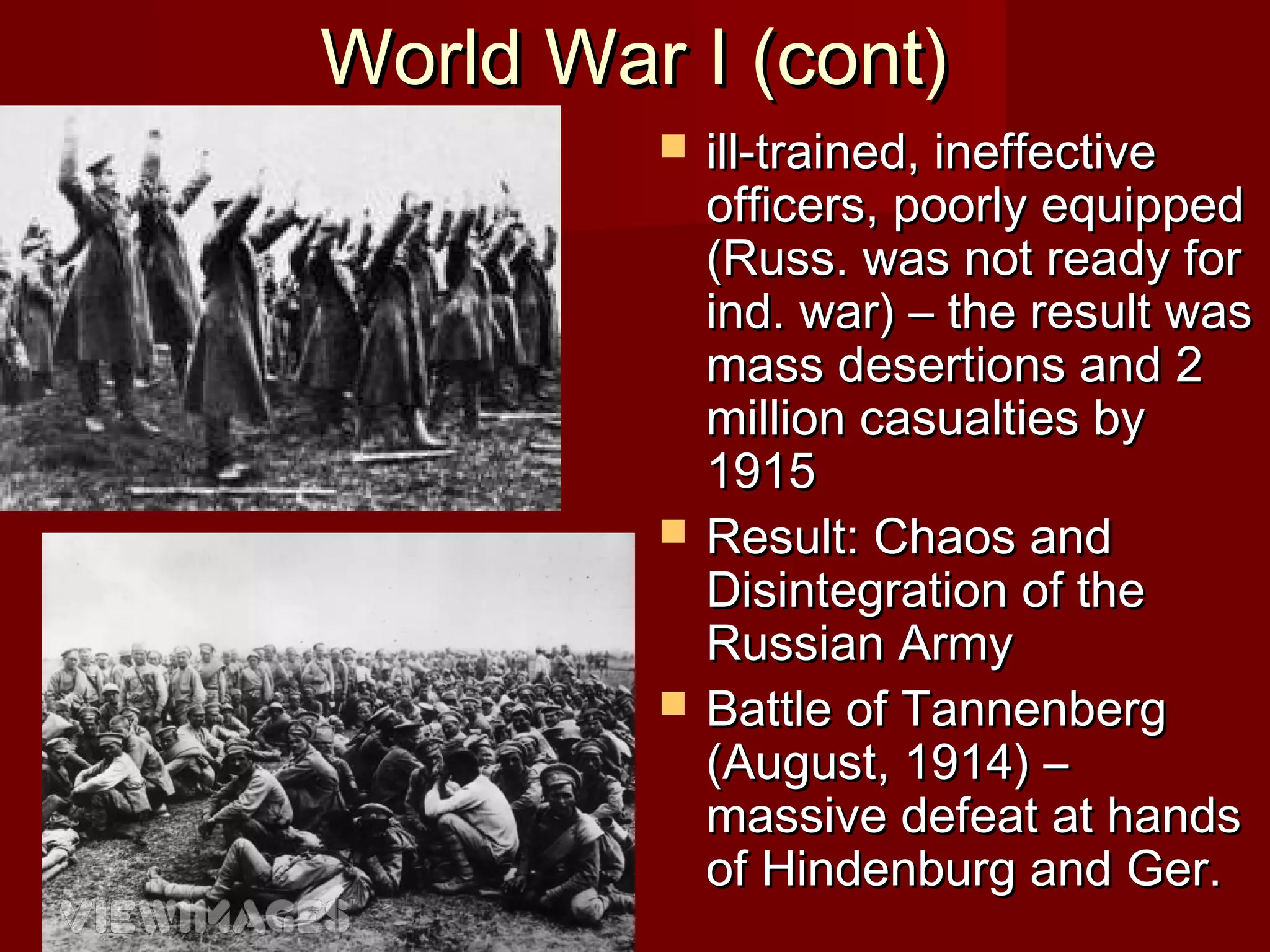
World War I (cont)
            ill-trained, ineffective
             officers, poorly equipped
             (Russ. was not ready for
             ind. war) – the result was
             mass desertions and 2
             million casualties by
             1915
            Result: Chaos and
             Disintegration of the
             Russian Army
            Battle of Tannenberg
             (August, 1914) –
             massive defeat at hands
             of Hindenburg and Ger.
The Collapse of the Imperial
       Government
                 Nicholas left for the
                  Front—September, 1915
                 Alexandra and Rasputin
                  throw the government
                  into chaos
                 Alexandra and other
                  high government officials
                  accused of treason
The Collapse of the Imperial
    Government (cont)
                 Rasputin assassinated
                  in December of 1916
                 Complete
                  mismanagement of the
                  wartime economy
                 ind. production
                  plummeted, inflation and
                  starvation were
                  rampant, and the cities
                  were overflowing w/
                  refugees
                 they became a hotbed
                  for pol. activism, and
                  this was ignited by
                  serious food shortages
                  in March 1917, esp. in
                  St. Petersburg
The Two Revolutions of 1917
                     The March
                      Revolution
                      (March 12)
                     The November
                      Revolution
                      (November 6)
The March       Origins: Food riots/strikes
Revolution      Duma declared itself a
                 Provisional Government
                 on March12
                Tsar ordered soldiers to
                 intervene; instead they
                 joined the rebellion…the
                 Tsar thus abdicated on
                 March 17
                the Menshevik Alexander
                 Kerensky headed the
                 Provisional Government,
                 along w/ Prince Lvov
                 – Very Popular Revolution
                 – Kerensky favoured gradual
                   socialist reform/ saw the
                   war effort as #1 priority
Kornilov Affair
   General Kornilov
    attempted to
    overthrow Provisional
    Government with
    military takeover
   To prevent this
    takeover, Kerensky
    freed many Bolshevik
    leaders from prison
    and supplied arms to
    many revolutionaries
The Petrograd Soviet
             leftists in St.
              Petersburg formed
              the Petrograd Soviet,
              which they claimed to
              be the legit. gov’t
             Ger. was aware of the
              Russ. situation and
              began to concentrate
              on the W. Front
             Ger. even played a
              role in returning Lenin
              to Russia, so he
              could foment rev.
                – Having been
                  granted “safe
                  passage”, Lenin
                  returned in April
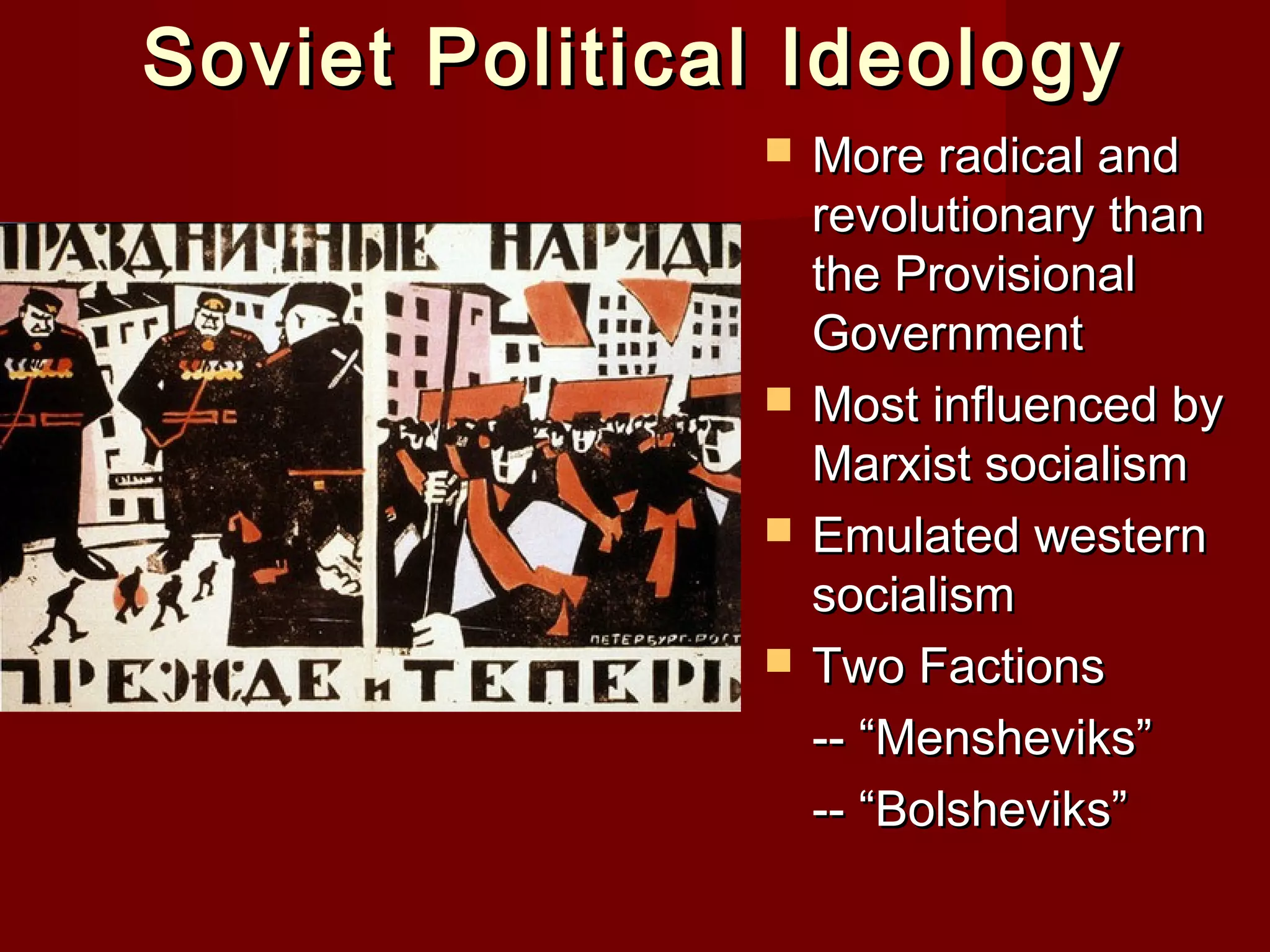
Soviet Political Ideology
                  More radical and
                   revolutionary than
                   the Provisional
                   Government
                  Most influenced by
                   Marxist socialism
                  Emulated western
                   socialism
                  Two Factions
                   -- “Mensheviks”
                   -- “Bolsheviks”
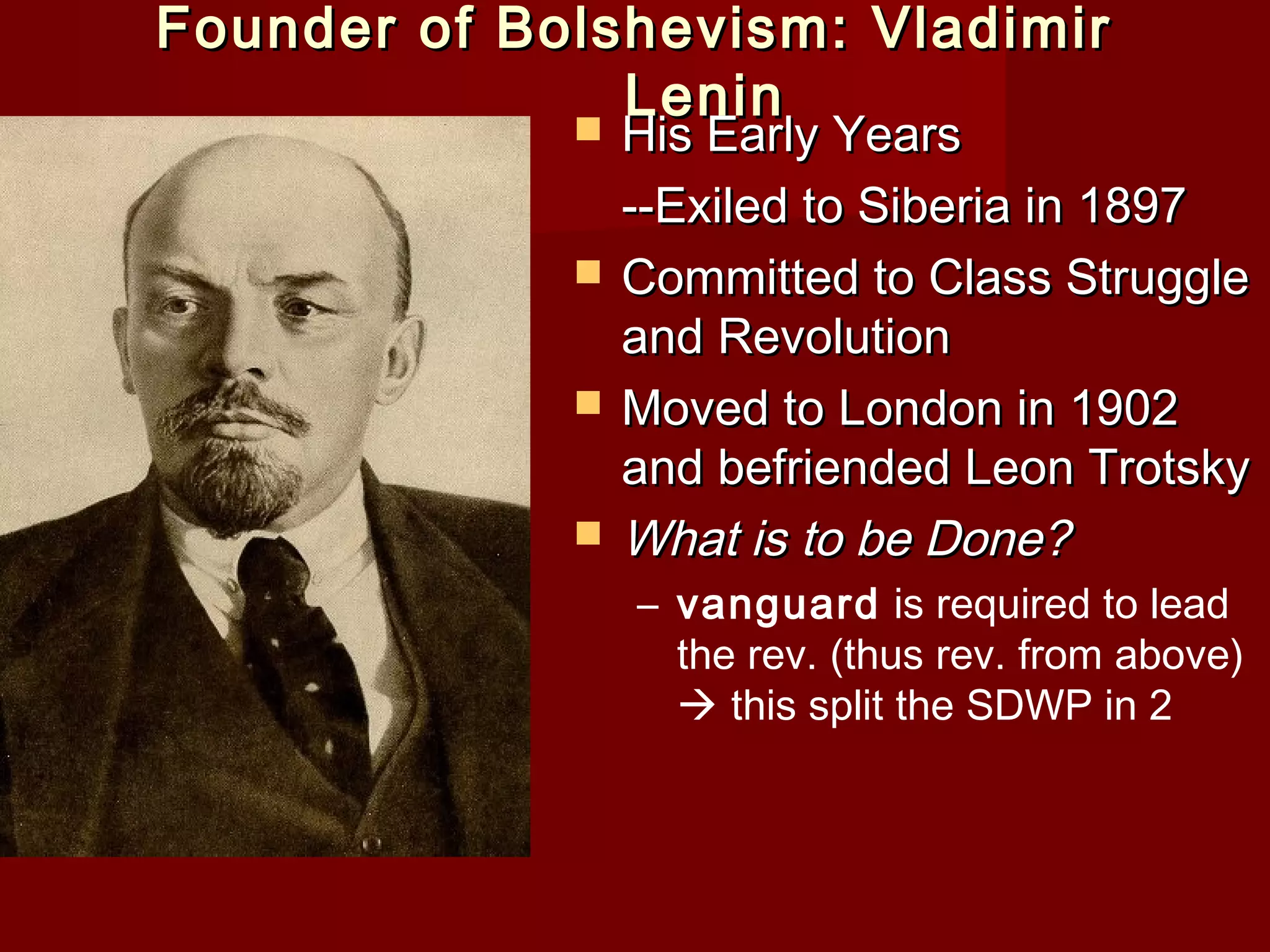
Founder of Bolshevism: Vladimir
               Lenin
                His Early Years
                 --Exiled to Siberia in 1897
                Committed to Class Struggle
                 and Revolution
                Moved to London in 1902
                 and befriended Leon Trotsky
                What is to be Done?
                 – vanguard is required to lead
                   the rev. (thus rev. from above)
                    this split the SDWP in 2
Lenin Steps into This Vacuum
             Amnesty granted to all
              political prisoners in March of
              1917
             Lenin’s arrival in Petrograd
             A tremendously charismatic
              personality
             “ Peace, Land, Bread”
             “ All Power to the Soviets”
             He preached that the war was
              a capitalist/imperialist war
              that offered no rewards for
              the peasants/workers; he also
              felt the war was over w/ the
              czar’s abdication
             Bolshevik party membership
              exploded; their power was
              consolidated
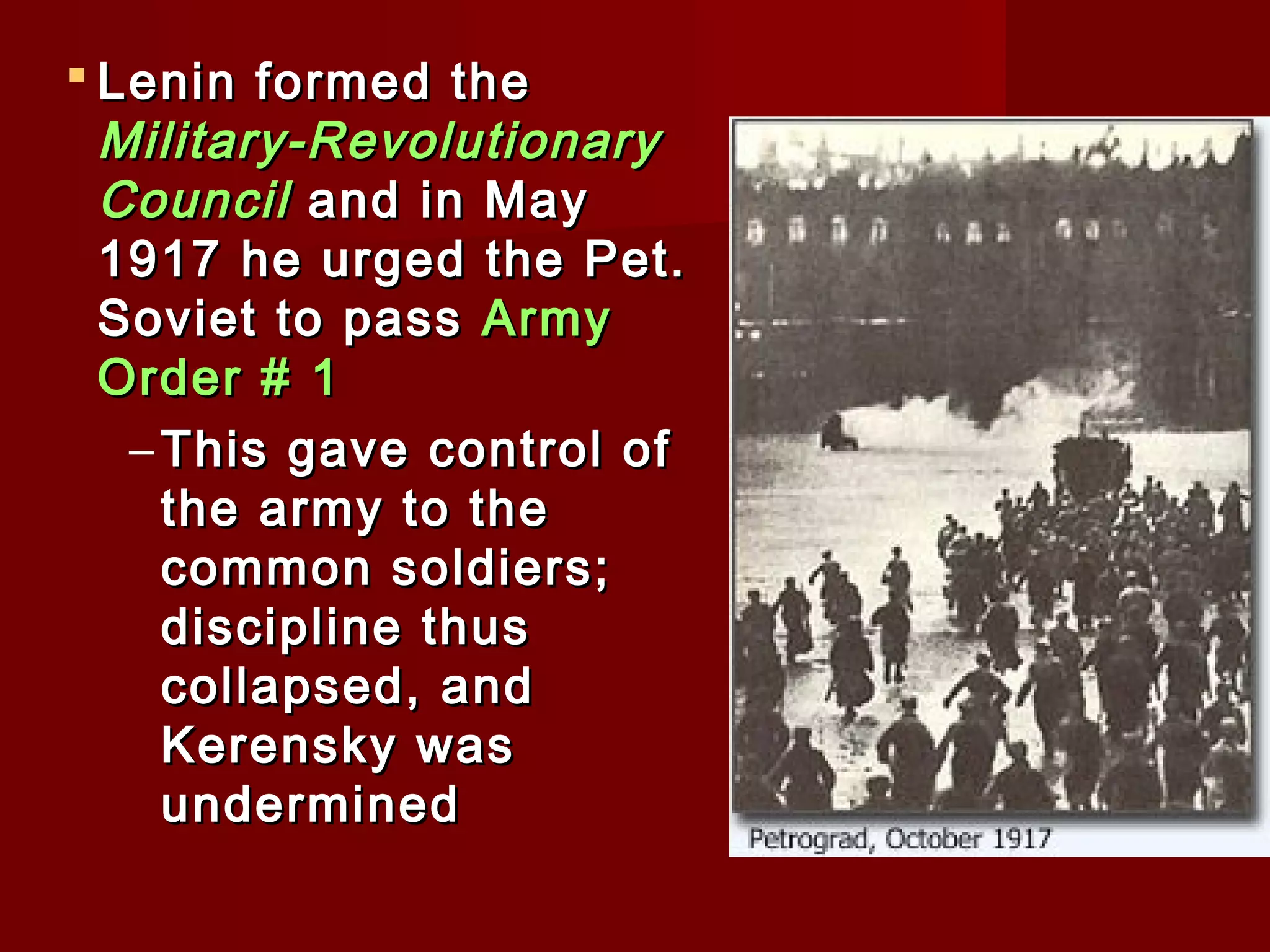
 Lenin formed the
  Military-Revolutionary
  Council and in May
  1917 he urged the Pet.
  Soviet to pass Army
  Order # 1
   – This gave control of
     the army to the
     common soldiers;
     discipline thus
     collapsed, and
     Kerensky was
     undermined
The November      Nov. 6, 1917…
                   this was the ideological
  Revolution
               
                   aspect of the rev., w/ the
                   coup itself planned by Leon
                   Trotsky , who had gained
                   the confidence of the army
                   (= the “Red Miracle”)
                  Lenin went on to
                   consolidate his power in
                   Jan. 1918 when he
                   disbanded the Constituent
                   Assembly (had replaced the
                   Duma) – the Bolsheviks had
                   not gained a majority there
                   in late Nov. elections -
                   Russ. dem. thus terminated
                    a Co uncil of People’s
                   Commissars was created
                  All private property was
                   abolished and divided
                   among the peasantry
                  Largest industrial
                   enterprises nationalized
November Revolution (cont)
                   Political Police
                    organized:
                    CHEKA
                   Revolutionary
                    army created
                    with Trotsky in
                    charge = “Red
                    Army”
                   Bolshevik Party
                    renamed
                    Communist Party
                    in March of 1918
November Revolution (cont)
                Lenin’s 1st task was to
                 get Russia out of the
                 war so he could
                 concentrate on internal
                 reform…
                The Treaty of Brest-
                 Litovsk negotiated with
                 the Germans, giving
                 them much Russian
                 territory, population, and
                 resources
                Civil War followed,
                 1917-1920
                  “ Reds” versus
                 “Whites”
                Complete breakdown of
                 Russian economy and
Interpreting the Russian Revolution
                     The official Marxist
                      interpretation
                       The importance of a
                      permanent international
                      revolution
                     Function of Russian
                      History and Culture
                     Imposed Revolution on
                      an unwilling victim
                     A Social Revolution…
The russian revolution

The russian revolution

  • 1.
    The Russian Revolution  Scott Masters Crestwood College
  • 2.
    Pre-Revolutionary Russia  Only true autocracy left in Europe  No type of representative political institutions  Nicholas II became tsar in 1884  Believed he was the absolute ruler anointed by God  Russo-Japanese War (1904) – defeat led to pol. instability
  • 3.
    conditions deteriorated, rev. became possible, esp. w/ Lenin’s involvement  he had gravitated towards the Social Dem. Workers’ Party of George Plekhanov – they believed in dialectical materialism and thus favoured modernization/capitalism (which the czars also favoured as a measure to catch up w/ the w. Europe, esp. after the Crimean and Russo-Japanese Wars)
  • 4.
    The Revolution of1905  Rapid growth of (discontented) working class  Vast majority of workers concentrated in St. Petersburg and Moscow  Little help from the countryside: impoverished peasants – Populist Movements of the 1870s and later had done little to improve their lot – No individual land ownership – Rural Famine
  • 5.
    Tsar paid no Conservatism attention to the Continues: Duma; it was harassed and 1905-1917 political parties suppressed – only token land reform was passed  Nicholas was personally a very weak man; he became increasingly remote as a ruler  Numerous soviets thus began to appear
  • 6.
    Alexandra: The PowerBehind the Throne  Even more blindly committed to autocracy than her husband  She was under the influence of Rasputin  Origins of Rasputin’s power - ?  Scandals surrounding Rasputin served to discredit the monarchy
  • 7.
  • 8.
    World War I:“The Last Straw”  War revealed the ineptitude and arrogance of the country’s aristocratic elite  Corrupt military leadership had contempt for ordinary Russian people  Average peasants had very little invested in the War
  • 9.
    World War I(cont)  ill-trained, ineffective officers, poorly equipped (Russ. was not ready for ind. war) – the result was mass desertions and 2 million casualties by 1915  Result: Chaos and Disintegration of the Russian Army  Battle of Tannenberg (August, 1914) – massive defeat at hands of Hindenburg and Ger.
  • 10.
    The Collapse ofthe Imperial Government  Nicholas left for the Front—September, 1915  Alexandra and Rasputin throw the government into chaos  Alexandra and other high government officials accused of treason
  • 11.
    The Collapse ofthe Imperial Government (cont)  Rasputin assassinated in December of 1916  Complete mismanagement of the wartime economy  ind. production plummeted, inflation and starvation were rampant, and the cities were overflowing w/ refugees  they became a hotbed for pol. activism, and this was ignited by serious food shortages in March 1917, esp. in St. Petersburg
  • 12.
    The Two Revolutionsof 1917  The March Revolution (March 12)  The November Revolution (November 6)
  • 13.
    The March  Origins: Food riots/strikes Revolution  Duma declared itself a Provisional Government on March12  Tsar ordered soldiers to intervene; instead they joined the rebellion…the Tsar thus abdicated on March 17  the Menshevik Alexander Kerensky headed the Provisional Government, along w/ Prince Lvov – Very Popular Revolution – Kerensky favoured gradual socialist reform/ saw the war effort as #1 priority
  • 14.
    Kornilov Affair  General Kornilov attempted to overthrow Provisional Government with military takeover  To prevent this takeover, Kerensky freed many Bolshevik leaders from prison and supplied arms to many revolutionaries
  • 15.
    The Petrograd Soviet  leftists in St. Petersburg formed the Petrograd Soviet, which they claimed to be the legit. gov’t  Ger. was aware of the Russ. situation and began to concentrate on the W. Front  Ger. even played a role in returning Lenin to Russia, so he could foment rev. – Having been granted “safe passage”, Lenin returned in April
  • 16.
    Soviet Political Ideology  More radical and revolutionary than the Provisional Government  Most influenced by Marxist socialism  Emulated western socialism  Two Factions -- “Mensheviks” -- “Bolsheviks”
  • 17.
    Founder of Bolshevism:Vladimir Lenin  His Early Years --Exiled to Siberia in 1897  Committed to Class Struggle and Revolution  Moved to London in 1902 and befriended Leon Trotsky  What is to be Done? – vanguard is required to lead the rev. (thus rev. from above)  this split the SDWP in 2
  • 18.
    Lenin Steps intoThis Vacuum  Amnesty granted to all political prisoners in March of 1917  Lenin’s arrival in Petrograd  A tremendously charismatic personality  “ Peace, Land, Bread”  “ All Power to the Soviets”  He preached that the war was a capitalist/imperialist war that offered no rewards for the peasants/workers; he also felt the war was over w/ the czar’s abdication  Bolshevik party membership exploded; their power was consolidated
  • 19.
     Lenin formedthe Military-Revolutionary Council and in May 1917 he urged the Pet. Soviet to pass Army Order # 1 – This gave control of the army to the common soldiers; discipline thus collapsed, and Kerensky was undermined
  • 20.
    The November  Nov. 6, 1917… this was the ideological Revolution  aspect of the rev., w/ the coup itself planned by Leon Trotsky , who had gained the confidence of the army (= the “Red Miracle”)  Lenin went on to consolidate his power in Jan. 1918 when he disbanded the Constituent Assembly (had replaced the Duma) – the Bolsheviks had not gained a majority there in late Nov. elections - Russ. dem. thus terminated  a Co uncil of People’s Commissars was created  All private property was abolished and divided among the peasantry  Largest industrial enterprises nationalized
  • 21.
    November Revolution (cont)  Political Police organized: CHEKA  Revolutionary army created with Trotsky in charge = “Red Army”  Bolshevik Party renamed Communist Party in March of 1918
  • 22.
    November Revolution (cont)  Lenin’s 1st task was to get Russia out of the war so he could concentrate on internal reform…  The Treaty of Brest- Litovsk negotiated with the Germans, giving them much Russian territory, population, and resources  Civil War followed, 1917-1920  “ Reds” versus “Whites”  Complete breakdown of Russian economy and
  • 23.
    Interpreting the RussianRevolution  The official Marxist interpretation  The importance of a permanent international revolution  Function of Russian History and Culture  Imposed Revolution on an unwilling victim  A Social Revolution…