This document summarizes and analyzes the Right to the City movement. It discusses how capitalism has led to the privatization and commodification of cities, marginalizing the poor. It introduces the Brazilian City Statute, which was the first to enshrine the Right to the City in law and establish mechanisms like land use regulations and community participation. However, it notes that in practice these rights are often not enforced and the poor continue to face issues like lack of basic services, gentrification, and forced evictions. It argues that while laws like the Right to Adequate Housing exist, without clear implementation guidelines and deadlines, these rights remain invisible, especially to policymakers.

![protection from illicit evictions; and Usucapião Urbano which recognises land titles for favela-dwellers – if
residence can be demonstrated for a period over 5 years at the absence of any lawful contention – (ibid.).
Of incontrovertibly commonality is how the eternal gap between theoretical (legal) and practical
(enforcement) appeasement is realised. In-fact, of most these admirable tools, few are actually effectively
finalised, while their real beneficial role towards underprivileged people is puzzling, to say the least. PEUC is
of little help to those people who can already barely afford daily aliments, since such properties are not
market-placed free of charge. Meanwhile, PAR is an efficient capitalistic stratagem to snatch the utmost out
of people's pockets (Harvey, 2012). As happened in England through the 1980/90s, when a missed rental
payment happens (may it be for any reason e.g. speculation, economic crisis, loss of job) interest rates then
come handy to the entrepreneur until eviction can lawfully be conquered, for the sake of wealth. As the city
enlarges under powerful investors, violence is unchained towards those – previously peripheral – slum
terrains which now find themselves being of hallucinogenic value, while ZEIS is deliberately made forgotten
(Amnesty International, 2013b; 2013b; Harvey, 2008; Tianhao, 2012). Luckily, there still are the much
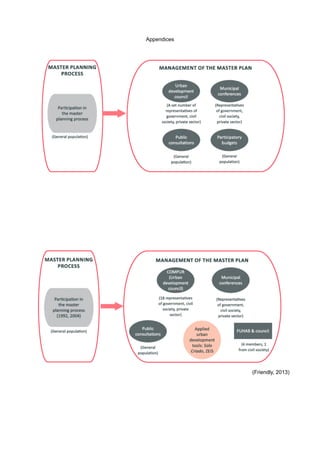
corrupted – and co-optatively appointed – COMPUR's representatives who would never let all of this
materialise (Friendly, 2013). And if doubt is still prosperous within the lector, the visual power of such
wrongdoings should be accessed, perhaps with a particular touch onto the 2014 World Cup infrastructural
projects (BBC News, 2014; latterjsb, 2012).
As the SC is continuously disregarded, apart from minor exceptions, the same is valid for human
rights obligations. Brazil, having ratified the International Covenant on Economic, Social and Cultural Rights
(ICESCR), International Covenant on Civil and Political Rights (ICCPR), Convention on the Elimination of All
Forms of Discrimination against Women (CEDAW) and the Convention on the Rights of the Child (CRC) is
required to promote the Right to Adequate Housing (RAH) which each of them contains.
Placing exceptional care in regard to women (CEDAW Art. 14[2], 15[2]) and children (CRC Art. 16[1], 27[3])
the RAH demands immediate protection against discriminatory practices which can result to the
disadvantaged access to mainly public, but also private, resources (i.e. socio-spatial segregation may well
negatively impact the access to employment opportunities and enjoyment of public libraries) (OHCHR,
2009). Dolefully, the explicitly cited “adequate standard of living” (ICESCR Art. 7[2] and 11[1]) is for major
part a progressive right, meaning that its achievement does not set precise and instantaneous boundaries.
Implementing this right is thus not firmly established as a concrete duty (ibid.). In-fact, even though the RAH
must be interpreted widely, e.g. 1) the cost of a property must not threaten the enjoyment of other rights; 2)
presence of safe food storages, water and sanitation systems; 3) adequate space and physical security; its
implementation is not obligatory. No doubt that without minimum requirements which could have easily been
set through time deadlines (e.g. 2 years to reduce national homelessness of 5%; 1 year to establish a
permanent state's agency specifically designed to address housing problems, etc.), the RAH became](https://image.slidesharecdn.com/b7e3f902-6dee-4707-ae58-0b2016f55d21-150706144011-lva1-app6891/85/The-Right-to-City-Exploring-The-Struggles-4-320.jpg)
![invisible, particularly to political concerns. It is although fair to utter that the SC in Brazil successfully gave
birth to – if nothing else for outward appearance – the Ministry of Cities (Valença and Bonates, 2010).
Despite this, the RAH remains prominent within the field of unlawful displacements and arbitrary
forced evictions. It is noteworthy how the family is understood as the “fundamental root of society” (ICESCR
Art. 10[1],[3]) placing it under special safeguard, while Art. 17 ICCPR states “everyone has the right to the
protection of the law against [such] interference or attacks”. What this means, is that everyone is equally
protected by the law, no matter what. Dolefully again, it does not represent reality. Satirically, most of the
characteristics laid down by the United Nations Committee on Economic, Social and Cultural Rights in its
general comment No. 7 (1997) on forced evictions, are broken as daily routines. Amnesty international
(2013c; 2013d) has long recorded the symbiotic relationship between states and corporations against those
marginalised communities (Al Jazeera English, 2012; HRBAProductions, 2012). To be clearer, let us
expound upon.
Notice must be provided within reasonable time, hence to leave the potential evictee with enough
time to access accurate and veracious consultation which should be freely provided at every step of the
eviction process (OHCHR, 2009). This way, legal contestation could be claimed or, at least, fair retribution/
remedy be negotiated (Amnesty International, 2014). But while any type of remedy is manipulatively avoided,
violence is preferred as to cut unnecessary time and costs. Not only deprived by these rights, the slum-
dwellers are practically stripped away of everything else. Bulldozers accompanied by the military, in-fact,
destroy whole neighbourhoods altogether with their contents (Amnesty International, 2013a). Whether the
demolishing process happens to be at night or in a rainy day, is not of much concern to the evictors who
systematically answer no question, the public may ask (OHCHR, 2009). So displaced, the additionally
impoverished people have no other choice than to find another peripheral area where to settle; another time
illegally, another time at the face of prosperous prostitution, drug addiction and violence – another time at the
marginal fringes, where society is abandoned –.
The Right to City is a right to change. A right to the democratic control over perpetual adaptation.
Born out of street manifestations, is the right to recapture the equality, solidarity once ripped away by the
forceful Private Property Rights of capitalistic nature (Harvey, 2012). And if Brazil, in general terms, may not
seem to mirror the best actualisation, perhaps Curitiba city has much to teach.
In Curitiba, Brazil, the RC has achieved great social changes. The expansion of the City has been
limited in order to better concentrate its resources and saving energy expenditures. Businesses have been
developed through 5 axes radiating out the centre of the city altogether with the transport system, meaning
that its citizens could benefit from more equal distribution of jobs, wealth and hence social integration
(Soltani and Sharifi, 2012). This, coupled with the restriction of inhabitants per areas and cheaper tickets,
has fostered the improved use of public transports, which is faster and more reliable, so diminishing toxic](https://image.slidesharecdn.com/b7e3f902-6dee-4707-ae58-0b2016f55d21-150706144011-lva1-app6891/85/The-Right-to-City-Exploring-The-Struggles-5-320.jpg)
![Bibliography
Al Jazeera English. (2012). Brazil favela eviction turns violent [online]. Available from: https://
www.youtube.com/watch?v=Nf1cILLV4d4. Last accessed: 14th April 2014.
Amnesty International. (2008). The Arab Human Rights Committee: Elections of Members and Criteria of
Membership [online]. Available from: http://www.amnesty.org/en/library/info/IOR65/001/2008/en. Last
accessed: 11th December 2013.
AmnestyInternational. (2013a). Evict Them in Five Easy Steps [online]. Available from: https://
www.youtube.com/watch?v=ruIM8fpyySU. Last accessed: 14th April 2014.
Amnesty International. (2013b). Urgent Action: Families Left Homeless, Threatened by Gunmen [online].
Available from: http://www.amnestyusa.org/sites/default/files/uaa31213.pdf . Last accessed: 11th december
2013.
Amnesty International. (2013c). Slums and Informal Settlements – Calendar [online]. Available from: http://
www.amnesty.org/en/library/asset/ACT35/023/2013/en/ccb19945-f784-4d82-898e-89bea790e4a9/
act350232013en.pdf. Last accessed: 14th April 2014.
Amnesty International. (2013d). Amnesty International Report 2013: The State of The World's Human Rights
[online]. Available from: http://files.amnesty.org/air13/
AmnestyInternational_AnnualReport2013_complete_en.pdf. Last accessed: 14th April 2014.
Amnesty International. (2014). Injustice incorporated: Corporate abuses and the human right to remedy
[online]. Available from: http://www.amnesty.org/en/library/asset/POL30/001/2014/en/
33454c09-79af-4643-9e8e-1ee8c972e360/pol300012014en.pdf. Last accessed: 14th April 2014.
BBC News. (2014). Evictions stepped up in Brazil ahead of World Cup [online]. Available from: http://
www.bbc.co.uk/news/world-latin-america-25694340. Last accessed: 14th April 2014.
Bodach, S. and Hamhaber, J. (2010). Energy efficiency in social housing: Opportunities and barriers from a
case study in Brazil. Energy Policy. 38 (12), 7898–7910.
Brown, A. (2010). The ‘right to the city’: From Paris 1968 to Rio 2010 [online]. Paper presented at the 11th
Conference of the Network-Association of European Researchers on Urbanization in the
South (N-AERUS). Available from: https://www.youtube.com/watch?v=ZDwJuVDYzbU. Last accessed: 14th
April 2014.
Carolini, G.Y. (2013). Perverting Progress? The Challenges of Implementing both Fiscal and Social
Responsibility in São Paulo (1995–2010). Urban Studies. 50 (2), 356–371.
Chao, W. and Kang, W. (2010). A Study on Environmental Impact of High Speed Maglev Traffic Engineering
[online]. Available from: http://ieeexplore.ieee.org/xpl/login.jsp?tp=&arnumber=5576917&url=http%3A%2F
%2Fieeexplore.ieee.org%2Fxpls%2Fabs_all.jsp%3Farnumber%3D5576917. Last accessed: 14th April 2014.
Cities Alliance and Ministry of Cities. (2010). The City Statute of Brazil a Commentary [online]. Available
from: http://www.ifrc.org/docs/idrl/945EN.pdf . Last accessed: 11th december 2013.
Statute of The City. Brazil. 10 July 2001.
Cocron, P., Bühler, F., Franke, T., Neumann, I., Dielmann, B. and Krems, J.F. (2013). Energy recapture
through deceleration – regenerative braking in electric vehicles from a user perspective. Ergonomics. 56 (8),
1203-1215.
Convention on the Rights of the Child. New York. 20 November 1989.
Convention to Eliminate All Forms of Discrimination Against Women. New York. 18 December 1979.
Fernandes, E. (2007). Constructing the `Right To the City' in Brazil. Social & Legal Studies. 16 (2), 201–219.](https://image.slidesharecdn.com/b7e3f902-6dee-4707-ae58-0b2016f55d21-150706144011-lva1-app6891/85/The-Right-to-City-Exploring-The-Struggles-7-320.jpg)
![Finley, L.L. (2013). Examining state and state-corporate crime surrounding major sporting events.
Contemporary Justice Review: Issues in Criminal, Social, and Restorative Justice. 16 (2), 228-250.
Friendly, A. (2013). The right to the city: theory and practice in Brazil. Planning Theory & Practice. 14 (2),
158-179.
Harvey, D. (2008). The Right to The City. New Left Review. 53 Sept/Oct, 23-40.
Harvey, D (2012). Rebel Cities - From the Right to the City to the Urban Revolution. London: Verso. 1-187.
Holston, J. (2011). Contesting privilege with right: the transformation of differentiated citizenship in Brazil.
Citizenship Studies. 15 (3/4), 335-352.
HRBAProductions. (2012). The Road to Rio - Brazil's Forced Removals [online]. Available from: https://
www.youtube.com/watch?v=ZDwJuVDYzbU. Last accessed: 14th April 2014.
Inside Housing. (2013). Building a new Brazil [online]. Available from: http://www.insidehousing.co.uk/home/
analysis/building-a-new-brazil/6529721.article. Last accessed: 14th April 2014.
Instituto Polis. (2003). The Statute of The City [online]. [online]. Available from: http://www.polis.org.br/
uploads/916/916.pdf. Last accessed: 14th April 2014.
International Alliance of Inhabitants. (2005). World Charter for the Right to the City [online]. Available from:
http://www.urbanreinventors.net/3/wsf.pdf. Last accessed: 14th April 2014.
International Covenant on Civil and Political Rights. New York. 16 December 1966.
International Covenant on Economic, Social and Cultural Rights. New York. 16 December 1966.
Laird, J. (2013) Sustainable city living - from the ground up [online]. Focus renewable energy. Available from:
http://www.renewableenergyfocus.com/view/33144/sustainable-city-living-from-the-ground-up/. Last
accessed: 14th April 2014.
latterjsb. (2012). The brutal reality in Brazil: Violence and evictions for the World Cup 2014 [online]. Available
from: https://www.youtube.com/watch?v=IOtylLqHkpA. Last accessed: 14th April 2014.
Office of the High Commissioner for Human Rights. (2009). The Right to Adequate Housing [online].
Available from: http://www.ohchr.org/Documents/Publications/FS21_rev_1_Housing_en.pdf . Last accessed:
11th december 2013.
Park, R. (1967). On Social Control and Collective Behavior. Chicago: Chicago University Press. Cited in
Harvey, D. (2008). The Right to The City. New Left Review. 53 Sept/Oct, 23-40.
Pickett, S.T.A., Boone, C.G., McGrath, B.P, Cadenasso, M.L., Childers, D.L., Ogden, L.A., McHale, M. and
Grove, J.M. (2013). Ecological science and transformation to the sustainable city. Cities. 32 (2), 10-20.
Soltani, A. and Sharifi, E. (2012). A case study of sustainable urban planning principles in Curitiba (Brazil)
and their applicability in Shiraz (Iran). International Journal of Development and Sustainability. 1 (2),
120-134.
Tianhao, H. (2012). Urban Brazil An Olympic Opportunity. Harvard International Review. 34 (2), 9-10.
United Nations Committee on Economic, Social and Cultural Rights. General comment 7. 1997.
Valença, M.M. and Bonates, M.F. (2010). The trajectory of social housing policy in Brazil: From the National
Housing Bank to the Ministry of the Cities. Habitat International. 34 (2), 165–173.
Vilajosana, I., Llosa, J., Martinez, B., Domingo-Prieto, M., Angles, A. and Vilajosana, X. (2013).
Bootstrapping smart cities through a self-sustainable model based on big data flows. IEEE Communications
Magazine. 51 (6), 128-134.
Watson, V. (2012). Planning and the ‘stubborn realities’ of global south-east cities: Some emerging ideas.
Planning Theory. 12 (1), 81– 100.](https://image.slidesharecdn.com/b7e3f902-6dee-4707-ae58-0b2016f55d21-150706144011-lva1-app6891/85/The-Right-to-City-Exploring-The-Struggles-8-320.jpg)
![Wordpress. (2013). Unknown. [online]. Available from: https://
collapseofindustrialcivilization.files.wordpress.com/2013/05/tumblr_lnbvl8bgyj1qcr6iqo1_1280.jpg. Last
accessed: 14th April 2014.
Yuet Ho, C. (2013). Bargaining demolition in China: A practice of distrust. Critique of Anthropology. 33 (4),
412–428.](https://image.slidesharecdn.com/b7e3f902-6dee-4707-ae58-0b2016f55d21-150706144011-lva1-app6891/85/The-Right-to-City-Exploring-The-Struggles-9-320.jpg)