9781910068427
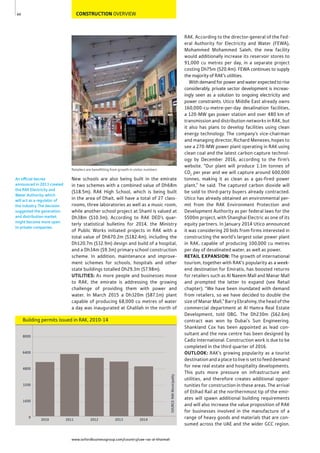
THE
REPORT
Ras Al Khaimah
2015
ECONOMY RETAIL ENERGY
HEALTH TOURISM FINANCE
INDUSTRY CONSTRUCTION EDUCATION
TRANSPORT REAL ESTATE INTERVIEWS
www.oxfordbusinessgroup.com
CONTENTS RAS AL KHAIMAH 2015 5
Box text
THE REPORT Ras Al Khaimah 2015
ISBN 978-1-910068-42-7
Editor-in-Chief: Andrew Jeffreys
Managing Editor, Middle East: Oliver
Cornock
Editorial Manager: Geoff Cooke
Group Managing Editor: Alistair Taylor
Chief Sub-Editor: Barbara Isenberg
Deputy Chief Sub-Editors: Martin
Stegman, Laura Nelson
Senior Sub-Editor: Jennie Patterson
Web Editor: Lorraine Turner
Sub-editors: Usman Ahmedani,
Abraham Armstrong, Danya
Chudacoff, Michael Gibson, Sam
Inglis, Krystell Jimenez, Jamie Leptien,
Amy Stapleton
Contributing Sub-editor: Miia
Bogdanoff
Analysts: Paige Aarhus, Tom Hill
Senior Editorial Researcher: Susan
Mano lu
Editorial Researchers: Sara Costa,
Billy Fitzherbert, Teresa Meoni,
Souhir Mzali, Jenna Oelschlegel
Creative Director: Yonca Ergin
Art Editor: Meltem Muzmuz
Graphic Assistants: Gülhan Atbas,
Arzu Çimen
Illustrations: Shi-Ji Liang
Photographer: Mourad Hammami
Production Manager: Selin Bolu
Operations & Administration Manager:
Burçin Ilgaz
Logistics & Distribution Coordinator:
Esra Sezgin
Logistics Executive: Öznur Usta
24
26
33
34
35
38
43
44
46
Viewpoint: Tony Abbott, Former Prime Minister
of Australia
ECONOMY
Drive to diversify: The emirate is aiming to
expand high-priority sectors
Interview: Sheikh Ahmad bin Saqr Al Qasimi,
Chairman, Ras Al Khaimah Free Trade Zone
Return to debt markets: The emirate issues its
first sovereign sukuk in a decade
Attracting interest: Streamlining the licensing
process to enhance the business environment
FINANCIAL SERVICES
Fertile soil: Financial services sector ready to
reap the benefits of economic expansion and
regulatory changes
Interview: Peter England, CEO, National Bank of
Ras Al Khaimah
Regulatory rewrite: Prioritising balance sheet
health for banks and insurers
INDUSTRY & RETAIL
On the right path: The emirate has much to
offer manufacturers
8
14
18
19
21
SNAPSHOT
RAK in figures
PROFILE
On course: Benefitting from its location and
natural resources, the emirate continues on
the path of development and growth
Interview: Sheikh Saud bin Saqr Al Qasimi,
Supreme Council Member and Ruler of Ras Al
Khaimah
Looking east: Trade with Asia is growing
A stable supply: Drivers and change in
GCC-Africa investment
A booming manufacturing industry – cou-
pled with a diversification drive and efforts
to capitalise on the UAE’s rising profile as a
global investment destination – is reaping
benefits for RAK’s economy, which contin-
ues to show strong growth. The emirate is
driving up foreign investment through a
continued expansion of its free zone net-
work and has plans to further develop its
tourism, education and health care sectors.
Fertile soil
Page 38
Drive to diversify
Page 26
The financial sector has remained strong, with a par-
ticularly dramatic increase being seen in the emirate’s
Islamic finance activity. Planned construction projects
in the UAE are expected to drive high demand for
building materials in RAK over the coming years, while
regulatory changes have led to increased activity in
the banking and insurance industries in line with Ba-
sel III requirements. Setting new capital and liquidity
standards, the new regulations limit insurance compa-
nies’ investments in various instruments and sectors.
CONTENTS RAS AL KHAIMAH 2015
www.oxfordbusinessgroup.com/country/uae-ras-al-khaimah
6
On the right path
Page 46
Chairman: Michael Benson-Colpi
Director of Field Operations: Elizabeth
Boissevain
Managing Director, Middle East: Jana
Treeck
Project Director: Ivana Carapic
Field Operations Executive: Meltem
Okur
Field Operations Assistant: Arda Özgen
For all editorial and advertising
enquiries please contact us at:
enquiries@oxfordbusinessgroup.com.
To order a copy of this publication
or to enquire about your subscription
please contact us at:
booksales@oxfordbusinessgroup.com.
All rights reserved. No part of this
publication may be reproduced,
stored in a retrieval system or
transmitted in any form by any means,
without the prior written permission
of Oxford Business Group.
Whilst every effort has been made to
ensure the accuracy of the information
contained in this book, the
authors and publisher accept no
responsibility for any errors it may
contain, or for any loss, financial or
otherwise, sustained by any person
using this publication.
Updates for the
information provided in this
volume can be found in Oxford
Business Group’s ‘Economic Updates’
service available via email or at
www.oxfordbusinessgroup.com
Oxford Business Group
131 Great Titchfield St. London
W1W 5BB United Kingdom
53
54
55
56
57
60
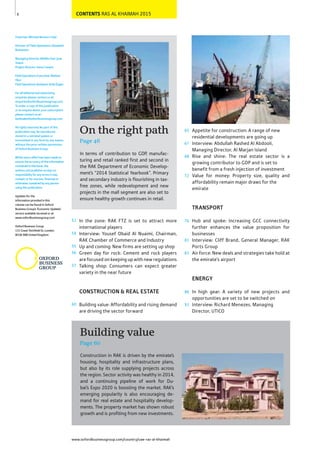
In terms of contribution to GDP, manufac-
turing and retail ranked first and second in
the RAK Department of Economic Develop-
ment’s “2014 Statistical Yearbook”. Primary
and secondary industry is flourishing in tax-
free zones, while redevelopment and new
projects in the mall segment are also set to
ensure healthy growth continues in retail.
65
67
68
72
76
81
83
86
93
Appetite for construction: A range of new
residential developments are going up
Interview: Abdullah Rashed Al Abdooli,
Managing Director, Al Marjan Island
Rise and shine: The real estate sector is a
growing contributor to GDP and is set to
benefit from a fresh injection of investment
Value for money: Property size, quality and
affordability remain major draws for the
emirate
TRANSPORT
Hub and spoke: Increasing GCC connectivity
further enhances the value proposition for
businesses
Interview: Cliff Brand, General Manager, RAK
Ports Group
Air force: New deals and strategies take hold at
the emirate’s airport
ENERGY
In high gear: A variety of new projects and
opportunities are set to be switched on
Interview: Richard Menezes, Managing
Director, UTICO
In the zone: RAK FTZ is set to attract more
international players
Interview: Yousef Obaid Al Nuaimi, Chairman,
RAK Chamber of Commerce and Industry
Up and coming: New firms are setting up shop
Green day for rock: Cement and rock players
are focused on keeping up with new regulations
Talking shop: Consumers can expect greater
variety in the near future
CONSTRUCTION & REAL ESTATE
Building value: Affordability and rising demand
are driving the sector forward
Building value
Page 60
Construction in RAK is driven by the emirate’s
housing, hospitality and infrastructure plans,
but also by its role supplying projects across
the region. Sector activity was healthy in 2014,
and a continuing pipeline of work for Du-
bai’s Expo 2020 is boosting the market. RAK’s
emerging popularity is also encouraging de-
mand for real estate and hospitality develop-
ments. The property market has shown robust
growth and is profiting from new investments.
CONTENTS RAS AL KHAIMAH 2015 7
Following a decade of investment in both
publicandprivatefacilities,thehealthcare
sector in RAK is set to see major growth.
New specialty services are expected to
serve the growing number of patients
suffering from the increasing prevalence
of lifestyle-related diseases, although the
absence of mandatory medical insurance
is a constraint for existing sector players.
With little in the way of hydrocarbons
reserves and limited domestic explora-
tion, the energy sector has expanded
on the back of its two major upstream
players. Both have interests in interna-
tional exploration and production and
aim to improve domestic power supply
through private sector investment and
the development of renewable energy.
Treatment table
Page 98
In high gear
Page 86
Hub and spoke
Page 76
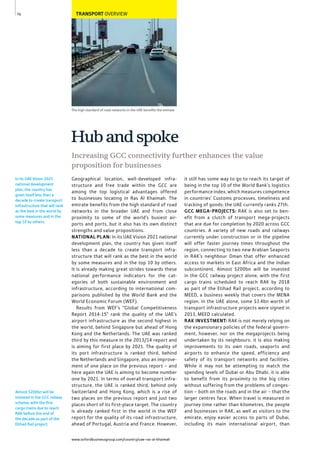
Benefitting from the UAE’s high standard
of road networks and proximity to some
of the world’s busiest airports and ports,
RAK offers many logistical advantages to
businesses locating in the emirate. The
Vision 2021 national development plan,
meanwhile, aims to see the UAE build
transport infrastructure that will rank
among the world’s best in under a decade.
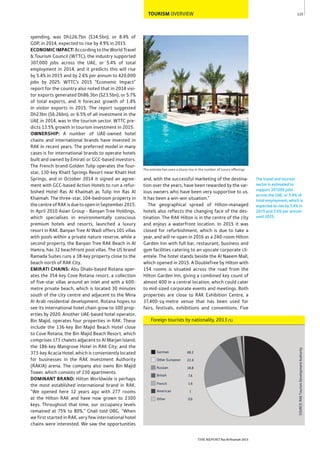
The emirate’s tourism sector has
been enjoying a period of growth and
profitability. The average room rate
in the emirate rose by 67% between
2011 and 2014, and in March 2015
the Tourism Development Authority
reported occupancy levels of 70%, an
8% increase on the previous year.
Keys to growth
Page 114
94
95
98
103
104
106
112
114
121
122
124
125
127
134
136
Far and wide: The emirate’s main players are
looking abroad for promising exploration and
production opportunities
The more the better: Population and economic
growth underline the need for water
HEALTH
Treatment table: The health care network is
expanding to meet the growing needs of
residents
Interview: Dr Myung-Whun Sung, CEO, Sheikh
Khalifa Specialty Hospital
Specialty care: Investing in local treatment
facilities to boost offerings
EDUCATION
Making the grade: Reforms are under way to
improve educational quality
A profitable lesson: Private institutions are
drawing the attention of financiers
TOURISM
Keys to growth: A proliferation of new hotels
and developments bodes well for continued
expansion
On the island: Further progress is expected on
a major development
On track: Efforts to develop and promote the
sector are ongoing
THE GUIDE
Dark horse: Equestrian culture is alive and
kicking in the emirate
Restored glories: The village of Jazirat Al Hamra
has an intriguing history
Where to stay: Hotels
Listings: Important numbers
Facts for visitors: Useful tips for new arrivals
THE REPORT Ras Al Khaimah 2015
SNAPSHOT
www.oxfordbusinessgroup.com/country/uae-ras-al-khaimah
8
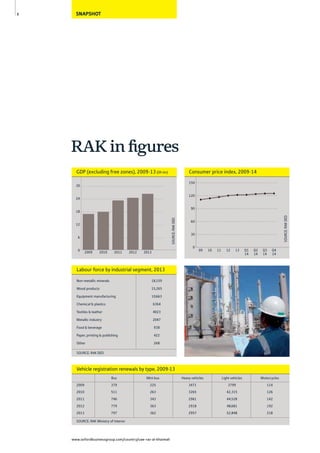
RAK in figures
SOURCE: RAK Ministry of Interior
Bus Mini-bus Heavy vehicles Light vehicles Motorcycles
2009 379 225 3471 3799 114
2010 511 263 3265 42,315 126
2011 746 343 2961 44,528 142
2012 779 363 2918 48,681 192
2013 797 362 2957 52,848 218
Vehicle registration renewals by type, 2009-13
SOURCE:RAKDED
Consumer price index, 2009-14
0
30
60
90
120
150
Q4
14
Q3
14
Q2
14
Q1
14
1312111009
GDP (excluding free zones), 2009-13 (Dh bn) SOURCE:RAKDED
0
6
12
18
24
30
20132012201120102009
SOURCE: RAK DED
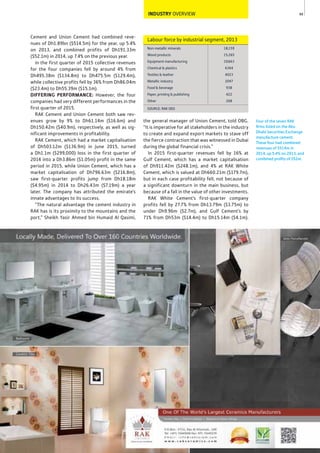
Non-metallic minerals 18,159
Wood products 15,265
Equipment manufacturing 10,663
Chemical & plastics 6364
Textiles & leather 4023
Metallic industry 2047
Food & beverage 938
Paper, printing & publishing 422
Other 268
Labour force by industrial segment, 2013
SNAPSHOT
THE REPORT Ras Al Khaimah 2015
9
Residential
Commercial
Agricultural
Federal gov't
Industrial
Other
69
23
3
2
2
1
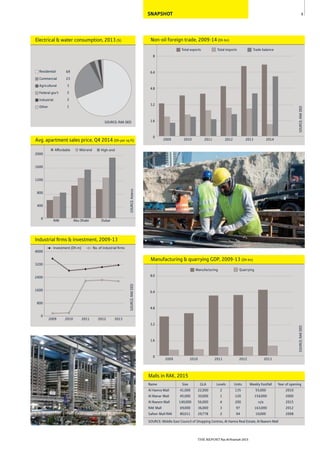
Electrical & water consumption, 2013 (%)
SOURCE: RAK DED
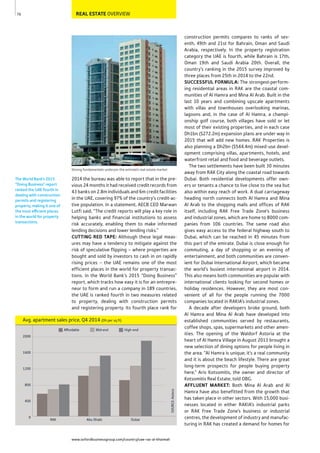
Avg. apartment sales price, Q4 2014 (Dh per sq ft)
SOURCE:Asteco
0
400
800
1200
1600
2000
High-endMid-endAffordable
DubaiAbu DhabiRAK
SOURCE:RAKDED
Industrial firms & investment, 2009-13
0
800
1600
2400
3200
4000
No. of industrial firmsInvestment (Dh m)
20132012201120102009
Non-oil foreign trade, 2009-14 (Dh bn)
SOURCE:RAKDED
0
1.6
3.2
4.8
6.4
8
Trade balanceTotal importsTotal exports
201420132012201120102009
SOURCE: Middle East Council of Shopping Centres, Al Hamra Real Estate, Al Naeem Mall
Name Size GLA Levels Units Weekly footfall Year of opening
Al Hamra Mall 41,000 22,000 2 135 55,000 2010
Al Manar Mall 45,000 30,000 1 120 154,000 2000
Al Naeem Mall 140,000 56,000 4 200 n/a 2015
RAK Mall 69,000 36,000 3 97 163,000 2012
Safeer Mall RAK 80,011 29,778 2 94 10,000 2008
Malls in RAK, 2015
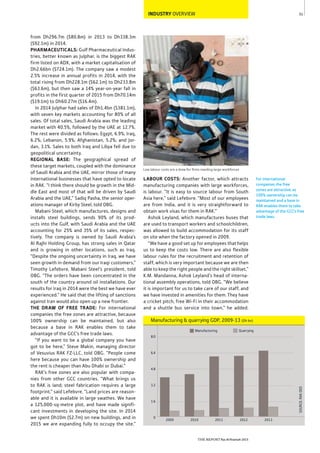
Manufacturing & quarrying GDP, 2009-13 (Dh bn)
SOURCE:RAKDED
0
1.6
3.2
4.8
6.4
8.0
QuarryingManufacturing
20132012201120102009
SNAPSHOT
www.oxfordbusinessgroup.com/country/uae-ras-al-khaimah
10
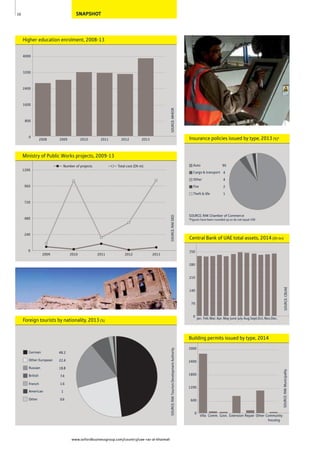
Central Bank of UAE total assets, 2014 (Dh bn)
SOURCE:CBUAE
0
70
140
210
280
350
Dec.Nov.Oct.Sept.Aug.JulyJuneMayApr.Mar.Feb.Jan.
Auto
Cargo & transport
Other
Fire
Theft & life
90
4
4
2
1
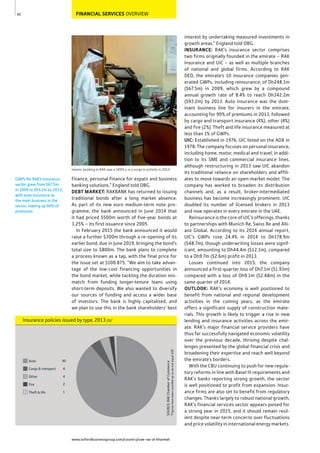
Insurance policies issued by type, 2013 (%)*
SOURCE: RAK Chamber of Commerce
*Figures have been rounded up so do not equal 100
Higher education enrolment, 2008-13
SOURCE:MHESR
0
800
1600
2400
3200
4000
201320122011201020092008
German
Other European
Russian
British
French
American
Other
48.2
22.4
18.8
7.4
1.6
1
0.6
Foreign tourists by nationality, 2013 (%)
SOURCE:RAKTourismDevelopmentAuthoritySOURCE:RAKDED
Ministry of Public Works projects, 2009-13
0
240
480
720
960
1200
Total cost (Dh m)Number of projects
20132012201120102009
Building permits issued by type, 2014
SOURCE:RAKMunicipality
0
600
1200
1800
2400
3000
Community
housing
OtherRepairExtensionGovt.Comm.Villa
THE REPORT Ras Al Khaimah 2015
11SNAPSHOT
National bank
branches
Money exchange
houses
Foreign bank
branches
Head office
31
22
6
1
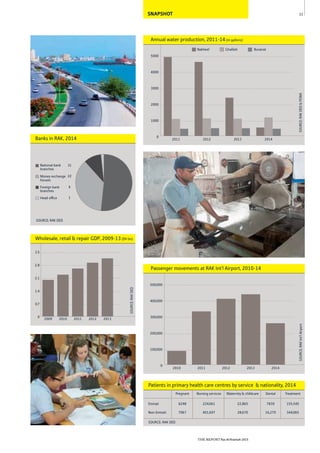
Banks in RAK, 2014
SOURCE: RAK DED
Wholesale, retail & repair GDP, 2009-13 (Dh bn)
SOURCE:RAKDED
0
0.7
1.4
2.1
2.8
3.5
20132012201120102009
SOURCE: RAK DED
Pregnant Nursing services Maternity & childcare Dental Treatment
Emirati 6248 224,061 22,865 7830 155,545
Non-Emirati 7067 401,697 28,670 16,270 344,065
Patients in primary health care centres by service & nationality, 2014
Annual water production, 2011-14 (m gallons)
SOURCE:RAKDED&FEWA
0
1000
2000
3000
4000
5000
BurairatGhalilahNakheel
2014201320122011
Passenger movements at RAK Int'l Airport, 2010-14
SOURCE:RAKInt'lAirport
0
100,000
200,000
300,000
400,000
500,000
20142013201220112010
13
Profile
Resources underpin cement and ceramics industries
Free zones catalyse growth in the industrial sector
Rising international profile as a tourism destination
GCC economic ties with Asia and Africa growing
www.oxfordbusinessgroup.com/country/uae-ras-al-khaimah
14
RAK has built several different engines of economic growth
PROFILE OVERVIEW
Pearling was a major part
of the emirate’s culture
and economy, and as
recently as the start of the
20th century the industry
employed 22,000 people
and exported £1.7m worth
of pearls worldwide.
The area that included the
modern-day UAE has long
been home to civilisations,
with archaeological
evidence of these dating
back thousands of years to
the 4th century BCE.
Ras Al Khaimah holds a unique position among the
seven emirates that make up the UAE. It has a rich
and long history that revolves around trade, with
its exports mainly driven by copper and pearl in
the past. Making the most of its vast reserves of
clay, limestone and sand found on the Hajar Moun-
tains, RAK has built a flourishing manufacturing
sector that has served as an engine for growth
over the past two decades, and in recent years the
emirate has also raised its profile as a tourist des-
tination. Meanwhile, RAK’s expanding free zones
have attracted more than 15,000 international
companies to the emirate.
HISTORY: The area that comprises the mod-
ern-day UAE has long been home to civilisations,
with archaeological evidence of some of these
dating back thousands of years. Beginning in the
4th century BCE, the Dilmun civilisation, centred
in what is now Bahrain, controlled the region from
Kuwait to Qatar, with a related culture holding
sway in the UAE and Oman.
The area around RAK later became known as
Julfar, a name referenced by Arab writers around
the time of the Islamic conquest of the Northern
Emirates in the 7th century CE. Julfar subsequently
moved near to modern-day RAK City, where it
thrived, becoming a major regional trade centre in
the 16th century. Julfar gradually lost prominence
as the modern city of RAK developed, and by the
18th century this new city was linked to the Al
Qasimi tribe to which the ruling family belongs.
The Al Qasimi tribe dominated trade in the lower
Gulf in the 18th century, pitting it against the
British East India Company and setting the stage
for British military involvement. After bombard-
ing the emirate in 1809 and 1816, British naval
forces invaded it in 1819 to control the growing
dominance of the Al Qasimi tribe. British occupa-
tion would have significant political and economic
effects on the region. British forces occupied RAK
for three years before the tribe’s leader signed
a treaty establishing RAK as a protectorate in
exchange for military protection in 1820.
The British signed similar treaties with a num-
ber of sheikhdoms in the region around the same
time, leading to the creation of the so-called Tru-
cial States, a political entity which was to endure
until the withdrawal of the British from the region
in 1971. Among other effects, Britain’s suppres-
sion of foreign attacks on the coast enabled RAK’s
pearling industry to emerge as one of the emir-
ate’s major sources of income and employment.
PEARLING: Dating back centuries, the tradition of
pearling has been as much a way of life and culture
as a source of income. The UAE National Media
Council writes that, “Pearling was never merely a
trade or a means of subsistence for the popula-
tion. It was an entirely integrated social system,
which has left a rich heritage of traditions.” At its
peak at the beginning of the 20th century, the Gulf
pearling industry employed over 22,000 people
and exported £1.7m worth of pearls, according to
the UAE National Media Council.
Shortly after the First World War, however, the
advent of Japanese cultured pearls and the global
recession of the 1920s had a severe impact on the
industry. One of RAK’s major trade partners, India,
placed a high tax on Gulf pearls, making exports
extremely expensive. These factors contributed
to the collapse of the industry, leading to several
years of economic decline in RAK.
FORMING THE UAE: By the mid-1960s, the UK
was facing its own economic and political pres-
sures and decided to end the treaty to protect
Qatar, Bahrain and the seven emirates and with-
draw from the region. The rulers of Abu Dhabi and
Dubai, along with Sharjah, Ajman, Umm Al Quwain
and Fujairah, formed a union and established the
Benefitting from its location and natural resources the emirate
continues on the path of development and growth
Oncourse
15
THE REPORT Ras Al Khaimah 2015
PROFILE OVERVIEW
Sheikh Saud bin Saqr Al
Qasimi has ruled RAK since
2010, following the passing
of his father, Sheikh Saqr.
The Supreme Council, a
body made up of the seven
rulers of the emirates,
governs the UAE at the
federal level.
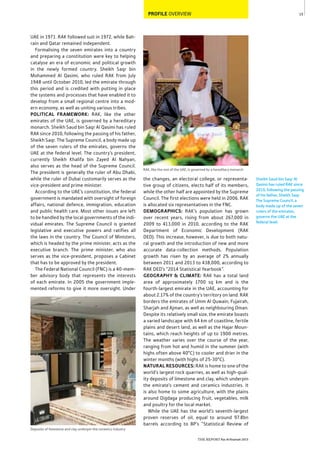
RAK, like the rest of the UAE, is governed by a hereditary monarch
the changes, an electoral college, or representa-
tive group of citizens, elects half of its members,
while the other half are appointed by the Supreme
Council. The first elections were held in 2006. RAK
is allocated six representatives in the FNC.
DEMOGRAPHICS: RAK’s population has grown
over recent years, rising from about 267,000 in
2009 to 413,000 in 2010, according to the RAK
Department of Economic Development (RAK
DED). This increase, however, is due to both natu-
ral growth and the introduction of new and more
accurate data-collection methods. Population
growth has risen by an average of 2% annually
between 2011 and 2013 to 438,000, according to
RAK DED’s “2014 Statistical Yearbook”.
GEOGRAPHY & CLIMATE: RAK has a total land
area of approximately 1700 sq km and is the
fourth-largest emirate in the UAE, accounting for
about 2.17% of the country’s territory on land. RAK
borders the emirates of Umm Al Quwain, Fujairah,
Sharjah and Ajman, as well as neighbouring Oman.
Despite its relatively small size, the emirate boasts
a varied landscape with 64 km of coastline, fertile
plains and desert land, as well as the Hajar Moun-
tains, which reach heights of up to 1900 metres.
The weather varies over the course of the year,
ranging from hot and humid in the summer (with
highs often above 40°C) to cooler and drier in the
winter months (with highs of 25-30°C).
NATURAL RESOURCES: RAK is home to one of the
world’s largest rock quarries, as well as high-qual-
ity deposits of limestone and clay, which underpin
the emirate’s cement and ceramics industries. It
is also home to some agriculture, with the plains
around Digdaga producing fruit, vegetables, milk
and poultry for the local market.
While the UAE has the world’s seventh-largest
proven reserves of oil, equal to around 97.8bn
barrels according to BP’s “Statistical Review of
UAE in 1971. RAK followed suit in 1972, while Bah-
rain and Qatar remained independent.
Formalising the seven emirates into a country
and preparing a constitution were key to helping
catalyse an era of economic and political growth
in the newly formed country. Sheikh Saqr bin
Mohammed Al Qasimi, who ruled RAK from July
1948 until October 2010, led the emirate through
this period and is credited with putting in place
the systems and processes that have enabled it to
develop from a small regional centre into a mod-
ern economy, as well as uniting various tribes.
POLITICAL FRAMEWORK: RAK, like the other
emirates of the UAE, is governed by a hereditary
monarch. Sheikh Saud bin Saqr Al Qasimi has ruled
RAK since 2010, following the passing of his father,
Sheikh Saqr. The Supreme Council, a body made up
of the seven rulers of the emirates, governs the
UAE at the federal level. The country’s president,
currently Sheikh Khalifa bin Zayed Al Nahyan,
also serves as the head of the Supreme Council.
The president is generally the ruler of Abu Dhabi,
while the ruler of Dubai customarily serves as the
vice-president and prime minister.
According to the UAE’s constitution, the federal
government is mandated with oversight of foreign
affairs, national defence, immigration, education
and public health care. Most other issues are left
to be handled by the local governments of the indi-
vidual emirates. The Supreme Council is granted
legislative and executive powers and ratifies all
the laws in the country. The Council of Ministers,
which is headed by the prime minister, acts as the
executive branch. The prime minister, who also
serves as the vice-president, proposes a Cabinet
that has to be approved by the president.
The Federal National Council (FNC) is a 40-mem-
ber advisory body that represents the interests
of each emirate. In 2005 the government imple-
mented reforms to give it more oversight. Under
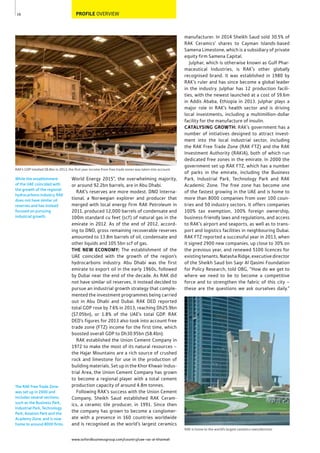
Deposits of limestone and clay underpin the ceramics industry
www.oxfordbusinessgroup.com/country/uae-ras-al-khaimah
16
RAK’s GDP totalled $8.4bn in 2013, the first year income from free trade zones was taken into account
PROFILE OVERVIEW
The RAK Free Trade Zone
was set up in 2000 and
includes several sections,
such as the Business Park,
Industrial Park, Technology
Park, Aviation Park and the
Academy Zone, and is now
home to around 8000 firms.
While the establishment
of the UAE coincided with
the growth of the regional
hydrocarbons industry, RAK
does not have similar oil
reserves and has instead
focused on pursuing
industrial growth.
manufacturer. In 2014 Sheikh Saud sold 30.5% of
RAK Ceramics’ shares to Cayman Islands-based
Samena Limestone, which is a subsidiary of private
equity firm Samena Capital.
Julphar, which is otherwise known as Gulf Phar-
maceutical Industries, is RAK’s other globally
recognised brand. It was established in 1980 by
RAK’s ruler and has since become a global leader
in the industry. Julphar has 12 production facili-
ties, with the newest launched at a cost of $9.6m
in Addis Ababa, Ethiopia in 2013. Julphar plays a
major role in RAK’s health sector and is driving
local investments, including a multimillion-dollar
facility for the manufacture of insulin.
CATALYSING GROWTH: RAK’s government has a
number of initiatives designed to attract invest-
ment into the local industrial sector, including
the RAK Free Trade Zone (RAK FTZ) and the RAK
Investment Authority (RAKIA), both of which run
dedicated free zones in the emirate. In 2000 the
government set up RAK FTZ, which has a number
of parks in the emirate, including the Business
Park, Industrial Park, Technology Park and RAK
Academic Zone. The free zone has become one
of the fastest growing in the UAE and is home to
more than 8000 companies from over 100 coun-
tries and 50 industry sectors. It offers companies
100% tax exemption, 100% foreign ownership,
business-friendly laws and regulations, and access
to RAK’s airport and seaports, as well as to trans-
port and logistics facilities in neighbouring Dubai.
RAK FTZ reported a successful year in 2013, when
it signed 2900 new companies, up close to 30% on
the previous year, and renewed 5100 licences for
existing tenants. Natasha Ridge, executive director
of the Sheikh Saud bin Saqr Al Qasimi Foundation
for Policy Research, told OBG, “How do we get to
where we need to be to become a competitive
force and to strengthen the fabric of this city –
these are the questions we ask ourselves daily.”
World Energy 2015”, the overwhelming majority,
or around 92.2bn barrels, are in Abu Dhabi.
RAK’s reserves are more modest. DNO Interna-
tional, a Norwegian explorer and producer that
merged with local energy firm RAK Petroleum in
2011, produced 12,000 barrels of condensate and
100m standard cu feet (scf) of natural gas in the
emirate in 2012. As of the end of 2012, accord-
ing to DNO, gross remaining recoverable reserves
amounted to 13.8m barrels of oil, condensate and
other liquids and 105.5bn scf of gas.
THE NEW ECONOMY: The establishment of the
UAE coincided with the growth of the region’s
hydrocarbons industry. Abu Dhabi was the first
emirate to export oil in the early 1960s, followed
by Dubai near the end of the decade. As RAK did
not have similar oil reserves, it instead decided to
pursue an industrial growth strategy that comple-
mented the investment programmes being carried
out in Abu Dhabi and Dubai. RAK DED reported
total GDP rose by 7.6% in 2013, reaching Dh25.9bn
($7.05bn), or 1.8% of the UAE’s total GDP. RAK
DED’s figures for 2013 also took into account free
trade zone (FTZ) income for the first time, which
boosted overall GDP to Dh30.95bn ($8.4bn).
RAK established the Union Cement Company in
1972 to make the most of its natural resources –
the Hajar Mountains are a rich source of crushed
rock and limestone for use in the production of
building materials. Set up in the Khor Khwair Indus-
trial Area, the Union Cement Company has grown
to become a regional player with a total cement
production capacity of around 4.8m tonnes.
Following RAK’s success with the Union Cement
Company, Sheikh Saud established RAK Ceram-
ics, a ceramic tile producer, in 1991. Since then
the company has grown to become a conglomer-
ate with a presence in 160 countries worldwide
and is recognised as the world’s largest ceramics
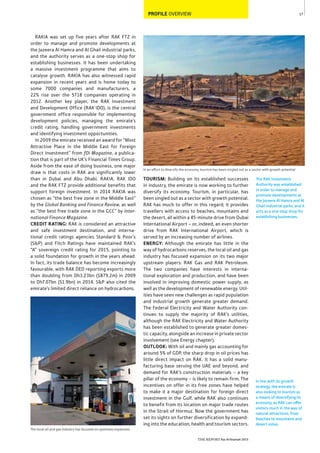
RAK is home to the world’s largest ceramics manufacturer
17
THE REPORT Ras Al Khaimah 2015
In an effort to diversify the economy, tourism has been singled out as a sector with growth potential
PROFILE OVERVIEW
In line with its growth
strategy, the emirate is
also looking to tourism as
a means of diversifying its
economy, as RAK can offer
visitors much in the way of
natural attractions, from
beaches to mountains and
desert vistas.
The RAK Investment
Authority was established
in order to manage and
promote developments at
the Jazeera Al Hamra and Al
Ghail industrial parks, and it
acts as a one-stop shop for
establishing businesses.
TOURISM: Building on its established successes
in industry, the emirate is now working to further
diversify its economy. Tourism, in particular, has
been singled out as a sector with growth potential.
RAK has much to offer in this regard; it provides
travellers with access to beaches, mountains and
the desert, all within a 45-minute drive from Dubai
International Airport – or, indeed, an even shorter
drive from RAK International Airport, which is
served by an increasing number of airlines.
ENERGY: Although the emirate has little in the
way of hydrocarbons reserves, the local oil and gas
industry has focused expansion on its two major
upstream players: RAK Gas and RAK Petroleum.
The two companies have interests in interna-
tional exploration and production, and have been
involved in improving domestic power supply, as
well as the development of renewable energy. Util-
ities have seen new challenges as rapid population
and industrial growth generate greater demand.
The Federal Electricity and Water Authority con-
tinues to supply the majority of RAK’s utilities,
although the RAK Electricity and Water Authority
has been established to generate greater domes-
tic capacity, alongside an increase in private sector
involvement (see Energy chapter).
OUTLOOK: With oil and mainly gas accounting for
around 5% of GDP, the sharp drop in oil prices has
little direct impact on RAK. It has a solid manu-
facturing base serving the UAE and beyond, and
demand for RAK’s construction materials – a key
pillar of the economy – is likely to remain firm. The
incentives on offer in its free zones have helped
to make it a major destination for foreign direct
investment in the Gulf, while RAK also continues
to benefit from its location on major trade routes
in the Strait of Hormuz. Now the government has
set its sights on further diversification by expand-
ing into the education, health and tourism sectors.
RAKIA was set up five years after RAK FTZ in
order to manage and promote developments at
the Jazeera Al Hamra and Al Ghail industrial parks,
and the authority serves as a one-stop shop for
establishing businesses. It has been undertaking
a massive investment programme that aims to
catalyse growth. RAKIA has also witnessed rapid
expansion in recent years and is home today to
some 7000 companies and manufacturers, a
22% rise over the 5718 companies operating in
2012. Another key player, the RAK Investment
and Development Office (RAK IDO), is the central
government office responsible for implementing
development policies, managing the emirate’s
credit rating, handling government investments
and identifying investment opportunities.
In 2009 the emirate received an award for “Most
Attractive Place in the Middle East for Foreign
Direct Investment” from fDi Magazine, a publica-
tion that is part of the UK’s Financial Times Group.
Aside from the ease of doing business, one major
draw is that costs in RAK are significantly lower
than in Dubai and Abu Dhabi. RAKIA, RAK IDO
and the RAK FTZ provide additional benefits that
support foreign investment. In 2014 RAKIA was
chosen as “the best free zone in the Middle East”
by the Global Banking and Finance Review, as well
as “the best free trade zone in the GCC” by Inter-
national Finance Magazine.
CREDIT RATING: RAK is considered an attractive
and safe investment destination, and interna-
tional credit ratings agencies Standard & Poor’s
(S&P) and Fitch Ratings have maintained RAK’s
“A” sovereign credit rating for 2015, pointing to
a solid foundation for growth in the years ahead.
In fact, its trade balance has become increasingly
favourable, with RAK DED reporting exports more
than doubling from Dh3.23bn ($879.2m) in 2009
to Dh7.07bn ($1.9bn) in 2014. S&P also cited the
emirate’s limited direct reliance on hydrocarbons.
The local oil and gas industry has focused on upstream expansion
www.oxfordbusinessgroup.com/country/uae-ras-al-khaimah
18 PROFILE INTERVIEW
Are you concerned that the numerous projects
that are currently under way, along with the
increasing drive to attract foreign nationals to
the emirate, could dilute Ras Al Khaimah’s her-
itage and traditions somewhat?
SHEIKH SAUD: I am not concerned about this at
all. If we believe in the strength of our culture and
heritage, and if we also believe in our ability to
marry these cornerstones of our identity to those
of progress and economic development, this will
allow us to adopt best practices, and will keep
us moving forward. This is exactly what we have
done in the past and what we will continue to do
in the future. For thousands of years, the people
of this land have excelled at trade with different
cultures, something we continue to do today. In
spite of this, we have not lost sight of our heritage.
We have kept one foot firmly rooted in our rich
history and identity, while the other continues to
strive forward, ensuring the long-term sustainable
development of our society.
In the past, you have spoken about the impor-
tance of innovation and entrepreneurship,
identifying education and a conducive regula-
tory environment as key. How is policy current-
ly developing in this regard?
SHEIKH SAUD: Having a good education system is
a must for any place that aspires to high levels of
development. Providing the younger generations
with the necessary skill sets to be able to take on
responsibilities and meet the various challenges of
modern-day life is absolutely essential.
However, it is not as easy as simply establishing
excellent schools. The broader civil framework
must be in place, which includes strong institu-
tional bodies, the rule of law and leadership.
While it is undoubtedly important to create
this framework within which individuals can excel
– which is what we are currently doing – there is no
such thing as guaranteed success. It is our responsi-
bility to provide individuals with every opportunity
to succeed. In the end, of course, it comes down to
the will and drive of the individual person.
How is strategy being developed in RAK at
present in order to meet the infrastructure
needs of the emirate’s growing population?
SHEIKH SAUD: The emirate of RAK collaborates
with the federal government on an overall cohe-
sive infrastructure strategy in order to serve our
people, and to help facilitate growth not only in
our emirate, but in the wider UAE.
We have invested heavily in our ports, airports,
roads and highways, sewage systems, power plants
and renewable energy platforms.
We also aim to constantly upgrade and maintain
our infrastructure to ensure that it keeps pace
with what is an ever-changing and dynamic mar-
ketplace, continuing to deliver for our growing
population while enhancing our commitment to
the shared prosperity of the UAE.
To what extent do you believe that the low-
cost carrier hub model is set to transform the
emirate’s status in the aviation sector?
SHEIKH SAUD: The low-cost carrier model has
been a great addition to the emirate and to the
entire country, adding an important new dimen-
sion to our flourishing aviation sector.
RAK International Airport recently signed an
agreement with Qatar Airways that will bring the
introduction of direct flights between Doha and
RAK on a daily basis. This is an exciting agreement,
and one that reflects the growing economic ties
being formed between this emirate and the wider
region. It is also one that will be of great signifi-
cance in the development of our tourism sector.
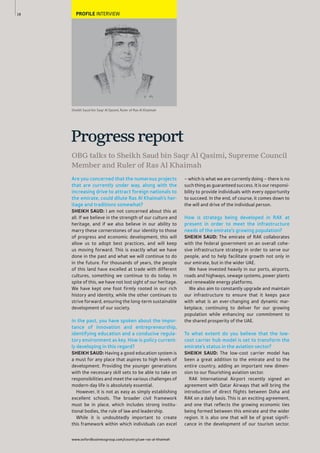
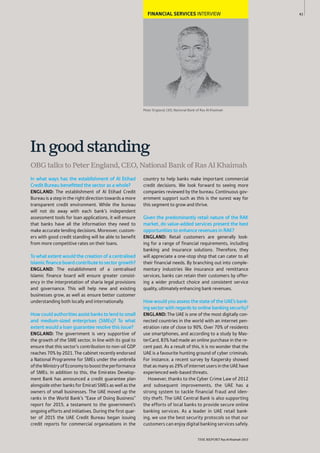
OBG talks to Sheikh Saud bin Saqr Al Qasimi, Supreme Council
Member and Ruler of Ras Al Khaimah
Progressreport
Sheikh Saud bin Saqr Al Qasimi, Ruler of Ras Al Khaimah
19
THE REPORT Ras Al Khaimah 2015
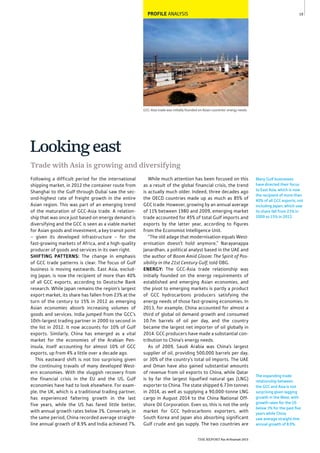
GCC-Asia trade was initially founded on Asian countries’ energy needs
PROFILE ANALYSIS
The expanding trade
relationship between
the GCC and Asia is not
surprising given lagging
growth in the West, with
growth rates for the US
below 3% for the past five
years while China
saw average straight-line
annual growth of 8.9%.
Many Gulf businesses
have directed their focus
to East Asia, which is now
the recipient of more than
40% of all GCC exports, not
including Japan, which saw
its share fall from 23% in
2000 to 15% in 2012.
Following a difficult period for the international
shipping market, in 2012 the container route from
Shanghai to the Gulf through Dubai saw the sec-
ond-highest rate of freight growth in the entire
Asian region. This was part of an emerging trend
of the maturation of GCC-Asia trade. A relation-
ship that was once just based on energy demand is
diversifying and the GCC is seen as a viable market
for Asian goods and investment, a key transit point
– given its developed infrastructure – for the
fast-growing markets of Africa, and a high-quality
producer of goods and services in its own right.
SHIFTING PATTERNS: The change in emphasis
of GCC trade patterns is clear. The focus of Gulf
business is moving eastwards. East Asia, exclud-
ing Japan, is now the recipient of more than 40%
of all GCC exports, according to Deutsche Bank
research. While Japan remains the region’s largest
export market, its share has fallen from 23% at the
turn of the century to 15% in 2012 as emerging
Asian economies absorb increasing volumes of
goods and services. India jumped from the GCC’s
10th-largest trading partner in 2000 to second in
the list in 2012. It now accounts for 10% of Gulf
exports. Similarly, China has emerged as a vital
market for the economies of the Arabian Pen-
insula, itself accounting for almost 10% of GCC
exports, up from 4% a little over a decade ago.
This eastward shift is not too surprising given
the continuing travails of many developed West-
ern economies. With the sluggish recovery from
the financial crisis in the EU and the US, Gulf
economies have had to look elsewhere. For exam-
ple, the UK, which is a traditional trading partner,
has experienced faltering growth in the last
five years, while the US has fared little better,
with annual growth rates below 3%. Conversely, in
the same period, China recorded average straight-
line annual growth of 8.9% and India achieved 7%.
While much attention has been focused on this
as a result of the global financial crisis, the trend
is actually much older. Indeed, three decades ago
the OECD countries made up as much as 85% of
GCC trade. However, growing by an annual average
of 11% between 1980 and 2009, emerging market
trade accounted for 45% of total Gulf imports and
exports by the latter year, according to figures
from the Economist Intelligence Unit.
“The old adage that modernisation equals West-
ernisation doesn’t hold anymore,” Narayanappa
Janardhan, a political analyst based in the UAE and
the author of Boom Amid Gloom: The Spirit of Pos-
sibility in the 21st Century Gulf, told OBG.
ENERGY: The GCC-Asia trade relationship was
initially founded on the energy requirements of
established and emerging Asian economies, and
the pivot to emerging markets is partly a product
of GCC hydrocarbons producers satisfying the
energy needs of those fast-growing economies. In
2013, for example, China accounted for almost a
third of global oil demand growth and consumed
10.7m barrels of oil per day, and the country
became the largest net importer of oil globally in
2014. GCC producers have made a substantial con-
tribution to China’s energy needs.
As of 2009, Saudi Arabia was China’s largest
supplier of oil, providing 500,000 barrels per day,
or 30% of the country’s total oil imports. The UAE
and Oman have also gained substantial amounts
of revenue from oil exports to China, while Qatar
is by far the largest liquefied natural gas (LNG)
exporter to China. The state shipped 6.73m tonnes
in 2014, as well as supplying a 90,000-tonne LNG
cargo in August 2014 to the China National Off-
shore Oil Corporation. Even so, this is not the only
market for GCC hydrocarbons exporters, with
South Korea and Japan also absorbing significant
Gulf crude and gas supply. The two countries are
Trade with Asia is growing and diversifying
Lookingeast
www.oxfordbusinessgroup.com/country/uae-ras-al-khaimah
20
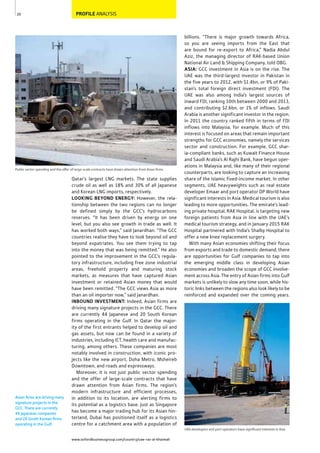
Public sector spending and the offer of large-scale contracts have drawn attention from Asian firms
PROFILE ANALYSIS
Asian firms are driving many
signature projects in the
GCC. There are currently
44 Japanese companies
and 20 South Korean firms
operating in the Gulf.
billions. “There is major growth towards Africa,
so you are seeing imports from the East that
are bound for re-export to Africa,” Nadia Abdul
Aziz, the managing director of RAK-based Union
National Air Land & Shipping Company, told OBG.
ASIA: GCC investment in Asia is on the rise. The
UAE was the third-largest investor in Pakistan in
the five years to 2012, with $1.4bn, or 9% of Paki-
stan’s total foreign direct investment (FDI). The
UAE was also among India’s largest sources of
inward FDI, ranking 10th between 2000 and 2013,
and contributing $2.6bn, or 1% of inflows. Saudi
Arabia is another significant investor in the region.
In 2011 the country ranked fifth in terms of FDI
inflows into Malaysia, for example. Much of this
interest is focused on areas that remain important
strengths for GCC economies, namely the services
sector and construction. For example, GCC shar-
ia-compliant banks, such as Kuwait Finance House
and Saudi Arabia’s Al Rajhi Bank, have begun oper-
ations in Malaysia and, like many of their regional
counterparts, are looking to capture an increasing
share of the Islamic fixed-income market. In other
segments, UAE heavyweights such as real estate
developer Emaar and port operator DP World have
significant interests in Asia. Medical tourism is also
leading to more opportunities. The emirate’s lead-
ing private hospital, RAK Hospital, is targeting new
foreign patients from Asia in line with the UAE’s
medical tourism strategy, and in January 2015 RAK
Hospital partnered with India’s Shalby Hospital to
offer a new knee replacement surgery.
With many Asian economies shifting their focus
from exports and trade to domestic demand, there
are opportunities for Gulf companies to tap into
the emerging middle class in developing Asian
economies and broaden the scope of GCC involve-
ment across Asia. The entry of Asian firms into Gulf
markets is unlikely to slow any time soon, while his-
toric links between the regions also look likely to be
reinforced and expanded over the coming years.
Qatar’s largest LNG markets. The state supplies
crude oil as well as 18% and 30% of all Japanese
and Korean LNG imports, respectively.
LOOKING BEYOND ENERGY: However, the rela-
tionship between the two regions can no longer
be defined simply by the GCC’s hydrocarbons
reserves. “It has been driven by energy on one
level, but you also see growth in trade as well. It
has worked both ways,” said Janardhan. “The GCC
countries realise they have to look beyond oil and
beyond expatriates. You see them trying to tap
into the money that was being remitted.” He also
pointed to the improvement in the GCC’s regula-
tory infrastructure, including free zone industrial
areas, freehold property and maturing stock
markets, as measures that have captured Asian
investment or retained Asian money that would
have been remitted. “The GCC views Asia as more
than an oil importer now,” said Janardhan.
INBOUND INVESTMENT: Indeed, Asian firms are
driving many signature projects in the GCC. There
are currently 44 Japanese and 20 South Korean
firms operating in the Gulf. In Qatar the major-
ity of the first entrants helped to develop oil and
gas assets, but now can be found in a variety of
industries, including ICT, health care and manufac-
turing, among others. These companies are most
notably involved in construction, with iconic pro-
jects like the new airport, Doha Metro, Msheireb
Downtown, and roads and expressways.
Moreover, it is not just public sector spending
and the offer of large-scale contracts that have
drawn attention from Asian firms. The region’s
modern infrastructure and efficient processes,
in addition to its location, are alerting firms to
its potential as a logistics base. Just as Singapore
has become a major trading hub for its Asian hin-
terland, Dubai has positioned itself as a logistics
centre for a catchment area with a population of
UAE developers and port operators have significant interests in Asia
21
THE REPORT Ras Al Khaimah 2015
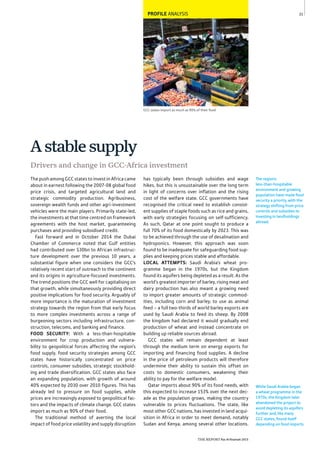
GCC states import as much as 90% of their food
PROFILE ANALYSIS
While Saudi Arabia began
a wheat programme in the
1970s, the Kingdom later
abandoned the project to
avoid depleting its aquifers
further and, like many
GCC states, found itself
depending on food imports.
The region’s
less-than-hospitable
environment and growing
population have made food
security a priority, with the
strategy shifting from price
controls and subsidies to
investing in landholdings
abroad.
The push among GCC states to invest in Africa came
about in earnest following the 2007-08 global food
price crisis, and targeted agricultural land and
strategic commodity production. Agribusiness,
sovereign wealth funds and other agri-investment
vehicles were the main players. Primarily state-led,
the investments at that time centred on framework
agreements with the host market, guaranteeing
purchases and providing subsidised credit.
Fast forward and in October 2014 the Dubai
Chamber of Commerce noted that Gulf entities
had contributed over $30bn to African infrastruc-
ture development over the previous 10 years, a
substantial figure when one considers the GCC’s
relatively recent start of outreach to the continent
and its origins in agriculture-focused investments.
The trend positions the GCC well for capitalising on
that growth, while simultaneously providing direct
positive implications for food security. Arguably of
more importance is the maturation of investment
strategy towards the region from that early focus
to more complex investments across a range of
burgeoning sectors including infrastructure, con-
struction, telecoms, and banking and finance.
FOOD SECURITY: With a less-than-hospitable
environment for crop production and vulnera-
bility to geopolitical forces affecting the region’s
food supply, food security strategies among GCC
states have historically concentrated on price
controls, consumer subsidies, strategic stockhold-
ing and trade diversification. GCC states also face
an expanding population, with growth of around
40% expected by 2030 over 2010 figures. This has
already led to pressure on food supplies, while
prices are increasingly exposed to geopolitical fac-
tors and the impacts of climate change. GCC states
import as much as 90% of their food.
The traditional method of averting the local
impact of food price volatility and supply disruption
has typically been through subsidies and wage
hikes, but this is unsustainable over the long term
in light of concerns over inflation and the rising
cost of the welfare state. GCC governments have
recognised the critical need to establish consist-
ent supplies of staple foods such as rice and grains,
with early strategies focusing on self-sufficiency.
As such, Qatar at one point sought to produce a
full 70% of its food domestically by 2023. This was
to be achieved through the use of desalination and
hydroponics. However, this approach was soon
found to be inadequate for safeguarding food sup-
plies and keeping prices stable and affordable.
LOCAL ATTEMPTS: Saudi Arabia’s wheat pro-
gramme began in the 1970s, but the Kingdom
found its aquifers being depleted as a result. As the
world’s greatest importer of barley, rising meat and
dairy production has also meant a growing need
to import greater amounts of strategic commod-
ities, including corn and barley, to use as animal
feed – a full two-thirds of world barley exports are
used by Saudi Arabia to feed its sheep. By 2008
the kingdom had declared it would gradually end
production of wheat and instead concentrate on
building up reliable sources abroad.
GCC states will remain dependent at least
through the medium term on energy exports for
importing and financing food supplies. A decline
in the price of petroleum products will therefore
undermine their ability to sustain this offset on
costs to domestic consumers, weakening their
ability to pay for the welfare model.
Qatar imports about 90% of its food needs, with
this expected to increase 153% over the next dec-
ade as the population grows, making the country
vulnerable to prices fluctuations. The state, like
most other GCC nations, has invested in land acqui-
sition in Africa in order to meet demand, notably
Sudan and Kenya, among several other locations.
Drivers and change in GCC-Africa investment
Astablesupply
www.oxfordbusinessgroup.com/country/uae-ras-al-khaimah
22
Land lease and production sharing deals provided to GCC investors should aid small-scale farmers
PROFILE ANALYSIS
The GCC region’s plans
for investment in Africa
are facilitated by the
widespread recognition on
the continent that FDI is a
way to provide employment
and further development
through both capital and
skills transfer.
The current phase of GCC investment in Africa
appears set to address many of the earlier struc-
tural weaknesses and, in the process, help develop
a more viable long-term investment environment
in many parts of the continent. This includes shifts
on the foreign investor side, and also locally among
African governments and key stakeholders. Coun-
tries like Zambia and Kenya are devising terms for
land use that could help stabilise conditions on the
ground. Leases in Zambia are likely to be provided
for no more than 25 years, and will come with a
requirement that crops produced on the land be
split up to 50-50 between exports and the local
market. Likewise in Kenya, there will likely be land
leases as opposed to outright sales.
BECOMING PARTNERS: Africa’s appetite for for-
eign direct investment (FDI) remains strong. FDI is
more widely recognised in Africa as a way to help
provide employment opportunities and develop
“expertise technologies and capital for improving
infrastructure such as roads, education and health
facilities”, as noted by the Centre for Interna-
tional Governance Innovation. Local stakeholders
in Kenya have shown themselves to be “willing to
accept and participate in land leases, provided
they include certain provisions”, such as 15-year
maximums, and that they be “renewable subject to
mutual negotiation”. This involvement would con-
trast with the historical trend in which landowners
were typically excluded from negotiations.
Helping to ensure a greater degree of trust
among local communities will provide for more
sustainable investments in agriculture, and will
have positive knock-on effects for other sectors as
well. In Kenya, for example, public-private partner-
ships (PPPs) received a boost in 2013 with the PPP
Act coming into force, “in order to strengthen the
legal and regulatory framework for PPPs… [and]
remove duplication and overlap”.
Incentives being promoted to lure back inves-
tors after an at-times rocky start include the Kenya
Investment Authority signing a double tax agree-
ment (DTA) with Qatar in April 2014. The deal will
protect investors from tax on repatriated profits
after they have already paid in their country of
investment. A “reciprocal agreement” was also
signed that is meant to “guarantee Kenyan and
Qatari businesspeople of rights to their assets
in the two countries”. Kenya that month also had
a draft DTA with Iran and the UAE, and a memo-
randum of understanding was signed between
KenGen and Nebras Power Company of Qatar.
In early 2014 African representatives presented
land lease and production sharing deals to GCC
investors as a means to aid small-scale farmers
and to also ensure food supplies for locals. Ghana,
for its part, has offered tax-free agreements for
investment in agriculture in the country’s north,
with the premise of sharing part of the produced
crops with the domestic market. But much is still to
be done in terms of regulation. Kenya, for instance,
STRATEGIC SOURCING: Along with sourcing from
Eastern Europe and farther afield in South Amer-
ica and Asia, GCC investors began looking more to
Africa – East Africa in particular – where available
farmland was seen as a way to provide domestic
populations with reliable sources of key agriculture
products. Countries targeted in the first phase
included Sudan, Ethiopia, Mali, Mauritania, Mozam-
bique and Tanzania, along with the North African
countries of Morocco and Egypt.
Many African investment destinations them-
selves, however, suffer from profound food
insecurity and political risks. Indeed, the Horn and
Sahel regions of the continent are the most fam-
ine-prone places on the planet. This has presented
foreign investors with a steep learning curve when
it comes to navigating African markets and relying
on those destinations for strategic commodities.
Local concerns over land rights and food security
presented serious operational and reputational
risks for Gulf investors. Early risks relating to land
use were due in large part to the absence of ade-
quate land ownership regulation, with Oxfam
reporting that up to 90% of land in sub-Saharan
Africa was unregistered, placing local residents at
greater risk of being displaced for new projects.
LOCAL GAINS: Many African governments have
shifted their emphasis to boosting local benefit, a
trend that is likely to reach beyond agriculture in
the coming years. This presents new challenges
for investors; however, it can present longer-term
benefits and opportunities as well. In a model for
how this can be achieved, the UAE’s Al Dahra Hold-
ing enforces a 50-50 sharing formula, according to
Khadim Al Darei, its vice-chairman, in a statement
given to local media in early 2014. According to Al
Darei, Al Dahra has avoided some of the problems
encountered by other foreign investors by actively
creating jobs for locals and sharing its produce.
23
THE REPORT Ras Al Khaimah 2015
Among other sectors, the African telecoms market holds promise for GCC-based operators
PROFILE ANALYSIS
Investment in African
infrastructure will require
$2.6trn by 2030, according
to the Dubai Chamber of
Commerce, but the interest
of both large and small
firms may help to share the
risk more evenly, as well as
encourage smaller projects.
sub-Saharan Africa, seeking a controlling stake in
Inwi in Morocco, where it had a 15% stake. Qatar’s
Ooredoo also operates in Tunisia and Algeria.
For Gulf investors, the unique support for the pri-
vate sector from state backers is likely to be a key
factor in helping investors weather further storms.
Saad Khalil, the director-general of the King Abdul-
lah Initiative for Saudi Agricultural Investment
Abroad, told the World Food Security Summit in
Dubai in February 2014 that the solution must now
come from partnerships between the private and
public sectors, with the government encouraging
risk-taking through the provision of interest-free
loans and partnerships with the Saudi Agricultural
and Livestock Investment Company.
CHALLENGES REMAIN: Many of the core chal-
lenges experienced in the Gulf’s earlier experiment
with African agriculture and land investment will
no doubt be encountered in other sectors in the
future. At the top of the list of risks facing Gulf
investors in Africa remain operational risks, the
honouring of contracts, a lack of skilled labour and
technology, currency volatility, political risk and
the change of government policies, in particular in
the midst of longer-term projects.
THINKING LONG TERM: Encouragingly, foreign
investors and African governments alike appear
to have taken heed of lessons learned. They are
demonstrating increasing commitment to bolster
structural mechanisms that should bring improve-
ment to the investment environment. This applies
to agriculture, but also sectors such as energy
and infrastructure. Moreover, a shift towards the
inclusion of landowners and local stakeholders
– as well as ensuring greater and more tangible
benefits for the local communities – presents
the opportunity for developing a more viable and
sustainable destination for the GCC’s strategic
long-term investments on the African continent.
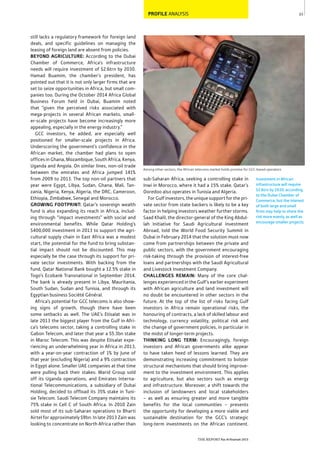
still lacks a regulatory framework for foreign land
deals, and specific guidelines on managing the
leasing of foreign land are absent from policies.
BEYOND AGRICULTURE: According to the Dubai
Chamber of Commerce, Africa’s infrastructure
needs will require investment of $2.6trn by 2030.
Hamad Buamim, the chamber’s president, has
pointed out that it is not only larger firms that are
set to seize opportunities in Africa, but small com-
panies too. During the October 2014 Africa Global
Business Forum held in Dubai, Buamim noted
that “given the perceived risks associated with
mega-projects in several African markets, small-
er-scale projects have become increasingly more
appealing, especially in the energy industry.”
GCC investors, he added, are especially well
positioned for smaller-scale projects in Africa.
Underscoring the government’s confidence in the
African market, the chamber had plans to open
offices in Ghana, Mozambique, South Africa, Kenya,
Uganda and Angola. On similar lines, non-oil trade
between the emirates and Africa jumped 141%
from 2009 to 2013. The top non-oil partners that
year were Egypt, Libya, Sudan, Ghana, Mali, Tan-
zania, Nigeria, Kenya, Algeria, the DRC, Cameroon,
Ethiopia, Zimbabwe, Senegal and Morocco.
GROWING FOOTPRINT: Qatar’s sovereign wealth
fund is also expanding its reach in Africa, includ-
ing through “impact investments” with social and
environmental benefits. While Qatar Holding’s
$400,000 investment in 2013 to support the agri-
cultural supply chain in East Africa was a modest
start, the potential for the fund to bring substan-
tial impact should not be discounted. This may
especially be the case through its support for pri-
vate sector investments. With backing from the
fund, Qatar National Bank bought a 12.5% stake in
Togo’s Ecobank Transnational in September 2014.
The bank is already present in Libya, Mauritania,
South Sudan, Sudan and Tunisia, and through its
Egyptian business Société Général.
Africa’s potential for GCC telecoms is also show-
ing signs of growth, though there have been
some setbacks as well. The UAE’s Etisalat was in
late 2013 the biggest player from the Gulf in Afri-
ca’s telecoms sector, taking a controlling stake in
Gabon Telecom, and later that year a $5.3bn stake
in Maroc Telecom. This was despite Etisalat expe-
riencing an underwhelming year in Africa in 2013,
with a year-on-year contraction of 1% by June of
that year (excluding Nigeria) and a 9% contraction
in Egypt alone. Smaller UAE companies at that time
were pulling back their stakes: Warid Group sold
off its Uganda operations, and Emirates Interna-
tional Telecommunications, a subsidiary of Dubai
Holding, decided to offload its 35% stake in Tuni-
sie Telecom. Saudi Telecom Company maintains its
75% stake in Cell C of South Africa. In 2010 Zain
sold most of its sub-Saharan operations to Bharti
Airtel for approximately $9bn. In late 2013 Zain was
looking to concentrate on North Africa rather than
www.oxfordbusinessgroup.com/country/uae-ras-al-khaimah
24 PROFILE VIEWPOINT
Tony Abbott, Former Prime Minister of Australia
Australia’s links with the Gulf states are close and
getting closer. Australians and citizens of Gulf states
are spending more and more time in each other’s
countries, the security relationship is growing and
business relationships are booming.
In 2014 Australia and the GCC traded $11.7bn in
goods, an increase of 7.2% over 2013. Negotiations
on a free trade agreement (FTA) with the GCC have
been suspended since 2009. This is far too long when
we know that an FTA is in the interests of all our coun-
tries. Our trade is complementary, our exports and
imports are not in direct competition and we are all
interested in long-term growth. For these reasons, I
am hopeful that negotiations will resume soon.
The GCC is an important market for our agricultural
and food exports, valued at $2.4bn in 2014. With an
FTA, high-quality Australian goods would become
more readily available at even more affordable prices
in the GCC. World-class Australian service providers
in health, education, engineering, construction and
event management would be more accessible.
Australia is open for business. We welcome for-
eign investment that benefits the investor and is in
line with our national interests and priorities. Invest-
ment from the Gulf states already exceeds $20bn in
Australia. An FTA would allow this to increase even
further. Australia has also embraced significant
investment from Gulf sovereign wealth funds, includ-
ing in infrastructure and tourism. For example, the
Abu Dhabi Investment Authority – through the Accor
Group – is the largest owner of hotels in Australia.
Australia’s Asset Recycling Initiative has opened up
significant opportunities for stakeholders to invest
in privatised brownfield assets. Sale proceeds will be
re-invested in quality new infrastructure projects.
This, in turn, leads to investment in Australia.
Our aviation industry is enhancing links between
the people of our regions and improving service
for consumers and trade. Around 150 direct, return
flights by Emirates, Etihad, Qatar Airways, Qantas and
Virgin operate between the Gulf and Australia each
week. The airline industry has demonstrated phe-
nomenal growth, benefitting all involved.
Close to 35,000 Australians call the Gulf states
home. Additionally, 300,000 Australian tourists visit
the UAE every year and there are 10,000 students
from GCC countries enrolled in education institutions
across Australia. The partnerships between Qantas
and Emirates, and Etihad and Virgin Australia, will
continue to bring our people closer together.
Our relationship also extends into the important
issue of national security. Australian and Gulf leaders
share the highest of priorities – to keep the people of
our nations safe. What’s happening in Syria and Iraq
threatens Australia and the wider Middle East region.
Australia is strongly committed to working with the
UAEandourotherpartnersintheGulftocountervio-
lent extremism. Together we are strengthening the
security of the Gulf through the military campaign to
disrupt, degrade and ultimately defeat Daesh. Aus-
tralia supports the initiative of the UAE, developed
in partnership with the US and others at the Wash-
ington Summit in early 2015, to establish regional
expertise in countering violent extremism (CVE). We
hosted our own Regional CVE Summit in June 2015
to consider how governments, civil society and local
communities can better challenge violent extremism.
My visit to the UAE in January 2015, similar to the
many visits to the Gulf that senior Australian minis-
ters have made in recent times, was very productive.
The Australian government has since announced
its intention to open a new embassy in Doha, which
will add to our existing diplomatic representation in
Riyadh, Abu Dhabi, Dubai and Kuwait City. My gov-
ernment sees the fast and evolving relationship with
the Gulf states as important and full of potential. We
will continue to strengthen this partnership based on
afoundationoffriendship,historyandcommongoals.
Tony Abbott, Former Prime Minister of Australia, on Australia’s
deepening relationship with the Gulf states
Astrongerpartnership
25
Economy
Streamlined licensing makes opening a business easier
The tourism sector is targeted for development
Limited impact from decline in international oil prices
The emirate’s free zones are attracting global firms
www.oxfordbusinessgroup.com/country/uae-ras-al-khaimah
26
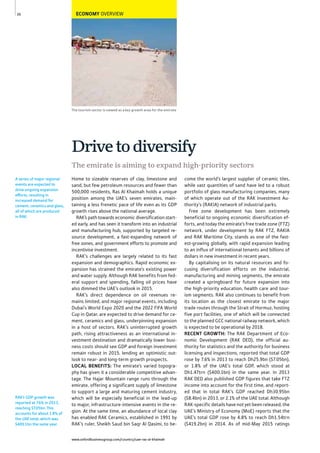
The tourism sector is viewed as a key growth area for the emirate
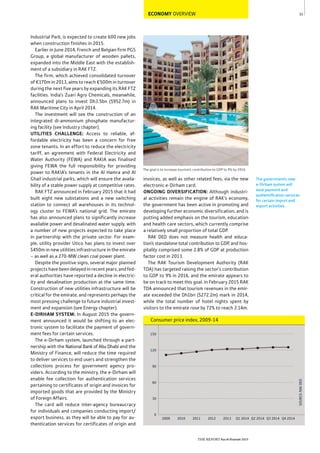
RAK’s GDP growth was
reported at 7.6% in 2013,
reaching $7.05bn. This
accounts for about 1.8% of
the UAE total, which was
$400.1bn the same year.
A series of major regional
events are expected to
drive ongoing expansion
efforts, resulting in
increased demand for
cement, ceramics and glass,
all of which are produced
in RAK.
ECONOMY OVERVIEW
Home to sizeable reserves of clay, limestone and
sand, but few petroleum resources and fewer than
500,000 residents, Ras Al Khaimah holds a unique
position among the UAE’s seven emirates, main-
taining a less frenetic pace of life even as its GDP
growth rises above the national average.
RAK’s path towards economic diversification start-
ed early, and has seen it transform into an industrial
and manufacturing hub, supported by targeted re-
source development, a fast-expanding network of
free zones, and government efforts to promote and
incentivise investment.
RAK’s challenges are largely related to its fast
expansion and demographics. Rapid economic ex-
pansion has strained the emirate’s existing power
and water supply. Although RAK benefits from fed-
eral support and spending, falling oil prices have
also dimmed the UAE’s outlook in 2015.
RAK’s direct dependence on oil revenues re-
mains limited, and major regional events, including
Dubai’s World Expo 2020 and the 2022 FIFA World
Cup in Qatar, are expected to drive demand for ce-
ment, ceramics and glass, underpinning expansion
in a host of sectors. RAK’s uninterrupted growth
path, rising attractiveness as an international in-
vestment destination and dramatically lower busi-
ness costs should see GDP and foreign investment
remain robust in 2015, lending an optimistic out-
look to near- and long-term growth prospects.
LOCAL BENEFITS: The emirate’s varied topogra-
phy has given it a considerable competitive advan-
tage. The Hajar Mountain range runs through the
emirate, offering a significant supply of limestone
to support a large and maturing cement industry,
which will be especially beneficial in the lead-up
to major, infrastructure-intensive events in the re-
gion. At the same time, an abundance of local clay
has enabled RAK Ceramics, established in 1991 by
RAK’s ruler, Sheikh Saud bin Saqr Al Qasimi, to be-
come the world’s largest supplier of ceramic tiles,
while vast quantities of sand have led to a robust
portfolio of glass manufacturing companies, many
of which operate out of the RAK Investment Au-
thority’s (RAKIA) network of industrial parks.
Free zone development has been extremely
beneficial to ongoing economic diversification ef-
forts, and today the emirate’s free trade zone (FTZ)
network, under development by RAK FTZ, RAKIA
and RAK Maritime City, stands as one of the fast-
est-growing globally, with rapid expansion leading
to an influx of international tenants and billions of
dollars in new investment in recent years.
By capitalising on its natural resources and fo-
cusing diversification efforts on the industrial,
manufacturing and mining segments, the emirate
created a springboard for future expansion into
the high-priority education, health care and tour-
ism segments. RAK also continues to benefit from
its location as the closest emirate to the major
trade routes through the Strait of Hormuz, hosting
five port facilities, one of which will be connected
to the planned GCC national railway network, which
is expected to be operational by 2018.
RECENT GROWTH: The RAK Department of Eco-
nomic Development (RAK DED), the official au-
thority for statistics and the authority for business
licensing and inspections, reported that total GDP
rose by 7.6% in 2013 to reach Dh25.9bn ($7.05bn),
or 1.8% of the UAE’s total GDP, which stood at
Dh1.47trn ($400.1bn) in the same year. In 2013
RAK DED also published GDP figures that take FTZ
income into account for the first time, and report-
ed that in total RAK’s GDP reached Dh30.95bn
($8.4bn) in 2013, or 2.1% of the UAE total. Although
RAK-specific details have not yet been released, the
UAE’s Ministry of Economy (MoE) reports that the
UAE’s total GDP rose by 4.8% to reach Dh1.54trn
($419.2bn) in 2014. As of mid-May 2015 ratings
The emirate is aiming to expand high-priority sectors
Drivetodiversify
27
THE REPORT Ras Al Khaimah 2015
The emirate has garnered a
favourable trade balance in
recent years, with exports
more than doubling from
$879.2m in 2009 to $1.9bn
in 2014.
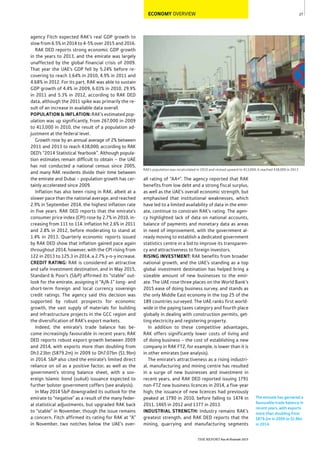
RAK’s population was recalculated in 2010 and revised upward to 413,000; it reached 438,000 in 2013
ECONOMY OVERVIEW
all rating of “AA+”. The agency reported that RAK
benefits from low debt and a strong fiscal surplus,
as well as the UAE’s overall economic strength, but
emphasised that institutional weaknesses, which
have led to a limited availability of data in the emir-
ate, continue to constrain RAK’s rating. The agen-
cy highlighted lack of data on national accounts,
balance of payments and monetary data as areas
in need of improvement, with the government al-
ready moving to establish a dedicated government
statistics centre in a bid to improve its transparen-
cy and attractiveness to foreign investors.
RISING INVESTMENT: RAK benefits from broader
national growth, and the UAE’s standing as a top
global investment destination has helped bring a
sizeable amount of new businesses to the emir-
ate. The UAE rose three places on the World Bank’s
2015 ease of doing business survey, and stands as
the only Middle East economy in the top 25 of the
189 countries surveyed. The UAE ranks first world-
wide in the paying taxes category and fourth place
globally in dealing with construction permits, get-
ting electricity and registering property.
In addition to these competitive advantages,
RAK offers significantly lower costs of living and
of doing business – the cost of establishing a new
company in RAK FTZ, for example, is lower than it is
in other emirates (see analysis).
The emirate’s attractiveness as a rising industri-
al, manufacturing and mining centre has resulted
in a surge of new businesses and investment in
recent years, and RAK DED reported issuing 1791
non-FTZ new business licences in 2014, a five-year
high; the issuance of new licences had previously
peaked at 1790 in 2010, before falling to 1474 in
2011, 1465 in 2012 and 1377 in 2013.
INDUSTRIAL STRENGTH: Industry remains RAK’s
greatest strength, and RAK DED reports that the
mining, quarrying and manufacturing segments
agency Fitch expected RAK’s real GDP growth to
slow from 6.5% in 2014 to 4-5% over 2015 and 2016.
RAK DED reports strong economic GDP growth
in the years to 2013, and the emirate was largely
unaffected by the global financial crisis of 2009.
That year the UAE’s GDP fell by 5.24% before re-
covering to reach 1.64% in 2010, 4.9% in 2011 and
4.68% in 2012. For its part, RAK was able to sustain
GDP growth of 4.4% in 2009, 6.03% in 2010, 29.9%
in 2011 and 5.3% in 2012, according to RAK DED
data, although the 2011 spike was primarily the re-
sult of an increase in available data overall.
POPULATION & INFLATION: RAK’s estimated pop-
ulation was up significantly, from 267,000 in 2009
to 413,000 in 2010, the result of a population ad-
justment at the federal level.
Growth rose by an annual average of 2% between
2011 and 2013 to reach 438,000, according to RAK
DED’s “2014 Statistical Yearbook”. Although popula-
tion estimates remain difficult to obtain – the UAE
has not conducted a national census since 2005,
and many RAK residents divide their time between
the emirate and Dubai – population growth has cer-
tainly accelerated since 2009.
Inflation has also been rising in RAK, albeit at a
slower pace than the national average, and reached
2.9% in September 2014, the highest inflation rate
in five years. RAK DED reports that the emirate’s
consumer price index (CPI) rose by 2.7% in 2010, in-
creasing from 111 to 114. Inflation hit 2.6% in 2011
and 2.8% in 2012, before moderating to stand at
1.4% in 2013. Quarterly economic reports issued
by RAK DED show that inflation gained pace again
throughout 2014, however, with the CPI rising from
122 in 2013 to 125.3 in 2014, a 2.7% y-o-y increase.
CREDIT RATING: RAK is considered an attractive
and safe investment destination, and in May 2015,
Standard & Poor’s (S&P) affirmed its “stable” out-
look for the emirate, assigning it “A/A-1” long- and
short-term foreign and local currency sovereign
credit ratings. The agency said this decision was
supported by robust prospects for economic
growth, the vast supply of materials for building
and infrastructure projects in the GCC region and
the diversification of RAK’s export markets.
Indeed, the emirate’s trade balance has be-
come increasingly favourable in recent years; RAK
DED reports robust export growth between 2009
and 2014, with exports more than doubling from
Dh3.23bn ($879.2m) in 2009 to Dh7.07bn ($1.9bn)
in 2014. S&P also cited the emirate’s limited direct
reliance on oil as a positive factor, as well as the
government’s strong balance sheet, with a sov-
ereign Islamic bond (sukuk) issuance expected to
further bolster government coffers (see analysis).
In May 2014 S&P downgraded its outlook for the
emirate to “negative” as a result of the many feder-
al statistical adjustments, but upgraded RAK back
to “stable” in November, though the issue remains
a concern. Fitch affirmed its rating for RAK at “A”
in November, two notches below the UAE’s over-
www.oxfordbusinessgroup.com/country/uae-ras-al-khaimah
28
Manufacturing stands as
the single largest economic
sector in the emirate,
contributing 25.1% of GDP,
followed by retail,
wholesale and repair
(12.1%), government
services (9.9%), financial
services (8.6%),
construction (7.5%), real
estate (6.9%) and
transportation (6.4%).
ECONOMY OVERVIEW
The number of industrial firms in RAK climbed to 2164 in 2013
terials, with the first wave of building expected to
kick off in late 2015.
Perhaps more promisingly, the 2022 FIFA World
Cup will be hosted in Qatar, which is preparing to
spend an estimated $70bn on new construction
projects. It has already reported rapid inflation in
the cost of construction materials, putting RAK in
a favourable position to capitalise on surging de-
mand for cement, glass and ceramics. Industrial
growth has also been driven by efforts to promote
and incentivise RAK’s free zones.
FREE ZONES: RAK’s free zones contributed a com-
bined Dh5.04bn ($1.4bn), some 16.3% of total GDP
in 2013, and are a significant growth driver for the
emirate, with new investment in these zones to-
talling well over $1bn between April and Novem-
ber 2014. RAK offers three free zones to foreign
investors – RAK FTZ, RAKIA’s Al Ghail and Al Hamra
industrial parks, and RAK Maritime City.
RAK FTZ was established in 2000, and today of-
fers four specialised free zone parks: the Business
Park, for office clients; the Technology Park, for
trading and light to medium manufacturing; the
Industrial Park, for heavy manufacturing; and the
RAK Academic Zone, for educational institutions.
The authority’s portfolio of clients has doubled in
the past four years to more than 8000 internation-
al firms from over 100 countries.
RAKIA has developed and managed free zone and
non-free zone jurisdictions in RAK since 2005. At
two industrial parks in Al Ghail and Al Hamra, RAKIA
is home to over 7500 companies and manufactur-
ers in various sectors, including metal, chemicals,
food, plastics and automotives, a 22% increase over
the 5718 firms operating there in 2012.
RAK Maritime City is the youngest of the emir-
ate’s free zones, having opened in May 2011 with
the aim of providing easy port access to industrial
exporters. The site will host a port facility covering
8m sq metres, and including a 5-metre quay wall
and deep harbour entrance. Special areas are des-
ignated for operations including warehousing, tank
storage, general cargo handling, industrial produc-
tion, and shipbuilding or repairs.
Stakeholders at all three free zones have been
active in promoting the available benefits, which
include tax exemptions and 100% foreign owner-
ship rights. RAK FTZ, in a bid to target new tenants
from East Asia, has also established a new window
with dedicated language services for prospective
East Asian tenants, while RAKIA established a new
tenants’ committee in 2014 to facilitate better
communication between tenants and its executive
management (see analysis).
A number of new tenants have established a
presence in the emirate as a result, most recently
when the UAE-based recycling firm, Asian Fibres,
announced that it plans to invest $100m to build
the MENA region’s largest regenerated polyester
staple fibre production facility in November 2014.
The facility, which will be located in RAKIA’s Al Ghail
collectively accounted for 34.3% of total GDP at
production factor cost in 2013, meaning the total
value of all goods and services produced in the
emirate excluding subsidies and indirect taxes. Of
this, manufacturing stands as the single largest
economic sector in the emirate, contributing 25.1%
of GDP, followed by retail, wholesale and repair
(12.1%), government services (9.9%), financial ser-
vices (8.6%), construction (7.5%), real estate (6.9%)
and transportation (6.4%).
According to the department, the number of in-
dustrial firms in the emirate has grown significant-
ly in recent years, rising from 168 firms in 2009 to
2164 in 2013. Total investment by these firms was
estimated at some Dh3.16bn ($860.2m) in 2013, a
3.9% increase over Dh3.04bn ($827.5m) in 2012.
The manufacturing sector is poised for signifi-
cant future expansion. The ongoing preparations
for Dubai’s World Expo 2020, which will entail an
estimated $6.9bn worth of new development pro-
jects, are set to drive demand for construction ma-
GDP (excluding free zones), 2009-13 (Dh bn)
SOURCE:RAKDED
0
6
12
18
24
30
20132012201120102009
31
THE REPORT Ras Al Khaimah 2015
The government’s new
e-Dirham system will
ease payment and
authentification services
for certain import and
export activities.
ECONOMY OVERVIEW
The goal is to increase tourism’s contribution to GDP to 9% by 2016
invoices, as well as other related fees, via the new
electronic e-Dirham card.
ONGOING DIVERSIFICATION: Although industri-
al activities remain the engine of RAK’s economy,
the government has been active in promoting and
developing further economic diversification, and is
putting added emphasis on the tourism, education
and health care sectors, which currently comprise
a relatively small proportion of total GDP.
RAK DED does not measure health and educa-
tion’s standalone total contribution to GDP, and hos-
pitality comprised some 2.8% of GDP at production
factor cost in 2013.
The RAK Tourism Development Authority (RAK
TDA) has targeted raising the sector’s contribution
to GDP to 9% in 2016, and the emirate appears to
be on track to meet this goal. In February 2015 RAK
TDA announced that tourism revenues in the emir-
ate exceeded the Dh1bn ($272.2m) mark in 2014,
while the total number of hotel nights spent by
visitors to the emirate rose by 72% to reach 2.14m.
Industrial Park, is expected to create 600 new jobs
when construction finishes in 2015.
Earlier in June 2014, French and Belgian firm PGS
Group, a global manufacturer of wooden pallets,
expanded into the Middle East with the establish-
ment of a subsidiary in RAK FTZ.
The firm, which achieved consolidated turnover
of €170m in 2013, aims to reach €500m in turnover
during the next five years by expanding its RAK FTZ
facilities. India’s Zuari Agro Chemicals, meanwhile,
announced plans to invest Dh3.5bn ($952.7m) in
RAK Maritime City in April 2014.
The investment will see the construction of an
integrated di-ammonium phosphate manufactur-
ing facility (see Industry chapter).
UTILITIES CHALLENGE: Access to reliable, af-
fordable electricity has been a concern for free
zone tenants. In an effort to reduce the electricity
tariff, an agreement with Federal Electricity and
Water Authority (FEWA) and RAKIA was finalised
giving FEWA the full responsibility for providing
power to RAKIA’s tenants in the Al Hamra and Al
Ghail industrial parks, which will ensure the availa-
bility of a stable power supply at competitive rates.
RAK FTZ announced in February 2015 that it had
built eight new substations and a new switching
station to connect all warehouses in its technol-
ogy cluster to FEWA’s national grid. The emirate
has also announced plans to significantly increase
available power and desalinated water supply, with
a number of new projects expected to take place
in partnership with the private sector. For exam-
ple, utility provider Utico has plans to invest over
$450m in new utilities infrastructure in the emirate
– as well as a 270-MW clean coal power plant.
Despite the positive signs, several major planned
projectshave been delayed in recentyears,and fed-
eral authorities have reported a decline in electric-
ity and desalination production at the same time.
Construction of new utilities infrastructure will be
critical for the emirate, and represents perhaps the
most pressing challenge to future industrial invest-
ment and expansion (see Energy chapter).
E-DIRHAM SYSTEM: In August 2015 the govern-
ment announced it would be shifting to an elec-
tronic system to facilitate the payment of govern-
ment fees for certain services.
The e-Dirham system, launched through a part-
nership with the National Bank of Abu Dhabi and the
Ministry of Finance, will reduce the time required
to deliver services to end users and strengthen the
collections process for government agency pro-
viders. According to the ministry, the e-Dirham will
enable fee collection for authentication services
pertaining to certificates of origin and invoices for
imported goods that are provided by the Ministry
of Foreign Affairs.
The card will reduce inter-agency bureaucracy
for individuals and companies conducting import/
export business, as they will be able to pay for au-
thentication services for certificates of origin and
SOURCE:RAKDED
Consumer price index, 2009-14
0
30
60
90
120
150
Q4 2014Q3 2014Q2 2014Q1 201420132012201120102009
www.oxfordbusinessgroup.com/country/uae-ras-al-khaimah
32
Visitors from the GCC
region constitute the
largest proportion of
tourists travelling to RAK.
With arrivals to the airport
climbing, visitor numbers
are poised to rise.
ECONOMY OVERVIEW
Fees for private schools in RAK are much lower than in other emirates
the near term, while longer-term plans include
launching new routes to Kuwait and Bahrain. Qatar
Airways will also start services to RAK in February
2016. Passenger numbers at the airport are fore-
cast to reach 600,000 by the end of 2015.
HEALTH CARE: In addition, the government is also
targeting value-added tourism through renewed
efforts to develop its medical tourism industry, in
line with the UAE’s broader strategy to transform
into a global medical tourism hub, with more than
1m medical tourists expected to visit the coun-
try annually by 2020. The emirate’s leading private
hospital, RAK Hospital, for example, is increasing-
ly targeting new foreign patients from Asia with a
range of specialty services, moving in January 2015
to partner with India’s Shalby Hospitals to offer a
new knee replacement surgery which will cut oper-
ating and recovery times substantially – patients will
spend 15 minutes or less on the operating table and
walk within three hours of the surgery.
Perhaps most significantly for future health
care and health tourism efforts, the long-awaited
Sheikh Khalifa Specialty Hospital (SKSH) was offi-
cially inaugurated in February 2015. The six-storey,
Dh1bn ($272.2m) facility focuses on tertiary treat-
ment, cancer and heart care, speciality services
that had been largely unavailable in RAK. When
fully operational, the authorities expect SKSH will
not only keep patients from travelling abroad for
treatments, but eventually serve as a regional hub
for this type of care (see Health chapter).
EDUCATION: The education sector is also poised
for expansion over the coming years, following
several years of robust growth at both private
K-12 schools and in RAK FTZ’s dedicated education
zone, where the majority of private post-secondary
institutions are concentrated.
Efforts to focus on science- and math-based
education and renewable energy have seen a host
of new research and development facilities estab-
lished in recent decades, most recently when Goog-
le unveiled its first-ever UAE-based innovation hub,
located in RAK, which is expected to serve around
500 students annually. As is the case across many
other sectors, RAK’s lower cost of living will sup-
port growth, with private primary, secondary and
post-secondary tuition fees standing considerably
lower than elsewhere in the UAE.
OUTLOOK: Its industrial, manufacturing and min-
ing sectors are its greatest strength, particular-
ly in the lead-up to Expo 2020 and the FIFA 2022
World Cup, but RAK’s rising population and eco-
nomic fundamentals have allowed it successes in
knowledge-based diversification. With investment
in other sectors rising, the emirate’s health, edu-
cation and tourism sectors are poised to increase
their contribution to GDP in the coming years. The
emirate’s expansion is linked to the UAE’s national
growth and RAK is set to benefit; projections for
the country stand at 4.5% in 2015, and the emirate
is expected to continue outpacing national growth.
This growth was driven by an influx of new ho-
tels coming on-line, most notably facilities on Al
Marjan Island, a cluster of four man-made islands
extending 4.5 km into the Gulf and slated for fu-
ture development. In 2014 the islands welcomed
the 315-room Marjan Island Resort and Spa, Dou-
ble Tree Hilton’s 484-room resort and spa, and the
655-room Rixos Bab Al Bahr Resort. As a result of
these and other facilities, the emirate’s total supply
of hotel beds rose by two-thirds between Septem-
ber 2013 and September 2014, reaching 5000.
Regional GCC visitors, including UAE nationals,
continue to constitute the largest proportion of
tourists, with visitor arrivals set to rise further in
the wake of new activity at RAK International Air-
port, after low-cost carrier Air Arabia, based in
Sharjah, began offering services in May 2014.
Company officials announced plans to extend
services beyond the initial routes to Jeddah, Cai-
ro and Muscat. Air Arabia is expected to launch
new routes to Pakistan, Bangladesh and India in
Non-oil foreign trade, 2009-14 (Dh bn)
SOURCE:RAKDED
0
1.6
3.2
4.8
6.4
8
Trade balanceTotal importsTotal exports
201420132012201120102009
33
THE REPORT Ras Al Khaimah 2015
ECONOMY INTERVIEW
Given the increasing diversification in the free
zone,whatsectorsdoyouseehavingthegreatest
potential outside of industry and tourism?
SHEIKHAHMAD: OneofthemaingoalsofRAKFTZis
consolidating and strengthening our traditional core
industrial manufacturing sector. While diversification
is necessary to long-term sustainable growth, we
must not lose focus on our industrial roots, which will
continue to play an integral part in our advancement
up the economic value chain. With that being said, we
need to come up with a sustainable economic mix; an
economy made up of industry and services.
A wider ecosystem of businesses, made up of link-
age and support sub-sectors, will increase diversifi-
cation, and contribute to broader economic expan-
sion and overall growth rates. Education will be the
catalyst in developing a wide-reaching and more har-
monious economic mix. Education is also the number
one determinant of long-term economic growth and
could very well lead to multiplier effects down the
line. In order to expand the breadth and depth of our
education sector, we are appealing to a wide variety
of academic institutions to set up in RAK. These in-
clude university branch campuses, higher education
providers, early learning centres, vocational bodies
and professional development institutes. Finally, the
health sector has received major impetus with the
opening of Sheikh Khalifa Specialty Hospital. In time,
we expect RAK FTZ to attract health sub-sectors that
can help enhance overall operations. We foresee best
practices emerging quickly with the addition of nurs-
ing schools, wellness centres and research labs.
What factors are drawing businesses to the FTZ?
SHEIKH AHMAD: Working with RAK FTZ means that
businesses benefit from closer proximity to major
markets including the Gulf, the wider Middle East,
South Asia, Africa and Europe. RAK FTZ is currently
home to 8000 companies from over 100 countries
and more than 50 sectors. We encourage business
owners and entrepreneurs to set up a company in
the free zone by offering myriad incentives that can
help them rapidly become thriving enterprises. These
include a tax-free environment, 100% business own-
ership, freedom from Customs duty, high-quality fa-
cilities, fast-track licensing and visa processes, and
business support services that allow businesses to
set up and grow profits as quickly as possible. We also
allow the construction of labour accommodation on
site, which helps business owners eliminate costs as-
sociated with labour transportation.
The benefits RAK FTZ offers come at a competitive
cost. Prices for our comprehensive business packag-
es are up to 50% lower than in other free zones in the
UAE. We devised lower cost structures to help our
clients maximise return on investments. Moreover,
we have made a concerted effort to modernise our
facilities and make each one customisable in the free
zone. No matter which type of park, i.e. technology,
heavy industry or academia, each will be tailor-made
to suit the needs of the businesses at hand. We strive
to become the most welcoming, efficient and easy
investment destination in the world by continuously
developing new services and facilities that are specif-
ically designed to support business growth.
What is being done to equip young Emiratis with
the skills needed by the job market?
SHEIKH AHMAD: RAK FTZ places a high priority on
recruiting, training and retaining talented UAE na-
tionals. This can be seen in our recruitment policy,
where 20% of our employees are Emirati.
We have also implemented the Tatawuri Initiative
and the UAE Empowerment Programme, which aim to
hone and expand the skill-sets of Emiratis.
In addition, work-experience programmes on offer
can bridge potential skill gaps that may emerge in the
transition between the classroom and the workplace.
Sheikh Ahmad bin Saqr Al Qasimi , Chairman, RAK FTZ
OBG talks to Sheikh Ahmad bin Saqr Al Qasimi, Chairman, Ras
Al Khaimah Free Trade Zone (RAK FTZ)
Contributingtogrowth
www.oxfordbusinessgroup.com/country/uae-ras-al-khaimah
34
Favourable market conditions have made bonds increasingly attractive
RAK deployed a $500m
sovereign sukuk in 2015 to
raise capital for upcoming
infrastructure projects, its
first such move since 2005.
Bonds, both Islamic and
conventional, have been
increasingly utilised by
public and semi-privatised
entities in the emirate
recently.
ECONOMY ANALYSIS
Although the government of Ras Al Khaimah is not
known for frequent bond issuance, it returned to the
debt markets in 2015 with the deployment of a $500m
sovereign sukuk (Islamic bond). Bonds, both Islam-
ic and conventional, have been increasingly utilised
by public and semi-privatised entities in the emirate
recently, and despite earlier indications that the gov-
ernment would seek a syndicated loan to raise capital
for new projects, debt market conditions are more fa-
vourable at present, as evidenced by RAK Bank’s recent
decisions to both issue and tap a new bond, its first
since 2005. With RAK’s spending set to rise as it moves
to improve public services and roll out new projects, a
sovereign sukuk will underpin expansion in the emirate,
and highlight the rising attractiveness of Islamic finan-
cial products both in RAK and the wider UAE.
SUKUK DEVELOPMENT: With the emirate enjoying
strong budget surpluses since 2009, bond issuance
from RAK’s government has been rare; however, in-
creasingly favourable market conditions, falling nation-
al growth projections for the UAE and ongoing market
volatility have made bonds an increasingly attractive
option for the emirate’s government. At the same time,
the UAE’s push to develop Islamic finance has had an
impactonthestructureofnewdebtinstrumentsinthe
country, and RAK has been active in issuing sukuk to fi-
nance government spending, moving in October 2013
to issue a $500m, 3.297%, five-year instrument priced
at a spread of 175 basis points (bps) over mid-swaps.
In June 2014, the emirate sent requests for propos-
als for an Islamic bond deal, around the same time that
Sharjah and Bahrain also started talks with bankers on
similar deals. Unlike the other two, however, RAK did
not immediately appoint banks to arrange the deal,
and in August 2014 local media reported that RAK had
issued a request for proposals for a syndicated loan, in-
dicating that it was looking at alternative options.
The government favoured the sukuk option, an-
nouncing in March 2015 that it had set the price for its
$1bn, dollar-denominated sukuk, issued under an ijara
structure, at 125 bps over mid-swaps. The government
also selected Al Hilal Bank, Citigroup, JP Morgan and
the National Bank of Abu Dhabi to arrange roadshows
in London, and the deal was printed in late March, ac-
cording to media reports, garnering $2.5bn of orders.
TURNING TO MARKETS: With the IMF expecting the
wider GCC to lose $300bn in 2015 should oil prices
remain depressed, and equities markets increasingly
bearish, a turn towards bond issuance is expected to
bolster government revenues in RAK if federal spend-
ing and investment income fall. In May 2015 the IMF
lowered its GDP growth forecast for the UAE to 3.2%
in 2015 and 2016, as a result of lower crude prices,
which fell 55% between June 2014 and August 2015.
Analysts have also lowered their outlook for the UAE’s
financial services sector as a result of an anticipated
slowdown in real estate and equities markets, with
the UAE Insurance Authority issuing investment reg-
ulations for insurance firms in February 2015 in a
bid to reduce losses (see Financial Services chapter).
Under the UAE’s constitution, education, health,
security, welfare and the majority of social spending
are administered at the federal level, while emirates
are in charge of infrastructure, natural resources and
economic strategy. RAK has benefitted from this: the
Dh1bn ($272.2m) Sheikh Khalifa Specialty Hospital, for
example, was financed by a grant from the Ministry of
Presidential Affairs. With growth forecasts diminished
and the emirate facing rising electricity and water
demand, a sovereign bond should enable new invest-
ment to meet RAK’s infrastructure needs. Conditions
are favourable, as evidenced by RAK Bank’s move to
issue a benchmark bond in 2014. The bank re-entered
the market for the first time since 2005 with a $500m,
3.25% issuance on the Abu Dhabi Securities Exchange
in June 2014, and re-opened the bond in February
2015, increasing it to $800m. The bank said debt
markets were more favourable than syndicated loans.
The emirate issues its first sovereign sukuk in a decade
Returntodebtmarkets
THE REPORT Ras Al Khaimah 2015
35
The emirate’s free zones ca-
ter to both local and inter-
national entities of all sizes:
small and medium-sized
enterprises, large
multinationals, and local
and international
corporations.
The emirate’s free trade zones offer competitive incentives to businesses
ECONOMY ANALYSIS
Streamlining the licensing process in order to enhance the
emirate’s business environment
Attractinginterest
In a bid to attract new foreign investment inflows
across a host of high-priority sectors, the govern-
ment of Ras Al Khaimah launched a number of new
initiatives for prospective and existing businesses in
2014. The RAK Department of Economic Develop-
ment (RAK DED) recently announced plans to work
with the UAE’s Ministry of Economy (MoE) to improve
the emirate’s business environment, with the new
agreement slated to streamline and de-centralise
business licensing procedures, in addition to attrib-
uting new fee collecting responsibilities to RAK DED,
highlighting the growing cooperation between feder-
al and emirate-level governments.
At the same time, existing businesses within RAK
Investment Authority’s (RAKIA) network of industri-
al parks are benefitting from services established to
enhance communication between RAKIA’s executive
management and park tenants, including the Ten-
ants Committee, an online community portal and
a client relations department. RAK Free Trade Zone
(RAK FTZ), meanwhile, is shifting its strategy to focus
on the quality of its tenants as it makes way for new
companies from East Asia, in a bid to support healthy,
sustainable long-term growth.
PREPARATION OF PROJECTS: With few petroleum
resources and a smaller population than Abu Dha-
bi and Dubai, RAK has benefitted from decades of
growth in industry and manufacturing, and rising
recent investment in its education, health care and
tourism sectors. At the federal level, the MoE is re-
sponsible for preparing projects under the nation’s
Vision 2021 development plan, including identifying
the stages, legislation and proposals necessary to
move major projects forward, in addition to conduct-
ing studies examining the activities across various
ministries and sectors.
Until recently, the MoE granted final approval for
all new business licences issued in RAK, with RAK DED,
which is legally responsible for managing statistics
and producing official RAK-specific data, coordinat-
ing with the MoE to carry out emirate-level licensing.
FREE ZONE INVESTMENT: The government has in-
troduced several initiatives aimed at attracting new
foreign investment in recent decades, including a
network of FTZs and industrial parks, under the aegis
of RAK Maritime City, RAK FTZ and RAKIA, which run
a number of dedicated free zones in the emirate. RAK
Maritime City, established in 2011, holds the govern-
ment’s newest free zone, spanning an area of 8m sq
metres, with plot sizes starting at 25,000 sq metres,
and larger 40,000-sq-metre plots offering tenants
exclusive berths and jetties. Free zone authorities
hope to attract between 40 and 50 tenants active in
the steel, petrochemicals and fabrication industries.
RAK FTZ was established in 2000 and has over
8000 businesses in 50 sectors from more than 100
countries. The FTZ holds four separate specialised
clusters for the business, technology, industrial and
education sectors. The zone has seen its occupied
space expand significantly in recent years, with fDi
magazine reporting a 24% increase in 2013, as near-
ly 3000 new firms established operations that year.
“RAK FTZ is making a significant contribution that not
only benefits RAK but also contributes to the eco-
nomic development of the entire UAE,” Ramy Jallad,
acting CEO of RAK FTZ and RAKIA, told OBG.
RAKIA was founded in 2005 to strengthen the in-
vestment climate in RAK and it has played a promi-
nent role in the growth of the emirate. After several
successful investments, the company’s key role was
transformed and RAKIA began to concentrate on
attracting regional and international businesses to
RAK. Small, medium and large multinationals, as well
as local and international corporations, have been
drawn to the firm’s industrial parks.
The authority reports that over Dh1bn ($272.2m)
has been invested in RAKIA’s parks to date, which has
resulted in the development of 26m sq metres of land
36
Although the emirate’s free
zones pride themselves on
relatively quick and painless
licensing procedures, the
government continues to
work to improve the
operating environment,
with RAK DED, RAKIA and
RAK FTZ each launching
initiatives to this end in
2014.
ECONOMY ANALYSIS
partnership and limited partnership companies, and
will also send data on those companies to the MoE,
including information on licensing and capital. The
agreement also mandates RAK DED to collect fees
and issue and amend documents for the business-
es specified, using the e-Dirham online payment
system, as well as transfer the income arising from
these payments to the MoE, under the supervision
of the Ministry of Finance.
The deal, which was signed by Mohammed Ahmed
bin Abdul Aziz Al Shehhi, undersecretary of the MoE,
and Ahmed Obaid Ahmed Alteneiji, general director
of RAK DED, seeks to attract further investments
into RAK via streamlined investment procedures, in
line with Vision 2021’s goals of forging strong part-
nerships between public and private entities. It also
marks an important step forward for federal and
emirate-level government cooperation.
“We were the first emirate to implement a federal
licensing system at the end of 2011, and our agree-
ment in 2014 further strengthens our relationship
with the MoE. Now businesses can go through all
of their licensing procedures here, without needing
to travel outside of the emirate, making RAK DED a
truly one-stop shop,” Alteneiji told OBG. Under the
agreement, RAK DED will charge Dh3000 ($817) to is-
sue official documents to limited liability companies,
Dh2000 ($544) for partnership or limited partnership
entities, and Dh1000 ($272) for amendments. Firms
openinganewbranchwillpayafeeofDh1000($272).
IMPROVEMENTS: In May 2014 RAKIA launched a
new platform for business leaders from within its
network of tenants, called the Tenants’ Committee.
The committee comprises leaders from within RA-
KIA’s Al Hamra and Al Ghail industrial parks, and acts
as a platform for members to express issues and
concerns to RAKIA’s executive management. RAK
FTZ, for its part, is maintaining high service standards
in the wake of rapid expansion, as the free zone stood
at nearly 100% occupancy in 2014. Authorities are
now working to allocating new land for development.
in the Al Hamra and Al Ghail industrial parks, with 95%
of Al Hamra’s land leased as of 2015. Major clients
include India’s Dabur, JBF RAK, Mahindra and Ashok
Leyland; France’s Saverglass and Arc International;
US firm Guardian Glass; Saudi Arabia’s Zamil Steel;
UAE-based Falcon Technologies International; South
Korea’s Posco; and the UK’s Vesuvius and Ahmad Tea.
INVESTOR INCENTIVES: Investors have been drawn
in by a host of incentives that have given the emirate
amajorcompetitiveadvantage.InRAK,freezoneten-
ants do not pay any corporate or income taxes, and
foreign investors are permitted 100% ownership of
their ventures and can fully repatriate profits. RAK’s
free zones also offer much lower business costs than
other UAE and regional free zones. Starter packages
at RAK FTZ, for example, begin at Dh15,000 ($4100),
compared to over Dh70,000 ($19,054) for a similar
start-up package at the Jebel Ali Free Zone in Dubai.
As a result of these incentives and competitive ad-
vantages, both RAK FTZ and RAKIA received notable
international accolades in 2014. fDi Magazine named
RAK FTZ one of the top-10 free zones for small and
medium-sized enterprises globally, while RAKIA was
named “Best Free Trade Zone in the GCC 2014” by the
London-based International Finance Magazine, as
a result of its economic potential, strategies for FDI,
transport links and cost-effectiveness.
NEW AGREEMENTS: Although the emirate’s free
zones pride themselves on relatively quick and pain-
less business licensing procedures, the government
continues to move towards improving the operating
environment for businesses, with RAK DED, RAKIA
and RAK FTZ each launching initiatives to support
these efforts in 2014. In July 2014 RAK DED an-
nounced it had been authorised to issue new licens-
ing documents on behalf of the MoE, after reaching a
landmark agreement with the ministry.
Under the new agreement, RAK DED is also au-
thorised to collect fees on behalf of the MoE. Un-
der the agreement, RAK DED will now receive ap-
plications for opening branches of limited liability,
37
Diversified economy limiting impact of lower oil prices
Local banks increasing focus on retail and SME lending
Regional construction to support demand for funding
Islamic financial activity demonstrates steady growth
Financial Services
www.oxfordbusinessgroup.com/country/uae-ras-al-khaimah
38 FINANCIAL SERVICES OVERVIEW
The emirate’s 40 banks,
25 money exchanges and
10 insurance firms benefit
from access to the UAE’s
national financial services
sector, one of the largest
and most stable in the
region.
Despite falling oil prices
globally, the financial
sector in RAK is expected
to remain strong, with new
lending mechanisms, bond
issuances and insurance
regulations.
A focus on retail and SME lending is carrying the sector forward
Financial services sector ready to reap the benefits of economic
expansion and regulatory changes
Fertilesoil
In recent years, Ras Al Khaimah’s financial services
sector has posted robust growth, driven by a rising
population and new infrastructure projects. The
industry has expanded beyond the emirate and of
the four largest players – the National Bank of RAK
(RAKBANK), Commercial Bank International (CBI),
RAK Insurance and United Insurance Company
(UIC) – three recorded positive results in 2014.
However, there are several challenges as well.
Impaired loan provisions cut into banking profits
in 2014, and the wider UAE insurance industry is
still faced with comparatively low penetration and
an over-reliance on reinsurance. Nevertheless,
government support for expansion has led to new
regulations from the federal Insurance Authority
(IA) and the Central Bank of the UAE (CBU), which
will reinforce stable growth in the sector. In Febru-
ary 2015 the IA issued a series of new regulations
for Islamic and conventional insurers operating in
the UAE, including limits on what kinds of invest-
ments firms can make in capital markets (see
analysis). The planned introduction of mandatory
medical insurance, long called for by stakeholders
across the UAE, will also serve to underpin growth.
Although the country’s wider financial services
sector is expected to feel the impact of falling oil
prices, lending in RAK should remain steady thanks
to targeted financing for small and medium-sized
enterprises (SMEs) and the government’s recent
sukuk (Islamic bond) issuance, which will help
the country move forward on a bevy of planned
infrastructure projects in the industrial, tourism,
education and health care segments.
MARKET PLAYERS: The CBU is responsible for
setting monetary policy, as well as federally licens-
ing and regulating banks in each emirate, while
all insurance companies operating in the country
fall under the purview of the IA. RAKBANK, CBI,
RAK Insurance and UIC are the emirate’s largest
financial services providers, alongside the state-
owned RAK Investment Development Office (RAK
IDO) and RAK Capital. RAK IDO acts as the govern-
ment’s corporate finance and advisory arm, and is
responsible for implementing economic develop-
ment policies, handling government investments,
managing the emirate’s credit rating and identify-
ing investment opportunities.
Meanwhile, RAK Capital is a special purpose
company incorporated in the Cayman Islands,
whose sole purview is participating in bond issu-
ance transactions, such as when it issued a $500m
sukuk on NASDAQ Dubai in October 2013.
According to the CBU, there were 40 banks
operating in RAK as of the end of October 2014
– 34 national banks and six foreign banks. Addi-
tionally, as of September 2014, the emirate was
home to 25 money exchanges. According to the
most recent sector report from the RAK Depart-
ment of Economic Development (RAK DED), there
were 10 insurance firms in operation at end-2013,
with gross written premiums (GWPs) for the sec-
tor at Dh263.4m ($71.7m) that year. All of these
companies are active across the UAE, and benefit
from access to the national financial services sec-
tor, which is one of the largest in the region; the
UAE’s banking sector alone had total assets worth
Dh2.38trn ($647.8bn) as of April 2015.
EXCHANGE ACTIVITY: As RAK does not have a
bourse of its own, listed companies in the emir-
ate use the Abu Dhabi Securities Exchange (ADX),
the Dubai Financial Market and NASDAQ Dubai.
Larger public companies, including RAK Ceramics,
RAKBANK and RAK Insurance, have been partially
privatised through share sales on the ADX, while
the RAK government has financed some spending
by issuing sovereign bonds.
RAK benefits from the UAE’s solid track record
of financial stability and well-respected fiscal
39
RAK has two home-grown
banks, which are important
drivers for growth in the
local economy, focusing
on activities such as
SME lending and helping
expand the Islamic banking
segment.
FINANCIAL SERVICES OVERVIEW
the end of 2014, RAKBANK’s authorised and issued
share capital stood at Dh1.68bn ($457.3m), with
52.77% held by the government of RAK, 27.65% by
UAE citizens and 19.58% by foreign investors.
The emirate’s other locally registered bank,
CBI, was established in 1991 and operates a retail
network spread across the UAE. Like RAKBANK,
CBI’s lending portfolio is well diversified, with the
bank offering corporate, SME and retail services
ranging from personal accounts to home, auto
and project finance. CBI shares are also traded on
the ADX, with total shareholder equity of Dh2.3bn
($626.1m) as of end-2014, up 7% over 2013.
STRONG PERFORMANCE: Both of RAK’s banks
had a strong year in 2014. RAKBANK posted
strong top-line growth; income rose by Dh405m
($110.2m) to reach Dh3.6bn ($979.9m), and for the
first time in the bank’s history operating profits
surpassed the Dh2bn ($544.4m) mark. Profits for
the year came to Dh1.45bn ($394.7m), a Dh23.8m
($6.5m) increase over 2013, while bank assets
grew by 15.6% to reach Dh34.8bn ($9.5bn).
Growth from Islamic finance activities and
net interest income, up Dh291.7m ($79.4m) y-o-
y, contributed to the positive results; however,
higher provisioning, which rose by 74.8% y-o-y to
Dh593.5m ($161.6m), muted profits.
Nonetheless, RAKBANK remains well provi-
sioned overall, with a loan loss coverage ratio of
87.1% at year-end, compared to 73.3% in 2013,
without taking mortgaged properties and other
realisable asset collateral into consideration.
Foritspart,CBIreporteda40%riseinnetoperat-
ing profits over 2013 to reach Dh465m ($126.6m),
thanks to robust asset growth and an increase in
fee-based income. The bank’s total assets rose
by 33% to reach Dh19.7bn ($5.4bn), while net fee
and commission income was up 7% at Dh220m
($59.9m). However, higher provisioning led to a
environment, as well as, according to credit ratings
agencies, the emirate’s economic diversification
and lack of direct dependence on oil for growth.
In May 2015 Standard & Poor’s affirmed its “A/A-”
long- and short-term foreign and local currency
sovereign credit ratings with a stable outlook,
supported by RAK’s supply of building materials
for regional projects and diversified export mar-
kets. This rating is particularly relevant for sukuk
issuance, with Islamic bonds increasingly deployed
by large public and private bodies, including RAK-
BANK, RAK Investment Authority and RAK Capital.
BANKING: In addition to hosting many UAE and
foreign bank branches, RAK is home to two banks
with local roots; RAKBANK and CBI. The oldest and
largest by assets is RAKBANK, which maintains its
head office in the emirate.
RAKBANK has five subsidiaries; RAK Islamic
Finance (RAKIFC); RAK Insurance; BOSS and RAK
Technologies, both back office support service
providers; and RAK Funding Cayman, established
in mid-2014 as a subsidiary for the issue of one of
the bank’s recent bonds. The bank owns 99.99% of
both RAKIFC and RAK Funding Cayman, and 80% of
BOSS and RAK Technologies.
Founded in 1976 by the ruling Al Qasimi family,
RAKBANK has developed into an important growth
driver in the emirate. The bank was reorganised in
2001, which saw it rebrand and diversify its activ-
ities from purely corporate services to retail and
SME banking. RAKBANK has also expanded its
Islamic banking activity, which is divided between
its Islamic banking division, RAK Amal, and RAKIFC,
which has paid-up capital of Dh100m ($27.2m).
Today, the bank has three business segments
– retail, business and treasury – across both the
traditional and Islamic lines, and operates 35
branches across the UAE, as well as over 200 ATMs
and a variety of banking platforms including tele-
phone, online, live chat and mobile banking. As of
The emirate is home to many UAE and foreign bank branches, in addition to two local banks
Lending and advances have risen steadily in recent years
THE REPORT Ras Al Khaimah 2015
www.oxfordbusinessgroup.com/country/uae-ras-al-khaimah
40 FINANCIAL SERVICES OVERVIEW
Banks are working to secure a greater share of the local lending market
Construction development
in the region bodes well
for RAK’s financial services
sector, with events such as
Dubai’s World Expo 2020
and FIFA World Cup 2022
in Qatar set to generate
greater investment and
financing demand.
for businesses to support companies operating
across the emirate.”
This was an even stronger performance than the
UAE as a whole, where lending saw a 9.5% increase.
National y-o-y loan growth is expected to fall
slightly, to between 7% and 8%, in 2015 due to a
slump in the property market and volatility in the
equities market, as oil prices more than halved in
the six months to January 2015. Prices have since
recovered somewhat, although lending is still
expected to be lower. RAK, not directly dependent
on oil for domestic growth, will be less affected.
CONSTRUCTION SURGE: The link between RAK’s
financial services sector and the UAE’s overall
economic growth continues to benefit the indus-
try, while ongoing regional initiatives could also
have positive knock-on effects on lending in the
emirate. New construction projects planned for
Dubai’s World Expo 2020 are expected to drive
demand for building materials. The Middle East
Economic Digest has reported that an estimated
$6.9bn worth of new developments are planned
for the event, with the first wave of construction
set to begin in late 2015.
RAK is also set to benefit from the run up to the
2022 FIFA World Cup in Qatar, which is expected
to generate $70bn in new construction projects.
“World Expo 2020 has seen a surge in infrastruc-
ture projects, government spending and new
business operations in Dubai. As a result, the
country as a whole stands to benefit from growth
in business activity, and banks are presented with
the opportunity to be at the forefront of this
momentum. We expect a trickle-down effect into
RAK, with additional businesses in support of the
expo setting up shop in the emirate’s competitive
free zones,” England told OBG.
RAK is well positioned to draw on its considera-
ble natural resources to supply cement, aggregate,
ceramics, glass and other materials for these pro-
jects, which will in turn boost demand for new
lending, particularly in the SME segment. With
RAK’s largest bank reporting triple-digit growth in
SME-focused lending in 2014, the business bank-
ing segment in particular is poised for resurgence.
According to Andrew Paul Smith, the CEO of
RAK Insurance, this should bode well for the
insurance industry’s long-term prospects in the
emirate. “I see healthy and sustainable growth in
the insurance sector given the UAE’s appetite for
construction projects,” he told OBG.
SME LENDING: Retail banking is RAKBANK’s
largest line of business, with retail activities
accounting for 88.7% of the bank’s total operating
income and 69.1% of assets as of the end of 2014.
This is followed by business lending, at 5.6% and
6.3%, respectively, and treasury lending, at 5.6%
and 21.7%, at end-2014.
However, stronger performance in the busi-
ness segment could rival retail activities over the
medium term. RAKBANK reports it has adopted a
24% year-on-year (y-o-y) drop in net profits, which
fell from Dh177m ($48.2m) to Dh134m ($36.5m).
Provisions increased from Dh156m ($42.5m) to
Dh332m ($90.4m) throughout the year.
LENDING: Lending has been on the rise across the
UAE. RAKBANK reported 15% growth in net loans
and advances in 2014 to reach Dh25.3bn ($6.9bn)
and a 6.9% rise in deposits to Dh24.7bn ($6.7bn).
Meanwhile, CBI’s total loans and advances were up
23% to Dh13.1bn ($3.6bn) for 2015, while deposits
rose 38% to Dh14.5bn ($4bn), up from Dh10.5bn
($2.9bn). Despite this strong growth, sector play-
ers continue in their efforts to secure a greater
share of the local lending market.
“By the end of the first quarter of 2015, 6% of
our lending portfolio came from loans offered to
RAK-based customers, which is below the market
share we aim to have,” Peter England, the CEO of
RAKBANK, told OBG. “In recent quarters the bank
increased lending in our home emirate, especially
in the form of mortgages and financial solutions
Banks & money exchanges in RAK, October 2014
SOURCE:CentralBankoftheUAE
0
7
14
21
28
35
Money exchangesForeign banksNational banks
41
The newly established Al
Etihad Credit Bureau is
working with financial,
utilities and government
bodies to set up a credit
reporting system across
the UAE to share data on
potential consumers.
FINANCIAL SERVICES OVERVIEW
counterpart to asset-based finance through RAK
Amal, under the concept of ijara.” CBI has adopted
a similar strategy, with its business lending focused
on the SME segment in 2014. The bank’s SME loan
portfolio has grown over 50% over the course of
the year to reach Dh784m ($213.4m).
The Al Etihad Credit Bureau (AECB) is working
to make it easier for banks to assess consumers’
financial risk. Established in 2012, the bureau was
originally mandated to implement and operate a
new credit reporting system across the UAE. The
AECB is currently working with financial, utilities
and government organisations to share data and
information on potential borrowers and improve
the consumer credit market.
ISLAMIC FINANCE: As in the rest of the UAE,
Islamic finance offers a formidable value proposi-
tion to RAK’s financial services sector, and 2014
saw a dramatic upswing in RAKBANK’s Islamic
finance activity. RAK Amal recorded 188.9% y-o-y
growth for the year to reach Dh2.2bn ($598.8m),
while net income from sharia-compliant financing
rose by Dh143.5m ($39.1m), in line with an overall
increase in its Islamic financing portfolio. Islamic
customer deposits were up Dh627.1m ($170.7m) at
Dh2.6bn ($707.7m).
“The 189% increase in gross finance and
advances in 2014 was mainly due to a surge in mar-
ket demand, especially for sharia-compliant auto
conservative stance regarding further provision-
ing, as part of a broader strategy that has seen
it avoid the pitfalls faced by other UAE banks
in the wake of the 2007-08 financial crisis. The
bank halted lending to the construction sector in
2006 and did not re-establish a strong presence
in business lending until mid-2014. The bank’s
non-performing loan (NPL) ratio remained steady
at 2.4%, while net credit losses to average loans
and advances came to 2.5%.
RAKBANK continues to target low-risk clients,
focusing on individuals and SMEs, most notably
with a new asset-based finance option rolled out
in mid-2014 that crossed the Dh100m ($27.2m)
threshold by year-end. This strategy saw the
bank’s business lending soar; it reported 131.4%
growth in the segment for 2014, to reach Dh2.2bn
($589.84m). Growth continued into 2015, with the
bank’s asset-backed programme having expanded
into Islamic lending.
“Asset-based finance covers financing for a wide
variety of assets, including commercial vehicles
and professional equipment, and offers high loan
amounts, competitive rates, options for funding or
refinancing of existing assets, and flexible repay-
ment periods,” England told OBG. “By the end of
the first quarter of 2015, asset-based finance
crossed the Dh200m ($54.4m) mark. During the
same quarter, we launched a sharia-compliant
www.oxfordbusinessgroup.com/country/uae-ras-al-khaimah
42
GWPs for RAK’s insurance
sector grew from $67.5m
in 2009 to $93.2m by 2013,
with auto insurance as
the main business in the
sector, making up 90% of
premiums.
FINANCIAL SERVICES OVERVIEW
Islamic banking in RAK saw a 189% y-o-y surge in activity in 2014
interest by undertaking measured investments in
growth areas,” England told OBG.
INSURANCE: RAK’s insurance sector comprises
two firms originally founded in the emirate – RAK
Insurance and UIC – as well as multiple branches
of national and global firms. According to RAK
DED, the emirate’s 10 insurance companies gen-
erated GWPs, including reinsurance, of Dh248.1m
($67.5m) in 2009, which grew by a compound
annual growth rate of 8.4% to reach Dh342.2m
($93.2m) by 2013. Auto insurance was the dom-
inant business line for insurers in the emirate,
accounting for 90% of premiums in 2013, followed
by cargo and transport insurance (4%), other (4%)
and fire (2%). Theft and life insurance measured at
less than 1% of GWPs.
UIC: Established in 1976, UIC listed on the ADX in
1978. The company focuses on personal insurance,
including home, motor, medical and travel, in addi-
tion to its SME and commercial insurance lines,
although restructuring in 2013 saw UIC abandon
its traditional reliance on shareholders and affili-
ates to move towards an open-market model. The
company has worked to broaden its distribution
channels and, as a result, broker-intermediated
business has become increasingly prominent. UIC
doubled its number of licensed brokers in 2013
and now operates in every emirate in the UAE.
Reinsurance is the core of UIC’s offerings, thanks
to partnerships with Munich Re, Swiss Re and Alli-
anz Global. According to its 2014 annual report,
UIC’s GWPs rose 24.4% in 2014 to Dh178.9m
($48.7m), though underwriting losses were signif-
icant, amounting to Dh44.4m ($12.1m), compared
to a Dh9.7m ($2.6m) profit in 2013.
Losses continued into 2015: the company
announced a first-quarter loss of Dh7.1m ($1.93m)
compared with a loss of Dh9.1m ($2.48m) in the
same quarter of 2014.
OUTLOOK: RAK’s economy is well positioned to
benefit from national and regional development
activities in the coming years, as the emirate
offers a significant supply of construction mate-
rials. This growth is likely to trigger a rise in new
lending and insurance activities across the emir-
ate. RAK’s major financial service providers have
thus far successfully navigated economic volatility
over the previous decade, thriving despite chal-
lenges presented by the global financial crisis and
broadening their expertise and reach well beyond
the emirate’s borders.
With the CBU continuing to push for new regula-
tory reforms in line with Basel III requirements and
RAK’s banks reporting strong growth, the sector
is well positioned to profit from expansion. Insur-
ance firms are also set to benefit from regulatory
changes. Thanks largely to robust national growth,
RAK’s financial services sector appears poised for
a strong year in 2015, and it should remain resil-
ient despite near-term concerns over fluctuations
and price volatility in international energy markets.
finance, personal finance for expats and business
banking solutions,” England told OBG.
DEBT MARKET: RAKBANK has returned to issuing
traditional bonds after a long market absence.
As part of its new euro medium-term note pro-
gramme, the bank announced in June 2014 that
it had priced $500m worth of five-year bonds at
3.25% – its first issuance since 2005.
In February 2015 the bank announced it would
raise a further $300m through a re-opening of its
earlier bond, due in June 2019, bringing the bond’s
total size to $800m. The bank plans to complete
a process known as a tap, with the final price for
the issue set at $100.875. “We aim to take advan-
tage of the low-cost financing opportunities in
the bond market, while tackling the duration mis-
match from funding longer-tenure loans using
short-term deposits. We also wanted to diversify
our sources of funding and access a wider base
of investors. The bank is highly capitalised, and
we plan to use this in the bank shareholders’ best
Auto
Cargo & transport
Other
Fire
Theft & life
90
4
4
2
1
Insurance policies issued by type, 2013 (%)*
SOURCE:RAKChamberofCommerce
*Figureshavebeenroundedupsodonotequal100
43
THE REPORT Ras Al Khaimah 2015
FINANCIAL SERVICES INTERVIEW
Peter England, CEO, National Bank of Ras Al Khaimah
OBG talks to Peter England, CEO, National Bank of Ras Al Khaimah
Ingoodstanding
In what ways has the establishment of Al Etihad
Credit Bureau benefitted the sector as a whole?
ENGLAND: The establishment of Al Etihad Credit
Bureau is a step in the right direction towards a more
transparent credit environment. While the bureau
will not do away with each bank’s independent
assessment tools for loan applications, it will ensure
that banks have all the information they need to
make accurate lending decisions. Moreover, custom-
ers with good credit standing will be able to benefit
from more competitive rates on their loans.
To what extent would the creation of a centralised
Islamicfinanceboardcontributetosectorgrowth?
ENGLAND: The establishment of a centralised
Islamic finance board will ensure greater consist-
ency in the interpretation of sharia legal provisions
and governance. This will help new and existing
businesses grow, as well as ensure better customer
understanding both locally and internationally.
Howcouldauthoritiesassistbankstolendtosmall
and medium-sized enterprises (SMEs)? To what
extent would a loan guarantee resolve this issue?
ENGLAND: The government is very supportive of
the growth of the SME sector, in line with its goal to
ensure that this sector’s contribution to non-oil GDP
reaches 70% by 2021. The cabinet recently endorsed
a National Programme for SMEs under the umbrella
oftheMinistryofEconomytoboosttheperformance
of SMEs. In addition to this, the Emirates Develop-
ment Bank has announced a credit guarantee plan
alongside other banks for Emirati SMEs as well as the
owners of small businesses. The UAE moved up the
ranks in the World Bank’s “Ease of Doing Business”
report for 2015, a testament to the government’s
ongoing efforts and initiatives. During the first quar-
ter of 2015 the UAE Credit Bureau began issuing
credit reports for commercial organisations in the
country to help banks make important commercial
credit decisions. We look forward to seeing more
companies reviewed by the bureau. Continuous gov-
ernment support such as this is the surest way for
this segment to grow and thrive.
Given the predominantly retail nature of the RAK
market, do value-added services present the best
opportunities to enhance revenues in RAK?
ENGLAND: Retail customers are generally look-
ing for a range of financial requirements, including
banking and insurance solutions. Therefore, they
will appreciate a one-stop shop that can cater to all
their financial needs. By branching out into comple-
mentary industries like insurance and remittance
services, banks can retain their customers by offer-
ing a wider product choice and consistent service
quality, ultimately enhancing bank revenues.
How would you assess the state of the UAE’s bank-
ing sector with regards to online banking security?
ENGLAND: The UAE is one of the most digitally con-
nected countries in the world with an internet pen-
etration rate of close to 90%. Over 70% of residents
use smartphones, and according to a study by Mas-
terCard, 83% had made an online purchase in the re-
cent past. As a result of this, it is no wonder that the
UAE is a favourite hunting ground of cyber criminals.
For instance, a recent survey by Kaspersky showed
that as many as 29% of internet users in the UAE have
experienced web-based threats.
However, thanks to the Cyber Crime Law of 2012
and subsequent improvements, the UAE has a
strong system to tackle financial fraud and iden-
tity theft. The UAE Central Bank is also supporting
the efforts of local banks to provide secure online
banking services. As a leader in UAE retail bank-
ing, we use the best security protocols so that our
customers can enjoy digital banking services safely.
www.oxfordbusinessgroup.com/country/uae-ras-al-khaimah
44
While the UAE’s central
bank recently released
reforms aimed at increasing
Basel III compliance, many
of the nation’s banks
already have high capital
adequacy ratios and would
not be greatly affected.
A series of recent
regulations issued by the
Insurance Authority in
February 2015 place limits
on the types of investments
insurance firms can make
and are designed to limit
losses from the equities
market.
Insurance firms can invest up to 30% of total assets in real estate
FINANCIAL SERVICES ANALYSIS
Regulatory changes in the UAE’s banking and insur-
ance industries have picked up in recent years. In
the banking sector, new regulations in line with
Basel III standards are set to stabilise and protect
banks, setting new capital and liquidity standards,
while changes to the insurance sector are to limit
investment losses in the UAE’s equities markets.
INSURANCE: In February 2015 the Insurance
Authority issued a series of new regulations for
Islamic and conventional insurers operating in the
UAE, including limits on what kinds of investments
firms can make in capital markets. These regulate
the financial, technical, investment and accounting
operations of both traditional and takaful (Islamic
insurance) providers, in order to reduce investment
income losses suffered in recent years.
The new rules were unveiled against a backdrop
ofincreasingvolatilityinlocalequitymarkets,which
have been hit hard by falling oil prices that plunged
by more than 50% between mid-2014 and January
2015. In turn, the Dubai Financial Market’s gen-
eral index dropped by 25% between October 2014
and February 2015, while the Abu Dhabi Exchange
benchmark index fell by 11% over the same period.
Insurance companies have also been affected —
Ras Al Khaimah’s United Insurance Company (UIC),
for example, reported a 9.7% drop in assets in 2014,
from Dh314.4m ($85.6m) to Dh283.9m ($77.3m).
To mitigate the sector’s market risk exposure, the
new regulations limit insurance firms’ investments
in different instruments and sectors. Under the
new rules, insurers can invest a maximum of 30%
of their total investment assets in real estate. The
threshold for investment in equity instruments for
listed and unlisted companies in the UAE is also set
at 30%, with a limit of 10% for any single stock, fund
or instrument. Meanwhile, investment in foreign
equity instruments is capped at 20%, with exposure
to a single counterparty established at 10% or less.
Importantly, insurance companies are permitted
to invest up to 100% of their funds in government
securities or instruments issued by the government
of the UAE or one of the emirates. They are also
required to deposit at least 5% of their assets with
banks in the UAE. In addition, the new regulations
allow insurers to invest up to 30% in loans secured
by life policies issued by the company itself, and
allocate as much as 1% to financial derivatives, up to
30% in secured loans and deposits with non-lend-
ers, and another 10% in other invested assets.
According to Sultan Al Mansouri, UAE minister of
economy and chairman of the IA, the new rules will
ensure solvency of insurance firms and their ability
to meet all liabilities, though their impact will not be
known until year-end results for 2015 are released.
BANKS: Banks are also adapting to new regula-
tory changes. The central bank moved to roll out
a series of reforms aimed at Basel III compliance
in September 2014, publishing its “Financial Sta-
bility Report 2013”, which proposed revisions to
the existing regulatory framework. Requirements
include a minimum capital adequacy ratio of 8% of
risk-weighted assets, with Tier 1 capital and core
Tier 1 capital to comprise 6% and 4.5%, respectively.
New liquidity regulations emphasise the need for
each bank to have a proper liquidity risk manage-
ment framework to minimise stress on existing
banks. These capital reforms are unlikely to have a
significant impact on UAE banks.
In September 2014 law firm Al Tamimi & Co. noted
that “many of the UAE local banks already have
high level[s] of capital adequacy, [and] the Basel III
changes may not substantially impact the require-
ments of capital profile of the local banks.” RAK-
BANK, for example, had a Tier 1 capital adequacy
ratio of 26.5% at end-2014, down from 29% in 2013
but above the Basel III limit, allowing “ample room
for growth”, according to its 2014 annual report.
Prioritising balance sheet health for banks and insurers
Regulatoryrewrite
45
RAK Free Trade Zone continues to grow in popularity
Environmental standards tightened by new regulations
Low-cost land and labour among the main attractions
Mall projects increasing the options for shoppers
Industry & Retail
www.oxfordbusinessgroup.com/country/uae-ras-al-khaimah
46
Limestone quarried in
RAK’s mountains feeds
into the manufacturing
process at its cement,
ceramics and glass works,
but over the last decade
the manufacturing base has
broadened considerably.
RAK is playing its part in the country’s diversification drive
INDUSTRY OVERVIEW
The emirate has much to offer manufacturers
On the right path
From the limestone quarries at its northern tip to
the multinational manufacturing plants near its
southern borders, primary and secondary industry
is flourishing in Ras Al Khaimah.
The man-made islands, skyscrapers and modern
highways that have put the UAE on the global map
in recent decades have all been built using rock
and cement from RAK. At the same time, a solid
manufacturing base serving the UAE and beyond
has sprung up on the emirate’s industrial and busi-
ness parks thanks to free zone terms that have
seen more than 15,000 international companies
take advantage of RAK’s strategic position as a
gateway to the GCC market.
Indeed, the emirate has carved its own niche
in the country’s economic diversification drive
and has been key to national efforts to reduce
dependence on oil and gas. It has also paved the
way for manufacturing growth and the country’s
“Made in the UAE” label.
ECONOMIC IMPORTANCE: Although oil and gas
represented 5.5% of GDP in 2013, according to the
RAK Department of Economic Development’s (RAK
DED’s) 2014 Statistical Yearbook, its contribution
was overshadowed by the combined impact of
quarrying, which stood at 3.7%, and manufactur-
ing, which accounted for 25.1% of the total.
The limestone quarried in the emirate’s moun-
tains feeds into the manufacturing process at
RAK’s cement, ceramics and glass works, but
over the last decade the manufacturing base has
broadened considerably.
The contribution made by quarrying grew in
both value and proportion of total GDP from 2009
to 2013. In 2009 quarrying produced Dh564.4m
($153.6m), or 3% of the total, but by 2013 this had
grown to Dh958.9m ($261m), representing a 70%
increase. This growth is even more remarkable
because it took place against the fall-out from the
global economic crisis, which put many construc-
tion projects in the region on hold.
RAK’s manufacturing sector also grew year-on-
year during that time. In 2009 it produced goods
valued at Dh3.87bn ($1.05bn) – or 23.3% of GDP
– but by 2013 the value of goods made in RAK
had grown by 68% to Dh6.5bn ($1.77bn), and for
the first time RAK could claim to have a Dh6bn
($1.63bn) a year manufacturing sector. Measured
by gross fixed capital formation, quarrying grew by
17% from Dh159m ($43.3m) in 2009 to Dh186.7m
($50.8m) in 2013, when it represented 2.7% of the
total, while the manufacturing sector expanded by
23% from Dh2.6bn ($707.7m) to Dh3.2bn ($871m),
representing 45.7% of the total capital formation
of all sectors in the economy.
JOBS IN INDUSTRY: Although the proportion of
RAK’s workers employed in quarrying declined
Free zone companies have had a significant impact on the economy
47
THE REPORT Ras Al Khaimah 2015
Employment in RAK’s manufacturing sector has increased dramatically of late, rising 242% from 2009 to 2013
The Department of
Economic Development
issued 1791 new licences
covering industrial,
commercial and
professional activities in
2014, compared to 1353 in
2013, a 32% increase.
INDUSTRY OVERVIEW
FREE ZONES: A key factor in the growth of the
manufacturing sector over that time, and in its
ongoing expansion in 2015, is the system of free
zones in RAK. The zones are placed strategically
around the emirate and offer competitive advan-
tages to companies targeting the GCC and MENA
regions with both goods and services.
RAK Free Trade Zone was the first zone to be
established by emiri decree in May 2000 and since
then more than 8000 companies have been regis-
tered there. The zone offers businesses a tax-free
location and 100% foreign ownership; outside of
the emirate’s free zones 51% ownership by a UAE
national is mandatory.
In 2005 RAK Investment Authority (RAKIA) was
formed, and it now operates two free zone indus-
trial parks located to the south of the commercial
centre of RAK, Al Hamra and Al Ghail.
By 2014 RAKIA was home to 7000 companies
from around the world and was voted Best Free
Zone in the GCC by London-based International
Finance Magazine, with 95% of the land leased out
at its Al Hamra park. RAKIA’s international tenants
include India’s Ashok Leyland, US’s Guardian Glass,
France’s Saverglass and Arc International, Ger-
many’s Duscholux, South Korea’s Posco, and UK’s
Vesuvius and Ahmad Tea.
RAK MARITIME CITY: In 2009 RAK Maritime City
was created by emiri decree as a free zone for
enterprises, companies and branch offices of both
local and national companies.
The venture will also be home to a $950m inte-
grated diammonium phosphate facility after
definitive agreements were signed by Zuari
Agro Chemicals, a subsidiary of India’s Adventz
Group, and the management of RAK Maritime
City in March 2014. The signing ceremony came
around two years after an initial memorandum of
understanding was agreed to by the two parties.
from 2% in 2009 to 1.7% in 2013, nominally the
quarrying workforce increased from 2700 quarry-
men in 2009 to 3621 in 2013.
Manufacturing, on the other hand, has seen
a significant transformation in its role in RAK’s
employment. In 2009 manufacturing employed
17,010 workers, exactly the same number as those
working in agriculture or fishing, and in each case
representing 12.6% of the total.
Ahead of those two sectors, 17,820 people were
working for businesses categorised as other ser-
vices. The government services sector employed
18,090, and there were 27,000 workers in retail,
wholesale and repair.
By 2013, manufacturing was employing 27.3%
of the overall workforce and 41,139 new jobs had
been created, taking the total number of people
in RAK’s manufacturing sector to 58,149, a 242%
increase over five years.
The growth of these private sector businesses
also meant government services were playing a
less significant role as an employer. Although the
number of people working in government services
increased from 18,090 in 2009 to 22,578 in 2013,
it went from being the second-biggest source of
jobs, and 13.4% of the total, to the fourth-largest,
employing 10.6% of the labour force.
The “Made in the UAE” vision has come to life
in RAK, where manufacturing is the dominant
sector, followed by wholesale, retail and repair
with 39,831 workers, or 18.7%, and construction
employing 25,986, or 12.2%.
Recent figures suggest significant growth in
the number of new enterprises. RAK DED reports
that it issued 1791 new licences covering indus-
trial, commercial and professional activities in
2014, compared to 1353 new licences in 2013,
a 32.4% increase. Among those new licences in
2014, 858 were issued to professionals, 832 to com-
mercial enterprises and 71 to industrial companies.
Manufacturing accounted for 25.1% of the emirate’s GDP in 2014
www.oxfordbusinessgroup.com/country/uae-ras-al-khaimah
48
Although free zone
companies have had a big
impact in recent years,
companies located in the
Al Hajar Mountains in
northern RAK have been
supplying major projects
with rock for much longer.
INDUSTRY OVERVIEW
RAK’s limestone has fuelled the creation of major cement firms
ROCK STARS: Although free zone companies
have had a significant impact on RAK’s economy in
recent years, companies in the Al Hajar Mountains
in the north of the emirate have been supplying
large projects with rock for much longer.
A 100% owned subsidiary of Dutch engineering
firm Volker Stevin began quarrying rock there 35
years ago, and between 1975 and 1980 it supplied
5m tonnes of rock to build Jubail Commercial Port
in Saudi Arabia. A further 5m tonnes was supplied
to Qatar for the building of Ras Laffan Port.
In May 1996 RAK’s Sheikh Saud bin Saqr Al
Qasimi purchased Stevin’s rights, and since 2004
the company has been operated as Stevin Rock
LLC, a 99% government-owned entity. In 2007 Ste-
vin joined forces with RAK Rock Company to form
one of the biggest mining companies in the world,
employing around 2500 people.
The company has the capacity to produce 45m
tonnes per annum (tpa) of rock, and between
2005 and 2010 the firms jointly produced some
250m tonnes of material. Dubai International Air-
port’s expansion, Dubai Mall and Burj Khalifa, the
world’s tallest building, were all built using rock
supplied by Stevin Rock.
QUARRY KINGS: With a capacity of 27m tpa,
Khor Khuwair is Stevin Rock’s largest quarry and
is capable of producing 5000 tonnes per hour of
high-quality limestone. This is shipped from its
seven-berth harbour and can be used in concrete,
cement, lime and steel processes.
At the company’s facilities in Al Ghail, in south-
ern RAK, it produces 10m tpa of dolomite, which
is used in the UAE, as well as throughout the GCC
and Asia. Its quarry at Kadra produces 7m tpa of
hard rock, or gabbro. Four 500-tonne-per-hour
crushing lines produce material, which is shipped
out through Saqr Port, with 30% being exported to
Qatar and Kuwait, according to the company.
RAK Rock produces limestone, aggregates and
sand for construction and has an annual produc-
tion capacity of 22m tpa.
Tarmac Middle East has also been running a
quarry in RAK since 2004, and has a total produc-
tion capacity of up to 10m tpa of gabbro for use
in the construction industry as concrete, asphalt
aggregate and armour products for coastal pro-
tection or reclamation schemes.
Output from the emirate’s quarries is being put
to use in a wide variety of construction projects.
“The marble business in RAK sees 30% of business
activity focused on residential projects, and 50%
focused on commercial businesses,” Yousef Al
Achkar, the director of Zein Marble, told OBG.
CEMENT WORKS: The emirate’s limestone has
also helped to create some of the region’s biggest
cement companies. Four out of the seven RAK
firms listed on the Abu Dhabi Securities Exchange
(ADX) manufacture cement.
Analysis of their 2014 financial statements
showed Gulf Cement, RAK Cement, RAK White
In December 2014 the French multinational
company Air Liquide opened a manufacturing
facility at RAK Maritime City, which is located to
the north of RAK City.
Another transport hub offering free zone
opportunities to businesses is RAK International
Airport, which is due to open an expanded cargo
centre in the first quarter of 2016.
“Certain parts of the airport are being devel-
oped as Special Investment Zones, and so the
cargo and logistics zone will accommodate the
new state-of-the-art facility, enhancing the whole
cargo offering for our clients,” Mohammed Qazi,
CEO of RAK International Airport, told OBG. “And
there are other parts of the airport that we have
developed into an industrial free zone and training
Special Investment Zones.”
“The industrial clusters are the backbone of
RAK’s economy, and I expect this to continue to
enhance and strengthen the emirate’s prospects,”
Abdallah Massaad, CEO of RAK Ceramics, told OBG.
SOURCE:RAKDED
Industrial firms & investment, 2009-13
0
800
1600
2400
3200
4000
No. of industrial firmsInvestment (Dh m)
20132012201120102009
49
Four of the seven RAK
firms listed on the Abu
Dhabi Securities Exchange
manufacture cement.
These four had combined
revenues of $514m in
2014, up 5.4% on 2013, and
combined profits of $52m.
INDUSTRY OVERVIEW
the general manager of Union Cement, told OBG.
“It is imperative for all stakeholders in the industry
to create and expand export markets to stave off
the fierce contraction that was witnessed in Dubai
during the global financial crisis.”
In 2015 first-quarter revenues fell by 16% at
Gulf Cement, which has a market capitalisation
of Dh911.42m ($248.1m), and 4% at RAK White
Cement, which is valued at Dh660.21m ($179.7m),
but in each case profitability fell, not because of
a significant downturn in the main business, but
because of a fall in the value of other investments.
RAK White Cement’s first-quarter company
profits fell by 27.7% from Dh13.79m ($3.75m) to
under Dh9.96m ($2.7m), and Gulf Cement’s by
71% from Dh53m ($14.4m) to Dh15.14m ($4.1m).
Cement and Union Cement had combined reve-
nues of Dh1.89bn ($514.5m) for the year, up 5.4%
on 2013, and combined profits of Dh191.33m
($52.1m) in 2014, up 7.4% on the previous year.
In the first quarter of 2015 collective revenues
for the four companies fell by around 4% from
Dh495.38m ($134.8m) to Dh475.5m ($129.4m),
while collective profits fell by 36% from Dh86.04m
($23.4m) to Dh55.39m ($15.1m).
DIFFERING PERFORMANCE: However, the four
companies had very different performances in the
first quarter of 2015.
RAK Cement and Union Cement both saw rev-
enues grow by 9% to Dh61.14m ($16.6m) and
Dh150.42m ($40.9m), respectively, as well as sig-
nificant improvements in profitability.
RAK Cement, which had a market capitalisation
of Dh503.12m ($136.9m) in June 2015, turned
a Dh1.1m ($299,000) loss in the first quarter of
2014 into a Dh3.86m ($1.05m) profit in the same
period in 2015, while Union Cement, which has a
market capitalisation of Dh796.63m ($216.8m),
saw first-quarter profits jump from Dh18.18m
($4.95m) in 2014 to Dh26.43m ($7.19m) a year
later. The company has attributed the emirate’s
innate advantages to its success.
“The natural advantage the cement industry in
RAK has is its proximity to the mountains and the
port,” Sheikh Yasir Ahmed bin Humaid Al Qasimi,
SOURCE: RAK DED
Non-metallic minerals 18,159
Wood products 15,265
Equipment manufacturing 10,663
Chemical & plastics 6364
Textiles & leather 4023
Metallic industry 2047
Food & beverage 938
Paper, printing & publishing 422
Other 268
Labour force by industrial segment, 2013
50
Margins in the cement
industry are being
squeezed as a result of
increasing competition,
rising overhead costs and
the fact that other Gulf
countries can produce at
lower cost.
INDUSTRY OVERVIEW
Output from the emirate’s quarries goes to a variety of projects
affected by falling oil prices. Abu Dhabi has cut
expenditure by 30% on some projects.”
That and rising competition has also impacted
profits. “Industry margins are being squeezed on
the back of increasing competition and rising over-
head costs, and the fact that other Gulf countries
can produce more cheaply,” Bassam Mohammad,
general manager of Pioneer Cement, told OBG.
CERAMICS: RAK Ceramics, which is the sec-
ond-largest of the emirate’s businesses listed on
ADX, with a market capitalisation of $780m, is one
of the world’s leading producers of ceramic sani-
taryware and tiles. In 2014 the ruler of RAK, Sheikh
Saud bin Saqr Al Qasimi, sold 30.5% of the compa-
ny’s shares to Cayman Islands-based Samena Lime-
stone, a subsidiary of private equity firm Samena
Capital, which has offices in London, Hong Kong
and Dubai. The value of the stake, which saw 250m
shares go to Samena Limestone, is estimated to
have been $240m.
Since the sale, RAK Ceramics, which has plants in
the UAE, Bangladesh, China, Sudan, India and Iran,
has announced it is focusing on its core activities,
which are sanitaryware, tableware, taps and tiles,
and that it has decided to dispose of loss-making
parts of the firm or units that are more peripheral
to its main business. The firm’s operations in China
and Sudan are likely to be sold off.
In contrast, the company is currently expanding
production in Bangladesh and India and has ambi-
tions to boost its global output. “In terms of sani-
taryware, our goal is to double production in three
years, and in tiles we plan to increase volumes in
core markets by strengthening distribution chan-
nels further,” Massaad told OBG. “The strategy is to
invest in and expand core businesses and exit non-
core areas. The company is focused on increasing
its market share in both existing and new markets
globally, and aspires to achieve a global leadership
position across all ceramic lifestyle solutions.” RAK
Ceramics saw its adjusted profits increase by 14%
Gulf Cement reported that the value of its
investments had declined dramatically from some
Dh41.68m ($11.3m) in the first quarter of 2014 to
Dh2.15m ($585,000) a year later, while in the case
of RAK White Cement, investment value fell from
Dh10.4m ($2.83m) to Dh4.67m ($1.27m) over the
same period. In the case of both companies, mod-
est downturns in core business activities appear
to have been exacerbated by the wider fall in the
value of investments.
CEMENT INDUSTRY PROSPECTS: At RAK Cement,
a company which has seen much-improved results
in 2015, there is qualified optimism about the
short-term prospects.
“I think that in the four years in the run up to
World Expo 2020 in Dubai, supply and demand
will improve,” Ahmed Ali Al Nuaimi, the company’s
general manager, told OBG. “However, although
Expo 2020 is good, many other projects have been
51
THE REPORT Ras Al Khaimah 2015
For international
companies the free
zones are attractive, as
100% ownership can be
maintained and a base in
RAK enables them to take
advantage of the GCC’s free
trade laws.
INDUSTRY OVERVIEW
LABOUR COSTS: Another factor, which attracts
manufacturing companies with large workforces,
is labour. “It is easy to source labour from South
Asia here,” said Lefebvre. “Most of our employees
are from India, and it is very straightforward to
obtain work visas for them in RAK.”
Ashok Leyland, which manufactures buses that
are used to transport workers and schoolchildren,
was allowed to build accommodation for its staff
on site when the factory opened in 2009.
“We have a good set up for employees that helps
us to keep the costs low. There are also flexible
labour rules for the recruitment and retention of
staff, which is very important because we are then
able to keep the right people and the right skillset,”
K.M. Mandanna, Ashok Leyland’s head of interna-
tional assembly operations, told OBG. “We believe
it is important for us to take care of our staff, and
we have invested in amenities for them. They have
a cricket pitch, free Wi-Fi in their accommodation
and a shuttle bus service into town,” he added.
Low labour costs are a draw for firms needing large workforces
from Dh296.7m ($80.8m) in 2013 to Dh338.3m
($92.1m) in 2014.
PHARMACEUTICALS: Gulf Pharmaceutical Indus-
tries, better known as Julphar, is the biggest RAK
firm listed on ADX, with a market capitalisation of
Dh2.66bn ($724.1m). The company saw a modest
2.5% increase in annual profits in 2014, with the
total rising from Dh228.1m ($62.1m) to Dh233.8m
($63.6m), but then saw a 14% year-on-year fall in
profits in the first quarter of 2015 from Dh70.14m
($19.1m) to Dh60.27m ($16.4m).
In 2014 Julphar had sales of Dh1.4bn ($381.1m),
with seven key markets accounting for 80% of all
sales. Of total sales, Saudi Arabia was the leading
market with 40.5%, followed by the UAE at 12.7%.
The rest were divided as follows: Egypt, 6.9%; Iraq,
6.2%; Lebanon, 5.9%; Afghanistan, 5.2%; and Jor-
dan, 3.1%. Sales to both Iraq and Libya fell due to
geopolitical uncertainty.
REGIONAL BASE: The geographical spread of
these target markets, coupled with the dominance
of Saudi Arabia and the UAE, mirror those of many
international businesses that have opted to locate
in RAK. “I think there should be growth in the Mid-
dle East and most of that will be driven by Saudi
Arabia and the UAE,” Sadiq Pasha, the senior oper-
ations manager of Kirby Steel, told OBG.
Mabani Steel, which manufactures, designs and
installs steel buildings, sends 90% of its prod-
ucts into the Gulf, with Saudi Arabia and the UAE
accounting for 25% and 35% of its sales, respec-
tively. The company is owned by Saudi Arabia’s
Al Rajhi Holding Group, has strong sales in Qatar
and is growing in other locations, such as Iraq.
“Despite the ongoing uncertainty in Iraq, we have
seen growth in demand from our Iraqi customers,”
Timothy Lefebvre, Mabani Steel’s president, told
OBG. “The orders have been concentrated in the
south of the country around oil installations. Our
results for Iraq in 2014 were the best we have ever
experienced.” He said that the lifting of sanctions
against Iran would also open up a new frontier.
THE DRAW OF FREE TRADE: For international
companies the free zones are attractive, because
100% ownership can be maintained, but also
because a base in RAK enables them to take
advantage of the GCC’s free trade laws.
“If you want to be a global company you have
got to be here,” Steve Makin, managing director
of Vesuvius RAK FZ-LLC, told OBG. “People come
here because you can have 100% ownership and
the rent is cheaper than Abu Dhabi or Dubai.”
RAK’s free zones are also popular with compa-
nies from other GCC countries. “What brings us
to RAK is land; steel fabrication requires a large
footprint,” said Lefebvre. “Land prices are reason-
able and it is available in large swathes. We have
a 125,000-sq-metre plot, and have made signifi-
cant investments in developing the site. In 2014
we spent Dh10m ($2.7m) on new buildings, and in
2015 we are expanding fully to occupy the site.”
Manufacturing & quarrying GDP, 2009-13 (Dh bn)
SOURCE:RAKDED
0
1.6
3.2
4.8
6.4
8.0
QuarryingManufacturing
20132012201120102009
52
Power supply has been a historic problem in the northern emirates
An April 2015 report
predicts sustainable growth
for the food industry in the
GCC, with consumption
set for a compound annual
growth rate of 3.5%
between 2014 and 2019.
INDUSTRY OVERVIEW
first half of 2015 to Dh34.54m ($9.39m). The com-
pany, which is listed on ADX, said it had increased
broiler production by 30% compared to 2014.
POWER PRICES: The major issue that was of con-
cern to RAKIA tenants in early 2015 was the trans-
fer of power supply from Al Ghail Power, which was
created to serve the parks, to the Federal Elec-
tricity and Water Authority (FEWA). Tenants have
been asked to pay an additional FEWA connection
fee on the transfer, with instalments spread over
four years. However, switching to FEWA will lock
them into the grid, give them long-term security
in terms of power supply and provide them with
cheaper rates.
Lefebvre, who is also co-chairman of the RAKIA
Tenants Committee, told OBG that power supply
had been a historic problem in the northern emir-
ates. “I think it makes sense for Gulf secondary
industries, such as manufacturers, to be here in
RAK as the cost base is competitive. Those who
require large amounts of electricity or gas may
find other locations more suitable.”
OUTLOOK: Although power supply remains a
major concern, and a considerable cost factor for
many industrial companies operating in RAK, the
availability of cheap land and labour in tax-free
zones that offer free trade with the GCC means
that RAK retains a compelling value proposition.
In the immediate future, government-driven
expenditure in the UAE, Qatar and Saudi Arabia
shows no sign of abating on big projects such
as Expo 2020 in Dubai, the World Cup 2022 in
Qatar, or the development of infrastructure.
Lower global oil prices may begin to dampen this
demand, but all three countries have significant
reserves to sustain their expansion plans for some
time to come. While there is construction work
taking place in GCC countries and further afield,
RAK’s quarries, cement works and factories, which
make everything from steel buildings to bathroom
suites, can still look forward to profitable times.
FOOD: An April 2015 report released by Alpen
Capital predicts sustainable growth for the food
industry in the GCC. The report suggested that
food consumption will have a compound annual
growth rate of 3.5% between 2014 and 2019, and
it estimates that the UAE’s consumption will grow
by 4.8%, the second-highest rate in the region.
RAK has already attracted investment from
international food companies, and it has also seen
many home-grown ventures flourish. RAKIA is
home to Almarai of Saudi Arabia, Dabur of India
and Ahmad Tea. Allied Gulf Food Industries FZ LLC
was founded in 2010 to help meet the demand for
new halal trademarks, and the company has grown
to a daily production capacity of 150 tonnes at its
33,000-sq-metre RAKIA factory.
RAK Poultry and Feeding Company, which pro-
duces both chickens and eggs, reported a 37%
year-on-year increase in revenues from sales in the
53
THE REPORT Ras Al Khaimah 2015
With lower office rents
than Abu Dhabi and Dubai,
coupled with lower living
costs for staff, RAK offers
significant savings for
large companies looking
to relocate part of their
operations.
New tenants can help drive the creation of value chains
INDUSTRY ANALYSIS
Almost 15 years after it was created, Ras Al
Khaimah Free Trade Zone (RAK FTZ) launched a
global awareness drive in 2014 to try to entice new
businesses. In just over a year, RAK FTZ delegates
visited Turkey, Singapore, Malaysia, South Korea,
Spain, the UK, Brazil, US, Italy, the Philippines, Aus-
tralia and Japan. This followed a successful year for
the zone in 2013, when it signed 2900 new com-
panies, an increase in the number of new clients
of almost 30% on the previous year, in addition to
renewing 5100 existing licences.
INTERNATIONAL APPEAL: RAK FTZ reported
that most of its new clients in 2013 came from the
Middle East, India, Pakistan, Turkey, the UK, France
and the US. However, it has clients from over 100
countries in all, many of them from places vis-
ited by its delegations. In many cases RAK FTZ
was cementing relations with countries that are
already well represented among its client base. For
instance, the US has 224 RAK FTZ companies, Italy
152, Australia 70 and Brazil nine. During the visit to
Brazil, government representatives told RAK FTZ’s
delegates that Brazilian exports to the UAE from
January to September 2014 totalled $2bn, sug-
gesting a presence in RAK would be advantageous
to many Brazilian firms. In addition to sending its
representatives to meet business leaders all over
the world, RAK FTZ runs permanent promotional
centres in Germany, Turkey and India.
Closer to home, RAK FTZ also has an information
centre in Dubai, and has said it is keen to encour-
age companies based there, or in Abu Dhabi, to
consider bifurcating their office operations to
save money by relocating back office operations
to RAK. With far cheaper office rents than either
Abu Dhabi or Dubai, coupled with lower living
costs for staff, large companies are being urged
to consider the savings they could make by a par-
tial relocation to the most northern of emirates.
FACILITIES: In response to the surge in clients
seen in 2013 RAK FTZ launched several new pro-
jects. In 2015 its district cooling plant was opened,
enabling the zone’s air conditioning units to use
less electricity while producing better air quality.
It also inaugurated 100 new warehouses in its
Technology Park in response to rising demand in
the UAE. Each unit is designed to fulfil the require-
ments of trading, as well as light and medium
industrial manufacturing activities. RAK FTZ was
prompt to connect the warehouses to the Federal
Electricity and Water Authority to ensure unin-
terrupted business operations for clients. Also in
2015 RAK FTZ opened its Boulevard Business Cen-
tre in Downtown Dubai. The new offices provide
a larger business centre than the previous Dubai
offices, with a wider range of services including
new sales, registration, licensing, leasing, renew-
als, company support and government services.
EXPANSION: The need for expansion is also being
driven by the growth of businesses already based
at RAK FTZ. In February 2015 armoured vehicle
manufacturer Streit Group opened a new facil-
ity on the site that saw its footprint triple, from
130,000 sq metres to 418,000 sq metres. The
company hopes to expand its premises there fur-
ther in the future. In the Academic Zone, India’s
Birla Institute of Technology, a university cam-
pus serving over 600 students, was also hoping
to expand, according to local media reports. RAK
FTZ announced that it wanted to see the Aca-
demic Zone expanded to provide more training for
health care workers, with construction of a health
sector set to start in 2016. RAK FTZ has said that
it wants to see more active companies operating
out of its facilities. This renewed focus on quality
is designed to ensure new tenants attract busi-
nesses that will help to drive growth by creating
value chains that can enhance the wider economy.
RAK FTZ is set to attract more international players
In the zone
www.oxfordbusinessgroup.com/country/uae-ras-al-khaimah
54 INDUSTRY INTERVIEW
Howisthechamberworkingtowardsthegovern-
ment’s goal of diversifying the economy beyond
its industrial manufacturing and tourism bases?
AL NUAIMI: In line with our commitment to the gov-
ernment’s economic diversification strategy, we are
showcasing the potential that exists in some promis-
ingeconomicsectors,suchasinformationtechnology,
among many others. In this regard, some specialists
andresearchershaveforecastabrightfutureforRAK
in the ICT sector, as it is believed that this element
will boost its chances of becoming one of the smart
cities of the future. We wish to continue striving for
greater economic diversification and towards con-
solidating RAK’s strongest economic pillars, namely
tourism and manufacturing, which make up 34% of
GDP, mainly through innovation and technology.
Whatcanbedonetoimproveemployeeretention
rates, especially at upper management levels?
NUAIMI: We believe that RAK’s high turnover in
human capital is a normal feature of a transitional
period in its economic development. As a result,
adjusting to employment patterns in the global and
regional market is a matter of time. We are placing
particular emphasis on developing human infra-
structure, by enhancing the quality of higher educa-
tion, and attracting and retaining the best talent.
What initiatives can be taken to spur private sec-
tor investment and encourage entrepreneurship?
AL NUAIMI: The RAK Chamber today accounts for
more than 24,000 company members. However, the
focus should be on consolidating quality and innova-
tion rather than on numbers alone. We are educat-
ing the local business community and encouraging
entrepreneurship through several programmes. We
believe that investment potential should not be val-
ued solely by financial volume but rather by its rele-
vance to the local economic sectors. Therefore, we
are aiming for high-quality investments, whether in
the government or private sector.
What role can small and medium-sized enterpris-
es (SMEs) play in RAK’s economic future?
AL NUAIMI: RAK is taking a full part in the inte-
grated national plan that has been established by
the UAE government in order to support SMEs. The
programme includes a federal council for SMEs, priv-
ileges and incentives for entrepreneurs, technical
training, and marketing support for projects. The
ultimate goal is for the SME sector to grow and con-
stitute up to 70% of the UAE’s non-oil GDP by 2021.
Howwouldyouassesstheprogressofthestruc-
tural adjustment programme (SAP) launched by
the government at the end of 2013?
AL NUAIMI: Considering the expansion of infra-
structure and urban transformation currently under
way in RAK, we believe the time is right for such a
programme. The programme has created an inte-
grated local pool as well as a system for data compi-
lation that assesses current components of any data.
Moreover, the programme turns unilateral depart-
mental projects into collaborative ones, involving
all stakeholders in a shared economic strategy.
Inwhichareasshouldchangesbemadetoensure
that maximum benefit can be derived from the
sub-sectors of established industries?
AL NUAIMI: Our “progressive smart” approach will
foster greater educational awareness among citizens
of our ongoing economic transformation. Capitalis-
ing on ICT technologies, developing energy-saving
practices and cultivating a sense of shared responsi-
bility for environmental protection are all necessary
for this process. Industry is no longer centred on
abundance in production, but rather on promoting
innovation as well as nurturing an economy of ideas.
A smart approach
OBG talks to Yousef Obaid Al Nuaimi, Chairman, Ras Al Khaimah
Chamber of Commerce and Industry
Yousef Obaid Al Nuaimi, Chairman, Chamber of Commerce and Industry
55
THE REPORT Ras Al Khaimah 2015
The smaller of RAKIA’s
industrial free zones, Al
Hamra, which is just south
of the city, covers 7m sq
metres, and 96% of that
land is already leased out.
RAKIA free zones host more than 500 manufacturing businesses
INDUSTRY ANALYSIS
A factory that will turn used plastic bottles into
100 tonnes a day of fibres to be used for blan-
kets, fleeces and car upholstery opened in Ras Al
Khaimah in 2015, following a $100m investment by
Asian Fibres, a company that plans to employ 600
staff at its new works.
AL GHAIL: The factory was built at Al Ghail Indus-
trial Park, the larger of two free zones operated
by RAK Investment Authority (RAKIA). Al Ghail is
situated to the south of RAK City and covers a total
area of 23m sq metres. According to Gulf Indus-
try Worldwide, 30% of Al Ghail’s land is currently
leased to tenants, which suggests another 16.1m
sq metres remains available for companies inter-
ested in investing there.
The smaller of RAKIA’s industrial free zones, Al
Hamra, which is also just south of the city, cov-
ers 7m sq metres, and 96% of that land is already
leased out. In late 2014 Rino Sabatino, RAKIA’s for-
mer CEO, told local media that in that year 350 new
companies had leased more than 5m sq metres in
its two industrial parks. The Asian Fibres site will
occupy 80,000 sq metres, and the week before the
company signed, Indian building materials com-
pany Everest Industries also agreed to rent a plot.
MANUFACTURING CENTRE: The two companies
join more than 500 other manufacturing busi-
nesses at RAKIA free zones, which have 7000 ten-
ants in all. One of the first manufacturing firms to
build a plant at Al Ghail was India’s Ashok Leyland,
with production starting in 2009. The plant has
the capacity to produce more than 2000 buses
and plans are set to boost this to 4500. Ashok
Leyland’s manufacturing process relies on just-
in-time supply of components, and has helped to
create more employment beyond the confines of
the free zone. “We are employing 600 of our own
staff here, but indirectly we are providing work for
another 400 or 500 people who are associated
with us, such as just-in-time suppliers and haulage
companies,” K.M. Mandanna, Ashok Leyland’s head
of international assembly operations, told OBG.
EXPANSION: Asian Fibres will join more than 30
other firms on RAKIA’s sites that are involved in
manufacturing plastic materials. There are com-
panies using plastic to make cutlery, cups, bags,
film, packaging, stuffing for mattresses and pil-
lows, bottles, and pipes for use in construction.
The raw product in the Asian Fibres process is dis-
carded polyethylene terephthalate bottles. These
are sorted, shredded and processed into polyester
staple fibre, which is then spun into yarns that can
be used to create a range of fabrics and products.
The company was formed in 2014, but it has bold
plans for development and expects to see produc-
tion at its RAK plant double to 200 tonnes per day.
The company also said it will be the biggest factory
of its kind in the Middle East.
FURTHER INVESTMENT: If RAKIA can continue
to lease out 5m sq metres to new tenants each
year, its Al Ghail and Al Hamra industrial parks will
be fully let by 2020. The larger of the two indus-
trial parks may be further away from RAK’s main
population centres, but transport infrastructure
is being improved to ensure this is not an imped-
iment. To the north, the RAK ring road is due to
be completed within a year, while from the south
the railway is coming. Plans by engineering firm
Atkins, which is overseeing the rail design, suggest
Al Ghail will have its own freight terminal as part
of the rail network. This should increase Al Ghail’s
attractiveness, particularly for firms working with
heavy commodities. Once Etihad Rail’s network is
connected to the GCC’s rail network, freight will
be able to reach Red Sea Ports in Saudi Arabia and
Indian Ocean ports in Oman in record time, while
firms at Al Ghail will continue to benefit from prox-
imity to air and sea ports in Dubai and Abu Dhabi.
Several new firms have already set up shop in the emirate
Up and coming
www.oxfordbusinessgroup.com/country/uae-ras-al-khaimah
56
Dust emissions and fumes are among the irregularities highlighted
The introduction of the
surveillance measures
came a few months after
the Federal National
Council passed an
amendment to Clause 44
of the UAE’s environmental
protection legislation.
INDUSTRY ANALYSIS
The rock and cement industry in Ras Al Khaimah
helped build the world’s highest skyscraper, Dubai’s
BurjKhalifa,butisnowbeingmonitoredbyunmanned
observation planes. This was announced by Saif
Mohammed Al Shara, assistant under-secretary for
external audit at the Federal Ministry of Environment
and Water (MoEW) in May 2015. “This technology
ushers in a new phase in round-the-clock inspection
and monitoring of crusher and quarry activities to
ensure none are in violation of facility regulations,”
said a statement from the MoEW.
HI-TECH: The ministry said use of unmanned aerial
vehicles,whicharefittedwith3Dimagingandrecord-
ing equipment, is to monitor and react to any “irregu-
larities” that might pose a threat to public health and
safety. The statement added: “The most important of
these irregularities are the thick dust emissions from
operations, dense fumes from exhaust engines and
equipment, thick dust from the roads, as well as the
inadequate maintenance of dust controlling systems,
and covers of cracker units.”
The introduction of the surveillance measures
came a few months after a lengthy debate by the
UAE’s Federal National Council (FNC), which passed a
new amendment to Clause 44 of the country’s envi-
ronmental protection legislation, requiring quarries
and cement companies to adhere to national laws.
FNC members from RAK argued against the clause,
saying that individual emirates should have the right
to manage their own natural resources. Local daily
The National reported that major objections were
raised by FNC member Ahmed Al Amash, who is also
the managing director of Gulf Cement. The firm is
RAK’s biggest producer, and has an annual capacity
of 2.7m tonnes of cement and 3.8m tonnes of clinker.
Priortothedebate,localnewspapersreportedthatin
October 2014, a cement plant in RAK was closed for a
month by federal inspectors who said they had found
a number of violations. The name of the factory was
not released, and none of the four RAK cement firms
listed on the Abu Dhabi Securities Exchange pub-
lished any notifications of a closure to shareholders.
STRATEGY: Various green initiatives are taking place
as part of the UAE’s Vision 2021, and in December
2012 the country submitted its response to the UN
Framework Convention on Climate Change, detailing
sourcesofgreenhousegasemissionsandoutliningits
strategy for improvement. The data on greenhouse
gas emissions was gathered in 1994, 2000 and 2005.
According to the report, 2005 data showed that
the UAE produced 174,357 gigagrams (Gg) of CO2

equivalent, with industry accounting for 5.4% of the
total, or 9426 Gg of CO2
equivalent. The report went
on to state that the UAE’s cement, limestone and
dolomite industries were responsible for nearly 68%
of industry’s emissions, or 6406 Gg of CO2
equivalent,
which equated to 3.67% of all UAE CO2
emissions in
2005.Inthesameyeartheenergyindustryaccounted
for 88.2% of emissions, or 153,833 Gg of CO2
equiv-
alent. Among the steps being taken to reduce the
country’s carbon footprint outlined in the report was
the use of technology to reuse waste heat reserves at
Union Cement, which it said had resulted in a savings
of 668,250 tonnes of CO2
equivalent.
COAL:In2013similartechnologywasintroducedat
Gulf Cement, which has its own gas turbine power
plant that produces 27 MWh. RAK Cement also has
a gas turbine, but its site is designed to operate on
coal as well, and for the last seven years has been
using the cheaper fuel. The plant’s management
said cement companies in other GCC countries can
produce cement at 40-45% of the production cost
in RAK, because the fuel in those countries is highly
subsidised. “MoEW staff are working very hard in
the UAE, and every month new rules are coming
out,” Ahmed Ali Al Nuaimi, RAK Cement Company’s
general manager, told OBG. “I think that in three or
four years we will not be able to use coal any more.”
Green day for rock
Players in the cement and rock sector are focusing on keeping
up with new regulations
57
THE REPORT Ras Al Khaimah 2015
The number of people
employed in the sector
has grown each year since
2009, when it provided
27,000 jobs, to 39,831 in
2013, a 48% increase over
five years.
Some 78% of outlets in the emirate are located in RAK City
RETAIL ANALYSIS
The retail landscape in Ras Al Khaimah is set for
a period of expansion, renewal and rejuvenation.
In 2015 the oldest shopping mall in the emir-
ate announced plans to double in size within 12
months, and new outlets opened in a water-front
retail complex in the centre of the city. With these
developments, the range of brands, food outlets
and entertainment centres is growing, and offer-
ing more options for the emirate’s consumers.
NUMBERS: In terms of contribution to RAK’s GDP,
the wholesale, retail and repair services sector
was second only to manufacturing in the RAK
Department of Economic Development’s (RAK
DED’s) 2014 “Statistical Yearbook”. In 2013 it
recorded investments worth Dh3.1bn ($843.8m)
and accounted for 12.1% of RAK’s GDP. This repre-
sented year-on-year growth of 8% from 2012 when
it was worth Dh2.9bn ($789.4m), and growth of
59% since 2009. The sector was also the emirate’s
second-largest employer, again after manufactur-
ing, accounting for 18.7% of RAK’s workforce.
The number of people employed in the sector
has grown every year since 2009, when it provided
27,000 jobs, to 39,831 in 2013, a 48% increase
over five years. It was also a 3% rise over 38,680 in
2012. By gross fixed capital formation, wholesale,
retail and repair services were valued at Dh34.7m
($9.4m) in 2013, 5% of the total and 52% more than
in 2009, when it was valued at Dh227m ($61.8m).
With 9044 outlets offering retail, wholesale and
repair services, the sector accounted for 63% of all
economic establishments in RAK, with construc-
tion in second place at 18%.
“The retail sector has become very competitive,
and I view this as a healthy thing for consumers
and retailers alike,” Ahmad Essa Al Naeem, chair-
man of Al Naeem Mall, told OBG.
STREET SHOPS: According to RAK DED’s 2014
report, 78% of the outlets providing retail,
wholesale and repair services were to be found
in RAK City and concentrated in the area from Al
Dhait in the south to Shamal in the north on the
Al Rams Road. Although there are larger retailers,
the main roads through RAK are lined with individ-
ual stores, often clustered together according to
the services they offer or the products they sell.
MANAR MALL: The modern retail mall concept,
which has been so successful across the UAE and
the wider GCC region, only came to RAK in 2000,
with the opening of Manar Mall, which is owned
by Al Hamra Real Estate Development. The sin-
gle-storey mall is built over 45,000 sq metres, with
a gross leasable area (GLA) of 30,000 sq metres,
and has more than 120 units. With a Carrefour
supermarket as its main anchor tenant, Manar
Mall also hosts Marks & Spencer, Gap, Next, H&M
and Nike. According to the Middle East Council of
Shopping Centres (MECSC), the mall has a weekly
footfall of 154,000. By the third quarter of 2016,
Manar Mall is expected to have doubled in size to
a GLA of 60,000 sq metres. “We have been inun-
dated by demand from retailers, and it is based on
that that we decided to double the size of Manar
Mall,” Barry Ebrahimy, group head of commer-
cial property at Al Hamra Real Estate Develop-
ment Company, told OBG. The Dh230m ($62.6m)
contract for the work was awarded to Dubai’s Sun
Engineering and Contractors in February 2015.
Consumers can expect greater variety in the near future
Talking shop
SOURCE: Middle East Council of Shopping Centres, Al Hamra Real Estate, Al Naeem Mall
Name Size GLA Levels Units Weekly footfall Year of opening
Al Hamra Mall 41,000 22,000 2 135 55,000 2010
Al Manar Mall 45,000 30,000 1 120 154,000 2000
Al Naeem Mall 140,000 56,000 4 200 n/a 2015
RAK Mall 69,000 36,000 3 97 163,000 2012
Safeer Mall RAK 80,011 29,778 2 94 10,000 2008
Malls in RAK, 2015
58
Both the new malls that are
opening up in RAK and the
existing ones that are being
reorganised are offering an
increased range of shops
and facilities.
RETAIL ANALYSIS
cases we have relocated them within the mall, so
we have more spaces available. However, within
the next three to six months we will have some big
names coming in. Al Hamra Mall is the only mall in
this part of the emirate, and a lot of the customers
are affluent residents or tourists.”
SAFEER MALL: In 2008 the owners of Century
Mall in Dubai opened a 500,000-sq-metre mall,
with a GLA of just under 30,000 sq metres, on
Sheikh Rashid bin Said Road on the southern
fringes of RAK City. Safeer Mall’s supermarket
anchor is a Carrefour and the retail centre also
features a Home Centre, Max Retail and Fun City,
among others. According to MECSC, Safeer Mall
has a weekly footfall of 10,000.
RAK MALL: Owned by Abu Dhabi-based Line
Investments and Property, RAK Mall occupies a
69,000-sq-metre site and has a GLA of 36,000 sq
metres. It opened in April 2012, and, according to
MECSC, it has a weekly footfall of 163,000.
AL NAEEM MALL: Construction work on Al Naeem
Mall was completed in 2009 and it covers a total
area of 130,000 sq metres over four floors.
The shopping centre is owned by Project Man-
agement and Development Company of Saudi Ara-
bia. This section of RAK City centre is also going
through a period of rejuvenation. The RAK Hilton
next door to the mall is being refurbished, and
is due to reopen as a Hilton Garden Inn in 2016.
AL HAMRA MALL: The other mall owned by Al
Hamra Real Estate Development serves the new
planned communities that have developed to the
south of the city. Spread over two floors, Al Hamra
Mall has over 100 stores, a total area of 37,000 sq
metres and parking for 650 vehicles. It was opened
in April 2010, and according to MECSC, has a
weekly footfall of 55,000. Its ground floor anchor
store is a Spinneys supermarket, which caters to
the residents of both Al Hamra Village and Mina
Al Arab, although a 7000-sq-metre Choithrams
opened at Mina Al Arab in November 2013. The
mall has coffee shops, family restaurants and a
food court on the first floor. It also houses a Vox
Cinema and a children’s entertainment centre.
REORGANISATION: In April 2015 Al Hamra Mall
was being reorganised, with 16 first-floor units
and 20 units on the ground floor unoccupied out
of a total of 185 stores. The owners said that nego-
tiations are taking place with new tenants and that
they are confident shoppers will have an improved
experience within a few months.
“Al Hamra Mall was completed during an ear-
lier period when the world was entering into the
financial crisis, so a lot of space was filled without
a proper retail strategy, resulting in there being
a lot of one-off shops. So we have taken time to
reorganise the mall,” Ebrahimy told OBG. “In some
cases we have closed stores down, and in other
59
Construction & Real Estate
Housing, hospitality and infrastructure drive activity
New mortgage rules introduced across the UAE in 2013
Strong demand leads to new residential development
Rental prices expected to remain steady in near term
www.oxfordbusinessgroup.com/country/uae-ras-al-khaimah
60
Emirati residents can take
advantage of the federal
Sheikh Zayed Housing
Programme, which provides
interest-free loans,
non-refundable grants and
housing in compounds.
The sector contributed
7.5% of GDP in 2013, while
in terms of gross capital
formation, construction
firms accounted for some
$77m, or 4.1% of the total
value of businesses.
56% of permits issued in 2014 were for the construction of villas
CONSTRUCTION OVERVIEW
A key sector in Ras Al Khaimah, the construction
industry is driven by housing, hospitality and infra-
structure schemes within the emirate, but also by
its key role in providing raw materials and manu-
factured components for mega-projects in the
UAE and beyond. Although the sector has seen
unprecedented peaks and troughs in the last dec-
ade, activity levels have rebounded and a pipeline
of new activity in the run up to Dubai’s Expo 2020
gives added cause for optimism in the near term.
ECONOMIC ROLE: The construction sector em-
ployed 12% of all workers in the emirate in 2013,
according to the RAK Department of Economic
Development (RAK DED), with 25,986 people work-
ing in the industry, up 70% from 15,255 in 2009.
In terms of gross capital formation, construction
companies were worth Dh284m ($77.3m) in 2013,
or 4.1% of the total value of businesses in the
emirate, and up from Dh267m ($72.7m) in 2009,
when they accounted for 4.7% of the total value.
The sector accounted for 7.5% of GDP in 2013,
according to RAK DED, a proportion that had not
changed dramatically over the previous five years.
It had been worth 7.6% in 2009, but dropped
to 6.1% in 2010 before peaking at 8.7% in 2011.
The sector’s contribution to GDP was Dh1.94bn
($528.1m) in 2013, up from Dh1.26bn ($343m) in
2009, Dh1.07bn ($291.3m) in 2010 and just below
the peak of Dh1.99bn ($542.7m) in 2011.
BUILDING PERMITS: One barometer of the level
of activity in the sector is the number of building
permits issued by RAK Municipal Authority, which
declined from 6147 in 2011 to 5768 in 2012, 5398
in 2013 and 4930 in 2014. Of the 2014 total, some
2751 – 56% – were for the construction of villas,
down by 32% from 4047 to 2751, though many
developers have villa projects still under way.
In its “2014 Statistical Yearbook”, RAK DED noted
that in 2013 there had been a “remarkable surge”
in demand for property, particularly in the Al
Jazirah Al Hamra area. In 2015 areas south of RAK
City remain the focus for new developments by Al
Hamra Real Estate Development, RAK Properties
at its Mina Al Arab waterfront community and Al
Marjan Island, which manages the development of
four man-made islands built by the emirate’s for-
mer property arm, Rakeen, in a $1.8bn mixed-use
housing and hospitality scheme. All three loca-
tions offer upscale, low- and medium-rise housing
aimed at affluent Emiratis and foreign buyers.
HOMES FOR EMIRATIS: RAK’s Emirati residents
canalsotakeadvantageofthefederalSheikhZayed
Housing Programme (SZHP), which is designed to
provide citizens with affordable homes. The SZHP
provides interest-free loans for the purchase or
construction of properties, non-refundable grants
to help people buy, build or refurbish a property,
and housing in compounds that are handed over
to beneficiaries. To receive assistance from the
SZHP, Emirati nationals must be able to demon-
strate they have not received government housing
aid in the last 15 years, that they are the family
breadwinner, and that their assets and income are
not sufficient to own a “good house”.
In 2014, 2281 people in RAK benefitted from
SZHP assistance, up from 2167 in 2013. The total
value of assistance paid out to beneficiaries in
2013 was Dh1.02bn ($277.6m), and in 2014 this
increased to Dh1.2bn ($326.6m). The number of
beneficiaries had gradually declined from 1004
people receiving Dh500m ($136.1m) in 2009 to
647 people receiving Dh320m ($87.1m) in 2012. In
April 2015 the SZHP announced the first phase of
a housing project at Bateen Al Samar in RAK would
start in June. The scheme will see 1000 homes built
in two phases at a site covering 5 sq km. Jamila
Al Fandi, the SZHP’s director-general, told local
media that 2838 homes for citizens were under
Affordability and rising demand are driving the sector forward
Buildingvalue
61
THE REPORT Ras Al Khaimah 2015
A number of hotel
construction, expansion
and refurbishment projects
are taking place thanks to
the growth of RAK’s tourism
sector, which generated
more than Dh1bn ($272m)
for the first time in 2014.
CONSTRUCTION OVERVIEW
Construction employed 12% of all workers in the emirate in 2013
MASTER DEVELOPERS: Development of both
Al Hamra Village and Al Marjan Islands has been
driven by companies established with the approval
of RAK’s ruler, Sheikh Saud bin Saqr Al Qasimi.
Rakeen, then the state property arm, was respon-
sible for the tendering process for feasibility,
engineering, procurement and construction of
these projects, whose development and delivery is
managed by the emirate-owned Al Marjan Island
and private firm Al Hamra Real Estate Develop-
ment. The former was set up in 2013 to take over
and develop the freehold land bank in RAK.
The Mina Al Arab residential complex, just north
of Al Hamra, is owned by RAK Properties. The com-
pany was created in 2005 and its founders, which
include the government of RAK, hold 45% of the
shares, with the rest floated on the Abu Dhabi
Securities Exchange. According to its annual
report, RAK Properties made a profit of Dh156m
($42.5m) in 2014, up 3.4% from Dh151m ($41.1m)
in 2013, and had assets valued at Dh4.72bn
construction in various parts of the emirate, and
that the organisation had approved 2100 grants
and loans in RAK in 2014.
HOTELS: The growth of RAK’s tourism sector –
whose revenues passed Dh1bn ($272.2m) for the
first time in 2014, according to the emirate’s Tour-
ism Development Authority – has led many hotels
build new units or expand and refurbish old ones
(see Tourism chapter). In the first half of 2014 the
first three hotels opened on the Al Marjan Islands.
With 655 rooms, the Rixos Bab Al Bahr can accom-
modate more guests than any other hotel in the
emirate. The owners of the Al Marjan DoubleTree
Resort and Spa by Hilton, which opened with 484
rooms, brought an additional 235,577 sq feet, and
in the last quarter of 2014 began construction of
another 250 holiday villas with their own dining
outlets, taking its total key count to 730. Marjan
Resort and Spa was originally designed as Mar-
bella Bay, a luxury residential complex with 430
units, but when the UAE housing market stalled
in 2009, the developer, Sharjah’s Manazil, opted
to turn part of it into a 301-room hotel. A fourth
hotel, the seven-storey, 265-room Hotel Santorini,
was being built at Al Marjan Island in 2015 by the
Bin Majid Hotels Group. Across the bay, Hilton’s Al
Hamra Beach and Golf Resort is to open another
670 rooms, and the adjacent conference centre
is being expanded to be able to host 3000 peo-
ple when joined with the nearby Hiltons. The RAK
Hilton in RAK City is also investing in a refurbish-
ment, and will reopen as a Hilton Garden Inn in
2016. With two of the four Marjan Islands still to
be developed, opportunities exist for developers
to build new hotels on a site that is close to other
attractions and already has infrastructure such as
roads, walkways and connected utilities. “There is
no central business district in RAK City, but histor-
ical sites are being spruced up, and state of the
art retail outlets are finally entering the market,”
Paul Ashton, deputy chief executive officer of RAK
Properties, told OBG.
RETURN ON INVESTMENT: Opinions on the
length of time it takes to see a return on invest-
ment in hotel development in RAK vary. Roger
Tannous, the general manager of Marjan Resort
and Spa, believes the owners of his hotel may have
longer to wait than some developers because of
the length and complexity of the construction
process. “You will seldom see hotels with marble
floors and gold leaf covering the ceilings in the
atrium, so we cannot really talk about benchmark-
ing with this hotel,” he told OBG.
However, Mohab Ghali, the country manager for
Hilton RAK, whose portfolio includes the Waldorf
Astoria in Al Hamra, is more optimistic. “The return
is good for investors in RAK and it makes sense
to invest in hotels here rather than real estate,”
Ghali told OBG. “I think in the UAE some of them
see a return in seven years, some eight years and
some 10. The model in RAK is different to Europe.”
SOURCE:RAKDED
Ministry of Public Works projects, 2009-13
0
240
480
720
960
1200
Total cost (Dh m)Number of projects
20132012201120102009
THE REPORT Ras Al Khaimah 2015
www.oxfordbusinessgroup.com/country/uae-ras-al-khaimah
62
Investment in infrastructure
improvements such as
the RAK ring road will
lessen the impact of lorry
traffic on residential and
commercial areas. Two of
the three phases of the
road have been completed.
CONSTRUCTION OVERVIEW
The new RAK ring road provides a critical link for heavy vehicles
and four underpasses along the expressway by the
UAE Ministry of Public Works.
At the emirate level, the RAK Department of
Public Works and Services announced in February
2015 that 90% of the second phase of the 7.2-
km expansion of the Al Saedi-Al Twain road had
been completed. The department said the second
phase of the 21-km ring road was scheduled for
completion in April 2015, and that work on the
third and final stage would begin the following
month. Ahmed Al Hammadi, the director-general
of the department, also told local media that the
road leading to the Saedi roundabout from Sheikh
Mohammed bin Zayed Road would have three
lanes in each direction rather than two. As of press
time, the 9-km, four-lane Al Yalayes Road was set
to open in August 2015
AVIATION: The emirate is also investing in its air
infrastructure by making efforts to expand the role
of Ras Al Khaimah International Airport as a budget
airline destination, cargo hub and business centre.
In 2015 a contract was signed for the construction
of a larger cargo facility at the airport. Dubai-based
SKA International took over the operation of the
existing cargo facility in May 2015, and signed a
contract to build a new freight complex. Due to be
operational from the first quarter of 2016, it will
cover an area of 15,000 sq metres. The facility is
being built in an area of the airport designated as a
free zone. In addition, a separate free zone is being
developed at the airport to encourage industrial
and commercial businesses to locate there, while
the facility is also embarking on new projects, such
as a VIP terminal for business aviation, expansion
of the arrivals terminal, and a terminal that will link
departures and arrivals (see Transport chapter).
SATELLITE TECHNOLOGY: While the ring road is
being built at ground level, the Ministry of Public
Works is hoping that a new investment will help it
plan and plot major infrastructure improvements
using space technology. In March 2015 it signed
a memorandum of understanding with Emirates
Institution for Advanced Science and Technology.
This will allow planners to use satellite imagery
when planning and devising infrastructure
improvements, and to make use of an unmanned
aircraft that is designed to take photographs from
60,000 feet up. The ministry has also invested in
new technology to ensure roads that have already
been built are safer. The Masar initiative will see
a fleet of patrol vehicles tasked with maintain-
ing the quality of federal roads by reporting any
problems with surface damage, faulty lighting or
broken signs. The ministry is also planning to build
rest areas at 5-km to 10-km intervals, as well as
lay-bys for emergency services vehicles.
The RAK Department of Public Works has also
been responsible for measures to control the flow
of traffic, including the deployment of more speed
bumps in built-up areas to reduce speed and make
the roads safer. The number of fatalities on RAK’s
($1.29bn), up from Dh4.7bn ($1.28bn) in 2013. In
addition to its investments in the emirate, RAK
Properties is building a 266-home development on
Reem Island in Abu Dhabi. The firm is also planning
to build several hotels in the Mina Al Arab complex
to cater to “specialist hospitality segments”.
INFRASTRUCTURE: With three major federal
highways leading to RAK and a growing industrial
sector, there has been considerable investment in
infrastructure improvements in recent years that
will lessen the impact of lorry traffic on residen-
tial and commercial areas. Al Rajhi Construction
was awarded the $108m contract to build the
RAK ring road in 2012, and had completed two of
three planned phases at time of press. The road
will provide a critical link for heavy vehicles car-
rying cement, aggregate and rock from RAK’s
quarries and cement works north of the city to
the Sheikh Mohammed bin Zayed Road leading
south towards Dubai. Dubai-based StructCon was
awarded the contract to build all seven bridges
Building permits issued by type, 2014
SOURCE:RAKMunicipality
0
600
1200
1800
2400
3000
Community
housing
OtherRepairExtensionMosqueGovernmentCommercialVilla
63
Preliminary engineering
work for phase three of
Etihad Rail is under way,
with initial plans showing
branch lines serving Al
Ghail Industrial Area and
Stevin Rock, as well as a
container port at Al Hamra,
a central station, and a
line running north to the
quarries and cement works.
A new hospital opened in 2015 while another one is being built
CONSTRUCTION OVERVIEW
three railheads at Shawkah, Al Ghail and at Khow
Khuwair adjacent to Saqr Port, with the three
Stevin Rock centres sending 6m, 11.9m and 4.5m
tonnes of materials out by rail, respectively.
HOSPITALS & SCHOOLS: February 2015 saw
the official opening of the Dh600m ($163.3m)
Sheikh Khalifa Specialist Hospital, a six-storey
infirmary with a 62,000-sq-metre main building
on a 200,000-sq-metre campus in the south of
RAK. To the north of the city a smaller hospital is
also being built at Shaam in a contract valued at
Dh85m ($23.1m), and is due to be completed by
2016. The design of the hospital demonstrates
RAK’s commitment to green building technology.
It has been built to take advantage of natural
light, and gypsum cut-outs made out of recycled
material have been used in the construction, along
with energy-saving lighting and water systems.
The 8000-sq-metre hospital will have 32 beds.
roads fell every year from 2009, when 80 people
died, until 2013, when 42 people were killed in
traffic accidents, according to Ministry of Inte-
rior statistics. In 2014, by contrast, 71 people died
on the emirate’s roads, according to local media,
which reported that RAK’s police had banned
heavy trucks from the roads from 6.30am to
8.30am and from 1.00pm to 3.00pm to ease traf-
fic flows at peak times, and also to make the roads
safer for children and families.
RAILWAY: Another measure designed to reduce
freight traffic on the roads is the Etihad Rail
network. British company Atkins is already under-
taking preliminary engineering work for phase
three of the project, which will connect the North-
ern Emirates to the 1200-km network. Although
Etihad Rail will select contractors to provide pro-
ject management, design and build, and safety
services for construction of the railway itself,
the new transport network is likely to create
opportunities to build infrastructure supporting
businesses that wish to use the service.
Initial plans prepared by Atkins show branch
lines serving Al Ghail Industrial Area and Stevin
Rock, as well as a container port at Al Hamra, a
central station and a line running north to the
quarries and cement works north of RAK City.
In 2014 three companies based in RAK signed
memoranda of understanding with Etihad Rail to
ship millions of tonnes of materials for the con-
struction industry around the UAE, giving them
the potential to export to other countries in the
GCC on the wider network.
In July 2014 Al Futtaim Tarmac Quarry at
Shawkah announced that by 2020 it expected to
be sending around 6m tonnes of bulk commod-
ities by rail a year, and in December 2014 Stevin
Rock said that by 2020 it expected to be using rail
for almost half of the 46m tonnes of limestone,
aggregate and other construction materials the
company produces annually. This will entail using
www.oxfordbusinessgroup.com/country/uae-ras-al-khaimah
64
An official decree
announced in 2013 created
the RAK Electricity and
Water Authority, which
will act as a regulator of
the industry. The decision
suggested the generation
and distribution market
might become more open
to private companies.
CONSTRUCTION OVERVIEW
RAK. According to the director-general of the Fed-
eral Authority for Electricity and Water (FEWA),
Mohammed Mohammed Saleh, the new facility
would additionally increase its reservoir stores to
91,000 cu metres per day, in a separate project
costing Dh75m ($20.4m). FEWA continues to supply
the majority of RAK’s utilities.
With demand for power and water expected to rise
considerably, private sector development is increas-
ingly seen as a solution to ongoing electricity and
power constraints. Utico Middle East already owns
160,000-cu-metre-per-day desalination facilities,
a 120-MW gas power station and over 480 km of
transmission and distribution networks in RAK, but
it also has plans to develop facilities using clean
energy technology. The company’s vice-chairman
and managing director, Richard Menezes, hopes to
see a 270-MW power plant operating in RAK using
clean coal and the latest carbon capture technol-
ogy by December 2016, according to the firm’s
website. “Our plant will produce 1.1m tonnes of
CO2
per year and we will capture around 600,000
tonnes, making it as clean as a gas-fired power
plant,” he said. The captured carbon dioxide will
be sold to third-party buyers already contracted.
Utico has already obtained an environmental per-
mit from the RAK Environment Protection and
Development Authority as per federal laws for the
$500m project, with Shanghai Electric as one of its
equity partners. In January 2014 Utico announced
it was considering 20 bids from firms interested in
constructing the world’s largest solar power plant
in RAK, capable of producing 100,000 cu metres
per day of desalinated water, as well as power.
RETAIL EXPANSION: The growth of international
tourism, together with RAK’s popularity as a week-
end destination for Emiratis, has boosted returns
for retailers such as Al Naeem Mall and Manar Mall
and prompted the latter to expand (see Retail
chapter). “We have been inundated with demand
from retailers, so we have decided to double the
size of Manar Mall,” Barry Ebrahimy, the head of the
commercial department at Al Hamra Real Estate
Development, told OBG. The Dh230m ($62.6m)
contract was won by Dubai’s Sun Engineering.
Shankland Cox has been appointed as lead con-
sultant and the new centre has been designed by
Cadiz International. Construction work is due to be
completed in the third quarter of 2016.
OUTLOOK: RAK’s growing popularity as a tourist
destination and a place to live is set to feed demand
for new real estate and hospitality developments.
This puts more pressure on infrastructure and
utilities, and therefore creates additional oppor-
tunities for construction in these areas. The arrival
of Etihad Rail at the northernmost tip of the emir-
ates will spawn additional building requirements
and will also increase the value proposition of RAK
for businesses involved in the manufacture of a
range of heavy goods and materials that are con-
sumed across the UAE and the wider GCC region.
Retailers are benefitting from growth in visitor numbers
New schools are also being built in the emirate
in two schemes with a combined value of Dh68m
($18.5m). RAK High School, which is being built
in the area of Dhait, will have a total of 27 class-
rooms, three laboratories as well as a music room,
while another school project at Shaml is valued at
Dh38m ($10.3m). According to RAK DED’s quar-
terly statistical bulletins for 2014, the Ministry
of Public Works initiated projects in RAK with a
total value of Dh670.2m ($182.4m), including the
Dh120.7m ($32.9m) design and build of a hospital,
and a Dh34m ($9.3m) primary school construction
scheme. In addition, maintenance and improve-
ment schemes for schools, hospitals and other
state buildings totalled Dh29.3m ($7.98m).
UTILITIES: As more people and businesses move
to RAK, the emirate is addressing the growing
challenge of providing them with power and
water. In March 2015 a Dh320m ($87.1m) plant
capable of producing 68,000 cu metres of water
a day was inaugurated at Ghalilah in the north of
Building permits issued in RAK, 2010-14
SOURCE:RAKMunicipality
0
1600
3200
4800
6400
8000
20142013201220112010
THE REPORT Ras Al Khaimah 2015
65
The success of the seaside
communities to the south
of Ras Al Khaimah City
has given impetus for new
housing developments.
Hundreds of homes are
being built at Mina Al Arab,
Al Hamra and Al Marjan
Islands.
Several current projects will be marketed as holiday properties
CONSTRUCTION ANALYSIS
The success of the suburban seaside communities
that have sprung up in Al Jazirah Al Hamra, to the
south of Ras Al Khaimah City, has given real estate
developers an appetite for new housing schemes.
Hundreds of homes are currently being built both
at Mina Al Arab and Al Hamra, while on the Al
Marjan Islands development new waterfront com-
munities are taking shape on reclaimed land.
RAK PROPERTIES: The Abu Dhabi Securities
Exchange-listed RAK Properties launched its Mina
Al Arab project in May 2006 at a cost of Dh10bn
($2.7bn). The mixed-use development is divided
into six districts which spread over 4m sq metres.
A mixture of apartments and villas give water-
front views, facing either the sea or Mina Al Arab
Lagoon. In 2014 RAK Properties announced two
new schemes. In May Al Nuaimi Group was awarded
a contract to build phase 1 of the Flamingo pro-
ject, which consists of 124 waterfront villas in a
community with swimming pools, playgrounds and
a multi-purpose sports court. According to RAK
Properties, the Flamingo villas should be handed
over in the fourth quarter of 2015. In May 2015
RAK Properties announced the release of phase 2
of the Flamingo project comprising 57 villas and
also announced plans to develop a “touristic devel-
opment” valued at Dh2bn ($544.4m) over the next
few years on one of the islands at Mina Al Arab.
In November 2014 work began on Bermuda, a
scheme to build 157 waterfront villas at Mina Al
Arab and due for completion by the second quar-
ter of 2016. In its 2014 annual report the company
reported it had retained a small number of villas
for rental purposes, but that the rest had been
sold off-plan. The Bermuda project, whose villas
range from two to six bedrooms, is being com-
pleted by Al Tameer Group. In a statement issued
with the annual report, RAK Properties’ managing
director and CEO, Mohammed Sultan Al Qadi, said
2014 had seen impressive growth and that Dh1bn
($272.2m) had been set aside for the expansion
programme. “There is no doubt that the introduc-
tion of Flamingo and Bermuda Villas has greatly
enhanced our performance levels,” he said.
AL HAMRA: Demand for upscale coastal villas is
also behind two residential schemes around Al
Hamra Village. In Al Hamra Village itself 162 homes
are being developed in a new area called Bayti,
“my home” in Arabic. The three- and four-bedroom
houses are being marketed as ideal holiday prop-
erties or as family homes for people who live and
work in the emirates. Residents will have access
to swimming pools and Al Hamra’s other commu-
nity facilities, including the golf course, Al Hamra
Marina, restaurants and Al Hamra Mall, which has
shops, restaurants and a Vox Max cinema.
The construction contract was awarded to Al
Karmel and is due to be completed by December
2015. In April 2015 Al Hamra Real Estate Develop-
ment reported that most of the Bayti properties
had been sold off-plan, and the company said all
1000 villas in the existing Al Hamra village were
occupied and that 30 apartments out of 2500
remain on the market.
FALCON ISLAND: Work has also started on
another of Al Hamra Real Estate Development’s
new residential projects, Falcon Island. The Dh1bn
($272.2m) scheme is being built on an existing
island and will feature 150 luxury waterfront
properties built to meet Leadership in Energy
and Environmental Design platinum standards.
Italian sustainable architecture company A++ is
behind the design of the infrastructure, which will
include a solar-powered district cooling system
with energy generated from photovoltaic panels
built in the shape of a falcon’s wing, both on the
bridge leading to the island and on the roof of a
core building that will house gyms and shops. The
Appetiteforconstruction
A range of new residential developments are going up
66
www.oxfordbusinessgroup.com/country/uae-ras-al-khaimah
Developments along the coast as well as on islands have been a particular focus for the sector
Hundreds of homes being
built for Emiratis who
qualify for housing or
assistance to build their
own properties under the
Sheikh Zayed Housing
Programme provide a
steady stream of work for
building companies.
CONSTRUCTION ANALYSIS
are building hundreds of homes at a time,” Barry
Ebrahimy, the head of the commercial department
at Al Hamra Real Estate Development, told OBG.
“Nobody is building thousands of homes. We are
not overbuilding; we are following the laws of
supply and demand. We don’t want to compare
ourselves to Dubai but to complement it. If Dubai
is like Los Angeles, we see ourselves as being like
Newport Beach,” he added.
Although the new developments south of RAK
City are aimed at affluent Emiratis, international
residents and tourists looking for holiday homes,
property prices are lower than in Dubai. The emir-
ate markets itself as a relaxed destination or place
of residence, offering “affordable luxury”. How-
ever, when it comes to luring large-scale property
developers away from Dubai, RAK faces a chal-
lenge because lower property values translate
into a slower return on investment.
Despite this, investment continues to flow in.
“We have invested in RAK. We built RAK Tower and
the Union Tower, and we have a project on Marjan
Island, a mixed-use development combining resi-
dential properties and a hotel,” Abdul Kunbargi,
the CEO of Union Investments, told OBG. Union
has also developed Yasmin Village, a community
of upscale apartments and villas with views of the
mountains, which is inland from the main city and
convenient for Nakheel Street, Saqr Hospital and
RAK International Airport.
HOMES FOR NATIONALS: Although flagship
upscale residential schemes may be expanding in
RAK, hundreds of homes are also being built for
Emiratis who qualify for housing or assistance with
loans or grants to build their own properties under
the Sheikh Zayed Housing Programme (SZHP).
The developments are producing a substantial
stream of work for house builders. The quarterly
statistical bulletins produced by RAK Department
forEconomicDevelopmentshowthatin2014there
were schemes to build 942 homes for citizens with
a total expenditure, including new and ongoing
projects, of more than Dh758m ($206.3m).
In 2013, a total of 508 homes were built for
citizens and there was a combined expenditure
of Dh433m ($117.9m). In 2015 the construction
of a new 2000-home development started, with
funding from the SZHP expected to total around
Dh2bn ($544.4m). The settlement for Emiratis is
being built between Emirates Road and Moham-
med bin Zayed Road, and will include green spaces
as well as shops and other amenities.
Mohammed Al Haram, the director of the pro-
ject, told local media, “The first phase includes
500 houses. The whole project is expected to be
completed within four to five years. The project is
part of a new strategy by the programme to build
cities that accommodate a large number of peo-
ple, and includes all needed services.” Based on
an average family size of five, the new community
is expected to be home to around 10,000 people.
homes on the island will have radiant cooling pan-
els on the ceilings and cool coatings on the walls,
which are designed to reduce the demand for air
conditioning. The island will be divided in two by
a canal. China Harbour Engineering secured the
Dh170m ($46.3m) contract to complete the marine
and infrastructure works at the site, which will
include reshaping the island, and creating mooring
areas and beaches. Falcon Island was showcased
at Cityscape Global in Dubai in 2014, with the first
phase selling out almost immediately, according to
Al Hamra Real Estate Development. The homes are
due to be handed over by the last quarter of 2017.
AL MARJAN ISLAND: The four man-made islands
that make up Al Marjan Island constitute the larg-
est development in RAK in the hospitality and
residential segments, set for a total of 8000 rooms
and 10,000 residential units. Three hotels opened
in 2014, residential properties have been built and
more are on the way. Bab Al Bahr residence, built
by Rakeen Development next to the Rixos Hotel,
consists of 500 apartments ranging from studios
of 40-56 sq metres to 320-sq-metre penthouses
and one-, two- and three-bedroom homes.
The development features a communal swim-
ming pool, a play area, underground parking and a
beach. Al Hamra Real Estate Development is plan-
ning to build an additional 100 waterfront villas
on the fourth island. In addition to Al Hamra’s Real
Estate Development’s projects, the Marjan Resort
and Spa also consists of several freehold villas.
SUPPLY & DEMAND: Although both RAK Prop-
erties and Al Hamra Real Estate Development
impressed potential investors at Cityscape Global
in Dubai, the scale of development currently being
planned in RAK suggests thoughtful optimism
rather than excessive and exuberant ambition.
“If you look at what RAK Properties is doing with
Bermuda or our plans for Bayti or Falcon Island, we
67
THE REPORT Ras Al Khaimah 2015
CONSTRUCTION & REAL ESTATE INTERVIEW
OBG talks to Abdullah Rashed Al Abdooli, Managing Director,
Al Marjan Island
Cateringtoall
Abdullah Rashed Al Abdooli, Managing Director, Al Marjan Island
What policies and initiatives do the authorities
and planners need to consider in terms of en-
couraging families to settle in Ras Al Khaimah?
AL ABDOOLI: It is important to create an inclu-
sive society that meets the needs of a diverse and
growing population. Most developers work with
local authorities to ensure that all projects encour-
age a sense of community. These projects should
also aim to catalyse wider communal and economic
growth. In order to build a stable housing market,
quality academic institutions, health care services
and transport networks are needed.
Of course working with local banks to facil-
itate housing loans will bring further value to
the community. To serve a community ethos, the
introduction of the RAK Real Estate Regulatory
Administration in 2009 monitors the relationship
between property owners and residents, adding an
extra layer of protection for real estate investors
in the emirate, while also protecting the interests
of residents. Moreover, investors can be assured of
added benefits such as no income tax, no personal
tax, 100% foreign ownership, no foreign exchange
controls, 100% repatriation of capital and profits,
advanced infrastructure, streamlined utilities, and
labour accommodation.
How can the emirate enhance its image as a
destination in the region, and how do you see
the niche and boutique segment developing?
AL ABDOOLI: The traditional Arab values of RAK
go hand-in-hand with a cosmopolitan flair and an
expanding economy. The emirate’s natural land-
scape is a key asset, as one can easily access the
sea, the mountains and the desert. As the fourth
largest of the seven emirates, RAK is a strategic
geographic location at the base of the Arabian Gulf
and is therefore a crossroad of international trade.
Theemiratealsoholdsmajorpotentialforsmaller
niche hotels. It is not difficult to attract a diverse
range of hotels given the landscape of beaches,
mountains and deserts. Boutique hotels have great
scope too, with niche and diversified properties
ready to add to the scene, such as health-focused
boutique hotels, specialised medical offerings and
others that value beaches and waterfronts.
To what extent is attracting the right calibre of
employees a legitimate concern for operators
and hotel chains in the emirate?
AL ABDOOLI: RAK is making strides in the luxury
segment, with tourist numbers from core markets
such as Russia, Germany, the UK and India on the
rise. However, the largest and most reliable seg-
ment is the domestic market. Regardless of where
tourists come from, it is clear that with demand
increasing and competition among the other emir-
ates becoming fiercer, service has become the
defining specialisation.
Hotel operators have responded by enrich-
ing the sector with the most skilled and
competent employees available, picked from a rig-
orous recruitment process that spans the globe.
Many employees working in the tourism segment
perceive the UAE as an ideal destination to climb
the career ladder in hospitality. Finally, RAK’s lower
prices afford employees the opportunity to settle
here for 25-50% of the cost of other emirates.
How do you view the real estate market in RAK?
AL ABDOOLI: The RAK market is unique and sta-
ble when it comes to real estate, especially when
we compare the local market to those of the other
Northern Emirates. The rental return on invest-
ment is around 9% annually, and rental returns
increased by 11% year-on-year in 2014. This is
a healthy indicator that will support real estate
market growth and maintain RAK’s attractiveness.
www.oxfordbusinessgroup.com/country/uae-ras-al-khaimah
68
More than $1.1bn is being spent on new housing schemes
The real estate and
business services sector
contributed around $487m,
or 6.9%, to RAK’s GDP in
2013, which is 42% more
than in 2009.
An official decree issued
in 2005 allows freehold
ownership of property by
expatriates in designated
free zone areas of the
emirate.
REAL ESTATE OVERVIEW
The property market in Ras Al Khaimah has shown
robust growth and resilience to the volatility found
elsewhere in the UAE, and is set to benefit from a
fresh injection of investment. More than Dh4bn
($1.1bn) is being spent on new housing schemes
that will come onto the market by 2017.
Strong fundamentals underpin the emirate’s
real estate market, including freehold property
ownership for international buyers, and a vibrant
economy built on the pillars of industry, manufac-
turing and tourism. In addition, federal funds have
been released to ensure Emiratis are not priced out
of the housing market as part of the UAE’s national
strategic development plan, Vision 2021.
ECONOMICIMPORTANCE: RAK’s real estate sector
is a significant element of the emirate’s economy.
According to RAK’s “2014 Statistical Yearbook”, the
real estate and business services sector contrib-
uted Dh1.79bn ($487.2m) to GDP in 2013 – 6.9%
of the total and 42% more than in 2009, when it
generated Dh1.26bn ($343m) – and grew by almost
10% from Dh1.63bn ($443.7m) in 2012.
When measured by gross capital formation, real
estate and business is even weightier, and was val-
ued at Dh885m ($240.9m), worth around 13% of
the total, making it the third-most-significant sec-
tor after mining and quarrying, and manufacturing.
The sector’s value in 2013 was 18% higher than in
2009, when it was Dh749m ($203.9m).
The real estate and business sector employed a
total of 4899 people in 2013, 2.3% of the overall
workforce, and up 40% on the 3510 professionals
who worked in the sector in 2009.
COST OF HOUSING: According to figures from the
National Bureau of Statistics, from 2012 to 2013
the cost of housing, as measured in the consumer
price index, was subject to 0.4% inflation, below
the general inflation rate of 1.4%, and from 2009
to 2013 the general price of goods, as measured by
the same metric, increased by 9.4%, while housing
fell by 4.1% from 108 in 2009 to 103.6 in 2013.
FIRM FOUNDATIONS: One of the fundamental
strengths of the RAK property market between
2005 and 2015 has been the transparency of its
rules on ownership and its openness to interna-
tional investment. An official decree issued in 2005
permitted freehold ownership of property by expa-
triates in designated free zone areas, making it the
first emirate to follow Dubai’s move in 2002.
Additionally, in 2005 new laws were introduced in
RAK, with Decision Number 20 allowing UAE nation-
als to purchase property in all areas of the emirate.
In 2007 Decision Number 12 included further relax-
ation of the rules, allowing non-UAE nationals and
corporate bodies to own freehold title to property
in projects owned by RAK Investment Authority
(RAKIA), Al Hamra Real Estate Development and
Rakeen, which was created in 2006 as the govern-
ment’s property arm. A year before Rakeen was
formed, RAK Properties was created as a joint-stock
company with government backing. RAK Properties
is listed on the Abu Dhabi Securities Exchange, and
owns 26% of Rakeen. Working within RAK’s inves-
tor-friendly legal framework, these state-backed
entities have been responsible for the master plan-
ning of the Al Marjan Island, Al Marjan, Al Hamra
and Mina Al Arab communities in the Al Jazirah Al
Hamra area, a half-hour drive south of RAK City.
Neighbouring emirates that have been more
reluctant to grant freehold property titles have
been less fortunate. In its annual report on UAE
property published in 2015, Asteco Property Man-
agement noted that in Sharjah, legislation had only
recently been introduced to allow 100-year lease-
hold ownership of property. Prior to that, property
purchases there were limited to GCC nationals or
Arab expatriates. The Asteco report noted that
sales transactions were limited in Sharjah in 2014
The sector is a growing contributor to GDP
Riseandshine
69
THE REPORT Ras Al Khaimah 2015
Under the new mortgage rules, loan-to-property-value ratios have been set based on price and nationality
New mortgage regulations
introduced by the Central
Bank of the UAE and the
launch of the federal Al
Etihad Credit Bureau are
both factors expected to
reduce risk for lenders.
REAL ESTATE OVERVIEW
than 20% from the middle of 2013 to the start of
2014, and remained 27% higher y-o-y in May 2014.
The market also saw a 50% increase in the over-
all volume of transactions. However, the average
value of transactions remained well below the
peak in 2008. The average transaction was Dh5.6m
($1.52m) in 2008, but Dh2.5m ($681,000) in 2013,
according to the IMF report.
The report noted that the volume of transac-
tions slowed in the first quarter of 2014, possibly
because of the doubling of transaction fees. While
these conditions may have been specific to a prop-
erty market 50 miles from RAK, measures were
taken at a federal level to mitigate against the
knock-on effects of a Dubai bubble elsewhere.
NEW MORTGAGE RULES: In December 2013 new
regulations came into force that were introduced
by the Central Bank of the UAE and applied to all
seven emirates. The measures were based on loan-
to-property-value (LTV) ratios, with variations
based on the price of the property and the nation-
ality of the purchaser, according to a briefing from
corporate law firm Al Tamimi & Co.
For UAE nationals the LTV was set at 80% for
first properties valued at Dh5m ($1.36m) or less,
at 70% for first properties worth more than Dh5m
($1.36m) and at 65% for all second or subsequent
properties irrespective of their value.
For non-UAE nationals the LTV for first proper-
ties was 75% under Dh5m ($1.36m), 65% over Dh5m
($1.36m) and 60% for second or subsequent prop-
erties. The LTV ratio for properties bought off-plan
was set at 50%, irrespective of the property’s value
or the nationality of the purchaser.
CREDIT BUREAU: Another factor that was
expected to reduce risk for lenders – but which
might also exert downward pressure on real estate
transactions in the UAE – was the launch of the fed-
eral Al Etihad Credit Bureau (AECB). By November
due to uncertainty over the new regulations. How-
ever, in its subsequent report on the first quarter
of 2015, Asteco said, “With the change in property
ownership laws in Sharjah, developers are eyeing
the emirate as a destination for the development of
more affordable accommodation for expatriates.”
It reported a healthy level of interest in Sharjah’s
market in the first three months of the year, but
said that price was proving to be a sticking point.
INDEPENDENCE: RAK may find a stronger rival in
the competition for foreign property investment as
a result of Sharjah’s new laws, but the real estate
markets in the two emirates are very different. As
Dubai’s closest neighbour, Sharjah is much more
entwined with the big city’s volatile housing sector.
This was particularly noticeable in the rental mar-
ket in 2014, according to Asteco, which found that
demand for leased accommodation in Sharjah was
strong in the first quarter due to high rental rates
in Dubai, but slowed in the second half as new reg-
ulations helped cool the market in the larger city.
In contrast, the report noted, “RAK’s transactional
activity was stable throughout the year. Mas-
ter-planned developments such as Al Hamra, Bab Al
Bahr and Mina Al Arab in RAK were in demand and
had healthy occupancy levels.”
While RAK may have been hit hard by the UAE
property crash in 2009, five years on there are
signs that its existing flagship developments have
enabled the most northerly emirate to benefit
from its independent, separate real estate market,
rather than relying on interdependence with the
bigger markets of Dubai and Abu Dhabi.
DOUBLE BUBBLE: In 2012 and 2013 Dubai’s real
estate sector showed strong growth, but also
prompted fears in some quarters that a bubble
could be developing again, one that could have a
ripple effect across the country. In June 2014 the
IMF published a paper entitled “Avoiding Bubbles
and Macro Instability”, which warned that mega-
projects announced following the successful Expo
2020 bid could “exacerbate risks of potentially
disruptive real estate correction”, and said that
although some measures had been taken to cool
the market, more might be required.
“Careful macroeconomic management and
appropriate strategic planning measures will be
essential to minimise cost overruns, avoid over-
heating and mitigate the risk of a real estate
bubble,” warned the report. It acknowledged that
the authorities in Dubai had taken measures to
reduce speculative investment in residential real
estate by increasing the transaction fee from 2% to
4%, and insisting that developers own 100% of the
land and hold 20% of the construction cost in an
escrow account. The authorities were also consid-
ering new rules for off-plan purchases.
Dubai Land Department monthly data showed
that from the second half of 2012, residential prop-
erty prices grew by more than 10% year-on-year
(y-o-y), and that the growth accelerated to more
www.oxfordbusinessgroup.com/country/uae-ras-al-khaimah
70
The World Bank’s 2015
“Doing Business” report
ranked the UAE fourth in
dealing with construction
permits and registering
property, making it one of
the most efficient places
in the world for property
transactions.
REAL ESTATE OVERVIEW
Strong fundamentals underpin the emirate’s real estate market
construction permits compares to ranks of sev-
enth, 49th and 21st for Bahrain, Oman and Saudi
Arabia, respectively. In the property registration
category the UAE is fourth, while Bahrain is 17th,
Oman 19th and Saudi Arabia 20th. Overall, the
country’s ranking in the 2015 survey improved by
three places from 25th in 2014 to the 22nd.
SUCCESSFUL FORMULA: The strongest-perform-
ing residential areas in RAK are the coastal com-
munities of Al Hamra and Mina Al Arab. Built in the
last 10 years and combining upscale apartments
with villas and townhouses overlooking marinas,
lagoons and, in the case of Al Hamra, a champi-
onship golf course, both villages have sold or let
most of their existing properties, and in each case
Dh1bn ($272.2m) expansion plans are under way in
2015 that will add new homes. RAK Properties is
also planning a Dh2bn ($544.4m) mixed-use devel-
opment comprising villas, apartments, hotels, and
waterfront retail and food and beverage outlets.
The two settlements have been built 30 minutes
away from RAK City along the coastal road towards
Dubai. Both residential developments offer own-
ers or tenants a chance to live close to the sea but
also within easy reach of work. A dual carriageway
heading north connects both Al Hamra and Mina
Al Arab to the shopping malls and offices of RAK
itself, including RAK Free Trade Zone’s business
and industrial zones, which are home to 8000 com-
panies from 106 countries. The same road also
gives easy access to the federal highway south to
Dubai, which can be reached in 45 minutes from
this part of the emirate. Dubai is close enough for
commuting, a day of shopping or an evening of
entertainment, and both communities are conven-
ient for Dubai International Airport, which became
the world’s busiest international airport in 2014.
This also means both communities are popular with
international clients looking for second homes or
holiday residences. However, they are most con-
venient of all for the people running the 7000
companies located in RAKIA’s industrial zones.
A decade after developers broke ground, both
Al Hamra and Mina Al Arab have developed into
established communities served by restaurants,
coffee shops, spas, supermarkets and other amen-
ities. The opening of the Waldorf Astoria at the
heart of Al Hamra Village in August 2013 brought a
new selection of dining options for people living in
the area. “Al Hamra is unique; it’s a real community
and it is about the beach lifestyle. There are great
long-term prospects for people buying property
here,” Aris Kotsomitis, the owner and director of
Kotsomitis Real Estate, told OBG.
AFFLUENT MARKET: Both Mina Al Arab and Al
Hamra have also benefitted from the growth that
has taken place in other sectors. With 15,000 busi-
nesses located in either RAKIA’s industrial parks
or RAK Free Trade Zone’s business or industrial
centres, the development of industry and manufac-
turing in RAK has created a demand for homes for
2014 the bureau was able to report that in the pre-
vious 24 months it had received credit records from
43 banks on 2.8m individuals and 6m credit facilities
in the UAE, covering 97% of the country’s credit-ac-
tive population. In a statement, AECB CEO Marwan
Lutfi said, “The credit reports will play a key role in
helping banks and financial institutions to assess
risk accurately, enabling them to make informed
lending decisions and lower lending risks.”
CUTTING RED TAPE: Although these legal meas-
ures may have a tendency to mitigate against the
risk of speculative flipping – where properties are
bought and sold by investors to cash in on rapidly
rising prices – the UAE remains one of the most
efficient places in the world for property transac-
tions. In the World Bank’s 2015 “Doing Business”
report, which tracks how easy it is for an entrepre-
neur to form and run a company in 189 countries,
the UAE is ranked fourth in two measures related
to property, dealing with construction permits
and registering property. Its fourth place rank for
Avg. apartment sales price, Q4 2014 (Dh per sq ft)
SOURCE:Asteco
0
400
800
1200
1600
2000
High-endMid-endAffordable
DubaiAbu DhabiRAK
71
THE REPORT Ras Al Khaimah 2015
Although there are plans
to expand the mature
residential communities of
Mina Al Arab and Al Hamra,
the focus for residential
growth is now expected
to shift to Al Marjan’s four
man-made islands.
Freehold ownership of property by expatriates is permitted in designated free zone areas in RAK
REAL ESTATE OVERVIEW
that, with the exception of a few properties held
back for lease purposes, the schemes had sold out.
ATTRACTING INVESTMENT: While the mature
residential communities of Mina Al Arab and Al
Hamra work on expansion plans, the focus for resi-
dential development is expected to shift to the four
man-made islands of Al Marjan Island. There are
already freehold properties at Marjan Island Resort
and Spa, while the Bab Al Bahr Residence, built by
Rakeen Development, is home to 500 apartments.
In addition, Al Hamra Real Estate Development is
building 100 waterfront villas on View Island, the
furthest from the coast. In addition, Dream Island is
due to be turned into a party island with an empha-
sis on night life, according to local media reports.
“We hope that more projects come to the islands,”
Roger Tannous, the general manager of Marjan
Island Resort and Spa, told OBG. “Four hotel prop-
erties do not create a destination and we need a
destination to be created.”
According to JLL’s annual investor sentiment
survey of 600 MENA property portfolio holders,
residential property in the UAE remains the most
popular pick for the region’s investors, but within
the UAE Dubai is the most popular. However, the
report notes that the gradual cooling of the res-
idential market there from the middle of 2014,
“could prompt investors to switch out of the resi-
dential sector and into other asset classes”.
OUTLOOK: RAK describes itself as the rising emir-
ate, and the prospects for its real estate market are
certainly looking up. New homes coming onto the
market from the end of 2015 to 2017 will supply
strong demand from both Emirati and international
buyers in the vibrant communities to the south of
RAK City, while in other parts of the emirate new
neighbourhoods are currently taking shape that
will provide citizens with new homes, schools,
shops and amenities such as leisure facilities.
executives. Tourist numbers have also grown sig-
nificantly, with tourism revenues surpassing Dh1bn
($272.2m) in 2014, a year which saw 72% growth in
guest nights to 2.14m, according to RAK Tourism
Development Authority. The growth in interna-
tional visitor numbers generates interest among
people interested in buying holiday homes and has
contributed to the cosmopolitan mix of residents,
with Al Hamra Village claiming that properties have
been bought by people from 60 different countries.
AFFORDABILITY: Another significant attraction
for Mina Al Arab and Al Hamra is that, compared to
Dubai or Abu Dhabi, RAK’s two most desirable areas
offer more room for less money. In its 2014 report
on UAE property published in 2015, Asteco com-
pared the different types of property that could
be bought for Dh2m ($544,000) across the coun-
try. In Abu Dhabi an investor could choose from a
one-bedroom flat in Al Bandar, a two-bedroom
apartment in Marina Square, or if they wanted
three bedrooms, a villa in Al Ghadeer or a town
house in Al Reef. In Dubai, Dh2m ($544,000) would
buy a flat with one bedroom in Dubai International
Financial Centre, a two-bedroom flat in the Greens,
a townhouse in The Springs, a three-bedroom
townhouse in Jumeirah Village Circle or a villa with
four bedrooms bought off-plan in Reem. In RAK
buyers could choose from a four-bedroom duplex,
a four-bedroom villa at Mina Al Arab or a three-bed-
room house with golf course views at Al Hamra.
ROOM FOR EXPANSION: With demand for proper-
ties in both Mina Al Arab and Al Hamra strong and
supply short, RAK Properties and Al Hamra Real
Estate Development are developing new offerings
at each community. Al Hamra’s flagship project is
Falcon Island, on an island adjacent to the commu-
nity, which will be turned into a development of
150 mansions built using environmentally friendly
materials and powered by photovoltaic instal-
lations incorporated into the design. Prices will
start at Dh5.7m ($1.6m). “A similar-sized property
at Palm Jumeirah in Dubai would cost Dh12m-13m
($3.3m-3.5m), and the quality of homes and life-
style is also completely different,” Barry Ebrahimy,
head of the commercial department at Al Hamra
Real Estate Development, told OBG.
Falcon Island’s properties, many of which have
been sold off-plan, are due to be handed over by
the third quarter of 2017. Al Hamra is also build-
ing 162 three- and four-bedroom townhouses in
an area of the village that will be called Bayti, and
which is due for completion by December 2015.
RAK Properties, the master planner of Mina Al Arab,
is working on two schemes known as Flamingo and
Bermuda. The 124 waterfront villas in the Flamingo
development are due to be handed over by the end
of 2015, while the 157 villas in the Bermuda scheme
should be ready for their new owners by the sec-
ond quarter of 2016. In the company’s 2014 annual
report, RAK Properties revealed it had budgeted
Dh1bn ($272.2m) for the two projects and said
www.oxfordbusinessgroup.com/country/uae-ras-al-khaimah
72
The annual rent charged for
two-bedroom properties
in RAK was lower than the
annual rental for a studio in
either Abu Dhabi or Dubai,
according to a review of
property trends in the UAE
from 2008 to 2014.
Rental prices are expected to remain stable in the emirate
REAL ESTATE ANALYSIS
The real estate rental market provides fascinating
insights into Ras Al Khaimah’s evolving relationship
with the other emirates. While the price cycle from
2008 to 2014 may have tracked the fortunes of other
UAE markets in some respects, in other ways RAK
stands apart, with its own identity and offerings.
SURVEY: Asteco Property Management’s review
of property trends in the UAE from 2008 to 2014
compares the fortunes of the seven emirates. Its fig-
ures for the fourth quarter of 2014 show that rental
prices were highest in Abu Dhabi and second-highest
in Dubai. For studios and two- and three-bedroom
properties, RAK’s rents in the fourth quarter of 2014
were the third-highest. However, the rent charged in
RAK is almost half the rate in Abu Dhabi or Dubai for
equivalent-sized properties. The biggest difference
was for two-bedroom properties, where the annual
rent in Abu Dhabi was Dh108,000 ($29,400), com-
pared to Dh100,000 ($27,200) in Dubai and Dh51,000
($13,900) in RAK, which is lower than the annual
rental for a studio in either Abu Dhabi or Dubai.
When three-bedroom properties were compared,
the price in RAK was Dh80,000 ($21,800) a year
against Dh137,000 ($37,300) in Dubai and Dh150,000
($40,800) in Abu Dhabi. The least-expensive emirate
was RAK’s neighbour Umm Al Quwain, where average
rents for a three-bedroom property were Dh40,000
($10,900), only marginally higher than the Dh39,000
($10,860) being asked for a one-bedroom flat in RAK.
SIX YEARS ON: Looking back over six years, there
are still places in the UAE where rental prices remain
much lower than in 2008. In the fourth quarter of
2014 older properties in RAK City were commanding
rents that were around 25% lower than at the same
pointin2008.Yetmanyareasfaredmuchworsewhen
the final quarters of 2008 and 2014 are compared,
according to Asteco. Annual rents were down by 34%
in Umm Al Quwain, by 37% in the Al Yarmook area of
Sharjah, by 40% for four- or five-bedroom properties
in Dubai’s Mirdif, by 41% for older three-bedroom
properties in Al Ain, by 48% for mid to lower-end
properties in three districts on Abu Dhabi Island, and
by 61% in Abu Dhabi’s Khalifa A and B developments.
Still, for landlords who invested in rental proper-
ties at the market’s nadir, things have been looking
up, particularly in the new upscale communities
of Mina Al Arab and Al Hamra. The top three per-
formers from 2012 to 2014 were: three-bedroom
properties in newer parts of RAK, which saw rents
increase by 38% from Dh80,000 ($21,800) per year in
2012 to Dh110,000 ($29,900) in 2014; one-bedroom
flats in older parts of RAK, which had dropped to
Dh22,000 ($6000) by 2012, but which had rebounded
to Dh32,500 ($8850) by 2014, a rise of 48%; and
two-bedroom properties in newer parts of RAK,
which hit the depressed market in 2012 able to com-
mand rents of Dh31,000 ($8440), but which now go
for Dh62,500 ($17,010), up 102% in three years.
PROSPECTS: Despite the impressive uptick in rental
prices seen in recent years in RAK, the authors of the
Asteco report predict price stability in RAK rather
than exponential increases going forward. The report
notes that, when rental prices surged in Dubai in early
2014, tenants seeking cheaper flats tended to target
Sharjah and Ajman, which are closer to Dubai, rather
than considering a commute from RAK. The report
suggests that the size and quality of homes availa-
ble in the managed estates of Al Hamra and Mina Al
Arab were the main draw for RAK, rather than simple
searches for cheaper homes. However, those new
communities, which are 30 minutes closer to Dubai
than RAK City, do have strong appeal. Improvements
to the Sheikh Mohammed bin Zayed Road made
since 2006 mean there is a multi-lane highway all the
way. “When you look at the travel time, it’s better to
commute from RAK than it is from Sharjah, because
from Sharjah you have to go through more traffic,”
Abdul Kunbargi, CEO of Union Investments, told OBG.
Property size, quality and affordability remain major draws for
the emirate
Valueformoney
75
Transport
Increasing GCC connectivity improves overall logistics
High rankings for airport and port infrastructure
Special investment zones with direct access to the sea
New airport cargo centre to boost freight capacity
www.oxfordbusinessgroup.com/country/uae-ras-al-khaimah
76
Almost $200bn will be
invested in the GCC railway
scheme, with the first
cargo trains due to reach
RAK before the end of
the decade as part of the
Etihad Rail project.
The high standard of road networks in the UAE benefits the emirate
In its UAE Vision 2021
national development
plan, the country has
given itself less than a
decade to create transport
infrastructure that will rank
as the best in the world by
some measures and in the
top 10 by others.
TRANSPORT OVERVIEW
Geographical location, well-developed infra-
structure and free trade within the GCC are
among the top logistical advantages offered
to businesses locating in Ras Al Khaimah. The
emirate benefits from the high standard of road
networks in the broader UAE and from close
proximity to some of the world’s busiest air-
ports and ports, but it also has its own distinct
strengths and value propositions.
NATIONAL PLAN: In its UAE Vision 2021 national
development plan, the country has given itself
less than a decade to create transport infra-
structure that will rank as the best in the world
by some measures and in the top 10 by others.
It is already making great strides towards these
national performance indicators for the cat-
egories of both sustainable environment and
infrastructure, according to international com-
parisons published by the World Bank and the
World Economic Forum (WEF).
Results from WEF’s “Global Competitiveness
Report 2014-15” rank the quality of the UAE’s
airport infrastructure as the second highest in
the world, behind Singapore but ahead of Hong
Kong and the Netherlands. The UAE was ranked
third by this measure in the 2013/14 report and
is aiming for first place by 2021. The quality of
its port infrastructure is ranked third, behind
the Netherlands and Singapore, also an improve-
ment of one place on the previous report – and
here again the UAE is aiming to become number
one by 2021. In terms of overall transport infra-
structure, the UAE is ranked third, behind only
Switzerland and Hong Kong, which is a rise of
two places on the previous report and just two
places short of its first-place target. The country
is already ranked first in the world in the WEF
report for the quality of its road infrastructure,
ahead of Portugal, Austria and France. However,
it still has some way to go to reach its target of
being in the top 10 of the World Bank’s logistics
performance index, which measures competence
in countries’ Customs processes, timeliness and
tracking of goods: the UAE currently ranks 27th.
GCC MEGA-PROJECTS: RAK is also set to ben-
efit from a clutch of transport mega-projects
that are due for completion by 2020 across GCC
countries. A variety of new roads and railways
currently under construction or in the pipeline
will offer faster journey times throughout the
region, connecting to two new Arabian Seaports
in RAK’s neighbour Oman that offer enhanced
access to markets in East Africa and the Indian
subcontinent. Almost $200bn will be invested
in the GCC railway project alone, with the first
cargo trains scheduled to reach RAK by 2018
as part of the Etihad Rail project, according to
MEED, a business weekly that covers the MENA
region. In the UAE alone, some $3.4bn worth of
transport infrastructure projects were signed in
2013, MEED calculated.
RAK INVESTMENT: RAK is not merely relying on
the expansionary policies of the federal govern-
ment, however, nor on the megaprojects being
undertaken by its neighbours: it is also making
improvements to its own roads, seaports and
airports to enhance the speed, efficiency and
safety of its transport networks and facilities.
While it may not be attempting to match the
spending levels of Dubai or Abu Dhabi, it is able
to benefit from its proximity to the big cities
without suffering from the problems of conges-
tion – both on the roads and in the air – that the
larger centres face. When travel is measured in
journey time rather than kilometres, the people
and businesses in RAK, as well as visitors to the
emirate, enjoy easier access to parts of Dubai,
including its main international airport, than
Increasing GCC connectivity further enhances the value
proposition for businesses
Hubandspoke
77
THE REPORT Ras Al Khaimah 2015
RAKMC has been built over
8m sq metres and offers
free zone terms to a variety
of commercial, industrial,
trading and manufacturing
companies wishing to take
advantage of the emirate’s
proximity to markets in the
Gulf and further afield.
There are five ports in the
emirate, each with a clearly
defined role or niche, and
all of them branded as RAK
Ports and managed by the
Saqr Port Authority.
Improvements to seaports will enhance the speed, efficiency and safety of RAK’s transport networks
TRANSPORT OVERVIEW
general cargo, as well as caters to leisure craft.
Last, Al Jazeera Port provides 12 dry docks, with
repair and lifting facilities covering an area of
50,000 sq metres. It can handle vessels up to 55
metres in length and 18 metres wide.
SPECIAL INVESTMENT ZONE: RAKMC has been
built over 8m sq metres and offers free zone
terms to a variety of commercial, industrial, trad-
ing and manufacturing companies wishing to take
advantage of the emirate’s proximity to markets
in the Gulf and further afield. Air Liquide Middle
East Manufacturing, for example, produces air
separation units at a 33,000-sq-metre plant on
its waterfront site of 181,000 sq metres. Operat-
ing since 2014, the plant has a private jetty 452
metres long that allows direct loading onto heavy
lift vessels for shipment to Middle East customers.
Similarly, Eversendai Offshore, which fabricates
steel, is using its 180,000-sq-metre plot and 505-
metre private jetty to enter the market for jack-up
rigs for the Middle East oil and gas industry. Archi-
rodon, a multinational with extensive maritime
construction contracts in the Gulf, has its regional
base on a RAKMC plot of 152,000 sq metres with
a 666-metre jetty. In April 2015 Panol Industries,
a subsidiary of India’s Panama Petrochem, opened
a plant that makes rubber processing oil after 18
months of construction. Other companies with
private waterfront operations in RAKMC include
Boskalis Westminster, a global dredging firm, and
two onshore and offshore construction compa-
nies, Van Oord and BAM International.
AL JAZEERA PORT: Focused on dry-docking and
ship repair for small and medium-sized vessels,
Al Jazeera Port covers a range of marine ser-
vices, with a 50,000-sq-metre dry dock area and
12 dry berths. Global Shipyard, headquartered in
India and a subsidiary of Mumbai’s Prince Marine
Transportation Services, began building ships at
those who live in some parts of the city itself.
From a UAE-wide perspective, RAK also serves as
a gateway to Oman’s northern Musandam Gov-
ernorate. And, to the extent that trade sanctions
are eventually lifted on Iran – negotiations for
which took place in early 2015, with a framework
agreement reached in April and a formal deal
concluded in July – more opportunities should
open up for businesses based in RAK. According
to the World Bank, Iran’s population of 80.8m
is second only to Egypt in the region. The IMF
estimates that Iran’s GDP is $393.5bn at 2015
current prices, larger than the UAE’s $363.7bn.
RAK is served by transport networks on land,
at sea and in the air, which complement elements
of the national infrastructure and which must
also been seen in a broader regional context.
SEAPORTS: There are five ports in the emir-
ate, each with a clearly defined role or niche.
Branded as RAK Ports, all are managed by the
Saqr Port Authority. Saqr Port was the UAE’s first
major port and is now the largest port for bulk
dry commodities in the Middle East and North
Africa, according to the emirate’s Investment and
Development Office. RAK Maritime City (RAKMC),
created by emiri decree in 2009 and opened in
May 2011, has been designated a special invest-
ment zone for companies needing direct access
to the sea, providing private jetties, common
user berths, 5 km of quay wall and plots of
20,000-1m sq metres for lease. This allows them
to make products near their own wharf and ship
directly, without the added cost of transporting
them to a separate port. RAK Khor Port, which is
the marine base for several offshore oil and gas
operators and provides lay-by facilities for barge
and workboat operators, has a passenger cruise
terminal and also provides cargo-handling ser-
vices, warehousing and marine maintenance. Al
Jeer Port, opened in 2009, handles livestock and
The emirate has proximity to big cities yet few congestion problems
www.oxfordbusinessgroup.com/country/uae-ras-al-khaimah
78
The journey time from the
emirate’s industrial zone
to Khasab in Oman is one
hour and 40 minutes, and
companies in RAK City are
able to reach the Omani
port in just over an hour.
The five ports each have distinct offerings useful in certain industries
TRANSPORT OVERVIEW
COMMODITY CARGO: Saqr Port is the emir-
ate’s main conduit for raw materials and bulk
cargo, catering to a range of goods including
aggregate, limestone, bauxite, clinker, coal, cal-
cium carbonate, gypsum, iron ore, red shale,
laterite, silica sand, animal feedstuffs and soda
ash. Because it handles the rock, aggregate and
cement produced by RAK’s heavy industries and
quarries – many of which serve the region’s
construction industry – the volume of cargo
it handles can fluctuate with the level of con-
struction work taking place in GCC countries and
beyond. However, the regular shipment of lime-
stone to the Indian iron and steel industry has
given the port significant additional volumes.
Saqr Seaport Authority volume throughput
figures show the port handled about 49.6m
tonnes of cargo in 2014, an increase of nearly
100% on the 25.9m tonnes handled in 2010. Of
this total, 44.1m tonnes were for export. During
2014, the port handled 1626 vessels loading or
discharging bulk cargo, using 10 berths: seven
port authority berths, another berth with a rail-
mounted ship loader that is operated solely for
RAK Rock and Stevin Rock vessels, and two com-
mon-user berths at RAKMC.
BROADER PICTURE: Although RAK’s five ports
on the Gulf have distinctive offerings that are
particularly useful for certain industries, the
emirate’s road network gives access to other
opportunities at all points of the compass. Many
companies use Jebel Ali, to the south in Dubai,
the ninth-largest container port in the world.
Expansions taking place at Jebel Ali Port, which is
operated by DP World, mean it will have a capac-
ity of 19m twenty-foot equivalent units (TEUs)
by the second half of 2015. The port is located
122 km from businesses in the RAK Industrial
Authority area, with an estimated journey time
of one hour and 20 minutes, though the route
can become busy during peak traffic hours.
Significant developments have also been tak-
ing place in ports operated by RAK’s eastern
neighbour, Oman. Khasab Port, in that coun-
try’s northern Musandam Governorate, is on
the Straits of Hormuz and just 90 minutes’
sailing time from the ports of Iran. It is already
being used by cruise ships, and there are plans
to develop it as a commercial port. In 2014 the
Omani government signed a memorandum of
understanding (MoU) with Iran’s Kaveh Port and
Marine Services to develop facilities at Khasab.
The significance for the emirate is that the only
road serving the port starts at the RAK-Oman
border crossing. The journey time from the emir-
ate’s industrial zone to Khasab is one hour and 40
minutes, and companies in RAK City are able to
reach the Omani port in just over an hour. Those
wishing to trade with Iran, should sanctions be
lifted, could opt to use the emirate’s ports as
well. Bandar Lengeh port in Iran is less than 100
a new base in Al Jazeera Port in 2015 (it also has a
base in Singapore). The company’s first project at
this new facility, a 48-metre, multi-purpose sup-
ply vessel, has been launched and was nearing
completion for delivery as of mid-2015. Another
order for a second vessel is awaiting confirma-
tion. Global Shipyard has signed a 10-year lease
on a dry berth at the port, and has requested
additional space for planned expansions.
Al Jazeera Port is also playing a key role in
various marine construction projects. For up
to two years from January 2015, Hyundai Engi-
neering and Construction, which was awarded
the $1.89bn contract to build a series of man-
made islands off the coast of Abu Dhabi, will
store and sort sections of concrete quay walls
at Al Jazeera Port. These sections will then be
shipped to Satah Al Razboot Island Number Four.
The concrete units are being manufactured at
RAK Precast at their Al Hamra facility and then
transported to the port by road prior to shipment.
Passenger movements at RAK Int'l Airport, 2010-14
SOURCE:RAKInt'lAirport
0
100,000
200,000
300,000
400,000
500.000
20142013201220112010
79
THE REPORT Ras Al Khaimah 2015
Some 23,667 driver’s
licences were issued or
renewed in RAK in 2013,
of which 21,282 were for
cars, 821 for trucks, 634 for
motorcycles and 554 for
buses or mini-buses.
Two of the three multi-lane federal highways in RAK run southwards to Sharjah, Dubai and Abu Dhabi
Goods from the UAE can
be exported from Sohar
in northern Oman to East
Africa, Europe or the Indian
subcontinent without
having to pass through the
Straits of Hormuz.
TRANSPORT OVERVIEW
Oman’s Musandam Governorate, there is a mul-
ti-lane highway to Sham, just short of the border
check-point, and from there a single-lane road
runs through Oman to Khasab, at the far tip of
the Musandam Peninsula.
COMMUTER TIMES: The ease of access afforded
by the Sheikh Mohammed Bin Zayed Road, com-
bined with the difference in housing costs
between Dubai and RAK, creates a strong value
proposition for commuters. It is possible, for
example, to drive from Al Hamra to Dubai Inter-
national Airport in less than an hour. Moreover,
in that same part of Dubai, free park-and-ride
schemes for metro users mean commuters are
able to take the green line from Etisalat, which
has 3000 parking spaces, or the red line from
Rashidiya, which has 2714. “RAK has a compelling
proposition, and we are seeing reverse migra-
tion, with people from Dubai or Sharjah moving
to RAK because it has a lovely feel to it,” Timothy
Lefebvre, president of Mabani Steel, told OBG.
“This is the closest I have ever lived to work, and
if I want to go to Dubai it is only an hour away.”
ROAD USERS: Ministry of Interior figures show
that 23,667 driver’s licences were issued or
renewed in RAK in 2013, of which 21,282 were
for cars, 821 for trucks, 634 for motorcycles and
554 for buses or mini-buses. A well-regulated and
metered taxi service operates in RAK, licensed by
the emirate’s transport authority, and provides
services between the different emirates. Some
hotels offer shuttle services from the airport.
The Al Hamra bus route runs from the south of
the emirate to Sham in the north.
In 2009, the Indian company Ashok Leyland
began operations at a factory in RAK that builds
thousands of buses and mini-buses a year. The
company supplies vehicles that can be used to
transport workers or schoolchildren in the UAE
nautical miles from RAK Port, half a day’s sail for
a vessel travelling at 10 knots.
Businesses in RAK would also have an advan-
tage if shipping through the Straits of Hormuz
is ever compromised, thereby disrupting Jebel Ali
or RAK’s ports, because Oman is also investing
in its ports on the Arabian Sea and on infra-
structure to link these with the Arabian interior.
The port of Sohar, which is the result of a $15bn
investment, is just 186 km from the emirate’s
industrial area and can be reached in two hours
and 20 minutes. For businesses in RAK’s southern
Al Ghail Industrial special investment zone, the
journey time is just over an hour. Sohar is closer
to RAK than it is to either Jebel Ali or Abu Dhabi.
Goods from the UAE can be exported from Sohar
to East Africa, Europe or the Indian subcontinent
without having to pass through the choke-point
of the Straits of Hormuz. Oman International
Container Terminal, which is within the port of
Sohar, has a capacity of 1.5m TEUs, with current
expansion plans set to raise this to 2.5m by 2018.
ROAD NETWORKS: RAK is served by three
multi-lane federal highways, two of which run
southwards to Sharjah, Dubai and Abu Dhabi.
The E11 Al Etihad Road hugs the coastline and
takes traffic through Umm Al Quwain, Ajman
and Sharjah on the way to Dubai. The E311
road, known as the Emirates Road until it was
renamed the Sheikh Mohammed Bin Zayed Road
in 2013, is a 140-km arterial route linking Abu
Dhabi to Dubai and RAK. The 73-km section run-
ning through Dubai was expanded to six lanes in
2006 and is capable of handling 12,000 vehicles
an hour. From RAK, the E311 is the preferred
route for traffic heading to Dubai, Jebel Ali or
Abu Dhabi. Traffic joining the road in RAK can
bypass Sharjah, Ajman and Umm Al Quwain and
so potentially reach the centre of Dubai more
quickly than vehicles making the journey from
those emirates. For traffic heading more directly
to Abu Dhabi, the E611, or Emirates Road, runs
south-west and links up with that emirate with-
out passing through Dubai. The third federal
highway is the E18, which takes traffic from the
centre of RAK City, out past RAK International
Airport, on towards Al Ghail Industrial Park and
thence towards the emirate of Fujairah, Dibba
in Oman, Al Manama in Ajman, or further south
to Sohar in Oman. For traffic heading north to
SOURCE: RAK Ministry of Interior
Bus Mini-bus Heavy Light Motorcycles
vehicles vehicles
2009 379 225 3471 3799 114
2010 511 263 3265 42315 126
2011 746 343 2961 44528 142
2012 779 363 2918 48681 192
2013 797 362 2957 52848 218
Vehicle registration renewals, 2009-13
www.oxfordbusinessgroup.com/country/uae-ras-al-khaimah
80
The 1200-km Etihad Rail
project is being built
across the UAE in three
stages and will eventually
transport both freight and
passengers, providing rail
links to the proposed GCC
network.
The emirate’s own international airport is used by a budget airline as well as a number of charter carriers
TRANSPORT OVERVIEW
and other GCC countries. “In 2014 we built 2750
buses, and by the end of 2015 we will have taken
capacity up to 4500,” K M Mandanna, Ashok
Leyland’s head of international assembly oper-
ations, told OBG. “A lot of the demand is coming
from the growth in the construction sector.”
RAIL PROJECT: The 1200-km Etihad Rail project
is being built across the UAE in three stages and
will eventually transport both freight and pas-
sengers, providing rail links to the proposed GCC
network. The first phase, which runs between
Habshan and Ruwais, has already been com-
pleted and the second will connect the line to
Mussafah, Khalifa Port and Jebel Ali, as well as
reach the borders of Oman and Saudi Arabia.
The connection to RAK is part of phase three
and is due for completion by 2018. The British
engineering firm Atkins won the Preliminary
Engineering contract and its initial blueprint
for phase three shows the line turning north at
Al Ghail junction, with branch lines for a Stevin
Rock Terminal and a Ghail Bulk terminal between
that junction and RAK station to the north.
At RAK station the railway forks, with one line
heading north towards Saqr Port and the other
turning towards the coast and passing through
an Al Hamra Transfer Station and Depot before
terminating at Al Hamra Bulk Container Terminal.
According to Etihad Rail, a number of busi-
nesses in RAK have already signed MoUs with the
company. In June 2014 it reported Tarmac Mid-
dle East had signed an agreement to serve its
Al Futtaim Tarmac Quarry Product Company at
Shawkah. Meanwhile, Al Jaber Group has signed
an MoU to transport aggregates from its facility
at Shawkah to UAE ports and eventually across
the GCC network. In all, Etihad Rail reports that
some 54 companies across the UAE have signed
MoUs to use the rail network as of mid-2015.
AIR SERVICES: RAK’s proximity to Dubai Inter-
national Airport offers significant advantages
to the emirate’s tourism and real estate indus-
try. Its beaches and villas are within an hour of
what is the world’s busiest airport by interna-
tional passenger traffic, according to Airports
Council International. Dubai International is also
one of three UAE air hubs – the other two being
Abu Dhabi International and Dubai’s Al Maktoum
International – that are expanding to cater to
a third of a billion passengers a year between
them within a decade. RAK’s own international
airport is used by budget airline Air Arabia and
a number of charter carriers, but in a significant
move, in May 2015 Qatar Airways announced it
would begin running direct flights to RAK start-
ing in February 2016, which could pave the way
for other international airlines to do so as well.
The challenge for RAK International Airport is to
find ways to complement the multibillion-dollar
investments being made in Abu Dhabi and Dubai
by developing facilities that serve RAK’s busi-
nesses. “I think the UAE should be thinking about
how to capitalise at UAE scale in aviation, rather
than just focusing on individual emirates,” the
airport’s CEO, Mohammed Qazi, told OBG. “The
land area is very small, and as a consequence the
airspace above is very small too, but you have the
northern part of the country here in RAK where
there is quieter airspace you can utilise.”
OUTLOOK: The transport infrastructure that
serves RAK has already helped the emirate to
grow and has improved its value proposition for
businesses, tourists and residents. The arrival of
the railway in 2018 may not instantly boost the
fortunes of the UAE’s most northerly emirate,
but it will add a multi-modal element to its trans-
port infrastructure that will help ensure that RAK
is able to tap into the opportunities afforded by
a GCC region that is increasingly interconnected.
The emirate is located within an hour of the world’s busiest airport
81
THE REPORT Ras Al Khaimah 2015
TRANSPORT INTERVIEW
Cliff Brand, General Manager, RAK Ports Group
OBG talks to Cliff Brand, General Manager, RAK Ports Group
Akeycommodity
Can RAK’s port activities be further diversified
from the current concentrations?
BRAND: The scope for diversifying RAK’s port ac-
tivities varies from port to port. In the case of Saqr
Port, there are limited options for diversification,
if any at all. The port and RAK quarries rely on one
another, and demand for quarried products will be
high for the foreseeable future. As such, Saqr Port
will remain a major bulk port for as long as there is
quarried product to export and import. RAK Mari-
time City is a landlord/tenant port and diversifica-
tion opportunities are limited there, as are options
at Al Jeer Port, which concentrates on leisure, small
vessel cargo and livestock. In the cases of Ras Al
Khaimah Port and Al Jazeera Port, diversification
is possible and there are many options available,
particularly within the cruise and leisure industries.
What effect will Etihad Rail have on commercial
activities at RAK Ports, and how is the ports
strategy developing to accommodate this?
BRAND: Etihad Rail will benefit all players in RAK
and will provide an additional transport option, as
far as RAK Ports is concerned. Current planning on
port strategy takes into account the impact that
the new rail freight link will have and also looks to
the infrastructure requirements that will inevitably
result once it is completed. However, it is too early
to start developing strategies in this regard.
How will rail expansion alter the dynamics of
RAK’s logistics segment? Will aggregate ship-
ping continue to depend on trucking?
BRAND: The rail expansion will have an impact
on the entire logistics industry in RAK, creating a
more streamlined and efficient transport system
that will generally benefit industry. The majority
of aggregate for both import and export from and
to RAK currently travels by road. When the rail link
arrives, it is inevitable that a percentage of the
aggregate will be shifted to the rail segment, pro-
vided rail transport is cost competitive. However,
some 20% of the emirate’s product is exported to
other countries and will remain unaffected by the
connection to the rail freight network
How significantly does the maritime economy
drive growth in the emirate? Do you see room
for maritime sub-sectors to emerge?
BRAND: The maritime economy plays a part in the
growth of RAK, and an increase in construction
activity in the Middle East and the Far East has
resulted in increased demand for aggregate and
other products, which leads to greater demand for
bulk shipping and other shipping services. Gener-
ally, it is the commodity and service sectors that
drive the maritime economy, as can be seen from
the effects declining oil prices are currently having
on that segment of the maritime industry.
Conversely, greater demand for bulk products
and other services has a positive effect on RAK’s
economy. In relation to the emergence of maritime
sub-sectors, again this is dependant on the success
of the economy in RAK. If the demand for commod-
ity and service products grows, this will inevitably
result in the emergence of maritime sub-sectors.
How concerned are you that there will be a sig-
nificant decline in maritime activity after Dubai
Expo 2020 and FIFA World Cup in 2022 in Doha?
BRAND: Both of these events are expected to have
some effect on the throughput of Saqr Port in
particular; however, RAK quarries are fulfilling for-
eign demand for their products and this will more
than cover the gap resulting from any decrease in
demand from Dubai and Doha. As such, the port is
expected to remain a major bulk port in the MENA
region beyond the dates and events in question.
THE REPORT Ras Al Khaimah 2015
83
Major recent challenges
for RAKI include the abrupt
closure of the previous
anchor carrier at the end
of 2013, the rouble crisis
in 2014, delayed services
to India and the fall in the
price of oil.
RAKI’s budget airline
partner ran its first flight
from the airport on May
6, 2014, and a year later it
was operating 10 routes
from the emirate.
RAKI is working to expand its role as a budget airline destination
TRANSPORT ANALYSIS
As the management of Ras Al Khaimah Interna-
tional Airport (RAKI) prepare to celebrate the
facility’s 40th anniversary in 2016, they are working
to expand its role as a budget airline destination,
cargo hub and business centre. The hope is that
deals signed in 2014 and 2015 will prove to be sig-
nificant milestones in the airport’s history.
AIR ARABIA: The first of these was with Shar-
jah-based Air Arabia, the region’s biggest budget
airline. On May 6, 2014 the airline’s first flight took
off from RAKI. One year later, it was operating 10
routes from there: to Kathmandu in Nepal, Mus-
cat in Oman, Dhaka and Chittagong in Bangladesh,
Cairo in Egypt, Islamabad, Lahore and Peshawar in
Pakistan, Doha in Qatar, and Jeddah in Saudi Arabia.
Air Arabia’s opening of operations in RAKI followed
a deal in February 2014, when it became RAK’s
national airline and designated carrier.
STRONG PERFORMANCE: Partly as a result, 2014
was a bumper year for Air Arabia, which saw net
profits rise by 30% to Dh566m ($154.1m) and turn-
over by 17% to Dh3.7bn ($1.01bn). At the end of the
year, during which it carried 6.8m passengers, Air
Arabia was serving 101 destinations from five hubs;
in Cairo, Amman, Morocco, Sharjah and RAK.
LOW-COST MODEL: The management team at
RAKI believes that to retain Air Arabia’s allegiance
and benefit from the airline’s growth, it must
adapt the service it provides to meet the needs
of a budget carrier. “We want to be seen as the
low-cost airport,” RAKI CEO Mohammed Qazi told
OBG. “That does not mean we want to be seen as a
cheap airport; it means we want to develop a repu-
tation as a cost-effective and efficient airport.” To
achieve this aim, Qazi is drawing on lessons learned
at UK airports, including London’s Stansted, where
he worked with Irish low-cost carrier Ryanair. “Low
cost is all about quick and efficient turnaround
times,” he told OBG. “We want to process aircraft
that come in and go back out within a certain
period of time, because we know that the longer
the aircraft sits on the ground, the more the costs
increase. To do that you have to build an infrastruc-
ture that favours the low-cost business model.”
PASSENGER NUMBERS: The deal with Air Ara-
bia came at an opportune moment for RAKI and
against the backdrop of two significant issues
affecting passenger numbers: the abrupt closure
of its previous anchor carrier RAK Airways at the
end of 2013, and the rouble crisis in 2014. RAK
Airways, which had landing rights in Saudi Arabia,
India, Pakistan, Nepal and Qatar, ceased operations
at the end of 2013, and although RAKI signed a new
deal with Air Arabia within two months, the new
anchor carrier had no scheduled flights from the
airport until May 6, 2014, when its first such flight
took off for Jeddah, Saudi Arabia.
Further challenges came later in the year. First,
Air Arabia’s planned services to India were delayed
as the airline waited for that country’s government
to process its application for landing rights. Sec-
ond, the fall in the price of oil, which began in June
2014 and was followed by a rapid decline in the
value of the rouble at the end of the year, caused
a slump in the number of passengers visiting the
UAE from Russia – Russians made up almost 20%
of RAK’s overseas tourists in 2013, according to
the RAK Tourism Development Authority. At Dubai
International Airport, monthly figures for January
and February 2015 showed declines in the number
of travellers from Russia and Russian Common-
weath countries by 22.7% and 35.6%, respectively,
compared to the same months in 2014. With no
scheduled flights from Russia arriving at RAKI, the
impact was felt in its charter business as well.
The net result of these problems was that RAKI
saw its total passenger numbers fall from 434,507
in 2013 to 255,660 in 2014, a drop of 41%. To beat
New deals and strategies take hold at the emirate’s airport
Airforce
www.oxfordbusinessgroup.com/country/uae-ras-al-khaimah
84
One new target revenue
stream for RAKI is the
dismantling of aircraft at
the end of their life cycle,
parts from which can be
used to support other
operational aircraft.
A contract was signed in
2015 to build a new, larger
cargo facility at RAKI, as
well as a separate new
freight complex that will be
four times the size of the
existing cargo centre.
A special investment zone is being developed at RAKI to draw industrial and commercial businesses
TRANSPORT ANALYSIS
SPECIAL INVESTMENT ZONES: The cargo facility
is being constructed in an area of the airport that
has been designated as a special investment zone.
Meanwhile, a second such zone is being developed
at RAKI to encourage industrial and commercial
businesses to locate there, particularly those with
a focus on aviation or import-export. There are
plans to enhance the road system surrounding the
airport area by building an additional exit on the
main roundabout that can service the new cargo
facility. More broadly, the Etihad Railway, which is
scheduled for completion by 2018, could benefit
both freight companies and passengers.
LIFE CYCLE MANAGEMENT: Another target rev-
enue stream for RAKI has been the dismantling of
aircraft at the end of their life cycle. In 2014, an
Airbus A340-500 was dismantled at RAKI. “This has
never happened in this part of the world, and has
only happened once before anywhere else, so it is
a big achievement,” Qazi said. “Now we are look-
ing to expand this service and become the industry
leaders in aircraft life-cycle management.” Air-
bus had delivered 32 A340-500s to international
airlines between 2003 and 2010, but these
four-engine, long-haul airplanes became victims
of high fuel prices, so many airlines replaced them
with cheaper two-engine aircraft. Parts from the
dismantled aircraft can be used to support other
operational aircraft. RAKI hopes that it can pro-
vide a similar service to other airlines in the region,
enabling them to dispose of unwanted aircraft and
recycle reusable parts and base metals.
LOOKING FORWARD: In the future, the airport is
interested in developing its training capability to
service the rapidly growing air hubs developing
elsewhere in the UAE.
Qazi sees potential for at least two types of
training. “There are a lot of new aircraft coming
into service in the region, so air crews will need
to be trained for these,” he told OBG. He added
that there is a considerable market for safety and
security training for people working on the ground
and in any business at the airport. “As an airport
business you have to invest not only in your train-
ing but also in your trainers, because the regulator
requires this. There is also a constant evolution in
safety bulletins and updates in response to new
and evolving threats.”
RAKI is therefore set to benefit from a number
of projects in the short to medium term. With land
connectivity increasing through expansion of the
E611 highway and Airport Road, accessibility for
passengers will be greatly enhanced in 2015 and
2016. With electricity systems upgraded, RAKI is
embarking on new projects, including a VIP termi-
nal for business aviation, expansion of the arrivals
terminal and a terminal that connects departures
and arrivals. When these expansions are finished
by the end of 2016, the airport should be ready to
handle higher volumes of flights, as well as wel-
come investments to its special investment zones.
2013 performance figures in 2015, the airport
would have to handle an average of 36,210 pas-
sengers a month. Although this number was only
surpassed in two months in 2014, namely April and
May, Qazi remains optimistic. He said Malaysian Air-
lines Charter is already operating at RAKI, and that
there are deals in the pipeline in 2015 for charters
from Russia, Germany, India and Pakistan.
Qatar Airways will also launch daily direct flights
to RAK in October 2015 to meet growing demand
for travel to and from the UAE. The airline already
operates 98 weekly flights to Dubai, 28 to Dubai
World Central, 42 to Abu Dhabi and 21 to Shar-
jah. The addition of seven weekly flights to RAK
means the airline will have a weekly total of 196
flights from Doha to the UAE. With Qatar Airways’s
new daily flight alongside Air Arabia’s existing and
planned new routes, RAKI should be linked to 38
destinations by the end of 2015, according to Qazi.
CARGO EXPANSION: A second important con-
tract signed in 2015 was for the construction of a
new, larger cargo facility at the airport. Under the
agreement, Dubai-based SKA International took
over the operation of the existing facility on May
1, 2015, and also signed a separate contract to
build a new freight complex that will be four times
the size of the existing cargo centre. Once it has
been completed, it will span 15,000 sq metres, with
designated areas for perishables and high-value
items, bonded warehouses, and storage for relief
supplies. The new cargo centre at RAKI is due to
be operational starting in the first quarter of 2016.
“We see RAKI as an infrastructure provider for
anything linked with aviation or transport,” Qazi
told OBG. “From an infrastructure point of view,
cargo and logistics play significant parts too. SKA
International has a fuel farm here, so RAKI can be
packaged as a one-stop shop for fuel and cargo,
complemented by the airport’s ground services.”
85
Energy
Access to affordable electricity remains a priority
Demand for power set to soar as businesses set up shop
Local energy players expand international operations
Infrastructure needed to meet rising demand for water
www.oxfordbusinessgroup.com/country/uae-ras-al-khaimah
86
Although efforts are
under way to enhance
local capacity, the Federal
Electricity and Water
Authority continues to
supply the lion’s share of
RAK’s utilities.
The demand for power is set to grow rapidly over the coming years
The energy mix is currently
led by government-owned
operators RAK Petroleum
and RAK Gas, which are
both involved in exploration
and operation activities
internationally.
ENERGY OVERVIEW
With little in the way of hydrocarbons reserves and
limited domestic exploration under way, Ras Al
Khaimah’s energy sector has expanded on the back
of its two major upstream players: RAK Gas and RAK
Petroleum. The two firms each have interests in
international exploration and production (E&P), and
have undertaken efforts to improve domestic power
supply through private sector investment and the
development of renewable energy. The late-2014
plunge in oil prices is set to have a mixed effect on
RAK’senergysector.Althoughthecostoffuelandgas
imports for the emirate’s industrial companies will
decline, falling prices have also had a negative impact
on the country’s two major oil and gas players.
BACKGROUND: In utilities, rapid population and
industrial growth have presented major challenges
for the industry, with the supply of electricity stand-
ing as the most significant impediment to future
economic growth. While efforts are under way to
develop local capacity, the Federal Electricity and
Water Authority (FEWA) continues to supply the
majority of RAK’s utilities. With demand for power
and water expected to increase considerably in the
coming years, private sector development is increas-
ingly being seen as a solution to ongoing electricity
and power constraints. A handful of private providers
have sprung up in recent years, most notably Utico,
which has announced plans to invest millions in new
renewable and coal-fired power projects. However,
planned projects have faced delays, with industrial
and residential consumers struggling to manage
rising electricity tariffs and water supply inter-
ruptions, creating a less optimistic outlook for
near-term energy expansion in the emirate.
MAJOR PLAYERS: Government-owned RAK Petro-
leum stands as the sole upstream oil company in the
emirate, while RAK Gas is the only gas E&P player. RAK
Petroleum has been active in international explora-
tion activities in recent years, and in 2014 the firm’s
long-awaited initial public offering (IPO) saw it list on
the Oslo Børs, the Norwegian stock exchange.
RAK Gas is primarily concerned with procuring and
supplying natural gas for the emirate, but has also
expanded its global E&P activities in recent years,
with assets including offshore blocks in Somaliland
and Malawi. RAK Gas is the main operator of Blocks
SL-9 and -12 in Somaliland, with 75% ownership, while
the other 25% is owned by a local group, Independ-
ent Energy Capital Corporation. A joint venture (JV)
between the aforementioned two players will see a
750-km, 2D seismic survey acquired in late 2015. In
Malawi, RAK Gas is the 100% operator of Blocks 4 and
5. The group also operates the emirate’s sole process-
ing facility in Khor Khwair.
Oil produced from RAK Gas and RAK Petroleum’s
international interests is not shipped for domestic
use, but sold on the international market, forming an
important revenue stream for the government. How-
ever, all gas is consumed domestically.
Regarding utilities, FEWA acts as the emirate’s elec-
tricity and water supplier, and meets the bulk of RAK’s
demand, while the RAK Investment Authority (RAKIA)
owns two power plants in Al Ghail and Al Hamra, serv-
ing two industrial parks of the same name through Al
Ghail Power, a wholly owned subsidiary.
Utico is the largest private desalination firm in the
UAE, with operations concentrated in RAK, where its
desalination capacity is 160,000 cu metres per day
(cmd). It also has 120 MW of power and more than
480 km of transmission and distribution lines. Com-
pleted projects include a seawater-reverse-osmosis
(SWRO) and gas-fired power plant, with a production
of 90,000 cmd and total-installed capacity of 100
MW, as well as a SWRO desalination plant built for a
golf course, with an output of 25,000 cmd.
The emirate is also home to a number of research
centres, including the RAK Research and Innova-
tion Centre, which develops application-based solar
Inhighgear
A variety of new projects and opportunities are set to be
switched on
87
THE REPORT Ras Al Khaimah 2015
Local players in the
sector have expanded
their activities to merge
operations with
non-Emirati firms and list
on foreign markets.
ENERGY OVERVIEW
The number of power and water consumers fell 12% in 2013
stock exchange, a move which was approved by
shareholders and saw the group transfer its assets to
a newly formed Dutch firm, with a parent shell com-
pany based in the UK. The firm recorded net profits of
Dh58.1m ($15.81m) in the same year, after reaching
a record Dh271.57m ($73.92m) in net profits in 2012.
In October 2014 the company announced plans to
raise $25m through an IPO on the Oslo Børs, offering
shares to institutional and retail investors in Norway,
as well as a private placement for selected interna-
tional institutions. The restructuring, migration and
IPO came to fruition when RAK Petroleum listed in
November 2014. The company’s IPO came in the
midst of turmoil on commodities markets as the price
of oil fell by more than 50% from June 2014 to January
2015. RAK Petroleum recorded $90.53m of associate
losses in 2014 and $16.9m in JV impairments, which
led to a total loss of $110.91m.
Company share prices reached a high of $3.08 on
November10,2014,beforedroppingby46.7%oftheir
value by April 2015 and closing at $1.37 on August 4.
power and waste management projects under the
aegis of the American University of RAK and École
Polytechnique Fédérale de Lausanne, a campus of
the Swiss federal university, which is also active in
researching renewable energy and waste manage-
ment projects, among other areas.
RAK PETROLEUM: Founded in 2005 and based in
Dubai, RAK Petroleum holds an indirect interest in
a diversified E&P portfolio spanning eight countries
in the MENA region. Its resource base stood at more
than 245m barrels of oil and gas on an oil equivalent
basis in 2015 through its stake in two investment
entities, DNO ASA and Foxtrot International. Com-
pany assets totalled $692m as of December 2014.
DNO:Duringthelate2000s,RAKPetroleumexpanded
its working relationship with Norwegian E&P firm
DNO, later acquiring a minority stake in the company.
In July 2011 the UAE firm moved to merge operations
with DNO under an assets-for-shares agreement. The
deal was finalised in 2012 and RAK Petroleum’s stake
in the company rose from 30% to 42.8%.
DNO has been listed on the Oslo Børs since 1981
and in March 2015 issued 60.5m new shares as part
of a $124.5m equity offering. RAK Petroleum did
not purchase shares in the offering, and its share-
holding interest fell from 42.8% to 40.45% as a
result. The local player is the only shareholder with
more than a 5% stake in DNO, with the market value
of its stake standing at $971m in 2014.
DNO holds stakes in onshore and offshore oil and
gasblocksintheKurdishRegionalGovernment(KRG),
Yemen, Oman, the UAE, Tunisia and Somaliland. The
company’s proven and probable reserves totalled
483.6m barrels of oil equivalent (boe) in 2014, down
from 541.9m boe in 2013, as a result of an ongoing
shift away from appraisal drilling, with the firm focus-
ing on expanding production at the KRG’s Tawke field.
FOXTROT: RAK Petroleum also holds a 33% stake in
private firm Foxtrot International, acquired in 2013
via its wholly owned subsidiary Mondoil Enterprises.
Established in 1994, Foxtrot International is an E&P
company active solely in Côte d’Ivoire. The group
operates and holds a 27.27% stake in offshore Block
CI-27, which contains the two largest producing gas
fields in the country, Foxtrot and Mahi, as well as
operates and holds a 27.5% stake in Block CI-502,
after acquiring an offshore exploration licence in
2014 (see analysis). Foxtrot produces more than 70%
ofCôted’Ivoire’sgasfromtheFoxtrotandMahifields,
andin2014reportedbeingnearcompletionofafour-
year campaign to develop two additional discoveries,
the Marlin oil and gas field and the Manta gas field,
with the first round of production expected in 2015.
At present, RAK Petroleum holds indirect interest
across 22 blocks of various stages of exploration,
development and production in eight different coun-
tries. The company reported a compound annual
growth rate of 59% from 2008 to 2014, and boasted
five consecutive years of profit through 2014.
BADTIMING:InMay2013RAKPetroleumannounced
a plan to restructure and list on a then-unspecified
Electricity production & consumption, 2010-13 (m KWh)
SOURCE:RAKDED
0
400
800
1200
1600
2000
Consumed powerGenerated power
2013201220112010
www.oxfordbusinessgroup.com/country/uae-ras-al-khaimah
88
The emirate’s gas supply
comes from Oman, Umm
Al Quwain and local
sources. Integration into
the federal power system
is expected to enhance
energy connections in the
long run.
ENERGY OVERVIEW
Natural gas production stood at about 95m scfd in April 2015
The firm’s core activity is gas marketing, with sales
centred on the emirate’s three industrial areas of Al
Hamra, Khor Khwair and Al Ghail. RAK Ceramics, one
ofthelargestceramictilemanufacturersintheworld,
and RAK Cement, a major regional cement company,
stand as RAK Gas’ largest customers, in addition to
a number of glass and gypsum-board manufactur-
ers, smaller cement companies and other industrial
consumers. In late 2009 the company signed an
agreement to supply power to RAKIA’s 84-MW Al
Ghail and 45-MW Al Hamra power plants for 10 years.
RAK Gas sources its supply from the Bukha Alpha
and West Bukha fields in Oman, the Atlantis field in
Umm Al Quwain (UAQ), RAK’s Saleh field and via the
Egyptian General Petroleum Corporation. In May,
Qatari group Dolphin Energy announced that it had
begun supplying 40m cu ft of natural gas daily to the
emirate through RAK Gas for a period of two and a
half years. The Saleh field, meanwhile, is close to the
end of its economic lifespan and today supplies lim-
ited amounts of oil and gas on an intermittent basis,
according to DNO’s 2014 annual report.
RAK Gas also holds an onshore block in Egypt, at Al
Ghazaliyat, with plans to begin drilling in the second
quarter of 2016. The group is currently in the process
of acquiring 612 km for seismic 2D analysis. On the
Tanzanian islands of Pemba and Zanzibar, RAK Gas
is the 100% owner and operator of an onshore and
offshore licence, and is set to undertake 2D seismic
analysis, further details of which were not available.
GASPROCESSING: RAK Gas owns a processing plant
at Khor Khwair, and uses two separate gas treatment
trains to treat raw gas from the Bukha Alpha and
West Bukha fields, as well as at the Atlantis field.
This facility was originally constructed to process
gas from the Saleh field, and in 1991 the company
signed a long-term lease agreement for the pro-
cessing plant with Oman’s Bukha Alpha field, under
which the company processes gas, stripping liquids
and liquefied petroleum gas at its Bukha train.
In2006RAKGasbeganconstructiononthesecond
train, Atlantis, with the train eventually processing
raw gas from the UAQ field. In December 2009 the
company upgraded its Bukha train to accept gas from
the West Bukha field, as well as introduce crossover
capabilities for its trains.
RAK Gas invested a total of $300m to upgrade its
facilities between 2007 and 2011, with production
expected to reach 150m standard cu feet per day
(scfd) by the end of 2012, although the company
reported that production stood closer to 95m scfd as
of April 2015, the most recent figures available.
Although major industrial tenants, most notably
RAK Cement, had previously cited rising gas prices
as a significant factor cutting into their profits, with
RAK Gas diverting most of its Qatar imports to the
national grid in the wake of sky-rocketing prices in
the late 2000s, the 2014 price collapse bodes well for
future availability of affordable gas supply. In addi-
tion, rising industrial connections to the FEWA grid
haveconsiderablyimprovedgassupplyintheemirate.
DNO reported similar losses, with total operating
revenues at $452m in 2014, though full-year operat-
ing losses were $243m, after the group wrote down
the value of its oil and gas assets in response to the
lower price of crude, which created $297m of impair-
ments. Net losses were $226m as a result, without
which profits would have been $53m. DNO shares fell
from $3.34 in early July 2014 to $1.39 on April 1, 2015,
as a result of uncertainty in global oil markets, as well
as concern around the timing of export payments to
DNO in the KRG. On August 4 its value stood at $1.24.
RAK GAS: Established in 1984 as the emirate’s sole
government-owned gas E&P company, RAK Gas
remains the only supplier of natural gas in the emir-
ate. In 2007 the company converted into a limited
liability corporation, and today the group is 99%
government-owned, with RAKIA holding a 1% stake,
distributing power to its tenants via its subsidiary Al
Ghail Power. The company’s E&P portfolio includes
indirect interest in several exploration-stage blocks,
including assets in Malawi and Tanzania, respectively.
Residential
Commercial
Agricultural
Federal gov't
Industrial
Other
69
23
3
2
2
1
Electrical & water consumption by consumer, 2013 (%)
SOURCE:RAKDED
91
THE REPORT Ras Al Khaimah 2015
The expansion of RAK Free
Trade Zone saw 1791 new
business licences issued
in 2014, with the demand
for power expected to rise
considerably going forward.
Government-owned RAK Petroleum’s assets stood at $692m in 2014
ENERGY OVERVIEW
Dh0.60 ($0.16) per kilowatt per hour – Al Ghail Power
customers, particularly energy-intensive industrial
tenants, continue to pay some of the highest electric-
ity tariffs in the UAE. Utico, meanwhile, has the lowest
power and water tariff, at Dh0.38-0.43 ($0.10-0.12)
as a maximum tariff, including fuel surcharge, which
is lower than FEWA. However, Utico has a maximum
capacity of 100 MW to offer consumers.
A connection to the FEWA and Utico grid has
therefore become the preferred option in RAK, with
RAK FTZ announcing in February 2015 that it had
connected the last of the light manufacturing ware-
housesinitsindustrialclustertothissource,removing
the need for these warehouses to provide their own
power via diesel generators. The savings provide
a significant competitive advantage, according to
company officials, while the move highlights RAK’s
ongoing effort to achieve energy self-sufficiency.
ENERGY DEPENDENCE: Under UAE federal law,
FEWA is responsible for providing water and power
to UAE citizens living in RAK, as well as other RAK
ELECTRICITY:ObtainingaclearpictureofRAK’selec-
tricity sector has been challenging for stakeholders,
with the RAK Department of Economic Develop-
ment (RAK DED) reporting that the total number of
power and water consumers dropped by 12% in 2013
to 73,832, while total power generation fell 53.7%
to 526.05m KWh. The department also noted four
consecutive years of declining output, with total
generated power falling from a high of 1.5bn KWh in
2010 to 1.2bn KWh in 2011 and 1.13bn KWh in 2012.
“This decline raises doubts about the accuracy of
the figures,” wrote RAK DED of electricity output in
its 2014 Statistical Yearbook. RAK DED’s 2014 quar-
terly updates reported that generation at Nakheel
had reached 58.46m KW in 2014, although figures for
total kilowatts per hour generated were not available.
According to a 2012 FEWA report, the Northern
Emirates had total installed capacity of 387 MW via
theNakheelpowerstation,thelargestonFEWA’sgrid,
which comprised 41.8% of the authority’s total 924
MW of installed capacity in 2012. Utilised generation
capacity at Nakheel stood at 182 MW in 2012, or 32%
of the grid’s total. According to FEWA data, custom-
ers in RAK are supplied solely by the Nakheel power
station. Outside of FEWA, RAKIA’s Al Ghail Power sup-
plies its Al Ghail and Al Hamra industrial parks, as well
as residents of Al Hamra Village, although figures for
total generating capacity were not available, while
Utico can supply 120 MW of generating capacity. A
further 50 MW of capacity is being added. Off-grid,
power demand is about 340 MW per consumer as of
December 2014. This represents potential for new
entities to invest in increasing capacity and existing
providers to serve the region.
TARIFFS & SUPPLY: With a growing number of firms
establishing operations in the emirate, RAK Free
Trade Zone (RAK FTZ), the emirate’s largest free zone,
reported 2900 new tenants in 2013, and RAKDED
issued 1791 new business licences in 2014, a five-year
high. Demand for power is thus set to soar, with the
availabilityofaffordableelectricitycitedasoneofthe
biggest impediments to future expansion.
As of August 2014 FEWA customers paid between
Dh0.23 ($0.06) and Dh0.38 ($0.10) per kilowatt per
hour, the same price as Dubai Electricity and Water
Authority customers, but above the Dh0.05-0.30
($0.01-0.08) paid by customers of Abu Dhabi Water
and Electricity Authority (ADWEA). However, during
2015 ADWEA increased water and power charges
by 40%, reducing the gap between DEWA, FEWA and
SharjahElectricityandWaterAuthority.AlGhailPower,
meanwhile, charges a flat rate of Dh0.43 ($0.12) per
KWh,inadditiontoafluctuatingsurchargethatstood
at Dh0.17 ($0.05) per KWh in August 2014, with res-
idents of Al Hamra Village reporting in 2014 that
they were paying electricity tariffs up to 160% higher
than those charged by FEWA. Although in December
2014 FEWA raised its rate for industrial customers
by Dh0.04-0.05 ($0.011-0.014) per kilowatt per hour
for residential, commercial and government consum-
ers – a move which brought tariffs to a maximum of
Annual water production, 2011-14 (m gallons)
SOURCE:RAKDED&FEWA
0
1000
2000
3000
4000
5000
BurairatGhalilahNakheel
2014201320122011
www.oxfordbusinessgroup.com/country/uae-ras-al-khaimah
92
A number of international
players have put forward
bids for tenders to build
desalinisation plants and
develop renewable power
capacity in the emirate.
The demand for water in
RAK is projected to reach
100m imperial gallons per
day (MIGD) in the coming
years, up from 70 MIGD in
2014.
ENERGY OVERVIEW
Independent power plants and public-private partnerships could help to meet rising demand for energy
awarded to ACS Holdings of Spain with an investment
of about $195m. The new entity is owned by Utico
and ACS. The desalination plant will help meet rising
demand and optimise Utico’s existing facilities. FEWA
is already an existing purchaser of water from Utico,
and this project will increase this off-take agreement.
The company projects that RAK’s regional total
water demand will rise to 100 MIGD in the com-
ing years, from 70 MIGD in 2014 (see analysis). The
desalination plant tender process concluded in early
November 2013 and the company floated a tender
for construction of the 40-MW power plant in Janu-
ary 2014. The projects will be developed on a 20-year
guaranteed take-off agreement by Utico, with the
successful bidder funding 40% of the project and
Utico providing the remaining 60%. The solar IPP will
provide power to both the desalination plant and Uti-
co’s grid, while planned connections to FEWA’s grid
could boost solar power capacity to 120 MW.
In March 2014 Utico announced participation in
both tenders, with 116 firms from 15 countries bid-
ding on the projects. Major energy players, including
France’s GDF Suez, Spain’s Abengoa, Italy’s Elf Energy
andACWApower,wereamongtheinternationalcom-
panies bidding. While this process highlights RAK’s
attractiveness as a utility investment destination,
delays in contract awards will exacerbate ongoing
water shortages and gives a less optimistic outlook
for private-sector-led energy development.
OUTLOOK: Although the RAK government is already
feeling the impact of lower global oil prices, with
RAK Petroleum recording its first year of losses since
2007 in 2014, falling oil prices will benefit RAK Gas’s
major industrial customers and should improve the
availability of affordable fuel necessary for ongo-
ing industrial expansion. Population and industrial
growth dictate that energy demands in the emirate
will rise, and access to affordable electricity remains
aconcern.Meanwhile,privatesectorplayersarelikely
to see opportunities to enter the market as a result.
residents. Nonetheless, rising local demand, in addi-
tion to elsewhere in the UAE, has enhanced the
need for greater local capacity. In March 2013 RAK
established its own regulator, RAK Electricity and
Water Authority, with FEWA retaining responsibil-
ity for power and electricity in the emirate. The RAK
government has also collaborated with India’s Tata
Power (which has since left RAK) to conduct a needs
assessment and 10-year forecast for the emirate’s
domestic energy sector, though the results have
not been made public. Independent power plants
(IPPs) and water and power plants rolled out by pri-
vate developers under a public-private partnership
scheme are therefore the most likely channel under
which demand will be met.
UTICO INVESTMENT: The largest single project
under development by Utico is a planned $500m
clean-coal power project, the first of its kind in the
world,whichissettooffergeneratingcapacityof270
MW upon completion. The plant will capture carbon
dioxide emissions, making it more environmentally
friendly than traditional coal-fired plants, while the
falling price of coal globally has presented a unique
opportunity for power generation in RAK.
Utico has partnered with Shanghai Electric to
develop the plant, which will use carbon capture and
storage to reduce emissions. In July 2014 Richard
Menezes, managing director of Utico, told Construc-
tion Week Online that regulatory and permit issues
had delayed the start of the project by six months,
reporting that it expected to begin commercial oper-
ations by December 2016.
The company is also active in the development of
renewablesprojectsandplanstoinvest$450minnew
UAE utilities projects. Projects the company is work-
ing on in RAK include a 40-MW solar power plant and
a solar-powered desalination plant that, with a capac-
ity of 22m imperial gallons per day (MIGD), would be
the world’s largest such facility. The project has been
The emirate established its own electricity regulator in 2013
93
THE REPORT Ras Al Khaimah 2015
Richard Menezes, Managing Director, UTICO
ENERGY INTERVIEW
Given Ras Al Khaimah’s energy mix, how can con-
cerns about industrial utilities be addressed?
MENEZES: The present energy mix in RAK con-
sists of natural gas, which is supplied by RAK Gas
through its sourcing from fields it owns and oper-
ates in the UAE, as well as supplies from Bukha in
Oman and from Dolphin Energy of Qatar. RAK is
presently developing its own fields in the emirate
and is also considering setting up a liquefied nat-
ural gas terminal in the next 18-24 months, as an
alternative to meet rising demand. There are also
talks ongoing for direct regional supplies to be
delivered directly into RAK, thus improving supply
security and lowering costs at the same time.
Today’s power supply mix comes from Utico, Al
Ghail Power, and the Federal Electricity and Water
Authority (FEWA). FEWA is in talks to take over
Al Ghail’s distribution responsibilities. Utico has
invested and installed 120 MW of gas-powered
capacity in RAK and 31m imperial gallons per day of
water, and is investing $200m in a new 22m-gallon
desalination facility with Spain’s ACS, which should
be operational by 2017. Additionally, Utico has
received an environmental permit from the RAK
Environment Protection and Development Author-
ity to set up a 270-MW clean coal power plant.
What renewable sources should RAK consider?
MENEZES: RAK’s natural landscape can easily lend
itself to solar power and pumped hydro storage
projects. Although solar power requires signif-
icant land area as a primary input, the landscape
provides opportunities to lower pumping costs for
transmission and increase capacity.
The opportunities that RAK provides, based on
its location for connectivity and the support of
liberal policies, enables cost saving measures for
producing energy at peak times, storing energy
through water and pumping it – including using a
reverse operating turbine and/or producing power
on an as-needed basis. Energy can be stored in
more than the conventional molten salt/concrete
medium, but through other mediums or through
the storage of water, thus providing pumped water
at the cheapest time of the day and also economis-
ing its transmission and availability.
RAK also has other opportunities, particularly
in waste-to-energy, and landfill gas development
and utilisation. Tidal energy locations and oppor-
tunities have also been identified in RAK, which can
commercially produce power. These, supported by
co-generation, are good investment opportunities.
Clean coal power with carbon capture mech-
anisms becomes a green technological method
through reusing carbon dioxide for replacing
commercially available CO2 that requires longer
transportation carbon footprints to it, or CO2 pro-
duced using natural gas combustion. It provides
many other spin-offs, leading to a much-reduced
carbon footprint. In many ways, renewable energy
is about a commitment not just to reusing, but
also to conserving at the same time. RAK provides
opportunities for technology leaders and investors
to combine renewable energy with energy-saving
systems in a profitable market. The government
has found a balance, being pro-environment and
pro-development at the same time. A common mis-
conception is that people think these two policies
are mutually exclusive, but they are not.
Is carbon capture technology for coal economi-
cally viable? What is its future in RAK?
MENEZES: Considering the evolution of renew-
able energy technologies and their costs, coal by
itself will be more of a support baseload power fuel
source. Its propagation will be limited, but it will
thrive due to a lower fuel cost baseload power sup-
ply source, until a critical mix has been achieved.
OBG talks to Richard Menezes, Managing Director, UTICO
Keepingalternativesopen
www.oxfordbusinessgroup.com/country/uae-ras-al-khaimah
94
While falling global oil
prices have dampened
projected short-term
profits for state-owned
operators from RAK, a
diversified portfolio is likely
to prove profitable in the
long run.
A number of blocks and
licences for exploration
and drilling in Africa and
the Middle East have been
awarded to hydrocarbons
operators from the emirate.
ENERGY ANALYSIS
RAK energy players hold stakes in several global hydrocarbons groups
The emirate’s two upstream oil and gas exploration
and production (E&P) companies, RAK Petroleum
and RAK Gas, have both been active in overseas
exploration activities in recent years. RAK Petroleum
maintainsindirectinvestmentsacrosseightcountries
in the MENA region, while RAK Gas has expanded its
international portfolio via new exploration in Malawi
and Somaliland. Although falling global oil prices have
dimmed near-term estimates, a growing and well-di-
versified international portfolio should allow each
company to expand its reach and revenues, as well as
create a critical revenue stream for the government
as it continues to invest in domestic development.
KEY STAKES: Government-owned RAK Petroleum
maintains an indirect interest in 22 blocks at vari-
ous stages of exploration and development through
its 40.45% stake in Norwegian E&P firm DNO ASA
and a 33% stake in Foxtrot International, which was
acquired in 2013. Foxtrot is active solely in Côte d’Ivo-
ire, while DNO holds interests across Yemen, Oman,
theUAE,SomalilandandIraq,inparticular,theKurdish
Regional Government (KRG). Both of these compa-
nies have reported promising growth as a result of
new discoveries in recent years.
CÔTE D’IVOIRE OPERATIONS: Foxtrot operates and
holds a 27.27% stake in Côte d’Ivoire’s offshore Block
CI-27, which contains the two largest producing gas
fieldsinthecountry,FoxtrotandMahi.Gasproduction
from the block averaged 142.6m standard cu feet per
day in 2014, equivalent to 70% of the country’s total
gas production, which is sold on the domestic market
for power generation, and industrial and commercial
use under fixed-price terms that averaged $5.87 per
million British thermal units in 2014.
In March 2015 Foxtrot announced it had made a
discovery in the block following drilling of the Marlin
North-1 well and has announced plans to continue
explorationwithintheblock’sMarlinoilandgasfields.
The firm is also planning to maintain its activity on
the nearby Manta gas field. This is part of a four-year,
$1bn expansion programme involving installation of
a second production platform, with new well drilling
commencinginJuly2015. Expansion continues,and in
2014 the company acquired an offshore exploration
licence for Block CI-502, adjacent to Block CI-27, and
now operates and holds a 27.5% stake in the block.
AFRICAN ACTIVITIES: RAK Gas also announced in
December 2014 that it had been awarded a govern-
mentcontractfromMalawiforoilandgasexploration
in two of six blocks slated for production, Blocks 4
and 5. The company regards Block 4 as particularly
promising, as it spans areas of high potential, includ-
ing Phalombe, Thyolo, Mulanje, Chiradzulu, Machinga,
Balaka, Blantyre and Mangochi. According to local
mediareports,earlyexplorationwillinvolvelow-fly-
ing aerial surveillance at 80-150 metres above the
ground, and upon locating promising reserves RAK
Gas is planning to employ full-tensor gravity gra-
diometry as a method to extract resources. The
group also announced that it will begin exploration
of Somaliland’s blocks SL-9 and SL-12 in partner-
ship with Ophir Energy. RAK Gas began 2D seismic
surveys of the blocks in January 2014 and plans to
extend the total area surveyed by 750 km, accord-
ing to local media reports.
EXPANDING PRODUCTION: Meanwhile, DNO has
shifted its strategy away from appraisal drilling, with
the company focusing on expanding production at
the Tawke field in the KRG. Bijan Mossavar-Rahmani,
executive chairman of RAK Petroleum, chairman of
Foxtrot International and executive chairman of DNO,
has announced plans to focus on aligning spending
with earnings in 2015, highlighting its KRG opera-
tions as the most promising revenue stream. DNO
production reached record levels in 2014, rising 66%
year-on-year (y-o-y) to 117,482 barrels of oil equiva-
lent per day, with production at the Tawke field rising
by some 131% y-o-y to reach 91,255 barrels per day.
The emirate’s main players are looking abroad for promising
opportunities
Farandwide
95
Desalination provides
approximately 37% of the
UAE’s total water demand
and made up 62.5% of total
water production in the
emirate in 2013.
Human economic
development, including
new residences and general
population growth, has put
an added strain on local
water supply.
ENERGY ANALYSIS
The emirate relies on salt-water desalination for most of its water supply
Themorethebetter
Population and economic growth underline the need for water
Withagrowingpopulationandrisingwaterconsump-
tion, investment in new water production facilities
over the previous decade has been a priority for Ras
Al Khaimah. The Federal Authority for Electricity and
Water (FEWA) has made major strides in meeting
RAK’s rising demand, most recently when it inaugu-
rated the new Ghalilah desalination plant in 2015 and
startednewdesalunitsof8mimperialgallonsperday
(MIGD), laying more than 90 km of new transmission
and distribution networks. While declining output
at FEWA facilities in Nakheel has impacted water
production and could limit the emirate’s ability to
meet consumer demand in the future, Utico’s invest-
ment and construction of new facilities is increasing
the capacity available for RAK and the region. The
authorities are thus now looking at partnership with
the private sector, including a flagship solar-powered
desalination facility, to meet growing energy needs.
Project delays could remain a concern, however.
RISING DEMAND: Although some towns located
withintheHajarMountainrangereceiveupto350mm
of rainfall each year, the emirate relies on salt-water
desalination for the bulk its water supply – activities
that have become increasingly important in the wake
of rapid population growth. The RAK Department of
Economic Development (RAK DED) reported that the
emirate’s population jumped from 267,000 in 2009 to
438,000 in 2013, a 64% increase, mainly due to larger
and better census coverage in the emirate.
The growing number of residents, however, has put
a strain on existing water supply, as is the case across
the UAE. Desalination provides approximately 37%
of the country’s total water demand and comprised
62.5% of total water production in RAK in 2013. The
remainder is sourced from rapidly declining ground-
water reserves, making new desalination facilities
critical for national development.
In January 2015 Han Seung-Soo, former prime min-
ister of South Korea and the UN’s special envoy on
disasterriskreductionandwater,highlightedthatthe
UAE contained just 83 cu metres per capita per year
of renewable water resources, against the UN’s water
scarcity threshold of 1000 cu metres per person
per year. According to Han, exploitation of ground-
water resources has led to total water consumption
exceeding the nation’s natural recharge capacity by
24-fold, with the UAE’s total groundwater supply fall-
ing by 18% since 2003 as a result.
WATER SHORTFALLS: Total desalination capacity
in RAK stood at 6m imperial gallons per day (MIGD)
in 2003, and FEWA was already reporting water
shortagesintheemiratethatyearasaresultofindus-
trialisation and population growth. In January 2013
the authority announced plans to raise the emir-
ate’s production capacity by an additional 8 MIGD
through construction of new facilities. At the time,
these activities were concentrated in Nakheel, which
held three small-scale desalination plants, as well as
the Burairat plant, which offered 1.2 MIGD of capac-
ity as of 2012. Following revisions to existing plans,
the emirate’s capacity rose with the construction of
the Dh35m ($9.53m) Ghalilah Seawater Desalination
Plant, offering initial capacity of 3 MIGD, as well as a
new Nakheel facility, both of which were completed
in 2004. The Dh30m ($8.17m) Nakheel plant initially
offered 10 MIGD of capacity; however, production
has declined over the previous decade, which has
affected domestic water production in the emirate.
Growth in the Nakheel region in the city of RAK has,
however, seen an influx of new residents, businesses
and hotels, putting further pressure on supply.
The emirate was once again hit by water shortages
in 2008 and again in mid-2011 as a result of technical
problems at Nakheel’s desalination facilities. Figures
releasedbyRAKDEDshowthattheplant’sannualout-
put declined from 4.87bn gallons in 2011 to 2.35bn
gallons in 2013, compared to 1.04bn gallons at Ghali-
lah and 463.27m gallons at Burairat. The department
THE REPORT Ras Al Khaimah 2015
www.oxfordbusinessgroup.com/country/uae-ras-al-khaimah
96
Collaboration between
public and private
enterprise is developing
new infrastructure,
including two new
reservoirs being built at a
cost of $5.72m.
Construction of the world’s
largest solar-powered
seawater desalination plant
is expected to add 22m
imperial gallons of water
per day to local capacity.
ENERGY ANALYSIS
Reverse osmosis is regarded as a more efficient and environmentally friendly method of desalination
Utico reported that its total desalination capacity
ownership in the emirate stood at 160,000 cu metres
per day at the end of 2014, and its transmission and
distribution network was more than 480 km.
GHALILAH PLANT: The most significant recent
development for RAK’s desalination sector was the
opening of the new Ghalilah desalination plant,
which was officially inaugurated in March 2015. The
Dh320m ($87.1m) facility has a capacity of 15 MIGD,
while its associated water tanks and pumping station,
builtatacostofDh75m($20.42m),add20mgallonsof
emergency capacity. US firm Aquatech was awarded
a construction contract for the plant in June 2011.
The facility was built using low-cost PX pressure
exchanger devices from US-based Energy Recovery,
which won a supply contract in June 2012. Japan’s
Toray Industries supplied reverse osmosis (RO) mem-
branes for the project. RO stands as a more efficient
and environmentally friendly method of desalination,
compared to multiple-effect distillation (MED), or
evaporation processes.
Indeed, the emirate has so far embraced RO tech-
nology, with FEWA reporting in 2012 that of its 10
operational water desalination facilities, eight oper-
ated using RO technology and just two – Ajman and
Nakheel – used MED technology.
LONG-TERM DEVELOPMENT: Mohammed Saleh,
director of FEWA, told local media in March 2015 that
the new Ghalilah station will increase daily water pro-
duction in RAK to 33 MIGD. He noted, however, that
RAK’s daily water demands stand at 36 MIGD, com-
pared to 15.5 MIGD in Fujairah, 25 MIGD in Ajman and
8.5 MIGD in Umm Al Quwain. Although the new Ghal-
ilah facility will have a considerable impact on RAK’s
water security, the emirate’s reported current capac-
ity is still 3 MIGD less than what it uses, meaning the
emirate has yet to reach water self-sufficiency.
Development of new desalination facilities will be
critical to meeting long-term demand, and stakehold-
ers were heartened by the 2013 announcement that
Utico plans to build the world’s largest solar-powered
seawater desalination plant in RAK.
With an expected capacity of 22 MIGD, the plant
would transform RAK’s water sector and offer the
additional benefits of 40 MW of solar-generated
electricity. However, the project has been hit by
delays. Utico floated a construction tender for the
new plant in November 2013, which was finalised in
January 2014, but Utico has not set a date for com-
mencement of construction.
However, this has not dampened government plans
to increase capacity, with FEWA announcing plans to
launch a tender for a new desalination plant in the
UAE in the first half of 2015. The plant is expected
to offer capacity of 30 MIGD at a cost of Dh700m
($190.5m), although further details have yet to be
revealed. The federal government has also focused
its attention on the Northern Emirates, announcing
a Dh15bn ($4.08bn) investment project for power
and water facilities in 2013, as well as a 100-MW solar
power plant in partnership with the private sector.
also reported that total water plant production in the
emirate fell from 6.64bn gallons annually in 2010 to
3.87bngallons in2013, droppinga further 46% torest
at 2.07bn gallons in 2014, with production at Nakheel
reachingjust514.03m gallons for thatyear, compared
to 1.12bn gallons at Ghalilah and 433.9m gallons at
Burairat. Well water production has simultaneously
risen from 2.16bn gallons annually in 2010 to 2.31bn
gallons in 2013, according to RAK DED, although
this was not enough to cover the shortfall in plant
production. RAK’s total water production capacity,
includingwellproduction,fellfrom24.1MIGDin2010
to16.9MIGDin2013,andfrom8.8bngallonsannually
to 6.2bn gallons during the same period.
NEW INFRASTRUCTURE: FEWA has also been active
in building new infrastructure, announcing in January
2012 the construction of two reservoirs at a cost of
about Dh21m ($5.72m) to provide cumulative capac-
ity of 10m gallons of emergency drinking water. In the
same month, FEWA also announced plans to build
two reservoirs, each with a 10m-gallon capacity, as
well as a desalination plant at Ghalilah, originally due
to come on-line by 2013.
The new plant was delayed, however, and in Octo-
ber 2014 officials announced that the Julphar region
of RAK City was in the midst of a water rationing pro-
gramme, with water being pumped to the area for
36 hours, followed by a 12-hour cut. FEWA officials
noted that the authority was supplying the emirate
with 36 MIGD, including 1.5 MIGD provided to Julphar,
although they did not specify how much of this came
from local supplies and attributed the shortage to a
glitch at the Ghalilah plant.
As a result of this most recent shortage, FEWA
announced plans to build a new water pumping sta-
tion in Ghalilah, as well as three storage tanks with
a combined capacity of 2m gallons. Long-term plans
include construction of a 400-km pipeline to connect
NakheeltoJulphar.Meanwhile,privateutilitycompany
97
New specialty care hospital inaugurated in 2015
Increased investment in local treatment facilities
Growing health needs spur additional care centres
Shortage of medical staff continues to pose challenges
Mandatory insurance cover expected in the near term
Health
www.oxfordbusinessgroup.com/country/uae-ras-al-khaimah
98
New facilities should offer major benefits for health provision
HEALTH OVERVIEW
A total of 1152 staff were
employed at public
hospitals in 2013. This
includes 177 general
physicians, eight dentists,
37 pharmacists and 595
nursing staff.
Demand for new services is
rising rapidly. RAK, like the
rest of the UAE, is
suffering from an
increasing incidence of
lifestyle-related diseases,
including diabetes, heart
disease and cancer, and
limited local treatment
options in public hospitals
are driving patients to seek
treatment overseas.
Following a decade of investment in both public and
private facilities, the health care sector in Ras Al
Khaimah is set for major growth in the coming years.
The official inauguration of the new Sheikh Khalifa
Specialty Hospital (SKSH) in early 2015 represents
perhaps the most significant step forward for the
emirate’s health care industry, although ongoing in-
vestment in RAK’s network of private facilities has
also had a dramatic impact on the sector’s landscape.
Demand for new services is rising rapidly – RAK,
like the rest of the UAE, is suffering from the rising
incidence of lifestyle-related diseases, including di-
abetes, heart disease and cancer. At the same time,
limited local treatment options at public hospitals are
driving patients to seek treatment abroad. A third
challenge is lack of mandatory health insurance, al-
though such a scheme is reportedly in the works and,
if adopted, could open new doors for existing players.
An expanding portfolio of new facilities will offer
major benefits for health provision and overall eco-
nomic expansion, with knock-on benefits extending
to RAK residents and local institutions. These include
the RAK Medical Health Science University (RAKM-
HSU) and Julphar (Gulf Pharmaceuticals Industries),
which has grown into a leading manufacturing firm,
with plans to expand its operations internationally in
the coming years. Although staff shortages and a ris-
ing disease burden will continue to challenge stake-
holders, they also present considerable opportunities
for growth and investment, as envisioned by both
Sheikh Saud bin Saqr Al Qasimi, RAK’s ruler, and the
UAE’s Vision 2021 National Agenda, which emphasis-
es economic diversification and the development of a
knowledge-based economy.
SECTOR OVERVIEW: Development and provision of
health care services in RAK is carried out at the fed-
eral level through the UAE’s Ministry of Health (MoH)
and its local unit, RAK Medical District (RAKMD),
which plays an important role in aligning local health
policies to the broader national Vision 2021 econom-
ic development plan. The MoH has been increasingly
active in developing new patient care and service de-
livery options in partnership with the private sector,
as well as establishing mandatory health insurance
for residents of Abu Dhabi and Dubai, although a pro-
gramme for this has yet to be rolled out in RAK.
PUBLIC HOSPITALS: The emirate is home to four
public hospitals, Saqr, Shaam, Ibrahim bin Hamad and
the Obaidullah Elderly Hospital, as well as the state-
owned RAK Preventative Care Medical Centre and
RAK Dental Centre. The emirate offered 520 beds in
2013,accordingtotheRAK2014StatisticalYearbook,
although the recent addition of the federally funded
SKSH has boosted the total by 95 beds by April 2015.
The hospital’s total number of beds is expected to ex-
pand to 248 when fully operational in 2017.
A total of 1152 staff were employed at public hos-
pitals in 2013, according to the RAK 2014 Statistical
Yearbook, the most recent year for which figures are
available. This includes 177 general physicians, eight
dentists, 37 pharmacists, and 595 nursing staff, al-
though this represents a 30.6% decline from 1659
staff in 2012. RAKMD reported 18 primary health
care centres in the emirate, employing 76 physicians,
20 dentists and 39 pharmacists. In addition to these
facilities, RAK also offers 89 clinics located across
various schools, employing 11 doctors and 67 nurses.
PRIVATE HOSPITALS: RAK’s private hospital net-
work consists of RAK Hospital, Al Zahwari Hospital
and Al Oraibi Hospital, with the 65-bed RAK Hospital
being the pre-eminent private facility in the Northern
Emirates. RAKMD reports that the private network
employed 102 physicians, seven dentists, nine phar-
macists, 124 nurses and 34 technicians in 2013.
EXPENDITURE: RAK benefits from rising nationwide
health care expenditure. In a 2014 report the US-
UAE Business Council found that total health care
expenditure in the country reached $16.8bn in 2013,
The health care network is expanding to meet the growing
needs of residents
Treatmenttable
99
THE REPORT Ras Al Khaimah 2015
HEALTH OVERVIEW
Medical service providers face serious staff shortages as dozens of new hospitals have recently opened
The total number of
doctors and dentists at
government hospitals rose
by 6.1% between 2009 and
2013, from 292 to 310,
while patient numbers at
public hospitals
simultaneously increased
by 130%.
According to RAKMD, the
total number of primary
care patients in the emirate
reached 937,133 in 2014.
Of this total, 797,769, or
85.1%, were Emiratis.
average of 3.33 doctors and 8.42 nurses for every
1000 RAK residents in 2013.
Although the introduction of a UAE-wide licensing
system, introduced by the health authorities in Dubai
and Abu Dhabi in October 2014, will enable doctors
in one emirate to work across the UAE, these doctors
will still require approval from the respective emirate
before practising there. In RAK, where an estimated
1450 personnel are required for full operation of the
new SKSH facility, the RAKMHSU represents perhaps
the most significant supply of future medical staff.
RAKMHSU: Founded in 2006 with an initial enrol-
ment of 22 students, RAKMHSU has since risen to
become a major training ground for medical pro-
fessionals in the UAE. Enrolment stood at 1120 as of
March 2015, and today the university comprises four
colleges dedicated to medical, dental and pharma-
ceutical sciences, as well as a nursing college. In 2011
the university became the first in the UAE to offer
a two-year master of science degree in nursing and
clinicalpharmaceutics,andexpandedtheseofferings
in 2014 to include specialisations in paediatric nurs-
ing, community health nursing, psychiatric nursing
and pharmaceutics, as well as a doctor of pharmacy.
The university was also the first to establish a sepa-
rate clinical pharmacy department in local hospitals.
RAKMHSU’s medical degree programme runs for
six years, including three years of clinical training and
a one-year internship. Other bachelor programmes
span four years, while the RAK College of Nursing
offers a bridge programme for diploma students. In
September 2014, 170 students graduated at RAKM-
HSU’s fourth convocation, including 41 medical, 19
dental, 46 pharmacy, and 65 nursing students.
RAKMHSU is undergoing an expansion, including
the construction of a new academic block and sports
complex on an 11,887-sq-metre plot. This growth will
enable RAKMHSU to accommodate its enrolment in-
crease to 1600 students by 2017, with the university
equating to $1200 per person annually, and putting
the UAE among the top 20 countries globally in terms
of health care expenditure.
Meanwhile, investment bank Alpen Capital esti-
mates health care spending in the UAE will rise by
13.1% annually until 2018, creating what it describes
as “unprecedented” demand, in line with broader re-
gional trends. Global consultancy McKinsey & Com-
pany reported in 2014 that demand for health care
across the GCC is expected to rise by 240% over the
next 20 years, most notably in the areas of cardiovas-
cular (419%) and diabetes care (323%).
PATIENT NUMBERS: Patient numbers have ris-
en sharply in recent years, with RAKMD reporting
172,239 admissions at its public hospitals in 2009,
and 137,448 private hospital admissions, for a total
of 309,687 that year. By 2013 that number had risen
to 239,327 private and 395,537 public admissions for
a total of 634,864 admissions, representing a 105%
increase in just five years. According to RAKMD, the
total number of primary care patients in the emirate
reached 937,133 in 2014, the most recent year for
which figures are available. Of this total, 797,769, or
85.1%, were Emirati patients, although the data did
not specify how many were admitted to a hospital.
With the opening of RAK Hospital in 2007, private
health services have become increasingly popular in
the emirate, despite the fact that Emirati patients are
entitled to free health care at any public hospital. The
number of admissions at private facilities increased
by 74% between 2009 and 2013, according to RAK-
MD, and roseby 19.3% between 2012and 2013alone,
from 200,662 patients in 2012.
STAFF SHORTAGE: Dozens of new hospitals have
openedintheUAEinrecentyears,themostrecentin-
cluding RAK’s SKSH, Abu Dhabi’s Cleveland Clinic and
Dubai’s Thumbay Hospital. While a boon to the sector
and development, staff shortages are becoming an
increasingly critical issue facing service providers.
Despite recording a 105% increase in hospital ad-
missions between 2009 and 2013, RAKMD reports
that staff numbers have shown only a moderate in-
crease and in some cases a decline during the same
period. This trend is exacerbating an ongoing short-
age of qualified medical personnel that has already
had an impact on health operations in RAK.
According to RAKMD, the total number of doctors
and dentists at government hospitals rose by 6.1%
between 2009 and 2013, from 292 to 310, while pa-
tient numbers at public hospitals simultaneously in-
creased by 130%. RAKMD further reports that total
staff numbers in the health sector decreased from a
high of 1806 in 2009 to 1152 in 2013.
Indeed, the drop in qualified medical professionals
is shared across the UAE, with the country suffering
from one of the lowest ratios of doctors and nurses
per capita in the GCC, according to consultancy firm
Colliers International. In 2013 there were reportedly
1.5 doctors and 2.7 nurses for every 1000 residents,
accordingtoColliers.Incomparison,theWorldHealth
Organisation’s (WHO) European Region reported an
www.oxfordbusinessgroup.com/country/uae-ras-al-khaimah
100
With specialty care options
for lifestyle-related
diseases remaining in
limited supply in the public
sector, the government has
increasingly targeted
private health care
provision as a strategy to
improve patient outcomes.
HEALTH OVERVIEW
By one estimate demand for health care across the GCC is expected to rise by 240% over the next 20 years
health in RAK. In 2014 the Institute for Health Metrics
reported that over 66% of men and 60% of women
in the UAE are classified as obese. Regional industry
magazine Middle East Health reported that the UAE
had the second-highest prevalence of diabetes in
the world in 2013, with 20% of residents and 25% of
Emiratis living with the disease, and a significant por-
tion remains undiagnosed and thus untreated. Direct
health care for diabetes accounts for nearly 40% of
total health care expenditure in the UAE, or $6.6bn
in 2011. At the same time, diabetics in the UAE have
the highest prevalence of heart disease amongst all
GCC countries, with MiddleEastHealthreporting that
diabetic Emiratis and UAE residents are three times
morelikelytohaveaheartattackandfourtimesmore
likely to have a stroke, and that an estimated 50% will
eventually die from the disease.
SPECIALTY CARE: Rising patient numbers, ongo-
ing staff shortages, and the growing prevalence of
non-communicable diseases have had a profound im-
pact on the availability of specialty care in public sec-
tor hospitals, forcing many patients from the North-
ern Emirates to seek treatment in other parts of the
country or abroad. RAKMD reported that in 2013 the
emirate’s public hospitals offered just three beds for
burn patients, 18 cardiology beds, eight urology beds
and four neurosurgery beds to serve the emirate’s
population of 438,000. There were no public oncol-
ogy beds in 2013, and the majority of specialty care
offered is found at the 234-bed Saqr Hospital.
With specialty care options for lifestyle-related
diseases in limited supply in the public sector, the
government has increasingly targeted private health
care provision as a strategy to improve patient out-
comes, most notably with the launch of RAK Hospi-
tal. Perhaps most significantly for specialty patients,
the SKSH was officially inaugurated in February 2015,
targeting cancer and heart care, with the facility
expected to offer 248 beds across a host of
specialty segments once it is fully operational in 2017.
expectedtobecomeasignificantsourceofnewmed-
ical personnel for SKSH.
“The university is hoping to have a close relation-
ship with SKSH, which will be a win-win situation; our
students can get trained at SKSH, and staff at the
hospital can teach at RAKMHSU,” S Gurumadhva Rao,
vice-chancellor of RAKMHSU, told OBG. To broaden
the experience of its students and staff, the institu-
tion has also drafted agreements with universities in
Jordan, Malaysia, India and the US, where it can send
students to receive short-term clinical training. Every
year, RAKMHSU sends faculty to national and interna-
tional conferences to increase their exposure to the
latest medical technology. “All of this will allow RAKM-
HSU to better meet rising demand for trained health
professionals in the emirate,” Rao said.
The emirate’s largest free zone, RAK Free Trade
Zone (RAK FTZ), is also set to expand its offerings in a
bidtocatertothegrowinghumanresourcedemands.
In July 2014, free zone authorities announced plans to
construct a new health training centre in the educa-
tion zone cluster, including a nursing school, labs and
a wellness facility, all of which are being established
to support the SKSH. Construction on the new facili-
ties is expected to begin by June 2016.
LIFESTYLE CHANGES: Urbanisation and dispos-
able incomes have both recorded a sharp increase
across the UAE over the previous 15 years, and with
these trends, lifestyle-related health conditions, like
non-communicable diseases such as cancer and dia-
betes, have grown into pressing national health con-
cerns. Cancer is the second-leading cause of death
in the UAE after cardiovascular disease. The WHO
predicts that if the UAE does not adopt preventative
screening and early detection programmes, cancer
deaths across the UAE will quadruple from 832 in
2008 to 3356 by 2030, while the number of new cas-
es will rise to reach 5914 by the same year. Obesity
anddiabetesposeanothersignificantthreattopublic
Facilities expansion will offer major benefits for health provision
101
RAK’s hospitals are offering a growing portfolio of specialty services
Although the share of
private health care in
RAK continues to rise,
existing private facilities
remain constrained by the
emirate’s lack of mandatory
medical coverage.
HEALTH OVERVIEW
serves roughly the same population as we do,” Raza
Siddiqui, CEO of AHG, told OBG. “Foreign patients are
already coming to us for heart and joint treatments,
andournewkneereplacementsurgeryisexpectedto
increase this number significantly.”
In April 2015 AHG unveiled a new diabetes treat-
ment centre in RAK, as well as two more in Dubai. The
centres will offer access to a multidisciplinary team
that includes cardiologists, ophthalmologists, neph-
rologists, endocrinologists, dieticians and podiatrists,
as well as a clinical testing facility.
THE INSURANCE QUESTION: Although the share of
private health care in RAK continues to rise, existing
private facilities remain constrained by the emirate’s
lack of mandatory medical coverage, which many ar-
gue would offer significant knock-on benefits to pub-
lic and private facilities alike. Abu Dhabi was the first
emirate in the UAE to introduce mandatory health
insurance in 2006, and in November 2013, the Dubai
RAK HOSPITAL: The 140,000-sq-ft, three-storey
RAK Hospital is one of the most prominent private
health care providers in the emirate, and is owned
by Arabian Healthcare Group (AHG), a joint-venture
company formed between the government of RAK
and Dubai’s ETA Star Healthcare. Management is pro-
vided by Swiss firm Sonnehof Swiss Health.
Positioningitselfasapremiumhealthcareandhos-
pitality complex, the 65-bed facility was designed by
US firm Ellerbe Becket, who also designed Mayo Clinic
in the US, and offers three suites, nine super-deluxe
roomsand24deluxerooms.Serviceofferingsinclude
eight intensive care unit beds, six nursery beds, four
neonatal intensive care units, four operating thea-
tres, one cardiac catheter lab, and 40 outpatient clin-
ics, as well as accident and emergency services. The
hospital has seen patient numbers increase by 35%
over the last seven years, thanks in part to a growing
portfolio of specialty services.
SERVICE EXPANSION: RAK Hospital has been ac-
tive in expanding its specialty care options in recent
months, and in November 2014 opened the first ded-
icated eye centre in the emirate. The comprehensive
facility focuses on a range of areas related to eye and
vision health, from sight enhancement to rehabilita-
tion services, and offers services, including cataract
surgery,refractivesurgeryandcorrections,glaucoma
treatment,andvitreoretinalsurgeries,amongothers.
A number of other specialty services are coming
online in RAK Hospital as well. In January 2015 the
hospital announced that it had signed a partnership
with India’s Shalby Hospitals to introduce a “zero
technique” knee replacement surgery that cuts the
time spent on the operating table from two hours to
15 minutes. With this new approach, surgeons have
been able to serve a much larger patient base, and
patient recovery time has been significantly reduced.
The introduction of this new surgery technique is
expected to significantly improve RAK’s prospects as
a medical tourism hub. “Our inspiration is the Mayo
Clinic, because Rochester, New York, is also small, but
www.oxfordbusinessgroup.com/country/uae-ras-al-khaimah
102 HEALTH OVERVIEW
RAK’s pharmaceutical
industry is thriving in
the wake of
unprecedented new
demand across
both the UAE and GCC.
Growth in private health care should bolster pharma sales in 2015
the federal government in rolling out such a system.
“Once mandatory medical insurance is in place here,
we will have new challenges. We will need to prevent
abuse through data collection and the establishment
of gate keepers,” Siddiqui told OBG.
PHARMACEUTICALS: RAK’s pharmaceutical indus-
try is thriving in the face of unprecedented new de-
mand across both the UAE and GCC, with Julphar now
one of the largest pharmaceutical manufacturers in
the Gulf region. Established in RAK in 1980 and ini-
tially offering just five products, the company has ex-
panded its operations to comprise 12 manufacturing
facilities that today produce over 1m boxes of medi-
cine per day. Eleven of these are based in RAK, and in
2013 the company opened a 12th facility in Ethiopia
as part of its global expansion strategy.
Julphar currently produces a total of 213 differ-
ent pharmaceutical products that are distributed to
over 40 countries. Julphar is noted for its production
of large batches of crude insulin made using crystals
derived from recombinant DNA technology, and man-
ufactured at its facilities in RAK.
The company reported steady growth in 2014, with
total sales revenues reaching Dh1.43bn ($389.25m), a
5.2% increase year-on-year, driven by 7.5% growth in
private market sales. Gross profits rose 3.4% to reach
Dh848.2m ($230.9m), operating profits rose 1.1%
to Dh238.5m ($64.9m), and net profits rose 2.9% to
reach Dh234.7m ($63.9m).
It is expected that the growth in private health
care will further bolster sales in 2015; according to
officials at SKSH, the hospital plans to capitalise on
Julphar’s close proximity in its pharmaceutical pro-
curement, which should make a significant impact on
mid-term sales and revenues. “We are fortunate that
the emirate contains such a large pharmaceutical
manufacturing facility. We expect a very strong col-
laborationwith[Julphar]inthecomingyears,”Myung-
Whun Sung, CEO of SKSH, told OBG.
OUTLOOK: With an expanding portfolio of specialty
care,risingpublicandprivateinvestmentandexpend-
iture, and an intensifying government focus on med-
ical tourism, RAK’s health care segment is expected
to see significant expansion in the coming years. The
entrance of SKSH into the emirate’s health landscape
is perhaps the most promising development to date,
and should see an increasing number of national and
foreign patients flock to RAK in the coming years. At
thesametime,newspecialtyservicesonofferatboth
SKSH and RAK Hospital will serve a growing number
of patients suffering from increasing prevalence of
non-communicable diseases.
Although a mandatory medical insurance scheme
has yet to be rolled out and there remain shortages in
health care providers, the mid-term forecast is nev-
ertheless optimistic given increased investment and
demand. Ongoing expansion at RAKMHSU and RAK
FTZ is expected to alleviate the most pressing human
resources concerns, while the planned introduction
of universal health insurance should help hospi-
tals expand the scale and scope of their operations.
Health Authority announced plans to implement its
own mandatory health insurance legislation, with the
aim of creating an integrated health network based
on a sustainable financing system.
The Dubai Health Insurance Law No. 11/2013 went
into effect in January 2014, mandating all employers
in Dubai to provide health insurance coverage for
employees, although companies were given rolling
deadlines to comply: those with more than 1000 em-
ployees had until October 2014 to roll out health care
plans; companies with 100-999 employees had to
provide coverage as of July 2015; and companies with
fewer than 100 employees must comply by June 2016.
In the Northern Emirates, plans for mandatory
health coverage were announced in 2004 and again
in 2007, but have yet to be rolled out, despite warn-
ings from stakeholders that the system cannot ex-
pand without such policies. “Private, for-profit health
care is technology and capital intensive. You need
to have enough money to keep up with technology,
which can cost hundreds of millions of dollars, but
who is bringing this capital to the table? We have to
encourage investment in health care because of the
returns that it offers,” Siddiqui told OBG.
In October 2014, sources at the MoH told leading
UAE daily The National that plans were under way
to introduce mandatory coverage in the Northern
Emirates in the near term, although further details
have yet to be unveiled. Stakeholders in RAK were
nonetheless heartened to hear the news, with many
calling for improvements to existing record-keeping
practises in order to reduce the challenges facing
SOURCE: RAK DED
Pregnant Nursing services Maternity & childcare Dental Treatment
Emirati 6248 224,061 22,865 7830 155,545
Non-Emirati 7067 401,697 28,670 16,270 344,065
Patients in primary health care centres by service & nationality, 2014
103
THE REPORT Ras Al Khaimah 2015
HEALTH INTERVIEW
Dr Myung-Whun Sung, CEO, Sheikh Khalifa Specialty Hospital
OBG talks to Dr Myung-Whun Sung, CEO, Sheikh Khalifa
Specialty Hospital (SKSH)
Teachingmoment
How will research and development (R&D) grow
in RAK and what role does the SKSH play in this?
SUNG: Without a strong commitment to R&D and a
collaborative effort among universities, hospitals and
other health care institutions, we cannot guarantee a
sustainable, long-term health system. Ras Al Khaimah
has an opportunity to enhance its R&D culture with
the success of Julphar Pharmaceuticals and the RAK
Medical and Health Sciences University (RAKMHSU).
Together, these institutions are training the next gen-
eration of health care professionals.
SKSH, as a tertiary specialty hospital, is initiating
research and training plans. Most of our consultant
physicians are teaching and researching, boosting
R&D in the health care industry. We will provide on-
site clinical training programmes and hold academ-
ic conferences in collaboration with local medical
schools.Thiswillcreateavirtuouscycle,ensuringthat
hospitals, schools, academics and the health care in-
dustry are growing sustainably and growing together.
To what extent will the emirate’s health care sec-
tor stimulate the growth of related industries?
SUNG: With regard to associated industries, medical
tourism comes to mind. In the UAE there are inbound
and outbound medical tourism segments. In South
Korea, many inbound medical tourists visit for quality
clinical services. Seoul National University Hospital,
for example, has admitted visitors from the UAE who
seek advanced care but also want to sightsee.
One of the primary goals of SKSH is to reduce out-
bound medical tourism, incentivising locals to get
care domestically. Developing the domestic health
care sector into an international-standard operation
would entice locals to seek treatment here at home
and reduce costly travel expenses for the govern-
ment. There is a lot of interest in the in-bound market
from GCC countries, where we are trying to develop a
combined package of medical check-ups and tourism.
What policy initiatives could address lifestyle re-
lated diseases in the emirate?
SUNG: Early detection and the promotion of healthy
lifestyles was included in a proposal to the govern-
ment when we were being awarded the operation of
SKSH. We have great experience in preventive medi-
cine from South Korea, where it is well documented
that most people above the age of 30 utilise preven-
tive health care. We would like to see the same here.
In some aspects, early detection is more important
than high-quality clinical treatment, because even
with the best physicians, it is nearly impossible to re-
verse the course of a terminal disease.
The UAE government has agreed to those health
initiatives for which we will collaborate with the Min-
istry of Health, and as a result, we are planning to
introduce them in a two-part system. The first part
is targeted at higher-income nationals with the hope
that they pass on the benefits to their families and
friends. The second part will provide universal access
to basic services, where we will share our experience
from South Korea and implement best practices.
How will SKSH be collaborating with RAKMHSU?
SUNG: Collaborating with local medical schools is
critical to the development and sustainability of a
long-term action-plan for knowledge sharing and
transfer with the wider health care community.
It is our hope that one day they will be able to pro-
vide a steady stream of able and competent health
care professionals. In addition to our overall contri-
bution, SKSH is establishing a teaching hospital for
medical students and general practitioners, which
will enhance the learning environment. These are
supported by the Seoul National University Hospital.
Additionally, SKSH will support the training of phy-
sicians and specialists through various educational
programmes, and we have regular conferences and
symposiumsforthedoctorsinthenorthernemirates.
www.oxfordbusinessgroup.com/country/uae-ras-al-khaimah
104 HEALTH ANALYSIS
A new public hospital inaugurated in February 2015 offers tertiary care
Officials have stressed that
the hospital will not
compete with other
institutions in delivering
primary and secondary
care, but will aim instead to
reduce the need for local
residents to travel abroad
when seeking care.
RAK, like the rest of the
UAE, has witnessed rapid
population growth and
rising health care demand
in recent years, with
existing pressure
exacerbated by the fact
that until recently, options
for referral tertiary care
were extremely limited.
Investing in local treatment facilities to boost offerings
The inauguration of the Sheikh Khalifa Specialty Hos-
pital (SKSH) in February 2015 was a major step in the
development of the Ras Al Khaimah health sector.
Offering much-needed tertiary care, the hospital’s
facilities are expected to have a major impact on the
provision of health services, serving patients from
the UAE’s Northern Emirates who would otherwise
have to travel for treatment.
Although the hospital’s full opening has been de-
layed by human resource challenges, the staff short-
fall also offers considerable opportunities to the RAK
Medical and Health Science University (RAKMHSU),
and bodes well for longer-term development of the
emirate’s overall health ecosystem.
BACKGROUND: RAK, like the rest of the UAE, has
witnessed rapid population growth and rising health
care demand in recent years, with existing pressure
exacerbated by the fact that until recently, options
for referral tertiary care were extremely limited. As
a result, patients were often obliged to fly abroad or
drive to Dubai or Abu Dhabi to seek medical care, an
inconvenient and costly process that also limited pa-
tients’ access to follow-up care.
Financed by a grant from Sheikh Khalifa bin Zayed
Al Nahyan, president of the UAE and ruler of Abu Dha-
bi, the Dh1bn ($272.2m) SKSH project broke ground
in May 2009, with the government investing $163.7m
for the construction of a 700,000-sq-ft facility on the
outskirts of the city. It is the second health care facil-
ity to be established under the Ministry of Presiden-
tial Affairs, following the construction of the Sheikh
Khalifa General Hospital in the neighbouring emirate
of Umm Al Quwain, which was completed in 2013.
The Ministry of Public Works awarded the design
and build contract to a joint venture between Perkins
Eastman and Al Bayaty Architects and Engineering. In
August 2014, authorities announced that the hospi-
tal would be operated and managed by South Korea’s
Seoul National University Hospital (SNUH), beating
out Johns Hopkins Hospital in Baltimore, Stanford
University Medical College in California, and London’s
King’s College Hospital. SNUH is set to provide 200 of
1400 staff at SKSH. Construction was completed in
March 2014 and services rolled out later that year.
OFFERINGS: The six-storey hospital will focus on
cancer and cardiovascular care, with facilities includ-
ing comprehensive oncology and cardiology depart-
ments, diagnostics, radiology, neuroscience, heart
disease, burn units, laparoscopy, an intensive care
unit for heart disease patients and an emergency de-
partment. The hospital will initially accommodate 248
beds, a number that is expected to rise to 400.
Although it operates as one of the largest spe-
cialty care centres in the Middle East, officials have
stressedthatthe hospitalwillnot compete withother
institutions in delivering primary and secondary care,
but will aim instead to reduce the need for local resi-
dents to travel abroad when seeking care.
“As we prepare the hospital, we will continue re-
ducing the number of referral patients who travel to
foreign countries for treatment, which is a significant
value proposition for the UAE,” Myung-Whun Sung,
CEO of SKSH, told OBG. “We are here to provide long-
term support for the toughest cases.”
HUMAN RESOURCE CHALLENGES: SNUH hopes to
bring 100% of SKSH facilities online by 2017, provided
staffing issues are addressed. “This is one of the ma-
jor obstacles we have. It is difficult to find good medi-
cal personnel, especially young doctors, so education
and training are very important,” Sung told OBG.
To help meet the shortfall, SNUH is delivering train-
ing to students at RAK MHSU, with SKSH expecting its
first interns in September 2015. Combined with on-
going recruitment efforts on the part of SNUH, which
has already brought over 190 staff and their families
to the emirate, the hospital’s personnel shortage
should narrow considerably in the medium term, pav-
ing the way for at-home specialty treatment in RAK.
Specialtycare
105
Education
Student enrichment initiatives support development
Increased emphasis is on scientific research
Renewables projects launched by local institutions
Private schools seeing a surge in demand
www.oxfordbusinessgroup.com/country/uae-ras-al-khaimah
106
Several initiatives aim to boost the quality of the education system
Education spending is a
major federal priority. The
Ministry of Education’s
2014 education budget
stood at an estimated
$2.7bn, or 21% of the
total budget, the majority
of which will be directed
towards general education
improvements.
The Ministry of Education’s
mid-range policy for the
2015-21 period targets
knowledge integration
in industries related to
science, technology,
engineering and
mathematics.
EDUCATION OVERVIEW
Making the grade
Reforms are under way to improve educational quality
As an industrialised emirate with limited petroleum
resources, Ras Al Khaimah has witnessed consider-
able economic diversification in recent years, driven
in large part by government plans to equip the emir-
ate with a knowledge-based economy that includes a
profitable education sector.
In the wake of rapid population growth, the emir-
ate has seenenrolment inboththe K-12and post-sec-
ondary segments swell in recent years, particularly in
private schools. The education sector’s transforma-
tion is ongoing, and new research and tech-based
industries are poised to work in partnership with the
publicsectortobolsterlearningandcareerprospects
in the science, technology, engineering and mathe-
matics (STEM) segment. This increased emphasis on
scientific research may be especially effective at the
RAK Free Trade Zone (RAK FTZ), which is expected to
undergo a major expansion of its education cluster in
the coming years following a period of rising foreign
investment, and should bring about opportunities for
involvement with domestic industries.
The sector is not without challenges, such as staff
shortages in certain segments and matching educa-
tion materials to market needs. “My main line of con-
cern is bridging the gap between the workplace and
theclassroom,”HassanHamdanAlAlkim,presidentof
the American University of RAK (AURAK), told OBG.
Nonetheless, the sector is expected to continue on a
strong growth path, presenting considerable oppor-
tunities for private investors in the coming years.
MINISTERIAL CONTROL: Education in RAK is admin-
istered at the federal level under the supervision of
the Ministry of Education (MoE) and the Ministry of
Higher Education and Scientific Research (MoHESR.)
The MoE is responsible for regulating the sector and
planning education strategies within the framework
of its general education policy, and operates in RAK
throughalocalgovernmentunit,theRAKEducational
Zone (RAK Ed Zone.) In 2009 the ministry launched a
new accreditation process with the goal of improving
educational outcomes, announcing that all schools in
RAK and the Northern Emirates will be assessed and
accredited by 2017. The K-12 education system is reg-
ulatedbytheMoE,whichplanseducationalstrategies
within the framework of its general education policy.
The ministry’s mid-range policy, approved in October
2014 for the 2015-21 period, targets knowledge inte-
gration in STEM-related industries. MoHESR, mean-
while, oversees the post-secondary sector, while
the Commission for Academic Accreditation (CAA)
licenses degree-granting public and private institu-
tions in the country. The CAA is less active in RAK,
because the majority of the emirate’s post-secondary
institutions are concentrated in RAK FTZ’s Academic
Zone. The Academic Zone regulates post-secondary
institutions registered in the zone, and in mid-2014 it
announced plans to introduce an accreditation sys-
tem modelled on the CAA and Dubai’s Knowledge and
Human Development Authority (KHDA).
Education spending has become a major federal
priority, and 21% of the UAE’s Dh140bn ($38.1bn),
three-year draft budget covering 2014 through 2016
was allocated to public and higher education. The
MoE’s 2014 education budget stood at an estimated
Dh9.8bn ($2.7bn), or 21% of the total annual budget,
the majority of which was earmarked for general
education improvements. The 2015 budget allocated
49% of Dh49.1bn ($13.4bn) in total spending to social
services, including education and health care.
FOCUS AREAS: RAK has undertaken a number of ini-
tiatives that aim to boost the quality of the system.
The areas of focus include improving the English lan-
guage proficiency of Emirati secondary school gradu-
ates given that English is the language of instruction
at all public universities; promoting the academic suc-
cessofmaleEmiratistudents;recruitingandretaining
male Emirati teachers; effectively using technology in
educating students; and advancing research at the
107
RAK’s public primary and
secondary school system is
divided into five segments:
kindergarten, cycle one,
cycle two, secondary school
and vocational school.
The number of students
enrolled in public schools
rose by 8.9% between
2008/09 and 2013/14 to
reach 33,610 students.
EDUCATION OVERVIEW
six to nine, while secondary school serves grades 10
through 12. In its 2014 “RAK Statistical Yearbook”,
the RAK Department of Economic Development (RAK
DED) and RAK Ed Zone reported the emirate’s pub-
lic school portfolio comprised 15 kindergartens, 20
cycle one schools, 16 cycle two schools, 12 second-
ary schools, 26 schools teaching both primary and
secondary students, and one vocational school, the
Practical Technology Academy. Although the number
of public schools in the emirate has remained rel-
atively stable since 2009, RAK DED reports that the
number of students enrolled in these institutions has
shown a modest increase in recent years, rising 8.9%
between 2008/09 and 2013/14 to reach 33,610 stu-
dents. Of this, 3990, or 11.9%, were enrolled in kin-
dergarten, 12,424 (37%) in cycle one, 9532 (28.4%) in
cycle two and 6906 (20.5%) in secondary. The num-
ber of students enrolled in the Practical Technology
Academy has risen sharply in recent years, from 475
in 2009/10 to 758 in 2013/14.
PRIVATE SCHOOLS: RAK’s private K-12 segment
offers vast potential to investors, with the sector
recording high growth since 2009. The number of
private K-12 schools operating in RAK has fluctu-
ated between 24 and 25 establishments since 2009,
and in 2013/14 the private K-12 segment comprised
one kindergarten and 24 other schools. The number
of students enrolled in these institutions has risen
sharply, with RAK DED reporting a 41.2% rise – from
higher education level and incorporating its contri-
butions into policies. For example, efforts targeting
student enrichment in public schools include Hands
on Learning and the Sheikh Saqr Student Enrichment
programmes, which are initiatives of the Sheikh Saud
bin Saqr Al Qasimi Foundation for Policy Research
(AQF), a think tank established to study education,
health care, urban planning and social demograph-
ics in the emirate. The former is a vocational learning
scheme aiming to reduce male secondary student
drop-outrates,whilethelattersupportsthedevelop-
ment of talented Emirati secondary school students
and prepares them to undertake university studies in
the UAE and overseas.
RESEARCH EMPHASIS: The national focus on STEM
activities has influenced education development in
RAK. Although the UAE has two federal research bod-
ies – the National Authority for Scientific Research
and the Emirates Centre for Strategic Studies – RAK
has a number of its own such facilities, including a
graduate research centre of École Polytechnique
Fédérale de Lausanne (EPFL), a research branch of
the eponymous Swiss institution; the RAK Research
and Innovation Centre (RAKRIC); and the AQF.
K-12: RAK’s public primary and secondary school
system is divided into five segments: kindergarten,
cycle one, cycle two, secondary school and vocational
school. Kindergarten starts at age four and cycle one
covers grades one to five. Cycle two covers grades
108
RAK’s private K-12 segment has recorded high growth since 2009
Staff shortages have
historically been a
significant challenge for
the private K-12 segment.
This remains an obstacle
within the wider UAE, with
rapid population growth
and increasingly stringent
accreditation criteria
adding to the burden.
EDUCATION OVERVIEW
especially as new institutions open. GEMS, the larg-
est private provider in the emirate, opened its GEMS
Westminster Academy in RAK as recently as 2013.
However, the private sector remains constrained
by a lack of available highly qualified staff. Yousef Al
Achkar, chairman of RAK Academy, told OBG, “Good
teachers make good schools. This is a basic formula.”
RAK ACADEMY: RAK Academy’s network of private
primary and secondary schools represents the larg-
est body of private institutions in the emirate. Com-
prising the Primary Years Programme School (PYPS),
British Curriculum Primary School (BCPS) and the
RAK Academy Secondary School, the network has
captured an increasingly large market share in recent
years; PYPS, for example, reports that its student
numbers rose from 850 in 2010 to over 1200 in 2015,
following its recent move to a new campus building
in September 2014, while RAK Academy’s secondary
school boasts 750 students, nearly 40% of the emir-
ate’s total private secondary cohort. BCPS, estab-
lished in 2008, accepts students from kindergarten
to grade six and offers subject specialties in ICT and
computing, sports, design technology and art.
Private school fees are lower in RAK than else-
where in the UAE: at RAK Academy, for example,
during the 2014/15 academic year fees ranged from
Dh12,490 ($3400) to Dh22,600 ($6150) annually
for pre-kindergarten and kindergarten students;
between Dh22,900 ($6230) and Dh31,780 ($8650)
forprimarystudents;andbetweenDh32,466($8840)
and Dh33,850 ($9200) for secondary students. The
RAK American Academy for Girls charged between
Dh15,120 ($4115) annually for kindergarten stu-
dents and Dh31,920 ($8700) for grade 12 students
in the same year. In contrast, Dubai College and the
Dubai American School charge between Dh70,000
($19,000) and Dh100,000 ($27,200) annually.
POST-SECONDARY: The number of post-second-
ary students in RAK has soared in recent years, with
MoHESRreportinga46.9%riseinenrolmentbetween
2008 and 2013, with 3846 students reported as of
15,152 to 21,398 students – in enrolment between
the 2009/10 and 2013/14 academic years. The cycle
onesegmentaccountsforthemajorityofprivateK-12
students in RAK: 9958, or 46.5%, in 2013/14, com-
pared to 4790 (21.8%) in kindergarten, 2198 (22%) in
cycle two and 1945 (9.1%) in secondary schools.
Staff shortages have long been a significant chal-
lenge for the private K-12 segment, with the emirate
reportingshortagesfrom2002onwards.Thisremains
an obstacle in the wider UAE, with rapid population
growth and stringent accreditation criteria adding to
the burden. The MoE reported an estimated shortfall
of 800 teachers in Dubai and the Northern Emirates
in 2012. At the RAK Education Zone, 73 staff resigned
in 2013/14 and 78 in 2014/15 – mostly to retire, but
also to take up better-paid jobs elsewhere or enter
higher education, as its director, Sumaia Abdullah Al
Suwaidi, told the Khaleej Times. The need for a con-
stant supply of teachers thus looks set to continue,
109
THE REPORT Ras Al Khaimah 2015
The Academic Zone hosts
seven of the emirate’s
14 post-secondary
schools. Institutions and
students benefit from
RAK’s affordability, with
many schools offering
internationally accredited
degrees at comparatively
lower costs.
EDUCATION OVERVIEW
The emirate is developing its own targeted strategy for R&D
Higher education enrolment, 2008-13
SOURCE:MHESR
0
800
1600
2400
3200
4000
201320122011201020092008
personnel (see Health chapter), will also benefit RAK-
MHSUstudentsandtheschoolwillsenditsfirstbatch
of interns to SKSH in September 2015.
HIGHER TECH: Offering vocational and applied
training for Emirati students, the HCT stands as the
UAE’s largest higher education institution and offers
degree and diploma programmes to 20,000 students
at 17 men’s and women’s campuses. RAK is home to
two of these campuses, the RAK Men’s and Women’s
Colleges (part of the HCT system), which special-
ise in work-related, English-language programmes
in business, applied communication, computer and
information science, engineering, health sciences
and education. Both were established in 1993, with
enrolment at the Men’s College standing at 524 as
of 2014, while the Women’s College had a total of
1887 students enrolled. Men’s College programmes
include a bachelor’s of applied science in applied
communications, business administration, informa-
tion technology, information systems and mecha-
tronic engineering technology, as well as diplomas in
2013. Emiratis numbered 2590 students, 67.3% of the
total, according to MoHESR. Major government-sup-
ported institutions include the RAK Medical and
Health Science University (RAKMHSU), the Higher
Colleges of Technology (HCT), and the AURAK.
The Academic Zone (part of the RAK FTZ) hosts
seven of the emirate’s 14 post-secondary institutions,
including India’s Birla Institute of Technology; the UK’s
Bolton University, which was established in partner-
ship with India’s Western International College group;
and a branch campus of Pakistan’s Abasyn University,
which opened in June 2014. Institutions and students
benefit from RAK’s affordability, with many RAK
FTZ institutions offering internationally accredited
degrees at comparatively lower costs, while a rising
emphasis on STEM careers at the national and emir-
ate level has created favourable conditions for new
education investment (see analysis).
RAKMHSU: Founded in 2006 with just 22 students,
RAKMHSU has become an important training ground
for medical personnel in the Northern Emirates and
beyond, with enrolment standing at 1120 as of March
2015. The university offers four constituent colleges
dedicated to medical sciences, dental sciences, phar-
maceutical sciences and a Ministry of Health-spon-
sorednursingcollegethathasbachelor’sprogrammes
in medicine, dentistry, pharmacy and nursing, as well
as two-year master’s degrees in nursing and phar-
macy. RAKMHSU’s medical degree programme spans
six years, including three years of clinical training
at federal hospitals in RAK and Fujairah, and a one-
year internship. The RAK College of Pharmaceutical
Science is the first such establishment in the UAE to
host a separate clinical pharmacy department in local
hospitals, while the nursing programme emphasises
clinical experience (the RAK College of Nursing offers
a bridge programme for diploma students hoping to
earn a four-year bachelor’s degree in nursing).
In September 2014 RAKMHSU hosted its fourth
convocation, with 171 students graduating, including
41 medical, 19 dental, 46 pharmacy and 65 nursing
students. Of these, seven graduated from the uni-
versity’s master’s of science in nursing programme,
launched in 2011, and seven with a master’s of sci-
ence in clinical pharmaceutics, introduced in the
same year. RAKMHSU was the first post-secondary
institution in the UAE to establish master’s pro-
grammes in these disciplines.
The number of master’s graduates will likely rise in
the comingyears,after the universityintroducednew
master’s of science degrees in paediatric nursing,
community health nursing, psychiatric nursing and
pharmaceutics, and a doctor of pharmacy in 2014.
RAKMHSU’s role in the education sector is set to
expand. Administrators plan to raise its enrolment
cap to 1600 students by 2017, with construction
of a 100,000-sq-metre expansion and a new aca-
demic block and sports complex now under way, and
expected to be completed before 2016. The recent
inauguration of the new Sheikh Khalifa Specialty Hos-
pital (SKSH), which has faced a shortage of qualified
www.oxfordbusinessgroup.com/country/uae-ras-al-khaimah
110
With the federal goal
of meeting 15% of total
energy demand via
renewable sources by 2030,
RAK’s research institutions
are increasingly involved
in launching their own
renewable energy projects.
21% of the UAE’s $38.1bn, three-year draft budget for 2014-16 was allocated to public and higher education
EDUCATION OVERVIEW
established Abasyn University, which is based in Paki-
stan and opened its first branch campus in the zone
in 2014. According to Mansour, an inspection model
based on that of the KHDA in Dubai would be opti-
mal for the Academic Zone, with improved operations
expected to attract new foreign investment, which
has been on the rise in recent years (see analysis).
RENEWEDFOCUS:StakeholdersacrosstheUAEhave
called for a greater focus on research and develop-
ment (R&D), and in January 2014 the Federal National
Council reported that research funding comprises
just 0.15% of MoHESR’s education spending. A num-
ber of institutions have rolled out new programmes
in partnership with the private sector, including Abu
Dhabi’s Petroleum Institute and Zayed University, and
RAK is now moving to employ similar approaches to
develop its own targeted R&D strategy.
The government of RAK has taken an active role
in promoting and financing R&D activities, while the
emirate’s existing national research facilities – AQF,
RAKRIC and EPFL – have increasingly coordinated
their activities with the private sector across key
policy areas including renewable energy, urban plan-
ning and waste management. Private companies
themselves are also moving to capitalise on RAK’s
untapped potential. The R&D push affects a range
of sectors but has created challenges for some seg-
ments, such as health-focused educational facilities.
Even so, these institutions are utilising connec-
tions with the private sector to bridge funding gaps.
S Gurumadhva Rao, vice-chancellor of RAK Health
and Medical Sciences University, told OBG, “As R&D
funding is limited, we adapt our curricula to meet the
developments of the professional sector.”
RENEWABLE DRIVE: Development of new renewa-
ble energy sources is a prerogative for the national
government, with the UAE announcing in January
2015 that it had tripled its renewable energy target.
The goal is to meet 15% of total energy demand in the
country via renewable sources by 2030.
RAK’s research institutions have been increasingly
involved in launching their own applicable renewa-
ble energy projects, most notably RAKRIC and EPFL.
RAKRIC is an R&D centre specialising in solar energy
development and operating on 8700 sq metres of
land in RAK FTZ’s industrial zone. The facility houses
seven R&D test platforms focused on green energy
projects including solar-driven cooling systems and
desalination, and operates in partnership with the
private sector to develop specialised projects on
a case-by-case basis. In March 2015, for example,
RAKRIC launched a joint research partnership with
private firm Reed Bed Construction to develop new
wastewater treatment processes.
EPFL has also been active in renewable energy and
waste management R&D, hosting roughly 20 grad-
uate interns selected from its main campus in Lau-
sanne, Switzerland to spend one year conducting
research at its RAK branch campus. Recent research
offerings include a model vertical-axis wind turbine,
which generates power regardless of which direction
applied engineering technology. In addition to these
programmes, the Women’s College also offers a
bachelor’s of education in primary education, English
language teaching and educational technology.
AURAK: Established in 2005, AURAK is an independ-
ent, co-educational, state-owned institution, orig-
inally established as a branch campus of US-based
George Mason University (GMU). GMU discontinued
itsoperationsinRAKin2009,withSheikhSaudbinSaqr
Al Qasimi, ruler of RAK, moving to establish AURAK in
its place. Early offerings include four CAA-accredited
bachelor of science programmes in biotechnology,
business administration, computer engineering, and
electronics and communication. Expansion saw the
university introduce 18 new programmes, including a
bachelor’s of science in accounting and a variety of
engineering disciplines, a bachelor’s of arts in English
language and mass communication, and a bache-
lor’s of architecture. Graduate programmes include
a master’s of business administration (MBA), an
executive MBA, and master’s in engineering project
management and education. Enrolment has grown
considerably since 2009/10, rising from 126 students
to 431 in the 2013/14 academic year, according to
CAA data. In July 2014 the Swiss Centre for Electron-
ics and Microtechnology (CSEM-UAE), a joint venture
betweenSwitzerland’sCSEMandtheRAKInvestment
Authority, transferred assets and activities to AURAK
and was re-branded as RAKRIC.
ACCREDITATION: Although the Academic Zone’s
schools do not fall under the supervision of the CAA,
in June 2014 RAK FTZ announced plans to improve
the reputation of its schools by setting new stand-
ards for institutions in its education zone. The zone’s
academies director at the time, Seda Mansour, told
The National, a UAE daily, that the free zone plans to
introduce annual school inspections before moving
forward on major expansion plans, including con-
structionofnewresidentialcampusesfortherecently
111
In a significant step for
RAK, Google established
an Innovation Hub in the
emirate in 2015, citing a
regional shortage of
STEM-trained workers
as the main factor in its
decision to launch the
facility.
Private companies are moving to capitalise on RAK’s potential
EDUCATION OVERVIEW
radio-controlled model aircraft with simulators,
drones, scientific tools like data loggers and probes,
3D printers and scanners, virtual robotics, as well as
ICT and math-graphing tools. The establishment of
this lab is significant for RAK and marks a promising
step towards developing an R&D landscape on par
with the UAE’s larger emirates.
OUTLOOK: RAK’s education sector holds tremen-
dous potential for future expansion. The emirate’s
cost advantage and a growing emphasis on renew-
able energy and STEM-focused R&D activities have
had an impact on the sector, which is expected to
experience an increasing level of private investment.
Although RAK, like the wider UAE, will continue to
grapple with human resource challenges and the
expansion of accreditation and monitoring activities,
itsrisingpopulation,ongoingdiversificationandstate
support for the development of a knowledge-based
economy bode well for the growth of the sector.
the wind blows, and cost-effective, high-capacity
solar energy storage units.
THINKTANK: The emirate is also active in conducting
policy research through the AQF, which has consist-
ently been ranked as one of the MENA region’s top
think tanks by the Global Go To Think Tank Index.
Established in 2009, the foundation aims to support
the social, cultural and economic development in RAK
and the UAE through three main areas of activity:
research, local capacity development and community
engagement. The foundation was initially established
with a focus on education, but has since expanded its
remit to cover public health and urban planning. Offi-
cials in RAK pursue evidence-based policies, and the
foundation acts as a bridge between researchers and
policymakers. The AQF equips policymakers with rele-
vant research findings, which it publishes in the form
of working papers, policy papers and other reports.
Moreover, the foundation collaborates with other
local and international organisations to support
research on and capacity development initiatives in
RAK by providing a variety of grant opportunities to
researchers and institutions.
GOOGLE: Significantly for the emirate, in early 2015
Google established an Innovation Hub in RAK. The
supplementary learning and teacher-training centre
focuses on STEM content, offering classes in robot-
ics, 3D printing, aerospace, electronics, computer
coding and programming and green energy to K-12
students. Citing a regional shortage of STEM-trained
workers as the main reason for its decision, Google
launched the facility in partnership with Al Bayt Mit-
wahid, an association set up by employees of the Abu
Dhabi Crown Prince’s Court and managed by EduTech,
a private learning services provider.
The project will offer classes three days a week
and has the capacity to reach a total of 500 students
every year, in addition to providing 150 hours of train-
ing to 200 teachers. According to media reports,
the lab has been equipped with learning tools
including programmable robots, humanoid robots,
www.oxfordbusinessgroup.com/country/uae-ras-al-khaimah
112
Private school growth is
outpacing public school
growth, with private K-12
enrolment increasing by
13% to 21,398 pupils in
2013/14, compared to 2.6%
enrolment growth at
public schools.
RAK’s growing population
as well as its lower costs of
living and doing business
bode well for investors
in the private education
sector.
The UAE’s private education sector was worth $1.9bn in 2013
EDUCATION ANALYSIS
The UAE’s private education sector is rapidly expand-
ing and Ras Al Khaimah is no exception – as its
population rises against a backdrop of economic
development, the emirate has seen a number of
new private schools open of late, particularly in the
post-secondary segment. A focus on science, tech-
nology, engineering and maths (STEM) training has
benefitted the K-12 and post-secondary segments.
PRIVATE MARKET EXPANSION: Although all Emir-
atis are provided free, state-funded education up to
the post-secondary level, the UAE’s expanding expa-
triate population is unable to utilise this system and
has thus driven growth in its private school market.
According to a July 2014 report published by Alpen
Capital, the UAE’s population is expected to rise to
9.9m by 2016, of which 88% will be expatriates. The
value of the UAE’s private education sector stood
at $1.9bn in 2013 and is expected to rise. The RAK
Department of Economic Development (RAK DED)
reports that the emirate’s population in 2015 stands
at 438,000, compared to 267,000 in 2009. This, cou-
pled with the emirate’s lower costs of living and doing
business, bodes well for investors in the private edu-
cation sector. Private school growth is outpacing
public school growth, with RAK DED reporting private
K-12 enrolment rose by 13% to reach 21,398 pupils in
2013/14, nearly 40% of the emirate’s 55,008 K-12 stu-
dents, compared to 2.6% enrolment growth at public
schools. In the post-secondary segment, the number
of non-Emirati students attending post-secondary
institutions rose by nearly 18% in 2013, from 1067 to
1256students,accordingtodatafromtheMinistryof
Higher Education and Scientific Research.
GROWTH STRATEGY: The government of RAK is tar-
getingexpansionoftheK-12andpost-secondaryseg-
mentsthroughprivatesectorcollaboration,reporting
in 2013 that it was negotiating with US-based col-
leges over potential international campuses. The RAK
Free Trade Zone’s (RAK FTZ) education zone offers
investor incentives, while setting up a new business
there costs less than a third of what it does in Dubai’s
Jebel Ali Free Zone. “There are many reasons to
develop this emirate into an education hub: it’s quiet,
economically sound and the cost of living is a fraction
of what it would be in Dubai,” Sudhir Kartha, CEO of
Western International College (WINC), told OBG.
INVESTMENT DESTINATION: Investment in RAK’s
education sector has been rising as a result. Nota-
bly, in February 2015 Google announced that it had
built its first-ever UAE-based Innovation Hub in RAK,
which will provide STEM-focused training to teachers
and K-12 students. In the post-secondary segment,
RAK FTZ’s Academic Zone remains the most popu-
lar location for new academic investment. Several
institutions have established a presence in the zone,
including India’s Bharati Vidyapeeth University; the
University of Bolton, which partnered with WINC to
offer UK-accredited business, engineering and con-
structiondegreesin2008;andtheVatelInternational
Business School for Hotel and Tourism Management.
Recent developments indicate the rising value
proposition of private education in RAK – CORE Edu-
cation unveiled plans to invest $2m to take over the
existing RAK Institute of Engineering in 2012, and
Pakistan’s Abasyn University inaugurated its off-
shore campus at RAK FTZ in June 2014, with tuition
fees costing around 35% less than similar schools in
Dubai. The UAE’s rising demand for a STEM-trained
workforce has also benefitted this segment; at Bol-
ton University’s RAK campus, Kartha said students’
post-graduation employment prospects are far more
promising than in many Western markets, as a result
of a growing number of opportunities presented by
major national development projects. “RAK is one of
the more industrialised emirates and our students
have access to tremendous opportunities here.
Half the world’s cranes are in the UAE, so anything
construction-related is in high demand,” he told OBG.
Private institutions are drawing the attention of financiers
A profitable lesson
113
Tourism
Range of new hotels and offerings come to market
Al Marjan Island a focus for new developments
Record year for tourism revenue and nights spent
Operators are looking to new visitor markets
www.oxfordbusinessgroup.com/country/uae-ras-al-khaimah
114
In the first quarter of 2015
RAK’s three-, four- and
five-star hotels had 417,598
rooms available with
629,728 beds. Guest nights
totalled 219,038 in March
2015.
According to the RAK
Department of Economic
Development, the
restaurant and hotel sector
was valued at $198.3m
in 2013 and accounted
for 2.8% of the emirate’s
GDP, which was up from
$90.37m and 2% in 2009.
RevPAR rose 72% over the 2011-14 period, from $66.28 to $114.27
TOURISM OVERVIEW
In recent years, the tourism sector in Ras Al
Khaimah has been enjoying a period of growth and
profitability. In March 2015, a year after three new
hotels opened, adding more than 1450 keys to the
emirate’s hospitality sector, RAK’s Tourism Devel-
opment Authority (RAK TDA) was able to report
average occupancy levels of 70.31%, above the pre-
vious year’s average of 62.41%. The northern-most
emirate also has ambitious plans to continue the
growth of its tourism sector. The development
pipeline includes expansion and refurbishment
of existing properties, the completion of the Al
Marjan Island projects, a new ecologically-themed
hotel at Mina Al Arab and a new Marriott hotel.
RAK TDA: RAK TDA was created in 2011 and tasked
with the role of regulating and promoting the emir-
ate’s hospitality sector. As part of its remit, RAK
TDA collates and publishes data on hotels, working
alongside the RAK Department of Economic Devel-
opment (RAK DED) to assess the impact of tour-
ism on GDP. According to the most recent figures
in RAK DED’s “2014 Statistical Yearbook”, the res-
taurants and hotel sector was valued at Dh728.4m
($198.3m) in 2013, accounting for around 2.8% of
RAK’s GDP. This is up from 2009, when the numbers
were Dh332m ($90.37m) and 2% of GDP.
INDICATORS: Industry figures also show signif-
icant growth and increasing income across key
hotel performance indicators. Revenue per avail-
able room (RevPAR) went from Dh243.5 ($66.28)
in 2011 to Dh419.81 ($114.27) in 2014, which rep-
resents growth of 72% over five years, according
to a 2014 report by STR Global. Over the same
period, the average room rate rose by 67%, from
Dh389.81 ($106.11) in 2011 to Dh651.39 ($177.31)
in 2014. Rooms sold increased by 98% from 2010
to 2014, from 521,041 to just over 1m, according
to RAK TDA. The average percentage occupancy
has fluctuated during the five-year period, but has
remained in the mid- to high sixties. It was 69.12% in
2011 and reached a peak of 69.28% in 2012 before
dipping slightly to 64.4% in 2014, the year in which
three new hotels opened for business. Figures for
the first quarter of 2015 show that the occupancy
rate climbed from 53.85% in January to 61.66% in
February and 70.31% in March 2015. These RAK
TDA figures showed that in the first quarter of
2015, RAK’s three-, four- and five-star hotels had
a total of 417,598 rooms available with 629,728
beds. Guest nights grew from 166,204 in January
to 189,475 in February and 219,038 in March 2015.
However, Hilton Worldwide’s country manager
for RAK, Mohab Ghali, said investors should take
other factors into account beyond occupancy rates
because the sector has grown rapidly. “I would say
that 2014 was not a fair or representative year,
because we went from 2000 rooms in 2013 to 5000
rooms in 2014,” Ghali told OBG. “During this period
we ran at almost the same occupancy level. In gen-
eral, it would take two to three years to increase
to this level of occupancy with a new injection of
capacity such as we have witnessed here.”
RECORD-BREAKING YEAR: In February 2015 RAK
TDA reported tourism revenue in 2014 had sur-
passed the Dh1bn ($272.2m) mark and that the
number of guest nights had grown by 72% com-
pared to the previous year to 2.14m, suggesting a
total of 1.24m in 2013. Its detailed records of 19
hotels, classified as three-star and above, showed
total revenues of Dh906m ($246.6m), with food
and beverage accounting for Dh309.5m ($84.2m),
room revenues of Dh538m ($146.4m) and other
income of Dh59m ($16.1m).
TOURISM & UAE GDP: Federal UAE statistics
show tourism’s direct contribution to the econ-
omy in 2014 was Dh61.6bn ($16.77bn), or 4.1% of
total GDP, with a forecast rise of 4.9% in 2015. The
contribution to GDP, including direct and indirect
A proliferation of new hotels and developments bodes well for
continued expansion
Keys to growth
115
THE REPORT Ras Al Khaimah 2015
The travel and tourism
sector is estimated to
support 307,000 jobs
across the UAE, or 5.4% of
total employment, which is
expected to rise by 5.4% in
2015 and 2.6% per annum
until 2025.
TOURISM OVERVIEW
The emirate has seen a sharp rise in the number of luxury offerings
and, with the successful marketing of the destina-
tion over the years, have been rewarded by the var-
ious owners who have been very supportive to us.
It has been a win-win situation.”
The geographical spread of Hilton-managed
hotels also reflects the changing face of the des-
tination. The RAK Hilton is in the centre of the city
and enjoys a waterfront location. In 2015 it was
closed for refurbishment, which is due to take a
year, and will re-open in 2016 as a 240-room Hilton
Garden Inn with full bar, restaurant, business and
gym facilities catering to an upscale corporate cli-
entele. The hotel stands beside the Al Naeem Mall,
which opened in 2015. A DoubleTree by Hilton with
154 rooms is situated across the road from the
Hilton Garden Inn, giving a combined key count of
almost 400 in a central location, which could cater
to mid-sized corporate events and meetings. Both
properties are close to RAK Exhibition Centre, a
37,400-sq-metre venue that has been used for
fairs, festivals, exhibitions and conventions. Five
spending, was Dh126.7bn ($34.5bn), or 8.4% of
GDP, in 2014, expected to rise by 4.9% in 2015.
ECONOMIC IMPACT: According to the World Travel
& Tourism Council (WTTC), the industry supported
307,000 jobs across the UAE, or 5.4% of total
employment in 2014, and it predicts this will rise
by 5.4% in 2015 and by 2.6% per annum to 420,000
jobs by 2025. WTTC’s 2015 “Economic Impact”
report for the country also noted that in 2014 visi-
tor exports generated Dh86.3bn ($23.5bn), or 5.7%
of total exports, and it forecast growth of 1.4%
in visitor exports in 2015. The report suggested
Dh23bn ($6.26bn), or 6.5% of all investment in the
UAE in 2014, was in the tourism sector. WTTC pre-
dicts 13.5% growth in tourism investment in 2015.
OWNERSHIP: A number of UAE-owned hotel
chains and international brands have invested in
RAK in recent years. The preferred model in many
cases is for international brands to operate hotels
built and owned by Emirati or GCC-based investors.
The French brand Golden Tulip operates the four-
star, 130-key Khatt Springs Resort near Khatt Hot
Springs, and in October 2014 it signed an agree-
ment with GCC-based Action Hotels to run a refur-
bished Hotel Ras Al Khaimah as Tulip Inn Ras Al
Khaimah. The three-star, 104-bedroom property in
thecentreofRAKisduetoopeninSeptember2015.
In April 2010 Asian Group - Banyan Tree Holdings,
which specialises in environmentally conscious
premium hotels and resorts, launched a luxury
resort in RAK. Banyan Tree Al Wadi offers 101 villas
with pools within a private nature reserve, while a
second property, the Banyan Tree RAK Beach in Al
Hamra, has 32 beachfront pool villas. The US brand
Ramada Suites runs a 38-key property close to the
beach north of RAK City.
EMIRATI CHAINS: Abu Dhabi-based Rotana oper-
ates the 354-key Cove Rotana resort, a collection
of five-star villas around an inlet and with a 600-
metre private beach, which is located 30 minutes
south of the city centre and adjacent to the Mina
Al Arab residential development. Rotana hopes to
see its international hotel chain grow to 100 prop-
erties by 2020. Another UAE-based hotel operator,
Bin Majid, operates four properties in RAK. These
include the 136-key Bin Majid Beach Hotel close
to Cove Rotana; the Bin Majid Beach Resort, which
comprises 173 chalets adjacent to Al Marjan Island;
the 186-key Mangrove Hotel in RAK City; and the
373-key Acacia Hotel, which is conveniently located
for businesses in the RAK Investment Authority
(RAKIA) arena. The company also owns Bin Majid
Tower, which consists of 230 apartments.
DOMINANT BRAND: Hilton Worldwide is perhaps
the most established international brand in RAK.
“We opened here 12 years ago with 277 rooms
at the Hilton RAK and have now grown to 2300
keys. Throughout that time, our occupancy levels
remained at 75% to 80%,” Ghali told OBG. “When
we first started in RAK, very few international hotel
chains were interested. We saw the opportunities
German
Other European
Russian
British
French
American
Other
48.2
22.4
18.8
7.4
1.6
1
0.6
Foreign tourists by nationality, 2013 (%)
SOURCE:RAKTourismDevelopmentAuthority
119
Al Marjan Island consists
of four reclaimed areas of
land and provides a new
seafront location for villas,
apartments and hotels,
with three new hotels
opening in early 2014 and
a fourth due by the end of
2015.
TOURISM OVERVIEW
THE REPORT Ras Al Khaimah 2015
Three out of the four largest source markets for tourists are in Europe
in 2014 were UAE residents. According to Christo-
pher Hewett, associate director of UK-based firm
TRI Consulting, RAK has long appealed to people
living in the UAE. “People enjoy coming to RAK on
family breaks and holidays,” Hewett told OBG. “It is
a relaxing place close to Dubai, but more afforda-
ble.” However, he said the destination has also
worked hard to reach out to new markets. “RAK is
becoming one of the strongest performers in the
UAE, because it has developed from a small inter-
nal destination to one that has become much more
international in its appeal,” Hewett said. “Much of
this is owed to RAK TDA, which has emphasised
international markets much more in recent years,
leading to more tourism. When you compare RAK
to other areas of the UAE, it has grown faster than
other emirates such as Fujairah.”
INTERNATIONAL DESTINATION: RAK TDA data
show that the four largest source markets in 2014
accounted for 72% of overnight stays, with 26%
coming from the UAE, 22% from Germany, 19%
from Russia and 6% from the UK. The rouble crisis
in 2014 had an impact on the hotel sector, which
had come to rely on the Russian market. “We were
affected significantly by the lack of Russian tour-
ists,” Tannous told OBG. Indeed, Russian charter
airlines stopped most direct services to RAK Inter-
national Airport, according to the airport’s CEO,
Mohammed Qazi. “The Ukraine war and the trou-
bles with the Russian currency have affected the
whole of the region and even bigger players such
as Dubai’s international airport in terms of charter
flights to this area,” Qazi told OBG. Monthly figures
released by Dubai International Airport showed
year-on-year falls in passenger numbers from Rus-
sia and neighbouring countries in January (22.7%),
February (35.6%) and March (31.7%) in 2015.
Such trends are prompting efforts to diversify
source markets in the tourism industry. “At Hilton
minutes’ drive away from the city centre, the Ras Al
Khaimah Resort and Spa was Hilton’s second prop-
erty in the emirate when it opened in 2006, with a
subsequent expansion in 2009. It boasts a 1.5-km
sandy beach, six swimming pools, children’s facili-
ties, 13 food and beverage outlets, and 475 keys.
In recent years Hilton’s newest properties have
been developed further south in the emirate at Al
Hamra, and most recently on Al Marjan Island.
AL MARJAN: Consisting of four reclaimed areas of
land, Al Marjan Island has been developed to pro-
vide a new seafront location for villas, apartments
and hotels. In early 2014 three hotels opened: Al
Marjan Island Resort and Spa, Rixos Bab Al Bahr,
and a DoubleTree by Hilton Resort and Spa. The
three properties opened with 301, 650 and 484
keys, respectively. A fourth hotel, Bin Majid Hotels’
Santorini, is due to open in 2015. Al Marjan Island
Resort and Spa, which is owned and operated by
Emirati companies, does not serve alcohol, while
Bab Al Bahr is an “ultra-all-inclusive” resort and
operated by Turkish firm Rixos. Further develop-
ments are planned for Al Marjan (see analysis).
AL HAMRA: While Al Marjan may be the newest
part of the emirate, a few hundred metres across
the water sit the hotels, villas and amenities of
Al Hamra that provide dining, golf, shopping and
beach activities. Hilton Worldwide runs all the
hotels in Al Hamra, either under its own brands
or in an advisory capacity – except for the Banyan
Tree RAK Beach, a 32-villa resort. Hilton Al Hamra
Beach and Golf Resort is currently a 265-key prop-
erty, and Hilton advises in the management of Al
Hamra Residence and Village, which has 367 keys.
AIMING FOR THE HIGH END: However, the emir-
ate’s most high-profile high-end property is the
Waldorf Astoria, which opened in 2013. “The open-
ing of the Waldorf Astoria in August 2013 changed
the whole hotel landscape in RAK because it set
the mark for everybody to compete against,” Roger
Tannous, general manager of Al Marjan Resort and
Spa, told OBG. “Prior, hotels were more scattered.”
The luxury hotel blends features found in Waldorf
Astoria properties around the world with local
influences. The Peacock Alley promenade in its
entrance hall recreates the ambience of the orig-
inal New York hotel, while its grand six-metre-high
lobby clock, handmade by Smith of Derby in the UK,
has been created with five rotating prayer rings,
which display the prayer times each day.
The hotel also features a number of restaurants
serving both local and international cuisine, with
noted chefs such as Lebanon’s Joe Barza serving as
culinary consultants. “Opening a luxury property
with 346 keys in RAK is not easy,” Ghali told OBG.
“We have done well because of the grandeur of the
property and the brand name.”
WEEKENDERS: RAK’s popularity as a destination
forlocalsisalsoapparentwhenthenationalityofits
touristsisconsidered.RAKTDAfigurespublishedby
RAK DED show 40% of guests staying in the emirate
120
The emirate bills itself as an affordable luxury destination
RAK is expected to see
RevPAR grow by 5%,
while average daily rates
are much lower than
its neighbours at $188,
compared to $232 in Abu
Dhabi Beach and $484 at
Dubai’s Palm Jumeirah.
TOURISM OVERVIEW
exhibitions (MICE) segment, there are also plans
to expand and upgrade the Al Hamra Conference
Centre. “What we are planning to do is demolish
the existing convention centre and build a state-
of-the-art convention centre with a capacity of
3000, which can be supported by the Waldorf and
the Hilton properties around the area,” Ghali told
OBG. “This is one of the reasons we are expanding
our key count here in Al Hamra.”
Orascom Developments announced an exten-
sion to Cove Rotana with an additional 150 rooms,
and RAK Properties said it has plans for a new
hotel at Mina Al Arab. In May 2015 a new deal was
announced with Marriott International, which will
build a 300-key, five-star beach resort to the north
of RAK in the Maaridh area, due to open in 2019.
BENCHMARKS: RAK describes itself as the rising
emirate and a centre of affordable luxury. These
claims are borne out by 2015 forecasts by inter-
national property management firm Colliers Inter-
national, which predicts that RAK can expect a
growth in RevPAR of 5%. Along with Dubai Creek
and Festival City, this is the highest level of antici-
pated growth in the UAE, according to Colliers. Its
forecast for RevPAR in RAK is $118, which is higher
than Sharjah ($68), Fujairah ($87) and Abu Dhabi
City ($103), but still far below any of Dubai’s dis-
tricts, which ranged from $174 in Sheikh Zayed
Road to $396 in Palm Jumeirah. The same report
anticipates occupancy levels of 63% in RAK in
2015, below Fujairah (65%), Abu Dhabi City (76%)
and Palm Jumeirah in Dubai (82%), which suggests
room for growth. The average daily rate in RAK was
forecast at $188, compared to $232 at Abu Dhabi
Beach and $484 at Dubai’s Palm Jumeirah.
OUTLOOK: With expansion and affordability in
mind, hoteliers and developers active in RAK are
looking to take advantage of the emirate’s growing
attraction and meet the rising demand for accom-
modation. Among the most promising projects are
those that look to leverage industry growth in RAK
with accommodation needs, with a particular focus
on the luxury travel and MICE segments. Estab-
lished hotel chains are building on past success to
meet demand, indicating a positive outlook and
high expectations for the tourism sector’s future.
we avoid relying on any one specific or a small num-
ber of markets, and so the impact of the fall in the
Russian market was more minimal for us compared
to other chains that catered more to this subsec-
tor,” Ghali told OBG. He explained that Hilton’s
European target markets include Scandinavia, Ger-
many, Eastern Europe, Italy and France, while the
DoubleTree at Al Marjan Island has made a point of
targeting China, and the Hilton Resort and Waldorf
Astoria cater to large Indian wedding parties.
EXPANSION PIPELINE: The refurbishment and
rebranding of the RAK Hilton as a Hilton Garden
Inn, adjacent to the DoubleTree by Hilton, will give
Hilton a corporate destination with 400 keys in RAK
City. However, its main target for expansion is in Al
Hamra and at the adjacent DoubleTree by Hilton
Resort and Spa at Al Marjan. The latter is to add
250 villas, while the Hilton Beach and Golf Resort,
which currently has 265 keys, is to add another 670
for a total of 935. This means Hilton, with its part-
ners at Al Hamra Residence and Village, will have
2000 keys across the Al Hamra and Al Marjan areas.
To make this collective offering more appeal-
ing to the meetings, incentives, conferences and
THE REPORT Ras Al Khaimah 2015
121
Al Marjan Island includes
Breeze Island, which already
has two hotels: Treasure
Island, with one resort and
spa; Dream Island; and View
Island.
Al Marjan Island
developments are much
closer to the UAE’s three
largest airports, which
will provide RAK with a
competitive advantage,
especially after Dubai and
Abu Dhabi expand their
facilities in the next few
years.
New projects are changing the shape of the emirate’s hospitality sector
TOURISM ANALYSIS
When three new hotels with a combined key count
of 1440 opened on Al Marjan Island in 2014, Ras
Al Khaimah’s new resort destination came to life.
Indeed, developers hope to see the area grow sub-
stantially in the next few years as a mixed develop-
ment of holiday homes, restaurants, bars, marinas
and up to 20 hotels that will together make a sig-
nificant contribution to the emirate’s economy and
change the shape of its hospitality sector.
NEW HOTELS: The first hotel to open on the
islands, in January 2014, was the DoubleTree by
Hilton Resort and Spa with 484 keys. The facility is
situated on what is known as Breeze Island, a man-
made peninsula that carries the road connecting
the remaining three islands: Treasure Island, which
curves around a cove facing the shore; Dream
Island, which is to the north and adjacent to the
beaches of Al Hamra; and View Island, a circular
islet facing out into the Gulf. A month after the
DoubleTree opened its doors, another hotel wel-
comed its first guests to Breeze Island and in doing
so brought a new approach to the hospitality sec-
tor. Rixos Bab Al Bahr has more keys than any other
establishment in the emirate, with 650 rooms, and
is also RAK’s first “ultra-all-inclusive” destination.
The hotel is run by the Turkish hospitality chain
Rixos and is the newest foreign operator.
The third hotel to open was on the next island in
the chain, Treasure Island. The alcohol-free Marjan
Island Resort and Spa opened its first 100 rooms in
March 2014, and the remaining 201 rooms in July
of that year. The master developers of the islands
reported that 100,000 people visited Al Marjan
hotels between January and August 2014. “The
good thing that happened was that we opened
three hotels within two months of each other,”
Roger Tannous, general manager of Marjan Resort
and Spa, told OBG. “Alongside our marketing
efforts, the Rixos and DoubleTree also generated
their own publicity, and this has all helped raise the
profile of the island.” A fourth hotel, the Santorini,
run by UAE-based Bin Majid hotels, is due to open
in 2015 on Treasure Island, with 410 rooms.
FUTURE EXPANSION: Some 250 villas will soon be
added to the DoubleTree Resort and Spa Marjan
Island, served by their own gym, spa and restaurant,
according to Mohab Ghali, RAK country manager
for Hilton Worldwide, with much of the infrastruc-
ture for this already in place. The development is
also being designed to appeal to younger gener-
ations. “One of the key components that needs to
be mentioned is how we are actively targeting mil-
lennials,” Haitham Mattar, CEO of the RAK Tourism
Development Authority, told OBG. “One of the four
islands sharply focuses on lifestyle, adventure, fun
and celebrations, and what we are seeing is a great
interest from investors and hotel brands.”
AIRPORT CAPACITY: The Al Marjan Island devel-
opments are closer than any of RAK’s other resorts
to UAE’s three biggest airports. This could have
significant implications, as Dubai and Abu Dhabi’s
facilities have embarked on expansion plans that
will see their passenger capacity almost quadruple
in the next few years. In 2014 Dubai International
was the world’s busiest international airport, with
70.5m passengers, Abu Dhabi handled 20m and
in its first year of accepting passengers Dubai’s
second airport, Al Maktoum International, saw
845,000. By 2020 Dubai International is aiming
for 100m and Abu Dhabi International for 40m.
Both ambitions are dwarfed by Dubai Al Maktoum,
which has launched a $32bn extension plan that
will give it a capacity of 220m passengers per year
by around 2030. As a result, within 10 years the
UAE’s three main airports could be seeing 360m
airline passengers a year. In one telling sign, Qatar
Airways announced in May 2015 plans to launch
direct flight services to RAK the following October.
On the island
Further progress is expected on a major resort development
www.oxfordbusinessgroup.com/country/uae-ras-al-khaimah
122
Revenues for the emirate’s
tourism sector rose 44%
in 2014 and the total
number of overnight
stays by guests grew by
72% to reach 2.14m.
Tourism revenues were up 26% y-o-y in the first quarter of 2015
On track
TOURISM ANALYSIS
The tourism industry hit a high note in 2014, with
revenues surpassing Dh1bn ($272.2m) and the total
number of overnight stays by guests growing by 72%
over 2013 to reach 2.14m. As the government inten-
sifies efforts to develop and promote the tourism
sector, in line with Sheikh Saud bin Saqr Al Qasimi’s
long-term vision for economic diversification, the
sector is hoping to attract an increasingly wide range
of regional and global visitors.
At the same time, budget carrier Air Arabia
launched intra-GCC services to RAK International Air-
port from May 2014, while the emirate’s flagship Al
Marjan Island development witnessed a surge in new
hotel rooms opening throughout the year. Although
the strengthening dirham and an anticipated decline
in Russian visitors may pose a challenge to industry
expansion in 2015, rising levels of British and regional
visitors should help to counter the impact, keeping
the emirate’s long-term tourism targets on track.
REVENUES & GUEST NIGHTS RISE: The RAK Tour-
ism Development Authority (RAK TDA) said in Feb-
ruary 2015 that tourism revenues rose 44% in 2014,
whilethetotalnumberofnightsspentbyguestsgrew
by 72% from 2013 to reach 2.14m. The robust growth
continued in the first quarter of 2015 with revenue
up 26% year-on-year (y-o-y). Growth was supported
by dozens of hotel facilities opening in 2014, includ-
ing the 655-room Rixos Bab Al Bahr Resort, the 315-
room Marjan Island Resort and Spa, and Double Tree
Hilton’s 484-room resort and spa, also on Al Marjan
Island. The addition of these hotels saw the emirate’s
total supply of hotel beds rise by two-thirds between
September 2013 and September 2014 to reach 5000.
The up-and-coming Al Marjan Island, a cluster of four
man-made islands extending 4.5 km into the Gulf, are
also expected to raise the emirate’s profile. In addi-
tion, RAK signed a deal with Marriott International in
May 2015, which will see the construction of a new
five-star beachfront hotel that is set to open in 2019.
Top visitor markets include the UAE, Germany,
Russia, the UK, India, Ukraine and Italy in the first
six months of 2014, although total visitor numbers
dropped substantially in the period, falling from
577,900 in the first half of 2013 to 330,048 in the
same period the following year. This was largely
attributed to the effect of a weak rouble, resulting
in fewer Russian tourists to the emirate. Despite this,
tourist spendingroseby 40% toreach $118.7m during
the same period, according to media reports.
GROWTHSTRATEGY: Without the significant hydro-
carbonsofmanyofitsneighboursintheregion,RAK’s
government has turned to industry, tourism, health
and education in order to diversify economic growth.
The emirate has seen its tourism sector expand dra-
matically since RAK TDA was established in 2011, with
the authority most recently setting a target of an
additional 1000 hotel rooms by 2017, RAK TDA’s new
CEO,HaithamMattar,saidinastatementinMay2015.
One factor that has helped in recent years is the
emirate’s affordable luxury, which has given it a con-
siderable advantage in an increasingly competitive
market. Dubai’s Tri Hospitality Consulting reported
that hotel rates in RAK averaged $175 per night in
March 2014, compared to over $350 in Dubai.
NEW VISITORS & MARKETS: Given a slowdown in
Russian arrivals, operators are looking to new visi-
tor markets. Tourism operators have highlighted the
relatively untapped European markets of the Czech
Republic, Serbia and Romania, as well as Central Asian
markets such as Kazakhstan and Uzbekistan. The UK
is also a key target market, with visitor numbers ris-
ing by 239% y-o-y in 2014 to 131,054, making it RAK’s
fourth-largest visitor market, according to RAK TDA.
Meanwhile, with regional visitors representing the
emirate’s largest tourism base, service expansion at
the airport will help the emirate support long-term
visitor growth. Air Arabia launched its RAK hub in
May 2014, its second in the UAE, with 10 destinations.
Efforts to develop and promote the sector are ongoing
The Guide
123
Equestrian culture has a long tradition in the emirate
A look at some of the top local hotels and resorts
Listings for government offices, services and more
Useful information for business and leisure travellers
www.oxfordbusinessgroup.com/country/uae-ras-al-khaimah
124 THE GUIDE CULTURE
Arabian horses are famed for their endurance, strength and loyalty
Equestrian culture is alive and kicking in the emirate
As the ancient Arabic proverb says, “Horses know
their horsemen the best”. Indeed, “not everyone
has the ability to connect with a horse,” accord-
ing to Nikolas Santek, the stable manager of the
Al Wadi Equestrian Adventure Centre. This may
ring even truer for the Arabian horse, which must
identify its riders and caretakers by the sound of
their walk, as Arabian horses’ vision is generally
poor. The horses are famed for their endurance,
strength and loyalty – not to mention their beauty.
Prized for centuries, they remain widely sought
after, and are a source of both personal pride and
social status for their owners.
HARSH DESERT CLIMATE: Centuries of isolation
have helped to shape the unique qualities of the
Arabian horse, which over time honed its physical
prowess by traversing expansive swathes of desert
in the lands that today make up the modern UAE.
Bedouin breeders insisted on maintaining the
purity of the horse’s blood, believing that it would
give them the best chance of facing down the
harsh desert climate, and of winning long drawn
out battles. While it is believed to be one of the
world’s oldest surviving breeds, its origins remain
clouded in uncertainty, with many claiming the
horse originated in northern Syria and southern
Turkey. Indeed, its first appearance on the Arabian
Peninsula stretches back to 2500 BCE.
The Arabian horse has five primary ancestors:
Kaheela, Ebia, Dahma, Showeimah and Saqlaweya.
These are all celebrated at Dubai’s Horse Museum,
with rooms devoted to bloodlines, physiology and
the role of the Arabian horse in classical literature.
The museum also features photographs and arti-
facts from various sites with a significance in the
UAE’s equestrian history.
One site that has yielded many important dis-
coveries over the years is at Meleiha, a small village
south of Al Dhaid, about 50 km from the coast in
Sharjah. Investigations that took place in Meleiha
from the 1970s onwards have uncovered a pre-Is-
lamic settlement that included a large tomb, with
the remains of horses and camels alongside those
of their owners. A horse’s bridle, decorated with
metal rings and gold plates, was dated to be from
as far back as 300 BCE.
EQUINE HERITAGE: Arabian horses tend to be
classified according to their place of origin. For
example, Hejazis are famed for their black eyes,
strong hooves and ankles, while the Najdi have long
necks, lean faces, small ears, broad buttocks and
thighs. Yemeni horses have coarse, thick bodies,
short necks, thin buttocks and thighs. Syrian Arabi-
ans, meanwhile, boast beautiful colours, wide eyes,
bald foreheads, soft hooves and big jawbones.
From the 1990s onwards, the UAE began to cul-
tivate its equine heritage more seriously, making
efforts to preserve local breeds and issuing inter-
nationally recognised birth certificates.
A royal stable – among the oldest in the entire
UAE – has been situated in Ras Al Khaimah for
nearly 50 years, and horses continue to be used
to patrol local villages by night. “The decline of the
horse as a tool of battle and transport was largely
inevitable, but this is not to say that the Arabian
horse has lost its relevance– far from it,” Santek
said. “The horse has become a source of passion –
and more widely accessible to the public too.”
Situated close to the renowned Banyan Tree Al
Wadi Resort sits the newly opened Al Wadi Eques-
trian Adventure Centre, which offers riding lessons
and has become a popular place for tourists to
experience local equestrian culture. Horses are
taken on desert walks, and are given daily exer-
cises to take such as jumping. While this may seem
a far cry from the battlefields on which the Arabian
horse once trod, it represents a more appropriate
setting for equestrian life in these modern times.
Darkhorse
THE REPORT Ras Al Khaimah 2015
125THE GUIDE HISTORY
Efforts to promote tourism have tended to focus on the coast
The village of Jazirat Al Hamra has an intriguing history
Restoredglories
population and workforce.
However, by the early 1970s the town had been
largely abandoned as a result of both economic
and political factors, most significantly growth in
the UAE’s nascent oil industry, which drew workers
from across the Northern Emirates into Abu Dhabi
in search of new opportunities.
In recent years, collective efforts to restore the
site,originallyspearheadedbyfourlocalvolunteers,
have seen RAK residents work on improvements
including the installation of street lights and flag
poles, and building restoration, in preparation for
an annual celebration hosted in the village, and
coinciding with the UAE’s week-long National Day
celebrations in December. These early efforts
have resulted in a restoration and development
programme spearheaded by both Sheikh Saud Bin
Saqr Al Qasimi, ruler of RAK, and Sheikh Khalifa bin
Zayed Al Nahyan, president of the UAE.
Part of the charm JAH holds today lies in how
so much of it appears untouched and unchanged
after decades of abandonment. The village con-
tains 334 historic buildings, including 18 shops, 11
mosques and two schools, much of which stands
today as a living memory of the emirate’s deep
cultural and historic roots. “Although most of the
housing infrastructure has deteriorated over time,
many are still standing. It’s an expansive village,
it has over 400 units, and a lot of it is still intact.
Some of the public areas are still standing and in
good shape, like the mosques and fort, and some
of the old merchant’s areas – there was a small
fish market and a little souq – those are also still
standing,” Haitham Mattar, CEO of the RAK Tourism
Development Authority (RAK TDA), told OBG.
PEARL HERITAGE: JAH was built around what was
once a thriving pearl industry, which played a cen-
tral role in the UAE’s economy prior to the nation’s
oil boom. Much like the efforts to restore the town
Much of Ras Al Khaimah’s efforts to promote
tourism have focused on the emirate’s white sand
beaches, luxury hotels and more relaxed pace of
life. At the same time, the emirate is also home to
several cultural and archaeological sites that are
playing an increasingly prominent role in develop-
ing tourism. This is demonstrated by recent efforts
to restore the ghost town of Jazirat Al Hamra (JAH),
or Red Island, a former pearling hub and Bedouin
trading post located just outside of RAK City.
Although the former island on which the village
was built has been filled in, and the town itself
has lain empty since the early 1970s, much of JAH
remains intact today, and the village stands as
a snapshot of what life was like before the UAE’s
economy was transformed by modernity. Efforts
are now under way to turn JAH into a major cultural
and historic site, with the village currently under
construction and expected to eventually house
new hotels and attractions.
UNDERGOING REHABILITATION: Efforts to
develop and preserve the nation’s history will see
several historic sites in RAK undergo rehabilita-
tion and restoration in the coming years, including
Dhayah Fort and the 6000-year-old Sheba’s Pal-
ace. Indeed, JAH, with its rich history, hundreds of
intact buildings, and special place in the memories
and hearts of many Emiratis, represents one of the
emirate’s most prominent cultural attractions.
JAH is a secluded town on the coast of RAK, just
18 km outside of RAK City. It began as a coastal
village established by, and central to, the Za’ab,
or Hadhr (coastal Bedouin), tribe during the 14th
century. As far back as the early 1800s, the town
housed hundreds, and later thousands of people,
many of whom worked as pearl divers, fishermen
and coastal traders. JAH endured military and
economic conflict with both the British and the
Portuguese, while sustaining a steadily growing
www.oxfordbusinessgroup.com/country/uae-ras-al-khaimah
126 THE GUIDE HISTORY
The governments of RAK and the UAE have invested heavily in restoration efforts at historical sites
of the exodus, the town has risen to prominence
among the world’s ghost hunters and filmmakers.
Stories regarding the supernatural presence in
JAH started spreading after it was abandoned, and
have persisted amongst locals and tourists visiting
the site. However some theorise that these stories
were left behind by the emigrating Zaabi tribe,
hoping that tales of angry spirits would keep their
ancestral home safe.
IN THE SPOTLIGHT: The rumoured haunting may
have its origins in exaggerated stories of supernat-
ural influence, but it has yielded economic benefits.
The film Djinn, for example, released in 2013 and
sponsored by the government of Abu Dhabi, was
filmed on location in JAH. The notion that JAH is
haunted contributes to the village’s quirky charm,
playing into a broader government strategy to
transform the site into an educational, cultural
and historical institution. The cultural myth that
has grown up around the site will help attract both
local and international visitors.
The governments of RAK and the UAE have
also invested heavily in restorations at JAH and
other historical sites. Together with RAK TDA,
they have drawn up a two-phase master plan to
restore the village to its former glory, while RAK
TDA has worked with consultancy PwC to develop a
post-restoration tourism development plan, which
could see new hotels spring up around what could
eventually become a living museum. “Some of the
existing two- and three-bedroom houses can easily
be transformed into tourism facilities, but we still
need to build the supporting elements for that, so
it will need a hotel built around it. Ideally we do not
want to interfere with the authenticity of the exist-
ing infrastructure. The goal is to keep its identity as
much as possible,” Mattar told OBG. The first phase
of the village’s restoration kicked off in early 2015
and is expected to wrap up within two years. After
that, RAK TDA may implement new on-site tour-
ist programmes before embarking on the second
phase, which will last 12-18 months.
Indeed, the restoration forms part of an ongo-
ing drive to preserve the cultural heritage of the
emirate, which will also see restoration activities
carried out at Dhayah Fort, a 16th-century fortress
that stood as the Al Qawasim tribe’s last bastion
against British invaders. Work will also go on at
Sheba’s Palace, named for the eponymous queen
mentioned in both the Quran and Bible, located in
the nearby Hajar Mountains and dating back 6000
years to when RAK was known as Julfar.
Sites like these could potentially become a
competitive advantage as tourism continues to
develop. “RAK is the richest emirate in terms of
archaeological and historical sites,” Mattar told
OBG. “It has assets dating back 6000 years, which
helps us position ourselves as a destination able to
deliver a cultural and heritage experience. To stand
out in the sea of sand, RAK needs to find a differ-
entiator, which is having its own historical assets.”
today, the industry required a great deal of com-
munal organisation and effort.
Pearl diving is the ancient art of retrieving oys-
ters or mussels from the ocean floor to harvest
saltwater pearls. Divers would descend as far as
125 feet on a single breath in order to fill their
small nets with shellfish resting in the oyster beds.
Pearl diving was a significant industry and source
of income for the people of India, South-east Asia
and the Arabian Peninsula, especially the UAE. As
a result of its bustling pearl industry, JAH became
an international hub during the 19th century, wel-
coming merchants and prominent citizens from as
far away as Iran and Africa, as well as pearl mer-
chants from the Abu Shamis tribe, boat crews and
labour from the Shihuh and Habus peoples, and
grazing land for the Bedu groups of the Al Khawatir.
Villages such as Jazirat Al Hamra were the primary
global producers of pearls up until the early 1930s,
when the Japanese invention of the cultured pearl
— a pearl created by manually placing a shell bead
inside an oyster — combined with a global eco-
nomic depression, killed the industry.
BEWARE OF DJINN: As well as being a pearling and
trading hub, JAH is the UAE’s most famous – and
perhaps even its only – “haunted” town. It is vis-
ited to this day by thrill-seekers and ghost hunters
hoping to spot the legendary djinn. Djinn are invis-
ible spirits found in both Islamic and pre-Islamic
Arab mythology. Described as having free will like
humans, they are capable of both good and evil
deeds and have a tendency to intervene in human
affairs. Although famous to Western audiences as
the genie in the film Aladdin, they are often por-
trayed in Arab culture as master shape-shifters
who can assume the form of snakes and black dogs.
Much like the djinn, Jazirat Al Hamra became
effectively invisible following the collapse of the
pearl industry. However, since the final stages
127
THE REPORT Ras Al Khaimah 2015
THE GUIDE HOTELS
Wheretostay
shops, shuttle service to the city, safe deposit box-
es, 24-hour room service. Organised trips can be
booked from the hotel, such as diving with equip-
ment hire, show cruises to Musandam in Oman,
desert safaris, camel riding, sand-boarding.
Wining & Dining: Trader Vic’s Mai Tai Lounge, Le Cha-
let (seasonal a la carte), Al Jazeera (Lebanese cui-
sine), all-day buffet, beach bar, pool bar.
DOUBLETREE BY HILTON RESORT & SPA
MARJAN ISLAND
PO Box 14800,
Marjan Island Boulevard,
Ras Al Khaimah, UAE
T: (07) 203 0000
F: (07) 203 0003
rasalkhaimah.doubletreebyhilton.com
ras-al-khaimah-resort@hilton.com
HILTON AL HAMRA BEACH & GOLF RESORT
PO Box 1468
Ras Al Khaimah, UAE
T: (07) 244 6666
F: (07) 244 6667
alhamrabeachandgolfresort.hilton.com
reservations.hamra@hilton.com
Rooms: 84 deluxe guest rooms, including suites, as
well as 183 luxury villa rooms and suites.
Business & Conference Facilities: Convention
centre with six meeting rooms and ballroom with
space for up to 1000 people, office hire, secretar-
ial services, audio-visual equipment.
Health & Leisure Facilities: Fitness centre, spa, sa-
lon, outdoor Jacuzzi, 2 heated pools, beach club, 2
floodlit tennis courts, mini-golf facilities , volley-
ball and water sports.
Guest Services: Children’s club, car hire desk, gift
www.oxfordbusinessgroup.com/country/uae-ras-al-khaimah
128 THE GUIDE HOTELS
Rooms: 485 guest rooms, including 5 suites and
150 chalets.
Business & Conference Facilities: Audio-visual
equipment rental, access to fax, modem and
photocopying services, printer, 3 meeting rooms,
high-speed internet.
Health & Leisure Facilities: Live music, fitness
room, beach volleyball and badminton, billiards,
boccia, chess, darts, motorised and non-motor-
ised water sports, pool, table tennis, access to
tennis court, sandy beach.
Guest Services: Baggage storage, car rental desk,
concierge desk, elevators, foreign currency ex-
change, gift shop, guest activities and recreation
desk, laundry and valet service, local area trans-
portation, multilingual staff, room service, safety
deposit box.
Wining & Dining: Al Marjan (all-day dining), Board-
walk (pool bar), Brasserie (French and European
cuisine), Sho Fee Rooftop Bar, The Anchor (mar-
itime-inspired restaurant and bar), The Lobby
Lounge (24/7 lounge), Vespa (Italian cuisine)
DOUBLETREE BY HILTON RAS AL KHAIMAH
PO Box 11938,
Al Jazah Road
Ras Al Khaimah, UAE
T: (07) 226 0666
F: (07) 226 0660
rasalkhaimah.doubletreebyhilton.com
reservations.rak@hilton.com
Rooms: 154 bedrooms, including 112 deluxe
rooms and 42 junior suites.
Business & Conference Facilities: Business cen-
tre featuring audio-visual equipment rental, fax,
modem, photo copying service, printer, 2 meeting
rooms, high-speed internet, secretarial services,
video conferencing available.
Health & Leisure Facilities: 2 massage rooms, fit-
ness room, pool, sauna, spa, steam room.
Guest Services: ATM, baggage storage, barber
shop, beauty salon, car rental desk, concierge
desk, elevators, florist, foreign currency exchange,
gift shop, laundry and valet service, local area
transportation, luggage hold, multi-lingual staff,
news stand, room service.
Wining & Dining: The Lobby Lounge, Podium (all-
day dining), Fresco (spa and energy bar).
HILTON RAS AL KHAIMAH RESORT & SPA
PO Box 12298
Al Maareedh Street
Ras Al Khaimah, UAE
T: (07) 228 8844
F: (07) 226 0022
rasalkhaimahresort.hilton.com
reservations.rakresort@hilton.com
Rooms: 42 guest rooms, 260 deluxe rooms and de-
luxe plus rooms, 22 suites, 151 villas.
Business & Conference Facilities: 3 meeting
rooms with capacity for up to 200 guests, access
to audio-visual equipment, fully equipped con-
nection station, fax, photocopier, scanner, colour
printer, high-speed internet access.
Health & Leisure Facilities: Beach stretching 1.5
km, beachside chalets & hotel room accommoda-
tion, 6 temperature-controlled pools, 1 salt wa-
ter pool, kids’ club with 250-sq-metre indoor and
outdoor playground, spa with 9 treatment rooms,
hamam, Jacuzzi, sauna and steam rooms.
Guest Services: Children’s club, car hire desk, gift
shops, shuttle service to the shopping centre, safe
deposit boxes, room service. Organised trips avail-
able, including diving, show cruises, desert safaris,
129
THE REPORT Ras Al Khaimah 2015
THE GUIDE HOTELS
camel riding, sand-boarding.
Wining & Dining: Maarid (international buffet),
Piaceri da Gustare (Italian cuisine), BN Café, Dome
Lounge, X.O. Bar, Sunset Bar, Al Bahar Rooftop
Lounge, 6 Degrees (shisha lounge), Passage to Asia
(Asian cuisine), Dhow Beach Bar, Pura Vida (Brazil-
ian grill), Al Bahar (beachside BBQ).
WALDORF ASTORIA RAS AL KHAIMAH
PO Box 14779
Vienna Street
Ras Al Khaimah, UAE
T: (07) 203 5555
www.placeshilton.com/wa-ras-al-khaimah
rasalkhaimah.info@waldorfastoria.com
Rooms: 62 classic rooms, 136 deluxe rooms, 116
junior suites, 11 one-bedroom suites, 16 tower
suites, 4 royal suites, 1 imperial suite.
Business & Conference Facilities: Multifunctional
meeting spaces with capacity for up to 90 people,
business centre with a comprehensive range of
services, convention centre with space for up to
800 people.
Health & Leisure Facilities: 18-hole championship
golf course, 350-metre private beach, 2 outdoor
temperature-controlled swimming pools, flood-
lit tennis courts, Waldorf Astoria Spa, including
signature treatments, thermal areas with aroma
steam, sauna, herbal bath, ice chute, fresh and
tropical showers, gymnasium featuring personal
training, flood-lit tennis courts.
Guest Services: Babysitting upon request, room
service, children’s activities, baggage storage,
chauffeur-driven cars, vehicle hire, Toni & Guy
hairdressing salon, Dhamani diamond boutique,
Rivoli boutiques, currency exchange, valet service,
laundry and dry cleaning services, multilingual
staff, safe deposit boxes, business centre, and li-
brary.
Wining & Dining: UMI (Japanese cuisine), Lexing-
ton Grill (American-style steaks and grills), Qasr
Al Bahar (breakfast and dinner), Marjan (Middle
Eastern cuisine), 17Squared (lounge and bar).
MARJAN ISLAND RESORT & SPA
PO Box 14745
Ras Al Khaimah, UAE
T: (07) 203 6666
F: (07) 203 6667
www.marjanislandresort.com
reservations@marjanislandresort.com
Rooms: 301 rooms and suites, including 59 su-
perior and premium rooms, 107 one-bedroom
suites, 8 family rooms, 12 two-bedroom suites, 13
three-bedroom suites, 2 royal suites.
Business & Conference Facilities: 3 meeting
rooms, 1 ballroom, internet access, stage, dedi-
cated events team, audio-visual equipment, fully
equipped business centre, themed coffee breaks.
Health & Leisure Facilities: Dedicated spa floor,
spa butler service and spa food private lounge,
La’mar holistic wellness spa, Man Space (male
beauty treatments), ladies-only beauty salon, fully
equipped separate gyms for men and women, sau-
na and Jacuzzi, 2 indoor swimming pools (one for
men, one for women), outdoor swimming pool for
adults and children, Pirates Club (children’s cen-
tre), outdoor children’s playground, bicycle rental,
1-km seafront boardwalk with café terraces, shops
and fishing deck, 80 metres of white sandy beach,
water sports, beach volleyball, multi-purpose
court designed basketball, football and tennis.
Guest Services: 24-hour concierge, babysitting
service upon request, baggage storage, currency
www.oxfordbusinessgroup.com/country/uae-ras-al-khaimah
130 THE GUIDE HOTELS
exchange, ATM booth, valet service, laundry, travel
desk.
Dining: Zaitouna House (Lebanese cuisine), Casa
Maghrib (Moroccan cuisine), Al Liwan (interna-
tional cuisine), Al Forno (Italian cuisine), Al Majlis
(lobby lounge), Amouage (shisha terrace), Infinity
(pool cafe), Turtle Beach (beach cafe), 24-hour in-
room dining service, Aysya (Asian cuisine).
MANGROVE BY BIN MAJID HOTELS & RESORTS
PO Box 2035
King Faisal Street
Ras Al Khaimah, UAE
T: (07) 233 7733
F: (07) 233 7703
www.binmajid.com
mangrove@binmajid.com
Rooms: 186 rooms, including 30 standard rooms,
90 executive rooms, 60 suite rooms and 6 presi-
dential suites.
Business & Conference Facilities: Business phone
service, express mail, fax, meeting rooms, high-
speed internet, office hire, photocopying and
printing, secretarial, services, 2 conference rooms,
audio-visual equipment.
Health & Leisure Facilities: Fitness centre, swim-
ming pool.
Guest Services: Room service, babysitting service
upon request, children’s activities, baggage stor-
age, vehicle hire, barber shop and beauty salon,
24-hour concierge, currency exchange, gift shop,
laundry, local area transport, multilingual staff,
safe deposit boxes and facilities for guests to book
tours or area sites.
Dining: Rainbow Restaurant (with international
cuisine) Noodles Corner (Chinese), Sidewalk Café,
Polo Bar, Blue Bar.
ACACIA BY BIN MAJID HOTELS & RESORT
PO Box 35757
Ras Al Khaimah, UAE
T: (07) 243 4421
F: (07) 2434429
www.acaciahotelrak.com
acacia@binmajid.com
Rooms: 373 rooms, including 216 standard rooms,
42 junior suites, 11 one-bedroom suites and 103
apartments. All rooms contain modern conveni-
ences including free broadband internet access,
television, hair blow dryers, rain showers, medi-
cal mattresses and air conditioning. Connecting
rooms available on request for families.
Business & Conference Facilities: Business phone
service, express mail, fax, meeting rooms, high-
speed internet, office hire, photocopying and
printing, secretarial services, 2 conference rooms,
access to audio-visual equipment.
Health & Leisure Facilities: Oxygen Gym, fully
stocked with cardiovascular and strength ma-
chines, swimming pool, children’s playground in-
cluding bouncy castle, O-Zone Spa includes Turk-
ish hamams, Jacuzzis, saunas, massage parlours
and beauty treatment salons.
Guest Services: Room service, babysitting service
upon request, children’s activities, baggage stor-
age, vehicle hire, barber shop and beauty salon,
24-hour concierge, currency exchange, gift shop,
laundry, local area transport, multilingual staff,
safe deposit boxes and facilities for guests to book
tours or area sites.
Dining: Al Nakhla (international cuisine, including
buffets and business lunches), Flamingo Bar (fea-
turing a daily happy hour from 5.00pm to 8.00pm
and a live band), Tides Grill and Pool Bar, Garden
Brew Cafe (premium coffee), Club Acacia (disco
featuring karaoke, darts and snooker).
131
THE REPORT Ras Al Khaimah 2015
THE GUIDE HOTELS
BEACH RESORT BY BIN MAJID HOTELS &
RESORTS
PO Box 3133
Ras Al Khaimah, UAE
T: (07) 244 6644
F: (07) 244 6633
www.binmajid.com
resort@binmajid.com
Rooms: 173 rooms, 84 deluxe chalets, 48 premium
chalets, 33 cabanas and 8 suites.
Business & Conference Facilities: Business phone
service, express mail, fax, meeting rooms, high-
speed internet, office hire, photocopying and
printing services, secretarial services, conference
room, audio-visual equipment.
Health & Leisure Facilities: Fitness centre, beach
volleyball, table tennis, tennis.
Guest Services: Room service, babysitting service
upon request, children’s activities, baggage stor-
age, vehicle hire, barber shop and beauty salon,
24-hour concierge, currency exchange, gift shop,
laundry, local area transport, multilingual staff,
safe deposit boxes.
Dining: Oasis Restaurant (international cuisine),
Coconut Groove Beach Bar, Cabana Bar, Waikiki
Pool Bar, Al Nakheel Coffee Shop, Zulu’s Bar.
SANTORINI BY BIN MAJID HOTELS & RESORTS
PO Box 1946
Ras Al Khaimah, UAE
T: (07) 235 2233
F: (07) 235 3225
www.binmajid.com
hotel@binmajid.com
Rooms: 227 rooms, including 1 presidential suite,
4 junior suites and 4 deluxe suites.
Business & Conference Facilities: Fully equipped
for meetings and corporate events, with business
phone service, express mail, fax, meeting rooms,
high-speed internet, office hire, photocopying
and printing, secretarial services, 3 ballrooms, au-
dio-visual equipment.
Health & Leisure Facilities: 2 full-sized tennis
courts, table tennis, playground, pool table, tem-
perature-controlled pool, fitness centre. Free
beach access by shuttle bus to nearby resort,
beach volleyball, football and water polo at nearby
resort.
Guest Services: Room service, babysitting service
upon request, children’s activities, baggage stor-
age, vehicle hire, barber shop and beauty salon,
24-hour concierge, currency exchange, gift shop,
valet service, laundry, local area transport, multi-
lingual staff, safe deposit boxes and facilities for
guests to book tours or area sites.
BEACH HOTEL BY BIN MAJID HOTELS &
RESORTS
PO Box 1946
Ras Al Khaimah, UAE
T: (07) 235 2233
F: (07) 235 3225
www.binmajid.com
hotel@binmajid.com
Rooms: 136 rooms, including 69 standard rooms,
65 deluxe rooms & 2 suites.
Business & Conference Facilities: Business phone
service, express mail, fax, meeting rooms, high-
speed internet, office hire, photocopying and
printing, secretarial, services, 1 ballrooms, au-
dio-visual equipment.
Health & Leisure Facilities: Fitness centre, beach
volleyball, table tennis, football.
www.oxfordbusinessgroup.com/country/uae-ras-al-khaimah
132 THE GUIDE HOTELS
BANYAN TREE AL WADI
PO Box 35288
Al Mazraa
Ras Al Khaimah, UAE
T: (07) 206 7777
F: (07) 243 5000
www.banyantree.com
alwadi@banyantree.com
Rooms: 101 pool villas.
Business & Conference Facilities: Library, secre-
tarial services, 4 multipurpose conference rooms.
Health & Leisure Facilities: Fitness centre, spa
with hydrothermal circuit, activities centre, pri-
vate nature reserve, camel/horseback riding, fal-
conry mews, archery, water sports activities at
Banyan Tree Beach Resort.
Guest Services: 24-hour on-call doctor, activities
host, babysitting, buggy service, currency ex-
change.
Wining & Dining: Al Waha (local & international
cuisine), Safran (South-east Asian cuisine), Safran
Tower (Thai), Moon Bar (cocktails and wine), Sa-
mar Lounge (cocktails and shisha), Sands Restau-
rant, Banyan Tree (international cuisine).
Guest Services: Room service, babysitting service
upon request, children’s activities, baggage stor-
age, vehicle hire, barber shop and beauty salon,
24-hour concierge, currency exchange, gift shop,
laundry, local area transport, multilingual staff,
safe deposit boxes and facilities for guests to book
tours or area sites.
Dining: Al Rahala (International Cuisine), Arcadia
Coffee shop, Al Waha Café, Bandhan Restaurant
(Indian cuisine), Peebles Bar, Bistro Amigos, Aqua
Bar and Waves Pool Bar.
BANYAN TREE RAS AL KHAIMAH BEACH
PO Box 35288
Al Jazirah Al Hamra
Ras Al Khaimah, UAE
T: (07) 206 7777
F: (07) 243 5000
www.banyantree.com
alwadi@banyantree.com
Rooms: 32 Bedouin-inspired pool villas, featuring
a plunge pool, opulent bathroom furnishings, high
tented ceilings and Arabian-style lamps.
Business & Conference Facilities: 1 meeting room
and half- and full-day meeting packages.
Health & Leisure Facilities: Spa, communal pool,
18-hole championship golf course at Al Hamra
Golf Club. Access to Banyan Tree Al Wadi’s hydro-
thermal circuit, activities centre, private nature
reserve, camel and horseback riding, falconry
mews, archery.
Guest Services: Doctor on-call, activities host,
babysitting, buggy service, currency exchange.
Wining & Dining: Sands Restaurant (international
cuisine), Al Waha (local and international cuisine),
Safran (South-east Asian), Safran Tower (Thai),
Moon Bar, Samar Lounge, in-villa dining.
133
THE REPORT Ras Al Khaimah 2015
THE GUIDE HOTELS
Lalezar (Turkish cuisine), Toast ‘n Burger (with
snacks and sandwiches), Meat Point (Steak House),
Fish Bone (seafood), Aiha (lobby lounge), Cup and
Go (cakes), Mohito Bar (Cocktails), Cigar Bar, Su
Bar (Pool side bar), Sea and See (beach bar), Nar-
gile (terrace and lounge) and Inferno (nightclub).
THE COVE ROTANA
PO Box 34429
Ras Al Khaimah, UAE
T: (07) 206 6000
F: (07) 206 6200
www.rotana.com/thecoverotanaresort
cove.resort@rotana.com
Rooms: 204 rooms and 78 villas (with 1, 2 or 3
bedrooms). 2 rooms with wheelchair accessibility.
All rooms contain a personal safe and enjoy daily
housekeeping service, as well as wired internet
Business & Conference Facilities: 3 meeting
rooms with audio-visual equipment that can ac-
commodate up to 120 delegates. Internet access
available throughout the resort (via a wireless
connection in lobby area and wired cable in all
rooms and villas).
Health & Leisure Facilities: Private plunge pools
provided for the 2- and 3-bedroom villas, fitness
centre with instructors, Jacuzzi, sauna, steam and
massage treatment rooms, 600 metres of sandy
beach, water sports and beach sports, Flippers’
Kids Club.
Guest Services: Laundry and dry cleaning, 24-
hour room service, car/limousine hire, valet park-
ing, currency exchange, doctor on call, newsstand.
Wining & Dining: Cinnamon (international buffet
with Oriental highlights), Basilico (Mediterranean
cuisine), Breeze (lounge bar), Laguna Bay (pool
bar), Sunset (pool bar), Breakers (beach bar).
RIXOS BAB AL BAHR
PO Box 14744
Al Marjan Island
Ras Al Khaimah, UAE
T: (07) 244 4400
F: (07) 244 4411
www.rixos.com
reservation.rak@rixos.com
Rooms: 650 rooms and suites to suit all needs,
including deluxe rooms, premium rooms, family
rooms, junior suites, senior suites and king suites.
Business & Conference Facilities: Main hall with
space for more than 880 people, 3 distinct meet-
ing rooms providing capacity for between 58 and
120 people, audio-visual equipment and high-
speed internet access, team of event specialists
to organise corporate and group events, business
phone service providing local and international
calls and faxes, printing and scanning services.
Health & Leisure Facilities: Private beach, 3 mixed
outdoor pools (including a large family pool, kids
pool and an adults-only pool), fully equipped fit-
ness centre, Teens Republic & Kids Club, 2 Ottoman
spas (one for men and one for women), secluded
private swimming pool, steam room, sauna and
traditional Turkish hamam, massage treatments,
beauty salon services. Daily and nightly sched-
ule of events and activities, late-night parties at
Inferno nightclub, access to upmarket boutiques
and shops. The resort is located just a few minutes
away from numerous shopping malls, a golf course
and water park.
Guest Services: Minibar, newspaper, baby cot
and bathtub, extra bed, 24-hour concierge, va-
let service, multilingual staff, safe deposit boxes.
Babysitting service available upon request, vehicle
hire, laundry, butler services, tour packages.
Wining & Dining: Aja (Asian), L’olivo (Italian),
www.oxfordbusinessgroup.com/country/uae-ras-al-khaimah
134 THE GUIDE LISTINGS
Arabic is the official language, but English is also
widely spoken in the emirate, particularly in the busi-
ness community. Legal documents, however, must
be written in, or translated into, Arabic before they
can be submitted to government agencies in English.
The tallest mountain in the UAE, Jebel Jais, with a
height of around 1930 metres, is located in the emir-
ate. Temperatures fluctuate from 16°C to 25°C in
December and 30°C to 40°C in July, and can reach
highs of 45°C and above during the summer months.
GOVERNMENT
OFFICES
The Ruler’s Court
235 0000
Courts
Department
233 1541
Economy
227 8000
Education
233 3333
Electronic Government
Authority
233 7551
Environment & Water
246 1666
Finance Department
228 1316
Health
228 3444
Culture, Youth &
Community Development
227 6666
Immigration Department
227 3333
Interior
235 6666
Justice, Islamic Affairs &
Awqaf
233 2329
Labour Department
233 7000
Lands Department
233 2610
Medical District
228 3444
Municipality Department
233 2422
Planning Department
228 3480
Public Works &
Services
233 2344
CHAMBERS &
ASSOCIATIONS
Chamber of Commerce &
Industry
207 0222
Department of Economic
Development
227 1222
Department of Federal
Electricity & Water
Authority
228 8444
Environment Protection &
Development Authority
233 3371
Investment & Development
Office
227 7888
RAK Free Trade Zone
204 1111
RAK Gas Commission
227 7555
RAK Investment Authority
206 8666
TRANSPORT
AUTHORITIES
Al Jeer Port
268 2333
Al Jazeera Port
244 6627
RAK Customs
233 3733
Department of Civil
Aviation
244 9111
RAK Airport Customs
233 4667
RAK International
Airport
244 8111
RAK Khor Port
228 8230
RAK Ports Authority
205 6000
RAK Transport Authority
227 8777
FOREIGN MISSIONS
(ABU DHABI)
Algeria
444 8949
Argentina
443 6838
Australia
401 7500
Bahrain
665 7500
Belgium
631 9449
Brazil
632 0606
Canada
694 0300
China
443 4276
Egypt
444 5566
France
813 1000
Germany
644 6693
Greece
449 2550
Hungary
676 6190
India
449 2700
Indonesia
445 4448
Iran
444 7618
Italy
443 5622
Japan
443 5696
Jordan
444 8588
Kenya
666 6300
Kuwait
447 7146
Lebanon
449 2100
Malaysia
448 2775
Morocco
443 3973
Oman
446 3333
Philippines
639 0006
Pakistan
444 7800
Palestine
447 1440
Qatar
449 3300
Saudi Arabia
444 5700
South Africa
447 3446
Spain
626 9544
Sudan
444 6699
Syria
444 8768
Ukraine
632 7586
UK
610 1100
US
414 2200
Yemen
444 8457
TRANSLATION &
INTERPRETATION
Al Awael for Legal
Translation
233 2168
Bukhari Translation Service
04 234 8658
Syed Translation Services
04 234 8155
LOCAL
COMPANIES
Ashok Leyland
258 4500
Electro RAK
244 7326
Franke
244 4940
Ghani Glass
244 4524
Gulf Cement
266 8222
JBF 244 7269
Kirby Building System
204 3333
Al Marjan Island LLC
203 5000
Pioneer Cement
258 4333
135
THE REPORT Ras Al Khaimah 2015
THE GUIDE LISTINGS
Hiring a car is easy and affordable, but taxis are a
convenient option as well. No international driving
licence is required to hire or drive a car in the UAE,
and one drives on the right side of the road. The
trip from RAK to Dubai by car takes about one hour.
A handshake isthe first introductionina businessset-
ting. In any greeting between men and women, the
woman must extend her hand first. If she does not, a
man should bow his head. Accepting or offering any-
thing with the left hand is considered to be impolite.
RAK Cement
Company
266 0111
RAK Ceramics
244 5046
RAK Gas
227 7555
RAK Insurance
227 3000
RAK Offshore
206 8666
RAK Petroleum
(04) 308 3800
RAK Properties
227 4333
RAK Rock
266 8251
RAK Therm
244 7124/5/6/8
RAKEEN
243 2724
Ceramin
243 3360
Quarry Mining
268 9799
Stevin Rock
258 8666
Union Cement
266 8166
United Insurance
Company
235 1584
AIRLINES
Air Arabia
233 9892
Emirates
04 708 1111
Etihad Airways
02 511 0000
Qatar Airways
(02) 621 0007
LEGAL,
CONSULTANCY &
ACCOUNTANCY
SERVICES
Bin Shabibi & Associates
227 3106
AGN Mak
(04) 227 3667
Deloitte
227 8892
Emirates Advocates
204 6719
International Legal
Consultants
236 4530
Morison Menon Chartered
Accountants
204 6400
BANKS
RAK Bank
206 2222
Commercial Bank
International
04 222 5265
Abu Dhabi Commercial
Bank
205 1700
National Bank of
Abu Dhabi
205 6666
Bank of Baroda
226 9377
Commercial Bank of Dubai
228 6266
Dubai Islamic Bank
228 4888
Emirates Islamic Bank
226 0363
First Gulf Bank
228 0664
HSBC
600 554 722
National Bank of Dubai
600 540 000
National Bank of Umm Al
Quwain
236 6444
Union National Bank
600 566 665
UNIVERSITIES &
TECHNICAL
INSTITUTIONS
American University RAK
221 0500
Bolton University
221 1221
École Polytechnique
Fédérale de Lausanne
206 9666
Ittihad University
205 9999
RAK Medical & Health
Sciences University
226 9995
LEISURE &
ENTERTAINMENT
Al Hamra Golf Club
244 7474
Al Hamra Mall
243 4444
Iceland Water Park
206 7888
Manar Mall
227 0000
Al Naeem Mall
227 5000
National Museum of RAK
233 3411
RAK Events
243 4561
RAK Tourism Office
233 8998
Towerlinks Golf Club
227 8555
HOSPITALS
RAK Hospital
207 4444
Saif bin Shubash
Hospital
222 3555
Saqr Hospital
222 3666
Shaam Hospital
266 6465
Sheikh Khalifa
Specialist Hospital
235 3955
EMERGENCY
SERVICES
Ambulance
998
Police
999
Directory
Assistance
181
Fire
997
CAR HIRE
Impala Rent a Car
226 4227
Al Yamama Rent a Car
233 3221
OTHER
USEFUL NUMBERS
Information Services
700 017 000
RAK Taxi Services
227 8777
COURIER
SERVICES
Aramex International
600 544 000
DHL Express
800 4004
Federal Express
800 4050
TNT Express
Worldwide
800 4333
United Parcel Service
800 4774
MEDIA
Al Bayan (Arabic)
(04) 344 4400
Al Khaleej Times (Arabic)
233 4380
Gulf News (English)
800 4125
Ittihad (Arabic)
233 2277
USEFUL LINKS
www.uae.gov.ae
www.rak.ae
www.rakinvest.ae
www.rakftz.com
www.rakchamber.ae
www.oxfordbusinessgroup.com/country/uae-ras-al-khaimah
136
Useful tips for arrivals
Factsforvisitors
THE GUIDE
ETIQUETTE: A handshake is usually the first intro-
ductioninabusinesssetting.Inanygreetingbetween
men and women, the woman must extend her hand
first. If she does not, a man should bow his head
instead. Accepting or offering anything with the left
hand is considered to be impolite.
LANGUAGE: Arabic is the official language, but Eng-
lish is also widely spoken, particularly in the business
community. Legal documents, however, must be writ-
ten in, or translated into, Arabic before they can be
submitted to government agencies in English.
BUSINESS HOURS & PUBLIC HOLIDAYS: The week-
end falls on Friday and Saturday. The UAE National
Day is on December 2. Government offices are open
Sunday through Thursday from 8.00am until 2.30pm,
but during the month of Ramadan office hours can
vary, so it is advised to check business schedules in
advance. Operating hours for private businesses are
generally from 9.00am to 6.00pm. Retail outlets,
shopping malls and supermarkets are open seven
days a week, usually from 10.00am to 10.00pm. The
time zone in the UAE is GMT + 4.
VISA: Citizens of the US, Canada, Australia, Western
Europe and some Asian nations, like Japan, Singapore,
MalaysiaandHongKong,canreceiveafree-of-charge
visit visa on arrival at the airport. Citizens of GCC
countries do not require a visa. Passports must be
valid for at least six months from the date of entry. If
you need to stay longer than 30 days, you may travel
to a neighbouring country and come back, or you may
choose to extend your visa for 30 more days at a cost
of Dh500 ($136). There is a penalty of Dh100 ($27)
per day for overstaying in the UAE with no valid visa.
HEALTH: UAE nationals have access to full medical
coverage provided by the state, and health cards are
available at a cost of Dh500 ($136) for expatriates
to access state hospitals for subsidised treatment.
However, it is advisable to obtain travel and medical
insurance. Pharmacies can be found widely in RAK.
CURRENCY: The local currency is the UAE dirham.
The exchange rate between the US dollar and the
UAE dirham is pegged at $1 to Dh3.67. In 2015, the
exchange rate with the euro was around €1 to
Dh4.01. Bank notes are available in denominations of
5,10,20,50,100,200,500and1000dirhams,andthe
notes include both English and Arabic writing.
FINANCIAL SERVICES: ATMs accept most interna-
tional cards and are widely available in RAK. However,
if you are going to travel throughout the desert or
mountains in the emirate, be sure to bring enough
cash with you. Credit cards are widely accepted in
most hotels, restaurants and local retail outlets.
TRANSPORT: Hiring a car is easy and affordable, but
taxis are a convenient option as well. No international
driving licence is required to hire or drive a car in the
UAE, and one drives on the right side of the road. The
trip from RAK to Dubai by car takes about one hour,
depending on traffic conditions. RAK International
Airport is serviced by regular flights from the GCC,
the wider Middle East and Asia.
ENVIRONMENT & CLIMATE: RAK is surrounded
by sea, mountains and desert. The tallest mountain
in the UAE, Jebel Jais, with a height of around 1930
metres, is located in the emirate. Temperatures fluc-
tuate from 16°C to 25°C in December and 30°C to
40°C in July, and can often reach highs of 45°C and
above during the summer months.
ELECTRICITY: The electricity supply is 220/240 V at
50 Hz. The UAE uses the same square, three-pin sock-
ets as the UK, although some outlets are Euro-plug
compatible and adapters are widely available.
COMMUNICATIONS: The UAE’s international dialling
code is +971, and RAK’s dialling code is 07. SIM cards
can be purchased from any licensed distributor, and
phone credit can be added in amounts of Dh25 ($7),
Dh50 ($14 and Dh100 ($27). Data plans are also sold
in various deals and packages. Wireless internet is
widely available in business centres, hotels and cafes.
The Report_Ras Al Khaimah_2015

The Report_Ras Al Khaimah_2015

  • 1.
    9781910068427 THE REPORT Ras Al Khaimah 2015 ECONOMYRETAIL ENERGY HEALTH TOURISM FINANCE INDUSTRY CONSTRUCTION EDUCATION TRANSPORT REAL ESTATE INTERVIEWS www.oxfordbusinessgroup.com
  • 7.
    CONTENTS RAS ALKHAIMAH 2015 5 Box text THE REPORT Ras Al Khaimah 2015 ISBN 978-1-910068-42-7 Editor-in-Chief: Andrew Jeffreys Managing Editor, Middle East: Oliver Cornock Editorial Manager: Geoff Cooke Group Managing Editor: Alistair Taylor Chief Sub-Editor: Barbara Isenberg Deputy Chief Sub-Editors: Martin Stegman, Laura Nelson Senior Sub-Editor: Jennie Patterson Web Editor: Lorraine Turner Sub-editors: Usman Ahmedani, Abraham Armstrong, Danya Chudacoff, Michael Gibson, Sam Inglis, Krystell Jimenez, Jamie Leptien, Amy Stapleton Contributing Sub-editor: Miia Bogdanoff Analysts: Paige Aarhus, Tom Hill Senior Editorial Researcher: Susan Mano lu Editorial Researchers: Sara Costa, Billy Fitzherbert, Teresa Meoni, Souhir Mzali, Jenna Oelschlegel Creative Director: Yonca Ergin Art Editor: Meltem Muzmuz Graphic Assistants: Gülhan Atbas, Arzu Çimen Illustrations: Shi-Ji Liang Photographer: Mourad Hammami Production Manager: Selin Bolu Operations & Administration Manager: Burçin Ilgaz Logistics & Distribution Coordinator: Esra Sezgin Logistics Executive: Öznur Usta 24 26 33 34 35 38 43 44 46 Viewpoint: Tony Abbott, Former Prime Minister of Australia ECONOMY Drive to diversify: The emirate is aiming to expand high-priority sectors Interview: Sheikh Ahmad bin Saqr Al Qasimi, Chairman, Ras Al Khaimah Free Trade Zone Return to debt markets: The emirate issues its first sovereign sukuk in a decade Attracting interest: Streamlining the licensing process to enhance the business environment FINANCIAL SERVICES Fertile soil: Financial services sector ready to reap the benefits of economic expansion and regulatory changes Interview: Peter England, CEO, National Bank of Ras Al Khaimah Regulatory rewrite: Prioritising balance sheet health for banks and insurers INDUSTRY & RETAIL On the right path: The emirate has much to offer manufacturers 8 14 18 19 21 SNAPSHOT RAK in figures PROFILE On course: Benefitting from its location and natural resources, the emirate continues on the path of development and growth Interview: Sheikh Saud bin Saqr Al Qasimi, Supreme Council Member and Ruler of Ras Al Khaimah Looking east: Trade with Asia is growing A stable supply: Drivers and change in GCC-Africa investment A booming manufacturing industry – cou- pled with a diversification drive and efforts to capitalise on the UAE’s rising profile as a global investment destination – is reaping benefits for RAK’s economy, which contin- ues to show strong growth. The emirate is driving up foreign investment through a continued expansion of its free zone net- work and has plans to further develop its tourism, education and health care sectors. Fertile soil Page 38 Drive to diversify Page 26 The financial sector has remained strong, with a par- ticularly dramatic increase being seen in the emirate’s Islamic finance activity. Planned construction projects in the UAE are expected to drive high demand for building materials in RAK over the coming years, while regulatory changes have led to increased activity in the banking and insurance industries in line with Ba- sel III requirements. Setting new capital and liquidity standards, the new regulations limit insurance compa- nies’ investments in various instruments and sectors.
  • 8.
    CONTENTS RAS ALKHAIMAH 2015 www.oxfordbusinessgroup.com/country/uae-ras-al-khaimah 6 On the right path Page 46 Chairman: Michael Benson-Colpi Director of Field Operations: Elizabeth Boissevain Managing Director, Middle East: Jana Treeck Project Director: Ivana Carapic Field Operations Executive: Meltem Okur Field Operations Assistant: Arda Özgen For all editorial and advertising enquiries please contact us at: enquiries@oxfordbusinessgroup.com. To order a copy of this publication or to enquire about your subscription please contact us at: booksales@oxfordbusinessgroup.com. All rights reserved. No part of this publication may be reproduced, stored in a retrieval system or transmitted in any form by any means, without the prior written permission of Oxford Business Group. Whilst every effort has been made to ensure the accuracy of the information contained in this book, the authors and publisher accept no responsibility for any errors it may contain, or for any loss, financial or otherwise, sustained by any person using this publication. Updates for the information provided in this volume can be found in Oxford Business Group’s ‘Economic Updates’ service available via email or at www.oxfordbusinessgroup.com Oxford Business Group 131 Great Titchfield St. London W1W 5BB United Kingdom 53 54 55 56 57 60 In terms of contribution to GDP, manufac- turing and retail ranked first and second in the RAK Department of Economic Develop- ment’s “2014 Statistical Yearbook”. Primary and secondary industry is flourishing in tax- free zones, while redevelopment and new projects in the mall segment are also set to ensure healthy growth continues in retail. 65 67 68 72 76 81 83 86 93 Appetite for construction: A range of new residential developments are going up Interview: Abdullah Rashed Al Abdooli, Managing Director, Al Marjan Island Rise and shine: The real estate sector is a growing contributor to GDP and is set to benefit from a fresh injection of investment Value for money: Property size, quality and affordability remain major draws for the emirate TRANSPORT Hub and spoke: Increasing GCC connectivity further enhances the value proposition for businesses Interview: Cliff Brand, General Manager, RAK Ports Group Air force: New deals and strategies take hold at the emirate’s airport ENERGY In high gear: A variety of new projects and opportunities are set to be switched on Interview: Richard Menezes, Managing Director, UTICO In the zone: RAK FTZ is set to attract more international players Interview: Yousef Obaid Al Nuaimi, Chairman, RAK Chamber of Commerce and Industry Up and coming: New firms are setting up shop Green day for rock: Cement and rock players are focused on keeping up with new regulations Talking shop: Consumers can expect greater variety in the near future CONSTRUCTION & REAL ESTATE Building value: Affordability and rising demand are driving the sector forward Building value Page 60 Construction in RAK is driven by the emirate’s housing, hospitality and infrastructure plans, but also by its role supplying projects across the region. Sector activity was healthy in 2014, and a continuing pipeline of work for Du- bai’s Expo 2020 is boosting the market. RAK’s emerging popularity is also encouraging de- mand for real estate and hospitality develop- ments. The property market has shown robust growth and is profiting from new investments.
  • 9.
    CONTENTS RAS ALKHAIMAH 2015 7 Following a decade of investment in both publicandprivatefacilities,thehealthcare sector in RAK is set to see major growth. New specialty services are expected to serve the growing number of patients suffering from the increasing prevalence of lifestyle-related diseases, although the absence of mandatory medical insurance is a constraint for existing sector players. With little in the way of hydrocarbons reserves and limited domestic explora- tion, the energy sector has expanded on the back of its two major upstream players. Both have interests in interna- tional exploration and production and aim to improve domestic power supply through private sector investment and the development of renewable energy. Treatment table Page 98 In high gear Page 86 Hub and spoke Page 76 Benefitting from the UAE’s high standard of road networks and proximity to some of the world’s busiest airports and ports, RAK offers many logistical advantages to businesses locating in the emirate. The Vision 2021 national development plan, meanwhile, aims to see the UAE build transport infrastructure that will rank among the world’s best in under a decade. The emirate’s tourism sector has been enjoying a period of growth and profitability. The average room rate in the emirate rose by 67% between 2011 and 2014, and in March 2015 the Tourism Development Authority reported occupancy levels of 70%, an 8% increase on the previous year. Keys to growth Page 114 94 95 98 103 104 106 112 114 121 122 124 125 127 134 136 Far and wide: The emirate’s main players are looking abroad for promising exploration and production opportunities The more the better: Population and economic growth underline the need for water HEALTH Treatment table: The health care network is expanding to meet the growing needs of residents Interview: Dr Myung-Whun Sung, CEO, Sheikh Khalifa Specialty Hospital Specialty care: Investing in local treatment facilities to boost offerings EDUCATION Making the grade: Reforms are under way to improve educational quality A profitable lesson: Private institutions are drawing the attention of financiers TOURISM Keys to growth: A proliferation of new hotels and developments bodes well for continued expansion On the island: Further progress is expected on a major development On track: Efforts to develop and promote the sector are ongoing THE GUIDE Dark horse: Equestrian culture is alive and kicking in the emirate Restored glories: The village of Jazirat Al Hamra has an intriguing history Where to stay: Hotels Listings: Important numbers Facts for visitors: Useful tips for new arrivals THE REPORT Ras Al Khaimah 2015
  • 10.
    SNAPSHOT www.oxfordbusinessgroup.com/country/uae-ras-al-khaimah 8 RAK in figures SOURCE:RAK Ministry of Interior Bus Mini-bus Heavy vehicles Light vehicles Motorcycles 2009 379 225 3471 3799 114 2010 511 263 3265 42,315 126 2011 746 343 2961 44,528 142 2012 779 363 2918 48,681 192 2013 797 362 2957 52,848 218 Vehicle registration renewals by type, 2009-13 SOURCE:RAKDED Consumer price index, 2009-14 0 30 60 90 120 150 Q4 14 Q3 14 Q2 14 Q1 14 1312111009 GDP (excluding free zones), 2009-13 (Dh bn) SOURCE:RAKDED 0 6 12 18 24 30 20132012201120102009 SOURCE: RAK DED Non-metallic minerals 18,159 Wood products 15,265 Equipment manufacturing 10,663 Chemical & plastics 6364 Textiles & leather 4023 Metallic industry 2047 Food & beverage 938 Paper, printing & publishing 422 Other 268 Labour force by industrial segment, 2013
  • 11.
    SNAPSHOT THE REPORT RasAl Khaimah 2015 9 Residential Commercial Agricultural Federal gov't Industrial Other 69 23 3 2 2 1 Electrical & water consumption, 2013 (%) SOURCE: RAK DED Avg. apartment sales price, Q4 2014 (Dh per sq ft) SOURCE:Asteco 0 400 800 1200 1600 2000 High-endMid-endAffordable DubaiAbu DhabiRAK SOURCE:RAKDED Industrial firms & investment, 2009-13 0 800 1600 2400 3200 4000 No. of industrial firmsInvestment (Dh m) 20132012201120102009 Non-oil foreign trade, 2009-14 (Dh bn) SOURCE:RAKDED 0 1.6 3.2 4.8 6.4 8 Trade balanceTotal importsTotal exports 201420132012201120102009 SOURCE: Middle East Council of Shopping Centres, Al Hamra Real Estate, Al Naeem Mall Name Size GLA Levels Units Weekly footfall Year of opening Al Hamra Mall 41,000 22,000 2 135 55,000 2010 Al Manar Mall 45,000 30,000 1 120 154,000 2000 Al Naeem Mall 140,000 56,000 4 200 n/a 2015 RAK Mall 69,000 36,000 3 97 163,000 2012 Safeer Mall RAK 80,011 29,778 2 94 10,000 2008 Malls in RAK, 2015 Manufacturing & quarrying GDP, 2009-13 (Dh bn) SOURCE:RAKDED 0 1.6 3.2 4.8 6.4 8.0 QuarryingManufacturing 20132012201120102009
  • 12.
    SNAPSHOT www.oxfordbusinessgroup.com/country/uae-ras-al-khaimah 10 Central Bank ofUAE total assets, 2014 (Dh bn) SOURCE:CBUAE 0 70 140 210 280 350 Dec.Nov.Oct.Sept.Aug.JulyJuneMayApr.Mar.Feb.Jan. Auto Cargo & transport Other Fire Theft & life 90 4 4 2 1 Insurance policies issued by type, 2013 (%)* SOURCE: RAK Chamber of Commerce *Figures have been rounded up so do not equal 100 Higher education enrolment, 2008-13 SOURCE:MHESR 0 800 1600 2400 3200 4000 201320122011201020092008 German Other European Russian British French American Other 48.2 22.4 18.8 7.4 1.6 1 0.6 Foreign tourists by nationality, 2013 (%) SOURCE:RAKTourismDevelopmentAuthoritySOURCE:RAKDED Ministry of Public Works projects, 2009-13 0 240 480 720 960 1200 Total cost (Dh m)Number of projects 20132012201120102009 Building permits issued by type, 2014 SOURCE:RAKMunicipality 0 600 1200 1800 2400 3000 Community housing OtherRepairExtensionGovt.Comm.Villa
  • 13.
    THE REPORT RasAl Khaimah 2015 11SNAPSHOT National bank branches Money exchange houses Foreign bank branches Head office 31 22 6 1 Banks in RAK, 2014 SOURCE: RAK DED Wholesale, retail & repair GDP, 2009-13 (Dh bn) SOURCE:RAKDED 0 0.7 1.4 2.1 2.8 3.5 20132012201120102009 SOURCE: RAK DED Pregnant Nursing services Maternity & childcare Dental Treatment Emirati 6248 224,061 22,865 7830 155,545 Non-Emirati 7067 401,697 28,670 16,270 344,065 Patients in primary health care centres by service & nationality, 2014 Annual water production, 2011-14 (m gallons) SOURCE:RAKDED&FEWA 0 1000 2000 3000 4000 5000 BurairatGhalilahNakheel 2014201320122011 Passenger movements at RAK Int'l Airport, 2010-14 SOURCE:RAKInt'lAirport 0 100,000 200,000 300,000 400,000 500,000 20142013201220112010
  • 15.
    13 Profile Resources underpin cementand ceramics industries Free zones catalyse growth in the industrial sector Rising international profile as a tourism destination GCC economic ties with Asia and Africa growing
  • 16.
    www.oxfordbusinessgroup.com/country/uae-ras-al-khaimah 14 RAK has builtseveral different engines of economic growth PROFILE OVERVIEW Pearling was a major part of the emirate’s culture and economy, and as recently as the start of the 20th century the industry employed 22,000 people and exported £1.7m worth of pearls worldwide. The area that included the modern-day UAE has long been home to civilisations, with archaeological evidence of these dating back thousands of years to the 4th century BCE. Ras Al Khaimah holds a unique position among the seven emirates that make up the UAE. It has a rich and long history that revolves around trade, with its exports mainly driven by copper and pearl in the past. Making the most of its vast reserves of clay, limestone and sand found on the Hajar Moun- tains, RAK has built a flourishing manufacturing sector that has served as an engine for growth over the past two decades, and in recent years the emirate has also raised its profile as a tourist des- tination. Meanwhile, RAK’s expanding free zones have attracted more than 15,000 international companies to the emirate. HISTORY: The area that comprises the mod- ern-day UAE has long been home to civilisations, with archaeological evidence of some of these dating back thousands of years. Beginning in the 4th century BCE, the Dilmun civilisation, centred in what is now Bahrain, controlled the region from Kuwait to Qatar, with a related culture holding sway in the UAE and Oman. The area around RAK later became known as Julfar, a name referenced by Arab writers around the time of the Islamic conquest of the Northern Emirates in the 7th century CE. Julfar subsequently moved near to modern-day RAK City, where it thrived, becoming a major regional trade centre in the 16th century. Julfar gradually lost prominence as the modern city of RAK developed, and by the 18th century this new city was linked to the Al Qasimi tribe to which the ruling family belongs. The Al Qasimi tribe dominated trade in the lower Gulf in the 18th century, pitting it against the British East India Company and setting the stage for British military involvement. After bombard- ing the emirate in 1809 and 1816, British naval forces invaded it in 1819 to control the growing dominance of the Al Qasimi tribe. British occupa- tion would have significant political and economic effects on the region. British forces occupied RAK for three years before the tribe’s leader signed a treaty establishing RAK as a protectorate in exchange for military protection in 1820. The British signed similar treaties with a num- ber of sheikhdoms in the region around the same time, leading to the creation of the so-called Tru- cial States, a political entity which was to endure until the withdrawal of the British from the region in 1971. Among other effects, Britain’s suppres- sion of foreign attacks on the coast enabled RAK’s pearling industry to emerge as one of the emir- ate’s major sources of income and employment. PEARLING: Dating back centuries, the tradition of pearling has been as much a way of life and culture as a source of income. The UAE National Media Council writes that, “Pearling was never merely a trade or a means of subsistence for the popula- tion. It was an entirely integrated social system, which has left a rich heritage of traditions.” At its peak at the beginning of the 20th century, the Gulf pearling industry employed over 22,000 people and exported £1.7m worth of pearls, according to the UAE National Media Council. Shortly after the First World War, however, the advent of Japanese cultured pearls and the global recession of the 1920s had a severe impact on the industry. One of RAK’s major trade partners, India, placed a high tax on Gulf pearls, making exports extremely expensive. These factors contributed to the collapse of the industry, leading to several years of economic decline in RAK. FORMING THE UAE: By the mid-1960s, the UK was facing its own economic and political pres- sures and decided to end the treaty to protect Qatar, Bahrain and the seven emirates and with- draw from the region. The rulers of Abu Dhabi and Dubai, along with Sharjah, Ajman, Umm Al Quwain and Fujairah, formed a union and established the Benefitting from its location and natural resources the emirate continues on the path of development and growth Oncourse
  • 17.
    15 THE REPORT RasAl Khaimah 2015 PROFILE OVERVIEW Sheikh Saud bin Saqr Al Qasimi has ruled RAK since 2010, following the passing of his father, Sheikh Saqr. The Supreme Council, a body made up of the seven rulers of the emirates, governs the UAE at the federal level. RAK, like the rest of the UAE, is governed by a hereditary monarch the changes, an electoral college, or representa- tive group of citizens, elects half of its members, while the other half are appointed by the Supreme Council. The first elections were held in 2006. RAK is allocated six representatives in the FNC. DEMOGRAPHICS: RAK’s population has grown over recent years, rising from about 267,000 in 2009 to 413,000 in 2010, according to the RAK Department of Economic Development (RAK DED). This increase, however, is due to both natu- ral growth and the introduction of new and more accurate data-collection methods. Population growth has risen by an average of 2% annually between 2011 and 2013 to 438,000, according to RAK DED’s “2014 Statistical Yearbook”. GEOGRAPHY & CLIMATE: RAK has a total land area of approximately 1700 sq km and is the fourth-largest emirate in the UAE, accounting for about 2.17% of the country’s territory on land. RAK borders the emirates of Umm Al Quwain, Fujairah, Sharjah and Ajman, as well as neighbouring Oman. Despite its relatively small size, the emirate boasts a varied landscape with 64 km of coastline, fertile plains and desert land, as well as the Hajar Moun- tains, which reach heights of up to 1900 metres. The weather varies over the course of the year, ranging from hot and humid in the summer (with highs often above 40°C) to cooler and drier in the winter months (with highs of 25-30°C). NATURAL RESOURCES: RAK is home to one of the world’s largest rock quarries, as well as high-qual- ity deposits of limestone and clay, which underpin the emirate’s cement and ceramics industries. It is also home to some agriculture, with the plains around Digdaga producing fruit, vegetables, milk and poultry for the local market. While the UAE has the world’s seventh-largest proven reserves of oil, equal to around 97.8bn barrels according to BP’s “Statistical Review of UAE in 1971. RAK followed suit in 1972, while Bah- rain and Qatar remained independent. Formalising the seven emirates into a country and preparing a constitution were key to helping catalyse an era of economic and political growth in the newly formed country. Sheikh Saqr bin Mohammed Al Qasimi, who ruled RAK from July 1948 until October 2010, led the emirate through this period and is credited with putting in place the systems and processes that have enabled it to develop from a small regional centre into a mod- ern economy, as well as uniting various tribes. POLITICAL FRAMEWORK: RAK, like the other emirates of the UAE, is governed by a hereditary monarch. Sheikh Saud bin Saqr Al Qasimi has ruled RAK since 2010, following the passing of his father, Sheikh Saqr. The Supreme Council, a body made up of the seven rulers of the emirates, governs the UAE at the federal level. The country’s president, currently Sheikh Khalifa bin Zayed Al Nahyan, also serves as the head of the Supreme Council. The president is generally the ruler of Abu Dhabi, while the ruler of Dubai customarily serves as the vice-president and prime minister. According to the UAE’s constitution, the federal government is mandated with oversight of foreign affairs, national defence, immigration, education and public health care. Most other issues are left to be handled by the local governments of the indi- vidual emirates. The Supreme Council is granted legislative and executive powers and ratifies all the laws in the country. The Council of Ministers, which is headed by the prime minister, acts as the executive branch. The prime minister, who also serves as the vice-president, proposes a Cabinet that has to be approved by the president. The Federal National Council (FNC) is a 40-mem- ber advisory body that represents the interests of each emirate. In 2005 the government imple- mented reforms to give it more oversight. Under Deposits of limestone and clay underpin the ceramics industry
  • 18.
    www.oxfordbusinessgroup.com/country/uae-ras-al-khaimah 16 RAK’s GDP totalled$8.4bn in 2013, the first year income from free trade zones was taken into account PROFILE OVERVIEW The RAK Free Trade Zone was set up in 2000 and includes several sections, such as the Business Park, Industrial Park, Technology Park, Aviation Park and the Academy Zone, and is now home to around 8000 firms. While the establishment of the UAE coincided with the growth of the regional hydrocarbons industry, RAK does not have similar oil reserves and has instead focused on pursuing industrial growth. manufacturer. In 2014 Sheikh Saud sold 30.5% of RAK Ceramics’ shares to Cayman Islands-based Samena Limestone, which is a subsidiary of private equity firm Samena Capital. Julphar, which is otherwise known as Gulf Phar- maceutical Industries, is RAK’s other globally recognised brand. It was established in 1980 by RAK’s ruler and has since become a global leader in the industry. Julphar has 12 production facili- ties, with the newest launched at a cost of $9.6m in Addis Ababa, Ethiopia in 2013. Julphar plays a major role in RAK’s health sector and is driving local investments, including a multimillion-dollar facility for the manufacture of insulin. CATALYSING GROWTH: RAK’s government has a number of initiatives designed to attract invest- ment into the local industrial sector, including the RAK Free Trade Zone (RAK FTZ) and the RAK Investment Authority (RAKIA), both of which run dedicated free zones in the emirate. In 2000 the government set up RAK FTZ, which has a number of parks in the emirate, including the Business Park, Industrial Park, Technology Park and RAK Academic Zone. The free zone has become one of the fastest growing in the UAE and is home to more than 8000 companies from over 100 coun- tries and 50 industry sectors. It offers companies 100% tax exemption, 100% foreign ownership, business-friendly laws and regulations, and access to RAK’s airport and seaports, as well as to trans- port and logistics facilities in neighbouring Dubai. RAK FTZ reported a successful year in 2013, when it signed 2900 new companies, up close to 30% on the previous year, and renewed 5100 licences for existing tenants. Natasha Ridge, executive director of the Sheikh Saud bin Saqr Al Qasimi Foundation for Policy Research, told OBG, “How do we get to where we need to be to become a competitive force and to strengthen the fabric of this city – these are the questions we ask ourselves daily.” World Energy 2015”, the overwhelming majority, or around 92.2bn barrels, are in Abu Dhabi. RAK’s reserves are more modest. DNO Interna- tional, a Norwegian explorer and producer that merged with local energy firm RAK Petroleum in 2011, produced 12,000 barrels of condensate and 100m standard cu feet (scf) of natural gas in the emirate in 2012. As of the end of 2012, accord- ing to DNO, gross remaining recoverable reserves amounted to 13.8m barrels of oil, condensate and other liquids and 105.5bn scf of gas. THE NEW ECONOMY: The establishment of the UAE coincided with the growth of the region’s hydrocarbons industry. Abu Dhabi was the first emirate to export oil in the early 1960s, followed by Dubai near the end of the decade. As RAK did not have similar oil reserves, it instead decided to pursue an industrial growth strategy that comple- mented the investment programmes being carried out in Abu Dhabi and Dubai. RAK DED reported total GDP rose by 7.6% in 2013, reaching Dh25.9bn ($7.05bn), or 1.8% of the UAE’s total GDP. RAK DED’s figures for 2013 also took into account free trade zone (FTZ) income for the first time, which boosted overall GDP to Dh30.95bn ($8.4bn). RAK established the Union Cement Company in 1972 to make the most of its natural resources – the Hajar Mountains are a rich source of crushed rock and limestone for use in the production of building materials. Set up in the Khor Khwair Indus- trial Area, the Union Cement Company has grown to become a regional player with a total cement production capacity of around 4.8m tonnes. Following RAK’s success with the Union Cement Company, Sheikh Saud established RAK Ceram- ics, a ceramic tile producer, in 1991. Since then the company has grown to become a conglomer- ate with a presence in 160 countries worldwide and is recognised as the world’s largest ceramics RAK is home to the world’s largest ceramics manufacturer
  • 19.
    17 THE REPORT RasAl Khaimah 2015 In an effort to diversify the economy, tourism has been singled out as a sector with growth potential PROFILE OVERVIEW In line with its growth strategy, the emirate is also looking to tourism as a means of diversifying its economy, as RAK can offer visitors much in the way of natural attractions, from beaches to mountains and desert vistas. The RAK Investment Authority was established in order to manage and promote developments at the Jazeera Al Hamra and Al Ghail industrial parks, and it acts as a one-stop shop for establishing businesses. TOURISM: Building on its established successes in industry, the emirate is now working to further diversify its economy. Tourism, in particular, has been singled out as a sector with growth potential. RAK has much to offer in this regard; it provides travellers with access to beaches, mountains and the desert, all within a 45-minute drive from Dubai International Airport – or, indeed, an even shorter drive from RAK International Airport, which is served by an increasing number of airlines. ENERGY: Although the emirate has little in the way of hydrocarbons reserves, the local oil and gas industry has focused expansion on its two major upstream players: RAK Gas and RAK Petroleum. The two companies have interests in interna- tional exploration and production, and have been involved in improving domestic power supply, as well as the development of renewable energy. Util- ities have seen new challenges as rapid population and industrial growth generate greater demand. The Federal Electricity and Water Authority con- tinues to supply the majority of RAK’s utilities, although the RAK Electricity and Water Authority has been established to generate greater domes- tic capacity, alongside an increase in private sector involvement (see Energy chapter). OUTLOOK: With oil and mainly gas accounting for around 5% of GDP, the sharp drop in oil prices has little direct impact on RAK. It has a solid manu- facturing base serving the UAE and beyond, and demand for RAK’s construction materials – a key pillar of the economy – is likely to remain firm. The incentives on offer in its free zones have helped to make it a major destination for foreign direct investment in the Gulf, while RAK also continues to benefit from its location on major trade routes in the Strait of Hormuz. Now the government has set its sights on further diversification by expand- ing into the education, health and tourism sectors. RAKIA was set up five years after RAK FTZ in order to manage and promote developments at the Jazeera Al Hamra and Al Ghail industrial parks, and the authority serves as a one-stop shop for establishing businesses. It has been undertaking a massive investment programme that aims to catalyse growth. RAKIA has also witnessed rapid expansion in recent years and is home today to some 7000 companies and manufacturers, a 22% rise over the 5718 companies operating in 2012. Another key player, the RAK Investment and Development Office (RAK IDO), is the central government office responsible for implementing development policies, managing the emirate’s credit rating, handling government investments and identifying investment opportunities. In 2009 the emirate received an award for “Most Attractive Place in the Middle East for Foreign Direct Investment” from fDi Magazine, a publica- tion that is part of the UK’s Financial Times Group. Aside from the ease of doing business, one major draw is that costs in RAK are significantly lower than in Dubai and Abu Dhabi. RAKIA, RAK IDO and the RAK FTZ provide additional benefits that support foreign investment. In 2014 RAKIA was chosen as “the best free zone in the Middle East” by the Global Banking and Finance Review, as well as “the best free trade zone in the GCC” by Inter- national Finance Magazine. CREDIT RATING: RAK is considered an attractive and safe investment destination, and interna- tional credit ratings agencies Standard & Poor’s (S&P) and Fitch Ratings have maintained RAK’s “A” sovereign credit rating for 2015, pointing to a solid foundation for growth in the years ahead. In fact, its trade balance has become increasingly favourable, with RAK DED reporting exports more than doubling from Dh3.23bn ($879.2m) in 2009 to Dh7.07bn ($1.9bn) in 2014. S&P also cited the emirate’s limited direct reliance on hydrocarbons. The local oil and gas industry has focused on upstream expansion
  • 20.
    www.oxfordbusinessgroup.com/country/uae-ras-al-khaimah 18 PROFILE INTERVIEW Areyou concerned that the numerous projects that are currently under way, along with the increasing drive to attract foreign nationals to the emirate, could dilute Ras Al Khaimah’s her- itage and traditions somewhat? SHEIKH SAUD: I am not concerned about this at all. If we believe in the strength of our culture and heritage, and if we also believe in our ability to marry these cornerstones of our identity to those of progress and economic development, this will allow us to adopt best practices, and will keep us moving forward. This is exactly what we have done in the past and what we will continue to do in the future. For thousands of years, the people of this land have excelled at trade with different cultures, something we continue to do today. In spite of this, we have not lost sight of our heritage. We have kept one foot firmly rooted in our rich history and identity, while the other continues to strive forward, ensuring the long-term sustainable development of our society. In the past, you have spoken about the impor- tance of innovation and entrepreneurship, identifying education and a conducive regula- tory environment as key. How is policy current- ly developing in this regard? SHEIKH SAUD: Having a good education system is a must for any place that aspires to high levels of development. Providing the younger generations with the necessary skill sets to be able to take on responsibilities and meet the various challenges of modern-day life is absolutely essential. However, it is not as easy as simply establishing excellent schools. The broader civil framework must be in place, which includes strong institu- tional bodies, the rule of law and leadership. While it is undoubtedly important to create this framework within which individuals can excel – which is what we are currently doing – there is no such thing as guaranteed success. It is our responsi- bility to provide individuals with every opportunity to succeed. In the end, of course, it comes down to the will and drive of the individual person. How is strategy being developed in RAK at present in order to meet the infrastructure needs of the emirate’s growing population? SHEIKH SAUD: The emirate of RAK collaborates with the federal government on an overall cohe- sive infrastructure strategy in order to serve our people, and to help facilitate growth not only in our emirate, but in the wider UAE. We have invested heavily in our ports, airports, roads and highways, sewage systems, power plants and renewable energy platforms. We also aim to constantly upgrade and maintain our infrastructure to ensure that it keeps pace with what is an ever-changing and dynamic mar- ketplace, continuing to deliver for our growing population while enhancing our commitment to the shared prosperity of the UAE. To what extent do you believe that the low- cost carrier hub model is set to transform the emirate’s status in the aviation sector? SHEIKH SAUD: The low-cost carrier model has been a great addition to the emirate and to the entire country, adding an important new dimen- sion to our flourishing aviation sector. RAK International Airport recently signed an agreement with Qatar Airways that will bring the introduction of direct flights between Doha and RAK on a daily basis. This is an exciting agreement, and one that reflects the growing economic ties being formed between this emirate and the wider region. It is also one that will be of great signifi- cance in the development of our tourism sector. OBG talks to Sheikh Saud bin Saqr Al Qasimi, Supreme Council Member and Ruler of Ras Al Khaimah Progressreport Sheikh Saud bin Saqr Al Qasimi, Ruler of Ras Al Khaimah
  • 21.
    19 THE REPORT RasAl Khaimah 2015 GCC-Asia trade was initially founded on Asian countries’ energy needs PROFILE ANALYSIS The expanding trade relationship between the GCC and Asia is not surprising given lagging growth in the West, with growth rates for the US below 3% for the past five years while China saw average straight-line annual growth of 8.9%. Many Gulf businesses have directed their focus to East Asia, which is now the recipient of more than 40% of all GCC exports, not including Japan, which saw its share fall from 23% in 2000 to 15% in 2012. Following a difficult period for the international shipping market, in 2012 the container route from Shanghai to the Gulf through Dubai saw the sec- ond-highest rate of freight growth in the entire Asian region. This was part of an emerging trend of the maturation of GCC-Asia trade. A relation- ship that was once just based on energy demand is diversifying and the GCC is seen as a viable market for Asian goods and investment, a key transit point – given its developed infrastructure – for the fast-growing markets of Africa, and a high-quality producer of goods and services in its own right. SHIFTING PATTERNS: The change in emphasis of GCC trade patterns is clear. The focus of Gulf business is moving eastwards. East Asia, exclud- ing Japan, is now the recipient of more than 40% of all GCC exports, according to Deutsche Bank research. While Japan remains the region’s largest export market, its share has fallen from 23% at the turn of the century to 15% in 2012 as emerging Asian economies absorb increasing volumes of goods and services. India jumped from the GCC’s 10th-largest trading partner in 2000 to second in the list in 2012. It now accounts for 10% of Gulf exports. Similarly, China has emerged as a vital market for the economies of the Arabian Pen- insula, itself accounting for almost 10% of GCC exports, up from 4% a little over a decade ago. This eastward shift is not too surprising given the continuing travails of many developed West- ern economies. With the sluggish recovery from the financial crisis in the EU and the US, Gulf economies have had to look elsewhere. For exam- ple, the UK, which is a traditional trading partner, has experienced faltering growth in the last five years, while the US has fared little better, with annual growth rates below 3%. Conversely, in the same period, China recorded average straight- line annual growth of 8.9% and India achieved 7%. While much attention has been focused on this as a result of the global financial crisis, the trend is actually much older. Indeed, three decades ago the OECD countries made up as much as 85% of GCC trade. However, growing by an annual average of 11% between 1980 and 2009, emerging market trade accounted for 45% of total Gulf imports and exports by the latter year, according to figures from the Economist Intelligence Unit. “The old adage that modernisation equals West- ernisation doesn’t hold anymore,” Narayanappa Janardhan, a political analyst based in the UAE and the author of Boom Amid Gloom: The Spirit of Pos- sibility in the 21st Century Gulf, told OBG. ENERGY: The GCC-Asia trade relationship was initially founded on the energy requirements of established and emerging Asian economies, and the pivot to emerging markets is partly a product of GCC hydrocarbons producers satisfying the energy needs of those fast-growing economies. In 2013, for example, China accounted for almost a third of global oil demand growth and consumed 10.7m barrels of oil per day, and the country became the largest net importer of oil globally in 2014. GCC producers have made a substantial con- tribution to China’s energy needs. As of 2009, Saudi Arabia was China’s largest supplier of oil, providing 500,000 barrels per day, or 30% of the country’s total oil imports. The UAE and Oman have also gained substantial amounts of revenue from oil exports to China, while Qatar is by far the largest liquefied natural gas (LNG) exporter to China. The state shipped 6.73m tonnes in 2014, as well as supplying a 90,000-tonne LNG cargo in August 2014 to the China National Off- shore Oil Corporation. Even so, this is not the only market for GCC hydrocarbons exporters, with South Korea and Japan also absorbing significant Gulf crude and gas supply. The two countries are Trade with Asia is growing and diversifying Lookingeast
  • 22.
    www.oxfordbusinessgroup.com/country/uae-ras-al-khaimah 20 Public sector spendingand the offer of large-scale contracts have drawn attention from Asian firms PROFILE ANALYSIS Asian firms are driving many signature projects in the GCC. There are currently 44 Japanese companies and 20 South Korean firms operating in the Gulf. billions. “There is major growth towards Africa, so you are seeing imports from the East that are bound for re-export to Africa,” Nadia Abdul Aziz, the managing director of RAK-based Union National Air Land & Shipping Company, told OBG. ASIA: GCC investment in Asia is on the rise. The UAE was the third-largest investor in Pakistan in the five years to 2012, with $1.4bn, or 9% of Paki- stan’s total foreign direct investment (FDI). The UAE was also among India’s largest sources of inward FDI, ranking 10th between 2000 and 2013, and contributing $2.6bn, or 1% of inflows. Saudi Arabia is another significant investor in the region. In 2011 the country ranked fifth in terms of FDI inflows into Malaysia, for example. Much of this interest is focused on areas that remain important strengths for GCC economies, namely the services sector and construction. For example, GCC shar- ia-compliant banks, such as Kuwait Finance House and Saudi Arabia’s Al Rajhi Bank, have begun oper- ations in Malaysia and, like many of their regional counterparts, are looking to capture an increasing share of the Islamic fixed-income market. In other segments, UAE heavyweights such as real estate developer Emaar and port operator DP World have significant interests in Asia. Medical tourism is also leading to more opportunities. The emirate’s lead- ing private hospital, RAK Hospital, is targeting new foreign patients from Asia in line with the UAE’s medical tourism strategy, and in January 2015 RAK Hospital partnered with India’s Shalby Hospital to offer a new knee replacement surgery. With many Asian economies shifting their focus from exports and trade to domestic demand, there are opportunities for Gulf companies to tap into the emerging middle class in developing Asian economies and broaden the scope of GCC involve- ment across Asia. The entry of Asian firms into Gulf markets is unlikely to slow any time soon, while his- toric links between the regions also look likely to be reinforced and expanded over the coming years. Qatar’s largest LNG markets. The state supplies crude oil as well as 18% and 30% of all Japanese and Korean LNG imports, respectively. LOOKING BEYOND ENERGY: However, the rela- tionship between the two regions can no longer be defined simply by the GCC’s hydrocarbons reserves. “It has been driven by energy on one level, but you also see growth in trade as well. It has worked both ways,” said Janardhan. “The GCC countries realise they have to look beyond oil and beyond expatriates. You see them trying to tap into the money that was being remitted.” He also pointed to the improvement in the GCC’s regula- tory infrastructure, including free zone industrial areas, freehold property and maturing stock markets, as measures that have captured Asian investment or retained Asian money that would have been remitted. “The GCC views Asia as more than an oil importer now,” said Janardhan. INBOUND INVESTMENT: Indeed, Asian firms are driving many signature projects in the GCC. There are currently 44 Japanese and 20 South Korean firms operating in the Gulf. In Qatar the major- ity of the first entrants helped to develop oil and gas assets, but now can be found in a variety of industries, including ICT, health care and manufac- turing, among others. These companies are most notably involved in construction, with iconic pro- jects like the new airport, Doha Metro, Msheireb Downtown, and roads and expressways. Moreover, it is not just public sector spending and the offer of large-scale contracts that have drawn attention from Asian firms. The region’s modern infrastructure and efficient processes, in addition to its location, are alerting firms to its potential as a logistics base. Just as Singapore has become a major trading hub for its Asian hin- terland, Dubai has positioned itself as a logistics centre for a catchment area with a population of UAE developers and port operators have significant interests in Asia
  • 23.
    21 THE REPORT RasAl Khaimah 2015 GCC states import as much as 90% of their food PROFILE ANALYSIS While Saudi Arabia began a wheat programme in the 1970s, the Kingdom later abandoned the project to avoid depleting its aquifers further and, like many GCC states, found itself depending on food imports. The region’s less-than-hospitable environment and growing population have made food security a priority, with the strategy shifting from price controls and subsidies to investing in landholdings abroad. The push among GCC states to invest in Africa came about in earnest following the 2007-08 global food price crisis, and targeted agricultural land and strategic commodity production. Agribusiness, sovereign wealth funds and other agri-investment vehicles were the main players. Primarily state-led, the investments at that time centred on framework agreements with the host market, guaranteeing purchases and providing subsidised credit. Fast forward and in October 2014 the Dubai Chamber of Commerce noted that Gulf entities had contributed over $30bn to African infrastruc- ture development over the previous 10 years, a substantial figure when one considers the GCC’s relatively recent start of outreach to the continent and its origins in agriculture-focused investments. The trend positions the GCC well for capitalising on that growth, while simultaneously providing direct positive implications for food security. Arguably of more importance is the maturation of investment strategy towards the region from that early focus to more complex investments across a range of burgeoning sectors including infrastructure, con- struction, telecoms, and banking and finance. FOOD SECURITY: With a less-than-hospitable environment for crop production and vulnera- bility to geopolitical forces affecting the region’s food supply, food security strategies among GCC states have historically concentrated on price controls, consumer subsidies, strategic stockhold- ing and trade diversification. GCC states also face an expanding population, with growth of around 40% expected by 2030 over 2010 figures. This has already led to pressure on food supplies, while prices are increasingly exposed to geopolitical fac- tors and the impacts of climate change. GCC states import as much as 90% of their food. The traditional method of averting the local impact of food price volatility and supply disruption has typically been through subsidies and wage hikes, but this is unsustainable over the long term in light of concerns over inflation and the rising cost of the welfare state. GCC governments have recognised the critical need to establish consist- ent supplies of staple foods such as rice and grains, with early strategies focusing on self-sufficiency. As such, Qatar at one point sought to produce a full 70% of its food domestically by 2023. This was to be achieved through the use of desalination and hydroponics. However, this approach was soon found to be inadequate for safeguarding food sup- plies and keeping prices stable and affordable. LOCAL ATTEMPTS: Saudi Arabia’s wheat pro- gramme began in the 1970s, but the Kingdom found its aquifers being depleted as a result. As the world’s greatest importer of barley, rising meat and dairy production has also meant a growing need to import greater amounts of strategic commod- ities, including corn and barley, to use as animal feed – a full two-thirds of world barley exports are used by Saudi Arabia to feed its sheep. By 2008 the kingdom had declared it would gradually end production of wheat and instead concentrate on building up reliable sources abroad. GCC states will remain dependent at least through the medium term on energy exports for importing and financing food supplies. A decline in the price of petroleum products will therefore undermine their ability to sustain this offset on costs to domestic consumers, weakening their ability to pay for the welfare model. Qatar imports about 90% of its food needs, with this expected to increase 153% over the next dec- ade as the population grows, making the country vulnerable to prices fluctuations. The state, like most other GCC nations, has invested in land acqui- sition in Africa in order to meet demand, notably Sudan and Kenya, among several other locations. Drivers and change in GCC-Africa investment Astablesupply
  • 24.
    www.oxfordbusinessgroup.com/country/uae-ras-al-khaimah 22 Land lease andproduction sharing deals provided to GCC investors should aid small-scale farmers PROFILE ANALYSIS The GCC region’s plans for investment in Africa are facilitated by the widespread recognition on the continent that FDI is a way to provide employment and further development through both capital and skills transfer. The current phase of GCC investment in Africa appears set to address many of the earlier struc- tural weaknesses and, in the process, help develop a more viable long-term investment environment in many parts of the continent. This includes shifts on the foreign investor side, and also locally among African governments and key stakeholders. Coun- tries like Zambia and Kenya are devising terms for land use that could help stabilise conditions on the ground. Leases in Zambia are likely to be provided for no more than 25 years, and will come with a requirement that crops produced on the land be split up to 50-50 between exports and the local market. Likewise in Kenya, there will likely be land leases as opposed to outright sales. BECOMING PARTNERS: Africa’s appetite for for- eign direct investment (FDI) remains strong. FDI is more widely recognised in Africa as a way to help provide employment opportunities and develop “expertise technologies and capital for improving infrastructure such as roads, education and health facilities”, as noted by the Centre for Interna- tional Governance Innovation. Local stakeholders in Kenya have shown themselves to be “willing to accept and participate in land leases, provided they include certain provisions”, such as 15-year maximums, and that they be “renewable subject to mutual negotiation”. This involvement would con- trast with the historical trend in which landowners were typically excluded from negotiations. Helping to ensure a greater degree of trust among local communities will provide for more sustainable investments in agriculture, and will have positive knock-on effects for other sectors as well. In Kenya, for example, public-private partner- ships (PPPs) received a boost in 2013 with the PPP Act coming into force, “in order to strengthen the legal and regulatory framework for PPPs… [and] remove duplication and overlap”. Incentives being promoted to lure back inves- tors after an at-times rocky start include the Kenya Investment Authority signing a double tax agree- ment (DTA) with Qatar in April 2014. The deal will protect investors from tax on repatriated profits after they have already paid in their country of investment. A “reciprocal agreement” was also signed that is meant to “guarantee Kenyan and Qatari businesspeople of rights to their assets in the two countries”. Kenya that month also had a draft DTA with Iran and the UAE, and a memo- randum of understanding was signed between KenGen and Nebras Power Company of Qatar. In early 2014 African representatives presented land lease and production sharing deals to GCC investors as a means to aid small-scale farmers and to also ensure food supplies for locals. Ghana, for its part, has offered tax-free agreements for investment in agriculture in the country’s north, with the premise of sharing part of the produced crops with the domestic market. But much is still to be done in terms of regulation. Kenya, for instance, STRATEGIC SOURCING: Along with sourcing from Eastern Europe and farther afield in South Amer- ica and Asia, GCC investors began looking more to Africa – East Africa in particular – where available farmland was seen as a way to provide domestic populations with reliable sources of key agriculture products. Countries targeted in the first phase included Sudan, Ethiopia, Mali, Mauritania, Mozam- bique and Tanzania, along with the North African countries of Morocco and Egypt. Many African investment destinations them- selves, however, suffer from profound food insecurity and political risks. Indeed, the Horn and Sahel regions of the continent are the most fam- ine-prone places on the planet. This has presented foreign investors with a steep learning curve when it comes to navigating African markets and relying on those destinations for strategic commodities. Local concerns over land rights and food security presented serious operational and reputational risks for Gulf investors. Early risks relating to land use were due in large part to the absence of ade- quate land ownership regulation, with Oxfam reporting that up to 90% of land in sub-Saharan Africa was unregistered, placing local residents at greater risk of being displaced for new projects. LOCAL GAINS: Many African governments have shifted their emphasis to boosting local benefit, a trend that is likely to reach beyond agriculture in the coming years. This presents new challenges for investors; however, it can present longer-term benefits and opportunities as well. In a model for how this can be achieved, the UAE’s Al Dahra Hold- ing enforces a 50-50 sharing formula, according to Khadim Al Darei, its vice-chairman, in a statement given to local media in early 2014. According to Al Darei, Al Dahra has avoided some of the problems encountered by other foreign investors by actively creating jobs for locals and sharing its produce.
  • 25.
    23 THE REPORT RasAl Khaimah 2015 Among other sectors, the African telecoms market holds promise for GCC-based operators PROFILE ANALYSIS Investment in African infrastructure will require $2.6trn by 2030, according to the Dubai Chamber of Commerce, but the interest of both large and small firms may help to share the risk more evenly, as well as encourage smaller projects. sub-Saharan Africa, seeking a controlling stake in Inwi in Morocco, where it had a 15% stake. Qatar’s Ooredoo also operates in Tunisia and Algeria. For Gulf investors, the unique support for the pri- vate sector from state backers is likely to be a key factor in helping investors weather further storms. Saad Khalil, the director-general of the King Abdul- lah Initiative for Saudi Agricultural Investment Abroad, told the World Food Security Summit in Dubai in February 2014 that the solution must now come from partnerships between the private and public sectors, with the government encouraging risk-taking through the provision of interest-free loans and partnerships with the Saudi Agricultural and Livestock Investment Company. CHALLENGES REMAIN: Many of the core chal- lenges experienced in the Gulf’s earlier experiment with African agriculture and land investment will no doubt be encountered in other sectors in the future. At the top of the list of risks facing Gulf investors in Africa remain operational risks, the honouring of contracts, a lack of skilled labour and technology, currency volatility, political risk and the change of government policies, in particular in the midst of longer-term projects. THINKING LONG TERM: Encouragingly, foreign investors and African governments alike appear to have taken heed of lessons learned. They are demonstrating increasing commitment to bolster structural mechanisms that should bring improve- ment to the investment environment. This applies to agriculture, but also sectors such as energy and infrastructure. Moreover, a shift towards the inclusion of landowners and local stakeholders – as well as ensuring greater and more tangible benefits for the local communities – presents the opportunity for developing a more viable and sustainable destination for the GCC’s strategic long-term investments on the African continent. still lacks a regulatory framework for foreign land deals, and specific guidelines on managing the leasing of foreign land are absent from policies. BEYOND AGRICULTURE: According to the Dubai Chamber of Commerce, Africa’s infrastructure needs will require investment of $2.6trn by 2030. Hamad Buamim, the chamber’s president, has pointed out that it is not only larger firms that are set to seize opportunities in Africa, but small com- panies too. During the October 2014 Africa Global Business Forum held in Dubai, Buamim noted that “given the perceived risks associated with mega-projects in several African markets, small- er-scale projects have become increasingly more appealing, especially in the energy industry.” GCC investors, he added, are especially well positioned for smaller-scale projects in Africa. Underscoring the government’s confidence in the African market, the chamber had plans to open offices in Ghana, Mozambique, South Africa, Kenya, Uganda and Angola. On similar lines, non-oil trade between the emirates and Africa jumped 141% from 2009 to 2013. The top non-oil partners that year were Egypt, Libya, Sudan, Ghana, Mali, Tan- zania, Nigeria, Kenya, Algeria, the DRC, Cameroon, Ethiopia, Zimbabwe, Senegal and Morocco. GROWING FOOTPRINT: Qatar’s sovereign wealth fund is also expanding its reach in Africa, includ- ing through “impact investments” with social and environmental benefits. While Qatar Holding’s $400,000 investment in 2013 to support the agri- cultural supply chain in East Africa was a modest start, the potential for the fund to bring substan- tial impact should not be discounted. This may especially be the case through its support for pri- vate sector investments. With backing from the fund, Qatar National Bank bought a 12.5% stake in Togo’s Ecobank Transnational in September 2014. The bank is already present in Libya, Mauritania, South Sudan, Sudan and Tunisia, and through its Egyptian business Société Général. Africa’s potential for GCC telecoms is also show- ing signs of growth, though there have been some setbacks as well. The UAE’s Etisalat was in late 2013 the biggest player from the Gulf in Afri- ca’s telecoms sector, taking a controlling stake in Gabon Telecom, and later that year a $5.3bn stake in Maroc Telecom. This was despite Etisalat expe- riencing an underwhelming year in Africa in 2013, with a year-on-year contraction of 1% by June of that year (excluding Nigeria) and a 9% contraction in Egypt alone. Smaller UAE companies at that time were pulling back their stakes: Warid Group sold off its Uganda operations, and Emirates Interna- tional Telecommunications, a subsidiary of Dubai Holding, decided to offload its 35% stake in Tuni- sie Telecom. Saudi Telecom Company maintains its 75% stake in Cell C of South Africa. In 2010 Zain sold most of its sub-Saharan operations to Bharti Airtel for approximately $9bn. In late 2013 Zain was looking to concentrate on North Africa rather than
  • 26.
    www.oxfordbusinessgroup.com/country/uae-ras-al-khaimah 24 PROFILE VIEWPOINT TonyAbbott, Former Prime Minister of Australia Australia’s links with the Gulf states are close and getting closer. Australians and citizens of Gulf states are spending more and more time in each other’s countries, the security relationship is growing and business relationships are booming. In 2014 Australia and the GCC traded $11.7bn in goods, an increase of 7.2% over 2013. Negotiations on a free trade agreement (FTA) with the GCC have been suspended since 2009. This is far too long when we know that an FTA is in the interests of all our coun- tries. Our trade is complementary, our exports and imports are not in direct competition and we are all interested in long-term growth. For these reasons, I am hopeful that negotiations will resume soon. The GCC is an important market for our agricultural and food exports, valued at $2.4bn in 2014. With an FTA, high-quality Australian goods would become more readily available at even more affordable prices in the GCC. World-class Australian service providers in health, education, engineering, construction and event management would be more accessible. Australia is open for business. We welcome for- eign investment that benefits the investor and is in line with our national interests and priorities. Invest- ment from the Gulf states already exceeds $20bn in Australia. An FTA would allow this to increase even further. Australia has also embraced significant investment from Gulf sovereign wealth funds, includ- ing in infrastructure and tourism. For example, the Abu Dhabi Investment Authority – through the Accor Group – is the largest owner of hotels in Australia. Australia’s Asset Recycling Initiative has opened up significant opportunities for stakeholders to invest in privatised brownfield assets. Sale proceeds will be re-invested in quality new infrastructure projects. This, in turn, leads to investment in Australia. Our aviation industry is enhancing links between the people of our regions and improving service for consumers and trade. Around 150 direct, return flights by Emirates, Etihad, Qatar Airways, Qantas and Virgin operate between the Gulf and Australia each week. The airline industry has demonstrated phe- nomenal growth, benefitting all involved. Close to 35,000 Australians call the Gulf states home. Additionally, 300,000 Australian tourists visit the UAE every year and there are 10,000 students from GCC countries enrolled in education institutions across Australia. The partnerships between Qantas and Emirates, and Etihad and Virgin Australia, will continue to bring our people closer together. Our relationship also extends into the important issue of national security. Australian and Gulf leaders share the highest of priorities – to keep the people of our nations safe. What’s happening in Syria and Iraq threatens Australia and the wider Middle East region. Australia is strongly committed to working with the UAEandourotherpartnersintheGulftocountervio- lent extremism. Together we are strengthening the security of the Gulf through the military campaign to disrupt, degrade and ultimately defeat Daesh. Aus- tralia supports the initiative of the UAE, developed in partnership with the US and others at the Wash- ington Summit in early 2015, to establish regional expertise in countering violent extremism (CVE). We hosted our own Regional CVE Summit in June 2015 to consider how governments, civil society and local communities can better challenge violent extremism. My visit to the UAE in January 2015, similar to the many visits to the Gulf that senior Australian minis- ters have made in recent times, was very productive. The Australian government has since announced its intention to open a new embassy in Doha, which will add to our existing diplomatic representation in Riyadh, Abu Dhabi, Dubai and Kuwait City. My gov- ernment sees the fast and evolving relationship with the Gulf states as important and full of potential. We will continue to strengthen this partnership based on afoundationoffriendship,historyandcommongoals. Tony Abbott, Former Prime Minister of Australia, on Australia’s deepening relationship with the Gulf states Astrongerpartnership
  • 27.
    25 Economy Streamlined licensing makesopening a business easier The tourism sector is targeted for development Limited impact from decline in international oil prices The emirate’s free zones are attracting global firms
  • 28.
    www.oxfordbusinessgroup.com/country/uae-ras-al-khaimah 26 The tourism sectoris viewed as a key growth area for the emirate RAK’s GDP growth was reported at 7.6% in 2013, reaching $7.05bn. This accounts for about 1.8% of the UAE total, which was $400.1bn the same year. A series of major regional events are expected to drive ongoing expansion efforts, resulting in increased demand for cement, ceramics and glass, all of which are produced in RAK. ECONOMY OVERVIEW Home to sizeable reserves of clay, limestone and sand, but few petroleum resources and fewer than 500,000 residents, Ras Al Khaimah holds a unique position among the UAE’s seven emirates, main- taining a less frenetic pace of life even as its GDP growth rises above the national average. RAK’s path towards economic diversification start- ed early, and has seen it transform into an industrial and manufacturing hub, supported by targeted re- source development, a fast-expanding network of free zones, and government efforts to promote and incentivise investment. RAK’s challenges are largely related to its fast expansion and demographics. Rapid economic ex- pansion has strained the emirate’s existing power and water supply. Although RAK benefits from fed- eral support and spending, falling oil prices have also dimmed the UAE’s outlook in 2015. RAK’s direct dependence on oil revenues re- mains limited, and major regional events, including Dubai’s World Expo 2020 and the 2022 FIFA World Cup in Qatar, are expected to drive demand for ce- ment, ceramics and glass, underpinning expansion in a host of sectors. RAK’s uninterrupted growth path, rising attractiveness as an international in- vestment destination and dramatically lower busi- ness costs should see GDP and foreign investment remain robust in 2015, lending an optimistic out- look to near- and long-term growth prospects. LOCAL BENEFITS: The emirate’s varied topogra- phy has given it a considerable competitive advan- tage. The Hajar Mountain range runs through the emirate, offering a significant supply of limestone to support a large and maturing cement industry, which will be especially beneficial in the lead-up to major, infrastructure-intensive events in the re- gion. At the same time, an abundance of local clay has enabled RAK Ceramics, established in 1991 by RAK’s ruler, Sheikh Saud bin Saqr Al Qasimi, to be- come the world’s largest supplier of ceramic tiles, while vast quantities of sand have led to a robust portfolio of glass manufacturing companies, many of which operate out of the RAK Investment Au- thority’s (RAKIA) network of industrial parks. Free zone development has been extremely beneficial to ongoing economic diversification ef- forts, and today the emirate’s free trade zone (FTZ) network, under development by RAK FTZ, RAKIA and RAK Maritime City, stands as one of the fast- est-growing globally, with rapid expansion leading to an influx of international tenants and billions of dollars in new investment in recent years. By capitalising on its natural resources and fo- cusing diversification efforts on the industrial, manufacturing and mining segments, the emirate created a springboard for future expansion into the high-priority education, health care and tour- ism segments. RAK also continues to benefit from its location as the closest emirate to the major trade routes through the Strait of Hormuz, hosting five port facilities, one of which will be connected to the planned GCC national railway network, which is expected to be operational by 2018. RECENT GROWTH: The RAK Department of Eco- nomic Development (RAK DED), the official au- thority for statistics and the authority for business licensing and inspections, reported that total GDP rose by 7.6% in 2013 to reach Dh25.9bn ($7.05bn), or 1.8% of the UAE’s total GDP, which stood at Dh1.47trn ($400.1bn) in the same year. In 2013 RAK DED also published GDP figures that take FTZ income into account for the first time, and report- ed that in total RAK’s GDP reached Dh30.95bn ($8.4bn) in 2013, or 2.1% of the UAE total. Although RAK-specific details have not yet been released, the UAE’s Ministry of Economy (MoE) reports that the UAE’s total GDP rose by 4.8% to reach Dh1.54trn ($419.2bn) in 2014. As of mid-May 2015 ratings The emirate is aiming to expand high-priority sectors Drivetodiversify
  • 29.
    27 THE REPORT RasAl Khaimah 2015 The emirate has garnered a favourable trade balance in recent years, with exports more than doubling from $879.2m in 2009 to $1.9bn in 2014. RAK’s population was recalculated in 2010 and revised upward to 413,000; it reached 438,000 in 2013 ECONOMY OVERVIEW all rating of “AA+”. The agency reported that RAK benefits from low debt and a strong fiscal surplus, as well as the UAE’s overall economic strength, but emphasised that institutional weaknesses, which have led to a limited availability of data in the emir- ate, continue to constrain RAK’s rating. The agen- cy highlighted lack of data on national accounts, balance of payments and monetary data as areas in need of improvement, with the government al- ready moving to establish a dedicated government statistics centre in a bid to improve its transparen- cy and attractiveness to foreign investors. RISING INVESTMENT: RAK benefits from broader national growth, and the UAE’s standing as a top global investment destination has helped bring a sizeable amount of new businesses to the emir- ate. The UAE rose three places on the World Bank’s 2015 ease of doing business survey, and stands as the only Middle East economy in the top 25 of the 189 countries surveyed. The UAE ranks first world- wide in the paying taxes category and fourth place globally in dealing with construction permits, get- ting electricity and registering property. In addition to these competitive advantages, RAK offers significantly lower costs of living and of doing business – the cost of establishing a new company in RAK FTZ, for example, is lower than it is in other emirates (see analysis). The emirate’s attractiveness as a rising industri- al, manufacturing and mining centre has resulted in a surge of new businesses and investment in recent years, and RAK DED reported issuing 1791 non-FTZ new business licences in 2014, a five-year high; the issuance of new licences had previously peaked at 1790 in 2010, before falling to 1474 in 2011, 1465 in 2012 and 1377 in 2013. INDUSTRIAL STRENGTH: Industry remains RAK’s greatest strength, and RAK DED reports that the mining, quarrying and manufacturing segments agency Fitch expected RAK’s real GDP growth to slow from 6.5% in 2014 to 4-5% over 2015 and 2016. RAK DED reports strong economic GDP growth in the years to 2013, and the emirate was largely unaffected by the global financial crisis of 2009. That year the UAE’s GDP fell by 5.24% before re- covering to reach 1.64% in 2010, 4.9% in 2011 and 4.68% in 2012. For its part, RAK was able to sustain GDP growth of 4.4% in 2009, 6.03% in 2010, 29.9% in 2011 and 5.3% in 2012, according to RAK DED data, although the 2011 spike was primarily the re- sult of an increase in available data overall. POPULATION & INFLATION: RAK’s estimated pop- ulation was up significantly, from 267,000 in 2009 to 413,000 in 2010, the result of a population ad- justment at the federal level. Growth rose by an annual average of 2% between 2011 and 2013 to reach 438,000, according to RAK DED’s “2014 Statistical Yearbook”. Although popula- tion estimates remain difficult to obtain – the UAE has not conducted a national census since 2005, and many RAK residents divide their time between the emirate and Dubai – population growth has cer- tainly accelerated since 2009. Inflation has also been rising in RAK, albeit at a slower pace than the national average, and reached 2.9% in September 2014, the highest inflation rate in five years. RAK DED reports that the emirate’s consumer price index (CPI) rose by 2.7% in 2010, in- creasing from 111 to 114. Inflation hit 2.6% in 2011 and 2.8% in 2012, before moderating to stand at 1.4% in 2013. Quarterly economic reports issued by RAK DED show that inflation gained pace again throughout 2014, however, with the CPI rising from 122 in 2013 to 125.3 in 2014, a 2.7% y-o-y increase. CREDIT RATING: RAK is considered an attractive and safe investment destination, and in May 2015, Standard & Poor’s (S&P) affirmed its “stable” out- look for the emirate, assigning it “A/A-1” long- and short-term foreign and local currency sovereign credit ratings. The agency said this decision was supported by robust prospects for economic growth, the vast supply of materials for building and infrastructure projects in the GCC region and the diversification of RAK’s export markets. Indeed, the emirate’s trade balance has be- come increasingly favourable in recent years; RAK DED reports robust export growth between 2009 and 2014, with exports more than doubling from Dh3.23bn ($879.2m) in 2009 to Dh7.07bn ($1.9bn) in 2014. S&P also cited the emirate’s limited direct reliance on oil as a positive factor, as well as the government’s strong balance sheet, with a sov- ereign Islamic bond (sukuk) issuance expected to further bolster government coffers (see analysis). In May 2014 S&P downgraded its outlook for the emirate to “negative” as a result of the many feder- al statistical adjustments, but upgraded RAK back to “stable” in November, though the issue remains a concern. Fitch affirmed its rating for RAK at “A” in November, two notches below the UAE’s over-
  • 30.
    www.oxfordbusinessgroup.com/country/uae-ras-al-khaimah 28 Manufacturing stands as thesingle largest economic sector in the emirate, contributing 25.1% of GDP, followed by retail, wholesale and repair (12.1%), government services (9.9%), financial services (8.6%), construction (7.5%), real estate (6.9%) and transportation (6.4%). ECONOMY OVERVIEW The number of industrial firms in RAK climbed to 2164 in 2013 terials, with the first wave of building expected to kick off in late 2015. Perhaps more promisingly, the 2022 FIFA World Cup will be hosted in Qatar, which is preparing to spend an estimated $70bn on new construction projects. It has already reported rapid inflation in the cost of construction materials, putting RAK in a favourable position to capitalise on surging de- mand for cement, glass and ceramics. Industrial growth has also been driven by efforts to promote and incentivise RAK’s free zones. FREE ZONES: RAK’s free zones contributed a com- bined Dh5.04bn ($1.4bn), some 16.3% of total GDP in 2013, and are a significant growth driver for the emirate, with new investment in these zones to- talling well over $1bn between April and Novem- ber 2014. RAK offers three free zones to foreign investors – RAK FTZ, RAKIA’s Al Ghail and Al Hamra industrial parks, and RAK Maritime City. RAK FTZ was established in 2000, and today of- fers four specialised free zone parks: the Business Park, for office clients; the Technology Park, for trading and light to medium manufacturing; the Industrial Park, for heavy manufacturing; and the RAK Academic Zone, for educational institutions. The authority’s portfolio of clients has doubled in the past four years to more than 8000 internation- al firms from over 100 countries. RAKIA has developed and managed free zone and non-free zone jurisdictions in RAK since 2005. At two industrial parks in Al Ghail and Al Hamra, RAKIA is home to over 7500 companies and manufactur- ers in various sectors, including metal, chemicals, food, plastics and automotives, a 22% increase over the 5718 firms operating there in 2012. RAK Maritime City is the youngest of the emir- ate’s free zones, having opened in May 2011 with the aim of providing easy port access to industrial exporters. The site will host a port facility covering 8m sq metres, and including a 5-metre quay wall and deep harbour entrance. Special areas are des- ignated for operations including warehousing, tank storage, general cargo handling, industrial produc- tion, and shipbuilding or repairs. Stakeholders at all three free zones have been active in promoting the available benefits, which include tax exemptions and 100% foreign owner- ship rights. RAK FTZ, in a bid to target new tenants from East Asia, has also established a new window with dedicated language services for prospective East Asian tenants, while RAKIA established a new tenants’ committee in 2014 to facilitate better communication between tenants and its executive management (see analysis). A number of new tenants have established a presence in the emirate as a result, most recently when the UAE-based recycling firm, Asian Fibres, announced that it plans to invest $100m to build the MENA region’s largest regenerated polyester staple fibre production facility in November 2014. The facility, which will be located in RAKIA’s Al Ghail collectively accounted for 34.3% of total GDP at production factor cost in 2013, meaning the total value of all goods and services produced in the emirate excluding subsidies and indirect taxes. Of this, manufacturing stands as the single largest economic sector in the emirate, contributing 25.1% of GDP, followed by retail, wholesale and repair (12.1%), government services (9.9%), financial ser- vices (8.6%), construction (7.5%), real estate (6.9%) and transportation (6.4%). According to the department, the number of in- dustrial firms in the emirate has grown significant- ly in recent years, rising from 168 firms in 2009 to 2164 in 2013. Total investment by these firms was estimated at some Dh3.16bn ($860.2m) in 2013, a 3.9% increase over Dh3.04bn ($827.5m) in 2012. The manufacturing sector is poised for signifi- cant future expansion. The ongoing preparations for Dubai’s World Expo 2020, which will entail an estimated $6.9bn worth of new development pro- jects, are set to drive demand for construction ma- GDP (excluding free zones), 2009-13 (Dh bn) SOURCE:RAKDED 0 6 12 18 24 30 20132012201120102009
  • 33.
    31 THE REPORT RasAl Khaimah 2015 The government’s new e-Dirham system will ease payment and authentification services for certain import and export activities. ECONOMY OVERVIEW The goal is to increase tourism’s contribution to GDP to 9% by 2016 invoices, as well as other related fees, via the new electronic e-Dirham card. ONGOING DIVERSIFICATION: Although industri- al activities remain the engine of RAK’s economy, the government has been active in promoting and developing further economic diversification, and is putting added emphasis on the tourism, education and health care sectors, which currently comprise a relatively small proportion of total GDP. RAK DED does not measure health and educa- tion’s standalone total contribution to GDP, and hos- pitality comprised some 2.8% of GDP at production factor cost in 2013. The RAK Tourism Development Authority (RAK TDA) has targeted raising the sector’s contribution to GDP to 9% in 2016, and the emirate appears to be on track to meet this goal. In February 2015 RAK TDA announced that tourism revenues in the emir- ate exceeded the Dh1bn ($272.2m) mark in 2014, while the total number of hotel nights spent by visitors to the emirate rose by 72% to reach 2.14m. Industrial Park, is expected to create 600 new jobs when construction finishes in 2015. Earlier in June 2014, French and Belgian firm PGS Group, a global manufacturer of wooden pallets, expanded into the Middle East with the establish- ment of a subsidiary in RAK FTZ. The firm, which achieved consolidated turnover of €170m in 2013, aims to reach €500m in turnover during the next five years by expanding its RAK FTZ facilities. India’s Zuari Agro Chemicals, meanwhile, announced plans to invest Dh3.5bn ($952.7m) in RAK Maritime City in April 2014. The investment will see the construction of an integrated di-ammonium phosphate manufactur- ing facility (see Industry chapter). UTILITIES CHALLENGE: Access to reliable, af- fordable electricity has been a concern for free zone tenants. In an effort to reduce the electricity tariff, an agreement with Federal Electricity and Water Authority (FEWA) and RAKIA was finalised giving FEWA the full responsibility for providing power to RAKIA’s tenants in the Al Hamra and Al Ghail industrial parks, which will ensure the availa- bility of a stable power supply at competitive rates. RAK FTZ announced in February 2015 that it had built eight new substations and a new switching station to connect all warehouses in its technol- ogy cluster to FEWA’s national grid. The emirate has also announced plans to significantly increase available power and desalinated water supply, with a number of new projects expected to take place in partnership with the private sector. For exam- ple, utility provider Utico has plans to invest over $450m in new utilities infrastructure in the emirate – as well as a 270-MW clean coal power plant. Despite the positive signs, several major planned projectshave been delayed in recentyears,and fed- eral authorities have reported a decline in electric- ity and desalination production at the same time. Construction of new utilities infrastructure will be critical for the emirate, and represents perhaps the most pressing challenge to future industrial invest- ment and expansion (see Energy chapter). E-DIRHAM SYSTEM: In August 2015 the govern- ment announced it would be shifting to an elec- tronic system to facilitate the payment of govern- ment fees for certain services. The e-Dirham system, launched through a part- nership with the National Bank of Abu Dhabi and the Ministry of Finance, will reduce the time required to deliver services to end users and strengthen the collections process for government agency pro- viders. According to the ministry, the e-Dirham will enable fee collection for authentication services pertaining to certificates of origin and invoices for imported goods that are provided by the Ministry of Foreign Affairs. The card will reduce inter-agency bureaucracy for individuals and companies conducting import/ export business, as they will be able to pay for au- thentication services for certificates of origin and SOURCE:RAKDED Consumer price index, 2009-14 0 30 60 90 120 150 Q4 2014Q3 2014Q2 2014Q1 201420132012201120102009
  • 34.
    www.oxfordbusinessgroup.com/country/uae-ras-al-khaimah 32 Visitors from theGCC region constitute the largest proportion of tourists travelling to RAK. With arrivals to the airport climbing, visitor numbers are poised to rise. ECONOMY OVERVIEW Fees for private schools in RAK are much lower than in other emirates the near term, while longer-term plans include launching new routes to Kuwait and Bahrain. Qatar Airways will also start services to RAK in February 2016. Passenger numbers at the airport are fore- cast to reach 600,000 by the end of 2015. HEALTH CARE: In addition, the government is also targeting value-added tourism through renewed efforts to develop its medical tourism industry, in line with the UAE’s broader strategy to transform into a global medical tourism hub, with more than 1m medical tourists expected to visit the coun- try annually by 2020. The emirate’s leading private hospital, RAK Hospital, for example, is increasing- ly targeting new foreign patients from Asia with a range of specialty services, moving in January 2015 to partner with India’s Shalby Hospitals to offer a new knee replacement surgery which will cut oper- ating and recovery times substantially – patients will spend 15 minutes or less on the operating table and walk within three hours of the surgery. Perhaps most significantly for future health care and health tourism efforts, the long-awaited Sheikh Khalifa Specialty Hospital (SKSH) was offi- cially inaugurated in February 2015. The six-storey, Dh1bn ($272.2m) facility focuses on tertiary treat- ment, cancer and heart care, speciality services that had been largely unavailable in RAK. When fully operational, the authorities expect SKSH will not only keep patients from travelling abroad for treatments, but eventually serve as a regional hub for this type of care (see Health chapter). EDUCATION: The education sector is also poised for expansion over the coming years, following several years of robust growth at both private K-12 schools and in RAK FTZ’s dedicated education zone, where the majority of private post-secondary institutions are concentrated. Efforts to focus on science- and math-based education and renewable energy have seen a host of new research and development facilities estab- lished in recent decades, most recently when Goog- le unveiled its first-ever UAE-based innovation hub, located in RAK, which is expected to serve around 500 students annually. As is the case across many other sectors, RAK’s lower cost of living will sup- port growth, with private primary, secondary and post-secondary tuition fees standing considerably lower than elsewhere in the UAE. OUTLOOK: Its industrial, manufacturing and min- ing sectors are its greatest strength, particular- ly in the lead-up to Expo 2020 and the FIFA 2022 World Cup, but RAK’s rising population and eco- nomic fundamentals have allowed it successes in knowledge-based diversification. With investment in other sectors rising, the emirate’s health, edu- cation and tourism sectors are poised to increase their contribution to GDP in the coming years. The emirate’s expansion is linked to the UAE’s national growth and RAK is set to benefit; projections for the country stand at 4.5% in 2015, and the emirate is expected to continue outpacing national growth. This growth was driven by an influx of new ho- tels coming on-line, most notably facilities on Al Marjan Island, a cluster of four man-made islands extending 4.5 km into the Gulf and slated for fu- ture development. In 2014 the islands welcomed the 315-room Marjan Island Resort and Spa, Dou- ble Tree Hilton’s 484-room resort and spa, and the 655-room Rixos Bab Al Bahr Resort. As a result of these and other facilities, the emirate’s total supply of hotel beds rose by two-thirds between Septem- ber 2013 and September 2014, reaching 5000. Regional GCC visitors, including UAE nationals, continue to constitute the largest proportion of tourists, with visitor arrivals set to rise further in the wake of new activity at RAK International Air- port, after low-cost carrier Air Arabia, based in Sharjah, began offering services in May 2014. Company officials announced plans to extend services beyond the initial routes to Jeddah, Cai- ro and Muscat. Air Arabia is expected to launch new routes to Pakistan, Bangladesh and India in Non-oil foreign trade, 2009-14 (Dh bn) SOURCE:RAKDED 0 1.6 3.2 4.8 6.4 8 Trade balanceTotal importsTotal exports 201420132012201120102009
  • 35.
    33 THE REPORT RasAl Khaimah 2015 ECONOMY INTERVIEW Given the increasing diversification in the free zone,whatsectorsdoyouseehavingthegreatest potential outside of industry and tourism? SHEIKHAHMAD: OneofthemaingoalsofRAKFTZis consolidating and strengthening our traditional core industrial manufacturing sector. While diversification is necessary to long-term sustainable growth, we must not lose focus on our industrial roots, which will continue to play an integral part in our advancement up the economic value chain. With that being said, we need to come up with a sustainable economic mix; an economy made up of industry and services. A wider ecosystem of businesses, made up of link- age and support sub-sectors, will increase diversifi- cation, and contribute to broader economic expan- sion and overall growth rates. Education will be the catalyst in developing a wide-reaching and more har- monious economic mix. Education is also the number one determinant of long-term economic growth and could very well lead to multiplier effects down the line. In order to expand the breadth and depth of our education sector, we are appealing to a wide variety of academic institutions to set up in RAK. These in- clude university branch campuses, higher education providers, early learning centres, vocational bodies and professional development institutes. Finally, the health sector has received major impetus with the opening of Sheikh Khalifa Specialty Hospital. In time, we expect RAK FTZ to attract health sub-sectors that can help enhance overall operations. We foresee best practices emerging quickly with the addition of nurs- ing schools, wellness centres and research labs. What factors are drawing businesses to the FTZ? SHEIKH AHMAD: Working with RAK FTZ means that businesses benefit from closer proximity to major markets including the Gulf, the wider Middle East, South Asia, Africa and Europe. RAK FTZ is currently home to 8000 companies from over 100 countries and more than 50 sectors. We encourage business owners and entrepreneurs to set up a company in the free zone by offering myriad incentives that can help them rapidly become thriving enterprises. These include a tax-free environment, 100% business own- ership, freedom from Customs duty, high-quality fa- cilities, fast-track licensing and visa processes, and business support services that allow businesses to set up and grow profits as quickly as possible. We also allow the construction of labour accommodation on site, which helps business owners eliminate costs as- sociated with labour transportation. The benefits RAK FTZ offers come at a competitive cost. Prices for our comprehensive business packag- es are up to 50% lower than in other free zones in the UAE. We devised lower cost structures to help our clients maximise return on investments. Moreover, we have made a concerted effort to modernise our facilities and make each one customisable in the free zone. No matter which type of park, i.e. technology, heavy industry or academia, each will be tailor-made to suit the needs of the businesses at hand. We strive to become the most welcoming, efficient and easy investment destination in the world by continuously developing new services and facilities that are specif- ically designed to support business growth. What is being done to equip young Emiratis with the skills needed by the job market? SHEIKH AHMAD: RAK FTZ places a high priority on recruiting, training and retaining talented UAE na- tionals. This can be seen in our recruitment policy, where 20% of our employees are Emirati. We have also implemented the Tatawuri Initiative and the UAE Empowerment Programme, which aim to hone and expand the skill-sets of Emiratis. In addition, work-experience programmes on offer can bridge potential skill gaps that may emerge in the transition between the classroom and the workplace. Sheikh Ahmad bin Saqr Al Qasimi , Chairman, RAK FTZ OBG talks to Sheikh Ahmad bin Saqr Al Qasimi, Chairman, Ras Al Khaimah Free Trade Zone (RAK FTZ) Contributingtogrowth
  • 36.
    www.oxfordbusinessgroup.com/country/uae-ras-al-khaimah 34 Favourable market conditionshave made bonds increasingly attractive RAK deployed a $500m sovereign sukuk in 2015 to raise capital for upcoming infrastructure projects, its first such move since 2005. Bonds, both Islamic and conventional, have been increasingly utilised by public and semi-privatised entities in the emirate recently. ECONOMY ANALYSIS Although the government of Ras Al Khaimah is not known for frequent bond issuance, it returned to the debt markets in 2015 with the deployment of a $500m sovereign sukuk (Islamic bond). Bonds, both Islam- ic and conventional, have been increasingly utilised by public and semi-privatised entities in the emirate recently, and despite earlier indications that the gov- ernment would seek a syndicated loan to raise capital for new projects, debt market conditions are more fa- vourable at present, as evidenced by RAK Bank’s recent decisions to both issue and tap a new bond, its first since 2005. With RAK’s spending set to rise as it moves to improve public services and roll out new projects, a sovereign sukuk will underpin expansion in the emirate, and highlight the rising attractiveness of Islamic finan- cial products both in RAK and the wider UAE. SUKUK DEVELOPMENT: With the emirate enjoying strong budget surpluses since 2009, bond issuance from RAK’s government has been rare; however, in- creasingly favourable market conditions, falling nation- al growth projections for the UAE and ongoing market volatility have made bonds an increasingly attractive option for the emirate’s government. At the same time, the UAE’s push to develop Islamic finance has had an impactonthestructureofnewdebtinstrumentsinthe country, and RAK has been active in issuing sukuk to fi- nance government spending, moving in October 2013 to issue a $500m, 3.297%, five-year instrument priced at a spread of 175 basis points (bps) over mid-swaps. In June 2014, the emirate sent requests for propos- als for an Islamic bond deal, around the same time that Sharjah and Bahrain also started talks with bankers on similar deals. Unlike the other two, however, RAK did not immediately appoint banks to arrange the deal, and in August 2014 local media reported that RAK had issued a request for proposals for a syndicated loan, in- dicating that it was looking at alternative options. The government favoured the sukuk option, an- nouncing in March 2015 that it had set the price for its $1bn, dollar-denominated sukuk, issued under an ijara structure, at 125 bps over mid-swaps. The government also selected Al Hilal Bank, Citigroup, JP Morgan and the National Bank of Abu Dhabi to arrange roadshows in London, and the deal was printed in late March, ac- cording to media reports, garnering $2.5bn of orders. TURNING TO MARKETS: With the IMF expecting the wider GCC to lose $300bn in 2015 should oil prices remain depressed, and equities markets increasingly bearish, a turn towards bond issuance is expected to bolster government revenues in RAK if federal spend- ing and investment income fall. In May 2015 the IMF lowered its GDP growth forecast for the UAE to 3.2% in 2015 and 2016, as a result of lower crude prices, which fell 55% between June 2014 and August 2015. Analysts have also lowered their outlook for the UAE’s financial services sector as a result of an anticipated slowdown in real estate and equities markets, with the UAE Insurance Authority issuing investment reg- ulations for insurance firms in February 2015 in a bid to reduce losses (see Financial Services chapter). Under the UAE’s constitution, education, health, security, welfare and the majority of social spending are administered at the federal level, while emirates are in charge of infrastructure, natural resources and economic strategy. RAK has benefitted from this: the Dh1bn ($272.2m) Sheikh Khalifa Specialty Hospital, for example, was financed by a grant from the Ministry of Presidential Affairs. With growth forecasts diminished and the emirate facing rising electricity and water demand, a sovereign bond should enable new invest- ment to meet RAK’s infrastructure needs. Conditions are favourable, as evidenced by RAK Bank’s move to issue a benchmark bond in 2014. The bank re-entered the market for the first time since 2005 with a $500m, 3.25% issuance on the Abu Dhabi Securities Exchange in June 2014, and re-opened the bond in February 2015, increasing it to $800m. The bank said debt markets were more favourable than syndicated loans. The emirate issues its first sovereign sukuk in a decade Returntodebtmarkets
  • 37.
    THE REPORT RasAl Khaimah 2015 35 The emirate’s free zones ca- ter to both local and inter- national entities of all sizes: small and medium-sized enterprises, large multinationals, and local and international corporations. The emirate’s free trade zones offer competitive incentives to businesses ECONOMY ANALYSIS Streamlining the licensing process in order to enhance the emirate’s business environment Attractinginterest In a bid to attract new foreign investment inflows across a host of high-priority sectors, the govern- ment of Ras Al Khaimah launched a number of new initiatives for prospective and existing businesses in 2014. The RAK Department of Economic Develop- ment (RAK DED) recently announced plans to work with the UAE’s Ministry of Economy (MoE) to improve the emirate’s business environment, with the new agreement slated to streamline and de-centralise business licensing procedures, in addition to attrib- uting new fee collecting responsibilities to RAK DED, highlighting the growing cooperation between feder- al and emirate-level governments. At the same time, existing businesses within RAK Investment Authority’s (RAKIA) network of industri- al parks are benefitting from services established to enhance communication between RAKIA’s executive management and park tenants, including the Ten- ants Committee, an online community portal and a client relations department. RAK Free Trade Zone (RAK FTZ), meanwhile, is shifting its strategy to focus on the quality of its tenants as it makes way for new companies from East Asia, in a bid to support healthy, sustainable long-term growth. PREPARATION OF PROJECTS: With few petroleum resources and a smaller population than Abu Dha- bi and Dubai, RAK has benefitted from decades of growth in industry and manufacturing, and rising recent investment in its education, health care and tourism sectors. At the federal level, the MoE is re- sponsible for preparing projects under the nation’s Vision 2021 development plan, including identifying the stages, legislation and proposals necessary to move major projects forward, in addition to conduct- ing studies examining the activities across various ministries and sectors. Until recently, the MoE granted final approval for all new business licences issued in RAK, with RAK DED, which is legally responsible for managing statistics and producing official RAK-specific data, coordinat- ing with the MoE to carry out emirate-level licensing. FREE ZONE INVESTMENT: The government has in- troduced several initiatives aimed at attracting new foreign investment in recent decades, including a network of FTZs and industrial parks, under the aegis of RAK Maritime City, RAK FTZ and RAKIA, which run a number of dedicated free zones in the emirate. RAK Maritime City, established in 2011, holds the govern- ment’s newest free zone, spanning an area of 8m sq metres, with plot sizes starting at 25,000 sq metres, and larger 40,000-sq-metre plots offering tenants exclusive berths and jetties. Free zone authorities hope to attract between 40 and 50 tenants active in the steel, petrochemicals and fabrication industries. RAK FTZ was established in 2000 and has over 8000 businesses in 50 sectors from more than 100 countries. The FTZ holds four separate specialised clusters for the business, technology, industrial and education sectors. The zone has seen its occupied space expand significantly in recent years, with fDi magazine reporting a 24% increase in 2013, as near- ly 3000 new firms established operations that year. “RAK FTZ is making a significant contribution that not only benefits RAK but also contributes to the eco- nomic development of the entire UAE,” Ramy Jallad, acting CEO of RAK FTZ and RAKIA, told OBG. RAKIA was founded in 2005 to strengthen the in- vestment climate in RAK and it has played a promi- nent role in the growth of the emirate. After several successful investments, the company’s key role was transformed and RAKIA began to concentrate on attracting regional and international businesses to RAK. Small, medium and large multinationals, as well as local and international corporations, have been drawn to the firm’s industrial parks. The authority reports that over Dh1bn ($272.2m) has been invested in RAKIA’s parks to date, which has resulted in the development of 26m sq metres of land
  • 38.
    36 Although the emirate’sfree zones pride themselves on relatively quick and painless licensing procedures, the government continues to work to improve the operating environment, with RAK DED, RAKIA and RAK FTZ each launching initiatives to this end in 2014. ECONOMY ANALYSIS partnership and limited partnership companies, and will also send data on those companies to the MoE, including information on licensing and capital. The agreement also mandates RAK DED to collect fees and issue and amend documents for the business- es specified, using the e-Dirham online payment system, as well as transfer the income arising from these payments to the MoE, under the supervision of the Ministry of Finance. The deal, which was signed by Mohammed Ahmed bin Abdul Aziz Al Shehhi, undersecretary of the MoE, and Ahmed Obaid Ahmed Alteneiji, general director of RAK DED, seeks to attract further investments into RAK via streamlined investment procedures, in line with Vision 2021’s goals of forging strong part- nerships between public and private entities. It also marks an important step forward for federal and emirate-level government cooperation. “We were the first emirate to implement a federal licensing system at the end of 2011, and our agree- ment in 2014 further strengthens our relationship with the MoE. Now businesses can go through all of their licensing procedures here, without needing to travel outside of the emirate, making RAK DED a truly one-stop shop,” Alteneiji told OBG. Under the agreement, RAK DED will charge Dh3000 ($817) to is- sue official documents to limited liability companies, Dh2000 ($544) for partnership or limited partnership entities, and Dh1000 ($272) for amendments. Firms openinganewbranchwillpayafeeofDh1000($272). IMPROVEMENTS: In May 2014 RAKIA launched a new platform for business leaders from within its network of tenants, called the Tenants’ Committee. The committee comprises leaders from within RA- KIA’s Al Hamra and Al Ghail industrial parks, and acts as a platform for members to express issues and concerns to RAKIA’s executive management. RAK FTZ, for its part, is maintaining high service standards in the wake of rapid expansion, as the free zone stood at nearly 100% occupancy in 2014. Authorities are now working to allocating new land for development. in the Al Hamra and Al Ghail industrial parks, with 95% of Al Hamra’s land leased as of 2015. Major clients include India’s Dabur, JBF RAK, Mahindra and Ashok Leyland; France’s Saverglass and Arc International; US firm Guardian Glass; Saudi Arabia’s Zamil Steel; UAE-based Falcon Technologies International; South Korea’s Posco; and the UK’s Vesuvius and Ahmad Tea. INVESTOR INCENTIVES: Investors have been drawn in by a host of incentives that have given the emirate amajorcompetitiveadvantage.InRAK,freezoneten- ants do not pay any corporate or income taxes, and foreign investors are permitted 100% ownership of their ventures and can fully repatriate profits. RAK’s free zones also offer much lower business costs than other UAE and regional free zones. Starter packages at RAK FTZ, for example, begin at Dh15,000 ($4100), compared to over Dh70,000 ($19,054) for a similar start-up package at the Jebel Ali Free Zone in Dubai. As a result of these incentives and competitive ad- vantages, both RAK FTZ and RAKIA received notable international accolades in 2014. fDi Magazine named RAK FTZ one of the top-10 free zones for small and medium-sized enterprises globally, while RAKIA was named “Best Free Trade Zone in the GCC 2014” by the London-based International Finance Magazine, as a result of its economic potential, strategies for FDI, transport links and cost-effectiveness. NEW AGREEMENTS: Although the emirate’s free zones pride themselves on relatively quick and pain- less business licensing procedures, the government continues to move towards improving the operating environment for businesses, with RAK DED, RAKIA and RAK FTZ each launching initiatives to support these efforts in 2014. In July 2014 RAK DED an- nounced it had been authorised to issue new licens- ing documents on behalf of the MoE, after reaching a landmark agreement with the ministry. Under the new agreement, RAK DED is also au- thorised to collect fees on behalf of the MoE. Un- der the agreement, RAK DED will now receive ap- plications for opening branches of limited liability,
  • 39.
    37 Diversified economy limitingimpact of lower oil prices Local banks increasing focus on retail and SME lending Regional construction to support demand for funding Islamic financial activity demonstrates steady growth Financial Services
  • 40.
    www.oxfordbusinessgroup.com/country/uae-ras-al-khaimah 38 FINANCIAL SERVICESOVERVIEW The emirate’s 40 banks, 25 money exchanges and 10 insurance firms benefit from access to the UAE’s national financial services sector, one of the largest and most stable in the region. Despite falling oil prices globally, the financial sector in RAK is expected to remain strong, with new lending mechanisms, bond issuances and insurance regulations. A focus on retail and SME lending is carrying the sector forward Financial services sector ready to reap the benefits of economic expansion and regulatory changes Fertilesoil In recent years, Ras Al Khaimah’s financial services sector has posted robust growth, driven by a rising population and new infrastructure projects. The industry has expanded beyond the emirate and of the four largest players – the National Bank of RAK (RAKBANK), Commercial Bank International (CBI), RAK Insurance and United Insurance Company (UIC) – three recorded positive results in 2014. However, there are several challenges as well. Impaired loan provisions cut into banking profits in 2014, and the wider UAE insurance industry is still faced with comparatively low penetration and an over-reliance on reinsurance. Nevertheless, government support for expansion has led to new regulations from the federal Insurance Authority (IA) and the Central Bank of the UAE (CBU), which will reinforce stable growth in the sector. In Febru- ary 2015 the IA issued a series of new regulations for Islamic and conventional insurers operating in the UAE, including limits on what kinds of invest- ments firms can make in capital markets (see analysis). The planned introduction of mandatory medical insurance, long called for by stakeholders across the UAE, will also serve to underpin growth. Although the country’s wider financial services sector is expected to feel the impact of falling oil prices, lending in RAK should remain steady thanks to targeted financing for small and medium-sized enterprises (SMEs) and the government’s recent sukuk (Islamic bond) issuance, which will help the country move forward on a bevy of planned infrastructure projects in the industrial, tourism, education and health care segments. MARKET PLAYERS: The CBU is responsible for setting monetary policy, as well as federally licens- ing and regulating banks in each emirate, while all insurance companies operating in the country fall under the purview of the IA. RAKBANK, CBI, RAK Insurance and UIC are the emirate’s largest financial services providers, alongside the state- owned RAK Investment Development Office (RAK IDO) and RAK Capital. RAK IDO acts as the govern- ment’s corporate finance and advisory arm, and is responsible for implementing economic develop- ment policies, handling government investments, managing the emirate’s credit rating and identify- ing investment opportunities. Meanwhile, RAK Capital is a special purpose company incorporated in the Cayman Islands, whose sole purview is participating in bond issu- ance transactions, such as when it issued a $500m sukuk on NASDAQ Dubai in October 2013. According to the CBU, there were 40 banks operating in RAK as of the end of October 2014 – 34 national banks and six foreign banks. Addi- tionally, as of September 2014, the emirate was home to 25 money exchanges. According to the most recent sector report from the RAK Depart- ment of Economic Development (RAK DED), there were 10 insurance firms in operation at end-2013, with gross written premiums (GWPs) for the sec- tor at Dh263.4m ($71.7m) that year. All of these companies are active across the UAE, and benefit from access to the national financial services sec- tor, which is one of the largest in the region; the UAE’s banking sector alone had total assets worth Dh2.38trn ($647.8bn) as of April 2015. EXCHANGE ACTIVITY: As RAK does not have a bourse of its own, listed companies in the emir- ate use the Abu Dhabi Securities Exchange (ADX), the Dubai Financial Market and NASDAQ Dubai. Larger public companies, including RAK Ceramics, RAKBANK and RAK Insurance, have been partially privatised through share sales on the ADX, while the RAK government has financed some spending by issuing sovereign bonds. RAK benefits from the UAE’s solid track record of financial stability and well-respected fiscal
  • 41.
    39 RAK has twohome-grown banks, which are important drivers for growth in the local economy, focusing on activities such as SME lending and helping expand the Islamic banking segment. FINANCIAL SERVICES OVERVIEW the end of 2014, RAKBANK’s authorised and issued share capital stood at Dh1.68bn ($457.3m), with 52.77% held by the government of RAK, 27.65% by UAE citizens and 19.58% by foreign investors. The emirate’s other locally registered bank, CBI, was established in 1991 and operates a retail network spread across the UAE. Like RAKBANK, CBI’s lending portfolio is well diversified, with the bank offering corporate, SME and retail services ranging from personal accounts to home, auto and project finance. CBI shares are also traded on the ADX, with total shareholder equity of Dh2.3bn ($626.1m) as of end-2014, up 7% over 2013. STRONG PERFORMANCE: Both of RAK’s banks had a strong year in 2014. RAKBANK posted strong top-line growth; income rose by Dh405m ($110.2m) to reach Dh3.6bn ($979.9m), and for the first time in the bank’s history operating profits surpassed the Dh2bn ($544.4m) mark. Profits for the year came to Dh1.45bn ($394.7m), a Dh23.8m ($6.5m) increase over 2013, while bank assets grew by 15.6% to reach Dh34.8bn ($9.5bn). Growth from Islamic finance activities and net interest income, up Dh291.7m ($79.4m) y-o- y, contributed to the positive results; however, higher provisioning, which rose by 74.8% y-o-y to Dh593.5m ($161.6m), muted profits. Nonetheless, RAKBANK remains well provi- sioned overall, with a loan loss coverage ratio of 87.1% at year-end, compared to 73.3% in 2013, without taking mortgaged properties and other realisable asset collateral into consideration. Foritspart,CBIreporteda40%riseinnetoperat- ing profits over 2013 to reach Dh465m ($126.6m), thanks to robust asset growth and an increase in fee-based income. The bank’s total assets rose by 33% to reach Dh19.7bn ($5.4bn), while net fee and commission income was up 7% at Dh220m ($59.9m). However, higher provisioning led to a environment, as well as, according to credit ratings agencies, the emirate’s economic diversification and lack of direct dependence on oil for growth. In May 2015 Standard & Poor’s affirmed its “A/A-” long- and short-term foreign and local currency sovereign credit ratings with a stable outlook, supported by RAK’s supply of building materials for regional projects and diversified export mar- kets. This rating is particularly relevant for sukuk issuance, with Islamic bonds increasingly deployed by large public and private bodies, including RAK- BANK, RAK Investment Authority and RAK Capital. BANKING: In addition to hosting many UAE and foreign bank branches, RAK is home to two banks with local roots; RAKBANK and CBI. The oldest and largest by assets is RAKBANK, which maintains its head office in the emirate. RAKBANK has five subsidiaries; RAK Islamic Finance (RAKIFC); RAK Insurance; BOSS and RAK Technologies, both back office support service providers; and RAK Funding Cayman, established in mid-2014 as a subsidiary for the issue of one of the bank’s recent bonds. The bank owns 99.99% of both RAKIFC and RAK Funding Cayman, and 80% of BOSS and RAK Technologies. Founded in 1976 by the ruling Al Qasimi family, RAKBANK has developed into an important growth driver in the emirate. The bank was reorganised in 2001, which saw it rebrand and diversify its activ- ities from purely corporate services to retail and SME banking. RAKBANK has also expanded its Islamic banking activity, which is divided between its Islamic banking division, RAK Amal, and RAKIFC, which has paid-up capital of Dh100m ($27.2m). Today, the bank has three business segments – retail, business and treasury – across both the traditional and Islamic lines, and operates 35 branches across the UAE, as well as over 200 ATMs and a variety of banking platforms including tele- phone, online, live chat and mobile banking. As of The emirate is home to many UAE and foreign bank branches, in addition to two local banks Lending and advances have risen steadily in recent years THE REPORT Ras Al Khaimah 2015
  • 42.
    www.oxfordbusinessgroup.com/country/uae-ras-al-khaimah 40 FINANCIAL SERVICESOVERVIEW Banks are working to secure a greater share of the local lending market Construction development in the region bodes well for RAK’s financial services sector, with events such as Dubai’s World Expo 2020 and FIFA World Cup 2022 in Qatar set to generate greater investment and financing demand. for businesses to support companies operating across the emirate.” This was an even stronger performance than the UAE as a whole, where lending saw a 9.5% increase. National y-o-y loan growth is expected to fall slightly, to between 7% and 8%, in 2015 due to a slump in the property market and volatility in the equities market, as oil prices more than halved in the six months to January 2015. Prices have since recovered somewhat, although lending is still expected to be lower. RAK, not directly dependent on oil for domestic growth, will be less affected. CONSTRUCTION SURGE: The link between RAK’s financial services sector and the UAE’s overall economic growth continues to benefit the indus- try, while ongoing regional initiatives could also have positive knock-on effects on lending in the emirate. New construction projects planned for Dubai’s World Expo 2020 are expected to drive demand for building materials. The Middle East Economic Digest has reported that an estimated $6.9bn worth of new developments are planned for the event, with the first wave of construction set to begin in late 2015. RAK is also set to benefit from the run up to the 2022 FIFA World Cup in Qatar, which is expected to generate $70bn in new construction projects. “World Expo 2020 has seen a surge in infrastruc- ture projects, government spending and new business operations in Dubai. As a result, the country as a whole stands to benefit from growth in business activity, and banks are presented with the opportunity to be at the forefront of this momentum. We expect a trickle-down effect into RAK, with additional businesses in support of the expo setting up shop in the emirate’s competitive free zones,” England told OBG. RAK is well positioned to draw on its considera- ble natural resources to supply cement, aggregate, ceramics, glass and other materials for these pro- jects, which will in turn boost demand for new lending, particularly in the SME segment. With RAK’s largest bank reporting triple-digit growth in SME-focused lending in 2014, the business bank- ing segment in particular is poised for resurgence. According to Andrew Paul Smith, the CEO of RAK Insurance, this should bode well for the insurance industry’s long-term prospects in the emirate. “I see healthy and sustainable growth in the insurance sector given the UAE’s appetite for construction projects,” he told OBG. SME LENDING: Retail banking is RAKBANK’s largest line of business, with retail activities accounting for 88.7% of the bank’s total operating income and 69.1% of assets as of the end of 2014. This is followed by business lending, at 5.6% and 6.3%, respectively, and treasury lending, at 5.6% and 21.7%, at end-2014. However, stronger performance in the busi- ness segment could rival retail activities over the medium term. RAKBANK reports it has adopted a 24% year-on-year (y-o-y) drop in net profits, which fell from Dh177m ($48.2m) to Dh134m ($36.5m). Provisions increased from Dh156m ($42.5m) to Dh332m ($90.4m) throughout the year. LENDING: Lending has been on the rise across the UAE. RAKBANK reported 15% growth in net loans and advances in 2014 to reach Dh25.3bn ($6.9bn) and a 6.9% rise in deposits to Dh24.7bn ($6.7bn). Meanwhile, CBI’s total loans and advances were up 23% to Dh13.1bn ($3.6bn) for 2015, while deposits rose 38% to Dh14.5bn ($4bn), up from Dh10.5bn ($2.9bn). Despite this strong growth, sector play- ers continue in their efforts to secure a greater share of the local lending market. “By the end of the first quarter of 2015, 6% of our lending portfolio came from loans offered to RAK-based customers, which is below the market share we aim to have,” Peter England, the CEO of RAKBANK, told OBG. “In recent quarters the bank increased lending in our home emirate, especially in the form of mortgages and financial solutions Banks & money exchanges in RAK, October 2014 SOURCE:CentralBankoftheUAE 0 7 14 21 28 35 Money exchangesForeign banksNational banks
  • 43.
    41 The newly establishedAl Etihad Credit Bureau is working with financial, utilities and government bodies to set up a credit reporting system across the UAE to share data on potential consumers. FINANCIAL SERVICES OVERVIEW counterpart to asset-based finance through RAK Amal, under the concept of ijara.” CBI has adopted a similar strategy, with its business lending focused on the SME segment in 2014. The bank’s SME loan portfolio has grown over 50% over the course of the year to reach Dh784m ($213.4m). The Al Etihad Credit Bureau (AECB) is working to make it easier for banks to assess consumers’ financial risk. Established in 2012, the bureau was originally mandated to implement and operate a new credit reporting system across the UAE. The AECB is currently working with financial, utilities and government organisations to share data and information on potential borrowers and improve the consumer credit market. ISLAMIC FINANCE: As in the rest of the UAE, Islamic finance offers a formidable value proposi- tion to RAK’s financial services sector, and 2014 saw a dramatic upswing in RAKBANK’s Islamic finance activity. RAK Amal recorded 188.9% y-o-y growth for the year to reach Dh2.2bn ($598.8m), while net income from sharia-compliant financing rose by Dh143.5m ($39.1m), in line with an overall increase in its Islamic financing portfolio. Islamic customer deposits were up Dh627.1m ($170.7m) at Dh2.6bn ($707.7m). “The 189% increase in gross finance and advances in 2014 was mainly due to a surge in mar- ket demand, especially for sharia-compliant auto conservative stance regarding further provision- ing, as part of a broader strategy that has seen it avoid the pitfalls faced by other UAE banks in the wake of the 2007-08 financial crisis. The bank halted lending to the construction sector in 2006 and did not re-establish a strong presence in business lending until mid-2014. The bank’s non-performing loan (NPL) ratio remained steady at 2.4%, while net credit losses to average loans and advances came to 2.5%. RAKBANK continues to target low-risk clients, focusing on individuals and SMEs, most notably with a new asset-based finance option rolled out in mid-2014 that crossed the Dh100m ($27.2m) threshold by year-end. This strategy saw the bank’s business lending soar; it reported 131.4% growth in the segment for 2014, to reach Dh2.2bn ($589.84m). Growth continued into 2015, with the bank’s asset-backed programme having expanded into Islamic lending. “Asset-based finance covers financing for a wide variety of assets, including commercial vehicles and professional equipment, and offers high loan amounts, competitive rates, options for funding or refinancing of existing assets, and flexible repay- ment periods,” England told OBG. “By the end of the first quarter of 2015, asset-based finance crossed the Dh200m ($54.4m) mark. During the same quarter, we launched a sharia-compliant
  • 44.
    www.oxfordbusinessgroup.com/country/uae-ras-al-khaimah 42 GWPs for RAK’sinsurance sector grew from $67.5m in 2009 to $93.2m by 2013, with auto insurance as the main business in the sector, making up 90% of premiums. FINANCIAL SERVICES OVERVIEW Islamic banking in RAK saw a 189% y-o-y surge in activity in 2014 interest by undertaking measured investments in growth areas,” England told OBG. INSURANCE: RAK’s insurance sector comprises two firms originally founded in the emirate – RAK Insurance and UIC – as well as multiple branches of national and global firms. According to RAK DED, the emirate’s 10 insurance companies gen- erated GWPs, including reinsurance, of Dh248.1m ($67.5m) in 2009, which grew by a compound annual growth rate of 8.4% to reach Dh342.2m ($93.2m) by 2013. Auto insurance was the dom- inant business line for insurers in the emirate, accounting for 90% of premiums in 2013, followed by cargo and transport insurance (4%), other (4%) and fire (2%). Theft and life insurance measured at less than 1% of GWPs. UIC: Established in 1976, UIC listed on the ADX in 1978. The company focuses on personal insurance, including home, motor, medical and travel, in addi- tion to its SME and commercial insurance lines, although restructuring in 2013 saw UIC abandon its traditional reliance on shareholders and affili- ates to move towards an open-market model. The company has worked to broaden its distribution channels and, as a result, broker-intermediated business has become increasingly prominent. UIC doubled its number of licensed brokers in 2013 and now operates in every emirate in the UAE. Reinsurance is the core of UIC’s offerings, thanks to partnerships with Munich Re, Swiss Re and Alli- anz Global. According to its 2014 annual report, UIC’s GWPs rose 24.4% in 2014 to Dh178.9m ($48.7m), though underwriting losses were signif- icant, amounting to Dh44.4m ($12.1m), compared to a Dh9.7m ($2.6m) profit in 2013. Losses continued into 2015: the company announced a first-quarter loss of Dh7.1m ($1.93m) compared with a loss of Dh9.1m ($2.48m) in the same quarter of 2014. OUTLOOK: RAK’s economy is well positioned to benefit from national and regional development activities in the coming years, as the emirate offers a significant supply of construction mate- rials. This growth is likely to trigger a rise in new lending and insurance activities across the emir- ate. RAK’s major financial service providers have thus far successfully navigated economic volatility over the previous decade, thriving despite chal- lenges presented by the global financial crisis and broadening their expertise and reach well beyond the emirate’s borders. With the CBU continuing to push for new regula- tory reforms in line with Basel III requirements and RAK’s banks reporting strong growth, the sector is well positioned to profit from expansion. Insur- ance firms are also set to benefit from regulatory changes. Thanks largely to robust national growth, RAK’s financial services sector appears poised for a strong year in 2015, and it should remain resil- ient despite near-term concerns over fluctuations and price volatility in international energy markets. finance, personal finance for expats and business banking solutions,” England told OBG. DEBT MARKET: RAKBANK has returned to issuing traditional bonds after a long market absence. As part of its new euro medium-term note pro- gramme, the bank announced in June 2014 that it had priced $500m worth of five-year bonds at 3.25% – its first issuance since 2005. In February 2015 the bank announced it would raise a further $300m through a re-opening of its earlier bond, due in June 2019, bringing the bond’s total size to $800m. The bank plans to complete a process known as a tap, with the final price for the issue set at $100.875. “We aim to take advan- tage of the low-cost financing opportunities in the bond market, while tackling the duration mis- match from funding longer-tenure loans using short-term deposits. We also wanted to diversify our sources of funding and access a wider base of investors. The bank is highly capitalised, and we plan to use this in the bank shareholders’ best Auto Cargo & transport Other Fire Theft & life 90 4 4 2 1 Insurance policies issued by type, 2013 (%)* SOURCE:RAKChamberofCommerce *Figureshavebeenroundedupsodonotequal100
  • 45.
    43 THE REPORT RasAl Khaimah 2015 FINANCIAL SERVICES INTERVIEW Peter England, CEO, National Bank of Ras Al Khaimah OBG talks to Peter England, CEO, National Bank of Ras Al Khaimah Ingoodstanding In what ways has the establishment of Al Etihad Credit Bureau benefitted the sector as a whole? ENGLAND: The establishment of Al Etihad Credit Bureau is a step in the right direction towards a more transparent credit environment. While the bureau will not do away with each bank’s independent assessment tools for loan applications, it will ensure that banks have all the information they need to make accurate lending decisions. Moreover, custom- ers with good credit standing will be able to benefit from more competitive rates on their loans. To what extent would the creation of a centralised Islamicfinanceboardcontributetosectorgrowth? ENGLAND: The establishment of a centralised Islamic finance board will ensure greater consist- ency in the interpretation of sharia legal provisions and governance. This will help new and existing businesses grow, as well as ensure better customer understanding both locally and internationally. Howcouldauthoritiesassistbankstolendtosmall and medium-sized enterprises (SMEs)? To what extent would a loan guarantee resolve this issue? ENGLAND: The government is very supportive of the growth of the SME sector, in line with its goal to ensure that this sector’s contribution to non-oil GDP reaches 70% by 2021. The cabinet recently endorsed a National Programme for SMEs under the umbrella oftheMinistryofEconomytoboosttheperformance of SMEs. In addition to this, the Emirates Develop- ment Bank has announced a credit guarantee plan alongside other banks for Emirati SMEs as well as the owners of small businesses. The UAE moved up the ranks in the World Bank’s “Ease of Doing Business” report for 2015, a testament to the government’s ongoing efforts and initiatives. During the first quar- ter of 2015 the UAE Credit Bureau began issuing credit reports for commercial organisations in the country to help banks make important commercial credit decisions. We look forward to seeing more companies reviewed by the bureau. Continuous gov- ernment support such as this is the surest way for this segment to grow and thrive. Given the predominantly retail nature of the RAK market, do value-added services present the best opportunities to enhance revenues in RAK? ENGLAND: Retail customers are generally look- ing for a range of financial requirements, including banking and insurance solutions. Therefore, they will appreciate a one-stop shop that can cater to all their financial needs. By branching out into comple- mentary industries like insurance and remittance services, banks can retain their customers by offer- ing a wider product choice and consistent service quality, ultimately enhancing bank revenues. How would you assess the state of the UAE’s bank- ing sector with regards to online banking security? ENGLAND: The UAE is one of the most digitally con- nected countries in the world with an internet pen- etration rate of close to 90%. Over 70% of residents use smartphones, and according to a study by Mas- terCard, 83% had made an online purchase in the re- cent past. As a result of this, it is no wonder that the UAE is a favourite hunting ground of cyber criminals. For instance, a recent survey by Kaspersky showed that as many as 29% of internet users in the UAE have experienced web-based threats. However, thanks to the Cyber Crime Law of 2012 and subsequent improvements, the UAE has a strong system to tackle financial fraud and iden- tity theft. The UAE Central Bank is also supporting the efforts of local banks to provide secure online banking services. As a leader in UAE retail bank- ing, we use the best security protocols so that our customers can enjoy digital banking services safely.
  • 46.
    www.oxfordbusinessgroup.com/country/uae-ras-al-khaimah 44 While the UAE’scentral bank recently released reforms aimed at increasing Basel III compliance, many of the nation’s banks already have high capital adequacy ratios and would not be greatly affected. A series of recent regulations issued by the Insurance Authority in February 2015 place limits on the types of investments insurance firms can make and are designed to limit losses from the equities market. Insurance firms can invest up to 30% of total assets in real estate FINANCIAL SERVICES ANALYSIS Regulatory changes in the UAE’s banking and insur- ance industries have picked up in recent years. In the banking sector, new regulations in line with Basel III standards are set to stabilise and protect banks, setting new capital and liquidity standards, while changes to the insurance sector are to limit investment losses in the UAE’s equities markets. INSURANCE: In February 2015 the Insurance Authority issued a series of new regulations for Islamic and conventional insurers operating in the UAE, including limits on what kinds of investments firms can make in capital markets. These regulate the financial, technical, investment and accounting operations of both traditional and takaful (Islamic insurance) providers, in order to reduce investment income losses suffered in recent years. The new rules were unveiled against a backdrop ofincreasingvolatilityinlocalequitymarkets,which have been hit hard by falling oil prices that plunged by more than 50% between mid-2014 and January 2015. In turn, the Dubai Financial Market’s gen- eral index dropped by 25% between October 2014 and February 2015, while the Abu Dhabi Exchange benchmark index fell by 11% over the same period. Insurance companies have also been affected — Ras Al Khaimah’s United Insurance Company (UIC), for example, reported a 9.7% drop in assets in 2014, from Dh314.4m ($85.6m) to Dh283.9m ($77.3m). To mitigate the sector’s market risk exposure, the new regulations limit insurance firms’ investments in different instruments and sectors. Under the new rules, insurers can invest a maximum of 30% of their total investment assets in real estate. The threshold for investment in equity instruments for listed and unlisted companies in the UAE is also set at 30%, with a limit of 10% for any single stock, fund or instrument. Meanwhile, investment in foreign equity instruments is capped at 20%, with exposure to a single counterparty established at 10% or less. Importantly, insurance companies are permitted to invest up to 100% of their funds in government securities or instruments issued by the government of the UAE or one of the emirates. They are also required to deposit at least 5% of their assets with banks in the UAE. In addition, the new regulations allow insurers to invest up to 30% in loans secured by life policies issued by the company itself, and allocate as much as 1% to financial derivatives, up to 30% in secured loans and deposits with non-lend- ers, and another 10% in other invested assets. According to Sultan Al Mansouri, UAE minister of economy and chairman of the IA, the new rules will ensure solvency of insurance firms and their ability to meet all liabilities, though their impact will not be known until year-end results for 2015 are released. BANKS: Banks are also adapting to new regula- tory changes. The central bank moved to roll out a series of reforms aimed at Basel III compliance in September 2014, publishing its “Financial Sta- bility Report 2013”, which proposed revisions to the existing regulatory framework. Requirements include a minimum capital adequacy ratio of 8% of risk-weighted assets, with Tier 1 capital and core Tier 1 capital to comprise 6% and 4.5%, respectively. New liquidity regulations emphasise the need for each bank to have a proper liquidity risk manage- ment framework to minimise stress on existing banks. These capital reforms are unlikely to have a significant impact on UAE banks. In September 2014 law firm Al Tamimi & Co. noted that “many of the UAE local banks already have high level[s] of capital adequacy, [and] the Basel III changes may not substantially impact the require- ments of capital profile of the local banks.” RAK- BANK, for example, had a Tier 1 capital adequacy ratio of 26.5% at end-2014, down from 29% in 2013 but above the Basel III limit, allowing “ample room for growth”, according to its 2014 annual report. Prioritising balance sheet health for banks and insurers Regulatoryrewrite
  • 47.
    45 RAK Free TradeZone continues to grow in popularity Environmental standards tightened by new regulations Low-cost land and labour among the main attractions Mall projects increasing the options for shoppers Industry & Retail
  • 48.
    www.oxfordbusinessgroup.com/country/uae-ras-al-khaimah 46 Limestone quarried in RAK’smountains feeds into the manufacturing process at its cement, ceramics and glass works, but over the last decade the manufacturing base has broadened considerably. RAK is playing its part in the country’s diversification drive INDUSTRY OVERVIEW The emirate has much to offer manufacturers On the right path From the limestone quarries at its northern tip to the multinational manufacturing plants near its southern borders, primary and secondary industry is flourishing in Ras Al Khaimah. The man-made islands, skyscrapers and modern highways that have put the UAE on the global map in recent decades have all been built using rock and cement from RAK. At the same time, a solid manufacturing base serving the UAE and beyond has sprung up on the emirate’s industrial and busi- ness parks thanks to free zone terms that have seen more than 15,000 international companies take advantage of RAK’s strategic position as a gateway to the GCC market. Indeed, the emirate has carved its own niche in the country’s economic diversification drive and has been key to national efforts to reduce dependence on oil and gas. It has also paved the way for manufacturing growth and the country’s “Made in the UAE” label. ECONOMIC IMPORTANCE: Although oil and gas represented 5.5% of GDP in 2013, according to the RAK Department of Economic Development’s (RAK DED’s) 2014 Statistical Yearbook, its contribution was overshadowed by the combined impact of quarrying, which stood at 3.7%, and manufactur- ing, which accounted for 25.1% of the total. The limestone quarried in the emirate’s moun- tains feeds into the manufacturing process at RAK’s cement, ceramics and glass works, but over the last decade the manufacturing base has broadened considerably. The contribution made by quarrying grew in both value and proportion of total GDP from 2009 to 2013. In 2009 quarrying produced Dh564.4m ($153.6m), or 3% of the total, but by 2013 this had grown to Dh958.9m ($261m), representing a 70% increase. This growth is even more remarkable because it took place against the fall-out from the global economic crisis, which put many construc- tion projects in the region on hold. RAK’s manufacturing sector also grew year-on- year during that time. In 2009 it produced goods valued at Dh3.87bn ($1.05bn) – or 23.3% of GDP – but by 2013 the value of goods made in RAK had grown by 68% to Dh6.5bn ($1.77bn), and for the first time RAK could claim to have a Dh6bn ($1.63bn) a year manufacturing sector. Measured by gross fixed capital formation, quarrying grew by 17% from Dh159m ($43.3m) in 2009 to Dh186.7m ($50.8m) in 2013, when it represented 2.7% of the total, while the manufacturing sector expanded by 23% from Dh2.6bn ($707.7m) to Dh3.2bn ($871m), representing 45.7% of the total capital formation of all sectors in the economy. JOBS IN INDUSTRY: Although the proportion of RAK’s workers employed in quarrying declined Free zone companies have had a significant impact on the economy
  • 49.
    47 THE REPORT RasAl Khaimah 2015 Employment in RAK’s manufacturing sector has increased dramatically of late, rising 242% from 2009 to 2013 The Department of Economic Development issued 1791 new licences covering industrial, commercial and professional activities in 2014, compared to 1353 in 2013, a 32% increase. INDUSTRY OVERVIEW FREE ZONES: A key factor in the growth of the manufacturing sector over that time, and in its ongoing expansion in 2015, is the system of free zones in RAK. The zones are placed strategically around the emirate and offer competitive advan- tages to companies targeting the GCC and MENA regions with both goods and services. RAK Free Trade Zone was the first zone to be established by emiri decree in May 2000 and since then more than 8000 companies have been regis- tered there. The zone offers businesses a tax-free location and 100% foreign ownership; outside of the emirate’s free zones 51% ownership by a UAE national is mandatory. In 2005 RAK Investment Authority (RAKIA) was formed, and it now operates two free zone indus- trial parks located to the south of the commercial centre of RAK, Al Hamra and Al Ghail. By 2014 RAKIA was home to 7000 companies from around the world and was voted Best Free Zone in the GCC by London-based International Finance Magazine, with 95% of the land leased out at its Al Hamra park. RAKIA’s international tenants include India’s Ashok Leyland, US’s Guardian Glass, France’s Saverglass and Arc International, Ger- many’s Duscholux, South Korea’s Posco, and UK’s Vesuvius and Ahmad Tea. RAK MARITIME CITY: In 2009 RAK Maritime City was created by emiri decree as a free zone for enterprises, companies and branch offices of both local and national companies. The venture will also be home to a $950m inte- grated diammonium phosphate facility after definitive agreements were signed by Zuari Agro Chemicals, a subsidiary of India’s Adventz Group, and the management of RAK Maritime City in March 2014. The signing ceremony came around two years after an initial memorandum of understanding was agreed to by the two parties. from 2% in 2009 to 1.7% in 2013, nominally the quarrying workforce increased from 2700 quarry- men in 2009 to 3621 in 2013. Manufacturing, on the other hand, has seen a significant transformation in its role in RAK’s employment. In 2009 manufacturing employed 17,010 workers, exactly the same number as those working in agriculture or fishing, and in each case representing 12.6% of the total. Ahead of those two sectors, 17,820 people were working for businesses categorised as other ser- vices. The government services sector employed 18,090, and there were 27,000 workers in retail, wholesale and repair. By 2013, manufacturing was employing 27.3% of the overall workforce and 41,139 new jobs had been created, taking the total number of people in RAK’s manufacturing sector to 58,149, a 242% increase over five years. The growth of these private sector businesses also meant government services were playing a less significant role as an employer. Although the number of people working in government services increased from 18,090 in 2009 to 22,578 in 2013, it went from being the second-biggest source of jobs, and 13.4% of the total, to the fourth-largest, employing 10.6% of the labour force. The “Made in the UAE” vision has come to life in RAK, where manufacturing is the dominant sector, followed by wholesale, retail and repair with 39,831 workers, or 18.7%, and construction employing 25,986, or 12.2%. Recent figures suggest significant growth in the number of new enterprises. RAK DED reports that it issued 1791 new licences covering indus- trial, commercial and professional activities in 2014, compared to 1353 new licences in 2013, a 32.4% increase. Among those new licences in 2014, 858 were issued to professionals, 832 to com- mercial enterprises and 71 to industrial companies. Manufacturing accounted for 25.1% of the emirate’s GDP in 2014
  • 50.
    www.oxfordbusinessgroup.com/country/uae-ras-al-khaimah 48 Although free zone companieshave had a big impact in recent years, companies located in the Al Hajar Mountains in northern RAK have been supplying major projects with rock for much longer. INDUSTRY OVERVIEW RAK’s limestone has fuelled the creation of major cement firms ROCK STARS: Although free zone companies have had a significant impact on RAK’s economy in recent years, companies in the Al Hajar Mountains in the north of the emirate have been supplying large projects with rock for much longer. A 100% owned subsidiary of Dutch engineering firm Volker Stevin began quarrying rock there 35 years ago, and between 1975 and 1980 it supplied 5m tonnes of rock to build Jubail Commercial Port in Saudi Arabia. A further 5m tonnes was supplied to Qatar for the building of Ras Laffan Port. In May 1996 RAK’s Sheikh Saud bin Saqr Al Qasimi purchased Stevin’s rights, and since 2004 the company has been operated as Stevin Rock LLC, a 99% government-owned entity. In 2007 Ste- vin joined forces with RAK Rock Company to form one of the biggest mining companies in the world, employing around 2500 people. The company has the capacity to produce 45m tonnes per annum (tpa) of rock, and between 2005 and 2010 the firms jointly produced some 250m tonnes of material. Dubai International Air- port’s expansion, Dubai Mall and Burj Khalifa, the world’s tallest building, were all built using rock supplied by Stevin Rock. QUARRY KINGS: With a capacity of 27m tpa, Khor Khuwair is Stevin Rock’s largest quarry and is capable of producing 5000 tonnes per hour of high-quality limestone. This is shipped from its seven-berth harbour and can be used in concrete, cement, lime and steel processes. At the company’s facilities in Al Ghail, in south- ern RAK, it produces 10m tpa of dolomite, which is used in the UAE, as well as throughout the GCC and Asia. Its quarry at Kadra produces 7m tpa of hard rock, or gabbro. Four 500-tonne-per-hour crushing lines produce material, which is shipped out through Saqr Port, with 30% being exported to Qatar and Kuwait, according to the company. RAK Rock produces limestone, aggregates and sand for construction and has an annual produc- tion capacity of 22m tpa. Tarmac Middle East has also been running a quarry in RAK since 2004, and has a total produc- tion capacity of up to 10m tpa of gabbro for use in the construction industry as concrete, asphalt aggregate and armour products for coastal pro- tection or reclamation schemes. Output from the emirate’s quarries is being put to use in a wide variety of construction projects. “The marble business in RAK sees 30% of business activity focused on residential projects, and 50% focused on commercial businesses,” Yousef Al Achkar, the director of Zein Marble, told OBG. CEMENT WORKS: The emirate’s limestone has also helped to create some of the region’s biggest cement companies. Four out of the seven RAK firms listed on the Abu Dhabi Securities Exchange (ADX) manufacture cement. Analysis of their 2014 financial statements showed Gulf Cement, RAK Cement, RAK White In December 2014 the French multinational company Air Liquide opened a manufacturing facility at RAK Maritime City, which is located to the north of RAK City. Another transport hub offering free zone opportunities to businesses is RAK International Airport, which is due to open an expanded cargo centre in the first quarter of 2016. “Certain parts of the airport are being devel- oped as Special Investment Zones, and so the cargo and logistics zone will accommodate the new state-of-the-art facility, enhancing the whole cargo offering for our clients,” Mohammed Qazi, CEO of RAK International Airport, told OBG. “And there are other parts of the airport that we have developed into an industrial free zone and training Special Investment Zones.” “The industrial clusters are the backbone of RAK’s economy, and I expect this to continue to enhance and strengthen the emirate’s prospects,” Abdallah Massaad, CEO of RAK Ceramics, told OBG. SOURCE:RAKDED Industrial firms & investment, 2009-13 0 800 1600 2400 3200 4000 No. of industrial firmsInvestment (Dh m) 20132012201120102009
  • 51.
    49 Four of theseven RAK firms listed on the Abu Dhabi Securities Exchange manufacture cement. These four had combined revenues of $514m in 2014, up 5.4% on 2013, and combined profits of $52m. INDUSTRY OVERVIEW the general manager of Union Cement, told OBG. “It is imperative for all stakeholders in the industry to create and expand export markets to stave off the fierce contraction that was witnessed in Dubai during the global financial crisis.” In 2015 first-quarter revenues fell by 16% at Gulf Cement, which has a market capitalisation of Dh911.42m ($248.1m), and 4% at RAK White Cement, which is valued at Dh660.21m ($179.7m), but in each case profitability fell, not because of a significant downturn in the main business, but because of a fall in the value of other investments. RAK White Cement’s first-quarter company profits fell by 27.7% from Dh13.79m ($3.75m) to under Dh9.96m ($2.7m), and Gulf Cement’s by 71% from Dh53m ($14.4m) to Dh15.14m ($4.1m). Cement and Union Cement had combined reve- nues of Dh1.89bn ($514.5m) for the year, up 5.4% on 2013, and combined profits of Dh191.33m ($52.1m) in 2014, up 7.4% on the previous year. In the first quarter of 2015 collective revenues for the four companies fell by around 4% from Dh495.38m ($134.8m) to Dh475.5m ($129.4m), while collective profits fell by 36% from Dh86.04m ($23.4m) to Dh55.39m ($15.1m). DIFFERING PERFORMANCE: However, the four companies had very different performances in the first quarter of 2015. RAK Cement and Union Cement both saw rev- enues grow by 9% to Dh61.14m ($16.6m) and Dh150.42m ($40.9m), respectively, as well as sig- nificant improvements in profitability. RAK Cement, which had a market capitalisation of Dh503.12m ($136.9m) in June 2015, turned a Dh1.1m ($299,000) loss in the first quarter of 2014 into a Dh3.86m ($1.05m) profit in the same period in 2015, while Union Cement, which has a market capitalisation of Dh796.63m ($216.8m), saw first-quarter profits jump from Dh18.18m ($4.95m) in 2014 to Dh26.43m ($7.19m) a year later. The company has attributed the emirate’s innate advantages to its success. “The natural advantage the cement industry in RAK has is its proximity to the mountains and the port,” Sheikh Yasir Ahmed bin Humaid Al Qasimi, SOURCE: RAK DED Non-metallic minerals 18,159 Wood products 15,265 Equipment manufacturing 10,663 Chemical & plastics 6364 Textiles & leather 4023 Metallic industry 2047 Food & beverage 938 Paper, printing & publishing 422 Other 268 Labour force by industrial segment, 2013
  • 52.
    50 Margins in thecement industry are being squeezed as a result of increasing competition, rising overhead costs and the fact that other Gulf countries can produce at lower cost. INDUSTRY OVERVIEW Output from the emirate’s quarries goes to a variety of projects affected by falling oil prices. Abu Dhabi has cut expenditure by 30% on some projects.” That and rising competition has also impacted profits. “Industry margins are being squeezed on the back of increasing competition and rising over- head costs, and the fact that other Gulf countries can produce more cheaply,” Bassam Mohammad, general manager of Pioneer Cement, told OBG. CERAMICS: RAK Ceramics, which is the sec- ond-largest of the emirate’s businesses listed on ADX, with a market capitalisation of $780m, is one of the world’s leading producers of ceramic sani- taryware and tiles. In 2014 the ruler of RAK, Sheikh Saud bin Saqr Al Qasimi, sold 30.5% of the compa- ny’s shares to Cayman Islands-based Samena Lime- stone, a subsidiary of private equity firm Samena Capital, which has offices in London, Hong Kong and Dubai. The value of the stake, which saw 250m shares go to Samena Limestone, is estimated to have been $240m. Since the sale, RAK Ceramics, which has plants in the UAE, Bangladesh, China, Sudan, India and Iran, has announced it is focusing on its core activities, which are sanitaryware, tableware, taps and tiles, and that it has decided to dispose of loss-making parts of the firm or units that are more peripheral to its main business. The firm’s operations in China and Sudan are likely to be sold off. In contrast, the company is currently expanding production in Bangladesh and India and has ambi- tions to boost its global output. “In terms of sani- taryware, our goal is to double production in three years, and in tiles we plan to increase volumes in core markets by strengthening distribution chan- nels further,” Massaad told OBG. “The strategy is to invest in and expand core businesses and exit non- core areas. The company is focused on increasing its market share in both existing and new markets globally, and aspires to achieve a global leadership position across all ceramic lifestyle solutions.” RAK Ceramics saw its adjusted profits increase by 14% Gulf Cement reported that the value of its investments had declined dramatically from some Dh41.68m ($11.3m) in the first quarter of 2014 to Dh2.15m ($585,000) a year later, while in the case of RAK White Cement, investment value fell from Dh10.4m ($2.83m) to Dh4.67m ($1.27m) over the same period. In the case of both companies, mod- est downturns in core business activities appear to have been exacerbated by the wider fall in the value of investments. CEMENT INDUSTRY PROSPECTS: At RAK Cement, a company which has seen much-improved results in 2015, there is qualified optimism about the short-term prospects. “I think that in the four years in the run up to World Expo 2020 in Dubai, supply and demand will improve,” Ahmed Ali Al Nuaimi, the company’s general manager, told OBG. “However, although Expo 2020 is good, many other projects have been
  • 53.
    51 THE REPORT RasAl Khaimah 2015 For international companies the free zones are attractive, as 100% ownership can be maintained and a base in RAK enables them to take advantage of the GCC’s free trade laws. INDUSTRY OVERVIEW LABOUR COSTS: Another factor, which attracts manufacturing companies with large workforces, is labour. “It is easy to source labour from South Asia here,” said Lefebvre. “Most of our employees are from India, and it is very straightforward to obtain work visas for them in RAK.” Ashok Leyland, which manufactures buses that are used to transport workers and schoolchildren, was allowed to build accommodation for its staff on site when the factory opened in 2009. “We have a good set up for employees that helps us to keep the costs low. There are also flexible labour rules for the recruitment and retention of staff, which is very important because we are then able to keep the right people and the right skillset,” K.M. Mandanna, Ashok Leyland’s head of interna- tional assembly operations, told OBG. “We believe it is important for us to take care of our staff, and we have invested in amenities for them. They have a cricket pitch, free Wi-Fi in their accommodation and a shuttle bus service into town,” he added. Low labour costs are a draw for firms needing large workforces from Dh296.7m ($80.8m) in 2013 to Dh338.3m ($92.1m) in 2014. PHARMACEUTICALS: Gulf Pharmaceutical Indus- tries, better known as Julphar, is the biggest RAK firm listed on ADX, with a market capitalisation of Dh2.66bn ($724.1m). The company saw a modest 2.5% increase in annual profits in 2014, with the total rising from Dh228.1m ($62.1m) to Dh233.8m ($63.6m), but then saw a 14% year-on-year fall in profits in the first quarter of 2015 from Dh70.14m ($19.1m) to Dh60.27m ($16.4m). In 2014 Julphar had sales of Dh1.4bn ($381.1m), with seven key markets accounting for 80% of all sales. Of total sales, Saudi Arabia was the leading market with 40.5%, followed by the UAE at 12.7%. The rest were divided as follows: Egypt, 6.9%; Iraq, 6.2%; Lebanon, 5.9%; Afghanistan, 5.2%; and Jor- dan, 3.1%. Sales to both Iraq and Libya fell due to geopolitical uncertainty. REGIONAL BASE: The geographical spread of these target markets, coupled with the dominance of Saudi Arabia and the UAE, mirror those of many international businesses that have opted to locate in RAK. “I think there should be growth in the Mid- dle East and most of that will be driven by Saudi Arabia and the UAE,” Sadiq Pasha, the senior oper- ations manager of Kirby Steel, told OBG. Mabani Steel, which manufactures, designs and installs steel buildings, sends 90% of its prod- ucts into the Gulf, with Saudi Arabia and the UAE accounting for 25% and 35% of its sales, respec- tively. The company is owned by Saudi Arabia’s Al Rajhi Holding Group, has strong sales in Qatar and is growing in other locations, such as Iraq. “Despite the ongoing uncertainty in Iraq, we have seen growth in demand from our Iraqi customers,” Timothy Lefebvre, Mabani Steel’s president, told OBG. “The orders have been concentrated in the south of the country around oil installations. Our results for Iraq in 2014 were the best we have ever experienced.” He said that the lifting of sanctions against Iran would also open up a new frontier. THE DRAW OF FREE TRADE: For international companies the free zones are attractive, because 100% ownership can be maintained, but also because a base in RAK enables them to take advantage of the GCC’s free trade laws. “If you want to be a global company you have got to be here,” Steve Makin, managing director of Vesuvius RAK FZ-LLC, told OBG. “People come here because you can have 100% ownership and the rent is cheaper than Abu Dhabi or Dubai.” RAK’s free zones are also popular with compa- nies from other GCC countries. “What brings us to RAK is land; steel fabrication requires a large footprint,” said Lefebvre. “Land prices are reason- able and it is available in large swathes. We have a 125,000-sq-metre plot, and have made signifi- cant investments in developing the site. In 2014 we spent Dh10m ($2.7m) on new buildings, and in 2015 we are expanding fully to occupy the site.” Manufacturing & quarrying GDP, 2009-13 (Dh bn) SOURCE:RAKDED 0 1.6 3.2 4.8 6.4 8.0 QuarryingManufacturing 20132012201120102009
  • 54.
    52 Power supply hasbeen a historic problem in the northern emirates An April 2015 report predicts sustainable growth for the food industry in the GCC, with consumption set for a compound annual growth rate of 3.5% between 2014 and 2019. INDUSTRY OVERVIEW first half of 2015 to Dh34.54m ($9.39m). The com- pany, which is listed on ADX, said it had increased broiler production by 30% compared to 2014. POWER PRICES: The major issue that was of con- cern to RAKIA tenants in early 2015 was the trans- fer of power supply from Al Ghail Power, which was created to serve the parks, to the Federal Elec- tricity and Water Authority (FEWA). Tenants have been asked to pay an additional FEWA connection fee on the transfer, with instalments spread over four years. However, switching to FEWA will lock them into the grid, give them long-term security in terms of power supply and provide them with cheaper rates. Lefebvre, who is also co-chairman of the RAKIA Tenants Committee, told OBG that power supply had been a historic problem in the northern emir- ates. “I think it makes sense for Gulf secondary industries, such as manufacturers, to be here in RAK as the cost base is competitive. Those who require large amounts of electricity or gas may find other locations more suitable.” OUTLOOK: Although power supply remains a major concern, and a considerable cost factor for many industrial companies operating in RAK, the availability of cheap land and labour in tax-free zones that offer free trade with the GCC means that RAK retains a compelling value proposition. In the immediate future, government-driven expenditure in the UAE, Qatar and Saudi Arabia shows no sign of abating on big projects such as Expo 2020 in Dubai, the World Cup 2022 in Qatar, or the development of infrastructure. Lower global oil prices may begin to dampen this demand, but all three countries have significant reserves to sustain their expansion plans for some time to come. While there is construction work taking place in GCC countries and further afield, RAK’s quarries, cement works and factories, which make everything from steel buildings to bathroom suites, can still look forward to profitable times. FOOD: An April 2015 report released by Alpen Capital predicts sustainable growth for the food industry in the GCC. The report suggested that food consumption will have a compound annual growth rate of 3.5% between 2014 and 2019, and it estimates that the UAE’s consumption will grow by 4.8%, the second-highest rate in the region. RAK has already attracted investment from international food companies, and it has also seen many home-grown ventures flourish. RAKIA is home to Almarai of Saudi Arabia, Dabur of India and Ahmad Tea. Allied Gulf Food Industries FZ LLC was founded in 2010 to help meet the demand for new halal trademarks, and the company has grown to a daily production capacity of 150 tonnes at its 33,000-sq-metre RAKIA factory. RAK Poultry and Feeding Company, which pro- duces both chickens and eggs, reported a 37% year-on-year increase in revenues from sales in the
  • 55.
    53 THE REPORT RasAl Khaimah 2015 With lower office rents than Abu Dhabi and Dubai, coupled with lower living costs for staff, RAK offers significant savings for large companies looking to relocate part of their operations. New tenants can help drive the creation of value chains INDUSTRY ANALYSIS Almost 15 years after it was created, Ras Al Khaimah Free Trade Zone (RAK FTZ) launched a global awareness drive in 2014 to try to entice new businesses. In just over a year, RAK FTZ delegates visited Turkey, Singapore, Malaysia, South Korea, Spain, the UK, Brazil, US, Italy, the Philippines, Aus- tralia and Japan. This followed a successful year for the zone in 2013, when it signed 2900 new com- panies, an increase in the number of new clients of almost 30% on the previous year, in addition to renewing 5100 existing licences. INTERNATIONAL APPEAL: RAK FTZ reported that most of its new clients in 2013 came from the Middle East, India, Pakistan, Turkey, the UK, France and the US. However, it has clients from over 100 countries in all, many of them from places vis- ited by its delegations. In many cases RAK FTZ was cementing relations with countries that are already well represented among its client base. For instance, the US has 224 RAK FTZ companies, Italy 152, Australia 70 and Brazil nine. During the visit to Brazil, government representatives told RAK FTZ’s delegates that Brazilian exports to the UAE from January to September 2014 totalled $2bn, sug- gesting a presence in RAK would be advantageous to many Brazilian firms. In addition to sending its representatives to meet business leaders all over the world, RAK FTZ runs permanent promotional centres in Germany, Turkey and India. Closer to home, RAK FTZ also has an information centre in Dubai, and has said it is keen to encour- age companies based there, or in Abu Dhabi, to consider bifurcating their office operations to save money by relocating back office operations to RAK. With far cheaper office rents than either Abu Dhabi or Dubai, coupled with lower living costs for staff, large companies are being urged to consider the savings they could make by a par- tial relocation to the most northern of emirates. FACILITIES: In response to the surge in clients seen in 2013 RAK FTZ launched several new pro- jects. In 2015 its district cooling plant was opened, enabling the zone’s air conditioning units to use less electricity while producing better air quality. It also inaugurated 100 new warehouses in its Technology Park in response to rising demand in the UAE. Each unit is designed to fulfil the require- ments of trading, as well as light and medium industrial manufacturing activities. RAK FTZ was prompt to connect the warehouses to the Federal Electricity and Water Authority to ensure unin- terrupted business operations for clients. Also in 2015 RAK FTZ opened its Boulevard Business Cen- tre in Downtown Dubai. The new offices provide a larger business centre than the previous Dubai offices, with a wider range of services including new sales, registration, licensing, leasing, renew- als, company support and government services. EXPANSION: The need for expansion is also being driven by the growth of businesses already based at RAK FTZ. In February 2015 armoured vehicle manufacturer Streit Group opened a new facil- ity on the site that saw its footprint triple, from 130,000 sq metres to 418,000 sq metres. The company hopes to expand its premises there fur- ther in the future. In the Academic Zone, India’s Birla Institute of Technology, a university cam- pus serving over 600 students, was also hoping to expand, according to local media reports. RAK FTZ announced that it wanted to see the Aca- demic Zone expanded to provide more training for health care workers, with construction of a health sector set to start in 2016. RAK FTZ has said that it wants to see more active companies operating out of its facilities. This renewed focus on quality is designed to ensure new tenants attract busi- nesses that will help to drive growth by creating value chains that can enhance the wider economy. RAK FTZ is set to attract more international players In the zone
  • 56.
    www.oxfordbusinessgroup.com/country/uae-ras-al-khaimah 54 INDUSTRY INTERVIEW Howisthechamberworkingtowardsthegovern- ment’sgoal of diversifying the economy beyond its industrial manufacturing and tourism bases? AL NUAIMI: In line with our commitment to the gov- ernment’s economic diversification strategy, we are showcasing the potential that exists in some promis- ingeconomicsectors,suchasinformationtechnology, among many others. In this regard, some specialists andresearchershaveforecastabrightfutureforRAK in the ICT sector, as it is believed that this element will boost its chances of becoming one of the smart cities of the future. We wish to continue striving for greater economic diversification and towards con- solidating RAK’s strongest economic pillars, namely tourism and manufacturing, which make up 34% of GDP, mainly through innovation and technology. Whatcanbedonetoimproveemployeeretention rates, especially at upper management levels? NUAIMI: We believe that RAK’s high turnover in human capital is a normal feature of a transitional period in its economic development. As a result, adjusting to employment patterns in the global and regional market is a matter of time. We are placing particular emphasis on developing human infra- structure, by enhancing the quality of higher educa- tion, and attracting and retaining the best talent. What initiatives can be taken to spur private sec- tor investment and encourage entrepreneurship? AL NUAIMI: The RAK Chamber today accounts for more than 24,000 company members. However, the focus should be on consolidating quality and innova- tion rather than on numbers alone. We are educat- ing the local business community and encouraging entrepreneurship through several programmes. We believe that investment potential should not be val- ued solely by financial volume but rather by its rele- vance to the local economic sectors. Therefore, we are aiming for high-quality investments, whether in the government or private sector. What role can small and medium-sized enterpris- es (SMEs) play in RAK’s economic future? AL NUAIMI: RAK is taking a full part in the inte- grated national plan that has been established by the UAE government in order to support SMEs. The programme includes a federal council for SMEs, priv- ileges and incentives for entrepreneurs, technical training, and marketing support for projects. The ultimate goal is for the SME sector to grow and con- stitute up to 70% of the UAE’s non-oil GDP by 2021. Howwouldyouassesstheprogressofthestruc- tural adjustment programme (SAP) launched by the government at the end of 2013? AL NUAIMI: Considering the expansion of infra- structure and urban transformation currently under way in RAK, we believe the time is right for such a programme. The programme has created an inte- grated local pool as well as a system for data compi- lation that assesses current components of any data. Moreover, the programme turns unilateral depart- mental projects into collaborative ones, involving all stakeholders in a shared economic strategy. Inwhichareasshouldchangesbemadetoensure that maximum benefit can be derived from the sub-sectors of established industries? AL NUAIMI: Our “progressive smart” approach will foster greater educational awareness among citizens of our ongoing economic transformation. Capitalis- ing on ICT technologies, developing energy-saving practices and cultivating a sense of shared responsi- bility for environmental protection are all necessary for this process. Industry is no longer centred on abundance in production, but rather on promoting innovation as well as nurturing an economy of ideas. A smart approach OBG talks to Yousef Obaid Al Nuaimi, Chairman, Ras Al Khaimah Chamber of Commerce and Industry Yousef Obaid Al Nuaimi, Chairman, Chamber of Commerce and Industry
  • 57.
    55 THE REPORT RasAl Khaimah 2015 The smaller of RAKIA’s industrial free zones, Al Hamra, which is just south of the city, covers 7m sq metres, and 96% of that land is already leased out. RAKIA free zones host more than 500 manufacturing businesses INDUSTRY ANALYSIS A factory that will turn used plastic bottles into 100 tonnes a day of fibres to be used for blan- kets, fleeces and car upholstery opened in Ras Al Khaimah in 2015, following a $100m investment by Asian Fibres, a company that plans to employ 600 staff at its new works. AL GHAIL: The factory was built at Al Ghail Indus- trial Park, the larger of two free zones operated by RAK Investment Authority (RAKIA). Al Ghail is situated to the south of RAK City and covers a total area of 23m sq metres. According to Gulf Indus- try Worldwide, 30% of Al Ghail’s land is currently leased to tenants, which suggests another 16.1m sq metres remains available for companies inter- ested in investing there. The smaller of RAKIA’s industrial free zones, Al Hamra, which is also just south of the city, cov- ers 7m sq metres, and 96% of that land is already leased out. In late 2014 Rino Sabatino, RAKIA’s for- mer CEO, told local media that in that year 350 new companies had leased more than 5m sq metres in its two industrial parks. The Asian Fibres site will occupy 80,000 sq metres, and the week before the company signed, Indian building materials com- pany Everest Industries also agreed to rent a plot. MANUFACTURING CENTRE: The two companies join more than 500 other manufacturing busi- nesses at RAKIA free zones, which have 7000 ten- ants in all. One of the first manufacturing firms to build a plant at Al Ghail was India’s Ashok Leyland, with production starting in 2009. The plant has the capacity to produce more than 2000 buses and plans are set to boost this to 4500. Ashok Leyland’s manufacturing process relies on just- in-time supply of components, and has helped to create more employment beyond the confines of the free zone. “We are employing 600 of our own staff here, but indirectly we are providing work for another 400 or 500 people who are associated with us, such as just-in-time suppliers and haulage companies,” K.M. Mandanna, Ashok Leyland’s head of international assembly operations, told OBG. EXPANSION: Asian Fibres will join more than 30 other firms on RAKIA’s sites that are involved in manufacturing plastic materials. There are com- panies using plastic to make cutlery, cups, bags, film, packaging, stuffing for mattresses and pil- lows, bottles, and pipes for use in construction. The raw product in the Asian Fibres process is dis- carded polyethylene terephthalate bottles. These are sorted, shredded and processed into polyester staple fibre, which is then spun into yarns that can be used to create a range of fabrics and products. The company was formed in 2014, but it has bold plans for development and expects to see produc- tion at its RAK plant double to 200 tonnes per day. The company also said it will be the biggest factory of its kind in the Middle East. FURTHER INVESTMENT: If RAKIA can continue to lease out 5m sq metres to new tenants each year, its Al Ghail and Al Hamra industrial parks will be fully let by 2020. The larger of the two indus- trial parks may be further away from RAK’s main population centres, but transport infrastructure is being improved to ensure this is not an imped- iment. To the north, the RAK ring road is due to be completed within a year, while from the south the railway is coming. Plans by engineering firm Atkins, which is overseeing the rail design, suggest Al Ghail will have its own freight terminal as part of the rail network. This should increase Al Ghail’s attractiveness, particularly for firms working with heavy commodities. Once Etihad Rail’s network is connected to the GCC’s rail network, freight will be able to reach Red Sea Ports in Saudi Arabia and Indian Ocean ports in Oman in record time, while firms at Al Ghail will continue to benefit from prox- imity to air and sea ports in Dubai and Abu Dhabi. Several new firms have already set up shop in the emirate Up and coming
  • 58.
    www.oxfordbusinessgroup.com/country/uae-ras-al-khaimah 56 Dust emissions andfumes are among the irregularities highlighted The introduction of the surveillance measures came a few months after the Federal National Council passed an amendment to Clause 44 of the UAE’s environmental protection legislation. INDUSTRY ANALYSIS The rock and cement industry in Ras Al Khaimah helped build the world’s highest skyscraper, Dubai’s BurjKhalifa,butisnowbeingmonitoredbyunmanned observation planes. This was announced by Saif Mohammed Al Shara, assistant under-secretary for external audit at the Federal Ministry of Environment and Water (MoEW) in May 2015. “This technology ushers in a new phase in round-the-clock inspection and monitoring of crusher and quarry activities to ensure none are in violation of facility regulations,” said a statement from the MoEW. HI-TECH: The ministry said use of unmanned aerial vehicles,whicharefittedwith3Dimagingandrecord- ing equipment, is to monitor and react to any “irregu- larities” that might pose a threat to public health and safety. The statement added: “The most important of these irregularities are the thick dust emissions from operations, dense fumes from exhaust engines and equipment, thick dust from the roads, as well as the inadequate maintenance of dust controlling systems, and covers of cracker units.” The introduction of the surveillance measures came a few months after a lengthy debate by the UAE’s Federal National Council (FNC), which passed a new amendment to Clause 44 of the country’s envi- ronmental protection legislation, requiring quarries and cement companies to adhere to national laws. FNC members from RAK argued against the clause, saying that individual emirates should have the right to manage their own natural resources. Local daily The National reported that major objections were raised by FNC member Ahmed Al Amash, who is also the managing director of Gulf Cement. The firm is RAK’s biggest producer, and has an annual capacity of 2.7m tonnes of cement and 3.8m tonnes of clinker. Priortothedebate,localnewspapersreportedthatin October 2014, a cement plant in RAK was closed for a month by federal inspectors who said they had found a number of violations. The name of the factory was not released, and none of the four RAK cement firms listed on the Abu Dhabi Securities Exchange pub- lished any notifications of a closure to shareholders. STRATEGY: Various green initiatives are taking place as part of the UAE’s Vision 2021, and in December 2012 the country submitted its response to the UN Framework Convention on Climate Change, detailing sourcesofgreenhousegasemissionsandoutliningits strategy for improvement. The data on greenhouse gas emissions was gathered in 1994, 2000 and 2005. According to the report, 2005 data showed that the UAE produced 174,357 gigagrams (Gg) of CO2 equivalent, with industry accounting for 5.4% of the total, or 9426 Gg of CO2 equivalent. The report went on to state that the UAE’s cement, limestone and dolomite industries were responsible for nearly 68% of industry’s emissions, or 6406 Gg of CO2 equivalent, which equated to 3.67% of all UAE CO2 emissions in 2005.Inthesameyeartheenergyindustryaccounted for 88.2% of emissions, or 153,833 Gg of CO2 equiv- alent. Among the steps being taken to reduce the country’s carbon footprint outlined in the report was the use of technology to reuse waste heat reserves at Union Cement, which it said had resulted in a savings of 668,250 tonnes of CO2 equivalent. COAL:In2013similartechnologywasintroducedat Gulf Cement, which has its own gas turbine power plant that produces 27 MWh. RAK Cement also has a gas turbine, but its site is designed to operate on coal as well, and for the last seven years has been using the cheaper fuel. The plant’s management said cement companies in other GCC countries can produce cement at 40-45% of the production cost in RAK, because the fuel in those countries is highly subsidised. “MoEW staff are working very hard in the UAE, and every month new rules are coming out,” Ahmed Ali Al Nuaimi, RAK Cement Company’s general manager, told OBG. “I think that in three or four years we will not be able to use coal any more.” Green day for rock Players in the cement and rock sector are focusing on keeping up with new regulations
  • 59.
    57 THE REPORT RasAl Khaimah 2015 The number of people employed in the sector has grown each year since 2009, when it provided 27,000 jobs, to 39,831 in 2013, a 48% increase over five years. Some 78% of outlets in the emirate are located in RAK City RETAIL ANALYSIS The retail landscape in Ras Al Khaimah is set for a period of expansion, renewal and rejuvenation. In 2015 the oldest shopping mall in the emir- ate announced plans to double in size within 12 months, and new outlets opened in a water-front retail complex in the centre of the city. With these developments, the range of brands, food outlets and entertainment centres is growing, and offer- ing more options for the emirate’s consumers. NUMBERS: In terms of contribution to RAK’s GDP, the wholesale, retail and repair services sector was second only to manufacturing in the RAK Department of Economic Development’s (RAK DED’s) 2014 “Statistical Yearbook”. In 2013 it recorded investments worth Dh3.1bn ($843.8m) and accounted for 12.1% of RAK’s GDP. This repre- sented year-on-year growth of 8% from 2012 when it was worth Dh2.9bn ($789.4m), and growth of 59% since 2009. The sector was also the emirate’s second-largest employer, again after manufactur- ing, accounting for 18.7% of RAK’s workforce. The number of people employed in the sector has grown every year since 2009, when it provided 27,000 jobs, to 39,831 in 2013, a 48% increase over five years. It was also a 3% rise over 38,680 in 2012. By gross fixed capital formation, wholesale, retail and repair services were valued at Dh34.7m ($9.4m) in 2013, 5% of the total and 52% more than in 2009, when it was valued at Dh227m ($61.8m). With 9044 outlets offering retail, wholesale and repair services, the sector accounted for 63% of all economic establishments in RAK, with construc- tion in second place at 18%. “The retail sector has become very competitive, and I view this as a healthy thing for consumers and retailers alike,” Ahmad Essa Al Naeem, chair- man of Al Naeem Mall, told OBG. STREET SHOPS: According to RAK DED’s 2014 report, 78% of the outlets providing retail, wholesale and repair services were to be found in RAK City and concentrated in the area from Al Dhait in the south to Shamal in the north on the Al Rams Road. Although there are larger retailers, the main roads through RAK are lined with individ- ual stores, often clustered together according to the services they offer or the products they sell. MANAR MALL: The modern retail mall concept, which has been so successful across the UAE and the wider GCC region, only came to RAK in 2000, with the opening of Manar Mall, which is owned by Al Hamra Real Estate Development. The sin- gle-storey mall is built over 45,000 sq metres, with a gross leasable area (GLA) of 30,000 sq metres, and has more than 120 units. With a Carrefour supermarket as its main anchor tenant, Manar Mall also hosts Marks & Spencer, Gap, Next, H&M and Nike. According to the Middle East Council of Shopping Centres (MECSC), the mall has a weekly footfall of 154,000. By the third quarter of 2016, Manar Mall is expected to have doubled in size to a GLA of 60,000 sq metres. “We have been inun- dated by demand from retailers, and it is based on that that we decided to double the size of Manar Mall,” Barry Ebrahimy, group head of commer- cial property at Al Hamra Real Estate Develop- ment Company, told OBG. The Dh230m ($62.6m) contract for the work was awarded to Dubai’s Sun Engineering and Contractors in February 2015. Consumers can expect greater variety in the near future Talking shop SOURCE: Middle East Council of Shopping Centres, Al Hamra Real Estate, Al Naeem Mall Name Size GLA Levels Units Weekly footfall Year of opening Al Hamra Mall 41,000 22,000 2 135 55,000 2010 Al Manar Mall 45,000 30,000 1 120 154,000 2000 Al Naeem Mall 140,000 56,000 4 200 n/a 2015 RAK Mall 69,000 36,000 3 97 163,000 2012 Safeer Mall RAK 80,011 29,778 2 94 10,000 2008 Malls in RAK, 2015
  • 60.
    58 Both the newmalls that are opening up in RAK and the existing ones that are being reorganised are offering an increased range of shops and facilities. RETAIL ANALYSIS cases we have relocated them within the mall, so we have more spaces available. However, within the next three to six months we will have some big names coming in. Al Hamra Mall is the only mall in this part of the emirate, and a lot of the customers are affluent residents or tourists.” SAFEER MALL: In 2008 the owners of Century Mall in Dubai opened a 500,000-sq-metre mall, with a GLA of just under 30,000 sq metres, on Sheikh Rashid bin Said Road on the southern fringes of RAK City. Safeer Mall’s supermarket anchor is a Carrefour and the retail centre also features a Home Centre, Max Retail and Fun City, among others. According to MECSC, Safeer Mall has a weekly footfall of 10,000. RAK MALL: Owned by Abu Dhabi-based Line Investments and Property, RAK Mall occupies a 69,000-sq-metre site and has a GLA of 36,000 sq metres. It opened in April 2012, and, according to MECSC, it has a weekly footfall of 163,000. AL NAEEM MALL: Construction work on Al Naeem Mall was completed in 2009 and it covers a total area of 130,000 sq metres over four floors. The shopping centre is owned by Project Man- agement and Development Company of Saudi Ara- bia. This section of RAK City centre is also going through a period of rejuvenation. The RAK Hilton next door to the mall is being refurbished, and is due to reopen as a Hilton Garden Inn in 2016. AL HAMRA MALL: The other mall owned by Al Hamra Real Estate Development serves the new planned communities that have developed to the south of the city. Spread over two floors, Al Hamra Mall has over 100 stores, a total area of 37,000 sq metres and parking for 650 vehicles. It was opened in April 2010, and according to MECSC, has a weekly footfall of 55,000. Its ground floor anchor store is a Spinneys supermarket, which caters to the residents of both Al Hamra Village and Mina Al Arab, although a 7000-sq-metre Choithrams opened at Mina Al Arab in November 2013. The mall has coffee shops, family restaurants and a food court on the first floor. It also houses a Vox Cinema and a children’s entertainment centre. REORGANISATION: In April 2015 Al Hamra Mall was being reorganised, with 16 first-floor units and 20 units on the ground floor unoccupied out of a total of 185 stores. The owners said that nego- tiations are taking place with new tenants and that they are confident shoppers will have an improved experience within a few months. “Al Hamra Mall was completed during an ear- lier period when the world was entering into the financial crisis, so a lot of space was filled without a proper retail strategy, resulting in there being a lot of one-off shops. So we have taken time to reorganise the mall,” Ebrahimy told OBG. “In some cases we have closed stores down, and in other
  • 61.
    59 Construction & RealEstate Housing, hospitality and infrastructure drive activity New mortgage rules introduced across the UAE in 2013 Strong demand leads to new residential development Rental prices expected to remain steady in near term
  • 62.
    www.oxfordbusinessgroup.com/country/uae-ras-al-khaimah 60 Emirati residents cantake advantage of the federal Sheikh Zayed Housing Programme, which provides interest-free loans, non-refundable grants and housing in compounds. The sector contributed 7.5% of GDP in 2013, while in terms of gross capital formation, construction firms accounted for some $77m, or 4.1% of the total value of businesses. 56% of permits issued in 2014 were for the construction of villas CONSTRUCTION OVERVIEW A key sector in Ras Al Khaimah, the construction industry is driven by housing, hospitality and infra- structure schemes within the emirate, but also by its key role in providing raw materials and manu- factured components for mega-projects in the UAE and beyond. Although the sector has seen unprecedented peaks and troughs in the last dec- ade, activity levels have rebounded and a pipeline of new activity in the run up to Dubai’s Expo 2020 gives added cause for optimism in the near term. ECONOMIC ROLE: The construction sector em- ployed 12% of all workers in the emirate in 2013, according to the RAK Department of Economic Development (RAK DED), with 25,986 people work- ing in the industry, up 70% from 15,255 in 2009. In terms of gross capital formation, construction companies were worth Dh284m ($77.3m) in 2013, or 4.1% of the total value of businesses in the emirate, and up from Dh267m ($72.7m) in 2009, when they accounted for 4.7% of the total value. The sector accounted for 7.5% of GDP in 2013, according to RAK DED, a proportion that had not changed dramatically over the previous five years. It had been worth 7.6% in 2009, but dropped to 6.1% in 2010 before peaking at 8.7% in 2011. The sector’s contribution to GDP was Dh1.94bn ($528.1m) in 2013, up from Dh1.26bn ($343m) in 2009, Dh1.07bn ($291.3m) in 2010 and just below the peak of Dh1.99bn ($542.7m) in 2011. BUILDING PERMITS: One barometer of the level of activity in the sector is the number of building permits issued by RAK Municipal Authority, which declined from 6147 in 2011 to 5768 in 2012, 5398 in 2013 and 4930 in 2014. Of the 2014 total, some 2751 – 56% – were for the construction of villas, down by 32% from 4047 to 2751, though many developers have villa projects still under way. In its “2014 Statistical Yearbook”, RAK DED noted that in 2013 there had been a “remarkable surge” in demand for property, particularly in the Al Jazirah Al Hamra area. In 2015 areas south of RAK City remain the focus for new developments by Al Hamra Real Estate Development, RAK Properties at its Mina Al Arab waterfront community and Al Marjan Island, which manages the development of four man-made islands built by the emirate’s for- mer property arm, Rakeen, in a $1.8bn mixed-use housing and hospitality scheme. All three loca- tions offer upscale, low- and medium-rise housing aimed at affluent Emiratis and foreign buyers. HOMES FOR EMIRATIS: RAK’s Emirati residents canalsotakeadvantageofthefederalSheikhZayed Housing Programme (SZHP), which is designed to provide citizens with affordable homes. The SZHP provides interest-free loans for the purchase or construction of properties, non-refundable grants to help people buy, build or refurbish a property, and housing in compounds that are handed over to beneficiaries. To receive assistance from the SZHP, Emirati nationals must be able to demon- strate they have not received government housing aid in the last 15 years, that they are the family breadwinner, and that their assets and income are not sufficient to own a “good house”. In 2014, 2281 people in RAK benefitted from SZHP assistance, up from 2167 in 2013. The total value of assistance paid out to beneficiaries in 2013 was Dh1.02bn ($277.6m), and in 2014 this increased to Dh1.2bn ($326.6m). The number of beneficiaries had gradually declined from 1004 people receiving Dh500m ($136.1m) in 2009 to 647 people receiving Dh320m ($87.1m) in 2012. In April 2015 the SZHP announced the first phase of a housing project at Bateen Al Samar in RAK would start in June. The scheme will see 1000 homes built in two phases at a site covering 5 sq km. Jamila Al Fandi, the SZHP’s director-general, told local media that 2838 homes for citizens were under Affordability and rising demand are driving the sector forward Buildingvalue
  • 63.
    61 THE REPORT RasAl Khaimah 2015 A number of hotel construction, expansion and refurbishment projects are taking place thanks to the growth of RAK’s tourism sector, which generated more than Dh1bn ($272m) for the first time in 2014. CONSTRUCTION OVERVIEW Construction employed 12% of all workers in the emirate in 2013 MASTER DEVELOPERS: Development of both Al Hamra Village and Al Marjan Islands has been driven by companies established with the approval of RAK’s ruler, Sheikh Saud bin Saqr Al Qasimi. Rakeen, then the state property arm, was respon- sible for the tendering process for feasibility, engineering, procurement and construction of these projects, whose development and delivery is managed by the emirate-owned Al Marjan Island and private firm Al Hamra Real Estate Develop- ment. The former was set up in 2013 to take over and develop the freehold land bank in RAK. The Mina Al Arab residential complex, just north of Al Hamra, is owned by RAK Properties. The com- pany was created in 2005 and its founders, which include the government of RAK, hold 45% of the shares, with the rest floated on the Abu Dhabi Securities Exchange. According to its annual report, RAK Properties made a profit of Dh156m ($42.5m) in 2014, up 3.4% from Dh151m ($41.1m) in 2013, and had assets valued at Dh4.72bn construction in various parts of the emirate, and that the organisation had approved 2100 grants and loans in RAK in 2014. HOTELS: The growth of RAK’s tourism sector – whose revenues passed Dh1bn ($272.2m) for the first time in 2014, according to the emirate’s Tour- ism Development Authority – has led many hotels build new units or expand and refurbish old ones (see Tourism chapter). In the first half of 2014 the first three hotels opened on the Al Marjan Islands. With 655 rooms, the Rixos Bab Al Bahr can accom- modate more guests than any other hotel in the emirate. The owners of the Al Marjan DoubleTree Resort and Spa by Hilton, which opened with 484 rooms, brought an additional 235,577 sq feet, and in the last quarter of 2014 began construction of another 250 holiday villas with their own dining outlets, taking its total key count to 730. Marjan Resort and Spa was originally designed as Mar- bella Bay, a luxury residential complex with 430 units, but when the UAE housing market stalled in 2009, the developer, Sharjah’s Manazil, opted to turn part of it into a 301-room hotel. A fourth hotel, the seven-storey, 265-room Hotel Santorini, was being built at Al Marjan Island in 2015 by the Bin Majid Hotels Group. Across the bay, Hilton’s Al Hamra Beach and Golf Resort is to open another 670 rooms, and the adjacent conference centre is being expanded to be able to host 3000 peo- ple when joined with the nearby Hiltons. The RAK Hilton in RAK City is also investing in a refurbish- ment, and will reopen as a Hilton Garden Inn in 2016. With two of the four Marjan Islands still to be developed, opportunities exist for developers to build new hotels on a site that is close to other attractions and already has infrastructure such as roads, walkways and connected utilities. “There is no central business district in RAK City, but histor- ical sites are being spruced up, and state of the art retail outlets are finally entering the market,” Paul Ashton, deputy chief executive officer of RAK Properties, told OBG. RETURN ON INVESTMENT: Opinions on the length of time it takes to see a return on invest- ment in hotel development in RAK vary. Roger Tannous, the general manager of Marjan Resort and Spa, believes the owners of his hotel may have longer to wait than some developers because of the length and complexity of the construction process. “You will seldom see hotels with marble floors and gold leaf covering the ceilings in the atrium, so we cannot really talk about benchmark- ing with this hotel,” he told OBG. However, Mohab Ghali, the country manager for Hilton RAK, whose portfolio includes the Waldorf Astoria in Al Hamra, is more optimistic. “The return is good for investors in RAK and it makes sense to invest in hotels here rather than real estate,” Ghali told OBG. “I think in the UAE some of them see a return in seven years, some eight years and some 10. The model in RAK is different to Europe.” SOURCE:RAKDED Ministry of Public Works projects, 2009-13 0 240 480 720 960 1200 Total cost (Dh m)Number of projects 20132012201120102009 THE REPORT Ras Al Khaimah 2015
  • 64.
    www.oxfordbusinessgroup.com/country/uae-ras-al-khaimah 62 Investment in infrastructure improvementssuch as the RAK ring road will lessen the impact of lorry traffic on residential and commercial areas. Two of the three phases of the road have been completed. CONSTRUCTION OVERVIEW The new RAK ring road provides a critical link for heavy vehicles and four underpasses along the expressway by the UAE Ministry of Public Works. At the emirate level, the RAK Department of Public Works and Services announced in February 2015 that 90% of the second phase of the 7.2- km expansion of the Al Saedi-Al Twain road had been completed. The department said the second phase of the 21-km ring road was scheduled for completion in April 2015, and that work on the third and final stage would begin the following month. Ahmed Al Hammadi, the director-general of the department, also told local media that the road leading to the Saedi roundabout from Sheikh Mohammed bin Zayed Road would have three lanes in each direction rather than two. As of press time, the 9-km, four-lane Al Yalayes Road was set to open in August 2015 AVIATION: The emirate is also investing in its air infrastructure by making efforts to expand the role of Ras Al Khaimah International Airport as a budget airline destination, cargo hub and business centre. In 2015 a contract was signed for the construction of a larger cargo facility at the airport. Dubai-based SKA International took over the operation of the existing cargo facility in May 2015, and signed a contract to build a new freight complex. Due to be operational from the first quarter of 2016, it will cover an area of 15,000 sq metres. The facility is being built in an area of the airport designated as a free zone. In addition, a separate free zone is being developed at the airport to encourage industrial and commercial businesses to locate there, while the facility is also embarking on new projects, such as a VIP terminal for business aviation, expansion of the arrivals terminal, and a terminal that will link departures and arrivals (see Transport chapter). SATELLITE TECHNOLOGY: While the ring road is being built at ground level, the Ministry of Public Works is hoping that a new investment will help it plan and plot major infrastructure improvements using space technology. In March 2015 it signed a memorandum of understanding with Emirates Institution for Advanced Science and Technology. This will allow planners to use satellite imagery when planning and devising infrastructure improvements, and to make use of an unmanned aircraft that is designed to take photographs from 60,000 feet up. The ministry has also invested in new technology to ensure roads that have already been built are safer. The Masar initiative will see a fleet of patrol vehicles tasked with maintain- ing the quality of federal roads by reporting any problems with surface damage, faulty lighting or broken signs. The ministry is also planning to build rest areas at 5-km to 10-km intervals, as well as lay-bys for emergency services vehicles. The RAK Department of Public Works has also been responsible for measures to control the flow of traffic, including the deployment of more speed bumps in built-up areas to reduce speed and make the roads safer. The number of fatalities on RAK’s ($1.29bn), up from Dh4.7bn ($1.28bn) in 2013. In addition to its investments in the emirate, RAK Properties is building a 266-home development on Reem Island in Abu Dhabi. The firm is also planning to build several hotels in the Mina Al Arab complex to cater to “specialist hospitality segments”. INFRASTRUCTURE: With three major federal highways leading to RAK and a growing industrial sector, there has been considerable investment in infrastructure improvements in recent years that will lessen the impact of lorry traffic on residen- tial and commercial areas. Al Rajhi Construction was awarded the $108m contract to build the RAK ring road in 2012, and had completed two of three planned phases at time of press. The road will provide a critical link for heavy vehicles car- rying cement, aggregate and rock from RAK’s quarries and cement works north of the city to the Sheikh Mohammed bin Zayed Road leading south towards Dubai. Dubai-based StructCon was awarded the contract to build all seven bridges Building permits issued by type, 2014 SOURCE:RAKMunicipality 0 600 1200 1800 2400 3000 Community housing OtherRepairExtensionMosqueGovernmentCommercialVilla
  • 65.
    63 Preliminary engineering work forphase three of Etihad Rail is under way, with initial plans showing branch lines serving Al Ghail Industrial Area and Stevin Rock, as well as a container port at Al Hamra, a central station, and a line running north to the quarries and cement works. A new hospital opened in 2015 while another one is being built CONSTRUCTION OVERVIEW three railheads at Shawkah, Al Ghail and at Khow Khuwair adjacent to Saqr Port, with the three Stevin Rock centres sending 6m, 11.9m and 4.5m tonnes of materials out by rail, respectively. HOSPITALS & SCHOOLS: February 2015 saw the official opening of the Dh600m ($163.3m) Sheikh Khalifa Specialist Hospital, a six-storey infirmary with a 62,000-sq-metre main building on a 200,000-sq-metre campus in the south of RAK. To the north of the city a smaller hospital is also being built at Shaam in a contract valued at Dh85m ($23.1m), and is due to be completed by 2016. The design of the hospital demonstrates RAK’s commitment to green building technology. It has been built to take advantage of natural light, and gypsum cut-outs made out of recycled material have been used in the construction, along with energy-saving lighting and water systems. The 8000-sq-metre hospital will have 32 beds. roads fell every year from 2009, when 80 people died, until 2013, when 42 people were killed in traffic accidents, according to Ministry of Inte- rior statistics. In 2014, by contrast, 71 people died on the emirate’s roads, according to local media, which reported that RAK’s police had banned heavy trucks from the roads from 6.30am to 8.30am and from 1.00pm to 3.00pm to ease traf- fic flows at peak times, and also to make the roads safer for children and families. RAILWAY: Another measure designed to reduce freight traffic on the roads is the Etihad Rail network. British company Atkins is already under- taking preliminary engineering work for phase three of the project, which will connect the North- ern Emirates to the 1200-km network. Although Etihad Rail will select contractors to provide pro- ject management, design and build, and safety services for construction of the railway itself, the new transport network is likely to create opportunities to build infrastructure supporting businesses that wish to use the service. Initial plans prepared by Atkins show branch lines serving Al Ghail Industrial Area and Stevin Rock, as well as a container port at Al Hamra, a central station and a line running north to the quarries and cement works north of RAK City. In 2014 three companies based in RAK signed memoranda of understanding with Etihad Rail to ship millions of tonnes of materials for the con- struction industry around the UAE, giving them the potential to export to other countries in the GCC on the wider network. In July 2014 Al Futtaim Tarmac Quarry at Shawkah announced that by 2020 it expected to be sending around 6m tonnes of bulk commod- ities by rail a year, and in December 2014 Stevin Rock said that by 2020 it expected to be using rail for almost half of the 46m tonnes of limestone, aggregate and other construction materials the company produces annually. This will entail using
  • 66.
    www.oxfordbusinessgroup.com/country/uae-ras-al-khaimah 64 An official decree announcedin 2013 created the RAK Electricity and Water Authority, which will act as a regulator of the industry. The decision suggested the generation and distribution market might become more open to private companies. CONSTRUCTION OVERVIEW RAK. According to the director-general of the Fed- eral Authority for Electricity and Water (FEWA), Mohammed Mohammed Saleh, the new facility would additionally increase its reservoir stores to 91,000 cu metres per day, in a separate project costing Dh75m ($20.4m). FEWA continues to supply the majority of RAK’s utilities. With demand for power and water expected to rise considerably, private sector development is increas- ingly seen as a solution to ongoing electricity and power constraints. Utico Middle East already owns 160,000-cu-metre-per-day desalination facilities, a 120-MW gas power station and over 480 km of transmission and distribution networks in RAK, but it also has plans to develop facilities using clean energy technology. The company’s vice-chairman and managing director, Richard Menezes, hopes to see a 270-MW power plant operating in RAK using clean coal and the latest carbon capture technol- ogy by December 2016, according to the firm’s website. “Our plant will produce 1.1m tonnes of CO2 per year and we will capture around 600,000 tonnes, making it as clean as a gas-fired power plant,” he said. The captured carbon dioxide will be sold to third-party buyers already contracted. Utico has already obtained an environmental per- mit from the RAK Environment Protection and Development Authority as per federal laws for the $500m project, with Shanghai Electric as one of its equity partners. In January 2014 Utico announced it was considering 20 bids from firms interested in constructing the world’s largest solar power plant in RAK, capable of producing 100,000 cu metres per day of desalinated water, as well as power. RETAIL EXPANSION: The growth of international tourism, together with RAK’s popularity as a week- end destination for Emiratis, has boosted returns for retailers such as Al Naeem Mall and Manar Mall and prompted the latter to expand (see Retail chapter). “We have been inundated with demand from retailers, so we have decided to double the size of Manar Mall,” Barry Ebrahimy, the head of the commercial department at Al Hamra Real Estate Development, told OBG. The Dh230m ($62.6m) contract was won by Dubai’s Sun Engineering. Shankland Cox has been appointed as lead con- sultant and the new centre has been designed by Cadiz International. Construction work is due to be completed in the third quarter of 2016. OUTLOOK: RAK’s growing popularity as a tourist destination and a place to live is set to feed demand for new real estate and hospitality developments. This puts more pressure on infrastructure and utilities, and therefore creates additional oppor- tunities for construction in these areas. The arrival of Etihad Rail at the northernmost tip of the emir- ates will spawn additional building requirements and will also increase the value proposition of RAK for businesses involved in the manufacture of a range of heavy goods and materials that are con- sumed across the UAE and the wider GCC region. Retailers are benefitting from growth in visitor numbers New schools are also being built in the emirate in two schemes with a combined value of Dh68m ($18.5m). RAK High School, which is being built in the area of Dhait, will have a total of 27 class- rooms, three laboratories as well as a music room, while another school project at Shaml is valued at Dh38m ($10.3m). According to RAK DED’s quar- terly statistical bulletins for 2014, the Ministry of Public Works initiated projects in RAK with a total value of Dh670.2m ($182.4m), including the Dh120.7m ($32.9m) design and build of a hospital, and a Dh34m ($9.3m) primary school construction scheme. In addition, maintenance and improve- ment schemes for schools, hospitals and other state buildings totalled Dh29.3m ($7.98m). UTILITIES: As more people and businesses move to RAK, the emirate is addressing the growing challenge of providing them with power and water. In March 2015 a Dh320m ($87.1m) plant capable of producing 68,000 cu metres of water a day was inaugurated at Ghalilah in the north of Building permits issued in RAK, 2010-14 SOURCE:RAKMunicipality 0 1600 3200 4800 6400 8000 20142013201220112010
  • 67.
    THE REPORT RasAl Khaimah 2015 65 The success of the seaside communities to the south of Ras Al Khaimah City has given impetus for new housing developments. Hundreds of homes are being built at Mina Al Arab, Al Hamra and Al Marjan Islands. Several current projects will be marketed as holiday properties CONSTRUCTION ANALYSIS The success of the suburban seaside communities that have sprung up in Al Jazirah Al Hamra, to the south of Ras Al Khaimah City, has given real estate developers an appetite for new housing schemes. Hundreds of homes are currently being built both at Mina Al Arab and Al Hamra, while on the Al Marjan Islands development new waterfront com- munities are taking shape on reclaimed land. RAK PROPERTIES: The Abu Dhabi Securities Exchange-listed RAK Properties launched its Mina Al Arab project in May 2006 at a cost of Dh10bn ($2.7bn). The mixed-use development is divided into six districts which spread over 4m sq metres. A mixture of apartments and villas give water- front views, facing either the sea or Mina Al Arab Lagoon. In 2014 RAK Properties announced two new schemes. In May Al Nuaimi Group was awarded a contract to build phase 1 of the Flamingo pro- ject, which consists of 124 waterfront villas in a community with swimming pools, playgrounds and a multi-purpose sports court. According to RAK Properties, the Flamingo villas should be handed over in the fourth quarter of 2015. In May 2015 RAK Properties announced the release of phase 2 of the Flamingo project comprising 57 villas and also announced plans to develop a “touristic devel- opment” valued at Dh2bn ($544.4m) over the next few years on one of the islands at Mina Al Arab. In November 2014 work began on Bermuda, a scheme to build 157 waterfront villas at Mina Al Arab and due for completion by the second quar- ter of 2016. In its 2014 annual report the company reported it had retained a small number of villas for rental purposes, but that the rest had been sold off-plan. The Bermuda project, whose villas range from two to six bedrooms, is being com- pleted by Al Tameer Group. In a statement issued with the annual report, RAK Properties’ managing director and CEO, Mohammed Sultan Al Qadi, said 2014 had seen impressive growth and that Dh1bn ($272.2m) had been set aside for the expansion programme. “There is no doubt that the introduc- tion of Flamingo and Bermuda Villas has greatly enhanced our performance levels,” he said. AL HAMRA: Demand for upscale coastal villas is also behind two residential schemes around Al Hamra Village. In Al Hamra Village itself 162 homes are being developed in a new area called Bayti, “my home” in Arabic. The three- and four-bedroom houses are being marketed as ideal holiday prop- erties or as family homes for people who live and work in the emirates. Residents will have access to swimming pools and Al Hamra’s other commu- nity facilities, including the golf course, Al Hamra Marina, restaurants and Al Hamra Mall, which has shops, restaurants and a Vox Max cinema. The construction contract was awarded to Al Karmel and is due to be completed by December 2015. In April 2015 Al Hamra Real Estate Develop- ment reported that most of the Bayti properties had been sold off-plan, and the company said all 1000 villas in the existing Al Hamra village were occupied and that 30 apartments out of 2500 remain on the market. FALCON ISLAND: Work has also started on another of Al Hamra Real Estate Development’s new residential projects, Falcon Island. The Dh1bn ($272.2m) scheme is being built on an existing island and will feature 150 luxury waterfront properties built to meet Leadership in Energy and Environmental Design platinum standards. Italian sustainable architecture company A++ is behind the design of the infrastructure, which will include a solar-powered district cooling system with energy generated from photovoltaic panels built in the shape of a falcon’s wing, both on the bridge leading to the island and on the roof of a core building that will house gyms and shops. The Appetiteforconstruction A range of new residential developments are going up
  • 68.
    66 www.oxfordbusinessgroup.com/country/uae-ras-al-khaimah Developments along thecoast as well as on islands have been a particular focus for the sector Hundreds of homes being built for Emiratis who qualify for housing or assistance to build their own properties under the Sheikh Zayed Housing Programme provide a steady stream of work for building companies. CONSTRUCTION ANALYSIS are building hundreds of homes at a time,” Barry Ebrahimy, the head of the commercial department at Al Hamra Real Estate Development, told OBG. “Nobody is building thousands of homes. We are not overbuilding; we are following the laws of supply and demand. We don’t want to compare ourselves to Dubai but to complement it. If Dubai is like Los Angeles, we see ourselves as being like Newport Beach,” he added. Although the new developments south of RAK City are aimed at affluent Emiratis, international residents and tourists looking for holiday homes, property prices are lower than in Dubai. The emir- ate markets itself as a relaxed destination or place of residence, offering “affordable luxury”. How- ever, when it comes to luring large-scale property developers away from Dubai, RAK faces a chal- lenge because lower property values translate into a slower return on investment. Despite this, investment continues to flow in. “We have invested in RAK. We built RAK Tower and the Union Tower, and we have a project on Marjan Island, a mixed-use development combining resi- dential properties and a hotel,” Abdul Kunbargi, the CEO of Union Investments, told OBG. Union has also developed Yasmin Village, a community of upscale apartments and villas with views of the mountains, which is inland from the main city and convenient for Nakheel Street, Saqr Hospital and RAK International Airport. HOMES FOR NATIONALS: Although flagship upscale residential schemes may be expanding in RAK, hundreds of homes are also being built for Emiratis who qualify for housing or assistance with loans or grants to build their own properties under the Sheikh Zayed Housing Programme (SZHP). The developments are producing a substantial stream of work for house builders. The quarterly statistical bulletins produced by RAK Department forEconomicDevelopmentshowthatin2014there were schemes to build 942 homes for citizens with a total expenditure, including new and ongoing projects, of more than Dh758m ($206.3m). In 2013, a total of 508 homes were built for citizens and there was a combined expenditure of Dh433m ($117.9m). In 2015 the construction of a new 2000-home development started, with funding from the SZHP expected to total around Dh2bn ($544.4m). The settlement for Emiratis is being built between Emirates Road and Moham- med bin Zayed Road, and will include green spaces as well as shops and other amenities. Mohammed Al Haram, the director of the pro- ject, told local media, “The first phase includes 500 houses. The whole project is expected to be completed within four to five years. The project is part of a new strategy by the programme to build cities that accommodate a large number of peo- ple, and includes all needed services.” Based on an average family size of five, the new community is expected to be home to around 10,000 people. homes on the island will have radiant cooling pan- els on the ceilings and cool coatings on the walls, which are designed to reduce the demand for air conditioning. The island will be divided in two by a canal. China Harbour Engineering secured the Dh170m ($46.3m) contract to complete the marine and infrastructure works at the site, which will include reshaping the island, and creating mooring areas and beaches. Falcon Island was showcased at Cityscape Global in Dubai in 2014, with the first phase selling out almost immediately, according to Al Hamra Real Estate Development. The homes are due to be handed over by the last quarter of 2017. AL MARJAN ISLAND: The four man-made islands that make up Al Marjan Island constitute the larg- est development in RAK in the hospitality and residential segments, set for a total of 8000 rooms and 10,000 residential units. Three hotels opened in 2014, residential properties have been built and more are on the way. Bab Al Bahr residence, built by Rakeen Development next to the Rixos Hotel, consists of 500 apartments ranging from studios of 40-56 sq metres to 320-sq-metre penthouses and one-, two- and three-bedroom homes. The development features a communal swim- ming pool, a play area, underground parking and a beach. Al Hamra Real Estate Development is plan- ning to build an additional 100 waterfront villas on the fourth island. In addition to Al Hamra’s Real Estate Development’s projects, the Marjan Resort and Spa also consists of several freehold villas. SUPPLY & DEMAND: Although both RAK Prop- erties and Al Hamra Real Estate Development impressed potential investors at Cityscape Global in Dubai, the scale of development currently being planned in RAK suggests thoughtful optimism rather than excessive and exuberant ambition. “If you look at what RAK Properties is doing with Bermuda or our plans for Bayti or Falcon Island, we
  • 69.
    67 THE REPORT RasAl Khaimah 2015 CONSTRUCTION & REAL ESTATE INTERVIEW OBG talks to Abdullah Rashed Al Abdooli, Managing Director, Al Marjan Island Cateringtoall Abdullah Rashed Al Abdooli, Managing Director, Al Marjan Island What policies and initiatives do the authorities and planners need to consider in terms of en- couraging families to settle in Ras Al Khaimah? AL ABDOOLI: It is important to create an inclu- sive society that meets the needs of a diverse and growing population. Most developers work with local authorities to ensure that all projects encour- age a sense of community. These projects should also aim to catalyse wider communal and economic growth. In order to build a stable housing market, quality academic institutions, health care services and transport networks are needed. Of course working with local banks to facil- itate housing loans will bring further value to the community. To serve a community ethos, the introduction of the RAK Real Estate Regulatory Administration in 2009 monitors the relationship between property owners and residents, adding an extra layer of protection for real estate investors in the emirate, while also protecting the interests of residents. Moreover, investors can be assured of added benefits such as no income tax, no personal tax, 100% foreign ownership, no foreign exchange controls, 100% repatriation of capital and profits, advanced infrastructure, streamlined utilities, and labour accommodation. How can the emirate enhance its image as a destination in the region, and how do you see the niche and boutique segment developing? AL ABDOOLI: The traditional Arab values of RAK go hand-in-hand with a cosmopolitan flair and an expanding economy. The emirate’s natural land- scape is a key asset, as one can easily access the sea, the mountains and the desert. As the fourth largest of the seven emirates, RAK is a strategic geographic location at the base of the Arabian Gulf and is therefore a crossroad of international trade. Theemiratealsoholdsmajorpotentialforsmaller niche hotels. It is not difficult to attract a diverse range of hotels given the landscape of beaches, mountains and deserts. Boutique hotels have great scope too, with niche and diversified properties ready to add to the scene, such as health-focused boutique hotels, specialised medical offerings and others that value beaches and waterfronts. To what extent is attracting the right calibre of employees a legitimate concern for operators and hotel chains in the emirate? AL ABDOOLI: RAK is making strides in the luxury segment, with tourist numbers from core markets such as Russia, Germany, the UK and India on the rise. However, the largest and most reliable seg- ment is the domestic market. Regardless of where tourists come from, it is clear that with demand increasing and competition among the other emir- ates becoming fiercer, service has become the defining specialisation. Hotel operators have responded by enrich- ing the sector with the most skilled and competent employees available, picked from a rig- orous recruitment process that spans the globe. Many employees working in the tourism segment perceive the UAE as an ideal destination to climb the career ladder in hospitality. Finally, RAK’s lower prices afford employees the opportunity to settle here for 25-50% of the cost of other emirates. How do you view the real estate market in RAK? AL ABDOOLI: The RAK market is unique and sta- ble when it comes to real estate, especially when we compare the local market to those of the other Northern Emirates. The rental return on invest- ment is around 9% annually, and rental returns increased by 11% year-on-year in 2014. This is a healthy indicator that will support real estate market growth and maintain RAK’s attractiveness.
  • 70.
    www.oxfordbusinessgroup.com/country/uae-ras-al-khaimah 68 More than $1.1bnis being spent on new housing schemes The real estate and business services sector contributed around $487m, or 6.9%, to RAK’s GDP in 2013, which is 42% more than in 2009. An official decree issued in 2005 allows freehold ownership of property by expatriates in designated free zone areas of the emirate. REAL ESTATE OVERVIEW The property market in Ras Al Khaimah has shown robust growth and resilience to the volatility found elsewhere in the UAE, and is set to benefit from a fresh injection of investment. More than Dh4bn ($1.1bn) is being spent on new housing schemes that will come onto the market by 2017. Strong fundamentals underpin the emirate’s real estate market, including freehold property ownership for international buyers, and a vibrant economy built on the pillars of industry, manufac- turing and tourism. In addition, federal funds have been released to ensure Emiratis are not priced out of the housing market as part of the UAE’s national strategic development plan, Vision 2021. ECONOMICIMPORTANCE: RAK’s real estate sector is a significant element of the emirate’s economy. According to RAK’s “2014 Statistical Yearbook”, the real estate and business services sector contrib- uted Dh1.79bn ($487.2m) to GDP in 2013 – 6.9% of the total and 42% more than in 2009, when it generated Dh1.26bn ($343m) – and grew by almost 10% from Dh1.63bn ($443.7m) in 2012. When measured by gross capital formation, real estate and business is even weightier, and was val- ued at Dh885m ($240.9m), worth around 13% of the total, making it the third-most-significant sec- tor after mining and quarrying, and manufacturing. The sector’s value in 2013 was 18% higher than in 2009, when it was Dh749m ($203.9m). The real estate and business sector employed a total of 4899 people in 2013, 2.3% of the overall workforce, and up 40% on the 3510 professionals who worked in the sector in 2009. COST OF HOUSING: According to figures from the National Bureau of Statistics, from 2012 to 2013 the cost of housing, as measured in the consumer price index, was subject to 0.4% inflation, below the general inflation rate of 1.4%, and from 2009 to 2013 the general price of goods, as measured by the same metric, increased by 9.4%, while housing fell by 4.1% from 108 in 2009 to 103.6 in 2013. FIRM FOUNDATIONS: One of the fundamental strengths of the RAK property market between 2005 and 2015 has been the transparency of its rules on ownership and its openness to interna- tional investment. An official decree issued in 2005 permitted freehold ownership of property by expa- triates in designated free zone areas, making it the first emirate to follow Dubai’s move in 2002. Additionally, in 2005 new laws were introduced in RAK, with Decision Number 20 allowing UAE nation- als to purchase property in all areas of the emirate. In 2007 Decision Number 12 included further relax- ation of the rules, allowing non-UAE nationals and corporate bodies to own freehold title to property in projects owned by RAK Investment Authority (RAKIA), Al Hamra Real Estate Development and Rakeen, which was created in 2006 as the govern- ment’s property arm. A year before Rakeen was formed, RAK Properties was created as a joint-stock company with government backing. RAK Properties is listed on the Abu Dhabi Securities Exchange, and owns 26% of Rakeen. Working within RAK’s inves- tor-friendly legal framework, these state-backed entities have been responsible for the master plan- ning of the Al Marjan Island, Al Marjan, Al Hamra and Mina Al Arab communities in the Al Jazirah Al Hamra area, a half-hour drive south of RAK City. Neighbouring emirates that have been more reluctant to grant freehold property titles have been less fortunate. In its annual report on UAE property published in 2015, Asteco Property Man- agement noted that in Sharjah, legislation had only recently been introduced to allow 100-year lease- hold ownership of property. Prior to that, property purchases there were limited to GCC nationals or Arab expatriates. The Asteco report noted that sales transactions were limited in Sharjah in 2014 The sector is a growing contributor to GDP Riseandshine
  • 71.
    69 THE REPORT RasAl Khaimah 2015 Under the new mortgage rules, loan-to-property-value ratios have been set based on price and nationality New mortgage regulations introduced by the Central Bank of the UAE and the launch of the federal Al Etihad Credit Bureau are both factors expected to reduce risk for lenders. REAL ESTATE OVERVIEW than 20% from the middle of 2013 to the start of 2014, and remained 27% higher y-o-y in May 2014. The market also saw a 50% increase in the over- all volume of transactions. However, the average value of transactions remained well below the peak in 2008. The average transaction was Dh5.6m ($1.52m) in 2008, but Dh2.5m ($681,000) in 2013, according to the IMF report. The report noted that the volume of transac- tions slowed in the first quarter of 2014, possibly because of the doubling of transaction fees. While these conditions may have been specific to a prop- erty market 50 miles from RAK, measures were taken at a federal level to mitigate against the knock-on effects of a Dubai bubble elsewhere. NEW MORTGAGE RULES: In December 2013 new regulations came into force that were introduced by the Central Bank of the UAE and applied to all seven emirates. The measures were based on loan- to-property-value (LTV) ratios, with variations based on the price of the property and the nation- ality of the purchaser, according to a briefing from corporate law firm Al Tamimi & Co. For UAE nationals the LTV was set at 80% for first properties valued at Dh5m ($1.36m) or less, at 70% for first properties worth more than Dh5m ($1.36m) and at 65% for all second or subsequent properties irrespective of their value. For non-UAE nationals the LTV for first proper- ties was 75% under Dh5m ($1.36m), 65% over Dh5m ($1.36m) and 60% for second or subsequent prop- erties. The LTV ratio for properties bought off-plan was set at 50%, irrespective of the property’s value or the nationality of the purchaser. CREDIT BUREAU: Another factor that was expected to reduce risk for lenders – but which might also exert downward pressure on real estate transactions in the UAE – was the launch of the fed- eral Al Etihad Credit Bureau (AECB). By November due to uncertainty over the new regulations. How- ever, in its subsequent report on the first quarter of 2015, Asteco said, “With the change in property ownership laws in Sharjah, developers are eyeing the emirate as a destination for the development of more affordable accommodation for expatriates.” It reported a healthy level of interest in Sharjah’s market in the first three months of the year, but said that price was proving to be a sticking point. INDEPENDENCE: RAK may find a stronger rival in the competition for foreign property investment as a result of Sharjah’s new laws, but the real estate markets in the two emirates are very different. As Dubai’s closest neighbour, Sharjah is much more entwined with the big city’s volatile housing sector. This was particularly noticeable in the rental mar- ket in 2014, according to Asteco, which found that demand for leased accommodation in Sharjah was strong in the first quarter due to high rental rates in Dubai, but slowed in the second half as new reg- ulations helped cool the market in the larger city. In contrast, the report noted, “RAK’s transactional activity was stable throughout the year. Mas- ter-planned developments such as Al Hamra, Bab Al Bahr and Mina Al Arab in RAK were in demand and had healthy occupancy levels.” While RAK may have been hit hard by the UAE property crash in 2009, five years on there are signs that its existing flagship developments have enabled the most northerly emirate to benefit from its independent, separate real estate market, rather than relying on interdependence with the bigger markets of Dubai and Abu Dhabi. DOUBLE BUBBLE: In 2012 and 2013 Dubai’s real estate sector showed strong growth, but also prompted fears in some quarters that a bubble could be developing again, one that could have a ripple effect across the country. In June 2014 the IMF published a paper entitled “Avoiding Bubbles and Macro Instability”, which warned that mega- projects announced following the successful Expo 2020 bid could “exacerbate risks of potentially disruptive real estate correction”, and said that although some measures had been taken to cool the market, more might be required. “Careful macroeconomic management and appropriate strategic planning measures will be essential to minimise cost overruns, avoid over- heating and mitigate the risk of a real estate bubble,” warned the report. It acknowledged that the authorities in Dubai had taken measures to reduce speculative investment in residential real estate by increasing the transaction fee from 2% to 4%, and insisting that developers own 100% of the land and hold 20% of the construction cost in an escrow account. The authorities were also consid- ering new rules for off-plan purchases. Dubai Land Department monthly data showed that from the second half of 2012, residential prop- erty prices grew by more than 10% year-on-year (y-o-y), and that the growth accelerated to more
  • 72.
    www.oxfordbusinessgroup.com/country/uae-ras-al-khaimah 70 The World Bank’s2015 “Doing Business” report ranked the UAE fourth in dealing with construction permits and registering property, making it one of the most efficient places in the world for property transactions. REAL ESTATE OVERVIEW Strong fundamentals underpin the emirate’s real estate market construction permits compares to ranks of sev- enth, 49th and 21st for Bahrain, Oman and Saudi Arabia, respectively. In the property registration category the UAE is fourth, while Bahrain is 17th, Oman 19th and Saudi Arabia 20th. Overall, the country’s ranking in the 2015 survey improved by three places from 25th in 2014 to the 22nd. SUCCESSFUL FORMULA: The strongest-perform- ing residential areas in RAK are the coastal com- munities of Al Hamra and Mina Al Arab. Built in the last 10 years and combining upscale apartments with villas and townhouses overlooking marinas, lagoons and, in the case of Al Hamra, a champi- onship golf course, both villages have sold or let most of their existing properties, and in each case Dh1bn ($272.2m) expansion plans are under way in 2015 that will add new homes. RAK Properties is also planning a Dh2bn ($544.4m) mixed-use devel- opment comprising villas, apartments, hotels, and waterfront retail and food and beverage outlets. The two settlements have been built 30 minutes away from RAK City along the coastal road towards Dubai. Both residential developments offer own- ers or tenants a chance to live close to the sea but also within easy reach of work. A dual carriageway heading north connects both Al Hamra and Mina Al Arab to the shopping malls and offices of RAK itself, including RAK Free Trade Zone’s business and industrial zones, which are home to 8000 com- panies from 106 countries. The same road also gives easy access to the federal highway south to Dubai, which can be reached in 45 minutes from this part of the emirate. Dubai is close enough for commuting, a day of shopping or an evening of entertainment, and both communities are conven- ient for Dubai International Airport, which became the world’s busiest international airport in 2014. This also means both communities are popular with international clients looking for second homes or holiday residences. However, they are most con- venient of all for the people running the 7000 companies located in RAKIA’s industrial zones. A decade after developers broke ground, both Al Hamra and Mina Al Arab have developed into established communities served by restaurants, coffee shops, spas, supermarkets and other amen- ities. The opening of the Waldorf Astoria at the heart of Al Hamra Village in August 2013 brought a new selection of dining options for people living in the area. “Al Hamra is unique; it’s a real community and it is about the beach lifestyle. There are great long-term prospects for people buying property here,” Aris Kotsomitis, the owner and director of Kotsomitis Real Estate, told OBG. AFFLUENT MARKET: Both Mina Al Arab and Al Hamra have also benefitted from the growth that has taken place in other sectors. With 15,000 busi- nesses located in either RAKIA’s industrial parks or RAK Free Trade Zone’s business or industrial centres, the development of industry and manufac- turing in RAK has created a demand for homes for 2014 the bureau was able to report that in the pre- vious 24 months it had received credit records from 43 banks on 2.8m individuals and 6m credit facilities in the UAE, covering 97% of the country’s credit-ac- tive population. In a statement, AECB CEO Marwan Lutfi said, “The credit reports will play a key role in helping banks and financial institutions to assess risk accurately, enabling them to make informed lending decisions and lower lending risks.” CUTTING RED TAPE: Although these legal meas- ures may have a tendency to mitigate against the risk of speculative flipping – where properties are bought and sold by investors to cash in on rapidly rising prices – the UAE remains one of the most efficient places in the world for property transac- tions. In the World Bank’s 2015 “Doing Business” report, which tracks how easy it is for an entrepre- neur to form and run a company in 189 countries, the UAE is ranked fourth in two measures related to property, dealing with construction permits and registering property. Its fourth place rank for Avg. apartment sales price, Q4 2014 (Dh per sq ft) SOURCE:Asteco 0 400 800 1200 1600 2000 High-endMid-endAffordable DubaiAbu DhabiRAK
  • 73.
    71 THE REPORT RasAl Khaimah 2015 Although there are plans to expand the mature residential communities of Mina Al Arab and Al Hamra, the focus for residential growth is now expected to shift to Al Marjan’s four man-made islands. Freehold ownership of property by expatriates is permitted in designated free zone areas in RAK REAL ESTATE OVERVIEW that, with the exception of a few properties held back for lease purposes, the schemes had sold out. ATTRACTING INVESTMENT: While the mature residential communities of Mina Al Arab and Al Hamra work on expansion plans, the focus for resi- dential development is expected to shift to the four man-made islands of Al Marjan Island. There are already freehold properties at Marjan Island Resort and Spa, while the Bab Al Bahr Residence, built by Rakeen Development, is home to 500 apartments. In addition, Al Hamra Real Estate Development is building 100 waterfront villas on View Island, the furthest from the coast. In addition, Dream Island is due to be turned into a party island with an empha- sis on night life, according to local media reports. “We hope that more projects come to the islands,” Roger Tannous, the general manager of Marjan Island Resort and Spa, told OBG. “Four hotel prop- erties do not create a destination and we need a destination to be created.” According to JLL’s annual investor sentiment survey of 600 MENA property portfolio holders, residential property in the UAE remains the most popular pick for the region’s investors, but within the UAE Dubai is the most popular. However, the report notes that the gradual cooling of the res- idential market there from the middle of 2014, “could prompt investors to switch out of the resi- dential sector and into other asset classes”. OUTLOOK: RAK describes itself as the rising emir- ate, and the prospects for its real estate market are certainly looking up. New homes coming onto the market from the end of 2015 to 2017 will supply strong demand from both Emirati and international buyers in the vibrant communities to the south of RAK City, while in other parts of the emirate new neighbourhoods are currently taking shape that will provide citizens with new homes, schools, shops and amenities such as leisure facilities. executives. Tourist numbers have also grown sig- nificantly, with tourism revenues surpassing Dh1bn ($272.2m) in 2014, a year which saw 72% growth in guest nights to 2.14m, according to RAK Tourism Development Authority. The growth in interna- tional visitor numbers generates interest among people interested in buying holiday homes and has contributed to the cosmopolitan mix of residents, with Al Hamra Village claiming that properties have been bought by people from 60 different countries. AFFORDABILITY: Another significant attraction for Mina Al Arab and Al Hamra is that, compared to Dubai or Abu Dhabi, RAK’s two most desirable areas offer more room for less money. In its 2014 report on UAE property published in 2015, Asteco com- pared the different types of property that could be bought for Dh2m ($544,000) across the coun- try. In Abu Dhabi an investor could choose from a one-bedroom flat in Al Bandar, a two-bedroom apartment in Marina Square, or if they wanted three bedrooms, a villa in Al Ghadeer or a town house in Al Reef. In Dubai, Dh2m ($544,000) would buy a flat with one bedroom in Dubai International Financial Centre, a two-bedroom flat in the Greens, a townhouse in The Springs, a three-bedroom townhouse in Jumeirah Village Circle or a villa with four bedrooms bought off-plan in Reem. In RAK buyers could choose from a four-bedroom duplex, a four-bedroom villa at Mina Al Arab or a three-bed- room house with golf course views at Al Hamra. ROOM FOR EXPANSION: With demand for proper- ties in both Mina Al Arab and Al Hamra strong and supply short, RAK Properties and Al Hamra Real Estate Development are developing new offerings at each community. Al Hamra’s flagship project is Falcon Island, on an island adjacent to the commu- nity, which will be turned into a development of 150 mansions built using environmentally friendly materials and powered by photovoltaic instal- lations incorporated into the design. Prices will start at Dh5.7m ($1.6m). “A similar-sized property at Palm Jumeirah in Dubai would cost Dh12m-13m ($3.3m-3.5m), and the quality of homes and life- style is also completely different,” Barry Ebrahimy, head of the commercial department at Al Hamra Real Estate Development, told OBG. Falcon Island’s properties, many of which have been sold off-plan, are due to be handed over by the third quarter of 2017. Al Hamra is also build- ing 162 three- and four-bedroom townhouses in an area of the village that will be called Bayti, and which is due for completion by December 2015. RAK Properties, the master planner of Mina Al Arab, is working on two schemes known as Flamingo and Bermuda. The 124 waterfront villas in the Flamingo development are due to be handed over by the end of 2015, while the 157 villas in the Bermuda scheme should be ready for their new owners by the sec- ond quarter of 2016. In the company’s 2014 annual report, RAK Properties revealed it had budgeted Dh1bn ($272.2m) for the two projects and said
  • 74.
    www.oxfordbusinessgroup.com/country/uae-ras-al-khaimah 72 The annual rentcharged for two-bedroom properties in RAK was lower than the annual rental for a studio in either Abu Dhabi or Dubai, according to a review of property trends in the UAE from 2008 to 2014. Rental prices are expected to remain stable in the emirate REAL ESTATE ANALYSIS The real estate rental market provides fascinating insights into Ras Al Khaimah’s evolving relationship with the other emirates. While the price cycle from 2008 to 2014 may have tracked the fortunes of other UAE markets in some respects, in other ways RAK stands apart, with its own identity and offerings. SURVEY: Asteco Property Management’s review of property trends in the UAE from 2008 to 2014 compares the fortunes of the seven emirates. Its fig- ures for the fourth quarter of 2014 show that rental prices were highest in Abu Dhabi and second-highest in Dubai. For studios and two- and three-bedroom properties, RAK’s rents in the fourth quarter of 2014 were the third-highest. However, the rent charged in RAK is almost half the rate in Abu Dhabi or Dubai for equivalent-sized properties. The biggest difference was for two-bedroom properties, where the annual rent in Abu Dhabi was Dh108,000 ($29,400), com- pared to Dh100,000 ($27,200) in Dubai and Dh51,000 ($13,900) in RAK, which is lower than the annual rental for a studio in either Abu Dhabi or Dubai. When three-bedroom properties were compared, the price in RAK was Dh80,000 ($21,800) a year against Dh137,000 ($37,300) in Dubai and Dh150,000 ($40,800) in Abu Dhabi. The least-expensive emirate was RAK’s neighbour Umm Al Quwain, where average rents for a three-bedroom property were Dh40,000 ($10,900), only marginally higher than the Dh39,000 ($10,860) being asked for a one-bedroom flat in RAK. SIX YEARS ON: Looking back over six years, there are still places in the UAE where rental prices remain much lower than in 2008. In the fourth quarter of 2014 older properties in RAK City were commanding rents that were around 25% lower than at the same pointin2008.Yetmanyareasfaredmuchworsewhen the final quarters of 2008 and 2014 are compared, according to Asteco. Annual rents were down by 34% in Umm Al Quwain, by 37% in the Al Yarmook area of Sharjah, by 40% for four- or five-bedroom properties in Dubai’s Mirdif, by 41% for older three-bedroom properties in Al Ain, by 48% for mid to lower-end properties in three districts on Abu Dhabi Island, and by 61% in Abu Dhabi’s Khalifa A and B developments. Still, for landlords who invested in rental proper- ties at the market’s nadir, things have been looking up, particularly in the new upscale communities of Mina Al Arab and Al Hamra. The top three per- formers from 2012 to 2014 were: three-bedroom properties in newer parts of RAK, which saw rents increase by 38% from Dh80,000 ($21,800) per year in 2012 to Dh110,000 ($29,900) in 2014; one-bedroom flats in older parts of RAK, which had dropped to Dh22,000 ($6000) by 2012, but which had rebounded to Dh32,500 ($8850) by 2014, a rise of 48%; and two-bedroom properties in newer parts of RAK, which hit the depressed market in 2012 able to com- mand rents of Dh31,000 ($8440), but which now go for Dh62,500 ($17,010), up 102% in three years. PROSPECTS: Despite the impressive uptick in rental prices seen in recent years in RAK, the authors of the Asteco report predict price stability in RAK rather than exponential increases going forward. The report notes that, when rental prices surged in Dubai in early 2014, tenants seeking cheaper flats tended to target Sharjah and Ajman, which are closer to Dubai, rather than considering a commute from RAK. The report suggests that the size and quality of homes availa- ble in the managed estates of Al Hamra and Mina Al Arab were the main draw for RAK, rather than simple searches for cheaper homes. However, those new communities, which are 30 minutes closer to Dubai than RAK City, do have strong appeal. Improvements to the Sheikh Mohammed bin Zayed Road made since 2006 mean there is a multi-lane highway all the way. “When you look at the travel time, it’s better to commute from RAK than it is from Sharjah, because from Sharjah you have to go through more traffic,” Abdul Kunbargi, CEO of Union Investments, told OBG. Property size, quality and affordability remain major draws for the emirate Valueformoney
  • 77.
    75 Transport Increasing GCC connectivityimproves overall logistics High rankings for airport and port infrastructure Special investment zones with direct access to the sea New airport cargo centre to boost freight capacity
  • 78.
    www.oxfordbusinessgroup.com/country/uae-ras-al-khaimah 76 Almost $200bn willbe invested in the GCC railway scheme, with the first cargo trains due to reach RAK before the end of the decade as part of the Etihad Rail project. The high standard of road networks in the UAE benefits the emirate In its UAE Vision 2021 national development plan, the country has given itself less than a decade to create transport infrastructure that will rank as the best in the world by some measures and in the top 10 by others. TRANSPORT OVERVIEW Geographical location, well-developed infra- structure and free trade within the GCC are among the top logistical advantages offered to businesses locating in Ras Al Khaimah. The emirate benefits from the high standard of road networks in the broader UAE and from close proximity to some of the world’s busiest air- ports and ports, but it also has its own distinct strengths and value propositions. NATIONAL PLAN: In its UAE Vision 2021 national development plan, the country has given itself less than a decade to create transport infra- structure that will rank as the best in the world by some measures and in the top 10 by others. It is already making great strides towards these national performance indicators for the cat- egories of both sustainable environment and infrastructure, according to international com- parisons published by the World Bank and the World Economic Forum (WEF). Results from WEF’s “Global Competitiveness Report 2014-15” rank the quality of the UAE’s airport infrastructure as the second highest in the world, behind Singapore but ahead of Hong Kong and the Netherlands. The UAE was ranked third by this measure in the 2013/14 report and is aiming for first place by 2021. The quality of its port infrastructure is ranked third, behind the Netherlands and Singapore, also an improve- ment of one place on the previous report – and here again the UAE is aiming to become number one by 2021. In terms of overall transport infra- structure, the UAE is ranked third, behind only Switzerland and Hong Kong, which is a rise of two places on the previous report and just two places short of its first-place target. The country is already ranked first in the world in the WEF report for the quality of its road infrastructure, ahead of Portugal, Austria and France. However, it still has some way to go to reach its target of being in the top 10 of the World Bank’s logistics performance index, which measures competence in countries’ Customs processes, timeliness and tracking of goods: the UAE currently ranks 27th. GCC MEGA-PROJECTS: RAK is also set to ben- efit from a clutch of transport mega-projects that are due for completion by 2020 across GCC countries. A variety of new roads and railways currently under construction or in the pipeline will offer faster journey times throughout the region, connecting to two new Arabian Seaports in RAK’s neighbour Oman that offer enhanced access to markets in East Africa and the Indian subcontinent. Almost $200bn will be invested in the GCC railway project alone, with the first cargo trains scheduled to reach RAK by 2018 as part of the Etihad Rail project, according to MEED, a business weekly that covers the MENA region. In the UAE alone, some $3.4bn worth of transport infrastructure projects were signed in 2013, MEED calculated. RAK INVESTMENT: RAK is not merely relying on the expansionary policies of the federal govern- ment, however, nor on the megaprojects being undertaken by its neighbours: it is also making improvements to its own roads, seaports and airports to enhance the speed, efficiency and safety of its transport networks and facilities. While it may not be attempting to match the spending levels of Dubai or Abu Dhabi, it is able to benefit from its proximity to the big cities without suffering from the problems of conges- tion – both on the roads and in the air – that the larger centres face. When travel is measured in journey time rather than kilometres, the people and businesses in RAK, as well as visitors to the emirate, enjoy easier access to parts of Dubai, including its main international airport, than Increasing GCC connectivity further enhances the value proposition for businesses Hubandspoke
  • 79.
    77 THE REPORT RasAl Khaimah 2015 RAKMC has been built over 8m sq metres and offers free zone terms to a variety of commercial, industrial, trading and manufacturing companies wishing to take advantage of the emirate’s proximity to markets in the Gulf and further afield. There are five ports in the emirate, each with a clearly defined role or niche, and all of them branded as RAK Ports and managed by the Saqr Port Authority. Improvements to seaports will enhance the speed, efficiency and safety of RAK’s transport networks TRANSPORT OVERVIEW general cargo, as well as caters to leisure craft. Last, Al Jazeera Port provides 12 dry docks, with repair and lifting facilities covering an area of 50,000 sq metres. It can handle vessels up to 55 metres in length and 18 metres wide. SPECIAL INVESTMENT ZONE: RAKMC has been built over 8m sq metres and offers free zone terms to a variety of commercial, industrial, trad- ing and manufacturing companies wishing to take advantage of the emirate’s proximity to markets in the Gulf and further afield. Air Liquide Middle East Manufacturing, for example, produces air separation units at a 33,000-sq-metre plant on its waterfront site of 181,000 sq metres. Operat- ing since 2014, the plant has a private jetty 452 metres long that allows direct loading onto heavy lift vessels for shipment to Middle East customers. Similarly, Eversendai Offshore, which fabricates steel, is using its 180,000-sq-metre plot and 505- metre private jetty to enter the market for jack-up rigs for the Middle East oil and gas industry. Archi- rodon, a multinational with extensive maritime construction contracts in the Gulf, has its regional base on a RAKMC plot of 152,000 sq metres with a 666-metre jetty. In April 2015 Panol Industries, a subsidiary of India’s Panama Petrochem, opened a plant that makes rubber processing oil after 18 months of construction. Other companies with private waterfront operations in RAKMC include Boskalis Westminster, a global dredging firm, and two onshore and offshore construction compa- nies, Van Oord and BAM International. AL JAZEERA PORT: Focused on dry-docking and ship repair for small and medium-sized vessels, Al Jazeera Port covers a range of marine ser- vices, with a 50,000-sq-metre dry dock area and 12 dry berths. Global Shipyard, headquartered in India and a subsidiary of Mumbai’s Prince Marine Transportation Services, began building ships at those who live in some parts of the city itself. From a UAE-wide perspective, RAK also serves as a gateway to Oman’s northern Musandam Gov- ernorate. And, to the extent that trade sanctions are eventually lifted on Iran – negotiations for which took place in early 2015, with a framework agreement reached in April and a formal deal concluded in July – more opportunities should open up for businesses based in RAK. According to the World Bank, Iran’s population of 80.8m is second only to Egypt in the region. The IMF estimates that Iran’s GDP is $393.5bn at 2015 current prices, larger than the UAE’s $363.7bn. RAK is served by transport networks on land, at sea and in the air, which complement elements of the national infrastructure and which must also been seen in a broader regional context. SEAPORTS: There are five ports in the emir- ate, each with a clearly defined role or niche. Branded as RAK Ports, all are managed by the Saqr Port Authority. Saqr Port was the UAE’s first major port and is now the largest port for bulk dry commodities in the Middle East and North Africa, according to the emirate’s Investment and Development Office. RAK Maritime City (RAKMC), created by emiri decree in 2009 and opened in May 2011, has been designated a special invest- ment zone for companies needing direct access to the sea, providing private jetties, common user berths, 5 km of quay wall and plots of 20,000-1m sq metres for lease. This allows them to make products near their own wharf and ship directly, without the added cost of transporting them to a separate port. RAK Khor Port, which is the marine base for several offshore oil and gas operators and provides lay-by facilities for barge and workboat operators, has a passenger cruise terminal and also provides cargo-handling ser- vices, warehousing and marine maintenance. Al Jeer Port, opened in 2009, handles livestock and The emirate has proximity to big cities yet few congestion problems
  • 80.
    www.oxfordbusinessgroup.com/country/uae-ras-al-khaimah 78 The journey timefrom the emirate’s industrial zone to Khasab in Oman is one hour and 40 minutes, and companies in RAK City are able to reach the Omani port in just over an hour. The five ports each have distinct offerings useful in certain industries TRANSPORT OVERVIEW COMMODITY CARGO: Saqr Port is the emir- ate’s main conduit for raw materials and bulk cargo, catering to a range of goods including aggregate, limestone, bauxite, clinker, coal, cal- cium carbonate, gypsum, iron ore, red shale, laterite, silica sand, animal feedstuffs and soda ash. Because it handles the rock, aggregate and cement produced by RAK’s heavy industries and quarries – many of which serve the region’s construction industry – the volume of cargo it handles can fluctuate with the level of con- struction work taking place in GCC countries and beyond. However, the regular shipment of lime- stone to the Indian iron and steel industry has given the port significant additional volumes. Saqr Seaport Authority volume throughput figures show the port handled about 49.6m tonnes of cargo in 2014, an increase of nearly 100% on the 25.9m tonnes handled in 2010. Of this total, 44.1m tonnes were for export. During 2014, the port handled 1626 vessels loading or discharging bulk cargo, using 10 berths: seven port authority berths, another berth with a rail- mounted ship loader that is operated solely for RAK Rock and Stevin Rock vessels, and two com- mon-user berths at RAKMC. BROADER PICTURE: Although RAK’s five ports on the Gulf have distinctive offerings that are particularly useful for certain industries, the emirate’s road network gives access to other opportunities at all points of the compass. Many companies use Jebel Ali, to the south in Dubai, the ninth-largest container port in the world. Expansions taking place at Jebel Ali Port, which is operated by DP World, mean it will have a capac- ity of 19m twenty-foot equivalent units (TEUs) by the second half of 2015. The port is located 122 km from businesses in the RAK Industrial Authority area, with an estimated journey time of one hour and 20 minutes, though the route can become busy during peak traffic hours. Significant developments have also been tak- ing place in ports operated by RAK’s eastern neighbour, Oman. Khasab Port, in that coun- try’s northern Musandam Governorate, is on the Straits of Hormuz and just 90 minutes’ sailing time from the ports of Iran. It is already being used by cruise ships, and there are plans to develop it as a commercial port. In 2014 the Omani government signed a memorandum of understanding (MoU) with Iran’s Kaveh Port and Marine Services to develop facilities at Khasab. The significance for the emirate is that the only road serving the port starts at the RAK-Oman border crossing. The journey time from the emir- ate’s industrial zone to Khasab is one hour and 40 minutes, and companies in RAK City are able to reach the Omani port in just over an hour. Those wishing to trade with Iran, should sanctions be lifted, could opt to use the emirate’s ports as well. Bandar Lengeh port in Iran is less than 100 a new base in Al Jazeera Port in 2015 (it also has a base in Singapore). The company’s first project at this new facility, a 48-metre, multi-purpose sup- ply vessel, has been launched and was nearing completion for delivery as of mid-2015. Another order for a second vessel is awaiting confirma- tion. Global Shipyard has signed a 10-year lease on a dry berth at the port, and has requested additional space for planned expansions. Al Jazeera Port is also playing a key role in various marine construction projects. For up to two years from January 2015, Hyundai Engi- neering and Construction, which was awarded the $1.89bn contract to build a series of man- made islands off the coast of Abu Dhabi, will store and sort sections of concrete quay walls at Al Jazeera Port. These sections will then be shipped to Satah Al Razboot Island Number Four. The concrete units are being manufactured at RAK Precast at their Al Hamra facility and then transported to the port by road prior to shipment. Passenger movements at RAK Int'l Airport, 2010-14 SOURCE:RAKInt'lAirport 0 100,000 200,000 300,000 400,000 500.000 20142013201220112010
  • 81.
    79 THE REPORT RasAl Khaimah 2015 Some 23,667 driver’s licences were issued or renewed in RAK in 2013, of which 21,282 were for cars, 821 for trucks, 634 for motorcycles and 554 for buses or mini-buses. Two of the three multi-lane federal highways in RAK run southwards to Sharjah, Dubai and Abu Dhabi Goods from the UAE can be exported from Sohar in northern Oman to East Africa, Europe or the Indian subcontinent without having to pass through the Straits of Hormuz. TRANSPORT OVERVIEW Oman’s Musandam Governorate, there is a mul- ti-lane highway to Sham, just short of the border check-point, and from there a single-lane road runs through Oman to Khasab, at the far tip of the Musandam Peninsula. COMMUTER TIMES: The ease of access afforded by the Sheikh Mohammed Bin Zayed Road, com- bined with the difference in housing costs between Dubai and RAK, creates a strong value proposition for commuters. It is possible, for example, to drive from Al Hamra to Dubai Inter- national Airport in less than an hour. Moreover, in that same part of Dubai, free park-and-ride schemes for metro users mean commuters are able to take the green line from Etisalat, which has 3000 parking spaces, or the red line from Rashidiya, which has 2714. “RAK has a compelling proposition, and we are seeing reverse migra- tion, with people from Dubai or Sharjah moving to RAK because it has a lovely feel to it,” Timothy Lefebvre, president of Mabani Steel, told OBG. “This is the closest I have ever lived to work, and if I want to go to Dubai it is only an hour away.” ROAD USERS: Ministry of Interior figures show that 23,667 driver’s licences were issued or renewed in RAK in 2013, of which 21,282 were for cars, 821 for trucks, 634 for motorcycles and 554 for buses or mini-buses. A well-regulated and metered taxi service operates in RAK, licensed by the emirate’s transport authority, and provides services between the different emirates. Some hotels offer shuttle services from the airport. The Al Hamra bus route runs from the south of the emirate to Sham in the north. In 2009, the Indian company Ashok Leyland began operations at a factory in RAK that builds thousands of buses and mini-buses a year. The company supplies vehicles that can be used to transport workers or schoolchildren in the UAE nautical miles from RAK Port, half a day’s sail for a vessel travelling at 10 knots. Businesses in RAK would also have an advan- tage if shipping through the Straits of Hormuz is ever compromised, thereby disrupting Jebel Ali or RAK’s ports, because Oman is also investing in its ports on the Arabian Sea and on infra- structure to link these with the Arabian interior. The port of Sohar, which is the result of a $15bn investment, is just 186 km from the emirate’s industrial area and can be reached in two hours and 20 minutes. For businesses in RAK’s southern Al Ghail Industrial special investment zone, the journey time is just over an hour. Sohar is closer to RAK than it is to either Jebel Ali or Abu Dhabi. Goods from the UAE can be exported from Sohar to East Africa, Europe or the Indian subcontinent without having to pass through the choke-point of the Straits of Hormuz. Oman International Container Terminal, which is within the port of Sohar, has a capacity of 1.5m TEUs, with current expansion plans set to raise this to 2.5m by 2018. ROAD NETWORKS: RAK is served by three multi-lane federal highways, two of which run southwards to Sharjah, Dubai and Abu Dhabi. The E11 Al Etihad Road hugs the coastline and takes traffic through Umm Al Quwain, Ajman and Sharjah on the way to Dubai. The E311 road, known as the Emirates Road until it was renamed the Sheikh Mohammed Bin Zayed Road in 2013, is a 140-km arterial route linking Abu Dhabi to Dubai and RAK. The 73-km section run- ning through Dubai was expanded to six lanes in 2006 and is capable of handling 12,000 vehicles an hour. From RAK, the E311 is the preferred route for traffic heading to Dubai, Jebel Ali or Abu Dhabi. Traffic joining the road in RAK can bypass Sharjah, Ajman and Umm Al Quwain and so potentially reach the centre of Dubai more quickly than vehicles making the journey from those emirates. For traffic heading more directly to Abu Dhabi, the E611, or Emirates Road, runs south-west and links up with that emirate with- out passing through Dubai. The third federal highway is the E18, which takes traffic from the centre of RAK City, out past RAK International Airport, on towards Al Ghail Industrial Park and thence towards the emirate of Fujairah, Dibba in Oman, Al Manama in Ajman, or further south to Sohar in Oman. For traffic heading north to SOURCE: RAK Ministry of Interior Bus Mini-bus Heavy Light Motorcycles vehicles vehicles 2009 379 225 3471 3799 114 2010 511 263 3265 42315 126 2011 746 343 2961 44528 142 2012 779 363 2918 48681 192 2013 797 362 2957 52848 218 Vehicle registration renewals, 2009-13
  • 82.
    www.oxfordbusinessgroup.com/country/uae-ras-al-khaimah 80 The 1200-km EtihadRail project is being built across the UAE in three stages and will eventually transport both freight and passengers, providing rail links to the proposed GCC network. The emirate’s own international airport is used by a budget airline as well as a number of charter carriers TRANSPORT OVERVIEW and other GCC countries. “In 2014 we built 2750 buses, and by the end of 2015 we will have taken capacity up to 4500,” K M Mandanna, Ashok Leyland’s head of international assembly oper- ations, told OBG. “A lot of the demand is coming from the growth in the construction sector.” RAIL PROJECT: The 1200-km Etihad Rail project is being built across the UAE in three stages and will eventually transport both freight and pas- sengers, providing rail links to the proposed GCC network. The first phase, which runs between Habshan and Ruwais, has already been com- pleted and the second will connect the line to Mussafah, Khalifa Port and Jebel Ali, as well as reach the borders of Oman and Saudi Arabia. The connection to RAK is part of phase three and is due for completion by 2018. The British engineering firm Atkins won the Preliminary Engineering contract and its initial blueprint for phase three shows the line turning north at Al Ghail junction, with branch lines for a Stevin Rock Terminal and a Ghail Bulk terminal between that junction and RAK station to the north. At RAK station the railway forks, with one line heading north towards Saqr Port and the other turning towards the coast and passing through an Al Hamra Transfer Station and Depot before terminating at Al Hamra Bulk Container Terminal. According to Etihad Rail, a number of busi- nesses in RAK have already signed MoUs with the company. In June 2014 it reported Tarmac Mid- dle East had signed an agreement to serve its Al Futtaim Tarmac Quarry Product Company at Shawkah. Meanwhile, Al Jaber Group has signed an MoU to transport aggregates from its facility at Shawkah to UAE ports and eventually across the GCC network. In all, Etihad Rail reports that some 54 companies across the UAE have signed MoUs to use the rail network as of mid-2015. AIR SERVICES: RAK’s proximity to Dubai Inter- national Airport offers significant advantages to the emirate’s tourism and real estate indus- try. Its beaches and villas are within an hour of what is the world’s busiest airport by interna- tional passenger traffic, according to Airports Council International. Dubai International is also one of three UAE air hubs – the other two being Abu Dhabi International and Dubai’s Al Maktoum International – that are expanding to cater to a third of a billion passengers a year between them within a decade. RAK’s own international airport is used by budget airline Air Arabia and a number of charter carriers, but in a significant move, in May 2015 Qatar Airways announced it would begin running direct flights to RAK start- ing in February 2016, which could pave the way for other international airlines to do so as well. The challenge for RAK International Airport is to find ways to complement the multibillion-dollar investments being made in Abu Dhabi and Dubai by developing facilities that serve RAK’s busi- nesses. “I think the UAE should be thinking about how to capitalise at UAE scale in aviation, rather than just focusing on individual emirates,” the airport’s CEO, Mohammed Qazi, told OBG. “The land area is very small, and as a consequence the airspace above is very small too, but you have the northern part of the country here in RAK where there is quieter airspace you can utilise.” OUTLOOK: The transport infrastructure that serves RAK has already helped the emirate to grow and has improved its value proposition for businesses, tourists and residents. The arrival of the railway in 2018 may not instantly boost the fortunes of the UAE’s most northerly emirate, but it will add a multi-modal element to its trans- port infrastructure that will help ensure that RAK is able to tap into the opportunities afforded by a GCC region that is increasingly interconnected. The emirate is located within an hour of the world’s busiest airport
  • 83.
    81 THE REPORT RasAl Khaimah 2015 TRANSPORT INTERVIEW Cliff Brand, General Manager, RAK Ports Group OBG talks to Cliff Brand, General Manager, RAK Ports Group Akeycommodity Can RAK’s port activities be further diversified from the current concentrations? BRAND: The scope for diversifying RAK’s port ac- tivities varies from port to port. In the case of Saqr Port, there are limited options for diversification, if any at all. The port and RAK quarries rely on one another, and demand for quarried products will be high for the foreseeable future. As such, Saqr Port will remain a major bulk port for as long as there is quarried product to export and import. RAK Mari- time City is a landlord/tenant port and diversifica- tion opportunities are limited there, as are options at Al Jeer Port, which concentrates on leisure, small vessel cargo and livestock. In the cases of Ras Al Khaimah Port and Al Jazeera Port, diversification is possible and there are many options available, particularly within the cruise and leisure industries. What effect will Etihad Rail have on commercial activities at RAK Ports, and how is the ports strategy developing to accommodate this? BRAND: Etihad Rail will benefit all players in RAK and will provide an additional transport option, as far as RAK Ports is concerned. Current planning on port strategy takes into account the impact that the new rail freight link will have and also looks to the infrastructure requirements that will inevitably result once it is completed. However, it is too early to start developing strategies in this regard. How will rail expansion alter the dynamics of RAK’s logistics segment? Will aggregate ship- ping continue to depend on trucking? BRAND: The rail expansion will have an impact on the entire logistics industry in RAK, creating a more streamlined and efficient transport system that will generally benefit industry. The majority of aggregate for both import and export from and to RAK currently travels by road. When the rail link arrives, it is inevitable that a percentage of the aggregate will be shifted to the rail segment, pro- vided rail transport is cost competitive. However, some 20% of the emirate’s product is exported to other countries and will remain unaffected by the connection to the rail freight network How significantly does the maritime economy drive growth in the emirate? Do you see room for maritime sub-sectors to emerge? BRAND: The maritime economy plays a part in the growth of RAK, and an increase in construction activity in the Middle East and the Far East has resulted in increased demand for aggregate and other products, which leads to greater demand for bulk shipping and other shipping services. Gener- ally, it is the commodity and service sectors that drive the maritime economy, as can be seen from the effects declining oil prices are currently having on that segment of the maritime industry. Conversely, greater demand for bulk products and other services has a positive effect on RAK’s economy. In relation to the emergence of maritime sub-sectors, again this is dependant on the success of the economy in RAK. If the demand for commod- ity and service products grows, this will inevitably result in the emergence of maritime sub-sectors. How concerned are you that there will be a sig- nificant decline in maritime activity after Dubai Expo 2020 and FIFA World Cup in 2022 in Doha? BRAND: Both of these events are expected to have some effect on the throughput of Saqr Port in particular; however, RAK quarries are fulfilling for- eign demand for their products and this will more than cover the gap resulting from any decrease in demand from Dubai and Doha. As such, the port is expected to remain a major bulk port in the MENA region beyond the dates and events in question.
  • 85.
    THE REPORT RasAl Khaimah 2015 83 Major recent challenges for RAKI include the abrupt closure of the previous anchor carrier at the end of 2013, the rouble crisis in 2014, delayed services to India and the fall in the price of oil. RAKI’s budget airline partner ran its first flight from the airport on May 6, 2014, and a year later it was operating 10 routes from the emirate. RAKI is working to expand its role as a budget airline destination TRANSPORT ANALYSIS As the management of Ras Al Khaimah Interna- tional Airport (RAKI) prepare to celebrate the facility’s 40th anniversary in 2016, they are working to expand its role as a budget airline destination, cargo hub and business centre. The hope is that deals signed in 2014 and 2015 will prove to be sig- nificant milestones in the airport’s history. AIR ARABIA: The first of these was with Shar- jah-based Air Arabia, the region’s biggest budget airline. On May 6, 2014 the airline’s first flight took off from RAKI. One year later, it was operating 10 routes from there: to Kathmandu in Nepal, Mus- cat in Oman, Dhaka and Chittagong in Bangladesh, Cairo in Egypt, Islamabad, Lahore and Peshawar in Pakistan, Doha in Qatar, and Jeddah in Saudi Arabia. Air Arabia’s opening of operations in RAKI followed a deal in February 2014, when it became RAK’s national airline and designated carrier. STRONG PERFORMANCE: Partly as a result, 2014 was a bumper year for Air Arabia, which saw net profits rise by 30% to Dh566m ($154.1m) and turn- over by 17% to Dh3.7bn ($1.01bn). At the end of the year, during which it carried 6.8m passengers, Air Arabia was serving 101 destinations from five hubs; in Cairo, Amman, Morocco, Sharjah and RAK. LOW-COST MODEL: The management team at RAKI believes that to retain Air Arabia’s allegiance and benefit from the airline’s growth, it must adapt the service it provides to meet the needs of a budget carrier. “We want to be seen as the low-cost airport,” RAKI CEO Mohammed Qazi told OBG. “That does not mean we want to be seen as a cheap airport; it means we want to develop a repu- tation as a cost-effective and efficient airport.” To achieve this aim, Qazi is drawing on lessons learned at UK airports, including London’s Stansted, where he worked with Irish low-cost carrier Ryanair. “Low cost is all about quick and efficient turnaround times,” he told OBG. “We want to process aircraft that come in and go back out within a certain period of time, because we know that the longer the aircraft sits on the ground, the more the costs increase. To do that you have to build an infrastruc- ture that favours the low-cost business model.” PASSENGER NUMBERS: The deal with Air Ara- bia came at an opportune moment for RAKI and against the backdrop of two significant issues affecting passenger numbers: the abrupt closure of its previous anchor carrier RAK Airways at the end of 2013, and the rouble crisis in 2014. RAK Airways, which had landing rights in Saudi Arabia, India, Pakistan, Nepal and Qatar, ceased operations at the end of 2013, and although RAKI signed a new deal with Air Arabia within two months, the new anchor carrier had no scheduled flights from the airport until May 6, 2014, when its first such flight took off for Jeddah, Saudi Arabia. Further challenges came later in the year. First, Air Arabia’s planned services to India were delayed as the airline waited for that country’s government to process its application for landing rights. Sec- ond, the fall in the price of oil, which began in June 2014 and was followed by a rapid decline in the value of the rouble at the end of the year, caused a slump in the number of passengers visiting the UAE from Russia – Russians made up almost 20% of RAK’s overseas tourists in 2013, according to the RAK Tourism Development Authority. At Dubai International Airport, monthly figures for January and February 2015 showed declines in the number of travellers from Russia and Russian Common- weath countries by 22.7% and 35.6%, respectively, compared to the same months in 2014. With no scheduled flights from Russia arriving at RAKI, the impact was felt in its charter business as well. The net result of these problems was that RAKI saw its total passenger numbers fall from 434,507 in 2013 to 255,660 in 2014, a drop of 41%. To beat New deals and strategies take hold at the emirate’s airport Airforce
  • 86.
    www.oxfordbusinessgroup.com/country/uae-ras-al-khaimah 84 One new targetrevenue stream for RAKI is the dismantling of aircraft at the end of their life cycle, parts from which can be used to support other operational aircraft. A contract was signed in 2015 to build a new, larger cargo facility at RAKI, as well as a separate new freight complex that will be four times the size of the existing cargo centre. A special investment zone is being developed at RAKI to draw industrial and commercial businesses TRANSPORT ANALYSIS SPECIAL INVESTMENT ZONES: The cargo facility is being constructed in an area of the airport that has been designated as a special investment zone. Meanwhile, a second such zone is being developed at RAKI to encourage industrial and commercial businesses to locate there, particularly those with a focus on aviation or import-export. There are plans to enhance the road system surrounding the airport area by building an additional exit on the main roundabout that can service the new cargo facility. More broadly, the Etihad Railway, which is scheduled for completion by 2018, could benefit both freight companies and passengers. LIFE CYCLE MANAGEMENT: Another target rev- enue stream for RAKI has been the dismantling of aircraft at the end of their life cycle. In 2014, an Airbus A340-500 was dismantled at RAKI. “This has never happened in this part of the world, and has only happened once before anywhere else, so it is a big achievement,” Qazi said. “Now we are look- ing to expand this service and become the industry leaders in aircraft life-cycle management.” Air- bus had delivered 32 A340-500s to international airlines between 2003 and 2010, but these four-engine, long-haul airplanes became victims of high fuel prices, so many airlines replaced them with cheaper two-engine aircraft. Parts from the dismantled aircraft can be used to support other operational aircraft. RAKI hopes that it can pro- vide a similar service to other airlines in the region, enabling them to dispose of unwanted aircraft and recycle reusable parts and base metals. LOOKING FORWARD: In the future, the airport is interested in developing its training capability to service the rapidly growing air hubs developing elsewhere in the UAE. Qazi sees potential for at least two types of training. “There are a lot of new aircraft coming into service in the region, so air crews will need to be trained for these,” he told OBG. He added that there is a considerable market for safety and security training for people working on the ground and in any business at the airport. “As an airport business you have to invest not only in your train- ing but also in your trainers, because the regulator requires this. There is also a constant evolution in safety bulletins and updates in response to new and evolving threats.” RAKI is therefore set to benefit from a number of projects in the short to medium term. With land connectivity increasing through expansion of the E611 highway and Airport Road, accessibility for passengers will be greatly enhanced in 2015 and 2016. With electricity systems upgraded, RAKI is embarking on new projects, including a VIP termi- nal for business aviation, expansion of the arrivals terminal and a terminal that connects departures and arrivals. When these expansions are finished by the end of 2016, the airport should be ready to handle higher volumes of flights, as well as wel- come investments to its special investment zones. 2013 performance figures in 2015, the airport would have to handle an average of 36,210 pas- sengers a month. Although this number was only surpassed in two months in 2014, namely April and May, Qazi remains optimistic. He said Malaysian Air- lines Charter is already operating at RAKI, and that there are deals in the pipeline in 2015 for charters from Russia, Germany, India and Pakistan. Qatar Airways will also launch daily direct flights to RAK in October 2015 to meet growing demand for travel to and from the UAE. The airline already operates 98 weekly flights to Dubai, 28 to Dubai World Central, 42 to Abu Dhabi and 21 to Shar- jah. The addition of seven weekly flights to RAK means the airline will have a weekly total of 196 flights from Doha to the UAE. With Qatar Airways’s new daily flight alongside Air Arabia’s existing and planned new routes, RAKI should be linked to 38 destinations by the end of 2015, according to Qazi. CARGO EXPANSION: A second important con- tract signed in 2015 was for the construction of a new, larger cargo facility at the airport. Under the agreement, Dubai-based SKA International took over the operation of the existing facility on May 1, 2015, and also signed a separate contract to build a new freight complex that will be four times the size of the existing cargo centre. Once it has been completed, it will span 15,000 sq metres, with designated areas for perishables and high-value items, bonded warehouses, and storage for relief supplies. The new cargo centre at RAKI is due to be operational starting in the first quarter of 2016. “We see RAKI as an infrastructure provider for anything linked with aviation or transport,” Qazi told OBG. “From an infrastructure point of view, cargo and logistics play significant parts too. SKA International has a fuel farm here, so RAKI can be packaged as a one-stop shop for fuel and cargo, complemented by the airport’s ground services.”
  • 87.
    85 Energy Access to affordableelectricity remains a priority Demand for power set to soar as businesses set up shop Local energy players expand international operations Infrastructure needed to meet rising demand for water
  • 88.
    www.oxfordbusinessgroup.com/country/uae-ras-al-khaimah 86 Although efforts are underway to enhance local capacity, the Federal Electricity and Water Authority continues to supply the lion’s share of RAK’s utilities. The demand for power is set to grow rapidly over the coming years The energy mix is currently led by government-owned operators RAK Petroleum and RAK Gas, which are both involved in exploration and operation activities internationally. ENERGY OVERVIEW With little in the way of hydrocarbons reserves and limited domestic exploration under way, Ras Al Khaimah’s energy sector has expanded on the back of its two major upstream players: RAK Gas and RAK Petroleum. The two firms each have interests in international exploration and production (E&P), and have undertaken efforts to improve domestic power supply through private sector investment and the development of renewable energy. The late-2014 plunge in oil prices is set to have a mixed effect on RAK’senergysector.Althoughthecostoffuelandgas imports for the emirate’s industrial companies will decline, falling prices have also had a negative impact on the country’s two major oil and gas players. BACKGROUND: In utilities, rapid population and industrial growth have presented major challenges for the industry, with the supply of electricity stand- ing as the most significant impediment to future economic growth. While efforts are under way to develop local capacity, the Federal Electricity and Water Authority (FEWA) continues to supply the majority of RAK’s utilities. With demand for power and water expected to increase considerably in the coming years, private sector development is increas- ingly being seen as a solution to ongoing electricity and power constraints. A handful of private providers have sprung up in recent years, most notably Utico, which has announced plans to invest millions in new renewable and coal-fired power projects. However, planned projects have faced delays, with industrial and residential consumers struggling to manage rising electricity tariffs and water supply inter- ruptions, creating a less optimistic outlook for near-term energy expansion in the emirate. MAJOR PLAYERS: Government-owned RAK Petro- leum stands as the sole upstream oil company in the emirate, while RAK Gas is the only gas E&P player. RAK Petroleum has been active in international explora- tion activities in recent years, and in 2014 the firm’s long-awaited initial public offering (IPO) saw it list on the Oslo Børs, the Norwegian stock exchange. RAK Gas is primarily concerned with procuring and supplying natural gas for the emirate, but has also expanded its global E&P activities in recent years, with assets including offshore blocks in Somaliland and Malawi. RAK Gas is the main operator of Blocks SL-9 and -12 in Somaliland, with 75% ownership, while the other 25% is owned by a local group, Independ- ent Energy Capital Corporation. A joint venture (JV) between the aforementioned two players will see a 750-km, 2D seismic survey acquired in late 2015. In Malawi, RAK Gas is the 100% operator of Blocks 4 and 5. The group also operates the emirate’s sole process- ing facility in Khor Khwair. Oil produced from RAK Gas and RAK Petroleum’s international interests is not shipped for domestic use, but sold on the international market, forming an important revenue stream for the government. How- ever, all gas is consumed domestically. Regarding utilities, FEWA acts as the emirate’s elec- tricity and water supplier, and meets the bulk of RAK’s demand, while the RAK Investment Authority (RAKIA) owns two power plants in Al Ghail and Al Hamra, serv- ing two industrial parks of the same name through Al Ghail Power, a wholly owned subsidiary. Utico is the largest private desalination firm in the UAE, with operations concentrated in RAK, where its desalination capacity is 160,000 cu metres per day (cmd). It also has 120 MW of power and more than 480 km of transmission and distribution lines. Com- pleted projects include a seawater-reverse-osmosis (SWRO) and gas-fired power plant, with a production of 90,000 cmd and total-installed capacity of 100 MW, as well as a SWRO desalination plant built for a golf course, with an output of 25,000 cmd. The emirate is also home to a number of research centres, including the RAK Research and Innova- tion Centre, which develops application-based solar Inhighgear A variety of new projects and opportunities are set to be switched on
  • 89.
    87 THE REPORT RasAl Khaimah 2015 Local players in the sector have expanded their activities to merge operations with non-Emirati firms and list on foreign markets. ENERGY OVERVIEW The number of power and water consumers fell 12% in 2013 stock exchange, a move which was approved by shareholders and saw the group transfer its assets to a newly formed Dutch firm, with a parent shell com- pany based in the UK. The firm recorded net profits of Dh58.1m ($15.81m) in the same year, after reaching a record Dh271.57m ($73.92m) in net profits in 2012. In October 2014 the company announced plans to raise $25m through an IPO on the Oslo Børs, offering shares to institutional and retail investors in Norway, as well as a private placement for selected interna- tional institutions. The restructuring, migration and IPO came to fruition when RAK Petroleum listed in November 2014. The company’s IPO came in the midst of turmoil on commodities markets as the price of oil fell by more than 50% from June 2014 to January 2015. RAK Petroleum recorded $90.53m of associate losses in 2014 and $16.9m in JV impairments, which led to a total loss of $110.91m. Company share prices reached a high of $3.08 on November10,2014,beforedroppingby46.7%oftheir value by April 2015 and closing at $1.37 on August 4. power and waste management projects under the aegis of the American University of RAK and École Polytechnique Fédérale de Lausanne, a campus of the Swiss federal university, which is also active in researching renewable energy and waste manage- ment projects, among other areas. RAK PETROLEUM: Founded in 2005 and based in Dubai, RAK Petroleum holds an indirect interest in a diversified E&P portfolio spanning eight countries in the MENA region. Its resource base stood at more than 245m barrels of oil and gas on an oil equivalent basis in 2015 through its stake in two investment entities, DNO ASA and Foxtrot International. Com- pany assets totalled $692m as of December 2014. DNO:Duringthelate2000s,RAKPetroleumexpanded its working relationship with Norwegian E&P firm DNO, later acquiring a minority stake in the company. In July 2011 the UAE firm moved to merge operations with DNO under an assets-for-shares agreement. The deal was finalised in 2012 and RAK Petroleum’s stake in the company rose from 30% to 42.8%. DNO has been listed on the Oslo Børs since 1981 and in March 2015 issued 60.5m new shares as part of a $124.5m equity offering. RAK Petroleum did not purchase shares in the offering, and its share- holding interest fell from 42.8% to 40.45% as a result. The local player is the only shareholder with more than a 5% stake in DNO, with the market value of its stake standing at $971m in 2014. DNO holds stakes in onshore and offshore oil and gasblocksintheKurdishRegionalGovernment(KRG), Yemen, Oman, the UAE, Tunisia and Somaliland. The company’s proven and probable reserves totalled 483.6m barrels of oil equivalent (boe) in 2014, down from 541.9m boe in 2013, as a result of an ongoing shift away from appraisal drilling, with the firm focus- ing on expanding production at the KRG’s Tawke field. FOXTROT: RAK Petroleum also holds a 33% stake in private firm Foxtrot International, acquired in 2013 via its wholly owned subsidiary Mondoil Enterprises. Established in 1994, Foxtrot International is an E&P company active solely in Côte d’Ivoire. The group operates and holds a 27.27% stake in offshore Block CI-27, which contains the two largest producing gas fields in the country, Foxtrot and Mahi, as well as operates and holds a 27.5% stake in Block CI-502, after acquiring an offshore exploration licence in 2014 (see analysis). Foxtrot produces more than 70% ofCôted’Ivoire’sgasfromtheFoxtrotandMahifields, andin2014reportedbeingnearcompletionofafour- year campaign to develop two additional discoveries, the Marlin oil and gas field and the Manta gas field, with the first round of production expected in 2015. At present, RAK Petroleum holds indirect interest across 22 blocks of various stages of exploration, development and production in eight different coun- tries. The company reported a compound annual growth rate of 59% from 2008 to 2014, and boasted five consecutive years of profit through 2014. BADTIMING:InMay2013RAKPetroleumannounced a plan to restructure and list on a then-unspecified Electricity production & consumption, 2010-13 (m KWh) SOURCE:RAKDED 0 400 800 1200 1600 2000 Consumed powerGenerated power 2013201220112010
  • 90.
    www.oxfordbusinessgroup.com/country/uae-ras-al-khaimah 88 The emirate’s gassupply comes from Oman, Umm Al Quwain and local sources. Integration into the federal power system is expected to enhance energy connections in the long run. ENERGY OVERVIEW Natural gas production stood at about 95m scfd in April 2015 The firm’s core activity is gas marketing, with sales centred on the emirate’s three industrial areas of Al Hamra, Khor Khwair and Al Ghail. RAK Ceramics, one ofthelargestceramictilemanufacturersintheworld, and RAK Cement, a major regional cement company, stand as RAK Gas’ largest customers, in addition to a number of glass and gypsum-board manufactur- ers, smaller cement companies and other industrial consumers. In late 2009 the company signed an agreement to supply power to RAKIA’s 84-MW Al Ghail and 45-MW Al Hamra power plants for 10 years. RAK Gas sources its supply from the Bukha Alpha and West Bukha fields in Oman, the Atlantis field in Umm Al Quwain (UAQ), RAK’s Saleh field and via the Egyptian General Petroleum Corporation. In May, Qatari group Dolphin Energy announced that it had begun supplying 40m cu ft of natural gas daily to the emirate through RAK Gas for a period of two and a half years. The Saleh field, meanwhile, is close to the end of its economic lifespan and today supplies lim- ited amounts of oil and gas on an intermittent basis, according to DNO’s 2014 annual report. RAK Gas also holds an onshore block in Egypt, at Al Ghazaliyat, with plans to begin drilling in the second quarter of 2016. The group is currently in the process of acquiring 612 km for seismic 2D analysis. On the Tanzanian islands of Pemba and Zanzibar, RAK Gas is the 100% owner and operator of an onshore and offshore licence, and is set to undertake 2D seismic analysis, further details of which were not available. GASPROCESSING: RAK Gas owns a processing plant at Khor Khwair, and uses two separate gas treatment trains to treat raw gas from the Bukha Alpha and West Bukha fields, as well as at the Atlantis field. This facility was originally constructed to process gas from the Saleh field, and in 1991 the company signed a long-term lease agreement for the pro- cessing plant with Oman’s Bukha Alpha field, under which the company processes gas, stripping liquids and liquefied petroleum gas at its Bukha train. In2006RAKGasbeganconstructiononthesecond train, Atlantis, with the train eventually processing raw gas from the UAQ field. In December 2009 the company upgraded its Bukha train to accept gas from the West Bukha field, as well as introduce crossover capabilities for its trains. RAK Gas invested a total of $300m to upgrade its facilities between 2007 and 2011, with production expected to reach 150m standard cu feet per day (scfd) by the end of 2012, although the company reported that production stood closer to 95m scfd as of April 2015, the most recent figures available. Although major industrial tenants, most notably RAK Cement, had previously cited rising gas prices as a significant factor cutting into their profits, with RAK Gas diverting most of its Qatar imports to the national grid in the wake of sky-rocketing prices in the late 2000s, the 2014 price collapse bodes well for future availability of affordable gas supply. In addi- tion, rising industrial connections to the FEWA grid haveconsiderablyimprovedgassupplyintheemirate. DNO reported similar losses, with total operating revenues at $452m in 2014, though full-year operat- ing losses were $243m, after the group wrote down the value of its oil and gas assets in response to the lower price of crude, which created $297m of impair- ments. Net losses were $226m as a result, without which profits would have been $53m. DNO shares fell from $3.34 in early July 2014 to $1.39 on April 1, 2015, as a result of uncertainty in global oil markets, as well as concern around the timing of export payments to DNO in the KRG. On August 4 its value stood at $1.24. RAK GAS: Established in 1984 as the emirate’s sole government-owned gas E&P company, RAK Gas remains the only supplier of natural gas in the emir- ate. In 2007 the company converted into a limited liability corporation, and today the group is 99% government-owned, with RAKIA holding a 1% stake, distributing power to its tenants via its subsidiary Al Ghail Power. The company’s E&P portfolio includes indirect interest in several exploration-stage blocks, including assets in Malawi and Tanzania, respectively. Residential Commercial Agricultural Federal gov't Industrial Other 69 23 3 2 2 1 Electrical & water consumption by consumer, 2013 (%) SOURCE:RAKDED
  • 93.
    91 THE REPORT RasAl Khaimah 2015 The expansion of RAK Free Trade Zone saw 1791 new business licences issued in 2014, with the demand for power expected to rise considerably going forward. Government-owned RAK Petroleum’s assets stood at $692m in 2014 ENERGY OVERVIEW Dh0.60 ($0.16) per kilowatt per hour – Al Ghail Power customers, particularly energy-intensive industrial tenants, continue to pay some of the highest electric- ity tariffs in the UAE. Utico, meanwhile, has the lowest power and water tariff, at Dh0.38-0.43 ($0.10-0.12) as a maximum tariff, including fuel surcharge, which is lower than FEWA. However, Utico has a maximum capacity of 100 MW to offer consumers. A connection to the FEWA and Utico grid has therefore become the preferred option in RAK, with RAK FTZ announcing in February 2015 that it had connected the last of the light manufacturing ware- housesinitsindustrialclustertothissource,removing the need for these warehouses to provide their own power via diesel generators. The savings provide a significant competitive advantage, according to company officials, while the move highlights RAK’s ongoing effort to achieve energy self-sufficiency. ENERGY DEPENDENCE: Under UAE federal law, FEWA is responsible for providing water and power to UAE citizens living in RAK, as well as other RAK ELECTRICITY:ObtainingaclearpictureofRAK’selec- tricity sector has been challenging for stakeholders, with the RAK Department of Economic Develop- ment (RAK DED) reporting that the total number of power and water consumers dropped by 12% in 2013 to 73,832, while total power generation fell 53.7% to 526.05m KWh. The department also noted four consecutive years of declining output, with total generated power falling from a high of 1.5bn KWh in 2010 to 1.2bn KWh in 2011 and 1.13bn KWh in 2012. “This decline raises doubts about the accuracy of the figures,” wrote RAK DED of electricity output in its 2014 Statistical Yearbook. RAK DED’s 2014 quar- terly updates reported that generation at Nakheel had reached 58.46m KW in 2014, although figures for total kilowatts per hour generated were not available. According to a 2012 FEWA report, the Northern Emirates had total installed capacity of 387 MW via theNakheelpowerstation,thelargestonFEWA’sgrid, which comprised 41.8% of the authority’s total 924 MW of installed capacity in 2012. Utilised generation capacity at Nakheel stood at 182 MW in 2012, or 32% of the grid’s total. According to FEWA data, custom- ers in RAK are supplied solely by the Nakheel power station. Outside of FEWA, RAKIA’s Al Ghail Power sup- plies its Al Ghail and Al Hamra industrial parks, as well as residents of Al Hamra Village, although figures for total generating capacity were not available, while Utico can supply 120 MW of generating capacity. A further 50 MW of capacity is being added. Off-grid, power demand is about 340 MW per consumer as of December 2014. This represents potential for new entities to invest in increasing capacity and existing providers to serve the region. TARIFFS & SUPPLY: With a growing number of firms establishing operations in the emirate, RAK Free Trade Zone (RAK FTZ), the emirate’s largest free zone, reported 2900 new tenants in 2013, and RAKDED issued 1791 new business licences in 2014, a five-year high. Demand for power is thus set to soar, with the availabilityofaffordableelectricitycitedasoneofthe biggest impediments to future expansion. As of August 2014 FEWA customers paid between Dh0.23 ($0.06) and Dh0.38 ($0.10) per kilowatt per hour, the same price as Dubai Electricity and Water Authority customers, but above the Dh0.05-0.30 ($0.01-0.08) paid by customers of Abu Dhabi Water and Electricity Authority (ADWEA). However, during 2015 ADWEA increased water and power charges by 40%, reducing the gap between DEWA, FEWA and SharjahElectricityandWaterAuthority.AlGhailPower, meanwhile, charges a flat rate of Dh0.43 ($0.12) per KWh,inadditiontoafluctuatingsurchargethatstood at Dh0.17 ($0.05) per KWh in August 2014, with res- idents of Al Hamra Village reporting in 2014 that they were paying electricity tariffs up to 160% higher than those charged by FEWA. Although in December 2014 FEWA raised its rate for industrial customers by Dh0.04-0.05 ($0.011-0.014) per kilowatt per hour for residential, commercial and government consum- ers – a move which brought tariffs to a maximum of Annual water production, 2011-14 (m gallons) SOURCE:RAKDED&FEWA 0 1000 2000 3000 4000 5000 BurairatGhalilahNakheel 2014201320122011
  • 94.
    www.oxfordbusinessgroup.com/country/uae-ras-al-khaimah 92 A number ofinternational players have put forward bids for tenders to build desalinisation plants and develop renewable power capacity in the emirate. The demand for water in RAK is projected to reach 100m imperial gallons per day (MIGD) in the coming years, up from 70 MIGD in 2014. ENERGY OVERVIEW Independent power plants and public-private partnerships could help to meet rising demand for energy awarded to ACS Holdings of Spain with an investment of about $195m. The new entity is owned by Utico and ACS. The desalination plant will help meet rising demand and optimise Utico’s existing facilities. FEWA is already an existing purchaser of water from Utico, and this project will increase this off-take agreement. The company projects that RAK’s regional total water demand will rise to 100 MIGD in the com- ing years, from 70 MIGD in 2014 (see analysis). The desalination plant tender process concluded in early November 2013 and the company floated a tender for construction of the 40-MW power plant in Janu- ary 2014. The projects will be developed on a 20-year guaranteed take-off agreement by Utico, with the successful bidder funding 40% of the project and Utico providing the remaining 60%. The solar IPP will provide power to both the desalination plant and Uti- co’s grid, while planned connections to FEWA’s grid could boost solar power capacity to 120 MW. In March 2014 Utico announced participation in both tenders, with 116 firms from 15 countries bid- ding on the projects. Major energy players, including France’s GDF Suez, Spain’s Abengoa, Italy’s Elf Energy andACWApower,wereamongtheinternationalcom- panies bidding. While this process highlights RAK’s attractiveness as a utility investment destination, delays in contract awards will exacerbate ongoing water shortages and gives a less optimistic outlook for private-sector-led energy development. OUTLOOK: Although the RAK government is already feeling the impact of lower global oil prices, with RAK Petroleum recording its first year of losses since 2007 in 2014, falling oil prices will benefit RAK Gas’s major industrial customers and should improve the availability of affordable fuel necessary for ongo- ing industrial expansion. Population and industrial growth dictate that energy demands in the emirate will rise, and access to affordable electricity remains aconcern.Meanwhile,privatesectorplayersarelikely to see opportunities to enter the market as a result. residents. Nonetheless, rising local demand, in addi- tion to elsewhere in the UAE, has enhanced the need for greater local capacity. In March 2013 RAK established its own regulator, RAK Electricity and Water Authority, with FEWA retaining responsibil- ity for power and electricity in the emirate. The RAK government has also collaborated with India’s Tata Power (which has since left RAK) to conduct a needs assessment and 10-year forecast for the emirate’s domestic energy sector, though the results have not been made public. Independent power plants (IPPs) and water and power plants rolled out by pri- vate developers under a public-private partnership scheme are therefore the most likely channel under which demand will be met. UTICO INVESTMENT: The largest single project under development by Utico is a planned $500m clean-coal power project, the first of its kind in the world,whichissettooffergeneratingcapacityof270 MW upon completion. The plant will capture carbon dioxide emissions, making it more environmentally friendly than traditional coal-fired plants, while the falling price of coal globally has presented a unique opportunity for power generation in RAK. Utico has partnered with Shanghai Electric to develop the plant, which will use carbon capture and storage to reduce emissions. In July 2014 Richard Menezes, managing director of Utico, told Construc- tion Week Online that regulatory and permit issues had delayed the start of the project by six months, reporting that it expected to begin commercial oper- ations by December 2016. The company is also active in the development of renewablesprojectsandplanstoinvest$450minnew UAE utilities projects. Projects the company is work- ing on in RAK include a 40-MW solar power plant and a solar-powered desalination plant that, with a capac- ity of 22m imperial gallons per day (MIGD), would be the world’s largest such facility. The project has been The emirate established its own electricity regulator in 2013
  • 95.
    93 THE REPORT RasAl Khaimah 2015 Richard Menezes, Managing Director, UTICO ENERGY INTERVIEW Given Ras Al Khaimah’s energy mix, how can con- cerns about industrial utilities be addressed? MENEZES: The present energy mix in RAK con- sists of natural gas, which is supplied by RAK Gas through its sourcing from fields it owns and oper- ates in the UAE, as well as supplies from Bukha in Oman and from Dolphin Energy of Qatar. RAK is presently developing its own fields in the emirate and is also considering setting up a liquefied nat- ural gas terminal in the next 18-24 months, as an alternative to meet rising demand. There are also talks ongoing for direct regional supplies to be delivered directly into RAK, thus improving supply security and lowering costs at the same time. Today’s power supply mix comes from Utico, Al Ghail Power, and the Federal Electricity and Water Authority (FEWA). FEWA is in talks to take over Al Ghail’s distribution responsibilities. Utico has invested and installed 120 MW of gas-powered capacity in RAK and 31m imperial gallons per day of water, and is investing $200m in a new 22m-gallon desalination facility with Spain’s ACS, which should be operational by 2017. Additionally, Utico has received an environmental permit from the RAK Environment Protection and Development Author- ity to set up a 270-MW clean coal power plant. What renewable sources should RAK consider? MENEZES: RAK’s natural landscape can easily lend itself to solar power and pumped hydro storage projects. Although solar power requires signif- icant land area as a primary input, the landscape provides opportunities to lower pumping costs for transmission and increase capacity. The opportunities that RAK provides, based on its location for connectivity and the support of liberal policies, enables cost saving measures for producing energy at peak times, storing energy through water and pumping it – including using a reverse operating turbine and/or producing power on an as-needed basis. Energy can be stored in more than the conventional molten salt/concrete medium, but through other mediums or through the storage of water, thus providing pumped water at the cheapest time of the day and also economis- ing its transmission and availability. RAK also has other opportunities, particularly in waste-to-energy, and landfill gas development and utilisation. Tidal energy locations and oppor- tunities have also been identified in RAK, which can commercially produce power. These, supported by co-generation, are good investment opportunities. Clean coal power with carbon capture mech- anisms becomes a green technological method through reusing carbon dioxide for replacing commercially available CO2 that requires longer transportation carbon footprints to it, or CO2 pro- duced using natural gas combustion. It provides many other spin-offs, leading to a much-reduced carbon footprint. In many ways, renewable energy is about a commitment not just to reusing, but also to conserving at the same time. RAK provides opportunities for technology leaders and investors to combine renewable energy with energy-saving systems in a profitable market. The government has found a balance, being pro-environment and pro-development at the same time. A common mis- conception is that people think these two policies are mutually exclusive, but they are not. Is carbon capture technology for coal economi- cally viable? What is its future in RAK? MENEZES: Considering the evolution of renew- able energy technologies and their costs, coal by itself will be more of a support baseload power fuel source. Its propagation will be limited, but it will thrive due to a lower fuel cost baseload power sup- ply source, until a critical mix has been achieved. OBG talks to Richard Menezes, Managing Director, UTICO Keepingalternativesopen
  • 96.
    www.oxfordbusinessgroup.com/country/uae-ras-al-khaimah 94 While falling globaloil prices have dampened projected short-term profits for state-owned operators from RAK, a diversified portfolio is likely to prove profitable in the long run. A number of blocks and licences for exploration and drilling in Africa and the Middle East have been awarded to hydrocarbons operators from the emirate. ENERGY ANALYSIS RAK energy players hold stakes in several global hydrocarbons groups The emirate’s two upstream oil and gas exploration and production (E&P) companies, RAK Petroleum and RAK Gas, have both been active in overseas exploration activities in recent years. RAK Petroleum maintainsindirectinvestmentsacrosseightcountries in the MENA region, while RAK Gas has expanded its international portfolio via new exploration in Malawi and Somaliland. Although falling global oil prices have dimmed near-term estimates, a growing and well-di- versified international portfolio should allow each company to expand its reach and revenues, as well as create a critical revenue stream for the government as it continues to invest in domestic development. KEY STAKES: Government-owned RAK Petroleum maintains an indirect interest in 22 blocks at vari- ous stages of exploration and development through its 40.45% stake in Norwegian E&P firm DNO ASA and a 33% stake in Foxtrot International, which was acquired in 2013. Foxtrot is active solely in Côte d’Ivo- ire, while DNO holds interests across Yemen, Oman, theUAE,SomalilandandIraq,inparticular,theKurdish Regional Government (KRG). Both of these compa- nies have reported promising growth as a result of new discoveries in recent years. CÔTE D’IVOIRE OPERATIONS: Foxtrot operates and holds a 27.27% stake in Côte d’Ivoire’s offshore Block CI-27, which contains the two largest producing gas fieldsinthecountry,FoxtrotandMahi.Gasproduction from the block averaged 142.6m standard cu feet per day in 2014, equivalent to 70% of the country’s total gas production, which is sold on the domestic market for power generation, and industrial and commercial use under fixed-price terms that averaged $5.87 per million British thermal units in 2014. In March 2015 Foxtrot announced it had made a discovery in the block following drilling of the Marlin North-1 well and has announced plans to continue explorationwithintheblock’sMarlinoilandgasfields. The firm is also planning to maintain its activity on the nearby Manta gas field. This is part of a four-year, $1bn expansion programme involving installation of a second production platform, with new well drilling commencinginJuly2015. Expansion continues,and in 2014 the company acquired an offshore exploration licence for Block CI-502, adjacent to Block CI-27, and now operates and holds a 27.5% stake in the block. AFRICAN ACTIVITIES: RAK Gas also announced in December 2014 that it had been awarded a govern- mentcontractfromMalawiforoilandgasexploration in two of six blocks slated for production, Blocks 4 and 5. The company regards Block 4 as particularly promising, as it spans areas of high potential, includ- ing Phalombe, Thyolo, Mulanje, Chiradzulu, Machinga, Balaka, Blantyre and Mangochi. According to local mediareports,earlyexplorationwillinvolvelow-fly- ing aerial surveillance at 80-150 metres above the ground, and upon locating promising reserves RAK Gas is planning to employ full-tensor gravity gra- diometry as a method to extract resources. The group also announced that it will begin exploration of Somaliland’s blocks SL-9 and SL-12 in partner- ship with Ophir Energy. RAK Gas began 2D seismic surveys of the blocks in January 2014 and plans to extend the total area surveyed by 750 km, accord- ing to local media reports. EXPANDING PRODUCTION: Meanwhile, DNO has shifted its strategy away from appraisal drilling, with the company focusing on expanding production at the Tawke field in the KRG. Bijan Mossavar-Rahmani, executive chairman of RAK Petroleum, chairman of Foxtrot International and executive chairman of DNO, has announced plans to focus on aligning spending with earnings in 2015, highlighting its KRG opera- tions as the most promising revenue stream. DNO production reached record levels in 2014, rising 66% year-on-year (y-o-y) to 117,482 barrels of oil equiva- lent per day, with production at the Tawke field rising by some 131% y-o-y to reach 91,255 barrels per day. The emirate’s main players are looking abroad for promising opportunities Farandwide
  • 97.
    95 Desalination provides approximately 37%of the UAE’s total water demand and made up 62.5% of total water production in the emirate in 2013. Human economic development, including new residences and general population growth, has put an added strain on local water supply. ENERGY ANALYSIS The emirate relies on salt-water desalination for most of its water supply Themorethebetter Population and economic growth underline the need for water Withagrowingpopulationandrisingwaterconsump- tion, investment in new water production facilities over the previous decade has been a priority for Ras Al Khaimah. The Federal Authority for Electricity and Water (FEWA) has made major strides in meeting RAK’s rising demand, most recently when it inaugu- rated the new Ghalilah desalination plant in 2015 and startednewdesalunitsof8mimperialgallonsperday (MIGD), laying more than 90 km of new transmission and distribution networks. While declining output at FEWA facilities in Nakheel has impacted water production and could limit the emirate’s ability to meet consumer demand in the future, Utico’s invest- ment and construction of new facilities is increasing the capacity available for RAK and the region. The authorities are thus now looking at partnership with the private sector, including a flagship solar-powered desalination facility, to meet growing energy needs. Project delays could remain a concern, however. RISING DEMAND: Although some towns located withintheHajarMountainrangereceiveupto350mm of rainfall each year, the emirate relies on salt-water desalination for the bulk its water supply – activities that have become increasingly important in the wake of rapid population growth. The RAK Department of Economic Development (RAK DED) reported that the emirate’s population jumped from 267,000 in 2009 to 438,000 in 2013, a 64% increase, mainly due to larger and better census coverage in the emirate. The growing number of residents, however, has put a strain on existing water supply, as is the case across the UAE. Desalination provides approximately 37% of the country’s total water demand and comprised 62.5% of total water production in RAK in 2013. The remainder is sourced from rapidly declining ground- water reserves, making new desalination facilities critical for national development. In January 2015 Han Seung-Soo, former prime min- ister of South Korea and the UN’s special envoy on disasterriskreductionandwater,highlightedthatthe UAE contained just 83 cu metres per capita per year of renewable water resources, against the UN’s water scarcity threshold of 1000 cu metres per person per year. According to Han, exploitation of ground- water resources has led to total water consumption exceeding the nation’s natural recharge capacity by 24-fold, with the UAE’s total groundwater supply fall- ing by 18% since 2003 as a result. WATER SHORTFALLS: Total desalination capacity in RAK stood at 6m imperial gallons per day (MIGD) in 2003, and FEWA was already reporting water shortagesintheemiratethatyearasaresultofindus- trialisation and population growth. In January 2013 the authority announced plans to raise the emir- ate’s production capacity by an additional 8 MIGD through construction of new facilities. At the time, these activities were concentrated in Nakheel, which held three small-scale desalination plants, as well as the Burairat plant, which offered 1.2 MIGD of capac- ity as of 2012. Following revisions to existing plans, the emirate’s capacity rose with the construction of the Dh35m ($9.53m) Ghalilah Seawater Desalination Plant, offering initial capacity of 3 MIGD, as well as a new Nakheel facility, both of which were completed in 2004. The Dh30m ($8.17m) Nakheel plant initially offered 10 MIGD of capacity; however, production has declined over the previous decade, which has affected domestic water production in the emirate. Growth in the Nakheel region in the city of RAK has, however, seen an influx of new residents, businesses and hotels, putting further pressure on supply. The emirate was once again hit by water shortages in 2008 and again in mid-2011 as a result of technical problems at Nakheel’s desalination facilities. Figures releasedbyRAKDEDshowthattheplant’sannualout- put declined from 4.87bn gallons in 2011 to 2.35bn gallons in 2013, compared to 1.04bn gallons at Ghali- lah and 463.27m gallons at Burairat. The department THE REPORT Ras Al Khaimah 2015
  • 98.
    www.oxfordbusinessgroup.com/country/uae-ras-al-khaimah 96 Collaboration between public andprivate enterprise is developing new infrastructure, including two new reservoirs being built at a cost of $5.72m. Construction of the world’s largest solar-powered seawater desalination plant is expected to add 22m imperial gallons of water per day to local capacity. ENERGY ANALYSIS Reverse osmosis is regarded as a more efficient and environmentally friendly method of desalination Utico reported that its total desalination capacity ownership in the emirate stood at 160,000 cu metres per day at the end of 2014, and its transmission and distribution network was more than 480 km. GHALILAH PLANT: The most significant recent development for RAK’s desalination sector was the opening of the new Ghalilah desalination plant, which was officially inaugurated in March 2015. The Dh320m ($87.1m) facility has a capacity of 15 MIGD, while its associated water tanks and pumping station, builtatacostofDh75m($20.42m),add20mgallonsof emergency capacity. US firm Aquatech was awarded a construction contract for the plant in June 2011. The facility was built using low-cost PX pressure exchanger devices from US-based Energy Recovery, which won a supply contract in June 2012. Japan’s Toray Industries supplied reverse osmosis (RO) mem- branes for the project. RO stands as a more efficient and environmentally friendly method of desalination, compared to multiple-effect distillation (MED), or evaporation processes. Indeed, the emirate has so far embraced RO tech- nology, with FEWA reporting in 2012 that of its 10 operational water desalination facilities, eight oper- ated using RO technology and just two – Ajman and Nakheel – used MED technology. LONG-TERM DEVELOPMENT: Mohammed Saleh, director of FEWA, told local media in March 2015 that the new Ghalilah station will increase daily water pro- duction in RAK to 33 MIGD. He noted, however, that RAK’s daily water demands stand at 36 MIGD, com- pared to 15.5 MIGD in Fujairah, 25 MIGD in Ajman and 8.5 MIGD in Umm Al Quwain. Although the new Ghal- ilah facility will have a considerable impact on RAK’s water security, the emirate’s reported current capac- ity is still 3 MIGD less than what it uses, meaning the emirate has yet to reach water self-sufficiency. Development of new desalination facilities will be critical to meeting long-term demand, and stakehold- ers were heartened by the 2013 announcement that Utico plans to build the world’s largest solar-powered seawater desalination plant in RAK. With an expected capacity of 22 MIGD, the plant would transform RAK’s water sector and offer the additional benefits of 40 MW of solar-generated electricity. However, the project has been hit by delays. Utico floated a construction tender for the new plant in November 2013, which was finalised in January 2014, but Utico has not set a date for com- mencement of construction. However, this has not dampened government plans to increase capacity, with FEWA announcing plans to launch a tender for a new desalination plant in the UAE in the first half of 2015. The plant is expected to offer capacity of 30 MIGD at a cost of Dh700m ($190.5m), although further details have yet to be revealed. The federal government has also focused its attention on the Northern Emirates, announcing a Dh15bn ($4.08bn) investment project for power and water facilities in 2013, as well as a 100-MW solar power plant in partnership with the private sector. also reported that total water plant production in the emirate fell from 6.64bn gallons annually in 2010 to 3.87bngallons in2013, droppinga further 46% torest at 2.07bn gallons in 2014, with production at Nakheel reachingjust514.03m gallons for thatyear, compared to 1.12bn gallons at Ghalilah and 433.9m gallons at Burairat. Well water production has simultaneously risen from 2.16bn gallons annually in 2010 to 2.31bn gallons in 2013, according to RAK DED, although this was not enough to cover the shortfall in plant production. RAK’s total water production capacity, includingwellproduction,fellfrom24.1MIGDin2010 to16.9MIGDin2013,andfrom8.8bngallonsannually to 6.2bn gallons during the same period. NEW INFRASTRUCTURE: FEWA has also been active in building new infrastructure, announcing in January 2012 the construction of two reservoirs at a cost of about Dh21m ($5.72m) to provide cumulative capac- ity of 10m gallons of emergency drinking water. In the same month, FEWA also announced plans to build two reservoirs, each with a 10m-gallon capacity, as well as a desalination plant at Ghalilah, originally due to come on-line by 2013. The new plant was delayed, however, and in Octo- ber 2014 officials announced that the Julphar region of RAK City was in the midst of a water rationing pro- gramme, with water being pumped to the area for 36 hours, followed by a 12-hour cut. FEWA officials noted that the authority was supplying the emirate with 36 MIGD, including 1.5 MIGD provided to Julphar, although they did not specify how much of this came from local supplies and attributed the shortage to a glitch at the Ghalilah plant. As a result of this most recent shortage, FEWA announced plans to build a new water pumping sta- tion in Ghalilah, as well as three storage tanks with a combined capacity of 2m gallons. Long-term plans include construction of a 400-km pipeline to connect NakheeltoJulphar.Meanwhile,privateutilitycompany
  • 99.
    97 New specialty carehospital inaugurated in 2015 Increased investment in local treatment facilities Growing health needs spur additional care centres Shortage of medical staff continues to pose challenges Mandatory insurance cover expected in the near term Health
  • 100.
    www.oxfordbusinessgroup.com/country/uae-ras-al-khaimah 98 New facilities shouldoffer major benefits for health provision HEALTH OVERVIEW A total of 1152 staff were employed at public hospitals in 2013. This includes 177 general physicians, eight dentists, 37 pharmacists and 595 nursing staff. Demand for new services is rising rapidly. RAK, like the rest of the UAE, is suffering from an increasing incidence of lifestyle-related diseases, including diabetes, heart disease and cancer, and limited local treatment options in public hospitals are driving patients to seek treatment overseas. Following a decade of investment in both public and private facilities, the health care sector in Ras Al Khaimah is set for major growth in the coming years. The official inauguration of the new Sheikh Khalifa Specialty Hospital (SKSH) in early 2015 represents perhaps the most significant step forward for the emirate’s health care industry, although ongoing in- vestment in RAK’s network of private facilities has also had a dramatic impact on the sector’s landscape. Demand for new services is rising rapidly – RAK, like the rest of the UAE, is suffering from the rising incidence of lifestyle-related diseases, including di- abetes, heart disease and cancer. At the same time, limited local treatment options at public hospitals are driving patients to seek treatment abroad. A third challenge is lack of mandatory health insurance, al- though such a scheme is reportedly in the works and, if adopted, could open new doors for existing players. An expanding portfolio of new facilities will offer major benefits for health provision and overall eco- nomic expansion, with knock-on benefits extending to RAK residents and local institutions. These include the RAK Medical Health Science University (RAKM- HSU) and Julphar (Gulf Pharmaceuticals Industries), which has grown into a leading manufacturing firm, with plans to expand its operations internationally in the coming years. Although staff shortages and a ris- ing disease burden will continue to challenge stake- holders, they also present considerable opportunities for growth and investment, as envisioned by both Sheikh Saud bin Saqr Al Qasimi, RAK’s ruler, and the UAE’s Vision 2021 National Agenda, which emphasis- es economic diversification and the development of a knowledge-based economy. SECTOR OVERVIEW: Development and provision of health care services in RAK is carried out at the fed- eral level through the UAE’s Ministry of Health (MoH) and its local unit, RAK Medical District (RAKMD), which plays an important role in aligning local health policies to the broader national Vision 2021 econom- ic development plan. The MoH has been increasingly active in developing new patient care and service de- livery options in partnership with the private sector, as well as establishing mandatory health insurance for residents of Abu Dhabi and Dubai, although a pro- gramme for this has yet to be rolled out in RAK. PUBLIC HOSPITALS: The emirate is home to four public hospitals, Saqr, Shaam, Ibrahim bin Hamad and the Obaidullah Elderly Hospital, as well as the state- owned RAK Preventative Care Medical Centre and RAK Dental Centre. The emirate offered 520 beds in 2013,accordingtotheRAK2014StatisticalYearbook, although the recent addition of the federally funded SKSH has boosted the total by 95 beds by April 2015. The hospital’s total number of beds is expected to ex- pand to 248 when fully operational in 2017. A total of 1152 staff were employed at public hos- pitals in 2013, according to the RAK 2014 Statistical Yearbook, the most recent year for which figures are available. This includes 177 general physicians, eight dentists, 37 pharmacists, and 595 nursing staff, al- though this represents a 30.6% decline from 1659 staff in 2012. RAKMD reported 18 primary health care centres in the emirate, employing 76 physicians, 20 dentists and 39 pharmacists. In addition to these facilities, RAK also offers 89 clinics located across various schools, employing 11 doctors and 67 nurses. PRIVATE HOSPITALS: RAK’s private hospital net- work consists of RAK Hospital, Al Zahwari Hospital and Al Oraibi Hospital, with the 65-bed RAK Hospital being the pre-eminent private facility in the Northern Emirates. RAKMD reports that the private network employed 102 physicians, seven dentists, nine phar- macists, 124 nurses and 34 technicians in 2013. EXPENDITURE: RAK benefits from rising nationwide health care expenditure. In a 2014 report the US- UAE Business Council found that total health care expenditure in the country reached $16.8bn in 2013, The health care network is expanding to meet the growing needs of residents Treatmenttable
  • 101.
    99 THE REPORT RasAl Khaimah 2015 HEALTH OVERVIEW Medical service providers face serious staff shortages as dozens of new hospitals have recently opened The total number of doctors and dentists at government hospitals rose by 6.1% between 2009 and 2013, from 292 to 310, while patient numbers at public hospitals simultaneously increased by 130%. According to RAKMD, the total number of primary care patients in the emirate reached 937,133 in 2014. Of this total, 797,769, or 85.1%, were Emiratis. average of 3.33 doctors and 8.42 nurses for every 1000 RAK residents in 2013. Although the introduction of a UAE-wide licensing system, introduced by the health authorities in Dubai and Abu Dhabi in October 2014, will enable doctors in one emirate to work across the UAE, these doctors will still require approval from the respective emirate before practising there. In RAK, where an estimated 1450 personnel are required for full operation of the new SKSH facility, the RAKMHSU represents perhaps the most significant supply of future medical staff. RAKMHSU: Founded in 2006 with an initial enrol- ment of 22 students, RAKMHSU has since risen to become a major training ground for medical pro- fessionals in the UAE. Enrolment stood at 1120 as of March 2015, and today the university comprises four colleges dedicated to medical, dental and pharma- ceutical sciences, as well as a nursing college. In 2011 the university became the first in the UAE to offer a two-year master of science degree in nursing and clinicalpharmaceutics,andexpandedtheseofferings in 2014 to include specialisations in paediatric nurs- ing, community health nursing, psychiatric nursing and pharmaceutics, as well as a doctor of pharmacy. The university was also the first to establish a sepa- rate clinical pharmacy department in local hospitals. RAKMHSU’s medical degree programme runs for six years, including three years of clinical training and a one-year internship. Other bachelor programmes span four years, while the RAK College of Nursing offers a bridge programme for diploma students. In September 2014, 170 students graduated at RAKM- HSU’s fourth convocation, including 41 medical, 19 dental, 46 pharmacy, and 65 nursing students. RAKMHSU is undergoing an expansion, including the construction of a new academic block and sports complex on an 11,887-sq-metre plot. This growth will enable RAKMHSU to accommodate its enrolment in- crease to 1600 students by 2017, with the university equating to $1200 per person annually, and putting the UAE among the top 20 countries globally in terms of health care expenditure. Meanwhile, investment bank Alpen Capital esti- mates health care spending in the UAE will rise by 13.1% annually until 2018, creating what it describes as “unprecedented” demand, in line with broader re- gional trends. Global consultancy McKinsey & Com- pany reported in 2014 that demand for health care across the GCC is expected to rise by 240% over the next 20 years, most notably in the areas of cardiovas- cular (419%) and diabetes care (323%). PATIENT NUMBERS: Patient numbers have ris- en sharply in recent years, with RAKMD reporting 172,239 admissions at its public hospitals in 2009, and 137,448 private hospital admissions, for a total of 309,687 that year. By 2013 that number had risen to 239,327 private and 395,537 public admissions for a total of 634,864 admissions, representing a 105% increase in just five years. According to RAKMD, the total number of primary care patients in the emirate reached 937,133 in 2014, the most recent year for which figures are available. Of this total, 797,769, or 85.1%, were Emirati patients, although the data did not specify how many were admitted to a hospital. With the opening of RAK Hospital in 2007, private health services have become increasingly popular in the emirate, despite the fact that Emirati patients are entitled to free health care at any public hospital. The number of admissions at private facilities increased by 74% between 2009 and 2013, according to RAK- MD, and roseby 19.3% between 2012and 2013alone, from 200,662 patients in 2012. STAFF SHORTAGE: Dozens of new hospitals have openedintheUAEinrecentyears,themostrecentin- cluding RAK’s SKSH, Abu Dhabi’s Cleveland Clinic and Dubai’s Thumbay Hospital. While a boon to the sector and development, staff shortages are becoming an increasingly critical issue facing service providers. Despite recording a 105% increase in hospital ad- missions between 2009 and 2013, RAKMD reports that staff numbers have shown only a moderate in- crease and in some cases a decline during the same period. This trend is exacerbating an ongoing short- age of qualified medical personnel that has already had an impact on health operations in RAK. According to RAKMD, the total number of doctors and dentists at government hospitals rose by 6.1% between 2009 and 2013, from 292 to 310, while pa- tient numbers at public hospitals simultaneously in- creased by 130%. RAKMD further reports that total staff numbers in the health sector decreased from a high of 1806 in 2009 to 1152 in 2013. Indeed, the drop in qualified medical professionals is shared across the UAE, with the country suffering from one of the lowest ratios of doctors and nurses per capita in the GCC, according to consultancy firm Colliers International. In 2013 there were reportedly 1.5 doctors and 2.7 nurses for every 1000 residents, accordingtoColliers.Incomparison,theWorldHealth Organisation’s (WHO) European Region reported an
  • 102.
    www.oxfordbusinessgroup.com/country/uae-ras-al-khaimah 100 With specialty careoptions for lifestyle-related diseases remaining in limited supply in the public sector, the government has increasingly targeted private health care provision as a strategy to improve patient outcomes. HEALTH OVERVIEW By one estimate demand for health care across the GCC is expected to rise by 240% over the next 20 years health in RAK. In 2014 the Institute for Health Metrics reported that over 66% of men and 60% of women in the UAE are classified as obese. Regional industry magazine Middle East Health reported that the UAE had the second-highest prevalence of diabetes in the world in 2013, with 20% of residents and 25% of Emiratis living with the disease, and a significant por- tion remains undiagnosed and thus untreated. Direct health care for diabetes accounts for nearly 40% of total health care expenditure in the UAE, or $6.6bn in 2011. At the same time, diabetics in the UAE have the highest prevalence of heart disease amongst all GCC countries, with MiddleEastHealthreporting that diabetic Emiratis and UAE residents are three times morelikelytohaveaheartattackandfourtimesmore likely to have a stroke, and that an estimated 50% will eventually die from the disease. SPECIALTY CARE: Rising patient numbers, ongo- ing staff shortages, and the growing prevalence of non-communicable diseases have had a profound im- pact on the availability of specialty care in public sec- tor hospitals, forcing many patients from the North- ern Emirates to seek treatment in other parts of the country or abroad. RAKMD reported that in 2013 the emirate’s public hospitals offered just three beds for burn patients, 18 cardiology beds, eight urology beds and four neurosurgery beds to serve the emirate’s population of 438,000. There were no public oncol- ogy beds in 2013, and the majority of specialty care offered is found at the 234-bed Saqr Hospital. With specialty care options for lifestyle-related diseases in limited supply in the public sector, the government has increasingly targeted private health care provision as a strategy to improve patient out- comes, most notably with the launch of RAK Hospi- tal. Perhaps most significantly for specialty patients, the SKSH was officially inaugurated in February 2015, targeting cancer and heart care, with the facility expected to offer 248 beds across a host of specialty segments once it is fully operational in 2017. expectedtobecomeasignificantsourceofnewmed- ical personnel for SKSH. “The university is hoping to have a close relation- ship with SKSH, which will be a win-win situation; our students can get trained at SKSH, and staff at the hospital can teach at RAKMHSU,” S Gurumadhva Rao, vice-chancellor of RAKMHSU, told OBG. To broaden the experience of its students and staff, the institu- tion has also drafted agreements with universities in Jordan, Malaysia, India and the US, where it can send students to receive short-term clinical training. Every year, RAKMHSU sends faculty to national and interna- tional conferences to increase their exposure to the latest medical technology. “All of this will allow RAKM- HSU to better meet rising demand for trained health professionals in the emirate,” Rao said. The emirate’s largest free zone, RAK Free Trade Zone (RAK FTZ), is also set to expand its offerings in a bidtocatertothegrowinghumanresourcedemands. In July 2014, free zone authorities announced plans to construct a new health training centre in the educa- tion zone cluster, including a nursing school, labs and a wellness facility, all of which are being established to support the SKSH. Construction on the new facili- ties is expected to begin by June 2016. LIFESTYLE CHANGES: Urbanisation and dispos- able incomes have both recorded a sharp increase across the UAE over the previous 15 years, and with these trends, lifestyle-related health conditions, like non-communicable diseases such as cancer and dia- betes, have grown into pressing national health con- cerns. Cancer is the second-leading cause of death in the UAE after cardiovascular disease. The WHO predicts that if the UAE does not adopt preventative screening and early detection programmes, cancer deaths across the UAE will quadruple from 832 in 2008 to 3356 by 2030, while the number of new cas- es will rise to reach 5914 by the same year. Obesity anddiabetesposeanothersignificantthreattopublic Facilities expansion will offer major benefits for health provision
  • 103.
    101 RAK’s hospitals areoffering a growing portfolio of specialty services Although the share of private health care in RAK continues to rise, existing private facilities remain constrained by the emirate’s lack of mandatory medical coverage. HEALTH OVERVIEW serves roughly the same population as we do,” Raza Siddiqui, CEO of AHG, told OBG. “Foreign patients are already coming to us for heart and joint treatments, andournewkneereplacementsurgeryisexpectedto increase this number significantly.” In April 2015 AHG unveiled a new diabetes treat- ment centre in RAK, as well as two more in Dubai. The centres will offer access to a multidisciplinary team that includes cardiologists, ophthalmologists, neph- rologists, endocrinologists, dieticians and podiatrists, as well as a clinical testing facility. THE INSURANCE QUESTION: Although the share of private health care in RAK continues to rise, existing private facilities remain constrained by the emirate’s lack of mandatory medical coverage, which many ar- gue would offer significant knock-on benefits to pub- lic and private facilities alike. Abu Dhabi was the first emirate in the UAE to introduce mandatory health insurance in 2006, and in November 2013, the Dubai RAK HOSPITAL: The 140,000-sq-ft, three-storey RAK Hospital is one of the most prominent private health care providers in the emirate, and is owned by Arabian Healthcare Group (AHG), a joint-venture company formed between the government of RAK and Dubai’s ETA Star Healthcare. Management is pro- vided by Swiss firm Sonnehof Swiss Health. Positioningitselfasapremiumhealthcareandhos- pitality complex, the 65-bed facility was designed by US firm Ellerbe Becket, who also designed Mayo Clinic in the US, and offers three suites, nine super-deluxe roomsand24deluxerooms.Serviceofferingsinclude eight intensive care unit beds, six nursery beds, four neonatal intensive care units, four operating thea- tres, one cardiac catheter lab, and 40 outpatient clin- ics, as well as accident and emergency services. The hospital has seen patient numbers increase by 35% over the last seven years, thanks in part to a growing portfolio of specialty services. SERVICE EXPANSION: RAK Hospital has been ac- tive in expanding its specialty care options in recent months, and in November 2014 opened the first ded- icated eye centre in the emirate. The comprehensive facility focuses on a range of areas related to eye and vision health, from sight enhancement to rehabilita- tion services, and offers services, including cataract surgery,refractivesurgeryandcorrections,glaucoma treatment,andvitreoretinalsurgeries,amongothers. A number of other specialty services are coming online in RAK Hospital as well. In January 2015 the hospital announced that it had signed a partnership with India’s Shalby Hospitals to introduce a “zero technique” knee replacement surgery that cuts the time spent on the operating table from two hours to 15 minutes. With this new approach, surgeons have been able to serve a much larger patient base, and patient recovery time has been significantly reduced. The introduction of this new surgery technique is expected to significantly improve RAK’s prospects as a medical tourism hub. “Our inspiration is the Mayo Clinic, because Rochester, New York, is also small, but
  • 104.
    www.oxfordbusinessgroup.com/country/uae-ras-al-khaimah 102 HEALTH OVERVIEW RAK’spharmaceutical industry is thriving in the wake of unprecedented new demand across both the UAE and GCC. Growth in private health care should bolster pharma sales in 2015 the federal government in rolling out such a system. “Once mandatory medical insurance is in place here, we will have new challenges. We will need to prevent abuse through data collection and the establishment of gate keepers,” Siddiqui told OBG. PHARMACEUTICALS: RAK’s pharmaceutical indus- try is thriving in the face of unprecedented new de- mand across both the UAE and GCC, with Julphar now one of the largest pharmaceutical manufacturers in the Gulf region. Established in RAK in 1980 and ini- tially offering just five products, the company has ex- panded its operations to comprise 12 manufacturing facilities that today produce over 1m boxes of medi- cine per day. Eleven of these are based in RAK, and in 2013 the company opened a 12th facility in Ethiopia as part of its global expansion strategy. Julphar currently produces a total of 213 differ- ent pharmaceutical products that are distributed to over 40 countries. Julphar is noted for its production of large batches of crude insulin made using crystals derived from recombinant DNA technology, and man- ufactured at its facilities in RAK. The company reported steady growth in 2014, with total sales revenues reaching Dh1.43bn ($389.25m), a 5.2% increase year-on-year, driven by 7.5% growth in private market sales. Gross profits rose 3.4% to reach Dh848.2m ($230.9m), operating profits rose 1.1% to Dh238.5m ($64.9m), and net profits rose 2.9% to reach Dh234.7m ($63.9m). It is expected that the growth in private health care will further bolster sales in 2015; according to officials at SKSH, the hospital plans to capitalise on Julphar’s close proximity in its pharmaceutical pro- curement, which should make a significant impact on mid-term sales and revenues. “We are fortunate that the emirate contains such a large pharmaceutical manufacturing facility. We expect a very strong col- laborationwith[Julphar]inthecomingyears,”Myung- Whun Sung, CEO of SKSH, told OBG. OUTLOOK: With an expanding portfolio of specialty care,risingpublicandprivateinvestmentandexpend- iture, and an intensifying government focus on med- ical tourism, RAK’s health care segment is expected to see significant expansion in the coming years. The entrance of SKSH into the emirate’s health landscape is perhaps the most promising development to date, and should see an increasing number of national and foreign patients flock to RAK in the coming years. At thesametime,newspecialtyservicesonofferatboth SKSH and RAK Hospital will serve a growing number of patients suffering from increasing prevalence of non-communicable diseases. Although a mandatory medical insurance scheme has yet to be rolled out and there remain shortages in health care providers, the mid-term forecast is nev- ertheless optimistic given increased investment and demand. Ongoing expansion at RAKMHSU and RAK FTZ is expected to alleviate the most pressing human resources concerns, while the planned introduction of universal health insurance should help hospi- tals expand the scale and scope of their operations. Health Authority announced plans to implement its own mandatory health insurance legislation, with the aim of creating an integrated health network based on a sustainable financing system. The Dubai Health Insurance Law No. 11/2013 went into effect in January 2014, mandating all employers in Dubai to provide health insurance coverage for employees, although companies were given rolling deadlines to comply: those with more than 1000 em- ployees had until October 2014 to roll out health care plans; companies with 100-999 employees had to provide coverage as of July 2015; and companies with fewer than 100 employees must comply by June 2016. In the Northern Emirates, plans for mandatory health coverage were announced in 2004 and again in 2007, but have yet to be rolled out, despite warn- ings from stakeholders that the system cannot ex- pand without such policies. “Private, for-profit health care is technology and capital intensive. You need to have enough money to keep up with technology, which can cost hundreds of millions of dollars, but who is bringing this capital to the table? We have to encourage investment in health care because of the returns that it offers,” Siddiqui told OBG. In October 2014, sources at the MoH told leading UAE daily The National that plans were under way to introduce mandatory coverage in the Northern Emirates in the near term, although further details have yet to be unveiled. Stakeholders in RAK were nonetheless heartened to hear the news, with many calling for improvements to existing record-keeping practises in order to reduce the challenges facing SOURCE: RAK DED Pregnant Nursing services Maternity & childcare Dental Treatment Emirati 6248 224,061 22,865 7830 155,545 Non-Emirati 7067 401,697 28,670 16,270 344,065 Patients in primary health care centres by service & nationality, 2014
  • 105.
    103 THE REPORT RasAl Khaimah 2015 HEALTH INTERVIEW Dr Myung-Whun Sung, CEO, Sheikh Khalifa Specialty Hospital OBG talks to Dr Myung-Whun Sung, CEO, Sheikh Khalifa Specialty Hospital (SKSH) Teachingmoment How will research and development (R&D) grow in RAK and what role does the SKSH play in this? SUNG: Without a strong commitment to R&D and a collaborative effort among universities, hospitals and other health care institutions, we cannot guarantee a sustainable, long-term health system. Ras Al Khaimah has an opportunity to enhance its R&D culture with the success of Julphar Pharmaceuticals and the RAK Medical and Health Sciences University (RAKMHSU). Together, these institutions are training the next gen- eration of health care professionals. SKSH, as a tertiary specialty hospital, is initiating research and training plans. Most of our consultant physicians are teaching and researching, boosting R&D in the health care industry. We will provide on- site clinical training programmes and hold academ- ic conferences in collaboration with local medical schools.Thiswillcreateavirtuouscycle,ensuringthat hospitals, schools, academics and the health care in- dustry are growing sustainably and growing together. To what extent will the emirate’s health care sec- tor stimulate the growth of related industries? SUNG: With regard to associated industries, medical tourism comes to mind. In the UAE there are inbound and outbound medical tourism segments. In South Korea, many inbound medical tourists visit for quality clinical services. Seoul National University Hospital, for example, has admitted visitors from the UAE who seek advanced care but also want to sightsee. One of the primary goals of SKSH is to reduce out- bound medical tourism, incentivising locals to get care domestically. Developing the domestic health care sector into an international-standard operation would entice locals to seek treatment here at home and reduce costly travel expenses for the govern- ment. There is a lot of interest in the in-bound market from GCC countries, where we are trying to develop a combined package of medical check-ups and tourism. What policy initiatives could address lifestyle re- lated diseases in the emirate? SUNG: Early detection and the promotion of healthy lifestyles was included in a proposal to the govern- ment when we were being awarded the operation of SKSH. We have great experience in preventive medi- cine from South Korea, where it is well documented that most people above the age of 30 utilise preven- tive health care. We would like to see the same here. In some aspects, early detection is more important than high-quality clinical treatment, because even with the best physicians, it is nearly impossible to re- verse the course of a terminal disease. The UAE government has agreed to those health initiatives for which we will collaborate with the Min- istry of Health, and as a result, we are planning to introduce them in a two-part system. The first part is targeted at higher-income nationals with the hope that they pass on the benefits to their families and friends. The second part will provide universal access to basic services, where we will share our experience from South Korea and implement best practices. How will SKSH be collaborating with RAKMHSU? SUNG: Collaborating with local medical schools is critical to the development and sustainability of a long-term action-plan for knowledge sharing and transfer with the wider health care community. It is our hope that one day they will be able to pro- vide a steady stream of able and competent health care professionals. In addition to our overall contri- bution, SKSH is establishing a teaching hospital for medical students and general practitioners, which will enhance the learning environment. These are supported by the Seoul National University Hospital. Additionally, SKSH will support the training of phy- sicians and specialists through various educational programmes, and we have regular conferences and symposiumsforthedoctorsinthenorthernemirates.
  • 106.
    www.oxfordbusinessgroup.com/country/uae-ras-al-khaimah 104 HEALTH ANALYSIS Anew public hospital inaugurated in February 2015 offers tertiary care Officials have stressed that the hospital will not compete with other institutions in delivering primary and secondary care, but will aim instead to reduce the need for local residents to travel abroad when seeking care. RAK, like the rest of the UAE, has witnessed rapid population growth and rising health care demand in recent years, with existing pressure exacerbated by the fact that until recently, options for referral tertiary care were extremely limited. Investing in local treatment facilities to boost offerings The inauguration of the Sheikh Khalifa Specialty Hos- pital (SKSH) in February 2015 was a major step in the development of the Ras Al Khaimah health sector. Offering much-needed tertiary care, the hospital’s facilities are expected to have a major impact on the provision of health services, serving patients from the UAE’s Northern Emirates who would otherwise have to travel for treatment. Although the hospital’s full opening has been de- layed by human resource challenges, the staff short- fall also offers considerable opportunities to the RAK Medical and Health Science University (RAKMHSU), and bodes well for longer-term development of the emirate’s overall health ecosystem. BACKGROUND: RAK, like the rest of the UAE, has witnessed rapid population growth and rising health care demand in recent years, with existing pressure exacerbated by the fact that until recently, options for referral tertiary care were extremely limited. As a result, patients were often obliged to fly abroad or drive to Dubai or Abu Dhabi to seek medical care, an inconvenient and costly process that also limited pa- tients’ access to follow-up care. Financed by a grant from Sheikh Khalifa bin Zayed Al Nahyan, president of the UAE and ruler of Abu Dha- bi, the Dh1bn ($272.2m) SKSH project broke ground in May 2009, with the government investing $163.7m for the construction of a 700,000-sq-ft facility on the outskirts of the city. It is the second health care facil- ity to be established under the Ministry of Presiden- tial Affairs, following the construction of the Sheikh Khalifa General Hospital in the neighbouring emirate of Umm Al Quwain, which was completed in 2013. The Ministry of Public Works awarded the design and build contract to a joint venture between Perkins Eastman and Al Bayaty Architects and Engineering. In August 2014, authorities announced that the hospi- tal would be operated and managed by South Korea’s Seoul National University Hospital (SNUH), beating out Johns Hopkins Hospital in Baltimore, Stanford University Medical College in California, and London’s King’s College Hospital. SNUH is set to provide 200 of 1400 staff at SKSH. Construction was completed in March 2014 and services rolled out later that year. OFFERINGS: The six-storey hospital will focus on cancer and cardiovascular care, with facilities includ- ing comprehensive oncology and cardiology depart- ments, diagnostics, radiology, neuroscience, heart disease, burn units, laparoscopy, an intensive care unit for heart disease patients and an emergency de- partment. The hospital will initially accommodate 248 beds, a number that is expected to rise to 400. Although it operates as one of the largest spe- cialty care centres in the Middle East, officials have stressedthatthe hospitalwillnot compete withother institutions in delivering primary and secondary care, but will aim instead to reduce the need for local resi- dents to travel abroad when seeking care. “As we prepare the hospital, we will continue re- ducing the number of referral patients who travel to foreign countries for treatment, which is a significant value proposition for the UAE,” Myung-Whun Sung, CEO of SKSH, told OBG. “We are here to provide long- term support for the toughest cases.” HUMAN RESOURCE CHALLENGES: SNUH hopes to bring 100% of SKSH facilities online by 2017, provided staffing issues are addressed. “This is one of the ma- jor obstacles we have. It is difficult to find good medi- cal personnel, especially young doctors, so education and training are very important,” Sung told OBG. To help meet the shortfall, SNUH is delivering train- ing to students at RAK MHSU, with SKSH expecting its first interns in September 2015. Combined with on- going recruitment efforts on the part of SNUH, which has already brought over 190 staff and their families to the emirate, the hospital’s personnel shortage should narrow considerably in the medium term, pav- ing the way for at-home specialty treatment in RAK. Specialtycare
  • 107.
    105 Education Student enrichment initiativessupport development Increased emphasis is on scientific research Renewables projects launched by local institutions Private schools seeing a surge in demand
  • 108.
    www.oxfordbusinessgroup.com/country/uae-ras-al-khaimah 106 Several initiatives aimto boost the quality of the education system Education spending is a major federal priority. The Ministry of Education’s 2014 education budget stood at an estimated $2.7bn, or 21% of the total budget, the majority of which will be directed towards general education improvements. The Ministry of Education’s mid-range policy for the 2015-21 period targets knowledge integration in industries related to science, technology, engineering and mathematics. EDUCATION OVERVIEW Making the grade Reforms are under way to improve educational quality As an industrialised emirate with limited petroleum resources, Ras Al Khaimah has witnessed consider- able economic diversification in recent years, driven in large part by government plans to equip the emir- ate with a knowledge-based economy that includes a profitable education sector. In the wake of rapid population growth, the emir- ate has seenenrolment inboththe K-12and post-sec- ondary segments swell in recent years, particularly in private schools. The education sector’s transforma- tion is ongoing, and new research and tech-based industries are poised to work in partnership with the publicsectortobolsterlearningandcareerprospects in the science, technology, engineering and mathe- matics (STEM) segment. This increased emphasis on scientific research may be especially effective at the RAK Free Trade Zone (RAK FTZ), which is expected to undergo a major expansion of its education cluster in the coming years following a period of rising foreign investment, and should bring about opportunities for involvement with domestic industries. The sector is not without challenges, such as staff shortages in certain segments and matching educa- tion materials to market needs. “My main line of con- cern is bridging the gap between the workplace and theclassroom,”HassanHamdanAlAlkim,presidentof the American University of RAK (AURAK), told OBG. Nonetheless, the sector is expected to continue on a strong growth path, presenting considerable oppor- tunities for private investors in the coming years. MINISTERIAL CONTROL: Education in RAK is admin- istered at the federal level under the supervision of the Ministry of Education (MoE) and the Ministry of Higher Education and Scientific Research (MoHESR.) The MoE is responsible for regulating the sector and planning education strategies within the framework of its general education policy, and operates in RAK throughalocalgovernmentunit,theRAKEducational Zone (RAK Ed Zone.) In 2009 the ministry launched a new accreditation process with the goal of improving educational outcomes, announcing that all schools in RAK and the Northern Emirates will be assessed and accredited by 2017. The K-12 education system is reg- ulatedbytheMoE,whichplanseducationalstrategies within the framework of its general education policy. The ministry’s mid-range policy, approved in October 2014 for the 2015-21 period, targets knowledge inte- gration in STEM-related industries. MoHESR, mean- while, oversees the post-secondary sector, while the Commission for Academic Accreditation (CAA) licenses degree-granting public and private institu- tions in the country. The CAA is less active in RAK, because the majority of the emirate’s post-secondary institutions are concentrated in RAK FTZ’s Academic Zone. The Academic Zone regulates post-secondary institutions registered in the zone, and in mid-2014 it announced plans to introduce an accreditation sys- tem modelled on the CAA and Dubai’s Knowledge and Human Development Authority (KHDA). Education spending has become a major federal priority, and 21% of the UAE’s Dh140bn ($38.1bn), three-year draft budget covering 2014 through 2016 was allocated to public and higher education. The MoE’s 2014 education budget stood at an estimated Dh9.8bn ($2.7bn), or 21% of the total annual budget, the majority of which was earmarked for general education improvements. The 2015 budget allocated 49% of Dh49.1bn ($13.4bn) in total spending to social services, including education and health care. FOCUS AREAS: RAK has undertaken a number of ini- tiatives that aim to boost the quality of the system. The areas of focus include improving the English lan- guage proficiency of Emirati secondary school gradu- ates given that English is the language of instruction at all public universities; promoting the academic suc- cessofmaleEmiratistudents;recruitingandretaining male Emirati teachers; effectively using technology in educating students; and advancing research at the
  • 109.
    107 RAK’s public primaryand secondary school system is divided into five segments: kindergarten, cycle one, cycle two, secondary school and vocational school. The number of students enrolled in public schools rose by 8.9% between 2008/09 and 2013/14 to reach 33,610 students. EDUCATION OVERVIEW six to nine, while secondary school serves grades 10 through 12. In its 2014 “RAK Statistical Yearbook”, the RAK Department of Economic Development (RAK DED) and RAK Ed Zone reported the emirate’s pub- lic school portfolio comprised 15 kindergartens, 20 cycle one schools, 16 cycle two schools, 12 second- ary schools, 26 schools teaching both primary and secondary students, and one vocational school, the Practical Technology Academy. Although the number of public schools in the emirate has remained rel- atively stable since 2009, RAK DED reports that the number of students enrolled in these institutions has shown a modest increase in recent years, rising 8.9% between 2008/09 and 2013/14 to reach 33,610 stu- dents. Of this, 3990, or 11.9%, were enrolled in kin- dergarten, 12,424 (37%) in cycle one, 9532 (28.4%) in cycle two and 6906 (20.5%) in secondary. The num- ber of students enrolled in the Practical Technology Academy has risen sharply in recent years, from 475 in 2009/10 to 758 in 2013/14. PRIVATE SCHOOLS: RAK’s private K-12 segment offers vast potential to investors, with the sector recording high growth since 2009. The number of private K-12 schools operating in RAK has fluctu- ated between 24 and 25 establishments since 2009, and in 2013/14 the private K-12 segment comprised one kindergarten and 24 other schools. The number of students enrolled in these institutions has risen sharply, with RAK DED reporting a 41.2% rise – from higher education level and incorporating its contri- butions into policies. For example, efforts targeting student enrichment in public schools include Hands on Learning and the Sheikh Saqr Student Enrichment programmes, which are initiatives of the Sheikh Saud bin Saqr Al Qasimi Foundation for Policy Research (AQF), a think tank established to study education, health care, urban planning and social demograph- ics in the emirate. The former is a vocational learning scheme aiming to reduce male secondary student drop-outrates,whilethelattersupportsthedevelop- ment of talented Emirati secondary school students and prepares them to undertake university studies in the UAE and overseas. RESEARCH EMPHASIS: The national focus on STEM activities has influenced education development in RAK. Although the UAE has two federal research bod- ies – the National Authority for Scientific Research and the Emirates Centre for Strategic Studies – RAK has a number of its own such facilities, including a graduate research centre of École Polytechnique Fédérale de Lausanne (EPFL), a research branch of the eponymous Swiss institution; the RAK Research and Innovation Centre (RAKRIC); and the AQF. K-12: RAK’s public primary and secondary school system is divided into five segments: kindergarten, cycle one, cycle two, secondary school and vocational school. Kindergarten starts at age four and cycle one covers grades one to five. Cycle two covers grades
  • 110.
    108 RAK’s private K-12segment has recorded high growth since 2009 Staff shortages have historically been a significant challenge for the private K-12 segment. This remains an obstacle within the wider UAE, with rapid population growth and increasingly stringent accreditation criteria adding to the burden. EDUCATION OVERVIEW especially as new institutions open. GEMS, the larg- est private provider in the emirate, opened its GEMS Westminster Academy in RAK as recently as 2013. However, the private sector remains constrained by a lack of available highly qualified staff. Yousef Al Achkar, chairman of RAK Academy, told OBG, “Good teachers make good schools. This is a basic formula.” RAK ACADEMY: RAK Academy’s network of private primary and secondary schools represents the larg- est body of private institutions in the emirate. Com- prising the Primary Years Programme School (PYPS), British Curriculum Primary School (BCPS) and the RAK Academy Secondary School, the network has captured an increasingly large market share in recent years; PYPS, for example, reports that its student numbers rose from 850 in 2010 to over 1200 in 2015, following its recent move to a new campus building in September 2014, while RAK Academy’s secondary school boasts 750 students, nearly 40% of the emir- ate’s total private secondary cohort. BCPS, estab- lished in 2008, accepts students from kindergarten to grade six and offers subject specialties in ICT and computing, sports, design technology and art. Private school fees are lower in RAK than else- where in the UAE: at RAK Academy, for example, during the 2014/15 academic year fees ranged from Dh12,490 ($3400) to Dh22,600 ($6150) annually for pre-kindergarten and kindergarten students; between Dh22,900 ($6230) and Dh31,780 ($8650) forprimarystudents;andbetweenDh32,466($8840) and Dh33,850 ($9200) for secondary students. The RAK American Academy for Girls charged between Dh15,120 ($4115) annually for kindergarten stu- dents and Dh31,920 ($8700) for grade 12 students in the same year. In contrast, Dubai College and the Dubai American School charge between Dh70,000 ($19,000) and Dh100,000 ($27,200) annually. POST-SECONDARY: The number of post-second- ary students in RAK has soared in recent years, with MoHESRreportinga46.9%riseinenrolmentbetween 2008 and 2013, with 3846 students reported as of 15,152 to 21,398 students – in enrolment between the 2009/10 and 2013/14 academic years. The cycle onesegmentaccountsforthemajorityofprivateK-12 students in RAK: 9958, or 46.5%, in 2013/14, com- pared to 4790 (21.8%) in kindergarten, 2198 (22%) in cycle two and 1945 (9.1%) in secondary schools. Staff shortages have long been a significant chal- lenge for the private K-12 segment, with the emirate reportingshortagesfrom2002onwards.Thisremains an obstacle in the wider UAE, with rapid population growth and stringent accreditation criteria adding to the burden. The MoE reported an estimated shortfall of 800 teachers in Dubai and the Northern Emirates in 2012. At the RAK Education Zone, 73 staff resigned in 2013/14 and 78 in 2014/15 – mostly to retire, but also to take up better-paid jobs elsewhere or enter higher education, as its director, Sumaia Abdullah Al Suwaidi, told the Khaleej Times. The need for a con- stant supply of teachers thus looks set to continue,
  • 111.
    109 THE REPORT RasAl Khaimah 2015 The Academic Zone hosts seven of the emirate’s 14 post-secondary schools. Institutions and students benefit from RAK’s affordability, with many schools offering internationally accredited degrees at comparatively lower costs. EDUCATION OVERVIEW The emirate is developing its own targeted strategy for R&D Higher education enrolment, 2008-13 SOURCE:MHESR 0 800 1600 2400 3200 4000 201320122011201020092008 personnel (see Health chapter), will also benefit RAK- MHSUstudentsandtheschoolwillsenditsfirstbatch of interns to SKSH in September 2015. HIGHER TECH: Offering vocational and applied training for Emirati students, the HCT stands as the UAE’s largest higher education institution and offers degree and diploma programmes to 20,000 students at 17 men’s and women’s campuses. RAK is home to two of these campuses, the RAK Men’s and Women’s Colleges (part of the HCT system), which special- ise in work-related, English-language programmes in business, applied communication, computer and information science, engineering, health sciences and education. Both were established in 1993, with enrolment at the Men’s College standing at 524 as of 2014, while the Women’s College had a total of 1887 students enrolled. Men’s College programmes include a bachelor’s of applied science in applied communications, business administration, informa- tion technology, information systems and mecha- tronic engineering technology, as well as diplomas in 2013. Emiratis numbered 2590 students, 67.3% of the total, according to MoHESR. Major government-sup- ported institutions include the RAK Medical and Health Science University (RAKMHSU), the Higher Colleges of Technology (HCT), and the AURAK. The Academic Zone (part of the RAK FTZ) hosts seven of the emirate’s 14 post-secondary institutions, including India’s Birla Institute of Technology; the UK’s Bolton University, which was established in partner- ship with India’s Western International College group; and a branch campus of Pakistan’s Abasyn University, which opened in June 2014. Institutions and students benefit from RAK’s affordability, with many RAK FTZ institutions offering internationally accredited degrees at comparatively lower costs, while a rising emphasis on STEM careers at the national and emir- ate level has created favourable conditions for new education investment (see analysis). RAKMHSU: Founded in 2006 with just 22 students, RAKMHSU has become an important training ground for medical personnel in the Northern Emirates and beyond, with enrolment standing at 1120 as of March 2015. The university offers four constituent colleges dedicated to medical sciences, dental sciences, phar- maceutical sciences and a Ministry of Health-spon- sorednursingcollegethathasbachelor’sprogrammes in medicine, dentistry, pharmacy and nursing, as well as two-year master’s degrees in nursing and phar- macy. RAKMHSU’s medical degree programme spans six years, including three years of clinical training at federal hospitals in RAK and Fujairah, and a one- year internship. The RAK College of Pharmaceutical Science is the first such establishment in the UAE to host a separate clinical pharmacy department in local hospitals, while the nursing programme emphasises clinical experience (the RAK College of Nursing offers a bridge programme for diploma students hoping to earn a four-year bachelor’s degree in nursing). In September 2014 RAKMHSU hosted its fourth convocation, with 171 students graduating, including 41 medical, 19 dental, 46 pharmacy and 65 nursing students. Of these, seven graduated from the uni- versity’s master’s of science in nursing programme, launched in 2011, and seven with a master’s of sci- ence in clinical pharmaceutics, introduced in the same year. RAKMHSU was the first post-secondary institution in the UAE to establish master’s pro- grammes in these disciplines. The number of master’s graduates will likely rise in the comingyears,after the universityintroducednew master’s of science degrees in paediatric nursing, community health nursing, psychiatric nursing and pharmaceutics, and a doctor of pharmacy in 2014. RAKMHSU’s role in the education sector is set to expand. Administrators plan to raise its enrolment cap to 1600 students by 2017, with construction of a 100,000-sq-metre expansion and a new aca- demic block and sports complex now under way, and expected to be completed before 2016. The recent inauguration of the new Sheikh Khalifa Specialty Hos- pital (SKSH), which has faced a shortage of qualified
  • 112.
    www.oxfordbusinessgroup.com/country/uae-ras-al-khaimah 110 With the federalgoal of meeting 15% of total energy demand via renewable sources by 2030, RAK’s research institutions are increasingly involved in launching their own renewable energy projects. 21% of the UAE’s $38.1bn, three-year draft budget for 2014-16 was allocated to public and higher education EDUCATION OVERVIEW established Abasyn University, which is based in Paki- stan and opened its first branch campus in the zone in 2014. According to Mansour, an inspection model based on that of the KHDA in Dubai would be opti- mal for the Academic Zone, with improved operations expected to attract new foreign investment, which has been on the rise in recent years (see analysis). RENEWEDFOCUS:StakeholdersacrosstheUAEhave called for a greater focus on research and develop- ment (R&D), and in January 2014 the Federal National Council reported that research funding comprises just 0.15% of MoHESR’s education spending. A num- ber of institutions have rolled out new programmes in partnership with the private sector, including Abu Dhabi’s Petroleum Institute and Zayed University, and RAK is now moving to employ similar approaches to develop its own targeted R&D strategy. The government of RAK has taken an active role in promoting and financing R&D activities, while the emirate’s existing national research facilities – AQF, RAKRIC and EPFL – have increasingly coordinated their activities with the private sector across key policy areas including renewable energy, urban plan- ning and waste management. Private companies themselves are also moving to capitalise on RAK’s untapped potential. The R&D push affects a range of sectors but has created challenges for some seg- ments, such as health-focused educational facilities. Even so, these institutions are utilising connec- tions with the private sector to bridge funding gaps. S Gurumadhva Rao, vice-chancellor of RAK Health and Medical Sciences University, told OBG, “As R&D funding is limited, we adapt our curricula to meet the developments of the professional sector.” RENEWABLE DRIVE: Development of new renewa- ble energy sources is a prerogative for the national government, with the UAE announcing in January 2015 that it had tripled its renewable energy target. The goal is to meet 15% of total energy demand in the country via renewable sources by 2030. RAK’s research institutions have been increasingly involved in launching their own applicable renewa- ble energy projects, most notably RAKRIC and EPFL. RAKRIC is an R&D centre specialising in solar energy development and operating on 8700 sq metres of land in RAK FTZ’s industrial zone. The facility houses seven R&D test platforms focused on green energy projects including solar-driven cooling systems and desalination, and operates in partnership with the private sector to develop specialised projects on a case-by-case basis. In March 2015, for example, RAKRIC launched a joint research partnership with private firm Reed Bed Construction to develop new wastewater treatment processes. EPFL has also been active in renewable energy and waste management R&D, hosting roughly 20 grad- uate interns selected from its main campus in Lau- sanne, Switzerland to spend one year conducting research at its RAK branch campus. Recent research offerings include a model vertical-axis wind turbine, which generates power regardless of which direction applied engineering technology. In addition to these programmes, the Women’s College also offers a bachelor’s of education in primary education, English language teaching and educational technology. AURAK: Established in 2005, AURAK is an independ- ent, co-educational, state-owned institution, orig- inally established as a branch campus of US-based George Mason University (GMU). GMU discontinued itsoperationsinRAKin2009,withSheikhSaudbinSaqr Al Qasimi, ruler of RAK, moving to establish AURAK in its place. Early offerings include four CAA-accredited bachelor of science programmes in biotechnology, business administration, computer engineering, and electronics and communication. Expansion saw the university introduce 18 new programmes, including a bachelor’s of science in accounting and a variety of engineering disciplines, a bachelor’s of arts in English language and mass communication, and a bache- lor’s of architecture. Graduate programmes include a master’s of business administration (MBA), an executive MBA, and master’s in engineering project management and education. Enrolment has grown considerably since 2009/10, rising from 126 students to 431 in the 2013/14 academic year, according to CAA data. In July 2014 the Swiss Centre for Electron- ics and Microtechnology (CSEM-UAE), a joint venture betweenSwitzerland’sCSEMandtheRAKInvestment Authority, transferred assets and activities to AURAK and was re-branded as RAKRIC. ACCREDITATION: Although the Academic Zone’s schools do not fall under the supervision of the CAA, in June 2014 RAK FTZ announced plans to improve the reputation of its schools by setting new stand- ards for institutions in its education zone. The zone’s academies director at the time, Seda Mansour, told The National, a UAE daily, that the free zone plans to introduce annual school inspections before moving forward on major expansion plans, including con- structionofnewresidentialcampusesfortherecently
  • 113.
    111 In a significantstep for RAK, Google established an Innovation Hub in the emirate in 2015, citing a regional shortage of STEM-trained workers as the main factor in its decision to launch the facility. Private companies are moving to capitalise on RAK’s potential EDUCATION OVERVIEW radio-controlled model aircraft with simulators, drones, scientific tools like data loggers and probes, 3D printers and scanners, virtual robotics, as well as ICT and math-graphing tools. The establishment of this lab is significant for RAK and marks a promising step towards developing an R&D landscape on par with the UAE’s larger emirates. OUTLOOK: RAK’s education sector holds tremen- dous potential for future expansion. The emirate’s cost advantage and a growing emphasis on renew- able energy and STEM-focused R&D activities have had an impact on the sector, which is expected to experience an increasing level of private investment. Although RAK, like the wider UAE, will continue to grapple with human resource challenges and the expansion of accreditation and monitoring activities, itsrisingpopulation,ongoingdiversificationandstate support for the development of a knowledge-based economy bode well for the growth of the sector. the wind blows, and cost-effective, high-capacity solar energy storage units. THINKTANK: The emirate is also active in conducting policy research through the AQF, which has consist- ently been ranked as one of the MENA region’s top think tanks by the Global Go To Think Tank Index. Established in 2009, the foundation aims to support the social, cultural and economic development in RAK and the UAE through three main areas of activity: research, local capacity development and community engagement. The foundation was initially established with a focus on education, but has since expanded its remit to cover public health and urban planning. Offi- cials in RAK pursue evidence-based policies, and the foundation acts as a bridge between researchers and policymakers. The AQF equips policymakers with rele- vant research findings, which it publishes in the form of working papers, policy papers and other reports. Moreover, the foundation collaborates with other local and international organisations to support research on and capacity development initiatives in RAK by providing a variety of grant opportunities to researchers and institutions. GOOGLE: Significantly for the emirate, in early 2015 Google established an Innovation Hub in RAK. The supplementary learning and teacher-training centre focuses on STEM content, offering classes in robot- ics, 3D printing, aerospace, electronics, computer coding and programming and green energy to K-12 students. Citing a regional shortage of STEM-trained workers as the main reason for its decision, Google launched the facility in partnership with Al Bayt Mit- wahid, an association set up by employees of the Abu Dhabi Crown Prince’s Court and managed by EduTech, a private learning services provider. The project will offer classes three days a week and has the capacity to reach a total of 500 students every year, in addition to providing 150 hours of train- ing to 200 teachers. According to media reports, the lab has been equipped with learning tools including programmable robots, humanoid robots,
  • 114.
    www.oxfordbusinessgroup.com/country/uae-ras-al-khaimah 112 Private school growthis outpacing public school growth, with private K-12 enrolment increasing by 13% to 21,398 pupils in 2013/14, compared to 2.6% enrolment growth at public schools. RAK’s growing population as well as its lower costs of living and doing business bode well for investors in the private education sector. The UAE’s private education sector was worth $1.9bn in 2013 EDUCATION ANALYSIS The UAE’s private education sector is rapidly expand- ing and Ras Al Khaimah is no exception – as its population rises against a backdrop of economic development, the emirate has seen a number of new private schools open of late, particularly in the post-secondary segment. A focus on science, tech- nology, engineering and maths (STEM) training has benefitted the K-12 and post-secondary segments. PRIVATE MARKET EXPANSION: Although all Emir- atis are provided free, state-funded education up to the post-secondary level, the UAE’s expanding expa- triate population is unable to utilise this system and has thus driven growth in its private school market. According to a July 2014 report published by Alpen Capital, the UAE’s population is expected to rise to 9.9m by 2016, of which 88% will be expatriates. The value of the UAE’s private education sector stood at $1.9bn in 2013 and is expected to rise. The RAK Department of Economic Development (RAK DED) reports that the emirate’s population in 2015 stands at 438,000, compared to 267,000 in 2009. This, cou- pled with the emirate’s lower costs of living and doing business, bodes well for investors in the private edu- cation sector. Private school growth is outpacing public school growth, with RAK DED reporting private K-12 enrolment rose by 13% to reach 21,398 pupils in 2013/14, nearly 40% of the emirate’s 55,008 K-12 stu- dents, compared to 2.6% enrolment growth at public schools. In the post-secondary segment, the number of non-Emirati students attending post-secondary institutions rose by nearly 18% in 2013, from 1067 to 1256students,accordingtodatafromtheMinistryof Higher Education and Scientific Research. GROWTH STRATEGY: The government of RAK is tar- getingexpansionoftheK-12andpost-secondaryseg- mentsthroughprivatesectorcollaboration,reporting in 2013 that it was negotiating with US-based col- leges over potential international campuses. The RAK Free Trade Zone’s (RAK FTZ) education zone offers investor incentives, while setting up a new business there costs less than a third of what it does in Dubai’s Jebel Ali Free Zone. “There are many reasons to develop this emirate into an education hub: it’s quiet, economically sound and the cost of living is a fraction of what it would be in Dubai,” Sudhir Kartha, CEO of Western International College (WINC), told OBG. INVESTMENT DESTINATION: Investment in RAK’s education sector has been rising as a result. Nota- bly, in February 2015 Google announced that it had built its first-ever UAE-based Innovation Hub in RAK, which will provide STEM-focused training to teachers and K-12 students. In the post-secondary segment, RAK FTZ’s Academic Zone remains the most popu- lar location for new academic investment. Several institutions have established a presence in the zone, including India’s Bharati Vidyapeeth University; the University of Bolton, which partnered with WINC to offer UK-accredited business, engineering and con- structiondegreesin2008;andtheVatelInternational Business School for Hotel and Tourism Management. Recent developments indicate the rising value proposition of private education in RAK – CORE Edu- cation unveiled plans to invest $2m to take over the existing RAK Institute of Engineering in 2012, and Pakistan’s Abasyn University inaugurated its off- shore campus at RAK FTZ in June 2014, with tuition fees costing around 35% less than similar schools in Dubai. The UAE’s rising demand for a STEM-trained workforce has also benefitted this segment; at Bol- ton University’s RAK campus, Kartha said students’ post-graduation employment prospects are far more promising than in many Western markets, as a result of a growing number of opportunities presented by major national development projects. “RAK is one of the more industrialised emirates and our students have access to tremendous opportunities here. Half the world’s cranes are in the UAE, so anything construction-related is in high demand,” he told OBG. Private institutions are drawing the attention of financiers A profitable lesson
  • 115.
    113 Tourism Range of newhotels and offerings come to market Al Marjan Island a focus for new developments Record year for tourism revenue and nights spent Operators are looking to new visitor markets
  • 116.
    www.oxfordbusinessgroup.com/country/uae-ras-al-khaimah 114 In the firstquarter of 2015 RAK’s three-, four- and five-star hotels had 417,598 rooms available with 629,728 beds. Guest nights totalled 219,038 in March 2015. According to the RAK Department of Economic Development, the restaurant and hotel sector was valued at $198.3m in 2013 and accounted for 2.8% of the emirate’s GDP, which was up from $90.37m and 2% in 2009. RevPAR rose 72% over the 2011-14 period, from $66.28 to $114.27 TOURISM OVERVIEW In recent years, the tourism sector in Ras Al Khaimah has been enjoying a period of growth and profitability. In March 2015, a year after three new hotels opened, adding more than 1450 keys to the emirate’s hospitality sector, RAK’s Tourism Devel- opment Authority (RAK TDA) was able to report average occupancy levels of 70.31%, above the pre- vious year’s average of 62.41%. The northern-most emirate also has ambitious plans to continue the growth of its tourism sector. The development pipeline includes expansion and refurbishment of existing properties, the completion of the Al Marjan Island projects, a new ecologically-themed hotel at Mina Al Arab and a new Marriott hotel. RAK TDA: RAK TDA was created in 2011 and tasked with the role of regulating and promoting the emir- ate’s hospitality sector. As part of its remit, RAK TDA collates and publishes data on hotels, working alongside the RAK Department of Economic Devel- opment (RAK DED) to assess the impact of tour- ism on GDP. According to the most recent figures in RAK DED’s “2014 Statistical Yearbook”, the res- taurants and hotel sector was valued at Dh728.4m ($198.3m) in 2013, accounting for around 2.8% of RAK’s GDP. This is up from 2009, when the numbers were Dh332m ($90.37m) and 2% of GDP. INDICATORS: Industry figures also show signif- icant growth and increasing income across key hotel performance indicators. Revenue per avail- able room (RevPAR) went from Dh243.5 ($66.28) in 2011 to Dh419.81 ($114.27) in 2014, which rep- resents growth of 72% over five years, according to a 2014 report by STR Global. Over the same period, the average room rate rose by 67%, from Dh389.81 ($106.11) in 2011 to Dh651.39 ($177.31) in 2014. Rooms sold increased by 98% from 2010 to 2014, from 521,041 to just over 1m, according to RAK TDA. The average percentage occupancy has fluctuated during the five-year period, but has remained in the mid- to high sixties. It was 69.12% in 2011 and reached a peak of 69.28% in 2012 before dipping slightly to 64.4% in 2014, the year in which three new hotels opened for business. Figures for the first quarter of 2015 show that the occupancy rate climbed from 53.85% in January to 61.66% in February and 70.31% in March 2015. These RAK TDA figures showed that in the first quarter of 2015, RAK’s three-, four- and five-star hotels had a total of 417,598 rooms available with 629,728 beds. Guest nights grew from 166,204 in January to 189,475 in February and 219,038 in March 2015. However, Hilton Worldwide’s country manager for RAK, Mohab Ghali, said investors should take other factors into account beyond occupancy rates because the sector has grown rapidly. “I would say that 2014 was not a fair or representative year, because we went from 2000 rooms in 2013 to 5000 rooms in 2014,” Ghali told OBG. “During this period we ran at almost the same occupancy level. In gen- eral, it would take two to three years to increase to this level of occupancy with a new injection of capacity such as we have witnessed here.” RECORD-BREAKING YEAR: In February 2015 RAK TDA reported tourism revenue in 2014 had sur- passed the Dh1bn ($272.2m) mark and that the number of guest nights had grown by 72% com- pared to the previous year to 2.14m, suggesting a total of 1.24m in 2013. Its detailed records of 19 hotels, classified as three-star and above, showed total revenues of Dh906m ($246.6m), with food and beverage accounting for Dh309.5m ($84.2m), room revenues of Dh538m ($146.4m) and other income of Dh59m ($16.1m). TOURISM & UAE GDP: Federal UAE statistics show tourism’s direct contribution to the econ- omy in 2014 was Dh61.6bn ($16.77bn), or 4.1% of total GDP, with a forecast rise of 4.9% in 2015. The contribution to GDP, including direct and indirect A proliferation of new hotels and developments bodes well for continued expansion Keys to growth
  • 117.
    115 THE REPORT RasAl Khaimah 2015 The travel and tourism sector is estimated to support 307,000 jobs across the UAE, or 5.4% of total employment, which is expected to rise by 5.4% in 2015 and 2.6% per annum until 2025. TOURISM OVERVIEW The emirate has seen a sharp rise in the number of luxury offerings and, with the successful marketing of the destina- tion over the years, have been rewarded by the var- ious owners who have been very supportive to us. It has been a win-win situation.” The geographical spread of Hilton-managed hotels also reflects the changing face of the des- tination. The RAK Hilton is in the centre of the city and enjoys a waterfront location. In 2015 it was closed for refurbishment, which is due to take a year, and will re-open in 2016 as a 240-room Hilton Garden Inn with full bar, restaurant, business and gym facilities catering to an upscale corporate cli- entele. The hotel stands beside the Al Naeem Mall, which opened in 2015. A DoubleTree by Hilton with 154 rooms is situated across the road from the Hilton Garden Inn, giving a combined key count of almost 400 in a central location, which could cater to mid-sized corporate events and meetings. Both properties are close to RAK Exhibition Centre, a 37,400-sq-metre venue that has been used for fairs, festivals, exhibitions and conventions. Five spending, was Dh126.7bn ($34.5bn), or 8.4% of GDP, in 2014, expected to rise by 4.9% in 2015. ECONOMIC IMPACT: According to the World Travel & Tourism Council (WTTC), the industry supported 307,000 jobs across the UAE, or 5.4% of total employment in 2014, and it predicts this will rise by 5.4% in 2015 and by 2.6% per annum to 420,000 jobs by 2025. WTTC’s 2015 “Economic Impact” report for the country also noted that in 2014 visi- tor exports generated Dh86.3bn ($23.5bn), or 5.7% of total exports, and it forecast growth of 1.4% in visitor exports in 2015. The report suggested Dh23bn ($6.26bn), or 6.5% of all investment in the UAE in 2014, was in the tourism sector. WTTC pre- dicts 13.5% growth in tourism investment in 2015. OWNERSHIP: A number of UAE-owned hotel chains and international brands have invested in RAK in recent years. The preferred model in many cases is for international brands to operate hotels built and owned by Emirati or GCC-based investors. The French brand Golden Tulip operates the four- star, 130-key Khatt Springs Resort near Khatt Hot Springs, and in October 2014 it signed an agree- ment with GCC-based Action Hotels to run a refur- bished Hotel Ras Al Khaimah as Tulip Inn Ras Al Khaimah. The three-star, 104-bedroom property in thecentreofRAKisduetoopeninSeptember2015. In April 2010 Asian Group - Banyan Tree Holdings, which specialises in environmentally conscious premium hotels and resorts, launched a luxury resort in RAK. Banyan Tree Al Wadi offers 101 villas with pools within a private nature reserve, while a second property, the Banyan Tree RAK Beach in Al Hamra, has 32 beachfront pool villas. The US brand Ramada Suites runs a 38-key property close to the beach north of RAK City. EMIRATI CHAINS: Abu Dhabi-based Rotana oper- ates the 354-key Cove Rotana resort, a collection of five-star villas around an inlet and with a 600- metre private beach, which is located 30 minutes south of the city centre and adjacent to the Mina Al Arab residential development. Rotana hopes to see its international hotel chain grow to 100 prop- erties by 2020. Another UAE-based hotel operator, Bin Majid, operates four properties in RAK. These include the 136-key Bin Majid Beach Hotel close to Cove Rotana; the Bin Majid Beach Resort, which comprises 173 chalets adjacent to Al Marjan Island; the 186-key Mangrove Hotel in RAK City; and the 373-key Acacia Hotel, which is conveniently located for businesses in the RAK Investment Authority (RAKIA) arena. The company also owns Bin Majid Tower, which consists of 230 apartments. DOMINANT BRAND: Hilton Worldwide is perhaps the most established international brand in RAK. “We opened here 12 years ago with 277 rooms at the Hilton RAK and have now grown to 2300 keys. Throughout that time, our occupancy levels remained at 75% to 80%,” Ghali told OBG. “When we first started in RAK, very few international hotel chains were interested. We saw the opportunities German Other European Russian British French American Other 48.2 22.4 18.8 7.4 1.6 1 0.6 Foreign tourists by nationality, 2013 (%) SOURCE:RAKTourismDevelopmentAuthority
  • 121.
    119 Al Marjan Islandconsists of four reclaimed areas of land and provides a new seafront location for villas, apartments and hotels, with three new hotels opening in early 2014 and a fourth due by the end of 2015. TOURISM OVERVIEW THE REPORT Ras Al Khaimah 2015 Three out of the four largest source markets for tourists are in Europe in 2014 were UAE residents. According to Christo- pher Hewett, associate director of UK-based firm TRI Consulting, RAK has long appealed to people living in the UAE. “People enjoy coming to RAK on family breaks and holidays,” Hewett told OBG. “It is a relaxing place close to Dubai, but more afforda- ble.” However, he said the destination has also worked hard to reach out to new markets. “RAK is becoming one of the strongest performers in the UAE, because it has developed from a small inter- nal destination to one that has become much more international in its appeal,” Hewett said. “Much of this is owed to RAK TDA, which has emphasised international markets much more in recent years, leading to more tourism. When you compare RAK to other areas of the UAE, it has grown faster than other emirates such as Fujairah.” INTERNATIONAL DESTINATION: RAK TDA data show that the four largest source markets in 2014 accounted for 72% of overnight stays, with 26% coming from the UAE, 22% from Germany, 19% from Russia and 6% from the UK. The rouble crisis in 2014 had an impact on the hotel sector, which had come to rely on the Russian market. “We were affected significantly by the lack of Russian tour- ists,” Tannous told OBG. Indeed, Russian charter airlines stopped most direct services to RAK Inter- national Airport, according to the airport’s CEO, Mohammed Qazi. “The Ukraine war and the trou- bles with the Russian currency have affected the whole of the region and even bigger players such as Dubai’s international airport in terms of charter flights to this area,” Qazi told OBG. Monthly figures released by Dubai International Airport showed year-on-year falls in passenger numbers from Rus- sia and neighbouring countries in January (22.7%), February (35.6%) and March (31.7%) in 2015. Such trends are prompting efforts to diversify source markets in the tourism industry. “At Hilton minutes’ drive away from the city centre, the Ras Al Khaimah Resort and Spa was Hilton’s second prop- erty in the emirate when it opened in 2006, with a subsequent expansion in 2009. It boasts a 1.5-km sandy beach, six swimming pools, children’s facili- ties, 13 food and beverage outlets, and 475 keys. In recent years Hilton’s newest properties have been developed further south in the emirate at Al Hamra, and most recently on Al Marjan Island. AL MARJAN: Consisting of four reclaimed areas of land, Al Marjan Island has been developed to pro- vide a new seafront location for villas, apartments and hotels. In early 2014 three hotels opened: Al Marjan Island Resort and Spa, Rixos Bab Al Bahr, and a DoubleTree by Hilton Resort and Spa. The three properties opened with 301, 650 and 484 keys, respectively. A fourth hotel, Bin Majid Hotels’ Santorini, is due to open in 2015. Al Marjan Island Resort and Spa, which is owned and operated by Emirati companies, does not serve alcohol, while Bab Al Bahr is an “ultra-all-inclusive” resort and operated by Turkish firm Rixos. Further develop- ments are planned for Al Marjan (see analysis). AL HAMRA: While Al Marjan may be the newest part of the emirate, a few hundred metres across the water sit the hotels, villas and amenities of Al Hamra that provide dining, golf, shopping and beach activities. Hilton Worldwide runs all the hotels in Al Hamra, either under its own brands or in an advisory capacity – except for the Banyan Tree RAK Beach, a 32-villa resort. Hilton Al Hamra Beach and Golf Resort is currently a 265-key prop- erty, and Hilton advises in the management of Al Hamra Residence and Village, which has 367 keys. AIMING FOR THE HIGH END: However, the emir- ate’s most high-profile high-end property is the Waldorf Astoria, which opened in 2013. “The open- ing of the Waldorf Astoria in August 2013 changed the whole hotel landscape in RAK because it set the mark for everybody to compete against,” Roger Tannous, general manager of Al Marjan Resort and Spa, told OBG. “Prior, hotels were more scattered.” The luxury hotel blends features found in Waldorf Astoria properties around the world with local influences. The Peacock Alley promenade in its entrance hall recreates the ambience of the orig- inal New York hotel, while its grand six-metre-high lobby clock, handmade by Smith of Derby in the UK, has been created with five rotating prayer rings, which display the prayer times each day. The hotel also features a number of restaurants serving both local and international cuisine, with noted chefs such as Lebanon’s Joe Barza serving as culinary consultants. “Opening a luxury property with 346 keys in RAK is not easy,” Ghali told OBG. “We have done well because of the grandeur of the property and the brand name.” WEEKENDERS: RAK’s popularity as a destination forlocalsisalsoapparentwhenthenationalityofits touristsisconsidered.RAKTDAfigurespublishedby RAK DED show 40% of guests staying in the emirate
  • 122.
    120 The emirate billsitself as an affordable luxury destination RAK is expected to see RevPAR grow by 5%, while average daily rates are much lower than its neighbours at $188, compared to $232 in Abu Dhabi Beach and $484 at Dubai’s Palm Jumeirah. TOURISM OVERVIEW exhibitions (MICE) segment, there are also plans to expand and upgrade the Al Hamra Conference Centre. “What we are planning to do is demolish the existing convention centre and build a state- of-the-art convention centre with a capacity of 3000, which can be supported by the Waldorf and the Hilton properties around the area,” Ghali told OBG. “This is one of the reasons we are expanding our key count here in Al Hamra.” Orascom Developments announced an exten- sion to Cove Rotana with an additional 150 rooms, and RAK Properties said it has plans for a new hotel at Mina Al Arab. In May 2015 a new deal was announced with Marriott International, which will build a 300-key, five-star beach resort to the north of RAK in the Maaridh area, due to open in 2019. BENCHMARKS: RAK describes itself as the rising emirate and a centre of affordable luxury. These claims are borne out by 2015 forecasts by inter- national property management firm Colliers Inter- national, which predicts that RAK can expect a growth in RevPAR of 5%. Along with Dubai Creek and Festival City, this is the highest level of antici- pated growth in the UAE, according to Colliers. Its forecast for RevPAR in RAK is $118, which is higher than Sharjah ($68), Fujairah ($87) and Abu Dhabi City ($103), but still far below any of Dubai’s dis- tricts, which ranged from $174 in Sheikh Zayed Road to $396 in Palm Jumeirah. The same report anticipates occupancy levels of 63% in RAK in 2015, below Fujairah (65%), Abu Dhabi City (76%) and Palm Jumeirah in Dubai (82%), which suggests room for growth. The average daily rate in RAK was forecast at $188, compared to $232 at Abu Dhabi Beach and $484 at Dubai’s Palm Jumeirah. OUTLOOK: With expansion and affordability in mind, hoteliers and developers active in RAK are looking to take advantage of the emirate’s growing attraction and meet the rising demand for accom- modation. Among the most promising projects are those that look to leverage industry growth in RAK with accommodation needs, with a particular focus on the luxury travel and MICE segments. Estab- lished hotel chains are building on past success to meet demand, indicating a positive outlook and high expectations for the tourism sector’s future. we avoid relying on any one specific or a small num- ber of markets, and so the impact of the fall in the Russian market was more minimal for us compared to other chains that catered more to this subsec- tor,” Ghali told OBG. He explained that Hilton’s European target markets include Scandinavia, Ger- many, Eastern Europe, Italy and France, while the DoubleTree at Al Marjan Island has made a point of targeting China, and the Hilton Resort and Waldorf Astoria cater to large Indian wedding parties. EXPANSION PIPELINE: The refurbishment and rebranding of the RAK Hilton as a Hilton Garden Inn, adjacent to the DoubleTree by Hilton, will give Hilton a corporate destination with 400 keys in RAK City. However, its main target for expansion is in Al Hamra and at the adjacent DoubleTree by Hilton Resort and Spa at Al Marjan. The latter is to add 250 villas, while the Hilton Beach and Golf Resort, which currently has 265 keys, is to add another 670 for a total of 935. This means Hilton, with its part- ners at Al Hamra Residence and Village, will have 2000 keys across the Al Hamra and Al Marjan areas. To make this collective offering more appeal- ing to the meetings, incentives, conferences and
  • 123.
    THE REPORT RasAl Khaimah 2015 121 Al Marjan Island includes Breeze Island, which already has two hotels: Treasure Island, with one resort and spa; Dream Island; and View Island. Al Marjan Island developments are much closer to the UAE’s three largest airports, which will provide RAK with a competitive advantage, especially after Dubai and Abu Dhabi expand their facilities in the next few years. New projects are changing the shape of the emirate’s hospitality sector TOURISM ANALYSIS When three new hotels with a combined key count of 1440 opened on Al Marjan Island in 2014, Ras Al Khaimah’s new resort destination came to life. Indeed, developers hope to see the area grow sub- stantially in the next few years as a mixed develop- ment of holiday homes, restaurants, bars, marinas and up to 20 hotels that will together make a sig- nificant contribution to the emirate’s economy and change the shape of its hospitality sector. NEW HOTELS: The first hotel to open on the islands, in January 2014, was the DoubleTree by Hilton Resort and Spa with 484 keys. The facility is situated on what is known as Breeze Island, a man- made peninsula that carries the road connecting the remaining three islands: Treasure Island, which curves around a cove facing the shore; Dream Island, which is to the north and adjacent to the beaches of Al Hamra; and View Island, a circular islet facing out into the Gulf. A month after the DoubleTree opened its doors, another hotel wel- comed its first guests to Breeze Island and in doing so brought a new approach to the hospitality sec- tor. Rixos Bab Al Bahr has more keys than any other establishment in the emirate, with 650 rooms, and is also RAK’s first “ultra-all-inclusive” destination. The hotel is run by the Turkish hospitality chain Rixos and is the newest foreign operator. The third hotel to open was on the next island in the chain, Treasure Island. The alcohol-free Marjan Island Resort and Spa opened its first 100 rooms in March 2014, and the remaining 201 rooms in July of that year. The master developers of the islands reported that 100,000 people visited Al Marjan hotels between January and August 2014. “The good thing that happened was that we opened three hotels within two months of each other,” Roger Tannous, general manager of Marjan Resort and Spa, told OBG. “Alongside our marketing efforts, the Rixos and DoubleTree also generated their own publicity, and this has all helped raise the profile of the island.” A fourth hotel, the Santorini, run by UAE-based Bin Majid hotels, is due to open in 2015 on Treasure Island, with 410 rooms. FUTURE EXPANSION: Some 250 villas will soon be added to the DoubleTree Resort and Spa Marjan Island, served by their own gym, spa and restaurant, according to Mohab Ghali, RAK country manager for Hilton Worldwide, with much of the infrastruc- ture for this already in place. The development is also being designed to appeal to younger gener- ations. “One of the key components that needs to be mentioned is how we are actively targeting mil- lennials,” Haitham Mattar, CEO of the RAK Tourism Development Authority, told OBG. “One of the four islands sharply focuses on lifestyle, adventure, fun and celebrations, and what we are seeing is a great interest from investors and hotel brands.” AIRPORT CAPACITY: The Al Marjan Island devel- opments are closer than any of RAK’s other resorts to UAE’s three biggest airports. This could have significant implications, as Dubai and Abu Dhabi’s facilities have embarked on expansion plans that will see their passenger capacity almost quadruple in the next few years. In 2014 Dubai International was the world’s busiest international airport, with 70.5m passengers, Abu Dhabi handled 20m and in its first year of accepting passengers Dubai’s second airport, Al Maktoum International, saw 845,000. By 2020 Dubai International is aiming for 100m and Abu Dhabi International for 40m. Both ambitions are dwarfed by Dubai Al Maktoum, which has launched a $32bn extension plan that will give it a capacity of 220m passengers per year by around 2030. As a result, within 10 years the UAE’s three main airports could be seeing 360m airline passengers a year. In one telling sign, Qatar Airways announced in May 2015 plans to launch direct flight services to RAK the following October. On the island Further progress is expected on a major resort development
  • 124.
    www.oxfordbusinessgroup.com/country/uae-ras-al-khaimah 122 Revenues for theemirate’s tourism sector rose 44% in 2014 and the total number of overnight stays by guests grew by 72% to reach 2.14m. Tourism revenues were up 26% y-o-y in the first quarter of 2015 On track TOURISM ANALYSIS The tourism industry hit a high note in 2014, with revenues surpassing Dh1bn ($272.2m) and the total number of overnight stays by guests growing by 72% over 2013 to reach 2.14m. As the government inten- sifies efforts to develop and promote the tourism sector, in line with Sheikh Saud bin Saqr Al Qasimi’s long-term vision for economic diversification, the sector is hoping to attract an increasingly wide range of regional and global visitors. At the same time, budget carrier Air Arabia launched intra-GCC services to RAK International Air- port from May 2014, while the emirate’s flagship Al Marjan Island development witnessed a surge in new hotel rooms opening throughout the year. Although the strengthening dirham and an anticipated decline in Russian visitors may pose a challenge to industry expansion in 2015, rising levels of British and regional visitors should help to counter the impact, keeping the emirate’s long-term tourism targets on track. REVENUES & GUEST NIGHTS RISE: The RAK Tour- ism Development Authority (RAK TDA) said in Feb- ruary 2015 that tourism revenues rose 44% in 2014, whilethetotalnumberofnightsspentbyguestsgrew by 72% from 2013 to reach 2.14m. The robust growth continued in the first quarter of 2015 with revenue up 26% year-on-year (y-o-y). Growth was supported by dozens of hotel facilities opening in 2014, includ- ing the 655-room Rixos Bab Al Bahr Resort, the 315- room Marjan Island Resort and Spa, and Double Tree Hilton’s 484-room resort and spa, also on Al Marjan Island. The addition of these hotels saw the emirate’s total supply of hotel beds rise by two-thirds between September 2013 and September 2014 to reach 5000. The up-and-coming Al Marjan Island, a cluster of four man-made islands extending 4.5 km into the Gulf, are also expected to raise the emirate’s profile. In addi- tion, RAK signed a deal with Marriott International in May 2015, which will see the construction of a new five-star beachfront hotel that is set to open in 2019. Top visitor markets include the UAE, Germany, Russia, the UK, India, Ukraine and Italy in the first six months of 2014, although total visitor numbers dropped substantially in the period, falling from 577,900 in the first half of 2013 to 330,048 in the same period the following year. This was largely attributed to the effect of a weak rouble, resulting in fewer Russian tourists to the emirate. Despite this, tourist spendingroseby 40% toreach $118.7m during the same period, according to media reports. GROWTHSTRATEGY: Without the significant hydro- carbonsofmanyofitsneighboursintheregion,RAK’s government has turned to industry, tourism, health and education in order to diversify economic growth. The emirate has seen its tourism sector expand dra- matically since RAK TDA was established in 2011, with the authority most recently setting a target of an additional 1000 hotel rooms by 2017, RAK TDA’s new CEO,HaithamMattar,saidinastatementinMay2015. One factor that has helped in recent years is the emirate’s affordable luxury, which has given it a con- siderable advantage in an increasingly competitive market. Dubai’s Tri Hospitality Consulting reported that hotel rates in RAK averaged $175 per night in March 2014, compared to over $350 in Dubai. NEW VISITORS & MARKETS: Given a slowdown in Russian arrivals, operators are looking to new visi- tor markets. Tourism operators have highlighted the relatively untapped European markets of the Czech Republic, Serbia and Romania, as well as Central Asian markets such as Kazakhstan and Uzbekistan. The UK is also a key target market, with visitor numbers ris- ing by 239% y-o-y in 2014 to 131,054, making it RAK’s fourth-largest visitor market, according to RAK TDA. Meanwhile, with regional visitors representing the emirate’s largest tourism base, service expansion at the airport will help the emirate support long-term visitor growth. Air Arabia launched its RAK hub in May 2014, its second in the UAE, with 10 destinations. Efforts to develop and promote the sector are ongoing
  • 125.
    The Guide 123 Equestrian culturehas a long tradition in the emirate A look at some of the top local hotels and resorts Listings for government offices, services and more Useful information for business and leisure travellers
  • 126.
    www.oxfordbusinessgroup.com/country/uae-ras-al-khaimah 124 THE GUIDECULTURE Arabian horses are famed for their endurance, strength and loyalty Equestrian culture is alive and kicking in the emirate As the ancient Arabic proverb says, “Horses know their horsemen the best”. Indeed, “not everyone has the ability to connect with a horse,” accord- ing to Nikolas Santek, the stable manager of the Al Wadi Equestrian Adventure Centre. This may ring even truer for the Arabian horse, which must identify its riders and caretakers by the sound of their walk, as Arabian horses’ vision is generally poor. The horses are famed for their endurance, strength and loyalty – not to mention their beauty. Prized for centuries, they remain widely sought after, and are a source of both personal pride and social status for their owners. HARSH DESERT CLIMATE: Centuries of isolation have helped to shape the unique qualities of the Arabian horse, which over time honed its physical prowess by traversing expansive swathes of desert in the lands that today make up the modern UAE. Bedouin breeders insisted on maintaining the purity of the horse’s blood, believing that it would give them the best chance of facing down the harsh desert climate, and of winning long drawn out battles. While it is believed to be one of the world’s oldest surviving breeds, its origins remain clouded in uncertainty, with many claiming the horse originated in northern Syria and southern Turkey. Indeed, its first appearance on the Arabian Peninsula stretches back to 2500 BCE. The Arabian horse has five primary ancestors: Kaheela, Ebia, Dahma, Showeimah and Saqlaweya. These are all celebrated at Dubai’s Horse Museum, with rooms devoted to bloodlines, physiology and the role of the Arabian horse in classical literature. The museum also features photographs and arti- facts from various sites with a significance in the UAE’s equestrian history. One site that has yielded many important dis- coveries over the years is at Meleiha, a small village south of Al Dhaid, about 50 km from the coast in Sharjah. Investigations that took place in Meleiha from the 1970s onwards have uncovered a pre-Is- lamic settlement that included a large tomb, with the remains of horses and camels alongside those of their owners. A horse’s bridle, decorated with metal rings and gold plates, was dated to be from as far back as 300 BCE. EQUINE HERITAGE: Arabian horses tend to be classified according to their place of origin. For example, Hejazis are famed for their black eyes, strong hooves and ankles, while the Najdi have long necks, lean faces, small ears, broad buttocks and thighs. Yemeni horses have coarse, thick bodies, short necks, thin buttocks and thighs. Syrian Arabi- ans, meanwhile, boast beautiful colours, wide eyes, bald foreheads, soft hooves and big jawbones. From the 1990s onwards, the UAE began to cul- tivate its equine heritage more seriously, making efforts to preserve local breeds and issuing inter- nationally recognised birth certificates. A royal stable – among the oldest in the entire UAE – has been situated in Ras Al Khaimah for nearly 50 years, and horses continue to be used to patrol local villages by night. “The decline of the horse as a tool of battle and transport was largely inevitable, but this is not to say that the Arabian horse has lost its relevance– far from it,” Santek said. “The horse has become a source of passion – and more widely accessible to the public too.” Situated close to the renowned Banyan Tree Al Wadi Resort sits the newly opened Al Wadi Eques- trian Adventure Centre, which offers riding lessons and has become a popular place for tourists to experience local equestrian culture. Horses are taken on desert walks, and are given daily exer- cises to take such as jumping. While this may seem a far cry from the battlefields on which the Arabian horse once trod, it represents a more appropriate setting for equestrian life in these modern times. Darkhorse
  • 127.
    THE REPORT RasAl Khaimah 2015 125THE GUIDE HISTORY Efforts to promote tourism have tended to focus on the coast The village of Jazirat Al Hamra has an intriguing history Restoredglories population and workforce. However, by the early 1970s the town had been largely abandoned as a result of both economic and political factors, most significantly growth in the UAE’s nascent oil industry, which drew workers from across the Northern Emirates into Abu Dhabi in search of new opportunities. In recent years, collective efforts to restore the site,originallyspearheadedbyfourlocalvolunteers, have seen RAK residents work on improvements including the installation of street lights and flag poles, and building restoration, in preparation for an annual celebration hosted in the village, and coinciding with the UAE’s week-long National Day celebrations in December. These early efforts have resulted in a restoration and development programme spearheaded by both Sheikh Saud Bin Saqr Al Qasimi, ruler of RAK, and Sheikh Khalifa bin Zayed Al Nahyan, president of the UAE. Part of the charm JAH holds today lies in how so much of it appears untouched and unchanged after decades of abandonment. The village con- tains 334 historic buildings, including 18 shops, 11 mosques and two schools, much of which stands today as a living memory of the emirate’s deep cultural and historic roots. “Although most of the housing infrastructure has deteriorated over time, many are still standing. It’s an expansive village, it has over 400 units, and a lot of it is still intact. Some of the public areas are still standing and in good shape, like the mosques and fort, and some of the old merchant’s areas – there was a small fish market and a little souq – those are also still standing,” Haitham Mattar, CEO of the RAK Tourism Development Authority (RAK TDA), told OBG. PEARL HERITAGE: JAH was built around what was once a thriving pearl industry, which played a cen- tral role in the UAE’s economy prior to the nation’s oil boom. Much like the efforts to restore the town Much of Ras Al Khaimah’s efforts to promote tourism have focused on the emirate’s white sand beaches, luxury hotels and more relaxed pace of life. At the same time, the emirate is also home to several cultural and archaeological sites that are playing an increasingly prominent role in develop- ing tourism. This is demonstrated by recent efforts to restore the ghost town of Jazirat Al Hamra (JAH), or Red Island, a former pearling hub and Bedouin trading post located just outside of RAK City. Although the former island on which the village was built has been filled in, and the town itself has lain empty since the early 1970s, much of JAH remains intact today, and the village stands as a snapshot of what life was like before the UAE’s economy was transformed by modernity. Efforts are now under way to turn JAH into a major cultural and historic site, with the village currently under construction and expected to eventually house new hotels and attractions. UNDERGOING REHABILITATION: Efforts to develop and preserve the nation’s history will see several historic sites in RAK undergo rehabilita- tion and restoration in the coming years, including Dhayah Fort and the 6000-year-old Sheba’s Pal- ace. Indeed, JAH, with its rich history, hundreds of intact buildings, and special place in the memories and hearts of many Emiratis, represents one of the emirate’s most prominent cultural attractions. JAH is a secluded town on the coast of RAK, just 18 km outside of RAK City. It began as a coastal village established by, and central to, the Za’ab, or Hadhr (coastal Bedouin), tribe during the 14th century. As far back as the early 1800s, the town housed hundreds, and later thousands of people, many of whom worked as pearl divers, fishermen and coastal traders. JAH endured military and economic conflict with both the British and the Portuguese, while sustaining a steadily growing
  • 128.
    www.oxfordbusinessgroup.com/country/uae-ras-al-khaimah 126 THE GUIDEHISTORY The governments of RAK and the UAE have invested heavily in restoration efforts at historical sites of the exodus, the town has risen to prominence among the world’s ghost hunters and filmmakers. Stories regarding the supernatural presence in JAH started spreading after it was abandoned, and have persisted amongst locals and tourists visiting the site. However some theorise that these stories were left behind by the emigrating Zaabi tribe, hoping that tales of angry spirits would keep their ancestral home safe. IN THE SPOTLIGHT: The rumoured haunting may have its origins in exaggerated stories of supernat- ural influence, but it has yielded economic benefits. The film Djinn, for example, released in 2013 and sponsored by the government of Abu Dhabi, was filmed on location in JAH. The notion that JAH is haunted contributes to the village’s quirky charm, playing into a broader government strategy to transform the site into an educational, cultural and historical institution. The cultural myth that has grown up around the site will help attract both local and international visitors. The governments of RAK and the UAE have also invested heavily in restorations at JAH and other historical sites. Together with RAK TDA, they have drawn up a two-phase master plan to restore the village to its former glory, while RAK TDA has worked with consultancy PwC to develop a post-restoration tourism development plan, which could see new hotels spring up around what could eventually become a living museum. “Some of the existing two- and three-bedroom houses can easily be transformed into tourism facilities, but we still need to build the supporting elements for that, so it will need a hotel built around it. Ideally we do not want to interfere with the authenticity of the exist- ing infrastructure. The goal is to keep its identity as much as possible,” Mattar told OBG. The first phase of the village’s restoration kicked off in early 2015 and is expected to wrap up within two years. After that, RAK TDA may implement new on-site tour- ist programmes before embarking on the second phase, which will last 12-18 months. Indeed, the restoration forms part of an ongo- ing drive to preserve the cultural heritage of the emirate, which will also see restoration activities carried out at Dhayah Fort, a 16th-century fortress that stood as the Al Qawasim tribe’s last bastion against British invaders. Work will also go on at Sheba’s Palace, named for the eponymous queen mentioned in both the Quran and Bible, located in the nearby Hajar Mountains and dating back 6000 years to when RAK was known as Julfar. Sites like these could potentially become a competitive advantage as tourism continues to develop. “RAK is the richest emirate in terms of archaeological and historical sites,” Mattar told OBG. “It has assets dating back 6000 years, which helps us position ourselves as a destination able to deliver a cultural and heritage experience. To stand out in the sea of sand, RAK needs to find a differ- entiator, which is having its own historical assets.” today, the industry required a great deal of com- munal organisation and effort. Pearl diving is the ancient art of retrieving oys- ters or mussels from the ocean floor to harvest saltwater pearls. Divers would descend as far as 125 feet on a single breath in order to fill their small nets with shellfish resting in the oyster beds. Pearl diving was a significant industry and source of income for the people of India, South-east Asia and the Arabian Peninsula, especially the UAE. As a result of its bustling pearl industry, JAH became an international hub during the 19th century, wel- coming merchants and prominent citizens from as far away as Iran and Africa, as well as pearl mer- chants from the Abu Shamis tribe, boat crews and labour from the Shihuh and Habus peoples, and grazing land for the Bedu groups of the Al Khawatir. Villages such as Jazirat Al Hamra were the primary global producers of pearls up until the early 1930s, when the Japanese invention of the cultured pearl — a pearl created by manually placing a shell bead inside an oyster — combined with a global eco- nomic depression, killed the industry. BEWARE OF DJINN: As well as being a pearling and trading hub, JAH is the UAE’s most famous – and perhaps even its only – “haunted” town. It is vis- ited to this day by thrill-seekers and ghost hunters hoping to spot the legendary djinn. Djinn are invis- ible spirits found in both Islamic and pre-Islamic Arab mythology. Described as having free will like humans, they are capable of both good and evil deeds and have a tendency to intervene in human affairs. Although famous to Western audiences as the genie in the film Aladdin, they are often por- trayed in Arab culture as master shape-shifters who can assume the form of snakes and black dogs. Much like the djinn, Jazirat Al Hamra became effectively invisible following the collapse of the pearl industry. However, since the final stages
  • 129.
    127 THE REPORT RasAl Khaimah 2015 THE GUIDE HOTELS Wheretostay shops, shuttle service to the city, safe deposit box- es, 24-hour room service. Organised trips can be booked from the hotel, such as diving with equip- ment hire, show cruises to Musandam in Oman, desert safaris, camel riding, sand-boarding. Wining & Dining: Trader Vic’s Mai Tai Lounge, Le Cha- let (seasonal a la carte), Al Jazeera (Lebanese cui- sine), all-day buffet, beach bar, pool bar. DOUBLETREE BY HILTON RESORT & SPA MARJAN ISLAND PO Box 14800, Marjan Island Boulevard, Ras Al Khaimah, UAE T: (07) 203 0000 F: (07) 203 0003 rasalkhaimah.doubletreebyhilton.com ras-al-khaimah-resort@hilton.com HILTON AL HAMRA BEACH & GOLF RESORT PO Box 1468 Ras Al Khaimah, UAE T: (07) 244 6666 F: (07) 244 6667 alhamrabeachandgolfresort.hilton.com reservations.hamra@hilton.com Rooms: 84 deluxe guest rooms, including suites, as well as 183 luxury villa rooms and suites. Business & Conference Facilities: Convention centre with six meeting rooms and ballroom with space for up to 1000 people, office hire, secretar- ial services, audio-visual equipment. Health & Leisure Facilities: Fitness centre, spa, sa- lon, outdoor Jacuzzi, 2 heated pools, beach club, 2 floodlit tennis courts, mini-golf facilities , volley- ball and water sports. Guest Services: Children’s club, car hire desk, gift
  • 130.
    www.oxfordbusinessgroup.com/country/uae-ras-al-khaimah 128 THE GUIDEHOTELS Rooms: 485 guest rooms, including 5 suites and 150 chalets. Business & Conference Facilities: Audio-visual equipment rental, access to fax, modem and photocopying services, printer, 3 meeting rooms, high-speed internet. Health & Leisure Facilities: Live music, fitness room, beach volleyball and badminton, billiards, boccia, chess, darts, motorised and non-motor- ised water sports, pool, table tennis, access to tennis court, sandy beach. Guest Services: Baggage storage, car rental desk, concierge desk, elevators, foreign currency ex- change, gift shop, guest activities and recreation desk, laundry and valet service, local area trans- portation, multilingual staff, room service, safety deposit box. Wining & Dining: Al Marjan (all-day dining), Board- walk (pool bar), Brasserie (French and European cuisine), Sho Fee Rooftop Bar, The Anchor (mar- itime-inspired restaurant and bar), The Lobby Lounge (24/7 lounge), Vespa (Italian cuisine) DOUBLETREE BY HILTON RAS AL KHAIMAH PO Box 11938, Al Jazah Road Ras Al Khaimah, UAE T: (07) 226 0666 F: (07) 226 0660 rasalkhaimah.doubletreebyhilton.com reservations.rak@hilton.com Rooms: 154 bedrooms, including 112 deluxe rooms and 42 junior suites. Business & Conference Facilities: Business cen- tre featuring audio-visual equipment rental, fax, modem, photo copying service, printer, 2 meeting rooms, high-speed internet, secretarial services, video conferencing available. Health & Leisure Facilities: 2 massage rooms, fit- ness room, pool, sauna, spa, steam room. Guest Services: ATM, baggage storage, barber shop, beauty salon, car rental desk, concierge desk, elevators, florist, foreign currency exchange, gift shop, laundry and valet service, local area transportation, luggage hold, multi-lingual staff, news stand, room service. Wining & Dining: The Lobby Lounge, Podium (all- day dining), Fresco (spa and energy bar). HILTON RAS AL KHAIMAH RESORT & SPA PO Box 12298 Al Maareedh Street Ras Al Khaimah, UAE T: (07) 228 8844 F: (07) 226 0022 rasalkhaimahresort.hilton.com reservations.rakresort@hilton.com Rooms: 42 guest rooms, 260 deluxe rooms and de- luxe plus rooms, 22 suites, 151 villas. Business & Conference Facilities: 3 meeting rooms with capacity for up to 200 guests, access to audio-visual equipment, fully equipped con- nection station, fax, photocopier, scanner, colour printer, high-speed internet access. Health & Leisure Facilities: Beach stretching 1.5 km, beachside chalets & hotel room accommoda- tion, 6 temperature-controlled pools, 1 salt wa- ter pool, kids’ club with 250-sq-metre indoor and outdoor playground, spa with 9 treatment rooms, hamam, Jacuzzi, sauna and steam rooms. Guest Services: Children’s club, car hire desk, gift shops, shuttle service to the shopping centre, safe deposit boxes, room service. Organised trips avail- able, including diving, show cruises, desert safaris,
  • 131.
    129 THE REPORT RasAl Khaimah 2015 THE GUIDE HOTELS camel riding, sand-boarding. Wining & Dining: Maarid (international buffet), Piaceri da Gustare (Italian cuisine), BN Café, Dome Lounge, X.O. Bar, Sunset Bar, Al Bahar Rooftop Lounge, 6 Degrees (shisha lounge), Passage to Asia (Asian cuisine), Dhow Beach Bar, Pura Vida (Brazil- ian grill), Al Bahar (beachside BBQ). WALDORF ASTORIA RAS AL KHAIMAH PO Box 14779 Vienna Street Ras Al Khaimah, UAE T: (07) 203 5555 www.placeshilton.com/wa-ras-al-khaimah rasalkhaimah.info@waldorfastoria.com Rooms: 62 classic rooms, 136 deluxe rooms, 116 junior suites, 11 one-bedroom suites, 16 tower suites, 4 royal suites, 1 imperial suite. Business & Conference Facilities: Multifunctional meeting spaces with capacity for up to 90 people, business centre with a comprehensive range of services, convention centre with space for up to 800 people. Health & Leisure Facilities: 18-hole championship golf course, 350-metre private beach, 2 outdoor temperature-controlled swimming pools, flood- lit tennis courts, Waldorf Astoria Spa, including signature treatments, thermal areas with aroma steam, sauna, herbal bath, ice chute, fresh and tropical showers, gymnasium featuring personal training, flood-lit tennis courts. Guest Services: Babysitting upon request, room service, children’s activities, baggage storage, chauffeur-driven cars, vehicle hire, Toni & Guy hairdressing salon, Dhamani diamond boutique, Rivoli boutiques, currency exchange, valet service, laundry and dry cleaning services, multilingual staff, safe deposit boxes, business centre, and li- brary. Wining & Dining: UMI (Japanese cuisine), Lexing- ton Grill (American-style steaks and grills), Qasr Al Bahar (breakfast and dinner), Marjan (Middle Eastern cuisine), 17Squared (lounge and bar). MARJAN ISLAND RESORT & SPA PO Box 14745 Ras Al Khaimah, UAE T: (07) 203 6666 F: (07) 203 6667 www.marjanislandresort.com reservations@marjanislandresort.com Rooms: 301 rooms and suites, including 59 su- perior and premium rooms, 107 one-bedroom suites, 8 family rooms, 12 two-bedroom suites, 13 three-bedroom suites, 2 royal suites. Business & Conference Facilities: 3 meeting rooms, 1 ballroom, internet access, stage, dedi- cated events team, audio-visual equipment, fully equipped business centre, themed coffee breaks. Health & Leisure Facilities: Dedicated spa floor, spa butler service and spa food private lounge, La’mar holistic wellness spa, Man Space (male beauty treatments), ladies-only beauty salon, fully equipped separate gyms for men and women, sau- na and Jacuzzi, 2 indoor swimming pools (one for men, one for women), outdoor swimming pool for adults and children, Pirates Club (children’s cen- tre), outdoor children’s playground, bicycle rental, 1-km seafront boardwalk with café terraces, shops and fishing deck, 80 metres of white sandy beach, water sports, beach volleyball, multi-purpose court designed basketball, football and tennis. Guest Services: 24-hour concierge, babysitting service upon request, baggage storage, currency
  • 132.
    www.oxfordbusinessgroup.com/country/uae-ras-al-khaimah 130 THE GUIDEHOTELS exchange, ATM booth, valet service, laundry, travel desk. Dining: Zaitouna House (Lebanese cuisine), Casa Maghrib (Moroccan cuisine), Al Liwan (interna- tional cuisine), Al Forno (Italian cuisine), Al Majlis (lobby lounge), Amouage (shisha terrace), Infinity (pool cafe), Turtle Beach (beach cafe), 24-hour in- room dining service, Aysya (Asian cuisine). MANGROVE BY BIN MAJID HOTELS & RESORTS PO Box 2035 King Faisal Street Ras Al Khaimah, UAE T: (07) 233 7733 F: (07) 233 7703 www.binmajid.com mangrove@binmajid.com Rooms: 186 rooms, including 30 standard rooms, 90 executive rooms, 60 suite rooms and 6 presi- dential suites. Business & Conference Facilities: Business phone service, express mail, fax, meeting rooms, high- speed internet, office hire, photocopying and printing, secretarial, services, 2 conference rooms, audio-visual equipment. Health & Leisure Facilities: Fitness centre, swim- ming pool. Guest Services: Room service, babysitting service upon request, children’s activities, baggage stor- age, vehicle hire, barber shop and beauty salon, 24-hour concierge, currency exchange, gift shop, laundry, local area transport, multilingual staff, safe deposit boxes and facilities for guests to book tours or area sites. Dining: Rainbow Restaurant (with international cuisine) Noodles Corner (Chinese), Sidewalk Café, Polo Bar, Blue Bar. ACACIA BY BIN MAJID HOTELS & RESORT PO Box 35757 Ras Al Khaimah, UAE T: (07) 243 4421 F: (07) 2434429 www.acaciahotelrak.com acacia@binmajid.com Rooms: 373 rooms, including 216 standard rooms, 42 junior suites, 11 one-bedroom suites and 103 apartments. All rooms contain modern conveni- ences including free broadband internet access, television, hair blow dryers, rain showers, medi- cal mattresses and air conditioning. Connecting rooms available on request for families. Business & Conference Facilities: Business phone service, express mail, fax, meeting rooms, high- speed internet, office hire, photocopying and printing, secretarial services, 2 conference rooms, access to audio-visual equipment. Health & Leisure Facilities: Oxygen Gym, fully stocked with cardiovascular and strength ma- chines, swimming pool, children’s playground in- cluding bouncy castle, O-Zone Spa includes Turk- ish hamams, Jacuzzis, saunas, massage parlours and beauty treatment salons. Guest Services: Room service, babysitting service upon request, children’s activities, baggage stor- age, vehicle hire, barber shop and beauty salon, 24-hour concierge, currency exchange, gift shop, laundry, local area transport, multilingual staff, safe deposit boxes and facilities for guests to book tours or area sites. Dining: Al Nakhla (international cuisine, including buffets and business lunches), Flamingo Bar (fea- turing a daily happy hour from 5.00pm to 8.00pm and a live band), Tides Grill and Pool Bar, Garden Brew Cafe (premium coffee), Club Acacia (disco featuring karaoke, darts and snooker).
  • 133.
    131 THE REPORT RasAl Khaimah 2015 THE GUIDE HOTELS BEACH RESORT BY BIN MAJID HOTELS & RESORTS PO Box 3133 Ras Al Khaimah, UAE T: (07) 244 6644 F: (07) 244 6633 www.binmajid.com resort@binmajid.com Rooms: 173 rooms, 84 deluxe chalets, 48 premium chalets, 33 cabanas and 8 suites. Business & Conference Facilities: Business phone service, express mail, fax, meeting rooms, high- speed internet, office hire, photocopying and printing services, secretarial services, conference room, audio-visual equipment. Health & Leisure Facilities: Fitness centre, beach volleyball, table tennis, tennis. Guest Services: Room service, babysitting service upon request, children’s activities, baggage stor- age, vehicle hire, barber shop and beauty salon, 24-hour concierge, currency exchange, gift shop, laundry, local area transport, multilingual staff, safe deposit boxes. Dining: Oasis Restaurant (international cuisine), Coconut Groove Beach Bar, Cabana Bar, Waikiki Pool Bar, Al Nakheel Coffee Shop, Zulu’s Bar. SANTORINI BY BIN MAJID HOTELS & RESORTS PO Box 1946 Ras Al Khaimah, UAE T: (07) 235 2233 F: (07) 235 3225 www.binmajid.com hotel@binmajid.com Rooms: 227 rooms, including 1 presidential suite, 4 junior suites and 4 deluxe suites. Business & Conference Facilities: Fully equipped for meetings and corporate events, with business phone service, express mail, fax, meeting rooms, high-speed internet, office hire, photocopying and printing, secretarial services, 3 ballrooms, au- dio-visual equipment. Health & Leisure Facilities: 2 full-sized tennis courts, table tennis, playground, pool table, tem- perature-controlled pool, fitness centre. Free beach access by shuttle bus to nearby resort, beach volleyball, football and water polo at nearby resort. Guest Services: Room service, babysitting service upon request, children’s activities, baggage stor- age, vehicle hire, barber shop and beauty salon, 24-hour concierge, currency exchange, gift shop, valet service, laundry, local area transport, multi- lingual staff, safe deposit boxes and facilities for guests to book tours or area sites. BEACH HOTEL BY BIN MAJID HOTELS & RESORTS PO Box 1946 Ras Al Khaimah, UAE T: (07) 235 2233 F: (07) 235 3225 www.binmajid.com hotel@binmajid.com Rooms: 136 rooms, including 69 standard rooms, 65 deluxe rooms & 2 suites. Business & Conference Facilities: Business phone service, express mail, fax, meeting rooms, high- speed internet, office hire, photocopying and printing, secretarial, services, 1 ballrooms, au- dio-visual equipment. Health & Leisure Facilities: Fitness centre, beach volleyball, table tennis, football.
  • 134.
    www.oxfordbusinessgroup.com/country/uae-ras-al-khaimah 132 THE GUIDEHOTELS BANYAN TREE AL WADI PO Box 35288 Al Mazraa Ras Al Khaimah, UAE T: (07) 206 7777 F: (07) 243 5000 www.banyantree.com alwadi@banyantree.com Rooms: 101 pool villas. Business & Conference Facilities: Library, secre- tarial services, 4 multipurpose conference rooms. Health & Leisure Facilities: Fitness centre, spa with hydrothermal circuit, activities centre, pri- vate nature reserve, camel/horseback riding, fal- conry mews, archery, water sports activities at Banyan Tree Beach Resort. Guest Services: 24-hour on-call doctor, activities host, babysitting, buggy service, currency ex- change. Wining & Dining: Al Waha (local & international cuisine), Safran (South-east Asian cuisine), Safran Tower (Thai), Moon Bar (cocktails and wine), Sa- mar Lounge (cocktails and shisha), Sands Restau- rant, Banyan Tree (international cuisine). Guest Services: Room service, babysitting service upon request, children’s activities, baggage stor- age, vehicle hire, barber shop and beauty salon, 24-hour concierge, currency exchange, gift shop, laundry, local area transport, multilingual staff, safe deposit boxes and facilities for guests to book tours or area sites. Dining: Al Rahala (International Cuisine), Arcadia Coffee shop, Al Waha Café, Bandhan Restaurant (Indian cuisine), Peebles Bar, Bistro Amigos, Aqua Bar and Waves Pool Bar. BANYAN TREE RAS AL KHAIMAH BEACH PO Box 35288 Al Jazirah Al Hamra Ras Al Khaimah, UAE T: (07) 206 7777 F: (07) 243 5000 www.banyantree.com alwadi@banyantree.com Rooms: 32 Bedouin-inspired pool villas, featuring a plunge pool, opulent bathroom furnishings, high tented ceilings and Arabian-style lamps. Business & Conference Facilities: 1 meeting room and half- and full-day meeting packages. Health & Leisure Facilities: Spa, communal pool, 18-hole championship golf course at Al Hamra Golf Club. Access to Banyan Tree Al Wadi’s hydro- thermal circuit, activities centre, private nature reserve, camel and horseback riding, falconry mews, archery. Guest Services: Doctor on-call, activities host, babysitting, buggy service, currency exchange. Wining & Dining: Sands Restaurant (international cuisine), Al Waha (local and international cuisine), Safran (South-east Asian), Safran Tower (Thai), Moon Bar, Samar Lounge, in-villa dining.
  • 135.
    133 THE REPORT RasAl Khaimah 2015 THE GUIDE HOTELS Lalezar (Turkish cuisine), Toast ‘n Burger (with snacks and sandwiches), Meat Point (Steak House), Fish Bone (seafood), Aiha (lobby lounge), Cup and Go (cakes), Mohito Bar (Cocktails), Cigar Bar, Su Bar (Pool side bar), Sea and See (beach bar), Nar- gile (terrace and lounge) and Inferno (nightclub). THE COVE ROTANA PO Box 34429 Ras Al Khaimah, UAE T: (07) 206 6000 F: (07) 206 6200 www.rotana.com/thecoverotanaresort cove.resort@rotana.com Rooms: 204 rooms and 78 villas (with 1, 2 or 3 bedrooms). 2 rooms with wheelchair accessibility. All rooms contain a personal safe and enjoy daily housekeeping service, as well as wired internet Business & Conference Facilities: 3 meeting rooms with audio-visual equipment that can ac- commodate up to 120 delegates. Internet access available throughout the resort (via a wireless connection in lobby area and wired cable in all rooms and villas). Health & Leisure Facilities: Private plunge pools provided for the 2- and 3-bedroom villas, fitness centre with instructors, Jacuzzi, sauna, steam and massage treatment rooms, 600 metres of sandy beach, water sports and beach sports, Flippers’ Kids Club. Guest Services: Laundry and dry cleaning, 24- hour room service, car/limousine hire, valet park- ing, currency exchange, doctor on call, newsstand. Wining & Dining: Cinnamon (international buffet with Oriental highlights), Basilico (Mediterranean cuisine), Breeze (lounge bar), Laguna Bay (pool bar), Sunset (pool bar), Breakers (beach bar). RIXOS BAB AL BAHR PO Box 14744 Al Marjan Island Ras Al Khaimah, UAE T: (07) 244 4400 F: (07) 244 4411 www.rixos.com reservation.rak@rixos.com Rooms: 650 rooms and suites to suit all needs, including deluxe rooms, premium rooms, family rooms, junior suites, senior suites and king suites. Business & Conference Facilities: Main hall with space for more than 880 people, 3 distinct meet- ing rooms providing capacity for between 58 and 120 people, audio-visual equipment and high- speed internet access, team of event specialists to organise corporate and group events, business phone service providing local and international calls and faxes, printing and scanning services. Health & Leisure Facilities: Private beach, 3 mixed outdoor pools (including a large family pool, kids pool and an adults-only pool), fully equipped fit- ness centre, Teens Republic & Kids Club, 2 Ottoman spas (one for men and one for women), secluded private swimming pool, steam room, sauna and traditional Turkish hamam, massage treatments, beauty salon services. Daily and nightly sched- ule of events and activities, late-night parties at Inferno nightclub, access to upmarket boutiques and shops. The resort is located just a few minutes away from numerous shopping malls, a golf course and water park. Guest Services: Minibar, newspaper, baby cot and bathtub, extra bed, 24-hour concierge, va- let service, multilingual staff, safe deposit boxes. Babysitting service available upon request, vehicle hire, laundry, butler services, tour packages. Wining & Dining: Aja (Asian), L’olivo (Italian),
  • 136.
    www.oxfordbusinessgroup.com/country/uae-ras-al-khaimah 134 THE GUIDELISTINGS Arabic is the official language, but English is also widely spoken in the emirate, particularly in the busi- ness community. Legal documents, however, must be written in, or translated into, Arabic before they can be submitted to government agencies in English. The tallest mountain in the UAE, Jebel Jais, with a height of around 1930 metres, is located in the emir- ate. Temperatures fluctuate from 16°C to 25°C in December and 30°C to 40°C in July, and can reach highs of 45°C and above during the summer months. GOVERNMENT OFFICES The Ruler’s Court 235 0000 Courts Department 233 1541 Economy 227 8000 Education 233 3333 Electronic Government Authority 233 7551 Environment & Water 246 1666 Finance Department 228 1316 Health 228 3444 Culture, Youth & Community Development 227 6666 Immigration Department 227 3333 Interior 235 6666 Justice, Islamic Affairs & Awqaf 233 2329 Labour Department 233 7000 Lands Department 233 2610 Medical District 228 3444 Municipality Department 233 2422 Planning Department 228 3480 Public Works & Services 233 2344 CHAMBERS & ASSOCIATIONS Chamber of Commerce & Industry 207 0222 Department of Economic Development 227 1222 Department of Federal Electricity & Water Authority 228 8444 Environment Protection & Development Authority 233 3371 Investment & Development Office 227 7888 RAK Free Trade Zone 204 1111 RAK Gas Commission 227 7555 RAK Investment Authority 206 8666 TRANSPORT AUTHORITIES Al Jeer Port 268 2333 Al Jazeera Port 244 6627 RAK Customs 233 3733 Department of Civil Aviation 244 9111 RAK Airport Customs 233 4667 RAK International Airport 244 8111 RAK Khor Port 228 8230 RAK Ports Authority 205 6000 RAK Transport Authority 227 8777 FOREIGN MISSIONS (ABU DHABI) Algeria 444 8949 Argentina 443 6838 Australia 401 7500 Bahrain 665 7500 Belgium 631 9449 Brazil 632 0606 Canada 694 0300 China 443 4276 Egypt 444 5566 France 813 1000 Germany 644 6693 Greece 449 2550 Hungary 676 6190 India 449 2700 Indonesia 445 4448 Iran 444 7618 Italy 443 5622 Japan 443 5696 Jordan 444 8588 Kenya 666 6300 Kuwait 447 7146 Lebanon 449 2100 Malaysia 448 2775 Morocco 443 3973 Oman 446 3333 Philippines 639 0006 Pakistan 444 7800 Palestine 447 1440 Qatar 449 3300 Saudi Arabia 444 5700 South Africa 447 3446 Spain 626 9544 Sudan 444 6699 Syria 444 8768 Ukraine 632 7586 UK 610 1100 US 414 2200 Yemen 444 8457 TRANSLATION & INTERPRETATION Al Awael for Legal Translation 233 2168 Bukhari Translation Service 04 234 8658 Syed Translation Services 04 234 8155 LOCAL COMPANIES Ashok Leyland 258 4500 Electro RAK 244 7326 Franke 244 4940 Ghani Glass 244 4524 Gulf Cement 266 8222 JBF 244 7269 Kirby Building System 204 3333 Al Marjan Island LLC 203 5000 Pioneer Cement 258 4333
  • 137.
    135 THE REPORT RasAl Khaimah 2015 THE GUIDE LISTINGS Hiring a car is easy and affordable, but taxis are a convenient option as well. No international driving licence is required to hire or drive a car in the UAE, and one drives on the right side of the road. The trip from RAK to Dubai by car takes about one hour. A handshake isthe first introductionina businessset- ting. In any greeting between men and women, the woman must extend her hand first. If she does not, a man should bow his head. Accepting or offering any- thing with the left hand is considered to be impolite. RAK Cement Company 266 0111 RAK Ceramics 244 5046 RAK Gas 227 7555 RAK Insurance 227 3000 RAK Offshore 206 8666 RAK Petroleum (04) 308 3800 RAK Properties 227 4333 RAK Rock 266 8251 RAK Therm 244 7124/5/6/8 RAKEEN 243 2724 Ceramin 243 3360 Quarry Mining 268 9799 Stevin Rock 258 8666 Union Cement 266 8166 United Insurance Company 235 1584 AIRLINES Air Arabia 233 9892 Emirates 04 708 1111 Etihad Airways 02 511 0000 Qatar Airways (02) 621 0007 LEGAL, CONSULTANCY & ACCOUNTANCY SERVICES Bin Shabibi & Associates 227 3106 AGN Mak (04) 227 3667 Deloitte 227 8892 Emirates Advocates 204 6719 International Legal Consultants 236 4530 Morison Menon Chartered Accountants 204 6400 BANKS RAK Bank 206 2222 Commercial Bank International 04 222 5265 Abu Dhabi Commercial Bank 205 1700 National Bank of Abu Dhabi 205 6666 Bank of Baroda 226 9377 Commercial Bank of Dubai 228 6266 Dubai Islamic Bank 228 4888 Emirates Islamic Bank 226 0363 First Gulf Bank 228 0664 HSBC 600 554 722 National Bank of Dubai 600 540 000 National Bank of Umm Al Quwain 236 6444 Union National Bank 600 566 665 UNIVERSITIES & TECHNICAL INSTITUTIONS American University RAK 221 0500 Bolton University 221 1221 École Polytechnique Fédérale de Lausanne 206 9666 Ittihad University 205 9999 RAK Medical & Health Sciences University 226 9995 LEISURE & ENTERTAINMENT Al Hamra Golf Club 244 7474 Al Hamra Mall 243 4444 Iceland Water Park 206 7888 Manar Mall 227 0000 Al Naeem Mall 227 5000 National Museum of RAK 233 3411 RAK Events 243 4561 RAK Tourism Office 233 8998 Towerlinks Golf Club 227 8555 HOSPITALS RAK Hospital 207 4444 Saif bin Shubash Hospital 222 3555 Saqr Hospital 222 3666 Shaam Hospital 266 6465 Sheikh Khalifa Specialist Hospital 235 3955 EMERGENCY SERVICES Ambulance 998 Police 999 Directory Assistance 181 Fire 997 CAR HIRE Impala Rent a Car 226 4227 Al Yamama Rent a Car 233 3221 OTHER USEFUL NUMBERS Information Services 700 017 000 RAK Taxi Services 227 8777 COURIER SERVICES Aramex International 600 544 000 DHL Express 800 4004 Federal Express 800 4050 TNT Express Worldwide 800 4333 United Parcel Service 800 4774 MEDIA Al Bayan (Arabic) (04) 344 4400 Al Khaleej Times (Arabic) 233 4380 Gulf News (English) 800 4125 Ittihad (Arabic) 233 2277 USEFUL LINKS www.uae.gov.ae www.rak.ae www.rakinvest.ae www.rakftz.com www.rakchamber.ae
  • 138.
    www.oxfordbusinessgroup.com/country/uae-ras-al-khaimah 136 Useful tips forarrivals Factsforvisitors THE GUIDE ETIQUETTE: A handshake is usually the first intro- ductioninabusinesssetting.Inanygreetingbetween men and women, the woman must extend her hand first. If she does not, a man should bow his head instead. Accepting or offering anything with the left hand is considered to be impolite. LANGUAGE: Arabic is the official language, but Eng- lish is also widely spoken, particularly in the business community. Legal documents, however, must be writ- ten in, or translated into, Arabic before they can be submitted to government agencies in English. BUSINESS HOURS & PUBLIC HOLIDAYS: The week- end falls on Friday and Saturday. The UAE National Day is on December 2. Government offices are open Sunday through Thursday from 8.00am until 2.30pm, but during the month of Ramadan office hours can vary, so it is advised to check business schedules in advance. Operating hours for private businesses are generally from 9.00am to 6.00pm. Retail outlets, shopping malls and supermarkets are open seven days a week, usually from 10.00am to 10.00pm. The time zone in the UAE is GMT + 4. VISA: Citizens of the US, Canada, Australia, Western Europe and some Asian nations, like Japan, Singapore, MalaysiaandHongKong,canreceiveafree-of-charge visit visa on arrival at the airport. Citizens of GCC countries do not require a visa. Passports must be valid for at least six months from the date of entry. If you need to stay longer than 30 days, you may travel to a neighbouring country and come back, or you may choose to extend your visa for 30 more days at a cost of Dh500 ($136). There is a penalty of Dh100 ($27) per day for overstaying in the UAE with no valid visa. HEALTH: UAE nationals have access to full medical coverage provided by the state, and health cards are available at a cost of Dh500 ($136) for expatriates to access state hospitals for subsidised treatment. However, it is advisable to obtain travel and medical insurance. Pharmacies can be found widely in RAK. CURRENCY: The local currency is the UAE dirham. The exchange rate between the US dollar and the UAE dirham is pegged at $1 to Dh3.67. In 2015, the exchange rate with the euro was around €1 to Dh4.01. Bank notes are available in denominations of 5,10,20,50,100,200,500and1000dirhams,andthe notes include both English and Arabic writing. FINANCIAL SERVICES: ATMs accept most interna- tional cards and are widely available in RAK. However, if you are going to travel throughout the desert or mountains in the emirate, be sure to bring enough cash with you. Credit cards are widely accepted in most hotels, restaurants and local retail outlets. TRANSPORT: Hiring a car is easy and affordable, but taxis are a convenient option as well. No international driving licence is required to hire or drive a car in the UAE, and one drives on the right side of the road. The trip from RAK to Dubai by car takes about one hour, depending on traffic conditions. RAK International Airport is serviced by regular flights from the GCC, the wider Middle East and Asia. ENVIRONMENT & CLIMATE: RAK is surrounded by sea, mountains and desert. The tallest mountain in the UAE, Jebel Jais, with a height of around 1930 metres, is located in the emirate. Temperatures fluc- tuate from 16°C to 25°C in December and 30°C to 40°C in July, and can often reach highs of 45°C and above during the summer months. ELECTRICITY: The electricity supply is 220/240 V at 50 Hz. The UAE uses the same square, three-pin sock- ets as the UK, although some outlets are Euro-plug compatible and adapters are widely available. COMMUNICATIONS: The UAE’s international dialling code is +971, and RAK’s dialling code is 07. SIM cards can be purchased from any licensed distributor, and phone credit can be added in amounts of Dh25 ($7), Dh50 ($14 and Dh100 ($27). Data plans are also sold in various deals and packages. Wireless internet is widely available in business centres, hotels and cafes.