The adventure of
the Red-Headed
League
María Echarri
The case: Introduction
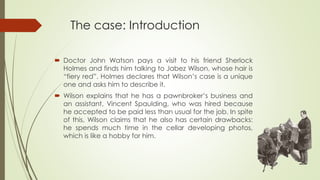
 Doctor John Watson pays a visit to his friend Sherlock
Holmes and finds him talking to Jabez Wilson, whose hair is
“fiery red”. Holmes declares that Wilson’s case is a unique
one and asks him to describe it.
 Wilson explains that he has a pawnbroker’s business and
an assistant, Vincent Spaulding, who was hired because
he accepted to be paid less than usual for the job. In spite
of this, Wilson claims that he also has certain drawbacks:
he spends much time in the cellar developing photos,
which is like a hobby for him.
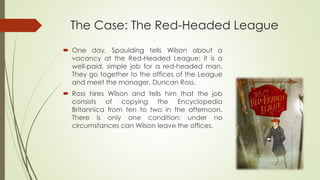
The Case: The Red-Headed League
 One day, Spaulding tells Wilson about a
vacancy at the Red-Headed League; it is a
well-paid, simple job for a red-headed man.
They go together to the offices of the League
and meet the manager, Duncan Ross.
 Ross hires Wilson and tells him that the job
consists of copying the Encyclopedia
Britannica from ten to two in the afternoon.
There is only one condition: under no
circumstances can Wilson leave the offices.
The Case: The disappearance
 After eight weeks working there, Wilson arrives
at the offices only to find that both the League
and the manager have disappeared.
 It is in that moment when he decides to
contact Holmes.
 The detective asks him about Vincent
Spaulding and finds out that Wilson hired him
a short time before the whole thing started.
Reaching for clues
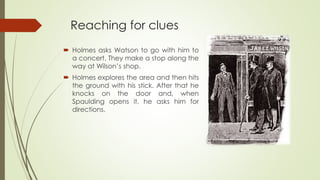
 Holmes asks Watson to go with him to
a concert. They make a stop along the
way at Wilson’s shop.
 Holmes explores the area and then hits
the ground with his stick. After that he
knocks on the door and, when
Spaulding opens it, he asks him for
directions.
Throwing hints
 Holmes explains Watson that he wanted to see Spaulding’s
trouser-knees but does not say why.
 Instead, he takes Watson to the other side of the street to see the
buildings behind Wilson’s shop. One of these buildings is a bank.
 Once the concert is over, Holmes asks Watson to meet him at ten
o’clock and to bring a revolver because he believes there is a
crime to be committed.
Preparing for the action
 When Watson arrives at Holmes’ office, he
finds him with two men: Mr. Jones – a police
officer – and Mr. Merryweather – a bank
manager.
 Holmes claims that they are going to trap
the famous criminal John Clay that night.
 The four men take cabs to the bank behind
Wilson’s shop and wait in the cellar without
any light.
Denouement
 After waiting for what seemed an eternity, they
see a light coming from the floor followed by a
hand and, finally, by a man, John Clay.
 It turns out that John Clay was actually
Wilson’s assistant, Spaulding.
 Clay is going to help another man to get out
from the whole in the floor but Holmes grabs
him and Mr. Jones takes him to the police-
station. The other man escapes.
Mystery solved
 Holmes explains that the purpose of the Red-Headed League was
to keep Wilson away from his shop so that Clay could dig a tunnel
to the bank, which was the reason why he accepted so little money
for his job.
 Spaulding’s worn trouser-knees, as well as the hollow sound of the
ground, confirmed Holmes’ suspicions.
 Lastly, the sudden disappearance of the League made him guess
that the crime was about to be committed.
Point of view
 As usually happens in detective
fiction, the author uses the first
person point of view to tell the story.
 The reader knows the facts from the
perspective of a character, Watson
in this case, and does not have
access to any other information.
 This technique makes the reader
feel identified with the narrator.
The Fair-Play Mystery
 In his stories, Conan Doyle introduces the technique
“the fair-play mystery”, which has become a very
common technique in detective fiction.
 This strategy allows the reader to know all the clues
the detective finds out so, theoretically, he would
be able to solve the mystery on his own.
 In fact, Holmes himself emphasizes this when he
encourages Watson to draw his own conclusions
instead of just telling him.
 As Watson stands for the reader, Holmes fostering
his reflection is Doyle’s way of making the reader
think and play an active role in the reading process.
Motifs
 The red hair in this story would stand for the
bizarre we face everyday in our lives but is also
a pun pointing to the so-called “red herring”.
 A “red-herring” is something that looks like a
clue but is not.
 It is used to mislead the reader by drawing his
attention to an irrelevant aspect of the story as
is the red hair in this case.
Bibliography
 Unknown author: Short Story Elements, from:
http://hrsbstaff.ednet.ns.ca/engramja/elements.html (Retrieved January
30, 2015)
 SparkNotes Editors. (2007). SparkNote on The Red-Headed League. from:
<http://www.sparknotes.com/short-stories/the-red-headed-league/>
(Retrieved January 30, 2015)
 Doyle, C. A. (2002): The Adventures of Sherlock Holmes, from:
<http://www.gutenberg.org/files/1661/1661-h/1661-h.htm#2> (Retrieved
January 29, 2015)

The Red-Headed League

  • 1.
    The adventure of theRed-Headed League María Echarri
  • 2.
    The case: Introduction Doctor John Watson pays a visit to his friend Sherlock Holmes and finds him talking to Jabez Wilson, whose hair is “fiery red”. Holmes declares that Wilson’s case is a unique one and asks him to describe it.  Wilson explains that he has a pawnbroker’s business and an assistant, Vincent Spaulding, who was hired because he accepted to be paid less than usual for the job. In spite of this, Wilson claims that he also has certain drawbacks: he spends much time in the cellar developing photos, which is like a hobby for him.
  • 3.
    The Case: TheRed-Headed League  One day, Spaulding tells Wilson about a vacancy at the Red-Headed League; it is a well-paid, simple job for a red-headed man. They go together to the offices of the League and meet the manager, Duncan Ross.  Ross hires Wilson and tells him that the job consists of copying the Encyclopedia Britannica from ten to two in the afternoon. There is only one condition: under no circumstances can Wilson leave the offices.
  • 4.
    The Case: Thedisappearance  After eight weeks working there, Wilson arrives at the offices only to find that both the League and the manager have disappeared.  It is in that moment when he decides to contact Holmes.  The detective asks him about Vincent Spaulding and finds out that Wilson hired him a short time before the whole thing started.
  • 5.
    Reaching for clues Holmes asks Watson to go with him to a concert. They make a stop along the way at Wilson’s shop.  Holmes explores the area and then hits the ground with his stick. After that he knocks on the door and, when Spaulding opens it, he asks him for directions.
  • 6.
    Throwing hints  Holmesexplains Watson that he wanted to see Spaulding’s trouser-knees but does not say why.  Instead, he takes Watson to the other side of the street to see the buildings behind Wilson’s shop. One of these buildings is a bank.  Once the concert is over, Holmes asks Watson to meet him at ten o’clock and to bring a revolver because he believes there is a crime to be committed.
  • 7.
    Preparing for theaction  When Watson arrives at Holmes’ office, he finds him with two men: Mr. Jones – a police officer – and Mr. Merryweather – a bank manager.  Holmes claims that they are going to trap the famous criminal John Clay that night.  The four men take cabs to the bank behind Wilson’s shop and wait in the cellar without any light.
  • 8.
    Denouement  After waitingfor what seemed an eternity, they see a light coming from the floor followed by a hand and, finally, by a man, John Clay.  It turns out that John Clay was actually Wilson’s assistant, Spaulding.  Clay is going to help another man to get out from the whole in the floor but Holmes grabs him and Mr. Jones takes him to the police- station. The other man escapes.
  • 9.
    Mystery solved  Holmesexplains that the purpose of the Red-Headed League was to keep Wilson away from his shop so that Clay could dig a tunnel to the bank, which was the reason why he accepted so little money for his job.  Spaulding’s worn trouser-knees, as well as the hollow sound of the ground, confirmed Holmes’ suspicions.  Lastly, the sudden disappearance of the League made him guess that the crime was about to be committed.
  • 10.
    Point of view As usually happens in detective fiction, the author uses the first person point of view to tell the story.  The reader knows the facts from the perspective of a character, Watson in this case, and does not have access to any other information.  This technique makes the reader feel identified with the narrator.
  • 11.
    The Fair-Play Mystery In his stories, Conan Doyle introduces the technique “the fair-play mystery”, which has become a very common technique in detective fiction.  This strategy allows the reader to know all the clues the detective finds out so, theoretically, he would be able to solve the mystery on his own.  In fact, Holmes himself emphasizes this when he encourages Watson to draw his own conclusions instead of just telling him.  As Watson stands for the reader, Holmes fostering his reflection is Doyle’s way of making the reader think and play an active role in the reading process.
  • 12.
    Motifs  The redhair in this story would stand for the bizarre we face everyday in our lives but is also a pun pointing to the so-called “red herring”.  A “red-herring” is something that looks like a clue but is not.  It is used to mislead the reader by drawing his attention to an irrelevant aspect of the story as is the red hair in this case.
  • 13.
    Bibliography  Unknown author:Short Story Elements, from: http://hrsbstaff.ednet.ns.ca/engramja/elements.html (Retrieved January 30, 2015)  SparkNotes Editors. (2007). SparkNote on The Red-Headed League. from: <http://www.sparknotes.com/short-stories/the-red-headed-league/> (Retrieved January 30, 2015)  Doyle, C. A. (2002): The Adventures of Sherlock Holmes, from: <http://www.gutenberg.org/files/1661/1661-h/1661-h.htm#2> (Retrieved January 29, 2015)