The real secret about start-ups
What I wish someone had told me about entrepreneurship,
Silicon Valley, and successful careers
In the past, most people would tell
you to:
Get a job at a big,
established company
Achieve job securityClimb the corporate ladder
Achieve job security
Sounds great, but…
Mmm, yeah, I’m going to have to go ahead
and ask you to come in on Sunday…
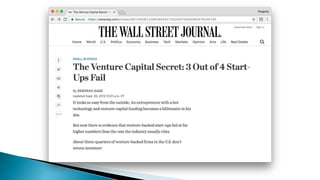
Nowadays, it’s all
about startups:
Sounds great, but…
So what do you do?
1. Startup myths
2. Startup truths
3. Startup careers
4. Getting started
Outline

1. Startup myths
2. Startup truths
3. Startup careers
4. Getting started
Outline

Myth #1: I’ll be an overnight
success!
Reality:
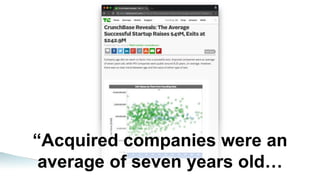
“Acquired companies were an
average of seven years old…
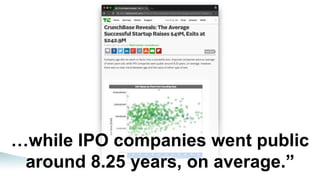
…while IPO companies went public
around 8.25 years, on average.”
Note: “exits” for the investors.
Founders stay on longer.
So if you remember nothing else
from this talk, remember this:
Building a successful startup takes
about a decade.
Are you willing to give 10 years of
your life to this idea?
Myth #2: I’m going to get rich!
Reality:
Most startups pay lower salaries
and offer few benefits
The stock is often worthless
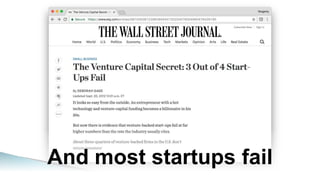
And most startups fail
Myth #3: I’ll get to party all day!
Reality:
This is startup life.
It’s not sexy or glamorous.
It’s mostly a lot of hard work.
Myth #4: I’ll get to write code
all day!
Some programmers might be
thinking, “this looks great!”
Reality:
Building a successful startup
takes more than just code
Sure, you’ll write plenty of code
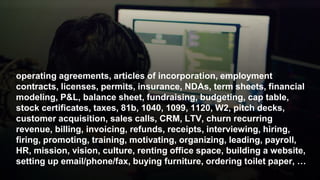
But you’ll also have to do
everything else, including:
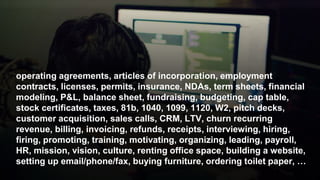
operating agreements, articles of incorporation, employment
contracts, licenses, permits, insurance, NDAs, term sheets, financial
modeling, P&L, balance sheet, fundraising, budgeting, cap table,
stock certificates, taxes, 81b, 1040, 1099, 1120, W2, pitch decks,
customer acquisition, sales calls, CRM, LTV, churn recurring
revenue, billing, invoicing, refunds, receipts, interviewing, hiring,
firing, promoting, training, motivating, organizing, leading, payroll,
HR, mission, vision, culture, renting office space, building a website,
setting up email/phone/fax, buying furniture, ordering toilet paper, …
Myth #5: All I need is a
brilliant idea!
Reality:
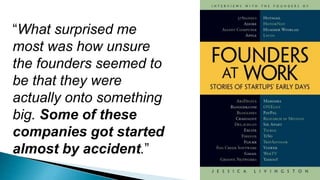
“What surprised me
most was how unsure
the founders seemed to
be that they were
actually onto something
big. Some of these
companies got started
almost by accident.”
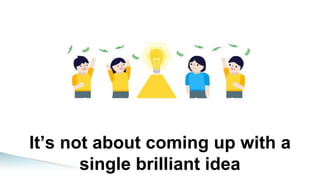
It’s not about coming up with a
single brilliant idea
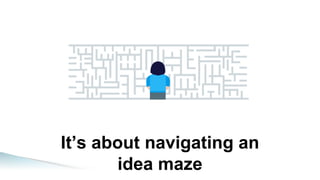
It’s about navigating an
idea maze
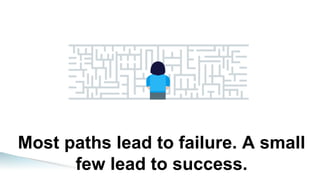
Most paths lead to failure. A small
few lead to success.
And even the best ideas don’t
matter without great execution
1. Startup myths
2. Startup truths
3. Startup careers
4. Getting started
Outline

You’ve now seen some common
startup myths
It’s not that they never happen, but
they are bad reasons to join or
start a startup.
So what are the good reasons to
join or start a startup?
1. Mastery
2. Autonomy
3. Purpose
Mastery: The urge to get better at
something.
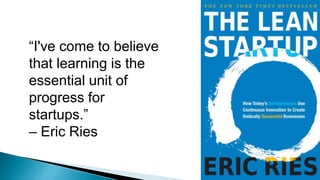
“I've come to believe
that learning is the
essential unit of
progress for
startups.”
– Eric Ries
Learning how to build a
product users want
Learning how to market
and sell a product
Learning how to build
and motivate a team
Learning how to…
operating agreements, articles of incorporation, employment
contracts, licenses, permits, insurance, NDAs, term sheets, financial
modeling, P&L, balance sheet, fundraising, budgeting, cap table,
stock certificates, taxes, 81b, 1040, 1099, 1120, W2, pitch decks,
customer acquisition, sales calls, CRM, LTV, churn recurring
revenue, billing, invoicing, refunds, receipts, interviewing, hiring,
firing, promoting, training, motivating, organizing, leading, payroll,
HR, mission, vision, culture, renting office space, building a website,
setting up email/phone/fax, buying furniture, ordering toilet paper, …
Join a startup if you want to grow
as a person
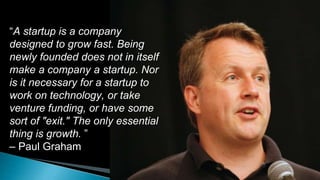
“A startup is a company
designed to grow fast. Being
newly founded does not in itself
make a company a startup. Nor
is it necessary for a startup to
work on technology, or take
venture funding, or have some
sort of "exit." The only essential
thing is growth. ”
– Paul Graham
Working for a growing company is
an amazing experience
Autonomy: The urge to control
your life.
At a startup, you choose
what to work on
At a startup, you choose
who to work with
At a startup, you choose
how to work
At a startup, you choose
where to work
Purpose: The urge to do something
meaningful.
This is what gets
me up in the morning.
As a startup, we are searching for
the right what and how.
“[Established] Companies
execute business models
where customers, their
problems, and necessary
product features are all
“knowns.” In sharp contrast,
startups operate in “search”
mode, seeking a repeatable
and profitable business model.”
– Steve Blank
It turns out that search mode
is more fun
It’s hard to feel passionate about
increasing profit margin by 0.3%
It’s hard not to feel passionate
about fighting for survival
When you’re one of 5,000
employees, you rarely feel like
you’re making a difference
When the company is 5 people,
everything you do matters
1. Startup myths
2. Startup truths
3. Startup careers
4. Getting started
Outline
You’ve now seen reasons you
should or shouldn’t join a startup
So where do startups
fit in your career?
1. Join an established company
2. Join a small startup
3. Start your own company
1. Join an established company
2. Join a small startup
3. Start your own company
At least once in your career, join a
big, established company
Try to join one of the leaders in
your industry
A “Google” on your resume will
benefit you your entire career
You will work with amazing people
You will make a good salary
(pay off your loans!)
You will learn how a successful
company operates
You’ll also learn how not to do
things
1. Join an established company
2. Join a small startup
3. Start your own company
At least once in your career,
join a small startup
Now is the golden age
of the startup.
Average tenure for a firm
in the S&P 500:
1958: 61 years
1980: 25 years
2012: 18 years
“On average, an S&P 500
company is now being
replaced about once every
two weeks […] At current
churn rate, 75% of the S&P
500 will be replaced by
2027.”
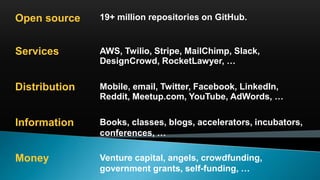
Open source 19+ million repositories on GitHub.
Services AWS, Twilio, Stripe, MailChimp, Slack,
DesignCrowd, RocketLawyer, …
Distribution Mobile, email, Twitter, Facebook, LinkedIn,
Reddit, Meetup.com, YouTube, AdWords, …
Information Books, classes, blogs, accelerators, incubators,
conferences, …
Money Venture capital, angels, crowdfunding,
government grants, self-funding, …
So why join a startup instead of
starting your own?
If you start a startup, you are stuck
with it for up to a decade.
In that same time period, you can
join 3-4 startups.
Earning experience, connections,
and stock at each one.
“The 100th engineer at
Facebook made far
more money than 99%
of Silicon Valley
entrepreneurs.”
– Dustin Moskovitz
Some people chase ambulances
Some people chase IPOs
How do you find a good
startup to join?
1. Look to your network.
2. Look at the products you use.
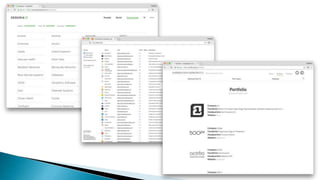
3. Look at elite VC portfolios.
1. Join an established company
2. Join a small startup
3. Start your own company
You’ll probably have more fun and
make more money joining
someone else’s company.
As a founder,
you will make
roughly 10x the
sacrifice.
10x more stress
10x more risk
10x more time
So is it ever a good idea
to start a company?
Yes:
When you can’t not do it.
You have an idea or passion that
you simply must do.
You’ve worked on it for years,
even while at other jobs.
You just have to bring your dream
into the world.
Just remember: a startup is one
way to accomplish your dream.
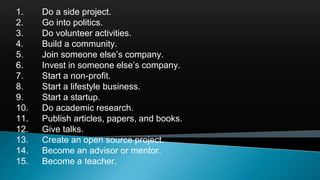
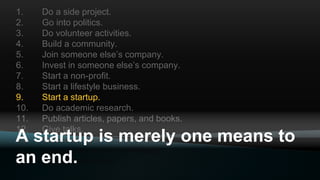
1. Do a side project.
2. Go into politics.
3. Do volunteer activities.
4. Build a community.
5. Join someone else’s company.
6. Invest in someone else’s company.
7. Start a non-profit.
8. Start a lifestyle business.
9. Start a startup.
10. Do academic research.
11. Publish articles, papers, and books.
12. Give talks.
13. Create an open source project.
14. Become an advisor or mentor.
15. Become a teacher.
1. Do a side project.
2. Go into politics.
3. Do volunteer activities.
4. Build a community.
5. Join someone else’s company.
6. Invest in someone else’s company.
7. Start a non-profit.
8. Start a lifestyle business.
9. Start a startup.
10. Do academic research.
11. Publish articles, papers, and books.
12. Give talks.
13. Create an open source project.
14. Become an advisor or mentor.
15. Become a teacher.
A startup is merely one means to
an end.
1. Startup myths
2. Startup truths
3. Startup careers
4. Getting started
Outline
So how do you start? How do you
build a good career?
“You need to be good at
something before you can
expect a good job.”
– Cal Newport
“The way to get
startup ideas is not
to try to think of
startup ideas […]
The way to have
good startup ideas
is to become the
sort of person who
has them.”
– Paul Graham
The way to have a great career is
not to search for a great career but
to make yourself great.
How to become great:
1. Study
2. Build
3. Share
How to become great:
1. Study
2. Build
3. Share
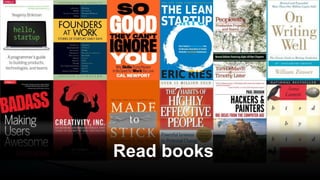
Read books
Read papers, articles, blogs
Take classes
Go to meetups, conferences, and
talks (like this one!)
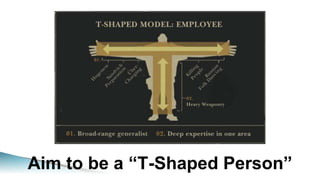
Aim to be a “T-Shaped Person”
How to become great:
1. Study
2. Build
3. Share
When I was a kid,
I didn’t like reading.
When I was in college,
I didn’t like reading.
When I was starting my career,
I didn’t like reading.
You know what finally got
me to love reading?
Becoming a person who
needs reading.
What kind of person is that?
A maker.
As I tried to build software, teams,
& products, I realized:
I have no idea what I’m doing.
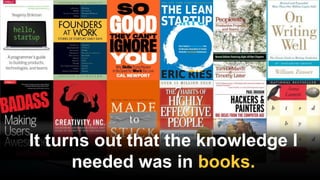
It turns out that the knowledge I
needed was in books.
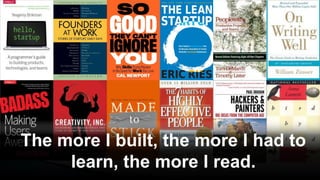
The more I built, the more I had to
learn, the more I read.
Go make things.
Work projects, side projects, learning
projects, open source, hackathons, prototypes,
inventions, art, music, teams, communities, …
How to become great:
1. Study
2. Build
3. Share
Share everything you’ve learned
Write
Speak
Open source
Why?
Quality: you do better work when
others are looking.
Branding: you become an expert
by sharing your expertise.
Mastery: the best way to learn
is to teach.
That’s why I’m here today.
To share what I’ve learned
with all of you.
The real secret about start ups

The real secret about start ups