Report on the Development
                            of the
              Advanced Encryption Standard (AES)
                                    James Nechvatal,
                    Elaine Barker, Lawrence Bassham, William Burr,
                      Morris Dworkin, James Foti, Edward Roback

                              Computer Security Division
                          Information Technology Laboratory
                     National Institute of Standards and Technology
                               Technology Administration
                             U.S. Department of Commerce

                            Publication Date: October 2, 2000


Abstract:
In 1997, the National Institute of Standards and Technology (NIST) initiated a process to
select a symmetric-key encryption algorithm to be used to protect sensitive (unclassified)
Federal information in furtherance of NIST’s statutory responsibilities. In 1998, NIST
announced the acceptance of fifteen candidate algorithms and requested the assistance of
the cryptographic research community in analyzing the candidates. This analysis included
an initial examination of the security and efficiency characteristics for each algorithm.
NIST reviewed the results of this preliminary research and selected MARS, RC6™,
Rijndael, Serpent and Twofish as finalists. Having reviewed further public analysis of the
finalists, NIST has decided to propose Rijndael as the Advanced Encryption Standard
(AES). The research results and rationale for this selection are documented in this report.

Key words: Advanced Encryption Standard (AES), cryptography, cryptanalysis,
cryptographic algorithms, encryption, Rijndael.


                                            1
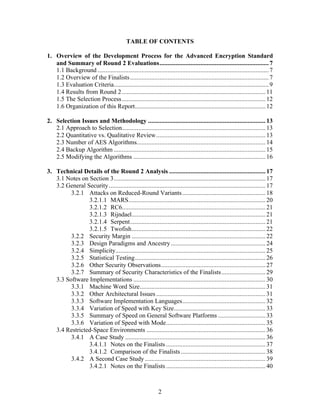
TABLE OF CONTENTS

1. Overview of the Development Process for the Advanced Encryption Standard
   and Summary of Round 2 Evaluations................................................................... 7
   1.1 Background ......................................................................................................... 7
   1.2 Overview of the Finalists ..................................................................................... 7
   1.3 Evaluation Criteria............................................................................................... 9
   1.4 Results from Round 2 ........................................................................................ 11
   1.5 The Selection Process ........................................................................................ 12
   1.6 Organization of this Report................................................................................ 12

2. Selection Issues and Methodology ........................................................................ 13
   2.1 Approach to Selection........................................................................................ 13
   2.2 Quantitative vs. Qualitative Review................................................................... 13
   2.3 Number of AES Algorithms............................................................................... 14
   2.4 Backup Algorithm ............................................................................................. 15
   2.5 Modifying the Algorithms ................................................................................. 16

3. Technical Details of the Round 2 Analysis ........................................................... 17
   3.1 Notes on Section 3............................................................................................. 17
   3.2 General Security ................................................................................................ 17
         3.2.1 Attacks on Reduced-Round Variants ................................................... 18
                3.2.1.1 MARS.................................................................................... 20
                3.2.1.2 RC6........................................................................................ 21
                3.2.1.3 Rijndael.................................................................................. 21
                3.2.1.4 Serpent................................................................................... 21
                3.2.1.5 Twofish.................................................................................. 22
         3.2.2 Security Margin .................................................................................. 22
         3.2.3 Design Paradigms and Ancestry .......................................................... 24
         3.2.4 Simplicity............................................................................................ 25
         3.2.5 Statistical Testing................................................................................ 26
         3.2.6 Other Security Observations................................................................ 27
         3.2.7 Summary of Security Characteristics of the Finalists........................... 29
   3.3 Software Implementations ................................................................................. 30
         3.3.1 Machine Word Size............................................................................. 31
         3.3.2 Other Architectural Issues ................................................................... 31
         3.3.3 Software Implementation Languages................................................... 32
         3.3.4 Variation of Speed with Key Size........................................................ 33
         3.3.5 Summary of Speed on General Software Platforms ............................. 33
         3.3.6 Variation of Speed with Mode............................................................. 35
   3.4 Restricted-Space Environments ......................................................................... 36
         3.4.1 A Case Study ...................................................................................... 36
                3.4.1.1 Notes on the Finalists ............................................................. 37
                3.4.1.2 Comparison of the Finalists .................................................... 38
         3.4.2 A Second Case Study .......................................................................... 39
                3.4.2.1 Notes on the Finalists ............................................................. 40


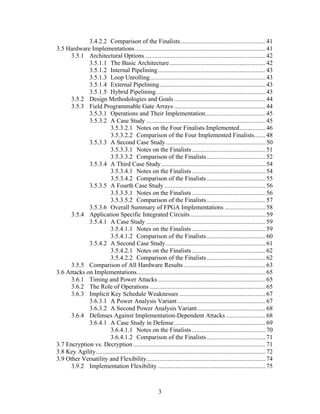
                                                             2
3.4.2.2 Comparison of the Finalists .................................................... 41
3.5 Hardware Implementations ................................................................................ 41
      3.5.1 Architectural Options .......................................................................... 42
             3.5.1.1 The Basic Architecture........................................................... 42
             3.5.1.2 Internal Pipelining.................................................................. 43
             3.5.1.3 Loop Unrolling....................................................................... 43
             3.5.1.4 External Pipelining................................................................. 43
             3.5.1.5 Hybrid Pipelining................................................................... 43
      3.5.2 Design Methodologies and Goals ........................................................ 44
      3.5.3 Field Programmable Gate Arrays ........................................................ 44
             3.5.3.1 Operations and Their Implementation..................................... 45
             3.5.3.2 A Case Study ......................................................................... 45
                        3.5.3.2.1 Notes on the Four Finalists Implemented................ 46
                        3.5.3.2.2 Comparison of the Four Implemented Finalists....... 48
             3.5.3.3 A Second Case Study ............................................................. 50
                        3.5.3.3.1 Notes on the Finalists ............................................. 51
                        3.5.3.3.2 Comparison of the Finalists .................................... 52
             3.5.3.4 A Third Case Study................................................................ 54
                        3.5.3.4.1 Notes on the Finalists ............................................. 54
                        3.5.3.4.2 Comparison of the Finalists .................................... 55
             3.5.3.5 A Fourth Case Study .............................................................. 56
                        3.5.3.5.1 Notes on the Finalists ............................................. 56
                        3.5.3.5.2 Comparison of the Finalists .................................... 57
             3.5.3.6 Overall Summary of FPGA Implementations ......................... 58
      3.5.4 Application Specific Integrated Circuits .............................................. 59
             3.5.4.1 A Case Study ......................................................................... 59
                        3.5.4.1.1 Notes on the Finalists ............................................. 59
                        3.5.4.1.2 Comparison of the Finalists .................................... 60
             3.5.4.2 A Second Case Study ............................................................. 61
                        3.5.4.2.1 Notes on the Finalists ............................................. 62
                        3.5.4.2.2 Comparison of the Finalists .................................... 62
      3.5.5 Comparison of All Hardware Results .................................................. 63
3.6 Attacks on Implementations............................................................................... 65
      3.6.1 Timing and Power Attacks .................................................................. 65
      3.6.2 The Role of Operations ....................................................................... 65
      3.6.3 Implicit Key Schedule Weaknesses ..................................................... 67
             3.6.3.1 A Power Analysis Variant ...................................................... 67
             3.6.3.2 A Second Power Analysis Variant.......................................... 68
      3.6.4 Defenses Against Implementation-Dependent Attacks ........................ 68
             3.6.4.1 A Case Study in Defense........................................................ 69
                        3.6.4.1.1 Notes on the Finalists ............................................. 70
                        3.6.4.1.2 Comparison of the Finalists .................................... 71
3.7 Encryption vs. Decryption ................................................................................. 71
3.8 Key Agility........................................................................................................ 72
3.9 Other Versatility and Flexibility......................................................................... 74
      3.9.2 Implementation Flexibility .................................................................. 75


                                                         3
3.10 Potential for Instruction-Level Parallelism ...................................................... 76

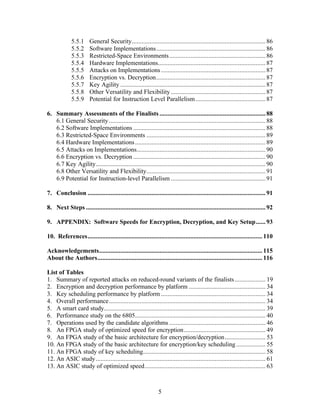
4. Intellectual Property Issues................................................................................... 79

5. Finalist Profiles...................................................................................................... 80
   5.1 MARS ............................................................................................................... 80
         5.1.1 General Security.................................................................................. 80
         5.1.2 Software Implementations................................................................... 80
         5.1.3 Restricted-Space Environments........................................................... 80
         5.1.4 Hardware Implementations.................................................................. 80
         5.1.5 Attacks on Implementations ................................................................ 80
         5.1.6 Encryption vs. Decryption................................................................... 81
         5.1.7 Key Agility ......................................................................................... 81
         5.1.8 Other Versatility and Flexibility .......................................................... 81
         5.1.9 Potential for Instruction-Level Parallelism........................................... 81
   5.2 RC6................................................................................................................... 81
         5.2.1 General Security.................................................................................. 81
         5.2.2 Software Implementations................................................................... 82
         5.2.3 Restricted-Space Environments........................................................... 82
         5.2.4 Hardware Implementations.................................................................. 82
         5.2.5 Attacks on Implementations ................................................................ 82
         5.2.6 Encryption vs. Decryption................................................................... 82
         5.2.7 Key Agility ......................................................................................... 82
         5.2.8 Other Versatility and Flexibility .......................................................... 83
         5.2.9 Potential for Instruction-Level Parallelism........................................... 83
   5.3 Rijndael ............................................................................................................. 83
         5.3.1 General Security.................................................................................. 83
         5.3.2 Software Implementations................................................................... 83
         5.3.3 Restricted-Space Environments........................................................... 83
         5.3.4 Hardware Implementations.................................................................. 84
         5.3.5 Attacks on Implementations ................................................................ 84
         5.3.6 Encryption vs. Decryption................................................................... 84
         5.3.7 Key Agility ......................................................................................... 84
         5.3.8 Other Versatility and Flexibility .......................................................... 84
         5.3.9 Potential for Instruction-Level Parallelism........................................... 84
   5.4 Serpent .............................................................................................................. 85
         5.4.1 General Security.................................................................................. 85
         5.4.2 Software Implementations................................................................... 85
         5.4.3 Restricted-Space Environments........................................................... 85
         5.4.4 Hardware Implementations.................................................................. 85
         5.4.5 Attacks on Implementations ................................................................ 85
         5.4.6 Encryption vs. Decryption................................................................... 85
         5.4.7 Key Agility ......................................................................................... 86
         5.4.8 Other Versatility and Flexibility .......................................................... 86
         5.4.9 Potential for Instruction Level Parallelism........................................... 86
   5.5 Twofish ............................................................................................................. 86


                                                               4
5.5.1     General Security.................................................................................. 86
             5.5.2     Software Implementations................................................................... 86
             5.5.3     Restricted-Space Environments........................................................... 86
             5.5.4     Hardware Implementations.................................................................. 87
             5.5.5     Attacks on Implementations ................................................................ 87
             5.5.6     Encryption vs. Decryption................................................................... 87
             5.5.7     Key Agility ......................................................................................... 87
             5.5.8     Other Versatility and Flexibility .......................................................... 87
             5.5.9     Potential for Instruction Level Parallelism........................................... 87

6. Summary Assessments of the Finalists ................................................................. 88
   6.1 General Security ................................................................................................ 88
   6.2 Software Implementations ................................................................................. 88
   6.3 Restricted-Space Environments ......................................................................... 89
   6.4 Hardware Implementations ................................................................................ 89
   6.5 Attacks on Implementations............................................................................... 90
   6.6 Encryption vs. Decryption ................................................................................. 90
   6.7 Key Agility........................................................................................................ 90
   6.8 Other Versatility and Flexibility......................................................................... 91
   6.9 Potential for Instruction-level Parallelism .......................................................... 91

7. Conclusion ............................................................................................................. 91

8. Next Steps .............................................................................................................. 92

9. APPENDIX: Software Speeds for Encryption, Decryption, and Key Setup...... 93

10. References........................................................................................................... 110

Acknowledgements.................................................................................................... 115
About the Authors..................................................................................................... 116

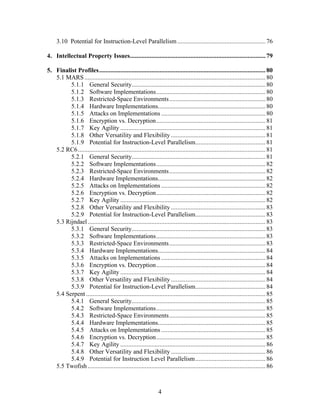
List of Tables
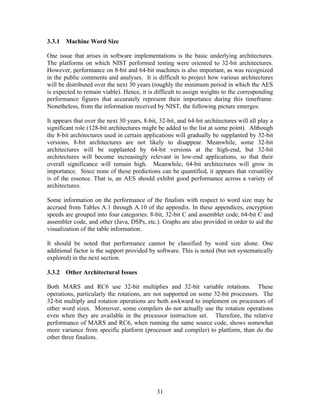
1. Summary of reported attacks on reduced-round variants of the finalists................... 19
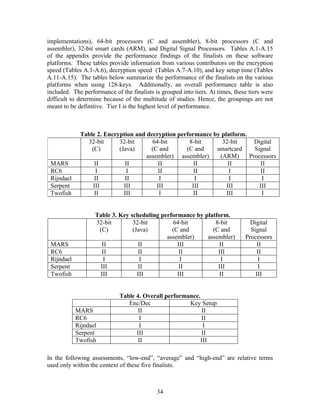
2. Encryption and decryption performance by platform ............................................... 34
3. Key scheduling performance by platform ................................................................ 34
4. Overall performance................................................................................................ 34
5. A smart card study................................................................................................... 39
6. Performance study on the 6805................................................................................ 40
7. Operations used by the candidate algorithms ........................................................... 46
8. An FPGA study of optimized speed for encryption.................................................. 49
9. An FPGA study of the basic architecture for encryption/decryption......................... 53
10. An FPGA study of the basic architecture for encryption/key scheduling .................. 55
11. An FPGA study of key scheduling........................................................................... 58
12. An ASIC study ........................................................................................................ 61
13. An ASIC study of optimized speed.......................................................................... 63


                                                              5
14. A smart card study of power analysis defense.......................................................... 70
15. Critical path and instruction-level parallelism .......................................................... 77


                                                       6
“I’ll do the [S]quare thing.”
                                                 -G.B. McCutcheon (1917)

1. Overview of the Development Process for the Advanced Encryption
   Standard and Summary of Round 2 Evaluations

The National Institute of Standards and Technology (NIST) has been working with the
international cryptographic community to develop an Advanced Encryption Standard
(AES). The overall goal is to develop a Federal Information Processing Standard (FIPS)
that specifies an encryption algorithm capable of protecting sensitive (unclassified)
government information well into the twenty-first century. NIST expects that the
algorithm will be used by the U.S. Government and, on a voluntary basis, by the private
sector.

The competition among the finalists was very intense, and NIST selected Rijndael as the
proposed AES algorithm at the end of a very long and complex evaluation process. This
report describes that process and summarizes many of the characteristics of the
algorithms that were identified during the public evaluation periods. The following
sections provide an overview of the AES development followed by a discussion of
specific analysis details.

1.1   Background

On January 2, 1997, NIST announced the initiation of an effort to develop the AES [31]
and made a formal call for algorithms on September 12, 1997 [32]. The call indicated
NIST’s goal that the AES would specify an unclassified, publicly disclosed encryption
algorithm, available royalty-free, worldwide. At a minimum, the algorithm would have
to implement symmetric key cryptography as a block cipher and support a block size of
128 bits and key sizes of 128, 192, and 256 bits.

 On August 20, 1998, NIST announced fifteen AES candidate algorithms at the First AES
Candidate Conference (AES1) and solicited public comments on the candidates [33].
Industry and academia submitters from twelve countries proposed the fifteen algorithms.
A Second AES Candidate Conference (AES2) was held in March 1999 to discuss the
results of the analysis that was conducted by the international cryptographic community
on the candidate algorithms. In August 1999, NIST announced its selection of five
finalist algorithms from the fifteen candidates. The selected algorithms were MARS,
RC6TM, Rijndael, Serpent and Twofish.

1.2   Overview of the Finalists

The five finalists are iterated block ciphers: they specify a transformation that is iterated a
number of times on the data block to be encrypted or decrypted. Each iteration is called a
round, and the transformation is called the round function. The data block to be encrypted
is called the plaintext; the encrypted plaintext is called the ciphertext. For decryption, the


                                              7
ciphertext is the data block to be processed. Each finalist also specifies a method for
generating a series of keys from the original user key; the method is called the key
schedule, and the generated keys are called subkeys. The round functions take distinct
subkeys as input along with the data block.

For each finalist, the very first and last cryptographic operations are some form of mixing
of subkeys with the data block. Such mixing of secret subkeys prevents an adversary
who does not know the keys from even beginning to encrypt the plaintext or decrypt the
ciphertext. Whenever this subkey mixing does not naturally occur as the initial step of
the first round or the final step of the last round, the finalists specify the subkey mixing as
an extra step called pre- or post-whitening.

There are other common technical features of the finalists. Four of the finalists specify
substitution tables, called S-boxes: an AxB bit S-box replaces A bit inputs with B bit
outputs. Three of the finalists specify variations on a structure for the round function,
called the Feistel structure. In the classic Feistel structure, half of the data block is used
to modify the other half of the data block, and then the halves are swapped. The two
finalists that do not use a Feistel structure process the entire data block in parallel during
each round using substitutions and linear transformations; thus, these two finalists are
examples of substitution-linear transformation networks.

Below is a summary of each of the finalist candidates in alphabetical order; profiles and
Round 2 assessments are provided in subsequent sections of this report.

      MARS [15] has several layers: key addition1 as pre-whitening, 8 rounds of unkeyed
      forward mixing, eight rounds of keyed forward transformation, 8 rounds of keyed
      backwards transformation, eight rounds of unkeyed backwards mixing, and key
      subtraction as post-whitening. The 16 keyed transformations are called the
      cryptographic core. The unkeyed rounds use two 8x32 bit S-boxes, addition, and the
      XOR operation. In addition to those elements, the keyed rounds use 32-bit key
      multiplication, data-dependent rotations, and key addition. Both the mixing and the
      core rounds are modified Feistel rounds in which one fourth of the data block is used
      to alter the other three fourths of the data block. MARS was submitted by the
      International Business Machines Corporation (IBM).

      RC6 [75] is a parameterized family of encryption ciphers that essentially use the
      Feistel structure; 20 rounds were specified for the AES submission. The round
      function of RC6 uses variable rotations that are regulated by a quadratic function of
      the data. Each round also includes 32-bit modular multiplication, addition, XOR (i.e.,
      exclusive-or), and key addition. Key addition is also used for pre- and post-whitening.
      RC6 was submitted to the AES development effort by RSA Laboratories.


1
    The operation of 32-bit addition is referred to simply as addition; the operation of 32-bit
    subtraction is referred to simply as subtraction in this report.


                                                8
Rijndael [22] is a substitution-linear transformation network with 10, 12 or 14
      rounds, depending on the key size. A data block to be processed using Rijndael is
      partitioned into an array of bytes, and each of the cipher operations is byte-oriented.
      Rijndael’s round function consists of four layers. In the first layer, an 8x8 S-box is
      applied to each byte. The second and third layers are linear mixing layers, in which
      the rows of the array are shifted, and the columns are mixed. In the fourth layer,
      subkey bytes are XORed into each byte of the array. In the last round, the column
      mixing is omitted. Rijndael was submitted by Joan Daemen (Proton World
      International) and Vincent Rijmen (Katholieke Universiteit Leuven).

      Serpent [4] is a substitution-linear transformation network consisting of 32 rounds.
      Serpent also specifies non-cryptographic initial and final permutations that facilitate
      an alternative mode of implementation called the bitslice mode. The round function
      consists of three layers: the key XOR operation, 32 parallel applications of one of the
      eight specified 4x4 S-boxes, and a linear transformation. In the last round, a second
      layer of key XOR replaces the linear transformation. Serpent was submitted by Ross
      Anderson (University of Cambridge), Eli Biham (Technion), and Lars Knudsen
      (University of California San Diego).

      Twofish [83] is a Feistel network with 16 rounds. The Feistel structure is slightly
      modified using 1-bit rotations. The round function acts on 32-bit words with four key-
      dependent 8x8 S-boxes, followed by a fixed 4x4 maximum distance separable matrix
      over GF(28), a pseudo-Hadamard transform, and key addition. Twofish was submitted
      by Bruce Schneier, John Kelsey, and Niels Ferguson (Counterpane Internet Security,
      Inc.), Doug Whiting (Hi/fn, Inc.), David Wagner (University of California Berkeley),
      and Chris Hall (Princeton University).

In announcing the finalists, NIST again solicited public review and comment on the
algorithms [34]. These algorithms received further analysis during a second, more in-
depth review period, and the Third AES Candidate Conference (AES3) was held in April
2000 to present and discuss much of that analysis. The public comment period for
reviewing the finalist algorithms closed on May 15, 2000. At that time, NIST’s AES
team conducted a thorough review of all of the public comments and analyses of the
finalists.

1.3    Evaluation Criteria

In the September 1997 call for candidate algorithms [32], NIST specified the overall
evaluation criteria that would be used to compare the candidate algorithms. These
criteria were developed from public comments to Ref. [31] and from the discussions at a
public AES workshop held on April 15, 1997 at NIST.

The evaluation criteria were divided into three major categories: 1) Security, 2) Cost, and
3) Algorithm and Implementation Characteristics. Security was the most important factor
in the evaluation and encompassed features such as resistance of the algorithm to


                                              9
cryptanalysis, soundness of its mathematical basis, randomness of the algorithm output,
and relative security as compared to other candidates.

Cost was a second important area of evaluation that encompassed licensing requirements,
computational efficiency (speed) on various platforms, and memory requirements. Since
one of NIST’s goals was that the final AES algorithm be available worldwide on a
royalty-free basis, public comments were specifically sought on intellectual property
claims and any potential conflicts. The speed of the algorithm on a variety of platforms
needed to be considered. During Round 1, the focus was primarily on the speed
associated with 128-bit keys. During Round 2, hardware implementations and the speeds
associated with the 192 and 256-bit key sizes were addressed. Memory requirements and
software implementation constraints for software implementations of the candidates were
also important considerations.

The third area of evaluation was algorithm and implementation characteristics such as
flexibility, hardware and software suitability, and algorithm simplicity. Flexibility
includes the ability of an algorithm:

   •   To handle key and block sizes beyond the minimum that must be supported,

   •   To be implemented securely and efficiently in many different types of
       environments, and

   •   To be implemented as a stream cipher, hashing algorithm, and to provide
       additional cryptographic services.

It must be feasible to implement an algorithm in both hardware and software, and
efficient firmware implementations were considered advantageous. The relative
simplicity of an algorithm’s design was also an evaluation factor.

During Rounds 1 and 2,       it became evident that the various issues being analyzed and
discussed often crossed       into more than one of the three main criteria headings.
Therefore, the criteria of   cost and algorithm characteristics were considered together as
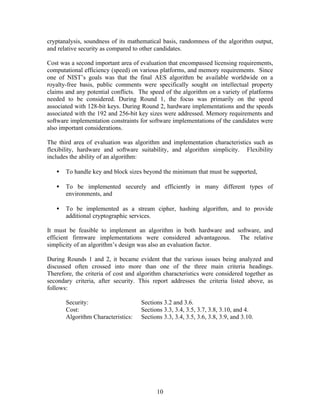
secondary criteria, after    security. This report addresses the criteria listed above, as
follows:

       Security:                       Sections 3.2 and 3.6.
       Cost:                           Sections 3.3, 3.4, 3.5, 3.7, 3.8, 3.10, and 4.
       Algorithm Characteristics:      Sections 3.3, 3.4, 3.5, 3.6, 3.8, 3.9, and 3.10.


                                              10
1.4   Results from Round 2

The Round 2 public review extended from the official announcement of the five AES
finalists on August 20, 1999 until the official close of the comment period on May 15,
2000. During Round 2, many members of the global cryptographic community supported
the AES development effort by analyzing and testing the five AES finalists.

NIST facilitated and focused the analysis of the finalists by providing an electronic
discussion forum and home page. The public and NIST used the electronic forum [1] to
discuss the finalists and relevant AES issues, inform the public of new analysis results,
etc. The AES home page [2] served as a tool to disseminate information such as
algorithm specifications and source code, AES3 papers, and other Round 2 public
comments.

Thirty-seven (37) papers were submitted to NIST for consideration for AES3. Twenty-
four (24) of those papers were presented at AES3 as part of the formal program, and one
of the remaining papers was presented during an informal session at AES3. All of the
submitted papers were posted on the AES home page [2] several weeks prior to AES3 in
order to promote informed discussions at the conference.

AES3 gave members of the international cryptographic community an opportunity to
present and discuss Round 2 analysis and other important topics relevant to the AES
development effort. A summary of AES3 presentations and discussions will be available
in Ref. [29]. In addition to the AES3 papers, NIST received 136 sets of public comments
on the finalists during Round 2 in the form of submitted papers, email comments and
letters. All of these comments were made publicly available on the AES home page [2]
on April 19, 2000.

NIST performed an analysis of mathematically optimized ANSI C and Java™
implementations2 of the candidate algorithms that were provided by the submitters prior
to the beginning of Round 1. NIST’s testing of ANSI C implementations focused on the
speed of the candidates on various desktop systems, using different combinations of
processors, operating systems, and compilers. The submitters’ Java™ code was tested
for speed and memory usage on a desktop system. NIST’s testing results for the ANSI C
and Java™ code are presented in Refs. [7] and [28], respectively. Additionally, extensive
statistical testing was performed by NIST on the candidates, and results are presented in
Ref. [88].


2
  These computer languages were used during the AES development process because of
their widespread use throughout the computer industry. Their use does not imply
recommendation or endorsement by the National Institute of Standards and Technology,
nor does it imply that these computer languages are necessarily the best available for the
purpose.


                                           11
1.5   The Selection Process

A team of NIST security personnel convened a series of meetings in order to establish the
strategy for AES algorithm selection (see Sec. 2). The team then proceeded to evaluate
the papers and comments received during the AES development process, compare the
results of the numerous studies made of the finalists and finally make the selection of the
proposed AES algorithm. There is a consensus by the team that the selected algorithm
will provide good security for the foreseeable future, is reasonably efficient and suitable
for various platforms and environments, and provides sufficient flexibility to
accommodate future requirements.

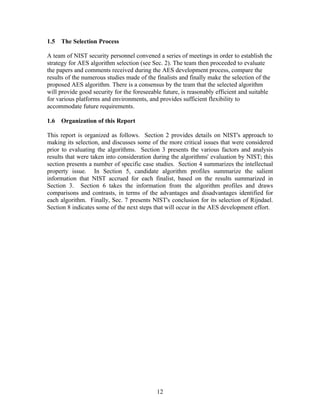
1.6   Organization of this Report

This report is organized as follows. Section 2 provides details on NIST's approach to
making its selection, and discusses some of the more critical issues that were considered
prior to evaluating the algorithms. Section 3 presents the various factors and analysis
results that were taken into consideration during the algorithms' evaluation by NIST; this
section presents a number of specific case studies. Section 4 summarizes the intellectual
property issue. In Section 5, candidate algorithm profiles summarize the salient
information that NIST accrued for each finalist, based on the results summarized in
Section 3. Section 6 takes the information from the algorithm profiles and draws
comparisons and contrasts, in terms of the advantages and disadvantages identified for
each algorithm. Finally, Sec. 7 presents NIST's conclusion for its selection of Rijndael.
Section 8 indicates some of the next steps that will occur in the AES development effort.


                                            12
2. Selection Issues and Methodology

2.1       Approach to Selection

As the public comment period neared its closing date of May 15, 2000, NIST
reconstituted its AES selection team (hereafter called the “team”) that was used for the
Round 1 selection of the finalists. This team was comprised of cross-disciplinary NIST
security staff. The team reviewed the public comments, drafted this selection report and
selected the algorithms to propose as the AES.

A few fundamental decisions confronted the team at the beginning of the selection
process. Specifically, the team considered whether to:

      •    Take a quantitative or qualitative approach to selection;

      •    Select one or multiple algorithms;

      •    Select a backup algorithm(s); and

      •    Consider public proposals to modify the algorithms.

The following sections briefly address these issues.

2.2       Quantitative vs. Qualitative Review

At one of its first meetings to plan for the post Round 2 activities, the team reviewed the
possibility of conducting a quantitative approach as proposed in Ref. [87]. Using this
process, each algorithm and combination of algorithms would receive a score based on
the evaluation criteria [32]. Was such a quantitative approach feasible, it could provide
an explicit assignment of values and allow a comparison of the algorithms? The
quantitative approach would also provide explicit weighting of each AES selection factor.
However, the consensus of the team was that the degree of subjectivity of many of the
criteria would result in numeric figures that would be debatable. Moreover, the issue of
quantitative review had been raised by the public at various times during the AES
development effort (most recently at AES3), and there seemed to be little agreement
regarding how different factors should be weighted and scored.          Team members also
expressed concern that determining a quantitative scoring system without significant
public discussion would give the impression that the system was unfair. For those
reasons, the team concluded that a quantitative approach to selection was not workable,
and decided to proceed as they did after Round 1. Namely, the team decided to review
the algorithms’ security, performance, implementation, and other characteristics, and to
make a decision based upon an overall assessment of each algorithm – keeping in mind
that security considerations were of foremost concern.


                                                13
2.3       Number of AES Algorithms

During the course of the Round 1 and 2 public evaluation periods, several arguments
were made regarding the number of algorithms that should be selected for inclusion in the
AES. In addition, the issue was raised about the selection of a “backup” algorithm in the
case that a single AES algorithm were selected and later deemed to be unsuitable. This
could occur, for example, because of a practical attack on the algorithm or an intellectual
property dispute. The team decided that it was necessary to address this issue as early as
possible, in part to narrow its scope of options under consideration during the rest of the
selection process.

Several arguments made in favor of multiple algorithms (and/or against a single
algorithm) included:

      •    In terms of resiliency, if one AES algorithm were broken, there would be at least
           one more AES algorithm available and implemented in products. Some
           commenters expressed the concern that extensive use of a single algorithm would
           place critical data at risk if that algorithm were shown to be insecure [42] [51]
           [52].

      •    Intellectual property (IP) concerns could surface later, calling into question the
           royalty-free availability of a particular algorithm. An alternative algorithm might
           provide an immediately available alternative that would not be affected by the
           envisioned IP concern [52].

      •    A set of AES algorithms could cover a wider range of desirable traits than a single
           algorithm. In particular, it might be possible to offer both high security and high
           efficiency to an extent not possible with a single algorithm [47] [52].

The public also submitted arguments in favor of a single AES algorithm (and/or against
multiple algorithms). Some of those arguments suggested that:

      •    Multiple AES algorithms would increase interoperability complexity and raise
           costs when multiple algorithms were implemented in products [17] [91].

      •    Multiple algorithms could be seen as multiplying the number of potential
           “intellectual property attacks” against implementers [17] [47] [48].

      •    The specification of multiple algorithms might cause the public to question
           NIST’s confidence in the security of any of the algorithms [6] [91].

      •    Hardware implementers could make better use of available resources by
           improving the performance of a single algorithm than by including multiple
           algorithms [92].


                                               14
The team discussed these and other issues raised during Round 2 regarding single or
multiple AES algorithms. The team recognized the likelihood, as evidenced by
commercial products today, that future products will continue to implement multiple
algorithms, as dictated by customer demand, requirements for interoperability with
legacy/proprietary systems, and so forth. Triple DES, which NIST anticipates will
remain a FIPS-approved algorithm for the foreseeable future, is expected to be available
in many commercial products for some time, as are other FIPS and non-FIPS algorithms.
In some regard, therefore, the presence of these multiple algorithms in current products
provides a degree of systemic resiliency – as does having multiple AES key sizes. In the
event of an attack, NIST would likely assess options at that time, including whether other
AES finalists were resistant to such an attack, or whether entirely new approaches were
necessary.

With respect to intellectual property issues, vendors noted that if multiple AES
algorithms were selected, market forces would likely result in a need to implement all
AES algorithms, thus exposing the vendors to additional intellectual property risks.

At the AES3 conference, there was significant discussion regarding the number of
algorithms that should be included in the AES. The vast majority of attendees expressed
their support - both verbally and with a show of hands - for selecting only a single
algorithm. There was some support for selecting a backup algorithm, but there was no
agreement as to how that should be accomplished. The above sentiments were reflected
in written comments provided to NIST by many of the attendees after the conference.

The team considered all of the comments and factors above before making the decision to
propose only a single algorithm for the AES. The team felt that other FIPS-approved
algorithms will provide a degree of systemic resiliency, and that a single AES algorithm
will promote interoperability and address vendor concerns about intellectual property and
implementation costs.

2.4   Backup Algorithm

As noted earlier, intertwined in the discussion of multiple AES algorithms was the issue
of whether to select a backup algorithm, particularly in the case of a single AES
algorithm. A backup could take a number of forms, ranging from an algorithm that
would not be required to be implemented in AES validated products (“cold backup”), to
requiring the backup algorithm in AES products as a “hot backup.” It was argued by
some commenters that, in many respects, a backup algorithm was nearly equivalent to a
two-algorithm AES, since many users would reasonably demand that even a “cold
backup” be implemented in products.

Given 1) the vendors’ concerns that a backup algorithm would be a de facto requirement
in products (for immediate availability in the future), 2) the complete uncertainty of
knowing the potential applicability of future breakthroughs in cryptanalysis, 3) NIST’s
interest in promoting interoperability, and 4) the availability of other algorithms (FIPS


                                           15
and non-FIPS) in commercial products, the team decided not to select a backup
algorithm.

As with its other cryptographic algorithm standards, NIST will continue to follow
developments in the cryptanalysis of the AES algorithm, and the standard will be
formally reevaluated every five years. Maintenance activities for the AES standard will
be performed at the appropriate time, in full consideration of the situation’s particular
circumstances. If an issue arises that requires more immediate attention, NIST will act
expeditiously and consider all available alternatives at that time.

2.5       Modifying the Algorithms

During Rounds 1 and 2, NIST received a number of comments that expressed an interest
in increasing the number of rounds of some of the algorithms. Although some comments
offered explicit rationale for an increase in the number of rounds (e.g., choosing an
algorithm with twice the number of rounds that the currently best known reduced-round
analysis requires), many did not. NIST noted that the submitters of the two algorithms
that received the most comments regarding an increase in rounds, RC6 and Rijndael, did
not choose to increase the number of rounds at the end of Round 1 (when "tweak"
proposals were being considered). Additionally, the Rijndael submitters even stated "the
number of rounds of Rijndael provides a sufficient margin of security with respect to
cryptanalytic attack." [23]

The following issues and concerns were expressed during the team's discussions:

      •    For some algorithms, it is not clear how the algorithm would be fully defined
           (e.g., the key schedule) with a different number of rounds, or how such a change
           would impact the security analysis.

      •    Changing the number of rounds would impact the large amount of performance
           analysis from Rounds 1 and 2. All performance data for the modified algorithm
           would need to be either estimated or performed again. In some cases, especially
           in hardware and in memory-restricted environments, estimating algorithm
           performance for the new number of rounds would not be a straightforward
           process.

      •    There was a lack of agreement in the public comments regarding the number of
           rounds to be added, and which algorithms should be altered.

      •    The submitters had confidence in the algorithms as submitted, and there were no
           post-Round 1 "tweaked" proposals for an increased numbers of rounds.

After much discussion, and given the factors listed above, the team decided that it would
be most appropriate to make its recommendation for the AES based on the algorithms as
submitted (i.e., without changing the number of rounds).


                                              16
3. Technical Details of the Round 2 Analysis

3.1   Notes on Section 3

The analyses presented in this paper were performed using the original specifications
submitted for the finalists prior to the beginning of Round 2. Most of the analysis of
MARS considered the Round 2 version [15], in which modifications had been made to
the original submitted specifications [100]. Some of the studies – including the NIST
software performance analyses [7] [28] - used algorithm source code that was provided
by the submitters themselves.

While NIST does not vouch for any particular data items that were submitted, all data
was taken into account. In some cases, the data from one study may not be consistent
with that of other studies. This may be due, for example, to different assumptions made
for the various studies. NIST considered these differences into account and attempted to
determine the general trend of the information provided. For the various case studies
presented in Sec. 3, this report summarizes some of these analyses and results, but the
reader should consult the appropriate references for more complete details.

3.2   General Security

Security was the foremost concern in evaluating the finalists. As stated in the original
call for candidates [32], NIST relied on the public security analysis conducted by the
cryptographic community. No attacks have been reported against any of the finalists,
and no other properties have been reported that would disqualify any of them.

The only attacks that have been reported to data are against simplified variants of the
algorithms: the number of rounds is reduced or simplified in other ways. A summary of
these attacks against reduced-round variants, and the resources of processing, memory,
and information that they require, is discussed in Sec. 3.2.1 and presented in Table 1.

It is difficult to assess the significance of the attacks on reduced-round variants of the
finalists. On the one hand, reduced-round variants are, in fact, different algorithms, so
attacks on them do not necessarily imply anything about the security of the original
algorithms. An algorithm could be secure with n rounds even if it were vulnerable with
n-1 rounds. On the other hand, it is standard practice in modern cryptanalysis to try to
build upon attacks on reduced-round variants, and, as observed in Ref. [56], attacks never
get worse over time. From this point of view, it would seem to be prudent to try to
estimate a “security margin” of the candidates, based on the attacks on reduced-round
variants.

One possible measure of the security margin, based on the proposal in Ref. [10], is the
degree to which the full number of rounds of an algorithm exceeds the largest number of
rounds that have been attacked. This idea and its limitations are discussed in Sec. 3.2.2.
There are a number of reasons not to rely heavily on any single figure of merit for the


                                           17
strength of an algorithm; however, this particular measure of the security margin may
provide some utility.

NIST considered other, less quantifiable characteristics of the finalists that might
conceivably impact upon their security. Confidence in the security analysis conducted
during the specified timeframe of the AES development process is affected by the
ancestry of the algorithms and their design paradigms as well as the difficulty of
analyzing particular combinations of operations using the current framework of
techniques. These issues are discussed in Secs. 3.2.3 and 3.2.4. The statistical testing
that NIST conducted on the candidates is discussed in Sec. 3.2.5. Various public
comments about the security properties of the finalists are discussed in Sec. 3.2.6. NIST’s
overall assessment of the security of the finalists is summarized in Sec. 3.2.7.

3.2.1 Attacks on Reduced-Round Variants

Table 1 summarizes the attacks against reduced-round variants of the finalists. For each
attack, the table gives a reference to the original paper in which the attack was described,
the number of rounds of the variant under attack, the key size, the type of attack, and the
resources that are required. The three resource categories that may be required for the
attack are information, memory, and processing.

The “Texts” column indicates the information required to effect the attack, specifically,
the number of plaintext blocks and corresponding ciphertext blocks encrypted under the
secret key. For most of the attacks, it does not suffice for the adversary to intercept
arbitrary texts; the plaintexts must take a particular form of the adversary’s choosing.
Such plaintexts are called chosen plaintexts. In the discussions of the attacks in Secs.
3.2.1.1 – 3.2.1.5, it is noted when an attack can use any known plaintext, as opposed to
chosen plaintext.

The “Mem. Bytes” column indicates the largest number of memory bytes that would be
used at any point in the course of executing the attack; this is not necessarily equivalent
to storing all of the required information.

The “Ops.” column indicates the expected number of operations that are necessary to
perform the attack. It is difficult to translate such a number into a time estimate, because
the time will depend on the computing power available, as well as the extent to which the
procedure can be conducted in parallel. The nature of the operations will also be a factor;
they will typically be full encryption operations, but the operations may also be partial
encryptions or some other operation. Even full encryptions will vary in the required
processing time across algorithms. Therefore, the number of operations required for an
attack should be regarded only as an approximate basis for comparison among different
attacks. The references should be consulted for full details.

A useful benchmark for the processing that is required for the attacks on reduced-round
variants is the processing that is required for an attack by key exhaustion, that is, by
trying every key. Any block cipher, in principle, can be attacked in this way. For the


                                            18
three AES key sizes, key exhaustion would require 2127, 2191, or 2255 operations, on
average. Even the smallest of these is large enough that any attacks by key exhaustion
are impractical today and likely to remain so for at least several decades.

 Table 1. Summary of reported attacks on reduced-round variants of the finalists.

  Algorithm, Reference        Rounds      Type of Attack      Texts      Mem.      Ops.
  Rounds                     (Key size)                                  Bytes
  MARS          [57]            11C       Amp. Boomerang       265        270      2229
  16 Core(C)    [58]          16M, 5C      Meet-in-Middle       8         2236     2232
  16 Mixing                   16M, 5C       Diff. M-i-M        250        2197     2247
     (M)                      6M, 6C      Amp. Boomerang       269        273      2197

  RC6              [39]          14         Stat. Disting.     2118       2112     2122
  20               [60]          12         Stat. Disting.      294       242      2119
                            14(192,256)     Stat. Disting.     2110       242      2135
                            14(192,256)     Stat. Disting.     2108       274      2160
                              15(256)       Stat. Disting.     2119       2138     2215
  Rijndael         [22]          4         Truncated Diff.      29       small      29
  10 (128)                       5         Truncated Diff.      211      small     240
  12 (192)                       6         Truncated Diff.      232      7*232     272
  14 (256)         [37]          6         Truncated Diff.    6*232      7*232     244
                              7 (192)      Truncated Diff.    19*232     7*232     2155
                              7 (256)      Truncated Diff.    21*232     7*232     2172
                                 7         Truncated Diff.   2128-2119    261      2120
                              8 (256)      Truncated Diff.   2128-2119    2101     2204
                              9 (256)       Related Key         277       NA       2224
                   [63]       7 (192)      Truncated Diff.      232      7*232     2184
                              7 (256)      Truncated Diff.      232      7*232     2200
                   [40]     7 (192,256)    Truncated Diff.      232      7*232     2140
  Serpent          [57]     8(192,256)    Amp. Boomerang       2113       2119     2179
  32               [62]       6 (256)      Meet-in-Middle      512        2246     2247
                                 6           Differential       283       240      290
                                 6           Differential       271       275      2103
                            6 (192,256)      Differential       241       245      2163
                              7 (256)        Differential      2122       2126     2248
                            8 (192,256)      Boomerang         2128       2133     2163
                            8 (192,256)   Amp. Boomerang       2110       2115     2175
                              9 (256)     Amp. Boomerang       2110       2212     2252
  Twofish        [35]          6(256)     Impossible Diff.     NA         NA       2256
  16             [36]            6          Related Key        NA         NA       NA
 NA = Information not readily available

Exhaustive key search requires little memory and information and can be readily
conducted in parallel using multiple processors. Thus, any attack that required more
operations than are required for the exhaustive key search probably would be more
difficult to execute than exhaustive key search. For this reason, many of the attacks on
reduced-round variants are only relevant to the larger AES key sizes, although the


                                          19
processing requirements are nevertheless impractical today. Similarly, the memory
requirements of many of the reported attacks against reduced-round variants are
significant.

Practical considerations are also relevant to the information requirements of the reported
attacks against reduced-round variants. Almost all of these attacks require more than 230
encryptions of chosen plaintexts; in other words, more than a billion encryptions, and in
some cases far more are required. Even if a single key were used this many times, it
might be impractical for an adversary to collect so much information. For instance, there
are linear and differential attacks in Ref. [12] and Ref. [64] on DES that require 243
known plaintexts and 247 encryptions of chosen plaintexts. However, NIST knows of no
circumstance in which those attacks were carried out against DES.

One model for collecting such large amounts of information would require physical
access for an adversary to one or more encryption devices that use the same secret key.
In that case, another useful benchmark would be the memory that would be required to
store the entire “codebook,” in other words, a table containing the ciphertext blocks
corresponding to every possible plaintext block. Such a table would require 2132 bytes of
memory for storage.

The following are comments on the attacks presented in Table 1.

3.2.1.1   MARS

There are many ways to simplify MARS for the purpose of analysis because of the
heterogeneous structure consisting of 4 different types of rounds. The 16 keyed rounds of
the cryptographic core are “wrapped” in 16 unkeyed mixing rounds and pre- and post-
whitening.

Four attacks on three simplified variants of MARS were presented in Refs. [57] and [58].
The first variant includes 11 core rounds, without any mixing rounds or whitening. The
authors attack this variant with a new type of truncated differential attack, called the
boomerang-amplifier, extending the methods in Ref. [90]. The second variant includes
both the whitening and the full 16 mixing rounds, while reducing the core rounds from 16
to 5. Two different meet-in-the-middle attacks are proposed on this variant; the
adversary does not need to choose the plaintexts for these attacks. The third variant
includes the whitening, while reducing both the number of mixing rounds and the number
of core rounds from 16 to 6.

Another paper reports an impossible differential for 8 of the 16 rounds of the MARS core
[11]. The authors imply that the existence of an impossible differential typically leads to
an attack that recovers the secret key from a variant that is a couple of rounds longer than
the differential. Because the attack does not actually exist, this attack is not included in
Table 1.


                                            20
3.2.1.2   RC6

The two papers presenting attacks on variants of RC6 both present a small, but iterative,
statistical bias in the round function. The resulting statistical correlations between inputs
of a certain form and their outputs can be used to distinguish some number of rounds of
RC6 from a random permutation.             In other words, the two papers construct
“distinguishers.” Both papers assume that the distribution of the subkeys is uniformly
random; the attack described in Ref. [39] on a 14 round variant of RC6, also assumes that
the variable rotation amounts produced within the round function are random. In Ref.
[60], the authors describe a distinguisher that they estimate, based on systematic
experimental results, will apply to variants of RC6 with up to 15 rounds. Attacks, i.e.,
methods for recovering the secret key, are described for 12, 14, and 15 round variants.
For a class of weak keys, estimated to be one key in 280, the non-randomness is estimated
to persist in reduced-round variants employing up to 17 rounds of RC6. In Ref. [76], the
RC6 submitters comment on the results in Ref. [60] and observe that those results support
their own estimates of the security of RC6.

3.2.1.3   Rijndael

The Rijndael specification describes a truncated differential attack on 4, 5, and 6 round
variants of Rijndael [22], based on a 3 round distinguisher of Rijndael. This attack is
called the “Square” attack, named after the cipher on which the attack was first mounted.
In Ref. [40], truncated differentials are used to construct a different distinguisher on 4
rounds, based on the experimentally confirmed existence of collisions between some
partial functions induced by the cipher. This distinguisher leads to a collision attack on 7
round variants of Rijndael.

The other papers that present attacks on variants of Rijndael build directly on the Square
attack. In Ref. [63], the Square attack is extended to 7 round variants of Rijndael by
guessing an extra round of subkeys. Table 1 indicates the results for the 192 and 256-bit
key sizes, where the total number of operations remains below those required for
exhaustive search. Similar attacks are described in Ref. [37]. These attacks are improved,
however, by a partial summing technique that reduces the number of operations. The
partial summing technique is also combined with a technique for trading off operations
for information, yielding attacks on 7 and 8 round variants that require almost the entire
codebook. The same paper also presents a related key attack on a 9 round variant with
256-bit keys. This attack requires not only encryptions of chosen plaintexts under the
secret key, but also encryptions under 255 other keys that are related to the secret key in a
manner chosen by the adversary.

3.2.1.4   Serpent

In Ref. [57], the amplified boomerang technique is used to construct a 7 round
distinguisher of Serpent, leading to an attack on a variant of Serpent with eight rounds for
the 192 and 256-bit key sizes. In Ref. [58], a refinement based on an experimental
observation reduces the texts, memory, and processing required for the attack; an


                                             21
extension to an attack on a 9 round variant is also offered. The same paper also presents
a standard meet-in-the-middle attack and differential attacks on 6 and 7 round variants of
Serpent, and a standard boomerang attack on an 8 round variant of Serpent that requires
the entire codebook.

3.2.1.5    Twofish

The Twofish team has found two attacks on variants of Twofish. In Ref. [35], a five
round impossible differential is used to attack a 6 round variant of Twofish under 256-bit
keys, with the required number of processing operations equivalent to that required for an
exhaustive search. If the pre- and post-whitening is removed from the variant, then the
attack can be extended to 7 rounds; alternatively, without whitening, 6 round variants can
be attacked with a complexity less than exhaustive search for each key size. In Ref. [36],
the Twofish team explains why the partial chosen-key and related key attack on a 9 round
variant of Twofish that they reported in the Twofish specification does not work. The
best such attack of which they are aware applies to a 6 round variant, or a 7 round variant
without whitening. The Twofish specification [83] also reports attacks on reduced-round
variants of Twofish that are considerably simplified in other ways: for example, by using
fixed S-boxes, by removing whitening or subkeys, or by allowing partial key guesses.

Outside of attacks mounted by the Twofish team, NIST knows of no attacks that have
been mounted on Twofish by simply reducing the number of rounds. In Ref. [70],
differential characteristics on 6 rounds are presented that apply only to certain key
dependent S-boxes and thus, only to a fraction of the keys. This particular fraction of the
keys could be considered as a class of weak keys, because the authors claim that
characteristics like theirs should lead directly to an attack on 7 or 8 round variants of
Twofish. Because the attack does not actually exist, it does not appear in Table 1. In Ref.
[59], an attack is mounted on a 4 round variant of Twofish in which 32-bit words are
scaled down to 8-bit words; other properties of Twofish are also explored.

3.2.2     Security Margin

NIST wished to evaluate the likelihood that an analytic shortcut attack would be found
for the candidate algorithms with all specified rounds in the next several decades, or
before attacks by key exhaustion become practical. It is difficult, however, to extrapolate
the data for reduced-round variants to the actual algorithms. The attacks on reduced
round variants are generally not even practical at this time because they require huge
amounts of resources. In fact, most of these attacks on reduced round variants are,
arguably, more difficult to execute in practice than attacks by exhaustive key search,
despite smaller processing requirements, because of their information and memory
requirements. Moreover, even if a shortcut attack on a simplified variant were practical,
the original algorithm might remain secure.

Nevertheless, attacks will improve in the future, and the resources available to carry them
out will be greater, so it might be prudent to favor algorithms that appear to have a
greater margin for security. If only a little simplification allows an attack on one


                                            22
algorithm, but a second algorithm has only been attacked after much greater
simplification, then that may be an indication that the second algorithm has a greater
margin for security. Simplification (in Sec. 3.2.2) includes round reductions, which is not
surprising, because the most notable frameworks of attacks, differential and linear
cryptanalysis, may be effectively resisted if the number of rounds is high enough.
Therefore, the full number of rounds specified for the algorithm has been compared to the
largest number of rounds at which an attack currently exists. In Ref. [85], the ratio of
these numbers was defined as the “safety factor” and calculated for each candidate.

There are several problems with relying heavily on this measure, or on any single figure
of merit that is based on the attacks on reduced-round variants. In general, the results
will be biased against algorithms that attract greater scrutiny in a limited analysis period.
This could plausibly occur, for example, if a particular algorithm is simpler, or at least
appears to be simpler, to analyze against certain attacks. Another factor could be the
ancestry of the algorithm and its constituent techniques, and the existence of previous
attacks upon which to build. The proposed measure would tend to favor novel techniques
for resisting attacks, techniques that have not yet stood the test of time. Similarly, the
proposed measure may not be a good index to the resistance of the algorithms to new and
novel techniques for attacking algorithms.

To develop a measure based on the largest number of rounds that are currently attacked is
also technically problematic, as is acknowledged in Ref. [85]. There is no natural
definition for the number of analyzed rounds, or even the total number of rounds
specified for each algorithm. For example, should the whitening in MARS, Twofish,
RC6, and Rijndael count as rounds or partial rounds? MARS has 16 unkeyed mixing
rounds and 16 keyed core rounds: is MARS a 16 round or a 32 round algorithm, or
something in between? Should attacks that ignore the mixing rounds be considered?
Should reduced-round variants of Serpent or Rijndael be required to inherit the slightly
modified final round? Another complicating factor is the key size, especially for Rijndael,
which varies the number of rounds depending on the key size.

What types of attacks should be included in the definition? Some attacks were successful
against only a small fraction of keys; some required encryption operations under related
unknown keys; some distinguished outputs from random permutations without an explicit
method for recovering the key; and some relied on experimental conjectures. In addition,
the attacks required considerably different resources; some even assume that nearly the
entire codebook was available to the attacker.

In light of these difficulties, NIST did not attempt to reduce its assessment of the security
margins of the finalists to a single measurement. NIST considered all of the reported
data, and used the raw number of analyzed rounds out of the total rounds specified for an
algorithm as a first approximation. The results are summarized below for each finalist.

Note that the rounds defined for the candidates are not necessarily comparable to each
other. For example, the algorithms based on the Feistel construction, MARS, RC6, and


                                             23
Twofish, require two rounds to alter an entire word of data, while a single round of
Rijndael or Serpent accomplishes this.

MARS: The results for MARS depend on the treatment of the “wrapper,” i.e., the pre-
and post-whitening and the 16 unkeyed mixing rounds that surround the 16 keyed core
rounds. Without the wrapper, 11 out of the 16 core rounds have been attacked. With the
wrapper, MARS has many more rounds than have been successfully attacked: only 5 out
of the 16 core rounds, or 21 out of the 32 total rounds have been attacked. Or, if the
wrapper is regarded as a pair of single, keyed rounds, then 7 out of the 18 rounds have
been attacked. For any of these cases, MARS appears to offer a high security margin.

RC6: Attacks have been mounted against 12, 14, and 15 out of the 20 rounds of RC6,
depending on the key size. The submitters point out in Ref. [78] that these results support
their original estimate that as many as 16 out of the 20 rounds may be vulnerable to
attack. RC6 appears to offer an adequate security margin.

Rijndael: For 128-bit keys, 6 or 7 out of the 10 rounds of Rijndael have been attacked,
the attack on 7 rounds requiring nearly the entire codebook. For 192-bit keys, 7 out of
the 12 rounds have been attacked. For 256-bit keys, 7, 8, or 9 out of the 14 rounds have
been attacked. The 8 round attack requires nearly the entire codebook, and the 9 round
attack requires encryptions under related unknown keys. The submitters point out in Ref.
[26] that the incremental round improvements over their own 6 round Square attack come
at a heavy cost in resources. Rijndael appears to offer an adequate security margin.

Serpent: Attacks have been mounted on 6, 8, or 9 out of 32 rounds of Serpent,
depending on the key size. Serpent appears to offer a high security margin.

Twofish: The Twofish team has mounted an attack on 6 out of the 16 rounds of Twofish
that requires encryption operations under related unknown keys. Another attack
proposed on 6 rounds for the 256-bit key size is no more efficient than exhaustive key
search. Twofish appears to offer a high security margin.

3.2.3 Design Paradigms and Ancestry

The history of the underlying design paradigms affects the confidence that may be placed
in the security analysis of the algorithms. This also applies to the constituent elements of
the design, such as the S-boxes. It may require more time for attacks to be developed
against novel techniques, and traditional techniques may tend to attract more analysis,
especially if attacks already exist on which to build. For example, the Feistel
construction, such as employed by DES, has been well studied, and three of the finalists
use variations of this structure. Another element that can affect public confidence is the
design of the S-boxes, which can be suspected of containing a hidden “trapdoor” that can
facilitate an attack. These considerations are discussed below for each finalist.

MARS: The heterogeneous round structure of MARS appears to be novel. Both the
mixing round and the core rounds are based on the Feistel construction, with considerable


                                            24
variation. MARS uses many different operations, most of which are traditional. A
product of key material and data is used to regulate the variable rotation operation. The
S-box was generated deterministically to achieve certain desired properties; thus, the
MARS specification asserts that MARS is unlikely to contain any structure that could be
used as a trapdoor for an attack. The MARS specification does not cite any algorithm as
an ancestor.

RC6: The design of RC6 evolved from the design of RC5, which has undergone several
years of analysis. The security of both algorithms relies on variable rotations as the
principal source of non-linearity; there are no S-boxes. The variable rotation operation in
RC6, unlike RC5, is regulated by a quadratic function of the data. The key schedules of
RC5 and RC6 are identical. The round structure of RC6 is a variation on the Feistel
construction. The RC6 specification asserts that there are no trapdoors in RC6 because
the only a priori defined part of RC6 is the well known mathematical constants used
during key setup.

Rijndael: Rijndael is a byte-oriented cipher based on the design of Square. The
submitters’ presentation of the Square attack served as a starting point for further
analysis. The types of substitution and permutation operations used in Rijndael are
standard. The S-box has a mathematical structure, based on the combination of inversion
over a Galois field and an affine transformation. Although this mathematical structure
might conceivably aid an attack, the structure is not hidden as would be the case for a
trapdoor. The Rijndael specification asserts that if the S-box was suspected of containing
a trapdoor, then the S-box could be replaced.

Serpent: Serpent is a byte-oriented algorithm. The types of substitution and permutation
operations are standard. The S-boxes are generated deterministically from those of DES
to have certain properties; the Serpent specification states that such a construction
counters the fear of trapdoors. The Serpent specification does not cite any algorithm as an
ancestor.

Twofish: Twofish uses a slight modification of the Feistel structure. The Twofish
specification does not cite any particular algorithm as its ancestor, but it does cite several
algorithms that share an important feature of Twofish, the key-dependent S-boxes, and
weighs the various design approaches to them. The Twofish specification asserts that
Twofish has no trapdoors and supports this conclusion with several arguments, including
the variability of the S-boxes.

3.2.4 Simplicity

Simplicity is a property whose impact on security is difficult to assess. On the one hand,
complicated algorithms can be considered more difficult to attack. On the other hand,
results may be easier to obtain on a simple algorithm, and an algorithm that is perceived
to be simple may attract relatively more scrutiny. Therefore, during the AES analysis
period, it may have been easier to be confident in the analysis of a simple algorithm.


                                             25
There is no consensus, however, on what constitutes simplicity. MARS has been
characterized as complicated in several public comments, but the submitters point out in
Ref. [20] that MARS requires fewer lines of C code in the Gladman implementations
than Rijndael, Twofish, and Serpent. RC6, by contrast, is generally regarded as the
simplest of the finalists, yet the modular multiplication operation it contains is arguably
much more complicated than typical cipher operations. In Ref. [49], the MARS team
points out that the published linear analysis of RC5 was found to be in error three years
after the publication of that analysis, so seemingly simple ciphers are not necessarily
easier to analyze.

For standard differential cryptanalysis, the type of operations employed tangibly affects
the rigor of the security analysis. If key material is mixed with data only by the XOR
operation, as in Serpent and Rijndael, then plaintext pairs with a given XOR difference
are the natural inputs, and the security analysis is relatively clean. If key material is
mixed with data by more than one operation, as in the other finalists, then there is no
natural notion of difference, and the security analysis requires more estimates. Similarly,
the use of variable rotations in MARS and RC6 would seem to inhibit the possibility of
clean security results against a variety of differential and linear attacks.

Another aspect of simplicity that relates to security analysis is scalability. If a simplified
variant can be constructed with a smaller block size, for example, then conducting
experiments on the variant becomes more feasible, which in turn may shed light on the
properties of the original algorithm. In Ref. [79], it is claimed that the lack of smaller
versions of MARS severely hampers analysis and experimentation. Similarly, in Ref.
[59], the authors assert that a “realistic” scaled-down variant of Twofish seems difficult
to construct. Both claims are plausible, although it should be noted that the MARS and
Twofish specifications contain considerable analysis of their individual design elements.
The Serpent specification asserts, plausibly, that it would not be difficult to construct
scaled-down variants of Serpent. RC6 and Rijndael are scaleable by design.

3.2.5 Statistical Testing

NIST conducted statistical tests on the AES finalists for randomness by evaluating
whether the outputs of the algorithms under certain test conditions exhibited properties
that would be expected of randomly generated outputs. These tests were conducted for
each of the three key sizes. In addition, NIST conducted a subset of the tests on reduced-
round versions of each algorithm. All of the testing was based on the NIST Statistical
Test Suite [80].

For the full round testing, each of the algorithms produced random-looking outputs for
each of the key sizes. For the reduced-round testing of each finalist, the outputs of an
early round appear to be random, as do the outputs of each subsequent round.
Specifically, the output of MARS appears to be random at 4 or more core rounds, RC6
and Serpent at 4 or more rounds, Rijndael at 3 or more rounds, and Twofish at 2 or more
rounds. The test conditions and results are described in Ref. [88]. For comments on the
limitations of NIST’s methodology, see Ref. [69].


                                             26
Additional testing, as described in Ref. [53] and limited to RC6, confirmed NIST’s
results for RC6 on certain statistical tests. Reference [74] presented detailed results from
measuring the diffusion properties of full round and reduced round versions of the
finalists. The quantities measured – including the degrees of completeness, of the
avalanche effect, and of strict avalanche criterion – were “indistinguishable from random
permutations after a very small number of rounds,” for all of the finalists.

In summary, none of the finalists was statistically distinguishable from a random
function.

3.2.6 Other Security Observations

Many observations have been offered about various properties that might impact the
security of the finalists. Because the implications of these observations are generally
subjective, they did not play a significant role in NIST's selection.

MARS: In Ref. [20], the MARS team conjectures that the heterogeneous structure of
MARS and its variety of operations constitute a kind of insurance against the unknown
attacks of the future. The MARS key schedule requires several stages of mixing; in Ref.
[77], key schedules that require the thorough mixing of key bits are cited for security
advantages. The estimates in the MARS specification of the resistance of the core to
linear cryptanalysis are questioned in Ref. [79]. In Ref. [61], one conjectured estimate
from the MARS specification is proven incorrect. In Ref. [14], it is pointed out that the
MARS S-box does not have all of the properties that the designers required. No attacks
are proposed based on these observations. In Ref. [49], the MARS team offers a
clarification of its analysis, supporting the original assessment that MARS is resilient
against linear attacks.

RC6: In Ref. [77], the thorough mixing provided by the RC6 key schedule is cited as a
security advantage. In Ref. [20], the concern is raised that RC6 relies mainly on data-
dependent rotations for its security, constituting a “ ‘single point of failure’…(as it does
not use S-boxes).”

Rijndael: In Ref. [86], the author discusses three concerns about the mathematical
structure of Rijndael and the potential vulnerabilities that result. First, he observes that
all of the operations of the cipher act on entire bytes of the data, rather than bits; this
property allows the Square attack on reduced-round variants. Moreover, the nearly
symmetric movement of the bytes troubles him. The only break to the symmetry is the
use of different round constants in the key schedule, and for the first eight rounds, these
constants are only one bit. If Rijndael were simplified to omit these round constants, then
encryption would be compatible with rotating each word of the data and subkeys by a
byte.

The second concern discussed in Ref. [86] is that “Rijndael is mostly linear.” He
disagrees with the deliberate design decision to avoid mixing the XOR operations with


                                            27
ordinary addition operations. He illustrates how to apply a linear map to the bits within
each byte without changing the overall algorithm, by compensating for the linear map in
the other elements of the cipher, including the key schedule. Similarly, the Galois field
that underlies the S-box can be represented in different basis vectors or can be
transformed to other Galois fields with different defining polynomials. In other words,
the Rijndael’s mathematical structure permits many equivalent formulations. The author
suggests that, by performing a series of manipulations to the S-box, an attacker might be
able to find a formulation of Rijndael with an exploitable weakness.

The third concern discussed in Ref. [86] is the relatively simple algebraic formula for the
S-box, which is given in the Rijndael specification. The formula is a polynomial of
degree 254 over the given Galois field, but there are only nine terms in the polynomial,
far fewer than would be expected in a typical randomly generated S-box of the same size.
The mathematical expression for the iteration of several rounds of Rijndael would be
much more complex, but the author asserts that the growth of the expression size as a
function of rounds has not been analyzed in detail. He presents some examples of
calculations in this setting, including the possible use of a “normal” basis, under which
the squaring operation amounts to just a rotation of bits. If the expression for five rounds
of Rijndael turned out to contain, say, only a million terms, then the author asserts that a
meet in the middle attack could be mounted by solving a large system of linear equations.
Such an attack would require the attacker to collect two million plaintext-ciphertext pairs.

In Ref. [86], it is also noted that an attacker that recovers or guesses appropriate bits of
Rijndael’s subkeys will be able to compute additional bits of the subkeys. (In the case of
DES, this property aided the construction of linear and differential attacks.) Extensions
of this observation are discussed in Ref. [37]; its authors deem these properties
worrisome and suggest that, contrary to a statement in the Rijndael specification, the key
schedule does not have high diffusion.

In Ref. [72], some properties of the linear part of the round function in Rijndael are
explored. In particular, the linear mapping within the round function has the property
that 16 iterations are equivalent to the identity mapping. The authors suggest that this
casts doubt on the claim in the Rijndael submission that the linear mapping provides high
diffusion over multiple rounds. In Ref. [24], the Rijndael submitters explain that the
observations in Ref. [72] do not contradict their claims about the security of Rijndael.
The authors of Ref. [72] offer a further response in Ref. [71].

Serpent: In Ref. [3], the Serpent team asserts that Serpent is the most secure of the
finalists. They cite Serpent’s many extra rounds, beyond those needed to resist today’s
attacks, as a reason why future advances in cryptanalysis should not break its design. In
Ref. [67], a concern is raised about the small size of Serpent’s S-boxes. Although the
author views the S-boxes as well designed with respect to linear and differential
cryptanalysis, the S-boxes may turn out to exhibit some other properties that are
exploitable in an attack. No such properties or attacks have been proposed. In Ref. [86],
it is noted that an attacker that recovers or guesses appropriate bits of the subkeys will be
able to compute additional bits of the subkeys.


                                             28
Twofish: Twofish uses an innovative paradigm, in the form of key-dependent S-boxes.
This creates an unusual dependency between the security of the algorithm and the
structure of the key schedule and S-boxes. In the 128-bit key case (where there are 128
bits of entropy), Twofish may be viewed as a collection of 264 different cryptosystems. A
64-bit quantity (representing 64 bits of the original 128 bits of entropy) that is derived
from the original key controls the selection of the cryptosystem. For any particular
cryptosystem, 64 bits of entropy remain, in effect, for the key. As a result of this
partitioning of the 128 bits of entropy derived from the original key, there has been some
speculation [66] that Twofish may be amenable to a divide-and-conquer attack. In such
an attack, an attacker would determine which of the 264 cryptosystems is in use, and then
determine the key to the cryptosystem. If a method could be devised to execute these
steps, the work factor for each step would presumably be 264. However, no general attack
along this line has been forthcoming. That is, if an attacker is faced with the task of
decrypting ciphertext encrypted with a 128-bit key, it is not clear that the partitioning of
the 128 bits of entropy gives the attacker any advantage. On the other hand, if a fixed
128-bit key is used repeatedly, each usage may leak some information about the
cryptosystem selected. If an attacker can make repeated observations of the cryptosystem
in action, he might conceivably be able to determine which of the 264 cryptosystems is in
use. Similar remarks apply to higher key sizes (in general, for k-bit keys, the
cryptosystem is determined by k/2 bits of entropy).

This feature of Twofish, called the key separation property of Twofish in Ref. [66], is
discussed further in Refs. [55], [68], and [96]. In particular, Ref. [55] notes that the
dependence of the S-boxes in Twofish on only 64 bits of entropy in the 128-bit key case
was a deliberate design decision. This decision is somewhat analogous to the
security/efficiency tradeoff involved in establishing the number of rounds in a system
with a fixed round function. The authors note that if the S-boxes had depended on 128
bits of entropy, the number of rounds of Twofish would have had to be reduced in order
to avoid an overly negative effect on key agility and/or throughput.

In Ref. [55], the Twofish team asserts that key-dependent S-boxes constitute a form of
security margin against unknown attacks.

In Ref. [59], the author explores a variety of properties of Twofish, including the
construction of truncated differentials for up to 16 rounds. Although these differentials
do not necessarily lead to an attack, the author finds it surprising that non-trivial
information can be pushed through all 16 rounds of Twofish.

3.2.7 Summary of Security Characteristics of the Finalists

As noted earlier, no general attacks against any of the finalists is known. Hence, the
determination of the level of security provided by the finalists is largely guesswork, as in
the case of any unbroken cryptosystem. The following is a summary of the known
security characteristics of the finalists.


                                            29
MARS appears to have a high security margin. A precise characterization of MARS is
difficult because of the fact that MARS employs two different kinds of rounds. MARS
has received some criticism based on its complexity, which may have hindered its
security analysis during the timeframe of the AES development process.

RC6 appears to have an adequate security margin. However, RC6 has received some
criticism because of its low security margin relative to that offered by other finalists. On
the other hand, RC6 has been praised for its simplicity, which may have facilitated its
security analysis during the specified timeframe of the AES development process. RC6 is
descended from RC5, which has received prior scrutiny.

Rijndael appears to have an adequate security margin. The security margin is a bit
difficult to measure because the number of rounds changes with the key size. Rijndael
has received some criticism on two grounds: that its security margin is on the low side
among the finalists, and that its mathematical structure may lead to attacks. However, its
structure is fairly simple, which may have facilitated its security analysis during the
specified timeframe of the AES development process.

Serpent appears to have a high security margin. Serpent also has a simple structure,
which may have facilitated its security analysis during the specified timeframe of the
AES development process.

Twofish appears to have a high security margin. Since Twofish uses key-dependent
round function, the notion of security margin may have less meaning for this algorithm
than for the other finalists. The dependence of the Twofish S-boxes on only k/2 bits of
entropy in the k-bit key case has led to a speculation that Twofish may be amenable to a
divide-and-conquer attack, although no such attack has been found. Twofish has received
some criticism for its complexity, making analysis difficult during the timeframe of the
AES development process.

3.3   Software Implementations

Software implementations cover a wide range. In some cases, space is essentially
unrestricted; in other cases, RAM and/or ROM may be severely restricted. In some cases,
large quantities of data are encrypted or decrypted with a single key. In other cases, the
key changes frequently, perhaps with each block of data.

Encryption or decryption speed may be traded off against security, indirectly or directly.
That is, the number of rounds specified for an algorithm is a factor in security; encryption
or decryption speed is roughly proportional to the number of rounds. Thus, speed cannot
be studied independently of security, as noted in Sec. 3.3.6.

There are many other aspects of software implementations. Some of these are explored
below, along with the basic speed and cost considerations.


                                            30
3.3.1 Machine Word Size

One issue that arises in software implementations is the basic underlying architectures.
The platforms on which NIST performed testing were oriented to 32-bit architectures.
However, performance on 8-bit and 64-bit machines is also important, as was recognized
in the public comments and analyses. It is difficult to project how various architectures
will be distributed over the next 30 years (roughly the minimum period in which the AES
is expected to remain viable). Hence, it is difficult to assign weights to the corresponding
performance figures that accurately represent their importance during this timeframe.
Nonetheless, from the information received by NIST, the following picture emerges:

It appears that over the next 30 years, 8-bit, 32-bit, and 64-bit architectures will all play a
significant role (128-bit architectures might be added to the list at some point). Although
the 8-bit architectures used in certain applications will gradually be supplanted by 32-bit
versions, 8-bit architectures are not likely to disappear. Meanwhile, some 32-bit
architectures will be supplanted by 64-bit versions at the high-end, but 32-bit
architectures will become increasingly relevant in low-end applications, so that their
overall significance will remain high. Meanwhile, 64-bit architectures will grow in
importance. Since none of these predictions can be quantified, it appears that versatility
is of the essence. That is, an AES should exhibit good performance across a variety of
architectures.

Some information on the performance of the finalists with respect to word size may be
accrued from Tables A.1 through A.10 of the appendix. In these appendices, encryption
speeds are grouped into four categories: 8-bit, 32-bit C and assembler code, 64-bit C and
assembler code, and other (Java, DSPs, etc.). Graphs are also provided in order to aid the
visualization of the table information.

It should be noted that performance cannot be classified by word size alone. One
additional factor is the support provided by software. This is noted (but not systematically
explored) in the next section.

3.3.2 Other Architectural Issues

Both MARS and RC6 use 32-bit multiplies and 32-bit variable rotations. These
operations, particularly the rotations, are not supported on some 32-bit processors. The
32-bit multiply and rotation operations are both awkward to implement on processors of
other word sizes. Moreover, some compilers do not actually use the rotation operations
even when they are available in the processor instruction set. Therefore, the relative
performance of MARS and RC6, when running the same source code, shows somewhat
more variance from specific platform (processor and compiler) to platform, than do the
other three finalists.


                                              31
3.3.3 Software Implementation Languages

The performance of the finalists also depends somewhat on the particular high-level
language used (e.g., assembler, compiler or interpreter). In some cases, the role played
by particular software has a strong effect on performance figures. There is a spectrum of
possibilities. At one extreme, hand-coded assembly code will generally produce better
performance than even an optimizing compiler. At the other extreme, interpreted
languages are, in general, poorly adapted to the task of optimizing performance.
Compilers are typically in between. In addition, as noted in the Sec. 3.3.2, some
compilers do a better job than others in making use of the support provided by the
underlying architecture for operations such as 32-bit rotations. This increases the
difficulty of measuring performance across a variety of platforms. Some finalists
benefited from the use of certain compilers on certain processors. However, this type of
performance increase on specific platforms does not necessarily translate into high
performance results across platforms.

There is no clear consensus on the relative importance of different languages. In Ref.
[84], the opinion is expressed that assembler coding is the best means of evaluating
performance on a given architecture. The reason provided is that hand-coded assembler
will be used when speed is important and a hardware implementation is not available. On
the other hand, the use of assembler or another means of optimizing for speed may raise
costs. Code development cost may be significant, especially if the goal is maximum
speed. For example, optimizations may be effected using hand coding for high-level
languages such as C, or by the use of assembly code. This developmental cost may or
may not translate into significant monetary cost, depending upon the specific
environment. In some environments, the speed at which the code runs is perceived as a
paramount consideration in evaluating efficiency, overriding cost considerations. In other
cases, the time and/or cost of code development is a more important consideration. In
some cases, the speed of key setup is more significant than encryption or decryption
speed. This makes it difficult to develop a universal metric for evaluating the
performance of the finalists.

Code development cost may need to be traded off against speed. That is, the use of
standard reference code may minimize cost, but may not allow significant optimization in
a particular environment. On the other hand, the use of non-standard code, such as hand-
coded assembler, may optimize speed at the expense of higher development cost.

Optimization spans a broad range. Some optimizations may be made without great effort.
Furthermore, some optimizations may be portable across platforms. At the opposite
extreme, some optimizations require much effort and/or are restricted to particular
platforms. Two related examples are discussed in Refs. [43] and [73], in which optimized
implementations of the Serpent S-boxes are obtained. This work involves exhaustive
searching through possible instruction sequences. The results improve Serpent’s
performance on the targeted platforms. However, this level of optimization involves
resource expenditures (e.g., 1000 hours of execution of search programs [43]) far beyond
optimizations that may be obtained using hand coding. Optimizations obtained by such


                                           32
searches do not necessarily port to different platforms. Maximal optimization on specific
platforms may raise the cost of code development substantially.

In Tables A.1-A.6 of the appendix, the results were obtained via a mixture of reference
code and hand-coded assembler. Some finalists (notably, Rijndael and Twofish)
performed better on some platforms when hand-coded assembler was used as opposed to
compilers. The results from Refs. [43] and [73] and from other papers dealing with
heavily optimized implementations of one finalist have been omitted from these tables.
Although such papers would be valuable aids in implementing a finalist in practice, their
significance for comparing the finalists is questionable since the papers only address a
single algorithm. Without knowing the level of effort applied to optimizing the
algorithms in the separate studies, it is impractical to compare studies where a single
algorithm was optimized. Choosing an AES algorithm on the basis of heavily optimized
implementations would not necessarily be an accurate predictor of the general
performance of the algorithm in the field, since extreme optimization may not be feasible
or cost-effective in many applications.

3.3.4 Variation of Speed with Key Size

The software performance of MARS, RC6, and Serpent does not vary significantly for
the three different AES key sizes. For Rijndael and Twofish, however, key setup or
encryption/decryption is noticeably slower for 192-bit keys than for 128-bit keys, and
slower still for 256-bit keys; see Tables A.1-A.15 in the appendix.

Rijndael specifies more rounds for the larger key sizes, affecting the speed of both
encryption/decryption and key setup. The key setup time remains the fastest among the
finalists for the larger key sizes.

For the larger key sizes, Twofish specifies extra layers both in the generation of its
subkeys and in the construction of its key-dependent S-boxes. Subkey computation only
affects the speed of key setup. However, the S-box construction can affect the speed of
either key setup or encryption/decryption, or both, depending on the extent to which the
S-boxes are pre-computed during key setup. For example, under the full keying option,
which optimizes for throughput, the effect of the extra layers in the S-boxes is confined to
key setup.

The variation of Rijndael and Twofish for the three key sizes complicates the evaluation
and comparison of the performance of all of the finalists. Most of the submitted data
applied to the 128-bit case. Rijndael and Twofish pay a performance penalty for the
larger key sizes, although in those cases, they arguably offer some compensation in
increased security.

3.3.5 Summary of Speed on General Software Platforms

An enormous amount of information has been gathered on the speed of the finalists on a
variety of software platforms. These platforms include 32-bit processors (C and Java


                                            33
implementations), 64-bit processors (C and assembler), 8-bit processors (C and
assembler), 32-bit smart cards (ARM), and Digital Signal Processors. Tables A.1-A.15
of the appendix provide the performance findings of the finalists on these software
platforms. These tables provide information from various contributors on the encryption
speed (Tables A.1-A.6), decryption speed (Tables A.7-A.10), and key setup time (Tables
A.11-A.15). The tables below summarize the performance of the finalists on the various
platforms when using 128-keys. Additionally, an overall performance table is also
included. The performance of the finalists is grouped into tiers. At times, these tiers were
difficult to determine because of the multitude of studies. Hence, the groupings are not
meant to be definitive. Tier I is the highest level of performance.


             Table 2. Encryption and decryption performance by platform.
               32-bit      32-bit      64-bit       8-bit      32-bit      Digital
                 (C)       (Java)      (C and      (C and    smartcard     Signal
                                     assembler) assembler)    (ARM)      Processors
 MARS             II         II           II          II         II          II
 RC6               I          I           II          II          I          II
 Rijndael         II         II           I           I           I           I
 Serpent         III         III         III         III         III         III
 Twofish          II         III          I           II         III          I


                   Table 3. Key scheduling performance by platform.
                   32-bit        32-bit        64-bit         8-bit               Digital
                    (C)          (Java)        (C and        (C and               Signal
                                             assembler)    assembler)           Processors
 MARS                II            II            III            II                   II
 RC6                 II            II             II           III                   II
 Rijndael             I             I             I              I                   I
 Serpent            III            II             II           III                   I
 Twofish            III            III           III            II                  III


                             Table 4. Overall performance.
                                Enc/Dec               Key Setup
            MARS                    II                     II
            RC6                     I                      II
            Rijndael                I                       I
            Serpent                III                     II
            Twofish                 II                    III

In the following assessments, “low-end”, “average” and “high-end” are relative terms
used only within the context of these five finalists.


                                            34
MARS provides average performance for encryption, decryption and key setup.

RC6 provides average to high-end performance for encryption and decryption, and
average performance for key setup.

Rijndael provides consistently high-end performance for encryption, decryption and key
setup, although performance decreases for the 192- and 256-bit key sizes.

Serpent provides consistently low-end performance for encryption and decryption, and
platform-dependent performance for key setup.

Twofish provides platform-dependent performance for encryption and decryption, and
consistently low-end performance for key setup. The “Full Keying” option was used in
the implementations (see Sec. 3.9.2). This option provides the fastest possible encryption
time by placing more computations in key setup. Encryption/decryption or key setup
performance decreases with the larger key sizes, depending upon the keying option used.

3.3.6 Variation of Speed with Mode

Another factor that may impact an algorithm’s performance is the mode of operation in
use. An algorithm running in a non-feedback mode (e.g., Electronic Codebook (ECB)
and Counter modes) can be implemented to process data blocks independently and,
therefore, simultaneously. The results from the simultaneous processing are then
interleaved to produce a stream of information that would be identical to the stream
produced by sequential processing. An implementation using this approach is considered
to be using an “interleaved mode.” This contrasts with feedback modes of operation
(e.g., Cipher Feedback, Cipher Block Chaining, etc.), which must process data blocks
sequentially. Thus, interleaved modes have the potential for taking advantage of parallel
processing functionality within some processors.

Only a few studies provided data comparing algorithm performance in both feedback and
non-feedback modes. In Ref. [19], a TriMedia VLIW CPU was used to test the
throughput of the finalists in the ECB mode using varying amounts of interleaving.
Although all five algorithms exhibited better performance with interleaving, RC6
benefited the most, in terms of both raw performance and percentage improvement.
Although Rijndael’s raw performance remained competitive, the author indicates that
Rijndael’s performance varied the least between interleaved and non-interleaved modes
[19].

The authors of Ref. [95] offer performance estimates for the finalists on the Alpha 21264
processor for processing single and multiple streams of data (used in feedback and
interleaved modes of operation, respectively). The Alpha 21264 processor, like the
TriMedia used in Ref. [19], indicates that the performance of RC6 can benefit greatly (by
more than 33%) in an interleaved mode, while MARS, Rijndael, and Twofish may not
improve at all. Serpent’s performance is estimated to improve somewhat when
processing multiple streams simultaneously.


                                           35
In Ref. [97], all five finalists are implemented in the TMS320C6201 DSP, in both
feedback and interleaved modes. As in the previous two studies, Rijndael showed no
speed improvement when executed in an interleaved mode. The authors indicate that the
DSP tools can very efficiently optimize the Rijndael code (in both mode types), which is
the reason for no change in performance [97]. However, all four of the other finalists
demonstrated improvements of between 10% and 40% when using an interleaved mode
for encryption. Twofish experienced the greatest percentage improvement for encryption
and decryption, while MARS and RC6 also executed significantly more quickly.
Serpent’s improvement was less dramatic.

Irrespective of the raw performance figures, the three studies indicate that for some
processors, there may be a significant difference in an algorithm’s performance for
encryption and decryption when comparing interleaved and feedback modes. Whether an
algorithm demonstrates any improved speed from one mode to another appears to depend
on the processor in use. For the processors in question, RC6 consistently improved its
performance significantly when used in an interleaved mode, while Rijndael’s
performance varied the least between the two mode types.

3.4   Restricted-Space Environments

In some environments, relatively small amounts of RAM and/or ROM are available for
such purposes as code storage (generally in ROM), representation of data objects such as
S-boxes (which could be stored in ROM or RAM, depending on whether pre-
computation or Boolean representation is used), and subkey storage (in RAM). In theory,
intermediate forms of storage such as EEPROM could be used for non-static quantities
such as subkeys. However, this would be impractical in many instances, since it would
negatively impact key agility. Thus, in particular, it must be assumed that subkeys are
stored in RAM.

Another consideration is that the available RAM must be used for various purposes, such
as the storage for intermediate variables during program execution. Thus, it cannot be
assumed that a large portion of this space is available for subkey storage.

In restricted-memory environments, the amounts of ROM and RAM needed to implement
the finalists may be a factor in determining their suitability for a given environment. A
major advantage (and in some cases, a virtual prerequisite) is support for on-the-fly
subkey computation (or some equivalent scheme that obviates the necessity of computing
and storing all subkeys in advance), as discussed in Sec. 3.8. In addition, ROM usage
must be reasonable.

3.4.1 A Case Study

In Ref. [82], the finalists are implemented on a high-end smart card. The smart card is
equipped with a Z80 microprocessor (8 bits), a coprocessor, 48 Kbytes of ROM, and 1
Kbyte of RAM. The Z80 can execute logical instructions, 1-bit shifts or rotations,


                                           36
addition, and subtraction. The coprocessor is useful in handling modular multiplications,
completing a multiplication within the execution time of a Z80 instruction. The
coprocessor can also be called upon for other arithmetic or logical operations, if
advantageous.

Code was written so that an encryption or decryption operation runs in the same amount
of time, regardless of the specific key or data bits used. This was intended to deflect
timing attacks and simple power analysis (Sec. 3.6.1). Defense against differential power
analysis and other variants was not considered. On-the-fly subkey computation was used
wherever possible. Only the results for encryption and key scheduling are reported,
although decryption is also analyzed.

3.4.1.1   Notes on the Finalists

MARS: MARS caused some problems because of its heterogeneous round structure (four
different round types). The 2 Kbytes of ROM needed for S-boxes were not a problem
because of the plentiful amount of ROM that was available.

Parsing for weak keys caused some problems in restricted-resource environments. It was
necessary to use some form of pattern matching in order to eliminate certain patterns
arising in key words (10 consecutive zeroes or ones are disallowed). The needed checks
increased the execution time and the amount of ROM required. If subkeys needed to be
regenerated, processing time was affected. This conditional regeneration of subkeys
opens the process to timing attacks. For simplicity, the authors omitted the required
weakness checks in the key schedule. Thus, their implementation of MARS was
incomplete.

Variable rotations could have caused problems per se because of the constant-time
requirement. However, the coprocessor solved this problem by emulating variable
rotations using modular multiplications (to left-rotate an m-bit string by n positions, store
it twice in a 2m-bit area, multiply by 2n mod 22m, then extract the high-end m bits).

The overall conclusion is that MARS causes problems in restricted-resource
environments, including high-end smart cards.

RC6: Encryption in RC6 is well suited to the particular smart card used in this study.
This is due to its reliance upon arithmetic operations, which the Z80 can off-load to the
coprocessor. As in the case of MARS, variable rotations can be handled using modular
multiplications.

The key schedule is simple, but on-the-fly subkey computation is not an option. This
could cause problems on low-end cards. In this study, storage for subkeys was plentiful.
On the other hand, key setup was very time-consuming, and took about four times as
many cycles as encryption.


                                             37
Rijndael: Rijndael is the most efficient of the finalists according to this study. The
AddRoundKey operation was carried out on the coprocessor. Other operations were
carried out by the Z80. Key setup was very efficient. However, the efficiency edge of
Rijndael over the other finalists was reduced if encryption and decryption were
implemented simultaneously, due to the relative lack of resource sharing between
encryption and decryption. Specifically, Rijndael would then require twice the amount of
ROM reported in the study.

Serpent: Two different Serpent implementation modes are possible: ordinary and bit-
sliced. Only the ordinary implementation was employed in this study. 2 Kbytes of ROM
were required for tables, not a problem on the card employed. Most of the rotations
required by Serpent were simpler using the 1-bit rotations of the Z80 rather than the
coprocessor. An exception was the 11-bit rotations that were off-loaded to the
coprocessor, along with XORs.

It is possible to implement Serpent using 80 bytes of RAM, due to support for on-the-fly
subkey computation. However, the authors chose to involve the coprocessor, which
required twice as much RAM. Key setup took about twice as many cycles as encryption.

The authors estimate that a bitsliced implementation would degrade speed somewhat, but
also reduce ROM requirements.

Twofish: There are several possible modes for implementing Twofish; these are
particularly relevant to restricted storage environments such as were used for this study.
Rotations were implemented with the Z80’s 1-bit rotations. Subkey additions and XORs
were off-loaded to the coprocessor. Performance depended, to some extent, on the size of
pre-computed tables; this was not systematically explored.

The connection between decryption and key setup was ignored in all case studies within
this study, due to the concentration on encryption. If encryption and decryption were
implemented simultaneously, however, Twofish would have a substantial advantage due
to its independent subkey computation property.

3.4.1.2   Comparison of the Finalists

The results of this study do not necessarily correspond to other studies, because of the
particular features of the smart card used. In particular, the invocation of the coprocessor
had a considerable effect on both time and RAM usage.

The results are summarized in Table 5, taken directly from Table 8 of Ref. [82]. In this
study, the algorithm implementations were optimized for speed. Note that the MARS
implementation was incomplete due to the omission of the weakness check during key
setup. This table clearly indicates that Rijndael is superior in every respect, within the
scope of the present study. Twofish is next best, followed by RC6; MARS and Serpent
seem to fall behind the other three algorithms, depending on the weights assigned to the


                                            38
various categories. The figures listed for MARS are too low, because of the incomplete
implementation of the key schedule.

                                  Table 5. A smart card study.
                                   Source: Ref. [82], Sec. 3.4.1

                          RAM        ROM          ENC      KEY     TIME

                MARS        572       5468          45       21       67
                RC6         156       1060          34      138      173
                RIJN         66        980          25       10       35
                SERP        164       3937          71      147      219
                TWOF         90       2808          31       28       60

  Legend:
   RAM      =    Total RAM in bytes.
   ROM      =    Total ROM in bytes.
   ENC      =    Time for encryption of one 128-bit block, in units of 1000 cycles.
   KEY      =    Time for key scheduling, in units of 1000 cycles.
   TIME     =    Encryption + key scheduling, in units of 1000 cycles.


If the parameters of the study were altered, the results would undoubtedly differ
somewhat. For example, if encryption and decryption were implemented simultaneously,
Serpent and Rijndael would be penalized because of the lack of resource sharing, and
Twofish would be rewarded for its independent subkey computation. The presence of an
arithmetic coprocessor clearly benefited MARS and RC6, since multiplication and
variable rotation could be executed efficiently.

3.4.2 A Second Case Study

In Ref. [54], the performances of four of the finalists (all except Twofish) were simulated
on the Motorola 6805 and are summarized in Table 6. “In general, the algorithms were
implemented to fit within 120 bytes of RAM including the key schedule. The algorithms
were implemented to take about 1024 bytes of ROM, but flexibility was allowed where
this would cause a large speed penalty.” [54] The performance for Twofish on the 6805 is
quoted from the Twofish submission. The 6805 family contains a number of variants,
with RAM ranging from 64 to 384 bytes, and ROM ranging from 1240 to 32,040 bytes.
The author considered two implementations of RC6 and MARS. The first, denoted
simply by RC6 and MARS in the table, were designed so that the RAM required for
encryption plus subkey storage did not exceed 120 bytes. The alternative
implementations, denoted by RC6(2) and MARS(2) in the table, had no limit on RAM for
encryption plus subkey storage. The results are given for the encryption of a single block
with a 128-bit key, except that the author considered decryption as well as encryption for
Rijndael (RIJN(d)). For Serpent, a bitslice implementation was used to conserve ROM.


                                             39
Table 6. Performance study on the 6805.
                           Source: Ref. [54], Tables 2 and 3

                        RAM                      ROM                      TIME
            KEYA       ENCA        SCHA      ENCO  EO+SO               ENCT  SCHT

 MARS             23       91        74          4059      4077         358      213
 MARS(2)         160       33        32          3329      4136          34      110
 RC6              56       55        38          1342      1374         106       79
 RC6(2)          176       24        30           639       933          33       82
 RIJN             16       34         0           879       879           9        0
 RIJN(d)          16       37         1           976      1049          14        2
 SERP             16       85         0          1056      1056         126        0
 TWOF             24       36       N/A           N/A      2200          27        2

 Legend:
  KEYA       =   Bytes of RAM needed for subkey storage.
  ENCA       =   Bytes of RAM needed for encryption.
  SCHA       =   Bytes of RAM needed for key setup.
  ENCO       =   Bytes of ROM needed for encryption.
  EO+SO      =   Bytes of ROM needed for encryption + key setup.
  ENC        =   Time to encrypt one block, in units of 1000 cycles.
  SCHT       =   Time to execute key setup, in units of 1000 cycles.


It is important to note that this study only tested the Round 1 version of MARS, which
had a different key schedule than the Round 2 version. Before Round 2, the MARS
submission team “tweaked” the key schedule, with a goal of making the key schedule
better suited for restricted-space environments. Unfortunately, during Round 2, there was
a general lack of cross cutting performance testing in those environments. Therefore,
NIST felt it was worthwhile to discuss Ref. [54], keeping in mind that the values for
MARS may be different for the Round 2 version.

3.4.2.1   Notes on the Finalists

MARS has a relatively large ROM requirement. Its key setup is very slow, and
encryption is also slow, especially when the amount of RAM is constrained (this study
only examined the original MARS submission, not the Round 2 version).

RC6 has a moderate ROM requirement. However, both key setup and encryption are
slow, especially when amount of RAM is constrained. In addition, if the amount of RAM
is constrained, then decryption will be very slow.

Rijndael has a low ROM requirement and very low RAM requirement. Both encryption
and decryption are at least twice as fast as any other finalist.


                                            40
Serpent has a low ROM requirement and moderate RAM requirement. Encryption is
very slow.

Twofish has a very low RAM requirement, except possibly for the key schedule that is
omitted for this study. The ROM requirement is fairly high. The speed is second best
among the finalists, although only about half as fast as the Rijndael decryption speed.

3.4.2.2   Comparison of the Finalists

It is difficult to draw any general conclusions about the finalists as a whole from this
study, due to the incomplete treatment of MARS and Twofish (i.e., the Round 1 version
of MARS is used, and the Twofish results have been quoted from statements made by the
Twofish submitters). Rijndael emerges as the best, with a low RAM requirement and at
least twice the encryption and decryption speed of any other finalist. Serpent is second
from a space point of view, but is slow.


3.5   Hardware Implementations

While a relatively large amount of data was available on the performance of software
implementations on various platforms, there was much less data available to NIST for
hardware implementations. A software implementer is simply trying to efficiently
express an algorithm in terms of an existing hardware device. However, a hardware
implementer is designing a device to perform the algorithm and has far more degrees of
freedom, but much more work to do to compare each alternative explored.

This is particularly true when attempting to exploit the parallelism of an algorithm. The
software implementer simply tries, as best he can, to use the available execution units of
a processor to maximize performance. The hardware implementer has many options to
design the hardware to best exploit the inherent parallelism of an algorithm.

Like software, hardware implementations can be optimized for speed or for size.
However, in the case of hardware, size translates much more directly into cost than is
usually the case for software implementations. Doubling the size of an encryption
program may make little difference on a general-purpose computer with a large memory,
but doubling the area used in a hardware device typically more than doubles the cost of
the device.

Two major classes of hardware devices, Field Programmable Gate Arrays and
Application Specific Integrated Circuits were studied during Round 2 and are discussed
separately in Sec. 3.5.3 and 3.5.4. First, however, some architectural considerations that
apply to both classes of hardware are explored.


                                           41
3.5.1 Architectural Options

There are many possible approaches to the hardware design of the finalists. Some of the
major options are explored below. The suitability of a particular option depends upon the
specific environment, including space and other available resources.

Another major consideration is the intended cryptographic mode of operation. The two
categories are the feedback and non-feedback modes. In both modes, plaintext consists of
a sequence of blocks to be processed. In the feedback modes (e.g., Cipher Block
Chaining, Cipher Feedback, and Output Feedback), the encryption or decryption of the
next block cannot begin until the present block has finished. This prevents the parallel
processing of separate blocks. In the non-feedback modes (e.g., Electronic Code Book,
counter mode or interleaved modes), this restriction is removed, and blocks can be
pipelined and/or processed in parallel, achieving substantially higher throughput
performance. However, for feedback modes, parallel encryption of separate plaintext
blocks is not possible; pipelining yields no performance gain and may cause a substantial
increase in the area required to implement the algorithm.

3.5.1.1   The Basic Architecture

If an algorithm has homogeneous rounds, the simplest implementation of encryption or
decryption in hardware is to implement one round in combinational logic. Combinational
logic circuits are circuits whose current output state is solely dependent on the present
state of the circuit inputs. In a system clock cycle, data is fed to the circuit implementing
that round via a multiplexer, and the output of the circuit is stored in a register. Thus, in
each system clock cycle, one round of the algorithm is evaluated. If the algorithm uses k
rounds, it takes k clock cycles to encrypt one block. This configuration is often referred to
as the basic architecture. An advantage of this architecture is the minimization of the
area required for round function implementation. However, additional hardware is
required for subkey multiplexing (and multiplexing of other large data objects such as S-
boxes, if applicable). The basic architecture is versatile; it may be used in either feedback
or non-feedback modes. It is also fairly efficient, since the logic implementing the round
is in continuous usage. However, not all parts of this logic are in use at any given time
during a cycle. Some optimization may be attainable by exploiting this fact, as noted in
Sec. 3.5.1.2.

If an algorithm has heterogeneous rounds, the basic architecture will have to be modified
accordingly. Each type of round will have to be implemented.

As discussed in Sec. 3.8, an algorithm may have an option for generating subkeys on-the-
fly. Another possibility is to perform subkey computation in hardware prior to encryption
or decryption, and store the subkeys in registers or RAM. A third possibility is to have
subkey computation performed externally, and subkeys stored prior to the processing of
the data blocks.


                                             42
3.5.1.2   Internal Pipelining

The basic architecture can be modified, in some cases, by partitioning the logic within a
round, with registers separating the individual portions of the rounds. It may be possible
to do so in such a fashion that the latencies associated with the portions are roughly
equal. In this event, the portions can form the stages of an internal pipeline within the
round, with each stage executed in one system clock cycle. This presents an opportunity
for instruction-level parallelism: if there are k stages, k blocks of data can be processed in
parallel. However, pipelining can only be fully exploited when non-feedback modes are
used.

Internal pipelining can increase throughput and efficiency considerably in non-feedback
modes. Throughput (i.e., the number of blocks processed per second) increases almost
linearly with the number of stages, but area requirements presumably increase at a much
lower rate, since the only requirement is the addition of some registers. However, the
potential for internal pipelining is generally limited, since it is necessary to subdivide a
round into portions with similar delays. Thus, in this form of pipelining, the number of
stages is generally small.

3.5.1.3   Loop Unrolling

Another variation on the basic architecture is loop unrolling. In this case, k copies of a
round are used, where k is usually a divisor of the number of rounds. All k rounds are
implemented as a single combinational logic. Loop unrolling increases both the area
devoted to round logic and the system clock cycle by a factor of roughly k. Furthermore,
k subkeys must be stored prior to each clock cycle, possibly increasing the number of
registers needed for this purpose. Loop unrolling can be used to increase throughput in a
feedback mode. However, with loop unrolling, the area requirement usually increases
more than the increase in throughput, resulting in lower efficiency.


3.5.1.4   External Pipelining

Another variation on the basic architecture is attained by placing registers between k
unrolled rounds. Then the k rounds form the stages of a pipeline (technically the registers,
rather than the logic implementing the rounds, form the stages). As in the case of internal
pipelining, this option can be fully exploited only in non-feedback modes. External
pipelining increases the area required by a factor of roughly k. Included in this increase is
often a k-fold replication of data objects such as S-boxes. On the other hand, in non-
feedback modes, throughput increases by a factor of roughly k as well.

3.5.1.5   Hybrid Pipelining

Both external and internal pipelining can be implemented simultaneously. That is, k
rounds of an algorithm can be replicated. In turn, each can be subdivided into m portions.
Altogether, a pipeline of k × m stages can be formed.


                                             43
3.5.2 Design Methodologies and Goals

There are two basic approaches to hardware design: low-level and high-level. High-level
design, which is language-based, tends to be predominant because of practical
considerations. The result of high-level design is implementations that are relatively easy
to produce, but may not be as optimal as would be the case with a low-level (schematic-
based) design methodology.          All of the studies reporting on the hardware
implementations of AES finalists were high-level designs. In most cases, the reported
performance data were the result of device simulations, rather than measurements
performed on the actual devices. Tools for designing and simulating FPGAs and ASICs
are mature and reliable. However, the tools use conservative design rules and
assumptions, therefore the attainable clock rates of actual devices may sometimes exceed
the predictions of the simulations.

Another consideration is the implementation goals. Possible goals include:

   •   Minimum area.

   •   Maximum throughput, with unlimited area.

   •   Maximum throughput within a fixed area.

   •   Maximum efficiency, as measured by throughput/area.

Generally, the goal determines the design approach; different goals often produce
incompatible design decisions. In particular, area minimization and speed maximization
are generally polar opposites. The maximization of speed may affect efficiency. For
example, full loop unrolling (all rounds unrolled) may maximize throughput but increase
the required area and reduce efficiency. On the other hand, in non-feedback modes,
pipelining may increase throughput but keep efficiency essentially constant (in the
external case – see Sec. 3.5.1.4) or increase efficiency (in the internal case – see Sec.
3.5.1.2).

3.5.3 Field Programmable Gate Arrays

A Field Programmable Gate Array (FPGA) is an integrated circuit consisting of a large
two-dimensional array of small computing units that can be programmed. Data can be
routed within the array, vertically or horizontally. Altering connections between the units
can effect re-routing. This type of hardware offers the advantages of flexibility, low
development cost, and low product cost for relatively low volume devices. In particular,
it is possible to reconfigure an FPGA to switch from one algorithm to another algorithm,
or from encryption to decryption or key setup. Reconfiguration takes only a fraction of a
second. However, the flexibility advantages are traded off against speeds lower than
those attainable by non-reconfigurable hardware devices (e.g., ASICs). On the other
hand, FPGAs can achieve speeds considerably higher than software implementations.


                                            44
The computing units of an FPGA are sometimes called Configurable Logic Blocks
(CLBs). Reconfiguration changes the functions of the CLBs and the connections between
them. A CLB typically consists of lookup tables and flip-flops. The lookup tables are
configured as either a small amount of combinational logic or a small RAM.

An FPGA may also contain embedded RAM blocks that can be employed as either
lookup tables or memory elements. However, there is a considerable variation between
FPGAs in this regard, and the use of embedded RAM may affect portability and the
universality of the results obtained. In addition, RAM has slower access time than CLBs.

Subkey computation can be implemented within the FPGA, in which case the array could
be configured for subkey computation, and then reconfigured for encryption or
decryption. Alternatively, subkey computation could be performed externally, and the
subkeys could be loaded through the input interface prior to the processing of the blocks.

In order to hold down time and cost, all FPGA investigations of the finalists had to focus
on certain priorities. For example, some researchers implemented only encryption. Others
implemented a wider scope of functions, but did not explore as wide a range of
architectures. All four of the FPGA case studies presented in this report used 128-bit
keys.

Unless otherwise noted, all case studies were implemented using VHDL3 and simulated
on a general-purpose computer for the specified FPGA. These simulations incorporated
all device and design specific timing constraints.

3.5.3.1   Operations and Their Implementation

The operations used by the finalists are summarized in Table 7. Note that the finalists can
be implemented using either table lookups, or both Boolean and fixed shift operations. S-
boxes can be implemented via combinational logic or embedded RAM. The XOR, mod
232 add and subtract, and fixed shift operations are fast and use few hardware resources.
The GF(28 ) multiplications used by the finalists are also efficient. The most costly
operation in terms of both area and time is mod 232 multiplication.

3.5.3.2   A Case Study

In Ref.[30], all finalists except MARS were implemented using FPGAs. However, only
the encryption function was implemented. It was assumed that subkeys were generated
externally, loaded from the external key bus, and stored in internal registers before
encryption began.


3
 VHDL stands for VHSIC Hardware Description Language. VHSIC is yet another
acronym that stands for Very High Speed Integrated Circuits.


                                            45
The target FPGA was the Xilinx Virtex XCV1000BG560-4. This device has 128K bits of
embedded RAM, 512 I/O pins, and a 64 x 96 array of CLBs. Language-based design
methodology was used, with VHDL being the chosen language. Synthesis tools (FPGA
Express by Synopsis, Inc. and Synplify by Synplicity, Inc.) were set to optimize the
implementation for speed. For internally pipelined architectures, a 40 MHz timing
constraint was used.


                 Table 7. Operations used by the candidate algorithms.
                                 Source: [30], Table 1.

                XOR      Table    FixShi VarShi Add        Sub      Mul      GFmul

   MARS          Y         Y        Y       Y       Y       Y        Y
   RC6           Y                  Y       Y       Y                Y
   RIJN          Y         Y        Y                                          Y
   SERP          Y         Y        Y
   TWOF          Y         Y        Y               Y                          Y

Legend:
 Y          =   Yes (operation is used by the algorithm)
 Table      =   Table lookup.
 FixShi     =   Fixed shift or rotate.
 VarShi     =   Data dependent shift or rotate.
 Add        =   Mod 232 addition.
 Sub        =   Mod 232 subtraction.
 Mul        =   Mod 232 multiplication.
 Gfmul      =   GF(28 ) multiplication.


Note: The terms basic architecture, external pipelining and internal pipelining are
referred to in Ref. [30] as iterative looping, partial pipelining and sub-pipelining,
respectively.

3.5.3.2.1 Notes on the Four Finalists Implemented

RC6: Although RC6 can use a mod 232 multiplier, a simpler structure called an array
squarer was all that was needed. The array squarer reduced the logic required for round
function implementation. Nonetheless, squaring was the dominant operation in terms of
time and space. Although the fast 32-bit variable rotation used by RC6 is potentially
resource intensive, the implementers found that a simple 5-stage 32-bit barrel shifter was
sufficient. Full loop unrolling and full external pipelining were infeasible, due to space
constraints.

In a feedback mode, 2-round external pipelining was found to yield the highest
throughput. This implementation increased the system clock frequency and throughput by
about 50% over the basic architecture, while increasing the area by only about 20%. In


                                           46
contrast, 2-round loop unrolling increased throughput by only about 8% over the basic
architecture, while using nearly as much area as 2-round external pipelining. External
pipelining using more than 2 rounds was counterproductive with respect to throughput, as
was the use of all forms of internal pipelining and hybrids of external/internal pipelining.

In a non-feedback mode, it was found that about 2/3 of the delay of the round function
was caused by mod 232 multiplications. Partitioning the multiplier and adding two internal
pipeline stages nearly tripled the system clock frequency. Combining this with 10-round
external pipelining resulted in a throughput that was more than 27 times greater than the
basic architecture. However, this required more than a four-fold increase in area
requirements. Further internal pipelining was counterproductive due to the atomic nature
of the multiplications, and further external pipelining was infeasible due to space
constraints.

In both feedback and non-feedback modes, the area requirement was minimized by the
basic architecture.

Rijndael: In this case study, the S-boxes predominated in terms of required logic
resources. Each S-box is an 8-bit by 8-bit lookup table, and 16 copies are required per
round. Other operations were simple. Full loop unrolling and full external pipelining were
infeasible due to space constraints.

In a feedback mode, 2-round loop unrolling attained the best throughput. However, the
improvement in throughput over the basic architecture was slight, while the increase in
area was about 50%. All forms of pipelining produced smaller throughputs. The use of
one internal pipeline stage lowered the area requirement compared to the basic
architecture, but also lowered throughput by about the same proportion.

In a non-feedback mode, about half of the round function delay was produced by S-box
substitutions. Adding one internal pipeline stage to separate the S-boxes nearly doubled
the system clock frequency. The highest throughput was obtained from 5-round external
pipelining combined with one internal pipeline stage. This increased throughput by a
factor of about 7 over the basic architecture, while roughly doubling the area
requirement. Further internal pipelining was not explored; further external pipelining was
infeasible due to space constraints. Adding one internal pipeline stage to the basic
architecture minimized the area requirement. This also increased throughput by about
70% over the basic architecture.

Serpent: The small size of the S-boxes permitted implementation via combinational
logic. In addition, the S-boxes matched well with the Xilinx CLBs. Other operations were
simple. The Serpent round function is so compact relative to the other three analyzed
finalists that it was the only one of the four implemented finalists that was amenable to
full loop unrolling and external pipelining (i.e., all 32 rounds).

In a feedback mode, 8-round loop unrolling attained the highest throughput. This reduced
the need for S-box multiplexing hardware. Throughput increased by nearly a factor of 8


                                            47
over the basic architecture, while the area increased by only about 40%. However, 32-
round loop unrolling, while feasible, lowered the system clock frequency and throughput.
External pipelining was counterproductive.

In a non-feedback mode, 32-round external pipelining produced the highest throughput,
about 8 times greater than the basic architecture, while increasing the area by about 80%.

In both feedback and non-feedback modes, the area was minimized by the basic
architecture. The round function components are simple enough that internal pipelining
was counterproductive.

Twofish: The predominant feature of the Twofish round function is the key-dependent S-
boxes. The S-boxes produced about half the delay. Internal pipelining with one stage was
feasible, separating the S-boxes. Full loop unrolling and full pipelining were infeasible.

In a feedback mode, the highest throughput was obtained by adding one internal pipeline
stage to the basic architecture. However, this increased throughput by only about 15%,
with a similar increase in the area requirement. External pipelining was
counterproductive.

In a non-feedback mode, the highest throughput resulted from 8-round external
pipelining, combined with one internal pipeline stage. This increased throughput by about
a factor of 15 over the basic architecture, while increasing the area by about a factor of 3.
Further external pipelining was infeasible due to space constraints.

In both modes, area was minimized by the basic architecture.

3.5.3.2.2 Comparison of the Four Implemented Finalists

As noted in Sec. 3.5.2, there is at least four different ways that the finalists could be
evaluated. One of these, maximum throughput with unlimited area, is not applicable in
the context of the present study, since only Serpent has a round function that is small
enough to permit full loop unrolling and external pipelining. Area measurements are
made in terms of CLB slices (a slice is half of a CLB).

The constraints on the available area could be interpreted in two different ways. One
viewpoint is to look at the maximum throughput attained in the available space.
However, this is device-dependent. In some cases, a more portable measurement is
efficiency, as measured by throughput/area. This could provide some insight into what
might be achievable if the space constraint were loosened or removed. However, there is
also a limitation on this measurement: throughput may not scale linearly with increases in
the number of rounds in loop unrolling. This is clearly illustrated in the case of Serpent,
where 8-round loop unrolling is superior to 32-round unrolling. It is dangerous to try to
extrapolate measurements from one FPGA family to another, or even within the same
family.


                                             48
In addition to the omission of MARS and the implementation of encryption only, a
significant constraint of this study is that the synthesis tools were set to optimize for
highest throughput. If minimum area or optimum efficiency were the goal, synthesis tools
would have to be reset accordingly. Thus, this study provides an accurate comparison
between the four implemented finalists only with respect to throughput optimization. The
results are given in Table 8; these results are based on Tables 4 and 5 of Ref. [30]. It
should be noted that the latter two tables are optimum throughputs from the much more
comprehensive Tables 2 and 3 of Ref. [30]. Implementations included encryption only,
and were optimized for speed. Thus, different architectural options are represented in the
table.

The interpretation of the results is dependent upon the mode of operation used and the
implementation goals. If a feedback mode is assumed, Serpent provides the highest
throughput (at least 45% better than any of the other three implemented finalists).
However, this throughput is attained at a high area cost. In terms of efficiency, Serpent
and Rijndael are virtually identical, with RC6 and Twofish both about 30% behind.

In a non-feedback mode, Serpent has an unequivocal edge over the competition,
providing more than twice the throughput of any of the other three finalists and, at the
same time, occupying the smallest area.

            Table 8. An FPGA study of optimized speed for encryption.
                         Source: Ref. [30], Tables 2 and 3.

                  NON-FEEDBACK                               FEEDBACK
               THRU  AREA   TH/AR                  THRU       AREA    TH/AR

 RC6            2398        10.8        221           126        3.19        39.6
 RIJN           1938        11.0        176           300        5.30        56.6
 SERP           4860         9.0        539           444        7.96        55.7
 TWOF           1585         9.3        169           120        3.05        39.1

 Legend:
  THRU = Throughput in Mbits/sec.
  AREA = Area in units of 1,000 CLB slices.
  TH/AR = THRU/AREA.

The authors conclude that among the four implemented finalists, Serpent is, in general,
the best suited to FPGA implementation. This is due mainly to the use of small S-boxes,
which increases efficiency in loop unrolling and makes full external pipelining feasible.
However, it should be kept in mind that these conclusions are specific to the device and
the implementation design goals.


                                           49
3.5.3.3   A Second Case Study

In Ref. [38], all five of the finalists were implemented, again using Xilinx FPGAs. Two
different Xilinx families were employed: the Virtex XCV1000BG560-4 and the smaller
XC4000. The CLBs of the two families are nearly identical from a functional point of
view. Language-based design was employed, with VHDL being the chosen language.
The exact Xilinx synthesis tools used are not specified.

Subkey computation was not implemented. It was assumed that subkeys were generated
externally and stored in internal memory. Both encryption and decryption were
implemented in units co-existing simultaneously within the FPGA. One advantage of
simultaneous implementation (as opposed to reconfiguration) is efficiency: resources can
be shared between the two units in most cases. The design paradigm used was to
maximize such resource sharing. This decreased both the speed and the total area for the
encryption and decryption units. In the case of MARS, RC6 and Twofish, an
encryption/decryption pair took up only about 10% more space than a dedicated
encryption unit. However, the increase was 60% for Rijndael and 100% for Serpent when
both encryption and decryption were implemented.

For each finalist, only one architectural option was implemented; this was chosen to be as
close as possible to the basic architecture. The basic architecture was implemented for
RC6, Rijndael, and Twofish. For Serpent, 8-round loop unrolling was used. This was
motivated by the fact that Serpent has 8 kinds of rounds, with each type using a single
replicated S-box. MARS uses two kinds of rounds, keyed and mixing. This necessitated
the use of two separate round implementations that share resources such as S-boxes.

Other architectural options such as pipelining are discussed, but were not implemented.
In particular, internal pipelining was analyzed in terms of what the authors designate as
the critical path. This is the path of operations, shared by encryption and decryption,
determines the minimum clock period of the system. A detailed study was made of
critical paths, shedding some light on the area required and the potential for internal
pipelining. The treatment of loop unrolling and external pipelining was largely
speculative, and has been superceded by the actual implementations of the first case study
(see Sec. 3.5.3.2).

Only two of the finalists were able to fit on the largest XC4000 FPGAs. Hence, these
results are omitted from this report. All five finalists were implemented in Virtex FPGAs.
The largest Virtex device (the XCV1000BG560-4) was used; all results below pertain to
the Virtex device. Actually, at most 38% of the available CLBs were used in
implementing the basic architecture (or its approximation, in the case of MARS and
Serpent). Hence, smaller members of the Virtex family could be used with this choice of
architectural option. Alternatively, on the XCV1000BG560-4, key setup could be
implemented in addition to encryption and decryption.


                                           50
Note: The terms internal and external pipelining are referred to in Ref. [38] as outer-
round and inner-round pipelining, respectively.

3.5.3.3.1 Notes on the Finalists

MARS: MARS fared well when measured by the hardware that needed to be added to
the encryption hardware to support decryption: two 32-bit subtracters and three 32-bit, 2-
input multiplexers. The extra hardware needed for both encryption and decryption
increased the required area by only about 10% beyond that needed for encryption alone.

MARS had the slowest minimum clock period of the five finalists. It used mod 232
multiplications, which are atomic and slow, and limit internal pipelining potential. An
additional source of delay in MARS was the resource sharing between the forward and
backward keyed transformations. On the other hand, resource sharing between encryption
and decryption (one encryption/decryption multiplexer) on the critical path caused a
negligible delay.

In addition to being slow, MARS also fared poorly in the area requirement, due to the
heterogeneous round structure, the use of large S-boxes, and the 32-bit multiplications.
The S-boxes were the major contributor to the large area requirement.

RC6: RC6 also fared well when measured in terms of the hardware that needed to be
added to the encryption hardware to support decryption. A 32-bit subtracter, two 32-bit,
2-input XORs, and eight 32 bit, 2-input multiplexers were required. The extra hardware
needed for both encryption and decryption increased the area requirement by only about
10% over and above the space needed for encryption alone.

Operations dominating the area were two mod 232 squarings, twelve 32-bit multiplexes,
and two variable rotations of 32-bit words. The squarings, which are atomic and slow,
dominated the round function delay and limited the internal pipelining potential. This
observation agreed with that of the first case study (see Sec. 3.5.3.2). Resource sharing
caused additional delay, due to the presence of three encryption/decryption multiplexers
on the critical path. RC6 ranks fourth in terms of the minimum clock period.

While the squaring and variable rotation operations were slow, they were not excessively
large, resulting in a relatively low area requirement (second best among the finalists).

Rijndael: In Rijndael, the encryption and decryption units are more separate than in RC6
or MARS. The units shared 16 lookup tables that implement inversions in GF(28).
Otherwise, the units were independent. Since the lookup tables took up about 40% of
encryption area, implementing both encryption and decryption required about 60% more
hardware than encryption alone.

Rijndael has the lowest clock period of the finalists. Its critical path contained only fast
operations, with the greatest delay produced by S-box accesses. The large data objects
needed, together with limited resource sharing between encryption and decryption,


                                            51
required a relatively large area. The potential for internal pipelining was limited by the
atomic nature of the S-box accesses. This observation agreed with the first case study.

The area required by Rijndael was adversely affected by the limited resource sharing
between encryption and decryption, as well as by the use of relatively large S-boxes. The
area requirement is, in fact, the polar opposite of speed: Rijndael had the largest area
requirements of the finalists.

Serpent: Serpent allows the least resource sharing of the finalists; the encryption and
decryption units are virtually independent. Thus, implementing both encryption and
decryption took roughly double the area needed for encryption alone.

In this study, 8 “official” rounds of Serpent were regarded as one “implementation
round.” This had the effect of stretching out the system clock, compared to the other
finalists, so that the clock period appeared to be slow. However, with a relatively slow
clock and only four implementation rounds, Serpent had a higher throughput in this study
than any other finalist.

Round function delay was dominated by S-box accesses. The authors note that Serpent
had a considerable potential for internal pipelining; however; this was a consequence of
combining 8 normal Serpent rounds into a single implementation round.

Serpent’s area requirement was adversely affected by the lack of resource sharing
between encryption and decryption and the use of S-boxes. In addition, 8 of the 32
“normal” Serpent rounds were included in this variation of the standard model. Thus,
Serpent fared relatively poorly in area requirements.

Twofish: Twofish fared best among the finalists when measured by the extra hardware
required to implement both encryption and decryption: two 32-bit, 2-input XORs and two
32-bit, 2-input multiplexers. This increased the area by only about 10% above that
needed for encryption alone.

Twofish had the second best minimum clock period (i.e., the second fastest), only about
10% greater than Rijndael. Like Rijndael, the critical path of Twofish contained only
simple operations. As in the case of Serpent, the authors noted that there was some
potential for internal pipelining. However, the pipelining was not explored empirically, so
the first case study (see Sec. 3.5.3.2) is a better source of analysis in this regard.

Twofish had the smallest area requirement of the finalists, due to a high degree of
resource sharing between encryption and decryption and the use of simple operations.

3.5.3.3.2 Comparison of the Finalists

The Virtex speed and area measurements are presented in Table 9; these measurements
were taken from Fig. 10 of Ref. [38]. Implementations included both encryption and
decryption, using only one architectural option (mainly the basic architecture, with


                                            52
Table 9. An FPGA study of the basic           appropriate modifications for MARS
  architecture for encryption/decryption.        and Serpent). Only a feedback mode
         Source: Ref. [38], Fig. 10.             was considered.

              THRU      AREA        TH/AR         As in the first case study (Sec. 3.5.3.2),
                                                 the interpretation of the results depends
MARS           39.8        2.7         14.5      on the modes of operation used and the
RC6           103.9        1.1         91.2      goals. Since the implementations in this
RIJN          331.5        2.9        114.2      second case study were essentially
SERP          339.4        4.4         76.5      restricted to the basic architecture used
TWOF          177.3        1.0        164.8      in a feedback mode, the scope of the
                                                 study is not as comprehensive as in the
Legend:                                          first study. In addition, the results are
 THRU = throughput in Mbits/sec.                 not directly comparable to the first case
 AREA = area in units of 1000 CLB                study. The first case study implemented
         slices.                                 only encryption; the emphasis in the
 TH/AR = THRU/AREA.                              present study is on the simultaneous
                                                 implementation of encryption and
decryption.

As in the first study, Serpent emerged as the fastest finalist, achieving a throughput at
least 45% higher than any other finalist. Minimum clock periods were not used in Table
9, in deference to the deviations from the basic architecture for Serpent and MARS. As
noted in Sec. 3.5.3.3.1, this affects the ranking of Serpent considerably, and makes
throughput the better metric. The fast speed of Serpent was traded off against area:
Serpent used over four times as much area as Twofish, partly because of near-zero
resource sharing between encryption and decryption.

Twofish used a very small area, partially as a result of near-100% sharing of encryption
and decryption resources. Thus, Twofish emerged as best in terms of both area
requirements and efficiency, achieving a throughput/area ratio at least 60% higher than
any other finalist. The efficiency of the two fastest finalists, Rijndael and Serpent, was
reduced by their large area requirements.

Comparison of Tables 8 and 9 reveals several other observations. The restriction to the
basic architecture in a feedback mode caused a much greater variation between the
speeds of the finalists. The inclusion of both encryption and decryption punished the non-
Feistel algorithms (Rijndael and Serpent) with respect to area requirements. Furthermore,
this second study helped to fill in the gap created by the omission of MARS from the first
case study. In this second study, MARS finished at the bottom in both speed and required
area (i.e., low speed and high area requirement), and fared very poorly on efficiency
(Twofish was at least 25 times more efficient).


                                           53
3.5.3.4   A Third Case Study

In Ref. [27], all five finalists were implemented on the Xilinx Virtex family of FPGAs.
Language-based design was used, with the Foundation Series v2.1i tool used for mapping
onto the devices.

This third study analyzed key setup, which was not treated in the first two studies. Two
functions were implemented simultaneously in separate units: encryption, referred to as
the cryptographic core, and the key-setup circuit. Simultaneous implementation allows
key setup and encryption to be done in parallel.

Performance is measured in two ways: throughput and “latency.” Throughput measures
the data encrypted per a unit of time, while latency, in this study, is the time delay
required for key-setup circuit before the cryptographic core can begin processing data.
Latency becomes an important factor when only small amounts of data are processed per
key. This distinguishes the third study from the previous two studies, in which the
throughput was the major time metric. Low latency and high throughput are generally
preferred in implementations.

Only a feedback mode is considered, and only the basic architecture is implemented for
each finalist, with no deviations (except for the implementation of one of each of the two
round types of MARS). The key-setup circuit uses embedded RAM to pass subkeys to
the cryptographic core. The cryptographic core can begin processing as soon as the first
subkey is available. Two different system clocks are possible, one for the cryptographic
core and another for the key-setup circuit, and in some cases this reduces latency
somewhat.

3.5.3.4.1 Notes on the Finalists

MARS: MARS had by far the highest latency, as well as the highest ratio of latency to
block encryption time. The use of two clocks improved latency somewhat; however,
latency remained significantly greater than the other algorithms. Key setup involved
string-matching operations that are relatively slow and expensive. Most operations of the
cryptographic core were simple. The exception was multiplication, which required a
multiplier computing partial results in parallel. The area requirement is high for both the
key-setup circuit and the cryptographic core (not to be confused with the inner 16 rounds
of MARS, designated as the cryptographic core in the MARS submission). Throughput is
average.

RC6: RC6 permits very compact implementations of both the key-setup circuit and the
cryptographic core, despite the necessity of a 32-bit multiplier. RC6 has moderate latency
but below average throughput. Employing separate clocks for key-setup circuit and the
cryptographic core reduced latency by a factor of nearly three.

Rijndael: A ROM-based, fully parallel lookup-table oriented implementation gave low
latency and high throughput. This results, however, in a moderately high area. Using


                                            54
separate clocks for key-setup circuit and the cryptographic core reduced latency
somewhat.

Serpent: Serpent has low latency. Although the Serpent round function allows a fast
clock, throughput is only average, due to the large number of rounds. Serpent had the
most compact implementation of the algorithms.

Twofish: The Twofish key schedule allows a range of space/time tradeoffs. The authors
of the paper decided to achieve the lowest possible latency. This was effected by
replicating permutation boxes and MDS matrices. As a result of these design decisions,
the Twofish key-setup circuit occupies by far the most area of any finalist, and requires
far more space than the cryptographic core. However, area minimization would evidently
have resulted in excessive latency. The net result was moderate latency at high area cost;
throughput is average.

3.5.3.4.2 Comparison of the Finalists

As in the two previous studies (Sec. 3.5.3.2 and 3.5.3.3), the conclusions reached about
the candidates are heavily dependent upon the design paradigm. In this third study, the
focus of attention was minimizing latency. This resulted in some tradeoffs between space
and latency that make the results of this study, summarized in Table 10, difficult to
compare with the results of the previous studies (as summarized in Tables 9 and 10). In
this table, the implementations included encryption and key setup. Only the basic
architecture was used, with no deviations. A feedback mode was assumed.

  Table 10. An FPGA study of the basic architecture for encryption/key setup.
                          Source: Ref. [27], Tables 1-16.

                 LAT      THRU       TH/AR KEYA CORA              AREA       LAT2

      MARS        1.96       2.04       2.96        2.28   4.62     6.89       1.45
      RC6         0.17       1.12       4.26        0.90   1.74     2.65       0.06
      RIJN        0.07       3.53       6.22        1.36   4.31     5.67       0.05
      SERP        0.08       1.49       6.62        1.30   1.25     2.55       0.08
      TWOF        0.18       1.73       1.84        6.55   2.81     9.36       0.16

   Legend:
    LAT      =   latency in microseconds, using a single system clock.
    THRU     =   throughput in units of 100 Mbits/sec.
    TH/AR    =   throughput per area, in units of 10 Kbits/(sec * CLB slice).
    KEYA     =   key-setup circuit area in units of 1000 CLB slices.
    CORA     =   encryption area in units of 1000 CLB slices.
    AREA     =   total area in units of 1000 CLB slices.
    LAT 2    =   latency in microseconds, using separate system clocks for key setup and
                 encryption.


                                               55
MARS has a much higher latency than the other finalists. The other four finalists are
much closer together with respect to latency. Rijndael has the smallest latency, followed
closely by Serpent.

Rijndael has the best throughput, at least 75% better than any other finalist. However,
Serpent achieves the best ratio of throughput to area. Serpent has the smallest total area,
followed closely by RC6. Unless area minimization is a paramount consideration,
Rijndael emerges as the overall best finalist in this study.

3.5.3.5   A Fourth Case Study

In Ref. [93], all five finalists were studied from the point of view of a “potential FPGA
implementer.” Analyses, which are quite detailed, were nonetheless referred to as
implementation sketches. The target FPGA family was the Xilinx Virtex.

The notation used in Ref. [93] is somewhat different than that used in the previous studies
(Secs. 3.5.3.2 – 3.5.3.4). The authors considered the use of a microcoded datapath, that is,
a processor designed for the application and driven by a small microprogram. They
found this primarily applicable to key setup. The authors also used “C-slow” to refer to
C-stage pipelines formed from one or more rounds. This appears to be similar to the
approach of the second study (Sec. 3.5.3.3): the only case in which multiple rounds were
used is Serpent, in which 8 rounds form an 8-stage pipeline. In other cases, a round or
half-round was internally pipelined. The use of half-rounds to implement rounds
(applicable to RC6 and Twofish) resulted in an option called a “folded round.”

This fourth study analyzes encryption, decryption, and key setup, and hence has
something in common with each of the three previous studies (Secs. 3.5.3.2 – 3.5.3.4).
However, the architectural options considered in this study seem to be somewhat out-of-
synch with those used in the previous studies. For example, Fig. 1 of Ref. [93] contains
some information similar to that found in Ref. [30]; however, it is difficult to reconcile
the two treatments. Since the treatment of Ref. [30] is based on VHDL implementations,
and the treatment in this fourth study appears to be more sketchy, it is assumed in this
report that the treatments of Ref. [30] take precedence when Refs. [30] and [93] do not
agree.

On the other hand, this fourth study provides a more detailed investigation of subkey
computation than any of the previous studies. In particular, the authors considered several
architectural options for the circuit used for subkey computation, which was assumed to
be implemented along with encryption or decryption units. In some cases, it was possible
to run subkey computation concurrently with encryption, decryption or both.

3.5.3.5.1 Notes on the Finalists

MARS: Subkey computation in MARS was slow. The generation process required sets
of subkeys to be modified several times. This effectively precluded pipelining or other


                                            56
methods for acceleration. The authors state that the best implementation option was a
custom microcoded datapath. This resulted in a reasonably compact area requirement.

RC6: RC6 also had slow subkey computation. The serial nature of the generation process
again precluded pipelining or other forms of acceleration. A custom microcoded datapath
is recommended, requiring a reasonably compact area.

Rijndael: Rijndael permits subkey computation concurrently with encryption, but not for
decryption. Subkey computation was compact and amenable to pipelining to some degree
that was not precisely specified. Efficient subkey computation produced fairly low
encryption latency. However, for decryption, subkey computation required either
buffering or generating the entire key schedule before decryption could begin. S-boxes
could be independent or shared with the encryption pipeline. Either way, the area
requirements were modest.

Serpent: As in the case of encryption, subkey computation in Serpent required many S-
box accesses. Theoretically, the circuit used for subkey computation could share S-boxes
with the encryption unit, but in practice, multiplexing would make this impractical.
Instead, a separate, 8-stage pipeline is recommended to implement subkey computation.
This pipeline allowed key setup to be concurrent with encryption, but not with
decryption. As in the case of Rijndael, the buffering of subkeys was required for
decryption. The pipeline required considerable area. Even if a smaller pipeline (2 rounds)
were used, the required area would still be high.

Twofish: Twofish was ideal in cases where switching between encryption and decryption
occur often. Subkeys can be generated independently in either direction; subkey
computation is thus amenable to full pipelining without buffering. S-boxes can be
independent or shared with the encryption and decryption pipelines. When shared S-
boxes were used, latency was low, but area was moderately high. When separate S-boxes
were used, latency was extremely low, but area was high.

3.5.3.5.2 Comparison of the Finalists

Ref. [93] actually discusses both encryption/decryption and key setup, although Sec.
3.5.3.5.1 focuses on key setup. A rough summary of the conclusions of this study
concerning encryption and decryption, as embodied in Fig. 1 of [93], is as follows. Only
one round of each finalist was generally implemented, with internal pipelining. An
exception was Serpent, for which 8 rounds were implemented. Rijndael had the lowest
latency, high throughput, and low area. Serpent achieved the highest throughput due to
the 8 rounds, but also had a large area requirement. MARS was slow with respect to both
latency and throughput; RC6 and Twofish were in between.

The results on key setup, as summarized in the Sec. 3.5.3.5.1, are tabulated in Table 11.
Implementations giving the lowest latency are listed, with the highest bandwidth being
the second priority; other implementations may have lower areas. Twofish emerged as by
far the best finalist from the point of view of this fourth study, due to its independent


                                           57
generation of subkeys. MARS and RC6 were very slow, with Serpent and Rijndael in
between.

                                                      3.5.3.6 Overall Summary of
      Table 11. An FPGA study of key setup.
                                                      FPGA Implementations
             Source: Ref. [93], Fig. 2.
                                                      It is difficult to directly compare
                   LAT     BAND       AREA
                                                      the results of the four previous
                                                      studies (Secs. 3.5.3.2 – 3.5.3.5),
       MARS         270        270       50
                                                      since      all    made      different
       RC6          264        264      290
                                                      assumptions        about     modes,
       RIJN          36         36      128
                                                      architectural options, and the
       SERP          32          4     2060
                                                      implementation of decryption and
       TWOF           4          4     1260
                                                      key setup. Tradeoffs between area
                                                      and speed make it essentially
 Legend:
                                                      impossible to condense hardware
   LAT = latency for subkey generation, in
                                                      results into one dimension. Thus,
          clock cycles.
                                                      it would be difficult to obtain
   BAND = number of clock cycles to generate a
                                                      anything analogous to the speed
          set of subkeys.
                                                      charts that are feasible in software
   AREA = number of CLB slices required for
                                                      for comparing the finalists. The
          subkey generation.
                                                      best that can be accomplished for
                                                      FPGAs is to profile the finalists
individually.

MARS suffers from its large S-boxes and, to a lesser extent, from its multiplications,
data-dependent rotations and heterogeneous round structure. MARS is generally
characterized by high latency for subkey computation and low efficiency, as measured by
throughput/area. The general opinion of the FPGA implementers is that MARS is the
least suitable for FPGA implementation, often by a considerable margin.

RC6 suffers, to some extent, from the use of multiplications and data-dependent
rotations. These operations tend to have a negative impact on throughput and latency.
However, RC6 has no S-boxes, which has a positive effect on the area requirements.
Overall, the design choice of using complex operations instead of S-boxes has a
canceling effect, putting RC6 in the middle range of the candidates by most FPGA
metrics provided during Round 2.

Rijndael has a low latency and the highest throughput of all the finalists in a feedback
mode, and good throughput in a non-feedback mode. Fully unrolled Rijndael
implementations have the highest throughput of any of the algorithms in feedback modes.
Rijndael’s area requirements are increased by limited resource sharing between the
encryption and decryption units, giving Rijndael moderately high area requirements in
the general case, where both encryption and decryption must be supported. Rijndael’s
efficiency is average or better.


                                          58
Serpent has a low latency and allows the highest throughput of all the finalists in non-
feedback mode, and good throughput in a feedback mode. Fully pipelined versions of
Serpent have the highest throughput of the candidate algorithms for non-feedback modes.
However, although reasonably compact implementations are possible, Serpent, often has
high area requirements as well. These are interconnected: Serpent is most naturally
viewed in this context in terms of 8-round groupings. These groupings increase the
potential for pipelining and loop unrolling, but also increase the area requirements.
Moreover, Serpent’s area requirements are increased by its lack of resource sharing
between the encryption and decryption units. Serpent’s efficiency is average or better.

Twofish tends to be in the middle range with respect to both latency and throughput.
Twofish’s area tends to be compact; however, it still tends to score in the low to moderate
range in efficiency. The details vary considerably with the setting. If decryption is
implemented simultaneously with encryption, Twofish benefits from considerable
resource sharing between the encryption and decryption units. If key setup is
implemented simultaneously with encryption and decryption, Twofish benefits from its
independent subkey computation.

3.5.4 Application Specific Integrated Circuits

An Application Specific Integrated Circuit (ASIC) is not reconfigurable and cannot be
altered once produced. ASICS can be economically produced only in large quantities;
they can have far more gates and be much faster than FPGAs. However, there are many
similarities, including architectural options and the general use of language-based design
tools such as VHDL.

3.5.4.1   A Case Study

In Ref. [94], all five finalists were implemented in CMOS4-based ASICs, using a 0.5
micron standard cell library that is not available outside NSA. VHDL was used to
describe the finalists. The final output of the design process was a gate-level schematic
for each finalist. The performance estimates are based on simulations.

Both the basic “iterative” architecture (see Sec. 3.5.1.1) and a full external pipelined
version were implemented for each finalist. All three key sizes (128, 192, 256 bits) were
implemented. Time and area results are reported for the case where all three key sizes
were implemented in a single key-setup circuit that could be controlled. This flexibility
reduced performance compared to the case where only a single size was implemented.

3.5.4.1.1 Notes on the Finalists

MARS: The heterogeneous round structure of MARS caused some problems. There are
six different round types altogether (unkeyed forward and backward, keyed forward and


4
    Complementary Metal Oxide Semiconductor.


                                            59
backward, pre-addition, and post-subtraction). This heterogeneity caused unusually
complex synchronization of the key-setup circuit and encryption/decryption blocks.

The Round 2 modified version of MARS was implemented. This version permits
generating and storing the 40 subkeys in groups of 10 during the encryption process. In
the pipelined architecture, each group of 10 subkeys was stored, creating a 4-stage key
schedule pipeline. The cryptographic core required only two subkeys at a time. Thus,
some space was wasted on the storage of extra subkeys. Decryption required generating
and storing all 40 subkeys in registers before processing began. Therefore, because both
encryption and decryption were implemented, the decision was made to generate and
store all 40 subkeys for the iterative architecture.

RC6: In RC6, resource sharing was used between encryption and decryption. The
iterative architecture was straightforward. In the pipelined architecture, the key schedule
was also pipelined, performing one subkey computation per clock cycle.

Rijndael: In Rijndael, the number of rounds was adjusted automatically with the key
size. In the pipelined architecture, the key schedule was also pipelined. Similar functions
could be used to generate subkeys for encryption or decryption; this aided Rijndael’s key
agility. For decryption, the pipeline started with the last subkey; the generation of this
subkey was essentially key setup time. For the iterative architecture, the key schedule
was used to calculate all subkeys. The last subkey was stored in case multiple decryptions
occurred with the same key.

Serpent: In the pipelined architecture, the key schedule was pipelined along with
encryption or decryption. For decryption, all subkeys were first generated in order to
obtain the last subkey. Four types of rounds were required, two for encryption and two
for decryption. In the iterative architecture, all subkeys were generated in order to obtain
the last subkey before decryption could commence.

Twofish: An advantage of Twofish is the substantial resource sharing between
encryption, decryption and key setup. Sharing between encryption and decryption did not
improve efficiency, since they were run in parallel. However, such sharing reduced
design time, since blocks could be replicated. Other optimizations are possible with
Twofish, but constitute area/time tradeoffs. The independent subkey computation
property eliminates the setup time needed by decryption for the other finalists. In
addition, encryption and decryption are almost identical. Both the pipelined and iterative
architectures were straightforward.

3.5.4.1.2 Comparison of the Finalists

The results of Ref. [94] are summarized in Table 12. In the basic architecture, Rijndael
gave the best performance as measured by throughput/area. Serpent was close behind.
RC6 and Twofish were substantially lower, and MARS was poor. Rijndael was best in
terms of throughput; RC6, Serpent and Twofish were best in terms of their area
requirements. In the fully pipelined mode, Serpent was best when measured by


                                            60
throughput/area. Rijndael was somewhat lower; RC6 and Twofish were considerably
lower, and MARS was poor. Serpent was best in throughput, followed by Rijndael; all
algorithms except MARS had small area requirements.

Key setup times were low for Rijndael, Serpent, and Twofish; they were high for RC6
and MARS.

                                  Table 12. An ASIC study.
                              Source: Ref. [94], Tables 11 and 12.

                            BASIC                              FULLY PIPELINED
                  AR      TH    KE           KD           AR      TH     KE    KD

    MARS         127       56    9553     27470         1333     2189   3718   3718
    RC6           21      103    8139      8139          554     2171   3660   3660
    RIJN          46      443       0       286          471     5163      0    233
    SERP          23      202      19       672          438     8030     18    212
    TWOF          23      104      61        61          343     2278      0      0

    Legend:
     AR =     area, in units of 1,000,000 µm2.
     TH =     throughput, Mbits/sec.
     KE =     key setup time, encrypt, ns.
     KD =     key setup time, decrypt, ns.


3.5.4.2       A Second Case Study

In Ref. [50], the finalists were implemented in Mitsubishi Electric’s 0.35 micron CMOS
ASICs. The design library is publicly available.

The design philosophy was to optimize the encryption speed for feedback modes. The
required area was not considered a significant metric. Full loop unrolling was used for
encryption, decryption, and key setup. Prior to encryption or decryption, it was assumed
that subkey bits had been stored in registers. No pipelining was used. Hence, one block
was encrypted or decrypted in one clock cycle. Only 128-bit keys were used for this
study.

No special optimization was used for the lookup tables. Performance depends on the
optimization capabilities of the synthesis tool used. The design language was Verilog
HDL5. Some operations, such as addition and multiplication, were taken from a library.


5
    Hardware Design Language.


                                                 61
3.5.4.2.1 Notes on the Finalists

MARS requires four types of round functions. The use of 16 multiplications in the
critical path resulted in its slow performance. The multiplications accounted for about 2/3
of the delay. Key setup was about three times slower than encryption.

RC6 required 20 multiplications in its critical path, which resulted in slow performance.
The multiplications accounted for about 3/4 of the delay. Key setup was about three times
slower than encryption.

Rijndael is well suited to a hardware implementation. The Rijndael implementation used
logical functions and lookup tables. However, there was an asymmetry between
encryption and decryption. The inverse of the MixColumn operation used more complex
constant values than the MixColumn. Hence, the critical path was longer for decryption.
The table lookups accounted for about half the delay. Key setup took about 85% as much
time as encryption.

Serpent is very well suited to a hardware implementation. The Serpent implementation
used linear transformations (XORs and shifts) and table lookups. The 32 tables were
small. The linear transformations accounted for about 36% of the delay, and the table
lookups accounted for 45%. The effect of the asymmetry of encryption and decryption is
not discussed in Ref. [50]. Key setup took about 85% as much time as encryption.

Twofish is moderately well suited to a hardware implementation. The Twofish
implementation used 8-bit by 8-bit lookup tables, additions, and logical operations. The
critical path had 48 lookup tables, which accounted for about half the delay. Key setup
used only about 5% of the time used for encryption.

3.5.4.2.2 Comparison of the Finalists

A summary of the results of this case study is given in Table 13. The emphasis in this
study was on encryption speed, although encryption, decryption and key setup were all
implemented. The table clearly shows that Rijndael was the best in terms of both
throughput and efficiency (throughput/area). The throughput of Rijndael was more than
twice that of any other finalist, while its area requirements were only modestly higher.
Serpent also fared well in both throughput and efficiency. Twofish was smaller than
Rijndael or Serpent, but did not fare nearly as well in throughput or efficiency. MARS
and RC6 were even lower for throughput, and fared very poorly for efficiency.

The authors suggest some ways in which their results could have been optimized, at some
expense. For example, a full-custom multiplier would reduce the critical path time of
MARS by about 50% and of RC6 by about 70%. However, the efficiencies of MARS and
RC6 would still be poor. An optimization of the lookup tables would not affect the
rankings by much.


                                            62
Table 13. An ASIC study of optimized speed.
                             Source: Ref. [50], Table 4.1.

                 CORA KEYA TOTA KEYT                  CRIT     K/C    THRU      T/A

     MARS           690     2245     2935     1740      567     3.1     225    0.07
     RC6            741      901     1643     2112      627     3.4     203    0.12
     RIJN           518       93      612       57       65     0.9    1950    3.18
     SERP           298      205      503      114      137     0.8     931    1.85
     TWOF           200      231      431       16      324     0.1     394    0.91

Legend:
 CORA =       area (in units of 1000 gates) for encryption/decryption core.
 KEYA =       area (in units of 1000 gates) for key scheduling.
 TOTA =       total area (in units of 1000 gates).
 KEYT =       key setup time, in ns.
 CRIT =       critical path time, in ns.
 K/C =        KEYT/CRIT.
 THRU =       throughput in Mbits/sec.
 T/A =        THRU/TOTA.


3.5.5 Comparison of All Hardware Results

It is difficult to completely reconcile the results for ASICS and FPGAs. As noted in Sec.
3.5.2, there are at least four metrics that could be used to evaluate performance in a
hardware context. Area requirements and efficiency apply to any hardware
implementation. However, FPGAs are much more strongly constrained by area
limitations. Thus, for example, Tables 2 and 3 of Ref. [30] are constrained by area
limitations on all the finalists except Serpent, ruling out options such as full loop
unrolling. On the other hand, Ref. [50] employed full loop unrolling for all the finalists.
FPGAs impose a certain structure on the logic and memory, while ASICs are not
similarly constrained. The studies did not usually include area minimization as a design
goal.

Another problem in trying to reach conclusions about hardware in general is that the
number of parameters (e.g., feedback vs. non-feedback mode, implementation vs.
omission of decryption and/or key setup, speed or area optimization) overwhelms the
available set of experiments. Thus, the set of studies to draw upon is somewhat diffuse,
with different implementers employing different sets of options. This limits
comparability.

The summaries below focus on throughput, area and efficiency. Key agility, which may
be an important factor in some hardware applications, is treated separately in Sec. 3.8.


                                            63
MARS required the largest area of any of the finalists, often by a considerable margin, in
every study where it was implemented. This is apparently due to the large S-boxes, the
key schedule, and the heterogeneous round structure. Its throughput in the studies was
generally low. Therefore, its efficiency (throughput/area) was uniformly less than the
other finalists.

RC6 can be effectively implemented in hardware. Despite the need to implement a
multiplier or an array squarer circuit, fairly compact implementations are possible. In
comparison to the other finalists, RC6’s throughput is generally average. RC6 seems to
perform relatively better in pipelined implementations, useful mainly for non-feedback
modes, than unrolled implementations that are optimized for feedback modes. This may
be at least partially a result of its reliance on multiplication, a long latency operation that
lends itself well to pipelining.

Rijndael allows high throughput designs for a variety of architectures, namely basic,
pipelined and unrolled implementations. When fully unrolled, 128-bit Rijndael has the
lowest single block encryption latency of any of the finalists and, therefore, the highest
throughput for feedback mode encryption. In standard architecture implementations, the
throughput of 128-bit implementations is also at or near the top. Most of the studies did
not consider other key sizes. However, since Rijndael adds additional rounds for larger
key sizes, throughput in the standard architecture or unrolled implementations falls with
larger key sizes, but still remains good. For fully pipelined implementations, area
requirements increase with larger key sizes, but throughput is unaffected. Rijndael has
good performance in fully pipelined implementations, giving it non-feedback throughput
performance that is second only to Serpent. Efficiency is generally very good.

Serpent uses 8 different S-boxes for each of 8 successive rounds, and repeats this four
times for a total of 32 rounds. This, “major/minor” round structure offers two different
interpretations of the basic architecture: one with one “minor” round repeated 32 times
and multiplexing hardware for the S-boxes, and another with 8 pipelined or unrolled
minor rounds that are repeated four times. The first alternative allows compact
implementations, while the second alternative eliminates S-box multiplexing and offers
better throughput and efficiency. One round of Serpent has the smallest latency of any of
the finalist algorithms; therefore, fully pipelined (32 stage) implementations of Serpent
offer the highest throughput of any of the five finalists for non-feedback modes. Fully or
partially (8 round) unrolled implementations of Serpent offer good, low latency single
block encryption that is useful for feedback mode encryption. Serpent is second only to
Rijndael in feedback mode throughput (that is, for the basic architecture and fully
unrolled implementations). Efficiency is generally very good.

Twofish offers many implementation options that somewhat complicate analysis.
However, throughput and efficiency in the basic architecture, pipelined and unrolled
implementations was generally average. Most studies considered only 128-bit key sizes;
however, Twofish’s throughput is reduced somewhat with larger key sizes in both the
standard architecture and pipelined implementations. Compact implementations are
possible.


                                              64
In summary, MARS is not a good choice for hardware implementation in terms of either
throughput or area requirements. Both RC6 and Twofish seem to have average
throughput and efficiency. Rijndael and Serpent generally have the best throughput and
efficiency of the candidates. Rijndael has the throughput advantage for feedback mode
implementations, while Serpent has the throughput advantage for non-feedback modes.
Rijndael’s 192-bit and 256-bit throughput is reduced somewhat for feedback modes from
that of 128-bit implementations, while Serpent’s speed is independent of key size.

3.6   Attacks on Implementations

In Sec. 3.2, the general security of the finalists was discussed. The attacks discussed
therein were essentially mathematical in nature and did not exploit the physical
characteristics of the implementations. There is another class of attacks that use physical
measurements conducted during algorithm execution to gather information about
quantities such as keys. Such attacks exploit a combination of intrinsic algorithm
characteristics and implementation-dependent features.

3.6.1 Timing and Power Attacks

In some environments, timing attacks can be effected against operations that execute in
different amounts of time, depending on their arguments. Power analysis attacks can be
effected against operations that use different amounts of power, depending on their power
consumption pattern, which may vary with the arguments to the operation. As noted in
Sec. 3.6, the vulnerability of an algorithm to such attacks is generally a function of both
the algorithm characteristics (e.g., the operations employed) and the implementation
characteristics (which affect the feasibility of the physical measurements needed). This
implies that some algorithms may be more suitable than others in certain environments in
which certain attacks are feasible, depending on the cost of defending the algorithm
against the particular attack. Defending against timing and/or power analysis attacks may
involve some combination of physical defenses (e.g., increasing the noise to signal ratio
of measurements) and various forms of modified implementation (e.g., changes in code).

3.6.2 The Role of Operations

A general defense against timing attacks is to ensure that each encryption and decryption
operation runs in the same amount of time. A possible defense against a power analysis
attack is software balancing. In order to accomplish software balancing, the data to be
treated (e.g., an intermediate result of the cryptographic algorithm) and the complement
of that data are processed using the same basic operation as near-simultaneously as
possible. In this way, the correlation to single bits of information is diminished. Software
balancing may be effective for certain operations whose power consumption can be
“masked” to some extent by executing the operation twice, employing the complement of
the argument(s) during the second execution. A rough summary of the vulnerabilities of
the basic operations used by the algorithms and their vulnerabilities to timing and power
attacks is as follows [25]:


                                            65
•   Table lookup: not vulnerable to timing attacks; relatively easy to effect a defense
       against power attacks by software balancing of the lookup address.

   •   Fixed shifts/rotations: not vulnerable to timing attacks; relatively easy to effect a
       defense against power attacks by software balancing of the register containing the
       shift/rotate amount, and its complement.

   •   Boolean operations: not vulnerable to timing attacks; relatively easy to effect a
       defense against power attacks by software balancing of arguments.

   •   Addition/subtraction: somewhat difficult to defend against timing or power
       attacks by software balancing of arguments because of the propagation of carry
       bits.

   •   Multiplication/division/squaring or variable shift/rotation: most difficult to defend
       against timing and power attacks by software balancing of arguments because of
       intricate dependencies.

In the above list of operations, stating that a defense may be effected does not guarantee
that a given operation is, in fact, protected; it merely means that such a defense is
theoretically possible. Conversely, stating that an operation is difficult to defend against
an attack does not imply that any given implementation of an algorithm employing that
operation is vulnerable to attack.

A summary of the basic operations used for encryption by the finalist algorithms is given
in Table 7 in Sec. 3.5.3.1, which was taken from Ref. [30]. Note that the GFmul
operations can be implemented using table lookups, or both Boolean and fixed shift
operations.

A rough summary of this information is as follows:

   •   Rijndael and Serpent use only Boolean operations, table lookups, and fixed
       shifts/rotations. These operations are the easiest to defend against attacks.

   •   Twofish uses addition, which is somewhat more difficult to defend against
       attacks.

   •   MARS and RC6 use multiplication/division/squaring and/or variable
       shift/rotation. These operations are the most difficult to defend.

Stating that an algorithm uses an operation that is difficult to defend does not mean that
the algorithm is indefensible; “difficulty” refers to the complexity of the task of defense.
For example, in some cases, software defenses may be sufficient to defend against a
particular attack. In other cases, a software defense may be infeasible, and some form of
hardware defense may be necessary. Furthermore, there is no guarantee that in a


                                            66
particular situation, any form of defense will work. That is, timing and power analysis
are implementation-dependent attacks; the vulnerability of algorithms to such attacks is
not an intrinsic algorithm characteristic.

3.6.3 Implicit Key Schedule Weaknesses

A general question regarding an algorithm is the following. If an attacker gains access to
a subkey (or, in some cases, a whitening key), does knowledge of this key yield
information about other subkeys or the original key? If so, this might be termed an
implicit (or perhaps conditional) key schedule weakness. This raises an issue that has had
significant consequences in practice, particularly in connection with power analysis
attacks. At the present time, two attacks are known that exploit implicit key schedule
weaknesses; these are discussed below.

3.6.3.1    A Power Analysis Variant

In Ref. [13], the authors employed a variant of power analysis to attack the finalists’ key
schedules in environments in which power analysis is feasible. Their approach correlated
the power consumed during the operation of the algorithm with the number of ones in a
subkey byte. Evaluating the number of ones yielded an equation involving the bits of the
original key, regarded as independent variables. A sufficient number of such evaluations
may provide a system of equations that can be used to obtain the original key, assuming
that the system of equations has a sufficiently high rank. The rank, in turn, depends upon
the randomness of the process used to generate subkeys from the original key;
conversely, redundancy in this process inhibits the attack by lowering the rank.
However, even if the full original key cannot be recovered, it may still be possible to
obtain some information about the original key.

If the power analysis attack in Ref. [13] could be effected, a rough classification of the
finalists by key schedule is as follows:

   •      Some implicit weakness: MARS, RC6 and Rijndael. An attack may reveal some
          information about the original key.

   •      No weakness: Serpent and Twofish.

Even if the attack were feasible in some instance, the attack would only demonstrate the
feasibility with respect to a given implementation of the finalist. Vulnerability to this type
of attack is not an intrinsic algorithm characteristic. Thus, stating that a finalist has an
implicit weakness that might be exploited under certain conditions simply means that
certain defenses may be needed to defend against the attack. There might also be
restrictions on the class of suitable implementations for a finalist. More generally, the
algorithm characteristics, implementation characteristics, and usage scenarios may impact
the feasibility of an attack.


                                             67
3.6.3.2    A Second Power Analysis Variant

In Ref. [16], another power analysis variant was employed to attack the algorithm key
schedules in certain implementations. The attack exploited the particular operations used
to generate subkeys. If some subkeys (or, in some cases, whitening keys) can be found, it
may be possible to obtain information about other subkeys or the original key. The
viability of the attack depends partially on the number of rounds that need to be attacked
to obtain the sought-after information (e.g., subkeys). For this attack, the finalists may be
classified roughly as follows:

   •      Most vulnerable: Rijndael, Serpent and Twofish. Their vulnerability springs
          from the derivability of the original key from a small number of subkeys or
          whitening keys. Only a small number of rounds need to be attacked.

   •      Less vulnerable: MARS and RC6. All or a large number of rounds need to be
          attacked.

Stating that a finalist is vulnerable to the attack presupposes that the attack is feasible.
See Ref. [16] for a discussion of the precise conditions under which the attack is feasible.
It should again be noted that vulnerability to such an attack is not an intrinsic algorithm
characteristic, but rather is heavily implementation-dependent.

3.6.4 Defenses Against Implementation-Dependent Attacks

Various mechanisms have been proposed to defend against timing and power analysis
attacks. Proposed defense mechanisms include (e.g., Ref. [25]):

   •      Elimination of branching in program execution, to defend against timing attacks.

   •      Software balancing (e.g., using complements of arguments to even out the total
          power consumed).

   •      Algorithm design (e.g., avoiding operations that are difficult to defend, and
          avoiding implicit key schedule weaknesses).

   •      Hardware mechanisms (e.g., random noise production).

   •      Choice of implementation device.

   •      Operational defenses.

Notes on the proposed defense mechanisms: software balancing and algorithm design
strategies were discussed in Sec. 3.6.2. Other mechanisms relate to the fact that the
essence of most attacks is to collect statistical samples of quantities such as power
consumption. Hardware defenses may raise the noise to signal ratio, requiring the
number of samples to be higher.


                                             68
The choice of implementation device is significant in several respects. First, high-end
devices may have hardware defenses that are unavailable in lower-end devices. Second,
attacks often model devices as finite-state automata. The difficulty in effecting an attack
(reflected in the number of statistical samples of power consumption) may be related to
the number of possible states of the device. The number of states determines, in part, the
complexity of the state space that must be analyzed. The complexity may be greater for
high-end devices.

Operational defenses also relate to the sampling phase of an attack. It may be possible to
limit an attacker’s ability to obtain samples pertaining to one key (e.g., by limiting the
number of encryptions that can be performed by one key). One method of defending
against timing or power attacks is to physically protect the device. This is feasible for
cases in which the owner of the device is not a potential adversary of the entity that
places keys on devices (in particular, when the device stores only keys generated by the
owner).

Practical defense systems are only beginning to be studied. One such study [21] is limited
to bit-slice ciphers, and hence is only applicable to Serpent. It is still unclear as to what
performance penalties would be entailed if the techniques described in this study were
implemented. A more general case study is summarized below.

3.6.4.1   A Case Study in Defense

In Ref. [65], a study was made of smart card implementations of the finalists. In this
study, implementations were augmented with defenses against power analysis attacks.
The performance degradation caused by these defenses was measured. The results of this
study are summarized in Table 14; these results were obtained from Table 2 of Ref. [65].
The study compared the results both with and without masking used as a defense against
power analysis attacks.

The approach in Ref. [65] can be considered a generalization of software balancing. In
software balancing, the bit-wise complements of data words are generated; in Ref. [65],
random strings of bits, called masks, were generated to combine with the input data and
key data. The fundamental algorithm operations were then carried out on the masked
data, after which the masks were removed. Because different random masks were used
for every execution of the algorithm, over a statistical sample, the power consumption
should be uncorrelated with the secret key and the input and output data.

A general note on the results: the RAM requirements of all the finalists were out-of-range
of typical low-end smart cards. The implementations were performed on a high-end, 32-
bit ARM-based card. In the cases of four of the finalists (all but Twofish), the RAM
requirements were similar, and the major distinctions came in speed and ROM
requirements.


                                             69
Table 14. A smart card study of power analysis defense.
                              Source: Ref. [65], Table 2

                  CYCU       CYCM      RAMU RAMM           ROMU       ROMM

      MARS          9425      73327         116      232     2984       7404
      RC6           5964      46282         232      284      464       1376
      RIJN          7086      13867          52      326     1756       2393
      SERP         15687      49495         176      340     2676       9572
      TWOF         19274      36694          60      696     1544       2656

Legend:
 CYCU      =   Cycle count, no masking.
 CYCM      =   Cycle count, with masking.
 RAMU      =   RAM, no masking.
 RAMM      =   RAM, with masking.
 ROMU      =   ROM, no masking.
 ROMM      =   ROM, with masking.


3.6.4.1.1 Notes on the Finalists

MARS was the most difficult of the finalists to mask against power analysis attacks. The
large size of the table used for table lookups created a problem, as did the masking of
multiplications and frequent converting between Boolean and arithmetic masking.
Consequently, MARS suffered severe performance degradation under masking, running
nearly eight times slower than in the unmasked mode. Its masked mode speed was the
slowest of the finalists, and its masked ROM requirement was second highest. The only
strong point was a low RAM requirement in both masked and unmasked modes, but this
resulted from the necessity for implementing the lookup table in ROM.

RC6 was easier to mask than MARS, but still suffered severe performance degradation
under masking, running nearly eight times slower than in the unmasked mode. Problems
resulted from the masking of multiplications and frequent changing from Boolean to
arithmetic masking. On the other hand, RC6 had a high speed and very low ROM
requirements in the unmasked mode. Thus, RC6, when implemented using the masked
mode, finished in the middle of the finalists in speed and was still the lowest for ROM
requirements. RC6 was second lowest in required RAM in the masked mode, but only by
a small margin.

Rijndael was relatively easy to mask because it uses only Boolean operations and table
lookups. The lookup table was small enough to be masked and stored in RAM. This
resulted in a considerable increase in RAM requirements from the unmasked case, where
it had the lowest RAM requirement, to the middle for the finalists for the masked case.


                                            70
All mask operations were independent of data, permitting a pre-calculation of the mask
values. Rijndael was by far the fastest of the finalists in the masked mode, nearly three
times faster than its nearest competitor. Rijndael was second lowest in its ROM
requirement and third in its RAM requirement for the masked mode, but only by a small
margin due to the very small unmasked requirement.

Serpent was implemented only in the bit-slice mode (the standard mode would have
been inefficient and harder to secure). In the bit-slice mode, there was a considerable
overhead due to the masking of Boolean operations. In some instances, masks could not
be pre-calculated. Thus, Serpent suffered some performance degradation in the masked
mode: Serpent’s speed was about three times slower in the masked mode than in the
unmasked mode, finishing second slowest among the finalists for both modes. Serpent’s
ROM requirement in the masked mode was the highest among the finalists, and its RAM
requirement was second highest, though by only a relatively small margin compared to
MARS, which required the least amount of RAM.

Twofish was relatively easy to implement in the masked mode. The masks were pre-
calculated, and many masks were shared. The masked lookup table was stored in RAM.
This resulted in 1) a considerable increase in the RAM requirement from that of the
unmasked mode (where it had the second lowest RAM requirement), and 2) the highest
RAM requirement among the finalists when the masked mode was used. Twofish’s
masked mode speed was second among the finalists. Twofish was in the middle of the
finalists in ROM requirements, which were still relatively low due to the placement of the
masked table.

3.6.4.1.2 Comparison of the Finalists

Overall, Rijndael appeared to offer the best combination of speed and memory usage
when the masking approach specified in Ref. [65] was used to protect against power
attacks. RC6 followed closely with relatively low memory requirements, although its
speed was mediocre among the finalists. The other three finalists exhibited greater
memory requirements: Twofish required almost 700 bytes of RAM, while MARS and
Serpent required over 7400 and 9500 bytes of ROM, respectively. Although Twofish and
Serpent showed mediocre performance that was significantly slower than Rijndael,
MARS displayed an exceptionally slow performance.

3.7   Encryption vs. Decryption

For MARS, RC6, and Twofish, encryption and decryption use similar functions. For
Rijndael and Serpent, encryption and decryption are distinct functions. This has some
impact on the measurement of efficiency. Tables A.1-A.6 of the appendix provide
encryption speeds, and Tables A.7-A.10 provide decryption speeds. These speeds cannot
simply be averaged, since there are some applications that require only encryption or
decryption, but not both.


                                           71
Another consideration is the extra space needed for decryption when the decryption
function is different from the encryption function, and both must be included in an
implementation. The amount of extra space needed to house both functions depends on
the amount of shared resources (e.g., S-boxes) between the two functions. In addition,
the significance of this penalty depends on how significant space requirements are and
upon the total amount of space needed to house both functions. In some instances, it may
be sufficient to implement only one function, in which case the issue of accommodating
both the encryption and the decryption operations does not arise.

For each finalist, the encryption speed and decryption speeds are very similar. However,
when key setup is included with encryption and decryption, there is a noticeable
difference in the performance of Rijndael: decryption plus key setup is slower than
encryption plus key setup. However, this difference becomes negligible when numerous
blocks are processed. The other finalists do not display this difference in performance.

3.8   Key Agility

Key agility refers to the ability to change keys quickly and with a minimum of resources.
This includes both subkey computation and the ability to switch between different
ongoing security associations when subkeys may already be available.

There are two basic methods for key schedule computation: pre-computation with the
storage of subkeys, and on-the-fly subkey computation (i.e., computation of the specific
subkeys needed for a particular round just prior to use in the round). Rijndael, Serpent,
and Twofish support on-the-fly-subkey computation. RC6 can support on-the-fly subkey
computation for encryption, but not for decryption, due to the non-invertible nature of the
subkey computation. MARS is a hybrid in that 10 of the 40 subkeys can be computed at
a time.

In the case of finalists supporting on-the-fly subkey computation, a second consideration
may arise concerning decryption. If the function used to generate subkeys is recursive
(i.e., a subkey value is based on previous subkey value[s]) and the function is also
invertible, a one-time execution of the key schedule must be performed fully in the
forward direction (i.e., used for encryption) to obtain the last subkey. An application
could save this last subkey as well as the first subkey for subsequent processing.
Henceforth, the key schedule can be run in either the forward or reverse direction6 to
perform on-the-fly subkey computation. This is the case for Rijndael. MARS also
exhibits this property, but subkeys are computed 10 at a time. Serpent’s key schedule has
the property that the last subkey can be computed directly from the original key, although
the specification does not explicitly state this. On the other hand, Twofish permits
subkeys to be computed in any order.


6
  The forward direction would be used to produce the subkeys in the correct order for the
encryption process, starting from the first subkey; the reverse direction would produce
the subkeys in the order needed for the decryption process, starting from the last subkey.


                                            72
In cases where large amounts of data are processed with a single key, the time to execute
the key schedule may be unimportant. On the other hand, in applications in which the
key is changed frequently, key agility may be an overriding factor. (See Tables A.11-
A.15 in the Appendix. Note that this is the "Full Keying" option for Twofish.)

Subkey computation methods impact key agility. If subkeys can be computed on-the-fly,
much less information is needed when switching between different security associations
(i.e., between contexts). If subkeys cannot be computed on-the-fly, more information is
needed to switch security associations rapidly. In this case, the additional information is
stored off-line. If there are a large number of security associations, this will require a
large amount of memory for storing the context information. This can be a significant
cost in hardware implementations or any other implementations that require that all
needed contexts be stored close at hand (e.g., in high-speed local or cache memory).

Based on these considerations, the finalists may be characterized as follows (key setup
times are available in Tables A.11-A.15 of the appendix):

MARS requires the computation of 10 of the 40 subkeys at a time, requiring additional
resources to store these 10 subkeys. In Ref. [46], three different levels of pre-
computations to foster key agility are described. The option with the fastest key setup
requires about 60 bytes of memory in addition to the storage of the original key; this is a
detriment in memory-restricted environments or environments where memory is a costly
commodity. MARS also requires a one-time execution of the key schedule to generate
all subkeys prior to the first decryption with a specific key. The computation of multiple
subkeys at one time uses more memory resources than are required for algorithms
performing on-the-fly subkey computation of a single subkey.

RC6 supports on-the-fly subkey computation only for encryption, given intermediate
values. The implementation indicated in Table 6 appears to compute the subkeys in this
way, requiring about 100 bytes of RAM; this is a detriment in memory-restricted
environments. The decryption subkeys must be pre-computed. The lack of on-the-fly
subkey computation reduces the level of key agility afforded by RC6.

Rijndael supports on-the-fly subkey computation for encryption and decryption.
However, it is not possible to produce the first decryption subkey directly from the
original key in a single computation. Therefore, prior to the first decryption with a
specific key, Rijndael requires a one-time execution of the key schedule, cycling through
all the subkeys, to generate the first decryption subkey. Thereafter, all other decryption
subkeys can be recomputed on-the-fly. This places a slight resource burden on Rijndael’s
key agility.

Serpent supports on-the-fly subkey computation for encryption and decryption. For
decryption, only a single computation is needed to obtain the first decryption subkey
from the original key. This computation is distinct from the transformation that is used
for every other subkey. The need to prepare for the decryption process by computing the


                                            73
first subkey by using a distinct transform places a slight resource burden on the key
agility of this algorithm.

Twofish supports on-the-fly subkey computation in any order. As a result, this algorithm
is very key agile.

Although subkey computation is discussed in this section because it is a general property
of algorithms, different modes of subkey computation are mainly relevant in restricted-
memory environments (see Sec. 3.5). In restricted-memory environments, on-the-fly
subkey computation is beneficial because memory, which is at a premium, is not needed
to store the pre-computed subkeys. With on-the-fly subkey computation, subkeys are
generated as they are needed and then discarded. Therefore, with respect to key setup,
Twofish, Serpent, and Rijndael are well suited to memory-restricted environments,
followed to a lesser degree by MARS and RC6.

3.9   Other Versatility and Flexibility

3.9.1 Parameter Flexibility

In the call for candidate algorithms [32], NIST indicated that, at a minimum, all AES
candidates must support a 128-bit block size and three key sizes of 128, 192, and 256-
bits. The call for algorithms also indicated that an algorithm’s support for additional key
and block sizes would be considered as part of the evaluation. Another potential area for
flexibility that was not identified in Ref. [32] is the number of rounds to be used for the
encryption and decryption operations. Algorithm flexibility may be beneficial in the
future if NIST determines that changes to the algorithm are necessary due to new attacks
or requirements. However, before any of these additional key, block, or round sizes
could be specified for use in the AES, they would need to undergo further analysis.

Below is a summary of the key, block, and round size capabilities that each of the
algorithms offers (i.e., capabilities that are integrated into the current algorithm
specifications).

MARS: MARS supports key sizes from 128 to 448 bits, in multiples of 32 bits. Three
possible approaches to extending the design of MARS to 256-bit blocks are mentioned in
the MARS specification.

RC6: The RC6 specification asserts that RC6 is “a fully-parameterized family of
encryption algorithms.” Members of the family are specified by RC6-w/r/b, where w is
the word size in bits, r is the number of rounds, and b is the key size in bytes.

Rijndael: Rijndael supports block sizes and key sizes of 128 bits, 192 bits, and 256 bits,
in any combination. The Rijndael specification only defines the number of rounds and
the offsets for the Shiftrow function for combinations of key sizes and block sizes within
this range. Otherwise, in principle, any combination of key sizes and block sizes that are


                                            74
multiples of 32 bits could be accommodated. The number of rounds of Rijndael is fixed
but, if necessary, can be modified as a parameter.

Serpent: Serpent can handle any key size up to 256 bits, due to the padding scheme used
in key setup. The Serpent specification asserts that versions of Serpent with different
block sizes (64 bits, 256 bits, or 512 bits, for example) would be straightforward to
develop.

Twofish: The Twofish algorithm can use any key size up to 256 bits. Twofish is defined
for the AES key sizes; keys of other sizes can be padded with zeroes to reach the next
AES defined key size. Additionally, the Twofish specification indicates that if extra
rounds are required, the key schedule is designed to allow for natural extensions.

RC6 and Rijndael offer the greatest flexibility in supporting key, block, and round sizes
beyond the required values. MARS, Serpent, and Twofish provide for key sizes other
than 128, 192, and 256 bits, but less flexibility is provided in block and round sizes.

3.9.2 Implementation Flexibility

Another aspect of flexibility is the possibility of optimizing cipher elements for particular
environments.    One example of implementation flexibility is on-the-fly subkey
computation, discussed in Sec. 3.8; another example is pipelining for hardware
implementations, discussed in Sec. 3.5. Some of the algorithm specifications identify
other elements that can be implemented in alternative ways, providing the flexibility to
optimize implementations for different performance goals.               Such elements are
summarized in this section.

One category of flexibility that, to some extent, is common to all of the finalists is the
potential for resource sharing in hardware. Any element of an algorithm that is used
repeatedly typically offers tradeoffs in hardware: to maximize the throughput, the
element is duplicated, and to minimize the chip area, the resource is shared. Resource
sharing between encryption and decryption is discussed in Sec. 3.5; other types of
resource sharing are summarized below for each finalist.

MARS: The MARS S-boxes are used in all four types of MARS rounds, as well as the
key schedule; thus, logic for the S-boxes could be shared in hardware implementations.
The four types of round functions also share other operations, and they have a similar
overall structure.

RC6: The quadratic function in RC6 can be implemented via a squaring operation rather
than a general multiplication operation. In hardware, resource sharing is possible in the
two halves of the round function, in particular, for the squaring/multiplication and
variable rotation operations. The key schedule might also potentially share the resources
for variable rotations.


                                             75
Rijndael: At the cost of an extra transformation in the key schedule, decryption can be
implemented with the same structure as encryption, although with different components.
To optimize for throughput on processors with a word length of 32 bits or more, the
different steps of the round function can be combined into a set of four table lookups. A
single table can replace the lookup tables, at the cost of additional rotation operations.
The same optimization applies to the decryption round function, although with a different
table. The MixColumn operation is designed to allow an efficient implementation on 8-
bit processors. Multiplication in the Galois field can be implemented either with Boolean
operations and fixed rotations or with a table. Rijndael’s key schedule uses its S-box,
offering an opportunity for resource sharing in hardware implementations.

Serpent: The Serpent specification describes a “bitslice” implementation that can
optimize the calculation of the S-boxes. Each round contains 32 parallel applications of
one of the eight 4x4 S-boxes. The bitslice implementation simultaneously calculates all
of the applications of the S-box by applying appropriate sequences of Boolean operations
to four 32-bit words. One sequence of Boolean operations is required for each of the four
output bits. For 32-bit processors, the bitslice method is faster than looking up S-box
values in stored tables, during which the processor is mostly idle as it computes
operations on the 4-bit words. The increase in speed comes at a slight cost in memory,
because the S-box tables are likely to require less memory than any equivalent sequences
of Boolean operations. Serpent’s key schedule uses the S-boxes, offering an opportunity
for resource sharing in hardware implementations.

Twofish: The Twofish specification describes four options for implementing the key
dependent S-boxes, plus a fifth option that applies only to implementations that are coded
in assembly language. The options represent a good range of the possible tradeoffs for
setup versus throughput. For example, the “full keying” option gives the greatest
throughput by pre-computing the combination of each of the four S-boxes with the
appropriate column of the maximum distance separable (MDS) matrix. On the other end
of the spectrum, the “zero keying” option uses the minimum setup time and table storage
by computing the S-boxes on-the-fly from key material and two fixed 8-bit permutations.
In order to save additional ROM on smart cards, the 8-bit permutations can be computed
from the underlying 4-bit permutations, although at a heavy cost in throughput.

In hardware, the analogous construction of the 8-bit permutations of Twofish from its
constituent 4-bit permutations would decrease the number of gates. The modular nature
of other Twofish elements offers several possibilities for resource sharing. For example,
the structures of the key schedule and the S-boxes are similar; similarly, each round
contains two sets of S-box computations. As in software, another means of increasing
throughput, at the cost of setup time, would be to pre-compute the S-boxes, which could
then be stored in on-chip RAM.

3.10 Potential for Instruction-Level Parallelism

It is anticipated that future processors will support various modes of parallelism to a
greater extent than existing processors. This raises the following type of question. If an


                                           76
unlimited number of instruction issue slots are available so that any potential parallelism
for single block encryption in a finalist can theoretically be exploited, to what extent can
the finalist take advantage of this situation? (Note: The issue of encrypting multiple
blocks simultaneously using interleaving was addressed in Sec. 3.3.6.)

Some information can be gleaned from an examination of the operations to be executed
for an algorithm. One concept, in this regard, is that of a critical path through code for a
particular instruction set [18]: each instruction can be weighted according to the number
of latent clock cycles. Latent clock cycles refer to the number of cycles between the
instruction issuance and the availability of the result to another instruction. A critical
path could then be defined to be the path from plaintext to ciphertext requiring the largest
number of cycles. Table 15 presents the results of several studies.

                  Table 15: Critical path and instruction-level parallelism.
                             Sources: Refs. [18], [45], and [98]

                     Crit1      Crit2       ETHR        THR            Par      IPC

       MARS            258        214          0.56      0.57            2        2
       RC6             185        181          0.69      0.69            2        2
       Rijndael         86         71          0.93      0.93            7       10
       Serpent         556        526          0.27      0.28            3        3
       Twofish         166        162          0.69      0.70            3        6

    Legend:
     Crit1 = the first estimate of critical path (in clock cycles); taken from Ref. [45]
     Crit2 = the second estimate of critical path (in clock cycles); taken from Ref. [18]
     ETHR = Estimated throughput (bits/cycle) on a hypothetical VLIW processor with
              5 instruction issue slots, from Ref. [18], Fig. 1.
     THR = Throughput (bits/cycle) on an actual VLIW processor with 5 instruction
              issue slots, in feedback mode [19], slide #3.
     Par    = An estimate of the maximum number of processing elements that can be
              effectively used in parallel, taken (roughly) from Table 6 in Ref. [18].
     IPC = An estimate of the maximum number of processing elements that can be
              effectively used in parallel; taken from Ref. [98].

The studies discussed in Refs. [18] and [45] present two theoretical estimates that
indicate quite similar lower bounds for the critical paths of the finalists. See the “Crit1”
and “Crit2” columns of Table 15.

The author of Ref. [18] extended his analysis by measuring the performance of compiled
C code when using one through eight instruction issue slots of a hypothetical family of
VLIW7 processors. The theoretical performance results in Ref. [18] for the five
instruction issue slot case were later confirmed when the author measured the throughput

7
    Very Long Instruction Word


                                              77
of the algorithms (in feedback mode) on an actual VLIW processor with five instruction
issue slots [19].

Two independent studies (see Refs. [18] and [98]) also provided comparable estimates of
instruction-level parallelism in software. The results of these studies are also
summarized in Table 15.

In conclusion, Rijndael has the most potential to benefit from instruction-level
parallelism. The rest of the algorithms appear to have less opportunity to benefit from
instruction-level parallelism.


                                          78
4. Intellectual Property Issues

During the initial call for algorithms to develop the AES, NIST established a goal of
worldwide, royalty free availability for the AES. While it is impossible to guarantee such
an outcome, NIST did take specific steps to help achieve this goal. First, NIST required
that the algorithm submitters identify all known intellectual property (IP) that may be
infringed by implementing their candidate algorithm. Secondly, submitters had to obtain
and provide written agreements as to the royalty free availability and use of all the
previously identified IP, in the event that their candidate was selected for inclusion in the
AES. NIST also specifically called attention to the IP issue at its various AES
conferences and in public calls for IP related comments. In its call for Round 2 public
comments, NIST stated:

   NIST seeks detailed comments regarding any intellectual property - particularly any
   patent not already identified by the finalists' submitters - that may be infringed by the
   practice of any of the finalist algorithms. This also includes comments from all
   parties - including submitters - regarding specific claims that the practice of a finalist
   algorithm infringes on their patent(s). Claims regarding infringement of copyrighted
   software are also particularly solicited. NIST views this input as a critical factor in
   the eventual widespread adoption and implementation of the algorithm(s) specified in
   the FIPS.

   NIST reminds all interested parties that the adoption of AES is being conducted as an
   open standards-setting activity. Specifically, NIST has requested that all interested
   parties identify to NIST any patents or inventions that may be required for the use of
   AES. NIST hereby gives public notice that it may seek redress under the antitrust laws
   of the United States against any party in the future who might seek to exercise patent
   rights against any user of AES that have not been disclosed to NIST in response to
   this request for information. [34]

After comments were analyzed, and the review process was completed, IP was not a
factor in NIST’s selection of the proposed AES algorithm. Consistent with its practice
for FIPS, however, NIST intends to state in the proposed AES FIPS that U.S. and foreign
patents may cover cryptographic devices implementing the standard.


                                             79
5. Finalist Profiles

The following summarizes the salient information that NIST was able to accrue about the
finalists.

5.1   MARS

5.1.1 General Security

MARS has no known security attacks.

Unlike the other finalists, MARS uses both data dependent rotations and S-boxes as non-
linear components. The nonstandard, heterogeneous round structure (16 mixing and 16
core rounds) of MARS makes it difficult to assess the margin of security provided, as
discussed in Sec. 3.2.2. However, MARS appears to have a high margin of security.
MARS has received some criticism on its complexity, which may have hindered its
security analysis during the timeframe of the AES development process. Refer to Sec. 3.2
for details.

5.1.2 Software Implementations

The efficiency of software implementations of MARS depends on how well the
processor/language combination handles the 32-bit multiplication and variable rotation
operations. This causes some variation between processors in the same family, and also
causes some variation between compilers on a given processor. MARS tends to finish in
the middle range in overall performance for encryption/decryption and for key setup, as
shown in Table 4 of Sec. 3.3.4. Refer to Sec. 3.3 for details.

5.1.3 Restricted-Space Environments

MARS is not well suited for restricted-space environments because of its ROM
requirement. As indicated by Table 6, the ROM requirement tends to be high. MARS has
a disadvantage in that it uses pattern-matching operations during key setup, requiring
extra resources. Refer to Sec. 3.4 for details.

5.1.4 Hardware Implementations

MARS has an above average area requirement. Its throughput is generally below average,
and its efficiency is uniformly below average. The speed of a MARS implementation is
independent of the key size used. Refer to Sec. 3.5 for details.

5.1.5 Attacks on Implementations

When implemented on devices that are vulnerable to timing or power attacks, MARS is
difficult to defend, due to the use of multiplications, variable rotations, and additions. The


                                             80
use of masking techniques to provide MARS with some defense against these attacks
produces severe performance degradation and high ROM requirements, as indicated by
Table 14. The key schedule is slightly vulnerable to the power analysis attacks in Refs.
[13] and [16]. Refer to Sec. 3.6 for details.

5.1.6 Encryption vs. Decryption

Encryption and decryption in MARS are similar functions. Thus, the speed of MARS
does not vary significantly between encryption and decryption. One FPGA study reports
that the implementation of both encryption and decryption takes about 10% more space
than the implementation of encryption alone. Refer to Secs. 3.5.3.3 and 3.7 for details.

5.1.7 Key Agility

MARS requires the computation of 10 of the 40 subkeys at a time, requiring additional
resources to store these 10 subkeys. This is a detriment in memory-restricted
environments. MARS also requires a one-time execution of the key schedule to generate
all subkeys prior to the first decryption with a specific key. The computation of multiple
subkeys at one time uses more memory resources than are required for algorithms
performing on-the-fly subkey computation of a single subkey. Refer to Sec. 3.8 for
details.

5.1.8 Other Versatility and Flexibility

MARS supports key sizes from 128 to 448 bits. Refer to Sec. 3.9 for details.

5.1.9 Potential for Instruction-Level Parallelism

As shown by Table 15, MARS has a limited potential for parallelism for a single block
encryption. Refer to Sec. 3.10 for details.

5.2   RC6

5.2.1 General Security

RC6 has no known security attacks.

RC6 uses data dependent rotations as non-linear components. Its security margin appears
to be adequate. RC6 has received praise for its simplicity, which may aid in its security
analysis during the timeframe of the AES development process. RC6’s lineage is a plus:
its predecessor, RC5, has been subjected to previous analysis. Refer to Sec. 3.2 for
details.


                                           81
5.2.2 Software Implementations

The predominant operations for RC6 are multiplications and variable rotations. Software
performance depends on how well the processor/language combination handles these
operations. The behavior of RC6 for encryption and decryption is mixed, as shown by
Tables A.1-A.10 of the appendix. Generally, RC6 is the fastest finalist on 32-bit
platforms. However, its relative performance drops off substantially on 64-bit processors.
RC6’s performance improves most significantly relative to the other finalists if it is used
in a mode capable of interleaving. Key setup time is average. Refer to Sec. 3.3 for details.

5.2.3 Restricted-Space Environments

RC6 has a low ROM requirement, which is an advantage in space-restricted
environments. However, RC6 lacks an on-the-fly subkey computation capability for
decryption, which creates a high RAM requirement. It is, therefore, not well suited for
implementation on devices with a very restricted amount of RAM available when
decryption is required. Refer to Sec. 3.4 for details.

5.2.4 Hardware Implementations

RC6 can be compactly implemented. Its throughput is average, and it is faster in non-
feedback modes. The throughput of an RC6 implementation is independent of the key
size used. Refer to Sec. 3.5 for details.

5.2.5 Attacks on Implementations

When implemented on devices vulnerable to timing or power attacks, RC6 is difficult to
defend, due to the use of multiplications, variable rotations, and additions. The use of
masking techniques to provide RC6 with some defense against these attacks degrades its
performance considerably, as indicated by Table 14. However, when masked, the RAM
and ROM requirements are very reasonable when compared to other finalists. RC6 is
slightly vulnerable to the power analysis attacks in Refs. [13] and [16]. Refer to Sec. 3.6
for details.

5.2.6 Encryption vs. Decryption

Encryption and decryption in RC6 are similar functions. Thus, the efficiency of RC6 does
not vary significantly between encryption and decryption. One FPGA study reports that
the implementation of both encryption and decryption takes only about 10% more space
than the implementation of encryption alone. Refer to Secs. 3.5.3.3 and 3.7 for details.

5.2.7 Key Agility

RC6 supports on-the-fly subkey computation only for encryption, given about 100 bytes
of intermediate values. The decryption subkeys must be pre-computed. The lack of on-


                                            82
the-fly subkey computation reduces the level of key agility afforded by RC6. Refer to
Sec. 3.8 for details.

5.2.8 Other Versatility and Flexibility

Block, key, and round sizes are parameterized. RC6 supports key sizes much higher than
256 bits. Refer to Sec. 3.9 for details.

5.2.9 Potential for Instruction-Level Parallelism

As shown by Table 15, RC6 has a limited potential for parallelism for a single block
encryption. Refer to Sec. 3.10 for details.

5.3   Rijndael

5.3.1 General Security

Rijndael has no known security attacks.

Rijndael uses S-boxes as non-linear components. Rijndael appears to have an adequate
security margin, but has received some criticism suggesting that its mathematical
structure may lead to attacks. On the other hand, the simple structure may have facilitated
its security analysis during the timeframe of the AES development process. Refer to Sec.
3.2 for details.

5.3.2 Software Implementations

As shown by Tables A.1-A.10 of the appendix, Rijndael performs encryption and
decryption very well across a variety of platforms, including 8-bit and 64-bit platforms,
and DSPs. However, there is a decrease in performance with the higher key sizes because
of the increased number of rounds that are performed. Rijndael’s high inherent
parallelism facilitates the efficient use of processor resources, resulting in very good
software performance even when implemented in a mode not capable of interleaving.
Rijndael’s key setup time is fast. Refer to Sec. 3.3 for details.

5.3.3 Restricted-Space Environments

In general, Rijndael is very well suited for restricted-space environments where either
encryption or decryption is implemented (but not both), as indicated by Tables 5 and 6. It
has very low RAM and ROM requirements. A drawback is that ROM requirements will
increase if both encryption and decryption are implemented simultaneously, although it
appears to remain suitable for these environments. The key schedule for decryption is
separate from encryption. Refer to Sec. 3.4 for details.


                                            83
5.3.4 Hardware Implementations

Rijndael has the highest throughput of any of the finalists for feedback modes and second
highest for non-feedback modes. For the 192 and 256-bit key sizes, throughput falls in
standard and unrolled implementations because of the additional number of rounds. For
fully pipelined implementations, the area requirement increases, but the throughput is
unaffected. Refer to Sec. 3.5 for details.

5.3.5 Attacks on Implementations

The operations used by Rijndael are among the easiest to defend against power and
timing attacks. The use of masking techniques to provide Rijndael with some defense
against these attacks does not cause significant performance degradation relative to the
other finalists, and its RAM requirement remains reasonable, as indicated by Table 14.
Rijndael appears to gain a major speed advantage over its competitors when such
protections are considered. However, implementations are vulnerable to the power
analysis attack in Ref. [16], and slightly vulnerable to the power analysis attack in Ref.
[13]. Refer to Sec. 3.6 for details.

5.3.6 Encryption vs. Decryption

The encryption and decryption functions in Rijndael differ. One FPGA study reports that
the implementation of both encryption and decryption takes about 60% more space than
the implementation of encryption alone. Rijndael’s speed does not vary significantly
between encryption and decryption, although the key setup performance is slower for
decryption than for encryption. Refer to Secs. 3.5.3.3 and 3.7 for details.

5.3.7 Key Agility

Rijndael supports on-the-fly subkey computation for encryption. Rijndael requires a one-
time execution of the key schedule to generate all subkeys prior to the first decryption
with a specific key. This places a slight resource burden on the key agility of Rijndael.
Refer to Sec. 3.8 for details.

5.3.8 Other Versatility and Flexibility

Rijndael fully supports block sizes and key sizes of 128 bits, 192 bits and 256 bits, in any
combination. In principle, the Rijndael structure can accommodate any block sizes and
key sizes that are multiples of 32, as well as changes in the number of rounds that are
specified. Refer to Sec. 3.9 for details.

5.3.9 Potential for Instruction-Level Parallelism

As indicated by Table 15, Rijndael has an excellent potential for parallelism for a single
block encryption. Refer to Sec. 3.10 for details.


                                            84
5.4   Serpent

5.4.1 General Security

Serpent has no known security attacks.

Serpent uses S-boxes as non-linear components. Serpent appears to have a high security
margin and a simple structure, which may have facilitated its security analysis during the
timeframe of the AES development process. Refer to Sec. 3.2 for details.

5.4.2 Software Implementations

Serpent is generally the slowest of the finalists in software speed for encryption and
decryption, as indicated by Tables A.1-A.10 of the appendix. Serpent’s key setup time is
average. Refer to Sec. 3.3 for details.

5.4.3 Restricted-Space Environments

Serpent is well suited to restricted-space environments, as indicated by Table 6, due to
low RAM and ROM requirements. A drawback is that ROM requirements will increase if
both encryption and decryption are implemented simultaneously, but Serpent should
remain suitable for restricted-space environments. Refer to Sec. 3.4 for details.

5.4.4 Hardware Implementations

Fully pipelined implementations of Serpent offer the highest throughput of any of the
finalists for non-feedback modes. Serpent is second in feedback mode throughput for the
basic architecture and fully unrolled implementations. Efficiency is generally very good,
and Serpent’s speed is independent of key size. Refer to Sec. 3.5 for details.

5.4.5 Attacks on Implementations

The operations used by Serpent are among the easiest to defend against timing and power
attacks. Serpent is most effectively defended against these attacks by using the bitslice
mode. Table 14 shows that when bitsliced Serpent is defended against power attacks by
masking, its performance degrades somewhat. In particular, Serpent’s speed is low, and
its ROM requirement is high. Implementations are vulnerable to the power analysis
attack in Ref. [16]. Refer to Sec. 3.6 for details.

5.4.6 Encryption vs. Decryption

Encryption and decryption in Serpent are different functions that share very limited
resources in hardware. One FPGA study reports that the implementation of both
encryption and decryption takes roughly twice the amount of space needed for encryption
alone. This is a disadvantage in hardware when both functions need to be implemented.


                                           85
Serpent’s speed does not vary significantly between encryption and decryption. Refer to
Secs. 3.5.3.3 and 3.7 for details.

5.4.7 Key Agility

Serpent supports on-the-fly subkey computation for encryption and decryption. For
decryption, only a single computation is needed to obtain the first decryption subkey
from the original key. This computation is distinct from the transformation that is used
for every other subkey. This places a slight resource burden on the key agility of Serpent.
Refer to Sec. 3.8 for details.

5.4.8 Other Versatility and Flexibility

Serpent can handle any key sizes up to 256 bits. In addition, a bitslice technique may be
used on 32-bit processors to improve performance. Refer to Sec. 3.9 for details.

5.4.9 Potential for Instruction Level Parallelism

Refer to Sec. 3.9 for details. As indicated by Table 15, Serpent has a limited potential for
parallelism for a single block encryption. Refer to Sec. 3.10 for details.

5.5   Twofish

5.5.1 General Security

Twofish has no known security attacks.

Twofish uses S-boxes as non-linear components. Twofish appears to have a high security
margin, but has been criticized because of its key separation property and for its
complexity, which may have hindered its security analysis during the timeframe of the
AES development process. Refer to Sec. 3.2 for details.

5.5.2 Software Implementations

As shown by Tables A.1 - A.10 of the appendix, Twofish has mixed results when
performing encryption and decryption. Key setup time is slow. Encryption/decryption or
key setup performance decreases with the larger key sizes, depending upon the keying
option used. Refer to Sec. 3.3 for details.

5.5.3 Restricted-Space Environments

As shown by Table 6, the RAM and ROM requirements of Twofish appear to make it
suitable for restricted-space environments. Refer to Sec. 3.4 for details.


                                            86
5.5.4 Hardware Implementations

Throughput and efficiency in the basic architecture, pipelined, and unrolled
implementations are generally average. Twofish’s throughput is reduced somewhat for
the larger key sizes in both the standard architecture and pipelined implementations.
Compact implementations are possible. Refer to Sec. 3.5 for details.

5.5.5 Attacks on Implementations

Twofish uses addition, which is somewhat difficult to defend against timing and power
analysis attacks. The use of masking techniques to provide Twofish with some defense
against these attacks does not degrade performance considerably, although its RAM
usage increases significantly, as indicated by Table 14. Twofish is vulnerable to the
power analysis attack in Ref. [16]. Refer to Sec. 3.6 for details.

5.5.6 Encryption vs. Decryption

Encryption and decryption in Twofish are nearly identical functions. Thus, the efficiency
of Twofish does not vary significantly between encryption and decryption. One FPGA
study reports that the implementation of both encryption and decryption takes only about
10% more space than the implementation of encryption alone. Refer to Secs. 3.5.3.3 and
3.7 for details.

5.5.7 Key Agility

Twofish supports on-the-fly subkey computation for both encryption and decryption. As
a result, Twofish is very key agile. Refer to Sec. 3.8 for details.

5.5.8 Other Versatility and Flexibility

The Twofish specification describes four options for implementing the key dependent S-
boxes, allowing various performance tradeoffs. Twofish supports arbitrary key sizes up to
256 bits. Refer to Sec. 3.9 for details.

5.5.9 Potential for Instruction Level Parallelism

As indicated by Table 15, Twofish has a limited potential for parallelism for a single
block encryption. Refer to Sec. 3.10 for details.


                                           87
6. Summary Assessments of the Finalists

The following are NIST’s overall assessments of the candidates, summarizing the results
of the Round 2 analysis. The assessments below are not intended to be a comprehensive
list or description of the features and properties of the algorithms, which were discussed
in the preceding sections of this report and in the public comments and analyses. The
preceding sections in this report should be consulted for the specific details of each
algorithm.

As discussed in Sec. 1.3, security was considered of primary importance during NIST's
evaluation of the finalists. Since many of the remaining (non-security) analysis results
often covered both the "cost" and "algorithm characteristics" evaluation criteria, NIST
considered all of these factors together, as secondary to security (i.e., "cost" factors could
not be clearly separated from "algorithm characteristics" factors.).

As indicated above in Sec. 4, although Intellectual Property (IP) information was
reviewed during the evaluation, it did not play a role in distinguishing one algorithm from
another, and therefore is not addressed in this section.

6.1   General Security

Based on the security analysis performed to-date, there are no known security attacks on
any of the five finalists, and all five algorithms appear to have adequate security for
the AES. In terms of security margin, MARS, Serpent, and Twofish appear to have high
security margins, while the margins for RC6 and Rijndael appear adequate. Some
comments criticized Rijndael for its mathematical structure and Twofish for its key
separation property; however, those observations have not led to attacks.

6.2   Software Implementations

RC6 and Rijndael generally demonstrate above average encryption and decryption speed
for 128-bit keys, with RC6 doing particularly well on 32-bit platforms and Rijndael
performing more evenly across platforms. MARS has average performance for
encryption and decryption across platforms, depending on how well the processor
performs 32-bit multiplications and variable rotations. Twofish has mixed results across
platforms for encryption and decryption, but is generally an average performer among the
finalists. Serpent is generally the slowest of the finalists for encryption and decryption.

The key setup performance for Rijndael is consistently the fastest of all the finalists. The
key setup performance for MARS, RC6, and Serpent is average, while that of Twofish is
consistently the slowest of the finalists.

MARS, RC6, and Serpent exhibit consistent encryption and decryption performance for
all three key sizes. Rijndael’s performance for encryption and decryption decreases with
higher key sizes due to the increased number of rounds. The encryption/decryption or


                                             88
key setup performance of Twofish decreases with the larger key sizes, depending on
which keying option is used.

The performance of RC6 improves most significantly relative to the other finalists if it is
used in a mode capable of interleaving.

6.3   Restricted-Space Environments

Rijndael has very low RAM and ROM requirements and is very well suited to restricted-
space environments when either encryption or decryption is implemented. A drawback is
that its ROM requirements increase if both encryption and decryption are implemented
simultaneously, although Rijndael still appears to remain suitable for restricted-space
environments.

Serpent has low RAM and ROM requirements and is well suited to restricted-space
environments, when either encryption or decryption is implemented. As with Rijndael,
Serpent's ROM requirements increase when both encryption and decryption are
implemented simultaneously, but the algorithm appears to remain suitable for restricted-
space environments.

The RAM and ROM requirements of Twofish appear to make it suitable for restricted-
space environments.

RC6 has a low ROM requirement, which is an advantage in restricted-space
environments. However, the algorithm lacks an on-the-fly subkey computation capability
for decryption, creating a high RAM requirement relative to the other finalists.
Therefore, RC6 is not well suited for implementation on devices with a very restricted
amount of available RAM when decryption is required.

MARS is not well suited for restricted-space environments due to its ROM requirement,
which tends to be the highest among the finalists. Additionally, MARS' key schedule
involves pattern-matching operations, which requires extra resources.

6.4   Hardware Implementations

Serpent and Rijndael appear to have the best hardware throughput of the finalists, for
both feedback and non-feedback modes. Serpent offers the highest throughput of the
finalists in non-feedback modes, and its efficiency (throughput/area) is generally very
good. Rijndael offers the highest throughput among the finalists for feedback modes.
For the larger key sizes, Rijndael’s throughput decreases, and fully pipelined
implementations require a higher area but without a decrease in throughput. Rijndael’s
efficiency also appears to be generally very good.

RC6 and Twofish generally appear to have average throughput, and both algorithms can
be compactly implemented. RC6’s throughput increases in non-feedback modes.
Twofish’s throughput is somewhat reduced for the larger key sizes.


                                            89
MARS has an above average area requirement, its throughput is generally below average,
and its efficiency is uniformly below average.

6.5   Attacks on Implementations

Rijndael and Serpent use operations that are among the easiest to defend against power
and timing attacks. Since it uses the addition operation, Twofish is somewhat more
difficult to defend against those same attacks. RC6 and MARS are the most difficult of
the five finalists to defend against timing and power attacks, due to their use of
multiplications, variable rotations, and additions.

When the algorithms are implemented using masking techniques for defense against
power and timing attacks, it appears that the performances of Rijndael, Serpent, and
Twofish are impacted significantly less than that of MARS and RC6. Rijndael also
appears to gain a major speed advantage over the other algorithms when such protections
are considered.

6.6   Encryption vs. Decryption

Twofish, MARS, and RC6 need very little additional area to implement both encryption
and decryption in hardware, as opposed to implementing encryption alone. The
encryption and decryption functions are nearly identical for Twofish, while the functions
are similar for both MARS and RC6.

Rijndael’s encryption and decryption are different - more than for Twofish, MARS, and
RC6 - although Rijndael can be implemented in such a way as to share some hardware
resources.

For Serpent, encryption and decryption are different functions that appear to share only
very limited hardware resources.

All of the finalists show very little speed variation, if any, between encryption and
decryption functions for a given key size. Rijndael’s key setup performance is slower for
decryption than for encryption.

6.7   Key Agility

Twofish supports on-the-fly subkey computation for both encryption and decryption.
Serpent also supports on-the-fly subkey computation for both encryption and decryption;
however, the decryption process requires one additional computation. Rijndael supports
on-the-fly subkey computation for encryption, but requires a one-time execution of the
entire key schedule prior to the first decryption with a particular key. MARS has
characteristics that are similar to Rijndael’s, except that 10 subkeys must be computed
and stored at a time. This places an additional resource burden on a MARS


                                           90
implementation. RC6 supports on-the-fly subkey computation for encryption only, given
intermediate values. Decryption subkeys for RC6 must be pre-computed.

6.8   Other Versatility and Flexibility

MARS supports key sizes ranging from 128 to 448 bits.

RC6 has parameterized block, key, and round sizes, including support for key sizes much
larger than 256 bits.

Rijndael supports additional block and key sizes in increments of 32 bits, and the number
of rounds can be altered.

Serpent supports any key size up to 256 bits, and the bitslice implementation can improve
its performance on many processors.

Twofish supports arbitrary key sizes up to 256 bits, and the algorithm specification offers
four options that allow various performance tradeoffs.

6.9   Potential for Instruction-level Parallelism

Rijndael has the most potential to benefit from instruction-level parallelism. The rest of
the algorithms appear to have less opportunity to benefit from instruction-level
parallelism.

7. Conclusion
Each of the finalist algorithms appears to offer adequate security, and each offers a
considerable number of advantages. Any of the finalists could serve admirably as the
AES. However, each algorithm also has one or more areas where it does not fare quite as
well as some other algorithm; none of the finalists is outstandingly superior to the rest.

NIST selected Rijndael as the proposed AES algorithm at the end of a very long and
complex evaluation process. During the evaluation, NIST analyzed all public comments,
papers, verbal comments at conferences, and NIST studies and reports. NIST judged
Rijndael to be the best overall algorithm for the AES.

Rijndael appears to be consistently a very good performer in both hardware and software
across a wide range of computing environments regardless of its use in feedback or non-
feedback modes. Its key setup time is excellent, and its key agility is good. Rijndael’s
very low memory requirements make it very well suited for restricted-space
environments, in which it also demonstrates excellent performance. Rijndael’s operations
are among the easiest to defend against power and timing attacks. Additionally, it appears
that some defense can be provided against such attacks without significantly impacting
Rijndael’s performance. Rijndael is designed with some flexibility in terms of block and
key sizes, and the algorithm can accommodate alterations in the number of rounds,


                                            91
although these features would require further study and are not being considered at this
time. Finally, Rijndael’s internal round structure appears to have good potential to benefit
from instruction-level parallelism.

There are many unknowns regarding future computing platforms and the wide range of
environments in which the AES will be implemented. However, when considered
together, Rijndael’s combination of security, performance, efficiency, implementability,
and flexibility make it an appropriate selection for the AES for use in the technology of
today and in the future.

8. Next Steps

Following NIST’s announcement of the proposed AES algorithm, NIST will prepare the
draft AES FIPS for public review and comment. After the close of the public comment
period, the standard will be revised by NIST, as appropriate, in response to those
comments. A review, approval, and promulgation process will then follow. If all steps
of the AES development process proceed as planned, it is anticipated that the standard
will be completed by the summer of 2001.

When the AES officially becomes a FIPS, a conformance-testing program will be
available for AES implementations through NIST’s Cryptographic Module Validation
Program (CMVP).


                                            92
9. APPENDIX: Software Speeds for Encryption, Decryption,
   and Key Setup

This appendix includes tables (A.1-A.15) and charts that present the encryption,
decryption, and key setup performance data from various studies of the five AES finalists.
Each study (identified by a letter, A-R) contains two columns.

•   Column 1 contains the actual performance data (datapoints) from the study. This is
    usually expressed in clock cycles (“Clocks”); however, results measured in terms of
    “Kbits/sec”, “Mbits/sec”, etc. are marked as such. In Tables A.11-A.15, key setup
    times for decryption are included in parentheses if they differ noticeably from the key
    setup times for encryption.

•   Column 2 presents a normalized representation of the data (“Norm.”) when compared
    to the fastest performance within a study. This allows easier comparisons of relative
    algorithm performance. The fastest datapoint in a study receives a normalized value
    of “1.00”. The remaining normalized values are calculated as follows. Where speed
    is measured in clock cycles, the normalized value of a selected datapoint equals the
    fastest datapoint divided by the selected datapoint. Where speed is measured in bits
    (or keys) per second (or msec), the normalized value equals the selected datapoint
    divided by the fastest datapoint. For example, in study “A” in Table A.1, RC6 uses
    the fewest number of clock cycles, and therefore has a value of 1.00 for that study.
    MARS has a normalized value of 223 / 306 = 0.73.

    For the key setup tables, the fastest datapoint within a study – for either encryption or
    decryption key setup speed - receives a normalized value of “1.00”. That datapoint is
    used to normalize key setup speeds for both encryption and decryption in that study.
    (Normalized values for the decryption key setup speeds are indicated in parentheses.)
    For example, in study “C” in Table A.11, Rijndael – when setting up 128-bit keys for
    encryption – uses the fewest number of clock cycles, and therefore has a normalized
    value of 1.00 for that study. The key setup for 256-bit Rijndael keys for decryption
    has a normalized value of 1289 / 3255 = 0.40.

Studies C, D, E, F, G, and M include values for all three key sizes (128, 192, and 256
bits) for all five finalists. The remainder of the studies only includes datapoints for 128-
bit keys. Datapoints for 128-bit keys are included in the tables below. If a source
contains performance figures for 192- and 256-bit keys that differ noticeably from the
128-bit key performance, those datapoints are also included. In those cases, the datapoint
for the 128-bit key size is listed first, followed by the 192-bit and 256-bit datapoints.

Following the tables is a series of charts that visually presents the normalization data for
each table.

NIST is including this information to give the reader a sense of the relative performance
of the finalists in different types of environments. These results are not exhaustive of


                                             93
Round 1 and Round 2 analysis, nor do they necessarily reflect optimum performance.
Several other studies are available that summarize so-called “best-known” values.
However, NIST does not include those studies in the tables below, since it is not always
clear how or where such “best-known” values were obtained, or whether the best-known
values are actually the best possible values. NIST decided that analyzing studies that
implemented the algorithms in a relatively consistent manner, in a particular
environment, with well-defined parameters would provide a better picture of the relative
performance of the algorithms.

The reader should also understand that for the different studies presented below, the
various contributors of the following values often used different coding techniques,
programming languages, compilation tools, constraints, and amounts of encrypted data.
This obviously resulted in different raw values.

In the following tables, the candidates will be abbreviated, as follows:

       RIJN = Rijndael
       SERP = Serpent
       TWOF = Twofish

NIST does not vouch for the accuracy of data not obtained by NIST.


                                             94
Tables A.1 - A.6. Software speeds (encryption)

                                      Table A.1. 32-bit processors (C).
                         A                  B                C                                  D                      E
                Clocks       Norm.     Clocks            Norm.       Clocks   Norm.    Mbits/sec    Norm.     Clocks       Norm.
 MARS            306         0.73          1600a         0.78         656     0.48       80.6         0.64    364          0.74
 RC6             223         1.00          1436          0.87         318     1.00      125.9         1.00    269          1.00
 RIJN            237         0.94          1276          0.98         805     0.40       52.6         0.42    362          0.74
                                                                      981     0.32       44.3         0.35    428          0.63
                                                                     1155     0.28       38.2         0.30    503          0.53
 SERP              --           --         1800          0.70        1261     0.25       50.3         0.40    953          0.28
 TWOF            282         0.79          1254          1.00         780     0.41       50.3         0.40    366          0.73
   a
       The value is based on the Round 1 version of MARS (with a different key schedule
       from the Round 2 version).

                                     Table A.2. 32-bit processors (Java).
                                       F                      G                                       H
                               Kbits/sec          Norm.          Kbits/sec     Norm.         Clocks          Norm.
   MARS                        19,718             0.75               3738      0.77           8840a          0.69
   RC6                         26,212             1.00               4698      0.97           6110           1.00
   RIJN                        19,321             0.74               4855      1.00           7770           0.79
                               16,922             0.65               4664      0.96
                               14,957             0.57               4481      0.92
   SERP                        11,464             0.44               1843      0.38         10050            0.61
   TWOF                        19,265             0.73               1749      0.36         14990            0.41
   a
       The value is based on the Round 1 version of MARS (with a different key schedule
       from the Round 2 version).

                             Table A.3. 64-bit processors (C and assembler).
                 a
                I                       J                   K               L                                          M
         Clocks Norm.            Clocks             Norm.            Clocks   Norm.    Clocks      Norm.     Kbits/sec       Norm.
MARS      540        0.31            511                  0.24        507b    0.97      515         0.57      63581.1        0.73
RC6       580        0.29            490                  0.26        559     0.88      428         0.68      86522.7        1.00
RIJN      168        1.00            125                  1.00        490     1.00      293         1.00      58282.7        0.67
                                                                                                              49080.1        0.57
                                                                                                              42387.4        0.49
SERP      580        0.29     565 / 419c      0.22 / 0.30             998     0.49      854         0.34      42174.4        0.48
TWOF      205        0.82           182              0.69             490     1.00      316         0.93      59947.9        0.69
   a
     The study used assembler implementations.
   b
     The value is based on the Round 1 version of MARS (with a different key schedule
     from the Round 2 version).
   c
     The encryption speed for Serpent (128-bit key) was updated in Ref. [99].


                                                                95
Table A.4. 8-bit processors (C and assembler).
                                         N                    O
                                    Clocks              Norm.    Clocks    Norm.
                                               a
                  MARS              34,163              0.28     45,588      0.56
                  RC6               32,731              0.29     34,736      0.73
                  RIJN               9,464              1.00     25,494      1.00
                  SERP             126,074              0.08     71,924b     0.35
                  TWOF              26,500              0.36     31,877      0.80
a
  The value is based on the Round 1 version of MARS (with a different key schedule
  from the Round 2 version).
b
  The study used a non-bitslice implementation of Serpent.


                Table A.5. 32-bit microprocessor for smartcards (ARM).
                                                P
                                               Clocks           Norm.
                         MARS                       9425         0.63
                         RC6                        5964         1.00
                         RIJN                       7086         0.84
                         SERP                      15687         0.38
                         TWOF                      19274         0.31


                       Table A.6. Digital Signal Processors (DSPs).
                                        Q                     R
                                  Clocks            Norm.       Clocks     Norm.
                                           a
                  MARS             8908              0.34        406       0.56
                  RC6              8231              0.43        292       0.78
                  RIJN             3518              1.00        228       1.00
                  SERP            14703              0.24        871       0.26
                  TWOF             4672              0.75        308       0.74
a
    The value is based on the Round 1 version of MARS (with a different key schedule
    from the Round 2 version).


                                                   96
E n c r y p t io n s p e e d f o r 3 2 - b i t p r o c e s s o r s ( C )
                                                                   f r o m T a b le A.1
                                  1 .2

                                       1
             Normalized speed


                                                                                                                               A
                                  0 .8
                                                                                                                               B
                                  0 .6                                                                                         C
                                                                                                                               D
                                  0 .4
                                                                                                                               E
                                  0 .2

                                       0
                                             MARS        RC6        R IJ N -         R IJ N -   R IJ N -   SERP   TWOF
                                                                     128              192        256


                                           E n c r y p t io n s p e e d f o r 3 2 - b it p r o c e s s o r ( J a v a )
                                                                    f r o m T a b le A .2
                                 1.2

                                   1
          Normalized speed


                                 0.8
                                                                                                                               F
                                 0.6
                                                                                                                               G
                                 0.4                                                                                           H

                                 0.2

                                   0
                                            MARS         RC6        R IJ N -         R IJ N -   R IJ N -   SERP   TWOF
                                                                     128              192        256


                                               E n c ryption s p e e d for 64-bit processors
                                                    ( C a n d a s s e m b l e r ) f r o m T a b l e A .3
                                1 .2

                                  1
Normalized speed


                                0 .8
                                                                                                                         I (asm )
                                                                                                                         J
                                0 .6
                                                                                                                         K
                                0 .4                                                                                     L
                                                                                                                         M
                                0 .2

                                  0
                                           MARS       RC6       R IJN-         R IJN-       R IJN-    SERP   TWOF
                                                                 128            192          256


                                                                                97
Encryption speed for 8-bit processors
                                         from T a b le A.4
                       1.2

                        1
Normalized speed


                       0.8

                       0.6                                                N
                                                                          O
                       0.4

                       0.2

                        0
                             MARS      RC6      R IJ N   SERP     TWOF


                                    Encryption speed for ARM
                                         fro m T a b le A.5
                       1.2

                         1
  Normalized speed


                       0.8

                       0.6
                                                                          P
                       0.4

                       0.2

                         0
                             MARS       RC6     R IJN    SERP    TWOF


                                     Encryption speed for DSP
                                          from T a b le A.6
                       1.2

                         1
    Normalized speed


                       0.8

                       0.6                                                Q
                                                                          R
                       0.4

                       0.2

                         0
                             MARS      RC6      R IJN    SERP    TW O F


                                                98
Legend for Tables A.1-A.6:

   A:   Intel Pentium II, C. Source: Ref. [5], Table 1.
   B:   Linux/GCC-2.7.2.2/Pentium 133 MHz MMX, C. Source: Ref. [10], Table 3.
   C:   Intel Pentium III 600MHz, C. Ref. [7], §5.1, Table 6 (128 blocks).
   D:   Apple G4 PowerPC, C. Ref. [8], slide 7.
   E:   Intel Pentium II/III, C. Source: Ref. [41], Table 1.
   F:   Intel Pentium Pro 200, w/ Symantec Visual Cafe 2.5a, Java. Ref. [89], Appendix.
   G:   Intel Pentium Pro 200, w/ JDK 1.3, JIT, Java. Ref. [28], Appendix B.
   H:   UltraSPARC-I, w/ JDK1.2, JIT, Java. Ref. [9], Table 2
   I:   Hewlett-Packard PA-RISC, ASM. Source: Ref. [98], Appendix A.
   J:   Hewlett-Packard IA-64, C. Source: Ref. [98], Appendix A; Ref. [99].
   K:   Compaq Alpha 21164a 500 MHz, C. Source: Ref. [9], Table 1.
   L:   Compaq Alpha 21264, C. Ref. [95], Table 1.
   M:   SGI 300 MHz R12000, C w/ GCC-2.8.1. Ref. [7], §5.2, Table 2.
   N:   Motorola 6805 CPU Core, C. Ref. [54], Table 3. (For MARS and RC6, there were
        two values presented. These two are for implementations where more than 120
        bytes of RAM are available.)
   O:   Z80 CPU + coprocessor. Ref. [82], Table 8.
   P:   ARM CPU. Ref. [65], Table 2.
   Q:   Texas Instruments TMS320c541 DSP, C. Source: Ref. [44].
   R:   Texas Instruments TMS320C6201 DSP, C. Source: Ref. [97], Table 1, single-
        block mode.


                                          99
Tables A.7.-A.10. Software speeds (decryption).

                                   Table A.7. 32-bit processors (C).

                             B                       C                       D                      E
                  Clocks         Norm.      Clocks       Norm.    Mbits/sec Norm.          Clocks       Norm.
                         a
    MARS          1580           0.74         569          0.53       83.9       0.68       371         0.62
    RC6           1406           0.83         307          1.00      123.9       1.00       231         1.00
    RIJN          1276           0.91         784          0.39       57.1       0.46       358         0.65
                                              955          0.32       47.9       0.39       421         0.55
                                             1121          0.23       41.3       0.33       492         0.47
    SERP          2102           0.55        1104          0.28       52.0       0.42       920         0.25
    TWOF          1162           1.00         613          0.50       47.9       0.39       376         0.61
a
    The value is based on the Round 1 version of MARS (with a different key schedule
    from the Round 2 version).


                                 Table A.8. 32-bit processors (Java).
                                              F                   G
                                         Kbits/sec       Norm.       Kbits/sec   Norm.
                   MARS                    19,443          0.80       3965          0.82
                   RC6                     24,338          1.00       4733          0.98
                   RIJN                    18,868          0.78       4819          1.00
                                           16,484          0.68       4624          0.96
                                           14,468          0.59       4444          0.92
                   SERP                    11,519          0.47       1873          0.39
                   TWOF                    18,841          0.77       1781          0.37


                     Table A.9. 64-bit processors (C and assembler).
                             Ia               J                M
                           Clocks       Norm.    Clocks      Norm.      Kbits/sec        Norm.
            MARS             538         0.31        527      0.24       66608.8           0.67
            RC6              493         0.34        490      0.28       98737.7           1.00
            RIJN             168         1.00        126      1.00       58282.7           0.59
                                                                         49368.8           0.50
                                                                         42819.9           0.43
            SERP             585         0.29        631      0.20       46113.8           0.47
            TWOF             200         0.84        182      0.69       63581.1           0.64
a
    The study used assembler implementations.


                                                      100
Table A.10. Digital Signal Processors (DSPs).

                                                              Q                       R
                                                     Clocks        Norm.     Clocks       Norm.
                                                             a
                                    MARS             8826          0.40        400        0.67
                                    RC6              8487          0.41        281        0.96
                                    RIJN             3500          1.00        269        1.00
                                    SERP            16443          0.21        917        0.29
                                    TWOF             4328          0.81        290        0.93
a
    The value is based on the Round 1 version of MARS (with a different key schedule
    from the Round 2 version).


                                    D e c r yption speed for 32-bit srocessor (C)
                                                     from Table A.7

                            1.2
     Normalized speed


                             1                                                                            B
                            0.8                                                                           C
                            0.6                                                                           D
                            0.4                                                                           E
                            0.2
                             0
                                  MARS      RC6     RIJN-         RIJN-    RIJN-      SERP       TW O F
                                                     128           192      256


                                  D e cryption speed for 32-bit processors (Java)
                                                   from T a b le A.8

                            1.2
         Normalized speed


                              1
                            0.8                                                                           F
                            0.6                                                                           G
                            0.4
                            0.2
                              0
                                  MARS      RC6      RIJN-        RIJN-    RIJN-      SERP       TW O F
                                                      128          192      256


                                                                  101
Decryption speed for 64-bit processor
                                                 ( C a n d a s s e m b ler) from T a b l e A . 9
                                  1.2

                                   1
Normalized speed


                                  0.8                                                                   I (asm)
                                  0.6                                                                   J
                                                                                                        M
                                  0.4

                                  0.2

                                   0
                                            MARS   RC6     R IJN -   R IJN -   R IJN -   SERP   TWOF
                                                            128       192       256


                                                       Decryption speed for DSP
                                                           from T a b l e A . 1 0

                                   1.2

                                        1
               Normalized speed


                                   0.8
                                                                                                              Q
                                   0.6
                                                                                                              R
                                   0.4

                                   0.2

                                        0
                                              MARS         RC6           R IJN           SERP    TWOF


                                                                        102
Legend for Tables A.7-A.10:

   B:   Linux/GCC-2.7.2.2/Pentium 133 MHz MMX, C. Source: Ref. [10], Table 3.
   C:   Intel Pentium III 600MHz, C. Ref. [7], §5.1, Table 6 (128 blocks).
   D:   Apple G4 PowerPC, C. Ref. [8], slide 7.
   E:   Intel Pentium II/III, C. Source: Ref. [41], Table 1.
   F:   Intel Pentium Pro 200, w/ Symantec Visual Cafe 2.5a, Java. Ref. [89], Appendix.
   G:   Intel Pentium Pro 200, w/ JDK 1.3, JIT, Java. Ref. [28], Appendix B.
   I:   Hewlett-Packard PA-RISC, ASM. Source: Ref. [98], Appendix A.
   J:   Hewlett-Packard IA-64, C. Source: Ref. [98], Appendix A.
   M:   SGI 300 MHz R12000, C w/ GCC-2.8.1. Ref. [7], §5.2, Table 2.
   Q:   Texas Instruments TMS320c541 DSP, C. Source: Ref. [44].
   R:   Texas Instruments TMS320C6201 DSP, C. Source: Ref. [97], Table 1, single-
        block mode.


                                          103
Tables A.11-A.15. Software speeds (key setup).


                                                       Table A.11. 32-bit processors (C).
                              B                              C                                D                                 E
                    Clocks            Norm.           Clocks        Norm.         Keys/msec         Norm.         Clocks               Norm.
MARS              4708 (5548)a      1.00(0.85)            4934         0.26               76.9          0.30            2118             0.10
                                                          4997         0.26               75.0          0.30
                                                          5171         0.25               73.2          0.29
RC6                          5186        0.91             2278         0.57              111.1          0.44          1697                0.13
                                                          2403         0.54              109.2          0.44          2040                0.11
                                                          2514         0.51              105.3          0.42          1894                0.11
RIJN           17,742 (18,886)      0.27(0.25)     1289 (1724)   1.00(0.75)      250.0 (162.3)    1.00(0.65)    215 (1334)          1.00(0.16)
                                                   2000 (2553)   0.64(0.50)      200.0 (133.3)    0.80(0.53)    215 (1591)          1.00(0.14)
                                                   2591 (3255)   0.50(0.40)      162.3 (107.2)    0.65(0.43)    288 (1913)          0.75(0.11)
SERP           13,154 (12,648)      0.36(0.37)            6944         0.19               58.8          0.24          1300                0.17
                                                          8853         0.15               46.9          0.19
                                                        10,668         0.12               38.7          0.15
TWOF                    18,846           0.25             9263         0.14               31.9          0.13             8520            0.03
                                                        12,722         0.10               23.3          0.09           11,755            0.02
                                                        17,954         0.07               17.4          0.07           15,700            0.01


   a
       The values are based on the Round 1 version of MARS (with a different key schedule from the Round 2 version).


                                                                      104
Table A.12. 32-bit processors (Java).
                                              F                                G
                                    Kbits/sec         Norm.        Kbits/sec          Norm.
           MARS                        28,680             0.30       2110             0.47
                                       27,680             0.29       3131             0.70
                                       26,683             0.28       4131             0.93
           RC6                         45,603             0.47       2233             0.50
                                       40,625             0.42       3335             0.75
                                       29,683             0.31       4444             1.00
           RIJN                96,234 (56017)       1.00(0.58)       1191             0.27
                               86,773 (48324)       0.90(0.50)       1574             0.35
                               70,494 (39963)       0.73(0.42)       1733             0.39
           SERP                        34,729             0.36        487             0.11
                                       33,729             0.35        734             0.17
                                       31,973             0.33        979             0.22
           TWOF                        13,469             0.14        286             0.06
                                       10,556             0.11        327             0.07
                                         8500             0.09        361             0.08


                         Table A.13. 64-bit processors (C and assembler).
                       a
                       I                     J                                        M
              Clocks       Norm.         Clocks           Norm.            Keys/sec           Norm.
MARS           1797        0.13             1408            0.11            60,975.6                0.29
                                                                            59,171.6                0.28
                                                                            57,803.5                0.27
RC6            1077        0.22             1581            0.09           147,058.8                0.69
RIJN            239        1.00              148            1.00   212,766 (161,290)          1.00(0.76)
                                                                   163,934 (125,000)          0.77(0.59)
                                                                   142,857 (108,696)          0.67(0.51)
SERP             668       0.36        475 / 340b   0.31 / 0.44             47,393.4                0.22
                                                                            37,878.8                0.17
                                                                            31,250.0                0.15
TWOF           2846        0.08             2445            0.06            31,055.9                0.15
                                                                            23,255.8                0.11
                                                                            16,420.4                0.08
  a
      The study used assembler implementations.
  b
      The key setup speed for Serpent (128-bit key) was updated in Ref. [99].


                                                    105
Table A.14. 8-bit processors.
                                                               O
                                                        Clocks        Norm.
                                          MARS           21,742       0.47
                                          RC6           138,851       0.07
                                          RIJN           10,318       1.00
                                          SERP          147,972a      0.07
                                          TWOF           28,512       0.36
a
    The study used a non-bitslice implementation of Serpent.

                                   Table A.15. Digital Signal Processors (DSPs).
                                                                Q
                                                          Clocks        Norm.
                                       MARS               54,427a       0.49
                                       RC6                40,011        0.67
                                       RIJN               26,642        1.00
                                       SERP               28,913        0.92
                                       TWOF               88,751        0.30
a
    The value is based on the Round 1 version of MARS (with a different key schedule
    from the Round 2 version).


The following five charts reflect key setup performance only for 128-bit keys.


                                128-bit key setup for 32-bit processors (C)
                                             from Table A.11

                        1.2
                         1                                                                  B
      Normalizedspeed


                                                                                            C
                        0.8
                                                                                            D
                        0.6                                                                 E
                        0.4
                        0.2
                         0
                              MARS- MARS-    RC6     RIJN-    RIJN-   SERP- SERP- T W O F
                               Enc   Dec              Enc      Dec     Enc   Dec


                                                        106
128-bit key setup for 32-bit processors (Java)
                                                 from T a b le A.12

                            1.2
         Normalized speed


                              1
                            0.8
                                                                                                    F
                            0.6                                                                     G
                            0.4
                            0.2
                              0
                                   MARS     RC6   R IJN - E n c     R IJN -    SERP     TWOF
                                                                     Dec


                                      128-bit key setup for 64-bit processors
                                        (C and assembler) from Table A.13
                            1.2
Normalized speed


                             1
                            0.8                                                                I (asm)
                            0.6                                                                J
                                                                                               M
                            0.4
                            0.2
                             0
                                  MARS    RC6     RIJN-           RIJN-       SERP    TWOF
                                                   Enc             Dec


                                                          107
128-bit key setup for 8-bit processors
                               ( a s s e m b ly) from T a b le A.14

                   1.2
                    1
Normalized speed


                   0.8
                   0.6                                                   O

                   0.4

                   0.2
                    0
                         MARS      RC6       R IJN     SERP       TWOF


                                128-bit key setup for DSP
                                    from T a b l e A . 1 5

                   1.2
                    1
Normalized speed


                   0.8
                   0.6                                                   S

                   0.4
                   0.2

                    0
                         MARS      RC6       R IJN      SERP      TWOF


                                             108
Legend for Tables A.11-A.15:

   B:   Linux/GCC-2.7.2.2/Pentium 133 MHz MMX. Source: Ref. [10], Table 3.
   C:   Intel Pentium III 600MHz, C. Ref. [7], §5.1, Table 6 (128 blocks).
   D:   Apple G4 PowerPC, C. Ref. [8], slide 7.
   E:   Intel Pentium II/III, C. Source: Ref. [41], Table 1.
   F:   Intel Pentium Pro 200, w/ Symantec Visual Cafe 2.5a, Java. Ref. [89], Appendix.
   G:   Intel Pentium Pro 200, w/ JDK 1.3, JIT, Java. Ref. [28], Appendix B.
   I:   Hewlett-Packard PA-RISC, ASM. Source: Ref. [98], Appendix A.
   J:   Hewlett-Packard IA-64, C. Source: Ref. [98], Appendix A; Ref. [99].
   M:   SGI 300 MHz R12000, C w/ GCC-2.8.1. Ref. [7], §5.2, Table 2.
   O:   Z80 CPU+ coprocessor. Ref. [82], Table 8.
   Q:   Texas Instruments TMS320c541 DSP, C. Source: Ref. [44].


                                          109
10.    References

[1]    AES discussion forum: http://aes.nist.gov/aes/.
[2]    AES home page: http://www.nist.gov/aes
[3]    R. Anderson, E. Biham, and L. Knudsen, The Case for Serpent, submitter
       presentation at The Third AES Candidate Conference, April 14, 2000, available at
       [2].
[4]    R. Anderson, E. Biham, and L. Knudsen, Serpent: A Proposal for the Advanced
       Encryption Standard, AES algorithm submission, June 1998, available at [2].
[5]    K. Aoki and H. Lipmaa, Fast Implementations of AES Candidates, in The Third
       AES Candidate Conference, printed by the National Institute of Standards and
       Technology, Gaithersburg, MD, April 13-14, 2000, pp. 106-120.
[6]    P. Barreto, E-mail comment, AES Round 2 public comment, May 14, 2000,
       available at [2].
[7]    L. Bassham, Efficiency Testing of ANSI C implementations of Round 2 Candidate
       Algorithms for the Advanced Encryption Standard, in The Third AES Candidate
       Conference, printed by the National Institute of Standards and Technology,
       Gaithersburg, MD, April 13-14, 2000, pp. 136-148.
[8]    L. Bassham, NIST Efficiency Testing of Round 2 AES Candidate Algorithms,
       presentation at The Third AES Candidate Conference, April 13, 2000, available at
       [2].
[9]    O. Baudron, et al., Report on the AES Candidates, in The Second AES Candidate
       Conference, printed by The National Institute of Standards and Technology,
       Gaithersburg, MD, March 22-23, 1999, pp. 53-67.
[10]   E. Biham, A Note on Comparing the AES Candidates, in The Second AES
       Candidate Conference, printed by The National Institute of Standards and
       Technology, Gaithersburg, MD, March 22-23, 1999, pp. 85-92.
[11]   E. Biham and V. Furman, Impossible Differential on 8-round MARS’ Core, in The
       Third AES Candidate Conference, printed by the National Institute of Standards
       and Technology, Gaithersburg, MD, April 13-14, 2000, pp. 186-194.
[12]   E. Biham and A. Shamir, Differential Cryptanalysis of the Data Encryption
       Standard, Springer-Verlag, New York, 1993.
[13]   E. Biham and A. Shamir, Power Analysis of the Key Scheduling of the AES
       Candidates, in The Second AES Candidate Conference, printed by The National
       Institute of Standards and Technology, Gaithersburg, MD, March 22-23, 1999,
       pp. 115-121.
[14]   L. Burnett, et al., Efficient Methods for Generating MARS-like S-boxes, in the
       preproceedings of the Fast Software Encryption Workshop 2000, April 10-12,
       2000.
[15]   C. Burwick, et al., MARS – A Candidate Cipher for AES, AES algorithm
       submission, August 20, 1999, available at [2].
[16]   S. Chari, et al., A Cautionary Note Regarding Evaluation of AES Candidates on
       Smart Cards, in The Second AES Candidate Conference, printed by The National
       Institute of Standards and Technology, Gaithersburg, MD, March 22-23, 1999,
       pp. 133-147.


                                         110
[17]   L. Chen, E-mail comment, AES Round 2 public comment, January 14, 2000,
       available at [2].
[18]   C. Clapp, Instruction-level Parallelism in AES Candidates, in The Second AES
       Candidate Conference, printed by The National Institute of Standards and
       Technology, Gaithersburg, MD, March 22-23, 1999, pp. 68-84.
[19]   C. Clapp, Performance of AES Candidates on the TriMedia VLIW Media-
       processor, rump session presentation at the Third AES Candidate Conference,
       April 13, 2000, available at [2].
[20]   D. Coppersmith, et al., IBM AES3 Comments, submitter presentation at The Third
       AES Candidate Conference, April 14, 2000, available at [2].
[21]   J. Daemen, M. Peeters, and G. Van Assche, Bitslice Ciphers and Power Analysis
       Attacks, in the preproceedings of the Fast Software Encryption Workshop 2000,
       April 10-12, 2000.
[22]   J. Daemen and V. Rijmen, AES Proposal: Rijndael, AES algorithm submission,
       September 3, 1999, available at [2].
[23]   J. Daemen and V. Rijmen, The AES second round Comments of the Rijndael, AES
       Round 2 public comment, May 12, 2000, available at [2].
[24]   J. Daemen and V. Rijmen, Answer to ‘new observations on Rijndael’, AES Forum
       comment, August 11, 2000, available at
       http://www.esat.kuleuven.ac.be/~rijmen/rijndael/.
[25]   J. Daemen and V. Rijmen, Resistance Against Implementation Attacks: A
       Comparative Study of the AES Proposals, in The Second AES Candidate
       Conference, printed by The National Institute of Standards and Technology,
       Gaithersburg, MD, March 22-23, 1999, pp. 122-132.
[26]   J. Daemen and V. Rijmen, Rijndael for AES, submitter presentation at The Third
       AES Candidate Conference, April 14, 2000, available at [2].
[27]   A. Dandalis, V. Prasanna, and J. Rolim, A Comparative Study of Performance of
       AES Final Candidates Using FPGAs, submission for the Third AES Candidate
       Conference, March 21, 2000, available at [2].
[28]   J. Dray, NIST Performance Analysis of the Final Round Java™ AES Candidates,
       in The Third AES Candidate Conference, printed by the National Institute of
       Standards and Technology, Gaithersburg, MD, April 13-14, 2000, pp. 149-160.
[29]   M. Dworkin, Conference Report: Third Advanced Encryption Standard
       Candidate Conference, Journal of Research of the National Institute of Standards
       and Technology (forthcoming).
[30]   A. Elbirt, et al., An FPGA Implementation and Performance Evaluation of the
       AES Block Cipher Candidate Algorithm Finalists, in The Third AES Candidate
       Conference, printed by the National Institute of Standards and Technology,
       Gaithersburg, MD, April 13-14, 2000, pp. 13-27.
[31]   Federal Register: January 2, 1997 (Volume 62, Number 93), available at [2].
[32]   Federal Register: September 12, 1997 (Volume 62, Number 177), available at [2].
[33]   Federal Register: September 14, 1998 (Volume 63, Number 177), available at [2].
[34]   Federal Register, September 15, 1999 (Volume 64, Number 178), available at [2].
[35]   N. Ferguson, Twofish Technical Report #5: Impossible Differentials in Twofish,
       AES Round 2 public comment, October 19, 1999, available at [2].


                                         111
[36]   N. Ferguson, Twofish Technical Report #6: A Twofish Retreat: Related-Key
       Attacks Against Reduced-Round Twofish, AES Round 2 public comment,
       February 14, 2000, available at [2].
[37]   N. Ferguson, et al., Improved Cryptanalysis of Rijndael, in the preproceedings of
       the Fast Software Encryption Workshop 2000, April 10-12, 2000.
[38]   K. Gaj and P. Chodowiec, Comparison of the hardware performance of the AES
       candidates using reconfigurable hardware, in The Third AES Candidate
       Conference, printed by the National Institute of Standards and Technology,
       Gaithersburg, MD, April 13-14, 2000, pp. 40-56.
[39]   H. Gilbert et al., A Statistical Attack on RC6, in the preproceedings of the Fast
       Software Encryption Workshop 2000, April 10-12, 2000.
[40]   H. Gilbert and M. Minier, A collision attack on 7 rounds of Rijndael, in The Third
       AES Candidate Conference, printed by the National Institute of Standards and
       Technology, April 13-14, 2000, pp. 230-241.
[41]   B. Gladman, AES Second Round Implementation Experience, AES Round 2
       public comment, May 15, 2000, available at [2].
[42]   B. Gladman, The Need for Multiple AES Winners, AES Round 1 public comment,
       April 7, 1999, available at [2].
[43]   B. Gladman, Serpent S-boxes as Boolean Functions, referenced by Ref. [41], May
       15, 2000, available at
       http://www.btinternet.com/~brian.gladman/cryptography_technology/serpent/.
[44]   K. Gorski and M. Skalski, Comments on AES Candidates, AES Round 1 public
       comment, April 15, 1999, available at [2].
[45]   G. Graunke, Yet Another Performance Analysis of the AES Candidates, AES
       Round 1 public comment, April 15, 1999, available at [2].
[46]   S. Halevi, Key Agility in MARS, AES Round 2 public comment, May 12, 2000,
       available at [2].
[47]   I. Harvey, The Effects of Multiple Algorithms in the Advanced Encryption
       Standard, in The Third AES Candidate Conference, printed by the National
       Institute of Standards and Technology, Gaithersburg, MD, April 13-14, 2000, pp.
       269-276.
[48]   J. Hughes, E-mail comment, AES Round 2 public comment, April 15, 2000,
       available at [2].
[49]   The IBM MARS team, Comments on MARS’s linear analysis, AES Round 2
       public comment, May 12, 2000, available at [2].
[50]   T. Ichikawa, T. Kasuya, and M. Matsui, Hardware Evaluation of the AES
       Finalists, in The Third AES Candidate Conference, printed by the National
       Institute of Standards and Technology, Gaithersburg, MD, April 13-14, 2000, pp.
       279-285.
[51]   D. Johnson, AES and Future Resiliency: More Thoughts and Questions, in The
       Third AES Candidate Conference, printed by the National Institute of Standards
       and Technology, Gaithersburg, MD, April 13-14, 2000, pp.257-268.
[52]   D. Johnson, Future Resiliency: A Possible New AES Evaluation Criterion,
       submission for The Second AES Conference, March 22-23,1999, available at [2].
[53]   J. Jonsson, J.-O. Larsson, and M. Robshaw, On the Statistical Testing of RC6,
       AES Round 2 public comment, April 7, 2000, available at [2].


                                          112
[54]   G. Keating, Performance analysis of AES candidates on the 6805 CPU core, AES
       Round 2 public comment, April 15, 1999, available at [2].
[55]   J. Kelsey, Twofish Technical Report #7: Key Separation in Twofish, AES Round
       2 public comment, April 7, 2000, available at [2].
[56]   J. Kelsey, et al., Cryptanalytic Progress: Lessons for AES, AES Round 2 public
       comment, May 1, 2000, available at [2].
[57]   J. Kelsey, T. Kohno, and B. Schneier, Amplified Boomerang Attacks Against
       Reduced-Round MARS and Serpent, in the preproceedings of the Fast Software
       Encryption Workshop 2000, April 10-12, 2000.
[58]   J. Kelsey and B. Schneier, MARS Attacks! Preliminary Cryptanalysis of Reduced-
       Round MARS Variants, in The Third AES Candidate Conference, printed by the
       National Institute of Standards and Technology, Gaithersburg, MD, April 13-14,
       2000, pp. 169-185.
[59]   L. Knudsen, Trawling Twofish (revisited), AES Round 2 public comment, May
       15, 2000, available at [2].
[60]   L. Knudsen and W. Meier, Correlations in RC6 with a Reduced Number of
       Rounds, in the preproceedings of the Fast Software Encryption Workshop 2000,
       April 10-12, 2000.
[61]   L. Knudsen and H. Raddum, Linear approximations to the MARS S-box, AES
       Round 2 public comment, April 7, 2000, available at [2].
[62]   T. Kohno, J. Kelsey, and B. Schneier, Preliminary Cryptanalysis of Reduced-
       Round Serpent, in The Third AES Candidate Conference, printed by the National
       Institute of Standards and Technology, Gaithersburg, MD, April 13-14, 2000, pp.
       195-214.
[63]   S. Lucks, Attacking Seven Rounds of Rijndael Under 192-bit and 256-bit Keys, in
       The Third AES Candidate Conference, printed by the National Institute of
       Standards and Technology, Gaithersburg, MD, April 13-14, 2000, pp. 215-229.
[64]   M. Matsui, Linear Cryptanalysis Method for DES Cipher, Advances in
       Cryptology—Eurocrypt ’93 (LNCS 765), 386-397 (1994).
[65]   T. Messerges, Securing the AES Finalists Against Power Analysis Attacks, in the
       preproceedings of the Fast Software Encryption Workshop 2000, April 10-12,
       2000.
[66]   F. Mirza and S. Murphy, An Observation on the Key Schedule of Twofish, in The
       Second AES Candidate Conference, printed by the National Institute of Standards
       and Technology, Gaithersburg, MD, March 22-23, 1999, pp. 151-154.
[67]   S. Mister, Properties of the Building Blocks of Serpent, AES Round 2 public
       comment, May 15, 2000, available at [2].
[68]   S. Murphy, The Key Separation of Twofish, submission for The Third AES
       Candidate Conference, March 15, 2000, available at [2].
[69]   S. Murphy, The Power of NIST’s Statistical Testing of AES Candidates,
       submission for The Third AES Candidate Conference, March 15, 2000, available
       at [2].
[70]   S. Murphy and M. Robshaw, Differential Cryptanalysis, Key-dependent S-boxes,
       and Twofish, AES Round 2 public comment, May 15, 2000, available at [2].


                                         113
[71]   S. Murphy and M. Robshaw, Further Comments on the Structure of Rijndael,
       AES Forum comment, August 17, 2000, available at
       http://www.cs.rhbnc.ac.uk/~sean/.
[72]   S. Murphy and M. Robshaw, New Observations on Rijndael, AES Forum
       comment, August 7, 2000, available at http://www.cs.rhbnc.ac.uk/~sean/.
[73]   D. Osvik, Speeding up Serpent, in The Third AES Candidate Conference, printed
       by the National Institute of Standards and Technology, Gaithersburg, MD, April
       13-14, 2000, pp. 317-329.
[74]   B. Preneel, et al., Comments by the NESSIE Project on the AES Finalists, AES
       Round 2 public comment, May 24, 2000, available at [2].
[75]   R. Rivest, et al., The RC6™ Block Cipher, AES algorithm submission, June 1998,
       available at [2].
[76]   R. Rivest, M. Robshaw, and L. Yin, E-mail comment, AES Round 2 public
       comment, November 29, 1999, available at [2].
[77]   R. Rivest, M. Robshaw, and Y. Yin, The Case for RC6 as the AES, AES Round 2
       public comment, May 15, 2000, available at [2].
[78]   R. Rivest, M. Robshaw, and Y. Yin, RC6 – The elegant AES choice, submitter
       presentation at the Third AES Candidate Conference, April 13-14, 2000, available
       at [2].
[79]   M. Robshaw and Y. Yin, Potential Flaws in the Conjectured Resistance of MARS
       to Linear Cryptanalysis, AES Round 2 public comment, April 27, 2000, available
       at [2].
[80]   A. Rukhin, et al., A Statistical Test Suite for Random and Pseudorandom Number
       Generators for Cryptographic Applications, NIST Special Publication 800-22,
       National Institute of Standards and Technology, Gaithersburg, MD, July 2000,
       available at http://csrc.nist.gov/rng/.
[81]   M. Saarinen, Almost Equivalent Keys in RC6 Found, AES forum comment, April
       7, 1999.
[82]   F. Sano, et al., Performance Evaluation of AES Finalists on the High-End Smart
       Card, in The Third AES Candidate Conference, printed by the National Institute
       of Standards and technology, Gaithersburg, MD, April 13-14, 2000, pp. 82-93.
[83]   B. Schneier, et al., Twofish: A 128-Bit Block Cipher, AES algorithm submission,
       June 15, 1998, available at [2].
[84]   B. Schneier, et al., Performance Comparison of the AES submissions, in The
       Second AES Candidate Conference, printed by The National Institute of
       Standards and Technology, Gaithersburg, MD, March 22-23, 1999, pp. 15-34.
[85]   B. Schneier, et al., The Twofish Team’s Final Comments on AES Selection, AES
       Round 2 public comment, May 15, 2000, available at [2].
[86]   R. Schroeppel, E-mail comment, AES Round 2 public comment, May 15, 2000,
       available at [2].
[87]   M. Smid, A Strategy for Analyzing Public Comments and Preparing the Round 2
       Status Report, AES Round 2 public comment, May 22, 2000, available at [2].
[88]   J. Soto and L. Bassham, Randomness Testing of the Advanced Encryption
       Standard Finalist Candidates, NIST IR 6483, National Institute of Standards and
       Technology, Gaithersburg, MD, April 2000, available at [2].


                                         114
[89]  A. Sterbenz and P. Lipp, Performance of the AES Candidate Algorithms in Java,
      in The Third AES Candidate Conference, printed by the National Institute of
      Standards and Technology, Gaithersburg, MD, April 13-14, 2000, pp. 161-165.
[90] D. Wagner, The boomerang attack, in the Fast Software Encryption, 6th
      International Workshop, Springer-Verlag, 1999, pp. 156-170.
[91] J. Walker, E-mail comment, AES Round 2 public comment, May 15, 2000,
      available at [2].
[92] N. Weaver, E-mail comment, AES Round 2 public comment, February 18, 2000,
      available at [2].
[93] N. Weaver and J. Wawrzynek, A Comparison of the AES Candidates Amenability
      to FPGA Implementation, in The Third AES Candidate Conference, printed by
      the National Institute of Standards and Technology, Gaithersburg, MD, April 13-
      14, 2000, pp. 28-39.
[94] B. Weeks, et al., Hardware Performance Simulations of Round 2 Advanced
      Encryption Standard Algorithms, National Security Agency white paper, May 15,
      2000, available at [2].
[95] R. Weiss and N. Binkert, A comparison of AES candidates on the Alpha 21264, in
      The Third AES Candidate Conference, printed by the National Institute of
      Standards and Technology, Gaithersburg, MD, April 13-14, 2000, pp. 75-81.
[96] D. Whiting, et al., Twofish Technical Report #4: Further Observations on the Key
      Schedule of Twofish, March 16, 1999, available at http://www.counterpane.com.
[97] T. Wollinger, et al., How Well Are High-End DSPs Suited for the AES
      Algorithms?, in The Third AES Candidate Conference, printed by the National
      Institute of Standards and Technology, Gaithersburg, MD, April 13-14, 2000, pp.
      94-105.
[98] J. Worley, et al., AES Finalists on PA-RISC and IA-64: Implementations &
      Performance, in The Third AES Candidate Conference, printed by the National
      Institute of Standards and Technology, Gaithersburg, MD, April 13-14, 2000, pp.
      57-74.
[99] J. Worley, E-mail comment, AES Round 2 public comment, May 15, 2000,
      available at [2].
[100] N. Zunic, Suggested ‘tweaks’ for the MARS cipher, proposed modification,
      submitted on May 15, 1999, available at [2].

Sun, Java and all Sun and Java-based marks are trademarks and registered trademarks of
Sun Microsystems, Inc. in the United States and other countries.

Acknowledgements

NIST is grateful for the efforts of all the AES candidate algorithm submitters, namely for
their work in preparing the submission packages, answering questions and providing
support during the specified timeframe of the AES development process, participating in
the AES conferences, and most importantly, for allowing their algorithms to be
scrutinized by the global cryptographic community.


                                           115
Additionally, NIST appreciates the efforts of all the people who performed analysis and
testing of the candidates during AES development, and who provided comments, testing
results, and recommendations as to which candidate(s) should be selected for the AES.

About the Authors
The authors consisted of NIST’s AES selection committee: James Nechvatal, Elaine
Barker, Morris Dworkin and James Foti are mathematicians in the Computer Security
Division of the NIST Information Technology Laboratory. Lawrence Bassham is a
computer scientist. William Burr is the Acting Group Manager of the Security
Technology Group within the Computer Security Division, and Edward Roback is the
Acting Chief of the Computer Security Division and chair of the AES selection
committee. The National Institute of Standards and Technology is an agency of the
Technology Administration, U.S. Department of Commerce.


                                         116

The R2 Report for Internet Compliance

  • 1.
    Report on theDevelopment of the Advanced Encryption Standard (AES) James Nechvatal, Elaine Barker, Lawrence Bassham, William Burr, Morris Dworkin, James Foti, Edward Roback Computer Security Division Information Technology Laboratory National Institute of Standards and Technology Technology Administration U.S. Department of Commerce Publication Date: October 2, 2000 Abstract: In 1997, the National Institute of Standards and Technology (NIST) initiated a process to select a symmetric-key encryption algorithm to be used to protect sensitive (unclassified) Federal information in furtherance of NIST’s statutory responsibilities. In 1998, NIST announced the acceptance of fifteen candidate algorithms and requested the assistance of the cryptographic research community in analyzing the candidates. This analysis included an initial examination of the security and efficiency characteristics for each algorithm. NIST reviewed the results of this preliminary research and selected MARS, RC6™, Rijndael, Serpent and Twofish as finalists. Having reviewed further public analysis of the finalists, NIST has decided to propose Rijndael as the Advanced Encryption Standard (AES). The research results and rationale for this selection are documented in this report. Key words: Advanced Encryption Standard (AES), cryptography, cryptanalysis, cryptographic algorithms, encryption, Rijndael. 1
  • 2.
    TABLE OF CONTENTS 1.Overview of the Development Process for the Advanced Encryption Standard and Summary of Round 2 Evaluations................................................................... 7 1.1 Background ......................................................................................................... 7 1.2 Overview of the Finalists ..................................................................................... 7 1.3 Evaluation Criteria............................................................................................... 9 1.4 Results from Round 2 ........................................................................................ 11 1.5 The Selection Process ........................................................................................ 12 1.6 Organization of this Report................................................................................ 12 2. Selection Issues and Methodology ........................................................................ 13 2.1 Approach to Selection........................................................................................ 13 2.2 Quantitative vs. Qualitative Review................................................................... 13 2.3 Number of AES Algorithms............................................................................... 14 2.4 Backup Algorithm ............................................................................................. 15 2.5 Modifying the Algorithms ................................................................................. 16 3. Technical Details of the Round 2 Analysis ........................................................... 17 3.1 Notes on Section 3............................................................................................. 17 3.2 General Security ................................................................................................ 17 3.2.1 Attacks on Reduced-Round Variants ................................................... 18 3.2.1.1 MARS.................................................................................... 20 3.2.1.2 RC6........................................................................................ 21 3.2.1.3 Rijndael.................................................................................. 21 3.2.1.4 Serpent................................................................................... 21 3.2.1.5 Twofish.................................................................................. 22 3.2.2 Security Margin .................................................................................. 22 3.2.3 Design Paradigms and Ancestry .......................................................... 24 3.2.4 Simplicity............................................................................................ 25 3.2.5 Statistical Testing................................................................................ 26 3.2.6 Other Security Observations................................................................ 27 3.2.7 Summary of Security Characteristics of the Finalists........................... 29 3.3 Software Implementations ................................................................................. 30 3.3.1 Machine Word Size............................................................................. 31 3.3.2 Other Architectural Issues ................................................................... 31 3.3.3 Software Implementation Languages................................................... 32 3.3.4 Variation of Speed with Key Size........................................................ 33 3.3.5 Summary of Speed on General Software Platforms ............................. 33 3.3.6 Variation of Speed with Mode............................................................. 35 3.4 Restricted-Space Environments ......................................................................... 36 3.4.1 A Case Study ...................................................................................... 36 3.4.1.1 Notes on the Finalists ............................................................. 37 3.4.1.2 Comparison of the Finalists .................................................... 38 3.4.2 A Second Case Study .......................................................................... 39 3.4.2.1 Notes on the Finalists ............................................................. 40 2
  • 3.
    3.4.2.2 Comparison ofthe Finalists .................................................... 41 3.5 Hardware Implementations ................................................................................ 41 3.5.1 Architectural Options .......................................................................... 42 3.5.1.1 The Basic Architecture........................................................... 42 3.5.1.2 Internal Pipelining.................................................................. 43 3.5.1.3 Loop Unrolling....................................................................... 43 3.5.1.4 External Pipelining................................................................. 43 3.5.1.5 Hybrid Pipelining................................................................... 43 3.5.2 Design Methodologies and Goals ........................................................ 44 3.5.3 Field Programmable Gate Arrays ........................................................ 44 3.5.3.1 Operations and Their Implementation..................................... 45 3.5.3.2 A Case Study ......................................................................... 45 3.5.3.2.1 Notes on the Four Finalists Implemented................ 46 3.5.3.2.2 Comparison of the Four Implemented Finalists....... 48 3.5.3.3 A Second Case Study ............................................................. 50 3.5.3.3.1 Notes on the Finalists ............................................. 51 3.5.3.3.2 Comparison of the Finalists .................................... 52 3.5.3.4 A Third Case Study................................................................ 54 3.5.3.4.1 Notes on the Finalists ............................................. 54 3.5.3.4.2 Comparison of the Finalists .................................... 55 3.5.3.5 A Fourth Case Study .............................................................. 56 3.5.3.5.1 Notes on the Finalists ............................................. 56 3.5.3.5.2 Comparison of the Finalists .................................... 57 3.5.3.6 Overall Summary of FPGA Implementations ......................... 58 3.5.4 Application Specific Integrated Circuits .............................................. 59 3.5.4.1 A Case Study ......................................................................... 59 3.5.4.1.1 Notes on the Finalists ............................................. 59 3.5.4.1.2 Comparison of the Finalists .................................... 60 3.5.4.2 A Second Case Study ............................................................. 61 3.5.4.2.1 Notes on the Finalists ............................................. 62 3.5.4.2.2 Comparison of the Finalists .................................... 62 3.5.5 Comparison of All Hardware Results .................................................. 63 3.6 Attacks on Implementations............................................................................... 65 3.6.1 Timing and Power Attacks .................................................................. 65 3.6.2 The Role of Operations ....................................................................... 65 3.6.3 Implicit Key Schedule Weaknesses ..................................................... 67 3.6.3.1 A Power Analysis Variant ...................................................... 67 3.6.3.2 A Second Power Analysis Variant.......................................... 68 3.6.4 Defenses Against Implementation-Dependent Attacks ........................ 68 3.6.4.1 A Case Study in Defense........................................................ 69 3.6.4.1.1 Notes on the Finalists ............................................. 70 3.6.4.1.2 Comparison of the Finalists .................................... 71 3.7 Encryption vs. Decryption ................................................................................. 71 3.8 Key Agility........................................................................................................ 72 3.9 Other Versatility and Flexibility......................................................................... 74 3.9.2 Implementation Flexibility .................................................................. 75 3
  • 4.
    3.10 Potential forInstruction-Level Parallelism ...................................................... 76 4. Intellectual Property Issues................................................................................... 79 5. Finalist Profiles...................................................................................................... 80 5.1 MARS ............................................................................................................... 80 5.1.1 General Security.................................................................................. 80 5.1.2 Software Implementations................................................................... 80 5.1.3 Restricted-Space Environments........................................................... 80 5.1.4 Hardware Implementations.................................................................. 80 5.1.5 Attacks on Implementations ................................................................ 80 5.1.6 Encryption vs. Decryption................................................................... 81 5.1.7 Key Agility ......................................................................................... 81 5.1.8 Other Versatility and Flexibility .......................................................... 81 5.1.9 Potential for Instruction-Level Parallelism........................................... 81 5.2 RC6................................................................................................................... 81 5.2.1 General Security.................................................................................. 81 5.2.2 Software Implementations................................................................... 82 5.2.3 Restricted-Space Environments........................................................... 82 5.2.4 Hardware Implementations.................................................................. 82 5.2.5 Attacks on Implementations ................................................................ 82 5.2.6 Encryption vs. Decryption................................................................... 82 5.2.7 Key Agility ......................................................................................... 82 5.2.8 Other Versatility and Flexibility .......................................................... 83 5.2.9 Potential for Instruction-Level Parallelism........................................... 83 5.3 Rijndael ............................................................................................................. 83 5.3.1 General Security.................................................................................. 83 5.3.2 Software Implementations................................................................... 83 5.3.3 Restricted-Space Environments........................................................... 83 5.3.4 Hardware Implementations.................................................................. 84 5.3.5 Attacks on Implementations ................................................................ 84 5.3.6 Encryption vs. Decryption................................................................... 84 5.3.7 Key Agility ......................................................................................... 84 5.3.8 Other Versatility and Flexibility .......................................................... 84 5.3.9 Potential for Instruction-Level Parallelism........................................... 84 5.4 Serpent .............................................................................................................. 85 5.4.1 General Security.................................................................................. 85 5.4.2 Software Implementations................................................................... 85 5.4.3 Restricted-Space Environments........................................................... 85 5.4.4 Hardware Implementations.................................................................. 85 5.4.5 Attacks on Implementations ................................................................ 85 5.4.6 Encryption vs. Decryption................................................................... 85 5.4.7 Key Agility ......................................................................................... 86 5.4.8 Other Versatility and Flexibility .......................................................... 86 5.4.9 Potential for Instruction Level Parallelism........................................... 86 5.5 Twofish ............................................................................................................. 86 4
  • 5.
    5.5.1 General Security.................................................................................. 86 5.5.2 Software Implementations................................................................... 86 5.5.3 Restricted-Space Environments........................................................... 86 5.5.4 Hardware Implementations.................................................................. 87 5.5.5 Attacks on Implementations ................................................................ 87 5.5.6 Encryption vs. Decryption................................................................... 87 5.5.7 Key Agility ......................................................................................... 87 5.5.8 Other Versatility and Flexibility .......................................................... 87 5.5.9 Potential for Instruction Level Parallelism........................................... 87 6. Summary Assessments of the Finalists ................................................................. 88 6.1 General Security ................................................................................................ 88 6.2 Software Implementations ................................................................................. 88 6.3 Restricted-Space Environments ......................................................................... 89 6.4 Hardware Implementations ................................................................................ 89 6.5 Attacks on Implementations............................................................................... 90 6.6 Encryption vs. Decryption ................................................................................. 90 6.7 Key Agility........................................................................................................ 90 6.8 Other Versatility and Flexibility......................................................................... 91 6.9 Potential for Instruction-level Parallelism .......................................................... 91 7. Conclusion ............................................................................................................. 91 8. Next Steps .............................................................................................................. 92 9. APPENDIX: Software Speeds for Encryption, Decryption, and Key Setup...... 93 10. References........................................................................................................... 110 Acknowledgements.................................................................................................... 115 About the Authors..................................................................................................... 116 List of Tables 1. Summary of reported attacks on reduced-round variants of the finalists................... 19 2. Encryption and decryption performance by platform ............................................... 34 3. Key scheduling performance by platform ................................................................ 34 4. Overall performance................................................................................................ 34 5. A smart card study................................................................................................... 39 6. Performance study on the 6805................................................................................ 40 7. Operations used by the candidate algorithms ........................................................... 46 8. An FPGA study of optimized speed for encryption.................................................. 49 9. An FPGA study of the basic architecture for encryption/decryption......................... 53 10. An FPGA study of the basic architecture for encryption/key scheduling .................. 55 11. An FPGA study of key scheduling........................................................................... 58 12. An ASIC study ........................................................................................................ 61 13. An ASIC study of optimized speed.......................................................................... 63 5
  • 6.
    14. A smartcard study of power analysis defense.......................................................... 70 15. Critical path and instruction-level parallelism .......................................................... 77 6
  • 7.
    “I’ll do the[S]quare thing.” -G.B. McCutcheon (1917) 1. Overview of the Development Process for the Advanced Encryption Standard and Summary of Round 2 Evaluations The National Institute of Standards and Technology (NIST) has been working with the international cryptographic community to develop an Advanced Encryption Standard (AES). The overall goal is to develop a Federal Information Processing Standard (FIPS) that specifies an encryption algorithm capable of protecting sensitive (unclassified) government information well into the twenty-first century. NIST expects that the algorithm will be used by the U.S. Government and, on a voluntary basis, by the private sector. The competition among the finalists was very intense, and NIST selected Rijndael as the proposed AES algorithm at the end of a very long and complex evaluation process. This report describes that process and summarizes many of the characteristics of the algorithms that were identified during the public evaluation periods. The following sections provide an overview of the AES development followed by a discussion of specific analysis details. 1.1 Background On January 2, 1997, NIST announced the initiation of an effort to develop the AES [31] and made a formal call for algorithms on September 12, 1997 [32]. The call indicated NIST’s goal that the AES would specify an unclassified, publicly disclosed encryption algorithm, available royalty-free, worldwide. At a minimum, the algorithm would have to implement symmetric key cryptography as a block cipher and support a block size of 128 bits and key sizes of 128, 192, and 256 bits. On August 20, 1998, NIST announced fifteen AES candidate algorithms at the First AES Candidate Conference (AES1) and solicited public comments on the candidates [33]. Industry and academia submitters from twelve countries proposed the fifteen algorithms. A Second AES Candidate Conference (AES2) was held in March 1999 to discuss the results of the analysis that was conducted by the international cryptographic community on the candidate algorithms. In August 1999, NIST announced its selection of five finalist algorithms from the fifteen candidates. The selected algorithms were MARS, RC6TM, Rijndael, Serpent and Twofish. 1.2 Overview of the Finalists The five finalists are iterated block ciphers: they specify a transformation that is iterated a number of times on the data block to be encrypted or decrypted. Each iteration is called a round, and the transformation is called the round function. The data block to be encrypted is called the plaintext; the encrypted plaintext is called the ciphertext. For decryption, the 7
  • 8.
    ciphertext is thedata block to be processed. Each finalist also specifies a method for generating a series of keys from the original user key; the method is called the key schedule, and the generated keys are called subkeys. The round functions take distinct subkeys as input along with the data block. For each finalist, the very first and last cryptographic operations are some form of mixing of subkeys with the data block. Such mixing of secret subkeys prevents an adversary who does not know the keys from even beginning to encrypt the plaintext or decrypt the ciphertext. Whenever this subkey mixing does not naturally occur as the initial step of the first round or the final step of the last round, the finalists specify the subkey mixing as an extra step called pre- or post-whitening. There are other common technical features of the finalists. Four of the finalists specify substitution tables, called S-boxes: an AxB bit S-box replaces A bit inputs with B bit outputs. Three of the finalists specify variations on a structure for the round function, called the Feistel structure. In the classic Feistel structure, half of the data block is used to modify the other half of the data block, and then the halves are swapped. The two finalists that do not use a Feistel structure process the entire data block in parallel during each round using substitutions and linear transformations; thus, these two finalists are examples of substitution-linear transformation networks. Below is a summary of each of the finalist candidates in alphabetical order; profiles and Round 2 assessments are provided in subsequent sections of this report. MARS [15] has several layers: key addition1 as pre-whitening, 8 rounds of unkeyed forward mixing, eight rounds of keyed forward transformation, 8 rounds of keyed backwards transformation, eight rounds of unkeyed backwards mixing, and key subtraction as post-whitening. The 16 keyed transformations are called the cryptographic core. The unkeyed rounds use two 8x32 bit S-boxes, addition, and the XOR operation. In addition to those elements, the keyed rounds use 32-bit key multiplication, data-dependent rotations, and key addition. Both the mixing and the core rounds are modified Feistel rounds in which one fourth of the data block is used to alter the other three fourths of the data block. MARS was submitted by the International Business Machines Corporation (IBM). RC6 [75] is a parameterized family of encryption ciphers that essentially use the Feistel structure; 20 rounds were specified for the AES submission. The round function of RC6 uses variable rotations that are regulated by a quadratic function of the data. Each round also includes 32-bit modular multiplication, addition, XOR (i.e., exclusive-or), and key addition. Key addition is also used for pre- and post-whitening. RC6 was submitted to the AES development effort by RSA Laboratories. 1 The operation of 32-bit addition is referred to simply as addition; the operation of 32-bit subtraction is referred to simply as subtraction in this report. 8
  • 9.
    Rijndael [22] isa substitution-linear transformation network with 10, 12 or 14 rounds, depending on the key size. A data block to be processed using Rijndael is partitioned into an array of bytes, and each of the cipher operations is byte-oriented. Rijndael’s round function consists of four layers. In the first layer, an 8x8 S-box is applied to each byte. The second and third layers are linear mixing layers, in which the rows of the array are shifted, and the columns are mixed. In the fourth layer, subkey bytes are XORed into each byte of the array. In the last round, the column mixing is omitted. Rijndael was submitted by Joan Daemen (Proton World International) and Vincent Rijmen (Katholieke Universiteit Leuven). Serpent [4] is a substitution-linear transformation network consisting of 32 rounds. Serpent also specifies non-cryptographic initial and final permutations that facilitate an alternative mode of implementation called the bitslice mode. The round function consists of three layers: the key XOR operation, 32 parallel applications of one of the eight specified 4x4 S-boxes, and a linear transformation. In the last round, a second layer of key XOR replaces the linear transformation. Serpent was submitted by Ross Anderson (University of Cambridge), Eli Biham (Technion), and Lars Knudsen (University of California San Diego). Twofish [83] is a Feistel network with 16 rounds. The Feistel structure is slightly modified using 1-bit rotations. The round function acts on 32-bit words with four key- dependent 8x8 S-boxes, followed by a fixed 4x4 maximum distance separable matrix over GF(28), a pseudo-Hadamard transform, and key addition. Twofish was submitted by Bruce Schneier, John Kelsey, and Niels Ferguson (Counterpane Internet Security, Inc.), Doug Whiting (Hi/fn, Inc.), David Wagner (University of California Berkeley), and Chris Hall (Princeton University). In announcing the finalists, NIST again solicited public review and comment on the algorithms [34]. These algorithms received further analysis during a second, more in- depth review period, and the Third AES Candidate Conference (AES3) was held in April 2000 to present and discuss much of that analysis. The public comment period for reviewing the finalist algorithms closed on May 15, 2000. At that time, NIST’s AES team conducted a thorough review of all of the public comments and analyses of the finalists. 1.3 Evaluation Criteria In the September 1997 call for candidate algorithms [32], NIST specified the overall evaluation criteria that would be used to compare the candidate algorithms. These criteria were developed from public comments to Ref. [31] and from the discussions at a public AES workshop held on April 15, 1997 at NIST. The evaluation criteria were divided into three major categories: 1) Security, 2) Cost, and 3) Algorithm and Implementation Characteristics. Security was the most important factor in the evaluation and encompassed features such as resistance of the algorithm to 9
  • 10.
    cryptanalysis, soundness ofits mathematical basis, randomness of the algorithm output, and relative security as compared to other candidates. Cost was a second important area of evaluation that encompassed licensing requirements, computational efficiency (speed) on various platforms, and memory requirements. Since one of NIST’s goals was that the final AES algorithm be available worldwide on a royalty-free basis, public comments were specifically sought on intellectual property claims and any potential conflicts. The speed of the algorithm on a variety of platforms needed to be considered. During Round 1, the focus was primarily on the speed associated with 128-bit keys. During Round 2, hardware implementations and the speeds associated with the 192 and 256-bit key sizes were addressed. Memory requirements and software implementation constraints for software implementations of the candidates were also important considerations. The third area of evaluation was algorithm and implementation characteristics such as flexibility, hardware and software suitability, and algorithm simplicity. Flexibility includes the ability of an algorithm: • To handle key and block sizes beyond the minimum that must be supported, • To be implemented securely and efficiently in many different types of environments, and • To be implemented as a stream cipher, hashing algorithm, and to provide additional cryptographic services. It must be feasible to implement an algorithm in both hardware and software, and efficient firmware implementations were considered advantageous. The relative simplicity of an algorithm’s design was also an evaluation factor. During Rounds 1 and 2, it became evident that the various issues being analyzed and discussed often crossed into more than one of the three main criteria headings. Therefore, the criteria of cost and algorithm characteristics were considered together as secondary criteria, after security. This report addresses the criteria listed above, as follows: Security: Sections 3.2 and 3.6. Cost: Sections 3.3, 3.4, 3.5, 3.7, 3.8, 3.10, and 4. Algorithm Characteristics: Sections 3.3, 3.4, 3.5, 3.6, 3.8, 3.9, and 3.10. 10
  • 11.
    1.4 Results from Round 2 The Round 2 public review extended from the official announcement of the five AES finalists on August 20, 1999 until the official close of the comment period on May 15, 2000. During Round 2, many members of the global cryptographic community supported the AES development effort by analyzing and testing the five AES finalists. NIST facilitated and focused the analysis of the finalists by providing an electronic discussion forum and home page. The public and NIST used the electronic forum [1] to discuss the finalists and relevant AES issues, inform the public of new analysis results, etc. The AES home page [2] served as a tool to disseminate information such as algorithm specifications and source code, AES3 papers, and other Round 2 public comments. Thirty-seven (37) papers were submitted to NIST for consideration for AES3. Twenty- four (24) of those papers were presented at AES3 as part of the formal program, and one of the remaining papers was presented during an informal session at AES3. All of the submitted papers were posted on the AES home page [2] several weeks prior to AES3 in order to promote informed discussions at the conference. AES3 gave members of the international cryptographic community an opportunity to present and discuss Round 2 analysis and other important topics relevant to the AES development effort. A summary of AES3 presentations and discussions will be available in Ref. [29]. In addition to the AES3 papers, NIST received 136 sets of public comments on the finalists during Round 2 in the form of submitted papers, email comments and letters. All of these comments were made publicly available on the AES home page [2] on April 19, 2000. NIST performed an analysis of mathematically optimized ANSI C and Java™ implementations2 of the candidate algorithms that were provided by the submitters prior to the beginning of Round 1. NIST’s testing of ANSI C implementations focused on the speed of the candidates on various desktop systems, using different combinations of processors, operating systems, and compilers. The submitters’ Java™ code was tested for speed and memory usage on a desktop system. NIST’s testing results for the ANSI C and Java™ code are presented in Refs. [7] and [28], respectively. Additionally, extensive statistical testing was performed by NIST on the candidates, and results are presented in Ref. [88]. 2 These computer languages were used during the AES development process because of their widespread use throughout the computer industry. Their use does not imply recommendation or endorsement by the National Institute of Standards and Technology, nor does it imply that these computer languages are necessarily the best available for the purpose. 11
  • 12.
    1.5 The Selection Process A team of NIST security personnel convened a series of meetings in order to establish the strategy for AES algorithm selection (see Sec. 2). The team then proceeded to evaluate the papers and comments received during the AES development process, compare the results of the numerous studies made of the finalists and finally make the selection of the proposed AES algorithm. There is a consensus by the team that the selected algorithm will provide good security for the foreseeable future, is reasonably efficient and suitable for various platforms and environments, and provides sufficient flexibility to accommodate future requirements. 1.6 Organization of this Report This report is organized as follows. Section 2 provides details on NIST's approach to making its selection, and discusses some of the more critical issues that were considered prior to evaluating the algorithms. Section 3 presents the various factors and analysis results that were taken into consideration during the algorithms' evaluation by NIST; this section presents a number of specific case studies. Section 4 summarizes the intellectual property issue. In Section 5, candidate algorithm profiles summarize the salient information that NIST accrued for each finalist, based on the results summarized in Section 3. Section 6 takes the information from the algorithm profiles and draws comparisons and contrasts, in terms of the advantages and disadvantages identified for each algorithm. Finally, Sec. 7 presents NIST's conclusion for its selection of Rijndael. Section 8 indicates some of the next steps that will occur in the AES development effort. 12
  • 13.
    2. Selection Issuesand Methodology 2.1 Approach to Selection As the public comment period neared its closing date of May 15, 2000, NIST reconstituted its AES selection team (hereafter called the “team”) that was used for the Round 1 selection of the finalists. This team was comprised of cross-disciplinary NIST security staff. The team reviewed the public comments, drafted this selection report and selected the algorithms to propose as the AES. A few fundamental decisions confronted the team at the beginning of the selection process. Specifically, the team considered whether to: • Take a quantitative or qualitative approach to selection; • Select one or multiple algorithms; • Select a backup algorithm(s); and • Consider public proposals to modify the algorithms. The following sections briefly address these issues. 2.2 Quantitative vs. Qualitative Review At one of its first meetings to plan for the post Round 2 activities, the team reviewed the possibility of conducting a quantitative approach as proposed in Ref. [87]. Using this process, each algorithm and combination of algorithms would receive a score based on the evaluation criteria [32]. Was such a quantitative approach feasible, it could provide an explicit assignment of values and allow a comparison of the algorithms? The quantitative approach would also provide explicit weighting of each AES selection factor. However, the consensus of the team was that the degree of subjectivity of many of the criteria would result in numeric figures that would be debatable. Moreover, the issue of quantitative review had been raised by the public at various times during the AES development effort (most recently at AES3), and there seemed to be little agreement regarding how different factors should be weighted and scored. Team members also expressed concern that determining a quantitative scoring system without significant public discussion would give the impression that the system was unfair. For those reasons, the team concluded that a quantitative approach to selection was not workable, and decided to proceed as they did after Round 1. Namely, the team decided to review the algorithms’ security, performance, implementation, and other characteristics, and to make a decision based upon an overall assessment of each algorithm – keeping in mind that security considerations were of foremost concern. 13
  • 14.
    2.3 Number of AES Algorithms During the course of the Round 1 and 2 public evaluation periods, several arguments were made regarding the number of algorithms that should be selected for inclusion in the AES. In addition, the issue was raised about the selection of a “backup” algorithm in the case that a single AES algorithm were selected and later deemed to be unsuitable. This could occur, for example, because of a practical attack on the algorithm or an intellectual property dispute. The team decided that it was necessary to address this issue as early as possible, in part to narrow its scope of options under consideration during the rest of the selection process. Several arguments made in favor of multiple algorithms (and/or against a single algorithm) included: • In terms of resiliency, if one AES algorithm were broken, there would be at least one more AES algorithm available and implemented in products. Some commenters expressed the concern that extensive use of a single algorithm would place critical data at risk if that algorithm were shown to be insecure [42] [51] [52]. • Intellectual property (IP) concerns could surface later, calling into question the royalty-free availability of a particular algorithm. An alternative algorithm might provide an immediately available alternative that would not be affected by the envisioned IP concern [52]. • A set of AES algorithms could cover a wider range of desirable traits than a single algorithm. In particular, it might be possible to offer both high security and high efficiency to an extent not possible with a single algorithm [47] [52]. The public also submitted arguments in favor of a single AES algorithm (and/or against multiple algorithms). Some of those arguments suggested that: • Multiple AES algorithms would increase interoperability complexity and raise costs when multiple algorithms were implemented in products [17] [91]. • Multiple algorithms could be seen as multiplying the number of potential “intellectual property attacks” against implementers [17] [47] [48]. • The specification of multiple algorithms might cause the public to question NIST’s confidence in the security of any of the algorithms [6] [91]. • Hardware implementers could make better use of available resources by improving the performance of a single algorithm than by including multiple algorithms [92]. 14
  • 15.
    The team discussedthese and other issues raised during Round 2 regarding single or multiple AES algorithms. The team recognized the likelihood, as evidenced by commercial products today, that future products will continue to implement multiple algorithms, as dictated by customer demand, requirements for interoperability with legacy/proprietary systems, and so forth. Triple DES, which NIST anticipates will remain a FIPS-approved algorithm for the foreseeable future, is expected to be available in many commercial products for some time, as are other FIPS and non-FIPS algorithms. In some regard, therefore, the presence of these multiple algorithms in current products provides a degree of systemic resiliency – as does having multiple AES key sizes. In the event of an attack, NIST would likely assess options at that time, including whether other AES finalists were resistant to such an attack, or whether entirely new approaches were necessary. With respect to intellectual property issues, vendors noted that if multiple AES algorithms were selected, market forces would likely result in a need to implement all AES algorithms, thus exposing the vendors to additional intellectual property risks. At the AES3 conference, there was significant discussion regarding the number of algorithms that should be included in the AES. The vast majority of attendees expressed their support - both verbally and with a show of hands - for selecting only a single algorithm. There was some support for selecting a backup algorithm, but there was no agreement as to how that should be accomplished. The above sentiments were reflected in written comments provided to NIST by many of the attendees after the conference. The team considered all of the comments and factors above before making the decision to propose only a single algorithm for the AES. The team felt that other FIPS-approved algorithms will provide a degree of systemic resiliency, and that a single AES algorithm will promote interoperability and address vendor concerns about intellectual property and implementation costs. 2.4 Backup Algorithm As noted earlier, intertwined in the discussion of multiple AES algorithms was the issue of whether to select a backup algorithm, particularly in the case of a single AES algorithm. A backup could take a number of forms, ranging from an algorithm that would not be required to be implemented in AES validated products (“cold backup”), to requiring the backup algorithm in AES products as a “hot backup.” It was argued by some commenters that, in many respects, a backup algorithm was nearly equivalent to a two-algorithm AES, since many users would reasonably demand that even a “cold backup” be implemented in products. Given 1) the vendors’ concerns that a backup algorithm would be a de facto requirement in products (for immediate availability in the future), 2) the complete uncertainty of knowing the potential applicability of future breakthroughs in cryptanalysis, 3) NIST’s interest in promoting interoperability, and 4) the availability of other algorithms (FIPS 15
  • 16.
    and non-FIPS) incommercial products, the team decided not to select a backup algorithm. As with its other cryptographic algorithm standards, NIST will continue to follow developments in the cryptanalysis of the AES algorithm, and the standard will be formally reevaluated every five years. Maintenance activities for the AES standard will be performed at the appropriate time, in full consideration of the situation’s particular circumstances. If an issue arises that requires more immediate attention, NIST will act expeditiously and consider all available alternatives at that time. 2.5 Modifying the Algorithms During Rounds 1 and 2, NIST received a number of comments that expressed an interest in increasing the number of rounds of some of the algorithms. Although some comments offered explicit rationale for an increase in the number of rounds (e.g., choosing an algorithm with twice the number of rounds that the currently best known reduced-round analysis requires), many did not. NIST noted that the submitters of the two algorithms that received the most comments regarding an increase in rounds, RC6 and Rijndael, did not choose to increase the number of rounds at the end of Round 1 (when "tweak" proposals were being considered). Additionally, the Rijndael submitters even stated "the number of rounds of Rijndael provides a sufficient margin of security with respect to cryptanalytic attack." [23] The following issues and concerns were expressed during the team's discussions: • For some algorithms, it is not clear how the algorithm would be fully defined (e.g., the key schedule) with a different number of rounds, or how such a change would impact the security analysis. • Changing the number of rounds would impact the large amount of performance analysis from Rounds 1 and 2. All performance data for the modified algorithm would need to be either estimated or performed again. In some cases, especially in hardware and in memory-restricted environments, estimating algorithm performance for the new number of rounds would not be a straightforward process. • There was a lack of agreement in the public comments regarding the number of rounds to be added, and which algorithms should be altered. • The submitters had confidence in the algorithms as submitted, and there were no post-Round 1 "tweaked" proposals for an increased numbers of rounds. After much discussion, and given the factors listed above, the team decided that it would be most appropriate to make its recommendation for the AES based on the algorithms as submitted (i.e., without changing the number of rounds). 16
  • 17.
    3. Technical Detailsof the Round 2 Analysis 3.1 Notes on Section 3 The analyses presented in this paper were performed using the original specifications submitted for the finalists prior to the beginning of Round 2. Most of the analysis of MARS considered the Round 2 version [15], in which modifications had been made to the original submitted specifications [100]. Some of the studies – including the NIST software performance analyses [7] [28] - used algorithm source code that was provided by the submitters themselves. While NIST does not vouch for any particular data items that were submitted, all data was taken into account. In some cases, the data from one study may not be consistent with that of other studies. This may be due, for example, to different assumptions made for the various studies. NIST considered these differences into account and attempted to determine the general trend of the information provided. For the various case studies presented in Sec. 3, this report summarizes some of these analyses and results, but the reader should consult the appropriate references for more complete details. 3.2 General Security Security was the foremost concern in evaluating the finalists. As stated in the original call for candidates [32], NIST relied on the public security analysis conducted by the cryptographic community. No attacks have been reported against any of the finalists, and no other properties have been reported that would disqualify any of them. The only attacks that have been reported to data are against simplified variants of the algorithms: the number of rounds is reduced or simplified in other ways. A summary of these attacks against reduced-round variants, and the resources of processing, memory, and information that they require, is discussed in Sec. 3.2.1 and presented in Table 1. It is difficult to assess the significance of the attacks on reduced-round variants of the finalists. On the one hand, reduced-round variants are, in fact, different algorithms, so attacks on them do not necessarily imply anything about the security of the original algorithms. An algorithm could be secure with n rounds even if it were vulnerable with n-1 rounds. On the other hand, it is standard practice in modern cryptanalysis to try to build upon attacks on reduced-round variants, and, as observed in Ref. [56], attacks never get worse over time. From this point of view, it would seem to be prudent to try to estimate a “security margin” of the candidates, based on the attacks on reduced-round variants. One possible measure of the security margin, based on the proposal in Ref. [10], is the degree to which the full number of rounds of an algorithm exceeds the largest number of rounds that have been attacked. This idea and its limitations are discussed in Sec. 3.2.2. There are a number of reasons not to rely heavily on any single figure of merit for the 17
  • 18.
    strength of analgorithm; however, this particular measure of the security margin may provide some utility. NIST considered other, less quantifiable characteristics of the finalists that might conceivably impact upon their security. Confidence in the security analysis conducted during the specified timeframe of the AES development process is affected by the ancestry of the algorithms and their design paradigms as well as the difficulty of analyzing particular combinations of operations using the current framework of techniques. These issues are discussed in Secs. 3.2.3 and 3.2.4. The statistical testing that NIST conducted on the candidates is discussed in Sec. 3.2.5. Various public comments about the security properties of the finalists are discussed in Sec. 3.2.6. NIST’s overall assessment of the security of the finalists is summarized in Sec. 3.2.7. 3.2.1 Attacks on Reduced-Round Variants Table 1 summarizes the attacks against reduced-round variants of the finalists. For each attack, the table gives a reference to the original paper in which the attack was described, the number of rounds of the variant under attack, the key size, the type of attack, and the resources that are required. The three resource categories that may be required for the attack are information, memory, and processing. The “Texts” column indicates the information required to effect the attack, specifically, the number of plaintext blocks and corresponding ciphertext blocks encrypted under the secret key. For most of the attacks, it does not suffice for the adversary to intercept arbitrary texts; the plaintexts must take a particular form of the adversary’s choosing. Such plaintexts are called chosen plaintexts. In the discussions of the attacks in Secs. 3.2.1.1 – 3.2.1.5, it is noted when an attack can use any known plaintext, as opposed to chosen plaintext. The “Mem. Bytes” column indicates the largest number of memory bytes that would be used at any point in the course of executing the attack; this is not necessarily equivalent to storing all of the required information. The “Ops.” column indicates the expected number of operations that are necessary to perform the attack. It is difficult to translate such a number into a time estimate, because the time will depend on the computing power available, as well as the extent to which the procedure can be conducted in parallel. The nature of the operations will also be a factor; they will typically be full encryption operations, but the operations may also be partial encryptions or some other operation. Even full encryptions will vary in the required processing time across algorithms. Therefore, the number of operations required for an attack should be regarded only as an approximate basis for comparison among different attacks. The references should be consulted for full details. A useful benchmark for the processing that is required for the attacks on reduced-round variants is the processing that is required for an attack by key exhaustion, that is, by trying every key. Any block cipher, in principle, can be attacked in this way. For the 18
  • 19.
    three AES keysizes, key exhaustion would require 2127, 2191, or 2255 operations, on average. Even the smallest of these is large enough that any attacks by key exhaustion are impractical today and likely to remain so for at least several decades. Table 1. Summary of reported attacks on reduced-round variants of the finalists. Algorithm, Reference Rounds Type of Attack Texts Mem. Ops. Rounds (Key size) Bytes MARS [57] 11C Amp. Boomerang 265 270 2229 16 Core(C) [58] 16M, 5C Meet-in-Middle 8 2236 2232 16 Mixing 16M, 5C Diff. M-i-M 250 2197 2247 (M) 6M, 6C Amp. Boomerang 269 273 2197 RC6 [39] 14 Stat. Disting. 2118 2112 2122 20 [60] 12 Stat. Disting. 294 242 2119 14(192,256) Stat. Disting. 2110 242 2135 14(192,256) Stat. Disting. 2108 274 2160 15(256) Stat. Disting. 2119 2138 2215 Rijndael [22] 4 Truncated Diff. 29 small 29 10 (128) 5 Truncated Diff. 211 small 240 12 (192) 6 Truncated Diff. 232 7*232 272 14 (256) [37] 6 Truncated Diff. 6*232 7*232 244 7 (192) Truncated Diff. 19*232 7*232 2155 7 (256) Truncated Diff. 21*232 7*232 2172 7 Truncated Diff. 2128-2119 261 2120 8 (256) Truncated Diff. 2128-2119 2101 2204 9 (256) Related Key 277 NA 2224 [63] 7 (192) Truncated Diff. 232 7*232 2184 7 (256) Truncated Diff. 232 7*232 2200 [40] 7 (192,256) Truncated Diff. 232 7*232 2140 Serpent [57] 8(192,256) Amp. Boomerang 2113 2119 2179 32 [62] 6 (256) Meet-in-Middle 512 2246 2247 6 Differential 283 240 290 6 Differential 271 275 2103 6 (192,256) Differential 241 245 2163 7 (256) Differential 2122 2126 2248 8 (192,256) Boomerang 2128 2133 2163 8 (192,256) Amp. Boomerang 2110 2115 2175 9 (256) Amp. Boomerang 2110 2212 2252 Twofish [35] 6(256) Impossible Diff. NA NA 2256 16 [36] 6 Related Key NA NA NA NA = Information not readily available Exhaustive key search requires little memory and information and can be readily conducted in parallel using multiple processors. Thus, any attack that required more operations than are required for the exhaustive key search probably would be more difficult to execute than exhaustive key search. For this reason, many of the attacks on reduced-round variants are only relevant to the larger AES key sizes, although the 19
  • 20.
    processing requirements arenevertheless impractical today. Similarly, the memory requirements of many of the reported attacks against reduced-round variants are significant. Practical considerations are also relevant to the information requirements of the reported attacks against reduced-round variants. Almost all of these attacks require more than 230 encryptions of chosen plaintexts; in other words, more than a billion encryptions, and in some cases far more are required. Even if a single key were used this many times, it might be impractical for an adversary to collect so much information. For instance, there are linear and differential attacks in Ref. [12] and Ref. [64] on DES that require 243 known plaintexts and 247 encryptions of chosen plaintexts. However, NIST knows of no circumstance in which those attacks were carried out against DES. One model for collecting such large amounts of information would require physical access for an adversary to one or more encryption devices that use the same secret key. In that case, another useful benchmark would be the memory that would be required to store the entire “codebook,” in other words, a table containing the ciphertext blocks corresponding to every possible plaintext block. Such a table would require 2132 bytes of memory for storage. The following are comments on the attacks presented in Table 1. 3.2.1.1 MARS There are many ways to simplify MARS for the purpose of analysis because of the heterogeneous structure consisting of 4 different types of rounds. The 16 keyed rounds of the cryptographic core are “wrapped” in 16 unkeyed mixing rounds and pre- and post- whitening. Four attacks on three simplified variants of MARS were presented in Refs. [57] and [58]. The first variant includes 11 core rounds, without any mixing rounds or whitening. The authors attack this variant with a new type of truncated differential attack, called the boomerang-amplifier, extending the methods in Ref. [90]. The second variant includes both the whitening and the full 16 mixing rounds, while reducing the core rounds from 16 to 5. Two different meet-in-the-middle attacks are proposed on this variant; the adversary does not need to choose the plaintexts for these attacks. The third variant includes the whitening, while reducing both the number of mixing rounds and the number of core rounds from 16 to 6. Another paper reports an impossible differential for 8 of the 16 rounds of the MARS core [11]. The authors imply that the existence of an impossible differential typically leads to an attack that recovers the secret key from a variant that is a couple of rounds longer than the differential. Because the attack does not actually exist, this attack is not included in Table 1. 20
  • 21.
    3.2.1.2 RC6 The two papers presenting attacks on variants of RC6 both present a small, but iterative, statistical bias in the round function. The resulting statistical correlations between inputs of a certain form and their outputs can be used to distinguish some number of rounds of RC6 from a random permutation. In other words, the two papers construct “distinguishers.” Both papers assume that the distribution of the subkeys is uniformly random; the attack described in Ref. [39] on a 14 round variant of RC6, also assumes that the variable rotation amounts produced within the round function are random. In Ref. [60], the authors describe a distinguisher that they estimate, based on systematic experimental results, will apply to variants of RC6 with up to 15 rounds. Attacks, i.e., methods for recovering the secret key, are described for 12, 14, and 15 round variants. For a class of weak keys, estimated to be one key in 280, the non-randomness is estimated to persist in reduced-round variants employing up to 17 rounds of RC6. In Ref. [76], the RC6 submitters comment on the results in Ref. [60] and observe that those results support their own estimates of the security of RC6. 3.2.1.3 Rijndael The Rijndael specification describes a truncated differential attack on 4, 5, and 6 round variants of Rijndael [22], based on a 3 round distinguisher of Rijndael. This attack is called the “Square” attack, named after the cipher on which the attack was first mounted. In Ref. [40], truncated differentials are used to construct a different distinguisher on 4 rounds, based on the experimentally confirmed existence of collisions between some partial functions induced by the cipher. This distinguisher leads to a collision attack on 7 round variants of Rijndael. The other papers that present attacks on variants of Rijndael build directly on the Square attack. In Ref. [63], the Square attack is extended to 7 round variants of Rijndael by guessing an extra round of subkeys. Table 1 indicates the results for the 192 and 256-bit key sizes, where the total number of operations remains below those required for exhaustive search. Similar attacks are described in Ref. [37]. These attacks are improved, however, by a partial summing technique that reduces the number of operations. The partial summing technique is also combined with a technique for trading off operations for information, yielding attacks on 7 and 8 round variants that require almost the entire codebook. The same paper also presents a related key attack on a 9 round variant with 256-bit keys. This attack requires not only encryptions of chosen plaintexts under the secret key, but also encryptions under 255 other keys that are related to the secret key in a manner chosen by the adversary. 3.2.1.4 Serpent In Ref. [57], the amplified boomerang technique is used to construct a 7 round distinguisher of Serpent, leading to an attack on a variant of Serpent with eight rounds for the 192 and 256-bit key sizes. In Ref. [58], a refinement based on an experimental observation reduces the texts, memory, and processing required for the attack; an 21
  • 22.
    extension to anattack on a 9 round variant is also offered. The same paper also presents a standard meet-in-the-middle attack and differential attacks on 6 and 7 round variants of Serpent, and a standard boomerang attack on an 8 round variant of Serpent that requires the entire codebook. 3.2.1.5 Twofish The Twofish team has found two attacks on variants of Twofish. In Ref. [35], a five round impossible differential is used to attack a 6 round variant of Twofish under 256-bit keys, with the required number of processing operations equivalent to that required for an exhaustive search. If the pre- and post-whitening is removed from the variant, then the attack can be extended to 7 rounds; alternatively, without whitening, 6 round variants can be attacked with a complexity less than exhaustive search for each key size. In Ref. [36], the Twofish team explains why the partial chosen-key and related key attack on a 9 round variant of Twofish that they reported in the Twofish specification does not work. The best such attack of which they are aware applies to a 6 round variant, or a 7 round variant without whitening. The Twofish specification [83] also reports attacks on reduced-round variants of Twofish that are considerably simplified in other ways: for example, by using fixed S-boxes, by removing whitening or subkeys, or by allowing partial key guesses. Outside of attacks mounted by the Twofish team, NIST knows of no attacks that have been mounted on Twofish by simply reducing the number of rounds. In Ref. [70], differential characteristics on 6 rounds are presented that apply only to certain key dependent S-boxes and thus, only to a fraction of the keys. This particular fraction of the keys could be considered as a class of weak keys, because the authors claim that characteristics like theirs should lead directly to an attack on 7 or 8 round variants of Twofish. Because the attack does not actually exist, it does not appear in Table 1. In Ref. [59], an attack is mounted on a 4 round variant of Twofish in which 32-bit words are scaled down to 8-bit words; other properties of Twofish are also explored. 3.2.2 Security Margin NIST wished to evaluate the likelihood that an analytic shortcut attack would be found for the candidate algorithms with all specified rounds in the next several decades, or before attacks by key exhaustion become practical. It is difficult, however, to extrapolate the data for reduced-round variants to the actual algorithms. The attacks on reduced round variants are generally not even practical at this time because they require huge amounts of resources. In fact, most of these attacks on reduced round variants are, arguably, more difficult to execute in practice than attacks by exhaustive key search, despite smaller processing requirements, because of their information and memory requirements. Moreover, even if a shortcut attack on a simplified variant were practical, the original algorithm might remain secure. Nevertheless, attacks will improve in the future, and the resources available to carry them out will be greater, so it might be prudent to favor algorithms that appear to have a greater margin for security. If only a little simplification allows an attack on one 22
  • 23.
    algorithm, but asecond algorithm has only been attacked after much greater simplification, then that may be an indication that the second algorithm has a greater margin for security. Simplification (in Sec. 3.2.2) includes round reductions, which is not surprising, because the most notable frameworks of attacks, differential and linear cryptanalysis, may be effectively resisted if the number of rounds is high enough. Therefore, the full number of rounds specified for the algorithm has been compared to the largest number of rounds at which an attack currently exists. In Ref. [85], the ratio of these numbers was defined as the “safety factor” and calculated for each candidate. There are several problems with relying heavily on this measure, or on any single figure of merit that is based on the attacks on reduced-round variants. In general, the results will be biased against algorithms that attract greater scrutiny in a limited analysis period. This could plausibly occur, for example, if a particular algorithm is simpler, or at least appears to be simpler, to analyze against certain attacks. Another factor could be the ancestry of the algorithm and its constituent techniques, and the existence of previous attacks upon which to build. The proposed measure would tend to favor novel techniques for resisting attacks, techniques that have not yet stood the test of time. Similarly, the proposed measure may not be a good index to the resistance of the algorithms to new and novel techniques for attacking algorithms. To develop a measure based on the largest number of rounds that are currently attacked is also technically problematic, as is acknowledged in Ref. [85]. There is no natural definition for the number of analyzed rounds, or even the total number of rounds specified for each algorithm. For example, should the whitening in MARS, Twofish, RC6, and Rijndael count as rounds or partial rounds? MARS has 16 unkeyed mixing rounds and 16 keyed core rounds: is MARS a 16 round or a 32 round algorithm, or something in between? Should attacks that ignore the mixing rounds be considered? Should reduced-round variants of Serpent or Rijndael be required to inherit the slightly modified final round? Another complicating factor is the key size, especially for Rijndael, which varies the number of rounds depending on the key size. What types of attacks should be included in the definition? Some attacks were successful against only a small fraction of keys; some required encryption operations under related unknown keys; some distinguished outputs from random permutations without an explicit method for recovering the key; and some relied on experimental conjectures. In addition, the attacks required considerably different resources; some even assume that nearly the entire codebook was available to the attacker. In light of these difficulties, NIST did not attempt to reduce its assessment of the security margins of the finalists to a single measurement. NIST considered all of the reported data, and used the raw number of analyzed rounds out of the total rounds specified for an algorithm as a first approximation. The results are summarized below for each finalist. Note that the rounds defined for the candidates are not necessarily comparable to each other. For example, the algorithms based on the Feistel construction, MARS, RC6, and 23
  • 24.
    Twofish, require tworounds to alter an entire word of data, while a single round of Rijndael or Serpent accomplishes this. MARS: The results for MARS depend on the treatment of the “wrapper,” i.e., the pre- and post-whitening and the 16 unkeyed mixing rounds that surround the 16 keyed core rounds. Without the wrapper, 11 out of the 16 core rounds have been attacked. With the wrapper, MARS has many more rounds than have been successfully attacked: only 5 out of the 16 core rounds, or 21 out of the 32 total rounds have been attacked. Or, if the wrapper is regarded as a pair of single, keyed rounds, then 7 out of the 18 rounds have been attacked. For any of these cases, MARS appears to offer a high security margin. RC6: Attacks have been mounted against 12, 14, and 15 out of the 20 rounds of RC6, depending on the key size. The submitters point out in Ref. [78] that these results support their original estimate that as many as 16 out of the 20 rounds may be vulnerable to attack. RC6 appears to offer an adequate security margin. Rijndael: For 128-bit keys, 6 or 7 out of the 10 rounds of Rijndael have been attacked, the attack on 7 rounds requiring nearly the entire codebook. For 192-bit keys, 7 out of the 12 rounds have been attacked. For 256-bit keys, 7, 8, or 9 out of the 14 rounds have been attacked. The 8 round attack requires nearly the entire codebook, and the 9 round attack requires encryptions under related unknown keys. The submitters point out in Ref. [26] that the incremental round improvements over their own 6 round Square attack come at a heavy cost in resources. Rijndael appears to offer an adequate security margin. Serpent: Attacks have been mounted on 6, 8, or 9 out of 32 rounds of Serpent, depending on the key size. Serpent appears to offer a high security margin. Twofish: The Twofish team has mounted an attack on 6 out of the 16 rounds of Twofish that requires encryption operations under related unknown keys. Another attack proposed on 6 rounds for the 256-bit key size is no more efficient than exhaustive key search. Twofish appears to offer a high security margin. 3.2.3 Design Paradigms and Ancestry The history of the underlying design paradigms affects the confidence that may be placed in the security analysis of the algorithms. This also applies to the constituent elements of the design, such as the S-boxes. It may require more time for attacks to be developed against novel techniques, and traditional techniques may tend to attract more analysis, especially if attacks already exist on which to build. For example, the Feistel construction, such as employed by DES, has been well studied, and three of the finalists use variations of this structure. Another element that can affect public confidence is the design of the S-boxes, which can be suspected of containing a hidden “trapdoor” that can facilitate an attack. These considerations are discussed below for each finalist. MARS: The heterogeneous round structure of MARS appears to be novel. Both the mixing round and the core rounds are based on the Feistel construction, with considerable 24
  • 25.
    variation. MARS usesmany different operations, most of which are traditional. A product of key material and data is used to regulate the variable rotation operation. The S-box was generated deterministically to achieve certain desired properties; thus, the MARS specification asserts that MARS is unlikely to contain any structure that could be used as a trapdoor for an attack. The MARS specification does not cite any algorithm as an ancestor. RC6: The design of RC6 evolved from the design of RC5, which has undergone several years of analysis. The security of both algorithms relies on variable rotations as the principal source of non-linearity; there are no S-boxes. The variable rotation operation in RC6, unlike RC5, is regulated by a quadratic function of the data. The key schedules of RC5 and RC6 are identical. The round structure of RC6 is a variation on the Feistel construction. The RC6 specification asserts that there are no trapdoors in RC6 because the only a priori defined part of RC6 is the well known mathematical constants used during key setup. Rijndael: Rijndael is a byte-oriented cipher based on the design of Square. The submitters’ presentation of the Square attack served as a starting point for further analysis. The types of substitution and permutation operations used in Rijndael are standard. The S-box has a mathematical structure, based on the combination of inversion over a Galois field and an affine transformation. Although this mathematical structure might conceivably aid an attack, the structure is not hidden as would be the case for a trapdoor. The Rijndael specification asserts that if the S-box was suspected of containing a trapdoor, then the S-box could be replaced. Serpent: Serpent is a byte-oriented algorithm. The types of substitution and permutation operations are standard. The S-boxes are generated deterministically from those of DES to have certain properties; the Serpent specification states that such a construction counters the fear of trapdoors. The Serpent specification does not cite any algorithm as an ancestor. Twofish: Twofish uses a slight modification of the Feistel structure. The Twofish specification does not cite any particular algorithm as its ancestor, but it does cite several algorithms that share an important feature of Twofish, the key-dependent S-boxes, and weighs the various design approaches to them. The Twofish specification asserts that Twofish has no trapdoors and supports this conclusion with several arguments, including the variability of the S-boxes. 3.2.4 Simplicity Simplicity is a property whose impact on security is difficult to assess. On the one hand, complicated algorithms can be considered more difficult to attack. On the other hand, results may be easier to obtain on a simple algorithm, and an algorithm that is perceived to be simple may attract relatively more scrutiny. Therefore, during the AES analysis period, it may have been easier to be confident in the analysis of a simple algorithm. 25
  • 26.
    There is noconsensus, however, on what constitutes simplicity. MARS has been characterized as complicated in several public comments, but the submitters point out in Ref. [20] that MARS requires fewer lines of C code in the Gladman implementations than Rijndael, Twofish, and Serpent. RC6, by contrast, is generally regarded as the simplest of the finalists, yet the modular multiplication operation it contains is arguably much more complicated than typical cipher operations. In Ref. [49], the MARS team points out that the published linear analysis of RC5 was found to be in error three years after the publication of that analysis, so seemingly simple ciphers are not necessarily easier to analyze. For standard differential cryptanalysis, the type of operations employed tangibly affects the rigor of the security analysis. If key material is mixed with data only by the XOR operation, as in Serpent and Rijndael, then plaintext pairs with a given XOR difference are the natural inputs, and the security analysis is relatively clean. If key material is mixed with data by more than one operation, as in the other finalists, then there is no natural notion of difference, and the security analysis requires more estimates. Similarly, the use of variable rotations in MARS and RC6 would seem to inhibit the possibility of clean security results against a variety of differential and linear attacks. Another aspect of simplicity that relates to security analysis is scalability. If a simplified variant can be constructed with a smaller block size, for example, then conducting experiments on the variant becomes more feasible, which in turn may shed light on the properties of the original algorithm. In Ref. [79], it is claimed that the lack of smaller versions of MARS severely hampers analysis and experimentation. Similarly, in Ref. [59], the authors assert that a “realistic” scaled-down variant of Twofish seems difficult to construct. Both claims are plausible, although it should be noted that the MARS and Twofish specifications contain considerable analysis of their individual design elements. The Serpent specification asserts, plausibly, that it would not be difficult to construct scaled-down variants of Serpent. RC6 and Rijndael are scaleable by design. 3.2.5 Statistical Testing NIST conducted statistical tests on the AES finalists for randomness by evaluating whether the outputs of the algorithms under certain test conditions exhibited properties that would be expected of randomly generated outputs. These tests were conducted for each of the three key sizes. In addition, NIST conducted a subset of the tests on reduced- round versions of each algorithm. All of the testing was based on the NIST Statistical Test Suite [80]. For the full round testing, each of the algorithms produced random-looking outputs for each of the key sizes. For the reduced-round testing of each finalist, the outputs of an early round appear to be random, as do the outputs of each subsequent round. Specifically, the output of MARS appears to be random at 4 or more core rounds, RC6 and Serpent at 4 or more rounds, Rijndael at 3 or more rounds, and Twofish at 2 or more rounds. The test conditions and results are described in Ref. [88]. For comments on the limitations of NIST’s methodology, see Ref. [69]. 26
  • 27.
    Additional testing, asdescribed in Ref. [53] and limited to RC6, confirmed NIST’s results for RC6 on certain statistical tests. Reference [74] presented detailed results from measuring the diffusion properties of full round and reduced round versions of the finalists. The quantities measured – including the degrees of completeness, of the avalanche effect, and of strict avalanche criterion – were “indistinguishable from random permutations after a very small number of rounds,” for all of the finalists. In summary, none of the finalists was statistically distinguishable from a random function. 3.2.6 Other Security Observations Many observations have been offered about various properties that might impact the security of the finalists. Because the implications of these observations are generally subjective, they did not play a significant role in NIST's selection. MARS: In Ref. [20], the MARS team conjectures that the heterogeneous structure of MARS and its variety of operations constitute a kind of insurance against the unknown attacks of the future. The MARS key schedule requires several stages of mixing; in Ref. [77], key schedules that require the thorough mixing of key bits are cited for security advantages. The estimates in the MARS specification of the resistance of the core to linear cryptanalysis are questioned in Ref. [79]. In Ref. [61], one conjectured estimate from the MARS specification is proven incorrect. In Ref. [14], it is pointed out that the MARS S-box does not have all of the properties that the designers required. No attacks are proposed based on these observations. In Ref. [49], the MARS team offers a clarification of its analysis, supporting the original assessment that MARS is resilient against linear attacks. RC6: In Ref. [77], the thorough mixing provided by the RC6 key schedule is cited as a security advantage. In Ref. [20], the concern is raised that RC6 relies mainly on data- dependent rotations for its security, constituting a “ ‘single point of failure’…(as it does not use S-boxes).” Rijndael: In Ref. [86], the author discusses three concerns about the mathematical structure of Rijndael and the potential vulnerabilities that result. First, he observes that all of the operations of the cipher act on entire bytes of the data, rather than bits; this property allows the Square attack on reduced-round variants. Moreover, the nearly symmetric movement of the bytes troubles him. The only break to the symmetry is the use of different round constants in the key schedule, and for the first eight rounds, these constants are only one bit. If Rijndael were simplified to omit these round constants, then encryption would be compatible with rotating each word of the data and subkeys by a byte. The second concern discussed in Ref. [86] is that “Rijndael is mostly linear.” He disagrees with the deliberate design decision to avoid mixing the XOR operations with 27
  • 28.
    ordinary addition operations.He illustrates how to apply a linear map to the bits within each byte without changing the overall algorithm, by compensating for the linear map in the other elements of the cipher, including the key schedule. Similarly, the Galois field that underlies the S-box can be represented in different basis vectors or can be transformed to other Galois fields with different defining polynomials. In other words, the Rijndael’s mathematical structure permits many equivalent formulations. The author suggests that, by performing a series of manipulations to the S-box, an attacker might be able to find a formulation of Rijndael with an exploitable weakness. The third concern discussed in Ref. [86] is the relatively simple algebraic formula for the S-box, which is given in the Rijndael specification. The formula is a polynomial of degree 254 over the given Galois field, but there are only nine terms in the polynomial, far fewer than would be expected in a typical randomly generated S-box of the same size. The mathematical expression for the iteration of several rounds of Rijndael would be much more complex, but the author asserts that the growth of the expression size as a function of rounds has not been analyzed in detail. He presents some examples of calculations in this setting, including the possible use of a “normal” basis, under which the squaring operation amounts to just a rotation of bits. If the expression for five rounds of Rijndael turned out to contain, say, only a million terms, then the author asserts that a meet in the middle attack could be mounted by solving a large system of linear equations. Such an attack would require the attacker to collect two million plaintext-ciphertext pairs. In Ref. [86], it is also noted that an attacker that recovers or guesses appropriate bits of Rijndael’s subkeys will be able to compute additional bits of the subkeys. (In the case of DES, this property aided the construction of linear and differential attacks.) Extensions of this observation are discussed in Ref. [37]; its authors deem these properties worrisome and suggest that, contrary to a statement in the Rijndael specification, the key schedule does not have high diffusion. In Ref. [72], some properties of the linear part of the round function in Rijndael are explored. In particular, the linear mapping within the round function has the property that 16 iterations are equivalent to the identity mapping. The authors suggest that this casts doubt on the claim in the Rijndael submission that the linear mapping provides high diffusion over multiple rounds. In Ref. [24], the Rijndael submitters explain that the observations in Ref. [72] do not contradict their claims about the security of Rijndael. The authors of Ref. [72] offer a further response in Ref. [71]. Serpent: In Ref. [3], the Serpent team asserts that Serpent is the most secure of the finalists. They cite Serpent’s many extra rounds, beyond those needed to resist today’s attacks, as a reason why future advances in cryptanalysis should not break its design. In Ref. [67], a concern is raised about the small size of Serpent’s S-boxes. Although the author views the S-boxes as well designed with respect to linear and differential cryptanalysis, the S-boxes may turn out to exhibit some other properties that are exploitable in an attack. No such properties or attacks have been proposed. In Ref. [86], it is noted that an attacker that recovers or guesses appropriate bits of the subkeys will be able to compute additional bits of the subkeys. 28
  • 29.
    Twofish: Twofish usesan innovative paradigm, in the form of key-dependent S-boxes. This creates an unusual dependency between the security of the algorithm and the structure of the key schedule and S-boxes. In the 128-bit key case (where there are 128 bits of entropy), Twofish may be viewed as a collection of 264 different cryptosystems. A 64-bit quantity (representing 64 bits of the original 128 bits of entropy) that is derived from the original key controls the selection of the cryptosystem. For any particular cryptosystem, 64 bits of entropy remain, in effect, for the key. As a result of this partitioning of the 128 bits of entropy derived from the original key, there has been some speculation [66] that Twofish may be amenable to a divide-and-conquer attack. In such an attack, an attacker would determine which of the 264 cryptosystems is in use, and then determine the key to the cryptosystem. If a method could be devised to execute these steps, the work factor for each step would presumably be 264. However, no general attack along this line has been forthcoming. That is, if an attacker is faced with the task of decrypting ciphertext encrypted with a 128-bit key, it is not clear that the partitioning of the 128 bits of entropy gives the attacker any advantage. On the other hand, if a fixed 128-bit key is used repeatedly, each usage may leak some information about the cryptosystem selected. If an attacker can make repeated observations of the cryptosystem in action, he might conceivably be able to determine which of the 264 cryptosystems is in use. Similar remarks apply to higher key sizes (in general, for k-bit keys, the cryptosystem is determined by k/2 bits of entropy). This feature of Twofish, called the key separation property of Twofish in Ref. [66], is discussed further in Refs. [55], [68], and [96]. In particular, Ref. [55] notes that the dependence of the S-boxes in Twofish on only 64 bits of entropy in the 128-bit key case was a deliberate design decision. This decision is somewhat analogous to the security/efficiency tradeoff involved in establishing the number of rounds in a system with a fixed round function. The authors note that if the S-boxes had depended on 128 bits of entropy, the number of rounds of Twofish would have had to be reduced in order to avoid an overly negative effect on key agility and/or throughput. In Ref. [55], the Twofish team asserts that key-dependent S-boxes constitute a form of security margin against unknown attacks. In Ref. [59], the author explores a variety of properties of Twofish, including the construction of truncated differentials for up to 16 rounds. Although these differentials do not necessarily lead to an attack, the author finds it surprising that non-trivial information can be pushed through all 16 rounds of Twofish. 3.2.7 Summary of Security Characteristics of the Finalists As noted earlier, no general attacks against any of the finalists is known. Hence, the determination of the level of security provided by the finalists is largely guesswork, as in the case of any unbroken cryptosystem. The following is a summary of the known security characteristics of the finalists. 29
  • 30.
    MARS appears tohave a high security margin. A precise characterization of MARS is difficult because of the fact that MARS employs two different kinds of rounds. MARS has received some criticism based on its complexity, which may have hindered its security analysis during the timeframe of the AES development process. RC6 appears to have an adequate security margin. However, RC6 has received some criticism because of its low security margin relative to that offered by other finalists. On the other hand, RC6 has been praised for its simplicity, which may have facilitated its security analysis during the specified timeframe of the AES development process. RC6 is descended from RC5, which has received prior scrutiny. Rijndael appears to have an adequate security margin. The security margin is a bit difficult to measure because the number of rounds changes with the key size. Rijndael has received some criticism on two grounds: that its security margin is on the low side among the finalists, and that its mathematical structure may lead to attacks. However, its structure is fairly simple, which may have facilitated its security analysis during the specified timeframe of the AES development process. Serpent appears to have a high security margin. Serpent also has a simple structure, which may have facilitated its security analysis during the specified timeframe of the AES development process. Twofish appears to have a high security margin. Since Twofish uses key-dependent round function, the notion of security margin may have less meaning for this algorithm than for the other finalists. The dependence of the Twofish S-boxes on only k/2 bits of entropy in the k-bit key case has led to a speculation that Twofish may be amenable to a divide-and-conquer attack, although no such attack has been found. Twofish has received some criticism for its complexity, making analysis difficult during the timeframe of the AES development process. 3.3 Software Implementations Software implementations cover a wide range. In some cases, space is essentially unrestricted; in other cases, RAM and/or ROM may be severely restricted. In some cases, large quantities of data are encrypted or decrypted with a single key. In other cases, the key changes frequently, perhaps with each block of data. Encryption or decryption speed may be traded off against security, indirectly or directly. That is, the number of rounds specified for an algorithm is a factor in security; encryption or decryption speed is roughly proportional to the number of rounds. Thus, speed cannot be studied independently of security, as noted in Sec. 3.3.6. There are many other aspects of software implementations. Some of these are explored below, along with the basic speed and cost considerations. 30
  • 31.
    3.3.1 Machine WordSize One issue that arises in software implementations is the basic underlying architectures. The platforms on which NIST performed testing were oriented to 32-bit architectures. However, performance on 8-bit and 64-bit machines is also important, as was recognized in the public comments and analyses. It is difficult to project how various architectures will be distributed over the next 30 years (roughly the minimum period in which the AES is expected to remain viable). Hence, it is difficult to assign weights to the corresponding performance figures that accurately represent their importance during this timeframe. Nonetheless, from the information received by NIST, the following picture emerges: It appears that over the next 30 years, 8-bit, 32-bit, and 64-bit architectures will all play a significant role (128-bit architectures might be added to the list at some point). Although the 8-bit architectures used in certain applications will gradually be supplanted by 32-bit versions, 8-bit architectures are not likely to disappear. Meanwhile, some 32-bit architectures will be supplanted by 64-bit versions at the high-end, but 32-bit architectures will become increasingly relevant in low-end applications, so that their overall significance will remain high. Meanwhile, 64-bit architectures will grow in importance. Since none of these predictions can be quantified, it appears that versatility is of the essence. That is, an AES should exhibit good performance across a variety of architectures. Some information on the performance of the finalists with respect to word size may be accrued from Tables A.1 through A.10 of the appendix. In these appendices, encryption speeds are grouped into four categories: 8-bit, 32-bit C and assembler code, 64-bit C and assembler code, and other (Java, DSPs, etc.). Graphs are also provided in order to aid the visualization of the table information. It should be noted that performance cannot be classified by word size alone. One additional factor is the support provided by software. This is noted (but not systematically explored) in the next section. 3.3.2 Other Architectural Issues Both MARS and RC6 use 32-bit multiplies and 32-bit variable rotations. These operations, particularly the rotations, are not supported on some 32-bit processors. The 32-bit multiply and rotation operations are both awkward to implement on processors of other word sizes. Moreover, some compilers do not actually use the rotation operations even when they are available in the processor instruction set. Therefore, the relative performance of MARS and RC6, when running the same source code, shows somewhat more variance from specific platform (processor and compiler) to platform, than do the other three finalists. 31
  • 32.
    3.3.3 Software ImplementationLanguages The performance of the finalists also depends somewhat on the particular high-level language used (e.g., assembler, compiler or interpreter). In some cases, the role played by particular software has a strong effect on performance figures. There is a spectrum of possibilities. At one extreme, hand-coded assembly code will generally produce better performance than even an optimizing compiler. At the other extreme, interpreted languages are, in general, poorly adapted to the task of optimizing performance. Compilers are typically in between. In addition, as noted in the Sec. 3.3.2, some compilers do a better job than others in making use of the support provided by the underlying architecture for operations such as 32-bit rotations. This increases the difficulty of measuring performance across a variety of platforms. Some finalists benefited from the use of certain compilers on certain processors. However, this type of performance increase on specific platforms does not necessarily translate into high performance results across platforms. There is no clear consensus on the relative importance of different languages. In Ref. [84], the opinion is expressed that assembler coding is the best means of evaluating performance on a given architecture. The reason provided is that hand-coded assembler will be used when speed is important and a hardware implementation is not available. On the other hand, the use of assembler or another means of optimizing for speed may raise costs. Code development cost may be significant, especially if the goal is maximum speed. For example, optimizations may be effected using hand coding for high-level languages such as C, or by the use of assembly code. This developmental cost may or may not translate into significant monetary cost, depending upon the specific environment. In some environments, the speed at which the code runs is perceived as a paramount consideration in evaluating efficiency, overriding cost considerations. In other cases, the time and/or cost of code development is a more important consideration. In some cases, the speed of key setup is more significant than encryption or decryption speed. This makes it difficult to develop a universal metric for evaluating the performance of the finalists. Code development cost may need to be traded off against speed. That is, the use of standard reference code may minimize cost, but may not allow significant optimization in a particular environment. On the other hand, the use of non-standard code, such as hand- coded assembler, may optimize speed at the expense of higher development cost. Optimization spans a broad range. Some optimizations may be made without great effort. Furthermore, some optimizations may be portable across platforms. At the opposite extreme, some optimizations require much effort and/or are restricted to particular platforms. Two related examples are discussed in Refs. [43] and [73], in which optimized implementations of the Serpent S-boxes are obtained. This work involves exhaustive searching through possible instruction sequences. The results improve Serpent’s performance on the targeted platforms. However, this level of optimization involves resource expenditures (e.g., 1000 hours of execution of search programs [43]) far beyond optimizations that may be obtained using hand coding. Optimizations obtained by such 32
  • 33.
    searches do notnecessarily port to different platforms. Maximal optimization on specific platforms may raise the cost of code development substantially. In Tables A.1-A.6 of the appendix, the results were obtained via a mixture of reference code and hand-coded assembler. Some finalists (notably, Rijndael and Twofish) performed better on some platforms when hand-coded assembler was used as opposed to compilers. The results from Refs. [43] and [73] and from other papers dealing with heavily optimized implementations of one finalist have been omitted from these tables. Although such papers would be valuable aids in implementing a finalist in practice, their significance for comparing the finalists is questionable since the papers only address a single algorithm. Without knowing the level of effort applied to optimizing the algorithms in the separate studies, it is impractical to compare studies where a single algorithm was optimized. Choosing an AES algorithm on the basis of heavily optimized implementations would not necessarily be an accurate predictor of the general performance of the algorithm in the field, since extreme optimization may not be feasible or cost-effective in many applications. 3.3.4 Variation of Speed with Key Size The software performance of MARS, RC6, and Serpent does not vary significantly for the three different AES key sizes. For Rijndael and Twofish, however, key setup or encryption/decryption is noticeably slower for 192-bit keys than for 128-bit keys, and slower still for 256-bit keys; see Tables A.1-A.15 in the appendix. Rijndael specifies more rounds for the larger key sizes, affecting the speed of both encryption/decryption and key setup. The key setup time remains the fastest among the finalists for the larger key sizes. For the larger key sizes, Twofish specifies extra layers both in the generation of its subkeys and in the construction of its key-dependent S-boxes. Subkey computation only affects the speed of key setup. However, the S-box construction can affect the speed of either key setup or encryption/decryption, or both, depending on the extent to which the S-boxes are pre-computed during key setup. For example, under the full keying option, which optimizes for throughput, the effect of the extra layers in the S-boxes is confined to key setup. The variation of Rijndael and Twofish for the three key sizes complicates the evaluation and comparison of the performance of all of the finalists. Most of the submitted data applied to the 128-bit case. Rijndael and Twofish pay a performance penalty for the larger key sizes, although in those cases, they arguably offer some compensation in increased security. 3.3.5 Summary of Speed on General Software Platforms An enormous amount of information has been gathered on the speed of the finalists on a variety of software platforms. These platforms include 32-bit processors (C and Java 33
  • 34.
    implementations), 64-bit processors(C and assembler), 8-bit processors (C and assembler), 32-bit smart cards (ARM), and Digital Signal Processors. Tables A.1-A.15 of the appendix provide the performance findings of the finalists on these software platforms. These tables provide information from various contributors on the encryption speed (Tables A.1-A.6), decryption speed (Tables A.7-A.10), and key setup time (Tables A.11-A.15). The tables below summarize the performance of the finalists on the various platforms when using 128-keys. Additionally, an overall performance table is also included. The performance of the finalists is grouped into tiers. At times, these tiers were difficult to determine because of the multitude of studies. Hence, the groupings are not meant to be definitive. Tier I is the highest level of performance. Table 2. Encryption and decryption performance by platform. 32-bit 32-bit 64-bit 8-bit 32-bit Digital (C) (Java) (C and (C and smartcard Signal assembler) assembler) (ARM) Processors MARS II II II II II II RC6 I I II II I II Rijndael II II I I I I Serpent III III III III III III Twofish II III I II III I Table 3. Key scheduling performance by platform. 32-bit 32-bit 64-bit 8-bit Digital (C) (Java) (C and (C and Signal assembler) assembler) Processors MARS II II III II II RC6 II II II III II Rijndael I I I I I Serpent III II II III I Twofish III III III II III Table 4. Overall performance. Enc/Dec Key Setup MARS II II RC6 I II Rijndael I I Serpent III II Twofish II III In the following assessments, “low-end”, “average” and “high-end” are relative terms used only within the context of these five finalists. 34
  • 35.
    MARS provides averageperformance for encryption, decryption and key setup. RC6 provides average to high-end performance for encryption and decryption, and average performance for key setup. Rijndael provides consistently high-end performance for encryption, decryption and key setup, although performance decreases for the 192- and 256-bit key sizes. Serpent provides consistently low-end performance for encryption and decryption, and platform-dependent performance for key setup. Twofish provides platform-dependent performance for encryption and decryption, and consistently low-end performance for key setup. The “Full Keying” option was used in the implementations (see Sec. 3.9.2). This option provides the fastest possible encryption time by placing more computations in key setup. Encryption/decryption or key setup performance decreases with the larger key sizes, depending upon the keying option used. 3.3.6 Variation of Speed with Mode Another factor that may impact an algorithm’s performance is the mode of operation in use. An algorithm running in a non-feedback mode (e.g., Electronic Codebook (ECB) and Counter modes) can be implemented to process data blocks independently and, therefore, simultaneously. The results from the simultaneous processing are then interleaved to produce a stream of information that would be identical to the stream produced by sequential processing. An implementation using this approach is considered to be using an “interleaved mode.” This contrasts with feedback modes of operation (e.g., Cipher Feedback, Cipher Block Chaining, etc.), which must process data blocks sequentially. Thus, interleaved modes have the potential for taking advantage of parallel processing functionality within some processors. Only a few studies provided data comparing algorithm performance in both feedback and non-feedback modes. In Ref. [19], a TriMedia VLIW CPU was used to test the throughput of the finalists in the ECB mode using varying amounts of interleaving. Although all five algorithms exhibited better performance with interleaving, RC6 benefited the most, in terms of both raw performance and percentage improvement. Although Rijndael’s raw performance remained competitive, the author indicates that Rijndael’s performance varied the least between interleaved and non-interleaved modes [19]. The authors of Ref. [95] offer performance estimates for the finalists on the Alpha 21264 processor for processing single and multiple streams of data (used in feedback and interleaved modes of operation, respectively). The Alpha 21264 processor, like the TriMedia used in Ref. [19], indicates that the performance of RC6 can benefit greatly (by more than 33%) in an interleaved mode, while MARS, Rijndael, and Twofish may not improve at all. Serpent’s performance is estimated to improve somewhat when processing multiple streams simultaneously. 35
  • 36.
    In Ref. [97],all five finalists are implemented in the TMS320C6201 DSP, in both feedback and interleaved modes. As in the previous two studies, Rijndael showed no speed improvement when executed in an interleaved mode. The authors indicate that the DSP tools can very efficiently optimize the Rijndael code (in both mode types), which is the reason for no change in performance [97]. However, all four of the other finalists demonstrated improvements of between 10% and 40% when using an interleaved mode for encryption. Twofish experienced the greatest percentage improvement for encryption and decryption, while MARS and RC6 also executed significantly more quickly. Serpent’s improvement was less dramatic. Irrespective of the raw performance figures, the three studies indicate that for some processors, there may be a significant difference in an algorithm’s performance for encryption and decryption when comparing interleaved and feedback modes. Whether an algorithm demonstrates any improved speed from one mode to another appears to depend on the processor in use. For the processors in question, RC6 consistently improved its performance significantly when used in an interleaved mode, while Rijndael’s performance varied the least between the two mode types. 3.4 Restricted-Space Environments In some environments, relatively small amounts of RAM and/or ROM are available for such purposes as code storage (generally in ROM), representation of data objects such as S-boxes (which could be stored in ROM or RAM, depending on whether pre- computation or Boolean representation is used), and subkey storage (in RAM). In theory, intermediate forms of storage such as EEPROM could be used for non-static quantities such as subkeys. However, this would be impractical in many instances, since it would negatively impact key agility. Thus, in particular, it must be assumed that subkeys are stored in RAM. Another consideration is that the available RAM must be used for various purposes, such as the storage for intermediate variables during program execution. Thus, it cannot be assumed that a large portion of this space is available for subkey storage. In restricted-memory environments, the amounts of ROM and RAM needed to implement the finalists may be a factor in determining their suitability for a given environment. A major advantage (and in some cases, a virtual prerequisite) is support for on-the-fly subkey computation (or some equivalent scheme that obviates the necessity of computing and storing all subkeys in advance), as discussed in Sec. 3.8. In addition, ROM usage must be reasonable. 3.4.1 A Case Study In Ref. [82], the finalists are implemented on a high-end smart card. The smart card is equipped with a Z80 microprocessor (8 bits), a coprocessor, 48 Kbytes of ROM, and 1 Kbyte of RAM. The Z80 can execute logical instructions, 1-bit shifts or rotations, 36
  • 37.
    addition, and subtraction.The coprocessor is useful in handling modular multiplications, completing a multiplication within the execution time of a Z80 instruction. The coprocessor can also be called upon for other arithmetic or logical operations, if advantageous. Code was written so that an encryption or decryption operation runs in the same amount of time, regardless of the specific key or data bits used. This was intended to deflect timing attacks and simple power analysis (Sec. 3.6.1). Defense against differential power analysis and other variants was not considered. On-the-fly subkey computation was used wherever possible. Only the results for encryption and key scheduling are reported, although decryption is also analyzed. 3.4.1.1 Notes on the Finalists MARS: MARS caused some problems because of its heterogeneous round structure (four different round types). The 2 Kbytes of ROM needed for S-boxes were not a problem because of the plentiful amount of ROM that was available. Parsing for weak keys caused some problems in restricted-resource environments. It was necessary to use some form of pattern matching in order to eliminate certain patterns arising in key words (10 consecutive zeroes or ones are disallowed). The needed checks increased the execution time and the amount of ROM required. If subkeys needed to be regenerated, processing time was affected. This conditional regeneration of subkeys opens the process to timing attacks. For simplicity, the authors omitted the required weakness checks in the key schedule. Thus, their implementation of MARS was incomplete. Variable rotations could have caused problems per se because of the constant-time requirement. However, the coprocessor solved this problem by emulating variable rotations using modular multiplications (to left-rotate an m-bit string by n positions, store it twice in a 2m-bit area, multiply by 2n mod 22m, then extract the high-end m bits). The overall conclusion is that MARS causes problems in restricted-resource environments, including high-end smart cards. RC6: Encryption in RC6 is well suited to the particular smart card used in this study. This is due to its reliance upon arithmetic operations, which the Z80 can off-load to the coprocessor. As in the case of MARS, variable rotations can be handled using modular multiplications. The key schedule is simple, but on-the-fly subkey computation is not an option. This could cause problems on low-end cards. In this study, storage for subkeys was plentiful. On the other hand, key setup was very time-consuming, and took about four times as many cycles as encryption. 37
  • 38.
    Rijndael: Rijndael isthe most efficient of the finalists according to this study. The AddRoundKey operation was carried out on the coprocessor. Other operations were carried out by the Z80. Key setup was very efficient. However, the efficiency edge of Rijndael over the other finalists was reduced if encryption and decryption were implemented simultaneously, due to the relative lack of resource sharing between encryption and decryption. Specifically, Rijndael would then require twice the amount of ROM reported in the study. Serpent: Two different Serpent implementation modes are possible: ordinary and bit- sliced. Only the ordinary implementation was employed in this study. 2 Kbytes of ROM were required for tables, not a problem on the card employed. Most of the rotations required by Serpent were simpler using the 1-bit rotations of the Z80 rather than the coprocessor. An exception was the 11-bit rotations that were off-loaded to the coprocessor, along with XORs. It is possible to implement Serpent using 80 bytes of RAM, due to support for on-the-fly subkey computation. However, the authors chose to involve the coprocessor, which required twice as much RAM. Key setup took about twice as many cycles as encryption. The authors estimate that a bitsliced implementation would degrade speed somewhat, but also reduce ROM requirements. Twofish: There are several possible modes for implementing Twofish; these are particularly relevant to restricted storage environments such as were used for this study. Rotations were implemented with the Z80’s 1-bit rotations. Subkey additions and XORs were off-loaded to the coprocessor. Performance depended, to some extent, on the size of pre-computed tables; this was not systematically explored. The connection between decryption and key setup was ignored in all case studies within this study, due to the concentration on encryption. If encryption and decryption were implemented simultaneously, however, Twofish would have a substantial advantage due to its independent subkey computation property. 3.4.1.2 Comparison of the Finalists The results of this study do not necessarily correspond to other studies, because of the particular features of the smart card used. In particular, the invocation of the coprocessor had a considerable effect on both time and RAM usage. The results are summarized in Table 5, taken directly from Table 8 of Ref. [82]. In this study, the algorithm implementations were optimized for speed. Note that the MARS implementation was incomplete due to the omission of the weakness check during key setup. This table clearly indicates that Rijndael is superior in every respect, within the scope of the present study. Twofish is next best, followed by RC6; MARS and Serpent seem to fall behind the other three algorithms, depending on the weights assigned to the 38
  • 39.
    various categories. Thefigures listed for MARS are too low, because of the incomplete implementation of the key schedule. Table 5. A smart card study. Source: Ref. [82], Sec. 3.4.1 RAM ROM ENC KEY TIME MARS 572 5468 45 21 67 RC6 156 1060 34 138 173 RIJN 66 980 25 10 35 SERP 164 3937 71 147 219 TWOF 90 2808 31 28 60 Legend: RAM = Total RAM in bytes. ROM = Total ROM in bytes. ENC = Time for encryption of one 128-bit block, in units of 1000 cycles. KEY = Time for key scheduling, in units of 1000 cycles. TIME = Encryption + key scheduling, in units of 1000 cycles. If the parameters of the study were altered, the results would undoubtedly differ somewhat. For example, if encryption and decryption were implemented simultaneously, Serpent and Rijndael would be penalized because of the lack of resource sharing, and Twofish would be rewarded for its independent subkey computation. The presence of an arithmetic coprocessor clearly benefited MARS and RC6, since multiplication and variable rotation could be executed efficiently. 3.4.2 A Second Case Study In Ref. [54], the performances of four of the finalists (all except Twofish) were simulated on the Motorola 6805 and are summarized in Table 6. “In general, the algorithms were implemented to fit within 120 bytes of RAM including the key schedule. The algorithms were implemented to take about 1024 bytes of ROM, but flexibility was allowed where this would cause a large speed penalty.” [54] The performance for Twofish on the 6805 is quoted from the Twofish submission. The 6805 family contains a number of variants, with RAM ranging from 64 to 384 bytes, and ROM ranging from 1240 to 32,040 bytes. The author considered two implementations of RC6 and MARS. The first, denoted simply by RC6 and MARS in the table, were designed so that the RAM required for encryption plus subkey storage did not exceed 120 bytes. The alternative implementations, denoted by RC6(2) and MARS(2) in the table, had no limit on RAM for encryption plus subkey storage. The results are given for the encryption of a single block with a 128-bit key, except that the author considered decryption as well as encryption for Rijndael (RIJN(d)). For Serpent, a bitslice implementation was used to conserve ROM. 39
  • 40.
    Table 6. Performancestudy on the 6805. Source: Ref. [54], Tables 2 and 3 RAM ROM TIME KEYA ENCA SCHA ENCO EO+SO ENCT SCHT MARS 23 91 74 4059 4077 358 213 MARS(2) 160 33 32 3329 4136 34 110 RC6 56 55 38 1342 1374 106 79 RC6(2) 176 24 30 639 933 33 82 RIJN 16 34 0 879 879 9 0 RIJN(d) 16 37 1 976 1049 14 2 SERP 16 85 0 1056 1056 126 0 TWOF 24 36 N/A N/A 2200 27 2 Legend: KEYA = Bytes of RAM needed for subkey storage. ENCA = Bytes of RAM needed for encryption. SCHA = Bytes of RAM needed for key setup. ENCO = Bytes of ROM needed for encryption. EO+SO = Bytes of ROM needed for encryption + key setup. ENC = Time to encrypt one block, in units of 1000 cycles. SCHT = Time to execute key setup, in units of 1000 cycles. It is important to note that this study only tested the Round 1 version of MARS, which had a different key schedule than the Round 2 version. Before Round 2, the MARS submission team “tweaked” the key schedule, with a goal of making the key schedule better suited for restricted-space environments. Unfortunately, during Round 2, there was a general lack of cross cutting performance testing in those environments. Therefore, NIST felt it was worthwhile to discuss Ref. [54], keeping in mind that the values for MARS may be different for the Round 2 version. 3.4.2.1 Notes on the Finalists MARS has a relatively large ROM requirement. Its key setup is very slow, and encryption is also slow, especially when the amount of RAM is constrained (this study only examined the original MARS submission, not the Round 2 version). RC6 has a moderate ROM requirement. However, both key setup and encryption are slow, especially when amount of RAM is constrained. In addition, if the amount of RAM is constrained, then decryption will be very slow. Rijndael has a low ROM requirement and very low RAM requirement. Both encryption and decryption are at least twice as fast as any other finalist. 40
  • 41.
    Serpent has alow ROM requirement and moderate RAM requirement. Encryption is very slow. Twofish has a very low RAM requirement, except possibly for the key schedule that is omitted for this study. The ROM requirement is fairly high. The speed is second best among the finalists, although only about half as fast as the Rijndael decryption speed. 3.4.2.2 Comparison of the Finalists It is difficult to draw any general conclusions about the finalists as a whole from this study, due to the incomplete treatment of MARS and Twofish (i.e., the Round 1 version of MARS is used, and the Twofish results have been quoted from statements made by the Twofish submitters). Rijndael emerges as the best, with a low RAM requirement and at least twice the encryption and decryption speed of any other finalist. Serpent is second from a space point of view, but is slow. 3.5 Hardware Implementations While a relatively large amount of data was available on the performance of software implementations on various platforms, there was much less data available to NIST for hardware implementations. A software implementer is simply trying to efficiently express an algorithm in terms of an existing hardware device. However, a hardware implementer is designing a device to perform the algorithm and has far more degrees of freedom, but much more work to do to compare each alternative explored. This is particularly true when attempting to exploit the parallelism of an algorithm. The software implementer simply tries, as best he can, to use the available execution units of a processor to maximize performance. The hardware implementer has many options to design the hardware to best exploit the inherent parallelism of an algorithm. Like software, hardware implementations can be optimized for speed or for size. However, in the case of hardware, size translates much more directly into cost than is usually the case for software implementations. Doubling the size of an encryption program may make little difference on a general-purpose computer with a large memory, but doubling the area used in a hardware device typically more than doubles the cost of the device. Two major classes of hardware devices, Field Programmable Gate Arrays and Application Specific Integrated Circuits were studied during Round 2 and are discussed separately in Sec. 3.5.3 and 3.5.4. First, however, some architectural considerations that apply to both classes of hardware are explored. 41
  • 42.
    3.5.1 Architectural Options Thereare many possible approaches to the hardware design of the finalists. Some of the major options are explored below. The suitability of a particular option depends upon the specific environment, including space and other available resources. Another major consideration is the intended cryptographic mode of operation. The two categories are the feedback and non-feedback modes. In both modes, plaintext consists of a sequence of blocks to be processed. In the feedback modes (e.g., Cipher Block Chaining, Cipher Feedback, and Output Feedback), the encryption or decryption of the next block cannot begin until the present block has finished. This prevents the parallel processing of separate blocks. In the non-feedback modes (e.g., Electronic Code Book, counter mode or interleaved modes), this restriction is removed, and blocks can be pipelined and/or processed in parallel, achieving substantially higher throughput performance. However, for feedback modes, parallel encryption of separate plaintext blocks is not possible; pipelining yields no performance gain and may cause a substantial increase in the area required to implement the algorithm. 3.5.1.1 The Basic Architecture If an algorithm has homogeneous rounds, the simplest implementation of encryption or decryption in hardware is to implement one round in combinational logic. Combinational logic circuits are circuits whose current output state is solely dependent on the present state of the circuit inputs. In a system clock cycle, data is fed to the circuit implementing that round via a multiplexer, and the output of the circuit is stored in a register. Thus, in each system clock cycle, one round of the algorithm is evaluated. If the algorithm uses k rounds, it takes k clock cycles to encrypt one block. This configuration is often referred to as the basic architecture. An advantage of this architecture is the minimization of the area required for round function implementation. However, additional hardware is required for subkey multiplexing (and multiplexing of other large data objects such as S- boxes, if applicable). The basic architecture is versatile; it may be used in either feedback or non-feedback modes. It is also fairly efficient, since the logic implementing the round is in continuous usage. However, not all parts of this logic are in use at any given time during a cycle. Some optimization may be attainable by exploiting this fact, as noted in Sec. 3.5.1.2. If an algorithm has heterogeneous rounds, the basic architecture will have to be modified accordingly. Each type of round will have to be implemented. As discussed in Sec. 3.8, an algorithm may have an option for generating subkeys on-the- fly. Another possibility is to perform subkey computation in hardware prior to encryption or decryption, and store the subkeys in registers or RAM. A third possibility is to have subkey computation performed externally, and subkeys stored prior to the processing of the data blocks. 42
  • 43.
    3.5.1.2 Internal Pipelining The basic architecture can be modified, in some cases, by partitioning the logic within a round, with registers separating the individual portions of the rounds. It may be possible to do so in such a fashion that the latencies associated with the portions are roughly equal. In this event, the portions can form the stages of an internal pipeline within the round, with each stage executed in one system clock cycle. This presents an opportunity for instruction-level parallelism: if there are k stages, k blocks of data can be processed in parallel. However, pipelining can only be fully exploited when non-feedback modes are used. Internal pipelining can increase throughput and efficiency considerably in non-feedback modes. Throughput (i.e., the number of blocks processed per second) increases almost linearly with the number of stages, but area requirements presumably increase at a much lower rate, since the only requirement is the addition of some registers. However, the potential for internal pipelining is generally limited, since it is necessary to subdivide a round into portions with similar delays. Thus, in this form of pipelining, the number of stages is generally small. 3.5.1.3 Loop Unrolling Another variation on the basic architecture is loop unrolling. In this case, k copies of a round are used, where k is usually a divisor of the number of rounds. All k rounds are implemented as a single combinational logic. Loop unrolling increases both the area devoted to round logic and the system clock cycle by a factor of roughly k. Furthermore, k subkeys must be stored prior to each clock cycle, possibly increasing the number of registers needed for this purpose. Loop unrolling can be used to increase throughput in a feedback mode. However, with loop unrolling, the area requirement usually increases more than the increase in throughput, resulting in lower efficiency. 3.5.1.4 External Pipelining Another variation on the basic architecture is attained by placing registers between k unrolled rounds. Then the k rounds form the stages of a pipeline (technically the registers, rather than the logic implementing the rounds, form the stages). As in the case of internal pipelining, this option can be fully exploited only in non-feedback modes. External pipelining increases the area required by a factor of roughly k. Included in this increase is often a k-fold replication of data objects such as S-boxes. On the other hand, in non- feedback modes, throughput increases by a factor of roughly k as well. 3.5.1.5 Hybrid Pipelining Both external and internal pipelining can be implemented simultaneously. That is, k rounds of an algorithm can be replicated. In turn, each can be subdivided into m portions. Altogether, a pipeline of k × m stages can be formed. 43
  • 44.
    3.5.2 Design Methodologiesand Goals There are two basic approaches to hardware design: low-level and high-level. High-level design, which is language-based, tends to be predominant because of practical considerations. The result of high-level design is implementations that are relatively easy to produce, but may not be as optimal as would be the case with a low-level (schematic- based) design methodology. All of the studies reporting on the hardware implementations of AES finalists were high-level designs. In most cases, the reported performance data were the result of device simulations, rather than measurements performed on the actual devices. Tools for designing and simulating FPGAs and ASICs are mature and reliable. However, the tools use conservative design rules and assumptions, therefore the attainable clock rates of actual devices may sometimes exceed the predictions of the simulations. Another consideration is the implementation goals. Possible goals include: • Minimum area. • Maximum throughput, with unlimited area. • Maximum throughput within a fixed area. • Maximum efficiency, as measured by throughput/area. Generally, the goal determines the design approach; different goals often produce incompatible design decisions. In particular, area minimization and speed maximization are generally polar opposites. The maximization of speed may affect efficiency. For example, full loop unrolling (all rounds unrolled) may maximize throughput but increase the required area and reduce efficiency. On the other hand, in non-feedback modes, pipelining may increase throughput but keep efficiency essentially constant (in the external case – see Sec. 3.5.1.4) or increase efficiency (in the internal case – see Sec. 3.5.1.2). 3.5.3 Field Programmable Gate Arrays A Field Programmable Gate Array (FPGA) is an integrated circuit consisting of a large two-dimensional array of small computing units that can be programmed. Data can be routed within the array, vertically or horizontally. Altering connections between the units can effect re-routing. This type of hardware offers the advantages of flexibility, low development cost, and low product cost for relatively low volume devices. In particular, it is possible to reconfigure an FPGA to switch from one algorithm to another algorithm, or from encryption to decryption or key setup. Reconfiguration takes only a fraction of a second. However, the flexibility advantages are traded off against speeds lower than those attainable by non-reconfigurable hardware devices (e.g., ASICs). On the other hand, FPGAs can achieve speeds considerably higher than software implementations. 44
  • 45.
    The computing unitsof an FPGA are sometimes called Configurable Logic Blocks (CLBs). Reconfiguration changes the functions of the CLBs and the connections between them. A CLB typically consists of lookup tables and flip-flops. The lookup tables are configured as either a small amount of combinational logic or a small RAM. An FPGA may also contain embedded RAM blocks that can be employed as either lookup tables or memory elements. However, there is a considerable variation between FPGAs in this regard, and the use of embedded RAM may affect portability and the universality of the results obtained. In addition, RAM has slower access time than CLBs. Subkey computation can be implemented within the FPGA, in which case the array could be configured for subkey computation, and then reconfigured for encryption or decryption. Alternatively, subkey computation could be performed externally, and the subkeys could be loaded through the input interface prior to the processing of the blocks. In order to hold down time and cost, all FPGA investigations of the finalists had to focus on certain priorities. For example, some researchers implemented only encryption. Others implemented a wider scope of functions, but did not explore as wide a range of architectures. All four of the FPGA case studies presented in this report used 128-bit keys. Unless otherwise noted, all case studies were implemented using VHDL3 and simulated on a general-purpose computer for the specified FPGA. These simulations incorporated all device and design specific timing constraints. 3.5.3.1 Operations and Their Implementation The operations used by the finalists are summarized in Table 7. Note that the finalists can be implemented using either table lookups, or both Boolean and fixed shift operations. S- boxes can be implemented via combinational logic or embedded RAM. The XOR, mod 232 add and subtract, and fixed shift operations are fast and use few hardware resources. The GF(28 ) multiplications used by the finalists are also efficient. The most costly operation in terms of both area and time is mod 232 multiplication. 3.5.3.2 A Case Study In Ref.[30], all finalists except MARS were implemented using FPGAs. However, only the encryption function was implemented. It was assumed that subkeys were generated externally, loaded from the external key bus, and stored in internal registers before encryption began. 3 VHDL stands for VHSIC Hardware Description Language. VHSIC is yet another acronym that stands for Very High Speed Integrated Circuits. 45
  • 46.
    The target FPGAwas the Xilinx Virtex XCV1000BG560-4. This device has 128K bits of embedded RAM, 512 I/O pins, and a 64 x 96 array of CLBs. Language-based design methodology was used, with VHDL being the chosen language. Synthesis tools (FPGA Express by Synopsis, Inc. and Synplify by Synplicity, Inc.) were set to optimize the implementation for speed. For internally pipelined architectures, a 40 MHz timing constraint was used. Table 7. Operations used by the candidate algorithms. Source: [30], Table 1. XOR Table FixShi VarShi Add Sub Mul GFmul MARS Y Y Y Y Y Y Y RC6 Y Y Y Y Y RIJN Y Y Y Y SERP Y Y Y TWOF Y Y Y Y Y Legend: Y = Yes (operation is used by the algorithm) Table = Table lookup. FixShi = Fixed shift or rotate. VarShi = Data dependent shift or rotate. Add = Mod 232 addition. Sub = Mod 232 subtraction. Mul = Mod 232 multiplication. Gfmul = GF(28 ) multiplication. Note: The terms basic architecture, external pipelining and internal pipelining are referred to in Ref. [30] as iterative looping, partial pipelining and sub-pipelining, respectively. 3.5.3.2.1 Notes on the Four Finalists Implemented RC6: Although RC6 can use a mod 232 multiplier, a simpler structure called an array squarer was all that was needed. The array squarer reduced the logic required for round function implementation. Nonetheless, squaring was the dominant operation in terms of time and space. Although the fast 32-bit variable rotation used by RC6 is potentially resource intensive, the implementers found that a simple 5-stage 32-bit barrel shifter was sufficient. Full loop unrolling and full external pipelining were infeasible, due to space constraints. In a feedback mode, 2-round external pipelining was found to yield the highest throughput. This implementation increased the system clock frequency and throughput by about 50% over the basic architecture, while increasing the area by only about 20%. In 46
  • 47.
    contrast, 2-round loopunrolling increased throughput by only about 8% over the basic architecture, while using nearly as much area as 2-round external pipelining. External pipelining using more than 2 rounds was counterproductive with respect to throughput, as was the use of all forms of internal pipelining and hybrids of external/internal pipelining. In a non-feedback mode, it was found that about 2/3 of the delay of the round function was caused by mod 232 multiplications. Partitioning the multiplier and adding two internal pipeline stages nearly tripled the system clock frequency. Combining this with 10-round external pipelining resulted in a throughput that was more than 27 times greater than the basic architecture. However, this required more than a four-fold increase in area requirements. Further internal pipelining was counterproductive due to the atomic nature of the multiplications, and further external pipelining was infeasible due to space constraints. In both feedback and non-feedback modes, the area requirement was minimized by the basic architecture. Rijndael: In this case study, the S-boxes predominated in terms of required logic resources. Each S-box is an 8-bit by 8-bit lookup table, and 16 copies are required per round. Other operations were simple. Full loop unrolling and full external pipelining were infeasible due to space constraints. In a feedback mode, 2-round loop unrolling attained the best throughput. However, the improvement in throughput over the basic architecture was slight, while the increase in area was about 50%. All forms of pipelining produced smaller throughputs. The use of one internal pipeline stage lowered the area requirement compared to the basic architecture, but also lowered throughput by about the same proportion. In a non-feedback mode, about half of the round function delay was produced by S-box substitutions. Adding one internal pipeline stage to separate the S-boxes nearly doubled the system clock frequency. The highest throughput was obtained from 5-round external pipelining combined with one internal pipeline stage. This increased throughput by a factor of about 7 over the basic architecture, while roughly doubling the area requirement. Further internal pipelining was not explored; further external pipelining was infeasible due to space constraints. Adding one internal pipeline stage to the basic architecture minimized the area requirement. This also increased throughput by about 70% over the basic architecture. Serpent: The small size of the S-boxes permitted implementation via combinational logic. In addition, the S-boxes matched well with the Xilinx CLBs. Other operations were simple. The Serpent round function is so compact relative to the other three analyzed finalists that it was the only one of the four implemented finalists that was amenable to full loop unrolling and external pipelining (i.e., all 32 rounds). In a feedback mode, 8-round loop unrolling attained the highest throughput. This reduced the need for S-box multiplexing hardware. Throughput increased by nearly a factor of 8 47
  • 48.
    over the basicarchitecture, while the area increased by only about 40%. However, 32- round loop unrolling, while feasible, lowered the system clock frequency and throughput. External pipelining was counterproductive. In a non-feedback mode, 32-round external pipelining produced the highest throughput, about 8 times greater than the basic architecture, while increasing the area by about 80%. In both feedback and non-feedback modes, the area was minimized by the basic architecture. The round function components are simple enough that internal pipelining was counterproductive. Twofish: The predominant feature of the Twofish round function is the key-dependent S- boxes. The S-boxes produced about half the delay. Internal pipelining with one stage was feasible, separating the S-boxes. Full loop unrolling and full pipelining were infeasible. In a feedback mode, the highest throughput was obtained by adding one internal pipeline stage to the basic architecture. However, this increased throughput by only about 15%, with a similar increase in the area requirement. External pipelining was counterproductive. In a non-feedback mode, the highest throughput resulted from 8-round external pipelining, combined with one internal pipeline stage. This increased throughput by about a factor of 15 over the basic architecture, while increasing the area by about a factor of 3. Further external pipelining was infeasible due to space constraints. In both modes, area was minimized by the basic architecture. 3.5.3.2.2 Comparison of the Four Implemented Finalists As noted in Sec. 3.5.2, there is at least four different ways that the finalists could be evaluated. One of these, maximum throughput with unlimited area, is not applicable in the context of the present study, since only Serpent has a round function that is small enough to permit full loop unrolling and external pipelining. Area measurements are made in terms of CLB slices (a slice is half of a CLB). The constraints on the available area could be interpreted in two different ways. One viewpoint is to look at the maximum throughput attained in the available space. However, this is device-dependent. In some cases, a more portable measurement is efficiency, as measured by throughput/area. This could provide some insight into what might be achievable if the space constraint were loosened or removed. However, there is also a limitation on this measurement: throughput may not scale linearly with increases in the number of rounds in loop unrolling. This is clearly illustrated in the case of Serpent, where 8-round loop unrolling is superior to 32-round unrolling. It is dangerous to try to extrapolate measurements from one FPGA family to another, or even within the same family. 48
  • 49.
    In addition tothe omission of MARS and the implementation of encryption only, a significant constraint of this study is that the synthesis tools were set to optimize for highest throughput. If minimum area or optimum efficiency were the goal, synthesis tools would have to be reset accordingly. Thus, this study provides an accurate comparison between the four implemented finalists only with respect to throughput optimization. The results are given in Table 8; these results are based on Tables 4 and 5 of Ref. [30]. It should be noted that the latter two tables are optimum throughputs from the much more comprehensive Tables 2 and 3 of Ref. [30]. Implementations included encryption only, and were optimized for speed. Thus, different architectural options are represented in the table. The interpretation of the results is dependent upon the mode of operation used and the implementation goals. If a feedback mode is assumed, Serpent provides the highest throughput (at least 45% better than any of the other three implemented finalists). However, this throughput is attained at a high area cost. In terms of efficiency, Serpent and Rijndael are virtually identical, with RC6 and Twofish both about 30% behind. In a non-feedback mode, Serpent has an unequivocal edge over the competition, providing more than twice the throughput of any of the other three finalists and, at the same time, occupying the smallest area. Table 8. An FPGA study of optimized speed for encryption. Source: Ref. [30], Tables 2 and 3. NON-FEEDBACK FEEDBACK THRU AREA TH/AR THRU AREA TH/AR RC6 2398 10.8 221 126 3.19 39.6 RIJN 1938 11.0 176 300 5.30 56.6 SERP 4860 9.0 539 444 7.96 55.7 TWOF 1585 9.3 169 120 3.05 39.1 Legend: THRU = Throughput in Mbits/sec. AREA = Area in units of 1,000 CLB slices. TH/AR = THRU/AREA. The authors conclude that among the four implemented finalists, Serpent is, in general, the best suited to FPGA implementation. This is due mainly to the use of small S-boxes, which increases efficiency in loop unrolling and makes full external pipelining feasible. However, it should be kept in mind that these conclusions are specific to the device and the implementation design goals. 49
  • 50.
    3.5.3.3 A Second Case Study In Ref. [38], all five of the finalists were implemented, again using Xilinx FPGAs. Two different Xilinx families were employed: the Virtex XCV1000BG560-4 and the smaller XC4000. The CLBs of the two families are nearly identical from a functional point of view. Language-based design was employed, with VHDL being the chosen language. The exact Xilinx synthesis tools used are not specified. Subkey computation was not implemented. It was assumed that subkeys were generated externally and stored in internal memory. Both encryption and decryption were implemented in units co-existing simultaneously within the FPGA. One advantage of simultaneous implementation (as opposed to reconfiguration) is efficiency: resources can be shared between the two units in most cases. The design paradigm used was to maximize such resource sharing. This decreased both the speed and the total area for the encryption and decryption units. In the case of MARS, RC6 and Twofish, an encryption/decryption pair took up only about 10% more space than a dedicated encryption unit. However, the increase was 60% for Rijndael and 100% for Serpent when both encryption and decryption were implemented. For each finalist, only one architectural option was implemented; this was chosen to be as close as possible to the basic architecture. The basic architecture was implemented for RC6, Rijndael, and Twofish. For Serpent, 8-round loop unrolling was used. This was motivated by the fact that Serpent has 8 kinds of rounds, with each type using a single replicated S-box. MARS uses two kinds of rounds, keyed and mixing. This necessitated the use of two separate round implementations that share resources such as S-boxes. Other architectural options such as pipelining are discussed, but were not implemented. In particular, internal pipelining was analyzed in terms of what the authors designate as the critical path. This is the path of operations, shared by encryption and decryption, determines the minimum clock period of the system. A detailed study was made of critical paths, shedding some light on the area required and the potential for internal pipelining. The treatment of loop unrolling and external pipelining was largely speculative, and has been superceded by the actual implementations of the first case study (see Sec. 3.5.3.2). Only two of the finalists were able to fit on the largest XC4000 FPGAs. Hence, these results are omitted from this report. All five finalists were implemented in Virtex FPGAs. The largest Virtex device (the XCV1000BG560-4) was used; all results below pertain to the Virtex device. Actually, at most 38% of the available CLBs were used in implementing the basic architecture (or its approximation, in the case of MARS and Serpent). Hence, smaller members of the Virtex family could be used with this choice of architectural option. Alternatively, on the XCV1000BG560-4, key setup could be implemented in addition to encryption and decryption. 50
  • 51.
    Note: The termsinternal and external pipelining are referred to in Ref. [38] as outer- round and inner-round pipelining, respectively. 3.5.3.3.1 Notes on the Finalists MARS: MARS fared well when measured by the hardware that needed to be added to the encryption hardware to support decryption: two 32-bit subtracters and three 32-bit, 2- input multiplexers. The extra hardware needed for both encryption and decryption increased the required area by only about 10% beyond that needed for encryption alone. MARS had the slowest minimum clock period of the five finalists. It used mod 232 multiplications, which are atomic and slow, and limit internal pipelining potential. An additional source of delay in MARS was the resource sharing between the forward and backward keyed transformations. On the other hand, resource sharing between encryption and decryption (one encryption/decryption multiplexer) on the critical path caused a negligible delay. In addition to being slow, MARS also fared poorly in the area requirement, due to the heterogeneous round structure, the use of large S-boxes, and the 32-bit multiplications. The S-boxes were the major contributor to the large area requirement. RC6: RC6 also fared well when measured in terms of the hardware that needed to be added to the encryption hardware to support decryption. A 32-bit subtracter, two 32-bit, 2-input XORs, and eight 32 bit, 2-input multiplexers were required. The extra hardware needed for both encryption and decryption increased the area requirement by only about 10% over and above the space needed for encryption alone. Operations dominating the area were two mod 232 squarings, twelve 32-bit multiplexes, and two variable rotations of 32-bit words. The squarings, which are atomic and slow, dominated the round function delay and limited the internal pipelining potential. This observation agreed with that of the first case study (see Sec. 3.5.3.2). Resource sharing caused additional delay, due to the presence of three encryption/decryption multiplexers on the critical path. RC6 ranks fourth in terms of the minimum clock period. While the squaring and variable rotation operations were slow, they were not excessively large, resulting in a relatively low area requirement (second best among the finalists). Rijndael: In Rijndael, the encryption and decryption units are more separate than in RC6 or MARS. The units shared 16 lookup tables that implement inversions in GF(28). Otherwise, the units were independent. Since the lookup tables took up about 40% of encryption area, implementing both encryption and decryption required about 60% more hardware than encryption alone. Rijndael has the lowest clock period of the finalists. Its critical path contained only fast operations, with the greatest delay produced by S-box accesses. The large data objects needed, together with limited resource sharing between encryption and decryption, 51
  • 52.
    required a relativelylarge area. The potential for internal pipelining was limited by the atomic nature of the S-box accesses. This observation agreed with the first case study. The area required by Rijndael was adversely affected by the limited resource sharing between encryption and decryption, as well as by the use of relatively large S-boxes. The area requirement is, in fact, the polar opposite of speed: Rijndael had the largest area requirements of the finalists. Serpent: Serpent allows the least resource sharing of the finalists; the encryption and decryption units are virtually independent. Thus, implementing both encryption and decryption took roughly double the area needed for encryption alone. In this study, 8 “official” rounds of Serpent were regarded as one “implementation round.” This had the effect of stretching out the system clock, compared to the other finalists, so that the clock period appeared to be slow. However, with a relatively slow clock and only four implementation rounds, Serpent had a higher throughput in this study than any other finalist. Round function delay was dominated by S-box accesses. The authors note that Serpent had a considerable potential for internal pipelining; however; this was a consequence of combining 8 normal Serpent rounds into a single implementation round. Serpent’s area requirement was adversely affected by the lack of resource sharing between encryption and decryption and the use of S-boxes. In addition, 8 of the 32 “normal” Serpent rounds were included in this variation of the standard model. Thus, Serpent fared relatively poorly in area requirements. Twofish: Twofish fared best among the finalists when measured by the extra hardware required to implement both encryption and decryption: two 32-bit, 2-input XORs and two 32-bit, 2-input multiplexers. This increased the area by only about 10% above that needed for encryption alone. Twofish had the second best minimum clock period (i.e., the second fastest), only about 10% greater than Rijndael. Like Rijndael, the critical path of Twofish contained only simple operations. As in the case of Serpent, the authors noted that there was some potential for internal pipelining. However, the pipelining was not explored empirically, so the first case study (see Sec. 3.5.3.2) is a better source of analysis in this regard. Twofish had the smallest area requirement of the finalists, due to a high degree of resource sharing between encryption and decryption and the use of simple operations. 3.5.3.3.2 Comparison of the Finalists The Virtex speed and area measurements are presented in Table 9; these measurements were taken from Fig. 10 of Ref. [38]. Implementations included both encryption and decryption, using only one architectural option (mainly the basic architecture, with 52
  • 53.
    Table 9. AnFPGA study of the basic appropriate modifications for MARS architecture for encryption/decryption. and Serpent). Only a feedback mode Source: Ref. [38], Fig. 10. was considered. THRU AREA TH/AR As in the first case study (Sec. 3.5.3.2), the interpretation of the results depends MARS 39.8 2.7 14.5 on the modes of operation used and the RC6 103.9 1.1 91.2 goals. Since the implementations in this RIJN 331.5 2.9 114.2 second case study were essentially SERP 339.4 4.4 76.5 restricted to the basic architecture used TWOF 177.3 1.0 164.8 in a feedback mode, the scope of the study is not as comprehensive as in the Legend: first study. In addition, the results are THRU = throughput in Mbits/sec. not directly comparable to the first case AREA = area in units of 1000 CLB study. The first case study implemented slices. only encryption; the emphasis in the TH/AR = THRU/AREA. present study is on the simultaneous implementation of encryption and decryption. As in the first study, Serpent emerged as the fastest finalist, achieving a throughput at least 45% higher than any other finalist. Minimum clock periods were not used in Table 9, in deference to the deviations from the basic architecture for Serpent and MARS. As noted in Sec. 3.5.3.3.1, this affects the ranking of Serpent considerably, and makes throughput the better metric. The fast speed of Serpent was traded off against area: Serpent used over four times as much area as Twofish, partly because of near-zero resource sharing between encryption and decryption. Twofish used a very small area, partially as a result of near-100% sharing of encryption and decryption resources. Thus, Twofish emerged as best in terms of both area requirements and efficiency, achieving a throughput/area ratio at least 60% higher than any other finalist. The efficiency of the two fastest finalists, Rijndael and Serpent, was reduced by their large area requirements. Comparison of Tables 8 and 9 reveals several other observations. The restriction to the basic architecture in a feedback mode caused a much greater variation between the speeds of the finalists. The inclusion of both encryption and decryption punished the non- Feistel algorithms (Rijndael and Serpent) with respect to area requirements. Furthermore, this second study helped to fill in the gap created by the omission of MARS from the first case study. In this second study, MARS finished at the bottom in both speed and required area (i.e., low speed and high area requirement), and fared very poorly on efficiency (Twofish was at least 25 times more efficient). 53
  • 54.
    3.5.3.4 A Third Case Study In Ref. [27], all five finalists were implemented on the Xilinx Virtex family of FPGAs. Language-based design was used, with the Foundation Series v2.1i tool used for mapping onto the devices. This third study analyzed key setup, which was not treated in the first two studies. Two functions were implemented simultaneously in separate units: encryption, referred to as the cryptographic core, and the key-setup circuit. Simultaneous implementation allows key setup and encryption to be done in parallel. Performance is measured in two ways: throughput and “latency.” Throughput measures the data encrypted per a unit of time, while latency, in this study, is the time delay required for key-setup circuit before the cryptographic core can begin processing data. Latency becomes an important factor when only small amounts of data are processed per key. This distinguishes the third study from the previous two studies, in which the throughput was the major time metric. Low latency and high throughput are generally preferred in implementations. Only a feedback mode is considered, and only the basic architecture is implemented for each finalist, with no deviations (except for the implementation of one of each of the two round types of MARS). The key-setup circuit uses embedded RAM to pass subkeys to the cryptographic core. The cryptographic core can begin processing as soon as the first subkey is available. Two different system clocks are possible, one for the cryptographic core and another for the key-setup circuit, and in some cases this reduces latency somewhat. 3.5.3.4.1 Notes on the Finalists MARS: MARS had by far the highest latency, as well as the highest ratio of latency to block encryption time. The use of two clocks improved latency somewhat; however, latency remained significantly greater than the other algorithms. Key setup involved string-matching operations that are relatively slow and expensive. Most operations of the cryptographic core were simple. The exception was multiplication, which required a multiplier computing partial results in parallel. The area requirement is high for both the key-setup circuit and the cryptographic core (not to be confused with the inner 16 rounds of MARS, designated as the cryptographic core in the MARS submission). Throughput is average. RC6: RC6 permits very compact implementations of both the key-setup circuit and the cryptographic core, despite the necessity of a 32-bit multiplier. RC6 has moderate latency but below average throughput. Employing separate clocks for key-setup circuit and the cryptographic core reduced latency by a factor of nearly three. Rijndael: A ROM-based, fully parallel lookup-table oriented implementation gave low latency and high throughput. This results, however, in a moderately high area. Using 54
  • 55.
    separate clocks forkey-setup circuit and the cryptographic core reduced latency somewhat. Serpent: Serpent has low latency. Although the Serpent round function allows a fast clock, throughput is only average, due to the large number of rounds. Serpent had the most compact implementation of the algorithms. Twofish: The Twofish key schedule allows a range of space/time tradeoffs. The authors of the paper decided to achieve the lowest possible latency. This was effected by replicating permutation boxes and MDS matrices. As a result of these design decisions, the Twofish key-setup circuit occupies by far the most area of any finalist, and requires far more space than the cryptographic core. However, area minimization would evidently have resulted in excessive latency. The net result was moderate latency at high area cost; throughput is average. 3.5.3.4.2 Comparison of the Finalists As in the two previous studies (Sec. 3.5.3.2 and 3.5.3.3), the conclusions reached about the candidates are heavily dependent upon the design paradigm. In this third study, the focus of attention was minimizing latency. This resulted in some tradeoffs between space and latency that make the results of this study, summarized in Table 10, difficult to compare with the results of the previous studies (as summarized in Tables 9 and 10). In this table, the implementations included encryption and key setup. Only the basic architecture was used, with no deviations. A feedback mode was assumed. Table 10. An FPGA study of the basic architecture for encryption/key setup. Source: Ref. [27], Tables 1-16. LAT THRU TH/AR KEYA CORA AREA LAT2 MARS 1.96 2.04 2.96 2.28 4.62 6.89 1.45 RC6 0.17 1.12 4.26 0.90 1.74 2.65 0.06 RIJN 0.07 3.53 6.22 1.36 4.31 5.67 0.05 SERP 0.08 1.49 6.62 1.30 1.25 2.55 0.08 TWOF 0.18 1.73 1.84 6.55 2.81 9.36 0.16 Legend: LAT = latency in microseconds, using a single system clock. THRU = throughput in units of 100 Mbits/sec. TH/AR = throughput per area, in units of 10 Kbits/(sec * CLB slice). KEYA = key-setup circuit area in units of 1000 CLB slices. CORA = encryption area in units of 1000 CLB slices. AREA = total area in units of 1000 CLB slices. LAT 2 = latency in microseconds, using separate system clocks for key setup and encryption. 55
  • 56.
    MARS has amuch higher latency than the other finalists. The other four finalists are much closer together with respect to latency. Rijndael has the smallest latency, followed closely by Serpent. Rijndael has the best throughput, at least 75% better than any other finalist. However, Serpent achieves the best ratio of throughput to area. Serpent has the smallest total area, followed closely by RC6. Unless area minimization is a paramount consideration, Rijndael emerges as the overall best finalist in this study. 3.5.3.5 A Fourth Case Study In Ref. [93], all five finalists were studied from the point of view of a “potential FPGA implementer.” Analyses, which are quite detailed, were nonetheless referred to as implementation sketches. The target FPGA family was the Xilinx Virtex. The notation used in Ref. [93] is somewhat different than that used in the previous studies (Secs. 3.5.3.2 – 3.5.3.4). The authors considered the use of a microcoded datapath, that is, a processor designed for the application and driven by a small microprogram. They found this primarily applicable to key setup. The authors also used “C-slow” to refer to C-stage pipelines formed from one or more rounds. This appears to be similar to the approach of the second study (Sec. 3.5.3.3): the only case in which multiple rounds were used is Serpent, in which 8 rounds form an 8-stage pipeline. In other cases, a round or half-round was internally pipelined. The use of half-rounds to implement rounds (applicable to RC6 and Twofish) resulted in an option called a “folded round.” This fourth study analyzes encryption, decryption, and key setup, and hence has something in common with each of the three previous studies (Secs. 3.5.3.2 – 3.5.3.4). However, the architectural options considered in this study seem to be somewhat out-of- synch with those used in the previous studies. For example, Fig. 1 of Ref. [93] contains some information similar to that found in Ref. [30]; however, it is difficult to reconcile the two treatments. Since the treatment of Ref. [30] is based on VHDL implementations, and the treatment in this fourth study appears to be more sketchy, it is assumed in this report that the treatments of Ref. [30] take precedence when Refs. [30] and [93] do not agree. On the other hand, this fourth study provides a more detailed investigation of subkey computation than any of the previous studies. In particular, the authors considered several architectural options for the circuit used for subkey computation, which was assumed to be implemented along with encryption or decryption units. In some cases, it was possible to run subkey computation concurrently with encryption, decryption or both. 3.5.3.5.1 Notes on the Finalists MARS: Subkey computation in MARS was slow. The generation process required sets of subkeys to be modified several times. This effectively precluded pipelining or other 56
  • 57.
    methods for acceleration.The authors state that the best implementation option was a custom microcoded datapath. This resulted in a reasonably compact area requirement. RC6: RC6 also had slow subkey computation. The serial nature of the generation process again precluded pipelining or other forms of acceleration. A custom microcoded datapath is recommended, requiring a reasonably compact area. Rijndael: Rijndael permits subkey computation concurrently with encryption, but not for decryption. Subkey computation was compact and amenable to pipelining to some degree that was not precisely specified. Efficient subkey computation produced fairly low encryption latency. However, for decryption, subkey computation required either buffering or generating the entire key schedule before decryption could begin. S-boxes could be independent or shared with the encryption pipeline. Either way, the area requirements were modest. Serpent: As in the case of encryption, subkey computation in Serpent required many S- box accesses. Theoretically, the circuit used for subkey computation could share S-boxes with the encryption unit, but in practice, multiplexing would make this impractical. Instead, a separate, 8-stage pipeline is recommended to implement subkey computation. This pipeline allowed key setup to be concurrent with encryption, but not with decryption. As in the case of Rijndael, the buffering of subkeys was required for decryption. The pipeline required considerable area. Even if a smaller pipeline (2 rounds) were used, the required area would still be high. Twofish: Twofish was ideal in cases where switching between encryption and decryption occur often. Subkeys can be generated independently in either direction; subkey computation is thus amenable to full pipelining without buffering. S-boxes can be independent or shared with the encryption and decryption pipelines. When shared S- boxes were used, latency was low, but area was moderately high. When separate S-boxes were used, latency was extremely low, but area was high. 3.5.3.5.2 Comparison of the Finalists Ref. [93] actually discusses both encryption/decryption and key setup, although Sec. 3.5.3.5.1 focuses on key setup. A rough summary of the conclusions of this study concerning encryption and decryption, as embodied in Fig. 1 of [93], is as follows. Only one round of each finalist was generally implemented, with internal pipelining. An exception was Serpent, for which 8 rounds were implemented. Rijndael had the lowest latency, high throughput, and low area. Serpent achieved the highest throughput due to the 8 rounds, but also had a large area requirement. MARS was slow with respect to both latency and throughput; RC6 and Twofish were in between. The results on key setup, as summarized in the Sec. 3.5.3.5.1, are tabulated in Table 11. Implementations giving the lowest latency are listed, with the highest bandwidth being the second priority; other implementations may have lower areas. Twofish emerged as by far the best finalist from the point of view of this fourth study, due to its independent 57
  • 58.
    generation of subkeys.MARS and RC6 were very slow, with Serpent and Rijndael in between. 3.5.3.6 Overall Summary of Table 11. An FPGA study of key setup. FPGA Implementations Source: Ref. [93], Fig. 2. It is difficult to directly compare LAT BAND AREA the results of the four previous studies (Secs. 3.5.3.2 – 3.5.3.5), MARS 270 270 50 since all made different RC6 264 264 290 assumptions about modes, RIJN 36 36 128 architectural options, and the SERP 32 4 2060 implementation of decryption and TWOF 4 4 1260 key setup. Tradeoffs between area and speed make it essentially Legend: impossible to condense hardware LAT = latency for subkey generation, in results into one dimension. Thus, clock cycles. it would be difficult to obtain BAND = number of clock cycles to generate a anything analogous to the speed set of subkeys. charts that are feasible in software AREA = number of CLB slices required for for comparing the finalists. The subkey generation. best that can be accomplished for FPGAs is to profile the finalists individually. MARS suffers from its large S-boxes and, to a lesser extent, from its multiplications, data-dependent rotations and heterogeneous round structure. MARS is generally characterized by high latency for subkey computation and low efficiency, as measured by throughput/area. The general opinion of the FPGA implementers is that MARS is the least suitable for FPGA implementation, often by a considerable margin. RC6 suffers, to some extent, from the use of multiplications and data-dependent rotations. These operations tend to have a negative impact on throughput and latency. However, RC6 has no S-boxes, which has a positive effect on the area requirements. Overall, the design choice of using complex operations instead of S-boxes has a canceling effect, putting RC6 in the middle range of the candidates by most FPGA metrics provided during Round 2. Rijndael has a low latency and the highest throughput of all the finalists in a feedback mode, and good throughput in a non-feedback mode. Fully unrolled Rijndael implementations have the highest throughput of any of the algorithms in feedback modes. Rijndael’s area requirements are increased by limited resource sharing between the encryption and decryption units, giving Rijndael moderately high area requirements in the general case, where both encryption and decryption must be supported. Rijndael’s efficiency is average or better. 58
  • 59.
    Serpent has alow latency and allows the highest throughput of all the finalists in non- feedback mode, and good throughput in a feedback mode. Fully pipelined versions of Serpent have the highest throughput of the candidate algorithms for non-feedback modes. However, although reasonably compact implementations are possible, Serpent, often has high area requirements as well. These are interconnected: Serpent is most naturally viewed in this context in terms of 8-round groupings. These groupings increase the potential for pipelining and loop unrolling, but also increase the area requirements. Moreover, Serpent’s area requirements are increased by its lack of resource sharing between the encryption and decryption units. Serpent’s efficiency is average or better. Twofish tends to be in the middle range with respect to both latency and throughput. Twofish’s area tends to be compact; however, it still tends to score in the low to moderate range in efficiency. The details vary considerably with the setting. If decryption is implemented simultaneously with encryption, Twofish benefits from considerable resource sharing between the encryption and decryption units. If key setup is implemented simultaneously with encryption and decryption, Twofish benefits from its independent subkey computation. 3.5.4 Application Specific Integrated Circuits An Application Specific Integrated Circuit (ASIC) is not reconfigurable and cannot be altered once produced. ASICS can be economically produced only in large quantities; they can have far more gates and be much faster than FPGAs. However, there are many similarities, including architectural options and the general use of language-based design tools such as VHDL. 3.5.4.1 A Case Study In Ref. [94], all five finalists were implemented in CMOS4-based ASICs, using a 0.5 micron standard cell library that is not available outside NSA. VHDL was used to describe the finalists. The final output of the design process was a gate-level schematic for each finalist. The performance estimates are based on simulations. Both the basic “iterative” architecture (see Sec. 3.5.1.1) and a full external pipelined version were implemented for each finalist. All three key sizes (128, 192, 256 bits) were implemented. Time and area results are reported for the case where all three key sizes were implemented in a single key-setup circuit that could be controlled. This flexibility reduced performance compared to the case where only a single size was implemented. 3.5.4.1.1 Notes on the Finalists MARS: The heterogeneous round structure of MARS caused some problems. There are six different round types altogether (unkeyed forward and backward, keyed forward and 4 Complementary Metal Oxide Semiconductor. 59
  • 60.
    backward, pre-addition, andpost-subtraction). This heterogeneity caused unusually complex synchronization of the key-setup circuit and encryption/decryption blocks. The Round 2 modified version of MARS was implemented. This version permits generating and storing the 40 subkeys in groups of 10 during the encryption process. In the pipelined architecture, each group of 10 subkeys was stored, creating a 4-stage key schedule pipeline. The cryptographic core required only two subkeys at a time. Thus, some space was wasted on the storage of extra subkeys. Decryption required generating and storing all 40 subkeys in registers before processing began. Therefore, because both encryption and decryption were implemented, the decision was made to generate and store all 40 subkeys for the iterative architecture. RC6: In RC6, resource sharing was used between encryption and decryption. The iterative architecture was straightforward. In the pipelined architecture, the key schedule was also pipelined, performing one subkey computation per clock cycle. Rijndael: In Rijndael, the number of rounds was adjusted automatically with the key size. In the pipelined architecture, the key schedule was also pipelined. Similar functions could be used to generate subkeys for encryption or decryption; this aided Rijndael’s key agility. For decryption, the pipeline started with the last subkey; the generation of this subkey was essentially key setup time. For the iterative architecture, the key schedule was used to calculate all subkeys. The last subkey was stored in case multiple decryptions occurred with the same key. Serpent: In the pipelined architecture, the key schedule was pipelined along with encryption or decryption. For decryption, all subkeys were first generated in order to obtain the last subkey. Four types of rounds were required, two for encryption and two for decryption. In the iterative architecture, all subkeys were generated in order to obtain the last subkey before decryption could commence. Twofish: An advantage of Twofish is the substantial resource sharing between encryption, decryption and key setup. Sharing between encryption and decryption did not improve efficiency, since they were run in parallel. However, such sharing reduced design time, since blocks could be replicated. Other optimizations are possible with Twofish, but constitute area/time tradeoffs. The independent subkey computation property eliminates the setup time needed by decryption for the other finalists. In addition, encryption and decryption are almost identical. Both the pipelined and iterative architectures were straightforward. 3.5.4.1.2 Comparison of the Finalists The results of Ref. [94] are summarized in Table 12. In the basic architecture, Rijndael gave the best performance as measured by throughput/area. Serpent was close behind. RC6 and Twofish were substantially lower, and MARS was poor. Rijndael was best in terms of throughput; RC6, Serpent and Twofish were best in terms of their area requirements. In the fully pipelined mode, Serpent was best when measured by 60
  • 61.
    throughput/area. Rijndael wassomewhat lower; RC6 and Twofish were considerably lower, and MARS was poor. Serpent was best in throughput, followed by Rijndael; all algorithms except MARS had small area requirements. Key setup times were low for Rijndael, Serpent, and Twofish; they were high for RC6 and MARS. Table 12. An ASIC study. Source: Ref. [94], Tables 11 and 12. BASIC FULLY PIPELINED AR TH KE KD AR TH KE KD MARS 127 56 9553 27470 1333 2189 3718 3718 RC6 21 103 8139 8139 554 2171 3660 3660 RIJN 46 443 0 286 471 5163 0 233 SERP 23 202 19 672 438 8030 18 212 TWOF 23 104 61 61 343 2278 0 0 Legend: AR = area, in units of 1,000,000 µm2. TH = throughput, Mbits/sec. KE = key setup time, encrypt, ns. KD = key setup time, decrypt, ns. 3.5.4.2 A Second Case Study In Ref. [50], the finalists were implemented in Mitsubishi Electric’s 0.35 micron CMOS ASICs. The design library is publicly available. The design philosophy was to optimize the encryption speed for feedback modes. The required area was not considered a significant metric. Full loop unrolling was used for encryption, decryption, and key setup. Prior to encryption or decryption, it was assumed that subkey bits had been stored in registers. No pipelining was used. Hence, one block was encrypted or decrypted in one clock cycle. Only 128-bit keys were used for this study. No special optimization was used for the lookup tables. Performance depends on the optimization capabilities of the synthesis tool used. The design language was Verilog HDL5. Some operations, such as addition and multiplication, were taken from a library. 5 Hardware Design Language. 61
  • 62.
    3.5.4.2.1 Notes onthe Finalists MARS requires four types of round functions. The use of 16 multiplications in the critical path resulted in its slow performance. The multiplications accounted for about 2/3 of the delay. Key setup was about three times slower than encryption. RC6 required 20 multiplications in its critical path, which resulted in slow performance. The multiplications accounted for about 3/4 of the delay. Key setup was about three times slower than encryption. Rijndael is well suited to a hardware implementation. The Rijndael implementation used logical functions and lookup tables. However, there was an asymmetry between encryption and decryption. The inverse of the MixColumn operation used more complex constant values than the MixColumn. Hence, the critical path was longer for decryption. The table lookups accounted for about half the delay. Key setup took about 85% as much time as encryption. Serpent is very well suited to a hardware implementation. The Serpent implementation used linear transformations (XORs and shifts) and table lookups. The 32 tables were small. The linear transformations accounted for about 36% of the delay, and the table lookups accounted for 45%. The effect of the asymmetry of encryption and decryption is not discussed in Ref. [50]. Key setup took about 85% as much time as encryption. Twofish is moderately well suited to a hardware implementation. The Twofish implementation used 8-bit by 8-bit lookup tables, additions, and logical operations. The critical path had 48 lookup tables, which accounted for about half the delay. Key setup used only about 5% of the time used for encryption. 3.5.4.2.2 Comparison of the Finalists A summary of the results of this case study is given in Table 13. The emphasis in this study was on encryption speed, although encryption, decryption and key setup were all implemented. The table clearly shows that Rijndael was the best in terms of both throughput and efficiency (throughput/area). The throughput of Rijndael was more than twice that of any other finalist, while its area requirements were only modestly higher. Serpent also fared well in both throughput and efficiency. Twofish was smaller than Rijndael or Serpent, but did not fare nearly as well in throughput or efficiency. MARS and RC6 were even lower for throughput, and fared very poorly for efficiency. The authors suggest some ways in which their results could have been optimized, at some expense. For example, a full-custom multiplier would reduce the critical path time of MARS by about 50% and of RC6 by about 70%. However, the efficiencies of MARS and RC6 would still be poor. An optimization of the lookup tables would not affect the rankings by much. 62
  • 63.
    Table 13. AnASIC study of optimized speed. Source: Ref. [50], Table 4.1. CORA KEYA TOTA KEYT CRIT K/C THRU T/A MARS 690 2245 2935 1740 567 3.1 225 0.07 RC6 741 901 1643 2112 627 3.4 203 0.12 RIJN 518 93 612 57 65 0.9 1950 3.18 SERP 298 205 503 114 137 0.8 931 1.85 TWOF 200 231 431 16 324 0.1 394 0.91 Legend: CORA = area (in units of 1000 gates) for encryption/decryption core. KEYA = area (in units of 1000 gates) for key scheduling. TOTA = total area (in units of 1000 gates). KEYT = key setup time, in ns. CRIT = critical path time, in ns. K/C = KEYT/CRIT. THRU = throughput in Mbits/sec. T/A = THRU/TOTA. 3.5.5 Comparison of All Hardware Results It is difficult to completely reconcile the results for ASICS and FPGAs. As noted in Sec. 3.5.2, there are at least four metrics that could be used to evaluate performance in a hardware context. Area requirements and efficiency apply to any hardware implementation. However, FPGAs are much more strongly constrained by area limitations. Thus, for example, Tables 2 and 3 of Ref. [30] are constrained by area limitations on all the finalists except Serpent, ruling out options such as full loop unrolling. On the other hand, Ref. [50] employed full loop unrolling for all the finalists. FPGAs impose a certain structure on the logic and memory, while ASICs are not similarly constrained. The studies did not usually include area minimization as a design goal. Another problem in trying to reach conclusions about hardware in general is that the number of parameters (e.g., feedback vs. non-feedback mode, implementation vs. omission of decryption and/or key setup, speed or area optimization) overwhelms the available set of experiments. Thus, the set of studies to draw upon is somewhat diffuse, with different implementers employing different sets of options. This limits comparability. The summaries below focus on throughput, area and efficiency. Key agility, which may be an important factor in some hardware applications, is treated separately in Sec. 3.8. 63
  • 64.
    MARS required thelargest area of any of the finalists, often by a considerable margin, in every study where it was implemented. This is apparently due to the large S-boxes, the key schedule, and the heterogeneous round structure. Its throughput in the studies was generally low. Therefore, its efficiency (throughput/area) was uniformly less than the other finalists. RC6 can be effectively implemented in hardware. Despite the need to implement a multiplier or an array squarer circuit, fairly compact implementations are possible. In comparison to the other finalists, RC6’s throughput is generally average. RC6 seems to perform relatively better in pipelined implementations, useful mainly for non-feedback modes, than unrolled implementations that are optimized for feedback modes. This may be at least partially a result of its reliance on multiplication, a long latency operation that lends itself well to pipelining. Rijndael allows high throughput designs for a variety of architectures, namely basic, pipelined and unrolled implementations. When fully unrolled, 128-bit Rijndael has the lowest single block encryption latency of any of the finalists and, therefore, the highest throughput for feedback mode encryption. In standard architecture implementations, the throughput of 128-bit implementations is also at or near the top. Most of the studies did not consider other key sizes. However, since Rijndael adds additional rounds for larger key sizes, throughput in the standard architecture or unrolled implementations falls with larger key sizes, but still remains good. For fully pipelined implementations, area requirements increase with larger key sizes, but throughput is unaffected. Rijndael has good performance in fully pipelined implementations, giving it non-feedback throughput performance that is second only to Serpent. Efficiency is generally very good. Serpent uses 8 different S-boxes for each of 8 successive rounds, and repeats this four times for a total of 32 rounds. This, “major/minor” round structure offers two different interpretations of the basic architecture: one with one “minor” round repeated 32 times and multiplexing hardware for the S-boxes, and another with 8 pipelined or unrolled minor rounds that are repeated four times. The first alternative allows compact implementations, while the second alternative eliminates S-box multiplexing and offers better throughput and efficiency. One round of Serpent has the smallest latency of any of the finalist algorithms; therefore, fully pipelined (32 stage) implementations of Serpent offer the highest throughput of any of the five finalists for non-feedback modes. Fully or partially (8 round) unrolled implementations of Serpent offer good, low latency single block encryption that is useful for feedback mode encryption. Serpent is second only to Rijndael in feedback mode throughput (that is, for the basic architecture and fully unrolled implementations). Efficiency is generally very good. Twofish offers many implementation options that somewhat complicate analysis. However, throughput and efficiency in the basic architecture, pipelined and unrolled implementations was generally average. Most studies considered only 128-bit key sizes; however, Twofish’s throughput is reduced somewhat with larger key sizes in both the standard architecture and pipelined implementations. Compact implementations are possible. 64
  • 65.
    In summary, MARSis not a good choice for hardware implementation in terms of either throughput or area requirements. Both RC6 and Twofish seem to have average throughput and efficiency. Rijndael and Serpent generally have the best throughput and efficiency of the candidates. Rijndael has the throughput advantage for feedback mode implementations, while Serpent has the throughput advantage for non-feedback modes. Rijndael’s 192-bit and 256-bit throughput is reduced somewhat for feedback modes from that of 128-bit implementations, while Serpent’s speed is independent of key size. 3.6 Attacks on Implementations In Sec. 3.2, the general security of the finalists was discussed. The attacks discussed therein were essentially mathematical in nature and did not exploit the physical characteristics of the implementations. There is another class of attacks that use physical measurements conducted during algorithm execution to gather information about quantities such as keys. Such attacks exploit a combination of intrinsic algorithm characteristics and implementation-dependent features. 3.6.1 Timing and Power Attacks In some environments, timing attacks can be effected against operations that execute in different amounts of time, depending on their arguments. Power analysis attacks can be effected against operations that use different amounts of power, depending on their power consumption pattern, which may vary with the arguments to the operation. As noted in Sec. 3.6, the vulnerability of an algorithm to such attacks is generally a function of both the algorithm characteristics (e.g., the operations employed) and the implementation characteristics (which affect the feasibility of the physical measurements needed). This implies that some algorithms may be more suitable than others in certain environments in which certain attacks are feasible, depending on the cost of defending the algorithm against the particular attack. Defending against timing and/or power analysis attacks may involve some combination of physical defenses (e.g., increasing the noise to signal ratio of measurements) and various forms of modified implementation (e.g., changes in code). 3.6.2 The Role of Operations A general defense against timing attacks is to ensure that each encryption and decryption operation runs in the same amount of time. A possible defense against a power analysis attack is software balancing. In order to accomplish software balancing, the data to be treated (e.g., an intermediate result of the cryptographic algorithm) and the complement of that data are processed using the same basic operation as near-simultaneously as possible. In this way, the correlation to single bits of information is diminished. Software balancing may be effective for certain operations whose power consumption can be “masked” to some extent by executing the operation twice, employing the complement of the argument(s) during the second execution. A rough summary of the vulnerabilities of the basic operations used by the algorithms and their vulnerabilities to timing and power attacks is as follows [25]: 65
  • 66.
    Table lookup: not vulnerable to timing attacks; relatively easy to effect a defense against power attacks by software balancing of the lookup address. • Fixed shifts/rotations: not vulnerable to timing attacks; relatively easy to effect a defense against power attacks by software balancing of the register containing the shift/rotate amount, and its complement. • Boolean operations: not vulnerable to timing attacks; relatively easy to effect a defense against power attacks by software balancing of arguments. • Addition/subtraction: somewhat difficult to defend against timing or power attacks by software balancing of arguments because of the propagation of carry bits. • Multiplication/division/squaring or variable shift/rotation: most difficult to defend against timing and power attacks by software balancing of arguments because of intricate dependencies. In the above list of operations, stating that a defense may be effected does not guarantee that a given operation is, in fact, protected; it merely means that such a defense is theoretically possible. Conversely, stating that an operation is difficult to defend against an attack does not imply that any given implementation of an algorithm employing that operation is vulnerable to attack. A summary of the basic operations used for encryption by the finalist algorithms is given in Table 7 in Sec. 3.5.3.1, which was taken from Ref. [30]. Note that the GFmul operations can be implemented using table lookups, or both Boolean and fixed shift operations. A rough summary of this information is as follows: • Rijndael and Serpent use only Boolean operations, table lookups, and fixed shifts/rotations. These operations are the easiest to defend against attacks. • Twofish uses addition, which is somewhat more difficult to defend against attacks. • MARS and RC6 use multiplication/division/squaring and/or variable shift/rotation. These operations are the most difficult to defend. Stating that an algorithm uses an operation that is difficult to defend does not mean that the algorithm is indefensible; “difficulty” refers to the complexity of the task of defense. For example, in some cases, software defenses may be sufficient to defend against a particular attack. In other cases, a software defense may be infeasible, and some form of hardware defense may be necessary. Furthermore, there is no guarantee that in a 66
  • 67.
    particular situation, anyform of defense will work. That is, timing and power analysis are implementation-dependent attacks; the vulnerability of algorithms to such attacks is not an intrinsic algorithm characteristic. 3.6.3 Implicit Key Schedule Weaknesses A general question regarding an algorithm is the following. If an attacker gains access to a subkey (or, in some cases, a whitening key), does knowledge of this key yield information about other subkeys or the original key? If so, this might be termed an implicit (or perhaps conditional) key schedule weakness. This raises an issue that has had significant consequences in practice, particularly in connection with power analysis attacks. At the present time, two attacks are known that exploit implicit key schedule weaknesses; these are discussed below. 3.6.3.1 A Power Analysis Variant In Ref. [13], the authors employed a variant of power analysis to attack the finalists’ key schedules in environments in which power analysis is feasible. Their approach correlated the power consumed during the operation of the algorithm with the number of ones in a subkey byte. Evaluating the number of ones yielded an equation involving the bits of the original key, regarded as independent variables. A sufficient number of such evaluations may provide a system of equations that can be used to obtain the original key, assuming that the system of equations has a sufficiently high rank. The rank, in turn, depends upon the randomness of the process used to generate subkeys from the original key; conversely, redundancy in this process inhibits the attack by lowering the rank. However, even if the full original key cannot be recovered, it may still be possible to obtain some information about the original key. If the power analysis attack in Ref. [13] could be effected, a rough classification of the finalists by key schedule is as follows: • Some implicit weakness: MARS, RC6 and Rijndael. An attack may reveal some information about the original key. • No weakness: Serpent and Twofish. Even if the attack were feasible in some instance, the attack would only demonstrate the feasibility with respect to a given implementation of the finalist. Vulnerability to this type of attack is not an intrinsic algorithm characteristic. Thus, stating that a finalist has an implicit weakness that might be exploited under certain conditions simply means that certain defenses may be needed to defend against the attack. There might also be restrictions on the class of suitable implementations for a finalist. More generally, the algorithm characteristics, implementation characteristics, and usage scenarios may impact the feasibility of an attack. 67
  • 68.
    3.6.3.2 A Second Power Analysis Variant In Ref. [16], another power analysis variant was employed to attack the algorithm key schedules in certain implementations. The attack exploited the particular operations used to generate subkeys. If some subkeys (or, in some cases, whitening keys) can be found, it may be possible to obtain information about other subkeys or the original key. The viability of the attack depends partially on the number of rounds that need to be attacked to obtain the sought-after information (e.g., subkeys). For this attack, the finalists may be classified roughly as follows: • Most vulnerable: Rijndael, Serpent and Twofish. Their vulnerability springs from the derivability of the original key from a small number of subkeys or whitening keys. Only a small number of rounds need to be attacked. • Less vulnerable: MARS and RC6. All or a large number of rounds need to be attacked. Stating that a finalist is vulnerable to the attack presupposes that the attack is feasible. See Ref. [16] for a discussion of the precise conditions under which the attack is feasible. It should again be noted that vulnerability to such an attack is not an intrinsic algorithm characteristic, but rather is heavily implementation-dependent. 3.6.4 Defenses Against Implementation-Dependent Attacks Various mechanisms have been proposed to defend against timing and power analysis attacks. Proposed defense mechanisms include (e.g., Ref. [25]): • Elimination of branching in program execution, to defend against timing attacks. • Software balancing (e.g., using complements of arguments to even out the total power consumed). • Algorithm design (e.g., avoiding operations that are difficult to defend, and avoiding implicit key schedule weaknesses). • Hardware mechanisms (e.g., random noise production). • Choice of implementation device. • Operational defenses. Notes on the proposed defense mechanisms: software balancing and algorithm design strategies were discussed in Sec. 3.6.2. Other mechanisms relate to the fact that the essence of most attacks is to collect statistical samples of quantities such as power consumption. Hardware defenses may raise the noise to signal ratio, requiring the number of samples to be higher. 68
  • 69.
    The choice ofimplementation device is significant in several respects. First, high-end devices may have hardware defenses that are unavailable in lower-end devices. Second, attacks often model devices as finite-state automata. The difficulty in effecting an attack (reflected in the number of statistical samples of power consumption) may be related to the number of possible states of the device. The number of states determines, in part, the complexity of the state space that must be analyzed. The complexity may be greater for high-end devices. Operational defenses also relate to the sampling phase of an attack. It may be possible to limit an attacker’s ability to obtain samples pertaining to one key (e.g., by limiting the number of encryptions that can be performed by one key). One method of defending against timing or power attacks is to physically protect the device. This is feasible for cases in which the owner of the device is not a potential adversary of the entity that places keys on devices (in particular, when the device stores only keys generated by the owner). Practical defense systems are only beginning to be studied. One such study [21] is limited to bit-slice ciphers, and hence is only applicable to Serpent. It is still unclear as to what performance penalties would be entailed if the techniques described in this study were implemented. A more general case study is summarized below. 3.6.4.1 A Case Study in Defense In Ref. [65], a study was made of smart card implementations of the finalists. In this study, implementations were augmented with defenses against power analysis attacks. The performance degradation caused by these defenses was measured. The results of this study are summarized in Table 14; these results were obtained from Table 2 of Ref. [65]. The study compared the results both with and without masking used as a defense against power analysis attacks. The approach in Ref. [65] can be considered a generalization of software balancing. In software balancing, the bit-wise complements of data words are generated; in Ref. [65], random strings of bits, called masks, were generated to combine with the input data and key data. The fundamental algorithm operations were then carried out on the masked data, after which the masks were removed. Because different random masks were used for every execution of the algorithm, over a statistical sample, the power consumption should be uncorrelated with the secret key and the input and output data. A general note on the results: the RAM requirements of all the finalists were out-of-range of typical low-end smart cards. The implementations were performed on a high-end, 32- bit ARM-based card. In the cases of four of the finalists (all but Twofish), the RAM requirements were similar, and the major distinctions came in speed and ROM requirements. 69
  • 70.
    Table 14. Asmart card study of power analysis defense. Source: Ref. [65], Table 2 CYCU CYCM RAMU RAMM ROMU ROMM MARS 9425 73327 116 232 2984 7404 RC6 5964 46282 232 284 464 1376 RIJN 7086 13867 52 326 1756 2393 SERP 15687 49495 176 340 2676 9572 TWOF 19274 36694 60 696 1544 2656 Legend: CYCU = Cycle count, no masking. CYCM = Cycle count, with masking. RAMU = RAM, no masking. RAMM = RAM, with masking. ROMU = ROM, no masking. ROMM = ROM, with masking. 3.6.4.1.1 Notes on the Finalists MARS was the most difficult of the finalists to mask against power analysis attacks. The large size of the table used for table lookups created a problem, as did the masking of multiplications and frequent converting between Boolean and arithmetic masking. Consequently, MARS suffered severe performance degradation under masking, running nearly eight times slower than in the unmasked mode. Its masked mode speed was the slowest of the finalists, and its masked ROM requirement was second highest. The only strong point was a low RAM requirement in both masked and unmasked modes, but this resulted from the necessity for implementing the lookup table in ROM. RC6 was easier to mask than MARS, but still suffered severe performance degradation under masking, running nearly eight times slower than in the unmasked mode. Problems resulted from the masking of multiplications and frequent changing from Boolean to arithmetic masking. On the other hand, RC6 had a high speed and very low ROM requirements in the unmasked mode. Thus, RC6, when implemented using the masked mode, finished in the middle of the finalists in speed and was still the lowest for ROM requirements. RC6 was second lowest in required RAM in the masked mode, but only by a small margin. Rijndael was relatively easy to mask because it uses only Boolean operations and table lookups. The lookup table was small enough to be masked and stored in RAM. This resulted in a considerable increase in RAM requirements from the unmasked case, where it had the lowest RAM requirement, to the middle for the finalists for the masked case. 70
  • 71.
    All mask operationswere independent of data, permitting a pre-calculation of the mask values. Rijndael was by far the fastest of the finalists in the masked mode, nearly three times faster than its nearest competitor. Rijndael was second lowest in its ROM requirement and third in its RAM requirement for the masked mode, but only by a small margin due to the very small unmasked requirement. Serpent was implemented only in the bit-slice mode (the standard mode would have been inefficient and harder to secure). In the bit-slice mode, there was a considerable overhead due to the masking of Boolean operations. In some instances, masks could not be pre-calculated. Thus, Serpent suffered some performance degradation in the masked mode: Serpent’s speed was about three times slower in the masked mode than in the unmasked mode, finishing second slowest among the finalists for both modes. Serpent’s ROM requirement in the masked mode was the highest among the finalists, and its RAM requirement was second highest, though by only a relatively small margin compared to MARS, which required the least amount of RAM. Twofish was relatively easy to implement in the masked mode. The masks were pre- calculated, and many masks were shared. The masked lookup table was stored in RAM. This resulted in 1) a considerable increase in the RAM requirement from that of the unmasked mode (where it had the second lowest RAM requirement), and 2) the highest RAM requirement among the finalists when the masked mode was used. Twofish’s masked mode speed was second among the finalists. Twofish was in the middle of the finalists in ROM requirements, which were still relatively low due to the placement of the masked table. 3.6.4.1.2 Comparison of the Finalists Overall, Rijndael appeared to offer the best combination of speed and memory usage when the masking approach specified in Ref. [65] was used to protect against power attacks. RC6 followed closely with relatively low memory requirements, although its speed was mediocre among the finalists. The other three finalists exhibited greater memory requirements: Twofish required almost 700 bytes of RAM, while MARS and Serpent required over 7400 and 9500 bytes of ROM, respectively. Although Twofish and Serpent showed mediocre performance that was significantly slower than Rijndael, MARS displayed an exceptionally slow performance. 3.7 Encryption vs. Decryption For MARS, RC6, and Twofish, encryption and decryption use similar functions. For Rijndael and Serpent, encryption and decryption are distinct functions. This has some impact on the measurement of efficiency. Tables A.1-A.6 of the appendix provide encryption speeds, and Tables A.7-A.10 provide decryption speeds. These speeds cannot simply be averaged, since there are some applications that require only encryption or decryption, but not both. 71
  • 72.
    Another consideration isthe extra space needed for decryption when the decryption function is different from the encryption function, and both must be included in an implementation. The amount of extra space needed to house both functions depends on the amount of shared resources (e.g., S-boxes) between the two functions. In addition, the significance of this penalty depends on how significant space requirements are and upon the total amount of space needed to house both functions. In some instances, it may be sufficient to implement only one function, in which case the issue of accommodating both the encryption and the decryption operations does not arise. For each finalist, the encryption speed and decryption speeds are very similar. However, when key setup is included with encryption and decryption, there is a noticeable difference in the performance of Rijndael: decryption plus key setup is slower than encryption plus key setup. However, this difference becomes negligible when numerous blocks are processed. The other finalists do not display this difference in performance. 3.8 Key Agility Key agility refers to the ability to change keys quickly and with a minimum of resources. This includes both subkey computation and the ability to switch between different ongoing security associations when subkeys may already be available. There are two basic methods for key schedule computation: pre-computation with the storage of subkeys, and on-the-fly subkey computation (i.e., computation of the specific subkeys needed for a particular round just prior to use in the round). Rijndael, Serpent, and Twofish support on-the-fly-subkey computation. RC6 can support on-the-fly subkey computation for encryption, but not for decryption, due to the non-invertible nature of the subkey computation. MARS is a hybrid in that 10 of the 40 subkeys can be computed at a time. In the case of finalists supporting on-the-fly subkey computation, a second consideration may arise concerning decryption. If the function used to generate subkeys is recursive (i.e., a subkey value is based on previous subkey value[s]) and the function is also invertible, a one-time execution of the key schedule must be performed fully in the forward direction (i.e., used for encryption) to obtain the last subkey. An application could save this last subkey as well as the first subkey for subsequent processing. Henceforth, the key schedule can be run in either the forward or reverse direction6 to perform on-the-fly subkey computation. This is the case for Rijndael. MARS also exhibits this property, but subkeys are computed 10 at a time. Serpent’s key schedule has the property that the last subkey can be computed directly from the original key, although the specification does not explicitly state this. On the other hand, Twofish permits subkeys to be computed in any order. 6 The forward direction would be used to produce the subkeys in the correct order for the encryption process, starting from the first subkey; the reverse direction would produce the subkeys in the order needed for the decryption process, starting from the last subkey. 72
  • 73.
    In cases wherelarge amounts of data are processed with a single key, the time to execute the key schedule may be unimportant. On the other hand, in applications in which the key is changed frequently, key agility may be an overriding factor. (See Tables A.11- A.15 in the Appendix. Note that this is the "Full Keying" option for Twofish.) Subkey computation methods impact key agility. If subkeys can be computed on-the-fly, much less information is needed when switching between different security associations (i.e., between contexts). If subkeys cannot be computed on-the-fly, more information is needed to switch security associations rapidly. In this case, the additional information is stored off-line. If there are a large number of security associations, this will require a large amount of memory for storing the context information. This can be a significant cost in hardware implementations or any other implementations that require that all needed contexts be stored close at hand (e.g., in high-speed local or cache memory). Based on these considerations, the finalists may be characterized as follows (key setup times are available in Tables A.11-A.15 of the appendix): MARS requires the computation of 10 of the 40 subkeys at a time, requiring additional resources to store these 10 subkeys. In Ref. [46], three different levels of pre- computations to foster key agility are described. The option with the fastest key setup requires about 60 bytes of memory in addition to the storage of the original key; this is a detriment in memory-restricted environments or environments where memory is a costly commodity. MARS also requires a one-time execution of the key schedule to generate all subkeys prior to the first decryption with a specific key. The computation of multiple subkeys at one time uses more memory resources than are required for algorithms performing on-the-fly subkey computation of a single subkey. RC6 supports on-the-fly subkey computation only for encryption, given intermediate values. The implementation indicated in Table 6 appears to compute the subkeys in this way, requiring about 100 bytes of RAM; this is a detriment in memory-restricted environments. The decryption subkeys must be pre-computed. The lack of on-the-fly subkey computation reduces the level of key agility afforded by RC6. Rijndael supports on-the-fly subkey computation for encryption and decryption. However, it is not possible to produce the first decryption subkey directly from the original key in a single computation. Therefore, prior to the first decryption with a specific key, Rijndael requires a one-time execution of the key schedule, cycling through all the subkeys, to generate the first decryption subkey. Thereafter, all other decryption subkeys can be recomputed on-the-fly. This places a slight resource burden on Rijndael’s key agility. Serpent supports on-the-fly subkey computation for encryption and decryption. For decryption, only a single computation is needed to obtain the first decryption subkey from the original key. This computation is distinct from the transformation that is used for every other subkey. The need to prepare for the decryption process by computing the 73
  • 74.
    first subkey byusing a distinct transform places a slight resource burden on the key agility of this algorithm. Twofish supports on-the-fly subkey computation in any order. As a result, this algorithm is very key agile. Although subkey computation is discussed in this section because it is a general property of algorithms, different modes of subkey computation are mainly relevant in restricted- memory environments (see Sec. 3.5). In restricted-memory environments, on-the-fly subkey computation is beneficial because memory, which is at a premium, is not needed to store the pre-computed subkeys. With on-the-fly subkey computation, subkeys are generated as they are needed and then discarded. Therefore, with respect to key setup, Twofish, Serpent, and Rijndael are well suited to memory-restricted environments, followed to a lesser degree by MARS and RC6. 3.9 Other Versatility and Flexibility 3.9.1 Parameter Flexibility In the call for candidate algorithms [32], NIST indicated that, at a minimum, all AES candidates must support a 128-bit block size and three key sizes of 128, 192, and 256- bits. The call for algorithms also indicated that an algorithm’s support for additional key and block sizes would be considered as part of the evaluation. Another potential area for flexibility that was not identified in Ref. [32] is the number of rounds to be used for the encryption and decryption operations. Algorithm flexibility may be beneficial in the future if NIST determines that changes to the algorithm are necessary due to new attacks or requirements. However, before any of these additional key, block, or round sizes could be specified for use in the AES, they would need to undergo further analysis. Below is a summary of the key, block, and round size capabilities that each of the algorithms offers (i.e., capabilities that are integrated into the current algorithm specifications). MARS: MARS supports key sizes from 128 to 448 bits, in multiples of 32 bits. Three possible approaches to extending the design of MARS to 256-bit blocks are mentioned in the MARS specification. RC6: The RC6 specification asserts that RC6 is “a fully-parameterized family of encryption algorithms.” Members of the family are specified by RC6-w/r/b, where w is the word size in bits, r is the number of rounds, and b is the key size in bytes. Rijndael: Rijndael supports block sizes and key sizes of 128 bits, 192 bits, and 256 bits, in any combination. The Rijndael specification only defines the number of rounds and the offsets for the Shiftrow function for combinations of key sizes and block sizes within this range. Otherwise, in principle, any combination of key sizes and block sizes that are 74
  • 75.
    multiples of 32bits could be accommodated. The number of rounds of Rijndael is fixed but, if necessary, can be modified as a parameter. Serpent: Serpent can handle any key size up to 256 bits, due to the padding scheme used in key setup. The Serpent specification asserts that versions of Serpent with different block sizes (64 bits, 256 bits, or 512 bits, for example) would be straightforward to develop. Twofish: The Twofish algorithm can use any key size up to 256 bits. Twofish is defined for the AES key sizes; keys of other sizes can be padded with zeroes to reach the next AES defined key size. Additionally, the Twofish specification indicates that if extra rounds are required, the key schedule is designed to allow for natural extensions. RC6 and Rijndael offer the greatest flexibility in supporting key, block, and round sizes beyond the required values. MARS, Serpent, and Twofish provide for key sizes other than 128, 192, and 256 bits, but less flexibility is provided in block and round sizes. 3.9.2 Implementation Flexibility Another aspect of flexibility is the possibility of optimizing cipher elements for particular environments. One example of implementation flexibility is on-the-fly subkey computation, discussed in Sec. 3.8; another example is pipelining for hardware implementations, discussed in Sec. 3.5. Some of the algorithm specifications identify other elements that can be implemented in alternative ways, providing the flexibility to optimize implementations for different performance goals. Such elements are summarized in this section. One category of flexibility that, to some extent, is common to all of the finalists is the potential for resource sharing in hardware. Any element of an algorithm that is used repeatedly typically offers tradeoffs in hardware: to maximize the throughput, the element is duplicated, and to minimize the chip area, the resource is shared. Resource sharing between encryption and decryption is discussed in Sec. 3.5; other types of resource sharing are summarized below for each finalist. MARS: The MARS S-boxes are used in all four types of MARS rounds, as well as the key schedule; thus, logic for the S-boxes could be shared in hardware implementations. The four types of round functions also share other operations, and they have a similar overall structure. RC6: The quadratic function in RC6 can be implemented via a squaring operation rather than a general multiplication operation. In hardware, resource sharing is possible in the two halves of the round function, in particular, for the squaring/multiplication and variable rotation operations. The key schedule might also potentially share the resources for variable rotations. 75
  • 76.
    Rijndael: At thecost of an extra transformation in the key schedule, decryption can be implemented with the same structure as encryption, although with different components. To optimize for throughput on processors with a word length of 32 bits or more, the different steps of the round function can be combined into a set of four table lookups. A single table can replace the lookup tables, at the cost of additional rotation operations. The same optimization applies to the decryption round function, although with a different table. The MixColumn operation is designed to allow an efficient implementation on 8- bit processors. Multiplication in the Galois field can be implemented either with Boolean operations and fixed rotations or with a table. Rijndael’s key schedule uses its S-box, offering an opportunity for resource sharing in hardware implementations. Serpent: The Serpent specification describes a “bitslice” implementation that can optimize the calculation of the S-boxes. Each round contains 32 parallel applications of one of the eight 4x4 S-boxes. The bitslice implementation simultaneously calculates all of the applications of the S-box by applying appropriate sequences of Boolean operations to four 32-bit words. One sequence of Boolean operations is required for each of the four output bits. For 32-bit processors, the bitslice method is faster than looking up S-box values in stored tables, during which the processor is mostly idle as it computes operations on the 4-bit words. The increase in speed comes at a slight cost in memory, because the S-box tables are likely to require less memory than any equivalent sequences of Boolean operations. Serpent’s key schedule uses the S-boxes, offering an opportunity for resource sharing in hardware implementations. Twofish: The Twofish specification describes four options for implementing the key dependent S-boxes, plus a fifth option that applies only to implementations that are coded in assembly language. The options represent a good range of the possible tradeoffs for setup versus throughput. For example, the “full keying” option gives the greatest throughput by pre-computing the combination of each of the four S-boxes with the appropriate column of the maximum distance separable (MDS) matrix. On the other end of the spectrum, the “zero keying” option uses the minimum setup time and table storage by computing the S-boxes on-the-fly from key material and two fixed 8-bit permutations. In order to save additional ROM on smart cards, the 8-bit permutations can be computed from the underlying 4-bit permutations, although at a heavy cost in throughput. In hardware, the analogous construction of the 8-bit permutations of Twofish from its constituent 4-bit permutations would decrease the number of gates. The modular nature of other Twofish elements offers several possibilities for resource sharing. For example, the structures of the key schedule and the S-boxes are similar; similarly, each round contains two sets of S-box computations. As in software, another means of increasing throughput, at the cost of setup time, would be to pre-compute the S-boxes, which could then be stored in on-chip RAM. 3.10 Potential for Instruction-Level Parallelism It is anticipated that future processors will support various modes of parallelism to a greater extent than existing processors. This raises the following type of question. If an 76
  • 77.
    unlimited number ofinstruction issue slots are available so that any potential parallelism for single block encryption in a finalist can theoretically be exploited, to what extent can the finalist take advantage of this situation? (Note: The issue of encrypting multiple blocks simultaneously using interleaving was addressed in Sec. 3.3.6.) Some information can be gleaned from an examination of the operations to be executed for an algorithm. One concept, in this regard, is that of a critical path through code for a particular instruction set [18]: each instruction can be weighted according to the number of latent clock cycles. Latent clock cycles refer to the number of cycles between the instruction issuance and the availability of the result to another instruction. A critical path could then be defined to be the path from plaintext to ciphertext requiring the largest number of cycles. Table 15 presents the results of several studies. Table 15: Critical path and instruction-level parallelism. Sources: Refs. [18], [45], and [98] Crit1 Crit2 ETHR THR Par IPC MARS 258 214 0.56 0.57 2 2 RC6 185 181 0.69 0.69 2 2 Rijndael 86 71 0.93 0.93 7 10 Serpent 556 526 0.27 0.28 3 3 Twofish 166 162 0.69 0.70 3 6 Legend: Crit1 = the first estimate of critical path (in clock cycles); taken from Ref. [45] Crit2 = the second estimate of critical path (in clock cycles); taken from Ref. [18] ETHR = Estimated throughput (bits/cycle) on a hypothetical VLIW processor with 5 instruction issue slots, from Ref. [18], Fig. 1. THR = Throughput (bits/cycle) on an actual VLIW processor with 5 instruction issue slots, in feedback mode [19], slide #3. Par = An estimate of the maximum number of processing elements that can be effectively used in parallel, taken (roughly) from Table 6 in Ref. [18]. IPC = An estimate of the maximum number of processing elements that can be effectively used in parallel; taken from Ref. [98]. The studies discussed in Refs. [18] and [45] present two theoretical estimates that indicate quite similar lower bounds for the critical paths of the finalists. See the “Crit1” and “Crit2” columns of Table 15. The author of Ref. [18] extended his analysis by measuring the performance of compiled C code when using one through eight instruction issue slots of a hypothetical family of VLIW7 processors. The theoretical performance results in Ref. [18] for the five instruction issue slot case were later confirmed when the author measured the throughput 7 Very Long Instruction Word 77
  • 78.
    of the algorithms(in feedback mode) on an actual VLIW processor with five instruction issue slots [19]. Two independent studies (see Refs. [18] and [98]) also provided comparable estimates of instruction-level parallelism in software. The results of these studies are also summarized in Table 15. In conclusion, Rijndael has the most potential to benefit from instruction-level parallelism. The rest of the algorithms appear to have less opportunity to benefit from instruction-level parallelism. 78
  • 79.
    4. Intellectual PropertyIssues During the initial call for algorithms to develop the AES, NIST established a goal of worldwide, royalty free availability for the AES. While it is impossible to guarantee such an outcome, NIST did take specific steps to help achieve this goal. First, NIST required that the algorithm submitters identify all known intellectual property (IP) that may be infringed by implementing their candidate algorithm. Secondly, submitters had to obtain and provide written agreements as to the royalty free availability and use of all the previously identified IP, in the event that their candidate was selected for inclusion in the AES. NIST also specifically called attention to the IP issue at its various AES conferences and in public calls for IP related comments. In its call for Round 2 public comments, NIST stated: NIST seeks detailed comments regarding any intellectual property - particularly any patent not already identified by the finalists' submitters - that may be infringed by the practice of any of the finalist algorithms. This also includes comments from all parties - including submitters - regarding specific claims that the practice of a finalist algorithm infringes on their patent(s). Claims regarding infringement of copyrighted software are also particularly solicited. NIST views this input as a critical factor in the eventual widespread adoption and implementation of the algorithm(s) specified in the FIPS. NIST reminds all interested parties that the adoption of AES is being conducted as an open standards-setting activity. Specifically, NIST has requested that all interested parties identify to NIST any patents or inventions that may be required for the use of AES. NIST hereby gives public notice that it may seek redress under the antitrust laws of the United States against any party in the future who might seek to exercise patent rights against any user of AES that have not been disclosed to NIST in response to this request for information. [34] After comments were analyzed, and the review process was completed, IP was not a factor in NIST’s selection of the proposed AES algorithm. Consistent with its practice for FIPS, however, NIST intends to state in the proposed AES FIPS that U.S. and foreign patents may cover cryptographic devices implementing the standard. 79
  • 80.
    5. Finalist Profiles Thefollowing summarizes the salient information that NIST was able to accrue about the finalists. 5.1 MARS 5.1.1 General Security MARS has no known security attacks. Unlike the other finalists, MARS uses both data dependent rotations and S-boxes as non- linear components. The nonstandard, heterogeneous round structure (16 mixing and 16 core rounds) of MARS makes it difficult to assess the margin of security provided, as discussed in Sec. 3.2.2. However, MARS appears to have a high margin of security. MARS has received some criticism on its complexity, which may have hindered its security analysis during the timeframe of the AES development process. Refer to Sec. 3.2 for details. 5.1.2 Software Implementations The efficiency of software implementations of MARS depends on how well the processor/language combination handles the 32-bit multiplication and variable rotation operations. This causes some variation between processors in the same family, and also causes some variation between compilers on a given processor. MARS tends to finish in the middle range in overall performance for encryption/decryption and for key setup, as shown in Table 4 of Sec. 3.3.4. Refer to Sec. 3.3 for details. 5.1.3 Restricted-Space Environments MARS is not well suited for restricted-space environments because of its ROM requirement. As indicated by Table 6, the ROM requirement tends to be high. MARS has a disadvantage in that it uses pattern-matching operations during key setup, requiring extra resources. Refer to Sec. 3.4 for details. 5.1.4 Hardware Implementations MARS has an above average area requirement. Its throughput is generally below average, and its efficiency is uniformly below average. The speed of a MARS implementation is independent of the key size used. Refer to Sec. 3.5 for details. 5.1.5 Attacks on Implementations When implemented on devices that are vulnerable to timing or power attacks, MARS is difficult to defend, due to the use of multiplications, variable rotations, and additions. The 80
  • 81.
    use of maskingtechniques to provide MARS with some defense against these attacks produces severe performance degradation and high ROM requirements, as indicated by Table 14. The key schedule is slightly vulnerable to the power analysis attacks in Refs. [13] and [16]. Refer to Sec. 3.6 for details. 5.1.6 Encryption vs. Decryption Encryption and decryption in MARS are similar functions. Thus, the speed of MARS does not vary significantly between encryption and decryption. One FPGA study reports that the implementation of both encryption and decryption takes about 10% more space than the implementation of encryption alone. Refer to Secs. 3.5.3.3 and 3.7 for details. 5.1.7 Key Agility MARS requires the computation of 10 of the 40 subkeys at a time, requiring additional resources to store these 10 subkeys. This is a detriment in memory-restricted environments. MARS also requires a one-time execution of the key schedule to generate all subkeys prior to the first decryption with a specific key. The computation of multiple subkeys at one time uses more memory resources than are required for algorithms performing on-the-fly subkey computation of a single subkey. Refer to Sec. 3.8 for details. 5.1.8 Other Versatility and Flexibility MARS supports key sizes from 128 to 448 bits. Refer to Sec. 3.9 for details. 5.1.9 Potential for Instruction-Level Parallelism As shown by Table 15, MARS has a limited potential for parallelism for a single block encryption. Refer to Sec. 3.10 for details. 5.2 RC6 5.2.1 General Security RC6 has no known security attacks. RC6 uses data dependent rotations as non-linear components. Its security margin appears to be adequate. RC6 has received praise for its simplicity, which may aid in its security analysis during the timeframe of the AES development process. RC6’s lineage is a plus: its predecessor, RC5, has been subjected to previous analysis. Refer to Sec. 3.2 for details. 81
  • 82.
    5.2.2 Software Implementations Thepredominant operations for RC6 are multiplications and variable rotations. Software performance depends on how well the processor/language combination handles these operations. The behavior of RC6 for encryption and decryption is mixed, as shown by Tables A.1-A.10 of the appendix. Generally, RC6 is the fastest finalist on 32-bit platforms. However, its relative performance drops off substantially on 64-bit processors. RC6’s performance improves most significantly relative to the other finalists if it is used in a mode capable of interleaving. Key setup time is average. Refer to Sec. 3.3 for details. 5.2.3 Restricted-Space Environments RC6 has a low ROM requirement, which is an advantage in space-restricted environments. However, RC6 lacks an on-the-fly subkey computation capability for decryption, which creates a high RAM requirement. It is, therefore, not well suited for implementation on devices with a very restricted amount of RAM available when decryption is required. Refer to Sec. 3.4 for details. 5.2.4 Hardware Implementations RC6 can be compactly implemented. Its throughput is average, and it is faster in non- feedback modes. The throughput of an RC6 implementation is independent of the key size used. Refer to Sec. 3.5 for details. 5.2.5 Attacks on Implementations When implemented on devices vulnerable to timing or power attacks, RC6 is difficult to defend, due to the use of multiplications, variable rotations, and additions. The use of masking techniques to provide RC6 with some defense against these attacks degrades its performance considerably, as indicated by Table 14. However, when masked, the RAM and ROM requirements are very reasonable when compared to other finalists. RC6 is slightly vulnerable to the power analysis attacks in Refs. [13] and [16]. Refer to Sec. 3.6 for details. 5.2.6 Encryption vs. Decryption Encryption and decryption in RC6 are similar functions. Thus, the efficiency of RC6 does not vary significantly between encryption and decryption. One FPGA study reports that the implementation of both encryption and decryption takes only about 10% more space than the implementation of encryption alone. Refer to Secs. 3.5.3.3 and 3.7 for details. 5.2.7 Key Agility RC6 supports on-the-fly subkey computation only for encryption, given about 100 bytes of intermediate values. The decryption subkeys must be pre-computed. The lack of on- 82
  • 83.
    the-fly subkey computationreduces the level of key agility afforded by RC6. Refer to Sec. 3.8 for details. 5.2.8 Other Versatility and Flexibility Block, key, and round sizes are parameterized. RC6 supports key sizes much higher than 256 bits. Refer to Sec. 3.9 for details. 5.2.9 Potential for Instruction-Level Parallelism As shown by Table 15, RC6 has a limited potential for parallelism for a single block encryption. Refer to Sec. 3.10 for details. 5.3 Rijndael 5.3.1 General Security Rijndael has no known security attacks. Rijndael uses S-boxes as non-linear components. Rijndael appears to have an adequate security margin, but has received some criticism suggesting that its mathematical structure may lead to attacks. On the other hand, the simple structure may have facilitated its security analysis during the timeframe of the AES development process. Refer to Sec. 3.2 for details. 5.3.2 Software Implementations As shown by Tables A.1-A.10 of the appendix, Rijndael performs encryption and decryption very well across a variety of platforms, including 8-bit and 64-bit platforms, and DSPs. However, there is a decrease in performance with the higher key sizes because of the increased number of rounds that are performed. Rijndael’s high inherent parallelism facilitates the efficient use of processor resources, resulting in very good software performance even when implemented in a mode not capable of interleaving. Rijndael’s key setup time is fast. Refer to Sec. 3.3 for details. 5.3.3 Restricted-Space Environments In general, Rijndael is very well suited for restricted-space environments where either encryption or decryption is implemented (but not both), as indicated by Tables 5 and 6. It has very low RAM and ROM requirements. A drawback is that ROM requirements will increase if both encryption and decryption are implemented simultaneously, although it appears to remain suitable for these environments. The key schedule for decryption is separate from encryption. Refer to Sec. 3.4 for details. 83
  • 84.
    5.3.4 Hardware Implementations Rijndaelhas the highest throughput of any of the finalists for feedback modes and second highest for non-feedback modes. For the 192 and 256-bit key sizes, throughput falls in standard and unrolled implementations because of the additional number of rounds. For fully pipelined implementations, the area requirement increases, but the throughput is unaffected. Refer to Sec. 3.5 for details. 5.3.5 Attacks on Implementations The operations used by Rijndael are among the easiest to defend against power and timing attacks. The use of masking techniques to provide Rijndael with some defense against these attacks does not cause significant performance degradation relative to the other finalists, and its RAM requirement remains reasonable, as indicated by Table 14. Rijndael appears to gain a major speed advantage over its competitors when such protections are considered. However, implementations are vulnerable to the power analysis attack in Ref. [16], and slightly vulnerable to the power analysis attack in Ref. [13]. Refer to Sec. 3.6 for details. 5.3.6 Encryption vs. Decryption The encryption and decryption functions in Rijndael differ. One FPGA study reports that the implementation of both encryption and decryption takes about 60% more space than the implementation of encryption alone. Rijndael’s speed does not vary significantly between encryption and decryption, although the key setup performance is slower for decryption than for encryption. Refer to Secs. 3.5.3.3 and 3.7 for details. 5.3.7 Key Agility Rijndael supports on-the-fly subkey computation for encryption. Rijndael requires a one- time execution of the key schedule to generate all subkeys prior to the first decryption with a specific key. This places a slight resource burden on the key agility of Rijndael. Refer to Sec. 3.8 for details. 5.3.8 Other Versatility and Flexibility Rijndael fully supports block sizes and key sizes of 128 bits, 192 bits and 256 bits, in any combination. In principle, the Rijndael structure can accommodate any block sizes and key sizes that are multiples of 32, as well as changes in the number of rounds that are specified. Refer to Sec. 3.9 for details. 5.3.9 Potential for Instruction-Level Parallelism As indicated by Table 15, Rijndael has an excellent potential for parallelism for a single block encryption. Refer to Sec. 3.10 for details. 84
  • 85.
    5.4 Serpent 5.4.1 General Security Serpent has no known security attacks. Serpent uses S-boxes as non-linear components. Serpent appears to have a high security margin and a simple structure, which may have facilitated its security analysis during the timeframe of the AES development process. Refer to Sec. 3.2 for details. 5.4.2 Software Implementations Serpent is generally the slowest of the finalists in software speed for encryption and decryption, as indicated by Tables A.1-A.10 of the appendix. Serpent’s key setup time is average. Refer to Sec. 3.3 for details. 5.4.3 Restricted-Space Environments Serpent is well suited to restricted-space environments, as indicated by Table 6, due to low RAM and ROM requirements. A drawback is that ROM requirements will increase if both encryption and decryption are implemented simultaneously, but Serpent should remain suitable for restricted-space environments. Refer to Sec. 3.4 for details. 5.4.4 Hardware Implementations Fully pipelined implementations of Serpent offer the highest throughput of any of the finalists for non-feedback modes. Serpent is second in feedback mode throughput for the basic architecture and fully unrolled implementations. Efficiency is generally very good, and Serpent’s speed is independent of key size. Refer to Sec. 3.5 for details. 5.4.5 Attacks on Implementations The operations used by Serpent are among the easiest to defend against timing and power attacks. Serpent is most effectively defended against these attacks by using the bitslice mode. Table 14 shows that when bitsliced Serpent is defended against power attacks by masking, its performance degrades somewhat. In particular, Serpent’s speed is low, and its ROM requirement is high. Implementations are vulnerable to the power analysis attack in Ref. [16]. Refer to Sec. 3.6 for details. 5.4.6 Encryption vs. Decryption Encryption and decryption in Serpent are different functions that share very limited resources in hardware. One FPGA study reports that the implementation of both encryption and decryption takes roughly twice the amount of space needed for encryption alone. This is a disadvantage in hardware when both functions need to be implemented. 85
  • 86.
    Serpent’s speed doesnot vary significantly between encryption and decryption. Refer to Secs. 3.5.3.3 and 3.7 for details. 5.4.7 Key Agility Serpent supports on-the-fly subkey computation for encryption and decryption. For decryption, only a single computation is needed to obtain the first decryption subkey from the original key. This computation is distinct from the transformation that is used for every other subkey. This places a slight resource burden on the key agility of Serpent. Refer to Sec. 3.8 for details. 5.4.8 Other Versatility and Flexibility Serpent can handle any key sizes up to 256 bits. In addition, a bitslice technique may be used on 32-bit processors to improve performance. Refer to Sec. 3.9 for details. 5.4.9 Potential for Instruction Level Parallelism Refer to Sec. 3.9 for details. As indicated by Table 15, Serpent has a limited potential for parallelism for a single block encryption. Refer to Sec. 3.10 for details. 5.5 Twofish 5.5.1 General Security Twofish has no known security attacks. Twofish uses S-boxes as non-linear components. Twofish appears to have a high security margin, but has been criticized because of its key separation property and for its complexity, which may have hindered its security analysis during the timeframe of the AES development process. Refer to Sec. 3.2 for details. 5.5.2 Software Implementations As shown by Tables A.1 - A.10 of the appendix, Twofish has mixed results when performing encryption and decryption. Key setup time is slow. Encryption/decryption or key setup performance decreases with the larger key sizes, depending upon the keying option used. Refer to Sec. 3.3 for details. 5.5.3 Restricted-Space Environments As shown by Table 6, the RAM and ROM requirements of Twofish appear to make it suitable for restricted-space environments. Refer to Sec. 3.4 for details. 86
  • 87.
    5.5.4 Hardware Implementations Throughputand efficiency in the basic architecture, pipelined, and unrolled implementations are generally average. Twofish’s throughput is reduced somewhat for the larger key sizes in both the standard architecture and pipelined implementations. Compact implementations are possible. Refer to Sec. 3.5 for details. 5.5.5 Attacks on Implementations Twofish uses addition, which is somewhat difficult to defend against timing and power analysis attacks. The use of masking techniques to provide Twofish with some defense against these attacks does not degrade performance considerably, although its RAM usage increases significantly, as indicated by Table 14. Twofish is vulnerable to the power analysis attack in Ref. [16]. Refer to Sec. 3.6 for details. 5.5.6 Encryption vs. Decryption Encryption and decryption in Twofish are nearly identical functions. Thus, the efficiency of Twofish does not vary significantly between encryption and decryption. One FPGA study reports that the implementation of both encryption and decryption takes only about 10% more space than the implementation of encryption alone. Refer to Secs. 3.5.3.3 and 3.7 for details. 5.5.7 Key Agility Twofish supports on-the-fly subkey computation for both encryption and decryption. As a result, Twofish is very key agile. Refer to Sec. 3.8 for details. 5.5.8 Other Versatility and Flexibility The Twofish specification describes four options for implementing the key dependent S- boxes, allowing various performance tradeoffs. Twofish supports arbitrary key sizes up to 256 bits. Refer to Sec. 3.9 for details. 5.5.9 Potential for Instruction Level Parallelism As indicated by Table 15, Twofish has a limited potential for parallelism for a single block encryption. Refer to Sec. 3.10 for details. 87
  • 88.
    6. Summary Assessmentsof the Finalists The following are NIST’s overall assessments of the candidates, summarizing the results of the Round 2 analysis. The assessments below are not intended to be a comprehensive list or description of the features and properties of the algorithms, which were discussed in the preceding sections of this report and in the public comments and analyses. The preceding sections in this report should be consulted for the specific details of each algorithm. As discussed in Sec. 1.3, security was considered of primary importance during NIST's evaluation of the finalists. Since many of the remaining (non-security) analysis results often covered both the "cost" and "algorithm characteristics" evaluation criteria, NIST considered all of these factors together, as secondary to security (i.e., "cost" factors could not be clearly separated from "algorithm characteristics" factors.). As indicated above in Sec. 4, although Intellectual Property (IP) information was reviewed during the evaluation, it did not play a role in distinguishing one algorithm from another, and therefore is not addressed in this section. 6.1 General Security Based on the security analysis performed to-date, there are no known security attacks on any of the five finalists, and all five algorithms appear to have adequate security for the AES. In terms of security margin, MARS, Serpent, and Twofish appear to have high security margins, while the margins for RC6 and Rijndael appear adequate. Some comments criticized Rijndael for its mathematical structure and Twofish for its key separation property; however, those observations have not led to attacks. 6.2 Software Implementations RC6 and Rijndael generally demonstrate above average encryption and decryption speed for 128-bit keys, with RC6 doing particularly well on 32-bit platforms and Rijndael performing more evenly across platforms. MARS has average performance for encryption and decryption across platforms, depending on how well the processor performs 32-bit multiplications and variable rotations. Twofish has mixed results across platforms for encryption and decryption, but is generally an average performer among the finalists. Serpent is generally the slowest of the finalists for encryption and decryption. The key setup performance for Rijndael is consistently the fastest of all the finalists. The key setup performance for MARS, RC6, and Serpent is average, while that of Twofish is consistently the slowest of the finalists. MARS, RC6, and Serpent exhibit consistent encryption and decryption performance for all three key sizes. Rijndael’s performance for encryption and decryption decreases with higher key sizes due to the increased number of rounds. The encryption/decryption or 88
  • 89.
    key setup performanceof Twofish decreases with the larger key sizes, depending on which keying option is used. The performance of RC6 improves most significantly relative to the other finalists if it is used in a mode capable of interleaving. 6.3 Restricted-Space Environments Rijndael has very low RAM and ROM requirements and is very well suited to restricted- space environments when either encryption or decryption is implemented. A drawback is that its ROM requirements increase if both encryption and decryption are implemented simultaneously, although Rijndael still appears to remain suitable for restricted-space environments. Serpent has low RAM and ROM requirements and is well suited to restricted-space environments, when either encryption or decryption is implemented. As with Rijndael, Serpent's ROM requirements increase when both encryption and decryption are implemented simultaneously, but the algorithm appears to remain suitable for restricted- space environments. The RAM and ROM requirements of Twofish appear to make it suitable for restricted- space environments. RC6 has a low ROM requirement, which is an advantage in restricted-space environments. However, the algorithm lacks an on-the-fly subkey computation capability for decryption, creating a high RAM requirement relative to the other finalists. Therefore, RC6 is not well suited for implementation on devices with a very restricted amount of available RAM when decryption is required. MARS is not well suited for restricted-space environments due to its ROM requirement, which tends to be the highest among the finalists. Additionally, MARS' key schedule involves pattern-matching operations, which requires extra resources. 6.4 Hardware Implementations Serpent and Rijndael appear to have the best hardware throughput of the finalists, for both feedback and non-feedback modes. Serpent offers the highest throughput of the finalists in non-feedback modes, and its efficiency (throughput/area) is generally very good. Rijndael offers the highest throughput among the finalists for feedback modes. For the larger key sizes, Rijndael’s throughput decreases, and fully pipelined implementations require a higher area but without a decrease in throughput. Rijndael’s efficiency also appears to be generally very good. RC6 and Twofish generally appear to have average throughput, and both algorithms can be compactly implemented. RC6’s throughput increases in non-feedback modes. Twofish’s throughput is somewhat reduced for the larger key sizes. 89
  • 90.
    MARS has anabove average area requirement, its throughput is generally below average, and its efficiency is uniformly below average. 6.5 Attacks on Implementations Rijndael and Serpent use operations that are among the easiest to defend against power and timing attacks. Since it uses the addition operation, Twofish is somewhat more difficult to defend against those same attacks. RC6 and MARS are the most difficult of the five finalists to defend against timing and power attacks, due to their use of multiplications, variable rotations, and additions. When the algorithms are implemented using masking techniques for defense against power and timing attacks, it appears that the performances of Rijndael, Serpent, and Twofish are impacted significantly less than that of MARS and RC6. Rijndael also appears to gain a major speed advantage over the other algorithms when such protections are considered. 6.6 Encryption vs. Decryption Twofish, MARS, and RC6 need very little additional area to implement both encryption and decryption in hardware, as opposed to implementing encryption alone. The encryption and decryption functions are nearly identical for Twofish, while the functions are similar for both MARS and RC6. Rijndael’s encryption and decryption are different - more than for Twofish, MARS, and RC6 - although Rijndael can be implemented in such a way as to share some hardware resources. For Serpent, encryption and decryption are different functions that appear to share only very limited hardware resources. All of the finalists show very little speed variation, if any, between encryption and decryption functions for a given key size. Rijndael’s key setup performance is slower for decryption than for encryption. 6.7 Key Agility Twofish supports on-the-fly subkey computation for both encryption and decryption. Serpent also supports on-the-fly subkey computation for both encryption and decryption; however, the decryption process requires one additional computation. Rijndael supports on-the-fly subkey computation for encryption, but requires a one-time execution of the entire key schedule prior to the first decryption with a particular key. MARS has characteristics that are similar to Rijndael’s, except that 10 subkeys must be computed and stored at a time. This places an additional resource burden on a MARS 90
  • 91.
    implementation. RC6 supportson-the-fly subkey computation for encryption only, given intermediate values. Decryption subkeys for RC6 must be pre-computed. 6.8 Other Versatility and Flexibility MARS supports key sizes ranging from 128 to 448 bits. RC6 has parameterized block, key, and round sizes, including support for key sizes much larger than 256 bits. Rijndael supports additional block and key sizes in increments of 32 bits, and the number of rounds can be altered. Serpent supports any key size up to 256 bits, and the bitslice implementation can improve its performance on many processors. Twofish supports arbitrary key sizes up to 256 bits, and the algorithm specification offers four options that allow various performance tradeoffs. 6.9 Potential for Instruction-level Parallelism Rijndael has the most potential to benefit from instruction-level parallelism. The rest of the algorithms appear to have less opportunity to benefit from instruction-level parallelism. 7. Conclusion Each of the finalist algorithms appears to offer adequate security, and each offers a considerable number of advantages. Any of the finalists could serve admirably as the AES. However, each algorithm also has one or more areas where it does not fare quite as well as some other algorithm; none of the finalists is outstandingly superior to the rest. NIST selected Rijndael as the proposed AES algorithm at the end of a very long and complex evaluation process. During the evaluation, NIST analyzed all public comments, papers, verbal comments at conferences, and NIST studies and reports. NIST judged Rijndael to be the best overall algorithm for the AES. Rijndael appears to be consistently a very good performer in both hardware and software across a wide range of computing environments regardless of its use in feedback or non- feedback modes. Its key setup time is excellent, and its key agility is good. Rijndael’s very low memory requirements make it very well suited for restricted-space environments, in which it also demonstrates excellent performance. Rijndael’s operations are among the easiest to defend against power and timing attacks. Additionally, it appears that some defense can be provided against such attacks without significantly impacting Rijndael’s performance. Rijndael is designed with some flexibility in terms of block and key sizes, and the algorithm can accommodate alterations in the number of rounds, 91
  • 92.
    although these featureswould require further study and are not being considered at this time. Finally, Rijndael’s internal round structure appears to have good potential to benefit from instruction-level parallelism. There are many unknowns regarding future computing platforms and the wide range of environments in which the AES will be implemented. However, when considered together, Rijndael’s combination of security, performance, efficiency, implementability, and flexibility make it an appropriate selection for the AES for use in the technology of today and in the future. 8. Next Steps Following NIST’s announcement of the proposed AES algorithm, NIST will prepare the draft AES FIPS for public review and comment. After the close of the public comment period, the standard will be revised by NIST, as appropriate, in response to those comments. A review, approval, and promulgation process will then follow. If all steps of the AES development process proceed as planned, it is anticipated that the standard will be completed by the summer of 2001. When the AES officially becomes a FIPS, a conformance-testing program will be available for AES implementations through NIST’s Cryptographic Module Validation Program (CMVP). 92
  • 93.
    9. APPENDIX: SoftwareSpeeds for Encryption, Decryption, and Key Setup This appendix includes tables (A.1-A.15) and charts that present the encryption, decryption, and key setup performance data from various studies of the five AES finalists. Each study (identified by a letter, A-R) contains two columns. • Column 1 contains the actual performance data (datapoints) from the study. This is usually expressed in clock cycles (“Clocks”); however, results measured in terms of “Kbits/sec”, “Mbits/sec”, etc. are marked as such. In Tables A.11-A.15, key setup times for decryption are included in parentheses if they differ noticeably from the key setup times for encryption. • Column 2 presents a normalized representation of the data (“Norm.”) when compared to the fastest performance within a study. This allows easier comparisons of relative algorithm performance. The fastest datapoint in a study receives a normalized value of “1.00”. The remaining normalized values are calculated as follows. Where speed is measured in clock cycles, the normalized value of a selected datapoint equals the fastest datapoint divided by the selected datapoint. Where speed is measured in bits (or keys) per second (or msec), the normalized value equals the selected datapoint divided by the fastest datapoint. For example, in study “A” in Table A.1, RC6 uses the fewest number of clock cycles, and therefore has a value of 1.00 for that study. MARS has a normalized value of 223 / 306 = 0.73. For the key setup tables, the fastest datapoint within a study – for either encryption or decryption key setup speed - receives a normalized value of “1.00”. That datapoint is used to normalize key setup speeds for both encryption and decryption in that study. (Normalized values for the decryption key setup speeds are indicated in parentheses.) For example, in study “C” in Table A.11, Rijndael – when setting up 128-bit keys for encryption – uses the fewest number of clock cycles, and therefore has a normalized value of 1.00 for that study. The key setup for 256-bit Rijndael keys for decryption has a normalized value of 1289 / 3255 = 0.40. Studies C, D, E, F, G, and M include values for all three key sizes (128, 192, and 256 bits) for all five finalists. The remainder of the studies only includes datapoints for 128- bit keys. Datapoints for 128-bit keys are included in the tables below. If a source contains performance figures for 192- and 256-bit keys that differ noticeably from the 128-bit key performance, those datapoints are also included. In those cases, the datapoint for the 128-bit key size is listed first, followed by the 192-bit and 256-bit datapoints. Following the tables is a series of charts that visually presents the normalization data for each table. NIST is including this information to give the reader a sense of the relative performance of the finalists in different types of environments. These results are not exhaustive of 93
  • 94.
    Round 1 andRound 2 analysis, nor do they necessarily reflect optimum performance. Several other studies are available that summarize so-called “best-known” values. However, NIST does not include those studies in the tables below, since it is not always clear how or where such “best-known” values were obtained, or whether the best-known values are actually the best possible values. NIST decided that analyzing studies that implemented the algorithms in a relatively consistent manner, in a particular environment, with well-defined parameters would provide a better picture of the relative performance of the algorithms. The reader should also understand that for the different studies presented below, the various contributors of the following values often used different coding techniques, programming languages, compilation tools, constraints, and amounts of encrypted data. This obviously resulted in different raw values. In the following tables, the candidates will be abbreviated, as follows: RIJN = Rijndael SERP = Serpent TWOF = Twofish NIST does not vouch for the accuracy of data not obtained by NIST. 94
  • 95.
    Tables A.1 -A.6. Software speeds (encryption) Table A.1. 32-bit processors (C). A B C D E Clocks Norm. Clocks Norm. Clocks Norm. Mbits/sec Norm. Clocks Norm. MARS 306 0.73 1600a 0.78 656 0.48 80.6 0.64 364 0.74 RC6 223 1.00 1436 0.87 318 1.00 125.9 1.00 269 1.00 RIJN 237 0.94 1276 0.98 805 0.40 52.6 0.42 362 0.74 981 0.32 44.3 0.35 428 0.63 1155 0.28 38.2 0.30 503 0.53 SERP -- -- 1800 0.70 1261 0.25 50.3 0.40 953 0.28 TWOF 282 0.79 1254 1.00 780 0.41 50.3 0.40 366 0.73 a The value is based on the Round 1 version of MARS (with a different key schedule from the Round 2 version). Table A.2. 32-bit processors (Java). F G H Kbits/sec Norm. Kbits/sec Norm. Clocks Norm. MARS 19,718 0.75 3738 0.77 8840a 0.69 RC6 26,212 1.00 4698 0.97 6110 1.00 RIJN 19,321 0.74 4855 1.00 7770 0.79 16,922 0.65 4664 0.96 14,957 0.57 4481 0.92 SERP 11,464 0.44 1843 0.38 10050 0.61 TWOF 19,265 0.73 1749 0.36 14990 0.41 a The value is based on the Round 1 version of MARS (with a different key schedule from the Round 2 version). Table A.3. 64-bit processors (C and assembler). a I J K L M Clocks Norm. Clocks Norm. Clocks Norm. Clocks Norm. Kbits/sec Norm. MARS 540 0.31 511 0.24 507b 0.97 515 0.57 63581.1 0.73 RC6 580 0.29 490 0.26 559 0.88 428 0.68 86522.7 1.00 RIJN 168 1.00 125 1.00 490 1.00 293 1.00 58282.7 0.67 49080.1 0.57 42387.4 0.49 SERP 580 0.29 565 / 419c 0.22 / 0.30 998 0.49 854 0.34 42174.4 0.48 TWOF 205 0.82 182 0.69 490 1.00 316 0.93 59947.9 0.69 a The study used assembler implementations. b The value is based on the Round 1 version of MARS (with a different key schedule from the Round 2 version). c The encryption speed for Serpent (128-bit key) was updated in Ref. [99]. 95
  • 96.
    Table A.4. 8-bitprocessors (C and assembler). N O Clocks Norm. Clocks Norm. a MARS 34,163 0.28 45,588 0.56 RC6 32,731 0.29 34,736 0.73 RIJN 9,464 1.00 25,494 1.00 SERP 126,074 0.08 71,924b 0.35 TWOF 26,500 0.36 31,877 0.80 a The value is based on the Round 1 version of MARS (with a different key schedule from the Round 2 version). b The study used a non-bitslice implementation of Serpent. Table A.5. 32-bit microprocessor for smartcards (ARM). P Clocks Norm. MARS 9425 0.63 RC6 5964 1.00 RIJN 7086 0.84 SERP 15687 0.38 TWOF 19274 0.31 Table A.6. Digital Signal Processors (DSPs). Q R Clocks Norm. Clocks Norm. a MARS 8908 0.34 406 0.56 RC6 8231 0.43 292 0.78 RIJN 3518 1.00 228 1.00 SERP 14703 0.24 871 0.26 TWOF 4672 0.75 308 0.74 a The value is based on the Round 1 version of MARS (with a different key schedule from the Round 2 version). 96
  • 97.
    E n cr y p t io n s p e e d f o r 3 2 - b i t p r o c e s s o r s ( C ) f r o m T a b le A.1 1 .2 1 Normalized speed A 0 .8 B 0 .6 C D 0 .4 E 0 .2 0 MARS RC6 R IJ N - R IJ N - R IJ N - SERP TWOF 128 192 256 E n c r y p t io n s p e e d f o r 3 2 - b it p r o c e s s o r ( J a v a ) f r o m T a b le A .2 1.2 1 Normalized speed 0.8 F 0.6 G 0.4 H 0.2 0 MARS RC6 R IJ N - R IJ N - R IJ N - SERP TWOF 128 192 256 E n c ryption s p e e d for 64-bit processors ( C a n d a s s e m b l e r ) f r o m T a b l e A .3 1 .2 1 Normalized speed 0 .8 I (asm ) J 0 .6 K 0 .4 L M 0 .2 0 MARS RC6 R IJN- R IJN- R IJN- SERP TWOF 128 192 256 97
  • 98.
    Encryption speed for8-bit processors from T a b le A.4 1.2 1 Normalized speed 0.8 0.6 N O 0.4 0.2 0 MARS RC6 R IJ N SERP TWOF Encryption speed for ARM fro m T a b le A.5 1.2 1 Normalized speed 0.8 0.6 P 0.4 0.2 0 MARS RC6 R IJN SERP TWOF Encryption speed for DSP from T a b le A.6 1.2 1 Normalized speed 0.8 0.6 Q R 0.4 0.2 0 MARS RC6 R IJN SERP TW O F 98
  • 99.
    Legend for TablesA.1-A.6: A: Intel Pentium II, C. Source: Ref. [5], Table 1. B: Linux/GCC-2.7.2.2/Pentium 133 MHz MMX, C. Source: Ref. [10], Table 3. C: Intel Pentium III 600MHz, C. Ref. [7], §5.1, Table 6 (128 blocks). D: Apple G4 PowerPC, C. Ref. [8], slide 7. E: Intel Pentium II/III, C. Source: Ref. [41], Table 1. F: Intel Pentium Pro 200, w/ Symantec Visual Cafe 2.5a, Java. Ref. [89], Appendix. G: Intel Pentium Pro 200, w/ JDK 1.3, JIT, Java. Ref. [28], Appendix B. H: UltraSPARC-I, w/ JDK1.2, JIT, Java. Ref. [9], Table 2 I: Hewlett-Packard PA-RISC, ASM. Source: Ref. [98], Appendix A. J: Hewlett-Packard IA-64, C. Source: Ref. [98], Appendix A; Ref. [99]. K: Compaq Alpha 21164a 500 MHz, C. Source: Ref. [9], Table 1. L: Compaq Alpha 21264, C. Ref. [95], Table 1. M: SGI 300 MHz R12000, C w/ GCC-2.8.1. Ref. [7], §5.2, Table 2. N: Motorola 6805 CPU Core, C. Ref. [54], Table 3. (For MARS and RC6, there were two values presented. These two are for implementations where more than 120 bytes of RAM are available.) O: Z80 CPU + coprocessor. Ref. [82], Table 8. P: ARM CPU. Ref. [65], Table 2. Q: Texas Instruments TMS320c541 DSP, C. Source: Ref. [44]. R: Texas Instruments TMS320C6201 DSP, C. Source: Ref. [97], Table 1, single- block mode. 99
  • 100.
    Tables A.7.-A.10. Softwarespeeds (decryption). Table A.7. 32-bit processors (C). B C D E Clocks Norm. Clocks Norm. Mbits/sec Norm. Clocks Norm. a MARS 1580 0.74 569 0.53 83.9 0.68 371 0.62 RC6 1406 0.83 307 1.00 123.9 1.00 231 1.00 RIJN 1276 0.91 784 0.39 57.1 0.46 358 0.65 955 0.32 47.9 0.39 421 0.55 1121 0.23 41.3 0.33 492 0.47 SERP 2102 0.55 1104 0.28 52.0 0.42 920 0.25 TWOF 1162 1.00 613 0.50 47.9 0.39 376 0.61 a The value is based on the Round 1 version of MARS (with a different key schedule from the Round 2 version). Table A.8. 32-bit processors (Java). F G Kbits/sec Norm. Kbits/sec Norm. MARS 19,443 0.80 3965 0.82 RC6 24,338 1.00 4733 0.98 RIJN 18,868 0.78 4819 1.00 16,484 0.68 4624 0.96 14,468 0.59 4444 0.92 SERP 11,519 0.47 1873 0.39 TWOF 18,841 0.77 1781 0.37 Table A.9. 64-bit processors (C and assembler). Ia J M Clocks Norm. Clocks Norm. Kbits/sec Norm. MARS 538 0.31 527 0.24 66608.8 0.67 RC6 493 0.34 490 0.28 98737.7 1.00 RIJN 168 1.00 126 1.00 58282.7 0.59 49368.8 0.50 42819.9 0.43 SERP 585 0.29 631 0.20 46113.8 0.47 TWOF 200 0.84 182 0.69 63581.1 0.64 a The study used assembler implementations. 100
  • 101.
    Table A.10. DigitalSignal Processors (DSPs). Q R Clocks Norm. Clocks Norm. a MARS 8826 0.40 400 0.67 RC6 8487 0.41 281 0.96 RIJN 3500 1.00 269 1.00 SERP 16443 0.21 917 0.29 TWOF 4328 0.81 290 0.93 a The value is based on the Round 1 version of MARS (with a different key schedule from the Round 2 version). D e c r yption speed for 32-bit srocessor (C) from Table A.7 1.2 Normalized speed 1 B 0.8 C 0.6 D 0.4 E 0.2 0 MARS RC6 RIJN- RIJN- RIJN- SERP TW O F 128 192 256 D e cryption speed for 32-bit processors (Java) from T a b le A.8 1.2 Normalized speed 1 0.8 F 0.6 G 0.4 0.2 0 MARS RC6 RIJN- RIJN- RIJN- SERP TW O F 128 192 256 101
  • 102.
    Decryption speed for64-bit processor ( C a n d a s s e m b ler) from T a b l e A . 9 1.2 1 Normalized speed 0.8 I (asm) 0.6 J M 0.4 0.2 0 MARS RC6 R IJN - R IJN - R IJN - SERP TWOF 128 192 256 Decryption speed for DSP from T a b l e A . 1 0 1.2 1 Normalized speed 0.8 Q 0.6 R 0.4 0.2 0 MARS RC6 R IJN SERP TWOF 102
  • 103.
    Legend for TablesA.7-A.10: B: Linux/GCC-2.7.2.2/Pentium 133 MHz MMX, C. Source: Ref. [10], Table 3. C: Intel Pentium III 600MHz, C. Ref. [7], §5.1, Table 6 (128 blocks). D: Apple G4 PowerPC, C. Ref. [8], slide 7. E: Intel Pentium II/III, C. Source: Ref. [41], Table 1. F: Intel Pentium Pro 200, w/ Symantec Visual Cafe 2.5a, Java. Ref. [89], Appendix. G: Intel Pentium Pro 200, w/ JDK 1.3, JIT, Java. Ref. [28], Appendix B. I: Hewlett-Packard PA-RISC, ASM. Source: Ref. [98], Appendix A. J: Hewlett-Packard IA-64, C. Source: Ref. [98], Appendix A. M: SGI 300 MHz R12000, C w/ GCC-2.8.1. Ref. [7], §5.2, Table 2. Q: Texas Instruments TMS320c541 DSP, C. Source: Ref. [44]. R: Texas Instruments TMS320C6201 DSP, C. Source: Ref. [97], Table 1, single- block mode. 103
  • 104.
    Tables A.11-A.15. Softwarespeeds (key setup). Table A.11. 32-bit processors (C). B C D E Clocks Norm. Clocks Norm. Keys/msec Norm. Clocks Norm. MARS 4708 (5548)a 1.00(0.85) 4934 0.26 76.9 0.30 2118 0.10 4997 0.26 75.0 0.30 5171 0.25 73.2 0.29 RC6 5186 0.91 2278 0.57 111.1 0.44 1697 0.13 2403 0.54 109.2 0.44 2040 0.11 2514 0.51 105.3 0.42 1894 0.11 RIJN 17,742 (18,886) 0.27(0.25) 1289 (1724) 1.00(0.75) 250.0 (162.3) 1.00(0.65) 215 (1334) 1.00(0.16) 2000 (2553) 0.64(0.50) 200.0 (133.3) 0.80(0.53) 215 (1591) 1.00(0.14) 2591 (3255) 0.50(0.40) 162.3 (107.2) 0.65(0.43) 288 (1913) 0.75(0.11) SERP 13,154 (12,648) 0.36(0.37) 6944 0.19 58.8 0.24 1300 0.17 8853 0.15 46.9 0.19 10,668 0.12 38.7 0.15 TWOF 18,846 0.25 9263 0.14 31.9 0.13 8520 0.03 12,722 0.10 23.3 0.09 11,755 0.02 17,954 0.07 17.4 0.07 15,700 0.01 a The values are based on the Round 1 version of MARS (with a different key schedule from the Round 2 version). 104
  • 105.
    Table A.12. 32-bitprocessors (Java). F G Kbits/sec Norm. Kbits/sec Norm. MARS 28,680 0.30 2110 0.47 27,680 0.29 3131 0.70 26,683 0.28 4131 0.93 RC6 45,603 0.47 2233 0.50 40,625 0.42 3335 0.75 29,683 0.31 4444 1.00 RIJN 96,234 (56017) 1.00(0.58) 1191 0.27 86,773 (48324) 0.90(0.50) 1574 0.35 70,494 (39963) 0.73(0.42) 1733 0.39 SERP 34,729 0.36 487 0.11 33,729 0.35 734 0.17 31,973 0.33 979 0.22 TWOF 13,469 0.14 286 0.06 10,556 0.11 327 0.07 8500 0.09 361 0.08 Table A.13. 64-bit processors (C and assembler). a I J M Clocks Norm. Clocks Norm. Keys/sec Norm. MARS 1797 0.13 1408 0.11 60,975.6 0.29 59,171.6 0.28 57,803.5 0.27 RC6 1077 0.22 1581 0.09 147,058.8 0.69 RIJN 239 1.00 148 1.00 212,766 (161,290) 1.00(0.76) 163,934 (125,000) 0.77(0.59) 142,857 (108,696) 0.67(0.51) SERP 668 0.36 475 / 340b 0.31 / 0.44 47,393.4 0.22 37,878.8 0.17 31,250.0 0.15 TWOF 2846 0.08 2445 0.06 31,055.9 0.15 23,255.8 0.11 16,420.4 0.08 a The study used assembler implementations. b The key setup speed for Serpent (128-bit key) was updated in Ref. [99]. 105
  • 106.
    Table A.14. 8-bitprocessors. O Clocks Norm. MARS 21,742 0.47 RC6 138,851 0.07 RIJN 10,318 1.00 SERP 147,972a 0.07 TWOF 28,512 0.36 a The study used a non-bitslice implementation of Serpent. Table A.15. Digital Signal Processors (DSPs). Q Clocks Norm. MARS 54,427a 0.49 RC6 40,011 0.67 RIJN 26,642 1.00 SERP 28,913 0.92 TWOF 88,751 0.30 a The value is based on the Round 1 version of MARS (with a different key schedule from the Round 2 version). The following five charts reflect key setup performance only for 128-bit keys. 128-bit key setup for 32-bit processors (C) from Table A.11 1.2 1 B Normalizedspeed C 0.8 D 0.6 E 0.4 0.2 0 MARS- MARS- RC6 RIJN- RIJN- SERP- SERP- T W O F Enc Dec Enc Dec Enc Dec 106
  • 107.
    128-bit key setupfor 32-bit processors (Java) from T a b le A.12 1.2 Normalized speed 1 0.8 F 0.6 G 0.4 0.2 0 MARS RC6 R IJN - E n c R IJN - SERP TWOF Dec 128-bit key setup for 64-bit processors (C and assembler) from Table A.13 1.2 Normalized speed 1 0.8 I (asm) 0.6 J M 0.4 0.2 0 MARS RC6 RIJN- RIJN- SERP TWOF Enc Dec 107
  • 108.
    128-bit key setupfor 8-bit processors ( a s s e m b ly) from T a b le A.14 1.2 1 Normalized speed 0.8 0.6 O 0.4 0.2 0 MARS RC6 R IJN SERP TWOF 128-bit key setup for DSP from T a b l e A . 1 5 1.2 1 Normalized speed 0.8 0.6 S 0.4 0.2 0 MARS RC6 R IJN SERP TWOF 108
  • 109.
    Legend for TablesA.11-A.15: B: Linux/GCC-2.7.2.2/Pentium 133 MHz MMX. Source: Ref. [10], Table 3. C: Intel Pentium III 600MHz, C. Ref. [7], §5.1, Table 6 (128 blocks). D: Apple G4 PowerPC, C. Ref. [8], slide 7. E: Intel Pentium II/III, C. Source: Ref. [41], Table 1. F: Intel Pentium Pro 200, w/ Symantec Visual Cafe 2.5a, Java. Ref. [89], Appendix. G: Intel Pentium Pro 200, w/ JDK 1.3, JIT, Java. Ref. [28], Appendix B. I: Hewlett-Packard PA-RISC, ASM. Source: Ref. [98], Appendix A. J: Hewlett-Packard IA-64, C. Source: Ref. [98], Appendix A; Ref. [99]. M: SGI 300 MHz R12000, C w/ GCC-2.8.1. Ref. [7], §5.2, Table 2. O: Z80 CPU+ coprocessor. Ref. [82], Table 8. Q: Texas Instruments TMS320c541 DSP, C. Source: Ref. [44]. 109
  • 110.
    10. References [1] AES discussion forum: http://aes.nist.gov/aes/. [2] AES home page: http://www.nist.gov/aes [3] R. Anderson, E. Biham, and L. Knudsen, The Case for Serpent, submitter presentation at The Third AES Candidate Conference, April 14, 2000, available at [2]. [4] R. Anderson, E. Biham, and L. Knudsen, Serpent: A Proposal for the Advanced Encryption Standard, AES algorithm submission, June 1998, available at [2]. [5] K. Aoki and H. Lipmaa, Fast Implementations of AES Candidates, in The Third AES Candidate Conference, printed by the National Institute of Standards and Technology, Gaithersburg, MD, April 13-14, 2000, pp. 106-120. [6] P. Barreto, E-mail comment, AES Round 2 public comment, May 14, 2000, available at [2]. [7] L. Bassham, Efficiency Testing of ANSI C implementations of Round 2 Candidate Algorithms for the Advanced Encryption Standard, in The Third AES Candidate Conference, printed by the National Institute of Standards and Technology, Gaithersburg, MD, April 13-14, 2000, pp. 136-148. [8] L. Bassham, NIST Efficiency Testing of Round 2 AES Candidate Algorithms, presentation at The Third AES Candidate Conference, April 13, 2000, available at [2]. [9] O. Baudron, et al., Report on the AES Candidates, in The Second AES Candidate Conference, printed by The National Institute of Standards and Technology, Gaithersburg, MD, March 22-23, 1999, pp. 53-67. [10] E. Biham, A Note on Comparing the AES Candidates, in The Second AES Candidate Conference, printed by The National Institute of Standards and Technology, Gaithersburg, MD, March 22-23, 1999, pp. 85-92. [11] E. Biham and V. Furman, Impossible Differential on 8-round MARS’ Core, in The Third AES Candidate Conference, printed by the National Institute of Standards and Technology, Gaithersburg, MD, April 13-14, 2000, pp. 186-194. [12] E. Biham and A. Shamir, Differential Cryptanalysis of the Data Encryption Standard, Springer-Verlag, New York, 1993. [13] E. Biham and A. Shamir, Power Analysis of the Key Scheduling of the AES Candidates, in The Second AES Candidate Conference, printed by The National Institute of Standards and Technology, Gaithersburg, MD, March 22-23, 1999, pp. 115-121. [14] L. Burnett, et al., Efficient Methods for Generating MARS-like S-boxes, in the preproceedings of the Fast Software Encryption Workshop 2000, April 10-12, 2000. [15] C. Burwick, et al., MARS – A Candidate Cipher for AES, AES algorithm submission, August 20, 1999, available at [2]. [16] S. Chari, et al., A Cautionary Note Regarding Evaluation of AES Candidates on Smart Cards, in The Second AES Candidate Conference, printed by The National Institute of Standards and Technology, Gaithersburg, MD, March 22-23, 1999, pp. 133-147. 110
  • 111.
    [17] L. Chen, E-mail comment, AES Round 2 public comment, January 14, 2000, available at [2]. [18] C. Clapp, Instruction-level Parallelism in AES Candidates, in The Second AES Candidate Conference, printed by The National Institute of Standards and Technology, Gaithersburg, MD, March 22-23, 1999, pp. 68-84. [19] C. Clapp, Performance of AES Candidates on the TriMedia VLIW Media- processor, rump session presentation at the Third AES Candidate Conference, April 13, 2000, available at [2]. [20] D. Coppersmith, et al., IBM AES3 Comments, submitter presentation at The Third AES Candidate Conference, April 14, 2000, available at [2]. [21] J. Daemen, M. Peeters, and G. Van Assche, Bitslice Ciphers and Power Analysis Attacks, in the preproceedings of the Fast Software Encryption Workshop 2000, April 10-12, 2000. [22] J. Daemen and V. Rijmen, AES Proposal: Rijndael, AES algorithm submission, September 3, 1999, available at [2]. [23] J. Daemen and V. Rijmen, The AES second round Comments of the Rijndael, AES Round 2 public comment, May 12, 2000, available at [2]. [24] J. Daemen and V. Rijmen, Answer to ‘new observations on Rijndael’, AES Forum comment, August 11, 2000, available at http://www.esat.kuleuven.ac.be/~rijmen/rijndael/. [25] J. Daemen and V. Rijmen, Resistance Against Implementation Attacks: A Comparative Study of the AES Proposals, in The Second AES Candidate Conference, printed by The National Institute of Standards and Technology, Gaithersburg, MD, March 22-23, 1999, pp. 122-132. [26] J. Daemen and V. Rijmen, Rijndael for AES, submitter presentation at The Third AES Candidate Conference, April 14, 2000, available at [2]. [27] A. Dandalis, V. Prasanna, and J. Rolim, A Comparative Study of Performance of AES Final Candidates Using FPGAs, submission for the Third AES Candidate Conference, March 21, 2000, available at [2]. [28] J. Dray, NIST Performance Analysis of the Final Round Java™ AES Candidates, in The Third AES Candidate Conference, printed by the National Institute of Standards and Technology, Gaithersburg, MD, April 13-14, 2000, pp. 149-160. [29] M. Dworkin, Conference Report: Third Advanced Encryption Standard Candidate Conference, Journal of Research of the National Institute of Standards and Technology (forthcoming). [30] A. Elbirt, et al., An FPGA Implementation and Performance Evaluation of the AES Block Cipher Candidate Algorithm Finalists, in The Third AES Candidate Conference, printed by the National Institute of Standards and Technology, Gaithersburg, MD, April 13-14, 2000, pp. 13-27. [31] Federal Register: January 2, 1997 (Volume 62, Number 93), available at [2]. [32] Federal Register: September 12, 1997 (Volume 62, Number 177), available at [2]. [33] Federal Register: September 14, 1998 (Volume 63, Number 177), available at [2]. [34] Federal Register, September 15, 1999 (Volume 64, Number 178), available at [2]. [35] N. Ferguson, Twofish Technical Report #5: Impossible Differentials in Twofish, AES Round 2 public comment, October 19, 1999, available at [2]. 111
  • 112.
    [36] N. Ferguson, Twofish Technical Report #6: A Twofish Retreat: Related-Key Attacks Against Reduced-Round Twofish, AES Round 2 public comment, February 14, 2000, available at [2]. [37] N. Ferguson, et al., Improved Cryptanalysis of Rijndael, in the preproceedings of the Fast Software Encryption Workshop 2000, April 10-12, 2000. [38] K. Gaj and P. Chodowiec, Comparison of the hardware performance of the AES candidates using reconfigurable hardware, in The Third AES Candidate Conference, printed by the National Institute of Standards and Technology, Gaithersburg, MD, April 13-14, 2000, pp. 40-56. [39] H. Gilbert et al., A Statistical Attack on RC6, in the preproceedings of the Fast Software Encryption Workshop 2000, April 10-12, 2000. [40] H. Gilbert and M. Minier, A collision attack on 7 rounds of Rijndael, in The Third AES Candidate Conference, printed by the National Institute of Standards and Technology, April 13-14, 2000, pp. 230-241. [41] B. Gladman, AES Second Round Implementation Experience, AES Round 2 public comment, May 15, 2000, available at [2]. [42] B. Gladman, The Need for Multiple AES Winners, AES Round 1 public comment, April 7, 1999, available at [2]. [43] B. Gladman, Serpent S-boxes as Boolean Functions, referenced by Ref. [41], May 15, 2000, available at http://www.btinternet.com/~brian.gladman/cryptography_technology/serpent/. [44] K. Gorski and M. Skalski, Comments on AES Candidates, AES Round 1 public comment, April 15, 1999, available at [2]. [45] G. Graunke, Yet Another Performance Analysis of the AES Candidates, AES Round 1 public comment, April 15, 1999, available at [2]. [46] S. Halevi, Key Agility in MARS, AES Round 2 public comment, May 12, 2000, available at [2]. [47] I. Harvey, The Effects of Multiple Algorithms in the Advanced Encryption Standard, in The Third AES Candidate Conference, printed by the National Institute of Standards and Technology, Gaithersburg, MD, April 13-14, 2000, pp. 269-276. [48] J. Hughes, E-mail comment, AES Round 2 public comment, April 15, 2000, available at [2]. [49] The IBM MARS team, Comments on MARS’s linear analysis, AES Round 2 public comment, May 12, 2000, available at [2]. [50] T. Ichikawa, T. Kasuya, and M. Matsui, Hardware Evaluation of the AES Finalists, in The Third AES Candidate Conference, printed by the National Institute of Standards and Technology, Gaithersburg, MD, April 13-14, 2000, pp. 279-285. [51] D. Johnson, AES and Future Resiliency: More Thoughts and Questions, in The Third AES Candidate Conference, printed by the National Institute of Standards and Technology, Gaithersburg, MD, April 13-14, 2000, pp.257-268. [52] D. Johnson, Future Resiliency: A Possible New AES Evaluation Criterion, submission for The Second AES Conference, March 22-23,1999, available at [2]. [53] J. Jonsson, J.-O. Larsson, and M. Robshaw, On the Statistical Testing of RC6, AES Round 2 public comment, April 7, 2000, available at [2]. 112
  • 113.
    [54] G. Keating, Performance analysis of AES candidates on the 6805 CPU core, AES Round 2 public comment, April 15, 1999, available at [2]. [55] J. Kelsey, Twofish Technical Report #7: Key Separation in Twofish, AES Round 2 public comment, April 7, 2000, available at [2]. [56] J. Kelsey, et al., Cryptanalytic Progress: Lessons for AES, AES Round 2 public comment, May 1, 2000, available at [2]. [57] J. Kelsey, T. Kohno, and B. Schneier, Amplified Boomerang Attacks Against Reduced-Round MARS and Serpent, in the preproceedings of the Fast Software Encryption Workshop 2000, April 10-12, 2000. [58] J. Kelsey and B. Schneier, MARS Attacks! Preliminary Cryptanalysis of Reduced- Round MARS Variants, in The Third AES Candidate Conference, printed by the National Institute of Standards and Technology, Gaithersburg, MD, April 13-14, 2000, pp. 169-185. [59] L. Knudsen, Trawling Twofish (revisited), AES Round 2 public comment, May 15, 2000, available at [2]. [60] L. Knudsen and W. Meier, Correlations in RC6 with a Reduced Number of Rounds, in the preproceedings of the Fast Software Encryption Workshop 2000, April 10-12, 2000. [61] L. Knudsen and H. Raddum, Linear approximations to the MARS S-box, AES Round 2 public comment, April 7, 2000, available at [2]. [62] T. Kohno, J. Kelsey, and B. Schneier, Preliminary Cryptanalysis of Reduced- Round Serpent, in The Third AES Candidate Conference, printed by the National Institute of Standards and Technology, Gaithersburg, MD, April 13-14, 2000, pp. 195-214. [63] S. Lucks, Attacking Seven Rounds of Rijndael Under 192-bit and 256-bit Keys, in The Third AES Candidate Conference, printed by the National Institute of Standards and Technology, Gaithersburg, MD, April 13-14, 2000, pp. 215-229. [64] M. Matsui, Linear Cryptanalysis Method for DES Cipher, Advances in Cryptology—Eurocrypt ’93 (LNCS 765), 386-397 (1994). [65] T. Messerges, Securing the AES Finalists Against Power Analysis Attacks, in the preproceedings of the Fast Software Encryption Workshop 2000, April 10-12, 2000. [66] F. Mirza and S. Murphy, An Observation on the Key Schedule of Twofish, in The Second AES Candidate Conference, printed by the National Institute of Standards and Technology, Gaithersburg, MD, March 22-23, 1999, pp. 151-154. [67] S. Mister, Properties of the Building Blocks of Serpent, AES Round 2 public comment, May 15, 2000, available at [2]. [68] S. Murphy, The Key Separation of Twofish, submission for The Third AES Candidate Conference, March 15, 2000, available at [2]. [69] S. Murphy, The Power of NIST’s Statistical Testing of AES Candidates, submission for The Third AES Candidate Conference, March 15, 2000, available at [2]. [70] S. Murphy and M. Robshaw, Differential Cryptanalysis, Key-dependent S-boxes, and Twofish, AES Round 2 public comment, May 15, 2000, available at [2]. 113
  • 114.
    [71] S. Murphy and M. Robshaw, Further Comments on the Structure of Rijndael, AES Forum comment, August 17, 2000, available at http://www.cs.rhbnc.ac.uk/~sean/. [72] S. Murphy and M. Robshaw, New Observations on Rijndael, AES Forum comment, August 7, 2000, available at http://www.cs.rhbnc.ac.uk/~sean/. [73] D. Osvik, Speeding up Serpent, in The Third AES Candidate Conference, printed by the National Institute of Standards and Technology, Gaithersburg, MD, April 13-14, 2000, pp. 317-329. [74] B. Preneel, et al., Comments by the NESSIE Project on the AES Finalists, AES Round 2 public comment, May 24, 2000, available at [2]. [75] R. Rivest, et al., The RC6™ Block Cipher, AES algorithm submission, June 1998, available at [2]. [76] R. Rivest, M. Robshaw, and L. Yin, E-mail comment, AES Round 2 public comment, November 29, 1999, available at [2]. [77] R. Rivest, M. Robshaw, and Y. Yin, The Case for RC6 as the AES, AES Round 2 public comment, May 15, 2000, available at [2]. [78] R. Rivest, M. Robshaw, and Y. Yin, RC6 – The elegant AES choice, submitter presentation at the Third AES Candidate Conference, April 13-14, 2000, available at [2]. [79] M. Robshaw and Y. Yin, Potential Flaws in the Conjectured Resistance of MARS to Linear Cryptanalysis, AES Round 2 public comment, April 27, 2000, available at [2]. [80] A. Rukhin, et al., A Statistical Test Suite for Random and Pseudorandom Number Generators for Cryptographic Applications, NIST Special Publication 800-22, National Institute of Standards and Technology, Gaithersburg, MD, July 2000, available at http://csrc.nist.gov/rng/. [81] M. Saarinen, Almost Equivalent Keys in RC6 Found, AES forum comment, April 7, 1999. [82] F. Sano, et al., Performance Evaluation of AES Finalists on the High-End Smart Card, in The Third AES Candidate Conference, printed by the National Institute of Standards and technology, Gaithersburg, MD, April 13-14, 2000, pp. 82-93. [83] B. Schneier, et al., Twofish: A 128-Bit Block Cipher, AES algorithm submission, June 15, 1998, available at [2]. [84] B. Schneier, et al., Performance Comparison of the AES submissions, in The Second AES Candidate Conference, printed by The National Institute of Standards and Technology, Gaithersburg, MD, March 22-23, 1999, pp. 15-34. [85] B. Schneier, et al., The Twofish Team’s Final Comments on AES Selection, AES Round 2 public comment, May 15, 2000, available at [2]. [86] R. Schroeppel, E-mail comment, AES Round 2 public comment, May 15, 2000, available at [2]. [87] M. Smid, A Strategy for Analyzing Public Comments and Preparing the Round 2 Status Report, AES Round 2 public comment, May 22, 2000, available at [2]. [88] J. Soto and L. Bassham, Randomness Testing of the Advanced Encryption Standard Finalist Candidates, NIST IR 6483, National Institute of Standards and Technology, Gaithersburg, MD, April 2000, available at [2]. 114
  • 115.
    [89] A.Sterbenz and P. Lipp, Performance of the AES Candidate Algorithms in Java, in The Third AES Candidate Conference, printed by the National Institute of Standards and Technology, Gaithersburg, MD, April 13-14, 2000, pp. 161-165. [90] D. Wagner, The boomerang attack, in the Fast Software Encryption, 6th International Workshop, Springer-Verlag, 1999, pp. 156-170. [91] J. Walker, E-mail comment, AES Round 2 public comment, May 15, 2000, available at [2]. [92] N. Weaver, E-mail comment, AES Round 2 public comment, February 18, 2000, available at [2]. [93] N. Weaver and J. Wawrzynek, A Comparison of the AES Candidates Amenability to FPGA Implementation, in The Third AES Candidate Conference, printed by the National Institute of Standards and Technology, Gaithersburg, MD, April 13- 14, 2000, pp. 28-39. [94] B. Weeks, et al., Hardware Performance Simulations of Round 2 Advanced Encryption Standard Algorithms, National Security Agency white paper, May 15, 2000, available at [2]. [95] R. Weiss and N. Binkert, A comparison of AES candidates on the Alpha 21264, in The Third AES Candidate Conference, printed by the National Institute of Standards and Technology, Gaithersburg, MD, April 13-14, 2000, pp. 75-81. [96] D. Whiting, et al., Twofish Technical Report #4: Further Observations on the Key Schedule of Twofish, March 16, 1999, available at http://www.counterpane.com. [97] T. Wollinger, et al., How Well Are High-End DSPs Suited for the AES Algorithms?, in The Third AES Candidate Conference, printed by the National Institute of Standards and Technology, Gaithersburg, MD, April 13-14, 2000, pp. 94-105. [98] J. Worley, et al., AES Finalists on PA-RISC and IA-64: Implementations & Performance, in The Third AES Candidate Conference, printed by the National Institute of Standards and Technology, Gaithersburg, MD, April 13-14, 2000, pp. 57-74. [99] J. Worley, E-mail comment, AES Round 2 public comment, May 15, 2000, available at [2]. [100] N. Zunic, Suggested ‘tweaks’ for the MARS cipher, proposed modification, submitted on May 15, 1999, available at [2]. Sun, Java and all Sun and Java-based marks are trademarks and registered trademarks of Sun Microsystems, Inc. in the United States and other countries. Acknowledgements NIST is grateful for the efforts of all the AES candidate algorithm submitters, namely for their work in preparing the submission packages, answering questions and providing support during the specified timeframe of the AES development process, participating in the AES conferences, and most importantly, for allowing their algorithms to be scrutinized by the global cryptographic community. 115
  • 116.
    Additionally, NIST appreciatesthe efforts of all the people who performed analysis and testing of the candidates during AES development, and who provided comments, testing results, and recommendations as to which candidate(s) should be selected for the AES. About the Authors The authors consisted of NIST’s AES selection committee: James Nechvatal, Elaine Barker, Morris Dworkin and James Foti are mathematicians in the Computer Security Division of the NIST Information Technology Laboratory. Lawrence Bassham is a computer scientist. William Burr is the Acting Group Manager of the Security Technology Group within the Computer Security Division, and Edward Roback is the Acting Chief of the Computer Security Division and chair of the AES selection committee. The National Institute of Standards and Technology is an agency of the Technology Administration, U.S. Department of Commerce. 116